Jeremiah 13:18

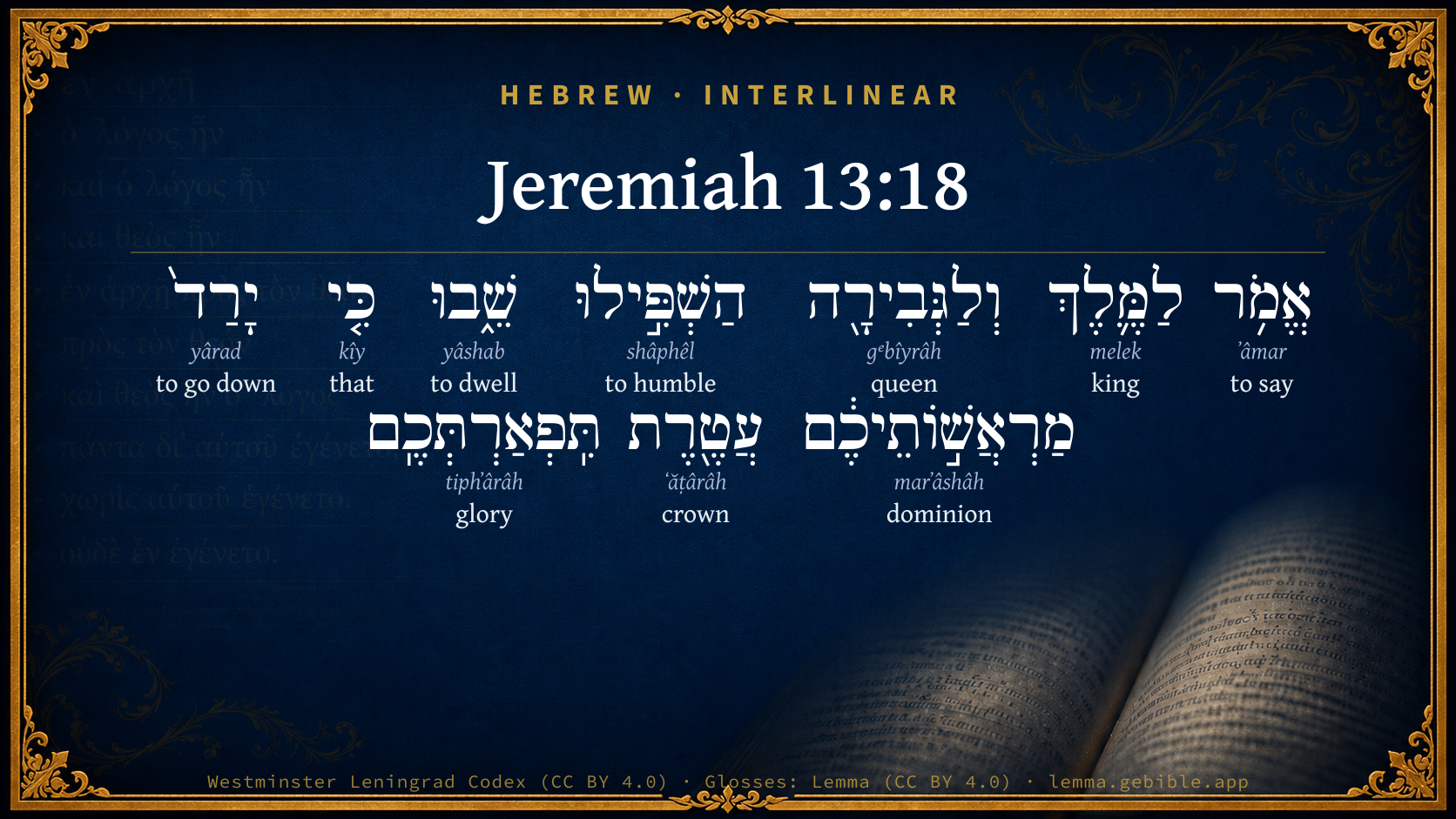
Hebrew (Westminster Leningrad Codex) Jeremiah 13:18 appears in the Hebrew Old Testament. The text above is from the Westminster Leningrad Codex. Each word links to its Strong’s number, a concise gloss, and parsing drawn from the Open Scriptures Hebrew Bible morphology. Click any word for its full Brown-Driver-Briggs (BDB) entry.
Download image
Cite this verse

Jeremiah 13:18 (World English Bible). Public Domain. Lemma interlinear Bible study tool, https://lemma.gebible.app/v/jeremiah/13/18.

Show BibTeX & RIS
BibTeX
RIS
English Translation
Say you to the king and to the queen-mother, Humble yourselves, sit down; for your headdresses are come down, even the crown of your glory.
World English Bible · Public Domain
Highlights
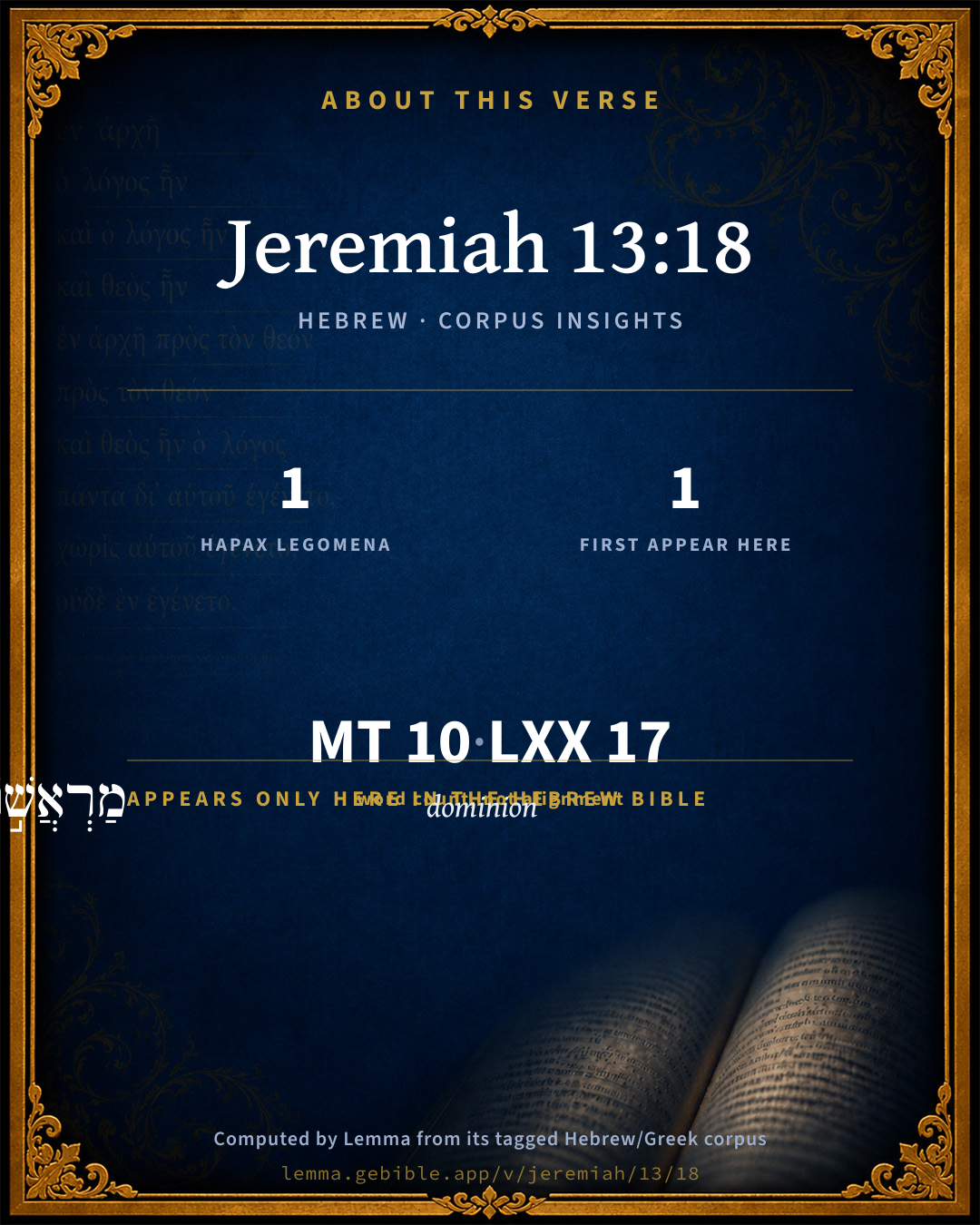
  • 1 hapax legomenon — only here in the Hebrew Bible
  • 1 first appearance in the Hebrew Bible
Full analysis ↓
Download a study sheet

One document with this verse’s original text, its word-by-word gloss line, the meaning frame, cross-references with their text, attributed commentary, and full source and license credits — printable, and it pastes into notes with its structure intact.

This verse Autodidact and up

Study sheet (.html) Plain text (.txt)

A passage Seminary Student

Up to 50 verses in one chapter. A passage sheet keeps up to 6 commentary sources and 12 cross-references per verse, in the order this page ranks them, and says so on the sheet whenever that leaves anything out. Ask for a single verse and you get the Autodidact verse sheet above.

Everything on this page stays free to read, with no account — the sheet is a download of what is already on screen, not access to it.

Want to remove ads? Support Godless Engineer
Compare translations 3

The same verse in 3 English versions, stacked beneath the original-language interlinear above. Click any original word for its lexicon entry.

Each is an independent rendering of the whole verse — the interlinear is not word-aligned to these translations.

Highlighted words mark where these versions differ — a whole-verse word diff, not a word-by-word alignment.

  • World English Bible Public Domain
    Say you to the king and to the queen-mother, Humble yourselves, sit down; for your headdresses are come down, even the crown of your glory.
  • King James Version Public Domain
    Say unto the king and to the queen, Humble yourselves, sit down: for your principalities shall come down, even the crown of your glory.
  • unfoldingWord Literal Text CC BY-SA 4.0
    “Say to the king and to the queen mother, ‘Make low, sit, for has come down from at your heads the crown of your glory.

unfoldingWord Literal Text — © unfoldingWord, licensed CC BY-SA 4.0. Word-aligned USFM3 via Door43 (git.door43.org/unfoldingWord/en_ult).

Versions to compare (up to 4)

3 of 4 selected

Show all 18 translations

Every available English version of this verse, each an independent rendering of the whole verse.

  • World English Bible Public Domain
    Say you to the king and to the queen-mother, Humble yourselves, sit down; for your headdresses are come down, even the crown of your glory.
  • Berean Standard Bible Public Domain
    Say to the king and to the queen mother: “Take a lowly seat, for your glorious crowns have fallen from your heads.”
  • Majority Standard Bible Public Domain
    Say to the king and to the queen mother: “Take a lowly seat, for your glorious crowns have fallen from your heads.”
  • King James Version Public Domain
    Say unto the king and to the queen, Humble yourselves, sit down: for your principalities shall come down, even the crown of your glory.
  • American Standard Version (1901) Public Domain
    Say thou unto the king and to the queen-mother, Humble yourselves, sit down; for your headtires are come down, even the crown of your glory.
  • Revised Version (1885) Public Domain
    Say thou unto the king and to the queen-mother, Humble yourselves, sit down: for your headtires are come down, even the crown of your glory.
  • Geneva Bible (1599) Public Domain
    Say vnto the King and to the Queene, Humble yourselues, sit downe, for the crowne of your glory shall come downe from your heads.
  • Douay-Rheims (1899) Public Domain
    Say to the king, and to the queen: Humble yourselves, sit down: for the crown of your glory is come down from your head.
  • Young's Literal Translation Public Domain
    Say to the king and to the mistress: Make yourselves low -- sit still, For come down have your principalities, The crown of your beauty.
  • Literal Standard Version CC BY-SA 4.0
    Say to the king and to the mistress: Make yourselves low—sit still, || For your principalities have come down, || The crown of your beauty.
  • Unlocked Literal Bible CC BY-SA 4.0
    “Say to the king and to the queen mother, 'Come down from your thrones, for your splendid crowns have fallen from your heads.'
  • unfoldingWord Literal Text CC BY-SA 4.0
    “Say to the king and to the queen mother, ‘Make low, sit, for has come down from at your heads the crown of your glory.
  • Darby Bible Public Domain
    Say unto the king and to the queen: Humble yourselves, sit down low; for from your heads shall come down the crown of your magnificence.
  • World Messianic Bible Public Domain
    Say to the king and to the queen mother, “Humble yourselves. Sit down, for your crowns have come down, even the crown of your glory.
  • Webster's Bible Public Domain
    Say to the king and to the queen, Humble yourselves, sit down: for your principalities shall come down, even the crown of your glory.
  • Free Bible Version CC BY-SA 4.0
    Tell the king and the queen mother: Get down from your thrones, because your splendid crowns have fallen from your heads.
  • Bible in Basic English Public Domain
    Say to the king and to the queen-mother, Make yourselves low, be seated on the earth: for the crown of your glory has come down from your heads.
  • JPS Tanakh (1917) Public Domain
    Say thou unto the king and to the queen-mother: 'Sit ye down low; for your headtires are come down, even your beautiful crown.'

Literal Standard Version (2020), Covenant Press — licensed CC BY-SA 4.0. Text via the HelloAO Bible API (eBible.org). Unlocked Literal Bible (unfoldingWord) — licensed CC BY-SA 4.0. Text via the HelloAO Bible API (eBible.org). unfoldingWord Literal Text — © unfoldingWord, licensed CC BY-SA 4.0. Word-aligned USFM3 via Door43 (git.door43.org/unfoldingWord/en_ult). Free Bible Version, Dr. Jonathan Gallagher — licensed CC BY-SA 4.0. Text via the HelloAO Bible API (eBible.org).

Word by word

More ways to search: Search by grammar → Find every occurrence → Compare this word →

Practice this passage: Drill this verse → Learn its vocabulary →

מַרְאֲשׁ֣וֹתֵיכֶ֔ם
marʼâshâh
H4761
“dominions · your”
Noun, Common, Feminine, Plural, Construct + Suffix, Personal, 2nd Person, Masculine, Plural
Part of Speech
Noun
Type
Common
Gender
Feminine
Number
Plural
State
Construct
Full BDB Definition

Origin: denominative from H7218

TWOT: 2097f

place at the head, dominion, head place (noun feminine) - at head place (adverb)
  1. אֱמֹ֥ר ʼâmar H559 “say” Verb, Qal, Imperative, 2nd Person, Masculine, Singular
  2. לַמֶּ֛לֶךְ melek H4428 “to/for the · king” Preposition, Determined + Noun, Common, Masculine, Singular, Absolute
  3. וְלַגְּבִירָ֖ה gᵉbîyrâh H1377 “and · to/for the · queen” Conjunction + Preposition, Determined + Noun, Common, Feminine, Singular, Absolute
  4. הַשְׁפִּ֣ילוּ shâphêl H8213 “humble” Verb, Hiphil, Imperative, 2nd Person, Masculine, Plural
  5. שֵׁ֑בוּ yâshab H3427 “dwell” Verb, Qal, Imperative, 2nd Person, Masculine, Plural
  6. כִּ֤י kîy H3588 “that” Conjunction
  7. יָרַד֙ yârad H3381 “to go down” Verb, Qal, Perfect, 3rd Person, Masculine, Singular
  8. עֲטֶ֖רֶת ʻăṭârâh H5850 “crown of” Noun, Common, Feminine, Singular, Construct
  9. תִּֽפְאַרְתְּכֶֽם tiphʼârâh H8597 “glory · your” Noun, Common, Feminine, Singular, Construct + Suffix, Personal, 2nd Person, Masculine, Plural

About this verse

These counts appear in no published source. They are computed here, from the morphology-tagged text and Lemma’s own curated glosses. What Lemma adds →

10
words
10
distinct lemmas
Prophets
section

Notable vocabulary

1 hapax legomenon — a word that appears only here in the entire Hebrew Bible:

  • מַרְאֲשׁ֣וֹתֵיכֶ֔ם dominion H4761

First appearance in Scripture

This word makes its first canonical appearance in the Hebrew Bible here:

  • מַרְאֲשׁ֣וֹתֵיכֶ֔ם dominion H4761

Shared distinctive vocabulary

וְלַגְּבִירָ֖ה queen H1377 occurs in 6 verses of the Hebrew Bible. Also found in:

Grammatical profile

  • 4 verbs
  • 5 nouns
  • 1 conjunction

Verb forms

  • אֱמֹ֥ר Qal · Imperative
  • הַשְׁפִּ֣ילוּ Hiphil · Imperative
  • שֵׁ֑בוּ Qal · Imperative
  • יָרַד֙ Qal · Perfect

Hebrew & Septuagint length

In the original languages it is 10 Hebrew tokens and 17 Greek tokens — but the two are counted differently (Hebrew bundles its prefixes and suffixes into one token; the Greek is in lemma form), so that isn’t a like-for-like length.

Cross-references

15

Topical passages linked to Jeremiah 13:18 in the Treasury of Scripture Knowledge — connected by theme and wording, ordered by reader-vote popularity; previews shown in the World English Bible.

  • Jeremiah 22:26 I will cast you out, and your mother who bore you, into another country, where you were not born; and there shall you die.
  • 2 Kings 24:12 and Jehoiachin the king of Judah went out to the king of Babylon, he, and his mother, and his servants, and his princes, and his officers: and the king of Babylon took him in the eighth year of his reign.
  • 2 Kings 24:15 He carried away Jehoiachin to Babylon; and the king's mother, and the king's wives, and his officers, and the chief men of the land, carried he into captivity from Jerusalem to Babylon.
  • 2 Chronicles 33:12 When he was in distress, he begged Yahweh his God, and humbled himself greatly before the God of his fathers.
  • 2 Chronicles 33:19 His prayer also, and how [God] was entreated of him, and all his sin and his trespass, and the places in which he built high places, and set up the Asherim and the engraved images, before he humbled himself: behold, they are written in the history of Hozai.
  • Isaiah 47:1 Come down, and sit in the dust, virgin daughter of Babylon; sit on the ground without a throne, daughter of the Chaldeans: for you shall no more be called tender and delicate.
  • Exodus 10:3 Moses and Aaron went in to Pharaoh, and said to him, "This is what Yahweh, the God of the Hebrews, says: 'How long will you refuse to humble yourself before me? Let my people go, that they may serve me.
  • 2 Chronicles 33:23 He didn't humble himself before Yahweh, as Manasseh his father had humbled himself; but this same Amon trespassed more and more.
  • Isaiah 3:26 Her gates shall lament and mourn; And she shall be desolate and sit on the ground.
  • Jonah 3:6 The news reached the king of Nineveh, and he arose from his throne, and took off his royal robe, covered himself with sackcloth, and sat in ashes.
  • Matthew 18:4 Whoever therefore humbles himself as this little child, the same is the greatest in the Kingdom of Heaven.
  • James 4:10 Humble yourselves in the sight of the Lord, and he will exalt you.
  • 1 Peter 5:6 Humble yourselves therefore under the mighty hand of God, that he may exalt you in due time;
  • Ezekiel 19:2–14 and say, What was your mother? A lioness: she couched among lions, in the midst of the young lions she nourished her cubs.
  • Lamentations 2:10 The elders of the daughter of Zion sit on the ground, they keep silence; They have cast up dust on their heads; they have girded themselves with sackcloth: The virgins of Jerusalem hang down their heads to the ground.

Cross-references courtesy of OpenBible.info (CC BY 4.0).

Hebrew and Greek witnesses Masoretic Hebrew ↔ Greek Septuagint

The same verse in the two great witnesses to the Old Testament, shown verse-for-verse.

These are two independent witnesses, not word-aligned to each other, and the Septuagint is shown in lemma (dictionary) form.

Hebrew Jeremiah 13:18 Masoretic · Westminster Leningrad Codex

אֱמֹ֥ר לַמֶּ֛לֶךְ וְלַגְּבִירָ֖ה הַשְׁפִּ֣ילוּ שֵׁ֑בוּ כִּ֤י יָרַד֙ מַרְאֲשׁ֣וֹתֵיכֶ֔ם עֲטֶ֖רֶת תִּֽפְאַרְתְּכֶֽם

Say you to the king and to the queen-mother, Humble yourselves, sit down; for your headdresses are come down, even the crown of your glory.

World English Bible · Public Domain

Greek LXX Structure differs

In the Septuagint, Jeremiah is about an eighth shorter than the Hebrew and arranges its material differently — the Oracles Against the Nations (Hebrew chapters 46–51) appear in the middle of the Greek book, after 25:13. Because the chapter and verse boundaries do not line up, a verse-for-verse comparison with the Hebrew is not shown.

A verse-for-verse comparison isn’t shown here because the chapters and verses don’t line up. Switch to the LXX edition with the MT / LXX toggle above to read the Greek directly.

On this verse, Keil & Delitzsch discusses the Septuagint’s reading. Read the note in Commentary ↓

Hebrew: Westminster Leningrad Codex (CC BY 4.0). Greek: Septuagint (public domain); English from a public-domain English Septuagint. How the Septuagint differs from the Hebrew →

Targum (Aramaic paraphrase)

1

The Targum is the ancient Jewish Aramaic paraphrase of the Hebrew Scriptures — an interpretive translation, not the Hebrew text itself. Onkelos (literal) and Pseudo-Jonathan (expansive) render the Torah, and Jonathan the Prophets. Coverage is partial: where no permissively-licensed English translation exists for a verse, only the Aramaic is shown. This is verse-level text, not a word-by-word alignment to the Hebrew.

  1. Targum Jonathan Prophets (Joshua–Malachi)
    אֲמַר לְמַלְכָּא וּלְמַלְכְּוָתָא אִמְאִיכוּ תָבוּ אֲרֵי גְלָא יְקַרְכוֹן מִנְכוֹן נְפַל כְּלִיל תּוּשְׁבַּתְּכוֹן:

    (no public-domain English translation for this verse)

    Targum Jonathan — Aramaic: “Mikraot Gedolot” (public domain). English: “Sefaria Community Translation” (CC0 1.0 (public-domain dedication)); “London "Chaldee Paraphrase," 1871” (public domain). Text via Sefaria.

Commentary

Notes on Jeremiah 13:18 from classic Christian and Jewish commentators (each source and its license shown beneath its notes). The classic Christian expositions comment on the surrounding passage and are grouped to its opening verse, so a note may address several verses; the Jewish commentaries on the Tanakh (Rashi and others) are per-verse, so they appear only where the commentator wrote on this verse.

Lemma curates 59 commentaries, every one of them public domain or Creative Commons licensed, each selected and text-cleaned for this edition rather than reprinted as found. About our sources →

Trapp's Complete Commentary

John Trapp

Jer 13:18 Say unto the king and to the queen, Humble yourselves, sit down: for your principalities shall come down, [even] the crown of your glory.

Ver. 18. Say to the king and to the queen.] Or Madam, the lady or mistress; that is, to the queen regent, even to Necustah, the mother of Jeconiah, say the Jews. When Beza, in the behalf of the reformed churches in France, made a speech at Possiacum before the young king and the queen mother, he spake so effectually, saith Rivet, that a great cardinal who heard it wished that either he had been dumb that day, or that they had all been deaf. This king and queen in the text might be as much convinced, though not thoroughly converted.

Humble yourselves, sit down.] Heb., Humble, sit below.

For your principalities.] Or, Your head attires.

The crown of your glory.] Or, Your crown of glory; that is, your glorious crown, of which you shall have cause enough to say, as Antigonus did of his diadem, O vilis pannus, &c. Or, as another monarch,

“ Nobilis es, fateor, rutilisque onerata lapillis,

Innumeris curis sod comitata venis:

Quod bene si nossent omnes expendere, nemo,

Nemo foret quite tollere vellet humo. ”

John Trapp, A Commentary or Exposition upon All the Books of the Old and New Testament (1647–1656) — public domain. Text from a community e-Sword module.

Joseph Benson's Commentary

Jer 13:18. Say unto the king and queen — That is, to Jehoiachin, called also Coniah, and his mother, who were carried captives to Babylon at the first coming of Nebuchadnezzar; see Jer 22:26; 2Ki 24:12. Some indeed suppose that Zedekiah and his mother are intended, which does not appear so probable. Humble yourselves — By true repentance, and so both give glory to God, and set a good example to your subjects; and sit down — Sit down and consider what is coming; sit down and lament your condition. For your principalities shall come down —

The honour and power by which you value yourselves, and in which you confide, even the crown of your glory — For when you are led away captive, where will the badges of your power and pre-eminence be then? Blessed be God, there is a crown of glory which shall never come down, and which they who humble themselves before God, in true repentance, shall in due time inherit.

Joseph Benson's Commentary on the Old and New Testaments (1811–1818) — public domain. Text from a community e-Sword module.

Keil & Delitzsch

C. F. Keil & F. Delitzsch

The fall of the kingdom, the captivity of Judah, with upbraidings against Jerusalem for her grievous guilt in the matter of idolatry. - Jer 13:18. "Say unto the king and to the sovereign lady: Sit you low down, for from your heads falls the crown of your glory. Jer 13:19. The cities of the south are shut and no man openeth; Judah is carried away captive all of it, wholly carried away captive. Jer 13:20. Lift up your eyes and behold them that come from midnight! Where is the flock that was given thee, thy glorious flock? Jer 13:21. What wilt thou say, if He set over thee those whom thou hast accustomed to thee as familiar friends, for a head? Shall not sorrows take thee, as a woman in travail? Jer 13:22. And if thou say in thine heart, Wherefore cometh this upon me? for the plenty of thine iniquity are thy skirts uncovered, thy heels abused. Jer 13:23. Can an Ethiopian change his skin, and a leopard his spots? Then may ye also do good that are accustomed to doing evil. Jer 13:24. Therefore will I scatter them like chaff that flies before the wind of the wilderness. Jer 13:25. This is thy lot, thine apportioned inheritance from me, because thou hast forgotten me and trustedst in falsehood. Jer 13:26. Therefore will I turn thy skirts over thy face, that thy shame be seen. Jer 13:27. Thine adultery and thy neighing, the crime of thy whoredom upon the ills, in the fields, I have seen thine abominations. Woe unto thee, Jerusalem! thou shalt not be made clean after how long a time yet!"

From Jer 13:18 on the prophet's discourse is addressed to the king and the queen-mother. The latter as such exercised great influence on the government, and is in the Books of Kings mentioned alongside of almost all the reigning kings (cf. Kg1 15:13; Kg2 10:13, etc.); so that we are not necessarily led to think of Jechoniah and his mother in especial. To them he proclaims the loss of the crown and the captivity of Judah. Set yourselves low down (cf. Gesen. 142, 3, b), i.e., descend from the throne; not in order to turn aside the threatening danger by humiliation, but, as the reason that follows show, because the kingdom is passing from you. For fallen is מראשׁתיכם, your head-gear, lit., what is about or on your head (elsewhere pointed מראשׁות, Sa1 19:13; Sa1 26:7), namely, your splendid crown. The perf. here is prophetic. The crown falls when the king loses country and kingship. This is put expressly in Jer 13:19. The meaning of the first half of the verse, which is variously taken, may be gathered from the second. In the latter the complete deportation of Judah is spoken of as an accomplished fact, because it is as sure to happen as if it had taken place already. Accordingly the first clause cannot bespeak expectation merely, or be understood, as it is by Grotius, as meaning that Judah need hope for no help from Egypt. This interpretation is irreconcilable with "the cities of the south." "The south" is the south country of Judah, cf. Jos 10:40; Gen 13:1, etc., and is not to be taken according to the prophetic use of "king of the south," Dan 11:5, Dan 11:9. The shutting of the cities is not to be taken, with Jerome, as siege by the enemy, as in Jos 6:1. There the closedness is otherwise illustrated: No man was going out or in; here, on the other hand, it is: No man openeth. "Shut" is to be explained according to Isa 24:10 : the cities are shut up by reason of ruins which block up the entrances to them; and in them is none that can open, because all Judah is utterly carried away. The cities of the south are mentioned, not because the enemy, avoiding the capital, had first brought the southern part of the land under his power, as Sennacherib had once advanced against Jerusalem from the south, Kg2 18:13., Jer 19:8 (Graf, Ng., etc.), but because they were the part of the kingdom most remote for an enemy approaching from the north; so that when they were taken, the land was reduced and the captivity of all Judah accomplished. For the form הגלת see Ew. 194, a, Ges. 75, Rem. 1. שׁלומים is adverbial accusative: in entirety, like מישׁרים, Psa 58:2, etc. For this cf. גּלוּת, Amo 1:6, Amo 1:9.

The announcement of captivity is carried on in Jer 13:20, where we have first an account of the impression which the carrying away captive will produce upon Jerusalem (Jer 13:20 and Jer 13:21), and next a statement of the cause of that judgment (Jer 13:22-27). In שׂאי and ראי a feminine is addressed, and, as appears from the suffix in עיניכם, one which is collective. The same holds good of the following verses on to Jer 13:27, where Jerusalem is named, doubtless the inhabitants of it, personified as the daughter of Zion - a frequent case. Ng. is wrong in supposing that the feminines in Jer 13:20 are called for by the previously mentioned queen-mother, that Jer 13:20-22 are still addressed to her, and that not till Jer 13:23 is there a transition from her in the address to the nation taken collectively and regarded as the mother of the country. The contents of Jer 13:20 do not tally with Ng.'s view; for the queen-mother was not the reigning sovereign, so that the inhabitants of the land could have been called her flock, however great was the influence she might exercise upon the king. The mention of foes coming from the north, and the question coupled therewith: Where is the flock? convey the thought that the flock is carried off by those enemies. The flock is the flock of Jahveh (Jer 13:17), and, in virtue of God's choice of it, a herd of gloriousness. The relative clause: "that was given thee," implies that the person addressed is to be regarded as the shepherd or owner of the flock. This will not apply to the capital and its citizens; for the influence exerted by the capital in the country is not so great as to make it appear the shepherd or lord of the people. But the relative clause is in good keeping with the idea of the idea of the daughter of Zion, with which is readily associated that of ruler of land and people. It intimates the suffering that will be endured by the daughter of Zion when those who have been hitherto her paramours are set up as head over her. The verse is variously explained. The old transll. and comm. take פּקד על in the sense of visit, chastise; so too Chr. B. Mich. and Ros.; and Ew. besides, who alters the text acc. to the lxx, changing יפקד into the plural יפקדוּ. For this change there is no sufficient reason; and without such change, the signif. visit, punish, gives us no suitable sense. The phrase means also: to appoint or set over anybody; cf. e.g., Jer 15:3. The subject can only be Jahveh. The words from ואתּ onwards form an adversative circumstantial clause: and yet thou hast accustomed them עליך, for אליך rof ,, to thee (cf. for למּד c. אל, Jer 10:2). The connection of the words אלּפים לראשׁ depends upon the sig. assigned to אלּפים. Gesen. (thes.) and Ros. still adhere to the meaning taken by Luther, Vat., and many others, viz., principes, princes, taking for the sense of the whole: whom thou hast accustomed (trained) to be princes over thee. This word is indeed the technical term for the old Edomitish chieftains of clans, Gen 36:15., and is applied as an archaic term by Zac 9:7 to the tribal princes of Judah; but it does not, as a general rule, mean prince, but familiar, friend, Ps. 655:14, Pro 16:28, Mic 7:5; cf. Jer 11:19. This being the well-attested signification, it is, in the first place, not competent to render עליך over or against thee (adversus te, Jerome); and Hitz.'s exposition: thou hast instructed them to thy hurt, hast taught them a disposition hostile to thee, cannot be justified by usage. In the second place, אלפים cannot be attached to the principal clause, "set over thee," and joined with "for a head:" if He set over thee - as princes for a head; but it belongs to "hast accustomed," while only "for a head" goes with "if He set" (as de Wet., Umbr., Ng., etc., construe). The prophet means the heathen kings, for whose favour Judah had hitherto been intriguing, the Babylonians and Egyptians. There is no cogent reason for referring the words, as many comm. do, to the Babylonians alone. For the statement is quite general throughout; and, on the one hand, Judah had, from the days of Ahaz on, courted the alliance not of the Babylonians alone, but of the Egyptians too (cf. Jer 2:18); and, on the other hand, after the death of Josiah, Judah had become subject to Egypt, and had had to endure the grievous domination of the Pharaohs, as Jeremiah had threatened, Jer 2:16. If God deliver the daughter of Zion into the power of these her paramours, i.e., if she be subjected to their rule, then will grief and pain seize on her as on a woman in childbirth; cf. Jer 6:24; Jer 22:23, etc. אשׁת לדה, woman of bearing; so here, only, elsewhere יולדה (cf. the passages cited); לדה is infin., as in Isa 37:3; Kg2 19:3; Hos 9:11.

Keil & Delitzsch — Biblical Commentary on the Old Testament (1861–1891) — public domain (CC PDM 1.0). Text via the HelloAO Bible API. (Old Testament only.)

Tyndale Open Study Notes

Tyndale Open Resources

13:18-19 The king was probably Jehoiakim’s son Jehoiachin, who was crowned in 597 BC after the death of his father; his mother was Nehushta (see 2 Kgs 24:1-9). Jehoiachin was eighteen years old and reigned for just three months; this message was probably delivered during his short reign. His glorious crowns would soon be taken from him by the Babylonians (see 2 Kgs 24:11-16). The treasures of the Temple and palace would be given to the Babylonians, and the royalty and elite of Judah would be carried into exile. At the same time, Judah’s southern neighbors would take over the towns of the Negev, the desert area from the city of Beersheba to the Gulf of Aqaba.

Tyndale Open Study Notes — © Tyndale Open Resources, licensed CC BY-SA 4.0. Text via the HelloAO Bible API.

Geneva Bible (1599)

Geneva Bible translators

For Jehoiachin and his mother rendered themselves by Jeremiah’s counsel to the king of Babylon, 2 Kings 24:12.

Geneva Bible (1599) marginal notes — public domain. Text via Bolls.life.

Jamieson, Fausset & Brown

Robert Jamieson, A. R. Fausset & David Brown

king--Jehoiachin or Jeconiah.

queen--the queen mother who, as the king was not more than eighteen years old, held the chief power. Nehushta, daughter of Elnathan, carried away captive with Jehoiachin by Nebuchadnezzar (Kg2 24:8-15).

Humble yourselves--that is, Ye shall be humbled, or brought low (Jer 22:26; Jer 28:2).

your principalities--rather, "your head ornament."

Jamieson, Fausset & Brown — Commentary Critical and Explanatory on the Whole Bible (1871) — public domain (CC PDM 1.0). Text via the HelloAO Bible API.

Adam Clarke's Commentary

Verse 18. Say unto the king and to the queen] Probably Jeconiah and his mother, under whose tutelage, being young when he began to reign, he was left, as is very likely.

Sit down] Show that ye have humbled yourselves; for your state will be destroyed, and your glorious crown taken from your heads.

Adam Clarke's Commentary on the Bible (1810–1826) — public domain. Text from a community e-Sword/MySword module.

John Calvin's Commentaries

The Prophet is here bidden to address his discourse directly to King Jehoiakim and his mother; for the term lady is not to be taken for the queen, the wife of Jehoiakim, but for his mother, who was then his associate in the kingdom, and possessed great authority. And there is no doubt but that God thus intended to rouse more fully the community in general; that is, by shewing that he would not spare, no, not the king nor the queen. But we may hence also learn what has already been observed, that the truth announced by the prophets is superior to all the greatness of the world. For it was said before to Jeremiah, “Reprove mountains and rebuke hills;” and still farther,

“Behold, I have set thee over kingdoms and nations, to pull down and to pluck up,” etc., (Jeremiah 1:10)

This ought to be carefully noticed; for kings and those who are eminent in the world, think that they are not only, by a singular privilege, exempt from all laws, but also free from every obligation to observe modesty and to avoid shame. Hence it is, that they from their elevation despise God and his prophets. Here God shews, that he supplied the prophets with his word for this end, — that they might close their eyes to all the splendor of the world, and shew no respect of persons, but pull down every height, and bring to order everything that is elevated in this world. Paul also teaches us, that ministers of the gospel are endued with this power;

“Given to us,” he says, “is power against every height that exalteth itself against Christ.” (2 Corinthians 10:5)

And hence we must observe, that all who are chosen to the office of teaching, cannot faithfully discharge their duty except they boldly, and with intrepid spirit, dare to reprove both kings and queens; for the word of God is not to be restricted to the common people or men in humble life, but it subjects to itself all, from the least to the greatest. This prophecy was no doubt very bitter to the king as well as to the common people; but it behooved Jeremiah to discharge faithfully his office; and this was also necessary, for the king Jehoiakim and his mother thought that they could not possibly be dethroned.

He therefore bids them to descend and to lie down; that is, he bids them to forget their ancient greatness. He does not simply exhort them to repent, but shews, that as they had been so refractory in their pride, the punishment of disgrace was nigh at hand, for the Lord would with a strong hand lay them prostrate. It is not then an exhortation that the Prophet gives; but he only foretells what they little thought of, — that they in vain flattered themselves, for the Lord would in a short time expose them to reproach by casting them down.

And this is evident from what is added, For descend shall the crown of your honor; that is, it shall be taken away from your highnesses, or from your eminencies, or from your heads; for the word ראשה, rashe, means sometimes the head. But some think that it means here eminencies, and that “the magnificent crown” is put here in apposition.

I have omitted, if I mistake not, to notice one thing; that is, the pride mentioned by the Prophet; except ye hear, weep will my soul in secret on account of pride Interpreters render it “your pride;” that is, the pride with which the Jews were filled; but I am inclined to take a different view, that the Prophet speaks here of the pride or the great power of those enemies whom the Jews then did not in any degree fear. “Since then,” says the Prophet, “ye are so secure, I will retire and weep by myself, and my soul by mourning shall mourn, yea, my eye shall flow down with tears, on account of the pride of the enemies, who are now so much despised by you;” Let us now proceed —

John Calvin's Commentaries (1540-1563) — public domain. Text from the Calvin Translation Society English edition (1840s-50s) via the Christian Classics Ethereal Library (ccel.org). Calvin's coverage is partial (roughly two-thirds of the Bible); uncommented books and verses are honest gaps, never fabricated. The 19th-century editor's footnotes and remarks are omitted so the notes are faithfully Calvin's own voice.

Ellicott's Commentary for English Readers

(18) The queen.—Not the usual word, the Hebrew feminine of king, but literally “the great lady” (“dominatrix” Vulg.), the title of a queen-mother (in this case, probably, of Nehushta, the mother of Jehoiachin, 2Ki_24:8), sharing the throne during her son’s minority. The same word is used of Maachah, the mother of Asa (1Ki_15:13; 2Ki_10:13; 2Ch_15:16), and meets us again in Jer_29:2.

Your principalities.—Literally, as in the margin, your head-tires, i.e., the diadems which were signs of kingly state. The word is used nowhere else, and may have been coined by the prophet or taken from the court vocabulary of the time.

A Bible Commentary for English Readers, edited by Charles John Ellicott (1878–1897) — public domain. Text from a community e-Sword module.

The Cambridge Bible for Schools and Colleges

gen. ed. J. J. S. Perowne

18. your headtires] The word in MT. means the place of the head (and so the same consonants with rather different vocalisation in Gen_28:11, 1Sa_19:16; 1Sa_26:7). We should therefore by a slight shortening of the word (so LXX) render for come down from your head is your beautiful crown (lit. crown of beauty).

Humble yourselves, sit down] better, as mg. Sit ye down low. Cp. Jer_14:2.

18, 19. Address to the king and the queen-mother

The highest shall be brought low, and the land with its cities emptied by universal captivity.

Graf and Du. make the king to be Jehoiakim and thus the queen-mother Zebidah (2Ki_23:36). Most however take the utterance as belonging to the three months’ reign of his successor, Jehoiachin, whose mother, Nehushta, is referred to in 2Ki_24:8; 2Ki_24:12; 2Ki_24:15. The prominence attached to the queen-mother by Eastern custom would be in that case enhanced by the king’s youth. Cp. Jer_22:26.

The Cambridge Bible for Schools and Colleges (gen. ed. J. J. S. Perowne; Cambridge University Press, 1878–1918) — public domain. Text from a community e-Sword module.

John Gill's Exposition

The cities of the south shall be shut up, and none shall open them,.... Meaning the cities of Judah, which lay in the southern part of the land of Israel, and to the south of Babylon; which might be said to be shut up, and not in the power of any to open, when besieged by the Chaldean army; or rather when destroyed, that there were none to go in and out; though some think the cities of Egypt are intended, which lay south of Judea, from whence the Jews should not have the relief they expected, and where they should find no refuge; but the former sense seems best:

Judah shall be carried away captive all of it; it was in part carried away in Jehoiachin's time, and wholly in Zedekiah's; which seems to be here respected:

it shall be wholly carried away captive; or, in perfections (e); most perfectly and completely; the same thing is meant as before, only in different words repeated, to express the certainty of it.

(e) "perfectionibus", Vatablus, Montanus. It is by Schmidt left untranslated, "Schelomim", which he takes to be the city of Jerusalem, sometimes called "Solyma"; the inhabitants of which were carried captive when Judah was; and so Junius and Tremellius translate it; "civita, pacatorum", and understand it of Jerusalem; which has the signification of peace in its name.

John Gill's Exposition of the Whole Bible (1746–1763) — public domain (CC PDM 1.0). Text via the HelloAO Bible API.

Albert Barnes' Notes on the Bible

The queen - i. e., “the queen-mother:” the word signifies literally “the great lady.” The king’s mother took precedence of his wives.

Sit down - The usual position of slaves.

For your principalities ... - Rather, “for the ornaments of your heads, even the crown of your majesty, shall come down.”

Albert Barnes' Notes on the Bible (1834–1885) — public domain. Text from a community e-Sword/MySword module.

Haydock's Catholic Bible Commentary

Queen; Nohesta, mother of Joachim, or to the consort of Sedecias. (Calmet) --- Septuagint, "to the princes." (Haydock)

George Leo Haydock (1774–1849), Haydock's Catholic Family Bible and Commentary, 1859 edition — public domain. Excludes Psalms (Douay-Rheims chapter numbering differs from Protestant) and Deuterocanonical books (Catholic canon only).

Matthew Poole's English Annotations

The author of holy writ is discernible by this as by other things, that the Scripture equally speaks to the greatest persons as to persons of meaner rank. God here calls to the king of Judah, whether it was at this time Jehoiakim, or his son Jehoiachin, is uncertain. By

principalities he means both their dignity and their liberty, that which he often calleth the crown of their glory. Some expound it head-tires, because the word deriveth from a word which signifies the head.

Matthew Poole's English Annotations on the Holy Bible (1683–1685) — public domain. Text from a community e-Sword/MySword module.

Whedon's Commentary on the Bible

Daniel D. Whedon

18. Queen — Rather, queen-mother. It seems to have been the custom among many Oriental peoples for the king’s mother to take precedence of his wife.

Principalities — The marginal reading is better, your head-tires, even the crown of your glory, shall come down.

Daniel D. Whedon (gen. ed.), Commentary on the Old and New Testaments (1874–1909) — public domain. Text from a community e-Sword module.

The Pulpit Commentary

The extent of the calamity shown in individual instances. For the fulfillment, see 2Ki_24:15. After a reign of three months, the young prince and his mother were carried to Babylon. And to the queen; rather, and to the queen-mother (literally, the mistress). It will be noticed that, except in two cases, the names of the mothers of the reigning kings of Judah are scrupulously mentioned in the Books of Kings. This and the title of "mistress" are indications of the high rank they enjoyed in the social system. In the case of Asa, we are told that he removed his mother, Maachah, from her position as "mistress," or queen-mother, on account of her idolatry. (1Ki_15:13) The political value of the station is strikingly shown by the ease with which Athaliah, as queen-mother,.usurped the supreme authority. (2Ki 11) From a historical point of view, the "queen-mother" of the Jews is a most interesting personage; she is a relic of the primitive age in which relationship was reckoned with regard to the mother (so with the Accadians, Etruseans, Finns, etc.). It should be added, however, that once (viz. 1Ki_11:19) the same title, "mistress," is applied to the queen-consort. Humble yourselves, sit down; rather, sit down in abase-sent; i.e. take the station suitable for your abased circumstances. (comp. Isa_47:1) Your principalities; rather, your head. ornaments.

Royalty humbled.

I GOD IS THE JUDGE OF KINGS. They are as far beneath God as are the meanest beggars. Their rank is no protection against the execution of Divine justice; their power no security against the consequences of the wrath of God. No earthly honor or power will serve men when they stand before the great throne of judgment.

II WICKED KINGS WILL MEET WITH SEVERE PUNISHMENT. The greater the privileges they have had, the more have they been able to abuse them, and therefore the greater their guilt. The larger their influence has been, the more harm have they done in using that influence for evil purposes. All who are entrusted with exceptional power should remember that this incurs exceptional responsibility.

III THE PRIDE OF KINGS WILL BE PUNISHED WITH HUMILIATION. Every sin will have its appropriate retribution. "Whatsoever a man soweth, that shall he also reap," not only in the main characteristics, but in particular features. Pride thus naturally sows the seed of shame. (Pro_29:23)

IV THE GREATNESS OF THE PRESENT PROSPERITY OF WICKED KINGS WILL ENHANCE THE SUFFERING OF THEIR FUTURE RETRIBUTION. They who stand highest can fall lowest. Poverty is felt more keenly by people who were once in affluence than by the children of the poor. The memory of his former luxuries must have added keenness to the sufferings of Dives in Hades. We are not to infer from this that future retribution is only a compensation for the inequality of the joys and sorrows of this life, that kings will suffer for their very greatness (for the wicked poor will be wretched hereafter, while the good and great will be blessed in the future with heavenly treasures), but that if we are unfaithful, the measure of future distress will necessarily be partly determined by that of present enjoyment. We need not, therefore, be envious of the prosperity of the wicked. Rather it should fill us with horror, grief, and pity as we consider what a fool"s paradise they live in what anguish will grow out of the contrast of it with the certain retribution of all sin!

The Pulpit Commentary (1880–1919), ed. H.D.M. Spence-Jones & Joseph S. Exell — public domain. Text from a community e-Sword module.

unfoldingWord translationNotes

Door43 World Missions Community

General Information:

Yahweh is continuing to talk to Jeremiah. He is telling Jeremiah what to say to the king of Judah and the king's mother.

queen mother

the mother of the king

for your splendid crowns have fallen from your heads

A king and queen mother wear crowns to represent their royal positions as the king and queen mother. Also, this event has not happened yet, but it is written here as if it already has. This can be written in future tense. AT: "for you will no longer be the king and queen mother, for your crowns, your pride and glory, will fall off" (See: Symbolic Action and Predictive Past)

The cities in the Negev will be shut up, with no one to open them

This means that the cities will be surrounded by their enemies, who will not allow anyone to go in or come out of the cities. AT: "The cities in the Negev will be shut up, and no one will be able to go into them or come out of them" (See: Assumed Knowledge and Implicit Information)

The cities in the Negev will be shut up

This can be stated in active form. AT: "Your enemies will shut the cities in the Negev up" (See: Active or Passive)

All Judah will be taken captive, completely taken captive

Here "Judah" represents the people who live there. This can be stated in active form. AT: "The enemies will take all of the people of Judah captive into exile" (See: Metonymy and Active or Passive)

translationWords

king

queen

humble

crown

proud

glory

Negev

Judah

exile

unfoldingWord translationNotes — © Distant Shores Media and the Door43 World Missions Community, licensed CC BY-SA 4.0. Source: git.door43.org/Door43/en_tn.

Rashi

Rabbi Shlomo Yitzchaki (Rashi)

to the king and to the queen mother Jehoiachin and his mother.

your greatness has come down Heb. מראשתיכם (vostremijevec in O.F.), your ascent, as it is stated: (II Kings 24:12) “And Jehoiachin... came out to him (sic), he and his mother and his servants,” and he led all of them in exile.

Rashi on the Tanakh — English translations: “The Judaica Press complete Tanach with Rashi, translated by A. J. Rosenberg” (CC BY 4.0); “Pentateuch with Rashi's commentary by M. Rosenbaum and A.M. Silbermann, 1929-1934” (public domain); “The Metsudah Tanach series, Lakewood, N.J” (CC BY 4.0); and “The Book of Joshua, Metsudah Publications, 1997” (CC BY 4.0). Text via Sefaria.

Lesson kit

Teaching starters — assembled from the data on this page, not authored interpretation. Every prompt links to the verse data it draws on. Edit before teaching.

Jeremiah, in the Prophets, opens this verse with 10 words (10 distinct Hebrew lemmas). Its most distinctive word is marʼâshâh (“dominion”). A historical commentator’s framing appears above. Read the whole chapter for the surrounding context.

Discussion questions

  1. The word marʼâshâh carries the sense “dominion.” How does it shape the verse?
  2. This verse holds 1 word here found nowhere else in the Hebrew Bible. What might the rare word draw attention to?
  3. The word “dominion” first appears here in Scripture. What is being introduced at this debut?
  4. 1 Kings 11:19 shares the word «queen» with this verse. How do the two illuminate each other?
  5. These translations render this verse differently. What is at stake in choosing one wording over another?
  6. The verb «אֱמֹ֥ר» is Qal Imperative. How does its form color the action?
  7. Reading how Trapp's Complete Commentary and Joseph Benson's Commentary read this verse, where do the two commentators agree and where do they part?

Things to notice

Reading settings

Reading text

Shown beneath each verse's original-language words.

Old Testament
Old Testament edition

Read the OT as the Masoretic Hebrew (MT) or the Greek Septuagint (LXX).

English shown for the Greek Septuagint (in the Hebrew ↔ Greek comparison).

Comparing translations? Open the Compare panel on any verse page to stack up to four side by side.