
1 Chronicles 4:18

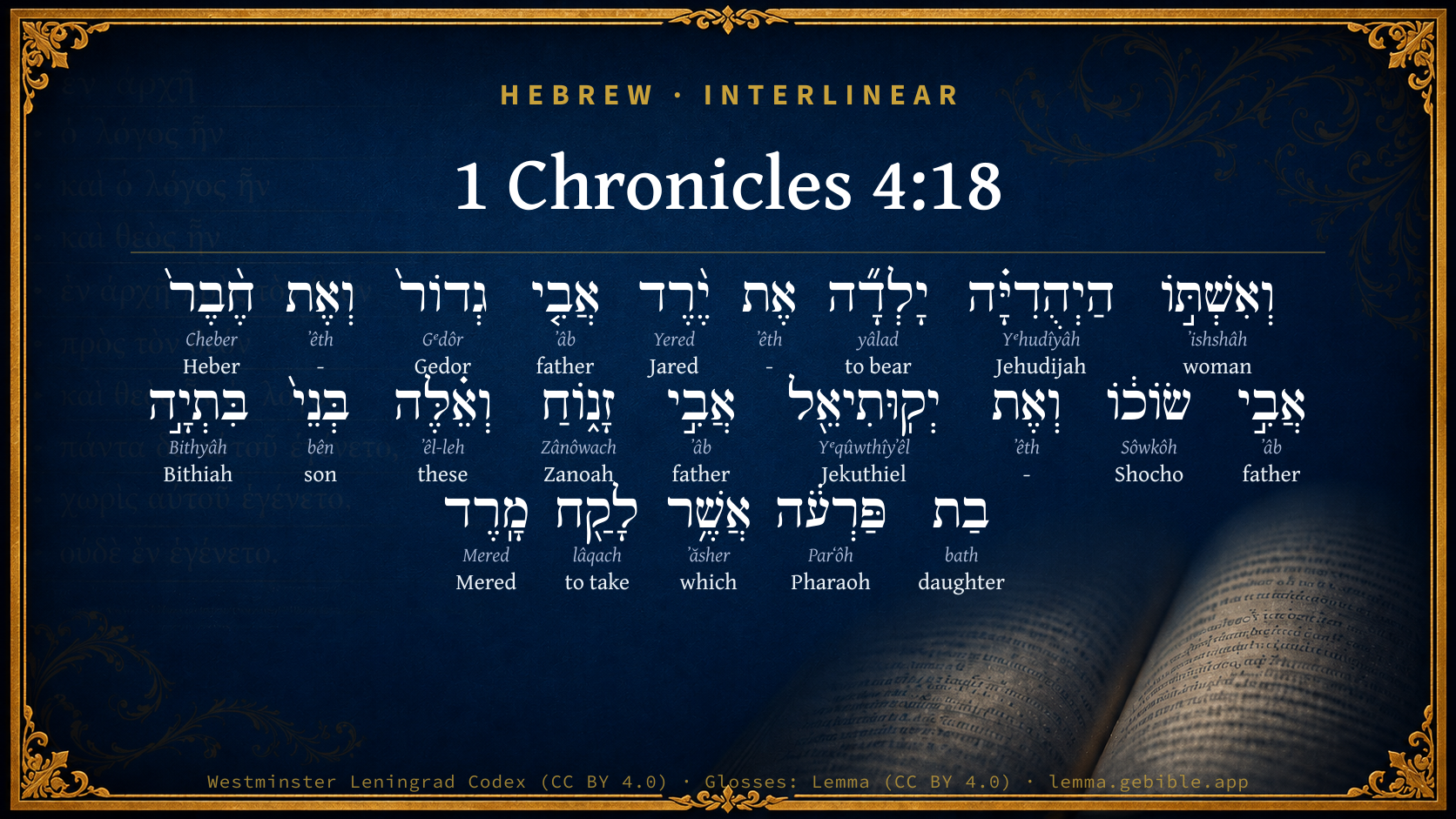
Hebrew (Westminster Leningrad Codex) 1 Chronicles 4:18 appears in the Hebrew Old Testament. The text above is from the Westminster Leningrad Codex. Each word links to its Strong’s number, a concise gloss, and parsing drawn from the Open Scriptures Hebrew Bible morphology. Click any word for its full Brown-Driver-Briggs (BDB) entry.
Download image
Cite this verse

1 Chronicles 4:18 (World English Bible). Public Domain. Lemma interlinear Bible study tool, https://lemma.gebible.app/v/1-chronicles/4/18.

Show BibTeX & RIS
BibTeX
RIS
English Translation
His wife the Jewess bore Jered the father of Gedor, and Heber the father of Soco, and Jekuthiel the father of Zanoah. These are the sons of Bithiah the daughter of Pharaoh, whom Mered took.
World English Bible · Public Domain
Highlights
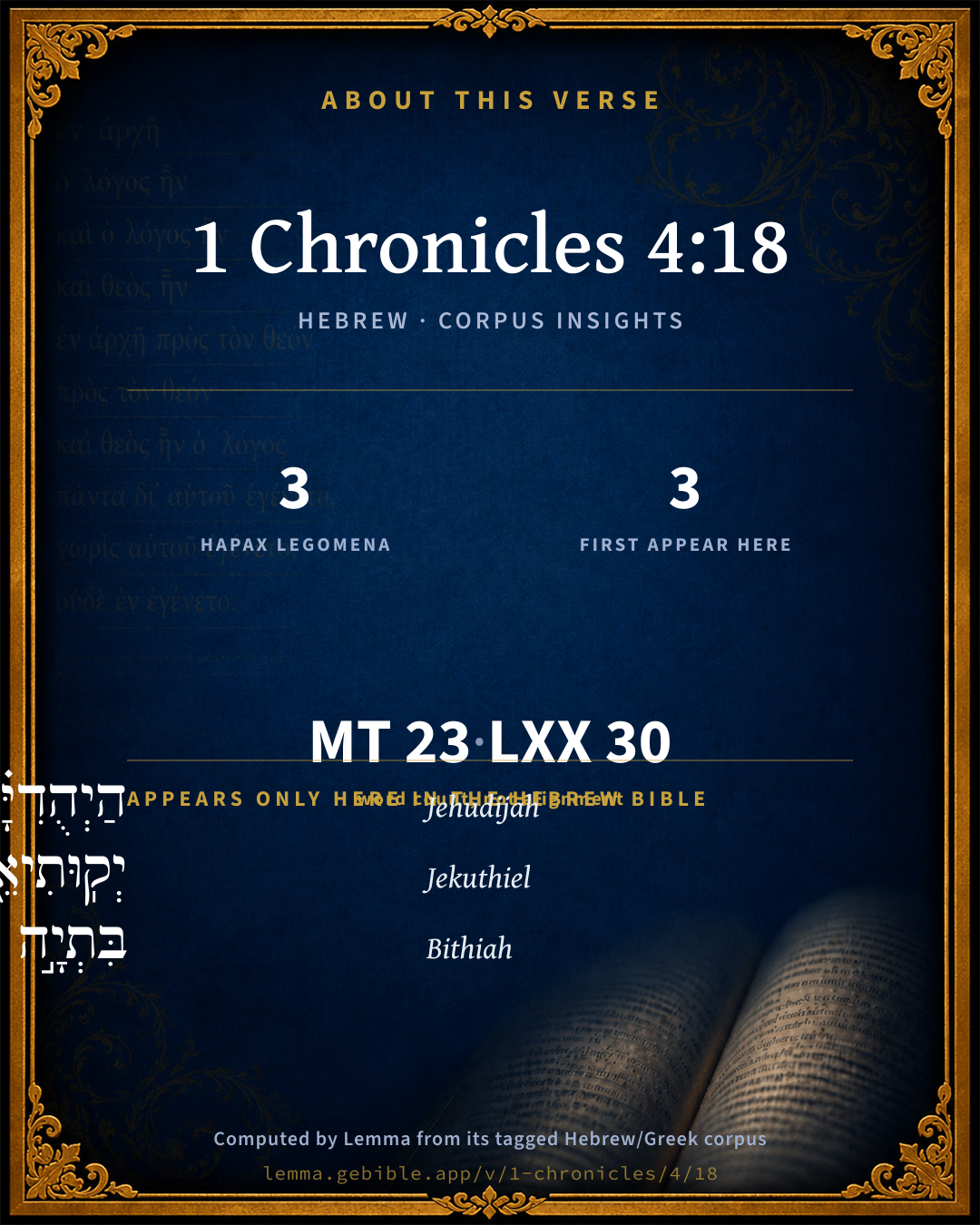
  • 3 hapax legomena — only here in the Hebrew Bible
  • 3 first appearances in the Hebrew Bible
Full analysis ↓
Download a study sheet

One document with this verse’s original text, its word-by-word gloss line, the meaning frame, cross-references with their text, attributed commentary, and full source and license credits — printable, and it pastes into notes with its structure intact.

This verse Autodidact and up

Study sheet (.html) Plain text (.txt)

A passage Seminary Student

Up to 50 verses in one chapter. A passage sheet keeps up to 6 commentary sources and 12 cross-references per verse, in the order this page ranks them, and says so on the sheet whenever that leaves anything out. Ask for a single verse and you get the Autodidact verse sheet above.

Everything on this page stays free to read, with no account — the sheet is a download of what is already on screen, not access to it.

Want to remove ads? Support Godless Engineer
Compare translations 3

The same verse in 3 English versions, stacked beneath the original-language interlinear above. Click any original word for its lexicon entry.

Each is an independent rendering of the whole verse — the interlinear is not word-aligned to these translations.

Highlighted words mark where these versions differ — a whole-verse word diff, not a word-by-word alignment.

  • World English Bible Public Domain
    His wife the Jewess bore Jered the father of Gedor, and Heber the father of Soco, and Jekuthiel the father of Zanoah. These are the sons of Bithiah the daughter of Pharaoh, whom Mered took.
  • King James Version Public Domain
    And his wife Jehudijah bare Jered the father of Gedor, and Heber the father of Socho, and Jekuthiel the father of Zanoah. And these are the sons of Bithiah the daughter of Pharaoh, which Mered took.
  • unfoldingWord Literal Text CC BY-SA 4.0
    And his Judahitess wife bore Jered, the father of Gedor, and Heber, the father of Soco, and Jekuthiel, the father of Zanoah. But those the sons of Bithiah, the daughter of Pharaoh, whom Mered took.

unfoldingWord Literal Text — © unfoldingWord, licensed CC BY-SA 4.0. Word-aligned USFM3 via Door43 (git.door43.org/unfoldingWord/en_ult).

Versions to compare (up to 4)

3 of 4 selected

Show all 17 translations

Every available English version of this verse, each an independent rendering of the whole verse.

  • World English Bible Public Domain
    His wife the Jewess bore Jered the father of Gedor, and Heber the father of Soco, and Jekuthiel the father of Zanoah. These are the sons of Bithiah the daughter of Pharaoh, whom Mered took.
  • Berean Standard Bible Public Domain
    These were the children of Pharaoh’s daughter Bithiah. Mered also took a Judean wife, who gave birth to Jered the father of Gedor, Heber the father of Soco, and Jekuthiel the father of Zanoah.
  • Majority Standard Bible Public Domain
    These were the children of Pharaoh’s daughter Bithiah. Mered also took a Judean wife, who gave birth to Jered the father of Gedor, Heber the father of Soco, and Jekuthiel the father of Zanoah.
  • King James Version Public Domain
    And his wife Jehudijah bare Jered the father of Gedor, and Heber the father of Socho, and Jekuthiel the father of Zanoah. And these are the sons of Bithiah the daughter of Pharaoh, which Mered took.
  • American Standard Version (1901) Public Domain
    And his wife the Jewess bare Jered the father of Gedor, and Heber the father of Soco, and Jekuthiel the father of Zanoah. And these are the sons of Bithiah the daughter of Pharaoh, whom Mered took.
  • Revised Version (1885) Public Domain
    And his wife the Jewess bare Jered the father of Gedor, and Heber the father of Soco, and Jekuthiel the father of Zanoah. And these are the sons of Bithiah the daughter of Pharaoh, which Mered took.
  • Geneva Bible (1599) Public Domain
    Also his wife Iehudiiah bare Iered the father of Gedor, and Heber the father of Socho, and Iekuthiel the father of Zanoah: and these are the sonnes of Bithiah ye daughter of Pharaoh which Mered tooke.
  • Douay-Rheims (1899) Public Domain
    And his wife Judaia, bore Jared the father of Gedor, and Heber the father of Socho, and Icuthiel the father of Zanoe. And these are the sons of Bethia the daughter of Pharao, whom Mered took to wife.
  • Young's Literal Translation Public Domain
    And his wife Jehudijah bare Jered father of Gedor, and Heber father of Socho, and Jekuthiel father of Zanoah. And these `are' sons of Bithiah daughter of Pharaoh, whom Mered took,
  • Literal Standard Version CC BY-SA 4.0
    And his wife Jehudijah bore Jered father of Gedor, and Heber father of Socho, and Jekuthiel father of Zanoah. And these [are] sons of Bithiah daughter of Pharaoh, whom Mered took,
  • unfoldingWord Literal Text CC BY-SA 4.0
    And his Judahitess wife bore Jered, the father of Gedor, and Heber, the father of Soco, and Jekuthiel, the father of Zanoah. But those the sons of Bithiah, the daughter of Pharaoh, whom Mered took.
  • Darby Bible Public Domain
    And his wife the Jewess bore Jered the father of Gedor, and Heber the father of Socho, and Jekuthiel the father of Zanoah. And these are the sons of Bithiah the daughter of Pharaoh whom Mered took.
  • World Messianic Bible Public Domain
    His wife Yehudiyah bore Jered the father of Gedor, Heber the father of Soco, and Jekuthiel the father of Zanoah. These are the sons of Bithiah the daughter of Pharaoh, whom Mered took.
  • Webster's Bible Public Domain
    And his wife Jehudijah bore Jered the father of Gedor, and Heber the father of Socho, and Jekuthiel the father of Zanoah. And these are the sons of Bithiah the daughter of Pharaoh whom Mered took.
  • Free Bible Version CC BY-SA 4.0
    (Another wife who came from Judah was the mother of Jered the father of Gedor, Heber the father of Soco, and Jekuthiel the father of Zanoah. ) These were the sons of Bithiah, Pharaoh's daughter, whom Mered had married.
  • Bible in Basic English Public Domain
    And his wife, a woman of the tribe of Judah, became the mother of Jered, the father of Gedor, and Heber, the father of Soco, and Jekuthiel, the father of Zanoah.
  • JPS Tanakh (1917) Public Domain
    and his wife Hajehudijah bore Jered the father of Gedor, and Heber the father of Soco, and Jekuthiel the father of Zanoah — and these are the sons of Bithiah the daughter of Pharaoh whom Mered took.

Literal Standard Version (2020), Covenant Press — licensed CC BY-SA 4.0. Text via the HelloAO Bible API (eBible.org). unfoldingWord Literal Text — © unfoldingWord, licensed CC BY-SA 4.0. Word-aligned USFM3 via Door43 (git.door43.org/unfoldingWord/en_ult). Free Bible Version, Dr. Jonathan Gallagher — licensed CC BY-SA 4.0. Text via the HelloAO Bible API (eBible.org).

Word by word

More ways to search: Search by grammar → Find every occurrence → Compare this word →

Practice this passage: Drill this verse → Learn its vocabulary →

הַיְהֻדִיָּ֗ה
Yᵉhudîyâh
H3057
“the · Jehudijah”
Particle, Definite Article + Noun, Gentilic, Feminine, Singular, Absolute
Part of Speech
Particle + Noun
Type
Gentilic
Gender
Feminine
Number
Singular
State
Absolute
Full BDB Definition

Origin: from H3064

TWOT: None

Jehudijah = "Jewess" - the Jewess (adjective feminine) - (CLBL) a Calebite, the wife of one named Ezra (noun proper feminine)
  1. וְאִשְׁתּ֣וֹ ʼishshâh H802 “and · woman · his” Conjunction + Noun, Common, Feminine, Singular, Construct + Suffix, Personal, 3rd Person, Masculine, Singular
  2. יָלְדָ֞ה yâlad H3205 “to bear” Verb, Qal, Perfect, 3rd Person, Feminine, Singular
  3. אֶת ʼêth H853 “-” Particle, Direct Object
  4. יֶ֨רֶד Yered H3382 “Jared” Noun, Proper
  5. אֲבִ֤י ʼâb H1 “father of” Noun, Common, Masculine, Singular, Construct
  6. גְדוֹר֙ Gᵉdôr H1446 “Gedor” Noun, Proper
  7. וְאֶת ʼêth H853 “and · -” Conjunction + Particle, Direct Object
  8. חֶ֨בֶר֙ Cheber H2268 “Heber” Noun, Proper
  9. אֲבִ֣י ʼâb H1 “father of” Noun, Common, Masculine, Singular, Construct
  10. שׂוֹכ֔וֹ Sôwkôh H7755 “Shocho” Noun, Proper
  11. וְאֶת ʼêth H853 “and · -” Conjunction + Particle, Direct Object
  12. יְקֽוּתִיאֵ֖ל Yᵉqûwthîyʼêl H3354 “Jekuthiel” Noun, Proper
  13. אֲבִ֣י ʼâb H1 “father of” Noun, Common, Masculine, Singular, Construct
  14. זָנ֑וֹחַ Zânôwach H2182 “Zanoah” Noun, Proper
  15. וְאֵ֗לֶּה ʼêl-leh H428 “and · these” Conjunction + Pronoun, Demonstrative, Common, Plural
  16. בְּנֵי֙ bên H1121 “sons of” Noun, Common, Masculine, Plural, Construct
  17. בִּתְיָ֣ה Bithyâh H1332 “Bithiah” Noun, Proper
  18. בַת bath H1323 “daughter of” Noun, Common, Feminine, Singular, Construct
  19. פַּרְעֹ֔ה Parʻôh H6547 “Pharaoh” Noun, Proper
  20. אֲשֶׁ֥ר ʼăsher H834 “which” Particle, Relative
  21. לָקַ֖ח lâqach H3947 “to take” Verb, Qal, Perfect, 3rd Person, Masculine, Singular
  22. מָֽרֶד Mered H4778 “Mered” Noun, Proper

About this verse

These counts appear in no published source. They are computed here, from the morphology-tagged text and Lemma’s own curated glosses. What Lemma adds →

23
words
19
distinct lemmas
Historical
section

Notable vocabulary

3 hapax legomena — words that appear only here in the entire Hebrew Bible:

  • הַיְהֻדִיָּ֗ה Jehudijah H3057
  • יְקֽוּתִיאֵ֖ל Jekuthiel H3354
  • בִּתְיָ֣ה Bithiah H1332

First appearance in Scripture

These words make their first canonical appearance in the Hebrew Bible here:

  • הַיְהֻדִיָּ֗ה Jehudijah H3057
  • יְקֽוּתִיאֵ֖ל Jekuthiel H3354
  • בִּתְיָ֣ה Bithiah H1332

Shared distinctive vocabulary

מָֽרֶד Mered H4778 occurs in 2 verses of the Hebrew Bible. Also found in:

Grammatical profile

  • 2 verbs
  • 16 nouns
  • 1 pronoun
  • 4 particles

Verb forms

  • יָלְדָ֞ה Qal · Perfect
  • לָקַ֖ח Qal · Perfect

Repetition

A word recurs within this verse — often emphatic in Hebrew:

  • אֲבִ֤י father H1 ×3

Hebrew & Septuagint length

In English translation the verse runs 35 words from the Hebrew and 38 from the Septuagint (LXX English) — closely comparable.

A rough comparison of the two English renderings, which tokenize alike — not a word-level alignment.

Word counts can differ between the Hebrew and the Greek without any difference in meaning — e.g. the Hebrew direct-object marker אֵת has no separate Greek word, and Greek often adds the article ὁ.

In the original languages it is 23 Hebrew tokens and 30 Greek tokens — but the two are counted differently (Hebrew bundles its prefixes and suffixes into one token; the Greek is in lemma form), so that isn’t a like-for-like length.

Cross-references

6

Topical passages linked to 1 Chronicles 4:18 in the Treasury of Scripture Knowledge — connected by theme and wording, ordered by reader-vote popularity; previews shown in the World English Bible.

  • 1 Chronicles 4:4 and Penuel the father of Gedor, and Ezer the father of Hushah. These are the sons of Hur, the firstborn of Ephrathah, the father of Bethlehem.
  • 1 Chronicles 4:39 They went to the entrance of Gedor, even to the east side of the valley, to seek pasture for their flocks.
  • Joshua 15:58 Halhul, Beth Zur, and Gedor,
  • 1 Chronicles 2:42 The sons of Caleb the brother of Jerahmeel were Mesha his firstborn, who was the father of Ziph; and the sons of Mareshah the father of Hebron.
  • Joshua 15:34–35 and Zanoah, and En Gannim, Tappuah, and Enam,
  • Joshua 15:48 In the hill-country, Shamir, and Jattir, and Socoh,

Cross-references courtesy of OpenBible.info (CC BY 4.0).

Hebrew and Greek witnesses Masoretic Hebrew ↔ Greek Septuagint

The same verse in the two great witnesses to the Old Testament, shown verse-for-verse.

These are two independent witnesses, not word-aligned to each other, and the Septuagint is shown in lemma (dictionary) form.

Hebrew 1 Chronicles 4:18 Masoretic · Westminster Leningrad Codex

וְאִשְׁתּ֣וֹ הַיְהֻדִיָּ֗ה יָלְדָ֞ה אֶת יֶ֨רֶד אֲבִ֤י גְדוֹר֙ וְאֶת חֶ֨בֶר֙ אֲבִ֣י שׂוֹכ֔וֹ וְאֶת יְקֽוּתִיאֵ֖ל אֲבִ֣י זָנ֑וֹחַ וְאֵ֗לֶּה בְּנֵי֙ בִּתְיָ֣ה בַת פַּרְעֹ֔ה אֲשֶׁ֥ר לָקַ֖ח מָֽרֶד

His wife the Jewess bore Jered the father of Gedor, and Heber the father of Soco, and Jekuthiel the father of Zanoah. These are the sons of Bithiah the daughter of Pharaoh, whom Mered took.

World English Bible · Public Domain

Greek LXX 1 Chronicles 4:18 Septuagint · lemma form

καί ὁ γυνή αὐτός οὗτος αδια τίκτω ὁ ιαρεδ πατήρ γεδωρ καί ὁ αβερ πατήρ σωχων καί ὁ ιεκθιηλ πατήρ ζανω καί οὗτος υἱός γελια θυγάτηρ φαραώ ὅς λαμβάνω μωρηδ

And his wife, that is Adia, bore Jared the father of Gedor, and Aber the father of Sochon, and Chetiel the father of Zamon: and these are the sons of Betthia the daughter of Pharao, whom Mored took.

LXX2012 (modern English Septuagint) · Public Domain

Hebrew: Westminster Leningrad Codex (CC BY 4.0). Greek: Septuagint (public domain); English from LXX2012 (modern English Septuagint) (Public Domain). How the Septuagint differs from the Hebrew →

Commentary

Notes on 1 Chronicles 4:18 from classic Christian and Jewish commentators (each source and its license shown beneath its notes). The classic Christian expositions comment on the surrounding passage and are grouped to its opening verse, so a note may address several verses; the Jewish commentaries on the Tanakh (Rashi and others) are per-verse, so they appear only where the commentator wrote on this verse.

Lemma curates 59 commentaries, every one of them public domain or Creative Commons licensed, each selected and text-cleaned for this edition rather than reprinted as found. About our sources →

Joseph Benson's Commentary

1Ch 4:18. Bithiah, the daughter of Pharaoh, whom Mered took — That is, married. But it is not likely that he married the daughter of the king of Egypt, unless some natural daughter; but rather of some other person called by that name, who might either be an Israelite, or one brought by force out of Egypt by way of spoil.

Joseph Benson's Commentary on the Old and New Testaments (1811–1818) — public domain. Text from a community e-Sword module.

Tyndale Open Study Notes

Tyndale Open Resources

4:18 Through Mered’s wife Bithia, a daughter of Pharaoh, the descendants of Judah included children of Egyptian heritage.

Tyndale Open Study Notes — © Tyndale Open Resources, licensed CC BY-SA 4.0. Text via the HelloAO Bible API.

Geneva Bible (1599)

Geneva Bible translators

Or, she bare, meaning, the second wife of Ezra.

Or, of whom he had Mered.

Geneva Bible (1599) marginal notes — public domain. Text via Bolls.life.

Jamieson, Fausset & Brown

Robert Jamieson, A. R. Fausset & David Brown

Jehudijah--"the Jewess," to distinguish her from his other wife, who was an Egyptian. This passage records a very interesting fact--the marriage of an Egyptian princess to a descendant of Caleb. The marriage must have taken place in the wilderness. The barriers of a different national language and national religion kept the Hebrews separate from the Egyptians; but they did not wholly prevent intimacies, and even occasional intermarriages between private individuals of the two nations. Before such unions, however, could be sanctioned, the Egyptian party must have renounced idolatry, and this daughter of Pharaoh, as appears from her name, had become a convert to the worship of the God of Israel.

Jamieson, Fausset & Brown — Commentary Critical and Explanatory on the Whole Bible (1871) — public domain (CC PDM 1.0). Text via the HelloAO Bible API.

Adam Clarke's Commentary

Verse 18. And his wife Jehudijah] The Targum considers the names in this verse as epithets of Moses: "And his wife Jehuditha educated Moses after she had drawn him out of the water: and she called his name Jered, because he caused the manna to descend upon Israel; and Prince Gedor, because he restored the desolations of Israel; Heber also, because he joined Israel to their heavenly Father; and Prince Socho, because he overshadowed Israel with his righteousness, and Jekuthiel, because the Israelites waited on the God of heaven in his time, forty years in the desert; and prince Zanoah, because God, on his account, had passed by the sins of Israel. These names Bithiah, the daughter of Pharaoh, called him by the spirit of prophecy, for she became a proselyte; and Mered took her to himself to wife: he is Caleb, and was so called because he opposed the counsel of the spies." - T. A similar explanation is given by Jarchi.

Adam Clarke's Commentary on the Bible (1810–1826) — public domain. Text from a community e-Sword/MySword module.

Ellicott's Commentary for English Readers

(18) And his wife Jehudijah [Margin is right, the Jewess] bare Jered.—It is obvious that a contrast with the sons of some non-Jewish wife is intended, and these latter ought already to have been mentioned. Clearly, therefore, the sentence “And these are the sons of Bithiah, the daughter of Pharaoh, which Mered took”—a sentence which is meaningless in its present position—must be restored to its original place after the first statement of 1Ch_4:17. We thus get the sense: “And the sons of Ezra were Jepher and Mered, and Epher and Jalon. And these [the following] are the sons of Bithiah, daughter of Pharaoh, whom Mered took [to wife]; she conceived Miriam and Shammai and Ishbah the father of Eshtemoa. And his [Mered’s] wife the Jewess bare Jered . . . Zanoah.” Thus the house of Mered son of Ezra bifurcates into a purely Judæan and a mixed Egyptian group of families. Eshtemoa (1Ch_4:17) lay south of Hebron, in the hil-country (Jos_15:50).

Gedor.—See 1Ch_4:4, where Penuel is called father of Gedor. The two lists may, and probably do, refer to different epochs.

Socho.—Jos_15:35; in the Shephelah, south-west of Jerusalem.

Zanoah.—Two Judæan towns were so named, one in the Shephelah, the other in the highlands (Jos_15:34; Jos_15:56).

Jekuthiel occurs here only; but comp. Joktheel (Jos_15:38), a town in the Shephelah.

Bithiah the daughter of Pharaoh.—Bithiah is apparently Hebrew, “daughter of Iah,” that is, a convert to the religion of Israel. It may be a Hebraized form of Bent-Aah, daughter of the Moon, or some like native name. Daughter of Pharaoh, if the nomenclature be tribal, need only mean an Egyptian clan which amalgamated with that of Mered. On the other hand, comp. 2Ch_8:11 and 1Ki_9:24, where the phrase is used in its literal sense.

A Bible Commentary for English Readers, edited by Charles John Ellicott (1878–1897) — public domain. Text from a community e-Sword module.

The Cambridge Bible for Schools and Colleges

gen. ed. J. J. S. Perowne

18. his wife] the wife of Mered, if the transposition mentioned in the last note be accepted.

his wife Jehudijah] R.V. his wife the Jewess (so called in contrast to his Egyptian wife).

Gedor] Cp. 1Ch_4:4, where a different person is perhaps by a different tradition called father of Gedor. Gedor is to be identified with the ruins of Jedur on the road between Jerusalem and Hebron (Bädeker, p. 135)

Socho] R.V. Soco.

Socho … Zanoah] The two places are mentioned in the reverse order in Jos_15:34-35 as situated in the lowland (Shephelah). Zâbû‘a still exists (Bädeker, p. 161).

these are the sons of Bithiah] See note on 1Ch_4:17.

The Cambridge Bible for Schools and Colleges (gen. ed. J. J. S. Perowne; Cambridge University Press, 1878–1918) — public domain. Text from a community e-Sword module.

John Gill's Exposition

And his wife Jehudijah,.... Another wife of Ezra; or, according to Kimchi, of Mered; a Jewess, as the word is by some rendered, to distinguish her from another wife, an Egyptian, in the latter part of the verse:

bare Jered the father of Gedor, and Heber the father of Socho, and Jekuthiel the father of Zanoah; who were princes, as Jarchi seems rightly to observe; of several cities of these names in the tribe of Judah, as of Gedor, see Jos 15:58, of Socoh, Jos 15:35, of Zanoah, Jos 15:34, the Targum interprets the names of all these men of Moses, whom Pharaoh's daughter brought up; and so other Jewish writers (a), into which mistake they were led by what follows:

and these are the sons of Bithiah, the daughter of Pharaoh, which Mered took; that is, to wife; this Mered was one of the sons of Ezra, Ch1 4:17 the Targum, and other Jewish writers (b), say this was Caleb, called Mered, because he rebelled against the counsel of the spies; but this contradicts their other notion of Jehudijah, or Bithiah, Pharaoh's daughter, whom he married, the one who brought up Moses, since Moses was elder than Caleb; but Bithiah, whom Mered married, was not a daughter of Pharaoh king of Egypt, but of an Israelite of this name; her sons are supposed to be those in the latter part of Ch1 4:17.

(a) T. Bab. Megillah, fol. 13. 1. Vajikra Rabba, sect. 1. fol. 146. 3. (b) T. Bab. Sanhedrin, fol. 19. 2. & Megillah, fol. 13. 1.

John Gill's Exposition of the Whole Bible (1746–1763) — public domain (CC PDM 1.0). Text via the HelloAO Bible API.

Albert Barnes' Notes on the Bible

His wife - i. e. Mered’s. Mered, it would seem, had two wives, Bithiah, an Egyptian woman, and a Jewish wife (see the margin), whose name is not given. If Mered was a chief of rank, Bithlah may have been married to him with the consent of her father, for the Egyptian kings often gave their daughters in marriage to foreigners. Or she may have elected to forsake her countrymen and cleave to a Jewish husband, becoming a convert to his religion. Her name, Bithiah, “daughter of Yahweh,” is like that of a convert.

Albert Barnes' Notes on the Bible (1834–1885) — public domain. Text from a community e-Sword/MySword module.

Haydock's Catholic Bible Commentary

Judaia, a second wife, of his own nation. By the first, from Egypt, Mered had Miriam, &c. Some words seem to be lost, which render it doubtful to whom Judaia was married.

George Leo Haydock (1774–1849), Haydock's Catholic Family Bible and Commentary, 1859 edition — public domain. Excludes Psalms (Douay-Rheims chapter numbering differs from Protestant) and Deuterocanonical books (Catholic canon only).

Matthew Poole's English Annotations

His wife; either Ezra’s wife, or rather, another wife of Mered. Jehudijah; or, the Jewess; so called to distinguish her from his Egyptian wife here following.

These are the sons, to wit, Miriam, and the rest following, 1Ch 4:17.

The daughter of Pharaoh; either

1. Of Pharaoh king of Egypt for Mered might be a person of great estate and quality; or this might be only Pharaoh’s illegitimate daughter. Or,

2. Of some other Egyptian or Israelite called by that name; which might easily happen upon divers occasions.

Matthew Poole's English Annotations on the Holy Bible (1683–1685) — public domain. Text from a community e-Sword/MySword module.

Keil & Delitzsch

C. F. Keil & F. Delitzsch

And his wife Jehudijah,.... Another wife of Ezra; or, according to Kimchi, of Mered; a Jewess, as the word is by some rendered, to distinguish her from another wife, an Egyptian, in the latter part of the verse:

bare Jered the father of Gedor, and Heber the father of Socho, and Jekuthiel the father of Zanoah; who were princes, as Jarchi seems rightly to observe; of several cities of these names in the tribe of Judah, as of Gedor, see Jos 15:58, of Socoh, Jos 15:35, of Zanoah, Jos 15:34, the Targum interprets the names of all these men of Moses, whom Pharaoh's daughter brought up; and so other Jewish writers (a), into which mistake they were led by what follows:

and these are the sons of Bithiah, the daughter of Pharaoh, which Mered took; that is, to wife; this Mered was one of the sons of Ezra, Ch1 4:17 the Targum, and other Jewish writers (b), say this was Caleb, called Mered, because he rebelled against the counsel of the spies; but this contradicts their other notion of Jehudijah, or Bithiah, Pharaoh's daughter, whom he married, the one who brought up Moses, since Moses was elder than Caleb; but Bithiah, whom Mered married, was not a daughter of Pharaoh king of Egypt, but of an Israelite of this name; her sons are supposed to be those in the latter part of Ch1 4:17.

(a) T. Bab. Megillah, fol. 13. 1. Vajikra Rabba, sect. 1. fol. 146. 3. (b) T. Bab. Sanhedrin, fol. 19. 2. & Megillah, fol. 13. 1.

Keil & Delitzsch — Biblical Commentary on the Old Testament (1861–1891) — public domain (CC PDM 1.0). Text via the HelloAO Bible API. (Old Testament only.)

Rashi

Rabbi Shlomo Yitzchaki (Rashi)

And his wife the Judahitess Caleb’s wife, who was born of Judah.

Jered, the father of Gedor, etc. the leaders of the cities, as it is written in Josh. (15:56): “and Jokdeam and Zanoah...,” (v. 58): “Halhul, Beth Zur, and Gedor,” (v. 36): “Jarmuth and Adullam, Soco and Azekah.”

And these are the sons of Bithiah the daughter of Pharaoh The “vav” separates between the sons of the Judahitess and the sons of Bithiah.

whom Mered married Caleb is Mered, who rebelled (שֶׁמָרַד) against the counsel of the spies, and so is the manner of the genealogy, that even for one, he says, “the sons of,” like (verse 15): “and the sons of Elah: Uknaz.”

Rashi on the Tanakh — English translations: “The Judaica Press complete Tanach with Rashi, translated by A. J. Rosenberg” (CC BY 4.0); “Pentateuch with Rashi's commentary by M. Rosenbaum and A.M. Silbermann, 1929-1934” (public domain); “The Metsudah Tanach series, Lakewood, N.J” (CC BY 4.0); and “The Book of Joshua, Metsudah Publications, 1997” (CC BY 4.0). Text via Sefaria.

Lesson kit

Teaching starters — assembled from the data on this page, not authored interpretation. Every prompt links to the verse data it draws on. Edit before teaching.

1 Chronicles, in the Historical, opens this verse with 23 words (19 distinct Hebrew lemmas). Its most distinctive word is Yᵉhudîyâh (“Jehudijah”). A historical commentator’s framing appears above. Read the whole chapter for the surrounding context.

Discussion questions

  1. How does “Jehudijah” (Yᵉhudîyâh) shape what this verse is saying?
  2. This verse holds 3 words here found nowhere else in the Hebrew Bible. What might the rare words draw attention to?
  3. 3 words here appear for the first time in Scripture. What is being introduced at this debut?
  4. 1 Chronicles 4:17 shares the word «Mered» with this verse. How do the two illuminate each other?
  5. “father” occurs 3× in this one verse. What is the effect of the repetition?
  6. The translations on this page render this verse differently — a whole-verse word diff, not a word-by-word alignment. What might account for the different wordings?
  7. The verb «יָלְדָ֞ה» is Qal Perfect. How does its form color the action?
  8. Reading how Joseph Benson's Commentary and Tyndale Open Study Notes read this verse, where do the two commentators agree and where do they part?

Things to notice

  • 3 words in this verse appear nowhere else in the Hebrew Bible.
  • 3 words make their first canonical appearance in Scripture here.
  • This verse counts 23 Hebrew ↔ 30 Greek words.
  • These translations choose different wording for 9 words in this verse.
  • “father” occurs 3× in this single verse.

Reading settings

Reading text

Shown beneath each verse's original-language words.

Old Testament
Old Testament edition

Read the OT as the Masoretic Hebrew (MT) or the Greek Septuagint (LXX).

English shown for the Greek Septuagint (in the Hebrew ↔ Greek comparison).

Comparing translations? Open the Compare panel on any verse page to stack up to four side by side.