
Haggai 2:22

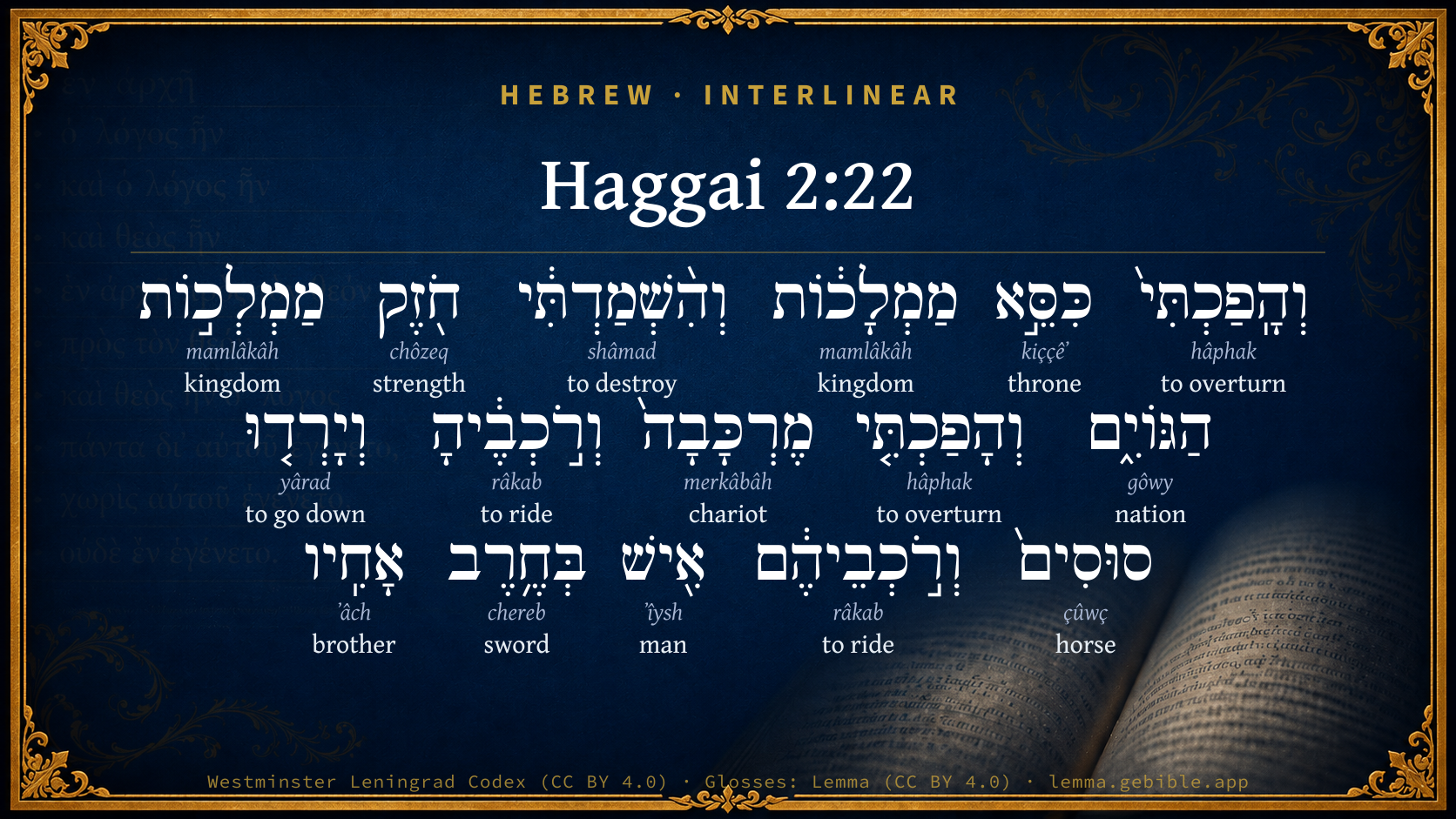
Hebrew (Westminster Leningrad Codex) Haggai 2:22 appears in the Hebrew Old Testament. The text above is from the Westminster Leningrad Codex. Each word links to its Strong’s number, a concise gloss, and parsing drawn from the Open Scriptures Hebrew Bible morphology. Click any word for its full Brown-Driver-Briggs (BDB) entry.
Download image
Cite this verse

Haggai 2:22 (World English Bible). Public Domain. Lemma interlinear Bible study tool, https://lemma.gebible.app/v/haggai/2/22.

Show BibTeX & RIS
BibTeX
RIS
English Translation
I will overthrow the throne of kingdoms. I will destroy the strength of the kingdoms of the nations. I will overthrow the chariots, and those who ride in them. The horses and their riders will come down, everyone by the sword of his brother.
World English Bible · Public Domain
Download a study sheet

One document with this verse’s original text, its word-by-word gloss line, the meaning frame, cross-references with their text, attributed commentary, and full source and license credits — printable, and it pastes into notes with its structure intact.

This verse Autodidact and up

Study sheet (.html) Plain text (.txt)

A passage Seminary Student

Up to 50 verses in one chapter. A passage sheet keeps up to 6 commentary sources and 12 cross-references per verse, in the order this page ranks them, and says so on the sheet whenever that leaves anything out. Ask for a single verse and you get the Autodidact verse sheet above.

Everything on this page stays free to read, with no account — the sheet is a download of what is already on screen, not access to it.

Want to remove ads? Support Godless Engineer
Compare translations 3

The same verse in 3 English versions, stacked beneath the original-language interlinear above. Click any original word for its lexicon entry.

Each is an independent rendering of the whole verse — the interlinear is not word-aligned to these translations.

Highlighted words mark where these versions differ — a whole-verse word diff, not a word-by-word alignment.

  • World English Bible Public Domain
    I will overthrow the throne of kingdoms. I will destroy the strength of the kingdoms of the nations. I will overthrow the chariots, and those who ride in them. The horses and their riders will come down, everyone by the sword of his brother.
  • King James Version Public Domain
    And I will overthrow the throne of kingdoms, and I will destroy the strength of the kingdoms of the heathen; and I will overthrow the chariots, and those that ride in them; and the horses and their riders shall come down, every one by the sword of his brother.
  • unfoldingWord Literal Text CC BY-SA 4.0
    And I will overthrow the throne of kingdoms and I will destroy the strength of the kingdoms of the nations! And I will overthrow the chariot and its rider, and the horses and their riders will fall, a man by the sword of his brother.

unfoldingWord Literal Text — © unfoldingWord, licensed CC BY-SA 4.0. Word-aligned USFM3 via Door43 (git.door43.org/unfoldingWord/en_ult).

Versions to compare (up to 4)

3 of 4 selected

Show all 18 translations

Every available English version of this verse, each an independent rendering of the whole verse.

  • World English Bible Public Domain
    I will overthrow the throne of kingdoms. I will destroy the strength of the kingdoms of the nations. I will overthrow the chariots, and those who ride in them. The horses and their riders will come down, everyone by the sword of his brother.
  • Berean Standard Bible Public Domain
    I will overturn royal thrones and destroy the power of the kingdoms of the nations. I will overturn chariots and their riders; horses and their riders will fall, each by the sword of his brother.
  • Majority Standard Bible Public Domain
    I will overturn royal thrones and destroy the power of the kingdoms of the nations. I will overturn chariots and their riders; horses and their riders will fall, each by the sword of his brother.
  • King James Version Public Domain
    And I will overthrow the throne of kingdoms, and I will destroy the strength of the kingdoms of the heathen; and I will overthrow the chariots, and those that ride in them; and the horses and their riders shall come down, every one by the sword of his brother.
  • American Standard Version (1901) Public Domain
    and I will overthrow the throne of kingdoms; and I will destroy the strength of the kingdoms of the nations; and I will overthrow the chariots, and those that ride in them; and the horses and their riders shall come down, every one by the sword of his brother.
  • Revised Version (1885) Public Domain
    and I will overthrow the throne of kingdoms, and I will destroy the strength of the kingdoms of the nations; and I will overthrow the chariots, and those that ride in them; and the horses and their riders shall come down, every one by the sword of his brother.
  • Geneva Bible (1599) Public Domain
    Speake to Zerubbabel the prince of Iudah, and say, I wil shake the heauens and the earth,
  • Douay-Rheims (1899) Public Domain
    Speak to Zorobabel the governor of Juda, saying: I will move both heaven and earth.
  • Young's Literal Translation Public Domain
    And have overturned the throne of kingdoms, And I have destroyed the strength of kingdoms of the nations, And overturned chariot and its charioteers, And come down have horses and their riders, Each by the sword of his brother.
  • Literal Standard Version CC BY-SA 4.0
    And have overturned the throne of kingdoms, || And I have destroyed the strength of kingdoms of the nations, || And overturned chariot and its charioteers, || And horses and their riders have come down, || Each by the sword of his brother.
  • Unlocked Literal Bible CC BY-SA 4.0
    For I will overthrow the throne of kingdoms and destroy the strength of the kingdoms of the nations! I will overthrow the chariots and their riders; the horses and their riders will fall down, each one because of his brother's sword.
  • unfoldingWord Literal Text CC BY-SA 4.0
    And I will overthrow the throne of kingdoms and I will destroy the strength of the kingdoms of the nations! And I will overthrow the chariot and its rider, and the horses and their riders will fall, a man by the sword of his brother.
  • Darby Bible Public Domain
    and I will overthrow the throne of kingdoms, and I will destroy the strength of the kingdoms of the nations; and I will overthrow the chariots, and those that ride therein; and the horses and their riders shall come down, every one by the sword of his brother.
  • World Messianic Bible Public Domain
    I will overthrow the throne of kingdoms. I will destroy the strength of the kingdoms of the nations. I will overthrow the chariots and those who ride in them. The horses and their riders will come down, everyone by the sword of his brother.
  • Webster's Bible Public Domain
    And I will overthrow the throne of kingdoms, and I will destroy the strength of the kingdoms of the heathen: and I will overthrow the chariots, and those that ride in them; and the horses and their riders shall come down, every one by the sword of his brother.
  • Free Bible Version CC BY-SA 4.0
    I will overthrow the thrones of kingdoms and destroy the power of the nations' kingdoms. I will overthrow the chariots and their riders. The horses and riders will fall, and the men will kill each other by the sword.
  • Bible in Basic English Public Domain
    Overturning the power of kingdoms; and I will send destruction on the strength of the kingdoms of the nations; by me war-carriages will be overturned with those who are in them; and the horses and the horsemen will come down, everyone by the sword of his brother.
  • JPS Tanakh (1917) Public Domain
    and I will overthrow the throne of kingdoms, and I will destroy the strength of the kingdoms of the nations; and I will overthrow the chariots, and those that ride in them; and the horses and their riders shall come down, every one by the sword of his brother.

Literal Standard Version (2020), Covenant Press — licensed CC BY-SA 4.0. Text via the HelloAO Bible API (eBible.org). Unlocked Literal Bible (unfoldingWord) — licensed CC BY-SA 4.0. Text via the HelloAO Bible API (eBible.org). unfoldingWord Literal Text — © unfoldingWord, licensed CC BY-SA 4.0. Word-aligned USFM3 via Door43 (git.door43.org/unfoldingWord/en_ult). Free Bible Version, Dr. Jonathan Gallagher — licensed CC BY-SA 4.0. Text via the HelloAO Bible API (eBible.org).

Word by word

More ways to search: Search by grammar → Find every occurrence → Compare this word →

Practice this passage: Drill this verse → Learn its vocabulary →

חֹ֖זֶק
chôzeq
H2392
“strength of”
Noun, Common, Masculine, Singular, Construct
Part of Speech
Noun
Type
Common
Gender
Masculine
Number
Singular
State
Construct
Full BDB Definition

Origin: from H2388

TWOT: 636c

strength
  1. וְהָֽפַכְתִּי֙ hâphak H2015 “and · to overturn” Conjunction + Verb, Qal, Sequential Perfect, 1st Person, Common, Singular
  2. כִּסֵּ֣א kiççêʼ H3678 “throne of” Noun, Common, Masculine, Singular, Construct
  3. מַמְלָכ֔וֹת mamlâkâh H4467 “kingdoms” Noun, Common, Feminine, Plural, Absolute
  4. וְהִ֨שְׁמַדְתִּ֔י shâmad H8045 “and · to destroy” Conjunction + Verb, Hiphil, Sequential Perfect, 1st Person, Common, Singular
  5. מַמְלְכ֣וֹת mamlâkâh H4467 “kingdoms of” Noun, Common, Feminine, Plural, Construct
  6. הַגּוֹיִ֑ם gôwy H1471 “the · nations” Particle, Definite Article + Noun, Common, Masculine, Plural, Absolute
  7. וְהָפַכְתִּ֤י hâphak H2015 “and · to overturn” Conjunction + Verb, Qal, Sequential Perfect, 1st Person, Common, Singular
  8. מֶרְכָּבָה֙ merkâbâh H4818 “chariot” Noun, Common, Feminine, Singular, Absolute
  9. וְרֹ֣כְבֶ֔יהָ râkab H7392 “and · riding · her” Conjunction + Verb, Qal, Participle Active, Masculine, Plural, Construct + Suffix, Personal, 3rd Person, Feminine, Singular
  10. וְיָרְד֤וּ yârad H3381 “and · to go down” Conjunction + Verb, Qal, Sequential Perfect, 3rd Person, Common, Plural
  11. סוּסִים֙ çûwç H5483 “horses” Noun, Common, Masculine, Plural, Absolute
  12. וְרֹ֣כְבֵיהֶ֔ם râkab H7392 “and · riding · them” Conjunction + Verb, Qal, Participle Active, Masculine, Plural, Construct + Suffix, Personal, 3rd Person, Masculine, Plural
  13. אִ֖ישׁ ʼîysh H376 “man” Noun, Common, Masculine, Singular, Absolute
  14. בְּחֶ֥רֶב chereb H2719 “in/at · sword of” Preposition + Noun, Common, Feminine, Singular, Construct
  15. אָחִֽיו ʼâch H251 “brother · his” Noun, Common, Masculine, Singular, Construct + Suffix, Personal, 3rd Person, Masculine, Singular

About this verse

These counts appear in no published source. They are computed here, from the morphology-tagged text and Lemma’s own curated glosses. What Lemma adds →

16
words
13
distinct lemmas
Prophets
section

Notable vocabulary

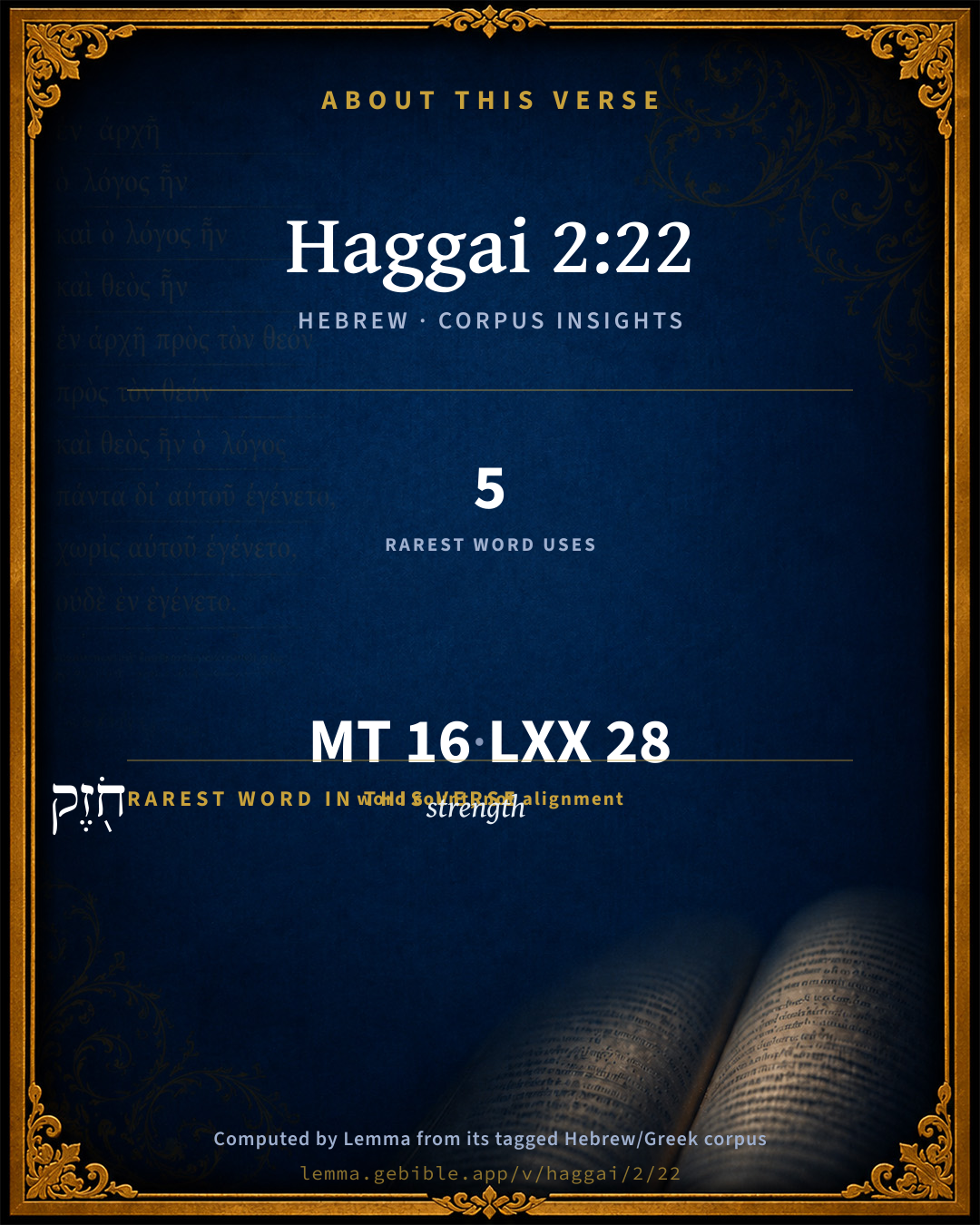
The rarest word here is חֹ֖זֶק strength H2392 — appearing just 5 times in the whole Hebrew Bible.

Shared distinctive vocabulary

חֹ֖זֶק strength H2392 occurs in 5 verses of the Hebrew Bible. Also found in:

Grammatical profile

  • 6 verbs
  • 10 nouns

Verb forms

  • וְהָֽפַכְתִּי֙ Qal · Sequential Perfect
  • וְהִ֨שְׁמַדְתִּ֔י Hiphil · Sequential Perfect
  • וְהָפַכְתִּ֤י Qal · Sequential Perfect
  • וְרֹ֣כְבֶ֔יהָ Qal · Participle Active
  • וְיָרְד֤וּ Qal · Sequential Perfect
  • וְרֹ֣כְבֵיהֶ֔ם Qal · Participle Active

Repetition

Words recur within this verse — often emphatic in Hebrew:

  • וְהָֽפַכְתִּי֙ to overturn H2015 ×2
  • מַמְלָכ֔וֹת kingdom H4467 ×2
  • וְרֹ֣כְבֶ֔יהָ to ride H7392 ×2

Hebrew & Septuagint length

In English translation the verse runs 44 words from the Hebrew and 27 from the Septuagint (LXX English) — the Septuagint runs noticeably shorter here. See the side-by-side →

A rough comparison of the two English renderings, which tokenize alike — not a word-level alignment.

Word counts can differ between the Hebrew and the Greek without any difference in meaning — e.g. the Hebrew direct-object marker אֵת has no separate Greek word, and Greek often adds the article ὁ.

In the original languages it is 16 Hebrew tokens and 28 Greek tokens — but the two are counted differently (Hebrew bundles its prefixes and suffixes into one token; the Greek is in lemma form), so that isn’t a like-for-like length.

Cross-references

29

Topical passages linked to Haggai 2:22 in the Treasury of Scripture Knowledge — connected by theme and wording, ordered by reader-vote popularity; previews shown in the World English Bible.

  • Micah 5:10 "It will happen in that day," says Yahweh, "That I will cut off your horses out of the midst of you, And will destroy your chariots.
  • Judges 7:22 They blew the three hundred trumpets, and Yahweh set every man's sword against his fellow, and against all the host; and the host fled as far as Beth-shittah toward Zererah, as far as the border of Abel Meholah, by Tabbath.
  • Psalms 46:9 He makes wars cease to the end of the earth. He breaks the bow, and shatters the spear. He burns the chariots in the fire.
  • Ezekiel 39:20 You shall be filled at my table with horses and chariots, with mighty men, and with all men of war, says the Lord Yahweh.
  • Micah 5:15 I will execute vengeance in anger, And wrath on the nations that didn't listen."
  • Zephaniah 3:8 "Therefore wait for me," says Yahweh, "until the day that I rise up to the prey, for my determination is to gather the nations, that I may assemble the kingdoms, to pour on them my indignation, even all my fierce anger, for all the earth will be devoured with the fire of my jealousy.
  • Zechariah 4:6 Then he answered and spoke to me, saying, "This is the word of Yahweh to Zerubbabel, saying, 'Not by might, nor by power, but by my Spirit,' says Yahweh of Hosts.
  • Zechariah 10:11 He will pass through the sea of affliction, And will strike the waves in the sea, And all the depths of the Nile will dry up; And the pride of Assyria will be brought down, And the scepter of Egypt will depart.
  • Matthew 24:7 For nation will rise against nation, and kingdom against kingdom; and there will be famines, plagues, and earthquakes in various places.
  • Psalms 76:6 At your rebuke, God of Jacob, Both chariot and horse are cast into a deep sleep.
  • Daniel 8:25 Through his policy he shall cause craft to prosper in his hand; and he shall magnify himself in his heart, and in [their] security shall he destroy many: he shall also stand up against the prince of princes; but he shall be broken without hand.
  • Exodus 14:17 I, behold, I will harden the hearts of the Egyptians, and they shall go in after them: and I will get myself honor over Pharaoh, and over all his host, over his chariots, and over his horsemen.
  • Exodus 14:28 The waters returned, and covered the chariots and the horsemen, even all Pharaoh's army that went in after them into the sea. There remained not so much as one of them.
  • Exodus 15:19 For the horses of Pharaoh went in with his chariots and with his horsemen into the sea, and Yahweh brought back the waters of the sea on them; but the children of Israel walked on dry land in the midst of the sea.
  • 1 Samuel 14:16 The watchmen of Saul in Gibeah of Benjamin looked; and, behold, the multitude melted away, and they went [here] and there.
  • 2 Chronicles 20:22 When they began to sing and to praise, Yahweh set liers-in-wait against the children of Ammon, Moab, and Mount Seir, who had come against Judah; and they were struck.
  • Isaiah 9:19 Through the wrath of Yahweh of hosts is the land burnt up; and the people are as the fuel of fire: no man spares his brother.
  • Isaiah 19:2 I will stir up the Egyptians against the Egyptians: and they shall fight everyone against his brother, and everyone against his neighbor; city against city, [and] kingdom against kingdom.
  • Isaiah 60:12 For that nation and kingdom that will not serve you shall perish; yes, those nations shall be utterly wasted.
  • Ezekiel 21:27 I will overturn, overturn, overturn it: this also shall be no more, until he come whose right it is; and I will give it [him].
  • Daniel 2:34–35 You saw until a stone was cut out without hands, which struck the image on its feet that were of iron and clay, and broke them in pieces.
  • Daniel 2:44–45 In the days of those kings shall the God of heaven set up a kingdom which shall never be destroyed, nor shall the sovereignty of it be left to another people; but it shall break in pieces and consume all these kingdoms, and it shall stand forever.
  • Daniel 7:25–27 He shall speak words against the Most High, and shall wear out the saints of the Most High; and he shall think to change the times and the law; and they shall be given into his hand until a time and times and half a time.
  • Micah 5:8 The remnant of Jacob will be among the nations, In the midst of many peoples, Like a lion among the animals of the forest, Like a young lion among the flocks of sheep; Who, if he goes through, treads down and tears in pieces, And there is no one to deliver.
  • Zechariah 9:10 I will cut off the chariot from Ephraim, And the horse from Jerusalem; And the battle bow will be cut off; And he will speak peace to the nations: And his dominion will be from sea to sea, And from the River to the ends of the earth.
  • Zechariah 12:2–5 "Behold, I will make Jerusalem a cup of reeling to all the surrounding peoples, and on Judah also will it be in the siege against Jerusalem.
  • Zechariah 14:3 Then Yahweh will go out and fight against those nations, as when he fought in the day of battle.
  • Revelation 11:15 The seventh angel sounded, and great voices in heaven followed, saying, "The kingdom of the world has become the Kingdom of our Lord, and of his Christ. He will reign forever and ever!"
  • Exodus 15:4 Pharaoh's chariots and his host has he cast into the sea; His chosen captains are sunk in the Red Sea.

Cross-references courtesy of OpenBible.info (CC BY 4.0).

Hebrew and Greek witnesses Masoretic Hebrew ↔ Greek Septuagint

The same verse in the two great witnesses to the Old Testament, shown verse-for-verse.

Here the Septuagint runs noticeably shorter than the Hebrew — LXX2012 (modern English Septuagint) 27 words vs World English Bible 44. A rough length comparison of the two English translations, not a word-level alignment — read both below.

These are two independent witnesses, not word-aligned to each other, and the Septuagint is shown in lemma (dictionary) form.

Hebrew Haggai 2:22 Masoretic · Westminster Leningrad Codex

וְהָֽפַכְתִּי֙ כִּסֵּ֣א מַמְלָכ֔וֹת וְהִ֨שְׁמַדְתִּ֔י חֹ֖זֶק מַמְלְכ֣וֹת הַגּוֹיִ֑ם וְהָפַכְתִּ֤י מֶרְכָּבָה֙ וְרֹ֣כְבֶ֔יהָ וְיָרְד֤וּ סוּסִים֙ וְרֹ֣כְבֵיהֶ֔ם אִ֖ישׁ בְּחֶ֥רֶב אָחִֽיו

I will overthrow the throne of kingdoms. I will destroy the strength of the kingdoms of the nations. I will overthrow the chariots, and those who ride in them. The horses and their riders will come down, everyone by the sword of his brother.

World English Bible · Public Domain

Greek LXX Haggai 2:22 Septuagint · lemma form

καί καταστρέφω θρόνος βασιλεύς καί ὀλεθρεύω δύναμις βασιλεύς ὁ ἔθνος καί καταστρέφω ἅρμα καί ἀναβάτης καί καταβαίνω ἵππος καί ἀναβάτης αὐτός ἕκαστος ἐν ῥομφαία πρός ὁ ἀδελφός αὐτός

Speak to Zorobabel the son of Salathiel, of the tribe of Juda, saying, I shake the heaven, and the earth, and the sea, and the dry land;

LXX2012 (modern English Septuagint) · Public Domain

On this verse, The Pulpit Commentary discusses the Septuagint’s reading. Read the note in Commentary ↓

Hebrew: Westminster Leningrad Codex (CC BY 4.0). Greek: Septuagint (public domain); English from LXX2012 (modern English Septuagint) (Public Domain). How the Septuagint differs from the Hebrew →

Targum (Aramaic paraphrase)

1

The Targum is the ancient Jewish Aramaic paraphrase of the Hebrew Scriptures — an interpretive translation, not the Hebrew text itself. Onkelos (literal) and Pseudo-Jonathan (expansive) render the Torah, and Jonathan the Prophets. Coverage is partial: where no permissively-licensed English translation exists for a verse, only the Aramaic is shown. This is verse-level text, not a word-by-word alignment to the Hebrew.

  1. Targum Jonathan Prophets (Joshua–Malachi)
    וְאֶהֱפּוֹךְ כּוּרְסֵי מַלְכוּתָא וְאֶתְּבַּר תּוֹקֶף מַלְכְוַת עַמְמַיָא וְאֶהֱפּוֹךְ רְתִיכִין וְרָכְבֵיהוֹן וְיִתְקַטְלוּן סוּסְוָן וְרָכְבֵיהוֹן גְבַר בְּחַרְבָּא דַאֲחוּהִי:

    (no public-domain English translation for this verse)

    Targum Jonathan — Aramaic: “Mikraot Gedolot” (public domain). English: “Sefaria Community Translation” (CC0 1.0 (public-domain dedication)); “London "Chaldee Paraphrase," 1871” (public domain). Text via Sefaria.

Commentary

Notes on Haggai 2:22 from classic Christian and Jewish commentators (each source and its license shown beneath its notes). The classic Christian expositions comment on the surrounding passage and are grouped to its opening verse, so a note may address several verses; the Jewish commentaries on the Tanakh (Rashi and others) are per-verse, so they appear only where the commentator wrote on this verse.

Lemma curates 59 commentaries, every one of them public domain or Creative Commons licensed, each selected and text-cleaned for this edition rather than reprinted as found. About our sources →

Trapp's Complete Commentary

John Trapp

Hag 2:22 And I will overthrow the throne of kingdoms, and I will destroy the strength of the kingdoms of the heathen; and I will overthrow the chariots, and those that ride in them; and the horses and their riders shall come down, every one by the sword of his brother.

Ver. 22. And I will overthrow the throne of kingdoms] sc. "By pouring contempt upon princes, and causing them to wander in the wilderness, where there is no way," Psa 107:40 (as he dealt with Darius, the last Persian monarch); "by putting down the mighty from their seat, and exalting them of low degree," Luk 1:52 (as he dealt with Bajazet, the Great Turk, and Tamerlane, the Scythian shepherd); by changing the times and the seasons, removing kings, and setting up others in their stead, Dan 2:21. All this God will do, and all that follows in the text, viz. destroy the strength of kingdoms, overthrow the chariots and their riders, &c., rather than his Church shall be unhelped or his kingdom of grace hindered. "Our help is in the name of the Lord, who made heaven and earth," Psa 124:8, and will rather unmake all again than we shall be unrelieved. "Yet have I set my king upon my holy hill of Zion," Psa 2:6. Yet, for all the sorrow, for all the malicious machinations and attempts of his enemies to the contrary; who are therehence admonished to be wise for themselves, and to kiss the Son, for he must reign, and all his foes must be his footstool. There is a council in heaven will dash the mould of all contrary councils upon earth. The stone cut out of the mountain without hands (which is Christ the conqueror) will break in pieces the iron, the brass, the clay, the silver, and the gold. And in the days of those kings shall the God of heaven set up a kingdom which shall never be destroyed; and the kingdom shall not be left to other people, but it shall break in pieces and consume all these kingdoms, and it shall stand for ever, Dan 2:44-45. So, Dan 7:21-22; Dan 7:26-27, after that the prophet had described the greatness and glory of all the four menarchies, at length he comes to speak of a kingdom which is the greatest and mightiest under the whole heaven, and that is the kingdom of the saints of the most High, whose kingdom is an everlasting kingdom: and all rulers shall serve and obey him, Dan 7:27.

John Trapp, A Commentary or Exposition upon All the Books of the Old and New Testament (1647–1656) — public domain. Text from a community e-Sword module.

Tyndale Open Study Notes

Tyndale Open Resources

2:22 I will overturn their chariots and riders: The prophet’s language would remind Israel of their deliverance from the Egyptian army (see Exod 15:1-21). The ambiguity of the threat of God’s judgment makes it unclear whether Haggai is referring to events in the distant future or to something more immediate involving the Persian Empire (e.g., the Greek-Persian wars during the reigns of Darius I and Xerxes or the later Peloponnesian War).

Tyndale Open Study Notes — © Tyndale Open Resources, licensed CC BY-SA 4.0. Text via the HelloAO Bible API.

Geneva Bible (1599)

Geneva Bible translators

I will make a change, and renew all things in Christ, of whom Zerubbabel here is a figure.

Geneva Bible (1599) marginal notes — public domain. Text via Bolls.life.

Jamieson, Fausset & Brown

Robert Jamieson, A. R. Fausset & David Brown

All other world kingdoms are to be overthrown to make way for Christ's universal kingdom (Dan 2:44). War chariots are to give place to His reign of peace (Mic 5:10; Zac 9:10).

Jamieson, Fausset & Brown — Commentary Critical and Explanatory on the Whole Bible (1871) — public domain (CC PDM 1.0). Text via the HelloAO Bible API.

The Cambridge Bible for Schools and Colleges

gen. ed. J. J. S. Perowne

22. I will overthrow the throne of kingdoms, &c.] After repeating, in ver. 21, the prediction of ver. 6, “I will shake the heavens and the earth,” the prophet expands in this verse the prediction of ver. 7, “I will shake all nations.” This is made more clear in R. V. by keeping the same English word nations (heathen, A. V.) for the same Heb. word in this verse and verse 7. The terms here employed are too wide to be satisfied by any event in the life of Zerubbabel: “There was in Zerubbabel’s time no shaking of the heaven or of nations. Darius had indeed to put down an unusual number of rebellions in the first few years after his accession; but, although he magnified himself on occasion of their suppression, they were only so many distinct and unconcerted revolts, each under its own head. All were far away in the distant East. The Persian empire, spread ‘probably over 2,000,000 square miles, or more than half of modern Europe,’ was not threatened; no foreign enemy assailed it; one impostor only claimed the throne of Darius. This would, if successful, have been, like his own accession, a change of dynasty, affecting nothing externally. But neither were lasting, some were very trifling.” Pusey. The prophecy reaches forth to the more distant future, and still awaits its full accomplishment.

shall come down] i.e. be brought low. Comp. Isa_34:7.

The Cambridge Bible for Schools and Colleges (gen. ed. J. J. S. Perowne; Cambridge University Press, 1878–1918) — public domain. Text from a community e-Sword module.

John Gill's Exposition

In that day, saith the Lord of hosts,.... When all these kingdoms, and their thrones and strength, are destroyed; which shows that what follows cannot be understood literally of Zerubbabel, who lived not to see these things done:

will I take thee, O Zerubbabel my servant, the son of Shealtiel, saith the Lord; that is, the Messiah, as is owned by Abarbinel; who says (x),

"the King Messiah shall come, who is of the seed of Zerubbabel; and he shall be the seal of the structure, and the end of the kingdoms; as it is said, "I will make thee as a signet, for I have chosen thee, saith the Lord of hosts"; for this no doubt is said concerning the days of the Messiah:''

and another Jewish writer (y), quoting the above author for the sense of this passage, and Eze 37:25, adds,

"for the King Messiah he will be David, and he will be Zerubbabel, that he may be a rod going out of their stem;''

and another (z) on these words observes,

"without doubt this is said concerning the expected Messiah, who will be of the seed of Zerubbabel; and therefore this promise was not at all fulfilled in him; for in the time of this prophecy he was but governor of Judah, and he never rose to greater dignity than what he then had:''

indeed these writers wrongly suppose the Messiah yet to come, and whom they in vain expect; and apply this, as they do many other prophecies, to the coming of Christ in the flesh, which belong to his spiritual appearance in his churches, or to his personal coming at the last day: however, this shows the conviction on their minds of the application of this and such like prophecies to the Messiah, who may be called Zerubbabel, as he is sometimes David, because he sprung from him, was of his lineage, and because he was a type of him, in bringing the people of the Jews out of the Babylonish captivity, in rebuilding the temple, in the government of the people, and in being chosen of God, and precious; as well as a servant of the Lord, as here expressed, and which is often mentioned as a character of the Messiah, Isa 49:3,

and will make thee as a signet; preserve, protect and defend, love, value, and esteem, and advance to great honour and dignity, power and authority: the signet or seal on a man's right hand, being what he always wears, is ever in sight, and he is careful of; as well as is what he greatly esteems, and is dear unto him, and he highly values; and by which a prince signs his decrees and edicts; see Isa 49:2 Sol 8:6,

for I have chosen thee, saith the Lord of hosts; to be the Redeemer and Saviour of his people; to be their King and Governor, and the Judge of the world. Christ is peculiarly God's elect, and in whom all his people are chosen; be is the chosen of God, and precious, Psa 89:19. The Targum is,

"for in thee I am well pleased;''

which is said by God the Father concerning Christ more than once, Mat 3:17. It is a prophecy of the exaltation of Christ after he had done his work, as the Lord's servant, and especially in the latter day, when he shall be King over all the earth; all which cannot be so well applied to Zerubbabel; unless with Reinbeck we understand it of the time of his resurrection from the dead at the last day; when great honour shall be put upon him as a faithful servant, and great love and affection expressed to him; but that will be no other than what will be common to all the saints and chosen of God; Christ, in whom all prophecies terminate, and so this, is doubtless intended.

(x) Mayene Jeshuah, fol. 13. 4. Vid. & Mashmiah Jeshuah, fol. 67. 2. (y) Abendana in Miclol Yophi in loc. (z) R. Isaac, Chizzuk Emunah, par. 1. c. 34. p. 289, 290.

Next: Zechariah Introduction

John Gill's Exposition of the Whole Bible (1746–1763) — public domain (CC PDM 1.0). Text via the HelloAO Bible API.

Haydock's Catholic Bible Commentary

Earth. Some great event is denoted. Nothing occurs in history after the second year of Darius, to shew that Zorobabel signalized himself. Theodoret thinks that the irruption of the Scythians, or of Gog, is meant. Others believe (Calmet) that the prophecy relates to Christ, at his first (St. Cyril) or second coming. (St. Jerome) --- But the Hebrew speaks of something past, and we doubt not but the attempt of Cambyses, three years before, is the subject, Ezechiel xxxviii. "I have overcome the throne of kings," Cambyses, and the magi, and have given the kingdom to another family. The enemy has destroyed himself. Then I kept thee as a seal, with the greatest care, Jeremias xxii. 24. Thou art no longer oppressed by the Persian king of his governor. Hystaspes has declared in thy favour. Nothing could more enhance the authority of Zorobabel than an action so recent, which God seemed to have permitted on his account, and for his glory. (Calmet) --- While all other kingdoms perish, the Church of Christ remains. (Worthington)

George Leo Haydock (1774–1849), Haydock's Catholic Family Bible and Commentary, 1859 edition — public domain. Excludes Psalms (Douay-Rheims chapter numbering differs from Protestant) and Deuterocanonical books (Catholic canon only).

Matthew Poole's English Annotations

I will overthrow the throne of kingdoms: now Babylonians are subjected to the Persian power, and this standeth on the strength of many kingdoms, and seems to be one throne secured by all the power of the known world, and can hardly be hoped to be hereafter better than an enemy and opposer of the Jews, and their restoring of the worship of God: for comfort in this case here is foretold God’s overthrowing them, in case they oppose.

I will destroy the strength: this seems an explaining of the former, and a confirming it too. Though the Gentiles of many kingdoms united in all their strength, set to hinder this work, this shall succeed so contrary to their expectation, that not you, but they shall find destruction as the end thereof; which was verified in the successive ruin of the Persian, Grecian, and Syrian kingdoms, all which oppressed the church, and were destroyed for it.

Every one by the sword of his brother: this passage foreshows that God will, by suffering civil wars to arise among these nations, ruin them by themselves, as in truth they did: now whilst those commotions and overthrows perplex and hurt the Jews, yet they were an occasion sometimes of some respite to them; their enemies were engaged on other designs, and could not mind mischief to the Jews.

Matthew Poole's English Annotations on the Holy Bible (1683–1685) — public domain. Text from a community e-Sword/MySword module.

The Pulpit Commentary

I will overthrow the throne of kingdoms. No events in Zerubbabel"s time satisfied this prediction, which waits for its fulfilment in the Messianic age. (Luk_1:52) "The throne" is used distributively for "every throne of kingdoms;" Septuagint, "thrones of kings." Of the heathen; of the nations. Chariots, etc. Emblems of the military power by which the nations had risen to eminence. (Psa_20:7; Zec_10:5) Shall come down. Be brought to the ground, perish. (Isa_34:7) By the sword of his brother. The heathen powers shall annihilate one another. (Eze_38:21; Zec_14:13)

The Pulpit Commentary (1880–1919), ed. H.D.M. Spence-Jones & Joseph S. Exell — public domain. Text from a community e-Sword module.

Rashi

Rabbi Shlomo Yitzchaki (Rashi)

and I will destroy the power of the kingdoms of the nations The kingdom of Persia, which now rules over the entire world, will fall into the hands of another kingdom at the end of thirty-four years from the building of the Temple, as we learned in tractate Avodah Zarah (9a).

Rashi on the Tanakh — English translations: “The Judaica Press complete Tanach with Rashi, translated by A. J. Rosenberg” (CC BY 4.0); “Pentateuch with Rashi's commentary by M. Rosenbaum and A.M. Silbermann, 1929-1934” (public domain); “The Metsudah Tanach series, Lakewood, N.J” (CC BY 4.0); and “The Book of Joshua, Metsudah Publications, 1997” (CC BY 4.0). Text via Sefaria.

Lesson kit

Teaching starters — assembled from the data on this page, not authored interpretation. Every prompt links to the verse data it draws on. Edit before teaching.

Haggai, in the Prophets, opens this verse with 16 words (13 distinct Hebrew lemmas). Its most distinctive word is chôzeq (“strength”). The Greek Septuagint runs shorter here. A historical commentator’s framing appears above. Read the whole chapter for the surrounding context.

Discussion questions

  1. The word chôzeq carries the sense “strength.” How does it shape the verse?
  2. How does Exodus 13:3, which shares the word «strength», read alongside this verse?
  3. What does the repetition of “to overturn” (2× in this one verse) do in this verse?
  4. The Septuagint runs shorter here than the Hebrew. What might account for the difference?
  5. The translations on this page render this verse differently — a whole-verse word diff, not a word-by-word alignment. What might account for the different wordings?
  6. «וְהָֽפַכְתִּי֙» is a Qal Sequential Perfect verb. How does that grammatical form shape the action described?
  7. Compare how Trapp's Complete Commentary and Tyndale Open Study Notes read this verse. Where do they agree or differ?

Things to notice

Reading settings

Reading text

Shown beneath each verse's original-language words.

Old Testament
Old Testament edition

Read the OT as the Masoretic Hebrew (MT) or the Greek Septuagint (LXX).

English shown for the Greek Septuagint (in the Hebrew ↔ Greek comparison).

Comparing translations? Open the Compare panel on any verse page to stack up to four side by side.