
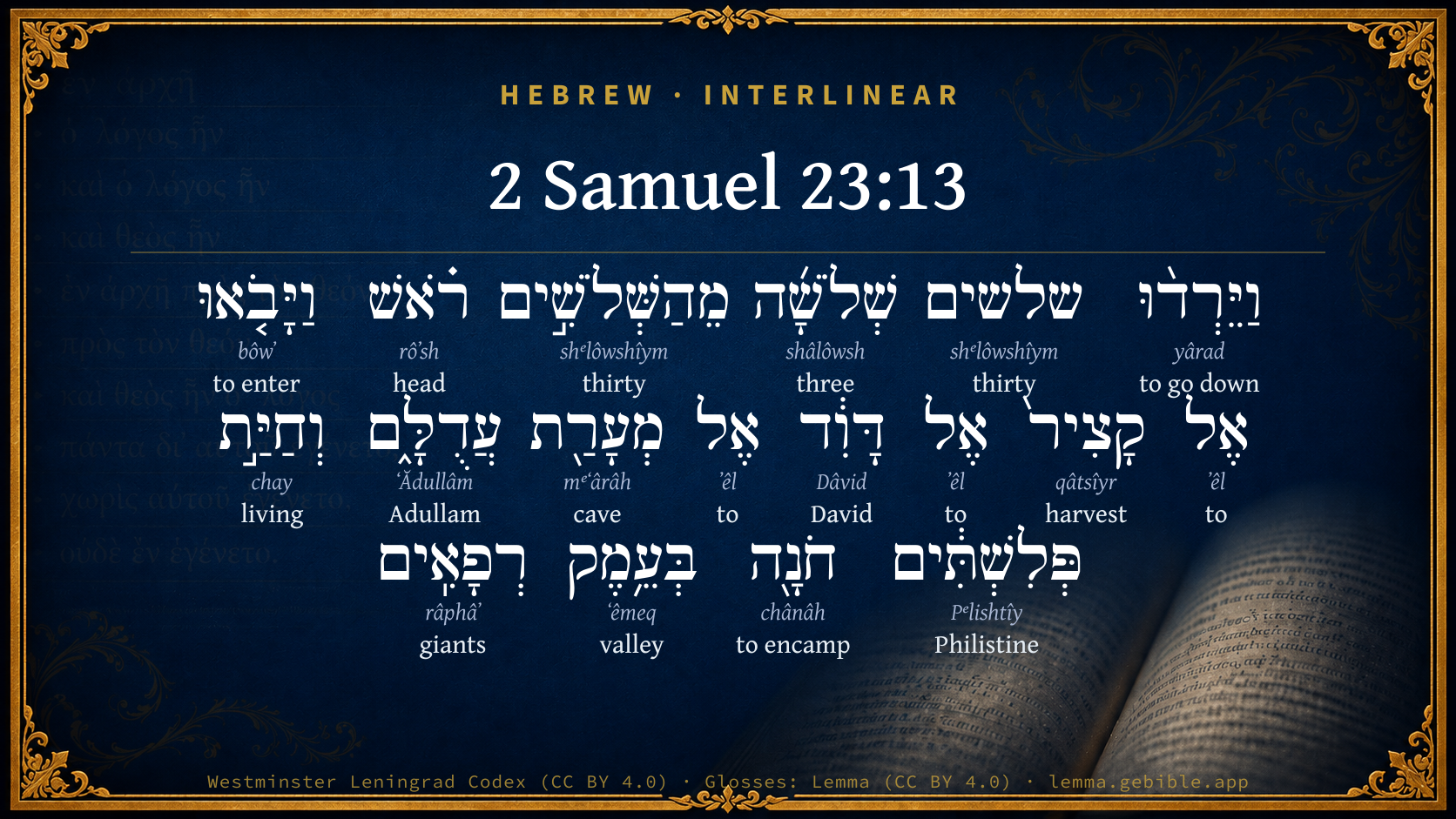
2 Samuel 23:13

Hebrew (Westminster Leningrad Codex) 2 Samuel 23:13 appears in the Hebrew Old Testament. The text above is from the Westminster Leningrad Codex. Each word links to its Strong’s number, a concise gloss, and parsing drawn from the Open Scriptures Hebrew Bible morphology. Click any word for its full Brown-Driver-Briggs (BDB) entry.
Download image
Cite this verse

2 Samuel 23:13 (World English Bible). Public Domain. Lemma interlinear Bible study tool, https://lemma.gebible.app/v/2-samuel/23/13.

Show BibTeX & RIS
BibTeX
RIS
English Translation
Three of the thirty chief men went down, and came to David in the harvest time to the cave of Adullam; and the troop of the Philistines was encamped in the valley of Rephaim.
World English Bible · Public Domain
Download a study sheet

One document with this verse’s original text, its word-by-word gloss line, the meaning frame, cross-references with their text, attributed commentary, and full source and license credits — printable, and it pastes into notes with its structure intact.

This verse Autodidact and up

Study sheet (.html) Plain text (.txt)

A passage Seminary Student

Up to 50 verses in one chapter. A passage sheet keeps up to 6 commentary sources and 12 cross-references per verse, in the order this page ranks them, and says so on the sheet whenever that leaves anything out. Ask for a single verse and you get the Autodidact verse sheet above.

Everything on this page stays free to read, with no account — the sheet is a download of what is already on screen, not access to it.

Want to remove ads? Support Godless Engineer
Compare translations 3

The same verse in 3 English versions, stacked beneath the original-language interlinear above. Click any original word for its lexicon entry.

Each is an independent rendering of the whole verse — the interlinear is not word-aligned to these translations.

Highlighted words mark where these versions differ — a whole-verse word diff, not a word-by-word alignment.

  • World English Bible Public Domain
    Three of the thirty chief men went down, and came to David in the harvest time to the cave of Adullam; and the troop of the Philistines was encamped in the valley of Rephaim.
  • King James Version Public Domain
    And three of the thirty chief went down, and came to David in the harvest time unto the cave of Adullam: and the troop of the Philistines pitched in the valley of Rephaim.
  • unfoldingWord Literal Text CC BY-SA 4.0
    And three from the head Thirty went down, and they came to the harvest, to David, to the cave of Adullam. And a troop of Philistines was camping in the Valley of the Raphaites.

unfoldingWord Literal Text — © unfoldingWord, licensed CC BY-SA 4.0. Word-aligned USFM3 via Door43 (git.door43.org/unfoldingWord/en_ult).

Versions to compare (up to 4)

3 of 4 selected

Show all 18 translations

Every available English version of this verse, each an independent rendering of the whole verse.

  • World English Bible Public Domain
    Three of the thirty chief men went down, and came to David in the harvest time to the cave of Adullam; and the troop of the Philistines was encamped in the valley of Rephaim.
  • Berean Standard Bible Public Domain
    At harvest time, three of the thirty chief men went down to David at the cave of Adullam, while a company of Philistines was encamped in the Valley of Rephaim.
  • Majority Standard Bible Public Domain
    At harvest time, three of the thirty chief men went down to David at the cave of Adullam, while a company of Philistines was encamped in the Valley of Rephaim.
  • King James Version Public Domain
    And three of the thirty chief went down, and came to David in the harvest time unto the cave of Adullam: and the troop of the Philistines pitched in the valley of Rephaim.
  • American Standard Version (1901) Public Domain
    And three of the thirty chief men went down, and came to David in the harvest time unto the cave of Adullam; and the troop of the Philistines was encamped in the valley of Rephaim.
  • Revised Version (1885) Public Domain
    And three of the thirty chief went down, and came to David in the harvest time unto the cave of Adullam; and the troop of the Philistines were encamped in the valley of Rephaim.
  • Geneva Bible (1599) Public Domain
    Afterward three of the thirtie captaines went downe, and came to Dauid in the haruest time vnto the caue of Adullam, and the hoste of the Philistims pitched in the valley of Rephaim.
  • Douay-Rheims (1899) Public Domain
    Moreover also before this the three who were princes among the thirty, went down and came to David in the harvest time into the cave of Odollam: and the camp of the Philistines was in the valley of the giants.
  • Young's Literal Translation Public Domain
    And three of the thirty heads go down and come unto the harvest, unto David, unto the cave of Adullam, and the company of the Philistines are encamping in the valley of Rephaim,
  • Literal Standard Version CC BY-SA 4.0
    And three of the thirty heads go down and come to the harvest, to David, to the cave of Adullam, and the company of the Philistines are encamping in the Valley of Rephaim,
  • Unlocked Literal Bible CC BY-SA 4.0
    Three of the thirty soldiers went down to David at harvest time, to the cave of Adullam. The army of the Philistines was camped in the Valley of Rephaim.
  • unfoldingWord Literal Text CC BY-SA 4.0
    And three from the head Thirty went down, and they came to the harvest, to David, to the cave of Adullam. And a troop of Philistines was camping in the Valley of the Raphaites.
  • Darby Bible Public Domain
    And three of the thirty chiefs went down, and came to David in the harvest time to the cave of Adullam, when the troop of the Philistines was encamped in the valley of Rephaim.
  • World Messianic Bible Public Domain
    Three of the thirty chief men went down, and came to David in the harvest time to the cave of Adullam; and the troop of the Philistines was encamped in the valley of Rephaim.
  • Webster's Bible Public Domain
    And three of the thirty chiefs went down, and came to David in the harvest time to the cave of Adullam: and the troop of the Philistines encamped in the valley of Rephaim.
  • Free Bible Version CC BY-SA 4.0
    At harvest-time, the Three, who were part of the Thirty leading warriors, went down to meet David when he was at the cave of Adullam. The Philistine army was camped in the valley of Rephaim.
  • Bible in Basic English Public Domain
    And three of the thirty went down at the start of the grain-cutting, and they came to David at the strong place of Adullam; and the band of Philistines had taken up their position in the valley of Rephaim.
  • JPS Tanakh (1917) Public Domain
    And three of the thirty chief went down, and came to David in the harvest time unto the cave of Adullam; and the troop of the Philistines were encamped in the valley of Rephaim.

Literal Standard Version (2020), Covenant Press — licensed CC BY-SA 4.0. Text via the HelloAO Bible API (eBible.org). Unlocked Literal Bible (unfoldingWord) — licensed CC BY-SA 4.0. Text via the HelloAO Bible API (eBible.org). unfoldingWord Literal Text — © unfoldingWord, licensed CC BY-SA 4.0. Word-aligned USFM3 via Door43 (git.door43.org/unfoldingWord/en_ult). Free Bible Version, Dr. Jonathan Gallagher — licensed CC BY-SA 4.0. Text via the HelloAO Bible API (eBible.org).

Word by word

More ways to search: Search by grammar → Find every occurrence → Compare this word →

Practice this passage: Drill this verse → Learn its vocabulary →

עֲדֻלָּ֑ם
ʻĂdullâm
H5725
“Adullam”
Noun, Proper
Part of Speech
Noun
Type
Proper
Full BDB Definition

Origin: probably from the pass. part. of the same as H5724

TWOT: None

Adullam = "justice of the people" - a town of the Canaanites allotted to Judah and lying in the lowlands; site of the cave where David hid
  1. וַיֵּרְד֨וּ yârad H3381 “and · to go down” Conjunction + Verb, Qal, Sequential Imperfect, 3rd Person, Masculine, Plural
  2. שלשים shᵉlôwshîym H7970 “thirty” Adjective, Cardinal number, Both, Plural, Absolute
  3. שְׁלֹשָׁ֜ה shâlôwsh H7969 “three” Adjective, Cardinal number, Masculine, Singular, Absolute
  4. מֵהַשְּׁלֹשִׁ֣ים shᵉlôwshîym H7970 “from · the · thirty” Preposition + Particle, Definite Article + Adjective, Cardinal number, Both, Plural, Absolute
  5. רֹ֗אשׁ rôʼsh H7218 “head” Noun, Common, Masculine, Singular, Absolute
  6. וַיָּבֹ֤אוּ bôwʼ H935 “and · to enter” Conjunction + Verb, Qal, Sequential Imperfect, 3rd Person, Masculine, Plural
  7. אֶל ʼêl H413 “to” Preposition
  8. קָצִיר֙ qâtsîyr H7105 “harvest” Noun, Common, Masculine, Singular, Absolute
  9. אֶל ʼêl H413 “to” Preposition
  10. דָּוִ֔ד Dâvid H1732 “David” Noun, Proper
  11. אֶל ʼêl H413 “to” Preposition
  12. מְעָרַ֖ת mᵉʻârâh H4631 “cave of” Noun, Common, Feminine, Singular, Construct
  13. וְחַיַּ֣ת chay H2416 “and · living of” Conjunction + Noun, Common, Feminine, Singular, Construct
  14. פְּלִשְׁתִּ֔ים Pᵉlishtîy H6430 “Philistines” Noun, Gentilic, Masculine, Plural, Absolute
  15. חֹנָ֖ה chânâh H2583 “encamping” Verb, Qal, Participle Active, Feminine, Singular, Absolute
  16. בְּעֵ֥מֶק ʻêmeq H6010 “in/at · valley of” Preposition + Noun, Common, Masculine, Singular, Construct
  17. רְפָאִֽים râphâʼ H7497 “giants” Noun, Proper

About this verse

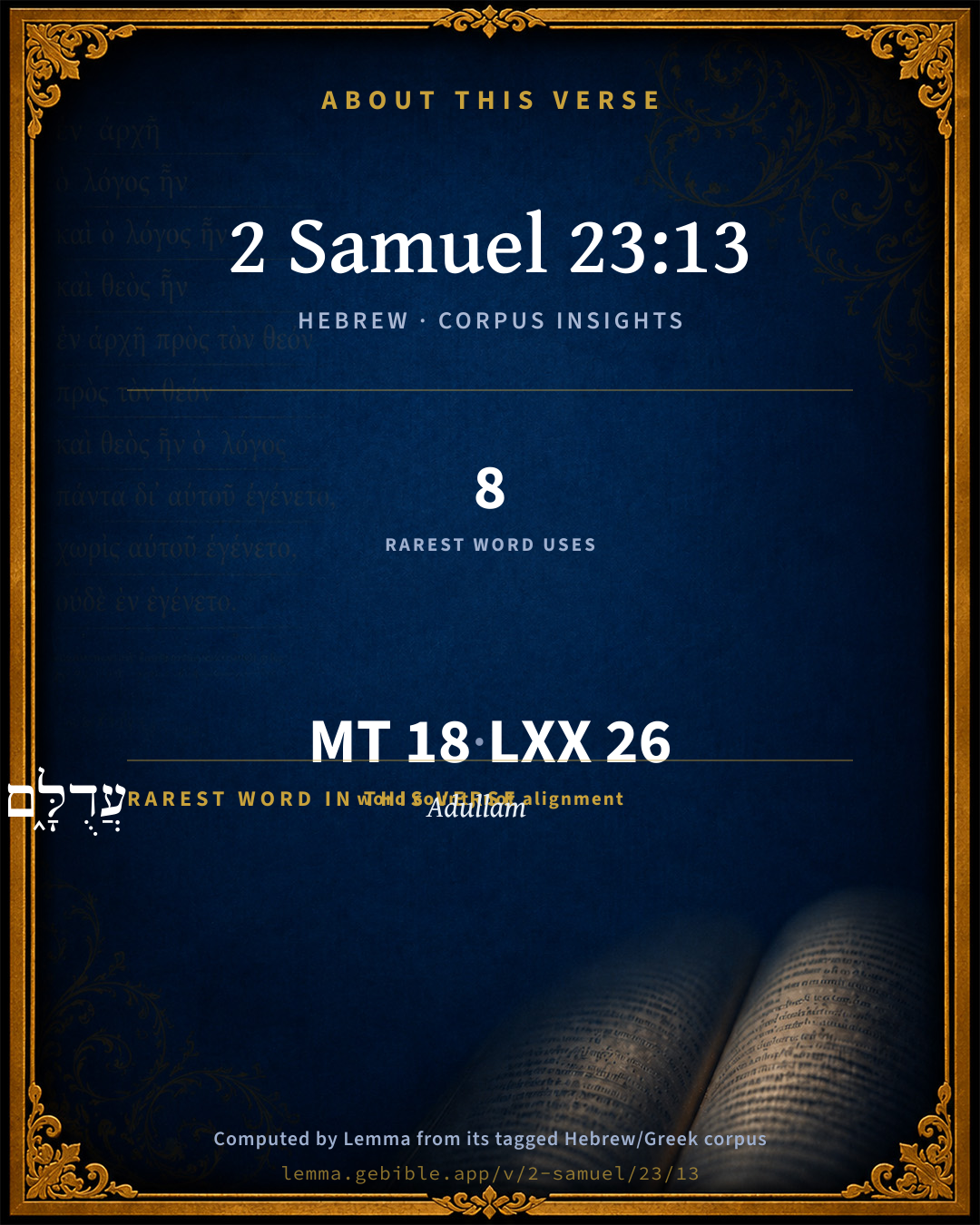
These counts appear in no published source. They are computed here, from the morphology-tagged text and Lemma’s own curated glosses. What Lemma adds →

18
words
15
distinct lemmas
Historical
section

Notable vocabulary

The rarest word here is עֲדֻלָּ֑ם Adullam H5725 — appearing just 8 times in the whole Hebrew Bible.

Shared distinctive vocabulary

עֲדֻלָּ֑ם Adullam H5725 occurs in 8 verses of the Hebrew Bible. Also found in:

Grammatical profile

  • 3 verbs
  • 9 nouns
  • 3 adjectives
  • 3 prepositions

Verb forms

  • וַיֵּרְד֨וּ Qal · Sequential Imperfect
  • וַיָּבֹ֤אוּ Qal · Sequential Imperfect
  • חֹנָ֖ה Qal · Participle Active

Repetition

Words recur within this verse — often emphatic in Hebrew:

  • שלשים thirty H7970 ×2
  • אֶל to H413 ×3

Hebrew & Septuagint length

In English translation the verse runs 34 words from the Hebrew and 35 from the Septuagint (LXX English) — closely comparable.

A rough comparison of the two English renderings, which tokenize alike — not a word-level alignment.

Word counts can differ between the Hebrew and the Greek without any difference in meaning — e.g. the Hebrew direct-object marker אֵת has no separate Greek word, and Greek often adds the article ὁ.

In the original languages it is 18 Hebrew tokens and 26 Greek tokens — but the two are counted differently (Hebrew bundles its prefixes and suffixes into one token; the Greek is in lemma form), so that isn’t a like-for-like length.

Cross-references

9

Topical passages linked to 2 Samuel 23:13 in the Treasury of Scripture Knowledge — connected by theme and wording, ordered by reader-vote popularity; previews shown in the World English Bible.

  • 1 Samuel 22:1 David therefore departed there, and escaped to the cave of Adullam: and when his brothers and all his father's house heard it, they went down there to him.
  • 2 Samuel 5:18 Now the Philistines had come and spread themselves in the valley of Rephaim.
  • Joshua 12:15 the king of Libnah, one; the king of Adullam, one;
  • Joshua 15:35 Jarmuth, and Adullam, Socoh, and Azekah,
  • 2 Samuel 5:22 The Philistines came up yet again, and spread themselves in the valley of Rephaim.
  • 1 Chronicles 11:15–19 Three of the thirty chief men went down to the rock to David, into the cave of Adullam; and the host of the Philistines were encamped in the valley of Rephaim.
  • 1 Chronicles 14:9 Now the Philistines had come and made a raid in the valley of Rephaim.
  • Isaiah 17:5 It shall be as when the harvester gathers the standing grain, and his arm reaps the ears; yes, it shall be as when one gleans ears in the valley of Rephaim.
  • Micah 1:15 I will yet bring to you, inhabitant of Mareshah, He who is the glory of Israel will come to Adullam.

Cross-references courtesy of OpenBible.info (CC BY 4.0).

Hebrew and Greek witnesses Masoretic Hebrew ↔ Greek Septuagint

The same verse in the two great witnesses to the Old Testament, shown verse-for-verse.

These are two independent witnesses, not word-aligned to each other, and the Septuagint is shown in lemma (dictionary) form.

Hebrew 2 Samuel 23:13 Masoretic · Westminster Leningrad Codex

וַיֵּרְד֨וּ שלשים שְׁלֹשָׁ֜ה מֵהַשְּׁלֹשִׁ֣ים רֹ֗אשׁ וַיָּבֹ֤אוּ אֶל קָצִיר֙ אֶל דָּוִ֔ד אֶל מְעָרַ֖ת עֲדֻלָּ֑ם וְחַיַּ֣ת פְּלִשְׁתִּ֔ים חֹנָ֖ה בְּעֵ֥מֶק רְפָאִֽים

Three of the thirty chief men went down, and came to David in the harvest time to the cave of Adullam; and the troop of the Philistines was encamped in the valley of Rephaim.

World English Bible · Public Domain

Greek LXX 2 Samuel 23:13 Septuagint · lemma form

καί καταβαίνω τρεῖς ἀπό ὁ τριάκοντα καί ἔρχομαι εἰς κασων πρός δαυίδ εἰς ὁ σπήλαιον οδολλαμ καί τάγμα ὁ ἀλλόφυλος παρα ἐνβάλλω ἐν ὁ κοιλάς ραφαϊμ

And three out of the thirty went down, and came to Cason to David, to the cave of Odollam; and there was an army of the Philistines, and they encamped in the valley of Raphain.

LXX2012 (modern English Septuagint) · Public Domain

On this verse, Haydock's Catholic Bible Commentary discusses the Septuagint’s reading. Read the note in Commentary ↓

Hebrew: Westminster Leningrad Codex (CC BY 4.0). Greek: Septuagint (public domain); English from LXX2012 (modern English Septuagint) (Public Domain). How the Septuagint differs from the Hebrew →

Targum (Aramaic paraphrase)

1

The Targum is the ancient Jewish Aramaic paraphrase of the Hebrew Scriptures — an interpretive translation, not the Hebrew text itself. Onkelos (literal) and Pseudo-Jonathan (expansive) render the Torah, and Jonathan the Prophets. Coverage is partial: where no permissively-licensed English translation exists for a verse, only the Aramaic is shown. This is verse-level text, not a word-by-word alignment to the Hebrew.

  1. Targum Jonathan Prophets (Joshua–Malachi)
    וּנְחָתוּ תְלָתָא גִבָּרַיָא מִגִבָּרֵי רֵישֵׁי מַשִׁרְיָתָא וַאֲתוֹ לַחֲצָדָא לְוַת דָוִד לִמְעָרַת עֲדֻלָם וּמַשִׁרְיַת פְּלִשְׁתָּאֵי שַׁרְיָא בְּמֵישַׁר גִבָּרַיָא:

    (no public-domain English translation for this verse)

    Targum Jonathan — Aramaic: “Mikraot Gedolot” (public domain). English: “Sefaria Community Translation” (CC0 1.0 (public-domain dedication)); “London "Chaldee Paraphrase," 1871” (public domain). Text via Sefaria.

Commentary

Notes on 2 Samuel 23:13 from classic Christian and Jewish commentators (each source and its license shown beneath its notes). The classic Christian expositions comment on the surrounding passage and are grouped to its opening verse, so a note may address several verses; the Jewish commentaries on the Tanakh (Rashi and others) are per-verse, so they appear only where the commentator wrote on this verse.

Lemma curates 59 commentaries, every one of them public domain or Creative Commons licensed, each selected and text-cleaned for this edition rather than reprinted as found. About our sources →

Trapp's Complete Commentary

John Trapp

2Sa 23:13 And three of the thirty chief went down, and came to David in the harvest time unto the cave of Adullam: and the troop of the Philistines pitched in the valley of Rephaim.

Ver. 13. And three of the thirty chief.] Or, The three captains over the thirty; viz., those three afore mentioned.

In the valley of Rephaim.] About the beginning of David’s reign. {2Sa 5:17-18}

John Trapp, A Commentary or Exposition upon All the Books of the Old and New Testament (1647–1656) — public domain. Text from a community e-Sword module.

The Biblical Illustrator

Joseph S. Exell

2Sa_23:13-17

And three of the thirty chiefs went down.

The dear-bought draught

I do not think that this was what you might call a mere sentimental longing. David was strong in true and real sentiment; but I do not think that when we have him pictured here longing and sighing, that he was, as some have supposed, merely suffering from passing home-sickness. Some take that view, and imagine that he just momentarily gave way to one of those whims or morbidities that come across the spirits of otherwise brave and earnest men, and make them as weakly sentimental as their neighbours. When I read that David longed, and I hear his longing set forth, I like to think of him as showing here something of his deepest and best. The Spirit of God would make us know that He understands us when we are like David. There is a depth in us; a deep below, perhaps, what we ourselves, in our commonplaces, were unaware of. The hard-beaten bottom or floor of our soul sometimes gives way. Many a time and oft, when we are not thinking, or ever we are aware, these common, ordinary, worldly hearts of ours are cleft as by a great chasm and depth, through which there comes, like the breath of the mountain wind sighing through a gorge, a great, inexhaustible Oh! Like David, we long! Oh, for youth; oh for renewal; oh for freshness; oh to get rid of what, is making me tame, and flat, and dull; of the earth, earthy; and of the world, worldly! You see, there was a great deal in that water. There is no water like the water we drank at home, when we were young. Is that sentimental? Is not that feeling derived from something deep and true within the soul? It is more than ordinary water. What memory brings into mind of all the years that have come and gone between! And this water of the well is the type, and symbol, and picture of it--the rush of the spring, with the sheen and the bubble of the water, We are not so utterly dead, and dark, and given up as we seem to-day. God can open rivers in dry places. He can pierce down, down through all the mortification and all the corruption; through all the sand and sawdust; all that is earthly and carnal--clown to the quick. Then up there comes that burdened sigh--Oh for living water! oh for cooling streams! Rightly used, it leads the longing soul back to more than original purity. And this is also a type of the cry of the backslider who once knew the joys of salvation; who once lived in Bethlehem, the House of Bread; and drank of the well that bubbles up from beneath its walls. Ah, yes, we repeat it again, there is a great deal in a drink, in what it suggests. Oh, may you get that suggestion and the satisfaction of it to-day. Oh! that I could get back to God, the living God! Do not go easily over that word: David longed. Oh that God would give us to-day longing hearts, to find Him out. For you will never find out God by greater intellect; never by wider reading and deeper study. This is the road to God; this is the new organ by which we receive the truth that alone can satisfy. As the hart panteth after the water-brooks, so panteth my soul after thee, O God. May it be given us to-day to taste, and see that God is good. Davids desire was gratified. The three mighty men said, He shall have it. Shall I say one had wisdom, and the other love, and the other power; and these three together scattered the powers of Philistia? Oh! dont you see how the Gospel breaks out upon us? You yearn for something the possession of which would be the renewing of your youth; the lack of which is decay; and your longing is heard, and your prayer answered before you know it. The Three Mighties, the Blessed and Glorious Three, Wisdom, Love, Might, have broken the host of the Philistines, and liars brought to us--right to our parched lips--before our sighing is done, that bubbling spring for lack of which we die. I knew the Gospel was there. I knew it when I read the story. I felt it more deeply the longer I studied it. Do not accuse me of dragging things in--of putting the Gospel where it is not. The grand key to open the Old Testament is Christ--put Him in wherever He will fit, and certainly He will fit here. Still further, the story deepens in interest. Nevertheless, he would not drink thereof, but poured it out unto the Lord. Here we have the very crown and flower of Gospel teaching. What ought this great love of God to produce in our hearts? What did this great love of these three mighty men produce in Davids heart? It begot in him a like spirit again. They flung themselves away for him; he flung himself, and them with him, back Upon God, the Fount and Spring of all. So with us: Christ has brought us pardon, and peace, and everlasting life. But let Christs sacrifice produce a self-sacrificing spirit in you--as Christ flung Himself away for you, so fling your life away for God--and you will enjoy it. It has been brought to you; lay yourself, body, soul, and spirit, on the altar--it is your reasonable sacrifice. Give now your money, for money is a covenant blessing. It is one rill of the fountain that comes from the well--the spring of Bethlehem. (J. McNeill.)

Longing for the water of the well of Bethlehem

It must have been a rare and imposing assembly that came to crown David king of all Israel. The Chronicles record the names and numbers of the principal contingents that were present on that memorable occasion. The Philistines, however, were watching the scene with profound dissatisfaction. So long as David was content to rule as a petty king in Hebron, leaving them free to raid the northern tribes at their will, they were not disposed to interfere; but when they heard that they had anointed David king over all Israel, all the Philistines went down to seek David. They probably waited until the august ceremonial was over, and the thousands of Israel had dispersed to their homes, and then poured over into Judah in such vast numbers--spreading themselves in the Valley of Ephraim, and cutting off Davids connection with the northern tribes--that he was forced to retire with his mighty men and faithful six hundred to the hold, which, by comparison of passages, must have been the celebrated fortress-cave of Adullam (2Sa_5:17; 2Sa_22:13-14.)

I. A sudden reversal of fortune. It was but as yesterday that David was the centre of the greatest assembly of warriors that his land had seen for many generations. With national acclaim he had been carried to the throne of a united people. He realised that he was fondly enshrined in the hearts of his countrymen; but to-day he is driven from Hebron, where for more than seven years he had dwelt in undisturbed security, back to that desolate mountain fastness, in which years before tie had taken refuge from the hatred of Saul. It was a startling reversal of fortune, a sudden overcasting of a radiant noon, a bolt out of a clear sky. Such sudden reversals come to us all--to wean us from confidence in men and things; to stay us from building our nest on any earth-grown tree; to force us to root ourselves in God alone. Child of mortality, such lessons will inevitably be set before thee to learn. In the hour of most radiant triumphs, thou must remember Him who has accounted thee fit to be his steward; thou must understand that thy place and power are thine only as His gift, and as a trusteeship for His glory. This contrast between the anointing of Hebron and the conflict of Adullam presents a striking analogy to the experiences of our Lord, who, after His anointing at the banks of the Jordan, was driven by the Spirit into the wilderness of Judaea to be forty days tempted of the devil. It is the law of the spiritual life. The bright light of popularity is too strong and searching for the perfect development of the Divine life. Loneliness, solitude, temptation, conflict--these are the flames that burn the Divine colours into our characters; such the processes through which the blessings of our anointing are made available for the poor, the broken-hearted, the prisoners, the captives, and the blind.

II. Gleams of light. The misty gloom of these dark hours was lit by some notable incidents. The mighty men excelled themselves in single combats with the Philistine champions. What marvels may be wrought by the inspiration of a single life! We cannot but revert in thought to that hour when, hard by that Very spot, an unknown youth stepped forth from the affrighted hosts of Israel to face the dreaded Goliath. Thus the lives of great men light up and inspire other lives. They mould their contemporaries. The inspiration of a Wesleys career raises a great army of preachers. The enthusiasm of a Carey, a Livingstone, a Paten stirs multitudes of hearts with missionary zeal. Those who had been the disciples of. Jesus became his apostles and martyrs. His own life of self-sacrifice for men has become the beacon-fire that has summoned myriads from the lowland valley of selfishness to the surrender, the self-denial, the anguish of the Cross, if only they might be permitted to follow in his steps.

III. A touching incident.

Adullam was not far from Bethlehem. One sultry afternoon he was a semi-prisoner in the hold. Over yonder, almost within sight, a garrison of Philistines held Bethlehem. Suddenly an irresistible longing swept across him to taste the water of the well of Bethlehem, which was by the gate. Almost involuntarily he gave expression to the wish. How often we sigh: for the waters of the well of Bethlehem! We go back on our past, and dwelt longingly on never-to-be-forgotten memories. Oh to see again that face; to feel the touch of that gentle hand; to hear that voice! Oh to be again as in those guileless happy years, when the forbidden fruit had never been tasted! Oh for that fresh vision of life, that devotion to the Saviours service, that new glad outburst of love! Oh that one would give us a drink of the water of the well of Bethlehem, which is beside the gate! They are vain regrets; there are no, mighties strong enough to break through, the serried ranks of the years, and fetch back the past. But the quest of the soul may yet be satisfied by what awaits it in Him who said, He that drinketh of this water shall thirst again; but he that drinketh of the water that I shall give him, shall never thirst: but it shall be in him a spring of water, rising up to everlasting life. Not in Bethlehems well, but in Him who was born there, shall the souls thirst be quenched for ever.

IV. The overthrow of the Philistines.--Prosperity had not altered the attitude of Davids soul, in its persistent waiting on God. As he was when first he came to Hebron, so he was still; and in this hour of perplexity; he inquired of the Lord, saying, Shall I go up against the Philistines? Wilt Thou deliver them into mine hand? In reply, he received the Divine assurance of certain victory; and when the battle commenced, it seemed to him as if the Lord Himself were sweeping them before Him like a winter flood, which, rushing down the mountain-side, carries all before it in its impetuous rush. Again the Philistines came up to assert their olden supremacy, and again David waited on the Lord for direction. It was well that he did so, because the plan of campaign was not as before. Those that rely on Gods co-operation must be careful to be in constant touch with Him. The aid which was given yesterday in one form, will be given to-morrow in another. In the first battle the position of the Philistines was carried by assault; in the second it was turned by ambush. Sometimes we have to march, sometimes to halt; now we are called to action, again to suffering; in this battle to rush forward like a torrent; in the next to glide stealthily to ambush and wait. We must admit nothing stereotyped in our methods. What did very well in the house of Dorcas will not suit in the stately palace of Cornelius. Let there be living faith in God. Then shall we know what God can do as a mighty co-operating force in our lives, making a breach in our foes, and marching his swift-stepping legions to our succour. (F. B. Meyer, B. A.)

The well of Bethlehem

This incident, which is strangely unlike the ordinary records of history, and has about it the air of an old-world romance, is here narrated, not in chronological order, but in a review of Davids life, when that life had well-nigh reached its close and its leading events stood out in their true proportions. It occurred immediately after David had been made king at Hebron, where there was war between him and the Philistines, who had pushed their way to Bethlehem, and threatened still further advance. In times of deprivation and danger, in great crises, which life itself is hanging in the balance, the mind reverts to early and familiar scenes, and invests them with a strong and pathetic charm. The man, whose boyhood was spent at the seaside, longs for a breath of its bracing air. The Swiss mountaineer, far away from home, listens to the songs of his early days, and is seized with a restless impulse to return. The old Highland woman, dying in the Red River settlements, surrounded by miles of prairies, can find no comfort save in remembering the bens and glens which she loved so well. Oh, doctor dear, for a wee bit of a hill! Surely we can understand it. Heaven lay about us in our infancy, and, from the rough world in which we dwell it is pleasant to look back and revive the vanished glory. Davids wish seemed foolish and vain, for the foe was encamped between him and the well. To reach it was all but impossible. David no doubt knew that, and his longing was the keener in consequence. We often fail to value our privileges until we have lost them. We know their worth only when they are beyond our reach. But the expression of the kings longing was heard. They listened to his faintest wish and made it their law. It was a noble and heroic act, a deed of splendid daring, the mere recital of which rebukes our selfishness and covers our cowardice with contempt.

1. The incident affords a remarkable instance of Davids power to inspire devotion. He could have been no sordid, common-place, self-seeking usurper for whom they did this; no slave of greedy ambition, swayed only by the lust of power. He was manly, trustful, and chivalrous, as a king should be, and the enthusiasm and fidelity of his soldiers were but the answering reflection of his own nobility and grace.

2. The incident exemplifies the power and inventiveness of love. Love will laugh at impossibilities. It is quick to devise means of fulfilling its desires, and though it be tender it is also courageous. It is gentle, but full of power, and can set its face like a flint against all opposition. Love to Christ will make us pure, strong, brave and victorious. We shall scorn to serve Him with that which costs us nothing, arid for His sake we shall count all things as loss. When David had in his hand the water, which only love strong as death could have secured, he refused to drink it, and poured it on the ground unto the Lord. How fickle and capricious! we have heard men say. Not so! Far other feelings prompted the refusal. There is a higher law than self-gratification. David was the very soul of chivalry, and felt that he had no right to the water which had been brought as by priestly hands and in a cup that had on it the marks of sacrifice. To have drunk it himself would have been sacrilege. There was but One Being worthy of it--He who had inspired the heroism and devotion which secured it. David saw in the act of the captains who had jeopardised their lives for him a love, a courage, and a self-surrender of which no mortal was the fitting object.

4. The action of Davids friends is a witness on both its sides to the unselfishness and grandeur of our nature. It shows that we have other than material instincts to satisfy, that we live not by bread alone. Physical gratification, bodily ease and comfort, prosperity in all its forms leave untouched vast spaces of our worldly thought and aspiration and need; and if we possess only what they can yield, the noblest elements of our nature will be feeble and impoverished, aye, and will become the means of our acutest suffering and most dreaded retribution. When the depths of our being are stirred, we think of God and our relation to Him. We live by admiration, love, and hope. There is something dearer than material pleasure, personal safety, and even life itself to the man who has been entranced by the vision of the Divine. He reveres the majesty of truth and duty, fidelity, honour, God. It is not necessary that we should be at ease, with an abundance of pleasure and of wealth. It is not even necessary that we should continue to live, but, it is necessary that we should be true, pure, upright, godly; and to fulfil this great law of our being there is absolutely no sacrifice which we should not be prepared to make. (J. Stuart.)

Courage

When the brave and ill-fated English envoy, Cavagnari, was warned by the Ameer of Afghanistan that his life was not safe at Cabul, he coolly replied that if he were shot down, there were others ready to take his place. Whilst one cannot but honour the courage of such a man, and feel a desire to throw a wreath upon his grave, it would be the greatest possible error to imagine that the commonest spheres of civil end prosaic life, do not, many and many a time, yield instances of an equally noble, though less showy heroism. (J. Thain Davidson, D. D.)

Energetic Men

We love upright, energetic men. Pull them this way, and then that way, and the other, and they only bend, but never break. Knock them down, and in a trice they are on their feet. Bury them in the mud, and in an hour they will be out and bright. They are not ever yawning sway existence, or walking about the world as if they had come into it with only half their soul; you cannot keep them down, you cannot destroy them. But for these the world would soon degenerate. They are the salt of the earth. Who but they start any noble project? They build our cities and rear our manufactories; they whiten the ocean with their sails, and they blacken the heavens with the smoke of their steam vessels and furnace fires; they draw treasures from the mine; they plough the earth. Blessings on them! Look to them, young men, and take courage; imitate their example; catch the spirit of their energy and enterprise, and you will deserve, and no doubt command, success. (Christian Weekly.)

The Biblical Illustrator, edited by Joseph S. Exell (c. 1880s–1900s) — public domain. Text from a community e-Sword module.

Tyndale Open Study Notes

Tyndale Open Resources

23:13 The cave of Adullam was a place of refuge for David from Saul (see 1 Sam 22:1). • The valley of Rephaim was located between Bethlehem and Jerusalem (see 2 Sam 5:17-25).

Tyndale Open Study Notes — © Tyndale Open Resources, licensed CC BY-SA 4.0. Text via the HelloAO Bible API.

Geneva Bible (1599)

Geneva Bible translators

Or, giants.

Geneva Bible (1599) marginal notes — public domain. Text via Bolls.life.

Adam Clarke's Commentary

Verse 13. And three of the thirty] The word שלשים shalishim, which we translate thirty, probably signifies an office or particular description of men. Of these shalishim we have here thirty-seven, and it can scarcely be said with propriety that we have thirty-seven out of thirty; and besides, in the parallel place, 1Ch 11:11-47, there are sixteen added. The captains over Pharaoh's chariots are termed שלשים shalishim, Ex 14:7.

The Philistines pitched in the valley of Rephaim.] This is the same war which is spoken of 2Sa 5:17, &c.

Adam Clarke's Commentary on the Bible (1810–1826) — public domain. Text from a community e-Sword/MySword module.

Ellicott's Commentary for English Readers

(13) Three of the thirty.—For “three” the Hebrew text reads “thirty” by a manifest error, which is corrected in the margin. These are not the same three (since there is no definite article) with those just mentioned, but were another three more eminent than the rest of the thirty, two of them being, no doubt, Abishai and Benaiah (2Sa_23:18; 2Sa_23:23). “The thirty” seems to have been a common name for this band of heroes (comp. 2Sa_23:23-24, &c), who were perhaps originally exactly thirty, but whose number varied from time to time, being here given (2Sa_23:39) as thirty-seven.

In the harvest time.—“The preposition does not mean in, and the reading in 1Ch_11:15 ‘to the rock’ is perhaps the true one” (Kirkpatrick). On “the valley of Rephaim,” see Note on 2Sa_5:18.

A Bible Commentary for English Readers, edited by Charles John Ellicott (1878–1897) — public domain. Text from a community e-Sword module.

The Cambridge Bible for Schools and Colleges

gen. ed. J. J. S. Perowne

13. three of the thirty chief] Not the three mentioned before, but in all probability Abishai, Benaiah, and a third not named, who were promoted from the “Thirty” to form a second triad as a reward for this feat of valour.

in the harvest time] The preposition does not mean in, and the reading of 1Ch_11:15 to the rock is perhaps the true one.

the cave of Adullam] David’s old haunt in the valley of Elah. See note on 1Sa_22:1.

the valley of Rephaim] See note on ch. 2Sa_5:18. The mention of the “hold” and this valley together in both narratives makes it not improbable that the exploit of the three heroes occurred in the invasion related in ch. 2Sa_5:17 ff.

13–17. The water of the well at Beth-lehem

The Cambridge Bible for Schools and Colleges (gen. ed. J. J. S. Perowne; Cambridge University Press, 1878–1918) — public domain. Text from a community e-Sword module.

John Gill's Exposition

And three of the thirty chiefs went down,.... Or three that were chief of the thirty, superior to them; which some understand of the three before mentioned, so Josephus (w); and that having related some particular exploits of theirs, here observes one, in which they were all concerned; and others think the three next are meant, of whom Abishai was the chief, Benaiah the next, and the third Asahel; but the first sense is best:

and came to David in the harvest time, unto the cave of Adullam; not when he was there, upon his flight from Saul, Sa1 22:1; but after he was king, when engaged in war with the Philistines; perhaps wheat harvest is here meant:

and the troop of the Philistines pitched in the valley of Rephaim; the army of the Philistines, as the Targum; of the valley of Rephaim; see Gill on Jos 15:8.

(w) Antiqu. l. 7. c. 12. sect. 4.

John Gill's Exposition of the Whole Bible (1746–1763) — public domain (CC PDM 1.0). Text via the HelloAO Bible API.

Albert Barnes' Notes on the Bible

The feat at Bethlehem by three of the thirty was the occasion of their being formed into a distinct triad; Abishai 2Sa 23:18, Benaiah 2Sa 23:20, and a third not named, were probably the three.

In the harvest time - An error for “to the rock” (compare the marginal reference).

The troop of the Philistines - The word rendered “troop” occurs in this sense only here (and, according to some, in 2Sa 23:11), and perhaps in Psa 68:11. In 1 Chr. 11, as in 2Sa 23:16 the reading is “host” or “camp,” which may be the true reading here.

Pitched - The same Hebrew word as “encamped” in 1Ch 11:15.

Valley of Rephaim - Or Giants. See 2Sa 21:16 note.

Albert Barnes' Notes on the Bible (1834–1885) — public domain. Text from a community e-Sword/MySword module.

Haydock's Catholic Bible Commentary

Before this. The exploits performed before the death of Goliath have been recorded. The following took place soon after the taking of Jerusalem. Hebrew simply, "And three of the Schalischim came to David at harvest-time, (Paralipomenon more correctly, to the rocks,) and into the cave," &c. (Calmet) --- Three is undoubtedly the proper word, though the printed Hebrew copies have thirty in the text; except the most ancient edition of Ximenes, 1515, which retains three, with all the versions, and some Hebrew manuscripts and as ver. 17. itself reads among would be better above; (ver. 23,) as the three officers aforesaid were not of the body of thirty, but of a still higher order. --- Harvest. Hebrew el Katsir, is never used elsewhere in this sense; and the Septuagint have left the latter word as a proper name, "at Kasoar;" etsur seems to have been the original word, as in Paralipomenon, "to the rock." Such places had frequently caverns or strong holds, 1 Kings xxiv. 1, 4. --- Camp. The Septuagint also seem to have read mene, as in Paralipomenon, instead of eith, which never occurs, for "a troop." (Kennicott) --- This camp was distant from the station at Bethlehem, (Menochius) which was distant from Jerusalem "two hours travel." (Maundrell) --- Giants, or Raphaim, 2 Kings xxi. 18. (Menochius)

George Leo Haydock (1774–1849), Haydock's Catholic Family Bible and Commentary, 1859 edition — public domain. Excludes Psalms (Douay-Rheims chapter numbering differs from Protestant) and Deuterocanonical books (Catholic canon only).

Matthew Poole's English Annotations

Three of the thirty; either,

1. The three already named, as is generally supposed, because it is said of them, in the close of this history, 1Ch 11:19, These things did these three mightiest. But in the Hebrew it is only these three mighty men, as the same words are rendered here, 2Sa 23:17. Or rather,

2. The following

three; for it is expressly said, both here, 2Sa 23:18, and 1Ch 11:20, that

Abishai was chief, and therefore one of the three; and this three are plainly distinguished from the first three, 2Sa 23:19; 1Ch 11:25.

Unto the cave of Adullam; which was a strong place, where David had been before, 1Sa 22:1, &c., and where he had now again fortified himself in the beginning of his reign, when the Philistines were too strong for him.

In the valley of Rephaim; of which see above, 2Sa 5:18.

Matthew Poole's English Annotations on the Holy Bible (1683–1685) — public domain. Text from a community e-Sword/MySword module.

Whedon's Commentary on the Bible

Daniel D. Whedon

13. Three of the thirty chief — That is, of the thirty whose names are given in 2Sa_23:24-39. Their names are not designated here, and this reference to them is too indefinite to be understood of the three just mentioned, namely, Jashobeam, Eleazar, and Shammah.

Came to David — Put themselves under his command when he was fleeing before Saul, and had taken refuge in the cave of Adullam. See 1Sa_22:1-2.

Pitched in… Rephaim — This was in all probability the same battle as that described in 2Sa_5:17-21, and occurred after David had been anointed king over Israel, but before he had taken up his settled residence in Jerusalem. See notes at that place. It is not said that this exploit occurred at the time these heroes first joined David’s band of men, as some have assumed.

Daniel D. Whedon (gen. ed.), Commentary on the Old and New Testaments (1874–1909) — public domain. Text from a community e-Sword module.

The Pulpit Commentary

And three. The Hebrew text has "thirty," for which both the Authorized Version and the Revised Version silently substitute "three," as is correctly given in Chronicles. The absence of the article shows that these three were not Jashobeam, Eleazar, and Shammah, but probably Abishai, Be-naiah, and another whose name and exploits have been purposely omitted both here and in Chronicles. Apparently this narrative, so interesting as showing the fascination which David exercised over his men, is given as having led to the institution of this second order of three in the brotherhood of the mighties. In the harvest time. The Hebrew is "to harvest," but in 1Ch_11:15 "to the rock." As the preposition used here cannot mean "in," this is probably the right reading. In this ease, also, it is the similarity of the words that has led to the con. fusion. Is it possible that these lists were taken from very old and worn catalogues, which it was very difficult to decipher?

Vers. 13-17. (1Ch_11:15-19)

The well of Bethlehem.

When a shepherd-youth, David doubtless often sat beside "the well by the gate," and refreshed himself with its cold, clear, sparkling water. But those days have long since departed; and he is now a king, with many cares. Bethlehem is occupied by a part of the Philistine host, and he is once more in "the hold" (2Sa_5:17; 1Sa_21:1) accompanied by his heroic band of men, to whom his every wish is equivalent to a command. "What a circle of names are associated with his name. some of them names and scarce anything beside men who would have been unheard of but for the occasions which brought them into temporary connection with so famous a man, and of whose lives, apart from that connection, we know nothing; yet all of whom had a life, had a character, were as precious as individuals in the eye of God as the great soul to whom they owe what little interest they have in the eyes of men!" The names of these three "knights" are not recorded; but their chivalrous achievement is immortalized. "God knows them, as he knows the noble acts of all his saints and martyrs, and will reward them at the great day" (Wordsworth). In the threefold scene here described we have

I THE NATURAL WISH expressed by the king. "Oh that one would give me drink!" etc. (ver. 15). It is:

1. Involuntarily excited. "In the harvest time," oppressed with heat, and exhausted by conflict and toil, David is parched with thirst, and overcome with a great longing for a refreshing draught from the well of Bethlehem, whose familiar walls he, perchance, sees from a distance. So men sometimes desire, not merely the satisfaction of bodily appetites, but also the gratification of deeper yearnings, for youth and home, and happier conditions and experiences. "Oh that I had wings like the dove!" etc. (Psa_55:6)

1. In itself innocent. Many a wish, even for objects at present out of reach and beset by difficulty and peril, is as blameless as the thirst of a traveller "in a dry and weary land where no water is." Although it may be "according to nature" (in the best sense), it nevertheless requires to be controlled, regulated, and subordinated to a higher law than that of pleasing ourselves; and it is, too frequently:

2. Inordinately indulged; so that it becomes a dominant selfish impulse. "The habit of wishing and hankering for those things which Providence denies, though natural to us and often given way to, even by godly men, in an unguarded hour, is a degree of rebellion against the Lord; and it shows the remaining sensuality and selfishness of the heart, and leads to many snares and evils" (Scott).

3. Inconsiderately uttered. David may not intend his men to hear what he says (still less to challenge their devotion); he may hardly be aware of their presence. But, knowing their character and his relation to them, he is none the less responsible for the effect of his words upon them; and should have put a bridle on his tongue. (Psa_39:1 Psa_106:33 Psa_141:3) Unregulated impulses and imprudent speech what mischief have they wrought in the world! "Watch and pray, lest ye enter into temptation.

II THE HEROIC DEED performed by his followers. "And the three mighty men broke through the host," etc. (ver. 16). "It was a foolhardy thing to do," some one says; "they might easily have seen that a draught of water was not worth the conflict and hazard necessary to obtain it." Happily they did not see it; else we had never heard of their heroic enterprise. Without calculating consequences, they act from a sense of duty, an impulse of unselfish devotion, a spirit of chivalry, "which shrinks from no sacrifice in order to do the smallest service for the object of its devotion;" therein exhibiting:

1. An intense attachment to their leader, love to his person, sympathy with his need, loyalty to his office, desire to please him and to do his will (as they interpreted it). It could have been inspired in them only by a man of great ability, generosity, and enthusiasm. They learnt it of him. (1Sa_17:50) His self-indulgent and momentary wish was no true index of his prevailing disposition.

2. A spontaneous, prompt, and cheerful purpose and endeavour. They say nothing and do not hesitate, but go together "into the jaws of death.

3. Invincible courage; a principle which is as needful in moral and spiritual conflict as in physical warfare. (2Sa_10:12) "Most probably it made such an impression as rendered the host of the Philistines an easy prey to the Israelites" (Blaikie).

4. Entire self-denial and self-sacrifice; disregarding alike their own pleasure and peril, and laying down their lives for his sake. "Greater love hath no man," etc.. (Joh_15:13) "Pure love has its measure in itself, and disregards in its outward expression every critic. (Mat_26:7-13) This exploit of the three heroes was a sacrifice offered, not so much to the man David, as rather in him to the "Anointed of the Lord," and therefore to the Lord himself" (Krummacher). How does it rebuke our lack of devotion so our Divine King Were we as ardent, loyal, courageous, and self-sacrificing as they, what victories should we gain over his adversaries and ours!

III THE SACRED OFFERING presented before the Lord. "And he would not drink thereof," etc. For the first time, probably, he becomes acquainted with their desperate exploit, when they come into his presence, stained with blood, and place the vessel, containing the water for which he longed, in his hands. To him it is as if it were their blood, and he cannot drink it. (Lev_17:11, Lev_17:12) To do so would be to justify his former wish, and gratify himself at the hazard of their lives. Their devotion evokes within him a nobler feeling and impulse than he before displayed; so that he practically confesses his fault, personally shares their suffering and self-denial, and publicly testifies his thankfulness for their preservation and his devotion to their welfare. And this he does in the highest and most effectual manner by making of their gift a libation, (1Sa_7:6) or drink offering, and thereby giving honour to God. "It was too sacred for him to drink, but it was on that very account deemed by him as worthy to be consecrated in sacrifice to God as any of the prescribed offerings of the Levitical ritual. Pure chivalry and pure religion there found an absolute union" (Stanley). Alexander denied himself of a draught of water because he could not bear to drink it alone, and the cup was too small to be divided among all his soldiers; Sir Philip Sidney, that he might give it to a wounded soldier, whose necessity appeared to him greater than his own ("Percy Anecdotes"); David, that he might present it unto God. "He never was more magnanimous than at this moment. This deed was a psalm, sublime in its significance, and forever sweet to all loving hearts in its pure simplicity." In his offering there is:

1. An exalted estimate of the value of human life.

2. A humble renunciation of the power even of a king to make use of itaccording to his own pleasure or for a selfish end.

3. A solemn recognition of the sovereignty of God over "life and breathand all things.

4. An unreserved submission, surrender, and sacrifice of every gift to himwho alone is worthy. David"s offering must have deepened the attachment of his three heroes, and exerted no small moral and spiritual influence on all his followers. How much greater is the "offering" of the Son of David (Eph_5:2; Heb_9:14) and his claim on our affection, gratitude, and self-consecration! Constrained by his love, we should live in the spirit of his life (Rom_12:1; 2Co_5:15; Php_2:17, "poured out as a libation;". (2Ti_4:6)

REFLECTIONS.

1. An impulse of a lower kind is most effectually overcome by one of ahigher order.

2. A wish in itself blameless may, in certain circumstances, be sinful andinjurious.

3. An action which is mistaken and imprudent sometimes affords occasionfor the display of the noblest principles.

4. The self-denial of some silently reproves the self-indulgence of others,and incites in them a similar spirit.

5. The highest return that can be made of gifts received from men is toconsecrate them to God.

6. A gift made to God is not "wasted," but is a means of conferringmanifold benefits on men.

7. The sacrifice of self enriches the soul by enabling it to partake more fullyof the life and love of him for whose sake it is made. D.

The Pulpit Commentary (1880–1919), ed. H.D.M. Spence-Jones & Joseph S. Exell — public domain. Text from a community e-Sword module.

unfoldingWord translationNotes

Door43 World Missions Community

Three of the thirty

These are not the same three soldiers mentioned in 2 Samuel 23:8-12.

the thirty

"the 30" or "the thirty bravest Israelite soldiers." The full meaning of this statement can be made clear. (See: Numbers and Assumed Knowledge and Implicit Information)

cave of Adullam

"cave near the town of Adullam." Adullam is near Bethlehem. (See: How to Translate Names)

Valley of Rephaim

This is the name of a place. See how you translated this in 2 Samuel 5:18.

in his stronghold

"in his protected place"

the Philistines had established at Bethlehem

"some Philistines soldiers were controlling the village of Bethlehem"

translationWords

harvest

stronghold

Bethlehem

unfoldingWord translationNotes — © Distant Shores Media and the Door43 World Missions Community, licensed CC BY-SA 4.0. Source: git.door43.org/Door43/en_tn.

Rashi

Rabbi Shlomo Yitzchaki (Rashi)

Of the thirty leaders. Yonoson translates: From the men who were leaders within the army.

Rashi on the Tanakh — English translations: “The Judaica Press complete Tanach with Rashi, translated by A. J. Rosenberg” (CC BY 4.0); “Pentateuch with Rashi's commentary by M. Rosenbaum and A.M. Silbermann, 1929-1934” (public domain); “The Metsudah Tanach series, Lakewood, N.J” (CC BY 4.0); and “The Book of Joshua, Metsudah Publications, 1997” (CC BY 4.0). Text via Sefaria.

Lesson kit

Teaching starters — assembled from the data on this page, not authored interpretation. Every prompt links to the verse data it draws on. Edit before teaching.

2 Samuel, in the Historical, opens this verse with 18 words (15 distinct Hebrew lemmas). Its most distinctive word is ʻĂdullâm (“Adullam”). A historical commentator’s framing appears above. Read the whole chapter for the surrounding context.

Discussion questions

  1. The word ʻĂdullâm carries the sense “Adullam.” How does it shape the verse?
  2. Joshua 12:15 shares the word «Adullam» with this verse. How do the two illuminate each other?
  3. “thirty” occurs 2× in this one verse. What is the effect of the repetition?
  4. These translations render this verse differently. What is at stake in choosing one wording over another?
  5. The verb «וַיֵּרְד֨וּ» is Qal Sequential Imperfect. How does its form color the action?
  6. Reading how Trapp's Complete Commentary and The Biblical Illustrator read this verse, where do the two commentators agree and where do they part?

Things to notice

Reading settings

Reading text

Shown beneath each verse's original-language words.

Old Testament
Old Testament edition

Read the OT as the Masoretic Hebrew (MT) or the Greek Septuagint (LXX).

English shown for the Greek Septuagint (in the Hebrew ↔ Greek comparison).

Comparing translations? Open the Compare panel on any verse page to stack up to four side by side.