Jonah 2:6

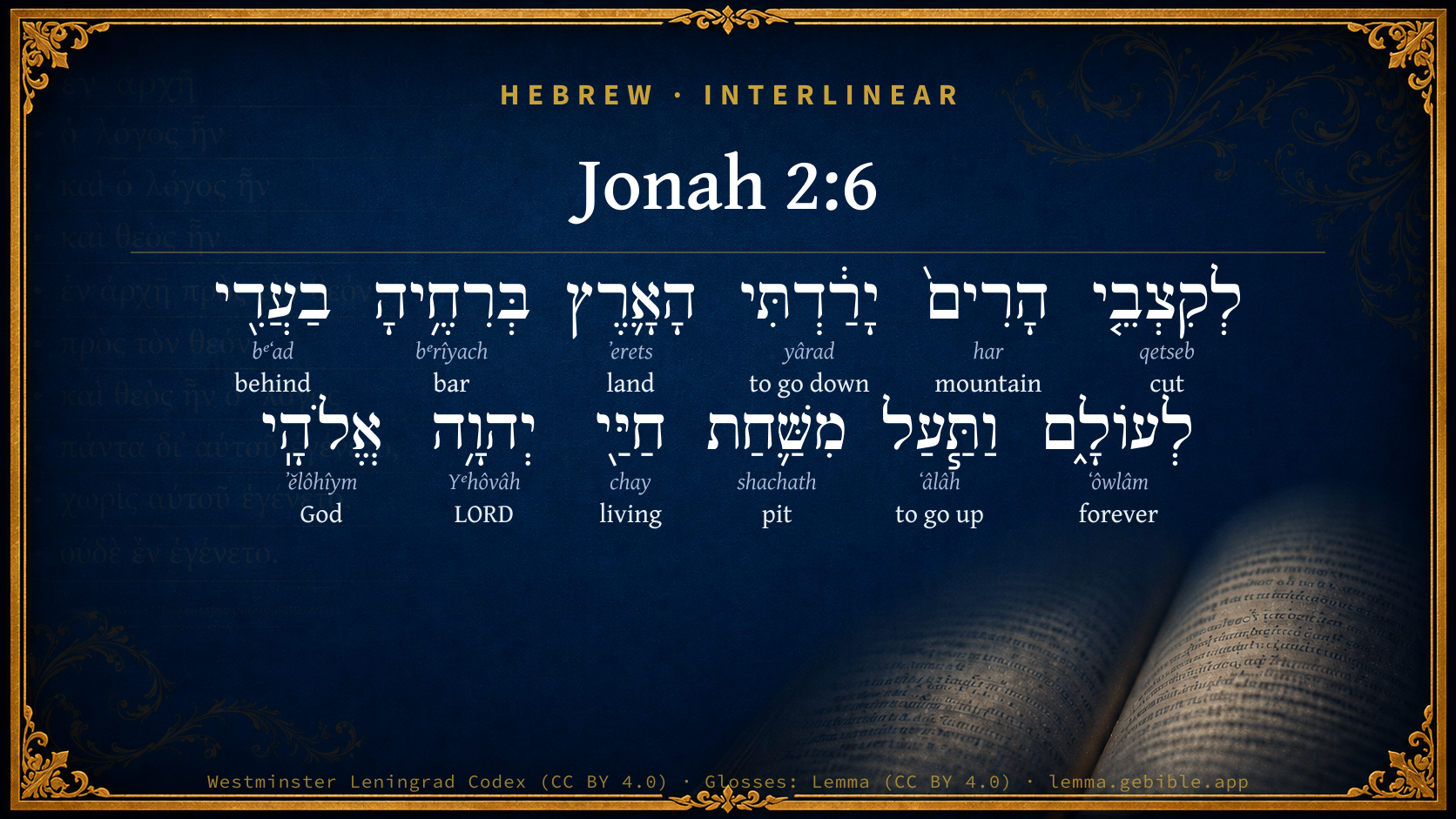
Hebrew (Westminster Leningrad Codex) Jonah 2:6 appears in the Hebrew Old Testament. The text above is from the Westminster Leningrad Codex. Each word links to its Strong’s number, a concise gloss, and parsing drawn from the Open Scriptures Hebrew Bible morphology. Click any word for its full Brown-Driver-Briggs (BDB) entry.
Download image
Cite this verse

Jonah 2:6 (World English Bible). Public Domain. Lemma interlinear Bible study tool, https://lemma.gebible.app/v/jonah/2/6.

Show BibTeX & RIS
BibTeX
RIS
English Translation
I went down to the bottoms of the mountains. The earth barred me in forever: Yet have you brought up my life from the pit, Yahweh my God.
World English Bible · Public Domain
Download a study sheet

One document with this verse’s original text, its word-by-word gloss line, the meaning frame, cross-references with their text, attributed commentary, and full source and license credits — printable, and it pastes into notes with its structure intact.

This verse Autodidact and up

Study sheet (.html) Plain text (.txt)

A passage Seminary Student

Up to 50 verses in one chapter. A passage sheet keeps up to 6 commentary sources and 12 cross-references per verse, in the order this page ranks them, and says so on the sheet whenever that leaves anything out. Ask for a single verse and you get the Autodidact verse sheet above.

Everything on this page stays free to read, with no account — the sheet is a download of what is already on screen, not access to it.

Want to remove ads? Support Godless Engineer
Compare translations 3

The same verse in 3 English versions, stacked beneath the original-language interlinear above. Click any original word for its lexicon entry.

Each is an independent rendering of the whole verse — the interlinear is not word-aligned to these translations.

Highlighted words mark where these versions differ — a whole-verse word diff, not a word-by-word alignment.

  • World English Bible Public Domain
    I went down to the bottoms of the mountains. The earth barred me in forever: Yet have you brought up my life from the pit, Yahweh my God.
  • King James Version Public Domain
    I went down to the bottoms of the mountains; the earth with her bars was about me for ever: yet hast thou brought up my life from corruption, O LORD my God.
  • unfoldingWord Literal Text CC BY-SA 4.0
    I had gone down to the bases of the mountains. The earth, its bars around me forever, but you brought up my life from the pit, Yahweh, my God!

unfoldingWord Literal Text — © unfoldingWord, licensed CC BY-SA 4.0. Word-aligned USFM3 via Door43 (git.door43.org/unfoldingWord/en_ult).

Versions to compare (up to 4)

3 of 4 selected

Show all 18 translations

Every available English version of this verse, each an independent rendering of the whole verse.

  • World English Bible Public Domain
    I went down to the bottoms of the mountains. The earth barred me in forever: Yet have you brought up my life from the pit, Yahweh my God.
  • Berean Standard Bible Public Domain
    To the roots of the mountains I descended; the earth beneath me barred me in forever! But You raised my life from the pit, O LORD my God!
  • Majority Standard Bible Public Domain
    To the roots of the mountains I descended; the earth beneath me barred me in forever! But You raised my life from the pit, O LORD my God!
  • King James Version Public Domain
    I went down to the bottoms of the mountains; the earth with her bars was about me for ever: yet hast thou brought up my life from corruption, O LORD my God.
  • American Standard Version (1901) Public Domain
    I went down to the bottoms of the mountains; The earth with its bars `closed' upon me for ever: Yet hast thou brought up my life from the pit, O Jehovah my God.
  • Revised Version (1885) Public Domain
    I went down to the bottoms of the mountains; the earth with her bars closed upon me for ever: yet hast thou brought up my life from the pit, O LORD my God.
  • Geneva Bible (1599) Public Domain
    I went downe to the bottome of the moutaines: the earth with her barres was about me for euer, yet hast thou brought vp my life from the pit, O Lord my God.
  • Douay-Rheims (1899) Public Domain
    The waters compassed me about even to the soul: the deep hath closed me round about, the sea hath covered my head.
  • Young's Literal Translation Public Domain
    To the cuttings of mountains I have come down, The earth, her bars `are' behind me to the age. And Thou bringest up from the pit my life, O Jehovah my God.
  • Literal Standard Version CC BY-SA 4.0
    To the cuttings of mountains I have come down, || The earth, her bars [are] behind me for all time. And You bring my life up from the pit, O YHWH my God.
  • Unlocked Literal Bible CC BY-SA 4.0
    I went down to the bases of the mountains; the earth with its bars closed upon me forever. Yet you brought up my life from the pit, Yahweh, my God!
  • unfoldingWord Literal Text CC BY-SA 4.0
    I had gone down to the bases of the mountains. The earth, its bars around me forever, but you brought up my life from the pit, Yahweh, my God!
  • Darby Bible Public Domain
    I went down to the bottoms of the mountains; The bars of the earth [closed] upon me for ever: But thou hast brought up my life from the pit, O Jehovah my God.
  • World Messianic Bible Public Domain
    I went down to the bottoms of the mountains. The earth barred me in forever; yet you have brought my life up from the pit, LORD my God.
  • Webster's Bible Public Domain
    \\2:5\\The waters encompassed me, even to the soul: the depth inclosed me on every side, the weeds were wrapped about my head.
  • Free Bible Version CC BY-SA 4.0
    I sank down to the base of the mountains; the earth barred me in forever. But you, my Lord, my God, brought me back up from the abyss.
  • Bible in Basic English Public Domain
    The waters were circling round me, even to the neck; the deep was about me; the sea-grass was twisted round my head.
  • JPS Tanakh (1917) Public Domain
    (2-7) I went down to the bottoms of the mountains; the earth with her bars closed upon me for ever; yet hast Thou brought up my life from the pit, O LORD my God.

Literal Standard Version (2020), Covenant Press — licensed CC BY-SA 4.0. Text via the HelloAO Bible API (eBible.org). Unlocked Literal Bible (unfoldingWord) — licensed CC BY-SA 4.0. Text via the HelloAO Bible API (eBible.org). unfoldingWord Literal Text — © unfoldingWord, licensed CC BY-SA 4.0. Word-aligned USFM3 via Door43 (git.door43.org/unfoldingWord/en_ult). Free Bible Version, Dr. Jonathan Gallagher — licensed CC BY-SA 4.0. Text via the HelloAO Bible API (eBible.org).

Word by word

More ways to search: Search by grammar → Find every occurrence → Compare this word →

Practice this passage: Drill this verse → Learn its vocabulary →

לְקִצְבֵ֤י
qetseb
H7095
“to/for · cuts of”
Preposition + Noun, Common, Masculine, Plural, Construct
Part of Speech
Preposition + Noun
Type
Common
Gender
Masculine
Number
Plural
State
Construct
Full BDB Definition

Origin: from H7094

TWOT: 2052a

cut, shape, extremity, form, base - cut, shape - extremity
  1. הָרִים֙ har H2022 “mountains” Noun, Common, Masculine, Plural, Absolute
  2. יָרַ֔דְתִּי yârad H3381 “to go down” Verb, Qal, Perfect, 1st Person, Common, Singular
  3. הָאָ֛רֶץ ʼerets H776 “the · land” Particle, Definite Article + Noun, Common, Both, Singular, Absolute
  4. בְּרִחֶ֥יהָ bᵉrîyach H1280 “bars · her” Noun, Common, Masculine, Plural, Construct + Suffix, Personal, 3rd Person, Feminine, Singular
  5. בַעֲדִ֖י bᵉʻad H1157 “behind · me” Preposition + Suffix, Personal, 1st Person, Common, Singular
  6. לְעוֹלָ֑ם ʻôwlâm H5769 “to/for · forever” Preposition + Noun, Common, Masculine, Singular, Absolute
  7. וַתַּ֧עַל ʻâlâh H5927 “and · to go up” Conjunction + Verb, Hiphil, Sequential Imperfect, 2nd Person, Masculine, Singular
  8. מִשַּׁ֛חַת shachath H7845 “from · pit” Preposition + Noun, Common, Feminine, Singular, Absolute
  9. חַיַּ֖י chay H2416 “living things · my” Noun, Common, Masculine, Plural, Construct + Suffix, Personal, 1st Person, Common, Singular
  10. יְהוָ֥ה Yᵉhôvâh H3068 “LORD” Noun, Proper
  11. אֱלֹהָֽי ʼĕlôhîym H430 “God(s) · my” Noun, Common, Masculine, Plural, Construct + Suffix, Personal, 1st Person, Common, Singular

About this verse

These counts appear in no published source. They are computed here, from the morphology-tagged text and Lemma’s own curated glosses. What Lemma adds →

12
words
12
distinct lemmas
Prophets
section

Notable vocabulary

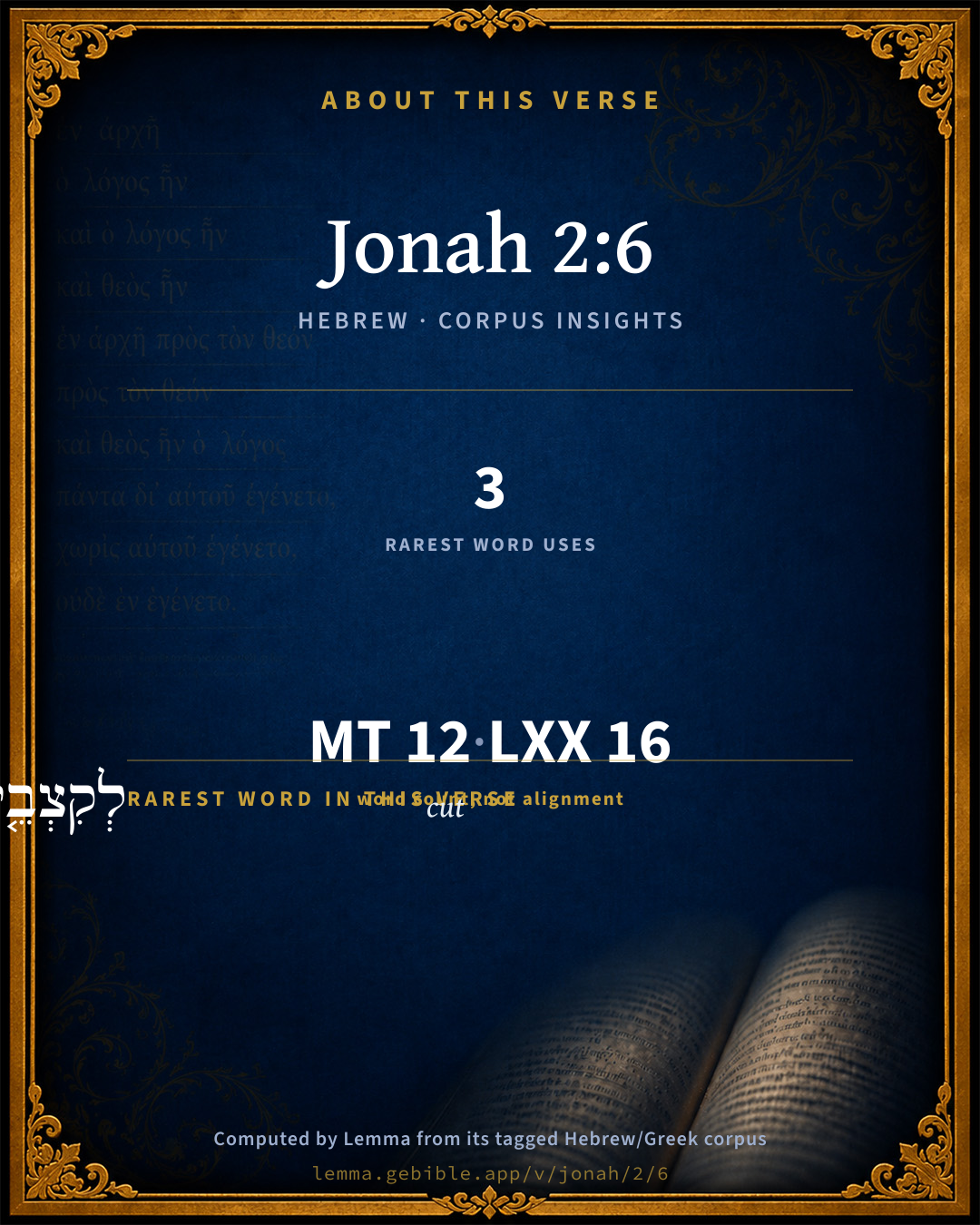
The rarest word here is לְקִצְבֵ֤י cut H7095 — appearing just 3 times in the whole Hebrew Bible.

Shared distinctive vocabulary

לְקִצְבֵ֤י cut H7095 occurs in 3 verses of the Hebrew Bible. Also found in:

Grammatical profile

  • 2 verbs
  • 9 nouns
  • 1 preposition

Verb forms

  • יָרַ֔דְתִּי Qal · Perfect
  • וַתַּ֧עַל Hiphil · Sequential Imperfect

Hebrew & Septuagint length

In English translation the verse runs 28 words from the Hebrew and 17 from the Septuagint (LXX English) — the Septuagint runs noticeably shorter here. See the side-by-side →

A rough comparison of the two English renderings, which tokenize alike — not a word-level alignment.

Word counts can differ between the Hebrew and the Greek without any difference in meaning — e.g. the Hebrew direct-object marker אֵת has no separate Greek word, and Greek often adds the article ὁ.

In the original languages it is 12 Hebrew tokens and 16 Greek tokens — but the two are counted differently (Hebrew bundles its prefixes and suffixes into one token; the Greek is in lemma form), so that isn’t a like-for-like length.

Cross-references

18

Topical passages linked to Jonah 2:6 in the Treasury of Scripture Knowledge — connected by theme and wording, ordered by reader-vote popularity; previews shown in the World English Bible.

  • Psalms 30:3 Yahweh, you have brought up my soul from Sheol. You have kept me alive, that I should not go down to the pit.
  • Psalms 16:10 For you will not leave my soul in Sheol, Neither will you allow your holy one to see corruption.
  • Isaiah 38:17 Behold, [it was] for [my] peace [that] I had great bitterness: But you have in love to my soul delivered it from the pit of corruption; For you have cast all my sins behind your back.
  • Psalms 143:7 Hurry to answer me, Yahweh. My spirit fails. Don't hide your face from me, So that I don't become like those who go down into the pit.
  • Proverbs 8:25–29 Before the mountains were settled in place, Before the hills, I was brought forth;
  • Deuteronomy 32:22 For a fire is kindled in my anger, Burns to the lowest Sheol, Devours the earth with its increase, Sets on fire the foundations of the mountains.
  • Job 33:24 Then God is gracious to him, and says, 'Deliver him from going down to the pit, I have found a ransom.'
  • Job 33:28 He has redeemed my soul from going into the pit, My life shall see the light.'
  • Job 38:4–11 "Where were you when I laid the foundations of the earth? Declare, if you have understanding.
  • Psalms 30:9 "What profit is there in my destruction, if I go down to the pit? Shall the dust praise you? Shall it declare your truth?
  • Psalms 55:23 But you, God, will bring them down into the pit of destruction. Bloodthirsty and deceitful men shall not live out half their days, But I will trust in you.
  • Psalms 65:6 Who by his power forms the mountains, Having armed yourself with strength;
  • Psalms 104:6 You covered it with the deep as with a cloak. The waters stood above the mountains.
  • Psalms 104:8 The mountains rose, The valleys sank down, To the place which you had assigned to them.
  • Isaiah 40:12 Who has measured the waters in the hollow of his hand, and meted out the sky with the span, and comprehended the dust of the earth in a measure, and weighed the mountains in scales, and the hills in a balance?
  • Habakkuk 3:6 He stood, and shook the earth. He looked, and made the nations tremble. The ancient mountains were crumbled. The age-old hills collapsed. His ways are eternal.
  • Habakkuk 3:10 The mountains saw you, and were afraid. The tempest of waters passed by. The deep roared and lifted up its hands on high.
  • Acts 13:33–37 that God has fulfilled the same to us, their children, in that he raised up Jesus. As it is also written in the second psalm, 'You are my Son. Today I have become your father.'

Cross-references courtesy of OpenBible.info (CC BY 4.0).

Hebrew and Greek witnesses Masoretic Hebrew ↔ Greek Septuagint

The same verse in the two great witnesses to the Old Testament, shown verse-for-verse.

Here the Septuagint runs noticeably shorter than the Hebrew — LXX2012 (modern English Septuagint) 17 words vs World English Bible 28. A rough length comparison of the two English translations, not a word-level alignment — read both below.

These are two independent witnesses, not word-aligned to each other, and the Septuagint is shown in lemma (dictionary) form.

Hebrew Jonah 2:6 Masoretic · Westminster Leningrad Codex

לְקִצְבֵ֤י הָרִים֙ יָרַ֔דְתִּי הָאָ֛רֶץ בְּרִחֶ֥יהָ בַעֲדִ֖י לְעוֹלָ֑ם וַתַּ֧עַל מִשַּׁ֛חַת חַיַּ֖י יְהוָ֥ה אֱלֹהָֽי

I went down to the bottoms of the mountains. The earth barred me in forever: Yet have you brought up my life from the pit, Yahweh my God.

World English Bible · Public Domain

Greek LXX Jonah 2:6 Septuagint · lemma form

περιχέω ὕδωρ ἐγώ ἕως ψυχή ἄβυσσος κυκλόω ἐγώ ἔσχατος δύω ὁ κεφαλή ἐγώ εἰς σχισμή ὄρος

Water was poured around me to the soul: the lowest deep compassed me, my head went down

LXX2012 (modern English Septuagint) · Public Domain

On this verse, The Pulpit Commentary discusses the Septuagint’s reading. Read the note in Commentary ↓

Hebrew: Westminster Leningrad Codex (CC BY 4.0). Greek: Septuagint (public domain); English from LXX2012 (modern English Septuagint) (Public Domain). How the Septuagint differs from the Hebrew →

Targum (Aramaic paraphrase)

1

The Targum is the ancient Jewish Aramaic paraphrase of the Hebrew Scriptures — an interpretive translation, not the Hebrew text itself. Onkelos (literal) and Pseudo-Jonathan (expansive) render the Torah, and Jonathan the Prophets. Coverage is partial: where no permissively-licensed English translation exists for a verse, only the Aramaic is shown. This is verse-level text, not a word-by-word alignment to the Hebrew.

  1. Targum Jonathan Prophets (Joshua–Malachi)
    אַקְפוּנִי מַיָא עַד מוֹתָא תְּהוֹמָא סְחוֹר סְחוֹר לִי יַמָא דְסוּף תָּלֵי עֵיל מֵרֵישִׁי:

    Water encircled me to death; depths surrounded me; the reedy sea rose over my head.

    Targum Jonathan — Aramaic: “Mikraot Gedolot” (public domain). English: “Sefaria Community Translation” (CC0 1.0 (public-domain dedication)); “London "Chaldee Paraphrase," 1871” (public domain). Text via Sefaria.

Commentary

Notes on Jonah 2:6 from classic Christian and Jewish commentators (each source and its license shown beneath its notes). The classic Christian expositions comment on the surrounding passage and are grouped to its opening verse, so a note may address several verses; the Jewish commentaries on the Tanakh (Rashi and others) are per-verse, so they appear only where the commentator wrote on this verse.

Lemma curates 59 commentaries, every one of them public domain or Creative Commons licensed, each selected and text-cleaned for this edition rather than reprinted as found. About our sources →

Trapp's Complete Commentary

John Trapp

Jon 2:6 I went down to the bottoms of the mountains; the earth with her bars [was] about me for ever: yet hast thou brought up my life from corruption, O LORD my God.

Ver. 6. I went down to the bottoms of the mountains] That is, of the promontories or rocks of the sea, where the waters are deepest. Thus Mercer after Kimchi. "The channels of waters were seen, and the foundations of the world were discovered," Psa 18:15. The mountains are said to be under water, Pro 8:25, because their foundations are there placed.

The earth with her bars was about me for ever] As if resolved there to keep me close prisoner; that though the fish had disgorged me, yet I should never have got to land. The shores are set by God as bars to keep the sea within his bounds, Job 38:8; Job 38:10-11 Jer 5:22. Here then all the creatures seemed to set against poor Jonah, and (which was more than all) the Creator too: so that he might sigh and say, as in the poet (Martial).

“ In me omnis terraeque aviumque marisque rapina est,

Forsitan et coeli ”

Yet hast thou brought up my life from corruption] i.e. From the place where I was likely to have lain and rotted. Cum duplicantur lateres, venit Moses: when things are at the worst God appeareth, as it were out of an engine, εκ της μηχανης. In the mount will the Lord be seen, Eze 37:11 2Ki 19:3; he stays so long sometimes that he hardly "finds faith on earth," Luk 18:8, and yet comes at last to the relief of his poor people; viz. when they are ripe and ready for it. He is a God of judgment, he knows how and when to deal forth his favours; and even waiteth to be gracious, Isa 30:18; Isa 28:21.

O Lord my God] sc. by the mean and merit of thy Son, in whom alone it is that thou, Lord, art my God, and that I can call thee Abba, Father. It is well observed by an interpreter, that in this short history of Jonah are all things contained which may make to the sound and saving knowledge of God and his will, of ourselves also and our duties.

John Trapp, A Commentary or Exposition upon All the Books of the Old and New Testament (1647–1656) — public domain. Text from a community e-Sword module.

Tyndale Open Study Notes

Tyndale Open Resources

2:6 Jonah’s metaphors (roots of the mountains; imprisoned in the earth) reflect ancient concepts of the underworld, with the dead being deep within the earth (see also 2:2). At one point Jonah felt hopelessly doomed to death’s prison. • But: The transition is powerful. Jonah, though certain of his own death, was not beyond God’s gracious reach. • the jaws of death (literally the pit): The Hebrew term normally denotes the habitat of the dead. Jonah’s language again makes it clear that at this point he considered himself as good as dead.

Tyndale Open Study Notes — © Tyndale Open Resources, licensed CC BY-SA 4.0. Text via the HelloAO Bible API.

Geneva Bible (1599)

Geneva Bible translators

Thou hast delivered me from the belly of the fish and all these dangers, as it were raising me from death to life.

Geneva Bible (1599) marginal notes — public domain. Text via Bolls.life.

Jamieson, Fausset & Brown

Robert Jamieson, A. R. Fausset & David Brown

bottoms of . . . mountains--their extremities where they terminate in the hidden depths of the sea. Compare , "the foundations of the hills" ().

earth with her bars was about me--Earth, the land of the living, is (not "was") shut against me.

for ever--so far as any effort of mine can deliver me.

yet hast thou brought up my life from corruption--rather, "Thou bringest . . . from the pit" [MAURER]. As in the previous clauses he expresses the hopelessness of his state, so in this, his sure hope of deliverance through Jehovah's infinite resources. "Against hope he believes in hope," and speaks as if the deliverance were actually being accomplished. Hezekiah seems to have incorporated Jonah's very words in his prayer (), just as Jonah appropriated the language of the Psalms.

Jamieson, Fausset & Brown — Commentary Critical and Explanatory on the Whole Bible (1871) — public domain (CC PDM 1.0). Text via the HelloAO Bible API.

Adam Clarke's Commentary

Verse 6. I went down to the bottoms of the mountains] This also may be literally understood. The fish followed the slanting base of the mountains, till they terminated in a plain at the bottom of the great deep.

The earth with her bars] He represents himself as a prisoner in a dungeon, closed in with bars which he could not remove, and which at first appeared to be for ever, i.e., the place where his life must terminate.

Yet hast thou brought up my life] The substance of this poetic prayer was composed while in the fish's belly; but afterwards the prophet appears to have thrown it into its present poetic form, and to have added some circumstances, such as that before us; for he now speaks of his deliverance from this imminent danger of death. "Thou hast brought up my life from corruption."

Adam Clarke's Commentary on the Bible (1810–1826) — public domain. Text from a community e-Sword/MySword module.

John Calvin's Commentaries

According to the same sense he says, I descended to the roots of the mountains. But he speaks of promontories, which were nigh the sea; as though he had said, that he was not cast into the midst of the sea, but that he had so sunk as to be fixed in the deep under the roots of mountains. All these things have the same designs which was to show that no deliverance could be hoped for, except God stretched forth his hand from heaven, and indeed in a manner new and incredible.

He says that the earth with its bars was around him. He means by this kind of speaking, that he was so shut up, as if the whole earth had been like a door. We know what sort of bars are those of the earth, when we ascribe bars to it: for when any door is fastened with bolts, we know how small a portion it is. But when we suppose the earth itself to be like a door, what kind of things must the bolts be? It is the same thing then as though Jonah had said, that he was so hindered from the vital light, as if the earth had been set against him to prevent his coming forth to behold the sun: the earth, then, was set against me, and that for ever

He afterwards comes to thanksgiving, And thou Jehovah, my God, hast made my life to ascend from the grave. Jonah, after having given a long description, for the purpose of showing that he was not once put to death, but that he had been overwhelmed with many and various deaths, now adds his gratitude to the Lord for having delivered him, Thou, he says, hast made my life to ascend from the grave, O Jehovah. He again confirms what I have once said, — that he did not pour forth empty prayers, but that he prayed with an earnest feeling, and in faith: for he would not have called him his God, except he was persuaded of his paternal love, so as to be able to expect from him a certain salvation. Thou, then, Jehovah, my God, he says; he does not say, Thou hast delivered me, but, Thou hast brought forth my life from the grave. Then Jonah, brought to life again, testifies here that he was not only delivered by God’s aid from the greatest danger, but that he had, by a certain kind of resurrection, been raised from the dead. This is the meaning of this mode of speaking, when he says that his life had been brought forth from the grave, or from corruption itself. It follows —

John Calvin's Commentaries (1540-1563) — public domain. Text from the Calvin Translation Society English edition (1840s-50s) via the Christian Classics Ethereal Library (ccel.org). Calvin's coverage is partial (roughly two-thirds of the Bible); uncommented books and verses are honest gaps, never fabricated. The 19th-century editor's footnotes and remarks are omitted so the notes are faithfully Calvin's own voice.

Ellicott's Commentary for English Readers

(6) Bottoms of the mountains.—Literally, ends or cuttings off, as, in margin. So the Vulg. extrema montium. Mountains were in the Hebrew conception the pillars of the world (see Job_9:6; Job_26:11), having their foundations firmly planted in the sea. These “hidden bases of the hills” were therefore the verge of the earth itself, and one lost among them would be close on the under-world of death.

The earth with her bars . . .—Literally, the earth her bars behind me for ever; i.e., the earth’s gates were closed upon me for ever, there was no possibility of return. The metaphor of a gateway to sheôl is common (Isa_38:10, &c.), but the earth is nowhere else said to be so guarded. Ewald therefore proposes to read sheôl here. But it is quite as natural to imagine a guarded passage out of the land of the living as into the land of the dead.

Corruption.—Rather, pit. (See Note, Psa_16:10.)

A Bible Commentary for English Readers, edited by Charles John Ellicott (1878–1897) — public domain. Text from a community e-Sword module.

The Cambridge Bible for Schools and Colleges

gen. ed. J. J. S. Perowne

6. bottoms] Lit., as in margin, “cuttings off,” the mountains being poetically conceived of as stretching away their roots or ridges to the lowest depths of the sea, and there ending or being cut off.

her bars] Lit., (as for) the earth, her bars, &c. The idea is that the gates of the earth were not only closed, but barred and made fast upon him, shutting him into the unseen world. The same word is used of Samson carrying away the gates of Gaza, “bar and all,” i. e. probably a wooden beam used to hold fast the gates when they were closed. Jdg_16:3. Comp. “Let not the pit shut her mouth upon me,” Psa_69:15.

from corruption] Rather, from the pit. R. V.

The Cambridge Bible for Schools and Colleges (gen. ed. J. J. S. Perowne; Cambridge University Press, 1878–1918) — public domain. Text from a community e-Sword module.

John Gill's Exposition

When my soul fainted within me,.... Covered with grief; overwhelmed with sorrow; ready to faint and sink at the sight of his sins; and under a sense of the wrath and displeasure of God, and being forsaken by him:

I remembered the Lord; his covenant and promises, his former mercies and lovingkindness, the gracious experiences he had had of these in times past; he remembered he was a God gracious and merciful, and ready to forgive, healed the backslidings of his people, and still loved them freely, and tenderly received and embraced them, when they returned to him:

and my prayer came in unto thee, into thine holy temple; into heaven itself, the habitation of God's holiness, the temple where he dwells, and is worshipped by holy angels and glorified saints; the prayer the prophet put up in the fish's belly, encouraged to it by remembering the mercy and goodness of God, ascended from thence, and reached the ears of the Lord of hosts in the highest heavens, and met with a kind reception, and had a gracious answer; see Psa 3:4.

John Gill's Exposition of the Whole Bible (1746–1763) — public domain (CC PDM 1.0). Text via the HelloAO Bible API.

Albert Barnes' Notes on the Bible

I went down to the bottoms, (literally “the cuttings off”) of the mountains - , the “roots” as the Chaldee and we call them, the hidden rocks, which the mountains push out, as it were, into the sea, and in which they end. Such hidden rocks extend along the whole length of that coast. These were his dungeon walls; “the earth, her bars,” those long submarine reefs of rock, his prison bars, “were around” him “forever:” the seaweeds were his chains: and, even thus, when things were at their uttermost, “Thou hast brought up my life from corruption,” to which his body would have fallen a prey, had not God sent the fish to deliver him. The deliverance for which be thanks God is altogether past: “Thou broughtest me up.” He calls “the” Lord, “my” God, because, being the God of all, He was especially his God, for whom He had done things of such marvelous love. God loves each soul which He has made with the same infinite love with which He loves all. Whence Paul says of Jesus Gal 2:20, “Who loved me and gave Himself for me.” He loves each, with the same undivided love, as if he had created none besides; and He allows each to say, “My God,” as if the Infinite God belonged wholly to each. So would He teach us the oneness of Union between the soul which God loves and which admits His love, and Himself.

Albert Barnes' Notes on the Bible (1834–1885) — public domain. Text from a community e-Sword/MySword module.

Haydock's Catholic Bible Commentary

Soul, so that I was in danger of being suffocated, Psalms lxviii. 2. (Calmet) --- Sea. Hebrew, "weeds entangled," &c. (Haydock) --- The Mediterranean has a great deal of sea weed. He speaks of the time before he was swallowed up by the fish.

George Leo Haydock (1774–1849), Haydock's Catholic Family Bible and Commentary, 1859 edition — public domain. Excludes Psalms (Douay-Rheims chapter numbering differs from Protestant) and Deuterocanonical books (Catholic canon only).

Matthew Poole's English Annotations

I went down, the fish carried him down,

to the bottoms of the mountains; as deep in the sea as are the bottoms of the mountains, or into those depths out of which might be supposed that mountains were thence drawn out by the roots; an elegant description of fathomless depths, whirlpools of the seas.

The earth with her bars was about me for ever; I seemed to be imprisoned where the bars that secured me were as great and durable as the rocks which they were made of.

Yet, notwithstanding all these insuperable difficulties, and my own fears,

hast thou brought up; by what was first my danger thou hast wonderfully secured me, what I thought should have been my grave was made a safety to me; by the fish Jonah is in due time fairly and safely set on shore.

My life; his life of nature; his life of comfort, and peace, and joy too.

From corruption, or the pit; a description of the stale of the dead, whose bodies turn to putrefaction and stench.

O Lord; O almighty and eternal Being, Lord and Sovereign over all.

My God; mine, saith Jonah, by particular choice, faith, and hope, whom I had served and should not have disobeyed, to whom I prayed, who hath pardoned, whom I will adore, obey, and love for ever.

Matthew Poole's English Annotations on the Holy Bible (1683–1685) — public domain. Text from a community e-Sword/MySword module.

Whedon's Commentary on the Bible

Daniel D. Whedon

6. The bottoms of the mountains — Literally, the cuttings off; the extreme ends. The mountains are thought of as extending their roots to the bottom of the sea (Psa_18:5).

The earth with her bars was about me — Literally, as to the earth, her bars were behind me. He thinks himself cast out from the earth; the earth has put down the bars so as to make return to the dry land impossible forever. The comparison is with a city whose gates are barred so that no one can enter. Marti reads 6a, “I went down to the nether parts of the earth, to the people of old time”; that is, the people who died in ancient times (Eze_26:20; Eze_32:18; Eze_32:24); in other words, to Sheol.

The depth of affliction and the deadly character of the peril make the deliverance the more wonderful. To this deliverance the singer now turns.

Yet hast thou brought up my life — Thou hast brought me up alive, in spite of the apparent hopelessness.

From corruption — R.V., “from the pit.” The former is the meaning given to the word by the ancient versions, but R.V. is to be preferred. The word is practically synonymous with Sheol (Jon_2:2; Psa_30:3; Psa_30:9).

Jehovah my God — See on Jon_2:1.

Jon_2:7 goes back to Jon_2:4, calling attention once more to the conflicting emotions while in the midst of danger.

My soul fainted — Literally, was overwhelmed; became exhausted (Psa_142:3; Psa_143:4).

I remembered — When about ready to give up the struggle he thought of Jehovah, and decided to appeal to him (4), and his prayer was heard (Psa_18:6; Psa_5:7).

Daniel D. Whedon (gen. ed.), Commentary on the Old and New Testaments (1874–1909) — public domain. Text from a community e-Sword module.

The Pulpit Commentary

The bottoms of the mountains; literally, the cuttings off, where the mountains seem to be cut off by the ocean floor; the roots of the mountains. Eiv scismawn , "the clefts of the mountains" (Soptuagint); Psa_18:15. The earth with her bars; as for the earth, her bars were about me; return to it was shut out for me; the gate by which I might return was locked behind me. He adds, forever, as it was to all appearance, because he had no power in himself of returning to earth and life. Yet; in spite of all, I am preserved. From corruption (shachath); as Job_17:14; de corruptione (Vulgate); so the Chaldee and Syriac; Septuagint, Anabhtw ek fyorav h zwh mou (Alex.), Anabhtw fyora zwhv mou (Vatican), "Let my life arise from destruction; " or, "Let the destruction of my life i.e. my destroyed life arise." Jerome refers the word to the digestive process in the fish"s stomach; it is probably merely a synonym for "death." The marginal rendering, "the pit," i.e. Sheol, is also etymologically correct. (comp. Psa_30:3) My God. He thankfully acknowledges that Jehovah has proved himself a beneficent God to him.

The Pulpit Commentary (1880–1919), ed. H.D.M. Spence-Jones & Joseph S. Exell — public domain. Text from a community e-Sword module.

John Wesley's Explanatory Notes

I went down - The fish carried him down as deep in the sea as are the bottoms of the mountains. With her bars - I seemed to be imprisoned where the bars that secured were as durable as the rocks, which they were made of. Yet - By what was first my danger, thou hast wonderfully secured me. From corruption - Or the pit, a description of the state of the dead. O Lord - In the assurance of faith, he speaks of the thing as already done.

John Wesley, Explanatory Notes Upon the Whole Bible (1754–1765) — public domain. Text via the GEBible commentary corpus.

Rashi

Rabbi Shlomo Yitzchaki (Rashi)

the Red Sea hangs over my head Lit., reeds are bound to my head. [Jonathan renders:] The Red Sea hangs over my head. For the Holy One, blessed he He, showed him the Red [lit., Reed] Sea and how Israel crossed in its midst, for the fish’s two eyes were like two windows, and he would look and see everything in the sea. [from Pirké d’Rabbi Eliezer ch. 10]

Rashi on the Tanakh — English translations: “The Judaica Press complete Tanach with Rashi, translated by A. J. Rosenberg” (CC BY 4.0); “Pentateuch with Rashi's commentary by M. Rosenbaum and A.M. Silbermann, 1929-1934” (public domain); “The Metsudah Tanach series, Lakewood, N.J” (CC BY 4.0); and “The Book of Joshua, Metsudah Publications, 1997” (CC BY 4.0). Text via Sefaria.

Lesson kit

Teaching starters — assembled from the data on this page, not authored interpretation. Every prompt links to the verse data it draws on. Edit before teaching.

Jonah, in the Prophets, opens this verse with 12 words (12 distinct Hebrew lemmas). Its most distinctive word is qetseb (“cut”). The Greek Septuagint runs shorter here. A historical commentator’s framing appears above. Read the whole chapter for the surrounding context.

Discussion questions

  1. The word qetseb carries the sense “cut.” How does it shape the verse?
  2. 1 Kings 6:25 shares the word «cut» with this verse. How do the two illuminate each other?
  3. Compared with the Hebrew, the Septuagint runs shorter here. What questions does that raise?
  4. These translations render this verse differently. What is at stake in choosing one wording over another?
  5. The verb «יָרַ֔דְתִּי» is Qal Perfect. How does its form color the action?
  6. Reading how Trapp's Complete Commentary and Tyndale Open Study Notes read this verse, where do the two commentators agree and where do they part?

Things to notice

Reading settings

Reading text

Shown beneath each verse's original-language words.

Old Testament
Old Testament edition

Read the OT as the Masoretic Hebrew (MT) or the Greek Septuagint (LXX).

English shown for the Greek Septuagint (in the Hebrew ↔ Greek comparison).

Comparing translations? Open the Compare panel on any verse page to stack up to four side by side.