

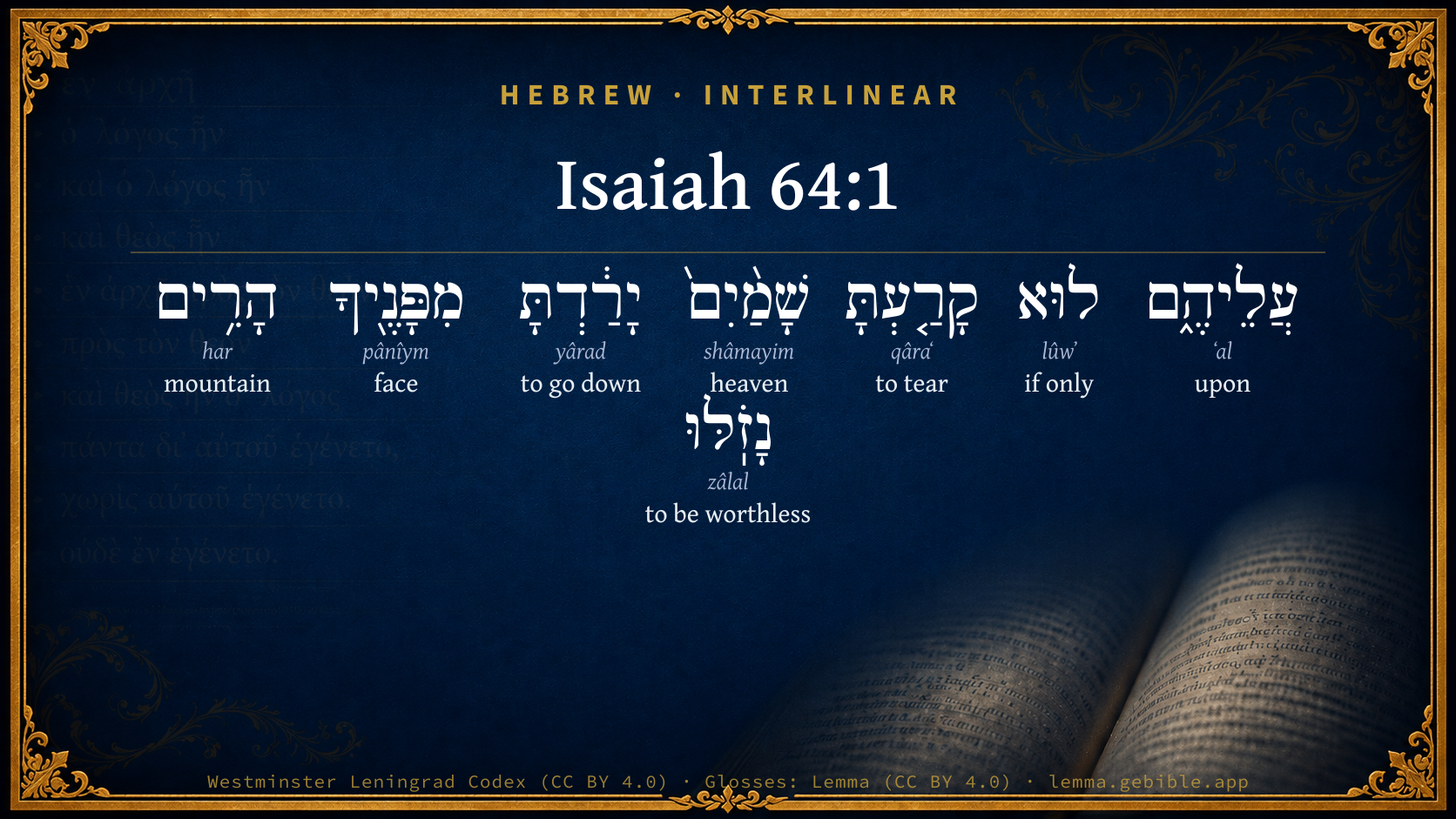
עֲלֵיהֶ֑ם לוּא קָרַ֤עְתָּ שָׁמַ֨יִם֙ יָרַ֔דְתָּ מִפָּנֶ֖יךָ הָרִ֥ים נָזֹֽלּוּ
Oh that you would tear the heavens, that you would come down, that the mountains might quake at your presence,
World English Bible · Public Domain
Oh that you would tear the heavens, that you would come down, that the mountains might quake at your presence,
One document with this verse’s original text, its word-by-word gloss line, the meaning frame, cross-references with their text, attributed commentary, and full source and license credits — printable, and it pastes into notes with its structure intact.
This verse Autodidact and up
A passage Seminary Student
Up to 50 verses in one chapter. A passage sheet keeps up to 6 commentary sources and 12 cross-references per verse, in the order this page ranks them, and says so on the sheet whenever that leaves anything out. Ask for a single verse and you get the Autodidact verse sheet above.
Everything on this page stays free to read, with no account — the sheet is a download of what is already on screen, not access to it.
The same verse in 3 English versions, stacked beneath the original-language interlinear above. Click any original word for its lexicon entry.
Each is an independent rendering of the whole verse — the interlinear is not word-aligned to these translations.
Highlighted words mark where these versions differ — a whole-verse word diff, not a word-by-word alignment.
Oh that you would tear the heavens, that you would come down, that the mountains might quake at your presence,
Oh that thou wouldest rend the heavens, that thou wouldest come down, that the mountains might flow down at thy presence,
If you would rend the heavens, you would come down! From your face the mountains would quake.
unfoldingWord Literal Text — © unfoldingWord, licensed CC BY-SA 4.0. Word-aligned USFM3 via Door43 (git.door43.org/unfoldingWord/en_ult).
Every available English version of this verse, each an independent rendering of the whole verse.
Oh that you would tear the heavens, that you would come down, that the mountains might quake at your presence,
If only You would rend the heavens and come down, so that mountains would quake at Your presence,
If only You would rend the heavens and come down, so that mountains would quake at Your presence,
Oh that thou wouldest rend the heavens, that thou wouldest come down, that the mountains might flow down at thy presence,
Oh that thou wouldest rend the heavens, that thou wouldest come down, that the mountains might quake at thy presence,
Oh that thou wouldest rend the heavens, that thou wouldest come down, that the mountains might flow down at thy presence;
Oh, that thou wouldest breake the heauens, and come downe, and that the mountaines might melt at thy presence!
That thou wouldst rend the heavens, and wouldst come down: the mountains would melt away at thy presence.
Didst Thou not rend the heavens? Thou didst come down, From thy presence did mountains flow,
Did You not tear the heavens? You came down, || Mountains flowed from Your presence,
“Oh, if you had split open the heavens and come down! The mountains would have shaken at your presence,
If you would rend the heavens, you would come down! From your face the mountains would quake.
Oh, that thou wouldest rend the heavens, that thou wouldest come down, -- that the mountains might flow down at thy presence,
Oh that you would tear the heavens, that you would come down, that the mountains might quake at your presence—
\\64:2\\As when the melting fire burneth, the fire causeth the waters to boil, to make thy name known to thy adversaries, that the nations may tremble at thy presence!
If only you would rip the heavens apart and come down! The mountains would tremble in your presence!
O let the heavens be broken open and come down, so that the mountains may be shaking before you, As when fire puts the brushwood in flames, or as when water is boiling from the heat of the fire: to make your name feared by your haters, so that the nations may be shaking before you;
(63-19) Oh, that Thou wouldest rend the heavens, that Thou wouldest come down, that the mountains might quake at Thy presence,
Literal Standard Version (2020), Covenant Press — licensed CC BY-SA 4.0. Text via the HelloAO Bible API (eBible.org). Unlocked Literal Bible (unfoldingWord) — licensed CC BY-SA 4.0. Text via the HelloAO Bible API (eBible.org). unfoldingWord Literal Text — © unfoldingWord, licensed CC BY-SA 4.0. Word-aligned USFM3 via Door43 (git.door43.org/unfoldingWord/en_ult). Free Bible Version, Dr. Jonathan Gallagher — licensed CC BY-SA 4.0. Text via the HelloAO Bible API (eBible.org).
More ways to search: Search by grammar → Find every occurrence → Compare this word →
Practice this passage: Drill this verse → Learn its vocabulary →
These counts appear in no published source. They are computed here, from the morphology-tagged text and Lemma’s own curated glosses. What Lemma adds →
Notable vocabulary
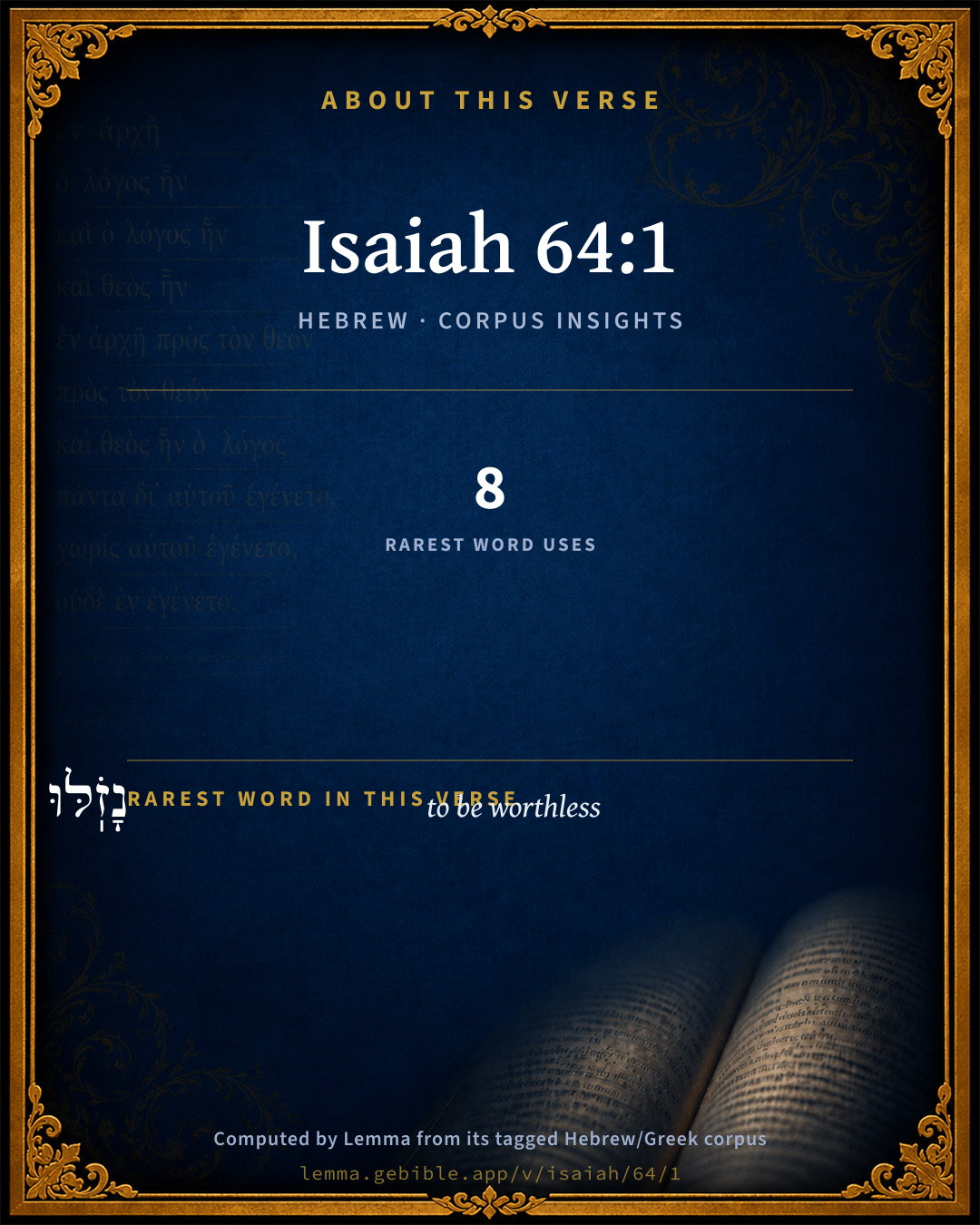
The rarest word here is נָזֹֽלּוּ to be worthless H2151 — appearing just 8 times in the whole Hebrew Bible.
Shared distinctive vocabulary
נָזֹֽלּוּ to be worthless H2151 occurs in 8 verses of the Hebrew Bible. Also found in:
Grammatical profile
Verb forms
Hebrew & Septuagint length
In English translation the verse runs 20 words from the Hebrew and 19 from the Septuagint (LXX English) — closely comparable.
A rough comparison of the two English renderings, which tokenize alike — not a word-level alignment.
Word counts can differ between the Hebrew and the Greek without any difference in meaning — e.g. the Hebrew direct-object marker אֵת has no separate Greek word, and Greek often adds the article ὁ.
Topical passages linked to Isaiah 64:1 in the Treasury of Scripture Knowledge — connected by theme and wording, ordered by reader-vote popularity; previews shown in the World English Bible.
Cross-references courtesy of OpenBible.info (CC BY 4.0).
The same verse in the two great witnesses to the Old Testament, shown verse-for-verse.
These are two independent witnesses, not word-aligned to each other, and the Septuagint is shown in lemma (dictionary) form.
עֲלֵיהֶ֑ם לוּא קָרַ֤עְתָּ שָׁמַ֨יִם֙ יָרַ֔דְתָּ מִפָּנֶ֖יךָ הָרִ֥ים נָזֹֽלּוּ
Oh that you would tear the heavens, that you would come down, that the mountains might quake at your presence,
World English Bible · Public Domain
ὡς κηρός ἀπό πῦρ τήκω καί κατακαίω πῦρ ὁ ὑπεναντίος καί φανερός εἰμί ὁ ὄνομα κύριος ἐν ὁ ὑπεναντίος ἀπό πρόσωπον σύ ἔθνος ταράσσω
If you would open the heaven, trembling will take hold upon the mountains from you, and they shall melt,
LXX2012 (modern English Septuagint) · Public Domain
On this verse, Albert Barnes' Notes on the Bible discusses the Septuagint’s reading. Read the note in Commentary ↓
Hebrew: Westminster Leningrad Codex (CC BY 4.0). Greek: Septuagint (public domain); English from LXX2012 (modern English Septuagint) (Public Domain). How the Septuagint differs from the Hebrew →
The Targum is the ancient Jewish Aramaic paraphrase of the Hebrew Scriptures — an interpretive translation, not the Hebrew text itself. Onkelos (literal) and Pseudo-Jonathan (expansive) render the Torah, and Jonathan the Prophets. Coverage is partial: where no permissively-licensed English translation exists for a verse, only the Aramaic is shown. This is verse-level text, not a word-by-word alignment to the Hebrew.
כַּד שְׁלַחְתָּא רוּגְזָךְ כְּאֶשְׁתָּא בְּיוֹמֵי אֵלִיָהוּ אִתְמַסְיָא יַמָא מַיָא מְלָחֲכָא אֶשְׁתָּא לְהוֹדִיעַ שְׁמָךְ לְסַנְאֵי עַמָךְ מִן קֳדָמָךְ עַמְמַיָא זָעוּ:
When Thou didst send forth Thine anger like fire in the days of Elijah, the sea was melted, the waters were flames of fire, to make Thy name known to the enemies of Thy people, that the nations may tremble at Thy presence.
Targum Jonathan — Aramaic: “Mikraot Gedolot” (public domain). English: “Sefaria Community Translation” (CC0 1.0 (public-domain dedication)); “London "Chaldee Paraphrase," 1871” (public domain). Text via Sefaria.
Teaching starters — assembled from the data on this page, not authored interpretation. Every prompt links to the verse data it draws on. Edit before teaching.
Isaiah, in the Prophets, opens this verse with 8 words (8 distinct Hebrew lemmas). Its most distinctive word is zâlal (“to be worthless”). A historical commentator’s framing appears above. Read the whole chapter for the surrounding context.
Commentary
Notes on Isaiah 64:1 from classic Christian and Jewish commentators (each source and its license shown beneath its notes). The classic Christian expositions comment on the surrounding passage and are grouped to its opening verse, so a note may address several verses; the Jewish commentaries on the Tanakh (Rashi and others) are per-verse, so they appear only where the commentator wrote on this verse.
Lemma curates 59 commentaries, every one of them public domain or Creative Commons licensed, each selected and text-cleaned for this edition rather than reprinted as found. About our sources →
Matthew Henry's Commentary
Matthew Henry's Commentary on the Whole Bible (1708–1710) — public domain (CC PDM 1.0). Text via the HelloAO Bible API.
The Cambridge Bible for Schools and Colleges
gen. ed. J. J. S. Perowne
The Cambridge Bible for Schools and Colleges (gen. ed. J. J. S. Perowne; Cambridge University Press, 1878–1918) — public domain. Text from a community e-Sword module.
Trapp's Complete Commentary
John Trapp
John Trapp, A Commentary or Exposition upon All the Books of the Old and New Testament (1647–1656) — public domain. Text from a community e-Sword module.
The Biblical Illustrator
Joseph S. Exell
The Biblical Illustrator, edited by Joseph S. Exell (c. 1880s–1900s) — public domain. Text from a community e-Sword module.
Joseph Benson's Commentary
Joseph Benson's Commentary on the Old and New Testaments (1811–1818) — public domain. Text from a community e-Sword module.
The Preacher's Complete Homiletical Commentary
Joseph S. Exell (gen. ed.)
The Preacher's Complete Homiletical Commentary (gen. ed. Joseph S. Exell; Funk & Wagnalls, c. 1892) — public domain (pre-1929). A full-Bible homiletical/sermon-outline anthology covering 65 of 66 books (2 John is absent from the source module). Text from a community e-Sword module.
The Sermon Bible
William Robertson Nicoll (ed.)
The Sermon Bible, ed. William Robertson Nicoll (1888–1900) — public domain. Text from a community e-Sword module.
Geneva Bible (1599)
Geneva Bible translators
Geneva Bible (1599) marginal notes — public domain. Text via Bolls.life.
Adam Clarke's Commentary
Adam Clarke's Commentary on the Bible (1810–1826) — public domain. Text from a community e-Sword/MySword module.
Ellicott's Commentary for English Readers
A Bible Commentary for English Readers, edited by Charles John Ellicott (1878–1897) — public domain. Text from a community e-Sword module.
John Gill's Exposition
John Gill's Exposition of the Whole Bible (1746–1763) — public domain (CC PDM 1.0). Text via the HelloAO Bible API.
Albert Barnes' Notes on the Bible
Albert Barnes' Notes on the Bible (1834–1885) — public domain. Text from a community e-Sword/MySword module.
Haydock's Catholic Bible Commentary
George Leo Haydock (1774–1849), Haydock's Catholic Family Bible and Commentary, 1859 edition — public domain. Excludes Psalms (Douay-Rheims chapter numbering differs from Protestant) and Deuterocanonical books (Catholic canon only).
Matthew Poole's English Annotations
Matthew Poole's English Annotations on the Holy Bible (1683–1685) — public domain. Text from a community e-Sword/MySword module.
Dummelow's Commentary on the Holy Bible
J. R. Dummelow
J. R. Dummelow, A Commentary on the Holy Bible (Macmillan, 1909) — public domain. Text from a community e-Sword module.
Whedon's Commentary on the Bible
Daniel D. Whedon
Daniel D. Whedon (gen. ed.), Commentary on the Old and New Testaments (1874–1909) — public domain. Text from a community e-Sword module.
The Pulpit Commentary
The Pulpit Commentary (1880–1919), ed. H.D.M. Spence-Jones & Joseph S. Exell — public domain. Text from a community e-Sword module.
John Wesley's Explanatory Notes
John Wesley, Explanatory Notes Upon the Whole Bible (1754–1765) — public domain. Text via the GEBible commentary corpus.
J. A. Alexander on Isaiah
Joseph Addison Alexander
Joseph Addison Alexander, The Prophecies of Isaiah (1846–1847; New York: Scribner, 1870–1878) — public domain. Text from a community e-Sword module.
Kretzmann's Popular Commentary
Paul E. Kretzmann
Paul E. Kretzmann, Popular Commentary of the Bible (1921–1924) — public domain. Text from a community e-Sword module.
unfoldingWord translationNotes
Door43 World Missions Community
unfoldingWord translationNotes — © Distant Shores Media and the Door43 World Missions Community, licensed CC BY-SA 4.0. Source: git.door43.org/Door43/en_tn.
Rashi
Rabbi Shlomo Yitzchaki (Rashi)
Rashi on the Tanakh — English translations: “The Judaica Press complete Tanach with Rashi, translated by A. J. Rosenberg” (CC BY 4.0); “Pentateuch with Rashi's commentary by M. Rosenbaum and A.M. Silbermann, 1929-1934” (public domain); “The Metsudah Tanach series, Lakewood, N.J” (CC BY 4.0); and “The Book of Joshua, Metsudah Publications, 1997” (CC BY 4.0). Text via Sefaria.
Ibn Ezra
Rabbi Abraham ibn Ezra
Ibn Ezra on the Tanakh — English translations: “Sefaria Community Translation” (CC0 1.0 (public-domain dedication)); “Yalkut, Sifsei Chachomim Chumash, Metsudah Publications, 2009” (CC BY 4.0); and “Commentary of Ibn Ezra on Isaiah - trans. by M. Friedlander, 1873” (public domain). Text via Sefaria.