
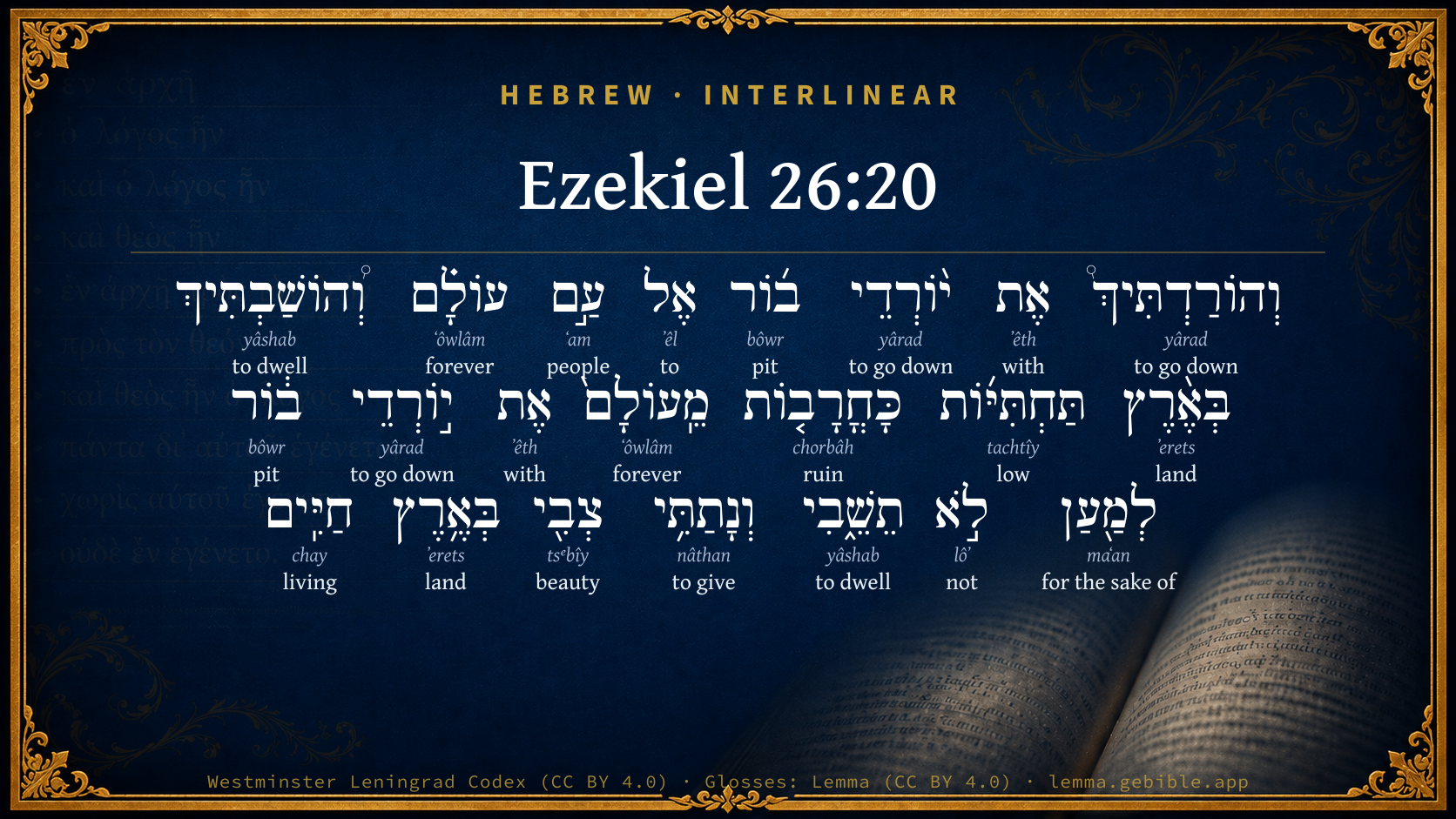
Ezekiel 26:20

Hebrew (Westminster Leningrad Codex) Ezekiel 26:20 appears in the Hebrew Old Testament. The text above is from the Westminster Leningrad Codex. Each word links to its Strong’s number, a concise gloss, and parsing drawn from the Open Scriptures Hebrew Bible morphology. Click any word for its full Brown-Driver-Briggs (BDB) entry.
Download image
Cite this verse

Ezekiel 26:20 (World English Bible). Public Domain. Lemma interlinear Bible study tool, https://lemma.gebible.app/v/ezekiel/26/20.

Show BibTeX & RIS
BibTeX
RIS
English Translation
then will I bring you down with those who descend into the pit, to the people of old time, and will make you to dwell in the lower parts of the earth, in the places that are desolate of old, with those who go down to the pit, that you be not inhabited; and I will set glory in the land of the living:
World English Bible · Public Domain
Download a study sheet

One document with this verse’s original text, its word-by-word gloss line, the meaning frame, cross-references with their text, attributed commentary, and full source and license credits — printable, and it pastes into notes with its structure intact.

This verse Autodidact and up

Study sheet (.html) Plain text (.txt)

A passage Seminary Student

Up to 50 verses in one chapter. A passage sheet keeps up to 6 commentary sources and 12 cross-references per verse, in the order this page ranks them, and says so on the sheet whenever that leaves anything out. Ask for a single verse and you get the Autodidact verse sheet above.

Everything on this page stays free to read, with no account — the sheet is a download of what is already on screen, not access to it.

Want to remove ads? Support Godless Engineer
Compare translations 3

The same verse in 3 English versions, stacked beneath the original-language interlinear above. Click any original word for its lexicon entry.

Each is an independent rendering of the whole verse — the interlinear is not word-aligned to these translations.

Highlighted words mark where these versions differ — a whole-verse word diff, not a word-by-word alignment.

  • World English Bible Public Domain
    then will I bring you down with those who descend into the pit, to the people of old time, and will make you to dwell in the lower parts of the earth, in the places that are desolate of old, with those who go down to the pit, that you be not inhabited; and I will set glory in the land of the living:
  • King James Version Public Domain
    When I shall bring thee down with them that descend into the pit, with the people of old time, and shall set thee in the low parts of the earth, in places desolate of old, with them that go down to the pit, that thou be not inhabited; and I shall set glory in the land of the living;
  • unfoldingWord Literal Text CC BY-SA 4.0
    then I will bring you down to the people of ancient times, like the others who have gone down into the pit; for I will make you live in the lowest realms of the earth as in ruins of ancient times. Because of this you will not come back and stand in the land of the living.

unfoldingWord Literal Text — © unfoldingWord, licensed CC BY-SA 4.0. Word-aligned USFM3 via Door43 (git.door43.org/unfoldingWord/en_ult).

Versions to compare (up to 4)

3 of 4 selected

Show all 18 translations

Every available English version of this verse, each an independent rendering of the whole verse.

  • World English Bible Public Domain
    then will I bring you down with those who descend into the pit, to the people of old time, and will make you to dwell in the lower parts of the earth, in the places that are desolate of old, with those who go down to the pit, that you be not inhabited; and I will set glory in the land of the living:
  • Berean Standard Bible Public Domain
    then I will bring you down with those who descend to the Pit, to the people of antiquity. I will make you dwell in the earth below like the ancient ruins, with those who descend to the Pit, so that you will no longer be inhabited or set in splendor in the land of the living.
  • Majority Standard Bible Public Domain
    then I will bring you down with those who descend to the Pit, to the people of antiquity. I will make you dwell in the earth below like the ancient ruins, with those who descend to the Pit, so that you will no longer be inhabited or set in splendor in the land of the living.
  • King James Version Public Domain
    When I shall bring thee down with them that descend into the pit, with the people of old time, and shall set thee in the low parts of the earth, in places desolate of old, with them that go down to the pit, that thou be not inhabited; and I shall set glory in the land of the living;
  • American Standard Version (1901) Public Domain
    then will I bring thee down with them that descend into the pit, to the people of old time, and will make thee to dwell in the nether parts of the earth, in the places that are desolate of old, with them that go down to the pit, that thou be not inhabited; and I will set glory in the land of the living:
  • Revised Version (1885) Public Domain
    then will I bring thee down with them that descend into the pit, to the people of old time, and will make thee to dwell in the nether parts of the earth, in the places that are desolate of old, with them that go down to the pit, that thou be not inhabited; and I will set glory in the land of the living:
  • Geneva Bible (1599) Public Domain
    When I shall cast thee downe with them that descende into the pitte, with the people of olde time, and shall set thee in the lowe partes of the earth, like the olde ruines, with them, I say, which goe downe to the pitte, so that thou shalt not be inhabited, and I shall shewe my glory in the land of the liuing,
  • Douay-Rheims (1899) Public Domain
    And when I shall bring thee down with those that descend into the pit to the everlasting people, and shall set thee in the lowest parts of the earth, as places desolate of old, with them that are brought down into the pit, that thou be not inhabited: and when I shall give glory in the land of the living,
  • Young's Literal Translation Public Domain
    And I have caused thee to go down, With those going down to the pit, Unto the people of old, And I have caused thee to dwell in the land, The lower parts -- in wastes of old, With those going down to the pit, So that thou art not inhabited, And I have given beauty in the land of the living.
  • Literal Standard Version CC BY-SA 4.0
    And I have caused you to go down, || With those going down to the pit, || To the people of old, || And I have caused you to dwell || In the lower parts of the earth—in ancient ruins, || With those going down to the pit, || So that you are not inhabited, || And I have given beauty in the land of the living.
  • Unlocked Literal Bible CC BY-SA 4.0
    then I will bring you down to the people of ancient times, like the others who have gone down into the pit; for I will make you live in the lowest realms of the earth as in ruins of ancient times. Because of this you will not come back and stand in the land of the living.
  • unfoldingWord Literal Text CC BY-SA 4.0
    then I will bring you down to the people of ancient times, like the others who have gone down into the pit; for I will make you live in the lowest realms of the earth as in ruins of ancient times. Because of this you will not come back and stand in the land of the living.
  • Darby Bible Public Domain
    then will I bring thee down, with them that go down to the pit, to the people of old time, and will cause thee to dwell in the lower parts of the earth, in places desolate of old, with them that go down to the pit, that thou be not inhabited; and I will set glory in the land of the living.
  • World Messianic Bible Public Domain
    then I will bring you down with those who descend into the pit, to the people of old time, and will make you dwell in the lower parts of the earth, in the places that are desolate of old, with those who go down to the pit, that you be not inhabited; and I will set glory in the land of the living.
  • Webster's Bible Public Domain
    When I shall bring thee down with them that descend into the pit, with the people of old time, and shall set thee in the low parts of the earth, in places desolate of old, with them that go down to the pit, that thou be not inhabited; and I shall set glory in the land of the living;
  • Free Bible Version CC BY-SA 4.0
    I will bring you down with those who are headed to the grave to join people from long ago. I will make you live under the earth like the ruins of the past together with those who have gone down into the grave, so that no one will live in you and you won't have any place in the land of the living.
  • Bible in Basic English Public Domain
    Then I will make you go down with those who go down into the underworld, to the people of the past, causing your living-place to be in the deepest parts of the earth, in places long unpeopled, with those who go down into the deep, so that there will be no one living in you; and you will have no glory in the land of the living.
  • JPS Tanakh (1917) Public Domain
    then will I bring thee down with them that descend into the pit, to the people of old time, and will make thee to dwell in the nether parts of the earth, like the places that are desolate of old, with them that go down to the pit, that thou be not inhabited; and I will set glory in the land of the living;

Literal Standard Version (2020), Covenant Press — licensed CC BY-SA 4.0. Text via the HelloAO Bible API (eBible.org). Unlocked Literal Bible (unfoldingWord) — licensed CC BY-SA 4.0. Text via the HelloAO Bible API (eBible.org). unfoldingWord Literal Text — © unfoldingWord, licensed CC BY-SA 4.0. Word-aligned USFM3 via Door43 (git.door43.org/unfoldingWord/en_ult). Free Bible Version, Dr. Jonathan Gallagher — licensed CC BY-SA 4.0. Text via the HelloAO Bible API (eBible.org).

Word by word

More ways to search: Search by grammar → Find every occurrence → Compare this word →

Practice this passage: Drill this verse → Learn its vocabulary →

תַּחְתִּיּ֜וֹת
tachtîy
H8482
“low”
Adjective, Adjective, Feminine, Plural, Absolute
Part of Speech
Adjective
Type
Adjective
Gender
Feminine
Number
Plural
State
Absolute
Full BDB Definition

Origin: from H8478

TWOT: 2504b

low, lower, lowest - lowest (as adjective) - the lower parts (substantive)
  1. וְהוֹרַדְתִּיךְ֩ yârad H3381 “and · to go down · you” Conjunction + Verb, Hiphil, Sequential Perfect, 1st Person, Common, Singular + Suffix, Personal, 2nd Person, Feminine, Singular
  2. אֶת ʼêth H854 “with” Preposition
  3. י֨וֹרְדֵי yârad H3381 “going down” Verb, Qal, Participle Active, Masculine, Plural, Construct
  4. ב֜וֹר bôwr H953 “pit” Noun, Common, Masculine, Singular, Absolute
  5. אֶל ʼêl H413 “to” Preposition
  6. עַ֣ם ʻam H5971 “people of” Noun, Common, Masculine, Singular, Construct
  7. עוֹלָ֗ם ʻôwlâm H5769 “forever” Noun, Common, Masculine, Singular, Absolute
  8. וְ֠הוֹשַׁבְתִּיךְ yâshab H3427 “and · to dwell · you” Conjunction + Verb, Hiphil, Sequential Perfect, 1st Person, Common, Singular + Suffix, Personal, 2nd Person, Feminine, Singular
  9. בְּאֶ֨רֶץ ʼerets H776 “in/at · land” Preposition + Noun, Common, Both, Singular, Absolute
  10. כָּחֳרָב֤וֹת chorbâh H2723 “like/as · ruins” Preposition + Noun, Common, Feminine, Plural, Absolute
  11. מֵֽעוֹלָם֙ ʻôwlâm H5769 “from · forever” Preposition + Noun, Common, Masculine, Singular, Absolute
  12. אֶת ʼêth H854 “with” Preposition
  13. י֣וֹרְדֵי yârad H3381 “going down” Verb, Qal, Participle Active, Masculine, Plural, Construct
  14. ב֔וֹר bôwr H953 “pit” Noun, Common, Masculine, Singular, Absolute
  15. לְמַ֖עַן maʻan H4616 “for the sake of” Preposition
  16. לֹ֣א lôʼ H3808 “not” Particle, Negative
  17. תֵשֵׁ֑בִי yâshab H3427 “to dwell” Verb, Qal, Imperfect, 2nd Person, Feminine, Singular
  18. וְנָתַתִּ֥י nâthan H5414 “and · to give” Conjunction + Verb, Qal, Sequential Perfect, 1st Person, Common, Singular
  19. צְבִ֖י tsᵉbîy H6643 “beauty” Noun, Common, Masculine, Singular, Absolute
  20. בְּאֶ֥רֶץ ʼerets H776 “in/at · land of” Preposition + Noun, Common, Both, Singular, Construct
  21. חַיִּֽים chay H2416 “living” Adjective, Adjective, Masculine, Plural, Absolute

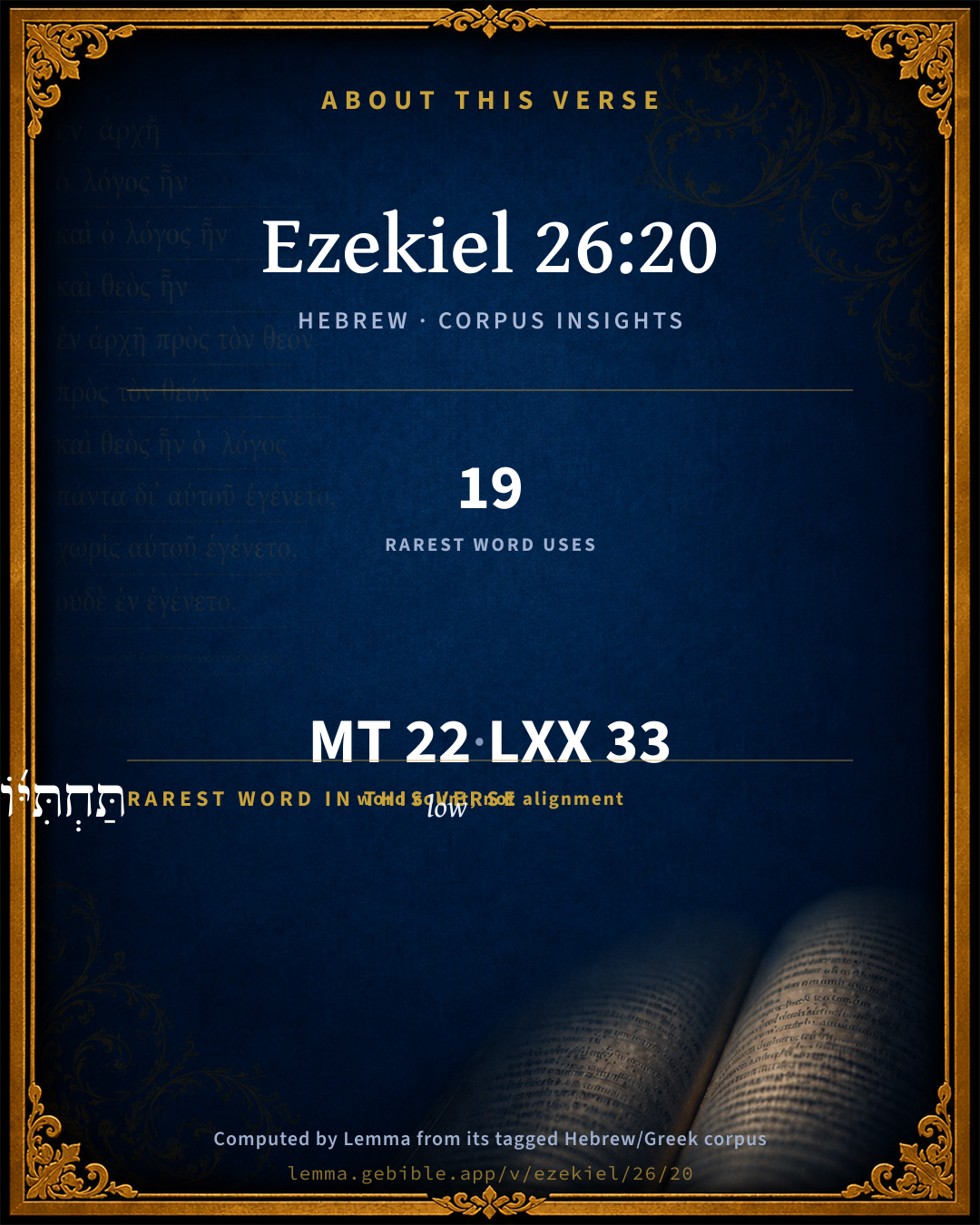
About this verse

These counts appear in no published source. They are computed here, from the morphology-tagged text and Lemma’s own curated glosses. What Lemma adds →

22
words
15
distinct lemmas
Prophets
section

Notable vocabulary

The rarest word here is תַּחְתִּיּ֜וֹת low H8482 — appearing just 19 times in the whole Hebrew Bible.

Shared distinctive vocabulary

תַּחְתִּיּ֜וֹת low H8482 occurs in 19 verses of the Hebrew Bible. Also found in:

Grammatical profile

  • 6 verbs
  • 9 nouns
  • 2 adjectives
  • 4 prepositions
  • 1 particle

Verb forms

  • וְהוֹרַדְתִּיךְ֩ Hiphil · Sequential Perfect
  • י֨וֹרְדֵי Qal · Participle Active
  • וְ֠הוֹשַׁבְתִּיךְ Hiphil · Sequential Perfect
  • י֣וֹרְדֵי Qal · Participle Active
  • תֵשֵׁ֑בִי Qal · Imperfect
  • וְנָתַתִּ֥י Qal · Sequential Perfect

Repetition

Words recur within this verse — often emphatic in Hebrew:

  • וְהוֹרַדְתִּיךְ֩ to go down H3381 ×3
  • ב֜וֹר pit H953 ×2
  • עוֹלָ֗ם forever H5769 ×2
  • וְ֠הוֹשַׁבְתִּיךְ to dwell H3427 ×2
  • בְּאֶ֨רֶץ land H776 ×2
  • אֶת with H854 ×2

Hebrew & Septuagint length

In English translation the verse runs 64 words from the Hebrew and 63 from the Septuagint (LXX English) — closely comparable.

A rough comparison of the two English renderings, which tokenize alike — not a word-level alignment.

Word counts can differ between the Hebrew and the Greek without any difference in meaning — e.g. the Hebrew direct-object marker אֵת has no separate Greek word, and Greek often adds the article ὁ.

In the original languages it is 22 Hebrew tokens and 33 Greek tokens — but the two are counted differently (Hebrew bundles its prefixes and suffixes into one token; the Greek is in lemma form), so that isn’t a like-for-like length.

Cross-references

20

Topical passages linked to Ezekiel 26:20 in the Treasury of Scripture Knowledge — connected by theme and wording, ordered by reader-vote popularity; previews shown in the World English Bible.

  • Psalms 27:13 I am still confident of this: I will see the goodness of Yahweh in the land of the living.
  • Luke 10:15 You, Capernaum, who are exalted to heaven, will be brought down to Hades.
  • Ezekiel 28:25–26 Thus says the Lord Yahweh: When I shall have gathered the house of Israel from the peoples among whom they are scattered, and shall be sanctified in them in the sight of the nations, then shall they dwell in their own land which I gave to my servant Jacob.
  • Ezekiel 32:18–32 Son of man, wail for the multitude of Egypt, and cast them down, even her, and the daughters of the famous nations, to the lower parts of the earth, with those who go down into the pit.
  • Zechariah 2:8 For thus says Yahweh of hosts: 'For honor he has sent me to the nations which plundered you; for he who touches you touches the apple of his eye.
  • Numbers 16:30 But if Yahweh make a new thing, and the ground open its mouth, and swallow them up, with all that appertain to them, and they go down alive into Sheol; then you shall understand that these men have despised Yahweh.
  • Numbers 16:33 So they, and all that appertained to them, went down alive into Sheol: and the earth closed on them, and they perished from among the assembly.
  • Job 30:3–6 They are gaunt from lack and famine. They gnaw the dry ground, in the gloom of waste and desolation.
  • Psalms 28:1 To you, Yahweh, I call. My rock, don't be deaf to me; Lest, if you are silent to me, I would become like those who go down into the pit.
  • Psalms 88:3–6 For my soul is full of troubles. My life draws near to Sheol.
  • Isaiah 4:5 Yahweh will create over the whole habitation of Mount Zion, and over her assemblies, a cloud and smoke by day, and the shining of a flaming fire by night; for over all the glory will be a canopy.
  • Isaiah 14:11–19 Your pomp is brought down to Sheol, [and] the noise of your viols: the worm is spread under you, and worms cover you.
  • Isaiah 59:10 We grope for the wall like the blind; yes, we grope as those who have no eyes: we stumble at noonday as in the twilight; among those who are lusty we are as dead men.
  • Lamentations 3:6 He has made me to dwell in dark places, as those that have been long dead.
  • Ezekiel 34:1–31 The word of Yahweh came to me, saying,
  • Ezekiel 39:7 My holy name will I make known in the midst of my people Israel; neither will I allow my holy name to be profaned any more: and the nations shall know that I am Yahweh, the Holy One in Israel.
  • Ezekiel 39:25–29 Therefore thus says the Lord Yahweh: Now will I bring back the captivity of Jacob, and have mercy on the whole house of Israel; and I will be jealous for my holy name.
  • Amos 9:2 Though they dig into Sheol, there my hand will take them; and though they climb up to heaven, there I will bring them down.
  • Jonah 2:2 He said, "I called because of my affliction to Yahweh. He answered me. Out of the belly of Sheol I cried. You heard my voice.
  • Jonah 2:6 I went down to the bottoms of the mountains. The earth barred me in forever: Yet have you brought up my life from the pit, Yahweh my God.

Cross-references courtesy of OpenBible.info (CC BY 4.0).

Hebrew and Greek witnesses Masoretic Hebrew ↔ Greek Septuagint

The same verse in the two great witnesses to the Old Testament, shown verse-for-verse.

These are two independent witnesses, not word-aligned to each other, and the Septuagint is shown in lemma (dictionary) form.

Hebrew Ezekiel 26:20 Masoretic · Westminster Leningrad Codex

וְהוֹרַדְתִּיךְ֩ אֶת י֨וֹרְדֵי ב֜וֹר אֶל עַ֣ם עוֹלָ֗ם וְ֠הוֹשַׁבְתִּיךְ בְּאֶ֨רֶץ תַּחְתִּיּ֜וֹת כָּחֳרָב֤וֹת מֵֽעוֹלָם֙ אֶת י֣וֹרְדֵי ב֔וֹר לְמַ֖עַן לֹ֣א תֵשֵׁ֑בִי וְנָתַתִּ֥י צְבִ֖י בְּאֶ֥רֶץ חַיִּֽים

then will I bring you down with those who descend into the pit, to the people of old time, and will make you to dwell in the lower parts of the earth, in the places that are desolate of old, with those who go down to the pit, that you be not inhabited; and I will set glory in the land of the living:

World English Bible · Public Domain

Greek LXX Ezekiel 26:20 Septuagint · lemma form

καί καταβιβάζω σύ πρός ὁ καταβαίνω εἰς βόθρος πρός λαός αἰών καί καταοἰκίζω σύ εἰς βάθος ὁ γῆ ὡς ἔρημος αἰώνιος μετά καταβαίνω εἰς βόθρος ὅπως μή καταοἰκέω μηδέ ἀναἵστημι ἐπί γῆ ζωή

and great waters shall cover you; and I shall bring you down to them that go down to the pit, to the people of old time, and shall cause you to dwell in the depths of the earth, as in everlasting desolation, with them that go down to the pit, that you may not be inhabited, nor stand upon the land of life;

LXX2012 (modern English Septuagint) · Public Domain

On this verse, The Cambridge Bible for Schools and Colleges discusses the Septuagint’s reading. Read the note in Commentary ↓

Hebrew: Westminster Leningrad Codex (CC BY 4.0). Greek: Septuagint (public domain); English from LXX2012 (modern English Septuagint) (Public Domain). How the Septuagint differs from the Hebrew →

Targum (Aramaic paraphrase)

1

The Targum is the ancient Jewish Aramaic paraphrase of the Hebrew Scriptures — an interpretive translation, not the Hebrew text itself. Onkelos (literal) and Pseudo-Jonathan (expansive) render the Torah, and Jonathan the Prophets. Coverage is partial: where no permissively-licensed English translation exists for a verse, only the Aramaic is shown. This is verse-level text, not a word-by-word alignment to the Hebrew.

  1. Targum Jonathan Prophets (Joshua–Malachi)
    וְאַחֲתִנִיךְ עִם נָחֲתֵי נוֹב בֵּית אַבְדָנָא לְוַת עַמָא דִמְעַלְמָא וְאַצְדִנִיךְ בְּאַרְעָא אַרְעִיתָא בְּחֶרְבָתָא דִמְעַלְמָא עִם נַחֲתֵי גוֹב בֵּית אָבְדָנָא בְּדִיל דְלָא תִּתְיַתְבִין וְאֶתֵּן חֶדְוָא בְּאַרְעָא דְיִשְׂרָאֵל:

    (no public-domain English translation for this verse)

    Targum Jonathan — Aramaic: “Mikraot Gedolot” (public domain). English: “Sefaria Community Translation” (CC0 1.0 (public-domain dedication)); “London "Chaldee Paraphrase," 1871” (public domain). Text via Sefaria.

Commentary

Notes on Ezekiel 26:20 from classic Christian and Jewish commentators (each source and its license shown beneath its notes). The classic Christian expositions comment on the surrounding passage and are grouped to its opening verse, so a note may address several verses; the Jewish commentaries on the Tanakh (Rashi and others) are per-verse, so they appear only where the commentator wrote on this verse.

Lemma curates 59 commentaries, every one of them public domain or Creative Commons licensed, each selected and text-cleaned for this edition rather than reprinted as found. About our sources →

Trapp's Complete Commentary

John Trapp

Eze 26:20 When I shall bring thee down with them that descend into the pit, with the people of old time, and shall set thee in the low parts of the earth, in places desolate of old, with them that go down to the pit, that thou be not inhabited; and I shall set glory in the land of the living;

Ver. 20. With the people of old time.] The multitude of those that are dead from the beginning of the world; or with the people of the old world, as Jerome will have it; and that the Tyrians’ destruction, both temporal and eternal, is hereby hinted.

When I shall set glory in the land of the living,] i.e., In Judea (where the living and true God is worshipped, and where are the right heirs of life) will I re-establish my Church, which is my glory; or when I shall glorify mine elect in mine heavenly kingdom.

John Trapp, A Commentary or Exposition upon All the Books of the Old and New Testament (1647–1656) — public domain. Text from a community e-Sword module.

Geneva Bible (1599)

Geneva Bible translators

Meaning, in Judea, when it shall be restored.

Which were dead long ago.

Geneva Bible (1599) marginal notes — public domain. Text via Bolls.life.

Jamieson, Fausset & Brown

Robert Jamieson, A. R. Fausset & David Brown

the pit--Tyre's disappearance is compared to that of the dead placed in their sepulchres and no more seen among the living (compare Eze 32:18, Eze 32:23; Isa 14:11, Isa 14:15, Isa 14:19).

I shall set glory in the land--In contrast to Tyre consigned to the "pit" of death, I shall set glory (that is, My presence symbolized by the Shekinah cloud, the antitype to which shall be Messiah, "the glory as of the only-begotten of the Father," Joh 1:14; Isa 4:2, Isa 4:5; Zac 6:13) in Judah.

of the living--as opposed to Tyre consigned to the "pit" of death. Judea is to be the land of national and spiritual life, being restored after its captivity (Eze 47:9). FAIRBAIRN loses the antithesis by applying the negative to both clauses, "and that thou be not set as a glory in the land of the living."

Jamieson, Fausset & Brown — Commentary Critical and Explanatory on the Whole Bible (1871) — public domain (CC PDM 1.0). Text via the HelloAO Bible API.

Adam Clarke's Commentary

Verse 20. And I shall set glory in the land of the living.] Judea so called, the land of the living God.

Adam Clarke's Commentary on the Bible (1810–1826) — public domain. Text from a community e-Sword/MySword module.

Ellicott's Commentary for English Readers

(20) With them that descend into the pit.—Comp. Isa_14:9-20. Tyre is here represented, as Babylon is there, as joining itself to the dead—a striking figure to indicate its utter and final destruction. This is to be understood of the Tyre that then was, the proud mistress of the sea. The question whether there might or might not ever be other inhabitants on the rock of Tyre is one which does not at all come within the scope of the prophet’s vision. The way of speaking of the place of the dead, as in the lower part of the earth, so common in Scripture (comp. Eph_4:9), does not by any means prove that the writers thought this to be the actual place of departed spirits, but only that, as it is a necessity of human thought and expression to indicate some locality, this locality, in association with the burial of the body, is most naturally placed “under the earth.” In the same way, men, even on opposite sides of the globe, always speak of God as “above them,” and their gestures and looks, as well as their words, unavoidably involve the same idea, though they perfectly know that He is omnipresent. (Comp. even the example of our Lord in Mar_6:41; Mar_7:34; Luk_9:16; Joh_17:1.)

Set glory in the land of the living.—The word for “glory” is the same as that used in Eze_20:6; Eze_20:15; Dan_8:9; Dan_11:16; Dan_11:41, in connection with Palestine. The prediction is that when Tyre, who is now rejoicing in the calamity of Judah, shall be past and forgotten, numbered with the dead, then God will establish His people as a living Church to Himself. A ray of Messianic promise shines through the prediction, although, for the time, it might seem nothing more than a foretelling of the restoration from the Captivity.

A Bible Commentary for English Readers, edited by Charles John Ellicott (1878–1897) — public domain. Text from a community e-Sword module.

The Cambridge Bible for Schools and Colleges

gen. ed. J. J. S. Perowne

20. when I shall bring] Rather in connexion with Eze_26:19 : when I shall make thee a desolate city … then I shall bring thee down. The prophet regards Tyre’s sinking beneath the waters as her entrance upon the descent into the pit, the place of the dead, just as frequently elsewhere (ch. 32) he snakes the grave the entrance into the underworld of the dead. Cf. Isa_14:11; Isa_14:19.

that descend into the pit] Rather: them that are gone down into the pit, unto the people. The common phrase “they that go down to the pit” should be rendered: that are gone down (past). Ezek. always says with them that are gone down, Eze_28:8, Eze_31:14 : cf. Isa_14:19; Isa_38:18.

The “people of old time” are those dead from of old, Eze_32:27; Lam_3:6; Psa_143:3; hardly with more definite ref. to the Flood, Job_22:15.

low parts of the earth] the nether parts, i.e. in the underworld of the dead (Eze_31:14, Eze_32:18-24; Lam_3:55; Psa_63:9), which was held to be situated in the bowels of the earth or under the earth.

in places desolate of old] According to the textual tradition (Baer, Ezek.) the true reading is like places …, so LXX., Vulg. The prophet gives Tyre a personality; when buried under the sea she goes down into the abode of the dead, and possibly he regards the “places desolate of old” as also gone down and gathered in the underworld. For “that go down,” that are gone down.

and I shall set glory] Such an antithesis is entirely unnatural; something further must be said of Tyre in continuation of “thou shalt not be inhabited.” Either: nor set (thy) glory, (reading 2 fem., with final y otiose), a phrase, however, nowhere else occurring; or else the reading presumably before LXX. must be accepted: nor arise (stand forth) in the land of the living (tithyççebi).

The Cambridge Bible for Schools and Colleges (gen. ed. J. J. S. Perowne; Cambridge University Press, 1878–1918) — public domain. Text from a community e-Sword module.

John Gill's Exposition

I will make thee a terror,.... To all the isles round about, who shall shake and tremble at the ruin of Tyre, as before observed; or to herself, being brought into a most terrible and distressed condition:

and thou shall be no more: in the same place and situation, in the same happy state and condition:

though thou be sought for, yet shalt thou never be found again, saith the Lord God: this is true of the antitype, Babylon, or antichrist, Rev 18:21.

Next: Ezekiel Chapter 27

John Gill's Exposition of the Whole Bible (1746–1763) — public domain (CC PDM 1.0). Text via the HelloAO Bible API.

Haydock's Catholic Bible Commentary

Everlasting: in the grave, till the day of judgment, Psalm xlviii. 12., and Wisdom xii. 5. --- Living, assigned to Israel, (chap. xxxii. 24.; Calmet) where holy people adore the true God, and shall rise to life eternal. (Menochius)

George Leo Haydock (1774–1849), Haydock's Catholic Family Bible and Commentary, 1859 edition — public domain. Excludes Psalms (Douay-Rheims chapter numbering differs from Protestant) and Deuterocanonical books (Catholic canon only).

Matthew Poole's English Annotations

Bring thee down; destroy thee, slay thee, and bury thee, throw thee into the grave.

The people of old time; who are long since dead, and gone to eternity, the people of eternity.

In the low parts of the earth; another description of the grave, from the situation, and from the solitudes or desolation of it. In brief, when Tyre, as a dead man, shall be buried, forgotten and perish utterly, and my hand hath done it, then it shall be known my hand hath avenged and punished all her insolence, inhumanity, and covetousness that she discovered when she rejoiced at Jerusalem’s fall.

Shall set glory; restore the beauty, strength, wealth of Israel, bring them back to Jerusalem, to worship in a rebuilt temple, where they shall enjoy me.

The land of the living; the land of Judea, called land of the living, because a land where God will bless and give life by his word, ordinances, and Spirit: thus different shall Tryre’s captivity and Jerusalem’s be.

Matthew Poole's English Annotations on the Holy Bible (1683–1685) — public domain. Text from a community e-Sword/MySword module.

Whedon's Commentary on the Bible

Daniel D. Whedon

20. When — Rather, then.

In places — Probably, like places. Sinking beneath the sea they drop at the same time into “the nether parts of the earth,” the underworld, where are the people of old time and all the ruined cities of the past. This picture of the dead in Sheol (the pit) is elaborated, Eze_32:18, etc. (Compare Isa_14:9; Psa_88:4-7.)

I shall set [rather, will set] glory in the land of the living — A very difficult phrase. Various readings are suggested, but in any case a contrast appears between the glorious life here and the shadow life in Sheol.

Daniel D. Whedon (gen. ed.), Commentary on the Old and New Testaments (1874–1909) — public domain. Text from a community e-Sword module.

The Pulpit Commentary

When I shall bring thee down, etc. The pit is sheol, Hades, the unseen world of the dead. The image may have been suggested by Isa_14:9, where it is used of Babylon. It was obviously one on whichthe mind of Ezekiel dwelt, and is reproduced in Eze_32:17-32. Here, apparently, the sinking in the depth of the waters (Ver. 19) is thought of as leading to that world of the dead that lay beneath them. The people of old time may possibly include the races of the old world that were submerged in the waters of the Flood. The imagery of Psa_88:3-7 seems to have been floating before the prophet"s mind. I shall set glory; better, will set. The contrast drawn is that between the shadow-world of the dead, and the earth with its living inhabitants. There Jehovah would establish his glory, would, sooner or later, manifest his kingdom, while Tyre and its pomp should be no more, belonging only to the past. Conjectural readings and renderings have been suggested as follows:

(1) Hitzig, "And thou no longer shinest with glory in the land of the living.

(2) Havernick and Kliefoth, "That I no longer produce anything glorious from thee in the land of the living.

(3) Ewald," That thou mayest not remain (or stand) in the laud of the living." I have adopted Keil"s interpretation of the Anthorized Version.

An encouraging assurance for a depressed people.

I shall set glory in the land of the living." Accepting this rendering as expressing the meaning of the original, and as applicable to Judah, we see in it

I A REMARKABLE DESIGNATION OF THE HOLY LAND. It is here called "the land of the living." Hengstenberg views "the land of the living" as standing in "contrast to Sheol, the land. of the dead, to which in the foregoing the inhabitants of Tyre are assigned." The expression seems to refer particularly to Palestine. The "Speaker"s Commentary" says, "The land of the living is the land of the true God, as opposed to the land of the dead, to which is gathered the glory of the world." And Matthew Henry, The holy land is the land of the living; for none but holy souls are properly living souls." There was propriety in applying this designation to that land, because there:

1. The living God was known and worshipped. "In Judah is God known: his Name is great in Israel," etc.; (Psa_76:1, Psa_76:2) My soul thirsteth for God, for the living God," etc.. (Psa_42:2) The people of other lands had riches, honors, power; but they were idolaters. Their gods were no gods, but dead idols. In the highest sense no land can be called living whose deity or deities are dead, unreal, mere human inventions. To the people of Judah and Jerusalem the living and true God had revealed himself through law-giver, prophet, and. poet, and through his hand in their history as a nation.

2. The living Word was possessed. The sacred writings of the Jews are far superior to those of heathen nations. They were true: "the Word of truth". (Psa_119:43, Psa_119:142, Psa_119:160) They were vital and lasting: ".living oracles"; (Act_7:38) "the Word of God, which liveth and abideth". (1Pe_1:23) They were life-giving. "Thy Word hath quickened, me". (Psa_119:50, Psa_119:93) Moreover, their Scriptures were light-giving: "Thy Word is a lamp unto my feet, and a light unto my path". (Psa_119:105, Psa_119:130)

3. The living ordinances were observed. The pure worship of the living and true God was instituted and practiced there, and, after the return from the Captivity, without any admixture of idolatry. Worship, when it is directed to the true Object and offered in a true spirit, develops and strengthens the noblest life of the worshipper. To the pious Jews the means of grace were as "wells of salvation." In these respects, then, Palestine was appropriately called "the land of the living." And with even greater fullness and force may the designation be applied to this favored land of ours.

II AN ENCOURAGING ASSURANCE CONCERNING THE HOLY LAND. "I shall set glory in the land of the living" Let us look at this assurance:

1. In its primary signification. By the side of the utter overthrow of Tyre, Ezekiel predicts the renewal of the Divine favor and of prosperity to Jerusalem. Brief as the clause is, it indicates the return of the people of Judah from captivity to their own land, the rebuilding of the temple of Jehovah, the re-establishment of religious ordinances, and the restoration of the sacred city. And all these things were in due season accomplished. And thus interpreted, the assurance given in the text is the more significant from the fact that, after their return home, the Jews never obscured the Divine glory by the practice of idolatry. They neither gave God"s glory to another nor his praise unto graven images.

2. In its other and grander signification. The text prophetically points to the coming of the Messiah and the proclamation of the glorious gospel. In the work of redemption by Jesus Christ we have a much more illustrious display of the glory of God than in the return of the exiles from Babylon to Jerusalem, the rebuilding of the temple, etc. And this glory is ever increasing amongst men as the triumphs of the gospel are multiplied. The enemies of the cause of God are being vanquished by truth and love, and his true kingdom is constantly being established more and more deeply and widely in this world. And at length "all the earth shall be filled with the glory of the Lord.

CONCLUSION. Even in the darkest seasons of its history there is always a bright and inspiring hope for the true Church of God. By its unfaithfulness it may bring upon itself severe chastisement from its great Head; but it shall arise from the dust purified and strengthened, and go forward in its glorious course, "fair as the moon, clear as the sun, terrible as an army with banners. W.J.

The Pulpit Commentary (1880–1919), ed. H.D.M. Spence-Jones & Joseph S. Exell — public domain. Text from a community e-Sword module.

John Wesley's Explanatory Notes

Bring thee down - When I shall slay thee, and throw thee into the grave. With the people - Who are long since dead, and gone to eternity. The low parts - Another description of the grave, from the situation and solitude of it. Set glory - Then I will restore the beauty, strength, and wealth of Israel, and bring them back to Jerusalem. In the land - In the land of Judea, called, land of the living, because a land, where God will bless, and give life by his word, ordinances, and spirit: thus different shall Tyre's captivity and Jerusalem's be.

John Wesley, Explanatory Notes Upon the Whole Bible (1754–1765) — public domain. Text via the GEBible commentary corpus.

Rashi

Rabbi Shlomo Yitzchaki (Rashi)

with those who descend into the Pit with those who descend into Gehinnom.

to a people of old with the other nations who are there from long ago.

like the ruins of old like the cities that were destroyed from times of yore, viz. Sodom and her sister cities.

but I shall bestow beauty upon the land of the living And I shall bestow beauty upon Jerusalem.

Rashi on the Tanakh — English translations: “The Judaica Press complete Tanach with Rashi, translated by A. J. Rosenberg” (CC BY 4.0); “Pentateuch with Rashi's commentary by M. Rosenbaum and A.M. Silbermann, 1929-1934” (public domain); “The Metsudah Tanach series, Lakewood, N.J” (CC BY 4.0); and “The Book of Joshua, Metsudah Publications, 1997” (CC BY 4.0). Text via Sefaria.

Lesson kit

Teaching starters — assembled from the data on this page, not authored interpretation. Every prompt links to the verse data it draws on. Edit before teaching.

Ezekiel, in the Prophets, opens this verse with 22 words (15 distinct Hebrew lemmas). Its most distinctive word is tachtîy (“low”). A historical commentator’s framing appears above. Read the whole chapter for the surrounding context.

Discussion questions

  1. The word tachtîy carries the sense “low.” How does it shape the verse?
  2. How does Genesis 6:16, which shares the word «low», read alongside this verse?
  3. What does the repetition of “to go down” (3× in this one verse) do in this verse?
  4. The translations on this page render this verse differently — a whole-verse word diff, not a word-by-word alignment. What might account for the different wordings?
  5. «וְהוֹרַדְתִּיךְ֩» is a Hiphil Sequential Perfect verb. How does that grammatical form shape the action described?
  6. Compare how Trapp's Complete Commentary and Geneva Bible (1599) read this verse. Where do they agree or differ?

Things to notice

Reading settings

Reading text

Shown beneath each verse's original-language words.

Old Testament
Old Testament edition

Read the OT as the Masoretic Hebrew (MT) or the Greek Septuagint (LXX).

English shown for the Greek Septuagint (in the Hebrew ↔ Greek comparison).

Comparing translations? Open the Compare panel on any verse page to stack up to four side by side.