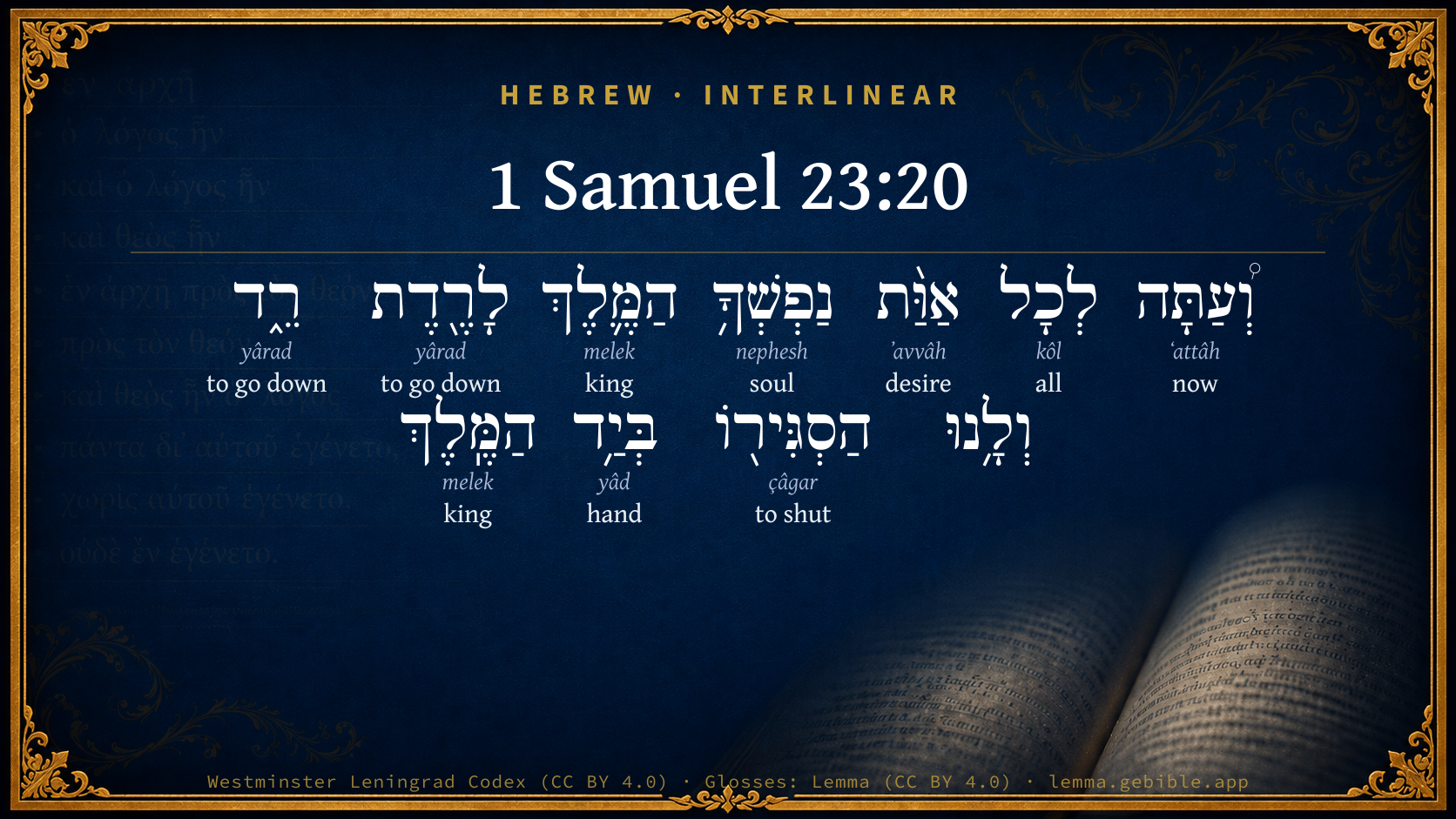
1 Samuel 23:20

Hebrew (Westminster Leningrad Codex) 1 Samuel 23:20 appears in the Hebrew Old Testament. The text above is from the Westminster Leningrad Codex. Each word links to its Strong’s number, a concise gloss, and parsing drawn from the Open Scriptures Hebrew Bible morphology. Click any word for its full Brown-Driver-Briggs (BDB) entry.
Download image
Cite this verse

1 Samuel 23:20 (World English Bible). Public Domain. Lemma interlinear Bible study tool, https://lemma.gebible.app/v/1-samuel/23/20.

Show BibTeX & RIS
BibTeX
RIS
English Translation
Now therefore, O king, come down, according to all the desire of your soul to come down; and our part shall be to deliver him up into the king's hand.
World English Bible · Public Domain
Download a study sheet

One document with this verse’s original text, its word-by-word gloss line, the meaning frame, cross-references with their text, attributed commentary, and full source and license credits — printable, and it pastes into notes with its structure intact.

This verse Autodidact and up

Study sheet (.html) Plain text (.txt)

A passage Seminary Student

Up to 50 verses in one chapter. A passage sheet keeps up to 6 commentary sources and 12 cross-references per verse, in the order this page ranks them, and says so on the sheet whenever that leaves anything out. Ask for a single verse and you get the Autodidact verse sheet above.

Everything on this page stays free to read, with no account — the sheet is a download of what is already on screen, not access to it.

Want to remove ads? Support Godless Engineer
Compare translations 3

The same verse in 3 English versions, stacked beneath the original-language interlinear above. Click any original word for its lexicon entry.

Each is an independent rendering of the whole verse — the interlinear is not word-aligned to these translations.

Highlighted words mark where these versions differ — a whole-verse word diff, not a word-by-word alignment.

  • World English Bible Public Domain
    Now therefore, O king, come down, according to all the desire of your soul to come down; and our part shall be to deliver him up into the king's hand.
  • King James Version Public Domain
    Now therefore, O king, come down according to all the desire of thy soul to come down; and our part shall be to deliver him into the king's hand.
  • unfoldingWord Literal Text CC BY-SA 4.0
    And now, O king, according to all of the desire of your soul to come down, come down, and to us to enclose him in the hand of the king.”

unfoldingWord Literal Text — © unfoldingWord, licensed CC BY-SA 4.0. Word-aligned USFM3 via Door43 (git.door43.org/unfoldingWord/en_ult).

Versions to compare (up to 4)

3 of 4 selected

Show all 18 translations

Every available English version of this verse, each an independent rendering of the whole verse.

  • World English Bible Public Domain
    Now therefore, O king, come down, according to all the desire of your soul to come down; and our part shall be to deliver him up into the king's hand.
  • Berean Standard Bible Public Domain
    Now, O king, come down whenever your soul desires, and we will be responsible for delivering him into your hand.”
  • Majority Standard Bible Public Domain
    Now, O king, come down whenever your soul desires, and we will be responsible for delivering him into your hand.”
  • King James Version Public Domain
    Now therefore, O king, come down according to all the desire of thy soul to come down; and our part shall be to deliver him into the king's hand.
  • American Standard Version (1901) Public Domain
    Now therefore, O king, come down, according to all the desire of thy soul to come down; and our part shall be to deliver him up into the king's hand.
  • Revised Version (1885) Public Domain
    Now therefore, O king, come down, according to all the desire of thy soul to come down; and our part shall be to deliver him up into the king’s hand.
  • Geneva Bible (1599) Public Domain
    Nowe therefore, O King, come downe according to all that thine heart can desire, and our part shall be to deliuer him into the Kinges handes.
  • Douay-Rheims (1899) Public Domain
    Now therefore come down, as thy soul hath desired to come down: and it shall be our business to deliver him into the king's hands.
  • Young's Literal Translation Public Domain
    And, now, by all the desire of thy soul, O king, to come down, come down, and ours `is' to shut him up into the hand of the king.'
  • Literal Standard Version CC BY-SA 4.0
    And now, by all the desire of your soul, O king, to come down, come down, and ours [is] to shut him up into the hand of the king.”
  • Unlocked Literal Bible CC BY-SA 4.0
    Now come down, king! According to your desire, come down! Our part will be to surrender him into the king's hand.”
  • unfoldingWord Literal Text CC BY-SA 4.0
    And now, O king, according to all of the desire of your soul to come down, come down, and to us to enclose him in the hand of the king.”
  • Darby Bible Public Domain
    And now, O king, come down according to all the desire of thy soul to come down; and it will be for us to deliver him up into the king's hand.
  • World Messianic Bible Public Domain
    Now therefore, O king, come down. According to all the desire of your soul to come down; and our part will be to deliver him up into the king’s hand.”
  • Webster's Bible Public Domain
    Now therefore, O king, come down according to all the desire of thy soul to come down; and our part shall be to deliver him into the king's hand.
  • Free Bible Version CC BY-SA 4.0
    So, Your Majesty, please come whenever you want, and we'll make sure to hand him over to you.”
  • Bible in Basic English Public Domain
    So now, O king, have your soul's desire and come down, and we, for our part, will give him up into the king's hands.
  • JPS Tanakh (1917) Public Domain
    Now therefore, O king, come down, according to all the desire of thy soul to come down; and our part shall be to deliver him up into the king's hand.'

Literal Standard Version (2020), Covenant Press — licensed CC BY-SA 4.0. Text via the HelloAO Bible API (eBible.org). Unlocked Literal Bible (unfoldingWord) — licensed CC BY-SA 4.0. Text via the HelloAO Bible API (eBible.org). unfoldingWord Literal Text — © unfoldingWord, licensed CC BY-SA 4.0. Word-aligned USFM3 via Door43 (git.door43.org/unfoldingWord/en_ult). Free Bible Version, Dr. Jonathan Gallagher — licensed CC BY-SA 4.0. Text via the HelloAO Bible API (eBible.org).

Word by word

More ways to search: Search by grammar → Find every occurrence → Compare this word →

Practice this passage: Drill this verse → Learn its vocabulary →

אַוַּ֨ת
ʼavvâh
H185
“desire of”
Noun, Common, Feminine, Singular, Construct
Part of Speech
Noun
Type
Common
Gender
Feminine
Number
Singular
State
Construct
Full BDB Definition

Origin: from H183

TWOT: 40b

desire, lust, will (not necessarily evil)
  1. וְ֠עַתָּה ʻattâh H6258 “and · now” Conjunction + Adverb
  2. לְכָל kôl H3605 “to/for · all of” Preposition + Noun, Common, Masculine, Singular, Construct
  3. נַפְשְׁךָ֥ nephesh H5315 “soul · your” Noun, Common, Both, Singular, Construct + Suffix, Personal, 2nd Person, Masculine, Singular
  4. הַמֶּ֛לֶךְ melek H4428 “the · king” Particle, Definite Article + Noun, Common, Masculine, Singular, Absolute
  5. לָרֶ֖דֶת yârad H3381 “to go down” Preposition + Verb, Qal, Infinitive Construct
  6. רֵ֑ד yârad H3381 “go down” Verb, Qal, Imperative, 2nd Person, Masculine, Singular
  7. הַסְגִּיר֖וֹ çâgar H5462 “to shut · him” Verb, Hiphil, Infinitive Construct + Suffix, Personal, 3rd Person, Masculine, Singular
  8. בְּיַ֥ד yâd H3027 “in/at · hand of” Preposition + Noun, Common, Both, Singular, Construct
  9. הַמֶּֽלֶךְ melek H4428 “the · king” Particle, Definite Article + Noun, Common, Masculine, Singular, Absolute

About this verse

These counts appear in no published source. They are computed here, from the morphology-tagged text and Lemma’s own curated glosses. What Lemma adds →

11
words
8
distinct lemmas
Historical
section

Notable vocabulary

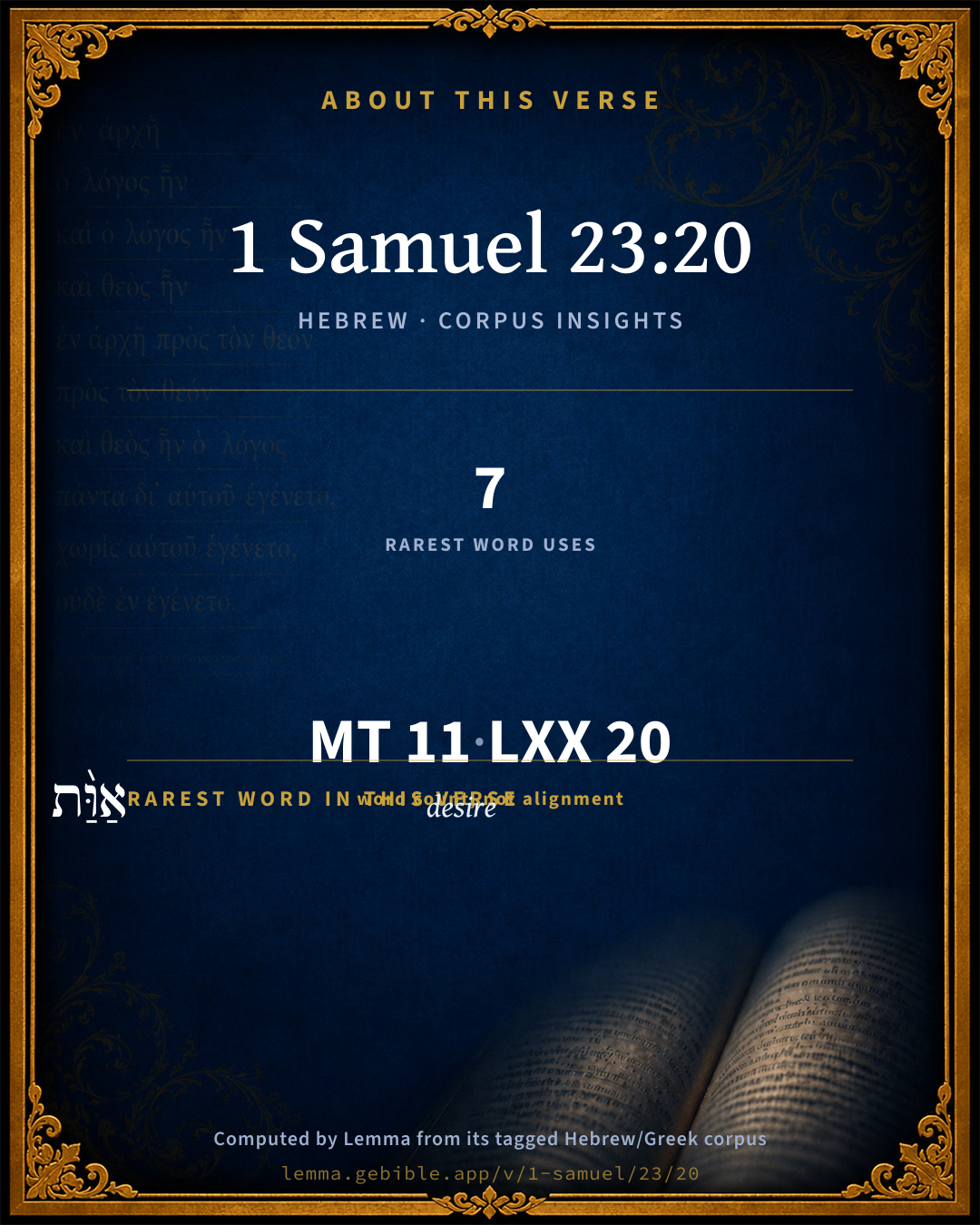
The rarest word here is אַוַּ֨ת desire H185 — appearing just 7 times in the whole Hebrew Bible.

Shared distinctive vocabulary

אַוַּ֨ת desire H185 occurs in 7 verses of the Hebrew Bible. Also found in:

Grammatical profile

  • 3 verbs
  • 6 nouns
  • 1 preposition
  • 1 adverb

Verb forms

  • לָרֶ֖דֶת Qal · Infinitive Construct
  • רֵ֑ד Qal · Imperative
  • הַסְגִּיר֖וֹ Hiphil · Infinitive Construct

Repetition

Words recur within this verse — often emphatic in Hebrew:

  • הַמֶּ֛לֶךְ king H4428 ×2
  • לָרֶ֖דֶת to go down H3381 ×2

Hebrew & Septuagint length

In English translation the verse runs 30 words from the Hebrew and 28 from the Septuagint (LXX English) — closely comparable.

A rough comparison of the two English renderings, which tokenize alike — not a word-level alignment.

Word counts can differ between the Hebrew and the Greek without any difference in meaning — e.g. the Hebrew direct-object marker אֵת has no separate Greek word, and Greek often adds the article ὁ.

In the original languages it is 11 Hebrew tokens and 20 Greek tokens — but the two are counted differently (Hebrew bundles its prefixes and suffixes into one token; the Greek is in lemma form), so that isn’t a like-for-like length.

Cross-references

9

Topical passages linked to 1 Samuel 23:20 in the Treasury of Scripture Knowledge — connected by theme and wording, ordered by reader-vote popularity; previews shown in the World English Bible.

  • 1 Samuel 23:12 Then said David, Will the men of Keilah deliver up to me and my men into the hand of Saul? Yahweh said, They will deliver you up.
  • Deuteronomy 18:6 If a Levite comes from any of your gates out of all Israel, where he lives as a foreigner, and comes with all the desire of his soul to the place which Yahweh shall choose;
  • 2 Samuel 3:21 Abner said to David, I will arise and go, and will gather all Israel to my lord the king, that they may make a covenant with you, and that you may reign over all that your soul desires. David sent Abner away; and he went in peace.
  • 1 Kings 21:11–14 The men of his city, even the elders and the nobles who lived in his city, did as Jezebel had sent to them, according as it was written in the letters which she had sent to them.
  • 2 Kings 10:5–7 He who was over the household, and he who was over the city, the elders also, and those who brought up [the children], sent to Jehu, saying, We are your servants, and will do all that you shall bid us; we will not make any man king: you do that which is good in your eyes.
  • Psalms 54:3 For strangers have risen up against me. Violent men have sought after my soul. They haven't set God before them. Selah.
  • Psalms 112:10 The wicked will see it, and be grieved. He shall gnash with his teeth, and melt away. The desire of the wicked will perish.
  • Proverbs 11:23 The desire of the righteous is only good. The expectation of the wicked is wrath.
  • Proverbs 29:26 Many seek the ruler's favor, But a man's justice comes from Yahweh.

Cross-references courtesy of OpenBible.info (CC BY 4.0).

Hebrew and Greek witnesses Masoretic Hebrew ↔ Greek Septuagint

The same verse in the two great witnesses to the Old Testament, shown verse-for-verse.

These are two independent witnesses, not word-aligned to each other, and the Septuagint is shown in lemma (dictionary) form.

Hebrew 1 Samuel 23:20 Masoretic · Westminster Leningrad Codex

וְ֠עַתָּה לְכָל אַוַּ֨ת נַפְשְׁךָ֥ הַמֶּ֛לֶךְ לָרֶ֖דֶת רֵ֑ד וְלָ֥נוּ הַסְגִּיר֖וֹ בְּיַ֥ד הַמֶּֽלֶךְ

Now therefore, O king, come down, according to all the desire of your soul to come down; and our part shall be to deliver him up into the king's hand.

World English Bible · Public Domain

Greek LXX 1 Samuel 23:20 Septuagint · lemma form

καί νῦν πᾶς ὁ πρός ψυχή ὁ βασιλεύς εἰς κατάβασις καταβαίνω πρός ἐγώ κλείω αὐτός εἰς ὁ χείρ ὁ βασιλεύς

And now according to all the king's desire to come down, let him come down to us; they have shut him up into the hands of the king.

LXX2012 (modern English Septuagint) · Public Domain

Hebrew: Westminster Leningrad Codex (CC BY 4.0). Greek: Septuagint (public domain); English from LXX2012 (modern English Septuagint) (Public Domain). How the Septuagint differs from the Hebrew →

Targum (Aramaic paraphrase)

1

The Targum is the ancient Jewish Aramaic paraphrase of the Hebrew Scriptures — an interpretive translation, not the Hebrew text itself. Onkelos (literal) and Pseudo-Jonathan (expansive) render the Torah, and Jonathan the Prophets. Coverage is partial: where no permissively-licensed English translation exists for a verse, only the Aramaic is shown. This is verse-level text, not a word-by-word alignment to the Hebrew.

  1. Targum Jonathan Prophets (Joshua–Malachi)
    וּכְעַן לְכָל רַעֲוַת נַפְשָׁךְ מַלְכָּא לְמֵיחַת חוּת וַאֲנַחְנָא נִמְסְרִינֵיהּ בִּידָא דְמַלְכָּא:

    (no public-domain English translation for this verse)

    Targum Jonathan — Aramaic: “Mikraot Gedolot” (public domain). English: “Sefaria Community Translation” (CC0 1.0 (public-domain dedication)); “London "Chaldee Paraphrase," 1871” (public domain). Text via Sefaria.

Commentary

Notes on 1 Samuel 23:20 from classic Christian and Jewish commentators (each source and its license shown beneath its notes). The classic Christian expositions comment on the surrounding passage and are grouped to its opening verse, so a note may address several verses; the Jewish commentaries on the Tanakh (Rashi and others) are per-verse, so they appear only where the commentator wrote on this verse.

Lemma curates 59 commentaries, every one of them public domain or Creative Commons licensed, each selected and text-cleaned for this edition rather than reprinted as found. About our sources →

Trapp's Complete Commentary

John Trapp

1Sa 23:20 Now therefore, O king, come down according to all the desire of thy soul to come down; and our part [shall be] to deliver him into the king’s hand.

Ver. 20. And our part shall be to deliver him.] Here is their proditio atque premissio dedendi Davidem. A company of Judases they showed themselves; and David turneth them over to God, that he may take an order with them. {Psa 54:3; Psa 54:5}

John Trapp, A Commentary or Exposition upon All the Books of the Old and New Testament (1647–1656) — public domain. Text from a community e-Sword module.

Tyndale Open Study Notes

Tyndale Open Resources

23:20 Both Keilah (23:12) and Ziph (23:14; Ps 54:title) were located in Judah, but neither one provided sanctuary for David, a native of Judah. David’s ascension to power was not the result of his own tribe’s loyalty but because of the will of God.

Tyndale Open Study Notes — © Tyndale Open Resources, licensed CC BY-SA 4.0. Text via the HelloAO Bible API.

John Gill's Exposition

Now therefore, O king, come down,.... From Gibeah to Ziph, and the wilderness of it, where David was:

according to all the desires of thy soul to come down; to seize such a prey which he was greatly desirous of, and of nothing more so than of that according to Abarbinel, the sense is, that the thing was ready in whatever way he should desire it; if he chose to come down himself, and lay hold on him, they invite him to come down; but if he did not choose to come down himself, they would seize him, and bring him to him, and deliver him up into his hand, and so he would be under no necessity of going down after him:

and our part shall be to deliver him into the king's hand; this we will take upon us to do, and save the king the trouble of coming down.

John Gill's Exposition of the Whole Bible (1746–1763) — public domain (CC PDM 1.0). Text via the HelloAO Bible API.

Matthew Poole's English Annotations

It shall be our care and business to the utmost of our power. Or, we will undertake to deliver him, or betray him to thee.

Matthew Poole's English Annotations on the Holy Bible (1683–1685) — public domain. Text from a community e-Sword/MySword module.

Rashi

Rabbi Shlomo Yitzchaki (Rashi)

And it is ours to hand him over. It is our obligation to deliver him.

Rashi on the Tanakh — English translations: “The Judaica Press complete Tanach with Rashi, translated by A. J. Rosenberg” (CC BY 4.0); “Pentateuch with Rashi's commentary by M. Rosenbaum and A.M. Silbermann, 1929-1934” (public domain); “The Metsudah Tanach series, Lakewood, N.J” (CC BY 4.0); and “The Book of Joshua, Metsudah Publications, 1997” (CC BY 4.0). Text via Sefaria.

Lesson kit

Teaching starters — assembled from the data on this page, not authored interpretation. Every prompt links to the verse data it draws on. Edit before teaching.

1 Samuel, in the Historical, opens this verse with 11 words (8 distinct Hebrew lemmas). Its most distinctive word is ʼavvâh (“desire”). A historical commentator’s framing appears above. Read the whole chapter for the surrounding context.

Discussion questions

  1. How does “desire” (ʼavvâh) shape what this verse is saying?
  2. How does Deuteronomy 12:15, which shares the word «desire», read alongside this verse?
  3. What does the repetition of “king” (2× in this one verse) do in this verse?
  4. These translations render this verse differently. What is at stake in choosing one wording over another?
  5. «לָרֶ֖דֶת» is a Qal Infinitive Construct verb. How does that grammatical form shape the action described?
  6. Compare how Trapp's Complete Commentary and Tyndale Open Study Notes read this verse. Where do they agree or differ?

Things to notice

Reading settings

Reading text

Shown beneath each verse's original-language words.

Old Testament
Old Testament edition

Read the OT as the Masoretic Hebrew (MT) or the Greek Septuagint (LXX).

English shown for the Greek Septuagint (in the Hebrew ↔ Greek comparison).

Comparing translations? Open the Compare panel on any verse page to stack up to four side by side.