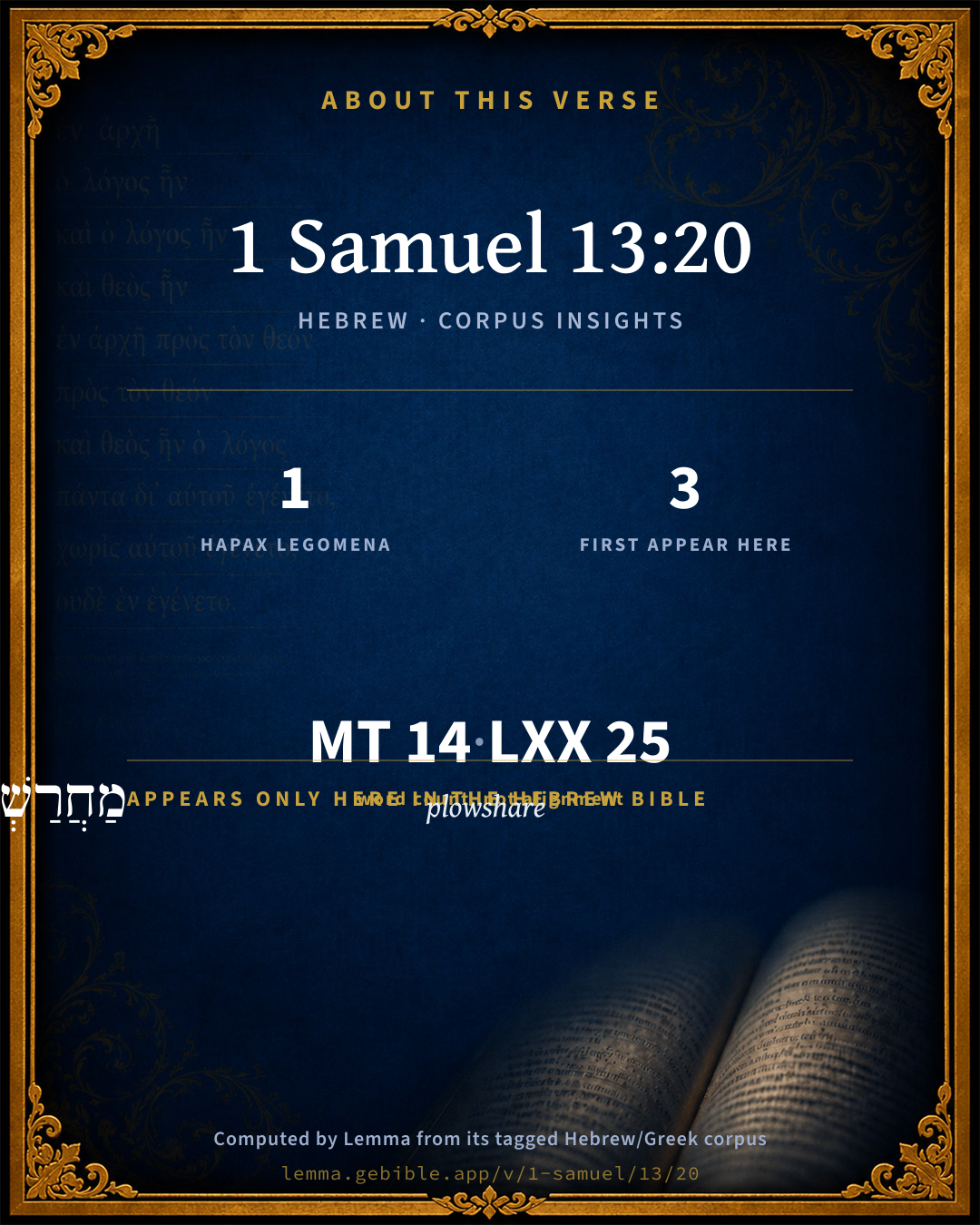
1 Samuel 13:20

Hebrew (Westminster Leningrad Codex) 1 Samuel 13:20 appears in the Hebrew Old Testament. The text above is from the Westminster Leningrad Codex. Each word links to its Strong’s number, a concise gloss, and parsing drawn from the Open Scriptures Hebrew Bible morphology. Click any word for its full Brown-Driver-Briggs (BDB) entry.
Download image
Cite this verse

1 Samuel 13:20 (World English Bible). Public Domain. Lemma interlinear Bible study tool, https://lemma.gebible.app/v/1-samuel/13/20.

Show BibTeX & RIS
BibTeX
RIS
English Translation
but all the Israelites went down to the Philistines, to sharpen every man his plowshare, mattock, axe, and sickle;
World English Bible · Public Domain
Highlights Full analysis ↓
Download a study sheet

One document with this verse’s original text, its word-by-word gloss line, the meaning frame, cross-references with their text, attributed commentary, and full source and license credits — printable, and it pastes into notes with its structure intact.

This verse Autodidact and up

Study sheet (.html) Plain text (.txt)

A passage Seminary Student

Up to 50 verses in one chapter. A passage sheet keeps up to 6 commentary sources and 12 cross-references per verse, in the order this page ranks them, and says so on the sheet whenever that leaves anything out. Ask for a single verse and you get the Autodidact verse sheet above.

Everything on this page stays free to read, with no account — the sheet is a download of what is already on screen, not access to it.

Want to remove ads? Support Godless Engineer
Compare translations 3

The same verse in 3 English versions, stacked beneath the original-language interlinear above. Click any original word for its lexicon entry.

Each is an independent rendering of the whole verse — the interlinear is not word-aligned to these translations.

Highlighted words mark where these versions differ — a whole-verse word diff, not a word-by-word alignment.

  • World English Bible Public Domain
    but all the Israelites went down to the Philistines, to sharpen every man his plowshare, mattock, axe, and sickle;
  • King James Version Public Domain
    But all the Israelites went down to the Philistines, to sharpen every man his share, and his coulter, and his axe, and his mattock.
  • unfoldingWord Literal Text CC BY-SA 4.0
    And all of Israel went down the Philistines, a man to sharpen his plow blade and his pick and his axe and his sickle.

unfoldingWord Literal Text — © unfoldingWord, licensed CC BY-SA 4.0. Word-aligned USFM3 via Door43 (git.door43.org/unfoldingWord/en_ult).

Versions to compare (up to 4)

3 of 4 selected

Show all 18 translations

Every available English version of this verse, each an independent rendering of the whole verse.

  • World English Bible Public Domain
    but all the Israelites went down to the Philistines, to sharpen every man his plowshare, mattock, axe, and sickle;
  • Berean Standard Bible Public Domain
    Instead, all the Israelites would go down to the Philistines to sharpen their plowshares, mattocks, axes, and sickles.
  • Majority Standard Bible Public Domain
    Instead, all the Israelites would go down to the Philistines to sharpen their plowshares, mattocks, axes, and sickles.
  • King James Version Public Domain
    But all the Israelites went down to the Philistines, to sharpen every man his share, and his coulter, and his axe, and his mattock.
  • American Standard Version (1901) Public Domain
    but all the Israelites went down to the Philistines, to sharpen every man his share, and his coulter, and his axe, and his mattock;
  • Revised Version (1885) Public Domain
    but all the Israelites went down to the Philistines, to sharpen every man his share, and his coulter, and his axe, and his mattock;
  • Geneva Bible (1599) Public Domain
    Wherefore all ye Israelites went downe to the Philistims, to sharpen euery man his share, his mattocke, and his axe, and his weeding hooke.
  • Douay-Rheims (1899) Public Domain
    So all Israel went down to the Philistines, to sharpen every man his ploughshare, and his spade, and his axe, and his rake.
  • Young's Literal Translation Public Domain
    and all Israel go down to the Philistines, to sharpen each his ploughshare, and his coulter, and his axe, and his mattock;
  • Literal Standard Version CC BY-SA 4.0
    and all Israel goes down to the Philistines, to each sharpen his plowshare, and his coulter, and his axe, and his mattock;
  • Unlocked Literal Bible CC BY-SA 4.0
    But all the men of Israel used to go down to the Philistines, each to sharpen his plow points, his mattock, his ax, and his sickle.
  • unfoldingWord Literal Text CC BY-SA 4.0
    And all of Israel went down the Philistines, a man to sharpen his plow blade and his pick and his axe and his sickle.
  • Darby Bible Public Domain
    And all Israel went down to the Philistines, every man to get his ploughshare, and his hoe, and his axe, and his sickle sharpened,
  • World Messianic Bible Public Domain
    but all the Israelites went down to the Philistines, each man to sharpen his own plowshare, mattock, ax, and sickle.
  • Webster's Bible Public Domain
    But all the Israelites went down to the Philistines, to sharpen every man his share, and his colter, and his ax, and his mattock.
  • Free Bible Version CC BY-SA 4.0
    All the Israelites had to go to the Philistines to sharpen their iron plowshares, pickaxes, axes, and sickles.
  • Bible in Basic English Public Domain
    But all the Israelites had to go to the Philistines to get their ploughs and blades and axes and hooks made sharp;
  • JPS Tanakh (1917) Public Domain
    but all the Israelites went down to the Philistines, to sharpen every man his plowshare, and his coulter, and his axe, and his mattock.

Literal Standard Version (2020), Covenant Press — licensed CC BY-SA 4.0. Text via the HelloAO Bible API (eBible.org). Unlocked Literal Bible (unfoldingWord) — licensed CC BY-SA 4.0. Text via the HelloAO Bible API (eBible.org). unfoldingWord Literal Text — © unfoldingWord, licensed CC BY-SA 4.0. Word-aligned USFM3 via Door43 (git.door43.org/unfoldingWord/en_ult). Free Bible Version, Dr. Jonathan Gallagher — licensed CC BY-SA 4.0. Text via the HelloAO Bible API (eBible.org).

Word by word

More ways to search: Search by grammar → Find every occurrence → Compare this word →

Practice this passage: Drill this verse → Learn its vocabulary →

מַחֲרַשְׁתּ֤וֹ
machăresheth
H4282
“plowshare · his”
Noun, Common, Feminine, Singular, Construct + Suffix, Personal, 3rd Person, Masculine, Singular
Part of Speech
Noun
Type
Common
Gender
Feminine
Number
Singular
State
Construct
Full BDB Definition

Origin: from H2790

TWOT: 760d

plough share
  1. וַיֵּרְד֥וּ yârad H3381 “and · to go down” Conjunction + Verb, Qal, Sequential Imperfect, 3rd Person, Masculine, Plural
  2. כָל kôl H3605 “all of” Noun, Common, Masculine, Singular, Construct
  3. יִשְׂרָאֵ֖ל Yisrâʼêl H3478 “Israel” Noun, Proper
  4. הַפְּלִשְׁתִּ֑ים Pᵉlishtîy H6430 “the · Philistines” Particle, Definite Article + Noun, Gentilic, Masculine, Plural, Absolute
  5. לִ֠לְטוֹשׁ lâṭash H3913 “to sharpen” Preposition + Verb, Qal, Infinitive Construct
  6. אִ֣ישׁ ʼîysh H376 “man” Noun, Common, Masculine, Singular, Absolute
  7. אֶת ʼêth H853 “-” Particle, Direct Object
  8. וְאֶת ʼêth H853 “and · -” Conjunction + Particle, Direct Object
  9. אֵתוֹ֙ ʼêth H855 “ploughshare · his” Noun, Common, Masculine, Singular, Construct + Suffix, Personal, 3rd Person, Masculine, Singular
  10. וְאֶת ʼêth H853 “and · -” Conjunction + Particle, Direct Object
  11. קַרְדֻּמּ֔וֹ qardôm H7134 “axe · his” Noun, Common, Both, Singular, Construct + Suffix, Personal, 3rd Person, Masculine, Singular
  12. וְאֵ֖ת ʼêth H853 “and · -” Conjunction + Particle, Direct Object
  13. מַחֲרֵשָׁתֽוֹ machărêshâh H4281 “plowshare · his” Noun, Common, Feminine, Singular, Construct + Suffix, Personal, 3rd Person, Masculine, Singular

About this verse

These counts appear in no published source. They are computed here, from the morphology-tagged text and Lemma’s own curated glosses. What Lemma adds →

14
words
11
distinct lemmas
Historical
section

Notable vocabulary

1 hapax legomenon — a word that appears only here in the entire Hebrew Bible:

  • מַחֲרַשְׁתּ֤וֹ plowshare H4282

First appearance in Scripture

These words make their first canonical appearance in the Hebrew Bible here:

  • מַחֲרַשְׁתּ֤וֹ plowshare H4282
  • אֵתוֹ֙ ploughshare H855
  • מַחֲרֵשָׁתֽוֹ plowshare H4281

Shared distinctive vocabulary

מַחֲרֵשָׁתֽוֹ plowshare H4281 occurs in 2 verses of the Hebrew Bible. Also found in:

Grammatical profile

  • 2 verbs
  • 8 nouns
  • 4 particles

Verb forms

  • וַיֵּרְד֥וּ Qal · Sequential Imperfect
  • לִ֠לְטוֹשׁ Qal · Infinitive Construct

Hebrew & Septuagint length

In English translation the verse runs 19 words from the Hebrew and 28 from the Septuagint (LXX English) — the Septuagint runs noticeably longer here. See the side-by-side →

A rough comparison of the two English renderings, which tokenize alike — not a word-level alignment.

Word counts can differ between the Hebrew and the Greek without any difference in meaning — e.g. the Hebrew direct-object marker אֵת has no separate Greek word, and Greek often adds the article ὁ.

In the original languages it is 14 Hebrew tokens and 25 Greek tokens — but the two are counted differently (Hebrew bundles its prefixes and suffixes into one token; the Greek is in lemma form), so that isn’t a like-for-like length.

Hebrew and Greek witnesses Masoretic Hebrew ↔ Greek Septuagint

The same verse in the two great witnesses to the Old Testament, shown verse-for-verse.

Here the Septuagint runs noticeably longer than the Hebrew — LXX2012 (modern English Septuagint) 28 words vs World English Bible 19. A rough length comparison of the two English translations, not a word-level alignment — read both below.

These are two independent witnesses, not word-aligned to each other, and the Septuagint is shown in lemma (dictionary) form.

Hebrew 1 Samuel 13:20 Masoretic · Westminster Leningrad Codex

וַיֵּרְד֥וּ כָל יִשְׂרָאֵ֖ל הַפְּלִשְׁתִּ֑ים לִ֠לְטוֹשׁ אִ֣ישׁ אֶת מַחֲרַשְׁתּ֤וֹ וְאֶת אֵתוֹ֙ וְאֶת קַרְדֻּמּ֔וֹ וְאֵ֖ת מַחֲרֵשָׁתֽוֹ

but all the Israelites went down to the Philistines, to sharpen every man his plowshare, mattock, axe, and sickle;

World English Bible · Public Domain

Greek LXX 1 Samuel 13:20 Septuagint · lemma form

καί καταβαίνω πᾶς ἰσραήλ εἰς γῆ ἀλλόφυλος χαλκεύω ἕκαστος ὁ θέριστρον αὐτός καί ὁ σκεῦος αὐτός καί ἕκαστος ὁ ἀξίνη αὐτός καί ὁ δρέπανον αὐτός

And all Israel went down to the Land of the Philistines to forge every one his reaping-hook and his tool, and every one his axe and his sickle.

LXX2012 (modern English Septuagint) · Public Domain

On this verse, Haydock's Catholic Bible Commentary discusses the Septuagint’s reading. Read the note in Commentary ↓

Hebrew: Westminster Leningrad Codex (CC BY 4.0). Greek: Septuagint (public domain); English from LXX2012 (modern English Septuagint) (Public Domain). How the Septuagint differs from the Hebrew →

Targum (Aramaic paraphrase)

1

The Targum is the ancient Jewish Aramaic paraphrase of the Hebrew Scriptures — an interpretive translation, not the Hebrew text itself. Onkelos (literal) and Pseudo-Jonathan (expansive) render the Torah, and Jonathan the Prophets. Coverage is partial: where no permissively-licensed English translation exists for a verse, only the Aramaic is shown. This is verse-level text, not a word-by-word alignment to the Hebrew.

  1. Targum Jonathan Prophets (Joshua–Malachi)
    וּנְחָתוּ כָל יִשְׂרָאֵל לְאַרְעָא פְלִשְׁתָּאֵי לְחָרָפָא גְבַר יַת פְּרָשֵׁיהּ וְיַת סִיכַת פַּדָנֵיהּ וְיַת כּוּלְבֵיהּ וְיַת עוּשְׁפֵיהּ:

    (no public-domain English translation for this verse)

    Targum Jonathan — Aramaic: “Mikraot Gedolot” (public domain). English: “Sefaria Community Translation” (CC0 1.0 (public-domain dedication)); “London "Chaldee Paraphrase," 1871” (public domain). Text via Sefaria.

Commentary

Notes on 1 Samuel 13:20 from classic Christian and Jewish commentators (each source and its license shown beneath its notes). The classic Christian expositions comment on the surrounding passage and are grouped to its opening verse, so a note may address several verses; the Jewish commentaries on the Tanakh (Rashi and others) are per-verse, so they appear only where the commentator wrote on this verse.

Lemma curates 59 commentaries, every one of them public domain or Creative Commons licensed, each selected and text-cleaned for this edition rather than reprinted as found. About our sources →

Trapp's Complete Commentary

John Trapp

1Sa 13:20 But all the Israelites went down to the Philistines, to sharpen every man his share, and his coulter, and his axe, and his mattock.

Ver. 20. But all the Israelites went down.] Which many of them could not do, without much trouble and expense of time. See into what straits sinful people plunge themselves!

John Trapp, A Commentary or Exposition upon All the Books of the Old and New Testament (1647–1656) — public domain. Text from a community e-Sword module.

Joseph Benson's Commentary

1Sa 13:20-21. The Israelites went down to the Philistines — Not to the country of the Philistines, for that was too far from many parts of the land of Israel; but to their garrisons, which they held among them even after Samuel had driven the main body of them out of the country. In these, it seems, the Philistines kept all the smiths, and there they allowed them to exercise their art for the uses following. Yet they had a file, &c. — They were allowed some proper instruments and tools for sharpening their implements of husbandry, in some degree; but no other.

Joseph Benson's Commentary on the Old and New Testaments (1811–1818) — public domain. Text from a community e-Sword module.

Adam Clarke's Commentary

Verse 20. But all the Israelites went down to the Philistines] We find from this that they did not grant them as much as Porsenna did to the Romans; he permitted the people to manufacture the implements of husbandry.

Adam Clarke's Commentary on the Bible (1810–1826) — public domain. Text from a community e-Sword/MySword module.

Ellicott's Commentary for English Readers

(20) To sharpen every man his share, and his coulter.—Porsenna, we read, in the time of the wars of the Republic, allowed the Romans iron implements for agriculture only. Coulter.—In Isa_2:4, Joe_3:10, this word is rendered “ploughshares “; so most of the older versions. We cannot now with any precision distinguish between these two implements of tillage.

And his mattock.—Jerome renders the Hebrew word here by “hoe” (sarculum). It was probably a kind of heavy hoe, used for turning up the ground.

A Bible Commentary for English Readers, edited by Charles John Ellicott (1878–1897) — public domain. Text from a community e-Sword module.

The Cambridge Bible for Schools and Colleges

gen. ed. J. J. S. Perowne

20. to sharpen] The word signifies “to sharpen by forging.”

his share, &c.] The agricultural implements mentioned cannot be identified with any certainty. The words rendered “share” and “mattock” are derived from the same root meaning to cut, and are almost identical in form. That rendered “coulter” is elsewhere translated “plow-share” (Isa_2:4, &c.).

The Cambridge Bible for Schools and Colleges (gen. ed. J. J. S. Perowne; Cambridge University Press, 1878–1918) — public domain. Text from a community e-Sword module.

John Gill's Exposition

But all the Israelites went down to the Philistines,.... Were obliged to go into Palestine, into some one or other of the cities of the Philistines, or to their garrisons, where the trade of a smith was exercised:

to sharpen every man his share, and his coulter; which are the parts of the plough made of iron, with which the earth is cut and thrown up:

and his axe and his mattock; or pick axe; with the one wood is felled and cut, and with the other stones are dug; and each of these for their several uses needed sharpening; and when they did, they were obliged to go to the Philistines to have them done, they having no smiths among them.

John Gill's Exposition of the Whole Bible (1746–1763) — public domain (CC PDM 1.0). Text via the HelloAO Bible API.

Albert Barnes' Notes on the Bible

The best rendering of the passage is perhaps as follows: “But all the Israelites went down to the Philistines to sharpen etc. 1Sa 13:21, whenever there was bluntness of edge to their shares and coulters and prong-forks and axes, and to point their goads.” Coulters and mattocks were cutting instruments of the type of the share.

Albert Barnes' Notes on the Bible (1834–1885) — public domain. Text from a community e-Sword/MySword module.

Haydock's Catholic Bible Commentary

All Israel, whom the Philistines had conquered, particularly the neighbouring tribes. (Calmet) --- They were obliged to go to the places where the enemy kept garrisons, (Menochius) as they did at Gabaa, Bethel, &c. --- Share. Septuagint, Syriac, &c., "scythe," or "sickle for corn;" Greek: theristerion. (Haydock) --- The original term, macharesha, may signify all sorts of implements. --- Spade. Hebrew is supposed to mean, "a coulter." Septuagint, "instrument," which the prophets often say will be turned into a sword, in times of war, Joel iii. 15., and Micheas iv. 3. --- Rake. The same generical term is used in Hebrew as was before translated a plough-share. Septuagint have "scythe;" Greek: drepanon. (Calmet)

George Leo Haydock (1774–1849), Haydock's Catholic Family Bible and Commentary, 1859 edition — public domain. Excludes Psalms (Douay-Rheims chapter numbering differs from Protestant) and Deuterocanonical books (Catholic canon only).

Matthew Poole's English Annotations

To the Philistines; not to the land of the Philistines, for it is not said so, and that was too remote; but to the stations and garrisons which the Philistines yet retained in several parts of Israel’s land, though Samuel’s authority had so far overawed them, that they durst not give the Israelites much disturbance. In these, therefore, the Philistines kept all the smiths, and here they allowed them the exercise of their art for the uses here following.

Matthew Poole's English Annotations on the Holy Bible (1683–1685) — public domain. Text from a community e-Sword/MySword module.

Whedon's Commentary on the Bible

Daniel D. Whedon

20. Share… mattock — It is hardly possible to determine the real meaning of the Hebrew words thus translated here. Both words are from the same root, (חרשׁ,) and may signify the sickle, the coulter, or the hoe, as well as the ploughshare or the mattock. In view of the uncertainty respecting these and other agricultural terms of the Hebrews, the reader may as well abide by the English version as any other.

Daniel D. Whedon (gen. ed.), Commentary on the Old and New Testaments (1874–1909) — public domain. Text from a community e-Sword module.

The Pulpit Commentary

The Israelites went down to the Philistines. Ie. to their land. This could only have applied to the districts near the Philistines, unless we suppose that they set up forges also at their garrisons. To sharpen. The verb chiefly refers to such work as required an anvil and hammer. As regards the implements, not only do the versions disagree in their renderings, but the Septuagint has a very curious different reading, to the effect that at harvest time the Israelites had to pay the Philistines three shekels for repairing and whetting their tools. The share is more probably a sickle. The coulter is certainly a ploughshare, as rendered in Isaiah Joe_3:10. Of the ax there is no doubt; and the mattock is a heavy hoe for turning up the ground, as spades for that purpose are scarcely anywhere used, except in our own country.

The Pulpit Commentary (1880–1919), ed. H.D.M. Spence-Jones & Joseph S. Exell — public domain. Text from a community e-Sword module.

John Wesley's Explanatory Notes

Philistines - Not to the land of the Philistines, but to the stations and garrisons which the Philistines retained in several parts of Israel's land, though Samuel's authority had so far over- awed them, that they durst not give the Israelites much disturbance. In these, therefore, the Philistines kept all the smiths; and here they allowed them the exercise of their art for the uses following.

John Wesley, Explanatory Notes Upon the Whole Bible (1754–1765) — public domain. Text via the GEBible commentary corpus.

Rashi

Rabbi Shlomo Yitzchaki (Rashi)

And all of Yisroel would go down to the Philistines. And when Yiroel needed iron smiths to sharpen mattocks, axes and tools, they had to go down to the land of the Philistines.

His plowshare. Soc in O.F.

His mattock. Coltre in O.F.

His axe. Besague in O.F.

His tools. Fosoir in O.F.

Rashi on the Tanakh — English translations: “The Judaica Press complete Tanach with Rashi, translated by A. J. Rosenberg” (CC BY 4.0); “Pentateuch with Rashi's commentary by M. Rosenbaum and A.M. Silbermann, 1929-1934” (public domain); “The Metsudah Tanach series, Lakewood, N.J” (CC BY 4.0); and “The Book of Joshua, Metsudah Publications, 1997” (CC BY 4.0). Text via Sefaria.

Lesson kit

Teaching starters — assembled from the data on this page, not authored interpretation. Every prompt links to the verse data it draws on. Edit before teaching.

1 Samuel, in the Historical, opens this verse with 14 words (11 distinct Hebrew lemmas). Its most distinctive word is machăresheth (“plowshare”). The Greek Septuagint runs longer here. A historical commentator’s framing appears above. Read the whole chapter for the surrounding context.

Discussion questions

  1. What does “plowshare” (machăresheth) contribute to the verse as a whole?
  2. This verse holds 1 word here found nowhere else in the Hebrew Bible. What might the rare word draw attention to?
  3. 3 words here appear for the first time in Scripture. What is being introduced at this debut?
  4. 1 Samuel 13:21 shares the word «plowshare» with this verse. How do the two illuminate each other?
  5. Compared with the Hebrew, the Septuagint runs longer here. What questions does that raise?
  6. These translations render this verse differently. What is at stake in choosing one wording over another?
  7. The verb «וַיֵּרְד֥וּ» is Qal Sequential Imperfect. How does its form color the action?
  8. Reading how Trapp's Complete Commentary and Joseph Benson's Commentary read this verse, where do the two commentators agree and where do they part?

Things to notice

Reading settings

Reading text

Shown beneath each verse's original-language words.

Old Testament
Old Testament edition

Read the OT as the Masoretic Hebrew (MT) or the Greek Septuagint (LXX).

English shown for the Greek Septuagint (in the Hebrew ↔ Greek comparison).

Comparing translations? Open the Compare panel on any verse page to stack up to four side by side.