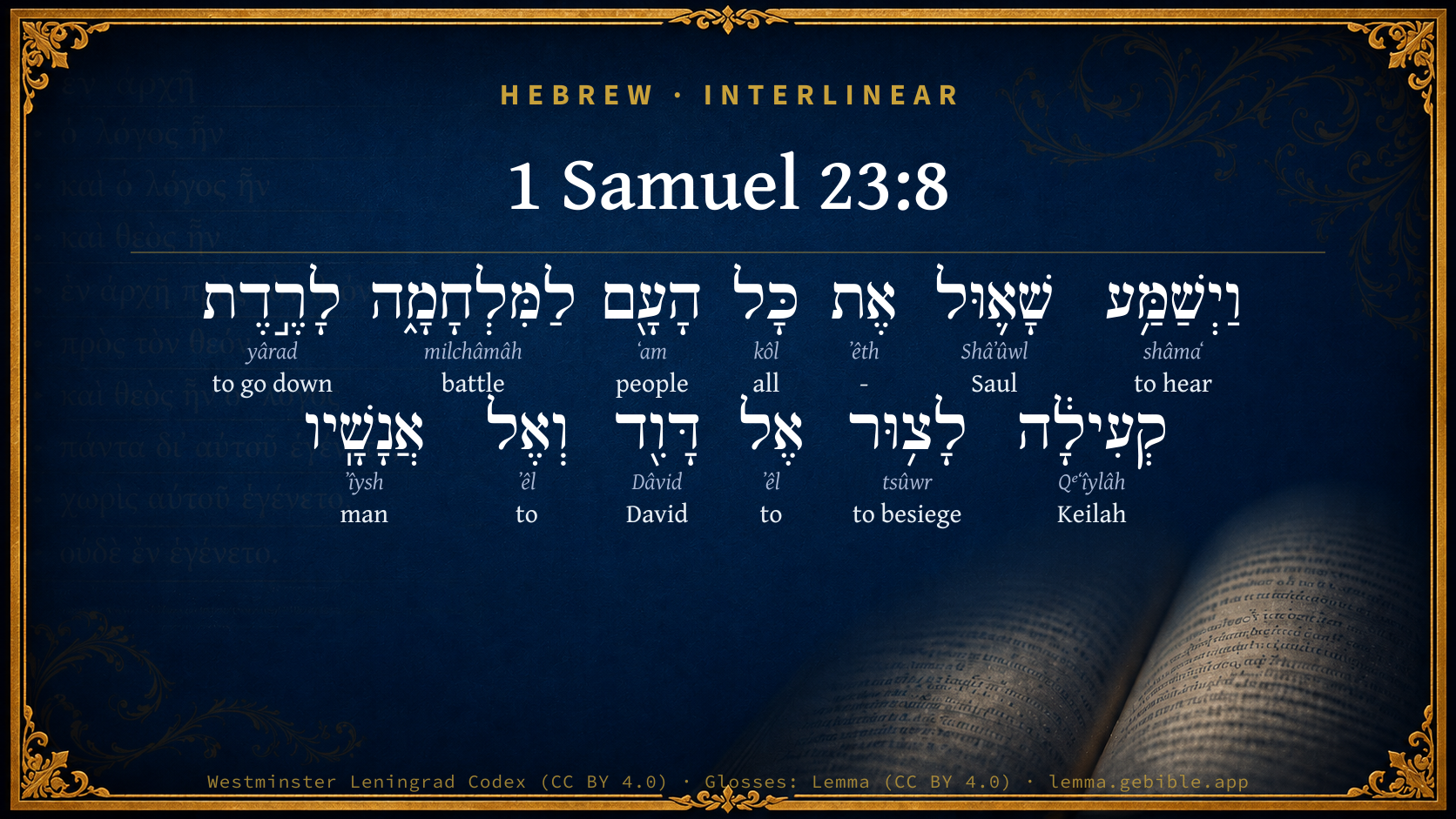
1 Samuel 23:8

Hebrew (Westminster Leningrad Codex) 1 Samuel 23:8 appears in the Hebrew Old Testament. The text above is from the Westminster Leningrad Codex. Each word links to its Strong’s number, a concise gloss, and parsing drawn from the Open Scriptures Hebrew Bible morphology. Click any word for its full Brown-Driver-Briggs (BDB) entry.
Download image
Cite this verse

1 Samuel 23:8 (World English Bible). Public Domain. Lemma interlinear Bible study tool, https://lemma.gebible.app/v/1-samuel/23/8.

Show BibTeX & RIS
BibTeX
RIS
English Translation
Saul summoned all the people to war, to go down to Keilah, to besiege David and his men.
World English Bible · Public Domain
Download a study sheet

One document with this verse’s original text, its word-by-word gloss line, the meaning frame, cross-references with their text, attributed commentary, and full source and license credits — printable, and it pastes into notes with its structure intact.

This verse Autodidact and up

Study sheet (.html) Plain text (.txt)

A passage Seminary Student

Up to 50 verses in one chapter. A passage sheet keeps up to 6 commentary sources and 12 cross-references per verse, in the order this page ranks them, and says so on the sheet whenever that leaves anything out. Ask for a single verse and you get the Autodidact verse sheet above.

Everything on this page stays free to read, with no account — the sheet is a download of what is already on screen, not access to it.

Want to remove ads? Support Godless Engineer
Compare translations 3

The same verse in 3 English versions, stacked beneath the original-language interlinear above. Click any original word for its lexicon entry.

Each is an independent rendering of the whole verse — the interlinear is not word-aligned to these translations.

Highlighted words mark where these versions differ — a whole-verse word diff, not a word-by-word alignment.

  • World English Bible Public Domain
    Saul summoned all the people to war, to go down to Keilah, to besiege David and his men.
  • King James Version Public Domain
    And Saul called all the people together to war, to go down to Keilah, to besiege David and his men.
  • unfoldingWord Literal Text CC BY-SA 4.0
    And Saul made all of the people hear for battle, to go down Keilah, to besiege against David and against his men.

unfoldingWord Literal Text — © unfoldingWord, licensed CC BY-SA 4.0. Word-aligned USFM3 via Door43 (git.door43.org/unfoldingWord/en_ult).

Versions to compare (up to 4)

3 of 4 selected

Show all 18 translations

Every available English version of this verse, each an independent rendering of the whole verse.

  • World English Bible Public Domain
    Saul summoned all the people to war, to go down to Keilah, to besiege David and his men.
  • Berean Standard Bible Public Domain
    Then Saul summoned all his troops to go to war at Keilah and besiege David and his men.
  • Majority Standard Bible Public Domain
    Then Saul summoned all his troops to go to war at Keilah and besiege David and his men.
  • King James Version Public Domain
    And Saul called all the people together to war, to go down to Keilah, to besiege David and his men.
  • American Standard Version (1901) Public Domain
    And Saul summoned all the people to war, to go down to Keilah, to besiege David and his men.
  • Revised Version (1885) Public Domain
    And Saul summoned all the people to war, to go down to Keilah, to besiege David and his men.
  • Geneva Bible (1599) Public Domain
    Then Saul called all the people together to warre, for to go downe to Keilah, and to besiege Dauid and his men.
  • Douay-Rheims (1899) Public Domain
    And Saul commanded all the people to go down to fight against Ceila, and to besiege David, and his men.
  • Young's Literal Translation Public Domain
    And Saul summoneth the whole of the people to battle, to go down to Keilah, to lay siege unto David and unto his men.
  • Literal Standard Version CC BY-SA 4.0
    And Saul summons all the people to the battle, to go down to Keilah, to lay siege to David and to his men.
  • Unlocked Literal Bible CC BY-SA 4.0
    Saul summoned all his forces for battle, to go down to Keilah, to besiege David and his men.
  • unfoldingWord Literal Text CC BY-SA 4.0
    And Saul made all of the people hear for battle, to go down Keilah, to besiege against David and against his men.
  • Darby Bible Public Domain
    And Saul summoned all the people to war, to go down to Keilah, to besiege David and his men.
  • World Messianic Bible Public Domain
    Saul summoned all the people to war, to go down to Keilah to besiege David and his men.
  • Webster's Bible Public Domain
    And Saul called all the people together to war, to go down to Keilah, to besiege David and his men.
  • Free Bible Version CC BY-SA 4.0
    So Saul called up his whole army to go and attack Keilah and to besiege David and his men.
  • Bible in Basic English Public Domain
    And Saul sent for all the people to come to the fight, and go down to Keilah to make an attack on David and his men.
  • JPS Tanakh (1917) Public Domain
    And Saul summoned all the people to war, to go down to Keilah, to besiege David and his men.

Literal Standard Version (2020), Covenant Press — licensed CC BY-SA 4.0. Text via the HelloAO Bible API (eBible.org). Unlocked Literal Bible (unfoldingWord) — licensed CC BY-SA 4.0. Text via the HelloAO Bible API (eBible.org). unfoldingWord Literal Text — © unfoldingWord, licensed CC BY-SA 4.0. Word-aligned USFM3 via Door43 (git.door43.org/unfoldingWord/en_ult). Free Bible Version, Dr. Jonathan Gallagher — licensed CC BY-SA 4.0. Text via the HelloAO Bible API (eBible.org).

Word by word

More ways to search: Search by grammar → Find every occurrence → Compare this word →

Practice this passage: Drill this verse → Learn its vocabulary →

קְעִילָ֔ה
Qᵉʻîylâh
H7084
“Keilah”
Noun, Proper
Part of Speech
Noun
Type
Proper
Full BDB Definition

Origin: perhaps from H7049 in the sense of inclosing

TWOT: None

Keilah = "fortress" - a city in the lowlands of Judah northwest of Hebron
  1. וַיְשַׁמַּ֥ע shâmaʻ H8085 “and · to hear” Conjunction + Verb, Piel, Sequential Imperfect, 3rd Person, Masculine, Singular
  2. שָׁא֛וּל Shâʼûwl H7586 “Saul” Noun, Proper
  3. אֶת ʼêth H853 “-” Particle, Direct Object
  4. כָּל kôl H3605 “all of” Noun, Common, Masculine, Singular, Construct
  5. הָעָ֖ם ʻam H5971 “the · people” Particle, Definite Article + Noun, Common, Masculine, Singular, Absolute
  6. לַמִּלְחָמָ֑ה milchâmâh H4421 “to/for the · battle” Preposition, Determined + Noun, Common, Feminine, Singular, Absolute
  7. לָרֶ֣דֶת yârad H3381 “to go down” Preposition + Verb, Qal, Infinitive Construct
  8. לָצ֥וּר tsûwr H6696 “to besiege” Preposition + Verb, Qal, Infinitive Construct
  9. אֶל ʼêl H413 “to” Preposition
  10. דָּוִ֖ד Dâvid H1732 “David” Noun, Proper
  11. וְאֶל ʼêl H413 “and · to” Conjunction + Preposition
  12. אֲנָשָֽׁיו ʼîysh H376 “men · his” Noun, Common, Masculine, Plural, Construct + Suffix, Personal, 3rd Person, Masculine, Singular

About this verse

These counts appear in no published source. They are computed here, from the morphology-tagged text and Lemma’s own curated glosses. What Lemma adds →

13
words
12
distinct lemmas
Historical
section

Notable vocabulary

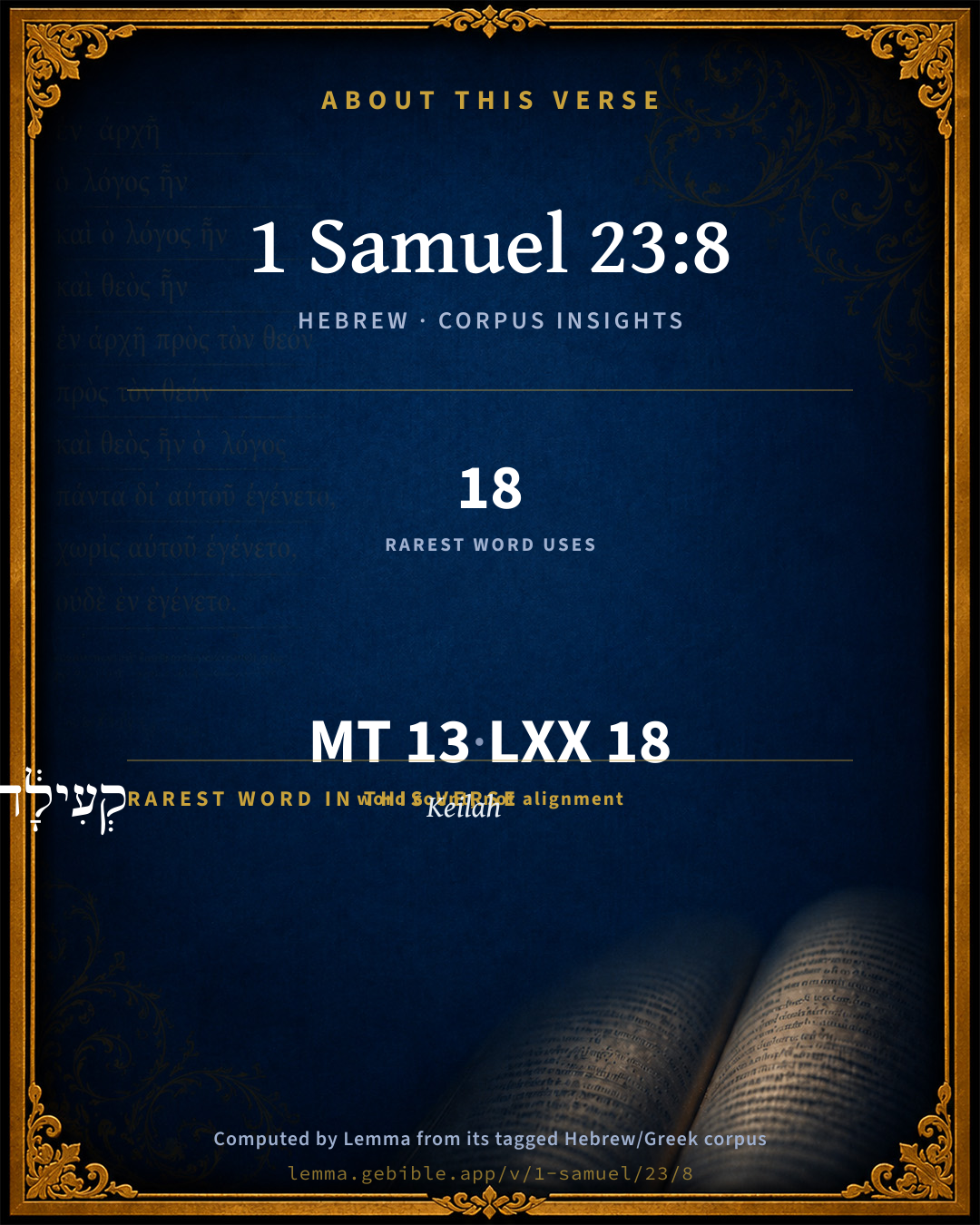
The rarest word here is קְעִילָ֔ה Keilah H7084 — appearing just 18 times in the whole Hebrew Bible.

Shared distinctive vocabulary

קְעִילָ֔ה Keilah H7084 occurs in 16 verses of the Hebrew Bible. Also found in:

Grammatical profile

  • 3 verbs
  • 7 nouns
  • 2 prepositions
  • 1 particle

Verb forms

  • וַיְשַׁמַּ֥ע Piel · Sequential Imperfect
  • לָרֶ֣דֶת Qal · Infinitive Construct
  • לָצ֥וּר Qal · Infinitive Construct

Repetition

A word recurs within this verse — often emphatic in Hebrew:

  • אֶל to H413 ×2

Hebrew & Septuagint length

In English translation the verse runs 18 words from the Hebrew and 19 from the Septuagint (LXX English) — closely comparable.

A rough comparison of the two English renderings, which tokenize alike — not a word-level alignment.

Word counts can differ between the Hebrew and the Greek without any difference in meaning — e.g. the Hebrew direct-object marker אֵת has no separate Greek word, and Greek often adds the article ὁ.

In the original languages it is 13 Hebrew tokens and 18 Greek tokens — but the two are counted differently (Hebrew bundles its prefixes and suffixes into one token; the Greek is in lemma form), so that isn’t a like-for-like length.

Hebrew and Greek witnesses Masoretic Hebrew ↔ Greek Septuagint

The same verse in the two great witnesses to the Old Testament, shown verse-for-verse.

These are two independent witnesses, not word-aligned to each other, and the Septuagint is shown in lemma (dictionary) form.

Hebrew 1 Samuel 23:8 Masoretic · Westminster Leningrad Codex

וַיְשַׁמַּ֥ע שָׁא֛וּל אֶת כָּל הָעָ֖ם לַמִּלְחָמָ֑ה לָרֶ֣דֶת קְעִילָ֔ה לָצ֥וּר אֶל דָּוִ֖ד וְאֶל אֲנָשָֽׁיו

Saul summoned all the people to war, to go down to Keilah, to besiege David and his men.

World English Bible · Public Domain

Greek LXX 1 Samuel 23:8 Septuagint · lemma form

καί παραἀγγέλλω σαούλ πᾶς ὁ λαός εἰς πόλεμος καταβαίνω εἰς κεϊλα συνἔχω ὁ δαυίδ καί ὁ ἀνήρ αὐτός

And Saul charged all the people to go down to war to Keila, to besiege David and his men.

LXX2012 (modern English Septuagint) · Public Domain

Hebrew: Westminster Leningrad Codex (CC BY 4.0). Greek: Septuagint (public domain); English from LXX2012 (modern English Septuagint) (Public Domain). How the Septuagint differs from the Hebrew →

Targum (Aramaic paraphrase)

1

The Targum is the ancient Jewish Aramaic paraphrase of the Hebrew Scriptures — an interpretive translation, not the Hebrew text itself. Onkelos (literal) and Pseudo-Jonathan (expansive) render the Torah, and Jonathan the Prophets. Coverage is partial: where no permissively-licensed English translation exists for a verse, only the Aramaic is shown. This is verse-level text, not a word-by-word alignment to the Hebrew.

  1. Targum Jonathan Prophets (Joshua–Malachi)
    וּכְנַשׁ שָׁאוּל יַת כָּל עַמָא לַאֲגָחָא קְרָבָא לְמֵיחַת לִקְעִילָה לְמֵצַר עַל דָוִד וְעַל גַבְרוֹהִי:

    (no public-domain English translation for this verse)

    Targum Jonathan — Aramaic: “Mikraot Gedolot” (public domain). English: “Sefaria Community Translation” (CC0 1.0 (public-domain dedication)); “London "Chaldee Paraphrase," 1871” (public domain). Text via Sefaria.

Commentary

Notes on 1 Samuel 23:8 from classic Christian and Jewish commentators (each source and its license shown beneath its notes). The classic Christian expositions comment on the surrounding passage and are grouped to its opening verse, so a note may address several verses; the Jewish commentaries on the Tanakh (Rashi and others) are per-verse, so they appear only where the commentator wrote on this verse.

Lemma curates 59 commentaries, every one of them public domain or Creative Commons licensed, each selected and text-cleaned for this edition rather than reprinted as found. About our sources →

Trapp's Complete Commentary

John Trapp

1Sa 23:8 And Saul called all the people together to war, to go down to Keilah, to besiege David and his men.

Ver. 8. To besiege David and his men.] Rather than to pursue the Philistines. So the Pope publisheth his Croysados against the Protestants; holding them greater enemies than are the Turks: witness his wars against the Waldenses in France, and the Hussites in Germany.

John Trapp, A Commentary or Exposition upon All the Books of the Old and New Testament (1647–1656) — public domain. Text from a community e-Sword module.

Jamieson, Fausset & Brown

Robert Jamieson, A. R. Fausset & David Brown

Saul called all the people together to war--not the united tribes of Israel, but the inhabitants of the adjoining districts. This force was raised, probably, on the ostensible pretext of opposing the Philistines, while, in reality, it was secretly to arouse mischief against David.

Jamieson, Fausset & Brown — Commentary Critical and Explanatory on the Whole Bible (1871) — public domain (CC PDM 1.0). Text via the HelloAO Bible API.

Adam Clarke's Commentary

Verse 8. Saul called all the people together] That is, all the people of that region or district, that they might scour the country, and hunt out David from all his haunts.

Adam Clarke's Commentary on the Bible (1810–1826) — public domain. Text from a community e-Sword/MySword module.

Ellicott's Commentary for English Readers

(8) And Saul called all the people together.—Such a summons to war on the part of the sovereign has been always a royal right. The plea, of course, alleged for this “summons” was the necessity of an immediate national effort against the hereditary enemies of the people.

A Bible Commentary for English Readers, edited by Charles John Ellicott (1878–1897) — public domain. Text from a community e-Sword module.

John Gill's Exposition

And Saul called all the people together to war,.... Or "caused them to hear" (m) summoned them by an herald, whom he sent into all parts of the kingdom to proclaim war, and require them in his name to attend him; which was the prerogative of a king to do:

to go down to Keilah, to besiege David and his men; that was what he privately intended, but the pretence was to make war against the Philistines.

(m) "fecit audire", Montanus, Piscator.

John Gill's Exposition of the Whole Bible (1746–1763) — public domain (CC PDM 1.0). Text via the HelloAO Bible API.

Haydock's Catholic Bible Commentary

People, in the neighbourhood. It is hardly probable that all Israel should be put in motion to take a few men. (Calmet)

George Leo Haydock (1774–1849), Haydock's Catholic Family Bible and Commentary, 1859 edition — public domain. Excludes Psalms (Douay-Rheims chapter numbering differs from Protestant) and Deuterocanonical books (Catholic canon only).

Lesson kit

Teaching starters — assembled from the data on this page, not authored interpretation. Every prompt links to the verse data it draws on. Edit before teaching.

1 Samuel, in the Historical, opens this verse with 13 words (12 distinct Hebrew lemmas). Its most distinctive word is Qᵉʻîylâh (“Keilah”). A historical commentator’s framing appears above. Read the whole chapter for the surrounding context.

Discussion questions

  1. What does “Keilah” (Qᵉʻîylâh) contribute to the verse as a whole?
  2. How does Joshua 15:44, which shares the word «Keilah», read alongside this verse?
  3. What does the repetition of “to” (2× in this one verse) do in this verse?
  4. These translations render this verse differently; the difference is in the English rendering, not the original. What questions does that raise?
  5. «וַיְשַׁמַּ֥ע» is a Piel Sequential Imperfect verb. How does that grammatical form shape the action described?
  6. Compare how Trapp's Complete Commentary and Jamieson, Fausset & Brown read this verse. Where do they agree or differ?

Things to notice

Reading settings

Reading text

Shown beneath each verse's original-language words.

Old Testament
Old Testament edition

Read the OT as the Masoretic Hebrew (MT) or the Greek Septuagint (LXX).

English shown for the Greek Septuagint (in the Hebrew ↔ Greek comparison).

Comparing translations? Open the Compare panel on any verse page to stack up to four side by side.