
1 Samuel 26:6

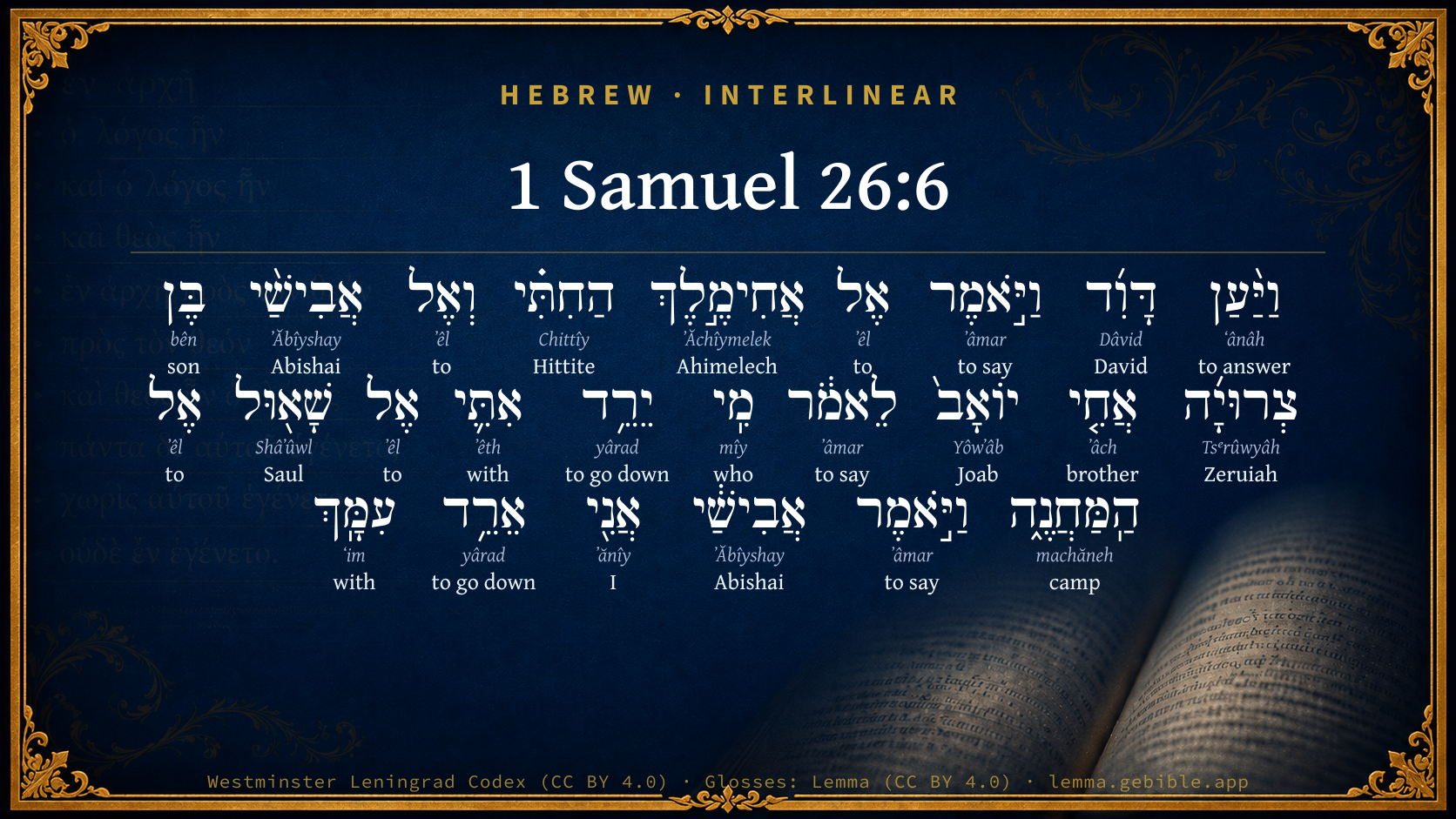
Hebrew (Westminster Leningrad Codex) 1 Samuel 26:6 appears in the Hebrew Old Testament. The text above is from the Westminster Leningrad Codex. Each word links to its Strong’s number, a concise gloss, and parsing drawn from the Open Scriptures Hebrew Bible morphology. Click any word for its full Brown-Driver-Briggs (BDB) entry.
Download image
Cite this verse

1 Samuel 26:6 (World English Bible). Public Domain. Lemma interlinear Bible study tool, https://lemma.gebible.app/v/1-samuel/26/6.

Show BibTeX & RIS
BibTeX
RIS
English Translation
Then answered David and said to Ahimelech the Hittite, and to Abishai the son of Zeruiah, brother to Joab, saying, Who will go down with me to Saul to the camp? Abishai said, I will go down with you.
World English Bible · Public Domain
Highlights
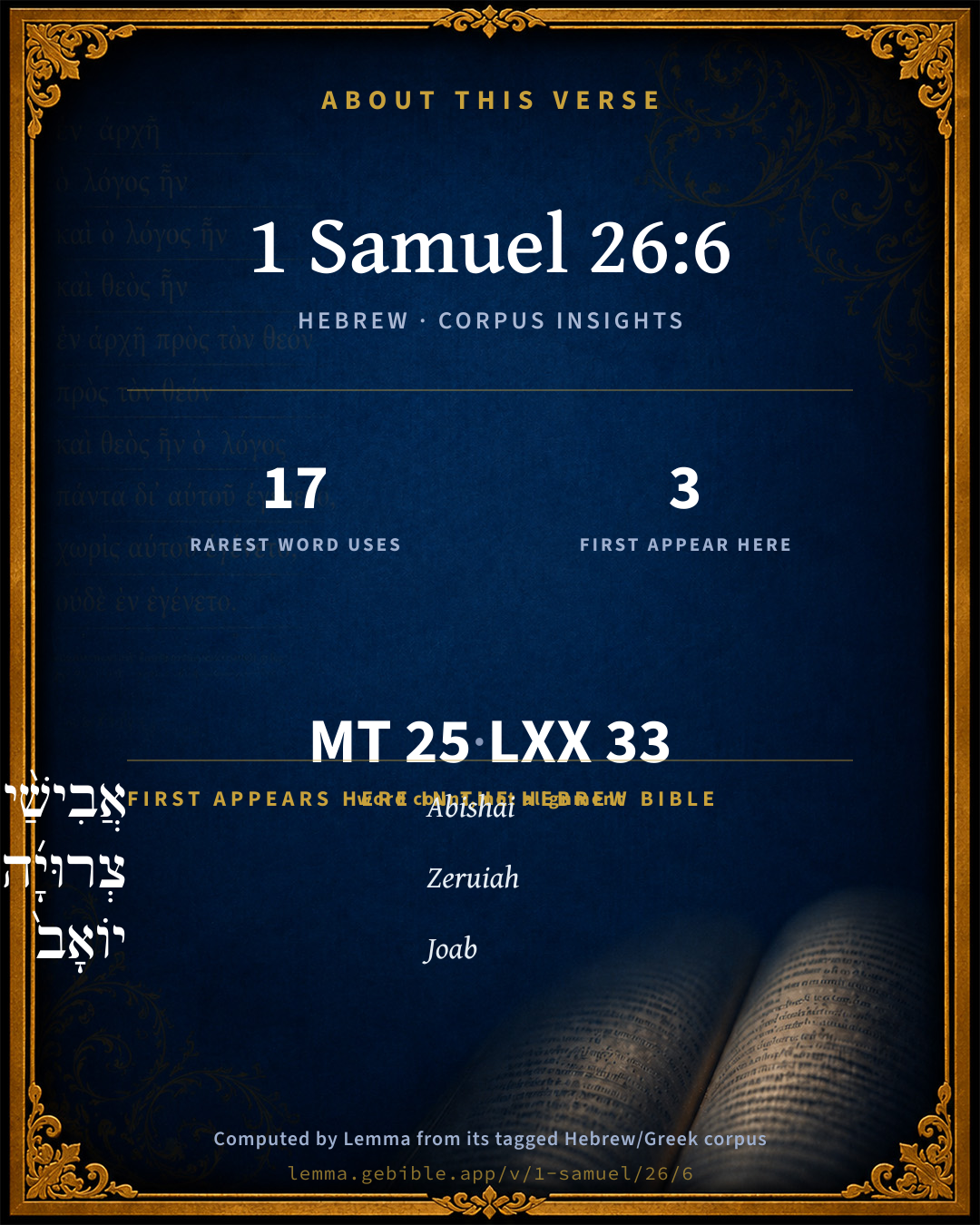
  • 3 first appearances in the Hebrew Bible
Full analysis ↓
Download a study sheet

One document with this verse’s original text, its word-by-word gloss line, the meaning frame, cross-references with their text, attributed commentary, and full source and license credits — printable, and it pastes into notes with its structure intact.

This verse Autodidact and up

Study sheet (.html) Plain text (.txt)

A passage Seminary Student

Up to 50 verses in one chapter. A passage sheet keeps up to 6 commentary sources and 12 cross-references per verse, in the order this page ranks them, and says so on the sheet whenever that leaves anything out. Ask for a single verse and you get the Autodidact verse sheet above.

Everything on this page stays free to read, with no account — the sheet is a download of what is already on screen, not access to it.

Want to remove ads? Support Godless Engineer
Compare translations 3

The same verse in 3 English versions, stacked beneath the original-language interlinear above. Click any original word for its lexicon entry.

Each is an independent rendering of the whole verse — the interlinear is not word-aligned to these translations.

Highlighted words mark where these versions differ — a whole-verse word diff, not a word-by-word alignment.

  • World English Bible Public Domain
    Then answered David and said to Ahimelech the Hittite, and to Abishai the son of Zeruiah, brother to Joab, saying, Who will go down with me to Saul to the camp? Abishai said, I will go down with you.
  • King James Version Public Domain
    Then answered David and said to Ahimelech the Hittite, and to Abishai the son of Zeruiah, brother to Joab, saying, Who will go down with me to Saul to the camp? And Abishai said, I will go down with thee.
  • unfoldingWord Literal Text CC BY-SA 4.0
    And David answered and said to Ahimelech the Hittite and to Abishai, the son of Zeruiah, the brother of Joab, saying, “Who will go down with me to Saul, to the camp?” And Abishai said, “I, I will go down with you.”

unfoldingWord Literal Text — © unfoldingWord, licensed CC BY-SA 4.0. Word-aligned USFM3 via Door43 (git.door43.org/unfoldingWord/en_ult).

Versions to compare (up to 4)

3 of 4 selected

Show all 18 translations

Every available English version of this verse, each an independent rendering of the whole verse.

  • World English Bible Public Domain
    Then answered David and said to Ahimelech the Hittite, and to Abishai the son of Zeruiah, brother to Joab, saying, Who will go down with me to Saul to the camp? Abishai said, I will go down with you.
  • Berean Standard Bible Public Domain
    And David asked Ahimelech the Hittite and Abishai son of Zeruiah, Joab’s brother, “Who will go down with me to Saul in the camp?” “I will go with you,” answered Abishai.
  • Majority Standard Bible Public Domain
    And David asked Ahimelech the Hittite and Abishai son of Zeruiah, Joab’s brother, “Who will go down with me to Saul in the camp?” “I will go with you,” answered Abishai.
  • King James Version Public Domain
    Then answered David and said to Ahimelech the Hittite, and to Abishai the son of Zeruiah, brother to Joab, saying, Who will go down with me to Saul to the camp? And Abishai said, I will go down with thee.
  • American Standard Version (1901) Public Domain
    Then answered David and said to Ahimelech the Hittite, and to Abishai the son of Zeruiah, brother to Joab, saying, Who will go down with me to Saul to the camp? And Abishai said, I will go down with thee.
  • Revised Version (1885) Public Domain
    Then answered David and said to Ahimelech the Hittite, and to Abishai the son of Zeruiah, brother to Joab, saying, Who will go down with me to Saul to the camp? And Abishai said, I will go down with thee.
  • Geneva Bible (1599) Public Domain
    Then spake Dauid, and said to Ahimelech the Hittite, and to Abishai the sonne of Zeruiah, brother to Ioab, saying, Who will go downe with me to Saul to the hoste? Then Abishai said, I will goe downe with thee.
  • Douay-Rheims (1899) Public Domain
    David spoke to Achimelech the Hethite, and Abisai the son of Sarvia the brother of Joab, saying: Who will go down with me to Saul into the camp? And Abisai said: I will go with thee.
  • Young's Literal Translation Public Domain
    And David answereth and saith unto Ahimelech the Hittite, and unto Abishai son of Zeruiah, brother of Joab, saying, `Who doth go down with me unto Saul, unto the camp?' and Abishai saith, `I -- I go down with thee.'
  • Literal Standard Version CC BY-SA 4.0
    And David answers and says to Ahimelech the Hittite, and to Abishai son of Zeruiah, brother of Joab, saying, “Who goes down with me to Saul, to the camp?” And Abishai says, “I go down with you.”
  • Unlocked Literal Bible CC BY-SA 4.0
    Then David said to Ahimelech the Hittite, and to Abishai son of Zeruiah, the brother of Joab, “Who will go down with me to Saul in the camp?” Abishai said, “I! I will go down with you.”
  • unfoldingWord Literal Text CC BY-SA 4.0
    And David answered and said to Ahimelech the Hittite and to Abishai, the son of Zeruiah, the brother of Joab, saying, “Who will go down with me to Saul, to the camp?” And Abishai said, “I, I will go down with you.”
  • Darby Bible Public Domain
    And David spake and said to Ahimelech the Hittite, and to Abishai the son of Zeruiah, Joab's brother, saying, Who will go down with me to Saul to the camp? And Abishai said, I will go down with thee.
  • World Messianic Bible Public Domain
    Then David answered and said to Ahimelech the Hittite, and to Abishai the son of Zeruiah, brother of Joab, saying, “Who will go down with me to Saul to the camp?” Abishai said, “I will go down with you.”
  • Webster's Bible Public Domain
    Then answered David, and said to Ahimelech the Hittite, and to Abishai, the son of Zeruiah, brother to Joab, saying, Who will go down with me to Saul to the camp? And Abishai said, I will go down with thee.
  • Free Bible Version CC BY-SA 4.0
    David asked Ahimelech the Hittite and Abishai, son of Zeruiah, Joab's brother, “Who wants to go with me into the camp to Saul?” “I'll go with you,” Abishai replied.
  • Bible in Basic English Public Domain
    Then David said to Ahimelech the Hittite, and to Abishai, the son of Zeruiah, brother of Joab, Who will go down with me to the tents of Saul? And Abishai said, I will go down with you.
  • JPS Tanakh (1917) Public Domain
    Then answered David and said to Ahimelech the Hittite, and to Abishai the son of Zeruiah, brother to Joab, saying: 'Who will go down with me to Saul to the camp?' And Abishai said: 'I will go down with thee.'

Literal Standard Version (2020), Covenant Press — licensed CC BY-SA 4.0. Text via the HelloAO Bible API (eBible.org). Unlocked Literal Bible (unfoldingWord) — licensed CC BY-SA 4.0. Text via the HelloAO Bible API (eBible.org). unfoldingWord Literal Text — © unfoldingWord, licensed CC BY-SA 4.0. Word-aligned USFM3 via Door43 (git.door43.org/unfoldingWord/en_ult). Free Bible Version, Dr. Jonathan Gallagher — licensed CC BY-SA 4.0. Text via the HelloAO Bible API (eBible.org).

Word by word

More ways to search: Search by grammar → Find every occurrence → Compare this word →

Practice this passage: Drill this verse → Learn its vocabulary →

אֲחִימֶ֣לֶךְ
ʼĂchîymelek
H288
“Ahimelech”
Noun, Proper
Part of Speech
Noun
Type
Proper
Full BDB Definition

Origin: from H251 and H4428

TWOT: None

Ahimelech = "my brother is king" or " brother of Melek" - a priest murdered by Doeg at Saul's command, for supposedly assisting David - a Hittite warrior under David
  1. וַיַּ֨עַן ʻânâh H6030 “and · to answer” Conjunction + Verb, Qal, Sequential Imperfect, 3rd Person, Masculine, Singular
  2. דָּוִ֜ד Dâvid H1732 “David” Noun, Proper
  3. וַיֹּ֣אמֶר ʼâmar H559 “and · to say” Conjunction + Verb, Qal, Sequential Imperfect, 3rd Person, Masculine, Singular
  4. אֶל ʼêl H413 “to” Preposition
  5. הַחִתִּ֗י Chittîy H2850 “the · Hittite” Particle, Definite Article + Noun, Gentilic, Masculine, Singular, Absolute
  6. וְאֶל ʼêl H413 “and · to” Conjunction + Preposition
  7. אֲבִישַׁ֨י ʼĂbîyshay H52 “Abishai” Noun, Proper
  8. בֶּן bên H1121 “son of” Noun, Common, Masculine, Singular, Construct
  9. צְרוּיָ֜ה Tsᵉrûwyâh H6870 “Zeruiah” Noun, Proper
  10. אֲחִ֤י ʼâch H251 “brother of” Noun, Common, Masculine, Singular, Construct
  11. יוֹאָב֙ Yôwʼâb H3097 “Joab” Noun, Proper
  12. לֵאמֹ֔ר ʼâmar H559 “to say” Preposition + Verb, Qal, Infinitive Construct
  13. מִֽי mîy H4310 “who” Particle, Interrogative
  14. יֵרֵ֥ד yârad H3381 “to go down” Verb, Qal, Imperfect, 3rd Person, Masculine, Singular
  15. אִתִּ֛י ʼêth H854 “with · me” Preposition + Suffix, Personal, 1st Person, Common, Singular
  16. אֶל ʼêl H413 “to” Preposition
  17. שָׁא֖וּל Shâʼûwl H7586 “Saul” Noun, Proper
  18. אֶל ʼêl H413 “to” Preposition
  19. הַֽמַּחֲנֶ֑ה machăneh H4264 “the · camp” Particle, Definite Article + Noun, Common, Both, Singular, Absolute
  20. וַיֹּ֣אמֶר ʼâmar H559 “and · to say” Conjunction + Verb, Qal, Sequential Imperfect, 3rd Person, Masculine, Singular
  21. אֲבִישַׁ֔י ʼĂbîyshay H52 “Abishai” Noun, Proper
  22. אֲנִ֖י ʼănîy H589 “I” Pronoun, Personal, 1st Person, Common, Singular
  23. אֵרֵ֥ד yârad H3381 “to go down” Verb, Qal, Imperfect, 1st Person, Common, Singular
  24. עִמָּֽךְ ʻim H5973 “with · you” Preposition + Suffix, Personal, 2nd Person, Feminine, Singular

About this verse

These counts appear in no published source. They are computed here, from the morphology-tagged text and Lemma’s own curated glosses. What Lemma adds →

25
words
18
distinct lemmas
Historical
section

Notable vocabulary

The rarest word here is אֲחִימֶ֣לֶךְ Ahimelech H288 — appearing just 17 times in the whole Hebrew Bible.

First appearance in Scripture

These words make their first canonical appearance in the Hebrew Bible here:

  • אֲבִישַׁ֨י Abishai H52
  • צְרוּיָ֜ה Zeruiah H6870
  • יוֹאָב֙ Joab H3097

Shared distinctive vocabulary

אֲחִימֶ֣לֶךְ Ahimelech H288 occurs in 16 verses of the Hebrew Bible. Also found in:

Grammatical profile

  • 6 verbs
  • 11 nouns
  • 1 pronoun
  • 6 prepositions
  • 1 particle

Verb forms

  • וַיַּ֨עַן Qal · Sequential Imperfect
  • וַיֹּ֣אמֶר Qal · Sequential Imperfect
  • לֵאמֹ֔ר Qal · Infinitive Construct
  • יֵרֵ֥ד Qal · Imperfect
  • וַיֹּ֣אמֶר Qal · Sequential Imperfect
  • אֵרֵ֥ד Qal · Imperfect

Repetition

Words recur within this verse — often emphatic in Hebrew:

  • וַיֹּ֣אמֶר to say H559 ×3
  • אֲבִישַׁ֨י Abishai H52 ×2
  • יֵרֵ֥ד to go down H3381 ×2
  • אֶל to H413 ×4

Hebrew & Septuagint length

In English translation the verse runs 39 words from the Hebrew and 40 from the Septuagint (LXX English) — closely comparable.

A rough comparison of the two English renderings, which tokenize alike — not a word-level alignment.

Word counts can differ between the Hebrew and the Greek without any difference in meaning — e.g. the Hebrew direct-object marker אֵת has no separate Greek word, and Greek often adds the article ὁ.

In the original languages it is 25 Hebrew tokens and 33 Greek tokens — but the two are counted differently (Hebrew bundles its prefixes and suffixes into one token; the Greek is in lemma form), so that isn’t a like-for-like length.

Cross-references

14

Topical passages linked to 1 Samuel 26:6 in the Treasury of Scripture Knowledge — connected by theme and wording, ordered by reader-vote popularity; previews shown in the World English Bible.

  • Judges 7:10–11 But if you fear to go down, go you with Purah your servant down to the camp:
  • 2 Samuel 2:18 The three sons of Zeruiah were there, Joab, and Abishai, and Asahel: and Asahel was as light of foot as a wild gazelle.
  • Genesis 10:15 Canaan became the father of Sidon (his firstborn), Heth,
  • Genesis 15:20 the Hittites, the Perizzites, the Rephaim,
  • 1 Samuel 14:6–7 Jonathan said to the young man who bore his armor, Come, and let us go over to the garrison of these uncircumcised: it may be that Yahweh will work for us; for there is no restraint to Yahweh to save by many or by few.
  • 2 Samuel 11:6 David sent to Joab, [saying], Send me Uriah the Hittite. Joab sent Uriah to David.
  • 2 Samuel 11:21 who struck Abimelech the son of Jerubbesheth? Didn't a woman cast an upper millstone on him from the wall, so that he died at Thebez? Why did you go so near the wall?' then shall you say, 'Your servant Uriah the Hittite is dead also.'"
  • 2 Samuel 11:24 The shooters shot at your servants from off the wall; and some of the king's servants are dead, and your servant Uriah the Hittite is dead also.
  • 2 Samuel 12:9 Why have you despised the word of Yahweh, to do that which is evil in his sight? You have struck Uriah the Hittite with the sword, and have taken his wife to be your wife, and have slain him with the sword of the children of Ammon.
  • 2 Samuel 16:9–10 Then said Abishai the son of Zeruiah to the king, "Why should this dead dog curse my lord the king? Please let me go over and take off his head."
  • 2 Samuel 18:5 The king commanded Joab and Abishai and Ittai, saying, Deal gently for my sake with the young man, even with Absalom. All the people heard when the king gave all the captains charge concerning Absalom.
  • 2 Samuel 23:18 Abishai, the brother of Joab, the son of Zeruiah, was chief of the three. He lifted up his spear against three hundred and killed them, and had a name among the three.
  • 2 Samuel 23:39 Uriah the Hittite: thirty-seven in all.
  • 1 Chronicles 2:15–16 Ozem the sixth, David the seventh;

Cross-references courtesy of OpenBible.info (CC BY 4.0).

Hebrew and Greek witnesses Masoretic Hebrew ↔ Greek Septuagint

The same verse in the two great witnesses to the Old Testament, shown verse-for-verse.

These are two independent witnesses, not word-aligned to each other, and the Septuagint is shown in lemma (dictionary) form.

Hebrew 1 Samuel 26:6 Masoretic · Westminster Leningrad Codex

וַיַּ֨עַן דָּוִ֜ד וַיֹּ֣אמֶר אֶל אֲחִימֶ֣לֶךְ הַחִתִּ֗י וְאֶל אֲבִישַׁ֨י בֶּן צְרוּיָ֜ה אֲחִ֤י יוֹאָב֙ לֵאמֹ֔ר מִֽי יֵרֵ֥ד אִתִּ֛י אֶל שָׁא֖וּל אֶל הַֽמַּחֲנֶ֑ה וַיֹּ֣אמֶר אֲבִישַׁ֔י אֲנִ֖י אֵרֵ֥ד עִמָּֽךְ

Then answered David and said to Ahimelech the Hittite, and to Abishai the son of Zeruiah, brother to Joab, saying, Who will go down with me to Saul to the camp? Abishai said, I will go down with you.

World English Bible · Public Domain

Greek LXX 1 Samuel 26:6 Septuagint · lemma form

καί ἀποκρίνω δαυίδ καί εἶπον πρός αχιμελεχ ὁ χετταῖος καί πρός αβεσσα υἱός σαρουια ἀδελφός ιωαβ λέγω τίς εἰςἔρχομαι μετά ἐγώ πρός σαούλ εἰς ὁ παρεμβολή καί εἶπον αβεσσα ἐγώ εἰςἔρχομαι μετά σύ

And David answered and spoke to Abimelech the Chettite, and to Abessa the son Saruia the brother of Joab, saying, Who will go in with me to Saul into the camp? And Abessa said, I will go in with you.

LXX2012 (modern English Septuagint) · Public Domain

Hebrew: Westminster Leningrad Codex (CC BY 4.0). Greek: Septuagint (public domain); English from LXX2012 (modern English Septuagint) (Public Domain). How the Septuagint differs from the Hebrew →

Targum (Aramaic paraphrase)

1

The Targum is the ancient Jewish Aramaic paraphrase of the Hebrew Scriptures — an interpretive translation, not the Hebrew text itself. Onkelos (literal) and Pseudo-Jonathan (expansive) render the Torah, and Jonathan the Prophets. Coverage is partial: where no permissively-licensed English translation exists for a verse, only the Aramaic is shown. This is verse-level text, not a word-by-word alignment to the Hebrew.

  1. Targum Jonathan Prophets (Joshua–Malachi)
    וַאֲתֵיב דָוִד וַאֲמַר לַאֲחִימֶלֶךְ חִתָּאָה וְלַאֲבִישַׁי בַּר צְרוּיָה אֲחוּהִי דְיוֹאָב לְמֵימַר מַן יֵחוֹת עִמִי לְוַת שָׁאוּל לְמַשְׁרִיתָא וַאֲמַר אֲבִישַׁי אֲנָא אֵיחוֹת עִמָךְ:

    (no public-domain English translation for this verse)

    Targum Jonathan — Aramaic: “Mikraot Gedolot” (public domain). English: “Sefaria Community Translation” (CC0 1.0 (public-domain dedication)); “London "Chaldee Paraphrase," 1871” (public domain). Text via Sefaria.

Commentary

Notes on 1 Samuel 26:6 from classic Christian and Jewish commentators (each source and its license shown beneath its notes). The classic Christian expositions comment on the surrounding passage and are grouped to its opening verse, so a note may address several verses; the Jewish commentaries on the Tanakh (Rashi and others) are per-verse, so they appear only where the commentator wrote on this verse.

Lemma curates 59 commentaries, every one of them public domain or Creative Commons licensed, each selected and text-cleaned for this edition rather than reprinted as found. About our sources →

Matthew Henry's Commentary

Here is, I. David's bold adventure into Saul's camp in the night, accompanied only by his kinsman Abishai, the son of Zeruiah. He proposed it to him and to another of his confidants (Sa1 26:6), but the other either declined it as too dangerous an enterprise, or at least was content that Abishai, who was forward to it, should run the risk of it rather than himself. Whether David was prompted to do this by his own courage, or by an extraordinary impression upon his spirits, or by the oracle, does not appear; but, like Gideon, he ventured through the guards, with a special assurance of the divine protection.

II. The posture he found the camp in Saul lay sleeping in the trench, or, as some read it, in his chariot, and in the midst of his carriages, with his spear stuck in the ground by him, to be ready if his quarters should by beaten up (Sa1 26:7); and all the soldiers, even those that were appointed to stand sentinel, were fast asleep, Sa1 26:12. Thus were their eyes closed and their hands bound, for a deep sleep from the Lord had fallen upon them; something extraordinary there was in it that they should all be asleep together, and so fast asleep that David and Abishai walked and talked among them, and yet none of them stirred. Sleep, when God gives it to his beloved, is their rest and refreshment; but he can, when he pleases, make it to his enemies their imprisonment. Thus are the stout-hearted spoiled; they have slept their sleep, and none of the men of might have found their hands, at thy rebuke, O God of Jacob! Psa 76:5, Psa 76:6. It was a deep sleep from the Lord, who has the command of the powers of nature, and makes them to serve his purposes as he pleases. Whom God will disable, or destroy, he binds up with a spirit of slumber, Rom 11:8. How helpless do Saul and all his forces lie, all, in effect, disarmed and chained! and yet nothing is done to them; they are only rocked asleep. How easily can God weaken the strongest, befool the wisest, and baffle the most watchful! Let all his friends therefore trust him and all his enemies fear him.

III. Abishai's request to David for a commission to dispatch Saul with the spear that stuck at his bolster, which (now that he lay so fair) he undertook to do at one blow, Sa1 26:8. He would not urge David to kill him himself, because he had declined doing this before when he had a similar opportunity; but he begged earnestly that David would give him leave to do it, pleading that he was his enemy, not only cruel and implacable, but false and perfidious, whom no reason would rule nor kindness work upon, and that God had now delivered him into his hand, and did in effect bid him strike. The last advantage he had of this kind was indeed but accidental, when Saul happened to be in the cave with him at the same time. But in this there was something extraordinary; the deep sleep that had fallen on Saul and all his guards was manifestly from the Lord, so that it was a special providence which gave him this opportunity; he ought not therefore to let it slip.

IV. David's generous refusal to suffer any harm to be done to Saul, and in it a resolute adherence to his principles of loyalty, Sa1 26:9. David charged Abishai not to destroy him, would not only not do it himself, but not permit another to do it. And he gave two reasons for it: - 1. It would be a sinful affront to God's ordinance. Saul was the Lord's anointed, king of Israel by the special appointment and nomination of the God of Israel, the power that was, and to resist him was to resist the ordinance of God, Rom 13:2. No man could do it and be guiltless. The thing he feared was guilt and his concern respected his innocence more than his safety. 2. It would be a sinful anticipation of God's providence. God had sufficiently shown him, in Nabal's case, that, if he left it to him to avenge him, he would do it in due time. Encouraged therefore by his experience in that instance, he resolves to wait till God shall think fit to avenge him on Saul, and he will by no means avenge himself (Sa1 26:10): "The Lord shall smite him, as he did Nabal, with some sudden stroke, or he shall die in battle (as it proved he did soon after), or, if not, his day shall come to die a natural death, and I will contentedly wait till then, rather than force my way to the promised crown by any indirect methods." The temptation indeed was very strong; but, if he should yield, he would sin against God, and therefore he will resist the temptation with the utmost resolution (Sa1 26:11): "The Lord forbid that I should stretch forth my hand against the Lord's anointed; no, I will never do it, nor suffer it to be done." Thus bravely does he prefer his conscience to his interest and trusts God with the issue.

V. The improvement he made of this opportunity for the further evidence of his own integrity. He and Abishai carried away the spear and cruse of water which Saul had by his bed-side (Sa1 26:12), and, which was very strange, none of all the guards were aware of it. If a physician had given them the strongest opiate or stupifying dose, they could not have been faster locked up with sleep. Saul's spear which he had by him for defence, and his cup of water which he had for his refreshment, were both stolen from him while he slept. Thus do we lose our strength and our comfort when we are careless, and secure, and off our watch.

Matthew Henry's Commentary on the Whole Bible (1708–1710) — public domain (CC PDM 1.0). Text via the HelloAO Bible API.

Trapp's Complete Commentary

John Trapp

1Sa 26:6 Then answered David and said to Ahimelech the Hittite, and to Abishai the son of Zeruiah, brother to Joab, saying, Who will go down with me to Saul to the camp? And Abishai said, I will go down with thee.

Ver. 6. And to Abishai the son of Zeruiah.] David’s own sister; her husband not mentioned, because, haply, of meaner rank, and no great deserts; her two sons Abishai and Joab were, as it is said of the two Roman Scipios,

“ Duo fulmina belli. ” - Lucan.

The two thunderbolts of war.

John Trapp, A Commentary or Exposition upon All the Books of the Old and New Testament (1647–1656) — public domain. Text from a community e-Sword module.

Joseph Benson's Commentary

1Sa 26:6-7. Ahimelech the Hittite — A valiant man of that nation, who was a proselyte to the Jewish religion; and not only followed David, but was always near to his person. Abishai — Brother to Joab, the son of Zeruiah, David’s sister. His father is not named, either because he was now dead, or because he was an obscure person. Abishai said, I will go — Either Ahimelech declined it, as too hazardous an enterprise; or Abishai, being a forward young man, offered himself while the other stood deliberating. David and Abishai came to the people by night — A bold attempt for two men to come into the midst of an army of three thousand chosen men. But it should be considered, 1st, That David had a particular assurance that God would preserve him to the kingdom; and, 2d, That he probably had a particular impression from God, exciting him to this work, and, possibly, God might reveal to him that he had cast them into this deep sleep, in order that David might have this second opportunity of manifesting his innocence toward Saul.

Joseph Benson's Commentary on the Old and New Testaments (1811–1818) — public domain. Text from a community e-Sword module.

Whedon's Commentary on the Bible

Daniel D. Whedon

DAVID SPARES SAUL A SECOND TIME, 1Sa_26:6-25.

6. Ahimelech the Hittite — Mentioned here only.

Abishai… Joab — Both sons of Zeruiah, and nephews of David. Compare 1Ch_2:16. These brothers ever devoted themselves with the utmost loyalty and zeal to their uncle, both during the time of his wanderings and after he became king. See on 2Sa_2:18.

Abishai said, I will go — Did Ahimelech decline through fear of danger?

Daniel D. Whedon (gen. ed.), Commentary on the Old and New Testaments (1874–1909) — public domain. Text from a community e-Sword module.

Tyndale Open Study Notes

Tyndale Open Resources

26:6 This is the only reference to Ahimelech the Hittite. • Zeruiah was David’s sister (1 Chr 2:16), so Abishai was David’s nephew. The sons of Zeruiah (Abishai, Joab, and Asahel) were three of David’s most faithful followers (e.g., 2 Sam 2:18), but they sometimes caused David difficulty (see 2 Sam 3:39; 16:10; 19:22).

Tyndale Open Study Notes — © Tyndale Open Resources, licensed CC BY-SA 4.0. Text via the HelloAO Bible API.

Geneva Bible (1599)

Geneva Bible translators

Who was a stranger, and not an Israelite.

Who afterward was David’s chief captain.

Geneva Bible (1599) marginal notes — public domain. Text via Bolls.life.

Adam Clarke's Commentary

Verse 6. Abishai the son of Zeruiah] She was David's sister; and therefore Abishai and Joab were nephews to David.

Adam Clarke's Commentary on the Bible (1810–1826) — public domain. Text from a community e-Sword/MySword module.

Ellicott's Commentary for English Readers

(6) Ahimelech the Hittite.—The Hittites were one of the old Canaanitish peoples; we hear of them round Hebron in the time of Abraham (Gen_15:20). The conquering Israelites subdued, but did not exterminate them; and gradually, in the days of the weakness and divisions which succeeded the first conquest, the Hittites, in common with many other of the old tribes, seeem to have enjoyed the Land of Promise with the children of Israel in a kind of joint occupation. We find the Hittites ranking here among David’s trusted faithful men; and later we hear of another Hittite, Uriah, the husband of Bathsheba, filling an important post in the royal army, and possessing a house and an establishment in the capital city of Jerusalem. We do not hear again of this Ahimelech in the sacred record.

Abishai the son of Zeruiah.—Zeruiah was David’s sister. Abishai, later one of the famous generals of David, was brother to Joab, afterwards the captain of the royal host. Abishai was apparently nearly of the same age as David. There was a third younger brother also high in the favour of his kinsman David—Asahel, celebrated especially for his speed in running. Between these three sons of Zeruiah and Abner a blood feud seems to have existed. Abner, the near relative, and captain of the host of Saul throughout that monarch’s reign, is closely associated with the fortunes of Saul. It has been supposed, and with some probability, that he was among the determined foes of David. Dreading the advent of the son of Jesse to the throne, he saw in his elevation the signal of the downfall of all Saul’s family and friends. He, Abner, surely would no longer be captain of the host of Israel. The words of David to Abner in this chapter (1Sa_26:14-16) seem to point to the fierce hatred which existed between them. The bloody sequel to the feud between the great kinsman of Saul and the three brothers, the famous sons of David’s sister, is strictly in accordance with what we should expect in these fierce, wild days. Some time after Saul’s death Abner slew the young Asahel, who seems to have been passionately loved by his elder brother. Abner became reconciled to David, but the reconciliation saved not the friend of Saul and the slayer of Asahel from the vengeance of Joab and Abishai, who murdered the illustrious Abner in cold blood.

And Abishai said, I will go down with thee.—Ahimelech seems to have backed out of the perilous night enterprise, but Abishai, the son of Zeruiah, with the reckless gallantry and the intense devotion to David which, with all their pride and self will, ever characterised these famous warrior kinsmen of the king, at once volunteered to go with his loved chief.

A Bible Commentary for English Readers, edited by Charles John Ellicott (1878–1897) — public domain. Text from a community e-Sword module.

The Cambridge Bible for Schools and Colleges

gen. ed. J. J. S. Perowne

6. Ahimelech the Hittite] Not mentioned elsewhere. Uriah was also a Hittite. The Hittites, or descendants of Heth, the second son of Canaan, occupied Kirjath-Arba, afterwards called Hebron, in the days of Abraham (Gen_23:2 ff.). Esau married Hittite wives (Gen_26:34). The Hittites are repeatedly mentioned as one of the nations inhabiting the land of Canaan, which were to be driven out by the Israelites (Jos_3:10). It is now known that a branch of the Hittites established an extremely powerful empire to the north of Syria, the chief centres of which were Carchemish on the Euphrates, and Kadesh on the Orontes. It was strong enough to threaten Assyria on the one hand and Egypt on the other, and lasted from the sixteenth century b.c. until it was destroyed by the Assyrians in the eighth century. Allusions to the “kings of the Hittites” are found in 1Ki_10:29; 2Ki_7:6. Our chief information about them is derived from Assyrian and Egyptian inscriptions.

Abishai the son of Zeruiah, brother to Joab] The first mention of David’s valiant but hard-hearted nephews, the sons of his sister Zeruiah, who play such an important part in his history. Abishai distinguished himself by saving David’s life in one of his Philistine wars (2Sa_21:17); shared the command of the army with his brother Joab (2Sa_10:10), and with him was implicated in the murder of Abner (2Sa_3:30); in Absalom’s rebellion both of them remained faithful to David (2Sa_16:9; 2Sa_18:2), but Joab, like Abiathar, supported Adonijah, and was put to death by Solomon’s order (1Ki_1:7; 1Ki_2:28-34).

The Cambridge Bible for Schools and Colleges (gen. ed. J. J. S. Perowne; Cambridge University Press, 1878–1918) — public domain. Text from a community e-Sword module.

John Gill's Exposition

Then answered David,.... Or addressed himself to the two following persons:

and said to Ahimelech the Hittite; who was either an Hittite by birth, but was become a proselyte, or he was an Israelite that had dwelt among the Hittites, and so had this name given him; the former seems most probable; some say (k) this was Uriah the Hittite:

and to Abishai the son of Zeruiah, brother to Joab; Zeruiah was the sister of David, Ch1 2:15; and these were two sons of hers, who very probably joined David at the cave of Adullam, Sa1 22:1,

saying, who will go down with me to Saul to the camp? that is, which of you two?

and Abishai said, I will go down with thee; the other being timorous, or Abishai being most forward spoke first.

(k) Hieron. Trad. Heb. in lib. Reg. fol. 76. M.

John Gill's Exposition of the Whole Bible (1746–1763) — public domain (CC PDM 1.0). Text via the HelloAO Bible API.

Albert Barnes' Notes on the Bible

Ahimelech the Hittite - Only mentioned here. Uriah was also a Hittite.

Abishai - He was son of Zeruiah, David’s sister, but probably about the same age as David. He because very famous as a warrior 2Sa 23:18, but was implicated with his brother Joab in the murder of Abner in retaliation for the death of their brother Asahel 2Sa 3:30.

Albert Barnes' Notes on the Bible (1834–1885) — public domain. Text from a community e-Sword/MySword module.

Haydock's Catholic Bible Commentary

Hethite. He had probably embraced the Jewish religion. --- Abisai was the son of Sarvia, David’s sister, and made a great figure at court. (Calmet) --- David was directed by God to manifest his clemency (Menochius) and reverence for Saul in this perilous attempt. (Haydock)

George Leo Haydock (1774–1849), Haydock's Catholic Family Bible and Commentary, 1859 edition — public domain. Excludes Psalms (Douay-Rheims chapter numbering differs from Protestant) and Deuterocanonical books (Catholic canon only).

Matthew Poole's English Annotations

Ahimelech the Hittite; so called, either because he was one of that nation, but converted to the Jewish religion; compare 2Sa 11:3; 15:18; or from his habitation amongst, or some relation, to some of that people.

Zeriah; David’s sister: see 1Ch 2:16. His father is not named, either because he was now dead, or because he was an obscure person.

Matthew Poole's English Annotations on the Holy Bible (1683–1685) — public domain. Text from a community e-Sword/MySword module.

The Pulpit Commentary

Ahimelech the Hittite. Though a portion of this once powerful people (Gen_15:20; Jud 1:26) was reduced to the position of bondmen, (1Ki_9:20) yet others had retained their independence, and their kings even are spoken of (ibid. 10:29; 2Ki_7:6) As Ahimelech is mentioned before Abishai, he must have held an honourable place with. David, as did subsequently another Hittite, Uriah. (2Sa_11:3) Abishai the son of Zeruiah. Zeruiah is described in 1Ch_2:16 as sister to Jesse"s sons, but apparently only by adoption, as both she and Abigail seem to have been daughters of the king of Ammon, (2Sa_17:25) whence probably the absence of any direct reference to their father. Abishai, who was probably about David"s age, and his two brothers were high in rank among David"s heroes, (1Ch_11:6, 1Ch_11:20, 1Ch_11:26) and apparently he was one of the three captains who, when David was in the cave of Adullam, broke through the host of the Philistines to fetch him water from the well of Bethlehem. Who will go down? It is evident that David and his men remained upon the mountains, which extend from Maon far to the southwest. Saul"s camp, being "by the way," i.e. near the road, would be on the lower ground. David having personally examined it, and seen that the watches were ill kept, asks which of the two will accompany him for the more hazardous enterprise of penetrating into it. Ahimelech seems prudently to have declined, but Abishai at once offers his services.

The Pulpit Commentary (1880–1919), ed. H.D.M. Spence-Jones & Joseph S. Exell — public domain. Text from a community e-Sword module.

John Wesley's Explanatory Notes

Zerujah - David's sister. His father is not named either because he was now dead; or because he was an obscure person.

John Wesley, Explanatory Notes Upon the Whole Bible (1754–1765) — public domain. Text via the GEBible commentary corpus.

unfoldingWord translationNotes

Door43 World Missions Community

Ahimelech ... Abishai

These are the names of men. (See: How to Translate Names)

Zeruiah

These are the names of women. (See: How to Translate Names)

go down ... to

David and his men were probably on higher ground than Saul.

I! I will go down

"I want to be the one who goes down"

God has put your enemy into your hand

Abishai speaks as if the enemy were a small object that God had put into David's hand. The word "hand" is a metonym for the power the hand can wield. AT: "God has given you complete control over your enemy" (See: Metonymy)

pin him to the ground with the spear

This is a metonym that refers to "kill with a spear" (See: Metonymy)

I will not strike him a second time

"I will kill him the first time I strike him" or "I will not need to strike him a second time"

translationWords

David

Hittite

Joab

Saul (OT)

spear

God

hand

unfoldingWord translationNotes — © Distant Shores Media and the Door43 World Missions Community, licensed CC BY-SA 4.0. Source: git.door43.org/Door43/en_tn.

Lesson kit

Teaching starters — assembled from the data on this page, not authored interpretation. Every prompt links to the verse data it draws on. Edit before teaching.

1 Samuel, in the Historical, opens this verse with 25 words (18 distinct Hebrew lemmas). Its most distinctive word is ʼĂchîymelek (“Ahimelech”). A historical commentator’s framing appears above. Read the whole chapter for the surrounding context.

Discussion questions

  1. The word ʼĂchîymelek carries the sense “Ahimelech.” How does it shape the verse?
  2. 3 words here appear for the first time in Scripture. What is being introduced at this debut?
  3. 1 Samuel 21:1 shares the word «Ahimelech» with this verse. How do the two illuminate each other?
  4. “to say” occurs 3× in this one verse. What is the effect of the repetition?
  5. The translations on this page render this verse differently — a whole-verse word diff, not a word-by-word alignment. What might account for the different wordings?
  6. The verb «וַיַּ֨עַן» is Qal Sequential Imperfect. How does its form color the action?
  7. Reading how Matthew Henry's Commentary and Trapp's Complete Commentary read this verse, where do the two commentators agree and where do they part?

Things to notice

Reading settings

Reading text

Shown beneath each verse's original-language words.

Old Testament
Old Testament edition

Read the OT as the Masoretic Hebrew (MT) or the Greek Septuagint (LXX).

English shown for the Greek Septuagint (in the Hebrew ↔ Greek comparison).

Comparing translations? Open the Compare panel on any verse page to stack up to four side by side.