
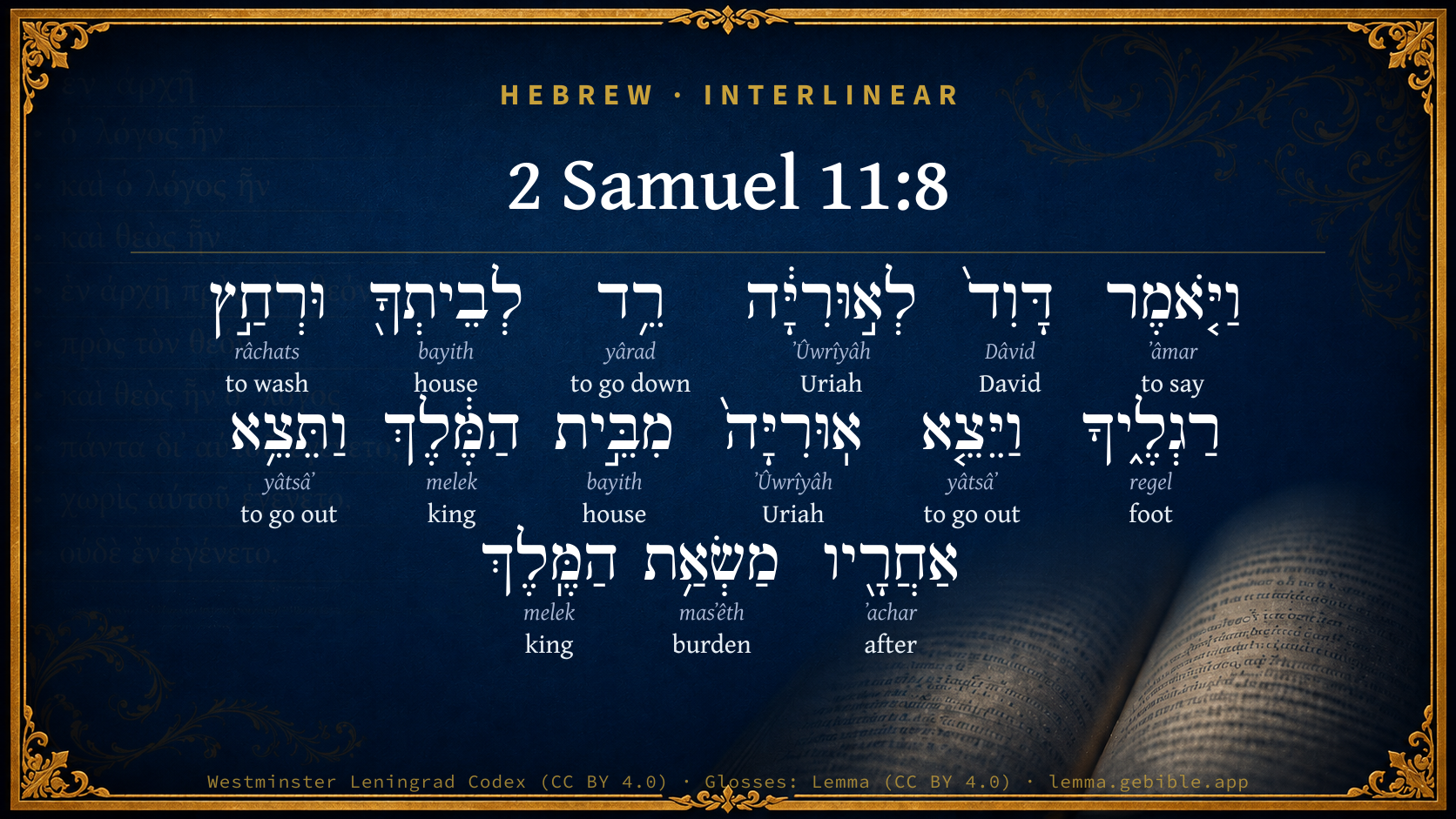
2 Samuel 11:8

Hebrew (Westminster Leningrad Codex) 2 Samuel 11:8 appears in the Hebrew Old Testament. The text above is from the Westminster Leningrad Codex. Each word links to its Strong’s number, a concise gloss, and parsing drawn from the Open Scriptures Hebrew Bible morphology. Click any word for its full Brown-Driver-Briggs (BDB) entry.
Download image
Cite this verse

2 Samuel 11:8 (World English Bible). Public Domain. Lemma interlinear Bible study tool, https://lemma.gebible.app/v/2-samuel/11/8.

Show BibTeX & RIS
BibTeX
RIS
English Translation
David said to Uriah, Go down to your house, and wash your feet. Uriah departed out of the king's house, and there followed him a mess [of food] from the king.
World English Bible · Public Domain
Download a study sheet

One document with this verse’s original text, its word-by-word gloss line, the meaning frame, cross-references with their text, attributed commentary, and full source and license credits — printable, and it pastes into notes with its structure intact.

This verse Autodidact and up

Study sheet (.html) Plain text (.txt)

A passage Seminary Student

Up to 50 verses in one chapter. A passage sheet keeps up to 6 commentary sources and 12 cross-references per verse, in the order this page ranks them, and says so on the sheet whenever that leaves anything out. Ask for a single verse and you get the Autodidact verse sheet above.

Everything on this page stays free to read, with no account — the sheet is a download of what is already on screen, not access to it.

Want to remove ads? Support Godless Engineer
Compare translations 3

The same verse in 3 English versions, stacked beneath the original-language interlinear above. Click any original word for its lexicon entry.

Each is an independent rendering of the whole verse — the interlinear is not word-aligned to these translations.

Highlighted words mark where these versions differ — a whole-verse word diff, not a word-by-word alignment.

  • World English Bible Public Domain
    David said to Uriah, Go down to your house, and wash your feet. Uriah departed out of the king's house, and there followed him a mess [of food] from the king.
  • King James Version Public Domain
    And David said to Uriah, Go down to thy house, and wash thy feet. And Uriah departed out of the king's house, and there followed him a mess of meat from the king.
  • unfoldingWord Literal Text CC BY-SA 4.0
    And David said to Uriah, “Go down to your house, and wash your feet.” And Uriah went out from the house of the king, and a gift the king went out after him.

unfoldingWord Literal Text — © unfoldingWord, licensed CC BY-SA 4.0. Word-aligned USFM3 via Door43 (git.door43.org/unfoldingWord/en_ult).

Versions to compare (up to 4)

3 of 4 selected

Show all 18 translations

Every available English version of this verse, each an independent rendering of the whole verse.

  • World English Bible Public Domain
    David said to Uriah, Go down to your house, and wash your feet. Uriah departed out of the king's house, and there followed him a mess [of food] from the king.
  • Berean Standard Bible Public Domain
    Then he said to Uriah, “Go down to your house and wash your feet.” So Uriah left the palace, and a gift from the king followed him.
  • Majority Standard Bible Public Domain
    Then he said to Uriah, “Go down to your house and wash your feet.” So Uriah left the palace, and a gift from the king followed him.
  • King James Version Public Domain
    And David said to Uriah, Go down to thy house, and wash thy feet. And Uriah departed out of the king's house, and there followed him a mess of meat from the king.
  • American Standard Version (1901) Public Domain
    And David said to Uriah, Go down to thy house, and wash thy feet. And Uriah departed out of the king's house, and there followed him a mess `of food' from the king.
  • Revised Version (1885) Public Domain
    And David said to Uriah, Go down thy house, and wash thy feet. And Uriah departed out of the king’s house, and there followed him a mess of meat from the king.
  • Geneva Bible (1599) Public Domain
    Afterward Dauid said to Vriah, Go downe to thine house, and wash thy feete. So Vriah departed out of the Kings palace, and the king sent a present after him.
  • Douay-Rheims (1899) Public Domain
    And David said to Urias: Go into thy house, and wash thy feet. And Urias went out from the king's house, and there went out after him a mess of meat from the king.
  • Young's Literal Translation Public Domain
    And David saith to Uriah, `Go down to thy house, and wash thy feet;' and Uriah goeth out of the king's house, and there goeth out after him a gift from the king,
  • Literal Standard Version CC BY-SA 4.0
    And David says to Uriah, “Go down to your house, and wash your feet”; and Uriah goes out of the king’s house, and there goes out a gift from the king after him,
  • Unlocked Literal Bible CC BY-SA 4.0
    David said to Uriah, “Go down to your house and wash your feet.” So Uriah left the king's palace, and the king sent a gift for Uriah after he left.
  • unfoldingWord Literal Text CC BY-SA 4.0
    And David said to Uriah, “Go down to your house, and wash your feet.” And Uriah went out from the house of the king, and a gift the king went out after him.
  • Darby Bible Public Domain
    And David said to Urijah, Go down to thy house and wash thy feet. And Urijah departed out of the king's house, and there followed him presents from the king.
  • World Messianic Bible Public Domain
    David said to Uriah, “Go down to your house and wash your feet.” Uriah departed out of the king’s house, and a gift from the king was sent after him.
  • Webster's Bible Public Domain
    And David said to Uriah, Go down to thy house, and wash thy feet. And Uriah departed out of the king's house, and there followed him a mess of meat from the king.
  • Free Bible Version CC BY-SA 4.0
    Then David told Uriah, “Go home now and have a rest.” Uriah left the palace, and the king sent him a gift after he'd gone.
  • Bible in Basic English Public Domain
    And David said to Uriah, Go down to your house and let your feet be washed. And Uriah went away from the king's house, and an offering from the king was sent after him.
  • JPS Tanakh (1917) Public Domain
    And David said to Uriah: 'Go down to thy house, and wash thy feet.' And Uriah departed out of the king's house, and there followed him a mess of food from the king.

Literal Standard Version (2020), Covenant Press — licensed CC BY-SA 4.0. Text via the HelloAO Bible API (eBible.org). Unlocked Literal Bible (unfoldingWord) — licensed CC BY-SA 4.0. Text via the HelloAO Bible API (eBible.org). unfoldingWord Literal Text — © unfoldingWord, licensed CC BY-SA 4.0. Word-aligned USFM3 via Door43 (git.door43.org/unfoldingWord/en_ult). Free Bible Version, Dr. Jonathan Gallagher — licensed CC BY-SA 4.0. Text via the HelloAO Bible API (eBible.org).

Word by word

More ways to search: Search by grammar → Find every occurrence → Compare this word →

Practice this passage: Drill this verse → Learn its vocabulary →

מַשְׂאַ֥ת
masʼêth
H4864
“burden of”
Noun, Common, Feminine, Singular, Construct
Part of Speech
Noun
Type
Common
Gender
Feminine
Number
Singular
State
Construct
Full BDB Definition

Origin: from \H5375\\

TWOT: 1421h

uprising, utterance, burden, portion, uplifting - that which rises, uprising, uplifting, signal, rising - utterance, oracle - burden - portion, present, largesse, gift, contribution, offering, tribute
  1. וַיֹּ֤אמֶר ʼâmar H559 “and · to say” Conjunction + Verb, Qal, Sequential Imperfect, 3rd Person, Masculine, Singular
  2. דָּוִד֙ Dâvid H1732 “David” Noun, Proper
  3. לְא֣וּרִיָּ֔ה ʼÛwrîyâh H223 “to/for · Uriah” Preposition + Noun, Proper
  4. רֵ֥ד yârad H3381 “go down” Verb, Qal, Imperative, 2nd Person, Masculine, Singular
  5. לְבֵיתְךָ֖ bayith H1004 “to/for · house · your” Preposition + Noun, Common, Masculine, Singular, Construct + Suffix, Personal, 2nd Person, Masculine, Singular
  6. וּרְחַ֣ץ râchats H7364 “and · wash” Conjunction + Verb, Qal, Imperative, 2nd Person, Masculine, Singular
  7. רַגְלֶ֑יךָ regel H7272 “feet · your” Noun, Common, Feminine, Dual, Construct + Suffix, Personal, 2nd Person, Masculine, Singular
  8. וַיֵּצֵ֤א yâtsâʼ H3318 “and · to go out” Conjunction + Verb, Qal, Sequential Imperfect, 3rd Person, Masculine, Singular
  9. אֽוּרִיָּה֙ ʼÛwrîyâh H223 “Uriah” Noun, Proper
  10. מִבֵּ֣ית bayith H1004 “from · house of” Preposition + Noun, Common, Masculine, Singular, Construct
  11. הַמֶּ֔לֶךְ melek H4428 “the · king” Particle, Definite Article + Noun, Common, Masculine, Singular, Absolute
  12. וַתֵּצֵ֥א yâtsâʼ H3318 “and · to go out” Conjunction + Verb, Qal, Sequential Imperfect, 3rd Person, Feminine, Singular
  13. אַחֲרָ֖יו ʼachar H310 “after · him” Preposition + Suffix, Personal, 3rd Person, Masculine, Singular
  14. הַמֶּֽלֶךְ melek H4428 “the · king” Particle, Definite Article + Noun, Common, Masculine, Singular, Absolute

About this verse

These counts appear in no published source. They are computed here, from the morphology-tagged text and Lemma’s own curated glosses. What Lemma adds →

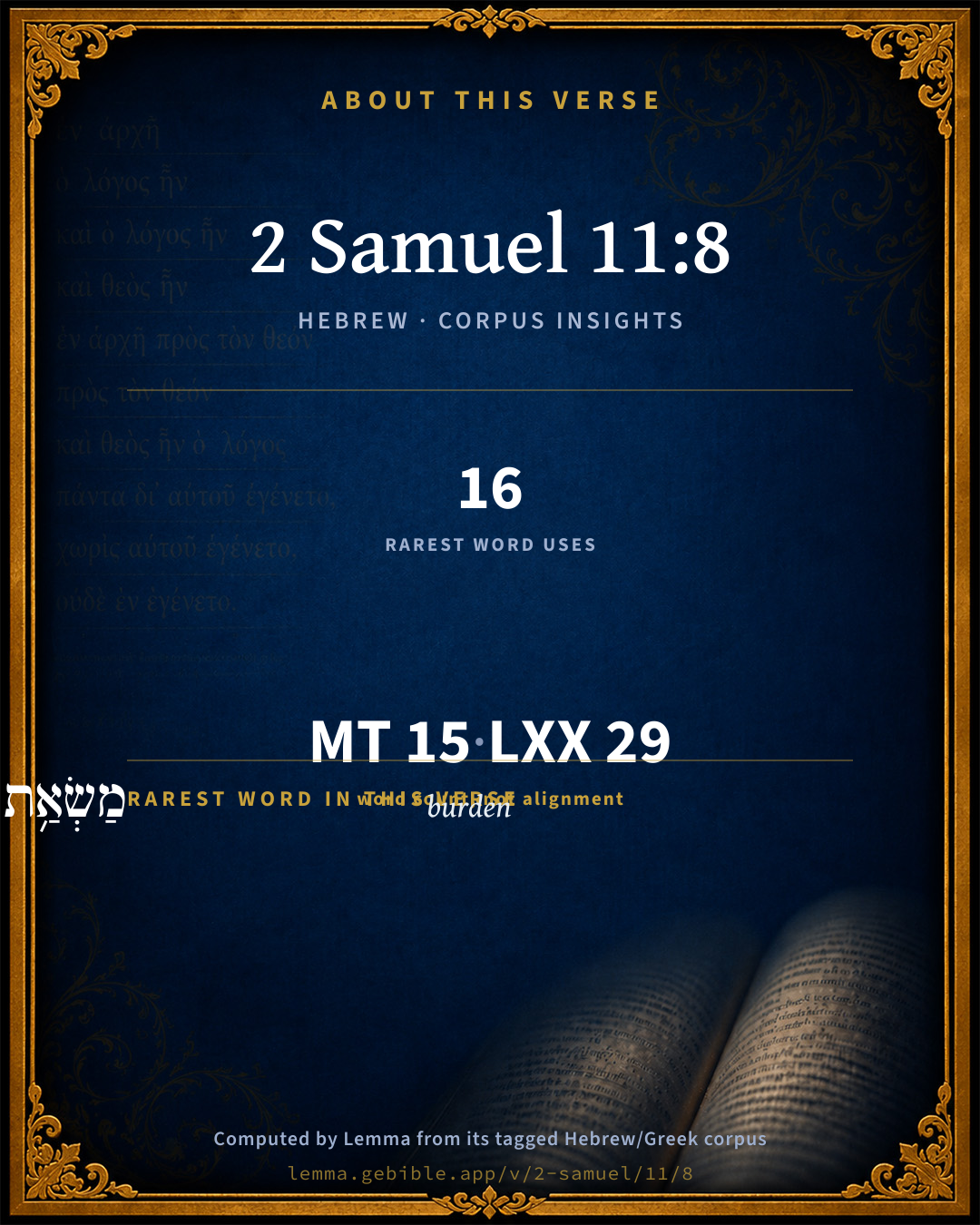
15
words
11
distinct lemmas
Historical
section

Notable vocabulary

The rarest word here is מַשְׂאַ֥ת burden H4864 — appearing just 16 times in the whole Hebrew Bible.

Shared distinctive vocabulary

מַשְׂאַ֥ת burden H4864 occurs in 14 verses of the Hebrew Bible. Also found in:

Grammatical profile

  • 5 verbs
  • 9 nouns
  • 1 preposition

Verb forms

  • וַיֹּ֤אמֶר Qal · Sequential Imperfect
  • רֵ֥ד Qal · Imperative
  • וּרְחַ֣ץ Qal · Imperative
  • וַיֵּצֵ֤א Qal · Sequential Imperfect
  • וַתֵּצֵ֥א Qal · Sequential Imperfect

Repetition

Words recur within this verse — often emphatic in Hebrew:

  • לְא֣וּרִיָּ֔ה Uriah H223 ×2
  • לְבֵיתְךָ֖ house H1004 ×2
  • וַיֵּצֵ֤א to go out H3318 ×2
  • הַמֶּ֔לֶךְ king H4428 ×2

Hebrew & Septuagint length

In English translation the verse runs 31 words from the Hebrew and 32 from the Septuagint (LXX English) — closely comparable.

A rough comparison of the two English renderings, which tokenize alike — not a word-level alignment.

Word counts can differ between the Hebrew and the Greek without any difference in meaning — e.g. the Hebrew direct-object marker אֵת has no separate Greek word, and Greek often adds the article ὁ.

In the original languages it is 15 Hebrew tokens and 29 Greek tokens — but the two are counted differently (Hebrew bundles its prefixes and suffixes into one token; the Greek is in lemma form), so that isn’t a like-for-like length.

Cross-references

11

Topical passages linked to 2 Samuel 11:8 in the Treasury of Scripture Knowledge — connected by theme and wording, ordered by reader-vote popularity; previews shown in the World English Bible.

  • Genesis 18:4 Now let a little water be fetched, wash your feet, and rest yourselves under the tree.
  • Genesis 19:2 and he said, "See now, my lords, please turn aside into your servant's house, stay all night, wash your feet, and you will rise up early, and go on your way." They said, "No, but we will stay in the street all night."
  • Genesis 43:24 The man brought the men into Joseph's house, and gave them water, and they washed their feet. He gave their donkeys fodder.
  • Genesis 43:34 He sent portions to them from before him, but Benjamin's portion was five times as much as any of theirs. They drank, and were merry with him.
  • Psalms 12:2 Everyone lies to his neighbor. They speak with flattering lips, and with a double heart.
  • Psalms 44:21 Won't God search this out? For he knows the secrets of the heart.
  • Psalms 55:21 His mouth was smooth as butter, But his heart was war. His words were softer than oil, Yet they were drawn swords.
  • Isaiah 29:15 Woe to those who hide deep their counsel from Yahweh, and whose works are in the dark, and who say, Who sees us? and who knows us?
  • Luke 7:44 Turning to the woman, he said to Simon, "Do you see this woman? I entered into your house, and you gave me no water for my feet, but she has wet my feet with her tears, and wiped them with the hair of her head.
  • Luke 12:2 But there is nothing covered up, that will not be revealed, nor hidden, that will not be known.
  • Hebrews 4:13 There is no creature that is hidden from his sight, but all things are naked and laid open before the eyes of him with whom we have to do.

Cross-references courtesy of OpenBible.info (CC BY 4.0).

Hebrew and Greek witnesses Masoretic Hebrew ↔ Greek Septuagint

The same verse in the two great witnesses to the Old Testament, shown verse-for-verse.

These are two independent witnesses, not word-aligned to each other, and the Septuagint is shown in lemma (dictionary) form.

Hebrew 2 Samuel 11:8 Masoretic · Westminster Leningrad Codex

וַיֹּ֤אמֶר דָּוִד֙ לְא֣וּרִיָּ֔ה רֵ֥ד לְבֵיתְךָ֖ וּרְחַ֣ץ רַגְלֶ֑יךָ וַיֵּצֵ֤א אֽוּרִיָּה֙ מִבֵּ֣ית הַמֶּ֔לֶךְ וַתֵּצֵ֥א אַחֲרָ֖יו מַשְׂאַ֥ת הַמֶּֽלֶךְ

David said to Uriah, Go down to your house, and wash your feet. Uriah departed out of the king's house, and there followed him a mess [of food] from the king.

World English Bible · Public Domain

Greek LXX 2 Samuel 11:8 Septuagint · lemma form

καί εἶπον δαυίδ ὁ ουριας καταβαίνω εἰς ὁ οἶκος σύ καί νίπτω ὁ πούς σύ καί ἐκἔρχομαι ουριας ἐκ οἶκος ὁ βασιλεύς καί ἐκἔρχομαι ὀπίσω αὐτός ἄρσις ὁ βασιλεύς

And David said to Urias, Go to your house, and wash your feet: and Urias departed from the house of the king, and a portion of meat from the king followed him.

LXX2012 (modern English Septuagint) · Public Domain

Hebrew: Westminster Leningrad Codex (CC BY 4.0). Greek: Septuagint (public domain); English from LXX2012 (modern English Septuagint) (Public Domain). How the Septuagint differs from the Hebrew →

Targum (Aramaic paraphrase)

1

The Targum is the ancient Jewish Aramaic paraphrase of the Hebrew Scriptures — an interpretive translation, not the Hebrew text itself. Onkelos (literal) and Pseudo-Jonathan (expansive) render the Torah, and Jonathan the Prophets. Coverage is partial: where no permissively-licensed English translation exists for a verse, only the Aramaic is shown. This is verse-level text, not a word-by-word alignment to the Hebrew.

  1. Targum Jonathan Prophets (Joshua–Malachi)
    וַאֲמַר דָוִד לְאוּרִיָא חוּת לְבֵיתָךְ וּשְׁטוֹף רִגְלָךְ וּנְפַק אוּרִיָה מִבֵּית מַלְכָּא וּנְפַקַת בַּתְרוֹהִי סְעוּדָתָא דְמַלְכָּא:

    (no public-domain English translation for this verse)

    Targum Jonathan — Aramaic: “Mikraot Gedolot” (public domain). English: “Sefaria Community Translation” (CC0 1.0 (public-domain dedication)); “London "Chaldee Paraphrase," 1871” (public domain). Text via Sefaria.

Commentary

Notes on 2 Samuel 11:8 from classic Christian and Jewish commentators (each source and its license shown beneath its notes). The classic Christian expositions comment on the surrounding passage and are grouped to its opening verse, so a note may address several verses; the Jewish commentaries on the Tanakh (Rashi and others) are per-verse, so they appear only where the commentator wrote on this verse.

Lemma curates 59 commentaries, every one of them public domain or Creative Commons licensed, each selected and text-cleaned for this edition rather than reprinted as found. About our sources →

Trapp's Complete Commentary

John Trapp

2Sa 11:8 And David said to Uriah, Go down to thy house, and wash thy feet. And Uriah departed out of the king’s house, and there followed him a mess [of meat] from the king.

Ver. 8. Go down to thy house and wash thy feet,] i.e., Cura corpus et recrea te cum uxore tua, Refresh thyself after thy travel, and rejoice with the wife of thy youth.

And there followed him a mess of meat from the king.] Ferculum regium, a mess royal, that Uriah might pamper his flesh, and then lie with his wife. Veneris enim stimuli sunt deliciae regale,: ut sine Cerere et Libero friget Venus. {a}

{a} Terent.

John Trapp, A Commentary or Exposition upon All the Books of the Old and New Testament (1647–1656) — public domain. Text from a community e-Sword module.

Joseph Benson's Commentary

2Sa 11:8-9. David said, Go down to thy house — Not doubting but he would there converse with his wife, and so hide their sin and shame. There followed him a mess of meat from the king — In token of David’s peculiar favour and kindness to him; and that, eating freely of good cheer, he might be the more desirous of enjoying the company of his wife. But Uriah slept at the door of the king’s house — Like a true soldier, he lay all night in the guard-chamber, and did not go home to his wife. This he did by the secret influence of God upon his mind, and the order of his wise providence, that David’s sin might be brought to light notwithstanding all his contrivances to conceal it.

Joseph Benson's Commentary on the Old and New Testaments (1811–1818) — public domain. Text from a community e-Sword module.

Tyndale Open Study Notes

Tyndale Open Resources

11:8 and relax: David assumed that Uriah would have sex with Bathsheba while on this weekend pass. Then everyone except Bathsheba would assume that the child was Uriah’s, conceived on this night. • a gift: David might not have even cared whether the husband and wife were intimate. Uriah’s return to his house would stifle any rumors as to how and when Bathsheba became pregnant.

Tyndale Open Study Notes — © Tyndale Open Resources, licensed CC BY-SA 4.0. Text via the HelloAO Bible API.

Geneva Bible (1599)

Geneva Bible translators

David thought that if Uriah lay with his wife, his fault might be cloaked.

Geneva Bible (1599) marginal notes — public domain. Text via Bolls.life.

Jamieson, Fausset & Brown

Robert Jamieson, A. R. Fausset & David Brown

David said to Uriah, Go down to thy house--This sudden recall, the manner of the king, his frivolous questions (Sa2 11:7), and his urgency for Uriah to sleep in his own house, probably awakened suspicions of the cause of this procedure.

there followed him a mess of meat from the king--A portion of meat from the royal table, sent to one's own house or lodgings, is one of the greatest compliments which an Eastern prince can pay.

Jamieson, Fausset & Brown — Commentary Critical and Explanatory on the Whole Bible (1871) — public domain (CC PDM 1.0). Text via the HelloAO Bible API.

Adam Clarke's Commentary

Verse 8. Go down to thy house, and wash thy feet.] Uriah had come off a journey, and needed this refreshment; but David's design was that he should go and lie with his wife, that the child now conceived should pass for his, the honour of Bath-sheba be screened, and his own crime concealed. At this time he had no design of the murder of Uriah, nor of taking Bath-sheba to wife.

A mess of meat from the king.] All this was artfully contrived.

Adam Clarke's Commentary on the Bible (1810–1826) — public domain. Text from a community e-Sword/MySword module.

Ellicott's Commentary for English Readers

(8) A mess of meat.—Lit. a present. The same word is used in Gen_43:34, and no doubt refers to some choice dish sent by the king to the guest whom he wished to honour.

A Bible Commentary for English Readers, edited by Charles John Ellicott (1878–1897) — public domain. Text from a community e-Sword module.

The Cambridge Bible for Schools and Colleges

gen. ed. J. J. S. Perowne

8. wash thy feet] An indispensable refreshment after a journey in the East, where sandals only were worn. Cp. Gen_18:4; Gen_43:24; Luk_7:44.

a mess of meat from the king] A portion from the king’s table as a mark of honour for his faithful servant. Cp. Gen_43:34.

The Cambridge Bible for Schools and Colleges (gen. ed. J. J. S. Perowne; Cambridge University Press, 1878–1918) — public domain. Text from a community e-Sword module.

John Gill's Exposition

And David said to Uriah, go down to thy house, and wash thy feet,.... For his refreshment, and to prepare for bed, which was what he wanted to get him to:

and Uriah departed out of the king's house; in order as it might seem to the king to go to his own:

and there followed him a mess of meat from the king: no doubt a delicious dish, to eat with his wife before he went to bed, to excite him the more to desire the enjoyment of her this mess consisted, according to Abarbinel, of bread, wine, and flesh; and who also observes, after Ben Gersom, that the word may be interpreted of a torch to light him home to his house, being night.

John Gill's Exposition of the Whole Bible (1746–1763) — public domain (CC PDM 1.0). Text via the HelloAO Bible API.

Albert Barnes' Notes on the Bible

A mess of meat - Compare Gen 43:34. The word denotes the honorable portion given by the host to his chief guest.

Albert Barnes' Notes on the Bible (1834–1885) — public domain. Text from a community e-Sword/MySword module.

Haydock's Catholic Bible Commentary

Feet. As they did not wear stockings, this practice was very common after a journey. David thus insinuated that Urias might take his rest, and go to his wife, that so he might suppose that the child was his own, and the crime of Bethsabee might be concealed. (Calmet) --- King, as a mark of honour, but in reality that he might be more excited to indulge his pleasures. (Abulensis) (Menochius)

George Leo Haydock (1774–1849), Haydock's Catholic Family Bible and Commentary, 1859 edition — public domain. Excludes Psalms (Douay-Rheims chapter numbering differs from Protestant) and Deuterocanonical books (Catholic canon only).

Matthew Poole's English Annotations

Go down to thy house; not doubting but he would there converse with his wife, and so cover their sin and shame.

Wash thy feet; as travellers there used to do. There followed him a mess of meat; seemingly as testimony of David’s respect and affection to him; but really to cheer up his spirits, and dispose him to desire his wife’s company.

Matthew Poole's English Annotations on the Holy Bible (1683–1685) — public domain. Text from a community e-Sword/MySword module.

Whedon's Commentary on the Bible

Daniel D. Whedon

DAVID’S ARTIFICES TO CONCEAL HIS SIN AND TO KILL URIAH, 2Sa_11:6-27.

8. Go down to thy house and wash thy feet — David’s ostensible object in sending for Uriah was to learn how the war prospered; and, being apparently pleased with his report of affairs, he directs him to go home and rest himself before returning to the scenes of war. Washing the feet was customary after a journey and before retiring to sleep. Gen_18:4; Gen_19:2. But the king’s real design was to have Uriah pass the night with his wife, that the child already conceived by her might not be regarded as the fruit of their adultery.

There followed him a mess — As a royal present to convince him of the king’s affection for him. Very likely David feared that his sin was known or suspected, for the guilty soul is ever clouded with such suspicions.

Daniel D. Whedon (gen. ed.), Commentary on the Old and New Testaments (1874–1909) — public domain. Text from a community e-Sword module.

The Pulpit Commentary

A mess (of meat); really, a royal present (see Est_2:18; Jer_40:5; Amo_5:11, where it is translated burdens of wheat, but really means presents of wheat, forced from the poor) though originally a portion of food sent to a guest from the table of the giver of a. (Gen_43:34) Uriah, as one of David"s thirty-seven heroes, would hold a high rank in the army, though the statement given by Josephus, that he was Joab"s armour bearer, is probably a mere conjecture, made with the view of explaining what seemed to him strange, that a foreigner should hold so distinguished a place among the captains of Israel. David sends for him, on the pretext that he wanted full information of Joab"s plans, and the state of the army, and the progress of the siege of Rabbah. And so prompt is Uriah, that he goes to the king still soiled with travel, and without calling at his house. And David makes his inquiries, listens with apparent interest to the narrative of the war, and, after receiving a full report, bids Uriah go home and rest and refresh himself after the journey. He sends him, moreover, a present, such probably as was usual after special service, but large and liberal, so as to put Uriah in good humour. But the old soldier cared for war more than for pleasure, and, instead of going to his house, spent the night in the guard room with the soldiers and others who were in attendance upon the king. (see 1Ki_14:27, 1Ki_14:28) All would be eager for news of friends and relatives, and it was a far greater delight to Uriah to chat with his old comrades than to be resting luxuriously in his own home.

The Pulpit Commentary (1880–1919), ed. H.D.M. Spence-Jones & Joseph S. Exell — public domain. Text from a community e-Sword module.

John Wesley's Explanatory Notes

Go down - Not doubting but he would there converse with his wife, and so cover their sin and shame.

John Wesley, Explanatory Notes Upon the Whole Bible (1754–1765) — public domain. Text via the GEBible commentary corpus.

Rashi

Rabbi Shlomo Yitzchaki (Rashi)

The king's meal. [Yonasan translates:] the king's meal.

Rashi on the Tanakh — English translations: “The Judaica Press complete Tanach with Rashi, translated by A. J. Rosenberg” (CC BY 4.0); “Pentateuch with Rashi's commentary by M. Rosenbaum and A.M. Silbermann, 1929-1934” (public domain); “The Metsudah Tanach series, Lakewood, N.J” (CC BY 4.0); and “The Book of Joshua, Metsudah Publications, 1997” (CC BY 4.0). Text via Sefaria.

Lesson kit

Teaching starters — assembled from the data on this page, not authored interpretation. Every prompt links to the verse data it draws on. Edit before teaching.

2 Samuel, in the Historical, opens this verse with 15 words (11 distinct Hebrew lemmas). Its most distinctive word is masʼêth (“burden”). A historical commentator’s framing appears above. Read the whole chapter for the surrounding context.

Discussion questions

  1. The word masʼêth carries the sense “burden.” How does it shape the verse?
  2. How does Genesis 43:34, which shares the word «burden», read alongside this verse?
  3. What does the repetition of “Uriah” (2× in this one verse) do in this verse?
  4. These translations render this verse differently. What is at stake in choosing one wording over another?
  5. «וַיֹּ֤אמֶר» is a Qal Sequential Imperfect verb. How does that grammatical form shape the action described?
  6. Compare how Trapp's Complete Commentary and Joseph Benson's Commentary read this verse. Where do they agree or differ?

Things to notice

Reading settings

Reading text

Shown beneath each verse's original-language words.

Old Testament
Old Testament edition

Read the OT as the Masoretic Hebrew (MT) or the Greek Septuagint (LXX).

English shown for the Greek Septuagint (in the Hebrew ↔ Greek comparison).

Comparing translations? Open the Compare panel on any verse page to stack up to four side by side.