1 Samuel 26:10

Hebrew (Westminster Leningrad Codex) 1 Samuel 26:10 appears in the Hebrew Old Testament. The text above is from the Westminster Leningrad Codex. Each word links to its Strong’s number, a concise gloss, and parsing drawn from the Open Scriptures Hebrew Bible morphology. Click any word for its full Brown-Driver-Briggs (BDB) entry.
Download image
Cite this verse

1 Samuel 26:10 (World English Bible). Public Domain. Lemma interlinear Bible study tool, https://lemma.gebible.app/v/1-samuel/26/10.

Show BibTeX & RIS
BibTeX
RIS
English Translation
David said, As Yahweh lives, Yahweh will strike him; or his day shall come to die; or he shall go down into battle and perish.
World English Bible · Public Domain
Download a study sheet

One document with this verse’s original text, its word-by-word gloss line, the meaning frame, cross-references with their text, attributed commentary, and full source and license credits — printable, and it pastes into notes with its structure intact.

This verse Autodidact and up

Study sheet (.html) Plain text (.txt)

A passage Seminary Student

Up to 50 verses in one chapter. A passage sheet keeps up to 6 commentary sources and 12 cross-references per verse, in the order this page ranks them, and says so on the sheet whenever that leaves anything out. Ask for a single verse and you get the Autodidact verse sheet above.

Everything on this page stays free to read, with no account — the sheet is a download of what is already on screen, not access to it.

Want to remove ads? Support Godless Engineer
Compare translations 3

The same verse in 3 English versions, stacked beneath the original-language interlinear above. Click any original word for its lexicon entry.

Each is an independent rendering of the whole verse — the interlinear is not word-aligned to these translations.

Highlighted words mark where these versions differ — a whole-verse word diff, not a word-by-word alignment.

  • World English Bible Public Domain
    David said, As Yahweh lives, Yahweh will strike him; or his day shall come to die; or he shall go down into battle and perish.
  • King James Version Public Domain
    David said furthermore, As the LORD liveth, the LORD shall smite him; or his day shall come to die; or he shall descend into battle, and perish.
  • unfoldingWord Literal Text CC BY-SA 4.0
    And David said, “The life of Yahweh—but rather Yahweh will strike him, or his day will come and he will die, or he will go down into a battle and be swept away—

unfoldingWord Literal Text — © unfoldingWord, licensed CC BY-SA 4.0. Word-aligned USFM3 via Door43 (git.door43.org/unfoldingWord/en_ult).

Versions to compare (up to 4)

3 of 4 selected

Show all 18 translations

Every available English version of this verse, each an independent rendering of the whole verse.

  • World English Bible Public Domain
    David said, As Yahweh lives, Yahweh will strike him; or his day shall come to die; or he shall go down into battle and perish.
  • Berean Standard Bible Public Domain
    David added, “As surely as the LORD lives, the LORD Himself will strike him down; either his day will come and he will die, or he will go into battle and perish.
  • Majority Standard Bible Public Domain
    David added, “As surely as the LORD lives, the LORD Himself will strike him down; either his day will come and he will die, or he will go into battle and perish.
  • King James Version Public Domain
    David said furthermore, As the LORD liveth, the LORD shall smite him; or his day shall come to die; or he shall descend into battle, and perish.
  • American Standard Version (1901) Public Domain
    And David said, As Jehovah liveth, Jehovah will smite him; or his day shall come to die; or he shall go down into battle and perish.
  • Revised Version (1885) Public Domain
    And David said, As the LORD liveth, the LORD shall smite him; or his day shall come to die; or he shall go down into battle, and perish.
  • Geneva Bible (1599) Public Domain
    Moreouer Dauid said, As the Lord liueth, eyther the Lord shall smite him, or his day shall come to dye, or he shall descend into battel, and perish.
  • Douay-Rheims (1899) Public Domain
    And David said: As the Lord liveth, unless the Lord shall strike him, or his day shall come to die, or he shall go down to battle and perish:
  • Young's Literal Translation Public Domain
    And David saith, `Jehovah liveth; except Jehovah doth smite him, or his day come that he hath died, or into battle he go down, and hath been consumed --
  • Literal Standard Version CC BY-SA 4.0
    And David says, “YHWH lives; except YHWH strikes him, or his day comes that he has died, or he goes down into battle and has been consumed—
  • Unlocked Literal Bible CC BY-SA 4.0
    David said, “As Yahweh lives, Yahweh will kill him, or his day will come to die, or he will go into battle and perish.
  • unfoldingWord Literal Text CC BY-SA 4.0
    And David said, “The life of Yahweh—but rather Yahweh will strike him, or his day will come and he will die, or he will go down into a battle and be swept away—
  • Darby Bible Public Domain
    And David said, [As] Jehovah liveth, Jehovah will surely smite him; either his day shall come to die, or he shall descend into battle and perish.
  • World Messianic Bible Public Domain
    David said, “As the LORD lives, the LORD will strike him; or his day shall come to die, or he shall go down into battle and perish.
  • Webster's Bible Public Domain
    David said furthermore, As the LORD liveth, the LORD will smite him; or his day will come to die; or he will descend into battle and perish.
  • Free Bible Version CC BY-SA 4.0
    As the Lord lives, the Lord himself will kill him. Either his time will come and he'll die, or he will go into battle and be killed.
  • Bible in Basic English Public Domain
    And David said, By the living Lord, the Lord will send destruction on him; the natural day of his death will come, or he will go into the fight and come to his end.
  • JPS Tanakh (1917) Public Domain
    And David said: 'As the LORD liveth, nay, but the LORD shall smite him; or his day shall come to die; or he shall go down into battle, and be swept away.

Literal Standard Version (2020), Covenant Press — licensed CC BY-SA 4.0. Text via the HelloAO Bible API (eBible.org). Unlocked Literal Bible (unfoldingWord) — licensed CC BY-SA 4.0. Text via the HelloAO Bible API (eBible.org). unfoldingWord Literal Text — © unfoldingWord, licensed CC BY-SA 4.0. Word-aligned USFM3 via Door43 (git.door43.org/unfoldingWord/en_ult). Free Bible Version, Dr. Jonathan Gallagher — licensed CC BY-SA 4.0. Text via the HelloAO Bible API (eBible.org).

Word by word

More ways to search: Search by grammar → Find every occurrence → Compare this word →

Practice this passage: Drill this verse → Learn its vocabulary →

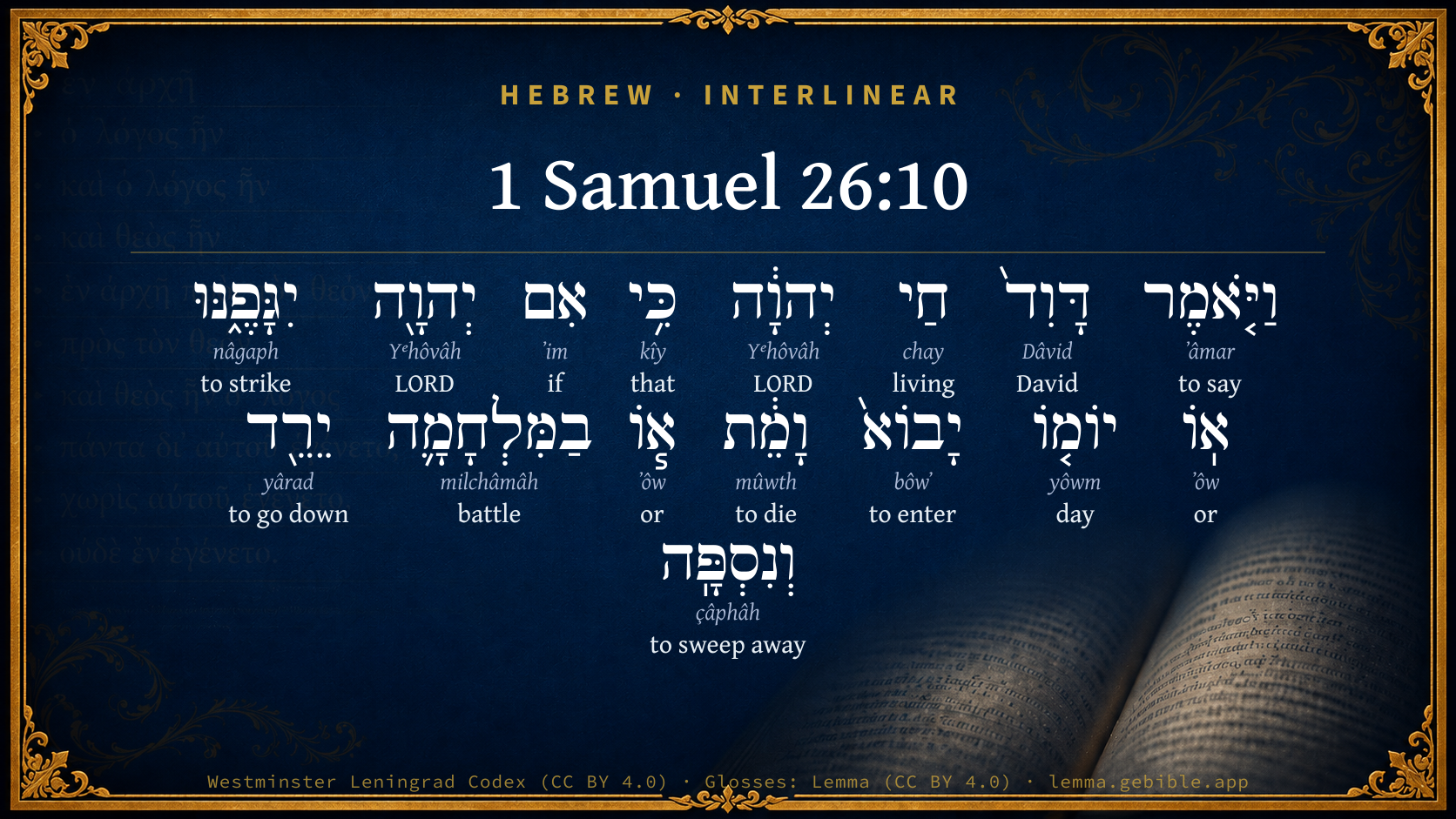
וְנִסְפָּֽה
çâphâh
H5595
“and · to sweep away”
Conjunction + Verb, Niphal, Perfect, 3rd Person, Masculine, Singular
Part of Speech
Conjunction + Verb
Stem
Niphal
Form
Perfect
Person
3rd Person
Gender
Masculine
Number
Singular
Full BDB Definition

Origin: a primitive root

TWOT: 1531

to sweep or snatch away, catch up, destroy, consume - (Qal) - to be snatched away - to sweep or snatch away - (Niphal) - to be swept away, be destroyed - to be caught up, be captured - (Hiphil) to catch up, gather
  1. וַיֹּ֤אמֶר ʼâmar H559 “and · to say” Conjunction + Verb, Qal, Sequential Imperfect, 3rd Person, Masculine, Singular
  2. דָּוִד֙ Dâvid H1732 “David” Noun, Proper
  3. חַי chay H2416 “living” Adjective, Adjective, Masculine, Singular, Absolute
  4. יְהוָ֔ה Yᵉhôvâh H3068 “LORD” Noun, Proper
  5. כִּ֥י kîy H3588 “that” Conjunction
  6. אִם ʼim H518 “if” Conjunction
  7. יְהוָ֖ה Yᵉhôvâh H3068 “LORD” Noun, Proper
  8. יִגָּפֶ֑נּוּ nâgaph H5062 “to strike · us” Verb, Qal, Imperfect, 3rd Person, Masculine, Singular + Suffix, Personal, 1st Person, Common, Plural
  9. אֽוֹ ʼôw H176 “or” Conjunction
  10. יוֹמ֤וֹ yôwm H3117 “day · his” Noun, Common, Masculine, Singular, Construct + Suffix, Personal, 3rd Person, Masculine, Singular
  11. יָבוֹא֙ bôwʼ H935 “to enter” Verb, Qal, Imperfect, 3rd Person, Masculine, Singular
  12. וָמֵ֔ת mûwth H4191 “and · to die” Conjunction + Verb, Qal, Perfect, 3rd Person, Masculine, Singular
  13. א֧וֹ ʼôw H176 “or” Conjunction
  14. בַמִּלְחָמָ֛ה milchâmâh H4421 “in/at the · battle” Preposition, Determined + Noun, Common, Feminine, Singular, Absolute
  15. יֵרֵ֖ד yârad H3381 “to go down” Verb, Qal, Imperfect, 3rd Person, Masculine, Singular

About this verse

These counts appear in no published source. They are computed here, from the morphology-tagged text and Lemma’s own curated glosses. What Lemma adds →

16
words
14
distinct lemmas
Historical
section

Notable vocabulary

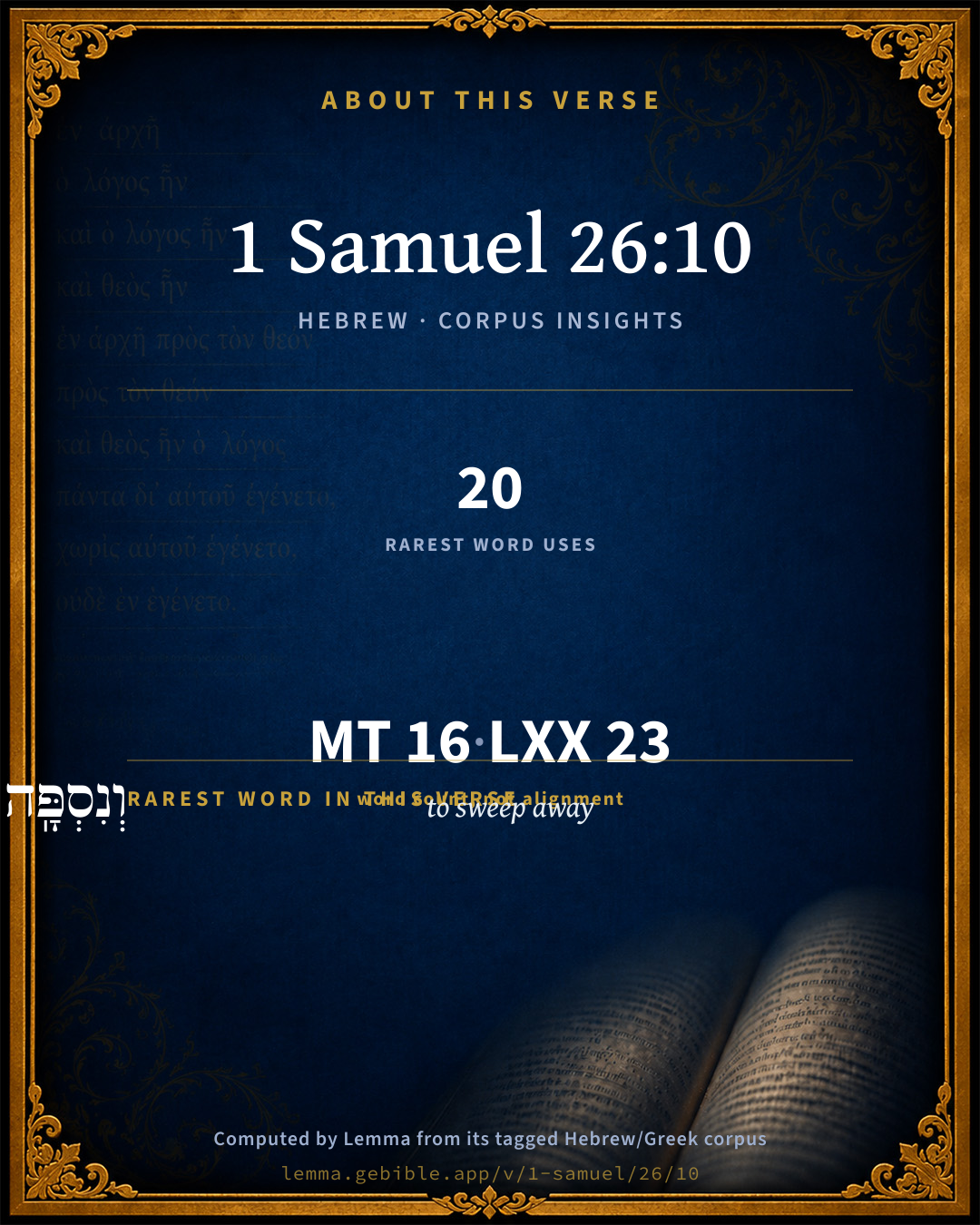
The rarest word here is וְנִסְפָּֽה to sweep away H5595 — appearing just 20 times in the whole Hebrew Bible.

Shared distinctive vocabulary

וְנִסְפָּֽה to sweep away H5595 occurs in 20 verses of the Hebrew Bible. Also found in:

Grammatical profile

  • 6 verbs
  • 5 nouns
  • 1 adjective
  • 4 conjunctions

Verb forms

  • וַיֹּ֤אמֶר Qal · Sequential Imperfect
  • יִגָּפֶ֑נּוּ Qal · Imperfect
  • יָבוֹא֙ Qal · Imperfect
  • וָמֵ֔ת Qal · Perfect
  • יֵרֵ֖ד Qal · Imperfect
  • וְנִסְפָּֽה Niphal · Perfect

Repetition

Words recur within this verse — often emphatic in Hebrew:

  • יְהוָ֔ה LORD H3068 ×2
  • אֽוֹ or H176 ×2

Hebrew & Septuagint length

In English translation the verse runs 25 words from the Hebrew and 35 from the Septuagint (LXX English) — the Septuagint runs noticeably longer here. See the side-by-side →

A rough comparison of the two English renderings, which tokenize alike — not a word-level alignment.

Word counts can differ between the Hebrew and the Greek without any difference in meaning — e.g. the Hebrew direct-object marker אֵת has no separate Greek word, and Greek often adds the article ὁ.

In the original languages it is 16 Hebrew tokens and 23 Greek tokens — but the two are counted differently (Hebrew bundles its prefixes and suffixes into one token; the Greek is in lemma form), so that isn’t a like-for-like length.

Cross-references

19

Topical passages linked to 1 Samuel 26:10 in the Treasury of Scripture Knowledge — connected by theme and wording, ordered by reader-vote popularity; previews shown in the World English Bible.

  • Genesis 47:29 The time drew near that Israel must die, and he called his son Joseph, and said to him, "If now I have found favor in your sight, please put your hand under my thigh, and deal kindly and truly with me. Please don't bury me in Egypt,
  • Deuteronomy 31:14 Yahweh said to Moses, Behold, your days approach that you must die: call Joshua, and present yourselves in the tent of meeting, that I may give him a charge. Moses and Joshua went, and presented themselves in the tent of meeting.
  • Romans 12:19 Don't seek revenge yourselves, beloved, but give place to God's wrath. For it is written, "Vengeance belongs to me; I will repay, says the Lord."
  • 1 Samuel 25:38 It happened about ten days after, that Yahweh struck Nabal, so that he died.
  • 1 Samuel 31:6 So Saul died, and his three sons, and his armor bearer, and all his men, that same day together.
  • Psalms 37:13 The Lord will laugh at him, For he sees that his day is coming.
  • 1 Samuel 25:26 Now therefore, my lord, as Yahweh lives, and as your soul lives, seeing Yahweh has withheld you from blood guiltiness, and from avenging yourself with your own hand, now therefore let your enemies, and those who seek evil to my lord, be as Nabal.
  • Deuteronomy 32:35 Vengeance is mine, and recompense, At the time when their foot shall slide: For the day of their calamity is at hand, The things that are to come on them shall make haste.
  • 1 Samuel 24:15 Yahweh therefore be judge, and give sentence between me and you, and see, and plead my cause, and deliver me out of your hand.
  • Job 7:1 "Isn't a man forced to labor on earth? Aren't his days like the days of a hired hand?
  • Job 14:5 Seeing his days are determined, The number of his months is with you, And you have appointed his bounds that he can't pass;
  • Job 14:14 If a man dies, shall he live again? All the days of my warfare would I wait, Until my release should come.
  • Psalms 37:10 For yet a little while, and the wicked will be no more. Yes, though you look for his place, he isn't there.
  • Psalms 94:1–2 Yahweh, you God to whom vengeance belongs, You God to whom vengeance belongs, shine forth.
  • Ecclesiastes 3:2 A time to be born, And a time to die; A time to plant, And a time to pluck up that which is planted;
  • Luke 18:7 Won't God avenge his chosen ones, who are crying out to him day and night, and yet he exercises patience with them?
  • Hebrews 9:27 Inasmuch as it is appointed for men to die once, and after this, judgment,
  • Revelation 18:8 Therefore in one day her plagues will come: death, mourning, and famine; and she will be utterly burned with fire; for the Lord God who has judged her is strong.
  • Psalms 94:23 He has brought on them their own iniquity, And will cut them off in their own wickedness. Yahweh, our God, will cut them off.

Cross-references courtesy of OpenBible.info (CC BY 4.0).

Hebrew and Greek witnesses Masoretic Hebrew ↔ Greek Septuagint

The same verse in the two great witnesses to the Old Testament, shown verse-for-verse.

Here the Septuagint runs noticeably longer than the Hebrew — LXX2012 (modern English Septuagint) 35 words vs World English Bible 25. A rough length comparison of the two English translations, not a word-level alignment — read both below.

These are two independent witnesses, not word-aligned to each other, and the Septuagint is shown in lemma (dictionary) form.

Hebrew 1 Samuel 26:10 Masoretic · Westminster Leningrad Codex

וַיֹּ֤אמֶר דָּוִד֙ חַי יְהוָ֔ה כִּ֥י אִם יְהוָ֖ה יִגָּפֶ֑נּוּ אֽוֹ יוֹמ֤וֹ יָבוֹא֙ וָמֵ֔ת א֧וֹ בַמִּלְחָמָ֛ה יֵרֵ֖ד וְנִסְפָּֽה

David said, As Yahweh lives, Yahweh will strike him; or his day shall come to die; or he shall go down into battle and perish.

World English Bible · Public Domain

Greek LXX 1 Samuel 26:10 Septuagint · lemma form

καί εἶπον δαυίδ ζάω κύριος ἐάν μή κύριος παίζω αὐτός ἤ ὁ ἡμέρα αὐτός ἔρχομαι καί ἀποθνήσκω ἤ εἰς πόλεμος καταβαίνω καί προςτίθημι

And David said, As the Lord lives, if the Lord strike him not, or his day come and he die, or he go down to battle and be added to his fathers, do not so.

LXX2012 (modern English Septuagint) · Public Domain

Hebrew: Westminster Leningrad Codex (CC BY 4.0). Greek: Septuagint (public domain); English from LXX2012 (modern English Septuagint) (Public Domain). How the Septuagint differs from the Hebrew →

Targum (Aramaic paraphrase)

1

The Targum is the ancient Jewish Aramaic paraphrase of the Hebrew Scriptures — an interpretive translation, not the Hebrew text itself. Onkelos (literal) and Pseudo-Jonathan (expansive) render the Torah, and Jonathan the Prophets. Coverage is partial: where no permissively-licensed English translation exists for a verse, only the Aramaic is shown. This is verse-level text, not a word-by-word alignment to the Hebrew.

  1. Targum Jonathan Prophets (Joshua–Malachi)
    וַאֲמַר דָוִד קַיָם הוּא יְיָ אֱלָהֵין מִן קֳדָם יְיָ יִתְמְחֵי אוֹ יוֹמֵיהּ יִמְטֵי וִימוּת אוֹ בִקְרָבָא יֵחוּת וְיִתְקְטֵל:

    (no public-domain English translation for this verse)

    Targum Jonathan — Aramaic: “Mikraot Gedolot” (public domain). English: “Sefaria Community Translation” (CC0 1.0 (public-domain dedication)); “London "Chaldee Paraphrase," 1871” (public domain). Text via Sefaria.

Commentary

Notes on 1 Samuel 26:10 from classic Christian and Jewish commentators (each source and its license shown beneath its notes). The classic Christian expositions comment on the surrounding passage and are grouped to its opening verse, so a note may address several verses; the Jewish commentaries on the Tanakh (Rashi and others) are per-verse, so they appear only where the commentator wrote on this verse.

Lemma curates 59 commentaries, every one of them public domain or Creative Commons licensed, each selected and text-cleaned for this edition rather than reprinted as found. About our sources →

Trapp's Complete Commentary

John Trapp

1Sa 26:10 David said furthermore, [As] the LORD liveth, the LORD shall smite him; or his day shall come to die; or he shall descend into battle, and perish.

Ver. 10. The Lord shall smite him.] The offending lion is not to be lashed with every man’s whip, but by the rod of his accustomed governor. And as men endure with patience a barren year, if it happen, or unseasonable weather: so must they tolerate the imperfections of their rulers, and quietly expect either reformation or alteration. But ill accidents attend such princes, as being absolute in power, will be too resolute in will, and dissolute in life.

John Trapp, A Commentary or Exposition upon All the Books of the Old and New Testament (1647–1656) — public domain. Text from a community e-Sword module.

Joseph Benson's Commentary

1Sa 26:10-11. The Lord shall smite him, &c. — David leaves it to the sovereign will and pleasure of God to put an end to Saul’s life when he saw best; either by a sudden stroke, or in the course of nature, or by causing him to fall in battle. Take the spear — Which will show where we have been, and what we could have done. And the cruise of water — Set there either for Saul to drink, if he were thirsty, or to wash himself, as was prescribed to the Israelites by the law, for many accidental pollutions.

Joseph Benson's Commentary on the Old and New Testaments (1811–1818) — public domain. Text from a community e-Sword module.

Tyndale Open Study Notes

Tyndale Open Resources

26:10 David was confident that God would judge between him and Saul just as he had done between him and Nabal (see 25:38). Saul did die . . . in battle against the Philistines (31:6).

Tyndale Open Study Notes — © Tyndale Open Resources, licensed CC BY-SA 4.0. Text via the HelloAO Bible API.

Adam Clarke's Commentary

Verse 10. The Lord shall smite him] He shall die by a stroke of the Divine judgment; or his day shall come to die-he shall die a natural death; which in the course of things must be before mine, and thus I shall get rid of mine enemy; or he shall descend into the battle, and perish-he shall fall by the enemies of his country. These are the three ordinary ways by which man accomplishes, as a hireling, his day. Murder David could not consider to be lawful; this would have been taking the matter out of God's hand, and this David would not do.

Adam Clarke's Commentary on the Bible (1810–1826) — public domain. Text from a community e-Sword/MySword module.

Ellicott's Commentary for English Readers

(10) David said furthermore.—David suggests three possible cases in which the Divine arm might smite the “anointed of Jehovah.” The first, the Lord “shall smite him” by some sudden death from disease—no doubt, the recent death of Nabal was in his mind; the second by what is termed “natural death;” and the third by some blow received in battle. The idea of an arrow winged by some unseen hand was evidently here in the speaker’s thoughts.

A Bible Commentary for English Readers, edited by Charles John Ellicott (1878–1897) — public domain. Text from a community e-Sword module.

The Cambridge Bible for Schools and Colleges

gen. ed. J. J. S. Perowne

10. David said, &c.] And David said, Nay, but Jehovah shall strike him, &c. The person of the anointed king is inviolable: his life is in Jehovah’s hands. It may be ended either (a) by a sudden stroke, such as that which smote Nabal (1Sa_25:38); or (b) by a natural death; or (c) by death in battle; but violent hands may not be laid upon him with impunity.

The Cambridge Bible for Schools and Colleges (gen. ed. J. J. S. Perowne; Cambridge University Press, 1878–1918) — public domain. Text from a community e-Sword module.

John Gill's Exposition

And David said furthermore,.... In order to make Abishai easy, and prevent his doing what he proposed:

as the Lord liveth; which was the form of an oath, made to assure Abishai of the truth of what follows, and therefore he need not be hasty to put Saul to death, since it would not be long before he should die, in one or other of the three following ways: either

the Lord shall smite him; suddenly, which the Jews call cutting off, or death by the hand of heaven, by the immediate hand of God:

or his day shall come to die; the time appointed for him to die a natural death, of some disease common to men:

or he shall descend into battle, and perish; which was commonly reckoned death, casual or accidental, and in which last way Saul did die, Sa1 31:3.

John Gill's Exposition of the Whole Bible (1746–1763) — public domain (CC PDM 1.0). Text via the HelloAO Bible API.

Haydock's Catholic Bible Commentary

To die a natural death. Thus those who are slain, are said to die before their day, Psalm liv. 28. Jesus was not taken, because his hour was not yet come, John ii. 4., and vii. 30. (Calmet) --- David waits with patience, that God might take off his adversary by sickness, old age, or the sword. (Menochius) -- He will not ascend the throne before the time appointed, and he will not kill Saul, except it be in battle, in his own defence. (Haydock)

George Leo Haydock (1774–1849), Haydock's Catholic Family Bible and Commentary, 1859 edition — public domain. Excludes Psalms (Douay-Rheims chapter numbering differs from Protestant) and Deuterocanonical books (Catholic canon only).

Matthew Poole's English Annotations

The Lord shall smite him, by some sudden and mortal stroke.

Or his day shall come to die, according to the course of nature.

Matthew Poole's English Annotations on the Holy Bible (1683–1685) — public domain. Text from a community e-Sword/MySword module.

Rashi

Rabbi Shlomo Yitzchaki (Rashi)

As Adonoy lives. Some say that he swore to his temptation; others say that he swore to Avishai, that if you kill this righteous man [Shaul], I shall mingle your blood with his blood.

Adonoy will strike him. Will bring his death prematurely.

Or his day will come. The day in which he is destined to die.

Rashi on the Tanakh — English translations: “The Judaica Press complete Tanach with Rashi, translated by A. J. Rosenberg” (CC BY 4.0); “Pentateuch with Rashi's commentary by M. Rosenbaum and A.M. Silbermann, 1929-1934” (public domain); “The Metsudah Tanach series, Lakewood, N.J” (CC BY 4.0); and “The Book of Joshua, Metsudah Publications, 1997” (CC BY 4.0). Text via Sefaria.

Lesson kit

Teaching starters — assembled from the data on this page, not authored interpretation. Every prompt links to the verse data it draws on. Edit before teaching.

1 Samuel, in the Historical, opens this verse with 16 words (14 distinct Hebrew lemmas). Its most distinctive word is çâphâh (“to sweep away”). The Greek Septuagint runs longer here. A historical commentator’s framing appears above. Read the whole chapter for the surrounding context.

Discussion questions

  1. What does “to sweep away” (çâphâh) contribute to the verse as a whole?
  2. How does Genesis 18:23, which shares the word «to sweep away», read alongside this verse?
  3. What does the repetition of “LORD” (2× in this one verse) do in this verse?
  4. The Septuagint runs longer here than the Hebrew. What might account for the difference?
  5. The translations on this page render this verse differently — a whole-verse word diff, not a word-by-word alignment. What might account for the different wordings?
  6. «וַיֹּ֤אמֶר» is a Qal Sequential Imperfect verb. How does that grammatical form shape the action described?
  7. Compare how Trapp's Complete Commentary and Joseph Benson's Commentary read this verse. Where do they agree or differ?

Things to notice

Reading settings

Reading text

Shown beneath each verse's original-language words.

Old Testament
Old Testament edition

Read the OT as the Masoretic Hebrew (MT) or the Greek Septuagint (LXX).

English shown for the Greek Septuagint (in the Hebrew ↔ Greek comparison).

Comparing translations? Open the Compare panel on any verse page to stack up to four side by side.