
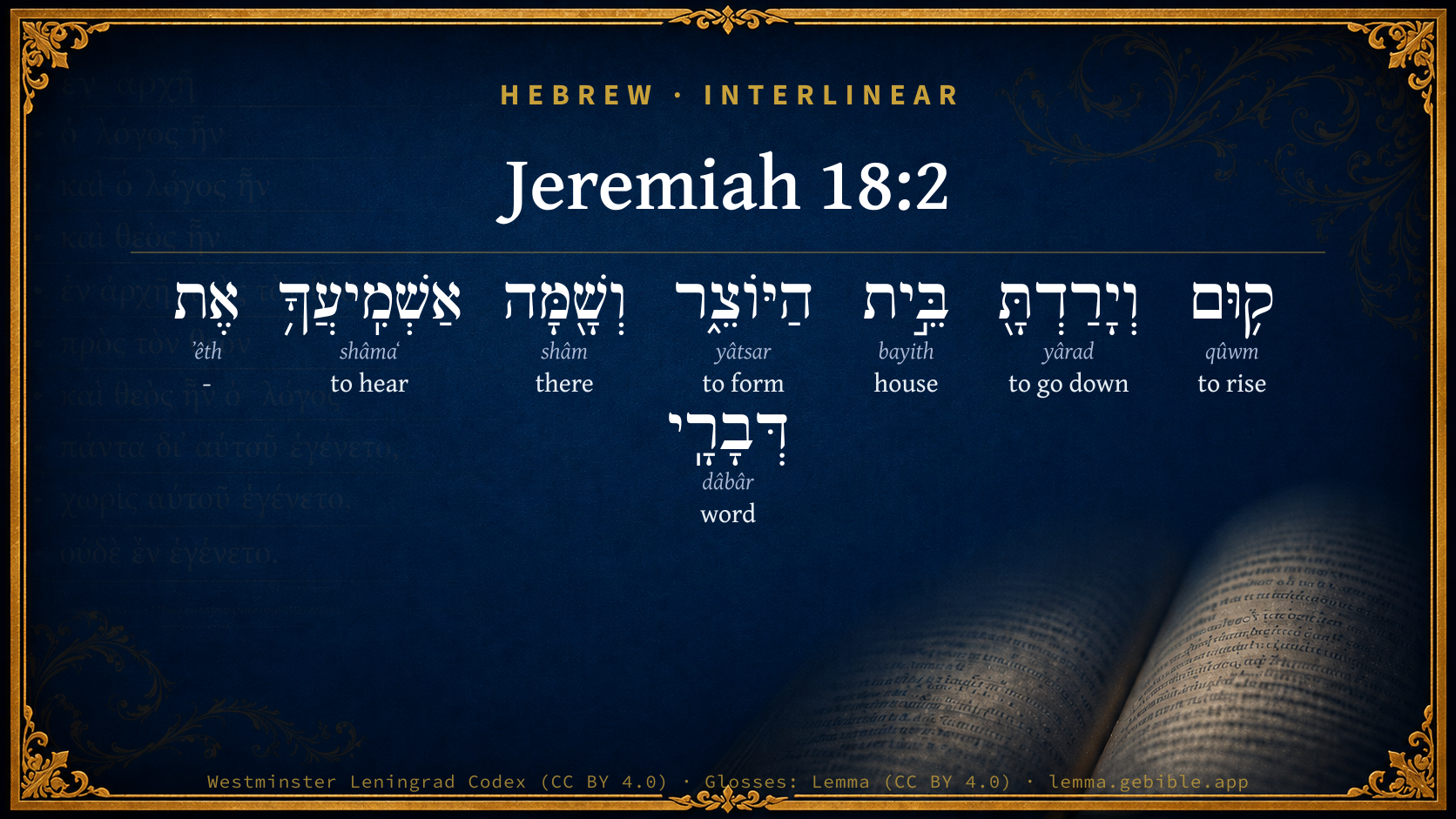
Jeremiah 18:2

Hebrew (Westminster Leningrad Codex) Jeremiah 18:2 appears in the Hebrew Old Testament. The text above is from the Westminster Leningrad Codex. Each word links to its Strong’s number, a concise gloss, and parsing drawn from the Open Scriptures Hebrew Bible morphology. Click any word for its full Brown-Driver-Briggs (BDB) entry.
Download image
Cite this verse

Jeremiah 18:2 (World English Bible). Public Domain. Lemma interlinear Bible study tool, https://lemma.gebible.app/v/jeremiah/18/2.

Show BibTeX & RIS
BibTeX
RIS
English Translation
Arise, and go down to the potter's house, and there I will cause you to hear my words.
World English Bible · Public Domain
Download a study sheet

One document with this verse’s original text, its word-by-word gloss line, the meaning frame, cross-references with their text, attributed commentary, and full source and license credits — printable, and it pastes into notes with its structure intact.

This verse Autodidact and up

Study sheet (.html) Plain text (.txt)

A passage Seminary Student

Up to 50 verses in one chapter. A passage sheet keeps up to 6 commentary sources and 12 cross-references per verse, in the order this page ranks them, and says so on the sheet whenever that leaves anything out. Ask for a single verse and you get the Autodidact verse sheet above.

Everything on this page stays free to read, with no account — the sheet is a download of what is already on screen, not access to it.

Want to remove ads? Support Godless Engineer
Compare translations 3

The same verse in 3 English versions, stacked beneath the original-language interlinear above. Click any original word for its lexicon entry.

Each is an independent rendering of the whole verse — the interlinear is not word-aligned to these translations.

Highlighted words mark where these versions differ — a whole-verse word diff, not a word-by-word alignment.

  • World English Bible Public Domain
    Arise, and go down to the potter's house, and there I will cause you to hear my words.
  • King James Version Public Domain
    Arise, and go down to the potter's house, and there I will cause thee to hear my words.
  • unfoldingWord Literal Text CC BY-SA 4.0
    “Arise and go down to the house of the potter, and there I will cause you to hear my words.”

unfoldingWord Literal Text — © unfoldingWord, licensed CC BY-SA 4.0. Word-aligned USFM3 via Door43 (git.door43.org/unfoldingWord/en_ult).

Versions to compare (up to 4)

3 of 4 selected

Show all 18 translations

Every available English version of this verse, each an independent rendering of the whole verse.

  • World English Bible Public Domain
    Arise, and go down to the potter's house, and there I will cause you to hear my words.
  • Berean Standard Bible Public Domain
    “Go down at once to the potter’s house, and there I will reveal My message to you.”
  • Majority Standard Bible Public Domain
    “Go down at once to the potter’s house, and there I will give you My message.”
  • King James Version Public Domain
    Arise, and go down to the potter's house, and there I will cause thee to hear my words.
  • American Standard Version (1901) Public Domain
    Arise, and go down to the potter's house, and there I will cause thee to hear my words.
  • Revised Version (1885) Public Domain
    Arise, and go down to the potter’s house, and there I will cause thee to hear my words.
  • Geneva Bible (1599) Public Domain
    Arise, and go downe into the potters house, and there shall I shewe thee my words.
  • Douay-Rheims (1899) Public Domain
    Arise, and go down to the potter's house, and there thou shalt hear my words.
  • Young's Literal Translation Public Domain
    Rise, and thou hast gone down `to' the potter's house, and there I cause thee to hear My words;
  • Literal Standard Version CC BY-SA 4.0
    “Rise, and you have gone down [to] the potter’s house, and there I cause you to hear My words”;
  • Unlocked Literal Bible CC BY-SA 4.0
    “Arise and go out to the potter's house, for I will have you hear my word there.”
  • unfoldingWord Literal Text CC BY-SA 4.0
    “Arise and go down to the house of the potter, and there I will cause you to hear my words.”
  • Darby Bible Public Domain
    Arise and go down to the potter's house, and there I will cause thee to hear my words.
  • World Messianic Bible Public Domain
    “Arise, and go down to the potter’s house, and there I will cause you to hear my words.”
  • Webster's Bible Public Domain
    Arise, and go down to the potter's house, and there I will cause thee to hear my words.
  • Free Bible Version CC BY-SA 4.0
    Go down right away to the potter's house. I will give you my message there.
  • Bible in Basic English Public Domain
    Up! go down to the potter's house, and there I will let my words come to your ears.
  • JPS Tanakh (1917) Public Domain
    'Arise, and go down to the potter's house, and there I will cause thee to hear My words.'

Literal Standard Version (2020), Covenant Press — licensed CC BY-SA 4.0. Text via the HelloAO Bible API (eBible.org). Unlocked Literal Bible (unfoldingWord) — licensed CC BY-SA 4.0. Text via the HelloAO Bible API (eBible.org). unfoldingWord Literal Text — © unfoldingWord, licensed CC BY-SA 4.0. Word-aligned USFM3 via Door43 (git.door43.org/unfoldingWord/en_ult). Free Bible Version, Dr. Jonathan Gallagher — licensed CC BY-SA 4.0. Text via the HelloAO Bible API (eBible.org).

Word by word

More ways to search: Search by grammar → Find every occurrence → Compare this word →

Practice this passage: Drill this verse → Learn its vocabulary →

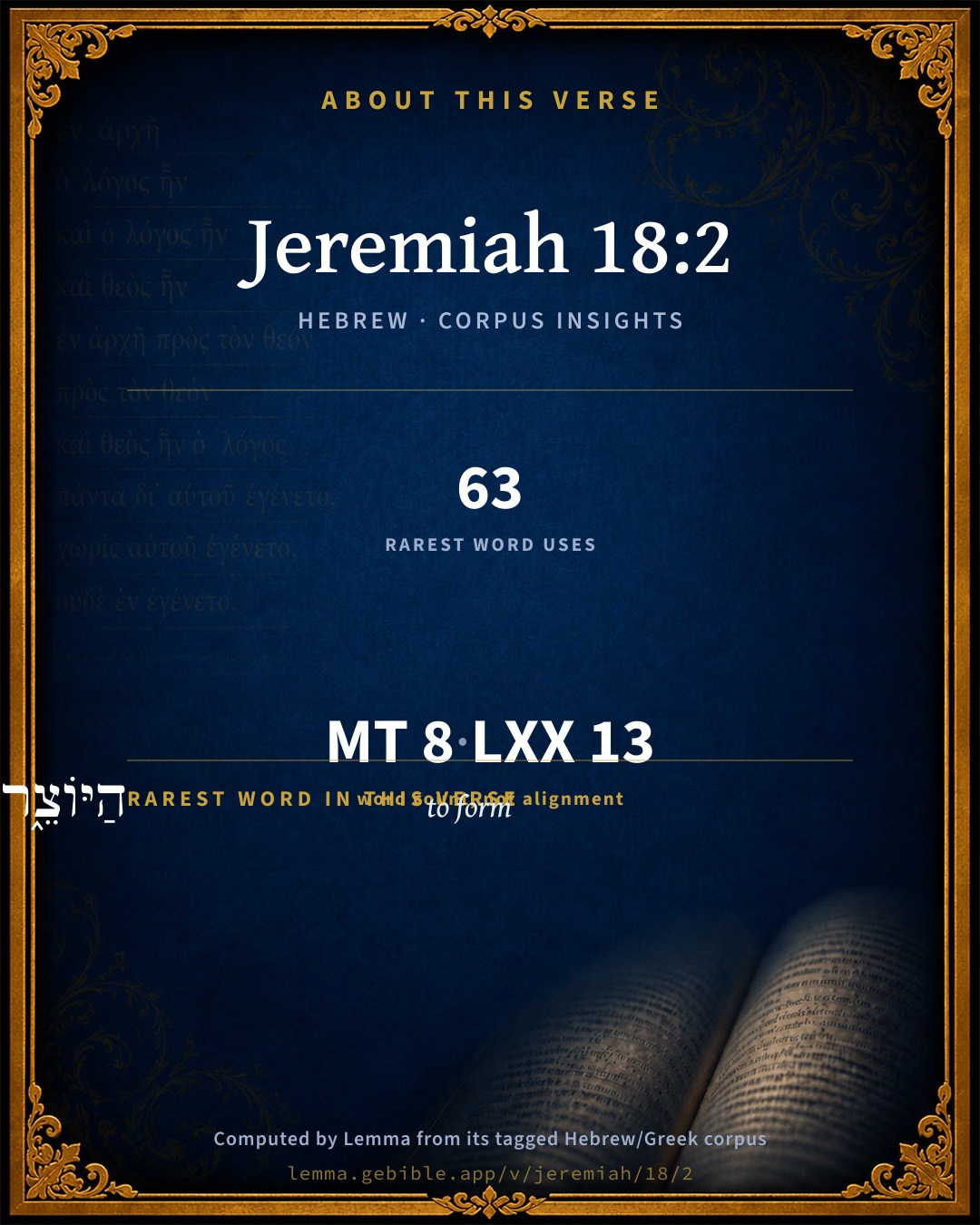
הַיּוֹצֵ֑ר
yâtsar
H3335
“the · forming”
Particle, Definite Article + Verb, Qal, Participle Active, Masculine, Singular, Absolute
Part of Speech
Particle + Verb
Stem
Qal
Form
Participle Active
Gender
Masculine
Number
Singular
State
Absolute
Full BDB Definition

Origin: probably identical with H3334 (through the squeezing into shape), ([compare H3331 ])

TWOT: 898

to form, fashion, frame - (Qal) to form, fashion - of human activity - of divine activity - of creation - of original creation - of individuals at conception - of Israel as a people - to frame, pre-ordain, plan (figuratively of divine) purpose of a situation) - (Niphal) to be formed, be created - (Pual) to be predetermined, be pre-ordained - (Hophal) to be formed
  1. ק֥וּם qûwm H6965 “rise” Verb, Qal, Imperative, 2nd Person, Masculine, Singular
  2. וְיָרַדְתָּ֖ yârad H3381 “and · to go down” Conjunction + Verb, Qal, Sequential Perfect, 2nd Person, Masculine, Singular
  3. בֵּ֣ית bayith H1004 “house of” Noun, Common, Masculine, Singular, Construct
  4. וְשָׁ֖מָּה shâm H8033 “and · there · toward” Conjunction + Adverb + Suffix, Demonstrative
  5. אַשְׁמִֽיעֲךָ֥ shâmaʻ H8085 “to hear · you” Verb, Hiphil, Imperfect, 1st Person, Common, Singular + Suffix, Personal, 2nd Person, Masculine, Singular
  6. אֶת ʼêth H853 “-” Particle, Direct Object
  7. דְּבָרָֽי dâbâr H1697 “words · my” Noun, Common, Masculine, Plural, Construct + Suffix, Personal, 1st Person, Common, Singular

About this verse

These counts appear in no published source. They are computed here, from the morphology-tagged text and Lemma’s own curated glosses. What Lemma adds →

8
words
8
distinct lemmas
Prophets
section

Grammatical profile

  • 4 verbs
  • 2 nouns
  • 1 adverb
  • 1 particle

Verb forms

  • ק֥וּם Qal · Imperative
  • וְיָרַדְתָּ֖ Qal · Sequential Perfect
  • הַיּוֹצֵ֑ר Qal · Participle Active
  • אַשְׁמִֽיעֲךָ֥ Hiphil · Imperfect

Hebrew & Septuagint length

In the original languages it is 8 Hebrew tokens and 13 Greek tokens — but the two are counted differently (Hebrew bundles its prefixes and suffixes into one token; the Greek is in lemma form), so that isn’t a like-for-like length.

Cross-references

8

Topical passages linked to Jeremiah 18:2 in the Treasury of Scripture Knowledge — connected by theme and wording, ordered by reader-vote popularity; previews shown in the World English Bible.

  • Hebrews 1:1 God, having in the past spoken to the fathers through the prophets at many times and in various ways,
  • Acts 9:6 But rise up, and enter into the city, and you will be told what you must do."
  • Jeremiah 19:1–2 Thus said Yahweh, Go, and buy a potter's earthen bottle, and [take] of the elders of the people, and of the elders of the priests;
  • Jeremiah 23:22 But if they had stood in my council, then had they caused my people to hear my words, and had turned them from their evil way, and from the evil of their doings.
  • Isaiah 20:2 at that time Yahweh spoke by Isaiah the son of Amoz, saying, Go, and loose the sackcloth from off your loins, and put your shoe from off your foot. He did so, walking naked and barefoot.
  • Jeremiah 13:1 Thus says Yahweh to me, Go, and buy you a linen belt, and put it on your loins, and don't put it in water.
  • Ezekiel 4:1–5 You also, son of man, take a tile, and lay it before you, and portray on it a city, even Jerusalem:
  • Amos 7:7 Thus he showed me and, behold, the Lord stood beside a wall made by a plumb line, with a plumb line in his hand.

Cross-references courtesy of OpenBible.info (CC BY 4.0).

Hebrew and Greek witnesses Masoretic Hebrew ↔ Greek Septuagint

The same verse in the two great witnesses to the Old Testament, shown verse-for-verse.

These are two independent witnesses, not word-aligned to each other, and the Septuagint is shown in lemma (dictionary) form.

Hebrew Jeremiah 18:2 Masoretic · Westminster Leningrad Codex

ק֥וּם וְיָרַדְתָּ֖ בֵּ֣ית הַיּוֹצֵ֑ר וְשָׁ֖מָּה אַשְׁמִֽיעֲךָ֥ אֶת דְּבָרָֽי

Arise, and go down to the potter's house, and there I will cause you to hear my words.

World English Bible · Public Domain

Greek LXX Structure differs

In the Septuagint, Jeremiah is about an eighth shorter than the Hebrew and arranges its material differently — the Oracles Against the Nations (Hebrew chapters 46–51) appear in the middle of the Greek book, after 25:13. Because the chapter and verse boundaries do not line up, a verse-for-verse comparison with the Hebrew is not shown.

A verse-for-verse comparison isn’t shown here because the chapters and verses don’t line up. Switch to the LXX edition with the MT / LXX toggle above to read the Greek directly.

On this verse, Keil & Delitzsch discusses the Septuagint’s reading. Read the note in Commentary ↓

Hebrew: Westminster Leningrad Codex (CC BY 4.0). Greek: Septuagint (public domain); English from a public-domain English Septuagint. How the Septuagint differs from the Hebrew →

Targum (Aramaic paraphrase)

1

The Targum is the ancient Jewish Aramaic paraphrase of the Hebrew Scriptures — an interpretive translation, not the Hebrew text itself. Onkelos (literal) and Pseudo-Jonathan (expansive) render the Torah, and Jonathan the Prophets. Coverage is partial: where no permissively-licensed English translation exists for a verse, only the Aramaic is shown. This is verse-level text, not a word-by-word alignment to the Hebrew.

  1. Targum Jonathan Prophets (Joshua–Malachi)
    קוּם וְתֵיחוֹת לְבֵית פַּחֳדָא וְתַמָן אַשְׁמְעִינָךְ יַת פִּתְגָמֵי:

    (no public-domain English translation for this verse)

    Targum Jonathan — Aramaic: “Mikraot Gedolot” (public domain). English: “Sefaria Community Translation” (CC0 1.0 (public-domain dedication)); “London "Chaldee Paraphrase," 1871” (public domain). Text via Sefaria.

Commentary

Notes on Jeremiah 18:2 from classic Christian and Jewish commentators (each source and its license shown beneath its notes). The classic Christian expositions comment on the surrounding passage and are grouped to its opening verse, so a note may address several verses; the Jewish commentaries on the Tanakh (Rashi and others) are per-verse, so they appear only where the commentator wrote on this verse.

Lemma curates 59 commentaries, every one of them public domain or Creative Commons licensed, each selected and text-cleaned for this edition rather than reprinted as found. About our sources →

Trapp's Complete Commentary

John Trapp

Jer 18:2 Arise, and go down to the potter’s house, and there I will cause thee to hear my words.

Ver. 2. Arise, and go down to the potter’s house.] Whether the prophet was to go actually to the potter’s house, or in vision only, it matters not. This we know, that our Saviour did actually wash his disciples’ feet, and at another time set a child in the midst of them when they were striving about the primacy, expounding to them afterwards what he meant; and so it might well be here. It may not be amiss for us to go down oft with Jeremiah to the potter’s house in our meditations - to consider, I mean, our original, Kεραμος ο ανθρωπος; as the "first man, Adam, was of the earth earthy," so are we ex lute lutei, from the clay, clayish.

John Trapp, A Commentary or Exposition upon All the Books of the Old and New Testament (1647–1656) — public domain. Text from a community e-Sword module.

Keil & Delitzsch

C. F. Keil & F. Delitzsch

The emblem and its interpretation. - Jer 18:2. "Arise and go down into the potter's house; there will I cause thee to hear my words. Jer 18:3. And I went down into the potter's house; and, behold, he wrought on the wheels. Jer 18:4. And the vessel was marred, that he wrought in clay, in the hand of the potter; then he made again another vessel of it, as seemed good to the potter to make. Jer 18:5. Then came the word of Jahveh to me, saying: Jer 18:6. Cannot I do with you as this potter, house of Israel? saith Jahveh. Behold, as the clay in the hand of the potter, so are ye in mine hand, house of Israel. Jer 18:7. Now I speak concerning a people and kingdom, to root it out and pluck up and destroy it. Jer 18:8. But if that people turns from its wickedness, against which I spake, the it repents me of the evil which I thought to do it. Jer 18:9. And now I speak concerning a people and a kingdom, to build and to plant it. Jer 18:10. If it do that which is evil in mine eyes, so that it hearkens not unto my voice, then it repents me of the good which I said I would do unto it."

By God's command Jeremiah is to go and see the potter's treatment of the clay, and to receive thereafter God's interpretation of the same. Here he has set before his eyes that which suggests a comparison of man to the clay and of God to the potter, a comparison that frequently occurred to the Hebrews, and which had been made to appear in the first formation of man (cf. Job 10:9; Job 33:6; Isa 29:16; Isa 45:9; Isa 64:7). This is done that he may forcibly represent to the people, by means of the emblem, the power of the Lord to do according to His will with all nations, and so with Israel too. From the "go down," we gather that the potteries of Jerusalem lay in a valley near the city. האבנים are the round frames by means of which the potter moulded his vessels. This sig. of the word is well approved here; but in Exo 1:16, where too it is found, the meaning is doubtful, and it is a question whether the derivation is from אבן or from אופן, wheel. The perfecta consec. ונשׁחת and ושׁב designate, taken in connection with the participle עשׂה, actions that were possibly repeated: "and if the vessel was spoilt, he made it over again;" cf. Ew. 342, b. עשׂה , working in clay, of the material in which men work in order to make something of it; cf. Exo 31:4.

(Note: Instead of בּחמר several codd. and editt. have כּחמר, as in Jer 18:6, to which Ew. and Hitz. both take objection, so that they delete כחמר (Ew.) or כּחמר בּיד היּוצר (Hitz.) as being glosses, since the words are not in the lxx. The attempts of Umbr. and Nag. to obtain a sense for כּחמר are truly of such a kind as only to strengthen the suspicion of spuriousness. Umbr., who is followed by Graf, expounds: "as the clay in the hand of the potter does;" whereto Hitz. justly replies: "but is then the (failure) solely its own doing?" Ng. will have כ to be the כ verit.: the vessel was marred, as clay in the hand of the potter, in which case the כחמר still interrupts. But the failure of the attempts to make a good sense of כחמר does in no respect justify the uncritical procedure of Ew. and Hitz. in deleting the word without considering that the reading is by no means established, since not only do the most important and correct editions and a great number of codd. read בּחמר, but Aquila, Theodot., the Chald, and Syr. give this reading; Norzi and Houbig. call it lectio accuratiorum codicum, and the Masora on Jer 18:6 and Job 10:9 confirms it. Cf. de Rossi variae lectt. ad h. l. and the critical remarks in the Biblia Hal. by J. H. Michaelis, according to which כחמר plainly made its way into the present verse from Jer 18:6 by the error of a copyist; and it can only be from his prejudice in favour of the lxx that Hitz. pronounces כחמר original, as being "the reading traditionally in use.")

Keil & Delitzsch — Biblical Commentary on the Old Testament (1861–1891) — public domain (CC PDM 1.0). Text via the HelloAO Bible API. (Old Testament only.)

Adam Clarke's Commentary

Verse 2. Go down to the potter's house] By this similitude God shows the absolute state of dependence on himself in which he has placed mankind. They are as clay in the hands of the potter; and in reference to every thing here below, he can shape their destinies as he pleases. Again; though while under the providential care of God they may go morally astray, and pervert themselves, yet they can be reclaimed by the almighty and all-wise Operator, and become such vessels as seemeth good for him to make. In considering this parable we must take heed that in running parallels we do not destroy the free agency of man, nor disgrace the goodness and supremacy of God.

Adam Clarke's Commentary on the Bible (1810–1826) — public domain. Text from a community e-Sword/MySword module.

Ellicott's Commentary for English Readers

(2) The potter’s house.—The place was probably identical with the “potter’s field” of Zec_11:13, the well-known spot where the workers in that art carried on their business. The traditional Aceldama, the “potter’s field” of Mat_27:7, is on the southern face of the valley of Hinnom, south of Jerusalem. The soil is still a kind of clay suitable and employed for the same purpose (Ritter, Palestine, iv. 165, Eng. Trans.). The purchase of the field to “bury strangers in” (Mat_27:7) implies, however, that it was looked upon as a piece of waste ground, and that its use had been exhausted.

A Bible Commentary for English Readers, edited by Charles John Ellicott (1878–1897) — public domain. Text from a community e-Sword module.

John Gill's Exposition

Then I went down to the potter's house,.... He did as the Lord commanded him; he was obedient to the divine will; he went to hear what the Lord had to say to him there, and to observe such things, from whence he might learn instruction for himself and others:

and, behold, he wrought a work on the wheels; the Targum renders it "upon a seat"; or "his seats", as Junius and Tremellius; but it signifies not the instrument on which the potter sat while he worked, but that on which he did his work. The Septuagint version renders it, "on stones" (n); and R. Jonah (o) says, that in some countries the potter's instrument is in the likeness of two millstones, the lowermost is the greatest, and the uppermost is the least. Or rather the word may signify "frames", or "moulds" (p), made of stone, in which the potter put his clay, and fashioned it: though I see no reason to depart from the signification of "wheels", which are used in the potter's work, even two of them; and so the word here is of the dual number; though one is more properly called the "wheel", and the other the "lathe", and are described as follows:

"The "potter's wheel" consists principally in its nut, which is a beam or axis, whose foot or pivot plays perpendicularly on a free stone sole, or bottom; from the four corners atop of this beam, which does not exceed two feet in height, arise four iron bars, called the spokes of the wheel; which forming diagonal lines with the beam, descend, and are fastened at bottom to the edges of a strong wooden circle, four feet in diameter, perfectly like the felloes of a coach wheel; except that it hath neither axis nor radii; and is only joined to the beam, which serves it as an axis, by the iron bars. The top of the nut is flat, of a circular figure, and a foot in diameter. On this is laid a piece of the clay, or earth, to be turned and fashioned. The wheel thus disposed is encompassed with four sides of four different pieces of wood, sustained in a wooden frame: the hind piece, which is that whereon the workman sits, is made a little inclining towards the wheel: on the fore piece are placed the pieces of prepared earth: lastly, the side pieces serve the workman to rest his feet against; and are made inclining, to give him more or less room, according to the size of the vessels to be turned; by his side is a trough of water, wherewith from time to time he wets his hands, to prevent the earth sticking to them.----The potter having prepared his clay or earth, and laid a piece of it suitable to the work he intends on the top of the beam, sits down; his thighs and legs much expanded, and his feet rested on the side pieces, as is most convenient. In this situation he turns the wheel round, till it has got the proper velocity; when, wetting his hands in the water, he bores the cavity of the vessel, continuing to widen it from the middle; and thus turns it into form, turning the wheel afresh, and wetting his hands from time to time.----The potter's "lathe" is also a kind of "wheel", but simpler and slighter than the former; its three chief members are an iron beam or axis, three feet and a half high, and two inches in diameter; a little wooden wheel, all of a piece, an inch thick, and seven or eight in diameter, placed horizontally atop of the beam, and serving to form the vessel on; and another larger wooden wheel, all of a piece, three inches thick, and two or three feet broad, fastened to the same beam at the bottom, parallel to the horizon. The beam, or axis, turns by a pivot at bottom, in an iron stand. The workman gives the motion to the lathe with his feet, by pushing the great wheel alternately with each foot; still giving it a lesser or greater degree of motion, as his work requires (q).''

Thus Jeremiah saw the potter work, or somewhat like this; for, no doubt, pottery, as other things, has been improved since his time.

(n) , Sept. "super lapide, vel typo", Calvin. (o) Apud Kimchi & Ben Melech in loc. (p) "Lapideos typos", Calvin; "super formas", Montanus. (q) Chambers's Cyclopaedia, in the word "Pottery".

John Gill's Exposition of the Whole Bible (1746–1763) — public domain (CC PDM 1.0). Text via the HelloAO Bible API.

Albert Barnes' Notes on the Bible

House - i. e., workshop. The clay-field where the potters exercised their craft lay to the south of Jerusalem just beyond the valley of Hinnom. Compare Zec 11:13; Mat 27:10.

Albert Barnes' Notes on the Bible (1834–1885) — public domain. Text from a community e-Sword/MySword module.

Haydock's Catholic Bible Commentary

Potter’s. Thus God would shew his dominion over all, Romans ix. 21.

George Leo Haydock (1774–1849), Haydock's Catholic Family Bible and Commentary, 1859 edition — public domain. Excludes Psalms (Douay-Rheims chapter numbering differs from Protestant) and Deuterocanonical books (Catholic canon only).

Matthew Poole's English Annotations

It is likely there was but one

potter near the place, or at least that there was one more noted and eminent than the rest, to whose house the Lord here sendeth the prophet, intending there further to tell him his mind what he would have him publish as his mind and will to this people.

Matthew Poole's English Annotations on the Holy Bible (1683–1685) — public domain. Text from a community e-Sword/MySword module.

Whedon's Commentary on the Bible

Daniel D. Whedon

2. Go down — Suggesting the location of the potter’s house or workshop in some valley near the city. The precise spot was in the valley of Hinnom, south of Jerusalem, the place made famous forever by the prophecy of Zechariah, (Zec_11:13,) the fulfilment of which is recorded by Matthew.

Daniel D. Whedon (gen. ed.), Commentary on the Old and New Testaments (1874–1909) — public domain. Text from a community e-Sword module.

Lesson kit

Teaching starters — assembled from the data on this page, not authored interpretation. Every prompt links to the verse data it draws on. Edit before teaching.

Jeremiah, in the Prophets, opens this verse with 8 words (8 distinct Hebrew lemmas). Its most distinctive word is yâtsar (“to form”). A historical commentator’s framing appears above. Read the whole chapter for the surrounding context.

Discussion questions

  1. The word yâtsar carries the sense “to form.” How does it shape the verse?
  2. Hebrews 1:1 shares this passage’s theme. How do the two illuminate each other?
  3. These translations render this verse differently; the difference is in the English rendering, not the original. What questions does that raise?
  4. The verb «ק֥וּם» is Qal Imperative. How does its form color the action?
  5. Reading how Trapp's Complete Commentary and Keil & Delitzsch read this verse, where do the two commentators agree and where do they part?

Things to notice

Reading settings

Reading text

Shown beneath each verse's original-language words.

Old Testament
Old Testament edition

Read the OT as the Masoretic Hebrew (MT) or the Greek Septuagint (LXX).

English shown for the Greek Septuagint (in the Hebrew ↔ Greek comparison).

Comparing translations? Open the Compare panel on any verse page to stack up to four side by side.