
1 Chronicles 11:15

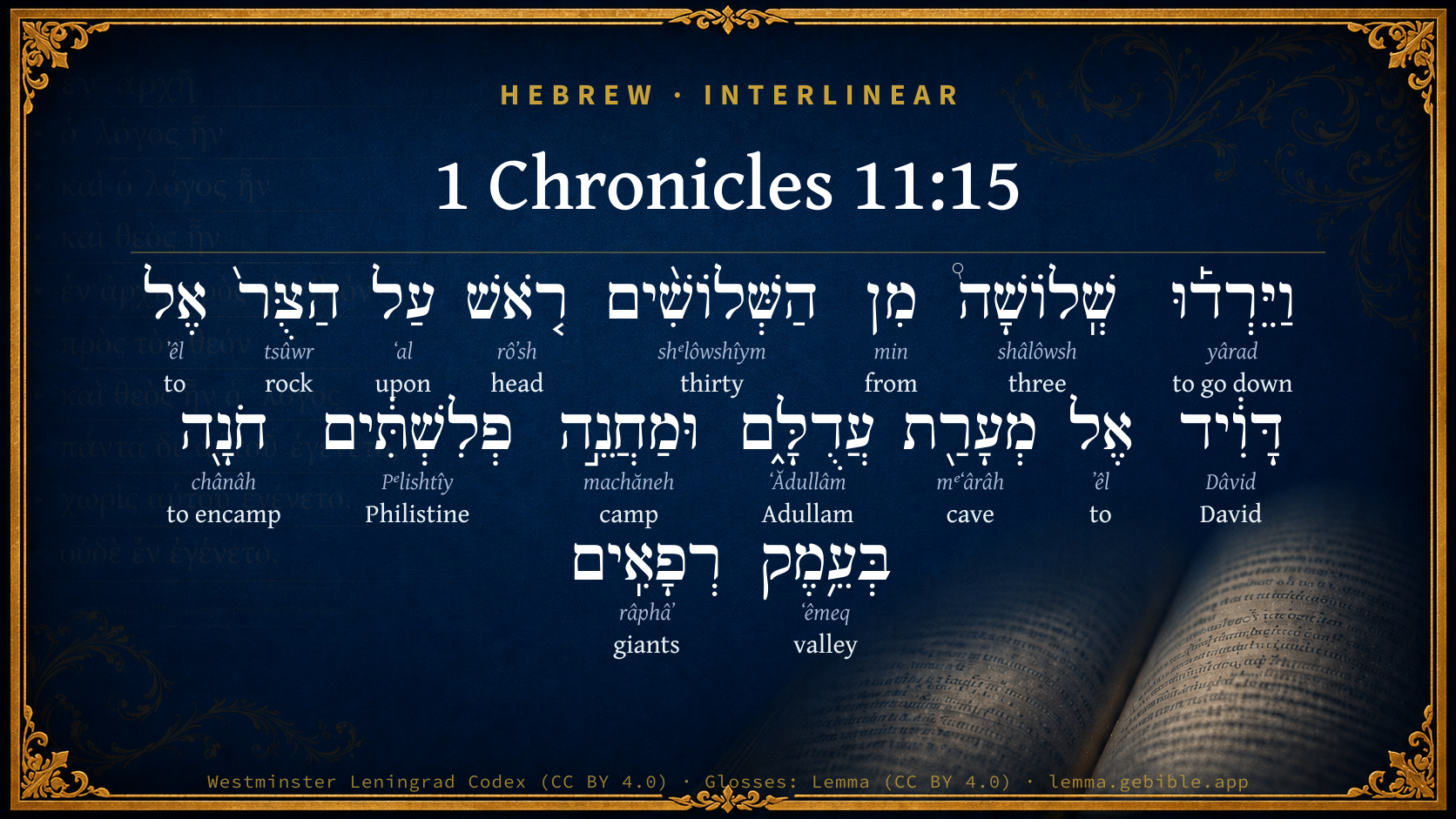
Hebrew (Westminster Leningrad Codex) 1 Chronicles 11:15 appears in the Hebrew Old Testament. The text above is from the Westminster Leningrad Codex. Each word links to its Strong’s number, a concise gloss, and parsing drawn from the Open Scriptures Hebrew Bible morphology. Click any word for its full Brown-Driver-Briggs (BDB) entry.
Download image
Cite this verse

1 Chronicles 11:15 (World English Bible). Public Domain. Lemma interlinear Bible study tool, https://lemma.gebible.app/v/1-chronicles/11/15.

Show BibTeX & RIS
BibTeX
RIS
English Translation
Three of the thirty chief men went down to the rock to David, into the cave of Adullam; and the host of the Philistines were encamped in the valley of Rephaim.
World English Bible · Public Domain
Download a study sheet

One document with this verse’s original text, its word-by-word gloss line, the meaning frame, cross-references with their text, attributed commentary, and full source and license credits — printable, and it pastes into notes with its structure intact.

This verse Autodidact and up

Study sheet (.html) Plain text (.txt)

A passage Seminary Student

Up to 50 verses in one chapter. A passage sheet keeps up to 6 commentary sources and 12 cross-references per verse, in the order this page ranks them, and says so on the sheet whenever that leaves anything out. Ask for a single verse and you get the Autodidact verse sheet above.

Everything on this page stays free to read, with no account — the sheet is a download of what is already on screen, not access to it.

Want to remove ads? Support Godless Engineer
Compare translations 3

The same verse in 3 English versions, stacked beneath the original-language interlinear above. Click any original word for its lexicon entry.

Each is an independent rendering of the whole verse — the interlinear is not word-aligned to these translations.

Highlighted words mark where these versions differ — a whole-verse word diff, not a word-by-word alignment.

  • World English Bible Public Domain
    Three of the thirty chief men went down to the rock to David, into the cave of Adullam; and the host of the Philistines were encamped in the valley of Rephaim.
  • King James Version Public Domain
    Now three of the thirty captains went down to the rock to David, into the cave of Adullam; and the host of the Philistines encamped in the valley of Rephaim.
  • unfoldingWord Literal Text CC BY-SA 4.0
    And three from the head Thirty went down to the rock, to David, to the cave of Adullam. And the camp of Philistines encamped in the Valley of the Raphaites.

unfoldingWord Literal Text — © unfoldingWord, licensed CC BY-SA 4.0. Word-aligned USFM3 via Door43 (git.door43.org/unfoldingWord/en_ult).

Versions to compare (up to 4)

3 of 4 selected

Show all 18 translations

Every available English version of this verse, each an independent rendering of the whole verse.

  • World English Bible Public Domain
    Three of the thirty chief men went down to the rock to David, into the cave of Adullam; and the host of the Philistines were encamped in the valley of Rephaim.
  • Berean Standard Bible Public Domain
    Three of the thirty chief men went down to David, to the rock at the cave of Adullam, while a company of Philistines was encamped in the Valley of Rephaim.
  • Majority Standard Bible Public Domain
    Three of the thirty chief men went down to David, to the rock at the cave of Adullam, while a company of Philistines was encamped in the Valley of Rephaim.
  • King James Version Public Domain
    Now three of the thirty captains went down to the rock to David, into the cave of Adullam; and the host of the Philistines encamped in the valley of Rephaim.
  • American Standard Version (1901) Public Domain
    And three of the thirty chief men went down to the rock to David, into the cave of Adullam; and the host of the Philistines were encamped in the valley of Rephaim.
  • Revised Version (1885) Public Domain
    And three of the thirty chief went down to the rock to David, into the cave of Adullam; and the host of the Philistines were encamped in the valley of Rephaim.
  • Geneva Bible (1599) Public Domain
    And three of the thirtie captaines went to a rocke to Dauid, into the caue of Adullam. And the armie of the Philistims camped in the valley of Rephaim.
  • Douay-Rheims (1899) Public Domain
    And three of the thirty captains went down to the rock, wherein David was, to the cave of Odollam, when the Philistines encamped in the valley of Raphaim.
  • Young's Literal Translation Public Domain
    And three of the thirty heads go down on the rock unto David, unto the cave of Adullam, and the host of the Philistines is encamping in the valley of Rephaim,
  • Literal Standard Version CC BY-SA 4.0
    And three of the thirty heads go down on the rock to David, to the cave of Adullam, and the host of the Philistines is encamping in the Valley of Rephaim,
  • Unlocked Literal Bible CC BY-SA 4.0
    Then three of the thirty leaders went down to the rock to David, to the cave of Adullam. The army of the Philistines was camped in the Valley of Rephaim.
  • unfoldingWord Literal Text CC BY-SA 4.0
    And three from the head Thirty went down to the rock, to David, to the cave of Adullam. And the camp of Philistines encamped in the Valley of the Raphaites.
  • Darby Bible Public Domain
    And three of the thirty chiefs went down to the rock to David, to the cave of Adullam, when the army of the Philistines was encamped in the valley of Rephaim.
  • World Messianic Bible Public Domain
    Three of the thirty chief men went down to the rock to David, into the cave of Adullam; and the army of the Philistines were encamped in the valley of Rephaim.
  • Webster's Bible Public Domain
    Now three of the thirty captains went down to the rock to David, into the cave of Adullam; and the host of the Philistines encamped in the valley of Rephaim.
  • Free Bible Version CC BY-SA 4.0
    Another time, the Three, who were part of the Thirty leading warriors, went down to meet David when he was at the cave of Adullam. The Philistine army was camped in the valley of Rephaim.
  • Bible in Basic English Public Domain
    And three of the thirty went down to David, to the rock, into the strong place of Adullam; and the army of the Philistines had taken up their position in the valley of Rephaim.
  • JPS Tanakh (1917) Public Domain
    And three of the thirty chiefs went down to the rock to David, unto the cave of Adullam; and the host of the Philistines were encamped in the valley of Rephaim.

Literal Standard Version (2020), Covenant Press — licensed CC BY-SA 4.0. Text via the HelloAO Bible API (eBible.org). Unlocked Literal Bible (unfoldingWord) — licensed CC BY-SA 4.0. Text via the HelloAO Bible API (eBible.org). unfoldingWord Literal Text — © unfoldingWord, licensed CC BY-SA 4.0. Word-aligned USFM3 via Door43 (git.door43.org/unfoldingWord/en_ult). Free Bible Version, Dr. Jonathan Gallagher — licensed CC BY-SA 4.0. Text via the HelloAO Bible API (eBible.org).

Word by word

More ways to search: Search by grammar → Find every occurrence → Compare this word →

Practice this passage: Drill this verse → Learn its vocabulary →

עֲדֻלָּ֑ם
ʻĂdullâm
H5725
“Adullam”
Noun, Proper
Part of Speech
Noun
Type
Proper
Full BDB Definition

Origin: probably from the pass. part. of the same as H5724

TWOT: None

Adullam = "justice of the people" - a town of the Canaanites allotted to Judah and lying in the lowlands; site of the cave where David hid
  1. וַיֵּרְד֡וּ yârad H3381 “and · to go down” Conjunction + Verb, Qal, Sequential Imperfect, 3rd Person, Masculine, Plural
  2. שְֽׁלוֹשָׁה֩ shâlôwsh H7969 “three” Adjective, Cardinal number, Masculine, Singular, Absolute
  3. מִן min H4480 “from” Preposition
  4. הַשְּׁלוֹשִׁ֨ים shᵉlôwshîym H7970 “the · thirty” Particle, Definite Article + Adjective, Cardinal number, Both, Plural, Absolute
  5. רֹ֤אשׁ rôʼsh H7218 “head” Noun, Common, Masculine, Singular, Absolute
  6. עַל ʻal H5921 “upon” Preposition
  7. הַצֻּר֙ tsûwr H6697 “the · rock” Particle, Definite Article + Noun, Common, Masculine, Singular, Absolute
  8. אֶל ʼêl H413 “to” Preposition
  9. דָּוִ֔יד Dâvid H1732 “David” Noun, Proper
  10. אֶל ʼêl H413 “to” Preposition
  11. מְעָרַ֖ת mᵉʻârâh H4631 “cave of” Noun, Common, Feminine, Singular, Construct
  12. וּמַחֲנֵ֣ה machăneh H4264 “and · camp of” Conjunction + Noun, Common, Both, Singular, Construct
  13. פְלִשְׁתִּ֔ים Pᵉlishtîy H6430 “Philistines” Noun, Gentilic, Masculine, Plural, Absolute
  14. חֹנָ֖ה chânâh H2583 “encamping” Verb, Qal, Participle Active, Feminine, Singular, Absolute
  15. בְּעֵ֥מֶק ʻêmeq H6010 “in/at · valley of” Preposition + Noun, Common, Masculine, Singular, Construct
  16. רְפָאִֽים râphâʼ H7497 “giants” Noun, Proper

About this verse

These counts appear in no published source. They are computed here, from the morphology-tagged text and Lemma’s own curated glosses. What Lemma adds →

17
words
16
distinct lemmas
Historical
section

Notable vocabulary

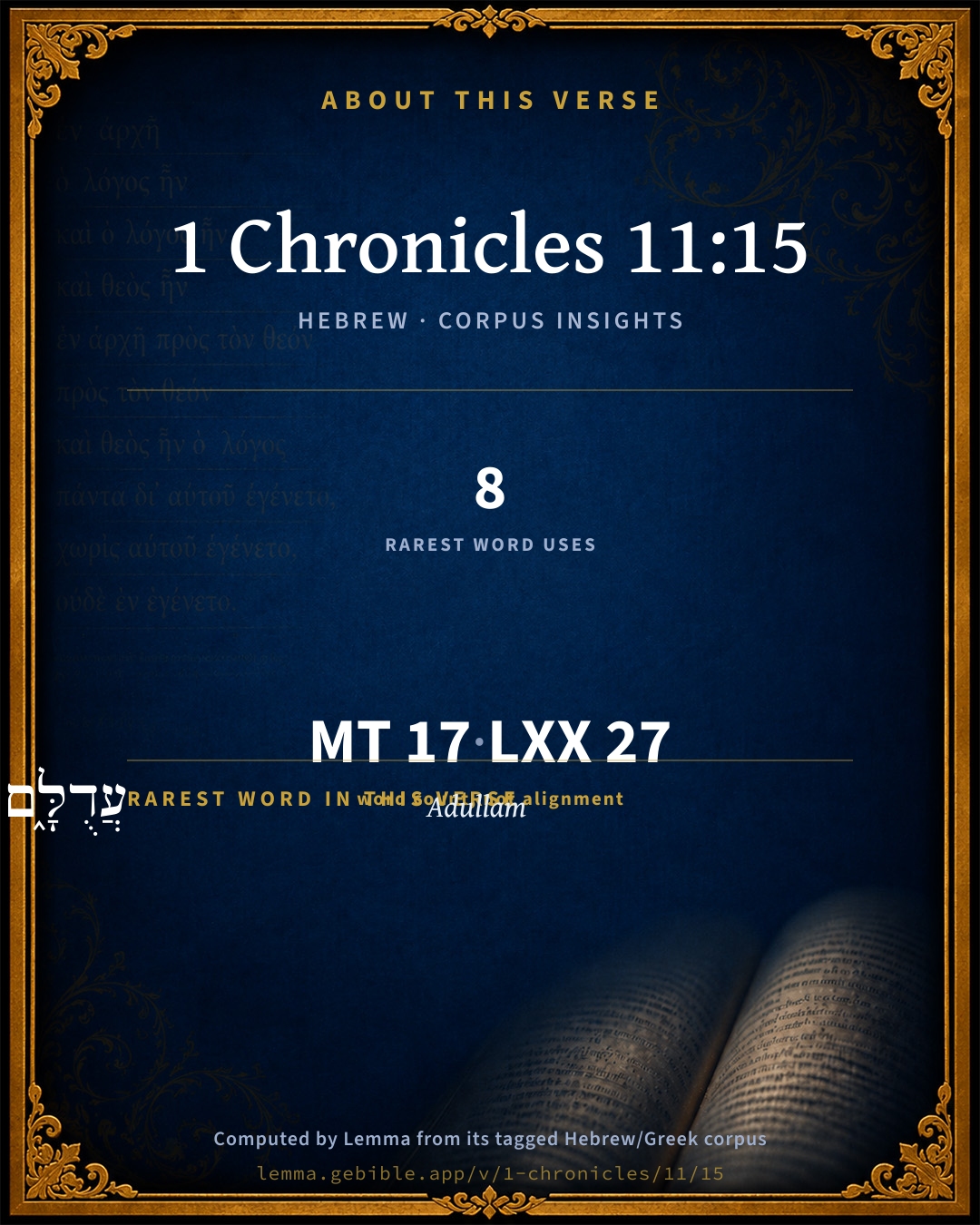
The rarest word here is עֲדֻלָּ֑ם Adullam H5725 — appearing just 8 times in the whole Hebrew Bible.

Shared distinctive vocabulary

עֲדֻלָּ֑ם Adullam H5725 occurs in 8 verses of the Hebrew Bible. Also found in:

Grammatical profile

  • 2 verbs
  • 9 nouns
  • 2 adjectives
  • 4 prepositions

Verb forms

  • וַיֵּרְד֡וּ Qal · Sequential Imperfect
  • חֹנָ֖ה Qal · Participle Active

Repetition

A word recurs within this verse — often emphatic in Hebrew:

  • אֶל to H413 ×2

Hebrew & Septuagint length

In English translation the verse runs 31 words from the Hebrew and 29 from the Septuagint (LXX English) — closely comparable.

A rough comparison of the two English renderings, which tokenize alike — not a word-level alignment.

Word counts can differ between the Hebrew and the Greek without any difference in meaning — e.g. the Hebrew direct-object marker אֵת has no separate Greek word, and Greek often adds the article ὁ.

In the original languages it is 17 Hebrew tokens and 27 Greek tokens — but the two are counted differently (Hebrew bundles its prefixes and suffixes into one token; the Greek is in lemma form), so that isn’t a like-for-like length.

Cross-references

9

Topical passages linked to 1 Chronicles 11:15 in the Treasury of Scripture Knowledge — connected by theme and wording, ordered by reader-vote popularity; previews shown in the World English Bible.

  • 2 Samuel 5:18 Now the Philistines had come and spread themselves in the valley of Rephaim.
  • 1 Chronicles 14:9 Now the Philistines had come and made a raid in the valley of Rephaim.
  • Isaiah 17:5 It shall be as when the harvester gathers the standing grain, and his arm reaps the ears; yes, it shall be as when one gleans ears in the valley of Rephaim.
  • Joshua 12:15 the king of Libnah, one; the king of Adullam, one;
  • Joshua 15:8 and the border went up by the valley of the son of Hinnom to the side of the Jebusite southward (the same is Jerusalem); and the border went up to the top of the mountain that lies before the valley of Hinnom westward, which is at the uttermost part of the valley of Rephaim northward;
  • 1 Samuel 22:1 David therefore departed there, and escaped to the cave of Adullam: and when his brothers and all his father's house heard it, they went down there to him.
  • 2 Samuel 5:22 The Philistines came up yet again, and spread themselves in the valley of Rephaim.
  • 2 Samuel 23:13–39 Three of the thirty chief men went down, and came to David in the harvest time to the cave of Adullam; and the troop of the Philistines was encamped in the valley of Rephaim.
  • Micah 1:15 I will yet bring to you, inhabitant of Mareshah, He who is the glory of Israel will come to Adullam.

Cross-references courtesy of OpenBible.info (CC BY 4.0).

Hebrew and Greek witnesses Masoretic Hebrew ↔ Greek Septuagint

The same verse in the two great witnesses to the Old Testament, shown verse-for-verse.

These are two independent witnesses, not word-aligned to each other, and the Septuagint is shown in lemma (dictionary) form.

Hebrew 1 Chronicles 11:15 Masoretic · Westminster Leningrad Codex

וַיֵּרְד֡וּ שְֽׁלוֹשָׁה֩ מִן הַשְּׁלוֹשִׁ֨ים רֹ֤אשׁ עַל הַצֻּר֙ אֶל דָּוִ֔יד אֶל מְעָרַ֖ת עֲדֻלָּ֑ם וּמַחֲנֵ֣ה פְלִשְׁתִּ֔ים חֹנָ֖ה בְּעֵ֥מֶק רְפָאִֽים

Three of the thirty chief men went down to the rock to David, into the cave of Adullam; and the host of the Philistines were encamped in the valley of Rephaim.

World English Bible · Public Domain

Greek LXX 1 Chronicles 11:15 Septuagint · lemma form

καί καταβαίνω τρεῖς ἐκ ὁ τριάκοντα ἄρχων εἰς ὁ πέτρα πρός δαυίδ εἰς ὁ σπήλαιον οδολλαμ καί παρεμβολή ὁ ἀλλόφυλος παρα ἐνβάλλω ἐν ὁ κοιλάς ὁ γίγας

And three of the thirty chiefs went down to the rock to David, to the cave of Odollam, and the camp of the Philistines was in the giants' valley.

LXX2012 (modern English Septuagint) · Public Domain

On this verse, Ellicott's Commentary for English Readers discusses the Septuagint’s reading. Read the note in Commentary ↓

Hebrew: Westminster Leningrad Codex (CC BY 4.0). Greek: Septuagint (public domain); English from LXX2012 (modern English Septuagint) (Public Domain). How the Septuagint differs from the Hebrew →

Commentary

Notes on 1 Chronicles 11:15 from classic Christian and Jewish commentators (each source and its license shown beneath its notes). The classic Christian expositions comment on the surrounding passage and are grouped to its opening verse, so a note may address several verses; the Jewish commentaries on the Tanakh (Rashi and others) are per-verse, so they appear only where the commentator wrote on this verse.

Lemma curates 59 commentaries, every one of them public domain or Creative Commons licensed, each selected and text-cleaned for this edition rather than reprinted as found. About our sources →

Jamieson, Fausset & Brown

Robert Jamieson, A. R. Fausset & David Brown

David longed, and said, Oh that one would give me drink . . . of the well of Beth-lehem--(See on Sa2 23:15). This chivalrous act evinces the enthusiastic devotion of David's men, that they were ready to gratify his smallest wish at the risk of their lives. It is probable that, when uttering the wish, David had no recollection of the military posted at Beth-lehem. It is generally taken for granted that those who fought a way to the well of Beth-lehem were the three champions just mentioned [see on Ch1 11:13]. But this is far from being clear. On the contrary, it would seem that three different heroes are referred to, for Abishai (Ch1 11:20) was one of them. The camp of the Philistines was in the valley of Rephaim (Ch1 11:15), which lay on the west of Jerusalem, but an outpost was stationed at Beth-lehem (Ch1 11:16), and through this garrison they had to force a passage.

Jamieson, Fausset & Brown — Commentary Critical and Explanatory on the Whole Bible (1871) — public domain (CC PDM 1.0). Text via the HelloAO Bible API.

Trapp's Complete Commentary

John Trapp

1Ch 11:15 Now three of the thirty captains went down to the rock to David, into the cave of Adullam; and the host of the Philistines encamped in the valley of Rephaim.

Ver. 15. Now three of the thirty captains.] Or, Three captains over the thirty. These first famous three jointly did the following exploit. See 1Ch 11:19.

John Trapp, A Commentary or Exposition upon All the Books of the Old and New Testament (1647–1656) — public domain. Text from a community e-Sword module.

The Biblical Illustrator

Joseph S. Exell

1Ch_11:15-19

Now three of the thirty captains went down to the rock to David.

The water of the well of Bethlehem

This incident, although it rests upon a basis of conspicuous bravery, evidently owes its cardinal importance to far deeper considerations. Some might be tempted to think that Davids conduct in pouring out the water was fantastic and wasteful--an ill-timed intrusion of a poetic sentiment on the stern realities of life. On the contrary his conduct is penetrated with the sense of the value of life, with deep appreciation of heroism and with a high-minded shrinking from any mean appropriation of the unselfish devotion of his fellow-men. Some lives there are that whatever is done for them are never thrilled by any self-abasing surprise; no sacrifice is above their merit--their bottomless egotism could swallow worlds.

I. The base acceptance of the incalculable risks and toils and sorrows of other men is to be noted in--

1. Those in whom is developed the undue love of command and the imperious appetite for personal distinction. The monarchs of the older world who remorselessly sacrificed blood and treasure to build themselves impregnable cities, or to erect stately sepulchres. The Eastern chieftain who bade his warrior take the needless death-leap. Napoleon Bonaparte.

2. In those simply selfish ones who have not yet risen high enough to afford themselves the luxury of tyranny. Their maxim is Everybody for himself. I have heard of a farmer, whose parcel of ground one might ride round in a couple of hours, express an eager desire for a war between two great powers, since it would probably enrich him. Merchants and millowners have not been free from such wishes. All this is to batten on flesh and blood.

3. In the indifferent many of us are like the receivers of stolen property, only too satisfied to receive and to ask no questions. We expect all the machinery of our life to work with regularity, but are coldly indifferent to the means. Let us learn from David a view of life diviner and therefore more humane.

II. Think of the heroic water-fetching that lies behind our own life.

1. Historically. Whole civilisations lie behind us; the Egyptian, Assyrian, Persian, Greek, and Roman--each has contributed its quota and we inherit the best of each. Do we reflect, with sufficient gratitude to God and man, on that costly part of which we are--the result?

2. The present day. Our life is enriched by the multitudinous toil of those who remain unknown, and often scantily rewarded. Davids words are not without meaning to us under existing social conditions.

3. Let us step on to more personal ground.

(1) Some of us are where we are through the wonderful devotion of our parents.

(2) Some of us, later on in life, have been saved by the generous resolve and clinging faithfulness of those whom it cost a great effort to befriend us.

III. What does Davids view lead us to?

1. Solemn thoughtfulness. What are we that all this should have been done for us? We ought to learn reverence for that majesty of history which the children of the market-place deride. We ought to view our privileges with a more anxious sense of responsibility.

2. The acceptance of such services as have been referred to is inevitable, for we cannot unmake history or sever ourselves from the complex influences of the present order of society. But what does rest in every mans power is to form his own estimate of the value of such services and to decide what use their sacred splendour or gentle unselfishness urge him to put them to.

3. The impulse to self-abnegation which we see in David. This is the practical tendency of all such lives and deeds. The legend of Curtius, self-devoted that he might save the State, may have been simply a concrete personification of the general patriotism of early Rome; but it gave memorable impulses to later generations. It was not absent from the mind of Regulus; it helped to cheer the Roman legions in Parthia and Persia and amid the German swamps and forests. God has set our lives in a framework of noble and unceasing sacrifice. In this old Jewish story we have a significant though undesigned illustration of the transcendent sacrifice of Christ. He has brought us the true living water. (T. Rhys Evans.)

Jashobeam, and courageous companions

It was just like David with his intense nature to speak and act in the way recorded in these verses. Just as an Italian in a northern region longs for the fruits and blue skies of his own land, so David longed for the water. We have here--

I. A manifestation of devoted loyalty. What ought we to venture for our King Jesus?

II. High appreciation of service. David pours it out before the Lord as the only One who is worthy to receive so great a sacrifice. Some might blame him for appearing to throw a slight on the act of the brave men--judicious waste. Some had indignation when the woman broke the alabaster box of ointment over Christs feet; but He looked at it in another light--He approved that loving, loyal, lavish waste. Only selfish souls could be indifferent to the lives of others. His act was not like that of the Pasha in the Russo-Turkish war who, when English doctors went to him at a great cost, eager to help the wounded Turkish soldiers, repulsed them and firmly declined to receive their services. What ought to be our feeling towards our King who has broken through the ranks of evil, to gain for us the water of Life? (J. Hastings.)

Longing for the associations of child-hood

There are times in life when our childhood comes up with new meaning and with new appeal. We long for the old homestead, for the mountains which girdled us round in early life, for the friends who heard our first speech and answered our first desires; we want to leave the far country and go home again, and, forgetting all the burden of the past, start life with all that is richest in experience. Any water would have quenched Davids thirst, but there are times when mere necessaries are not enough; we must have the subtle touch, the mysterious association, the romantic impulse, all the poetry of life. In our spiritual life we cannot be satisfied with great conceptions, brilliant thoughts, miracles of genius, words employed by the tongue of the master; we need a tone, a look, a touch, a peculiar and distinctive something which belongs to the very root and core of life, being charged with a poetry and a force all its own. (J. Parker, D. D.)

Water poured out as a libation

Some years ago in the State House of Georgia, at Atlanta, this scene occurred: A coloured minister, standing in the State House, said he was thirsty, and he was looking for something to drink. A white gentleman standing by, said, Ill get you a drink, and departed from the room. As the white gentleman was coming back with a glass of water for this black clergyman some one said to the clergyman, Do you know who that is who is bringing you a glass of water? No I who is it? That is Governor Colquitt. Then the black man took the glass of water and said, Thank you, Governor, but I cannot drink this under such circumstances, and he poured it on the floor, saying: I pour this out as a libation on the altar of Christian feeling between the two races. Dramatic? Yes, but Christian. (T. De Witt Talmage.)

A modern hero

A window in the chapel of the Lichfield Cathedral has a special meaning. It is one of several windows presented by the officers and men who had served in New Zealand during the Maori War, in token of their gratitude for Bishop Selwyns attention to their welfare in that campaign. It is a medallion depicting David in the act of pouring out the longed-for water of the well of Bethlehem, procured for him by the three mighty men at the risk of their lives. This medallion commemorates the similar heroic action of a Christian Maori who had been a pupil of Dr. Selwyns when he was Bishop of New Zealand. This Maori, Henere Taratoa, when the war broke out, felt hound to join his tribe. He was placed in charge of a fortified village known as the formidable Gate Psalm The British troops stormed the pa, and were repulsed with great slaughter. Several wounded officers were left inside the village, mad one of them feebly moaned for water. There was no water to be had, the nearest being within the British lines. At night this young Christian Maori crept down, at the risk of his life, within the line of English sentries, filled a vessel with water, and carried it back to the pa to refresh his dying enemys lips. The next day the British again stormed the place, and Henere was killed. On his person was found the text of Holy Scripture which had suggested the deed: If thine enemy thirst, give him drink! (Sunday Companion.)

Self-forgetfulness

That which especially distinguishes a high order of man from a low order of man--that which constitutes human goodness, human nobleness--is surely not the degree of enlightenment with which men pursue their own advantage; but it is self-forgetfulness, it is self-sacrifice, it is the disregard of personal pleasure and personal indulgence, personal advantages remote or present. (A. Froude.)

The Biblical Illustrator, edited by Joseph S. Exell (c. 1880s–1900s) — public domain. Text from a community e-Sword module.

Geneva Bible (1599)

Geneva Bible translators

That is, Eleazar and his two companions.

Geneva Bible (1599) marginal notes — public domain. Text via Bolls.life.

Ellicott's Commentary for English Readers

(15) Now three of the thirty captains.—Literally, and a three out of the thirty chiefs went down; a mode of description which appears to distinguish this trio from the former (1Ch_11:11-14). The form of the verb, however, connects this exploit with the same war. (Comp. 2Sa_23:13-17.)

To the rock.—’Al haç-çûr (later use of ‘al, “on”). Samuel has “at (or towards) harvest,” ‘el qaçir. In Hebrew writing the phrases are very similar. Our phrase looks like a correction of that in Samuel. At any rate, the Syriac, Targum, Arabic, and probably the LXX., read qaçir in the MSS. of Samuel. Here the LXX. has “to the rock;” Syriac omits the phrase.

Cave of Adullam.—See 1Sa_22:1.

Encamped.—Were camping.

Valley of Rephaim.—See Jos_15:8, Note. It lay south-west of Jerusalem, in the direction of Bethlehem. It may have got its name from the aboriginal Rephaim, Deu_3:11 (Authorised Version, giants), Jos_17:15. It was a rich corn land (Isa_13:5). (Comp. 1Ch_11:13.)

(15-19) Three unnamed heroes who fetched water for David from the well at Bethlehem.

A Bible Commentary for English Readers, edited by Charles John Ellicott (1878–1897) — public domain. Text from a community e-Sword module.

The Cambridge Bible for Schools and Colleges

gen. ed. J. J. S. Perowne

15. the thirty captains] R.V. the thirty chief.

to the rock] Samuel “in the harvest-time.” Perhaps both readings are wrong, the original reading being the name of a place. LXX. (B) in Sam. has εἰς Καδών.

the cave of Adullam] Perhaps we should read here (and in 1Sa_22:1; 2Sa_23:13) “strong hold of Adullam.” It is called “the hold” (strong hold) in 1Sa_22:4. G. A. Smith (Hist. Geog. p. 229) suggests an identification with a commanding hill in the Shephelah called ‘Aid-el-ma. It is about twelve miles to the S.W. of Beth-lehem.

the valley of Rephaim] Probably the broad depression traversed by the road from Jerusalem to Beth-lehem. See Jos_15:8 (“vale of Rephaim” R.V.; “valley of the giants” A.V.).

The Cambridge Bible for Schools and Colleges (gen. ed. J. J. S. Perowne; Cambridge University Press, 1878–1918) — public domain. Text from a community e-Sword module.

Haydock's Catholic Bible Commentary

Captains. This is not rightly expressed in any of the ancient versions, no more than in the Protestant, which has, ""Three of the Thirty chief;" marginal note, "Three captains over the Thirty." The latter signification comes much nearer to the truth. It should be, "And there went down three captains, (Jesbaam, Eleazar, and Semma. Haydock) who were over Thirty." --- Rock, (hatsur) which seems preferable to katsir, "in the time of harvest," 2 Kings. (Kennicott) (Calmet)

George Leo Haydock (1774–1849), Haydock's Catholic Family Bible and Commentary, 1859 edition — public domain. Excludes Psalms (Douay-Rheims chapter numbering differs from Protestant) and Deuterocanonical books (Catholic canon only).

The Pulpit Commentary

Three of the thirty. The thirty here alluded to have not been mentioned either in the Book of Samuel or here, except by implication of our ver. 11, where we might imagine the sense to be, "Now these are the names of the mighty men, in number thirty, whom David had, viz. Jashobeam, a Hachmonite, the chief of the thirty. " Nor are we told in either place who were the "three" here spoken of. The article is absent in both places, or it would be convenient and natural to suppose that the three just mentioned are those intended, which cannot, however, be taken for granted. The language of vers. 20-22, 25, might rather indicate that the three mentioned in those verses are those in question. The repeated uncertainty in which we are left on matters to which no intrinsic difficulty adheres seems evidence of injured manuscripts rather than of anything else. To the rock to David. This is the right reading, dwiDAla, rXujeAle and that in the parallel passage ("to David in the harvest-time") is not correct, dwiDAla, ryxiqAla,. The cave of Adullam. Adullam, evidently a place of great antiquity, (Gen_38:11, Gen_38:12, Gen_38:20) is mentioned in Jos_12:15 Jos_15:35; it was the seat then of a Canaanite king. It afterwards lay in Judah, in that lowland (called often the Shephelah) that ran from Joppa to Gaza, near the Mediterranean Sea. It kept name and fame to the last (2Ch_11:7; Neh_11:30) The "rock" marks the limestone cliffs of the region (Stanley"s "Sinai and Palestine," pp. 254-259, edit. 1866). We read of it, as David"s refuge. (1Sa_22:1, 1Sa_22:2) From our present passage, and its parallel we should have concluded that it could not have been far from Bethlehem. In this sense Dr. Thomson ("The Land and the Book," pp. 606, 607) refers to the tradition that fixes the cave at a spot now called Khureitun, between Bethlehem and the Dead Sea, and says, "Leaving our horses in charge of wild Arabs, and taking one Arab for a guide, we started for the cave, having a fearful gorge below, gigantic cliffs above, and the path winding along a shelf of the rock, narrow enough to make the nervous among us shudder. At length from a great rock, hanging on the edge of this shelf, we sprang by a long leap into a low window, which opened into the perpendicular face of the cliff. We were then within the hold of David, and creeping half-doubled through a narrow crevice for a few rods, we stood beneath the dark vault of the first grand chamber of this mysterious and oppressive cavern. Our whole collection of lights did little more than make the damp darkness visible. After groping about as long as we had Lime to spare, we returned to the light of day, fully convinced that, with David and his lion-hearted followers inside, all the strength of Israel under Saul could not have forced an entrance, and would not even have attempted it." The host. For this word "host" (hgej) the parallel (2Sa_23:13) has the "life of the Philistines" (but the Authorized Version, the "troop of"), i.e. the beasts and cattle of the Philistines. So also the Syriac Version translates, The Septuagint shows in this place parembolh, and in Samuel tagma. The valley of Rephaim. The situation of this notable valley is not certain. Yet there can be little doubt, in spite of Furst ("Handwortbuch," 2:383), who supposes a situation north-west of Jerusalem, that it must be near Bethlehem, and therefore south-west of the city. The word employed Here for "valley" (qmi) should mark an enclosed one. Rephaim means "giants." Hence our Authorized Version, "The valley of Hinnom westward, which is at the end of the valley of the giants northward". (Jos_15:8 Jos_18:16; also 2Sa_5:18; comp. with our present passage; and 2Sa_5:22 comp. with 1Ch_14:9)

Vers. 15-19.

The bravery of David"s three mighty men, and the better bravery of himself.

The graphic narrative of these verses needs no interpretation in the sense of either criticism or explanation. It offers itself, as it were, exclusively to the use of instruction, and to the illustration of the possibilities of human character. In doing so, it brings to view something of the weakness, much of the strength; and not least what is of the Divine in that character. Lessons manifestly present themselves from the consideration of the conduct of the three brave warriors in the first instance, and then of that of David by himself. Let us notice

I THE CONDUCT OF THE THREE WARRIORS.

1. Their courage. It was, perhaps, the least part of their excellence at this time. They were trained to deeds of dash and daring. They took pride in these. They were, by natural constitution and temperament, and now by some training and practice, predisposed to them. Their courage, therefore, must be somewhat the less reckoned to their praise, as containing but small measure of effort of any moral element. Possibly we ought even to deduct some little from it, as laying itself open in a degree to the charge of recklessness, on an occasion which was not one of absolute necessity in one aspect, nor of any moral necessity in another. Yet, nevertheless, if we cannot but admire the self-risking bravery, we shall not do wrong in crediting it with some intrinsic claim to commendation. For, to say the very least, how well it contrasts with the carefulness, the cautiousness, the lingeringness of cold self-calculation! And how well it illustrates how quality resides still in human nature which on occasion if only the occasion be an altogether worthy one can achieve very great things!

2. Their utter unselfishness. At all events, there is not the slightest trace of selfishness in what they did. They ran not for a prize of honour or money. They expect no crown, no garland, for their achievement if they shall be successful. The pleasure of ministering to a master they serve and love is the only reward they appear to contemplate.

3. Their spontaneous service. They wait for no command, nor even for a request. They do not so much as hear a wish, so uttered that they could interpret it into the nature of an intended hint or suggestion. They overhear only, and what they overhear is the sighing out of a wish. And probably it was the naturalness and the homeliness of it which helped much to move them the deep-drawn breath and the utterance of heart which was recognizable in it, though the expression but of a bodily appetite. What chords, strange to say, one sentence, one tone, of nature"s own voice will have efficacy to wake in the hearts of others, and, to the testimony of human goodness be it said, not least so when the voice is a voice of want! "God loves a cheerful giver," a willing workman, an obedient servant; rarely indeed does he behold more than this. For we cannot anticipate his command, nor run before his thought, nor be freer than his will. Yet let us feel it thus, not as from man to God, but as from man to man. If it be part of his glory and not the least of the tokens of his pitiful mercy to us feeble, faltering, limping full oft, that he take the will for the deed, and accept the thought for the act, how well must the sight suit him as some sign of nature"s return, when he may see the deed of any one of us to a brother or sisters "swift to the thought or wish divined, swift to the sigh o"erheard.

II THE CONDUCT OF DAVID. And we note that it is marked:

1. By a mistake of the tongue. We may allow that there was everything that there could be under the circumstances to palliate the mistake of a great man and a good man. But for that very reason let it be the more closely scanned. The facts were simply these. Here is a man whose slightest word will be likely to go further far than the entreaty and the argument and the urgent, plaintive expostulation of others. His position, his character, the known character of those now around him, the crisis of the hour, which witnessed such flush of military excitement in the royal camp, all argue this. Then that was the greater reason why, amid many a thought within, and the glowing of feeling, a special guard be put on the tongue. Yet the wish itself was an innocent wish, the outcome of a most innocent appetite, universally allowed to be at the same time an imperious appetite innocent if gratified, agonizing if denied. Even Jesus, and on the cross, said, "I thirst." But David"s was not a cry of mere thirst. It was not merely a sigh for the relief of thirst. If the thirst had been severer the evident probability is that it would not have been the water of Bethlehem"s gate, but some nearer and some more possible, which would have been invoked. Or, again, we may not grudge to take into account the praiseworthy class of feelings on which David"s mention of Bethlehem"s well drew. Home, and youth, and memory, and affectionate associations all contributed to it. Yet the "whole array" and complete circle of explanation and palliation constitute the happier condition for decisively settling the problem. These all, we are reminded, must under certain circumstances be "blown away." They all must yield to facts. They only garland the victim if allowed to remain. It seemed harsh when once Jesus, of gentlest lip, said, "For every idle word that men shall speak" they shall be brought to judgment, and shall give account. How often, how genuinely, that has struck men, and good men, as "a hard saying"! But, after all, what is there like facts for "bringing men to judgment"? And the fact here is that "the word," inopportunely sighed out with ever so much feeling, on the part of a good man and a great man, who hadn"t a wish or an idea of doing harm, produced effects immediately, at the very thought of which but a few hours after he himself shuddered

2. again. It teaches us, great and small, how great is the peril of the tongue, and that the more pensive, tender, pathetic tone may be the more mischievous one. Born of the heart, it knows and exerts its energy to touch heart again, and its sphere is amid material the most dangerous because the most explosive.

3. By a noble, practical acknowledgment of the mistake. David shuddered to think of the narrow risk which had been just challenged, and, though it was now safely escaped, he refused to drink that water. How soon, by the way, mind can conquer body, conscience can master appetite, deep moral and religious feeling put to flight sentiment, and the flash of conviction scathe like lightning a whole host of excuses! This acknowledgment of mistake on the part of David was all the more noble:

(1) Because it was practical. "He would not drink of it My God forbid it me, that I should do this thing drink the blood of these men that have put their lives in jeopardy; for with the jeopardy of their lives they brought it." David does not underrate the moral aspects of what had been taking place, and which was distinctly due to himself. He does not allow the plea that, as the mischief has been done, the only thing now left was to make the best of it. There was great moral honesty in this, loyal and even severe fidelity to conscience and its upbraidings, when he at once determines that he can take no advantage of enjoyment or of use from that water. And from the midst of error there rises up with fragrance a pure testimony to the moral feeling and moral principle of the wrong-doer. The recovery and return from their mistakes of those who essentially desire and follow after the right and good, wonderfully contrast sometimes with the corresponding sequel in the case of others

(2) Because it had to run the gauntlet of some of the most painful of all kinds of misunderstanding. It lay itself open to a suspicion of ungratefulness, that would seem the greater in proportion to the greatness of the efforts which had been made and the risk run. The appearance of ingratitude at such an untimely Juncture, in presence of such devotion, was the appearance which a keen and noble sensibility would shrink from above everything else. How much man will do at one time to save appearances, at another to court appearances! but what a test of principle, of resolution, of moral bravery, it is when sometimes a man is called on to set at naught appearances, and confide himself to right alone and to present conviction alone.

(3) And lastly, because of the homage which David paid to a principle distinctly religious as well as moral. David did not throw the water away, he did not give it to another, he did not beg the heroes avail themselves of it, but he "poured it out to the Lord." This was, no doubt, from his point of view and for his time of day an act of religion. That which was sacred with human life owns to one sovereign Proprietor alone. To him David took it, with faith in his existence, with faith in his watchful notice and oversight, with faith in his rewarding providence. It may be considered, indeed, open to possibility that David was permitted to feel in his own act the meaning of the blood of sacrifice. This, for the benefit of whomsoever it may be, must be poured out before the Lord God himself, if it is to have anything o! the efficacy of expiation and atonement. While for a moment we should think of it in this aspect, we may be taught, both for David and for ourselves, that. he who sacrifices to his God the thing he might most desire, shall find in the very midst of that sacrifice the principle, the earnest, the assured hope of life itself.

Vers. 15-19.

A royal afterthought.

This is a beautiful and touching episode in the military career of David. It brings out both the weakness and the strength of the Hebrew monarch.

I THE KING"S MOMENTARY INCONSIDERATENESS. (Ver. 17.) David was not by any means thoughtless of his subjects. He was not made of the hard material of which some celebrated adventurers have been composed, which made them utterly heedless of the losses and sufferings of their followers. He had a warm and generous heart. But on this occasion he was betrayed into an inconsiderate act. When his thirst could not possibly be allayed without placing the lives of his men in the most imminent risk, he should have borne it in silence rather than have uttered his wish for water. He should have remembered that the wish of a sovereign would probably be interpreted as a command, or be seized upon as an occasion for distinction or a means of securing a large reward. To such default all men are liable. It requires unceasing prayer and sleepless vigilance to avoid being surprised and "overtaken in a fault.

II THE DEVOTED LOYALTY OF HIS FOLLOWERS. (Ver. 18.) Three of his mighty men no sooner heard his utterance of strong desire than they set out to gratify it. Daring the utmost danger, their life in their hand, they "brake through the host of the Philistines, and drew water out of the well." David had the rare faculty of attaching men to himself with enthusiastic devotion. He won, not only the fidelity, but the eager and loving devotion of his servants. Surely his "greater Son," the Prince of Peace, is far more worthy of the unhesitating, uncalculating devotion of his subjects. Surely they should eagerly watch his eye, should spring to do his bidding, should joyfully run greatest risks and make largest sacrifices to fulfil the good pleasure of his will.

III THE REDEEMING AFTERTHOUGHT. (Vers. 18, 19.)

1. David disallowed his own selfishness. It is our habit to cover our wrongdeeds with plausible pretexts. Our ingenuity is generally equal to the discovery of reasons which will extenuate or justify our errors and our sins. David might have done the same had he been less worthy than he was. But he took the nobler course. He rebuked himself and disallowed his deed, He shrank from the act of profiting by his own inconsiderateness. God forbid... "shall I drink the blood of these won," etc.? Well would it have been for this oppressed world of ours if its kings and rulers had always shrunk thus from "drinking the blood" of the people. In itself it is doubtless better not to err than to err and afterwards to withdraw, but it is difficult for us not to be glad that David was guilty of this momentary thoughtlessness, inasmuch as it was directly followed by this noble and most honourable afterthought, that he would not gratify his taste through an act which had imperilled the lives of his followers. It was the readiest and most practical way of rebuking himself.

2. He rose into the region of self-denial and devotion. He "poured it out tothe Lord." He made it quite impossible for him to drink, and, at the same time, he offered an oblation unto the Lord. Seldom does so unpromising a commencement issue in so excellent an ending. But for the profoundly religious character of David, it would not have done so. We learn that:

(1) Deep-seated principles of piety and virtue should correct a mistake into which we may be surprised.

(2) That self-denial and devotion are truer triumphs than military conquests. We do not think much of Jashobeam"s exploit (ver. 11), but we shall never forget this penitential, self-sacrificing deed of David. C.

The Pulpit Commentary (1880–1919), ed. H.D.M. Spence-Jones & Joseph S. Exell — public domain. Text from a community e-Sword module.

unfoldingWord translationNotes

Door43 World Missions Community

three of the thirty

"3 of the 30" (See: Numbers)

the cave of Adullam

"the cave near the town of Adullam." Adullam is near Bethlehem. (See: How to Translate Names)

the Valley of Rephaim

This is the name of a place. (See: How to Translate Names)

in his stronghold, a cave

"in his safe place in a cave"

the Philistines had established their camp at Bethlehem

"the Philistines had stationed soldiers in Bethlehem"

the well at Bethlehem, the well that is by the gate

These two phrases refer to the same well. The second specifies which well in Bethlehem. (See: Doublet)

translationWords

stronghold

Bethlehem

cistern

gate

unfoldingWord translationNotes — © Distant Shores Media and the Door43 World Missions Community, licensed CC BY-SA 4.0. Source: git.door43.org/Door43/en_tn.

Rashi

Rabbi Shlomo Yitzchaki (Rashi)

And three of the thirty These three were the heads of the entire thirty.

Rashi on the Tanakh — English translations: “The Judaica Press complete Tanach with Rashi, translated by A. J. Rosenberg” (CC BY 4.0); “Pentateuch with Rashi's commentary by M. Rosenbaum and A.M. Silbermann, 1929-1934” (public domain); “The Metsudah Tanach series, Lakewood, N.J” (CC BY 4.0); and “The Book of Joshua, Metsudah Publications, 1997” (CC BY 4.0). Text via Sefaria.

Lesson kit

Teaching starters — assembled from the data on this page, not authored interpretation. Every prompt links to the verse data it draws on. Edit before teaching.

1 Chronicles, in the Historical, opens this verse with 17 words (16 distinct Hebrew lemmas). Its most distinctive word is ʻĂdullâm (“Adullam”). A historical commentator’s framing appears above. Read the whole chapter for the surrounding context.

Discussion questions

  1. How does “Adullam” (ʻĂdullâm) shape what this verse is saying?
  2. How does Joshua 12:15, which shares the word «Adullam», read alongside this verse?
  3. What does the repetition of “to” (2× in this one verse) do in this verse?
  4. The translations on this page render this verse differently — a whole-verse word diff, not a word-by-word alignment. What might account for the different wordings?
  5. «וַיֵּרְד֡וּ» is a Qal Sequential Imperfect verb. How does that grammatical form shape the action described?
  6. Compare how Jamieson, Fausset & Brown and Trapp's Complete Commentary read this verse. Where do they agree or differ?

Things to notice

Reading settings

Reading text

Shown beneath each verse's original-language words.

Old Testament
Old Testament edition

Read the OT as the Masoretic Hebrew (MT) or the Greek Septuagint (LXX).

English shown for the Greek Septuagint (in the Hebrew ↔ Greek comparison).

Comparing translations? Open the Compare panel on any verse page to stack up to four side by side.