
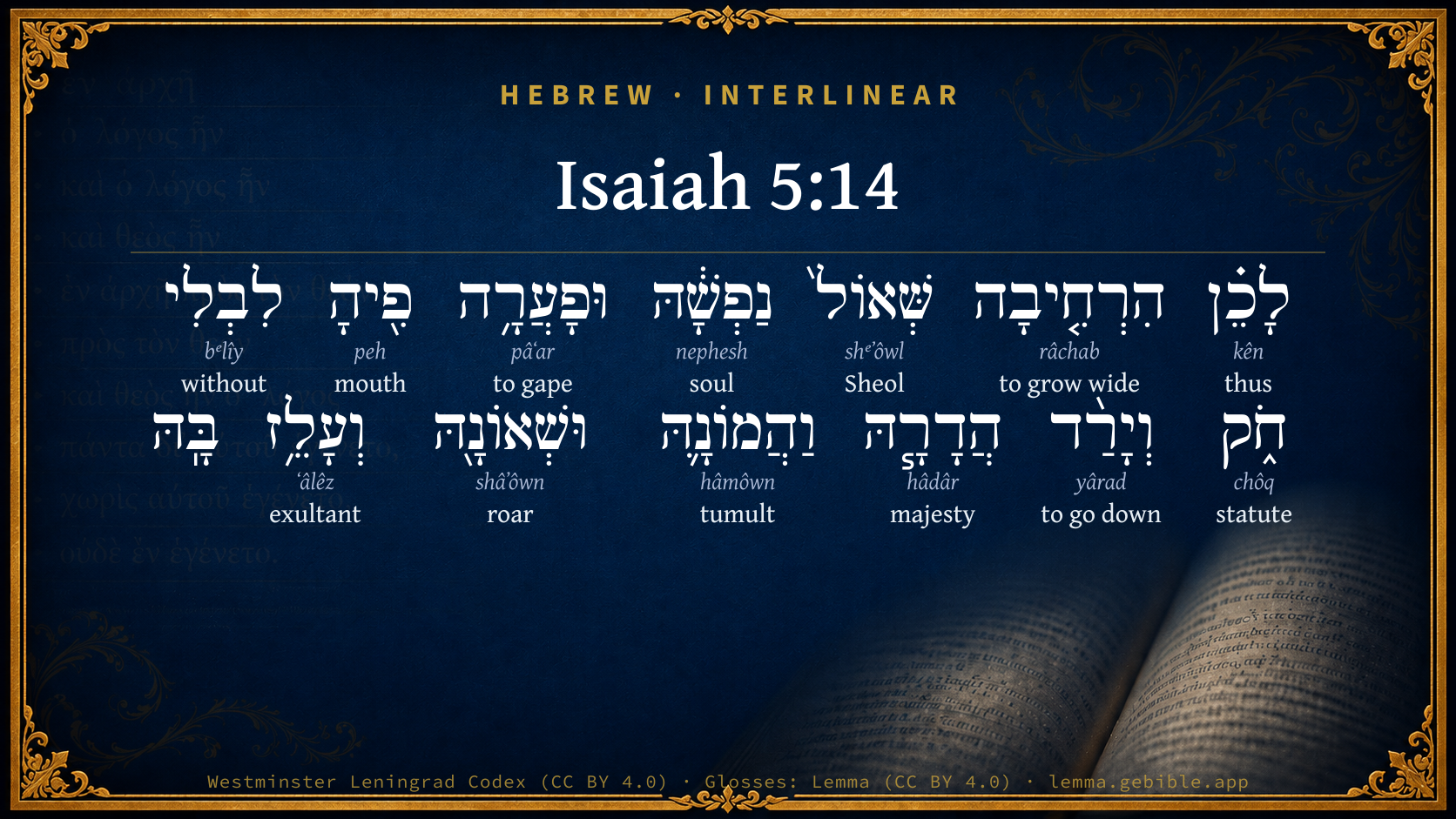
Isaiah 5:14

Hebrew (Westminster Leningrad Codex) Isaiah 5:14 appears in the Hebrew Old Testament. The text above is from the Westminster Leningrad Codex. Each word links to its Strong’s number, a concise gloss, and parsing drawn from the Open Scriptures Hebrew Bible morphology. Click any word for its full Brown-Driver-Briggs (BDB) entry.
Download image
Cite this verse

Isaiah 5:14 (World English Bible). Public Domain. Lemma interlinear Bible study tool, https://lemma.gebible.app/v/isaiah/5/14.

Show BibTeX & RIS
BibTeX
RIS
English Translation
Therefore Sheol has enlarged its desire, And opened its mouth without measure; And their glory, their multitude, their pomp, and he who rejoices among them, descend into it.
World English Bible · Public Domain
Highlights
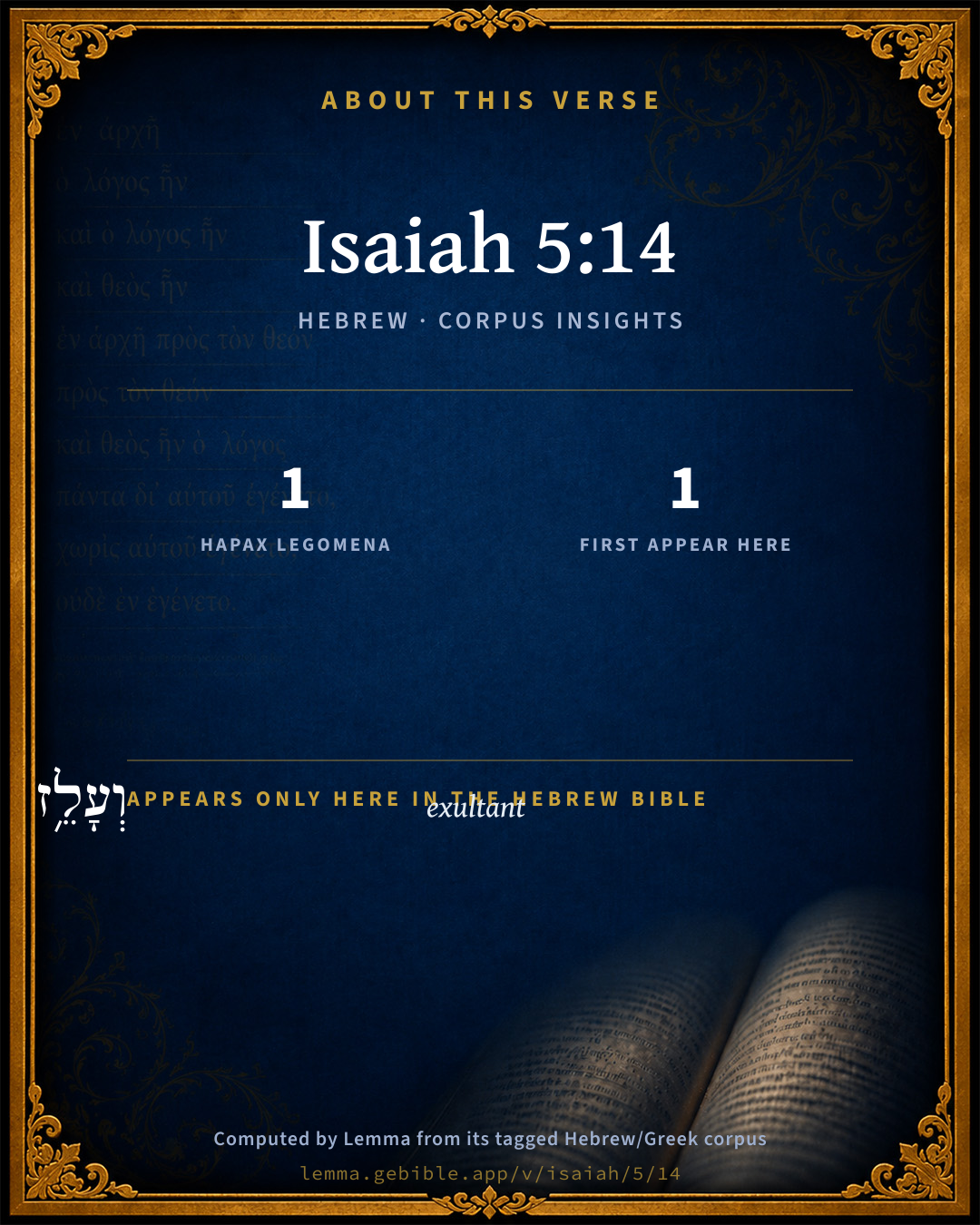
  • 1 hapax legomenon — only here in the Hebrew Bible
  • 1 first appearance in the Hebrew Bible
Full analysis ↓
Download a study sheet

One document with this verse’s original text, its word-by-word gloss line, the meaning frame, cross-references with their text, attributed commentary, and full source and license credits — printable, and it pastes into notes with its structure intact.

This verse Autodidact and up

Study sheet (.html) Plain text (.txt)

A passage Seminary Student

Up to 50 verses in one chapter. A passage sheet keeps up to 6 commentary sources and 12 cross-references per verse, in the order this page ranks them, and says so on the sheet whenever that leaves anything out. Ask for a single verse and you get the Autodidact verse sheet above.

Everything on this page stays free to read, with no account — the sheet is a download of what is already on screen, not access to it.

Want to remove ads? Support Godless Engineer
Compare translations 3

The same verse in 3 English versions, stacked beneath the original-language interlinear above. Click any original word for its lexicon entry.

Each is an independent rendering of the whole verse — the interlinear is not word-aligned to these translations.

Highlighted words mark where these versions differ — a whole-verse word diff, not a word-by-word alignment.

  • World English Bible Public Domain
    Therefore Sheol has enlarged its desire, And opened its mouth without measure; And their glory, their multitude, their pomp, and he who rejoices among them, descend into it.
  • King James Version Public Domain
    Therefore hell hath enlarged herself, and opened her mouth without measure: and their glory, and their multitude, and their pomp, and he that rejoiceth, shall descend into it.
  • unfoldingWord Literal Text CC BY-SA 4.0
    Therefore, Sheol has enlarged its soul, and it has opened its mouth without limit, and its honor and its multitude will go down, and its uproar and the one exulting in it.

unfoldingWord Literal Text — © unfoldingWord, licensed CC BY-SA 4.0. Word-aligned USFM3 via Door43 (git.door43.org/unfoldingWord/en_ult).

Versions to compare (up to 4)

3 of 4 selected

Show all 18 translations

Every available English version of this verse, each an independent rendering of the whole verse.

  • World English Bible Public Domain
    Therefore Sheol has enlarged its desire, And opened its mouth without measure; And their glory, their multitude, their pomp, and he who rejoices among them, descend into it.
  • Berean Standard Bible Public Domain
    Therefore Sheol enlarges its throat and opens wide its enormous jaws, and down go Zion’s nobles and masses, her revelers and carousers!
  • Majority Standard Bible Public Domain
    Therefore Sheol enlarges its throat and opens wide its enormous jaws, and down go Zion’s nobles and masses, her revelers and carousers!
  • King James Version Public Domain
    Therefore hell hath enlarged herself, and opened her mouth without measure: and their glory, and their multitude, and their pomp, and he that rejoiceth, shall descend into it.
  • American Standard Version (1901) Public Domain
    Therefore Sheol hath enlarged its desire, and opened its mouth without measure; and their glory, and their multitude, and their pomp, and he that rejoiceth among them, descend `into it'.
  • Revised Version (1885) Public Domain
    Therefore hell hath enlarged her desire, and opened her mouth without measure: and their glory, and their multitude, and their pomp, and he that rejoiceth among them, descend into it.
  • Geneva Bible (1599) Public Domain
    Therefore hell hath inlarged it selfe, and hath opened his mouth, without measure, and their glorie, and their multitude, and their pompe, and hee that reioyceth among them, shall descend into it.
  • Douay-Rheims (1899) Public Domain
    Therefore hath hell enlarged her soul, and opened her mouth without any bounds, and their strong ones, and their people, and their high and glorious ones shall go down into it.
  • Young's Literal Translation Public Domain
    Therefore hath Sheol enlarged herself, And hath opened her mouth without limit. And gone down hath its honour, and its multitude, And its noise, and its exulting one -- into her.
  • Literal Standard Version CC BY-SA 4.0
    Therefore Sheol has enlarged herself, || And has opened her mouth without limit. And its honor has gone down, and its multitude, || And its noise, and its exulting one—into her.
  • Unlocked Literal Bible CC BY-SA 4.0
    Therefore Sheol has made its appetite greater and has opened its mouth very wide; their elite, the people, their leaders, and the revelers and those who are happy among them, descend into Sheol.
  • unfoldingWord Literal Text CC BY-SA 4.0
    Therefore, Sheol has enlarged its soul, and it has opened its mouth without limit, and its honor and its multitude will go down, and its uproar and the one exulting in it.
  • Darby Bible Public Domain
    Therefore doth Sheol enlarge its desire, and open its mouth without measure; and her splendour shall descend [into it], and her multitude, and her tumult, and [all] that is joyful within her.
  • World Messianic Bible Public Domain
    Therefore Sheol has enlarged its desire, and opened its mouth without measure; and their glory, their multitude, their pomp, and he who rejoices among them, descend into it.
  • Webster's Bible Public Domain
    Therefore hell hath enlarged herself, and opened her mouth without measure: and their glory, and their multitude, and their pomp, and he that rejoiceth, shall descend into it.
  • Free Bible Version CC BY-SA 4.0
    The grave's appetite increases, its mouth opens wide, and Jerusalem's nobility and the masses will go down into it, along with the rowdy, drunken mobs.
  • Bible in Basic English Public Domain
    For this cause the underworld has made wide its throat, opening its mouth without limit: and her glory, and the noise of her masses, and her loud-voiced feasters, will go down into it.
  • JPS Tanakh (1917) Public Domain
    Therefore the nether-world hath enlarged her desire, and opened her mouth without measure; and down goeth their glory, and their tumult, and their uproar, and he that rejoiceth among them.

Literal Standard Version (2020), Covenant Press — licensed CC BY-SA 4.0. Text via the HelloAO Bible API (eBible.org). Unlocked Literal Bible (unfoldingWord) — licensed CC BY-SA 4.0. Text via the HelloAO Bible API (eBible.org). unfoldingWord Literal Text — © unfoldingWord, licensed CC BY-SA 4.0. Word-aligned USFM3 via Door43 (git.door43.org/unfoldingWord/en_ult). Free Bible Version, Dr. Jonathan Gallagher — licensed CC BY-SA 4.0. Text via the HelloAO Bible API (eBible.org).

Word by word

More ways to search: Search by grammar → Find every occurrence → Compare this word →

Practice this passage: Drill this verse → Learn its vocabulary →

וְעָלֵ֥ז
ʻâlêz
H5938
“and · exultant”
Conjunction + Adjective, Adjective, Masculine, Singular, Absolute
Part of Speech
Conjunction + Adjective
Type
Adjective
Gender
Masculine
Number
Singular
State
Absolute
Full BDB Definition

Origin: from H5937

TWOT: 1625a

exultant, jubilant
  1. לָכֵ֗ן kên H3651 “to/for · thus” Preposition + Adverb
  2. הִרְחִ֤יבָה râchab H7337 “to grow wide” Verb, Hiphil, Perfect, 3rd Person, Feminine, Singular
  3. שְּׁאוֹל֙ shᵉʼôwl H7585 “Sheol” Noun, Proper
  4. נַפְשָׁ֔הּ nephesh H5315 “soul · her” Noun, Common, Both, Singular, Construct + Suffix, Personal, 3rd Person, Feminine, Singular
  5. וּפָעֲרָ֥ה pâʻar H6473 “and · to gape” Conjunction + Verb, Qal, Perfect, 3rd Person, Feminine, Singular
  6. פִ֖יהָ peh H6310 “mouth · her” Noun, Common, Masculine, Singular, Construct + Suffix, Personal, 3rd Person, Feminine, Singular
  7. לִבְלִי bᵉlîy H1097 “to/for · without” Conjunction + Particle, Negative
  8. חֹ֑ק chôq H2706 “statute” Noun, Common, Masculine, Singular, Absolute
  9. וְיָרַ֨ד yârad H3381 “and · to go down” Conjunction + Verb, Qal, Sequential Perfect, 3rd Person, Masculine, Singular
  10. הֲדָרָ֧הּ hâdâr H1926 “majesty · her” Noun, Common, Masculine, Singular, Construct + Suffix, Personal, 3rd Person, Feminine, Singular
  11. וַהֲמוֹנָ֛הּ hâmôwn H1995 “and · tumult · her” Conjunction + Noun, Common, Masculine, Singular, Construct + Suffix, Personal, 3rd Person, Feminine, Singular
  12. וּשְׁאוֹנָ֖הּ shâʼôwn H7588 “and · roar · her” Conjunction + Noun, Common, Masculine, Singular, Construct + Suffix, Personal, 3rd Person, Feminine, Singular

About this verse

These counts appear in no published source. They are computed here, from the morphology-tagged text and Lemma’s own curated glosses. What Lemma adds →

14
words
13
distinct lemmas
Prophets
section

Notable vocabulary

1 hapax legomenon — a word that appears only here in the entire Hebrew Bible:

  • וְעָלֵ֥ז exultant H5938

First appearance in Scripture

This word makes its first canonical appearance in the Hebrew Bible here:

  • וְעָלֵ֥ז exultant H5938

Shared distinctive vocabulary

וּפָעֲרָ֥ה to gape H6473 occurs in 4 verses of the Hebrew Bible. Also found in:

Grammatical profile

  • 3 verbs
  • 7 nouns
  • 1 adjective
  • 1 preposition
  • 1 adverb
  • 1 particle

Verb forms

  • הִרְחִ֤יבָה Hiphil · Perfect
  • וּפָעֲרָ֥ה Qal · Perfect
  • וְיָרַ֨ד Qal · Sequential Perfect

Hebrew & Septuagint length

In English translation the verse runs 28 words from the Hebrew and 29 from the Septuagint (LXX English) — closely comparable.

A rough comparison of the two English renderings, which tokenize alike — not a word-level alignment.

Word counts can differ between the Hebrew and the Greek without any difference in meaning — e.g. the Hebrew direct-object marker אֵת has no separate Greek word, and Greek often adds the article ὁ.

Cross-references

23

Topical passages linked to Isaiah 5:14 in the Treasury of Scripture Knowledge — connected by theme and wording, ordered by reader-vote popularity; previews shown in the World English Bible.

  • Proverbs 30:16 Sheol, The barren womb; The earth that is not satisfied with water; And the fire that doesn't say, 'Enough.'
  • Habakkuk 2:5 Yes, moreover, wine is treacherous. A haughty man who doesn't stay at home, who enlarges his desire as Sheol, and he is like death, and can't be satisfied, but gathers to himself all nations, and heaps to himself all peoples.
  • Luke 21:34 "So be careful, or your hearts will be loaded down with carousing, drunkenness, and cares of this life, and that day will come on you suddenly.
  • Psalms 55:15 Let death come suddenly on them. Let them go down alive into Sheol. For wickedness is in their dwelling, in the midst of them.
  • Proverbs 27:20 Sheol and Abaddon are never satisfied; And a man's eyes are never satisfied.
  • Isaiah 30:33 For a Topheth is prepared of old; yes, for the king it is made ready; he has made it deep and large; the pile of it is fire and much wood; the breath of Yahweh, like a stream of sulfur, does kindle it.
  • Matthew 7:13 "Enter in by the narrow gate; for wide is the gate and broad is the way that leads to destruction, and many are those who enter in by it.
  • Revelation 20:13–15 The sea gave up the dead who were in it. Death and Hades gave up the dead who were in them. They were judged, each one according to his works.
  • Numbers 16:30–34 But if Yahweh make a new thing, and the ground open its mouth, and swallow them up, with all that appertain to them, and they go down alive into Sheol; then you shall understand that these men have despised Yahweh.
  • Isaiah 14:9 Sheol from beneath is moved for you to meet you at your coming; it stirs up the dead for you, even all the chief ones of the earth; it has raised up from their thrones all the kings of the nations.
  • Psalms 49:14 They are appointed as a flock for Sheol. Death shall be their shepherd. The upright shall have dominion over them in the morning. Their beauty shall decay in Sheol, Far from their mansion.
  • Proverbs 1:12 Let's swallow them up alive like Sheol, And whole, like those who go down into the pit.
  • Isaiah 21:4 My heart flutters, horror has frightened me; the twilight that I desired has been turned into trembling to me.
  • Ezekiel 32:18–30 Son of man, wail for the multitude of Egypt, and cast them down, even her, and the daughters of the famous nations, to the lower parts of the earth, with those who go down into the pit.
  • Luke 12:19–20 I will tell my soul, "Soul, you have many goods laid up for many years. Take your ease, eat, drink, be merry."'
  • Luke 16:20–23 A certain beggar, named Lazarus, was laid at his gate, full of sores,
  • Luke 17:27 They ate, they drank, they married, they were given in marriage, until the day that Noah entered into the ark, and the flood came, and destroyed them all.
  • Acts 12:21–23 On an appointed day, Herod dressed himself in royal clothing, sat on the throne, and gave a speech to them.
  • 1 Samuel 25:36–38 Abigail came to Nabal; and, behold, he held a feast in his house, like the feast of a king; and Nabal's heart was merry within him, for he was very drunken: therefore she told him nothing, less or more, until the morning light.
  • 2 Samuel 13:28–29 Absalom commanded his servants, saying, Mark you now, when Amnon's heart is merry with wine; and when I tell you, Smite Amnon, then kill him; don't be afraid; haven't I commanded you? be courageous, and be valiant.
  • Daniel 5:3–6 Then they brought the golden vessels that were taken out of the temple of the house of God which was at Jerusalem; and the king and his lords, his wives and his concubines, drank from them.
  • Daniel 5:30 In that night Belshazzar the Chaldean King was slain.
  • Nahum 1:10 For entangled like thorns, and drunken as with their drink, they are consumed utterly like dry stubble.

Cross-references courtesy of OpenBible.info (CC BY 4.0).

Hebrew and Greek witnesses Masoretic Hebrew ↔ Greek Septuagint

The same verse in the two great witnesses to the Old Testament, shown verse-for-verse.

These are two independent witnesses, not word-aligned to each other, and the Septuagint is shown in lemma (dictionary) form.

Hebrew Isaiah 5:14 Masoretic · Westminster Leningrad Codex

לָכֵ֗ן הִרְחִ֤יבָה שְּׁאוֹל֙ נַפְשָׁ֔הּ וּפָעֲרָ֥ה פִ֖יהָ לִבְלִי חֹ֑ק וְיָרַ֨ד הֲדָרָ֧הּ וַהֲמוֹנָ֛הּ וּשְׁאוֹנָ֖הּ וְעָלֵ֥ז בָּֽהּ

Therefore Sheol has enlarged its desire, And opened its mouth without measure; And their glory, their multitude, their pomp, and he who rejoices among them, descend into it.

World English Bible · Public Domain

Greek LXX Isaiah 5:14 Septuagint · lemma form

καί πλατύνω ὁ ᾅδης ὁ ψυχή αὐτός καί δια ἀναοἴγω ὁ στόμα αὐτός ὁ μή διαλείπω καί καταβαίνω ὁ ἔνδοξος καί ὁ μέγας καί ὁ πλούσιος καί ὁ λοιμός αὐτός

Therefore hell has enlarged its desire and opened its mouth without ceasing: and her glorious and great, and her rich and her pestilent men shall go down into it.

LXX2012 (modern English Septuagint) · Public Domain

On this verse, John Gill's Exposition discusses the Septuagint’s reading. Read the note in Commentary ↓

Hebrew: Westminster Leningrad Codex (CC BY 4.0). Greek: Septuagint (public domain); English from LXX2012 (modern English Septuagint) (Public Domain). How the Septuagint differs from the Hebrew →

Targum (Aramaic paraphrase)

1

The Targum is the ancient Jewish Aramaic paraphrase of the Hebrew Scriptures — an interpretive translation, not the Hebrew text itself. Onkelos (literal) and Pseudo-Jonathan (expansive) render the Torah, and Jonathan the Prophets. Coverage is partial: where no permissively-licensed English translation exists for a verse, only the Aramaic is shown. This is verse-level text, not a word-by-word alignment to the Hebrew.

  1. Targum Jonathan Prophets (Joshua–Malachi)
    בְּכֵן אַפְתִיאַת שְׁאוֹל נַפְשָׁהּ וּפְתָחַת פּוּמָהּ וְלֵית סוֹף וּנְחָתוּ יְקָרְהוֹן וְסִגְוְהוֹן וְאִתְרְגוּשְׁתְּהוֹן וְדִתְקוֹף בְּהוֹן:

    Therefore hell hath enlarged herself, and opened her mouth without measure, and their nobles, and their multitudes, and their tumultuous assemblies, and he that is strong among them, shall descend into it.

    Targum Jonathan — Aramaic: “Mikraot Gedolot” (public domain). English: “Sefaria Community Translation” (CC0 1.0 (public-domain dedication)); “London "Chaldee Paraphrase," 1871” (public domain). Text via Sefaria.

Commentary

Notes on Isaiah 5:14 from classic Christian and Jewish commentators (each source and its license shown beneath its notes). The classic Christian expositions comment on the surrounding passage and are grouped to its opening verse, so a note may address several verses; the Jewish commentaries on the Tanakh (Rashi and others) are per-verse, so they appear only where the commentator wrote on this verse.

Lemma curates 59 commentaries, every one of them public domain or Creative Commons licensed, each selected and text-cleaned for this edition rather than reprinted as found. About our sources →

Trapp's Complete Commentary

John Trapp

Isa 5:14 Therefore hell hath enlarged herself, and opened her mouth without measure: and their glory, and their multitude, and their pomp, and he that rejoiceth, shall descend into it.

Ver. 14. Therefore hell hath enlarged herself, &c.] To swallow up those insatiable helluones and lurcones, drunkards and epicures; these swill howls and sensualists, Cerberi instar, triaguttura pandebant. Diotimus of Athens was surnamed Tunbowl, and young Cicero, Tricongius, because he could take off three bottles of wine at a draught. Therefore death and hell

Have opened their mouth without measure.] Hiante rictu amplissimo helluones istos absorbere, To devour such pests and botches of mankind. Oh that the carousers were persuaded, as Mohammed told his followers, that in every grape there dwelt a devil! And oh that they would foresee and prevent a worse punishment in hell than befell that poor Turk who, being found drunk, had a ladleful of boiling lead poured down his throat by the command of a certain pasha!

And their glory.] Their great ones, those men of honour. {Isa 5:13}

And their multitude.] The meaner sort. Nos numeri sumus.

And their pomp.] Or, Their noise or tumult: their revel rout, as they call it, when they have drunk all the outs, and are now singing and hallooing.

John Trapp, A Commentary or Exposition upon All the Books of the Old and New Testament (1647–1656) — public domain. Text from a community e-Sword module.

The Biblical Illustrator

Joseph S. Exell

Isa_5:14-16

Hell hath enlarged herself . . . the Lord of hosts shall be exalted in Judgment

The grave

Hell, here, stands not for future punishment.

The word Sheol in Hebrew, Hades in Greek, and Hell in this verse, represent the place of the dead--the grave. This place of the dead is spoken of in the Bible as a very deep place (Deu_32:22; Job_11:8; Psa_139:7-8). As a very dark place (Job_10:21-22). And as a place having gates into it (Isa_38:10).

I. THE GROWING POWER OF THE GRAVE. The grave is here represented as having enlarged herself, and opened her mouth without measure. The words refer, undoubtedly, to a period when, through famine, pestilence, or war, mortality was on the increase. This increase of mortality teaches us--

1. The fruitlessness of all human efforts to avert death. Men have been struggling against death for six thousand years, and his dominion is wider today than ever.

2. How soon we shall be in the grave world. The mouth is opening for us; it is yawning at our feet.

II. THE LEVELLING POWER OF THE GRAVE. And their glory, and their multitude, and their pomp, and he that rejoiceth, shall descend into it. And the mean man shall be brought down, and the mighty man shall be humbled, and the eyes of the lofty shall be humbled. Learn from this--

1. How foolish it is to be proud of adventitious distinctions. They are only as flowers of the field, evanescent forms, and hues that variegate the common grass.

2. How important to seek an alliance with the eternally great and good. Seek a city which hath foundations, a kingdom that cannot be shaken.

III. THE ETERNAL SOVEREIGN OF THE GRAVE. But the Lord of hosts shall be exalted in judgment, and God that is holy shall be sanctified in righteousness.

1. He survives all dissolutions.

2. He will be increasingly honoured. The Lord of hosts shall be exalted in judgment. (Homilist.)

Gods judgments on the Jews

This judgment began to come upon the men whom Isaiah addressed, in the reign of Ahaz, soon after the delivery of the warning; but in order fully to understand it, we must (as in the case of all other prophecies) look at it in the light of the whole subsequent history of the Jews and of Christendom. In the final destruction of Jerusalem by the Romans, Christ and His apostles saw the selfish and carnal nation brought to its last trial and righteously condemned, and the sentence carried into execution by that Man whom God had appointed to judge the world. They declared, and the event, spread over successive centuries, has proved the truth of the declaration, that God was bringing down the mean man and the mighty man alike throughout the world and exalting Himself and His Son, setting His name up in the world, and causing it to triumph over all opposition. (Sir E. Strachey, Bart.)

God the righteous Judge

Though men may slavishly dread an arbitrary will, they can never feel for it that salutary tear which is the beginning of wisdom; and unless we believe that Gods judgments are righteous--that they are a part of the steady administration of a polity--as well as good in their effects, it will be impossible for us to keep long from superstition, or its opposite, scepticism. And, therefore, we may see the germ of a true historical and political philosophy in the prophets repeated assertion, that God is exalted in executing justice and sanctified in righteousness. (Sir E. Strachey, Bart.)

The Biblical Illustrator, edited by Joseph S. Exell (c. 1880s–1900s) — public domain. Text from a community e-Sword module.

The Preacher's Complete Homiletical Commentary

Joseph S. Exell (gen. ed.)

DEATH AND THE GRAVE

(For Easter Sunday.)

Isa_5:14-15. Therefore hell hath enlarged herself, &c.

In these terms of appalling sublimity Isaiah warns his countrymen of the calamities that were about to come upon them, on account of the innumerable transgressions into which they had been betrayed by their wilful ignorance of God. Therefore they should be carried away into captivity (Isa_5:13), and therefore also the sword, famine, and pestilence would conspire to fill the “under-world” with inhabitants. That “under-world” is represented as preparing itself for their reception, as a ravenous beast opens wide its jaws to devour its prey (Text). A prediction which, to the prosperous, wealthy, and powerful nation over which Uzziah ruled, doubtless seemed the most extravagant raving of fanaticism, but which was fulfilled nevertheless.

It is of the “under-world” that Isaiah speaks. “Therefore the under-world opens its jaws wide, and stretches open its mouth immeasurably wide; and the glory of Jerusalem descends, and its tumult, and noise, and those who rejoice within it. There are mean men bowed down, and lords humbled, and the eyes of lofty men are humbled.”—Delitsch. Our translation “hell” must not lead us to think merely of the place where the wicked are tormented; it is of conquests about to be achieved by death and the grave that Isaiah warned the men of his time. His prediction suggests a topic of which men of all times will do well to think, and that again another topic peculiarly suited to this day. Let us bethink ourselves—

I. Of THE CONQUESTS OF DEATH AND THE GRAVE.

I. These conquests have been effected in all ages. Generation after generation of mankind has been swept away by these grim and ancient warriors. During successive centuries men have gained wonderful power over the forces of nature, but they have acquired no real increase of ability to withstand these dread destroyers. All that science can do is in a few cases for a very short time to defer their victory. The “Elixir of Life” has been sought for in vain.—If in feebleness of mankind we had not sufficient proof of our fallen condition, certainly we should find it in the fact, that so many men have allied themselves with these foes of our race. All nations have conferred their brightest honours on those who have been the most successful ministers of death. Warrior and hero have been regarded as synonymous terms. In no respect is modern science more industrious, earnest or successful, than in the search for the means by which human life may be destroyed most easily on the largest scale.

II. They have been characterised by a solemn impartiality. With them there has been no respect of persons.

(1.) Meanness is no security against them. Poverty and lowliness are not without their compensations, as the poorer Jews discovered, when they saw the nobles and men of wealth, whom they had been accustomed to envy, carried away miserable captives, while they themselves were left behind (2Ki_24:14-16, &c). There are those whom human conquerors will not stoop to molest. But death and the grave have no such fastidiousness. They prey on the mean as well as the mighty.

(2.) Might is no defence against them. Rank and wealth can accomplish much, but they cannot overawe or bribe death [652] Death works like a reaper in the dark, cutting down the tall ears of corn as well as the grass that struggles for existence between them, the fair flowers as well as the noisome weeds.

[652] Look how easily Jehu stamped Jezebel in pieces, and Tamerlane’s troops of horse the Turkish footmen; or as the sturdy steed dashes out the little whappet’s brains, so easily does Death, with the least kick and spurn of his heel, the halest complexion, the stoutest constitution,—triumphing like an emperor over all sorts of people; treading on the necks of kings and princes, as Joshua over them in the cave; insulting in the terms of Rabshakeh: “Where is Hamath? the kings of Arphad, Ivah, and Sepharvaim? Elam, Meshach, and Tubal, whose fear was upon the living, are they not descended into the grave? made their beds in the slimy valley, and laid their swords under their heads? Hath wisdom delivered, strength rescued, or wealth rescued any out my fingers?”—Ward, 1577–1639.

Oh, eloquent, just, and mighty Death! whom none could advise, thou hast persuaded; what none hath dared, thou hast done; and whom all the world has flattered, thou alone hast cast out of the world and despised. Thou hast drawn together all the far-stretched greatness, all the pride, cruelty, and ambition of man, and covered it all with those two narrow words, Hic jacet.—Sir Walter Raleigh.

III. They have been characterised by a terrible unexpectedness. They are certain, but they cannot be foreseen. While they proceed with all the steadiness of gravitation, it is as impossible to foretell where they will be next accomplished, as it is to predict from which part of the heavens the next flash of lightning will burst forth, on which spot of earth the destructive fire will fall. Hence the wisdom of living in continual preparedness for the great change which will come to us all [655]

[655] We put far away the evil day, and therefore we are not duly impressed by the thought. But fourscore years are soon cut off, and we fly away; and how uncertain is our reaching that lonely verge of life, where the flowery meadows and the golden corn-fields slope gradually down into the bare and stony beach that fringes the eternal sea. The coast of death to most is an abrupt precipice; we are cut off in the midst of our days.—Macmillan.

Why should a man defer that which ought to be the occupation of a life, which ought to command all his powers in all their vigour—why should a man defer that to the last few abrupt moments, to his departure from time to eternity? When a man is going to any distant part of the globe—say to America—what preparation there is! How much it is talked about! It is a long, a distant, an eventful journey. The man talks about it; his friends prepare in every conceivable way. Oh, what infatuation and stupidity, what folly it is for a man to make no preparation for this distant voyage—the voyage to eternity!—Beaumont.

II. This survey of the conquests of death and the grave should remind us that there is another side to this solemn theme, and therefore I proceed to remind you, secondly, of THE CONQUERORS OF DEATH AND THE GRAVE. Through how many centuries did men live without any conception that these conquerors of our race might themselves be subjugated! Two astonishing events, indeed, occurred—the translation of Enoch and the rapture of Elijah—but their significance could not be fully understood at the time of their occurrence. The data for their complete interpretation had not then been furnished. But when that supreme event which we commemorate to-day occurred, these and many other mysteries were solved. When the Son of man, who had been crucified, emerged from the tomb, proclamation was made to the universe that the ancient power of death and the grave was broken. It was seen that it is possible to pass through them unharmed, and to return to the activities of life, not with diminished, but with increased, vigour. And He who demonstrated this astonishing truth has pledged Himself to accomplish for all who trust in Him a victory similar to His own. By faith in this pledge, countless millions have been enabled to triumph in spirit over Death at the very moment when he seemed to be numbering them also among his victims (1Co_15:55-57).

I. The victory of Christ’s followers over death and the grave is real. There seems to be one event unto all (Ecc_9:2-3). But it is not so. Death is not the conqueror of Christ’s servants; he is God’s servant, sent to conduct them to the rest prepared for them. The grave is not their prison, but a quiet resting-place from which presently the mortal body shall come forth immortal to greet the eternal morning.

II. The victory of Christ’s followers over death and the grave will ere long be manifest (1Th_4:14-16, &c.) In the doctrine of the resurrection, there is much that is mysterious and inexplicable, but this is certain, that the seeming victory of death and the grave over Christ’s followers shall be utterly reversed; as not a hoof belonging to God’s ancient people was left behind in Egypt, so NOTHING that belongs to a single follower of Christ upon which death and the grave have seized shall remain in their power (Hos_13:14). The resurrection will be more than a ransom. It will be a development (1Co_15:37-38; 1Co_15:42; 1Co_15:44). In view of these truths, let us to-day keep Easter with thankful and joyful hearts.

The Preacher's Complete Homiletical Commentary (gen. ed. Joseph S. Exell; Funk & Wagnalls, c. 1892) — public domain (pre-1929). A full-Bible homiletical/sermon-outline anthology covering 65 of 66 books (2 John is absent from the source module). Text from a community e-Sword module.

Tyndale Open Study Notes

Tyndale Open Resources

5:14 The grave (Hebrew Sheol) represented the place of the dead in ancient Near Eastern thinking (see 14:9).

Tyndale Open Study Notes — © Tyndale Open Resources, licensed CC BY-SA 4.0. Text via the HelloAO Bible API.

Geneva Bible (1599)

Geneva Bible translators

Meaning, the grave shall swallow up them that shall die for hunger and thirst, and yet for all this great destruction it shall ever be satiate.

Geneva Bible (1599) marginal notes — public domain. Text via Bolls.life.

Jamieson, Fausset & Brown

Robert Jamieson, A. R. Fausset & David Brown

hell--the grave; Hebrew, sheol; Greek, hades; "the unseen world of spirits." Not here, "the place of torment." Poetically, it is represented as enlarging itself immensely, in order to receive the countless hosts of Jews, which should perish (Num 16:30).

their--that is, of the Jewish people.

he that rejoiceth--the drunken reveller in Jerusalem.

Jamieson, Fausset & Brown — Commentary Critical and Explanatory on the Whole Bible (1871) — public domain (CC PDM 1.0). Text via the HelloAO Bible API.

Ellicott's Commentary for English Readers

(14) Therefore hell hath enlarged herself.—The Hebrew Sheol, or Hades, like “hell” itself in its original meaning, expressed not a place of torment, but the vast shadow – world of death, thought of as being below the earth (Psa_16:10; Psa_49:14). Here, as elsewhere (Jon_2:2; Pro_1:12; Pro_30:16), it is half-personified, as Hades and Death are in Rev_6:8; Rev_20:13-14. In that unseen world there were, in the later belief of Judaism, the two regions of Gehenna and of Eden or Paradise. What the prophet says is that all the pomp and glory of the rich oppressors are on their way to that inevitable doom. The word for “glory” (as in 1Sa_4:22) is the same as that for “honourable men” in Isa_5:13, so that the original has all the emphasis of repetition.

A Bible Commentary for English Readers, edited by Charles John Ellicott (1878–1897) — public domain. Text from a community e-Sword module.

The Cambridge Bible for Schools and Colleges

gen. ed. J. J. S. Perowne

14–17. A second threatening, in a sublime image, of the sudden destruction of Jerusalem. The transition to the fate of the capital is somewhat abrupt. 14. hell hath enlarged herself] better, Sheol hath enlarged her appetite (Hab_2:5). Sheol, the Underworld, the realm of the dead (like the Greek Hades), is here, as elsewhere, conceived as a devouring insatiable monster; cf. Hos_13:14; Jon_2:2; Son_8:6; Pro_1:12; Pro_30:16.

and their glory … descend into it] Render (nearly as Cheyne) and down goes her (Jerusalem’s) pomp, and her tumult and her uproar and (all) that is (so) jubilant in her.

The Cambridge Bible for Schools and Colleges (gen. ed. J. J. S. Perowne; Cambridge University Press, 1878–1918) — public domain. Text from a community e-Sword module.

John Gill's Exposition

Therefore hell hath enlarged herself,.... That is, the grave, to receive the dead which die with famine and thirst; signifying that the number of the dead would be so great, that the common burying places would not be sufficient to hold them; but additions must be made to them; or some vast prodigious pit must be dug, capable of receiving them; like Tophet, deep and large: or "hath enlarged her soul" (d); her desire after the dead, see Hab 2:5 being insatiable, and one of those things which are never satisfied, or have enough, Pro 30:15 wherefore it follows:

and opened her mouth without measure; immensely wide; there being no boundary to its desires, nor any end of its cravings, or of filling it. And so the Targum renders it, "without end". Moreover, by "hell" may be meant the miserable estate and condition of the Jews upon the destruction of Jerusalem, when they were in the utmost distress and misery; see Gill on Luk 16:23.

And their glory; their glorious ones, their nobles, as the Septuagint, Syriac, and Arabic versions; and the Targum, their princes, rulers, civil and ecclesiastical; which were the glory of the nation:

and their multitude; meaning the common people; or rather their great and honourable ones, as the Septuagint, Syriac, and Arabic versions render the word; and in which sense it may be used in the preceding verse Isa 5:13; since not of the poor, but of the rich, the context speaks; even of such who indulged themselves in luxury and pleasure:

and their pomp; the Septuagint version, "their rich ones"; such who live in pomp and splendour: but the word (e) signifies noise and tumult; and so the Targum renders it; and it designs noisy and tumultuous ones, who sing and roar, halloo and make a noise at feasts; and who may be called , "sons of tumult", or "tumultuous ones"; Jer 48:45 wherefore it follows:

and he that rejoiceth, that is, at their feasts,

shall descend into it; into hell, or the grave: or, "he that rejoiceth in it", that is, in the land or city; so the Targum,

"he that is strong among them;''

so Jarchi and Kimchi interpret it.

(d) "dilatavit suam animam", V. L. Munster, Montanus, Cocceius. (e) "et strepitus ejus", Montanus, Forerius.

John Gill's Exposition of the Whole Bible (1746–1763) — public domain (CC PDM 1.0). Text via the HelloAO Bible API.

Albert Barnes' Notes on the Bible

Therefore hell - The word transated “hell,” שׁאול she'ôl, has not the same meaning that we now attach to that word; its usual signification, among the Hebrews, was “the lower world, the region of departed spirits.” It corresponded to the Greek ἅδης Hadēs, “hades,” or place of the dead. This word occurs eleven times in the New Testament Mat 11:23; Mat 16:18; Luk 10:15; Luk 16:23; Act 2:27, Act 2:31; 1Co 15:55; Rev 1:18; Rev 6:8; Rev 20:13-14, in all of which places, except 1Co 15:55, it is rendered “hell,” though denoting, in most of those places, as it does in the Old Testament, the abodes of the dead. The Septuagint, in this place, and usually, translates the word שׁאול she'ôl by ἅδης Hadēs, “Hades.” It was represented by the Hebrews as “low down, or deep” in the earth - contrasted with the height of heaven; Deu 32:22; Job 11:8; Psa 139:7-8. It was a place where thick darkness reigns; Job 10:21-22 : ‘The land of darkness and the shadow of death; a land of darkness, as darkness itself.’ It is described as having “valleys, or depths,” Pro 9:18. It is represented also as having “gates,” Isa 38:10; and as being inhabited by a great multitude, some of whom sit on thrones, occupied in some respects as they were on earth; see the note at Isa 14:9. And it is also said that the wicked descend into it by openings in the earth, as Korah, Dathan, and Abiram did; Num 15:30, ... In this place, it means evidently the “regions of the dead,” without the idea of punishment; and the poetic representation is, that so many of the Jews would be cut off by famine, thirst, and the sword, that those vast regions would be obliged “to enlarge themselves” in order to receive them. It means, therefore, that while many of them would go into captivity Isa 5:13, vast multitudes of them would be cut off by famine, thirst, and the sword.

Opened her mouth - As if to absorb or consume them; as a “cavern,” or opening of the earth does; compare Num 16:30.

Without measure - Without any limit.

And their glory - All that they esteemed their pride and honor shall descend together into the yawning gulf.

Their multitude - The multitude of people; their vast hosts.

Their pomp - Noise, tumult; the bustle, and shouting, and display made in battle, or war, or victory; Isa 13:4; Amo 2:2; Hos 10:14.

And he that rejoiceth - All that the nation prided itself on, and all that was a source of joy, should be destroyed.

Albert Barnes' Notes on the Bible (1834–1885) — public domain. Text from a community e-Sword/MySword module.

Haydock's Catholic Bible Commentary

Hell. Or the grave, which never says enough, Proverbs xxx. 15. Isaias alludes to what should happen under Nabuchodonosor, as if it were past. (G.[Calmet?])

George Leo Haydock (1774–1849), Haydock's Catholic Family Bible and Commentary, 1859 edition — public domain. Excludes Psalms (Douay-Rheims chapter numbering differs from Protestant) and Deuterocanonical books (Catholic canon only).

Matthew Poole's English Annotations

Hell; or, the grave, as this word most commonly signifies.

Opened her mouth without measure, to receive those vast numbers which shall die by this famine, or otherwise, as is here implied.

Their glory; their honourable men, as they were called, Isa 5:13, being distinguished both here and there from the multitude.

Their pomp; all their glory, shall die with them.

He that rejoiceth; that spendeth all his days in mirth and jollity, and casteth away all cares and fears.

Matthew Poole's English Annotations on the Holy Bible (1683–1685) — public domain. Text from a community e-Sword/MySword module.

Whedon's Commentary on the Bible

Daniel D. Whedon

14, 15. Hell — In the Hebrew, sheol, to which, in the New Testament, the corresponding term is hades. The term sheol never means the grave, but always the invisible domain of the dead, whether referring to souls, as usually, or to bodies. See Dr. Burr’s Excursus on Job_7:21. The famished multitudes are making sheol populous with newly departed ones. Hence, enlarged herself means “enlarged” her capacity; and without measure imports ambition for more extensive limits than are decreed to her. Their glory… multitude… pomp, etc. — The pronoun “their” doubtless refers to Jerusalem, the fallen Zion, and the nouns belonging to it are the noisy, revelling inhabitants thereof. The common mass, mean… mighty… lofty, are seen tumbling daily into sheol together. Chap. 14, where see notes.

Daniel D. Whedon (gen. ed.), Commentary on the Old and New Testaments (1874–1909) — public domain. Text from a community e-Sword module.

The Pulpit Commentary

Therefore hell hath enlarged herself; rather, hath enlarged her desire. (comp. Hab_2:5) "Hell" here represents the underworld, into which souls descended at death, not yet perhaps recognized as comprehending two divisions, but regarded much as the Greeks regarded their Hades as a general receptacle of the dead, dark and silent. Hades (Sheol), not viewed as a person, but personified by poetical license, "enlarges her desire" and "opens her mouth" to receive the crowd that is approaching the crowd of those who in captivity succumb to the hardships of their lot. Their glory; literally, her glory the glory, i.e. , of Jerusalem, which is especially in the prophet"s thoughts. "Her glory, and her crowd, and her pomp, and he that is joyful in her, shall go down" into the sheol that gapes for them.

The Pulpit Commentary (1880–1919), ed. H.D.M. Spence-Jones & Joseph S. Exell — public domain. Text from a community e-Sword module.

John Wesley's Explanatory Notes

And he - That spends all his days in mirth and jollity.

John Wesley, Explanatory Notes Upon the Whole Bible (1754–1765) — public domain. Text via the GEBible commentary corpus.

Keil & Delitzsch

C. F. Keil & F. Delitzsch

The threat of punishment commences again with "therefore;" it has not yet satisfied itself, and therefore grasps deeper still. "Therefore the under-world opens its jaws wide, and stretches open its mouth immeasurably wide; and the glory of Jerusalem descends, and its tumult, and noise, and those who rejoice within it." The verbs which follow lâcēn (therefore) are prophetic preterites, as in Isa 5:13. The feminine suffixes attached to what the lower world swallows up do not refer to sheol (though this is construed more frequently, no doubt, as a feminine than as a masculine, as it is in Job 26:6), but, as expressed in the translation, to Jerusalem itself, which is also necessarily required by the last clause, "those who rejoice within it." The withdrawal of the tone from ועלז to the penultimate (cf., Châphētz in Psa 18:20; Psa 22:9) is intentionally omitted, to cause the rolling and swallowing up to be heard as it were. A mouth is ascribed to the under-world, also a nephesh, i.e., a greedy soul, in which sense nephesh is then applied metonymically sometimes to a thirst for blood (Psa 27:12), and sometimes to simple greediness (Isa 56:11), and even, as in the present passage and Hab 2:5, to the throat or swallow which the soul opens "without measure," when its craving knows no bounds (Psychol. p. 204). It has become a common thing now to drop entirely the notion which formerly prevailed, that the noun sheol was derived from the verb shâal in the sense in which it was generally employed, viz., to ask or demand; but Caspari, who has revived it again, is certainly so far correct, that the derivation of the word which the prophet had in his mind was this and no other. The word sheol (an infinitive form, like pekōd) signifies primarily the irresistible and inexorable demand made upon every earthly thing; and then secondarily, in a local sense, the place of the abode of shades, to which everything on the surface of the earth is summoned; or essentially the divinely appointed curse which demands and swallows up everything upon the earth. We simply maintain, however, that the word sheol, as generally sued, was associated in thought with shâal, to ask or demand. Originally, no doubt, it may have been derived from the primary and more material idea of the verb שׁאל, possibly from the meaning "to be hollow," which is also assumed to be the primary meaning of שׁעל.

(Note: The meaning "to be hollow" is not very firmly established, however; as the primary meaning of שׁעל, and the analogy sometimes adduced of hell = hollow (Hlle = Hhle), is a deceptive one, as Hlle (hell), to which Luther always gives the more correct form Helle, does not mean a hollow, but a hidden place (or a place which renders invisible: from hln, to conceal), Lat. celans (see Jtting, Bibl. Wrterbuch, 1864, pp. 85, 86). It is much more probable that the meaning of sheol is not the hollow place, but the depression or depth, from של, which corresponds precisely to the Greek χαλᾶν so far as its primary meaning is concerned (compare the talmudic shilshêl, to let down; shilshul, sinking or depression, Erubin 83b; shul, the foundation, fundus): see Hupfeld on Psa 6:6. Luzzatto on this passage also explains sheol as signifying depth, and compares the talmudic hishchil = hēshil, to let down (or, according to others, to draw up - two meanings which may easily be combined in the same word, starting from its radical idea, which indicates in a general a loosening of the previous connection). Frst has also given up the meaning cavitas, a hollow, and endeavours to find a more correct explanation of the primary signification of shâ'al (see at Isa 40:12).)

At any rate, this derivation answers to the view that generally prevailed in ancient times. According to the prevalent idea, Hades was in the interior of the earth. And there was nothing really absurd in this, since it is quite within the power and freedom of the omnipresent God to manifest Himself wherever and however He may please. As He reveals Himself above the earth, i.e., in heaven, among blessed spirits in the light of His love; so did He reveal Himself underneath the earth, viz., in Sheōl, in the darkness and fire of His wrath. And with the exception of Enoch and Elijah, with their marvellous departure from this life, the way of every mortal ended there, until the time when Jesus Christ, having first paid the λὐτρον, i.e., having shed His blood, which covers our guilt and turns the wrath of God into love, descended into Hades and ascended into heaven, and from that time forth has changed the death of all believers from a descent into Hades into an ascension to heaven. But even under the Old Testament the believer may have known, that whoever hid himself on this side the grave in Jehovah the living One, would retain his eternal germ of life even in Sheōl in the midst of the shades, and would taste the love of God even in the midst of wrath. It was this postulate of faith which lay at the foundation of the fact, that even under the Old Testament the broader and more comprehensive idea of Sheōl began to be contracted into the more limited notion of hell (see Psychol. p. 415). This is the case in the passage before us, where Isaiah predicts of everything of which Jerusalem was proud, and in which it revelled, including the persons who rejoice din these things, a descent into Hades; just as the Korahite author of Ps 49 wrote (Psa 49:14) that the beauty of the wicked would be given up to Hades to be consumed, without having hereafter any place in the upper world, when the upright should have dominion over them in the morning. Hades even here is almost equivalent to the New Testament gehenna.

Keil & Delitzsch — Biblical Commentary on the Old Testament (1861–1891) — public domain (CC PDM 1.0). Text via the HelloAO Bible API. (Old Testament only.)

J. A. Alexander on Isaiah

Joseph Addison Alexander

As the effect of the preceding judgments, the Prophet now describes a general mortality, under the figure of the grave, as a ravenous monster, gaping to devour the thoughtless revellers. Here, as in v. 13, he seems to be speaking of events already past. “Therefore (because famine and captivity have thus prevailed) the grave has enlarged herself and opened her mouth without measure, and down goes her pomp and her noise and her crowd and he that rejoices in her.” The sense of the term ‘grave’ here corresponds almost exactly to the poetical use of grave in English, as denoting one great receptacle, to which the grave of individuals may be conceived as inlets. It is thus that we speak of a voice from the grave, without referring to the burial-place of any individual. The idea of a place of torment, which is included in their present meaning, is derived from the peculiar use of the Greek equivalent in the book of Revelation, and belongs to the Hebrew word only by implication and in certain connections.

Joseph Addison Alexander, The Prophecies of Isaiah (1846–1847; New York: Scribner, 1870–1878) — public domain. Text from a community e-Sword module.

Scofield Reference Notes

C. I. Scofield

hell Heb. "Sheol," (See Scofield "Hab 2:5").

The Scofield Reference Bible (1917 edition), notes by C. I. Scofield — public domain. Text from a community e-Sword module.

Rashi

Rabbi Shlomo Yitzchaki (Rashi)

Therefore, the nether-world has expanded Retribution corresponding to deed; they expanded themselves to swallow much food and drink, and they opened their mouth to swallow, so will the nether world expand itself to swallow.

and opened Heb. פָּעֲרָה.

without measure Without end; and why [did the grave open] without measure? Because these people had no measure or limit to their enjoyments.

shall descend There the splendor of Jerusalem.

And those who rejoice therein Heb. ועלז בה. [I.e., those who rejoiced in Jerusalem, or in all the Land of Israel, with the plenty they had there, will fall into Sheol, i.e., they will die.]

Rashi on the Tanakh — English translations: “The Judaica Press complete Tanach with Rashi, translated by A. J. Rosenberg” (CC BY 4.0); “Pentateuch with Rashi's commentary by M. Rosenbaum and A.M. Silbermann, 1929-1934” (public domain); “The Metsudah Tanach series, Lakewood, N.J” (CC BY 4.0); and “The Book of Joshua, Metsudah Publications, 1997” (CC BY 4.0). Text via Sefaria.

Ibn Ezra

Rabbi Abraham ibn Ezra

נפשה Her breath. נפש is the breath that comes out of the mouth; comp. נפשו his breath (Job 41:21).

ופערה And opened; comp. פערו they opened (Job 29:23).

לבלי חק Unusually.

ועלז בה And all that rejoice in it. or, and rejoicing will be—to others—at his fall. According to R. Jonah, the phrase ועלז בה And rejoicing, or laughing will be in it, describes that kind of laughter which may sometimes be noticed in people at the moment of death.

Ibn Ezra on the Tanakh — English translations: “Sefaria Community Translation” (CC0 1.0 (public-domain dedication)); “Yalkut, Sifsei Chachomim Chumash, Metsudah Publications, 2009” (CC BY 4.0); and “Commentary of Ibn Ezra on Isaiah - trans. by M. Friedlander, 1873” (public domain). Text via Sefaria.

Lesson kit

Teaching starters — assembled from the data on this page, not authored interpretation. Every prompt links to the verse data it draws on. Edit before teaching.

Isaiah, in the Prophets, opens this verse with 14 words (13 distinct Hebrew lemmas). Its most distinctive word is ʻâlêz (“exultant”). A historical commentator’s framing appears above. Read the whole chapter for the surrounding context.

Discussion questions

  1. The word ʻâlêz carries the sense “exultant.” How does it shape the verse?
  2. 1 word here appears nowhere else in the Hebrew Bible. Why might the author reach for such rare wording?
  3. This is the first place “exultant” appears in Scripture (first appears here). What does its debut here establish?
  4. How does Job 16:10, which shares the word «to gape», read alongside this verse?
  5. These translations render this verse differently. What is at stake in choosing one wording over another?
  6. «הִרְחִ֤יבָה» is a Hiphil Perfect verb. How does that grammatical form shape the action described?
  7. Compare how Trapp's Complete Commentary and The Biblical Illustrator read this verse. Where do they agree or differ?

Things to notice

  • 1 word in this verse appears nowhere else in the Hebrew Bible.
  • 1 word makes its first canonical appearance in Scripture here.
  • These translations choose different wording for 24 words in this verse.
  • 13 distinct Hebrew lemmas span 14 words in this verse.

Reading settings

Reading text

Shown beneath each verse's original-language words.

Old Testament
Old Testament edition

Read the OT as the Masoretic Hebrew (MT) or the Greek Septuagint (LXX).

English shown for the Greek Septuagint (in the Hebrew ↔ Greek comparison).

Comparing translations? Open the Compare panel on any verse page to stack up to four side by side.