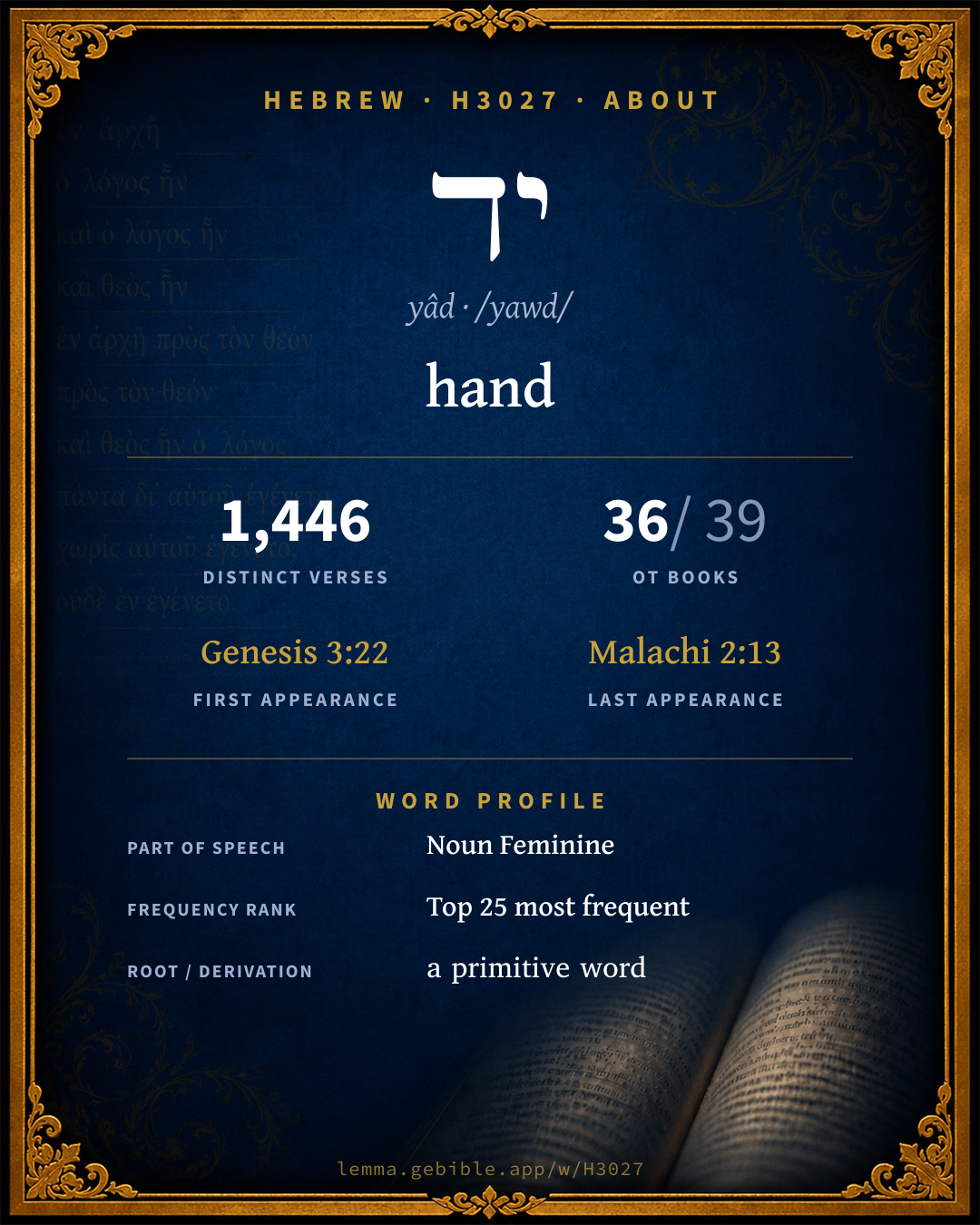
יָד
hand
‘hand’ is one of 4 main senses fuller range ↓
Full lexicon entry — Brown-Driver-Briggs (BDB)
From Brown-Driver-Briggs (BDB)
Where this word appears
See every Construct-state word in the Hebrew Bible →
Grammar key — what these labels mean
Part of speech
- Noun
- A naming word — a person, place, thing, or idea.
Noun type
- Common
- A common noun — a general class of person, place, or thing (“king,” “city,” “water”), not a specific name.
State
- Construct
- A noun bound to a following noun in a possessive / “of” relationship (the construct chain).
- Absolute
- The independent form of a noun, not bound to a following word.
Gender
- Both
- Attested as both masculine and feminine.
Number
- Singular
- One.
- Dual
- Exactly two — for natural pairs and some measures of time.
- Plural
- More than one (in Hebrew, generally three or more).
Every verse where H3027 appears in the Book of Micah — 5 distinct verses. Click any verse to open its interlinear word-by-word view. Verse text shown in the World English Bible for context — . Each verse’s Hebrew form is shown with its reference; the English is not keyword-highlighted, since the data carries no word-level English alignment. Use “Compare translations” on any verse to read it across multiple English versions. This concordance covers the Hebrew Bible; Septuagint (Greek Old Testament) occurrences are not indexed here.
Micah
- Micah 2:1 יָדָֽ/ם n c bs cs + sfx pers 3mp Woe to those who devise iniquity And work evil on their beds! When the morning is light, they practice it, Because it is in the power of their hand.
- Micah 5:9 יָדְ/ךָ֖ n c bs cs + sfx pers 2ms Let your hand be lifted up above your adversaries, And let all of your enemies be cut off.
- Micah 5:12 מִ/יָּדֶ֑/ךָ prep + n c bs cs + sfx pers 2ms I will destroy witchcraft from your hand; And you shall have no soothsayers.
- Micah 5:13 יָדֶֽי/ךָ n c bd cs + sfx pers 2ms I will cut off your engraved images and your pillars out of your midst; And you shall no more worship the work of your hands.
- Micah 7:16 יָד֙ n c bs The nations will see and be ashamed of all their might. They will lay their hand on their mouth. Their ears will be deaf.
About this entry
At a glance — auto-summarized from this page’s data, not written by a person. Every figure links to its source below. This summary describes the numbers; it doesn’t interpret them.
יד — transliterated yâd — is a Hebrew noun carrying the sense “hand.” The lexicon spreads it across several senses; see its full sense range. Spanning 1,446 verses in 36 books, it ranks among the most common words of the Hebrew Bible. Its earliest occurrence is Genesis 3:22. Sharing its root, it stands alongside יד, ידה and יך. See the sense tree, 1,446-verse concordance, and the renderings breakdown below.
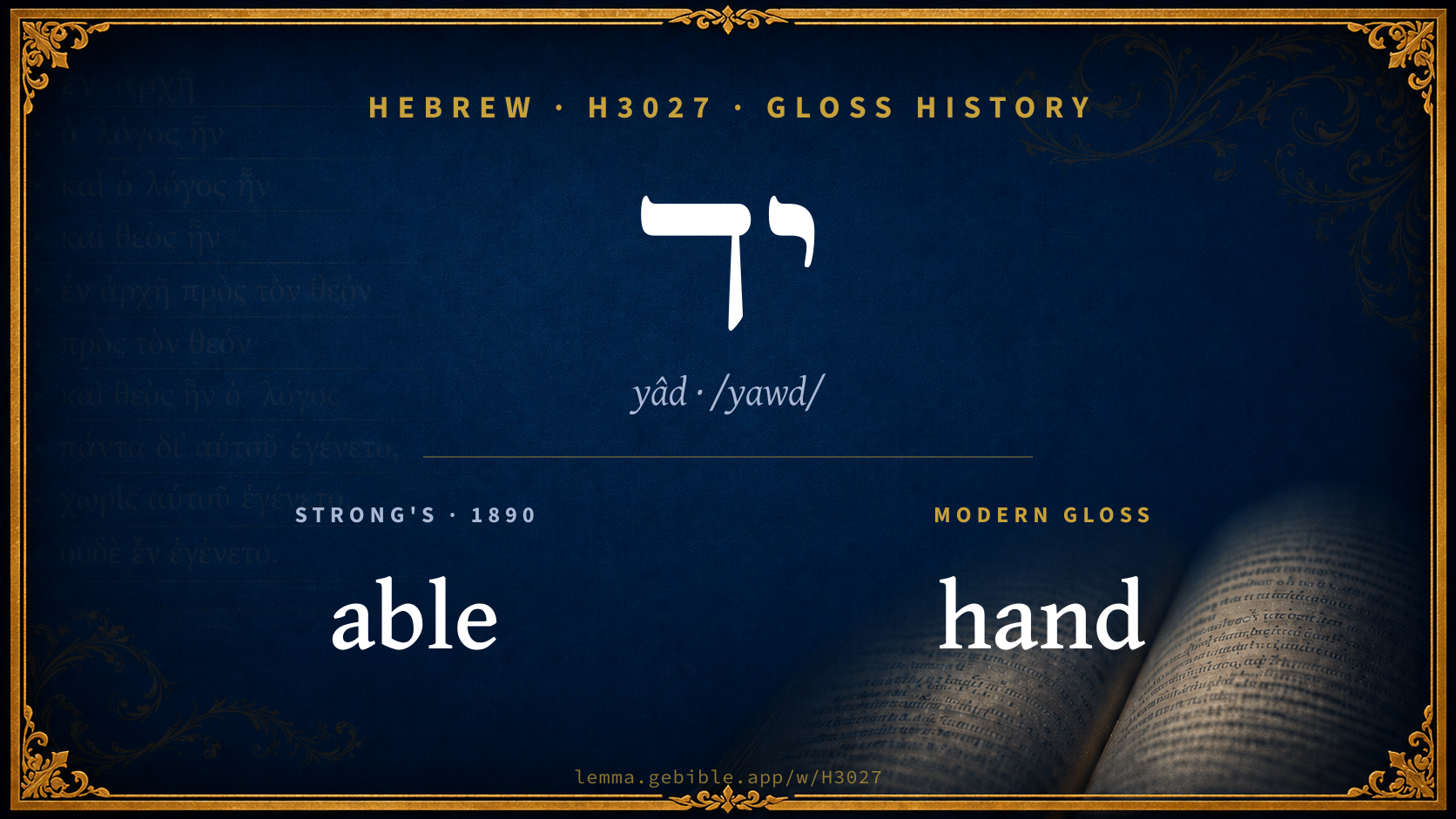
Gloss history
Strong's 1890 vs modern scholarship
About this word
Strong's H3027 catalogs a Hebrew word from the Hebrew Old Testament.
These counts are not copied from any lexicon or concordance. They are computed here, from the morphology-tagged Hebrew Old Testament. What Lemma adds →
- 1,446
- distinct verses
- The word appears in 1,446 distinct verses.
- 36 / 39
- OT books
- The word appears in 36 of 39 Old Testament books.
- #25
- by frequency
- Top 25 most frequent Hebrew words (rank 25 of 8,640 Hebrew words by occurrence).
View all 1,446 occurrences in the concordance →
By section of the Old Testament
By traditional corpus
Conventional, traditional groupings — biblical authorship is debated, so this is a traditional corpus grouping, not an authorship claim. Each share is this word’s portion of its verses in that division of the Hebrew canon. Each figure is a share of the word’s 1,446 distinct verses.
- Prophets (Nevi'im) 710 verses · 49%
- Writings (Ketuvim) 393 verses · 27%
- Torah (Pentateuch) 343 verses · 24%
How translations render this word
Counts come from each version’s own published word-to-Strong’s tagging or interlinear alignment — an approximate guide to how each version renders this word, not a word-level alignment the data otherwise carries. Because each total is that version’s own tagged count, the per-version totals vary from one another and need not match the appearance or distinct-verse counts above. These counts may also differ from a printed concordance because Lemma counts each distinctly tagged rendering and does not collapse phrase taggings into a single head-word total. This is a fixed set of word-tagged versions (KJV, ASV, BSB, ULT) and does not change with the reading translation you choose elsewhere. Each version’s license is shown beside its name below (and on Sources).
- King James Version: Hand 909×, Hands 231×, By 39×
- American Standard Version: Hand 775×, Hands 173×, By 64×
- Berean Standard Bible: Hand 630×, Hands 327×, Through 65×
- unfoldingWord Literal Text: Hand 755×, Hand of 398×, Hands 207×
King James Version Public Domain
Renders H3027 across 1,574 tagged occurrences — most commonly:
Plus other, less common renderings. Plus 200 renderings that appear only once — usually multi-word phrases or single function words the recovered tagging swept in, not distinct renderings. Not rendered by a distinct English word in 41 further occurrences.
American Standard Version Public Domain
Renders H3027 across 1,572 tagged occurrences — most commonly:
Plus other, less common renderings. Plus 288 renderings that appear only once — usually multi-word phrases or single function words the recovered tagging swept in, not distinct renderings. Not rendered by a distinct English word in 2 further occurrences.
Berean Standard Bible Public Domain
Renders H3027 across 1,403 tagged occurrences — most commonly:
Plus other, less common renderings. Plus 127 renderings that appear only once — usually multi-word phrases or single function words the recovered tagging swept in, not distinct renderings. Not rendered by a distinct English word in 211 further occurrences.
unfoldingWord Literal Text CC BY-SA 4.0
Renders H3027 across 1,633 tagged occurrences — most commonly:
Plus other, less common renderings. Plus 68 renderings that appear only once — usually multi-word phrases or single function words the recovered tagging swept in, not distinct renderings.
31 senses and sub-senses in the full BDB
What do BDB’s symbols mean?
BDB uses these scholarly abbreviations:
| Symbol | Meaning |
|---|---|
| 𝔊 | the Septuagint (the ancient Greek translation, LXX) |
| 𝔙 | the Vulgate (the Latin translation) |
| 𝔖 | the Syriac version (the Peshitta) |
| 𝔗 | the Targum (the Aramaic translation) |
| ψ | the Psalms |
| √ | root (the underlying root or stem) |
| ‖ | parallel passage (a synonymous or contrasted parallel) |
| † | the dagger: every passage where the word occurs is cited |
The 31 senses and sub-senses the full Brown-Driver-Briggs lexicon distinguishes for this word, in lexicon order (not ranked by frequency), with BDB’s own verbatim wording and sub-sense lettering. Shown in Hebrew script with BDB’s own scholarly abbreviations. The condensed entry is in the Lexicon Entry tab. See also the Forms in the corpus table below.
- 1. hand of man Gn 3:22; 4:11; 8:9 + often; תַּבְנִית יָד Ez 8:3 the shape of a hand (of God in Ezek.’s vision); of cherubim ת׳ יַד אָדָם 10:8, דְּמוּת יְדֵי אָדָם v 21: e.g. Genesis 3:22
- a. right hand יַד־יְמִינ(וֹ) Gn 48:17 (JE), Ju 7:20 2 S 20:9 Je 22:24 Ez 39:3 ψ 73:23; 121:5; יד[ם] הַיְמָנִית Ex 29:20 Lv 8:23, 24; 14:14, 17, 25, 28 (all P); a left-handed man is אִטֵּד יַד־יְמִינוֹ Ju 3:15; 20:16 (v. אטד); left hand יַד שְׂמֹאל(וֹ) 3:21; 7:20 Ez 39:3; both hands of one pers. are denoted by du., יָדַיִם Gn 27:22 2 K 3:11 + often; occasionally + numeral, שְׁתֵּי יָדָ֑י Dt 9:15, 17, so Lv 16:21 (P); du. also of hands of several persons Gn 5:29 Ex 29:10, 15, 19 Dt 31:29 2 K 11:16 = 2 Ch 23:15, Ez 21:12 +; yet sometimes sg. of hand of several persons Gn 19:16 Ex 29:9 Lv 8:24 Dt 1:25; 17:7(×2) Ju 7:20(×2) +. e.g. Genesis 48:17
- b. שְׁתֵּי כַּפּוֹת ידיו 1 S 5:4 the two palms of his hands; כַּפּוֹת הידים 2 K 9:35 Dn 10:10; אַצִּילוֹת יָדֶיךָ 9 Je 38:12 Ez 13:18; בֹּהֶן יָדָיו Ex 29:20 (P) = his thumbs (opp. בֹּהֶן רַגְלָם); בְּהֹנוֹת יד(יו) ורגל(יו) Ju 1:6, 7; bracelets were worn on hands, i.e. wrists Gn 24:22, 30, 47 (J), cf. thread bound on hand of Zerach 38:28(×2), 29, 30 (J), and cords on hands of Samson Ju 15:14; the ring was worn on hand, i.e. finger Gn 41:42 (E), Est 3:10. e.g. 1 Samuel 5:4
- c. as to hands in use, note זְרֹעֵי ידיו Gn 49:24 arms of his hands, i.e. arms which make his hands serviceable; מִלֵּא יָדוֹ בַּקֶּשֶׁת 2 K 9:24 he filled his hand with the bow, i.e. caused his hand to grasp it, seized it; הַרְכֵּב יָֽדְךָ עַל־הַקֶּשֶׁת 2 K 13:16(×2); especially fig. of consecrating or installing (as priest), מִלֵּא יַד he filled the hand of any one (perhaps orig. gave the selected portions of animal-sacrifices to, v. Lv 8:25 ff., so Di), installed as priest Ju 17:5, 12 1 K 13:33 (sq. וְ subord.); elsewhere only P and late: Ex 28:41 (‖ קִדַּשׁ), 29:9 also v 29 (‖ משׁח), v 33 (קדּשׁ), v 35 Lv 8:33 2 Ch 13:9; 29:31, sq. inf. Lv 16:32 (‖ משׁח), 21:10 (‖ יוּצַק שֶׁמֶן), Nu 3:3 (‖ משׁת); מִלֵּאתֶם יֶדְכֶם ליהוה 2 Ch 29:31 = ye have consecrated yourselves to י׳, is addressed appar. to the whole congregation (otherwise Be Öt and Di Ex 32:29); so the same expression Ex 32:29 (poss.) and 1 Ch 29:5 (certainly) of offering gifts to י׳; מִלְאוּ יָד֯ו Ez 43:26 of consecrating the altar (‖ כִּפֶּר, טִהַר); שָׁלַח יַד לְ Ju 5:26 stretch out hand to, so ישׁלח אֶל־ 2 S 6:6 (insert ידו Vrss Dr); hence מִשְׁלַח יד(כ)ם that to which one puts the hand, fig., = undertaking, †Dt 12:7, 18; 15:10; 23:21; 28:8, 20 †; שׁלח יד also in hostile sense, c. בְּ, Ex 22:7 1 S 24:7, 11; 26:11 ψ 55:21 +; cf. מוֹאָב מִשְׁלוֹחַ יָדָם Is 11:14; אֶבֶן יָד Nu 35:17 (P) a stone (thrown from) the hand; כְּלִי עֵץ־יָד v 18 a weapon in the hand; מַקֵּל יָד Ez 39:9 a staff in the hand; idols are מַעֲשֵׂה יְדֵי וגו׳ Is 2:8 + often v. מַעֲשֶׂה; man is work of God’s hand Jb 14:15. e.g. Genesis 49:24
- d. special phrases: kissing with the hand וַתִּשַּׁק יָדִי לְפִי Jb 31:27; (in silence) יָדִי שַׂמְתִּי לְמוֹ פִי 40:4 Mi 7:16 (עַל־פֶּה); the creditor is בַּעַל מַשֵּׁה יָדוֹ Dt 15:2; the debt מַשָּׁא כָל־יָד Ne 10:32; תְּרוּמַת יֶדְכֶם Dt 12:6, 11, 17 heave-offering of your hand; the hand is placed תחת יָרֵךְ in taking an oath Gn 24:2 (J); lifted (הרים) to י׳ 14:22; so perhaps יָד עַל־כֵּם יָהּ Ex 17:16 (E) hand on the throne of Yah! (but difficult, v. Di VB); often c. נשׂא: the hand is lifted (נשׂא) to heaven Dt 32:40 (of י׳’s oath, poem); elsewhere chiefly Ez and P: simply lift (נשׂא) the hand (= נשׁבע), sq. inf. Ex 6:8 Nu 14:30 (both P), Ez 20:28, 42; 47:14; sq. לְ pers. Ez 20:5(×2) (del. Co as gloss); sq. לְ pers. + inf. Ez 20:6, 15, 23; abs. 36:7; hence (citations) Ne 9:15 ψ 106:26; cf. Ne 8:6 the people answered אָמֵן אָמֵן בְּמֹעַל יְדֵיהֶם; נשׂא יד(ים) elsewhere (of men) in prayer ψ 28:2; cf. 68:32, and יָדִי לַיְלָה נִגְּרָה 77:3. Also of God, to give a signal Is 49:22; to rescue ψ 10:12. יְנֹפֵף יָדוֹ Is 10:32 he brandisheth his hand (Assyrian, in defiance); הֵנִיף יָדוֹ Is 11:15 (of י׳ in judgment), cf. 19:16 Zc 2:13 (sq. על); הֵנִיעַ יָדוֹ Zp 2:15 (in derision); הוֹשִׁיעַ יד לְ one’s hand bringing deliverance to, gaining success, by force, for 1 S 25:26 + (v. Dr), ins. also v 31 (𝔊 We Dr); the hand is weary יָֽגְעָה 2 S 23:10, it cleaves (דבק) to the sword (אֶל־הַחֶרֶב) v 10 (both om. by accident in ‖ 1 Ch 11:13, see VB); שֶׁבֶר יָד Lv 21:19 (H) fracture of hand = arm (‖ שֶׁבֶר רגל); after נָתַן: give a pledge וַיִּתְּנוּ יָדָם לְהוֹצִיא נְשֵׁיהֶם Ezr 10:19; submit נָתַן יַד תַּחַת שְׁלֹמֹה 1 Ch 29:24, i.e. they acknowledged him as their lord; תְּנוּ־יָד ליהוה 2 Ch 30:8; other phr. c. prep. v. infr. e.g. Job 31:27
- e. of hand as strong, helpful, etc.:—(1) of man: עֹצֶם יָדִי Dt 8:17 (‖ כֹּחִי); of fighting power of Edom בְּיָד חֲזָקָה Nu 20:20 (JE; ‖ בְּעַם כָּבֵד; cf. infr. of God); קִצְרֵי־יָד small in power 2 K 19:26 = Is 37:27 (cf. infr. of God); Isr. went out of Egypt בְּיָד רָמָה according to P, Ex 14:8 Nu 33:3 i.e. boldly, defiantly; same phr. of presumptuousness (against י׳) Nu 15:30 (P, cf. יָדֵנוּ רָ֫מָה Dt 32:27). Phrases of strengthening are: חִזַּק יָדָיו Ju 9:24 Ne 6:9; חִזַּק בְּיָדַיִם Ezr 1:6; החזיק בְּיַד־ Jb 8:20 (v. חזק); לִהְיוֹת יָדָיו אִתּוֹ 2 K 15:19 that his hands might be with him, to confirm his position; cf. 2 S 14:19 Je 26:24 1 Ch 4:10; note also מִי־הוּא לְיָדִי יִתָּקֵעַ Jb 17:3 who is he (that) will strike his hand into mine, i.e. give me a pledge (v. sub תקע); strength fails when hands drop: וַיִּרְפּוּ יָדָיו 2 S 4:1 then his hands dropped down, he grew feeble, spiritless (v. רפה); רְפֵי יָדַיִם 17:2 11 weak-handed, weak (‖ יָגֵעַ). (2) of (mighty) hand of God, pointing to earlier anthropomorphism; as strengthening Joseph Gn 49:24 (poem in J); as stretched out (שׁלח) to smite Ex 9:15 (J); so of מַלְאַךְ י׳ 2 S 24:16, sq. acc. + לְ inf., opp. הֶ֫רֶף יָדֶ֑ךָ v 16; as smiting (נָֽגְעָה בְּ) 1 S 6:9 Jb 19:21; as against (בְ among, in) cattle, etc., v 3 (J); city 1 S 5:9; the murrain v 3 (J); יַד־יהוה as heavy against (כבדה אֶל) 1 S 5:6; כָּֽבְדָה שָׁם v 11; קָֽשְׁתָה עַל v 7; of withdrawal of י׳’s chastising hand תָּסוּר יָדוֹ מִכֶּם 1 S 6:3; and (י׳ subj.) יָקֵל אֶת־יָדוֹ מֵעֲלֵיכֶם v 5; of י׳’s power to deliver his people:—†חֹ֫זֶק יָד Ex 13:3, 14, 16 (all JE) †; יָד חֲזָקָה 6:1(×2) (JE), 13:9 (JE), Dt 6:21; 7:8 Jos 4:24 (D); especially in phr. (בְּ)יָד חֲזָקָה וּ(בִ)זְרוֹעַ נְטוּיָה Dt 4:34 + (v. זְרוֹעַ p. 284); יד חזקה + כֹּחַ גָּדוֹל Ex 32:11 (JE), Ne 1:10; הֲיַד י׳ תִּקְצָ֑ר Nu 11:23 (JE) is the hand of י׳ shortened? Is 50:2; 59:1 (both sq. מִן); יָד נְטוּיָה in judgment Is 9:11, 16, 20; 10:4; הָֽיְתָה יַד־י׳ עלי(ו) of grasp of י׳’s hand in prophetic inspiration Ez 1:3; 3:22; 37:1; 40:1 2 K 3:15; יַד־י׳ עָלַי חזקה Ez 3:14; so בְּחֶזְקַת הַיָּד֑ Is 8:11; of God’s (י׳’s) good hand = favour, (late) יַד אלה(יו) טוֹבָה על(יו) Ezr 7:9; 8:18 Ne 2:8, 18; without טוֹבָה Ezr 7:6, 28; 8:22, 31; sq. inf. יַד האלהים לָתֵת לָהֶם 2 Ch 30:12; בֳּיֽדְךָ לְגַדֵּל 1 Ch 29:12; in gen. בֳּיֽדְךָ כֹּחַ וּגְבוּרָה v 12; of protection בְּצֵל יָדוֹ Is 49:2 in the shadow of his (י׳’s) hand. e.g. Deuteronomy 8:17
- 2. Fig. = strength, power:—לֹא הָיָה בָהֶם יָדַיִם לָנוּס Jos 8:20 (JE) there was not in them strength to flee; לֹא מָֽצְאוּ כָל־אַנְשֵׁי־חַיִל יְדֵיהֶם ψ 76:6 none of the men of might have found their hands, i.e. their powers are paralyzed in death (‖ נָמוּ שְׁנָתָם); with ref. to pecuniary ability: תַּגִּיעַ יָדוֹ דֵּי שֶׂה Lv 5:7 (on this and others c. דֵּי v. דַּי p. 191); תַּגִּיעַ יָדוֹ לִשְׁתֵּי תוֹרִים v 11 if his hand do not reach to two turtledoves; אֵין יָדוֹ מַשֶּׂגֶת 14:21 if his hand be unable to reach; so combinations with נשׂג Hiph.: v 22, 30, 31, 32 Nu 6:21 (all foregoing P), Lv 25:26, 47, 49; 27:8 (all H), Ez 46:7; כְּמַתְּנַת יָדוֹ Dt 16:17 according to the giving of his hand, i.e. his ability; similarly מַתַּת יָדוֹ Ez 46:5, 11; on יֶשׁ־לְאֵל יָדִי Gn 31:29, etc., v. ii. אֵל p. 43a supr.; other phr. c. prep. v. infr.; of dominion of king לְהָשִׁיב יָדוֹ בְּ 2 S 8:3 read prob. as ‖ 1 Ch 18:3 לְהַצִּיב יָדוֹ בְּ to establish his dominion at; hand = display of strength, action of י׳ ψ 78:42 Jb 27:11 Dt 34:12; especially הַיָּד הַגֶּדֹלָה אֲשֶׁד עָשָׂה י׳ Ex 14:31 (J) = the great achievement which י׳ did. e.g. Joshua 8:20
- 3. Fig. = side:
- a. of way יַד דֶּרֶךְ 1 S 4:13 Qr (Kt יך; but read prob. לְיַד השׁער v. Dr). e.g. 1 Samuel 4:13
- b. of gate בְּעַד יַד־הַשַּׁעַר 1 S 4:18 (text dub., v. Dr). e.g. 1 Samuel 4:18
- c. of stream or wady כָּל־יַד נַחַל יַבֹּק Dt 2:37. Especially du.: e.g. Deuteronomy 2:37
- d. of land, ארץ רַחֲבַת יָדַיִם Gn 34:21 (P) the land is wide of (on) both hands, i.e. in both directions, Ju 18:10 Is 22:18 1 Ch 4:40; of city Ne 7:4; of sea ψ 104:25; of streams רַחֲבֵי יָדָ֑יִם Is 33:21; מִיַּד כִּתִּים Nu 24:24 (JE) from the direction of Kittim.—Other phr. c. prep. v. infr. e.g. Genesis 34:21
- e. side = place, properly place at one side וְיָד תִּהְיֶה לְךָ מִחוּץ לַמַּחֲנֶה Dt 23:13; אִישׁ אֶת־יָדוֹ Je 6:3 each (in) his place; so כָּל־אִישׁ עַל־יָדוֹ Nu 2:17 (P);—v. other phrases c. prep. infr. e.g. Deuteronomy 23:13
- 4. יָד is used also in special senses:—
- a. monument 1 S 15:12; 2 S 18:18; 1 Ch 18:3 Is 56:5 sign Ez 21:24. e.g. 1 Samuel 15:12
- b. part, fractional part or share: of seed Gn 47:24 (J); share in king 2 S 19:44; of fighting men 2 K 11:7; of people Ne 11:1. e.g. Genesis 47:24
- c. time, repetition Gn 43:34 (J), Dn 1:20. Also f.pl. (only in fig. senses):— e.g. Genesis 43:34
- d. axle-trees 1 K 7:32, 33 (𝔖 ܐܻܝ̈ܕܰܗܳܬܳܐ). e.g. 1 Kings 7:32
- e. stays, supports for laver 1 K 7:35, 36; stays at sides of throne 1 K 10:19(×2) = 2 Ch 9:18(×2). e.g. 1 Kings 7:35
- f. tenons on sides of boards of tabernacle שְׁתֵּי יָדוֹת Ex 26:17 (P), also v 19(×2) 36:22, 24(×2). e.g. Exodus 26:17
- g. יָד חָזִית Is 57:8 according to Hi De Che Or Brd Du and most = a phallus thou beholdest; this favoured by context but without support in Heb. usage; Di a (beckoning) hand. e.g. Isaiah 57:8
- 5. יָד with prep.:—
- a. אֶל־יַד:—(1) after vb. of motion, into the charge, custody, of Est 2:3, 8(×2), 14; (2) אֶל־יַד by the side of gate 2 S 18:4; אֶל־יָדִי by my side, next to me 14:30; אֶל־יַד דֶּרֶךְ Ez 48:1a; אֶל־יַד חֲמָת v b (but on text v. Co); cf. also לְיַד, עַל־יַד. e.g. Esther 2:3
- b. בְּיַד into the hand: (1) נָתַן בְּיַד give into the hand of, lit., Gn 27:17; (2) into the possession of נָתַן בְּיַד Ex 10:25 (JE); especially (3) נתן ביד = give into the power of, deliver over to Jos 6:2; 7:7 (both JE), Dt 1:27 Ju 2:14a; 13:1; 15:12 1 K 22:6 2 K 18:30; 19:10; מָכַר בְּיַד sell into the hand of Ju 2:14b; 3:8; 4:2, 9; 10:7; נפל בְּיַד fall into the hand of 15:18 2 S 24:14; וַיְשַׁלְּחֵם בְּיַד פִּשְׁעָם Jb 8:4 and he delivered them into the power of their transgression, gave them over to it; also Is 64:6, which read וַתְּמַגְּנֵנוּ for MT וַתְּמוּגֵנוּ; (4) נתן בְּיַד = entrust to Gn 30:35; 32:17. e.g. Genesis 27:17
- c. בְּיַד in the hand of: (1) lit. מַטְּךָ אֲשֶׁר בְּיָדֶ֑ךָ Gn 38:18 (J) thy staff which is in thy hand, Ex 7:17 (J), 17:9 (E), 32:15 Nu 22:23, 31 Jos 5:13; 8:18 (all JE), 1 S 13:22; 14:27; 17:50; 18:10; 20:10 2 K 11:8, 11 = 2 Ch 23:7, Am 7:7 Is 6:6 Ez 40:3, 5; 47:3 Zc 2:5; 8:4; אֵין בְּיָדִי רָעָה וָפֶ֫שַׁע 1 S 14:12 there is not in my hand evil or transgression (orig. prob. of stains of blood, or other evidences of crime); מַה־בְּיָדִי רָעָה 26:18; (2) fig. in the possession of, Ex 21:16 (JE); נִמְצָא בְּיָדִי 1 S 9:8 there is found in my hand, i.e. I happen to have (¼ shekel); (3) in the (physical) power of Gn 16:6 (J; cf. תִּתְעַנִּי תַּחַת יָדֶיהָ v 9), Jb 1:12; בְּיַד לָשׁוֹן Pr 18:21 in the power of a tongue; in the care or charge of, entrusted to, Gn 39:23 (J); under the authority of 2 S 18:2(×3); Nu 31:49 (P);—in Je 41:9 (AV because of Gedaliah), read בּוֹר גָּדוֹל הוּא for ביד גדליהו הוא 𝔊 Hi Kue Gf Che Gie DrSm 291; (4) בְּיַד also with vbs. of taking, וַיִּקַּח בְּיָדוֹ אֶת־הָאֵשׁ Gn 22:6 and he took the fire in his hand, Ex 4:17, 20, 21 (all E), 1 S 17:40 2 K 9:1; thence to denote accompaniment, taking or being with one Jos 9:11 (JE), 2 S 8:10; 1 K 14:3 2 K 5:5; אִישׁ שׁוֹרוֹ בְּיָדוֹ 1 S 14:34 cf. 16:2; קַח בֳּיֽדְךָ שְׁלשִׁים אֲנָשִׁים Je 38:10. e.g. Genesis 38:18
- d. בְּיַד by the agency or instrumentality of Gn 38:20 (J), Ju 6:36; 1 S 11:7; 16:20 2 S 3:18; 10:2; 11:14; 12:25; 2 K 14:27; 2 Ch 1:17; 7:6 (orig. lit. sense discernible sometimes); especially of י׳’s speaking by the agency of prophets Ex 9:35 (R), Lv 8:36; 10:11 Nu 4:37, 45; 9:23; 10:13; 17:5; Jos 14:2; 20:2; 21:2, 8 (all P), 1 S 28:15, 17; 1 K 16:7, 12, 34; 2 K 9:36; 17:18, 28; 2 Ch 10:15; 33:8; 34:14; 35:6; Ne 8:14; 9:14, 30; מוּת בְּיַד י׳ Ex 16:3 (P) die by the hand of י׳; בְּיַד by the side of (very rare) ψ 141:6; Zc 4:12 olive-branches beside the two golden pipes; = near to, in time, נָכוֹן בְּיָדוֹ יוֹם חשֶׁךְ Jb 15:23 ready at his hand is a day of darkness (i.e. near at hand). e.g. Genesis 38:20
- e. כְּיַד הַמֶּלֶךְ 1 K 10:13; Est 1:7; 2:18 according to the hand (bounty) of the king. e.g. 1 Kings 10:13
- f. יָד לְיָד ‘hand to hand, surely’ Pr 11:21 לְיַד by the side of 1 S 19:3; 1 Ch 18:17; 23:28; Ne 11:24; Pr 8:3 ψ 140:6. e.g. Proverbs 11:21
- g. מִיַּד out of the hand:—(1) out of the power of, often nearly = מִן, used idiomat. c. many vbs.: c. הִצִּיל Gn 32:12(×2) (J), Ex 2:19; 18:9, 10(×2) (all JE), 1 S 17:37; מִתַּחַת יַד Ex 18:10 (JE; so c. פשׁע 2 Ch 21:8, 10(×2); cf. i. infr.); of animals מִיַּד 1 S 17:37(×2), מִיַּדִ־כֶּלֶב ψ 22:21; even of inanimate things י׳ לֶהָבָה Is 47:14 י׳ פַּח ψ 141:9; c. לָקַח Nu 21:26 (JE), 1 K 11:34, 35; c. קָרַע v 12, 31; c. מִלֵּט, מ׳ מִיַּד שְׁאוֹל ψ 89:49; c. פָּדָה, פ׳ מִיַּד שְׁאוֹל Ho 13:14 (‖ מִמָּ֫וֶת), ψ 49:16; פ׳ מִידֵי חֶרֶב Jb 5:20; pregn. יִשְׁפְּטֵנִי מִיָּדֶ֑ךָ 1 S 24:16 may he (י׳) judge (and save) me out of thy hand; so 2 S 18:19 and (with רִיב for שׁפט) 1 S 25:39; (2) מִיַּד of separation, מִיָּֽדְךָ נִגְזָ֑רוּ ψ 88:6 of wicked, cut off from nearness to God; (3) דָּרַשׁ מִיַּד exact (at the hand) of 2 S 4:11; Gn 9:5(×2) (P), Ez 33:6; 34:10 (= דָּרַשׁ מֵעִם Dt 18:19), also of animals Gn 9:5; בִּקֵּשׁ מִיַּד Ez 33:8; קָנָה מִיַּד Ru 4:5, 9 acquire at the hand of; נִקַּם מִיַּד 2 K 9:7; הִקְרִיב מִיַּד Lv 22:25 (H), רָצָה מִיַּד (י׳ subj.) Mal 1:10, 13; לָקַח רָצוֹן מִיַּד 2:13. e.g. Genesis 32:12
- h. עַל־יד(י):—(1) upon the hand(s) of תְּנָה אֹתוֹ עַל־יָדִי Gn 42:37 = entrust him to me (E; lit. put him upon my hand); יַגִּירֻהוּ עַל־יְדֵי־חָ֑רֶב ψ 63:11 they shall pour him out upon the hands of the sword = deliver him up to the sword; so Je 18:21 Ez 35:5; (2) עַל־יָד by hand Pr 13:11; עַל־יַד, עַל־יְדֵי according to the hand(s) of = at the guidance, direction of: עַל־יַד 1 Ch 25:2a; 2 Ch 26:13; עַל־יְדֵי Je 5:31; 33:13; so 1 Ch 25:2b, 3, 6(×2); עַל־יְדֵי דָוִיד 2 Ch 23:18 Ezr 3:10; עַל־יְדֵי כְּלִי דָוִיד 2 Ch 29:27 according to the guidance of the instruments of David; (3) by the side of, way עַל־יַד דֶּרֶךְ הַשַּׁעַר 2 S 15:2; river (היאר) עַל־יַד Ex 2:5 (E), Nu 13:29 (JE; ‖ עַל־הַיָּם), Je 46:6 Dn 10:4; city Jos 15:46 (JE); person (= in the company of) 2 S 15:18; people 2 Ch 21:16; especially late עַל־יַד next to (in a series) 17:15, 16, 18; 31:15 Ne 3:2(×2) + 13 times Ne 3, 13:13; עַל־יְדֵי by the side of Ju 11:26; people (אדום) עַל־יְדֵי Nu 34:3 (P), 1 Ch 7:29; cattle Jb 1:14; הֶעֱמִיד עַל־יְדֵי שִׁיר 1 Ch 6:16 he stationed them by the side of song, i.e. to watch over the singing. e.g. Genesis 42:37
- i. תַּחַת יַד under the hand = in the possession, at the disposal of; וְאִין יֶשׁ־פֹּה תַֿחַת־יָֽדְךָ חֲנִית וגו׳ 1 S 21:9; = in the power of, subject to Is 3:6 come, thou shalt be our ruler and this ruin under thy hand; pl. sq. vb., וְהִתְעַנִּי תַּחַת יָדֶיהָ Gn 16:9 (J) and submit thyself under her hands, her authority, Is 3:6.—מִתַּחַת יַד v. g. (1) supr., and sub תַּחַת. for מִתַּחַת יַד, 2 K 8:20, 22 (= 2 Ch 21:8, 10), 13:5; 17:7. e.g. 1 Samuel 21:9
Senses from the full Brown-Driver-Briggs lexicon (Brown, Driver, Briggs; Oxford 1906 — public domain), digitized via Sefaria, supplemented by the OpenScriptures HebrewLexicon (CC BY 4.0). Full attribution on Sources.
Word origin
n.f. Gn 25:26 + often (m. †Ex 17:12 †v. Di; on יִרְפּוּ יָדַיִם 2 S 4:1 Zp 3:16 2 Ch 15:7 Ne 6:9, v. Ges§ 145. 7 a, R. 1) hand (NH id.; Aramaic יְדָא, ܐܻܝܕܳܐ; Zinj. יד DHMSendsch. Gloss.; Arabic يَدٌّ; Sab. יד DHMZMG 1883, 343 Mordt ib. 1879, 492; Ethiopic እድ (v. LagBN 22); Sam. ࠀࠃ; Assyrian idu, hand, strength COTGloss.; der. by most from √ ל״י, on ground of pl. and sf. forms in cogn. lang., v. especially Philippi ZMG 1878, 74 Ba ZMG 1887, 637, but no trace of final י or ו in Heb., and meaning of such √ ל״י not clear; Thes al. from ידה extend, throw, but this in Arabic Ethiopic פ״ו, not פ״י, cf. Heb. Hiph.; Philippi comp. Arabic يَدَى iv. strengthen;—Sta§ 182, 183 regards יד as bilit.)—abs. יָד Gn 38:28 +; cstr. יַד 41:35 +; sf. יָדִי 14:22 +; יָֽדְךָ 22:12 +; יָֽדְכָה Ex 13:16; יֶדְכֶם Gn 9:2 +; יֶדְכֶן Ez 13:21(×2), 23, etc.; du. יָדַיִם Gn 34:21 +; cstr. יְדֵי 24:30 +; וִידֵי Ex 15:17 +, etc.; fpl. (in fig. senses) abs. יָדוֹת Gn 43:34 + 8 times; יָדֹת 47:24 + 2 times; cstr. וִידוֹת 1 K 7:32; sf. יְדֹתָיו Ex 26:19(×2) + 2 times; יְדֹתֶיהָ 1 K 7:35, 36; יְדוֹתָם 1 K 7:33;—
— Brown-Driver-Briggs (Oxford 1906, public domain), digitized via Sefaria, supplemented by the OpenScriptures HebrewLexicon (CC BY 4.0). See Sources.
Origin: a primitive word
Jastrow Dictionary
A second Hebrew/Aramaic lexicon for comparison, covering Aramaic and post-biblical (Talmudic, Targumic, Midrashic) usage that the biblical-Hebrew BDB does not. Matched by lemma rather than by Strong’s number, so a lemma may carry more than one Jastrow headword (shown separately below), and the entries cover usage well beyond the Bible.
יָד
- f. (rarely m.) (b. h.;
- 1. hand; forefoot; handle. Ex. R. s. 42, end מיד ליד from hand to hand, directly, opp. ע"י שלוחו through his messenger.—י׳ רחבה a wide hand, liberality. Y. Ḥag. I, 76ᶜ top עני ויָדוֹ ר׳ a poor man who is liberal, opp. י׳ מעוטה stingy.—Ḥull. 58ᵇ, a. fr. בְּיָד on the forefoot (of a quadruped).—Ukts. I, 1 כל שהוא יד ולא שזמר whatever part of a fruit serves as a handle (as the stem) and not as a protector (as the shell of a nut &c.). Kel. XXIX, 4 יַד הקורדום the handle of an ax; a. v. fr.—Cant. R. to I, 4 לא חלתה יד ליד hand does not fit hand, i.e. the two cases are incongruous.—Trnsf. an intimation, an incomplete statement intelligible from context, surroundings &c. Y. Ned. I, 36ᵈ top תופסין אותו משם יד לקרבן we make him responsible because what he said is suggestive of the word korban (as a vow); a. fr.—Du. יָדַיִם; pl. יָדוֹת. Yad. I, 1 נותנין לי׳ is required for pouring on the hands. Ib. II, 3 הי׳ מטמאות וכ׳ hands (when being washed) become unclean or clean up to the wrist; a. v. fr.—י׳ יפות, v. יָפֶה.—Ned. 2ᵇ ידות נדרים (or ידות) suggestions of vows, contrad. to כינויים, v. כִּינּוּי. Ib. 5ᵇ, a. fr. י׳ שאין מוכיחות לא הויין י׳ suggestions which are not beyond doubt, are no (binding) suggestions; a. fr.
- 2. power, authority, possession, share. B. Mets. 70ᵇ, v. אֶמְצַע. Kidd. 3ᵇ קטנה דלית לה יד וכ׳ a minor who cannot accept a betrothal for herself. Ned. 88ᵇ יד אשה כיד בעלה the wife’s possession is her husband’s possession. Kidd. 23ᵃ גיטו ויָדוֹ באים כאחד his letter of manumission and his right of self-disposal come simultaneously. Yeb. 39ᵃ; Keth. 83ᵃ ידו כיָדָהּ the husband’s right of disposal is as great as the wife’s (concerning what belongs to her); ידו עדיפא מידה his rights are stronger than hers. B. Mets. VI, 2 יָדָן על התחתונה their rights are the lowest, i.e. they are responsible for losses but can derive no benefits from favorable chances; ib. כל המשנה ידו על התחתונה וכ׳ whichever side changes the agreement is at a disadvantage, and whichever side breaks the agreement &c.; a. v. fr.—Du. יָדַיִם, constr. יְדֵי. Ab. Zar. 41ᵇ, a. e. מִירֵי ודאי, v. וַדַּאי.—יְדֵי חובתו, v. יָצָא.
- 3. portion, part.—Pl. יָדוֹת. Tosef. Men. IX, 10 שתי י׳ two thirds; a. fr.—מִיַּד (= מיד ליד) at once, directly, immediately. Tosef. Dem. VIII, 7, v. חָלַל Hif.—Y. Pes. VI, 33ᵃ מיד כל מי וכ׳ presently, every one whose Passover offering was a lamb &c.; a. v. fr.— עַל יַד, על יְדֵי (abbr. ע"י) through, by means of. Gitt. 40ᵇ שמא זיכה לו ע"י אחר he may have benefitted him (given him his liberty) through the agency of another person (without the slave’s knowledge). Nidd. I, 1 מעת לעת ממעטת ע"ו וכ׳ the period of twenty four hours is modified by the interval between one examination and the other (if that interval is less than twenty four hours); a. v. fr.—על ידי ש־ because. Lev. R. s. 32 ע"י שגדרו וכ׳ because the Israelites guarded themselves against unchastity, they were redeemed; a. v. fr.—עַל יָד עַל יָד gradually, little by little. B. Kam. 80ᵃ (opp. מיד); Tosef. ib. VIII, 15. Par. VIII, 7 Hai G. (ed. only once ע"י).—כלאחר יד, v. אַחַי.—יָדַיִם Yadayim, name of a treatise of the Mishnah and Tosefta, of the Order of Tohăroth, containing the laws of levitical cleanness or uncleanness of the hands.
יַד
- Targ. Num. XXXV, 17; a. fr.—V. אִידָא.—Kidd. 30ᵃ top אַדְּיָדָךְ על וכ׳ while thy hand yet rests on thy son’s neck (as long as you have control over him). Ab. Zar. 15ᵃ אַיָּדָא דספסירא (= h. על ידי) through an agent; a. fr.—Pl. יָדִין, יָדַיָּא. Targ. Ez. XXI, 12 (ed. Wil. יְדֵין). Targ. Is. XIII, 7; a. fr.—עַל יַד, על יְדֵי, v. preced. Targ. Ps. LXXXIX, 20. Targ. Y. Num. XXXIII, 1; a. fr.—על יְדֵי ד־ = h. ע"י ש־. Targ. Y. II, Gen. XLIV, 18.—מִן יַד, מִיַּד, v. preced. Targ. Y. Gen. I, 3. Targ. Ps. LIX, 12; a. e.
A Dictionary of the Targumim, the Talmud Babli and Yerushalmi, and the Midrashic Literature (Marcus Jastrow; London, Luzac, 1903) — Public Domain. Digitized via Sefaria. Digitized via Sefaria. Full attribution on Sources.
Forms in the corpus
The 463 distinct written forms H3027 takes in the Hebrew Bible, most frequent first — each parse links to that state’s occurrences in the concordance. Hebrew forms include their vowel points and cantillation, so a single lemma takes many written forms.
The 60 most common forms are shown; 403 rarer forms follow in the full concordance.
Same root — word family
Other BDB entries built from the same root as H3027, grouped by Strong’s listed origin. These share a root / origin per the lexicon — not necessarily a shared meaning. Each links to that word’s own entry.
Derived from this word
Compare all same-root words → They share a root, not necessarily a meaning.
Septuagint verse parallels
This word appears in 1,354 verses that also exist in the Greek Old Testament (Septuagint), out of the 1,446 Hebrew verses it occurs in. You can read those verses in Greek by switching the Old Testament edition to the Septuagint.
Read these verses in the Septuagint
- Genesis 3:22
- Exodus 2:5
- Leviticus 1:4
- Numbers 2:17
- Deuteronomy 1:25
- Joshua 2:19
- Judges 1:2
- Ruth 1:13
- 1 Samuel 2:13
- 2 Samuel 1:14
- 1 Kings 2:25
- 2 Kings 3:10
This is a verse-level parallel only — the same verses exist in both the Hebrew and Greek Old Testaments. No word-level Hebrew↔Greek correspondence is claimed: the data carries no such alignment, so no Greek word is shown as this Hebrew word’s translation. Coverage is not total — the Septuagint omits the deuterocanon and renumbers the Psalms, so some Hebrew verses have no direct Greek parallel.