
Proverbs 11:21

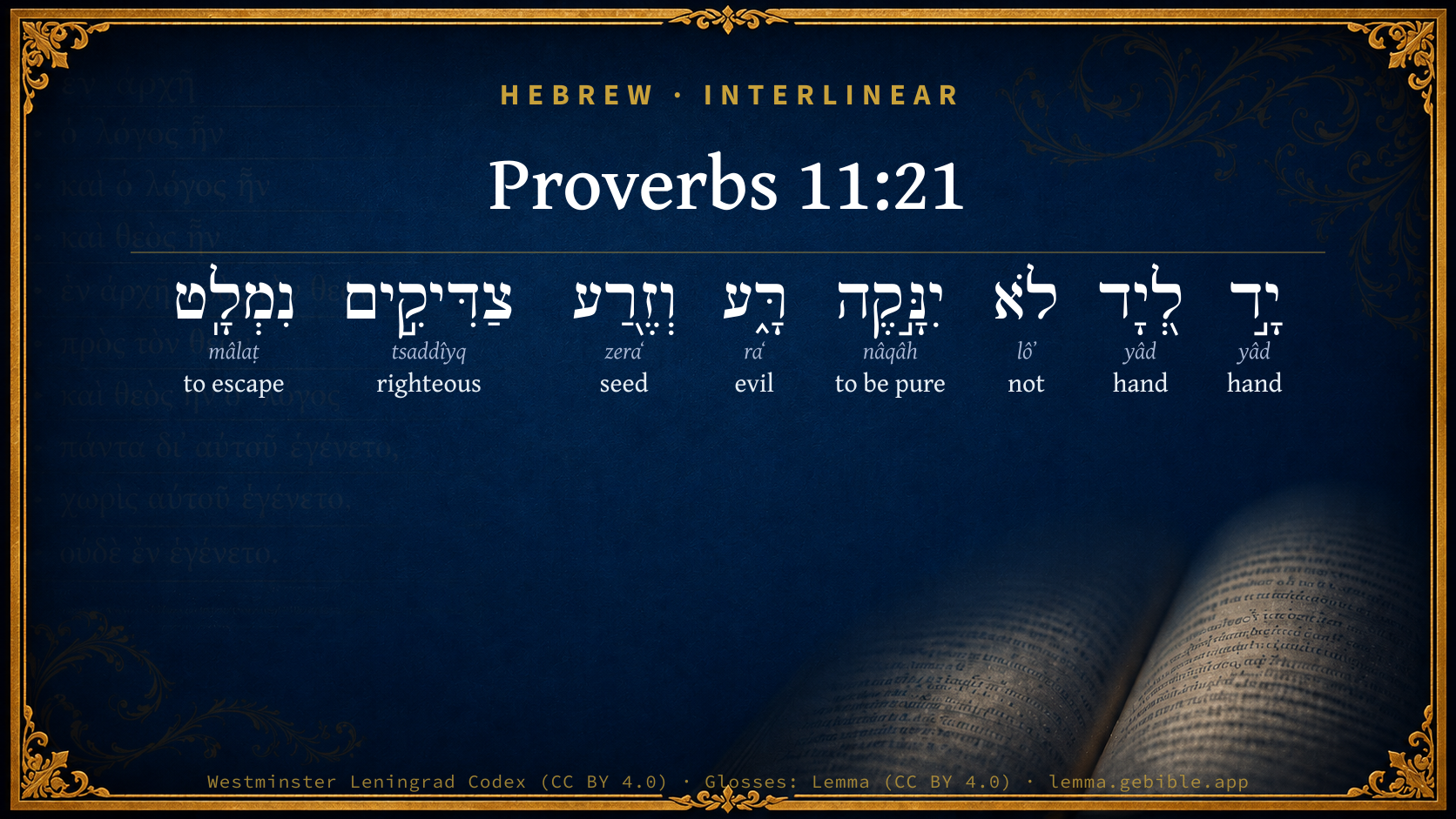
Hebrew (Westminster Leningrad Codex) Proverbs 11:21 appears in the Hebrew Old Testament. The text above is from the Westminster Leningrad Codex. Each word links to its Strong’s number, a concise gloss, and parsing drawn from the Open Scriptures Hebrew Bible morphology. Click any word for its full Brown-Driver-Briggs (BDB) entry.
Download image
Cite this verse

Proverbs 11:21 (World English Bible). Public Domain. Lemma interlinear Bible study tool, https://lemma.gebible.app/v/proverbs/11/21.

Show BibTeX & RIS
BibTeX
RIS
English Translation
Most assuredly, the evil man will not be unpunished, But the seed of the righteous will be delivered.
World English Bible · Public Domain
Download a study sheet

One document with this verse’s original text, its word-by-word gloss line, the meaning frame, cross-references with their text, attributed commentary, and full source and license credits — printable, and it pastes into notes with its structure intact.

This verse Autodidact and up

Study sheet (.html) Plain text (.txt)

A passage Seminary Student

Up to 50 verses in one chapter. A passage sheet keeps up to 6 commentary sources and 12 cross-references per verse, in the order this page ranks them, and says so on the sheet whenever that leaves anything out. Ask for a single verse and you get the Autodidact verse sheet above.

Everything on this page stays free to read, with no account — the sheet is a download of what is already on screen, not access to it.

Want to remove ads? Support Godless Engineer
Compare translations 3

The same verse in 3 English versions, stacked beneath the original-language interlinear above. Click any original word for its lexicon entry.

Each is an independent rendering of the whole verse — the interlinear is not word-aligned to these translations.

Highlighted words mark where these versions differ — a whole-verse word diff, not a word-by-word alignment.

  • World English Bible Public Domain
    Most assuredly, the evil man will not be unpunished, But the seed of the righteous will be delivered.
  • King James Version Public Domain
    Though hand join in hand, the wicked shall not be unpunished: but the seed of the righteous shall be delivered.
  • unfoldingWord Literal Text CC BY-SA 4.0
    Hand to hand, a wicked will not remain blameless, but the seed of the righteous will safely escape.

unfoldingWord Literal Text — © unfoldingWord, licensed CC BY-SA 4.0. Word-aligned USFM3 via Door43 (git.door43.org/unfoldingWord/en_ult).

Versions to compare (up to 4)

3 of 4 selected

Show all 18 translations

Every available English version of this verse, each an independent rendering of the whole verse.

  • World English Bible Public Domain
    Most assuredly, the evil man will not be unpunished, But the seed of the righteous will be delivered.
  • Berean Standard Bible Public Domain
    Be assured that the wicked will not go unpunished, but the offspring of the righteous will escape.
  • Majority Standard Bible Public Domain
    Be assured that the wicked will not go unpunished, but the offspring of the righteous will escape.
  • King James Version Public Domain
    Though hand join in hand, the wicked shall not be unpunished: but the seed of the righteous shall be delivered.
  • American Standard Version (1901) Public Domain
    `Though' hand `join' in hand, the evil man shall not be unpunished; But the seed of the righteous shall be delivered.
  • Revised Version (1885) Public Domain
    Though hand join in hand, the evil man shall not be unpunished: but the seed of the righteous shall be delivered.
  • Geneva Bible (1599) Public Domain
    Though hande ioyne in hande, the wicked shall not be vnpunished: but the seede of the righteous shall escape.
  • Douay-Rheims (1899) Public Domain
    Hand in hand the evil man shall not be innocent: but the seed of the just shall be saved.
  • Young's Literal Translation Public Domain
    Hand to hand, the wicked is not acquitted, And the seed of the righteous hath escaped.
  • Literal Standard Version CC BY-SA 4.0
    Hand to hand, the wicked is not acquitted, || And the seed of the righteous has escaped.
  • Unlocked Literal Bible CC BY-SA 4.0
    Be sure of this—the wicked person will not go unpunished, but the descendants of righteous people will be kept safe.
  • unfoldingWord Literal Text CC BY-SA 4.0
    Hand to hand, a wicked will not remain blameless, but the seed of the righteous will safely escape.
  • Darby Bible Public Domain
    Hand for hand! an evil [man] shall not be held innocent; but the seed of the righteous shall be delivered.
  • World Messianic Bible Public Domain
    Most certainly, the evil man will not be unpunished, but the offspring of the righteous will be delivered.
  • Webster's Bible Public Domain
    Though hand join in hand, the wicked shall not be unpunished: but the seed of the righteous shall be delivered.
  • Free Bible Version CC BY-SA 4.0
    You can be certain of this: the wicked won't go unpunished, but the good will be saved.
  • Bible in Basic English Public Domain
    Certainly the evil-doer will not go free from punishment, but the seed of the upright man will be safe.
  • JPS Tanakh (1917) Public Domain
    My hand upon it! the evil man shall not be unpunished; but the seed of the righteous shall escape.

Literal Standard Version (2020), Covenant Press — licensed CC BY-SA 4.0. Text via the HelloAO Bible API (eBible.org). Unlocked Literal Bible (unfoldingWord) — licensed CC BY-SA 4.0. Text via the HelloAO Bible API (eBible.org). unfoldingWord Literal Text — © unfoldingWord, licensed CC BY-SA 4.0. Word-aligned USFM3 via Door43 (git.door43.org/unfoldingWord/en_ult). Free Bible Version, Dr. Jonathan Gallagher — licensed CC BY-SA 4.0. Text via the HelloAO Bible API (eBible.org).

Word by word

More ways to search: Search by grammar → Find every occurrence → Compare this word →

Practice this passage: Drill this verse → Learn its vocabulary →

יִנָּ֣קֶה
nâqâh
H5352
“to be pure”
Verb, Niphal, Imperfect, 3rd Person, Masculine, Singular
Part of Speech
Verb
Stem
Niphal
Form
Imperfect
Person
3rd Person
Gender
Masculine
Number
Singular
Full BDB Definition

Origin: a primitive root

TWOT: 1412

to be empty, be clear, be pure, be free, be innocent, be desolate, be cut off - (Qal) to be empty, be clean, be pure - (Niphal) - to be cleaned out, be purged out - to be clean, be free from guilt, be innocent - to be free, be exempt from punishment - to be free, be exempt from obligation - (Piel) - to hold innocent, acquit - to leave unpunished
  1. יָ֣ד yâd H3027 “hand” Noun, Common, Both, Singular, Absolute
  2. לְ֭יָד yâd H3027 “to/for · hand” Preposition + Noun, Common, Both, Singular, Absolute
  3. לֹא lôʼ H3808 “not” Particle, Negative
  4. רָּ֑ע raʻ H7451 “evil” Adjective, Adjective, Masculine, Singular, Absolute
  5. וְזֶ֖רַע zeraʻ H2233 “and · seed of” Conjunction + Noun, Common, Masculine, Singular, Construct
  6. צַדִּיקִ֣ים tsaddîyq H6662 “righteous” Adjective, Adjective, Masculine, Plural, Absolute
  7. נִמְלָֽט mâlaṭ H4422 “to escape” Verb, Niphal, Perfect, 3rd Person, Masculine, Singular

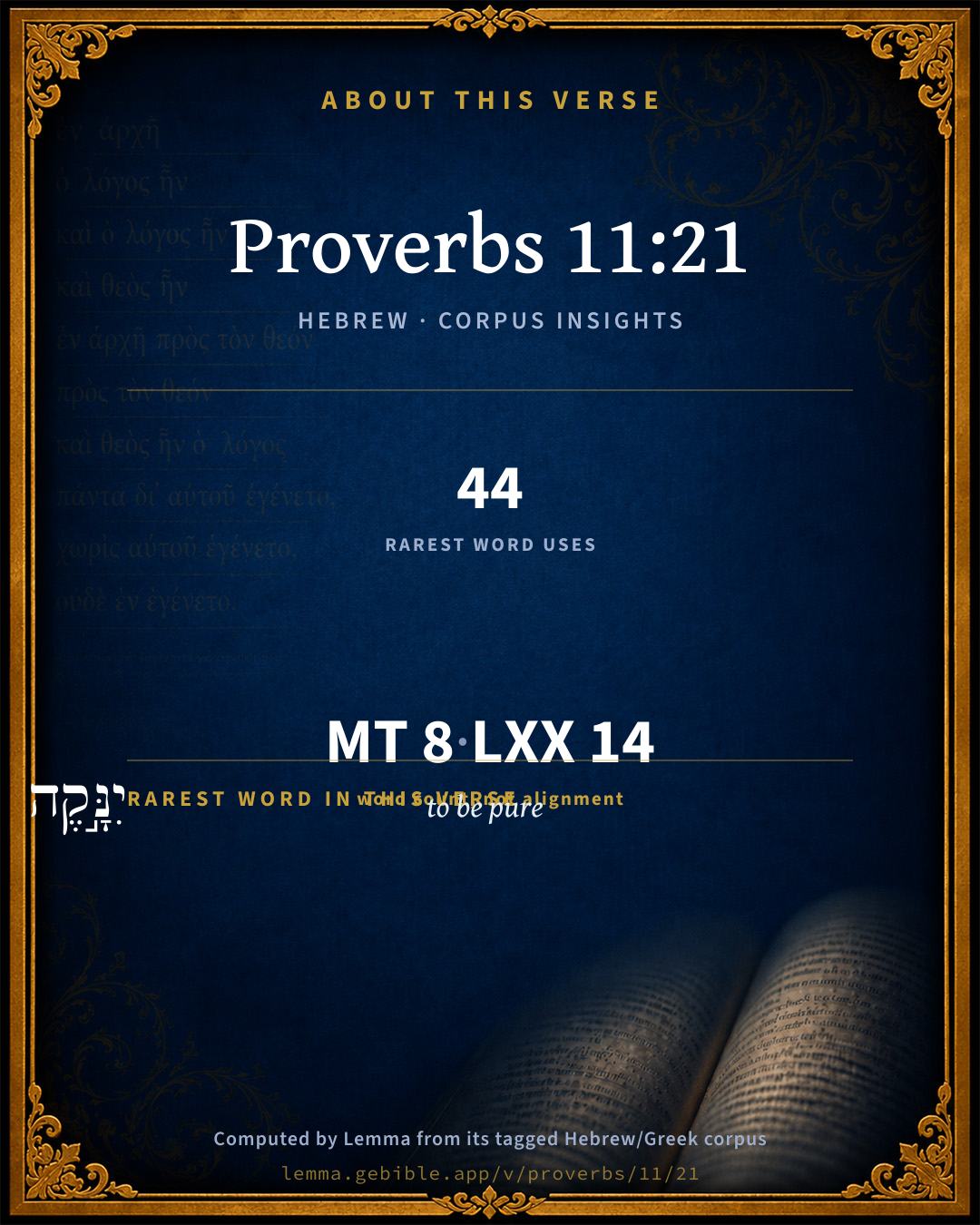
About this verse

These counts appear in no published source. They are computed here, from the morphology-tagged text and Lemma’s own curated glosses. What Lemma adds →

8
words
7
distinct lemmas
Wisdom
section

Shared distinctive vocabulary

יִנָּ֣קֶה to be pure H5352 occurs in 33 verses of the Hebrew Bible. Also found in:

Grammatical profile

  • 2 verbs
  • 3 nouns
  • 2 adjectives
  • 1 particle

Verb forms

  • יִנָּ֣קֶה Niphal · Imperfect
  • נִמְלָֽט Niphal · Perfect

Repetition

A word recurs within this verse — often emphatic in Hebrew:

  • יָ֣ד hand H3027 ×2

Hebrew & Septuagint length

In English translation the verse runs 18 words from the Hebrew and 20 from the Septuagint (LXX English) — closely comparable.

A rough comparison of the two English renderings, which tokenize alike — not a word-level alignment.

Word counts can differ between the Hebrew and the Greek without any difference in meaning — e.g. the Hebrew direct-object marker אֵת has no separate Greek word, and Greek often adds the article ὁ.

In the original languages it is 8 Hebrew tokens and 14 Greek tokens — but the two are counted differently (Hebrew bundles its prefixes and suffixes into one token; the Greek is in lemma form), so that isn’t a like-for-like length.

Cross-references

9

Topical passages linked to Proverbs 11:21 in the Treasury of Scripture Knowledge — connected by theme and wording, ordered by reader-vote popularity; previews shown in the World English Bible.

  • Psalms 112:1–2 Praise Yah! Blessed is the man who fears Yahweh, Who delights greatly in his commandments.
  • Acts 2:39 For to you is the promise, and to your children, and to all who are far off, even as many as the Lord our God will call to himself."
  • Jeremiah 32:39 and I will give them one heart and one way, that they may fear me forever, for the good of them, and of their children after them:
  • Psalms 37:26 All day long he deals graciously, and lends. His seed is blessed.
  • Proverbs 16:5 Everyone who is proud in heart is an abomination to Yahweh: They shall assuredly not be unpunished.
  • Proverbs 13:22 A good man leaves an inheritance to his children's children, But the wealth of the sinner is stored for the righteous.
  • Genesis 17:7–8 I will establish my covenant between me and you and your seed after you throughout their generations for an everlasting covenant, to be a God to you and to your seed after you.
  • Exodus 23:2 You shall not follow a crowd to do evil; neither shall you testify in court to side with a multitude to pervert justice;
  • Isaiah 27:4 Wrath is not in me: would that the briers and thorns were against me in battle! I would march on them, I would burn them together.

Cross-references courtesy of OpenBible.info (CC BY 4.0).

Hebrew and Greek witnesses Masoretic Hebrew ↔ Greek Septuagint

The same verse in the two great witnesses to the Old Testament, shown verse-for-verse.

These are two independent witnesses, not word-aligned to each other, and the Septuagint is shown in lemma (dictionary) form.

Hebrew Proverbs 11:21 Masoretic · Westminster Leningrad Codex

יָ֣ד לְ֭יָד לֹא יִנָּ֣קֶה רָּ֑ע וְזֶ֖רַע צַדִּיקִ֣ים נִמְלָֽט

Most assuredly, the evil man will not be unpunished, But the seed of the righteous will be delivered.

World English Bible · Public Domain

Greek LXX Proverbs 11:21 Septuagint · lemma form

χείρ χείρ ἐνβάλλω ἀδίκως οὐ ἀτιμώρητος εἰμί ὁ δέ σπείρω δικαιοσύνη λαμβάνω μισθός πιστός

He that unjustly strikes hands shall not be unpunished: but he that sows righteousness he shall receive a faithful reward.

LXX2012 (modern English Septuagint) · Public Domain

On this verse, The Cambridge Bible for Schools and Colleges discusses the Septuagint’s reading. Read the note in Commentary ↓

Hebrew: Westminster Leningrad Codex (CC BY 4.0). Greek: Septuagint (public domain); English from LXX2012 (modern English Septuagint) (Public Domain). How the Septuagint differs from the Hebrew →

Commentary

Notes on Proverbs 11:21 from classic Christian and Jewish commentators (each source and its license shown beneath its notes). The classic Christian expositions comment on the surrounding passage and are grouped to its opening verse, so a note may address several verses; the Jewish commentaries on the Tanakh (Rashi and others) are per-verse, so they appear only where the commentator wrote on this verse.

Lemma curates 59 commentaries, every one of them public domain or Creative Commons licensed, each selected and text-cleaned for this edition rather than reprinted as found. About our sources →

Trapp's Complete Commentary

John Trapp

Pro 11:21 [Though] hand [join] in hand, the wicked shall not be unpunished: but the seed of the righteous shall be delivered.

Ver. 21. Though hand join in hand, &c.] Heb., Hand to hand; that is, "out of hand, … by and by," as some interpret it. Munster renders it, "Though plague follow upon plague, the wicked will not amend." Others, though there be a combination, a conspiracy of wicked doers, as if, giant like, they would fight against God, {a} and resist his wrath, yet they shall never be able to avert or avoid it. "The wicked shall be turned into hell, yea, whole nations that forget God." {Psa 9:17} God stands not upon multitudes: he buried the old world in one universal grave of waters; and "turning the cities of Sodom and Gomorrah into ashes, condemned them with an overthrow." {2Pe 2:6} This is a good sense. Howbeit I cannot but incline to those that expound, "hand in hand," for "father and child," in regard of the following line, "But the seed of the righteous shall be delivered." As if the prophet should say - The wicked traduce a cursed stock of sin to their children, and shall therefore be punished in their own person, or at least in their posterity. "This their way is their folly; yet their posterity approve their sayings. Therefore like sheep they are laid in the grave, death shall feed on them." {Psa 49:13-14}

{a} Fεομαχοι.

John Trapp, A Commentary or Exposition upon All the Books of the Old and New Testament (1647–1656) — public domain. Text from a community e-Sword module.

The Biblical Illustrator

Joseph S. Exell

Pro_11:21

Though hand join in hand, the wicked shall not be unpunished.

(Taken with Luk_23:51)

The laws of responsibility in combinations and partnerships

We are surrounded by numberless combinations devised by men for all manner of purposes--religious, political, judicial, social, commercial, scientific, industrial, artistic, educational, etc. Men widely abandon endeavours after striking individuality in thought or conduct, and throw themselves blindfold into the stream of fashion which carries the multitude away. Men seek to recover their lost sense of power by combination with others in doctrine, in capital, indeed in all departments. The will of each individual becomes, as it were, a single minute cog in a mighty wheel-work of engineering, which carries everything before it. All this is not favourable to the sense of responsibility for conduct here or hereafter. There is a special delusion which attends the combinations in which men seek to recover the sense of power, and to unite their forces in order to accomplish their ends. This delusion consists in mistaking joint responsibility for divided responsibility. The persuasion is extended widely that union is not only strength in administration and enterprise, but that it distributes the oppressive burden of responsibility in equal or nearly equal and insignificant shares between all the persons who are joined together in any undertaking; so that although the practical result of their united action may be morally indefensible, or even utterly wicked and injurious, no single person can be justly blamed, or rendered accountable for the whole criminality of the result--since the wickedness has been effected by an organisation or administration consisting of numbers of agents who have assisted or consented in the work. A characteristic proverb has descended to us from the last century to this effect: A cathedral chapter would divide even a murder between them--a proverb unfairly singling out one particular kind of Christian combination for censure, yet embodying two truths applicable to every association, civil and religious.

1. That even well-disposed men will sometimes agree to do in company what they would not dare to do as individuals.

2. That no mans personal accountableness to God can ever be swallowed up and lost in an impersonal organisation. The relation of the individual to the moral government of God is primary, dominant, and inalienable; it cannot be diminished by the concurrence of others. Before God the combination of men in counsel and action results always not in divided responsibility but in joint responsibility. Each member is responsible for the whole result of what he consents to, or carries into action. There can be no divided liability for a conjoint iniquity. If this were not so, it would require men only to join hand in hand to go unpunished. But how should God judge the world unless in all such cases the responsibility is joint, not distributive? This is also the principle of human legislation and administration. It is not, therefore, good to undertake, as if merely nominal, any real responsibilities.

This truth, that a man is responsible for whatever he consents to, ought--

1. To be proclaimed in relation to ecclesiastical organisations and missionary societies.

2. The principle may be seen in the working of political party. Educated men are guilty, in a free country, of all the national iniquity against which they do not protest with determination.

3. The principle of personal liability needs application to commercial affairs and civil life. The Almighty God stands behind every creditor and every customer, in readiness to assert and enforce every just claim to the uttermost. The Infinite Defender of Right is behind every person who is wronged. The highest Law Court is omnipresent and sleepless. We cannot put an end to the great battle between selfish interests, but we can do much by public spirit and sound legislation to alleviate its woes. On the whole I must express my conviction, however, that the commercial world will bear an honourable comparison with the political and ecclesiastical, when tried by this principle of the responsibility of each member in every combination. (Edward White.)

Combination

Men, like sheep, are gregarious. The combination is--

I. Natural. The wicked, in the text, are supposed to be in danger, and nothing is more natural than for men to crowd together in common danger. Fear as well as love brings men together; the one drives, the other draws.

II. Useless. No combination of men, however great in number, vast in wisdom, mighty in strength, affluent in resources, can prevent punishment from befalling the wicked. It must come.

1. The moral constitution of the soul.

2. The justice of the universe.

3. The almightiness of God, render all human efforts to avoid it futile. (Homilist.)

Opposing God useless

The uselessness of opposing God must be manifest from every point of view. God is omniscient, and knows all things; is almighty, and can do all things; is omnipresent, and is everywhere: so that no device or counsel or plot can succeed against Him. The image of the text is that of conspiracy, wicked men combining, saying to one another in effect, It each of us cannot succeed singly, we may by combination succeed as a unity. The possibility of such a conspiracy was foreseen, and the issue of it is foretold in these plain terms. Let men add money to money, genius to genius, influence to influence, counsel to counsel, still it is but like the addition of so many ciphers--the number being very great but the value being absolutely nothing. What one man cannot do in this direction a thousand men are unable to do. Fool, then, is he who supposes that because he has followed a multitude to do evil, therefore no harm will come to him. Every man in the multitude will be judged as if he were alone responsible for the whole mischief. Hands that are joined together in wickedness may be dissevered on any occasion and for the flimsiest reasons. It is folly for any wicked man to trust in a man as wicked as himself, for the very fact that wickedness renders security impossible, and turns all manner of association into a mere matter of temporary convenience, which may be varied or destroyed according to a thousand contingencies. All evil partnerships in business are doomed to failure. All irregular alliances in the household must come to confusion and disappointment, and may end fatally. The same law holds good in the State, and indeed in every department of life. There can be no security but in righteousness, in high wisdom, in unselfish enthusiasm; where these abound the security is as complete as it is possible for man to make it. Men cannot be joined wisely and permanently together unless they are first joined to the living God. Men can only be joined to the living God through the living Christ; He is the vine, men are the branches, and unless the branch abides in the vine it cannot bear fruit, but is doomed to be burned. True union, therefore, must be religious or spiritual before it can be human and social. Neglect of this great law has ended in inexpressible disappointment and mortification on the part of statesmen, reformers, and propagandists of every kind. (J. Parker, D.D.)

But the seed of the righteous shall be delivered.--

The sanctions of obedience

The text is a twofold proposition--that combinations against God and godliness only incur failure and penalty; and that the triumph of righteousness is equally sure. There are among mens habits three general kinds of wickedness, or disobedience to Gods laws, entailing upon them three several orders and degrees of retribution or punishment: violations of the laws which govern the spiritual or moral man, the animal man, and the social man.

1. If the mind-laws, which include the intellectual and moral aspects of man, be disobeyed, that is if the process of education be not contemporaneous with the progress of years, the mental faculty languishes in the stagnation of its undeveloped powers, the mental man grows and abides an ignoramus, a stereotyped boor; and if the means of grace be in like manner neglected, the spiritual man rises not into the dignity which the love of God designed for him.

2. If the body-laws, or the principles which regulate the health, be disregarded by habits of excess or even ordinary indulgence or neglect of exercise, the penalty is a diseased body, and personal infirmity.

3. If the estate laws be disregarded, which make industry essential to getting, and frugality essential to saving what is got, and forethought essential in the way of insurance upon life or property, the punishment meets the man in his estate, in his condition of life, that is, in the form in which he has sinned. When we pray for a sound and enlightened mind, do we turn to the Word whose entrance giveth light? Do we seek to inform our minds, correct our judgments, and enrich our memories? When we pray for health and strength to labour and enjoy, do we avoid those varieties, artifices, and excesses in food and drink, and those sluggish habits of inactivity and sloth, which make health physically impossible? When we pray for prosperity in our worldly affairs, do we still, on conscientious principles, labour, working with our hands the thing that is meet? Do we glorify God in our attention to our business? Where can there be a more cogent, impressive, animating motive than the sterling fact, Ye are not your own; ye are bought with a price; therefore glorify God in your bodies and spirits, which are His? Man can no more do without God, or act independently of God and His laws, than the rays of light can dispense with the sun. All the errors of individual character, all the failures in educational theories, all the mistakes of experimental legislation, originate in the fundamental fatal effect of reckoning without God, setting aside the great elemental fact that He is at the root, progress, and issue of all things, and that to put Him out of our calculations, to supersede His constitution, is to start upon false premises, to provoke and compel a failure, to reason and range in a vicious circle, for ever retracing its impracticable, unprogressive steps. The wicked shall not go unpunished. The seed of the righteous shall be delivered. (Joseph B. Owen, M.A.)

The Biblical Illustrator, edited by Joseph S. Exell (c. 1880s–1900s) — public domain. Text from a community e-Sword module.

The Preacher's Complete Homiletical Commentary

Joseph S. Exell (gen. ed.)

CRITICAL NOTES.—

Pro_11:21. The Hebrew here is simply “hand to hand, the wicked,” etc. Zöckler and Delitzsch understand it as a formula of strong asseveration derived from the custom of becoming surety by clasping hands, and hence equivalent to “assuredly,” “verily,” “I pledge it.” Stuart says “Different meanings have been assigned.

1. Hand against hand, i.e., the injurious man.

2. From one hand to another, i.e., from one generation to another.

3. Joining hands in way of assurance—“verily.” All these are little better than guesses. The phrase is evidently proverbial and is doubtless abridged. The most simple interpretation is that of Michael, “Hand joined to hand will not protect the guilty. Let the evil man struggle with all his might he will not escape.”

MAIN HOMILETICS OF Pro_11:21

DELIVERANCE FROM A CONFEDERATED OPPOSITION

I. The wicked will certainly confederate against the good. They will join “hand in hand.”

1. On account of their nearness to each other. If two nations who are near neighbours feel that the advance of one in possessions, in power, in wealth, will be the correspondent retrogression of the other, there will be a confederation of each nation. Their nearness to each other will necessitate a defensive confederation—most likely an offensive one, for each will feel that its existence depends upon a union of its members. The wicked and the good in the entire universe make but two hostile camps, although they are not separated into distinct nationalities or divided by geographical boundaries in this world. Some of each side are found in every nation, in every city, in every hamlet, often in the same house, and while this is the case there will be confederation on both sides. We have here to do only with that of the wicked. Hatred of the good is often the only bond of union between wicked men, they feel that, if the good are to be held back from possessing the earth, they must unite to oppose their work. Hatred of Christ united Herod and Pilate (Luk_23:12).

2. This confederation of the wicked is against both persons and principles. The good fight only against the principles of the godless—they love their persons, the wicked hate both the persons and principles of the good.

3. The wicked will confederate because of the tremendous issues depending upon the conflict. If the principles that govern the good should triumph in the world, they instinctively feel that there will be no place left for their persons and principles.

4. Confederation implies choice, confidence in numbers, thought, and a covenant to stand by each other. Those who join hand to hand show that they choose each other’s society—choice is a revelation of character—those who join hands with the wicked reveal that they are wicked also. It implies confidence in numbers. Numbers have a wonderful influence in begetting confidence. They inspire men with hope of success. It seems impossible that so many can be defeated. The fact that the wicked are in the majority in this world is often a strong point with them. This was the hope of Pharaoh (Exo_14:6-7) and of Sennacherib (Isaiah 36). The first Napoleon made it his boast that “Providence fought always on the side of great battalions.” It likewise implies thought. They do not go to their work without taking counsel together as to the best means of accomplishing their ends. This “multitude of counsellors” (Pro_11:14) is one of the advantages of confederation. It likewise implies covenant. There is something even in a wicked man that makes him slow to break an agreement—to violate a solemn promise. Even the wicked Herod would keep his oath to the daughter of Herodias, although the thought of the crime which he must commit to do so startled him for a moment (Mat_14:9). All these things together make up the strength of the confederation of the wicked; but, notwithstanding,—

II. They will be defeated. “The seed of the righteous will be delivered.” The end of all their planning and plotting was the destruction of the good, but it will not be. Another confederation has been formed which has in it a stronger Person than any in the confederation of the wicked. God is in it. God has chosen the good for His confederates because they have chosen Him (Isa_41:8-9). Although the wicked have many on their side there are more in numbers on the other side (2Ki_6:16). Those unseen defenders of the good cause must be taken into account. God has thoughts and plans which embrace and overrule all the plans and schemes of the wicked. He has likewise made a covenant, and He cannot “alter the thing that has gone out of His lips” (Psa_89:34). Therefore the righteous may meet their foes with this challenge: “Associate yourselves, O ye people, and ye shall be broken in pieces; gird yourselves, and ye shall be broken in pieces. Take counsel together, and it shall come to naught; speak the word, and it shall not stand; for the Lord is with us” (Isa_8:9-10).

III. The members of the wicked confederation will be punished. Men think that individuals will be lost in the crowd. They think there is safety in being one of many. But it is not so. God will deal with men as individuals. He will “render to every man according to His work” (Psa_62:12). This is the word of the Lord to those who dare “to take counsel together against the Lord and against His anointed (Psa_2:2)—“Judgment also will I lay to the line and righteousness to the plummet; and the hail shall sweep away the refuges of lies, and the waters shall overflow the hiding-place. And your covenant with death shall be disannulled, and your agreement with hell shall not stand; when the overflowing scourge shall pass through, then ye shall be trodden down by it” (Isa_28:18). And this is His word to “the seed of the righteous,”—“Behold they shall surely gather together, but not by me: whosoever shall gather together against thee shall fall for thy sake. Behold, I have created the smith that bloweth the coals in the fire, and that bringeth forth an instrument for his work; and I have created the waster to destroy. No weapon that is formed against thee shall prosper, and every tongue that shall rise against thee in judgment thou shalt condemn” (Isa_54:15; Isa_54:17).

ILLUSTRATION

A very solemn method of taking an oath in the East is by joining hands, uttering at the same time a curse upon the false swearer. To this the wise man probably alludes. This form of swearing is still observed in Egypt and the vicinity; for when Mr. Bruce was at Shekh Hunner, he entreated the protection of the governor in prosecuting his journey, when the great people who were assembled came, and after joining hands, repeated a kind of prayer about two minutes long, by which they declared themselves and their children accursed, if ever they lifted up their hands against him in the tent, or the field, or the desert, or in case that he or his should fly to them for refuge, if they did not protect them at the risk of their lives. Or, sometimes, when two persons make a contract they bring the palms of their right hands into contact, and raise them to their lips and forehead. At other times they rub the forefingers of their right hands together, repeating the words “right, right,” or “together, together.”—Paxton’s Illustration.

OUTLINES AND SUGGESTIVE COMMENTS

What many wicked cannot do, in saving one wicked man from wrath, that shall one godly man do for many. For not only himself, but his seed shall be delivered.—Jermin.

The best way for any man to do his children good, is to be godly himself.—Dod.

The “seed of the righteous” is not simply the children of righteous people, because it includes the parents themselves; not simply the parents, because it includes the children; not both parents and children, because many children perish; but the seed of the righteous in the sense

(1) that righteousness runs in lines;—there is a generation of them that seek Him (Psa_24:6)—and

(2) that the righteous, as far as they are righteous in the parental relation, will have godly children (Gen_18:19; Tit_1:6). Righteousness itself (by its fidelities) has its offspring in Christian families. This is the favourite method of the Church’s growth.—Miller.

Let sinners beware of the danger and the inevitable result of fighting against God! “He is wise in heart, and mighty in strength; who hath hardened himself against Him and: prospered?” What fearful odds—the creature against the Creator! the sinner against his rightful Judge! the arm of flesh against the hand of Omnipotence. Though the wicked could league all creation with them in conspiracy and rebellion, how powerless the combination! “He that sitteth in the heavens should laugh; the Lord should have them in derision. He should speak unto them in His wrath, and vex them in His sore displeasure.” Companions in sin shall be companions in banishment and suffering. “Forsake the foolish, then, and live.” Choose another fellowship. Give your hand to God’s people, giving your heart to God Himself.—Wardlaw.

When we hear of the wicked, we are apt to think that men of abandoned lives can alone be meant. Hence, when we read the text we have a picture brought before us of some overbearing tyranny, or some perfidious conspiracy. Such specimens of evil are doubtless intended; still, after all, much more is included in its meaning, much which we see before our eyes. Is not the world itself evil? Is it an accident, is it an occasion, is it but an excess, or a crisis, or a complication of circumstances, which constitutes its sinfulness? or, rather, is it not one of our three great spiritual enemies at all times, and under all circumstances? (See Jas_4:4; Eph_2:2; Rom_12:2; 1Jn_2:15). Let us be sure, then, that that confederacy of evil which Scripture calls the world—that conspiracy against God of which Satan is the secret instigator—is something wider, and more subtle, and more ordinary than mere cruelty, or craft, or profligacy: it is that very world in which we are. It is not a certain body or party of men—it is human society itself.—J. H. Newman.

The Preacher's Complete Homiletical Commentary (gen. ed. Joseph S. Exell; Funk & Wagnalls, c. 1892) — public domain (pre-1929). A full-Bible homiletical/sermon-outline anthology covering 65 of 66 books (2 John is absent from the source module). Text from a community e-Sword module.

Tyndale Open Study Notes

Tyndale Open Resources

11:21 Godly behavior has positive consequences for the next generation.

Tyndale Open Study Notes — © Tyndale Open Resources, licensed CC BY-SA 4.0. Text via the HelloAO Bible API.

Geneva Bible (1599)

Geneva Bible translators

Though they make never so many friends, or think themselves never so sure, yet they shall not escape.

Geneva Bible (1599) marginal notes — public domain. Text via Bolls.life.

Matthew Henry's Commentary

Observe, 1. That confederacies in sin shall certainly be broken, and shall not avail to protect the sinners: Though hand join in hand, though there are many that concur by their practice to keep wickedness in countenance, and engage to stand by one another in defending it against all the attacks of virtue and justice, - though they are in league for the support and propagation of it, - though wicked children tread in the steps of their wicked parents, and resolve to keep up the trade, in defiance of religion, - yet all this will not protect them from the justice of God; they shall not be held guiltless; it will not excuse them to say that they did as the most did and as their company did; they shall not be unpunished; witness the flood that was brought upon a whole world of ungodly men. Their number, and strength, and unanimity in sin will stand them in no stead when the day of vengeance comes. 2. That entails of religion shall certainly be blessed: The seed of the righteous, that follow the steps of their righteousness, though they may fall into trouble, shall, in due time, be delivered. Though justice may come slowly to punish the wicked, and mercy may come slowly to save the righteous, yet both will come surely. Sometimes the seed of the righteous, though they are not themselves righteous, are delivered for the sake of their godly ancestors, as Israel often, and the seed of David.

Matthew Henry's Commentary on the Whole Bible (1708–1710) — public domain (CC PDM 1.0). Text via the HelloAO Bible API.

Jamieson, Fausset & Brown

Robert Jamieson, A. R. Fausset & David Brown

The combined power of the wicked cannot free them from just punishment, while the unaided children of the righteous find deliverance by reason of their pious relationship (Psa 37:25-26).

Jamieson, Fausset & Brown — Commentary Critical and Explanatory on the Whole Bible (1871) — public domain (CC PDM 1.0). Text via the HelloAO Bible API.

Adam Clarke's Commentary

Verse 21. Though hand join in hand] Let them confederate as they please, to support each other, justice will take care that they escape not punishment. The Hindoos sometimes ratify an engagement by one person laying his right hand on the hand of another.-WARD.

Adam Clarke's Commentary on the Bible (1810–1826) — public domain. Text from a community e-Sword/MySword module.

Ellicott's Commentary for English Readers

(21) Though hand join in hand.—For this sense comp. Isa_28:15, sqq. The passage may also mean “hand to hand,” i.e., from one generation to another; or, what is most probable, “the hand to it,” i.e., assuredly. For the general sense of the verse, comp. Psalms 37

A Bible Commentary for English Readers, edited by Charles John Ellicott (1878–1897) — public domain. Text from a community e-Sword module.

The Cambridge Bible for Schools and Colleges

gen. ed. J. J. S. Perowne

21. Though hand join in hand] Lit. hand to hand. This obscure phrase may mean either, though men clasp one another’s hands in strong confederacy (χειρὶ χεῖρας ἐμβαλὼν, LXX.); or, preserving more closely the parallel, from generation to generation, the idea being that of the Second Commandment, Exo_20:5.

The rendering, My hand upon it, R.V. marg. (sit dextra fidei testis), though forcible, is hardly in keeping with the style of this Book. The same phrase occurs Pro_16:5.

The Cambridge Bible for Schools and Colleges (gen. ed. J. J. S. Perowne; Cambridge University Press, 1878–1918) — public domain. Text from a community e-Sword module.

John Gill's Exposition

Though hand join in hand, the wicked shall not be unpunished,.... Though they give the hand to one another, unite in their counsels, enter into combinations, confederacies, and strict alliances, and join all their force and strength together; or though with both hands, with all their might and main, endeavour to secure themselves, yet they shall not go unpunished. This may be exemplified in the kings of the earth, that will join each other, and gather their armies together, to make war against Christ; when they will be conquered, taken, and slain, Rev 19:19. Jarchi interprets it, "from hand to hand", and explains it thus; from the hand of God into their hand shall come the reward of their work, and shall not go unpunished: to which may be added, even though there may be a succession of parents and children, and their substance may be handed down from the one to the other, yet at last just punishments will take place. To which is opposed,

but the seed of the righteous shall be delivered; these are the seed of the church in all successive ages; the seed that are accounted of by the Lord for a generation; particularly the remnant of the woman's seed, that keep the commandments of God, and have the testimony of Jesus Christ; against whom the dragon, the old serpent the devil, was wroth, and went forth to make war, in order utterly to destroy them; but they escaped his hands, were delivered from him, and preserved by the power and grace of God, as a seed to serve him, Rev 12:17.

John Gill's Exposition of the Whole Bible (1746–1763) — public domain (CC PDM 1.0). Text via the HelloAO Bible API.

Albert Barnes' Notes on the Bible

literally, “hand to hand.” The meaning of which is, “Hand may plight faith to hand, men may confederate for evil, yet punishment shall come at last;” or “From hand to hand, from one generation to another, punishment shall descend on the evil doers.”

Albert Barnes' Notes on the Bible (1834–1885) — public domain. Text from a community e-Sword/MySword module.

Haydock's Catholic Bible Commentary

In hand. At rest, or making agreements. God will punish the race of the wicked.

George Leo Haydock (1774–1849), Haydock's Catholic Family Bible and Commentary, 1859 edition — public domain. Excludes Psalms (Douay-Rheims chapter numbering differs from Protestant) and Deuterocanonical books (Catholic canon only).

Matthew Poole's English Annotations

Though hand join in hand; though they are fortified against God’s judgments by a numerous issue, and kindred, and friends, and by mutual strong combinations or confederacies. Shall not be unpunished; they shall be punished even in their own persons, as well as in their posterity. They shall not be able either totally to prevent God’s judgment, or to delay it from coming in their days.

The seed of the righteous, not only their persons, but their children, shall be delivered, without any such auxiliaries, by God’s special providence.

Matthew Poole's English Annotations on the Holy Bible (1683–1685) — public domain. Text from a community e-Sword/MySword module.

Whedon's Commentary on the Bible

Daniel D. Whedon

21. Though hand join in hand — Another disputed passage. יד ליד, (yadh leyadh,) hand to hand, was, likely, an elliptical phrase, with a conventional sense well understood at the time, but uncertain to us. The common acceptation of it is co-partnership; that is, a confederacy of wicked men binding one another by oath, in which they joined hands; a powerful combination to effect an evil result. Another sense sometimes given to it is, hand added to hand, as the emblem of strength and exertion: that is, let the wicked exert himself to his utmost with both hands, he shall not be acquitted or innocent; but the seed of the righteous — the righteous generation or race — shall be delivered. Compare Pro_16:5, for a similar expression. The first part of this verse may receive illustration by the following, from Bruce: “The great people among them (the shepherds of Suakem) came, and, after joining hands, repeated a kind of prayer of about two minutes long, by which they declared themselves and their children accursed if they ever lifted their hands against me, in the tell or in the field, in the desert or on the river; or in case I or mine should fly to them for refuge, if they did not protect us at the risk of their lives, their families, and their fortunes, or, as they emphatically expresses it, to the death of the last male child among them.”

Daniel D. Whedon (gen. ed.), Commentary on the Old and New Testaments (1874–1909) — public domain. Text from a community e-Sword module.

The Pulpit Commentary

Though hand join in hand; (Pro_16:5) literally, hand to hand, which may be taken variously. The Septuagint and some other versions take the phrase in the sense of unjust violence: "He who layeth hand upon hand unjustly;" Vulgate, manus in manu, "hand in hand," which is as enigmatical as the Hebrew. Some Jewish interpreters consider it an adverbial expression, signifying simply "soon." Some moderns take it to mean "sooner or later," as the Italian da mano in mano, or, in succession of one generation after another (Gesenius, Wordsworth). Others deem it a form of adjuration, equivalent to "I hereby attest, my hand upon it!" And this seems the most probable interpretation; assuredly the Divine justice shall be satisfied by the punishment of the wicked (comp. Psalm 37). The Authorized Version gives a very good sense: "Though hands be plighted in faith, and men may associate together in evil, the wicked shall not go unpunished". (comp. Isa_28:15) St. Gregory ("Mor. in Job," lib. 25) takes a very different view: "Hand in hand the wicked shall not be innocent;" for hand is wont to he joined with hand when it rests at ease, and no laborious employment exercises it. As though he were saying, "Even when the hand rests from sinful deeds, yet the wicked, by reason of his thoughts, is not innocent" (Oxford transl.). This exposition is, of course, divorced from the context. The seed of the righteous. This is not "the posterity of the righteous," but is a periphrasis for "the righteous," as in Psa_24:6 Psa_112:2, "the generation of the righteous". (comp. Isa_65:23) The climax which some see here as if the author intended to say, "Not only the good themselves, but their descendants also shall be delivered is non-existent and unnecessary. Septuagint, "But he that soweth righteousness shall receive a sure reward," which is another rendering of the second member of ver. 18. Shall be delivered; i.e. in the time of God"s wrath. (vers. 4, 23 Pro_2:22)

Inevitable doom and certain escape.

I A SOLEMN ASSEVERATION OF DOOM. The first words should be rendered, "The hand upon it!" referring to the custom of striking hands in a compact, and meaning the same as "My word for it!" Experience, the laws of nature, the assurances of God"s prophets, the voice of conscience, all ratify this doom; the sinner must meet his fate, and there is no ultimate deliverance.

II AN ASSURANCE OF SAFETY. The generation of the righteous, i.e. all that belong to that class, will escape from affliction, distress, condemnation, all woes that belong to time; for his refuge is in the eternal arms. If exiled from earth, it is to find a home in the bosom of God. J.

Divine providence.

"Reckonest thou this, O man, who doest such things, that thou shalt escape the judgment of God?". (Rom_2:3) No doubt men do indulge the thought that they will do wrong things with impunity; that, though others suffer, yet will they succeed in eluding justice; that they will have shrewdness enough to stop at the right point and to save themselves from the penalty of indiscretion. Sin is deceitful, and it imposes on its victims with strong and fatal delusions.

I THE CERTAINTY THAT SIN WILL SUFFER. "Though hand join in hand, the wicked shall not be unpunished.

1. How impotent must mere numbers be against the decision and the action of the Almighty! There is a certain sense of security that men have in being a part of a large multitude. But it is a false sense. What do numbers avail against the action of the elements of nature, or against the outworking of the laws which determine the well being and ill-being of the soul?

2. Confederacies of evil men are confessedly insecure. "Hand may join in hand;" the covetous, the dishonest, the violent, may combine; but in the heart of evil there are the seeds of unfaithfulness and treachery; and the alliance will break down in time. Sin carries in its folds the germ of its own undoing.

3. Against the continued success of sin many forces are combining.

(1) All honest and true men have a direct and strong interest in deposing and dishonoring it.

(2) It usually inflicts on some one man, or family, or city, an injury which calls forth an intense and invincible resentment.

(3) It has within it the elements of physical and moral weakness, which are sure to be developed in time.

(4) It is always open to the accusation of conscience and to consequent exposure.

(5) It must move and even hasten towards utter demoralization and the loss of all that is most worth keeping.

(6) It has against it the decree and the overruling action of the Holy One. (Psa_34:16; and text) Sin never is absolutely unpunished, even when it imagines that it is; and it never remains unpunished, though it may seem to have excellent chances of escape. The judgment of God will overtake it in time.

II THE HOPE OF THE RIGHTEOUS. "The seed of the righteous shall be delivered." "The generation of the upright shall be blessed". (Psa_112:2) Even if God allows a men to go on long without the proof of his Divine favour, yet will he not withhold his blessing. It will come upon the children, if not upon the upright man himself. And who is there that would not be more than willing that God should bless him through his offspring? To clothe them with honour, to satisfy them with substance, to deliver them in their time of trouble, to make them citizens of the kingdom of Christ, to employ them as ambassadors of Christ, is not this a meet ample and rich reward for ill our personal fidelity? If God blesses us in our children, we fire blessed indeed. C.

The Pulpit Commentary (1880–1919), ed. H.D.M. Spence-Jones & Joseph S. Exell — public domain. Text from a community e-Sword module.

John Wesley's Explanatory Notes

Though hand join - Though they are fortified against God's judgments by a numerous issue and kindred, and friends, and by mutual and strong combinations. The seed - Not only their persons, but their children.

John Wesley, Explanatory Notes Upon the Whole Bible (1754–1765) — public domain. Text via the GEBible commentary corpus.

Keil & Delitzsch

C. F. Keil & F. Delitzsch

The following proverbs are especially directed, as connected with this כן, against the contradiction of the external appearance and of the masked internal nature.

20 An abomination to Jahve are the crookedly dishonest of heart,

And they who are of honest walk are his delight.

Keil & Delitzsch — Biblical Commentary on the Old Testament (1861–1891) — public domain (CC PDM 1.0). Text via the HelloAO Bible API. (Old Testament only.)

Kretzmann's Popular Commentary

Paul E. Kretzmann

v. 21. Though hand join in hand, literally, "hand in hand," as a pledge or guarantee, that is, most assuredly, the wicked shall not be unpunished; but the seed of the righteous shall be delivered, the generation of the righteous, all who practice righteousness, will escape punishment.

Paul E. Kretzmann, Popular Commentary of the Bible (1921–1924) — public domain. Text from a community e-Sword module.

unfoldingWord translationNotes

Door43 World Missions Community

will not go unpunished

This phrase uses a negative to emphasize a positive idea. AT: "will certainly be punished" (See: Litotes)

Like a gold ring ... without discretion

A beautiful woman without discretion is compared to a useless and unsuitable golden ring in a pig's nose. (See: Simile)

without discretion

"without common sense" or "who is foolish"

translationWords

evil

punish

descend

gold

pig

unfoldingWord translationNotes — © Distant Shores Media and the Door43 World Missions Community, licensed CC BY-SA 4.0. Source: git.door43.org/Door43/en_tn.

Rashi

Rabbi Shlomo Yitzchaki (Rashi)

From hand to hand From the hand of the Holy One, blessed be He, to his hand shall come to him his wage, and he will not be cleansed of the evil that he committed.

Rashi on the Tanakh — English translations: “The Judaica Press complete Tanach with Rashi, translated by A. J. Rosenberg” (CC BY 4.0); “Pentateuch with Rashi's commentary by M. Rosenbaum and A.M. Silbermann, 1929-1934” (public domain); “The Metsudah Tanach series, Lakewood, N.J” (CC BY 4.0); and “The Book of Joshua, Metsudah Publications, 1997” (CC BY 4.0). Text via Sefaria.

Lesson kit

Teaching starters — assembled from the data on this page, not authored interpretation. Every prompt links to the verse data it draws on. Edit before teaching.

Proverbs, in the Wisdom, opens this verse with 8 words (7 distinct Hebrew lemmas). Its most distinctive word is nâqâh (“to be pure”). A historical commentator’s framing appears above. Read the whole chapter for the surrounding context.

Discussion questions

  1. What does “to be pure” (nâqâh) contribute to the verse as a whole?
  2. Genesis 24:8 shares the word «to be pure» with this verse. How do the two illuminate each other?
  3. “hand” occurs 2× in this one verse. What is the effect of the repetition?
  4. The translations on this page render this verse differently — a whole-verse word diff, not a word-by-word alignment. What might account for the different wordings?
  5. The verb «יִנָּ֣קֶה» is Niphal Imperfect. How does its form color the action?
  6. Reading how Trapp's Complete Commentary and The Biblical Illustrator read this verse, where do the two commentators agree and where do they part?

Things to notice

Reading settings

Reading text

Shown beneath each verse's original-language words.

Old Testament
Old Testament edition

Read the OT as the Masoretic Hebrew (MT) or the Greek Septuagint (LXX).

English shown for the Greek Septuagint (in the Hebrew ↔ Greek comparison).

Comparing translations? Open the Compare panel on any verse page to stack up to four side by side.