
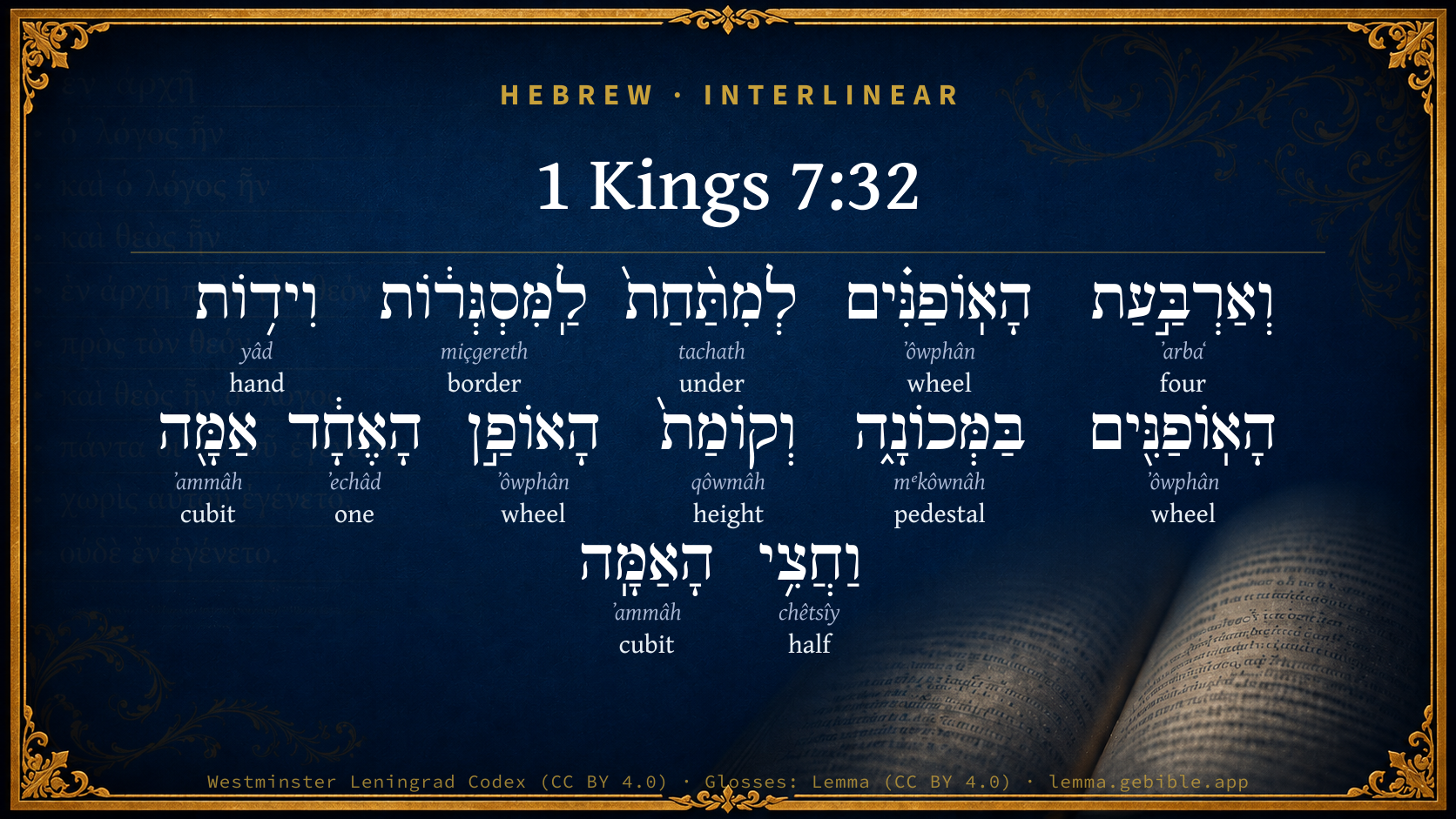
1 Kings 7:32

Hebrew (Westminster Leningrad Codex) 1 Kings 7:32 appears in the Hebrew Old Testament. The text above is from the Westminster Leningrad Codex. Each word links to its Strong’s number, a concise gloss, and parsing drawn from the Open Scriptures Hebrew Bible morphology. Click any word for its full Brown-Driver-Briggs (BDB) entry.
Download image
Cite this verse

1 Kings 7:32 (World English Bible). Public Domain. Lemma interlinear Bible study tool, https://lemma.gebible.app/v/1-kings/7/32.

Show BibTeX & RIS
BibTeX
RIS
English Translation
The four wheels were underneath the panels; and the axles of the wheels were in the base: and the height of a wheel was a cubit and half a cubit.
World English Bible · Public Domain
Download a study sheet

One document with this verse’s original text, its word-by-word gloss line, the meaning frame, cross-references with their text, attributed commentary, and full source and license credits — printable, and it pastes into notes with its structure intact.

This verse Autodidact and up

Study sheet (.html) Plain text (.txt)

A passage Seminary Student

Up to 50 verses in one chapter. A passage sheet keeps up to 6 commentary sources and 12 cross-references per verse, in the order this page ranks them, and says so on the sheet whenever that leaves anything out. Ask for a single verse and you get the Autodidact verse sheet above.

Everything on this page stays free to read, with no account — the sheet is a download of what is already on screen, not access to it.

Want to remove ads? Support Godless Engineer
Compare translations 3

The same verse in 3 English versions, stacked beneath the original-language interlinear above. Click any original word for its lexicon entry.

Each is an independent rendering of the whole verse — the interlinear is not word-aligned to these translations.

Highlighted words mark where these versions differ — a whole-verse word diff, not a word-by-word alignment.

  • World English Bible Public Domain
    The four wheels were underneath the panels; and the axles of the wheels were in the base: and the height of a wheel was a cubit and half a cubit.
  • King James Version Public Domain
    And under the borders were four wheels; and the axletrees of the wheels were joined to the base: and the height of a wheel was a cubit and half a cubit.
  • unfoldingWord Literal Text CC BY-SA 4.0
    And the four of the wheels beneath the panels, and the hands of the wheels in the stand. And the height of one wheel a cubit and half of a cubit.

unfoldingWord Literal Text — © unfoldingWord, licensed CC BY-SA 4.0. Word-aligned USFM3 via Door43 (git.door43.org/unfoldingWord/en_ult).

Versions to compare (up to 4)

3 of 4 selected

Show all 18 translations

Every available English version of this verse, each an independent rendering of the whole verse.

  • World English Bible Public Domain
    The four wheels were underneath the panels; and the axles of the wheels were in the base: and the height of a wheel was a cubit and half a cubit.
  • Berean Standard Bible Public Domain
    There were four wheels under the panels, and the axles of the wheels were attached to the stand; each wheel was a cubit and a half in diameter.
  • Majority Standard Bible Public Domain
    There were four wheels under the panels, and the axles of the wheels were attached to the stand; each wheel was a cubit and a half in diameter.
  • King James Version Public Domain
    And under the borders were four wheels; and the axletrees of the wheels were joined to the base: and the height of a wheel was a cubit and half a cubit.
  • American Standard Version (1901) Public Domain
    And the four wheels were underneath the panels; and the axletrees of the wheels were in the base: and the height of a wheel was a cubit and half a cubit.
  • Revised Version (1885) Public Domain
    And the four wheels were underneath the borders; and the axletrees of the wheels were in the base: and the height of a wheel was a cubit and half a cubit.
  • Geneva Bible (1599) Public Domain
    And vnder the borders were foure wheeles, and the axeltrees of the wheeles ioyned to the base: and the height of a wheele was a cubite and halfe a cubite.
  • Douay-Rheims (1899) Public Domain
    And the four wheels, which were at the four corners of the base, were joined one to another under the base: the height of a wheel was a cubit and a half.
  • Young's Literal Translation Public Domain
    And the four wheels `are' under the borders, and the spokes of the wheels `are' in the base, and the height of the one wheel `is' a cubit and half a cubit.
  • Literal Standard Version CC BY-SA 4.0
    And the four wheels [are] under the borders, and the spokes of the wheels [are] in the base, and the height of the one wheel [is] a cubit and half a cubit.
  • Unlocked Literal Bible CC BY-SA 4.0
    The four wheels were underneath the panels, and the axles of the wheels and their housings were in the stand. The height of a wheel was a cubit and a half.
  • unfoldingWord Literal Text CC BY-SA 4.0
    And the four of the wheels beneath the panels, and the hands of the wheels in the stand. And the height of one wheel a cubit and half of a cubit.
  • Darby Bible Public Domain
    And the four wheels were under the panels; and the supports of the wheels were in the base; and the height of a wheel was a cubit and half a cubit.
  • World Messianic Bible Public Domain
    The four wheels were underneath the panels; and the axles of the wheels were in the base. The height of a wheel was a cubit and half a cubit.
  • Webster's Bible Public Domain
    And under the borders were four wheels; and the axletrees of the wheels were joined to the base: and the hight of a wheel was a cubit and half a cubit.
  • Free Bible Version CC BY-SA 4.0
    The four wheels were under the panels, and the axles of the wheels were attached to the cart. Each wheel measured one and a half cubits in diameter.
  • Bible in Basic English Public Domain
    The four wheels were under the frames, and the rods on which the wheels were fixed were in the base; the wheels were a cubit and a half high.
  • JPS Tanakh (1917) Public Domain
    And the four wheels were underneath the borders; and the axletrees of the wheels were in the base; and the height of a wheel was a cubit and half a cubit.

Literal Standard Version (2020), Covenant Press — licensed CC BY-SA 4.0. Text via the HelloAO Bible API (eBible.org). Unlocked Literal Bible (unfoldingWord) — licensed CC BY-SA 4.0. Text via the HelloAO Bible API (eBible.org). unfoldingWord Literal Text — © unfoldingWord, licensed CC BY-SA 4.0. Word-aligned USFM3 via Door43 (git.door43.org/unfoldingWord/en_ult). Free Bible Version, Dr. Jonathan Gallagher — licensed CC BY-SA 4.0. Text via the HelloAO Bible API (eBible.org).

Word by word

More ways to search: Search by grammar → Find every occurrence → Compare this word →

Practice this passage: Drill this verse → Learn its vocabulary →

לַֽמִּסְגְּר֔וֹת
miçgereth
H4526
“to/for the · borders”
Preposition, Determined + Noun, Common, Feminine, Plural, Absolute
Part of Speech
Preposition + Noun
Type
Common
Gender
Feminine
Number
Plural
State
Absolute
Full BDB Definition

Origin: from H5462

TWOT: 1462d

border, fastness, rim - border, rim - fastness
  1. וְאַרְבַּ֣עַת ʼarbaʻ H702 “and · four” Conjunction + Adjective, Cardinal number, Masculine, Singular, Construct
  2. הָאֽוֹפַנִּ֗ים ʼôwphân H212 “the · wheels” Particle, Definite Article + Noun, Common, Masculine, Plural, Absolute
  3. לְמִתַּ֨חַת֙ tachath H8478 “to/for · from · under” Preposition + Preposition + Preposition
  4. וִיד֥וֹת yâd H3027 “and · hands of” Conjunction + Noun, Common, Both, Plural, Construct
  5. הָאֽוֹפַנִּ֖ים ʼôwphân H212 “the · wheels” Particle, Definite Article + Noun, Common, Masculine, Plural, Absolute
  6. בַּמְּכוֹנָ֑ה mᵉkôwnâh H4350 “in/at the · pedestal” Preposition, Determined + Noun, Common, Feminine, Singular, Absolute
  7. וְקוֹמַת֙ qôwmâh H6967 “and · height of” Conjunction + Noun, Common, Feminine, Singular, Construct
  8. הָאוֹפַ֣ן ʼôwphân H212 “the · wheel” Particle, Definite Article + Noun, Common, Masculine, Singular, Absolute
  9. הָאֶחָ֔ד ʼechâd H259 “the · one” Particle, Definite Article + Adjective, Cardinal number, Masculine, Singular, Absolute
  10. אַמָּ֖ה ʼammâh H520 “cubit” Noun, Common, Feminine, Singular, Absolute
  11. וַחֲצִ֥י chêtsîy H2677 “and · half of” Conjunction + Noun, Common, Masculine, Singular, Construct
  12. הָאַמָּֽה ʼammâh H520 “the · cubit” Particle, Definite Article + Noun, Common, Feminine, Singular, Absolute

About this verse

These counts appear in no published source. They are computed here, from the morphology-tagged text and Lemma’s own curated glosses. What Lemma adds →

13
words
10
distinct lemmas
Historical
section

Notable vocabulary

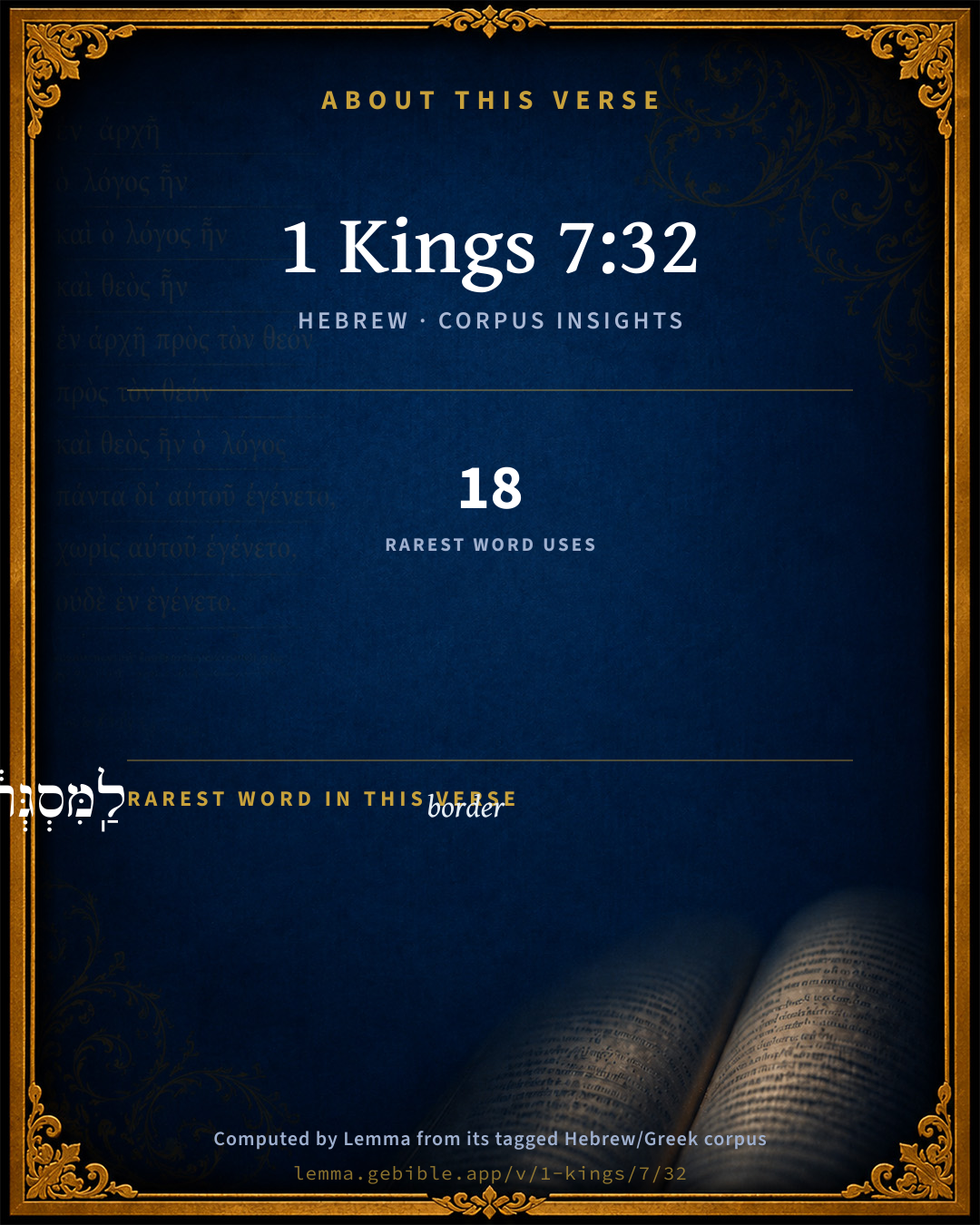
The rarest word here is לַֽמִּסְגְּר֔וֹת border H4526 — appearing just 18 times in the whole Hebrew Bible.

Shared distinctive vocabulary

לַֽמִּסְגְּר֔וֹת border H4526 occurs in 14 verses of the Hebrew Bible. Also found in:

Grammatical profile

  • 10 nouns
  • 2 adjectives
  • 1 preposition

Repetition

Words recur within this verse — often emphatic in Hebrew:

  • הָאֽוֹפַנִּ֗ים wheel H212 ×3
  • אַמָּ֖ה cubit H520 ×2

Hebrew & Septuagint length

In English translation the verse runs 30 words from the Hebrew and 12 from the Septuagint (LXX English) — the Septuagint runs noticeably shorter here. See the side-by-side →

A rough comparison of the two English renderings, which tokenize alike — not a word-level alignment.

Word counts can differ between the Hebrew and the Greek without any difference in meaning — e.g. the Hebrew direct-object marker אֵת has no separate Greek word, and Greek often adds the article ὁ.

Hebrew and Greek witnesses Masoretic Hebrew ↔ Greek Septuagint

The same verse in the two great witnesses to the Old Testament, shown verse-for-verse.

Here the Septuagint runs noticeably shorter than the Hebrew — LXX2012 (modern English Septuagint) 12 words vs World English Bible 30. A rough length comparison of the two English translations, not a word-level alignment — read both below.

These are two independent witnesses, not word-aligned to each other, and the Septuagint is shown in lemma (dictionary) form.

Hebrew 1 Kings 7:32 Masoretic · Westminster Leningrad Codex

וְאַרְבַּ֣עַת הָאֽוֹפַנִּ֗ים לְמִתַּ֨חַת֙ לַֽמִּסְגְּר֔וֹת וִיד֥וֹת הָאֽוֹפַנִּ֖ים בַּמְּכוֹנָ֑ה וְקוֹמַת֙ הָאוֹפַ֣ן הָאֶחָ֔ד אַמָּ֖ה וַחֲצִ֥י הָאַמָּֽה

The four wheels were underneath the panels; and the axles of the wheels were in the base: and the height of a wheel was a cubit and half a cubit.

World English Bible · Public Domain

Greek LXX 1 Kings 7:32 Septuagint · lemma form

καί εἰμί μετά σύ ἐν πᾶς ὅς πορεύομαι καί ἐκὀλεθρεύω πᾶς ὁ ἐχθρός σύ ἀπό πρόσωπον σύ καί ποιέω σύ ὄνομα κατά ὁ ὄνομα ὁ μέγας ὁ ἐπί ὁ γῆ σοκχωθ καί ἀνά μέσος σιρα

And the height of one wheel was a cubit and a half.

LXX2012 (modern English Septuagint) · Public Domain

Hebrew: Westminster Leningrad Codex (CC BY 4.0). Greek: Septuagint (public domain); English from LXX2012 (modern English Septuagint) (Public Domain). How the Septuagint differs from the Hebrew →

Targum (Aramaic paraphrase)

1

The Targum is the ancient Jewish Aramaic paraphrase of the Hebrew Scriptures — an interpretive translation, not the Hebrew text itself. Onkelos (literal) and Pseudo-Jonathan (expansive) render the Torah, and Jonathan the Prophets. Coverage is partial: where no permissively-licensed English translation exists for a verse, only the Aramaic is shown. This is verse-level text, not a word-by-word alignment to the Hebrew.

  1. Targum Jonathan Prophets (Joshua–Malachi)
    וְאַרְבְּעָא גִלְגְלַיָא לְמִלְרַע לִגְדַנְפַיָא וְאַשְׁדַת גִלְגְלַיָא בִּבְסִיסָא וְרוּמֵיהּ דְגַלְגַל חָד אַמְתָא וּפַלְגוּת אַמְתָא:

    (no public-domain English translation for this verse)

    Targum Jonathan — Aramaic: “Mikraot Gedolot” (public domain). English: “Sefaria Community Translation” (CC0 1.0 (public-domain dedication)); “London "Chaldee Paraphrase," 1871” (public domain). Text via Sefaria.

Commentary

Notes on 1 Kings 7:32 from classic Christian and Jewish commentators (each source and its license shown beneath its notes). The classic Christian expositions comment on the surrounding passage and are grouped to its opening verse, so a note may address several verses; the Jewish commentaries on the Tanakh (Rashi and others) are per-verse, so they appear only where the commentator wrote on this verse.

Lemma curates 59 commentaries, every one of them public domain or Creative Commons licensed, each selected and text-cleaned for this edition rather than reprinted as found. About our sources →

Trapp's Complete Commentary

John Trapp

1Ki 7:32 And under the borders [were] four wheels; and the axletrees of the wheels [were joined] to the base: and the height of a wheel [was] a cubit and half a cubit.

Ver. 32. And under the borders were four wheels.] Whereby the laver was trusatile sive ambulatorium. See 1Ki 7:30.

John Trapp, A Commentary or Exposition upon All the Books of the Old and New Testament (1647–1656) — public domain. Text from a community e-Sword module.

The Cambridge Bible for Schools and Colleges

gen. ed. J. J. S. Perowne

32. And under the borders [panels] were four wheels] Better, ‘the four wheels.’ They were so fixed that they might not hide by their upper part any portion of the ornamental panels.

and the axletrees of the wheels were joined to the base] More literally, were in the base. That is they formed a portion of the casting. The Hebrew word here is different from that rendered ‘axles’ in 1Ki_7:30. This word is literally ‘hands’ and no doubt signifies some kind of ‘holder’ or support by which the wheels were kept in place. If the ‘shoulders’ of 1Ki_7:30 also belong to the wheels they must have been made doubly secure.

The Cambridge Bible for Schools and Colleges (gen. ed. J. J. S. Perowne; Cambridge University Press, 1878–1918) — public domain. Text from a community e-Sword module.

John Gill's Exposition

And the work of the wheels was like the work of a chariot wheel,.... In the same form and fashion as one of them; the Targum is,

"like a chariot of glory;''

a splendid one, curiously wrought; unless reference is had in it to the chariot of Ezekiel's vision:

their axle trees, and their naves, and their felloes, and their spokes, were all molten; cast together when the base was.

John Gill's Exposition of the Whole Bible (1746–1763) — public domain (CC PDM 1.0). Text via the HelloAO Bible API.

Albert Barnes' Notes on the Bible

With the diameter (2 14 ft.) of the wheel here, may be compared that of the earliest Assyrian chariot-wheels, which was under 3 feet; and that of the front wheels seen in representations of Assyrian close carriages, which scarcely exceed 14th of the height of the entire vehicle. The wheels of these moveable lavers appear to have been a little less than 15th of the height of the whole structure.

Albert Barnes' Notes on the Bible (1834–1885) — public domain. Text from a community e-Sword/MySword module.

Haydock's Catholic Bible Commentary

Joined. Yet not so as to be immovable. (Calmet)

George Leo Haydock (1774–1849), Haydock's Catholic Family Bible and Commentary, 1859 edition — public domain. Excludes Psalms (Douay-Rheims chapter numbering differs from Protestant) and Deuterocanonical books (Catholic canon only).

Whedon's Commentary on the Bible

Daniel D. Whedon

32. Axletrees of the wheels — Rather, hands, or supports of the wheels, (e e in figure,) which fastened their axles to the base; the same as the undersetters. 1Ki_7:30. This same word occurs again in the next verse (33) and should be rendered, there as here, supports or stays.

Daniel D. Whedon (gen. ed.), Commentary on the Old and New Testaments (1874–1909) — public domain. Text from a community e-Sword module.

The Pulpit Commentary

And under the borders i.e. , panels were four Heb. the four i.e., those mentioned in ver. 30 wheels "The wheels reached no higher than that portion of the sides of the base which was ornamented with garlands" (Rawlinson). It would be more correct to say that the wheels did not cover any portion of the sides; they were under them; and the axletrees Heb. hands, as holding the wheel to the base or stand. Axletrees is altogether misleading. The hands were the parts connecting the wheels and axles of the wheels were joined to Heb. in, as marg. the base: and the height of a wheel was a cubit and half a cubit. i.e., 27 inches.

The Pulpit Commentary (1880–1919), ed. H.D.M. Spence-Jones & Joseph S. Exell — public domain. Text from a community e-Sword module.

unfoldingWord translationNotes

Door43 World Missions Community

their housings

Here the word "their" refers to the axles. The word "housings" refers to the casings into which the axles were inserted.

a cubit and a half

A cubit was 46 centimeters. AT: "about 70 centimeters" (See: Biblical Distance)

The wheels were forged like chariot wheels

This can be stated in active form. AT: "Huram made the wheels like small chariot wheels" (See: Active or Passive)

Their housings, rims, spokes, and hubs

Here the word "Their" refers to the wheels.

translationWords

chariot

unfoldingWord translationNotes — © Distant Shores Media and the Door43 World Missions Community, licensed CC BY-SA 4.0. Source: git.door43.org/Door43/en_tn.

Rashi

Rabbi Shlomo Yitzchaki (Rashi)

The four wheels were underneath the frames. Because the frames [reached] from the axle of one wheel to the axle of the other wheel, as I have explained.

And the axles of the wheels. That is the wood which is inserted into the wheels and is called, essieu in [O.F.]

Were in the base. The axles were joined and melted to the base in one pouring.

Rashi on the Tanakh — English translations: “The Judaica Press complete Tanach with Rashi, translated by A. J. Rosenberg” (CC BY 4.0); “Pentateuch with Rashi's commentary by M. Rosenbaum and A.M. Silbermann, 1929-1934” (public domain); “The Metsudah Tanach series, Lakewood, N.J” (CC BY 4.0); and “The Book of Joshua, Metsudah Publications, 1997” (CC BY 4.0). Text via Sefaria.

Lesson kit

Teaching starters — assembled from the data on this page, not authored interpretation. Every prompt links to the verse data it draws on. Edit before teaching.

1 Kings, in the Historical, opens this verse with 13 words (10 distinct Hebrew lemmas). Its most distinctive word is miçgereth (“border”). The Greek Septuagint runs shorter here. A historical commentator’s framing appears above. Read the whole chapter for the surrounding context.

Discussion questions

  1. The word miçgereth carries the sense “border.” How does it shape the verse?
  2. How does Exodus 25:25, which shares the word «border», read alongside this verse?
  3. What does the repetition of “wheel” (3× in this one verse) do in this verse?
  4. The Septuagint runs shorter here than the Hebrew. What might account for the difference?
  5. The translations on this page render this verse differently — a whole-verse word diff, not a word-by-word alignment. What might account for the different wordings?
  6. Compare how Trapp's Complete Commentary and The Cambridge Bible for Schools and Colleges read this verse. Where do they agree or differ?

Things to notice

Reading settings

Reading text

Shown beneath each verse's original-language words.

Old Testament
Old Testament edition

Read the OT as the Masoretic Hebrew (MT) or the Greek Septuagint (LXX).

English shown for the Greek Septuagint (in the Hebrew ↔ Greek comparison).

Comparing translations? Open the Compare panel on any verse page to stack up to four side by side.