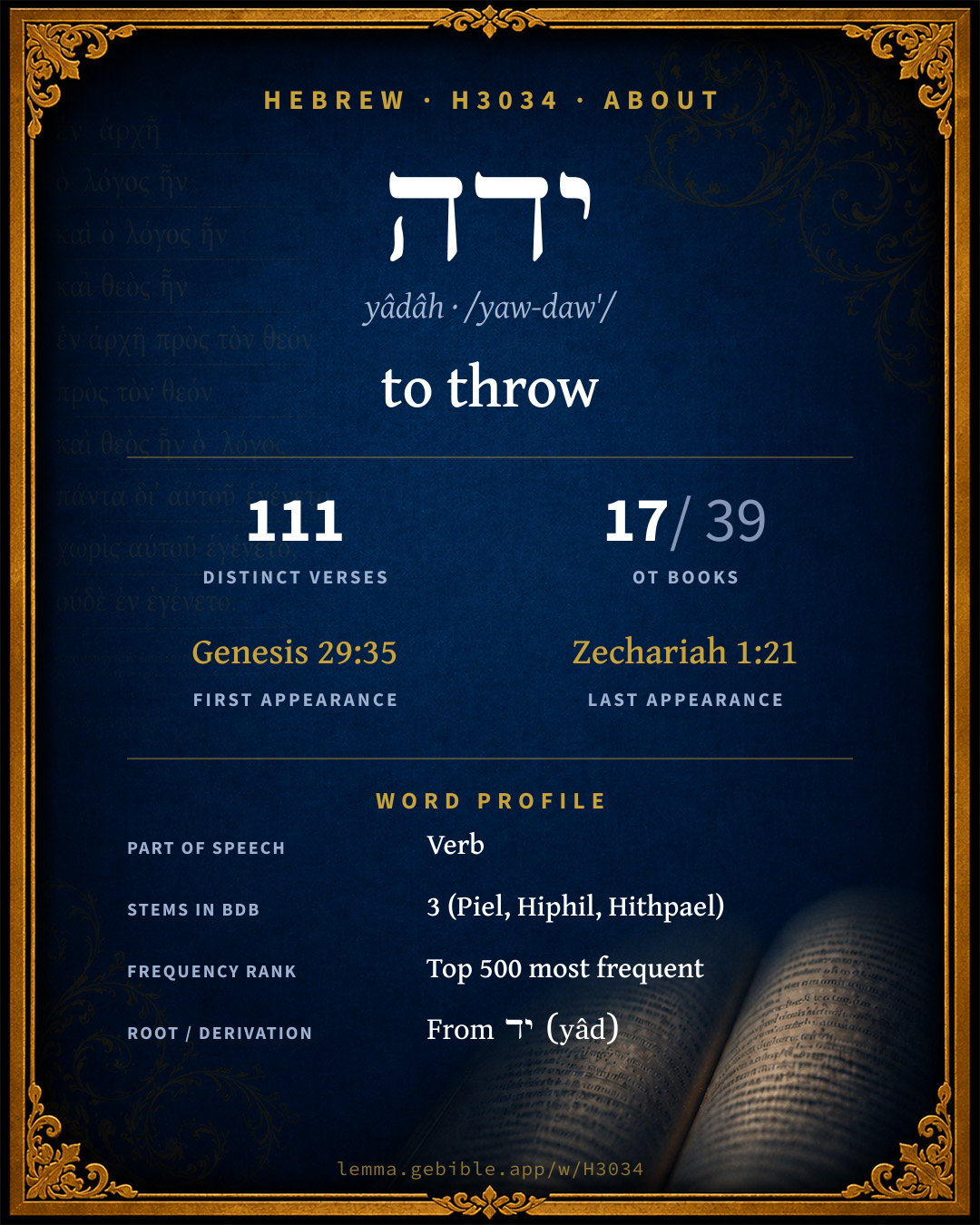
יָדָה
to throw
also: shoot, cast fuller range ↓
Full lexicon entry — Brown-Driver-Briggs (BDB)
From Brown-Driver-Briggs (BDB)
Where this word appears
See every Hiphil verb in the Hebrew Bible →
Grammar key — what these labels mean
Part of speech
- Verb
- An action or state-of-being word.
Stem
- Hiphil
- The causative active stem (“he caused / brought about”). Here: ‘give thanks’
- Hithpael
- The reflexive or reciprocal stem (the subject acts on itself). Here: ‘confess’
- Piel
- An intensive or resultative active stem.
- Qal
- The basic, simple active stem — the plain form of the verb (“he wrote”).
Form
- Imperative
- A direct command (“write!”).
- Imperfect
- An incomplete, ongoing, or future action (“he will / would write”).
- Infinitive Construct
- A bound verbal noun, frequently with prepositions (“to write / in writing”).
- Sequential Perfect
- A perfect with prefixed waw continuing a preceding imperfect or command (waw-consecutive perfect).
- Jussive
- A third- or second-person volitional form expressing wish or command (“let him write”).
- Participle Active
- A verbal adjective expressing ongoing or characteristic action (“writing / one who writes”).
- Perfect
- A completed action or state — Hebrew marks aspect (completeness) more than strict tense (“he wrote”).
- Sequential Imperfect
- An imperfect with prefixed waw — the standard past-narrative form (waw-consecutive imperfect).
- Cohortative
- A first-person volitional form expressing wish or resolve (“let me / let us write”).
State
- Absolute
- The independent form of a noun, not bound to a following word.
Person
- 2nd Person
- The one addressed (“you”).
- 1st Person
- The speaker (“I / we”).
- 3rd Person
- The one spoken about (“he / she / it / they”).
Gender
- Masculine
- Grammatically masculine.
- Common
- Either gender — not distinguished for this form.
- Feminine
- Grammatically feminine.
Number
- Plural
- More than one (in Hebrew, generally three or more).
- Singular
- One.
Grammatical forms 24 distinct
- Verb, Hiphil, Imperfect, 1st Person, Common, Singular 31 times (27%)
- Verb, Hiphil, Imperative, 2nd Person, Masculine, Plural 18 times (16%)
- Verb, Hiphil, Infinitive Construct 18 times (16%)
- Verb, Hiphil, Imperfect, 3rd Person, Masculine, Plural 13 times (11%)
- Verb, Hiphil, Sequential Perfect, 3rd Person, Common, Plural 4 times (4%)
- Verb, Hiphil, Jussive, 3rd Person, Masculine, Plural 4 times (4%)
- Verb, Hiphil, Imperfect, 3rd Person, Masculine, Singular 4 times (4%)
- Verb, Hithpael, Sequential Perfect, 3rd Person, Common, Plural 2 times (2%)
+16 more forms (20 occurrences)
Parsed forms decoded from the imported morphology (morphhb / Westminster Leningrad Codex — WLC text public domain, morphhb tagging CC BY 4.0), counted across 114 parsed occurrences — not distinct verses.
Every verse where H3034 appears — 111 distinct verses across 17 books. Click any verse to open its interlinear word-by-word view. Verse text shown in the World English Bible for context — . Each verse’s Hebrew form is shown with its reference; the English is not keyword-highlighted, since the data carries no word-level English alignment. Use “Compare translations” on any verse to read it across multiple English versions. This concordance covers the Hebrew Bible; Septuagint (Greek Old Testament) occurrences are not indexed here.
Genesis 2 verses
- Genesis 29:35 אוֹדֶ֣ה Hiphil impf 1cs She conceived again, and bare a son. She said, "This time will I praise Yahweh." Therefore she named him Judah. Then she stopped bearing.
- Genesis 49:8 יוֹד֣וּ/ךָ Hiphil impf 3mp + sfx pers 2ms "Judah, your brothers will praise you: Your hand will be on the neck of your enemies; Your father's sons will bow down before you.
Leviticus 3 verses
- Leviticus 5:5 וְ/הִ֨תְוַדָּ֔ה conj + Hithpael wpf 3ms It shall be, when he is guilty of one of these, he shall confess that in which he has sinned:
- Leviticus 16:21 וְ/הִתְוַדָּ֣ה conj + Hithpael pf 3ms Aaron shall lay both his hands on the head of the live goat, and confess over him all the iniquities of the children of Israel, and all their transgressions, even all their sins; and he shall put them on the head of the goat, and shall send him away into the wilderness by the hand of a man who is in readiness.
- Leviticus 26:40 וְ/הִתְוַדּ֤וּ conj + Hithpael wpf 3cp "'If they confess their iniquity, and the iniquity of their fathers, in their trespass which they trespassed against me, and also that, because they walked contrary to me,
Numbers 1 verse
2 Samuel 1 verse
1 Kings 2 verses
- 1 Kings 8:33 וְ/הוֹד֣וּ conj + Hiphil wpf 3cp When your people Israel are struck down before the enemy, because they have sinned against you; if they turn again to you, and confess your name, and pray and make supplication to you in this house:
- 1 Kings 8:35 וְ/הוֹד֣וּ conj + Hiphil wpf 3cp When the sky is shut up, and there is no rain, because they have sinned against you; if they pray toward this place, and confess your name, and turn from their sin, when you do afflict them:
1 Chronicles 9 verses
- 1 Chronicles 16:4 וּ/לְ/הוֹד֣וֹת conj + prep + Hiphil inf.cs He appointed certain of the Levites to minister before the ark of Yahweh, and to celebrate and to thank and praise Yahweh, the God of Israel:
- 1 Chronicles 16:7 לְ/הֹד֖וֹת prep + Hiphil inf.cs Then on that day David first ordained to give thanks to Yahweh, by the hand of Asaph and his brothers.
- 1 Chronicles 16:8 הוֹד֤וּ Hiphil impv 2mp Oh give thanks to Yahweh, call on his name; Make known his doings among the peoples.
- 1 Chronicles 16:34 הוֹד֤וּ Hiphil impv 2mp Oh give thanks to Yahweh; for he is good; For his loving kindness endures forever.
- 1 Chronicles 16:35 לְ/הֹדוֹת֙ prep + Hiphil inf.cs Say you, Save us, God of our salvation, Gather us together and deliver us from the nations, To give thanks to your holy name, To triumph in your praise.
- 1 Chronicles 16:41 לְ/הֹדוֹת֙ prep + Hiphil inf.cs and with them Heman and Jeduthun, and the rest who were chosen, who were mentioned by name, to give thanks to Yahweh, because his loving kindness endures forever;
- 1 Chronicles 23:30 לְ/הֹד֥וֹת prep + Hiphil inf.cs and to stand every morning to thank and praise Yahweh, and likewise in the evening;
- 1 Chronicles 25:3 הֹד֥וֹת Hiphil inf.cs Of Jeduthun; the sons of Jeduthun: Gedaliah, and Zeri, and Jeshaiah, Hashabiah, and Mattithiah, six, under the hands of their father Jeduthun with the harp, who prophesied in giving thanks and praising Yahweh.
- 1 Chronicles 29:13 מוֹדִ֥ים Hiphil ptcp.act mp Now therefore, our God, we thank you, and praise your glorious name.
2 Chronicles 8 verses
- 2 Chronicles 5:13 וּ/לְ/הֹדוֹת֮ conj + prep + Hiphil inf.cs it happened, when the trumpeters and singers were as one, to make one sound to be heard in praising and thanking Yahweh; and when they lifted up their voice with the trumpets and cymbals and instruments of music, and praised Yahweh, [saying], For he is good; for his loving kindness endures forever; that then the house was filled with a cloud, even the house of Yahweh,
- 2 Chronicles 6:24 וְ/הוֹד֣וּ conj + Hiphil wpf 3cp If your people Israel be struck down before the enemy, because they have sinned against you, and shall turn again and confess your name, and pray and make supplication before you in this house;
- 2 Chronicles 6:26 וְ/הוֹד֣וּ conj + Hiphil wpf 3cp When the sky is shut up, and there is no rain, because they have sinned against you; if they pray toward this place, and confess your name, and turn from their sin, when you do afflict them:
- 2 Chronicles 7:3 וְ/הוֹד֤וֹת conj + Hiphil inf.cs All the children of Israel looked on, when the fire came down, and the glory of Yahweh was on the house; and they bowed themselves with their faces to the ground on the pavement, and worshiped, and gave thanks to Yahweh, [saying], For he is good; for his loving kindness endures for ever.
- 2 Chronicles 7:6 לְ/הֹד֤וֹת prep + Hiphil inf.cs The priests stood, according to their offices; the Levites also with instruments of music of Yahweh, which David the king had made to give thanks to Yahweh, (for his loving kindness endures for ever), when David praised by their ministry: and the priests sounded trumpets before them; and all Israel stood.
- 2 Chronicles 20:21 הוֹד֣וּ Hiphil impv 2mp When he had taken counsel with the people, he appointed those who should sing to Yahweh, and give praise in holy array, as they went out before the army, and say, Give thanks to Yahweh; for his loving kindness endures forever.
- 2 Chronicles 30:22 וּ/מִ֨תְוַדִּ֔ים conj + Hithpael ptcp.act mp Hezekiah spoke comfortably to all the Levites who had good understanding [in the service] of Yahweh. So they ate throughout the feast for the seven days, offering sacrifices of peace-offerings, and making confession to Yahweh, the God of their fathers.
- 2 Chronicles 31:2 וּ/לְ/הֹד֣וֹת conj + prep + Hiphil inf.cs Hezekiah appointed the divisions of the priests and the Levites after their divisions, every man according to his service, both the priests and the Levites, for burnt offerings and for peace-offerings, to minister, and to give thanks, and to praise in the gates of the camp of Yahweh.
Ezra 2 verses
- Ezra 3:11 וּ/בְ/הוֹדֹ֤ת conj + prep + Hiphil inf.cs They sang one to another in praising and giving thanks to Yahweh, [saying], For he is good, for his loving kindness endures forever toward Israel. All the people shouted with a great shout, when they praised Yahweh, because the foundation of the house of Yahweh was laid.
- Ezra 10:1 וּ/כְ֨/הִתְוַדֹּת֔/וֹ conj + prep + Hithpael inf.cs + sfx pers 3ms Now while Ezra prayed and made confession, weeping and casting himself down before the house of God, there was gathered together to him out of Israel a very great assembly of men and women and children; for the people wept very sore.
Nehemiah 6 verses
- Nehemiah 1:6 וּ/מִתְוַדֶּ֗ה conj + Hithpael ptcp.act ms Let your ear now be attentive, and your eyes open, that you may listen to the prayer of your servant, which I pray before you at this time, day and night, for the children of Israel your servants while I confess the sins of the children of Israel, which we have sinned against you. Yes, I and my father's house have sinned:
- Nehemiah 9:2 וַ/יִּתְוַדּוּ֙ conj + Hithpael wimpf 3mp The seed of Israel separated themselves from all foreigners, and stood and confessed their sins, and the iniquities of their fathers.
- Nehemiah 9:3 מִתְוַדִּ֣ים Hithpael ptcp.act mp They stood up in their place, and read in the book of the law of Yahweh their God a fourth part of the day; and [another] fourth part they confessed, and worshiped Yahweh their God.
- Nehemiah 11:17 יְהוֹדֶ֣ה Hiphil impf 3ms and Mattaniah the son of Mica, the son of Zabdi, the son of Asaph, who was the chief to begin the thanksgiving in prayer, and Bakbukiah, the second among his brothers; and Abda the son of Shammua, the son of Galal, the son of Jeduthun.
- Nehemiah 12:24 לְ/הוֹד֔וֹת prep + Hiphil inf.cs The chiefs of the Levites: Hashabiah, Sherebiah, and Jeshua the son of Kadmiel, with their brothers over against them, to praise and give thanks, according to the commandment of David the man of God, watch next to watch.
- Nehemiah 12:46 וְ/הֹד֖וֹת conj + Hiphil inf.cs For in the days of David and Asaph of old there was a chief of the singers, and songs of praise and thanksgiving to God.
Job 1 verse
Psalms 64 verses
- Psalms 6:5 יֽוֹדֶה Hiphil impf 3ms For in death there is no memory of you. In Sheol, who shall give you thanks?
- Psalms 7:17 אוֹדֶ֣ה Hiphil impf 1cs I will give thanks to Yahweh according to his righteousness, And will sing praise to the name of Yahweh Most High.
- Psalms 9:1 אוֹדֶ֣ה Hiphil impf 1cs I will give thanks to Yahweh with my whole heart. I will tell of all your marvelous works.
- Psalms 18:49 אוֹדְ/ךָ֖ Hiphil impf 1cs + sfx pers 2ms Therefore I will give thanks to you, Yahweh, among the nations, And will sing praises to your name.
- Psalms 28:7 אֲהוֹדֶֽ/נּוּ Hiphil impf 1cs + sfx pers 3ms Yahweh is my strength and my shield. My heart has trusted in him, and I am helped. Therefore my heart greatly rejoices. With my song I will thank him.
- Psalms 30:4 וְ֝/הוֹד֗וּ conj + Hiphil impv 2mp Sing praise to Yahweh, you saints of his. Give thanks to his holy name.
- Psalms 30:9 הֲ/יוֹדְ/ךָ֥ ptcl inter + Hiphil impf 3ms + sfx pers 2ms "What profit is there in my destruction, if I go down to the pit? Shall the dust praise you? Shall it declare your truth?
- Psalms 30:12 אוֹדֶֽ/ךָּ Hiphil impf 1cs + sfx pers 2ms To the end that my heart may sing praise to you, and not be silent. Yahweh my God, I will give thanks to you forever!
- Psalms 32:5 אוֹדֶ֤ה Hiphil impf 1cs I acknowledged my sin to you. I didn't hide my iniquity. I said, I will confess my transgressions to Yahweh, And you forgave the iniquity of my sin. Selah.
- Psalms 33:2 הוֹד֣וּ Hiphil impv 2mp Give thanks to Yahweh with the lyre. Sing praises to him with the harp of ten strings.
- Psalms 35:18 א֭וֹדְ/ךָ Hiphil impf 1cs + sfx pers 2ms I will give you thanks in the great assembly. I will praise you among many people.
- Psalms 42:5 אוֹדֶ֗/נּוּ Hiphil impf 1cs + sfx pers 3ms Why are you in despair, my soul? Why are you disturbed within me? Hope in God! For I shall still praise him for the saving help of his presence.
- Psalms 42:11 אוֹדֶ֑/נּוּ Hiphil impf 1cs + sfx pers 3ms Why are you in despair, my soul? Why are you disturbed within me? Hope in God! For I shall still praise him, The saving help of my countenance, and my God.
- Psalms 43:4 וְ/אוֹדְ/ךָ֥ conj + Hiphil impf 1cs + sfx pers 2ms Then I will go to the altar of God, To God, my exceeding joy. I will praise you on the harp, God, my God.
- Psalms 43:5 אוֹדֶ֑/נּוּ Hiphil impf 1cs + sfx pers 3ms Why are you in despair, my soul? Why are you disturbed within me? Hope in God! For I shall still praise him: My Savior, my helper, and my God.
- Psalms 44:8 נוֹדֶ֣ה Hiphil coh 1cp In God we have made our boast all day long, We will give thanks to your name forever. Selah.
- Psalms 45:17 יְ֝הוֹדֻ֗/ךָ Hiphil impf 3mp + sfx pers 2ms I will make your name to be remembered in all generations. Therefore the peoples shall give you thanks forever and ever.
- Psalms 49:18 וְ֝/יוֹדֻ֗/ךָ conj + Hiphil impf 3mp + sfx pers 2ms Though while he lived he blessed his soul-- And men praise you when you do well for yourself--
- Psalms 52:9 אוֹדְ/ךָ֣ Hiphil impf 1cs + sfx pers 2ms I will give you thanks forever, because you have done it. I will hope in your name, for it is good, In the presence of your saints.
- Psalms 54:6 א֤וֹדֶה Hiphil impf 1cs With a free will offering, I will sacrifice to you. I will give thanks to your name, Yahweh, for it is good.
- Psalms 57:9 אוֹדְ/ךָ֖ Hiphil impf 1cs + sfx pers 2ms I will give thanks to you, Lord, among the peoples. I will sing praises to you among the nations.
- Psalms 67:3 יוֹד֖וּ/ךָ י֝וֹד֗וּ/ךָ Hiphil impf 3mp + sfx pers 2ms Hiphil impf 3mp + sfx pers 2ms Let the peoples praise you, God. Let all the peoples praise you.
- Psalms 67:5 יוֹד֖וּ/ךָ י֝וֹד֗וּ/ךָ Hiphil impf 3mp + sfx pers 2ms Hiphil impf 3mp + sfx pers 2ms Let the peoples praise you, God. Let all the peoples praise you.
- Psalms 71:22 אוֹדְ/ךָ֣ Hiphil impf 1cs + sfx pers 2ms I will also praise you with the harp for your faithfulness, my God. I sing praises to you with the lyre, Holy One of Israel.
- Psalms 75:1 ה֘וֹדִ֤ינוּ ה֭וֹדִינוּ Hiphil pf 1cp Hiphil pf 1cp We give thanks to you, God, We give thanks, for your Name is near. Men tell about your wondrous works.
- Psalms 76:10 תּוֹדֶ֑/ךָּ Hiphil impf 3fs + sfx pers 2ms Surely the wrath of man praises you. The survivors of your wrath are restrained.
- Psalms 79:13 נ֤וֹדֶ֥ה Hiphil impf 1cp So we, your people and sheep of your pasture, Will give you thanks forever. We will praise you forever, to all generations.
- Psalms 86:12 אוֹדְ/ךָ֤ Hiphil impf 1cs + sfx pers 2ms I will praise you, Lord my God, with my whole heart. I will glorify your name forevermore.
- Psalms 88:10 יוֹד֬וּ/ךָ Hiphil impf 3mp + sfx pers 2ms Do you show wonders to the dead? Do the dead rise up and praise you? Selah.
- Psalms 89:5 וְ/י֘וֹד֤וּ conj + Hiphil impf 3mp The heavens will praise your wonders, Yahweh; Your faithfulness also in the assembly of the holy ones.
- Psalms 92:1 לְ/הֹד֥וֹת prep + Hiphil inf.cs It is a good thing to give thanks to Yahweh, To sing praises to your name, Most High;
- Psalms 97:12 וְ֝/הוֹד֗וּ conj + Hiphil impv 2mp Be glad in Yahweh, you righteous people! Give thanks to his holy Name.
- Psalms 99:3 יוֹד֣וּ Hiphil impf 3mp Let them praise your great and awesome name. He is Holy!
- Psalms 100:4 הֽוֹדוּ Hiphil impv 2mp Enter into his gates with thanksgiving, Into his courts with praise. Give thanks to him, and bless his name.
- Psalms 105:1 הוֹד֣וּ Hiphil impv 2mp Give thanks to Yahweh! Call on his name! Make his doings known among the peoples.
- Psalms 106:1 הוֹד֣וּ Hiphil impv 2mp Praise Yahweh! Give thanks to Yahweh, for he is good, For his loving kindness endures forever.
- Psalms 106:47 לְ֭/הֹדוֹת prep + Hiphil inf.cs Save us, Yahweh, our God, Gather us from among the nations, To give thanks to your holy name, To triumph in your praise!
- Psalms 107:1 הֹד֣וּ Hiphil impv 2mp Give thanks to Yahweh, For he is good, For his loving kindness endures forever.
- Psalms 107:8 יוֹד֣וּ Hiphil juss 3mp Let them praise Yahweh for his loving kindness, For his wonderful works to the children of men!
- Psalms 107:15 יוֹד֣וּ Hiphil juss 3mp Let them praise Yahweh for his loving kindness, For his wonderful works to the children of men!
- Psalms 107:21 יוֹד֣וּ Hiphil juss 3mp Let them praise Yahweh for his loving kindness, For his wonderful works to the children of men!
- Psalms 107:31 יוֹד֣וּ Hiphil juss 3mp Let them praise Yahweh for his loving kindness, For his wonderful works for the children of men!
- Psalms 108:3 אוֹדְ/ךָ֖ Hiphil impf 1cs + sfx pers 2ms I will give thanks to you, Yahweh, among the nations. I will sing praises to you among the peoples.
- Psalms 109:30 א֘וֹדֶ֤ה Hiphil impf 1cs I will give great thanks to Yahweh with my mouth. Yes, I will praise him among the multitude.
- Psalms 111:1 אוֹדֶ֣ה Hiphil impf 1cs Praise Yah! I will give thanks to Yahweh with my whole heart, In the council of the upright, and in the congregation.
- Psalms 118:1 הוֹד֣וּ Hiphil impv 2mp Give thanks to Yahweh, for he is good, For his loving kindness endures forever.
- Psalms 118:19 אוֹדֶ֥ה Hiphil impf 1cs Open to me the gates of righteousness. I will enter into them. I will give thanks to Yah.
- Psalms 118:21 א֭וֹדְ/ךָ Hiphil impf 1cs + sfx pers 2ms I will give thanks to you, for you have answered me, And have become my salvation.
- Psalms 118:28 וְ/אוֹדֶ֑/ךָּ conj + Hiphil impf 1cs + sfx pers 2ms You are my God, and I will give thanks to you. You are my God, I will exalt you.
- Psalms 118:29 הוֹד֣וּ Hiphil impv 2mp Oh give thanks to Yahweh, for he is good, For his loving kindness endures forever.
- Psalms 119:7 א֭וֹדְ/ךָ Hiphil impf 1cs + sfx pers 2ms I will give thanks to you with uprightness of heart, When I learn your righteous judgments.
- Psalms 119:62 לְ/הוֹד֣וֹת prep + Hiphil inf.cs At midnight I will rise to give thanks to you, Because of your righteous ordinances.
- Psalms 122:4 לְ֝/הֹד֗וֹת prep + Hiphil inf.cs Where the tribes go up, even Yah's tribes, According to an ordinance for Israel, To give thanks to the name of Yahweh.
- Psalms 136:1 הוֹד֣וּ Hiphil impv 2mp Give thanks to Yahweh, for he is good; For his loving kindness endures forever.
- Psalms 136:2 ה֭וֹדוּ Hiphil impv 2mp Give thanks to the God of gods; For his loving kindness endures forever.
- Psalms 136:3 ה֭וֹדוּ Hiphil impv 2mp Give thanks to the Lord of lords; For his loving kindness endures forever:
- Psalms 136:26 ה֭וֹדוּ Hiphil impv 2mp Oh give thanks to the God of heaven; For his loving kindness endures forever.
- Psalms 138:1 אוֹדְ/ךָ֥ Hiphil impf 1cs + sfx pers 2ms I will give you thanks with my whole heart. Before the gods, I will sing praises to you.
- Psalms 138:2 וְ/א֘וֹדֶ֤ה conj + Hiphil impf 1cs I will bow down toward your holy temple, And give thanks to your Name for your loving kindness and for your truth; For you have exalted your Name and your Word above all.
- Psalms 138:4 יוֹד֣וּ/ךָ Hiphil impf 3mp + sfx pers 2ms All the kings of the earth will give you thanks, Yahweh, For they have heard the words of your mouth.
- Psalms 139:14 אֽוֹדְ/ךָ֗ Hiphil impf 1cs + sfx pers 2ms I will give thanks to you, For I am fearfully and wonderfully made. Your works are wonderful. My soul knows that very well.
- Psalms 140:13 יוֹד֣וּ Hiphil impf 3mp Surely the righteous will give thanks to your name. The upright will dwell in your presence.
- Psalms 142:7 לְ/הוֹד֪וֹת prep + Hiphil inf.cs Bring my soul out of prison, That I may give thanks to your name. The righteous will surround me, For you will be good to me.
- Psalms 145:10 יוֹד֣וּ/ךָ Hiphil impf 3mp + sfx pers 2ms All your works will give thanks to you, Yahweh. Your saints will extol you.
Proverbs 1 verse
Isaiah 5 verses
- Isaiah 12:1 אוֹדְ/ךָ֣ Hiphil impf 1cs + sfx pers 2ms In that day you will say, "I will give thanks to you, Yahweh; for though you were angry with me, your anger has turned away and you comfort me.
- Isaiah 12:4 הוֹד֤וּ Hiphil impv 2mp In that day you will say, "Give thanks to Yahweh! Call on his name. Declare his doings among the peoples. Proclaim that his name is exalted!
- Isaiah 25:1 אוֹדֶ֣ה Hiphil impf 1cs Yahweh, you are my God; I will exalt you, I will praise your name; for you have done wonderful things, [even] counsels of old, in faithfulness [and] truth.
- Isaiah 38:18 תּוֹדֶ֖/ךָּ Hiphil impf 3fs + sfx pers 2ms For Sheol can't praise you, death can't celebrate you: Those who go down into the pit can't hope for your truth.
- Isaiah 38:19 יוֹדֶ֖/ךָ Hiphil impf 3ms + sfx pers 2ms The living, the living, he shall praise you, as I do this day: The father to the children shall make known your truth.
Jeremiah 2 verses
- Jeremiah 33:11 הוֹדוּ֩ Hiphil impv 2mp the voice of joy and the voice of gladness, the voice of the bridegroom and the voice of the bride, the voice of those who say, Give thanks to Yahweh of Hosts, for Yahweh is good, for his loving kindness endures forever; [and of them] who bring [sacrifices of] thanksgiving into the house of Yahweh. For I will cause the captivity of the land to return as at the first, says Yahweh.
- Jeremiah 50:14 יְד֣וּ Qal impv 2mp Set yourselves in array against Babylon round about, all you who bend the bow; shoot at her, spare no arrows: for she has sinned against Yahweh.
Lamentations 1 verse
Daniel 2 verses
- Daniel 9:4 וָ/אֶתְוַדֶּ֑ה conj + Hithpael wimpf 1cs I prayed to Yahweh my God, and made confession, and said, Oh, Lord, the great and dreadful God, who keeps covenant and loving kindness with those who love him and keep his commandments,
- Daniel 9:20 וּ/מִתְוַדֶּה֙ conj + Hithpael ptcp.act ms While I was speaking, and praying, and confessing my sin and the sin of my people Israel, and presenting my supplication before Yahweh my God for the holy mountain of my God;
Zechariah 1 verse
About this entry
At a glance — auto-summarized from this page’s data, not written by a person. Every figure links to its source below. This summary describes the numbers; it doesn’t interpret them.
ידה (yâdâh) is a Hebrew verb most often rendered “to throw.” It clusters heavily in Psalms, which alone accounts for 58% of its uses. With 111 verses in 17 books, it is a common word in the Hebrew Bible. It first appears in Genesis 29:35. Different stems carry different senses — BDB groups them under 3 stems, among them Piel and Hiphil. For the data behind this summary, explore the sense tree and the renderings breakdown below.
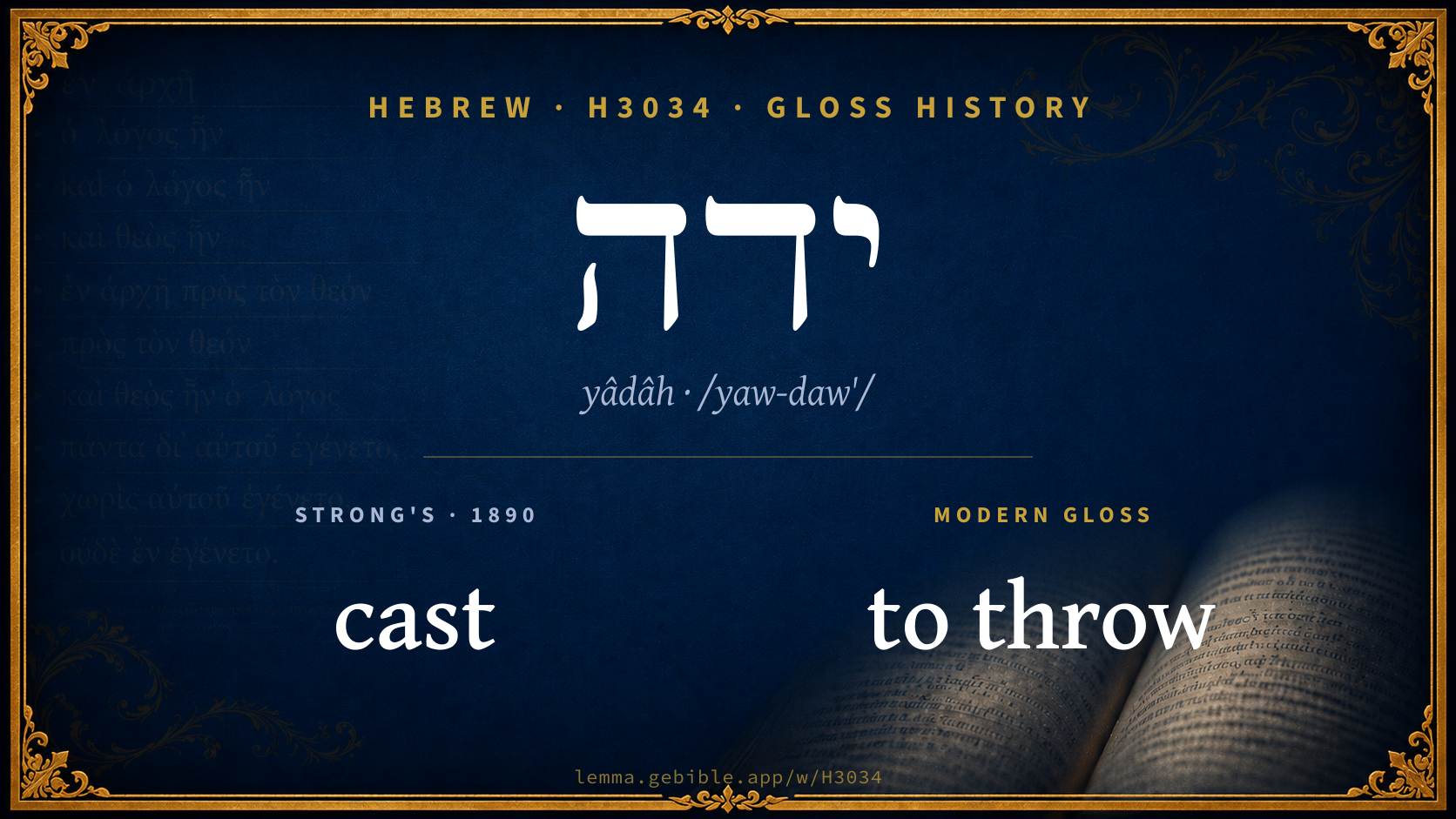
Gloss history
Strong's 1890 vs modern scholarship
About this word
Strong's H3034 catalogs a Hebrew word from the Hebrew Old Testament.
These counts are not copied from any lexicon or concordance. They are computed here, from the morphology-tagged Hebrew Old Testament. What Lemma adds →
- 111
- distinct verses
- The word appears in 111 distinct verses.
- 17 / 39
- OT books
- The word appears in 17 of 39 Old Testament books.
- #384
- by frequency
- Top 500 most frequent Hebrew words (rank 384 of 8,640 Hebrew words by occurrence).
View all 111 occurrences in the concordance →
Most concentrated in
- Psalms 64 verses 58%
- 1 Chronicles 9 verses 8%
- 2 Chronicles 8 verses 7%
By section of the Old Testament
By traditional corpus
Conventional, traditional groupings — biblical authorship is debated, so this is a traditional corpus grouping, not an authorship claim. Each share is this word’s portion of its verses in that division of the Hebrew canon. Each figure is a share of the word’s 111 distinct verses.
- Writings (Ketuvim) 94 verses · 85%
- Prophets (Nevi'im) 11 verses · 10%
- Torah (Pentateuch) 6 verses · 5%
How translations render this word
Counts come from each version’s own published word-to-Strong’s tagging or interlinear alignment — an approximate guide to how each version renders this word, not a word-level alignment the data otherwise carries. Because each total is that version’s own tagged count, the per-version totals vary from one another and need not match the appearance or distinct-verse counts above. These counts may also differ from a printed concordance because Lemma counts each distinctly tagged rendering and does not collapse phrase taggings into a single head-word total. This is a fixed set of word-tagged versions (KJV, ASV, BSB, ULT) and does not change with the reading translation you choose elsewhere. Each version’s license is shown beside its name below (and on Sources).
- King James Version: Give thanks 20×, I will praise 14×, Praise 14×
- American Standard Version: Give thanks 18×, I will give thanks 11×, Oh give thanks 8×
- Berean Standard Bible: Give thanks 20×, I will praise you 8×, Praise you 6×
- unfoldingWord Literal Text: Give thanks 24×, I will thank you 11×, Thank you 6×
King James Version Public Domain
Renders H3034 across 114 tagged occurrences — most commonly:
Plus 38 renderings that appear only once — usually multi-word phrases or single function words the recovered tagging swept in, not distinct renderings.
American Standard Version Public Domain
Renders H3034 across 112 tagged occurrences — most commonly:
Plus other, less common renderings. Plus 38 renderings that appear only once — usually multi-word phrases or single function words the recovered tagging swept in, not distinct renderings.
Berean Standard Bible Public Domain
Renders H3034 across 114 tagged occurrences — most commonly:
Plus other, less common renderings. Plus 28 renderings that appear only once — usually multi-word phrases or single function words the recovered tagging swept in, not distinct renderings.
unfoldingWord Literal Text CC BY-SA 4.0
Renders H3034 across 126 tagged occurrences — most commonly:
Plus other, less common renderings. Plus 29 renderings that appear only once — usually multi-word phrases or single function words the recovered tagging swept in, not distinct renderings.
11 senses and sub-senses in the full BDB
Hebrew verbs can shift meaning by stem (binyan): Qal is the basic action, Niphal is often passive or reflexive, Piel often intensifies or makes it factitive, and Hiphil is typically causative. The senses below are grouped under the stem BDB assigns to each. This entry also uses Hithpael (reflexive or reciprocal).
What do BDB’s symbols mean?
BDB uses these scholarly abbreviations:
| Symbol | Meaning |
|---|---|
| 𝔊 | the Septuagint (the ancient Greek translation, LXX) |
| 𝔙 | the Vulgate (the Latin translation) |
| 𝔖 | the Syriac version (the Peshitta) |
| 𝔗 | the Targum (the Aramaic translation) |
| ψ | the Psalms |
| √ | root (the underlying root or stem) |
| ‖ | parallel passage (a synonymous or contrasted parallel) |
| † | the dagger: every passage where the word occurs is cited |
The 11 senses and sub-senses the full Brown-Driver-Briggs lexicon distinguishes for this word, in lexicon order (not ranked by frequency), with BDB’s own verbatim wording and sub-sense lettering. Shown in Hebrew script with BDB’s own scholarly abbreviations. The condensed entry is in the Lexicon Entry tab. See also the Forms in the corpus table below.
Piel
- Impf. וַיַּדּוּ בִּי La 3:53 and they cast (stones) on me; Inf. יַדּוֹת Zc 2:4 to cast down (the horns of the nations). e.g. Lamentations 3:53
Hiphil
- (connex. with ידה throw, obscure, yet v. supr.) Pf. הוֹדוּ 1 K 8:33 + 3 times; הוֹדִינוּ ψ 75:2(×2); Impf. יְהוֹדֶה Ne 11:17 (on form v. Ges§ 53, R. 7); יוֹדֶה ψ 6:6; 1 s. sf. אֲהוֹדֶנּוּ 28:7 (Gesl.c.); אוֹדֶנּוּ 42:6, 12; 43:5; pl. יוֹדוּ 99:3 + 6 times; sf. יְהוֹדוּךָ 44:18 (Gesl.c.); יוֹדֻךָ 49:19, etc. + 41 times Impf.; Imv. הוֹדוּ Is 12:4 + 16 times; הֹדוּ ψ 107:1; Inf. הוֹדוֹת 1 Ch 25:3 + 11 times; הוֹדֹת Ezr 3:11; הֹדוֹת 1 Ch 16:7 + 4 times (see Baer ψ 92:2); Pt. מוֹדֶה Pr 28:13; pl. מוֹדִים 1 Ch 29:13;— e.g. 1 Kings 8:33
- 1. give thanks, laud, praise;
- a. c. acc. (1) of men, Judah Gn 49:8 (poetic play on name); Job (ironical) Jb 40:14; the king ψ 45:18; the rich 49:19; (2) of י׳, Gn 29:35 (J expl. name יהודה); elsewhere (mostly ψψ and Ch) of ritual worship (v. LagOr. ii. 22 f.); obj. שֵׁם י׳ Is 25:1 ψ 44:9; 54:8; 99:3; 138:2; 142:7; פֶּלֶא י׳ 89:6; יהוה 7:18; 9:2; 109:30; 111:1; יָהּ 118:19; sf. -ךָ referring to God 30:10, 13; 35:18; 43:4; 52:11; 67:4(×2), 6(×2); 71:22; 76:11; 88:11; 118:21, 28; 119:7; 138:1; 139:14 Is 38:18, 19 (song of Hez.); ֶנּוּ ψ 42:6, 12; 43:5; מִשִּׁירִי אֲהוֹדֶנּוּ 28:7 with my song will I praise him; אוֹדְךָ י׳ I will praise thee י׳ 2 S 22:50 = ψ 18:50 = 108:4, Is 12:1 (exilic hymn); אדני ψ 57:10; 86:12, cf. 138:4; 145:10. e.g. Genesis 49:8
- b. sq. לְ, only of the ritual worship: לְשֵׁם י׳ ψ 106:47 = 1 Ch 16:35, ψ 122:4; 140:14; לְזֵכֶר קָדְשׁוֹ 30:5; 97:12; לי׳ 1 Ch 16:4, 7, 41; 23:30; 25:3; 2 Ch 5:13; 7:6; 20:21 ψ 33:2; 92:2; 105:1 = 1 Ch 16:8 = Is 12:4; הודו לי׳ כי טוב give thanks to י׳ for he is good ψ 106:1; 107:1; 118:1, 29; 136:1 1 Ch 16:34; so Je 33:11 (sq. אֶת־י׳); cf. הוד(ו)ת 2 Ch 7:3 Ezr 3:11; יודו לי׳ חסדו ψ 107:8, 15, 21, 31; לאלהים Ne 12:46 ψ 136:1; לאדני v 3; לאל v 26; sfs. referring to God: לְךָ 6:6; 79:13; 119:62; לוֹ 100:4; לך + אלהים 75:2(×2) 1 Ch 29:13; abs. 2 Ch 31:2 Ne 11:17; 12:24 all of the ritual worship. e.g. Psalms 106:47
- 2. confess,
- a. the name of God, ‖ שׁוּב, התחנן, התפלל, 1 K 8:33, 35 = 2 Ch 6:24, 26. e.g. 1 Kings 8:33
- b. עֲלֵי פשׁע ψ 32:5 (‖ לֹא כִסִּיתִי); מוֹדֶה וְעֹזֵב (פשׁעיו) Pr 28:13 confessing and forsaking (his transgressions; opp. מְכַסֶּה). e.g. Psalms 32:5
Hithpael
- Pf. הִתְוַדָּה Lv 5:5; 16:21; הִתְוַדּוּ 26:40 Nu 5:7; Impf. 1 s. אֶתְוַדֶּה Dn 9:4; pl. יִתְוַדּוּ Ne 9:2; Inf. sf. הִתְוַדֹּתוֹ Ezr 10:1; Pt. מִתְוַדֶּה Ne 1:6 Dn 9:20; pl. מִתְוַדִּים 2 Ch 30:22 Ne 9:3;— e.g. Leviticus 5:5
- 1. confess, abs. Ezr 10:1 Ne 9:3 Dn 9:4; c. acc. עָוֹן Lv 16:21 (P), 26:40 (H); חטאת Nu 5:7 (P), Dn 9:20; אֲשֶׁר חָטָא Lv 5:5 (P); עַל חטאות Ne 1:6; 9:2. e.g. Ezra 10:1
- 2. give thanks, ליהוה, in the ritual worship 2 Ch 30:22. e.g. 2 Chronicles 30:22
Senses from the full Brown-Driver-Briggs lexicon (Brown, Driver, Briggs; Oxford 1906 — public domain), digitized via Sefaria, supplemented by the OpenScriptures HebrewLexicon (CC BY 4.0). Full attribution on Sources.
Word origin
vb. throw, cast (Arabic وَدَى exeruit, emisit, ii. iv. emisit (all now in special senses); Ethiopic ወደየ: throw, cast on or in (very often; cf. ወደደ:); whence Hiph. give thanks, confess (orig. acknowledge?) is commonly derived, perhaps from gestures accompanying the act, v. Thes LagOr ii. 22, yet connexion uncertain; Aramaic Pa. וַדֵּי, Aph. אוֹדִי confess, ܐܰܘܕܺܝ, ܐܫܬܘܕܝ id.; but Ethiopic አስተዋደየ accuse, perhaps also from gesture; Palm. מודא render thanks, often in votive inscrr., see Vog on No. 79; עבד ומודא Vog No. 101 = εὐχαρίστως ἀνέθηκε; מודן כל יום Vog No. 93. 1; ידתא pious Vog No. 29) Palm. ידתא 4 (arrows) at Je 50:14 (read prob., with some Codd. יְרוּ).
— Brown-Driver-Briggs (Oxford 1906, public domain), digitized via Sefaria, supplemented by the OpenScriptures HebrewLexicon (CC BY 4.0). See Sources.
Derived from יד (yâd) (H3027) — hand.
Jastrow Dictionary
A second Hebrew/Aramaic lexicon for comparison, covering Aramaic and post-biblical (Talmudic, Targumic, Midrashic) usage that the biblical-Hebrew BDB does not. Matched by lemma rather than by Strong’s number, so a lemma may carry more than one Jastrow headword (shown separately below), and the entries cover usage well beyond the Bible.
יָדָה
- , v. ידי
ידי
- (b. h.) to point, move (cmp. b. h. הָדָה).—Denom. יָד.
- [to raise hands,]
- 1. to thank, acknowledge; to give praise. Taan. 6ᵇ מוֹדִים … לך we offer thanks unto thee. Ber. V, 3 he who says in public prayer מודים מודים … אותו ‘we thank, we thank’ (as if pointing in different directions and acknowledging two divinities) must be silenced. Ib. IX, 5 (play on מ̇אד̇ך, Deut. VI, 5) בכל מ̇ד̇ה ומדה … הוי מוֹדֶה לו for whatever measure He metes out to thee, give thanks to Him. Ib. 54ᵇ ארבעה צריכין להוֹרוֹת four persons are bound to offer public thanks; a. v. fr. e.g. Deuteronomy 6:5
- 2. to admit, consent, to confess. Pes. IV, 9 (56ᵃ); Ber. 10ᵃ על ג׳ הוֹדוּ לו concerning three of his acts they agreed with him. B. Mets. 3ᵃ, a. fr. מוֹדֶה במקצת הטענה he who admits part of his opponent’s claim. Shebu. VI, 3; Keth. 108ᵇ, a. e. טענו … וה׳ לו בשעורים, v. טָעַן I. B. Mets. 12ᵇ בשחייב מודה when the debtor admits his indebtedness; a. v. fr. [Tosef. Par. IX (VIII), 6 שהן מודין, v. מוֹרִיר.]
- , Nithpa. נִתְוַדֶּה, (denom. of תּוֹדָה, cmp. Josh. VII, 19) to confess one’s sins before God. Yoma III, 8 ומִתְיַרֶּה and confesses in public. Ib. 40ᵃ להגריל ולהִתְוַדּוֹת to cast lots and to make confession (on the head of the scapegoat). Y. ib. VIII, end, 45ᶜ אע"פ שנ׳ בערבית צריך להתודות וכ׳ although he has made confession in the evening prayer, he must again confess &c.; a. fr.—V. וִידּוּי. e.g. Joshua 7:19
A Dictionary of the Targumim, the Talmud Babli and Yerushalmi, and the Midrashic Literature (Marcus Jastrow; London, Luzac, 1903) — Public Domain. Digitized via Sefaria. Digitized via Sefaria. Full attribution on Sources.
Forms in the corpus
The 77 distinct written forms H3034 takes in the Hebrew Bible, most frequent first — each parse links to that stem’s occurrences in the concordance. Hebrew forms include their vowel points and cantillation, so a single lemma takes many written forms.
The 60 most common forms are shown; 17 rarer forms follow in the full concordance.
Same root — word family
Other BDB entries built from the same root as H3034, grouped by Strong’s listed origin. These share a root / origin per the lexicon — not necessarily a shared meaning. Each links to that word’s own entry.
Derives from
Shares the same root
Derived from this word
Proper names from this root
People and places named from this root — a name, not an additional meaning of the word.
- ידו Yiddôw H3035 Iddo
- ידון Yâdôwn H3036 Jadon
- ידותון Yᵉdûwthûwn H3038 Jeduthun
- ידיה Yᵉdâyâh H3042 Jedaiah
- יהודה Yᵉhûwdâh H3063 Judah
Compare all same-root words → Showing 4 of 12 — not the complete family. 5 of the same-root words are proper names (people or places). They share a root, not necessarily a meaning.
Septuagint verse parallels
This word appears in 87 verses that also exist in the Greek Old Testament (Septuagint), out of the 111 Hebrew verses it occurs in. You can read those verses in Greek by switching the Old Testament edition to the Septuagint.
Read these verses in the Septuagint
- Genesis 29:35
- Leviticus 5:5
- Numbers 5:7
- 2 Samuel 22:50
- 1 Kings 8:33
- 1 Chronicles 16:4
- 2 Chronicles 5:13
- Ezra 3:11
- Job 40:14
- Psalms 6:5
- Proverbs 28:13
- Isaiah 12:1
This is a verse-level parallel only — the same verses exist in both the Hebrew and Greek Old Testaments. No word-level Hebrew↔Greek correspondence is claimed: the data carries no such alignment, so no Greek word is shown as this Hebrew word’s translation. Coverage is not total — the Septuagint omits the deuterocanon and renumbers the Psalms, so some Hebrew verses have no direct Greek parallel.