
Job 31:27

Hebrew (Westminster Leningrad Codex) Job 31:27 appears in the Hebrew Old Testament. The text above is from the Westminster Leningrad Codex. Each word links to its Strong’s number, a concise gloss, and parsing drawn from the Open Scriptures Hebrew Bible morphology. Click any word for its full Brown-Driver-Briggs (BDB) entry.
Download image
Cite this verse

Job 31:27 (World English Bible). Public Domain. Lemma interlinear Bible study tool, https://lemma.gebible.app/v/job/31/27.

Show BibTeX & RIS
BibTeX
RIS
English Translation
And my heart has been secretly enticed, My hand threw a kiss from my mouth:
World English Bible · Public Domain
Download a study sheet

One document with this verse’s original text, its word-by-word gloss line, the meaning frame, cross-references with their text, attributed commentary, and full source and license credits — printable, and it pastes into notes with its structure intact.

This verse Autodidact and up

Study sheet (.html) Plain text (.txt)

A passage Seminary Student

Up to 50 verses in one chapter. A passage sheet keeps up to 6 commentary sources and 12 cross-references per verse, in the order this page ranks them, and says so on the sheet whenever that leaves anything out. Ask for a single verse and you get the Autodidact verse sheet above.

Everything on this page stays free to read, with no account — the sheet is a download of what is already on screen, not access to it.

Want to remove ads? Support Godless Engineer
Compare translations 3

The same verse in 3 English versions, stacked beneath the original-language interlinear above. Click any original word for its lexicon entry.

Each is an independent rendering of the whole verse — the interlinear is not word-aligned to these translations.

Highlighted words mark where these versions differ — a whole-verse word diff, not a word-by-word alignment.

  • World English Bible Public Domain
    And my heart has been secretly enticed, My hand threw a kiss from my mouth:
  • King James Version Public Domain
    And my heart hath been secretly enticed, or my mouth hath kissed my hand:
  • unfoldingWord Literal Text CC BY-SA 4.0
    and my heart opened in secret and my hand kissed my mouth,

unfoldingWord Literal Text — © unfoldingWord, licensed CC BY-SA 4.0. Word-aligned USFM3 via Door43 (git.door43.org/unfoldingWord/en_ult).

Versions to compare (up to 4)

3 of 4 selected

Show all 18 translations

Every available English version of this verse, each an independent rendering of the whole verse.

  • World English Bible Public Domain
    And my heart has been secretly enticed, My hand threw a kiss from my mouth:
  • Berean Standard Bible Public Domain
    so that my heart was secretly enticed and my hand threw a kiss from my mouth,
  • Majority Standard Bible Public Domain
    so that my heart was secretly enticed and my hand threw a kiss from my mouth,
  • King James Version Public Domain
    And my heart hath been secretly enticed, or my mouth hath kissed my hand:
  • American Standard Version (1901) Public Domain
    And my heart hath been secretly enticed, And my mouth hath kissed my hand:
  • Revised Version (1885) Public Domain
    And my heart hath been secretly enticed, and my mouth hath kissed my hand:
  • Geneva Bible (1599) Public Domain
    If mine heart did flatter me in secrete, or if my mouth did kisse mine hand,
  • Douay-Rheims (1899) Public Domain
    And my heart in secret hath rejoiced, and I have kissed my hand with my mouth:
  • Young's Literal Translation Public Domain
    And my heart is enticed in secret, And my hand doth kiss my mouth,
  • Literal Standard Version CC BY-SA 4.0
    And my heart is enticed in secret, || And my hand kisses my mouth,
  • Unlocked Literal Bible CC BY-SA 4.0
    and if my heart has been secretly attracted, so that my mouth has kissed my hand in worship of them—
  • unfoldingWord Literal Text CC BY-SA 4.0
    and my heart opened in secret and my hand kissed my mouth,
  • Darby Bible Public Domain
    And my heart have been secretly enticed, so that my mouth kissed my hand:
  • World Messianic Bible Public Domain
    and my heart has been secretly enticed, and my hand threw a kiss from my mouth;
  • Webster's Bible Public Domain
    And my heart hath been secretly enticed, or my mouth hath kissed my hand:
  • Free Bible Version CC BY-SA 4.0
    and been tempted to secretly worship them by kissing my hand to them in devotion?
  • Bible in Basic English Public Domain
    A secret feeling of worship came into my heart, and my hand gave kisses from my mouth;
  • JPS Tanakh (1917) Public Domain
    And my heart hath been secretly enticed, and my mouth hath kissed my hand;

Literal Standard Version (2020), Covenant Press — licensed CC BY-SA 4.0. Text via the HelloAO Bible API (eBible.org). Unlocked Literal Bible (unfoldingWord) — licensed CC BY-SA 4.0. Text via the HelloAO Bible API (eBible.org). unfoldingWord Literal Text — © unfoldingWord, licensed CC BY-SA 4.0. Word-aligned USFM3 via Door43 (git.door43.org/unfoldingWord/en_ult). Free Bible Version, Dr. Jonathan Gallagher — licensed CC BY-SA 4.0. Text via the HelloAO Bible API (eBible.org).

Word by word

More ways to search: Search by grammar → Find every occurrence → Compare this word →

Practice this passage: Drill this verse → Learn its vocabulary →

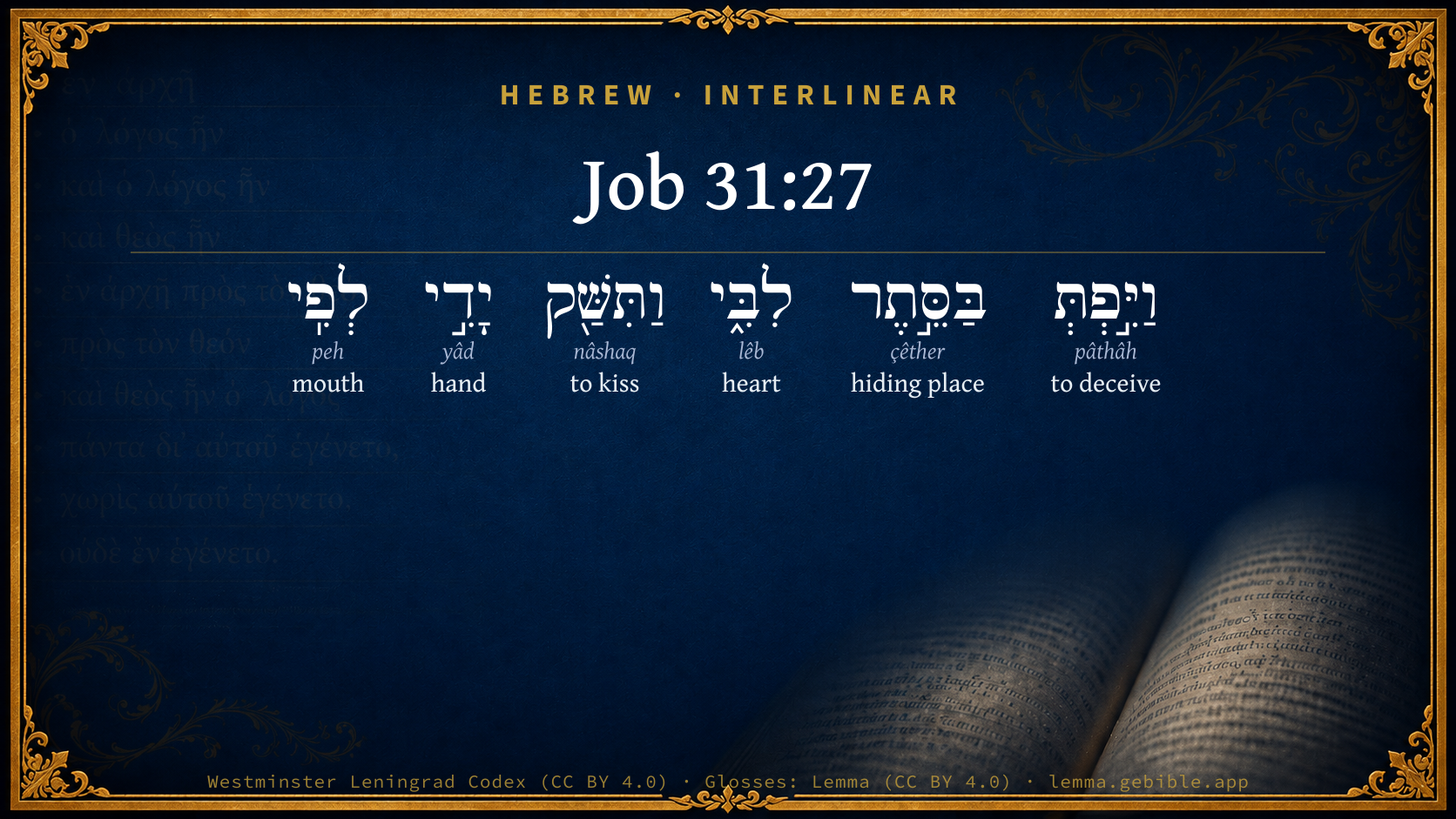
וַיִּ֣פְתְּ
pâthâh
H6601
“and · to deceive”
Conjunction + Verb, Qal, Sequential Imperfect, 3rd Person, Masculine, Singular
Part of Speech
Conjunction + Verb
Stem
Qal
Form
Sequential Imperfect
Person
3rd Person
Gender
Masculine
Number
Singular
Full BDB Definition

Origin: a primitive root

TWOT: 1853

to be spacious, be open, be wide - (Qal) to be spacious or open or wide - (Hiphil) to make spacious, make open - to be simple, entice, deceive, persuade - (Qal) - to be open-minded, be simple, be naive - to be enticed, be deceived - (Niphal) to be deceived, be gullible - (Piel) - to persuade, seduce - to deceive - (Pual) - to be persuaded - to be deceived
  1. בַּסֵּ֣תֶר çêther H5643 “in/at the · hiding place” Preposition, Determined + Noun, Common, Masculine, Singular, Absolute
  2. לִבִּ֑י lêb H3820 “heart · my” Noun, Common, Masculine, Singular, Construct + Suffix, Personal, 1st Person, Common, Singular
  3. וַתִּשַּׁ֖ק nâshaq H5401 “and · to kiss” Conjunction + Verb, Qal, Sequential Imperfect, 3rd Person, Feminine, Singular
  4. יָדִ֣י yâd H3027 “hand · my” Noun, Common, Both, Singular, Construct + Suffix, Personal, 1st Person, Common, Singular
  5. לְפִֽי peh H6310 “to/for · mouth · my” Preposition + Noun, Common, Masculine, Singular, Construct + Suffix, Personal, 1st Person, Common, Singular

About this verse

These counts appear in no published source. They are computed here, from the morphology-tagged text and Lemma’s own curated glosses. What Lemma adds →

6
words
6
distinct lemmas
Wisdom
section

Shared distinctive vocabulary

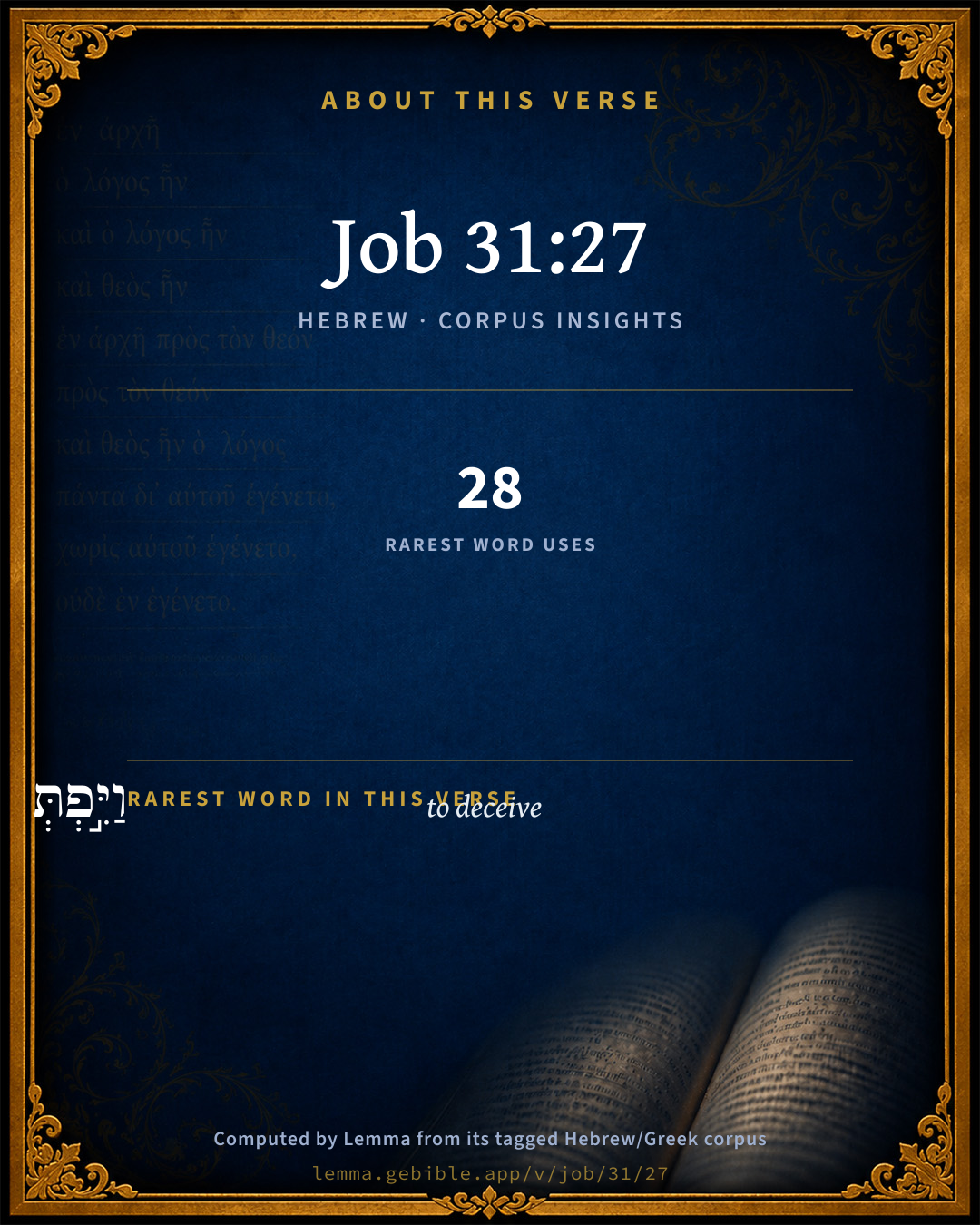
וַיִּ֣פְתְּ to deceive H6601 occurs in 26 verses of the Hebrew Bible. Also found in:

Grammatical profile

  • 2 verbs
  • 4 nouns

Verb forms

  • וַיִּ֣פְתְּ Qal · Sequential Imperfect
  • וַתִּשַּׁ֖ק Qal · Sequential Imperfect

Hebrew & Septuagint length

In English translation the verse runs 15 words from the Hebrew and 20 from the Septuagint (LXX English) — closely comparable.

A rough comparison of the two English renderings, which tokenize alike — not a word-level alignment.

Word counts can differ between the Hebrew and the Greek without any difference in meaning — e.g. the Hebrew direct-object marker אֵת has no separate Greek word, and Greek often adds the article ὁ.

Cross-references

8

Topical passages linked to Job 31:27 in the Treasury of Scripture Knowledge — connected by theme and wording, ordered by reader-vote popularity; previews shown in the World English Bible.

  • Deuteronomy 13:6 If your brother, the son of your mother, or your son, or your daughter, or the wife of your bosom, or your friend, who is as your own soul, entice you secretly, saying, Let us go and serve other gods, which you have not known, you, nor your fathers;
  • Deuteronomy 11:16 Take heed to yourselves, lest your heart be deceived, and you turn aside, and serve other gods, and worship them;
  • 1 Kings 19:18 Yet will I leave [me] seven thousand in Israel, all the knees which have not bowed to Baal, and every mouth which has not kissed him.
  • Psalms 2:12 Kiss the son, lest he be angry, and you perish in the way, For his wrath will soon be kindled. Blessed are all those who take refuge in him.
  • Isaiah 44:20 He feeds on ashes; a deceived heart has turned him aside; and he can't deliver his soul, nor say, Is there not a lie in my right hand?
  • Hosea 13:2 Now they sin more and more, And have made themselves molten images of their silver, Even idols according to their own understanding, All of them the work of the craftsmen. They say of them, "They offer human sacrifice and kiss the calves."
  • Romans 1:21 Because, knowing God, they didn't glorify him as God, neither gave thanks, but became vain in their reasoning, and their senseless heart was darkened.
  • Romans 1:28 Even as they refused to have God in their knowledge, God gave them up to a reprobate mind, to do those things which are not fitting;

Cross-references courtesy of OpenBible.info (CC BY 4.0).

Hebrew and Greek witnesses Masoretic Hebrew ↔ Greek Septuagint

The same verse in the two great witnesses to the Old Testament, shown verse-for-verse.

These are two independent witnesses, not word-aligned to each other, and the Septuagint is shown in lemma (dictionary) form.

Hebrew Job 31:27 Masoretic · Westminster Leningrad Codex

וַיִּ֣פְתְּ בַּסֵּ֣תֶר לִבִּ֑י וַתִּשַּׁ֖ק יָדִ֣י לְפִֽי

And my heart has been secretly enticed, My hand threw a kiss from my mouth:

World English Bible · Public Domain

Greek LXX Job 31:27 Septuagint · lemma form

καί εἰ ἀπατάω λάθρα ὁ καρδία ἐγώ εἰ δέ καί χείρ ἐγώ ἐπιτίθημι ἐπί στόμα ἐγώ φιλέω

and if my heart was secretly deceived, and if I have laid my hand upon my mouth and kissed it:

LXX2012 (modern English Septuagint) · Public Domain

On this verse, Haydock's Catholic Bible Commentary discusses the Septuagint’s reading. Read the note in Commentary ↓

Hebrew: Westminster Leningrad Codex (CC BY 4.0). Greek: Septuagint (public domain); English from LXX2012 (modern English Septuagint) (Public Domain). How the Septuagint differs from the Hebrew →

Commentary

Notes on Job 31:27 from classic Christian and Jewish commentators (each source and its license shown beneath its notes). The classic Christian expositions comment on the surrounding passage and are grouped to its opening verse, so a note may address several verses; the Jewish commentaries on the Tanakh (Rashi and others) are per-verse, so they appear only where the commentator wrote on this verse.

Lemma curates 59 commentaries, every one of them public domain or Creative Commons licensed, each selected and text-cleaned for this edition rather than reprinted as found. About our sources →

Trapp's Complete Commentary

John Trapp

Job 31:27 And my heart hath been secretly enticed, or my mouth hath kissed my hand:

Ver. 27. And my heart hath been secretly enticed] sc. By the devil, who is ειδωλοχαρης, as, saith Synesius, a great promoter of idolatry; and probably had tempted good Job to this sin also; but was bravely repulsed. If I have done this secretly, saith he, that is, contrary to my open profession of sincere religion. See Deu 27:10.

Or, my mouth hath kissed my hand] An action of idolaters, who kissed their idols that were present, 1Ki 19:18 Hos 13:2 (as the Papists now do their idols, even to the wearing of hardest marble), and to those which were further from them, they held out their hand, and afterwards did put it to their mouth; as an acknowledgment that they had their life and breath from them, saith Diodati, as a sign of subjection, saith Piscator, from Gen 41:40 Psa 2:12, "Kiss the Son," sc. with a kiss of homage, such as wherewith Samuel kissed Saul, 1Sa 10:1. And Plutarch saith (in Caton. Uticens.), that not to all, but to some special chief commanders, and generals, it was granted among the Romans, That the hand should be kissed before them by way of honour; and this was called adorare, quasi applicare manum ad os. That saying of Bernard (In Cantic. serm. iv.) is worthy of inserting, Qui in se, non in Domino gloriatur, manum suam osculatur; He that glories in himself, and not in the Lord, kisseth his own hand, and is, interpretative, an idolater.

John Trapp, A Commentary or Exposition upon All the Books of the Old and New Testament (1647–1656) — public domain. Text from a community e-Sword module.

Tyndale Open Study Notes

Tyndale Open Resources

31:27 secretly enticed in my heart: See 31:9. • throw kisses at them in worship: Cp. 1 Kgs 19:18; Hos 13:2.

Tyndale Open Study Notes — © Tyndale Open Resources, licensed CC BY-SA 4.0. Text via the HelloAO Bible API.

Geneva Bible (1599)

Geneva Bible translators

If mine own doings delighted me.

Geneva Bible (1599) marginal notes — public domain. Text via Bolls.life.

Jamieson, Fausset & Brown

Robert Jamieson, A. R. Fausset & David Brown

enticed--away from God to idolatry.

kissed . . . hand--"adoration," literally means this. In worshipping they used to kiss the hand, and then throw the kiss, as it were, towards the object of worship (Kg1 19:18; Hos 13:2).

Jamieson, Fausset & Brown — Commentary Critical and Explanatory on the Whole Bible (1871) — public domain (CC PDM 1.0). Text via the HelloAO Bible API.

The Cambridge Bible for Schools and Colleges

gen. ed. J. J. S. Perowne

27. or my mouth hath kissed my hand] lit. and my hand hath kissed my mouth. The meaning is, if his hand touched his mouth “in order to wave the homage of the lips towards the object of adoration” (Con.). Pliny (quoted in Del.) says, Inter adorandum dexteram ad osculum referimus et totum corpus circumagimus. The worship of the heavenly bodies was widely spread in the East and in Arabia. The remarkable passage, Jer_44:17 seq., shews that before the Exile worship of the “queen of heaven” had long been practised among all classes and in all the towns of Israel; comp. Eze_8:16.

The Cambridge Bible for Schools and Colleges (gen. ed. J. J. S. Perowne; Cambridge University Press, 1878–1918) — public domain. Text from a community e-Sword module.

John Gill's Exposition

If I rejoiced at the destruction of him that hated me,.... Job, though a good man, had his enemies, as all good men have, and that because of their goodness, and who hated him with an implacable hatred, without a cause, there being a rooted bitter enmity in the seed of the serpent against the godly in all generations; on whom sooner or later, at one time or another, destruction comes, one calamity or another on their families, diseases on their bodies, loss of substance, death of themselves or relatives; now it is a common thing with wicked men to rejoice in the adversity of their enemies, but good men should not do so; yet it is a difficult thing, and requires a large measure of grace, and that in exercise, not to feel any pleasing emotion, a secret joy and inward pleasure, at the hearing of anything of this sort befalling an enemy; which is a new crime Job purges himself from:

or lifted up myself when evil found him; either the evil of sin, which sooner or later finds out the sinner, charges him with guilt, and requires punishment, or the evil of punishment for sin; which, though it may seem to move slowly, pursues the sinner, and will overtake him, and light upon him. Mr. Broughton renders the words, "and bestirred me when he found loss": loss in his family, in his cattle, and in his substance; now, when this was the case, Job did not raise up himself in a haughty manner, and insult and triumph over him, or stir up himself to joy and rejoicing, or to make joyful motions, as Aben Ezra and Ben Gersom interpret it; and by his gestures show that he was elated with the evil that had befallen his enemy; indeed so far as the fall and destruction of the wicked make for the public good, for the interest of religion, for the glory of God, and the honour of his justice, it is lawful for good men to rejoice thereat; but not from a private affection, or from a private spirit of revenge, see Psa 58:10.

John Gill's Exposition of the Whole Bible (1746–1763) — public domain (CC PDM 1.0). Text via the HelloAO Bible API.

Albert Barnes' Notes on the Bible

And my heart hath been secretly enticed - That is, away from God, or led into sin.

Or my mouth hath kissed my hand - Margin, my hand hath kissed my mouth. The margin accords with the Hebrew. It was customary in ancient worship to kiss the idol that was worshipped; compare 1Ki 19:18, “I have left me seven thousand in Israel - and every mouth which hath not kissed him.” See, also, Hos 13:2. The Muslims at the present day, in their worship at Mecca, kiss the black stone which is fastened in the corner of the Beat Allah, as often as they pass it, in going round the Caaba. If they cannot come near enough to kiss it, they touch it with the hand, and kiss that. An Oriental pays his respects to one of a superior station by kissing his hand and putting it to his forehead. Paxton. See the custom of kissing the hand of a Prince, as it exists in Arabia, described by Niebuhr, Reisebeschreib. 1, S. 414. The custom prevailed, also, among the Romans and Greeks. Thus, Pliny (Hist. Nat. 28:2) says, Inter adorandum dexterarm ad osculum referimus, et totum corpus circumagimus. So Lucian in the book, περὶ ὀρχήτεως peri orchēseōs, says, “And the Indians, rising early, adore the sun - not as we, kissing the hand - τὴν χείρα κύσαντες tēn cheira kusantes - think that our vow is perfect.” The foundation of the custom here alluded to, is the respect and affection which is shown for one by kissing; and as the heavenly bodies which were worshipped were so remote that the worshippers could not have access to them, they expressed their veneration by kissing the hand. Job means to say, that he had never performed an act of homage to the heavenly bodies.

Albert Barnes' Notes on the Bible (1834–1885) — public domain. Text from a community e-Sword/MySword module.

Haydock's Catholic Bible Commentary

Rejoiced. Hebrew and Chaldean, "been seduced" to idolatry. (Menochius) --- The worship of the sun and moon was most ancient, Ezechiel viii. 16. --- Mouth, to testify respect and admiration. This custom prevailed in many nations. Lucian (dial. de sacrif.) observes that this only sacrifice of the poor was not disregarded. The Syrians still extend their hands towards the altar, and then apply them to their mouth and eyes, when the body and blood of Christ are offered in the Mass. (Life of M. de Chateuil.) (Calmet) --- Septuagint, (26) "Do I not see the shining sun eclipsed, (Haydock) and the moon disappear, for light does not belong to them," but to the Creator, from whom we have every thing; (Calmet) so that we should not swell with pride. Theodotion adds, (27) "and if my heart was secretly deceived." Septuagint continue, "if indeed, putting my hand to my mouth, I kissed, (28) this would also be imputed to me as a great transgression, because I should have acted falsely before the most high God." (Haydock) --- He will admit of no rival; hence the man who admits another god, denies Him. (Menochius) --- Job repels the charge which had been indirectly brought against him. (Worthington)

George Leo Haydock (1774–1849), Haydock's Catholic Family Bible and Commentary, 1859 edition — public domain. Excludes Psalms (Douay-Rheims chapter numbering differs from Protestant) and Deuterocanonical books (Catholic canon only).

Matthew Poole's English Annotations

Secretly; in my inward thoughts or affections, whilst I made open profession of my adherence to God and to the true religion. Enticed, or seduced, or deceived, by its plausible and glorious appearance, which might easily cheat a credulous and inconsiderate person to believe that there was something of a divinity in it, and so induce him to worship it. This emphatical expression seems to be used with design to teach the world this necessary and useful truth, that no mistake or error of mind would excuse the practice of idolatry. Or my mouth, Heb. and my mouth, which seems more proper here, because the secret error of the mind, without some such visible action and evidence as here follows, had not been punishable by the judges.

Kissed my hand, in token of worship; whereof this was a sign, whether given to men, as Gen 41:40; Psa 2:12, or to idols, 1Ki 19:18; Hos 13:2. And when the idols were out of the reach of idolaters, that they could not kiss them, they used to kiss their hands, and, as it were, to throw kisses at them; of which we have many examples in heathen writers; of which see my Latin Synopsis on this place.

Matthew Poole's English Annotations on the Holy Bible (1683–1685) — public domain. Text from a community e-Sword/MySword module.

Whedon's Commentary on the Bible

Daniel D. Whedon

27. Mouth… kissed… hand — Literally, My hand hath kissed my mouth, as in the margin. “In the act of worship,” says Pliny, we “kiss the right hand, and turn the whole body to the right,” Job_28:2; Job_28:5; also Job 11:45. Worshippers of the rising sun in Western Asia and Greece, according to Lucian, also kissed the hand to this luminary, “and then thought their adoration complete.” The act was expressive of affection for these objects.

Daniel D. Whedon (gen. ed.), Commentary on the Old and New Testaments (1874–1909) — public domain. Text from a community e-Sword module.

The Pulpit Commentary

And my heart hath been secretly enticed, or my mouth hath kissed my hand. The sin of the heart is placed first, as the fens et origo mali" the spiritual root of the matter. On this naturally follows the outward act which, in the case of idolatry, was commonly the act exactly expressed by the word "adore the movement of the hand to the mouth in token of reverence and honour (see Pliny, "Hist. Nat.," 28:2, "Inter adorandum dexteram ad osculum referimus, et totum corpus circumagimus;" and Minucius Felix, Octav., 2, Caecilius, simulacro Serapidis denotato, ut vulgus superstitiosum solet, manum ori admovens osculum labiis pressit").

The Pulpit Commentary (1880–1919), ed. H.D.M. Spence-Jones & Joseph S. Exell — public domain. Text from a community e-Sword module.

John Wesley's Explanatory Notes

Kissed - In token of worship, whereof this was a sign.

John Wesley, Explanatory Notes Upon the Whole Bible (1754–1765) — public domain. Text via the GEBible commentary corpus.

Rashi

Rabbi Shlomo Yitzchaki (Rashi)

And my heart was secretly enticed to the sun and the moon, saying that they are gods, like some heathens, who have gone astray (and worship) all the host of heaven.

Rashi on the Tanakh — English translations: “The Judaica Press complete Tanach with Rashi, translated by A. J. Rosenberg” (CC BY 4.0); “Pentateuch with Rashi's commentary by M. Rosenbaum and A.M. Silbermann, 1929-1934” (public domain); “The Metsudah Tanach series, Lakewood, N.J” (CC BY 4.0); and “The Book of Joshua, Metsudah Publications, 1997” (CC BY 4.0). Text via Sefaria.

Lesson kit

Teaching starters — assembled from the data on this page, not authored interpretation. Every prompt links to the verse data it draws on. Edit before teaching.

Job, in the Wisdom, opens this verse with 6 words (6 distinct Hebrew lemmas). Its most distinctive word is pâthâh (“to deceive”). A historical commentator’s framing appears above. Read the whole chapter for the surrounding context.

Discussion questions

  1. What does “to deceive” (pâthâh) contribute to the verse as a whole?
  2. Genesis 9:27 shares the word «to deceive» with this verse. How do the two illuminate each other?
  3. These translations render this verse differently; the difference is in the English rendering, not the original. What questions does that raise?
  4. The verb «וַיִּ֣פְתְּ» is Qal Sequential Imperfect. How does its form color the action?
  5. Reading how Trapp's Complete Commentary and Tyndale Open Study Notes read this verse, where do the two commentators agree and where do they part?

Things to notice

Reading settings

Reading text

Shown beneath each verse's original-language words.

Old Testament
Old Testament edition

Read the OT as the Masoretic Hebrew (MT) or the Greek Septuagint (LXX).

English shown for the Greek Septuagint (in the Hebrew ↔ Greek comparison).

Comparing translations? Open the Compare panel on any verse page to stack up to four side by side.