
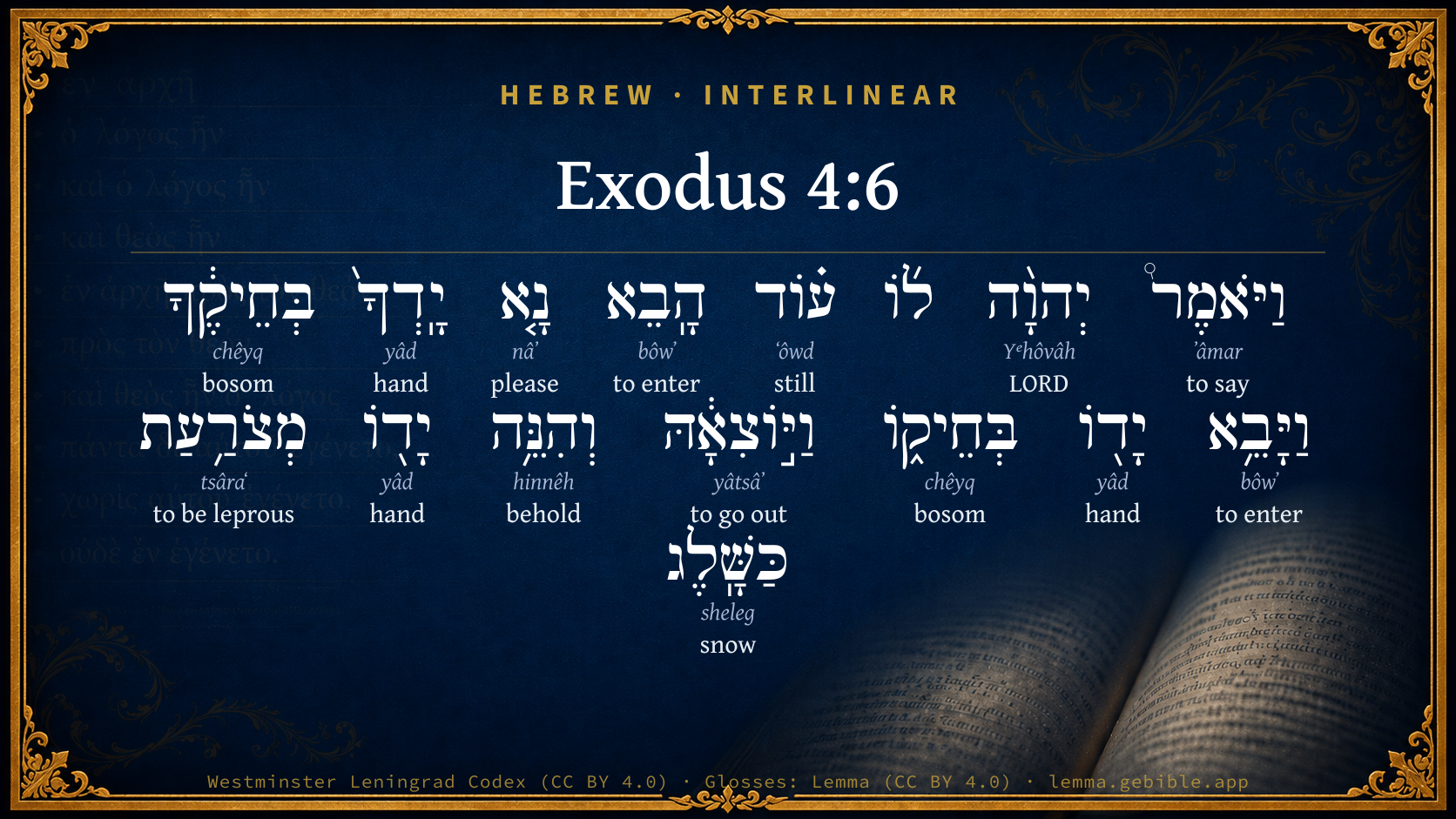
Exodus 4:6

Hebrew (Westminster Leningrad Codex) Exodus 4:6 appears in the Hebrew Old Testament. The text above is from the Westminster Leningrad Codex. Each word links to its Strong’s number, a concise gloss, and parsing drawn from the Open Scriptures Hebrew Bible morphology. Click any word for its full Brown-Driver-Briggs (BDB) entry.
Download image
Cite this verse

Exodus 4:6 (World English Bible). Public Domain. Lemma interlinear Bible study tool, https://lemma.gebible.app/v/exodus/4/6.

Show BibTeX & RIS
BibTeX
RIS
English Translation
Yahweh said furthermore to him, "Now put your hand inside your cloak." He put his hand inside his cloak, and when he took it out, behold, his hand was leprous, as white as snow.
World English Bible · Public Domain
Highlights
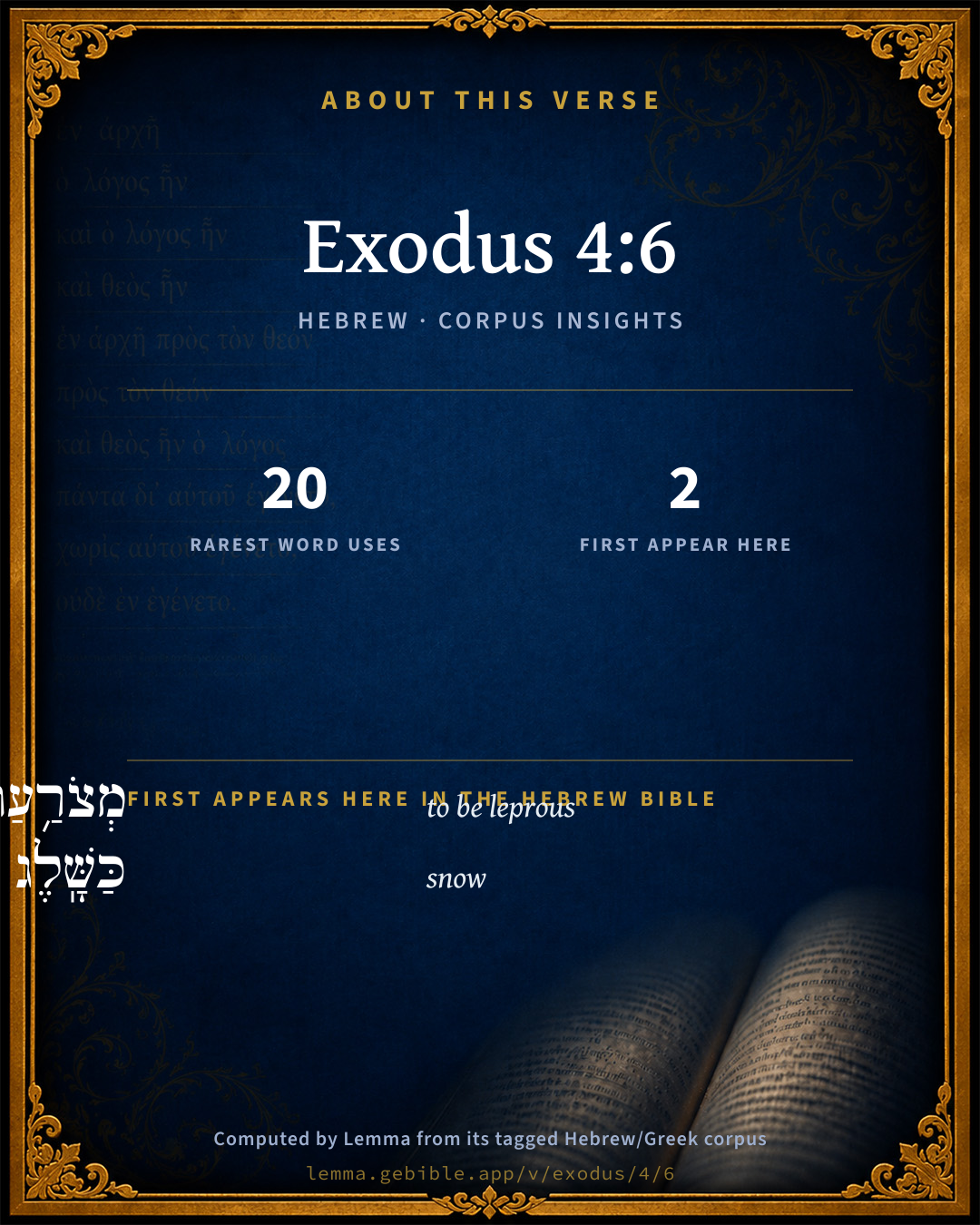
  • 2 first appearances in the Hebrew Bible
Full analysis ↓
Download a study sheet

One document with this verse’s original text, its word-by-word gloss line, the meaning frame, cross-references with their text, attributed commentary, and full source and license credits — printable, and it pastes into notes with its structure intact.

This verse Autodidact and up

Study sheet (.html) Plain text (.txt)

A passage Seminary Student

Up to 50 verses in one chapter. A passage sheet keeps up to 6 commentary sources and 12 cross-references per verse, in the order this page ranks them, and says so on the sheet whenever that leaves anything out. Ask for a single verse and you get the Autodidact verse sheet above.

Everything on this page stays free to read, with no account — the sheet is a download of what is already on screen, not access to it.

Want to remove ads? Support Godless Engineer
Compare translations 3

The same verse in 3 English versions, stacked beneath the original-language interlinear above. Click any original word for its lexicon entry.

Each is an independent rendering of the whole verse — the interlinear is not word-aligned to these translations.

Highlighted words mark where these versions differ — a whole-verse word diff, not a word-by-word alignment.

  • World English Bible Public Domain
    Yahweh said furthermore to him, "Now put your hand inside your cloak." He put his hand inside his cloak, and when he took it out, behold, his hand was leprous, as white as snow.
  • King James Version Public Domain
    And the LORD said furthermore unto him, Put now thine hand into thy bosom. And he put his hand into his bosom: and when he took it out, behold, his hand was leprous as snow.
  • unfoldingWord Literal Text CC BY-SA 4.0
    And Yahweh also said to him, “Put your hand in your bosom.” And he put his hand in his bosom. And he brought it out, and behold, his hand was being struck with a skin disease like snow.

unfoldingWord Literal Text — © unfoldingWord, licensed CC BY-SA 4.0. Word-aligned USFM3 via Door43 (git.door43.org/unfoldingWord/en_ult).

Versions to compare (up to 4)

3 of 4 selected

Show all 18 translations

Every available English version of this verse, each an independent rendering of the whole verse.

  • World English Bible Public Domain
    Yahweh said furthermore to him, "Now put your hand inside your cloak." He put his hand inside his cloak, and when he took it out, behold, his hand was leprous, as white as snow.
  • Berean Standard Bible Public Domain
    Furthermore, the LORD said to Moses, “Put your hand inside your cloak.” So he put his hand inside his cloak, and when he took it out, his hand was leprous, white as snow.
  • Majority Standard Bible Public Domain
    Furthermore, the LORD said to Moses, “Put your hand inside your cloak.” So he put his hand inside his cloak, and when he took it out, his hand was leprous, white as snow.
  • King James Version Public Domain
    And the LORD said furthermore unto him, Put now thine hand into thy bosom. And he put his hand into his bosom: and when he took it out, behold, his hand was leprous as snow.
  • American Standard Version (1901) Public Domain
    And Jehovah said furthermore unto him, Put now thy hand into thy bosom. And he put his hand into his bosom: and when he took it out, behold, his hand was leprous, as `white as' snow.
  • Revised Version (1885) Public Domain
    And the LORD said furthermore unto him, Put now thine hand into thy bosom. And he put his hand into his bosom: and when he took it out, behold, his hand was leprous, as white as snow.
  • Geneva Bible (1599) Public Domain
    And the Lord saide furthermore vnto him, Thrust nowe thine hand into thy bosome. And he thrust his hand into his bosome, and when he tooke it out againe, behold, his hand was leprous as snowe.
  • Douay-Rheims (1899) Public Domain
    And the Lord said again: Put thy hand into thy bosom. And when he had put it into his bosom, he brought it forth leprous as snow.
  • Young's Literal Translation Public Domain
    And Jehovah saith to him again, `Put in, I pray thee, thy hand into thy bosom;' and he putteth in his hand into his bosom, and he bringeth it out, and lo, his hand `is' leprous as snow;
  • Literal Standard Version CC BY-SA 4.0
    And YHWH says to him again, “Now put your hand into your bosom”; and he puts his hand into his bosom, and he brings it out, and behold, his hand [is] leprous as snow;
  • Unlocked Literal Bible CC BY-SA 4.0
    Yahweh also said to him, “Now put your hand inside your robe.” So Moses put his hand inside his robe. When he brought it out, behold, his hand was leprous, as white as snow.
  • unfoldingWord Literal Text CC BY-SA 4.0
    And Yahweh also said to him, “Put your hand in your bosom.” And he put his hand in his bosom. And he brought it out, and behold, his hand was being struck with a skin disease like snow.
  • Darby Bible Public Domain
    And Jehovah said moreover to him, Put now thy hand into thy bosom. And he put his hand into his bosom, and took it out, and behold, his hand was leprous, as snow.
  • World Messianic Bible Public Domain
    The LORD said furthermore to him, “Now put your hand inside your cloak.” He put his hand inside his cloak, and when he took it out, behold, his hand was leprous, as white as snow.
  • Webster's Bible Public Domain
    And the LORD said furthermore to him, Put now thy hand into thy bosom. And he put his hand into his bosom: and when he took it out, behold, his hand was leprous as snow.
  • Free Bible Version CC BY-SA 4.0
    Then the Lord told him, “Put your hand inside your clothes close to your chest.” So Moses did as he was told. When he took his hand out, it was white like snow with a skin disease.
  • Bible in Basic English Public Domain
    Then the Lord said to him again, Put your hand inside your clothing. And he put his hand inside his robe: and when he took it out it was like the hand of a leper, as white as snow.
  • JPS Tanakh (1917) Public Domain
    And the LORD said furthermore unto him: 'Put now thy hand into thy bosom.' And he put his hand into his bosom; and when he took it out, behold, his hand was leprous, as white as snow.

Literal Standard Version (2020), Covenant Press — licensed CC BY-SA 4.0. Text via the HelloAO Bible API (eBible.org). Unlocked Literal Bible (unfoldingWord) — licensed CC BY-SA 4.0. Text via the HelloAO Bible API (eBible.org). unfoldingWord Literal Text — © unfoldingWord, licensed CC BY-SA 4.0. Word-aligned USFM3 via Door43 (git.door43.org/unfoldingWord/en_ult). Free Bible Version, Dr. Jonathan Gallagher — licensed CC BY-SA 4.0. Text via the HelloAO Bible API (eBible.org).

Word by word

More ways to search: Search by grammar → Find every occurrence → Compare this word →

Practice this passage: Drill this verse → Learn its vocabulary →

מְצֹרַ֥עַת
tsâraʻ
H6879
“leprous”
Verb, Pual, Participle Passive, Feminine, Singular, Absolute
Part of Speech
Verb
Stem
Pual
Form
Participle Passive
Gender
Feminine
Number
Singular
State
Absolute
Full BDB Definition

Origin: a primitive root

TWOT: 1971

to be diseased of skin, be leprous - (Qal) to be a leper - (Pual) to have leprosy
  1. וַיֹּאמֶר֩ ʼâmar H559 “and · to say” Conjunction + Verb, Qal, Sequential Imperfect, 3rd Person, Masculine, Singular
  2. יְהוָ֨ה Yᵉhôvâh H3068 “LORD” Noun, Proper
  3. ע֗וֹד ʻôwd H5750 “still” Adverb
  4. הָֽבֵא bôwʼ H935 “enter” Verb, Hiphil, Imperative, 2nd Person, Masculine, Singular
  5. נָ֤א nâʼ H4994 “please” Particle, Exhortation
  6. יָֽדְךָ֙ yâd H3027 “hand · your” Noun, Common, Both, Singular, Construct + Suffix, Personal, 2nd Person, Masculine, Singular
  7. בְּחֵיקֶ֔ךָ chêyq H2436 “in/at · bosom · your” Preposition + Noun, Common, Masculine, Singular, Construct + Suffix, Personal, 2nd Person, Masculine, Singular
  8. וַיָּבֵ֥א bôwʼ H935 “and · to enter” Conjunction + Verb, Hiphil, Sequential Imperfect, 3rd Person, Masculine, Singular
  9. יָד֖וֹ yâd H3027 “hand · his” Noun, Common, Both, Singular, Construct + Suffix, Personal, 3rd Person, Masculine, Singular
  10. בְּחֵיק֑וֹ chêyq H2436 “in/at · bosom · his” Preposition + Noun, Common, Masculine, Singular, Construct + Suffix, Personal, 3rd Person, Masculine, Singular
  11. וַיּ֣וֹצִאָ֔הּ yâtsâʼ H3318 “and · to go out · her” Conjunction + Verb, Hiphil, Sequential Imperfect, 3rd Person, Masculine, Singular + Suffix, Personal, 3rd Person, Feminine, Singular
  12. וְהִנֵּ֥ה hinnêh H2009 “and · behold” Conjunction + Particle, Demonstrative
  13. יָד֖וֹ yâd H3027 “hand · his” Noun, Common, Both, Singular, Construct + Suffix, Personal, 3rd Person, Masculine, Singular
  14. כַּשָּֽׁלֶג sheleg H7950 “like/as the · snow” Preposition, Determined + Noun, Common, Masculine, Singular, Absolute

About this verse

These counts appear in no published source. They are computed here, from the morphology-tagged text and Lemma’s own curated glosses. What Lemma adds →

16
words
11
distinct lemmas
Pentateuch
section

Notable vocabulary

The rarest word here is מְצֹרַ֥עַת to be leprous H6879 — appearing just 20 times in the whole Hebrew Bible.

First appearance in Scripture

These words make their first canonical appearance in the Hebrew Bible here:

  • מְצֹרַ֥עַת to be leprous H6879
  • כַּשָּֽׁלֶג snow H7950

Shared distinctive vocabulary

מְצֹרַ֥עַת to be leprous H6879 occurs in 18 verses of the Hebrew Bible. Also found in:

Grammatical profile

  • 5 verbs
  • 7 nouns
  • 1 preposition
  • 1 adverb
  • 2 particles

Verb forms

  • וַיֹּאמֶר֩ Qal · Sequential Imperfect
  • הָֽבֵא Hiphil · Imperative
  • וַיָּבֵ֥א Hiphil · Sequential Imperfect
  • וַיּ֣וֹצִאָ֔הּ Hiphil · Sequential Imperfect
  • מְצֹרַ֥עַת Pual · Participle Passive

Repetition

Words recur within this verse — often emphatic in Hebrew:

  • יָֽדְךָ֙ hand H3027 ×3
  • הָֽבֵא to enter H935 ×2
  • בְּחֵיקֶ֔ךָ bosom H2436 ×2

Hebrew & Septuagint length

In English translation the verse runs 34 words from the Hebrew and 35 from the Septuagint (LXX English) — closely comparable.

A rough comparison of the two English renderings, which tokenize alike — not a word-level alignment.

Word counts can differ between the Hebrew and the Greek without any difference in meaning — e.g. the Hebrew direct-object marker אֵת has no separate Greek word, and Greek often adds the article ὁ.

Cross-references

2

Topical passages linked to Exodus 4:6 in the Treasury of Scripture Knowledge — connected by theme and wording, ordered by reader-vote popularity; previews shown in the World English Bible.

  • Numbers 12:10 The cloud removed from over the Tent; and, behold, Miriam was leprous, as [white as] snow: and Aaron looked at Miriam, and, behold, she was leprous.
  • 2 Kings 5:27 The leprosy therefore of Naaman shall cleave to you, and to your seed forever. He went out from his presence a leper [as white] as snow.

Cross-references courtesy of OpenBible.info (CC BY 4.0).

Hebrew and Greek witnesses Masoretic Hebrew ↔ Greek Septuagint

The same verse in the two great witnesses to the Old Testament, shown verse-for-verse.

These are two independent witnesses, not word-aligned to each other, and the Septuagint is shown in lemma (dictionary) form.

Hebrew Exodus 4:6 Masoretic · Westminster Leningrad Codex

וַיֹּאמֶר֩ יְהוָ֨ה ל֜וֹ ע֗וֹד הָֽבֵא נָ֤א יָֽדְךָ֙ בְּחֵיקֶ֔ךָ וַיָּבֵ֥א יָד֖וֹ בְּחֵיק֑וֹ וַיּ֣וֹצִאָ֔הּ וְהִנֵּ֥ה יָד֖וֹ מְצֹרַ֥עַת כַּשָּֽׁלֶג

Yahweh said furthermore to him, "Now put your hand inside your cloak." He put his hand inside his cloak, and when he took it out, behold, his hand was leprous, as white as snow.

World English Bible · Public Domain

Greek LXX Exodus 4:6 Septuagint · lemma form

εἶπον δέ αὐτός κύριος πάλιν εἰςφέρω ὁ χείρ σύ εἰς ὁ κόλπος σύ καί εἰςφέρω ὁ χείρ αὐτός εἰς ὁ κόλπος αὐτός καί ἐκφέρω ὁ χείρ αὐτός ἐκ ὁ κόλπος αὐτός καί γίγνομαι ὁ χείρ αὐτός ὡσεί χιών

And the Lord said again to him, Put your hand into your bosom; and he put his hand into his bosom, and brought his hand out of his bosom, and his hand became as snow.

LXX2012 (modern English Septuagint) · Public Domain

Hebrew: Westminster Leningrad Codex (CC BY 4.0). Greek: Septuagint (public domain); English from LXX2012 (modern English Septuagint) (Public Domain). How the Septuagint differs from the Hebrew →

Targum (Aramaic paraphrase)

2

The Targum is the ancient Jewish Aramaic paraphrase of the Hebrew Scriptures — an interpretive translation, not the Hebrew text itself. Onkelos (literal) and Pseudo-Jonathan (expansive) render the Torah, and Jonathan the Prophets. Coverage is partial: where no permissively-licensed English translation exists for a verse, only the Aramaic is shown. This is verse-level text, not a word-by-word alignment to the Hebrew.

  1. Targum Onkelos Torah (Genesis–Deuteronomy)
    וַאֲמַר יְיָ לֵהּ עוֹד אָעֵיל כְּעַן יְדָךְ בְּעִטְּפָךְ וְאָעֵיל יְדֵהּ בְּעִטְפֵהּ וְאַפְקַהּ וְהָא יְדֵהּ חַוְרָא כְתַלְגָא:

    (no public-domain English translation for this verse)

    Targum Onkelos — Aramaic: “Onkelos Genesis” (public domain); “Onkelos Exodus” (public domain); “Onkelos Leviticus” (public domain); “Onkelos Numbers” (public domain); “Onkelos Deuteronomy” (public domain). English: “Sefaria Community Translation” (CC0 1.0 (public-domain dedication)); “J.W. Etheridge. The Targums of Onkelos and Jonathan Ben Uzziel on the Pentateuch. London: Longmans, Green, 1862” (public domain). Text via Sefaria.

  2. Targum Pseudo-Jonathan Torah (Genesis–Deuteronomy)
    וַאֲמַר יְיָ לֵיהּ תּוּב אָעֵל כְּדוֹן יְדָךְ בְּחוּבָךְ וְאָעֵיל יָתֵיהּ בְּגוֹ חוּבֵיהּ וְהַנְפָּקָהּ וְהָא יְדֵיהּ סְגִירְתָּא מְחַוְורָא הִיא כְּתַלְגָא

    And the Lord said to him again, Put now thy hand within thy breast (Choba); and he put it within his breast, and withdrew it, and, behold, his hand was leprous, it was white as snow.

    Targum Pseudo-Jonathan — Aramaic: “Targum Jonathan on Genesis” (public domain); “Targum Jonathan on Exodus” (public domain); “Targum Jonathan on Leviticus” (public domain); “Targum Jonathan on Numbers” (public domain); “Targum Jonathan on Deuteronomy” (public domain). English: “The Targum of Jonathan ben Uzziel, trans. J. W. Etheridge, London, 1862” (public domain). Text via Sefaria.

Commentary

Notes on Exodus 4:6 from classic Christian and Jewish commentators (each source and its license shown beneath its notes). The classic Christian expositions comment on the surrounding passage and are grouped to its opening verse, so a note may address several verses; the Jewish commentaries on the Tanakh (Rashi and others) are per-verse, so they appear only where the commentator wrote on this verse.

Lemma curates 59 commentaries, every one of them public domain or Creative Commons licensed, each selected and text-cleaned for this edition rather than reprinted as found. About our sources →

Trapp's Complete Commentary

John Trapp

Exo 4:6 And the LORD said furthermore unto him, Put now thine hand into thy bosom. And he put his hand into his bosom: and when he took it out, behold, his hand [was] leprous as snow.

Ver. 6. Put now thine hand.] Here was sign upon sign, as Exo 3:12. So low stoops the Most High to our meanness. And doth he not the same favour for us by the often administration of the Lord’s supper? Doth he not seal again and again, &c.?

Was leprous as snow.] Let us but lay our hands upon our hearts, thrust them into our bosoms to rifle there, and we shall be sure to take them out leprous, all of a tetter. {tetter: A general term for any pustular herpetiform eruption of the skin, as eczema, herpes, impetigo, ringworm, etc.}

John Trapp, A Commentary or Exposition upon All the Books of the Old and New Testament (1647–1656) — public domain. Text from a community e-Sword module.

The Biblical Illustrator

Joseph S. Exell

Exo_4:6-7

Leprous as snow.

Leprosy as emblematical of doubt

I. That as leprosy was the worst disease that could have been permitted to the hand of Moses, so doubt of the divine word is the most hurtful that can overtake the human mind.

1. Both are small in their commencements.

2. Both are progressive in their developments.

3. Both are gloomy in their forebodings.

4. Both are isolating in their tendency.

5. Both are paralysing in their influence.

6. Both are deadly in their result.

II. That as leprosy comes upon men unexpectedly, so does doubt upon the human mind. The germ of scepticism often remains long concealed in the human mind; its workings are subtle, and we know not what will be the extent of its future harvest.

III. That as leprosy could only be removed. By the Divine touch, so human doubt can only be removed by communion with God. (J. S. Exell, M. A.)

Various suppositions as to the meaning of this miracle

1. Some give it a moral signification--as that the leprous hand of Moses showeth the works of the law that justifieth not.

2. Some give it a mystical signification--that the leprous hand of the synagogue of the Jews was cast off as the leprous person out of the house, and the hand restored betokeneth the Gentile Church adopted instead of the Jewish.

3. Some refer it to Christ, that He being the Hand, that is, the power of His Father, by taking our nature upon Him, became as it were leprous, that is, deformed, by His sufferings and passion, but by His resurrection and ascension His glory appeareth.

4. Some give it an historical signification--by the leprous hand they understand the miserable state of the Hebrews in the time of their cruel servitude, who in their deliverance received their former liberty.

5. Some think that the leprous hand signifieth the pollutions of Egypt, wherewith Israel was defiled, who being delivered were restored to the true worship of God.

6. That the first sending of Moses to the Israelites brought upon them more cruel treatment, but his after ministry brought them joy and deliverance.

7. That the hand being the instrument of working, betokeneth the ministry and authority of Moses, and that God would use a weak instrument to effect His will, Moses having lived a long time in banishment seemed a thing leprous and vile, yet God should in this His service make him a glorious vessel and instrument.

8. That as the leprosy is only cured by God, so their deliverance was only Gods work, and to humble Moses by the remembrance of his own infirmity.

9. As far as the intrinsic significancy of the sign is concerned, it was evidently calculated to teach that whatever is new, vigorous, vital, and flourishing, may at once be withered at the word of Omnipotence; and again with equal facility restored to its pristine condition. (J. S. Exell, M. A.)

Ability for Gods service

1. Human hands weak and unfit for service.

2. Sanctified power is only attained from God.

3. Hence the worker must be humble, but not impotent or paralytic in hand. (J. S. Exell, M. A.)

Soul-instruction

I. As undertaken by a Divine teacher. There are lessons for every man to learn, which heaven only can teach.

II. As employing the most impressive symbolism. The Divine teaching is always suggestive, never exhaustive.

III. As occupying but a short space of time. An eternal lesson may be learnt in a moment.

IV. As preparing for important duty. Divine instruction is never aimless. Designed not merely to make men clever, but to give them the power of moral emancipation. (J. S. Exell, M. A.)

The leprous hand restored

That which happened to the hand of Moses was a picture of what had happened, and was still to happen, to the people of Israel. By going down to Egypt, the Israelites had been preserved from the injurious influence of Canaanitish customs. Through the favour of the first Pharaohs, Egypt was undoubtedly a hiding-place, in which the family of Jacob had been cherished and preserved, when it was distressed both in body and mind. But there had been a change in both the men and the times, and Israel was enslaved, despised, and held in abomination in the land of Egypt. When Israel departed from Egypt, he was like a homeless leper. But Jehovah led him once more to a hiding-place, where he was cleansed from the leprosy which he had brought with him from Egypt, and where he was set apart as a holy people and a priestly nation (Exo_19:6). It is very easy to explain why this sign was not exhibited before Pharaoh as well as the others (chap. 7.). The thing signified was of too internal and spiritual a nature, it was too closely connected with the counsel of God concerning His people to be appropriately displayed to Pharaoh. (J. H. Kurtz, D. D.)

The Biblical Illustrator, edited by Joseph S. Exell (c. 1880s–1900s) — public domain. Text from a community e-Sword module.

The Preacher's Complete Homiletical Commentary

Joseph S. Exell (gen. ed.)

MAIN HOMILETICS OF THE PARAGRAPH.—Exo_4:6-7

LEPROSY AS EMBLEMATICAL OF DOUBT

I. That as leprosy was the worst disease that could have been permitted to the hand of Moses, so doubt of the Divine Word is the most hurtful that can overtake the human mind.

1. Both are small in their commencement. Leprosy first manifests itself as a little spot upon the skin. Then it is not accompanied by any pain. Any one, unacquainted with the malady, from seeing its first indication would have no idea that it was leprosy, and that its end would be so terrible. And so it is with doubt in reference to divine truth. At first it presents itself to the mind in a very innocent form, as a question, or as a suspicion. There is no mental grief or conflict. The soul has no idea that a terrible moral sickness is coming upon it, but regards the little indication of unbelief as an effort of investigation, and brave progress. Whereas if it was acquainted with the reality of the case it would see the first spot of mental leprosy.

2. Both are progressive in their development. That spot of leprosy does not long remain such—it grows larger—spreads wider—from limb to limb—until the entire system is full of it—and the whole man is covered with it. So it is with doubt. It does not long remain as a question—or as a suspicion of the truth—it advances to great uncertainty—to dimness of moral vision—until the mind is plunged into an impenetrable gloom. The man no longer doubts one truth, but all truth; the entire habit of his soul is rendered sceptical to heavenly things.

3. Both are gloomy in their forebodings. What dark and terrible forebodings would naturally occupy the soul of the leper, after the first terror and consciousness of the disease had come upon him. He would feel that certain death was before him—that no remedy—care—skill could attain his recovery. The grim shadow of the future would ever rest upon his soul. Life would be a burden to him. And who can describe the painful forebodings which fill a sceptical mind. There are the inner reasonings of the soul—there are bitter cries for light and truth. In quiet moments the conscience reveals another life—an eternal destiny—toward which the man is travelling, and the thought of its mystery fills him with awe. In fact all the doctrines of the Bible are turned by his scepticism into phantoms, which haunt him ever, and torment him with a sad prophecy of his awful future.

4. Both are isolating in their tendency. The leper had to be separated from his family—from his neighbours—friends—companions—he had to go into solitude and loneliness—away from all the active scenes of life In all probability his malady was contagious. Equally has doubt an isolating tendency—how often has it broken up families and near friendships. Scepticism throws a man in upon himself too much—it alienates his sympathy from those who differ from him in opinion—it places him without the spiritual enjoyments of the church—and renders him intensely lonely in spirit. Doubt is also contagious—it spreads not only from subject to subject—but from person to person—by speech—by argument—and thus, if it does not isolate itself—the community ought to demand its removal—especially from near the young.

5. Both are paralysing in their influence. How thoroughly paralysed are the limbs of the leper. They are withered. They are incapable of activity. They are almost useless to him. And so what a paralysing influence has doubt. It paralyses the mental faculties of man, rendering them almost incapable of a healthful and vigorous investigation of truth. It paralyses the sympathies of men—rendering them almost incapable of pity. It paralyses the activity of men—rendering them almost incapable of spiritual effort in the church of Christ.

6. Both are deadly in their result. In the system of the leper all vitality is destroyed—there is no play of physical energy—all the streams of life have been one by one dried up—its ultimate issue is the grave. Equally deadly is the issue of scepticism. It destroys mental vitality, and its sad destiny is the second death, far more awful than the first.

II. That as leprosy comes upon men unexpectedly, so does doubt upon the human mind. The leprosy generally comes suddenly and unexpectedly upon the individual afflicted thereby, although it might have been lurking long within his physical constitution. And so it is with scepticism and doubt. It comes unexpected upon the mind, it may have been hiding there for months; the thinker knows not where he has imbibed it, from what book, conversation, or series of mental reasonings. The germ of scepticism often remains long concealed in the human mind, its workings are subtle, and we know not what will be the extent of their future harvest.

III. That as leprosy could only be removed by the Divine touch, so human doubt can only be removed by communion with God. We read in the New Testament of a leper coming to Christ, and being healed by the Divine touch The coming of that wretched man to the Saviour must be typical of the ad vent of all doubting sceptical souls to him, and the result will be equally beneficial and happy. Such a mental and moral attitude will not be healed by logic—by argument—by entreaty—by persuasion—but only by a personal and spiritual interview with the Saviour. True prayer is the only cure for unbelief. LEARN:

1. To watch the first outgoings of the mind in relation to Divine truth.

2. Not to cultivate a captious spirit in relation to heavenly things.

3. To spend much time in communion with the Eternal Truth.

SUGGESTIVE COMMENTS ON THE VERSES

Exo_4:6. Varied suppositions as to the meaning of this miracle—

1. Some give it a moral signification—as that the leprous hand of Moses sheweth the works of the law that justifieth not

2. Some give it a mystical signification—that the leprous hand of the synagogue of the Jews was cast off as the leprous person out of the house, and the hand restored betokeneth the Gentile Church adopted instead of the Jewish [Augustine].

3. Some refer it to Christ, that he being the hand, that is, the power of his Father, by taking our nature upon him, became as it were leprous, that is deformed, by his sufferings and passion, but by his resurrection and ascension His glory appeareth

4. Some give it an historical signification—by the leprous hand they understand the miserable state of the Hebrews in the time of their cruel servitude, who in their deliverance received their former liberty.

5. Some think that the leprous hand signifieth the pollutions of Egypt, wherewith Israel was defiled, who being delivered were restored to the true worship of God.

6. That the first sending of Moses to the Israelites brought upon them more cruel treatment, but his after ministry brought them joy and deliverance.

7. That the hand being the instrument of working, betokeneth the ministry and authority of Moses, and that God would use a weak instrument to effect His will, Moses having lived a long time in banishment seemed a thing leprous and vile, yet God should in this His service make him a glorious vessel and instrument.

8. That as the leprosy is only cured by God so their deliverance was only God’s work, and to humble Moses by the remembrance of his own infirmity.

9. As far as the intrinsic significancy of the sign is concerned, it was evidently calculated to teach that whatever is new, vigorous, vital, and flourishing, may at once be withered at the word of Omnipotence; and again with equal facility restored to its pristine condition [Bush].

Power for God’s service:—

1. Human hands weak and unfit for service.

2. Sanctified power is only attained from God.

3. Hence the worker must be humble, but not impotent or paralytic in hand.

“Leprous as snow.” The white leprosy was that form with which the Hebrews were best acquainted, and the most difficult of cure.

God sometimes commands His servants in order to disease and try them.

A sudden change from soundness to leprosy is God’s miracle.

That there are times and circumstances when the use of legitimate things may prove injurious.

LEPROUS AS SNOW

I. “Leprous as snow.” Then our moral condition is a picture of woe. What more pitiable sight than a leper—with a fearful disease running through his veins. An outcast in the world. Contemplate the sinner. His natural bias to evil. Surrounded by his vices. He is restless. He is grief-stricken. He is without virtuous friendship. Truly he presents a sad spectacle. Contemplate the world—its passion and pride—its heathenism—superstition—and crime—it is “leprous as snow.”

II. “Leprous as snow.” Then our moral condition is an argument and a plea for Divine help. Would not a leper excite the pity of all who saw him. So our moral woe is a forceful appeal to the Divine mercy. Our grief is a prayer for the exercise of Divine power. Human aid is ineffective here. Men may pity the sinner. Only God can heal his leprosy. Every sinner in the universe is an object of Divine compassion. But wicked men will not allow the argument of their misery to find its conclusion in their moral reformation; they will not permit the prayer of their grief to be answered, they refuse the pardon it would obtain.

III. “Leprous as snow.” Then our moral conversion is a triumph of Divine grace. What a conversion for a leper to become a healthy, vigorous man. What a change in all his surroundings. How happy. How benevolent. So it is equally a marvellous transition for the sinner. Spiritual life courses richly through his soul. He is surrounded by heavenly companions, and animated by new hopes. His unrest is calmed. His grief is removed. His moral disease is healed. He is indeed a trophy of Divine grace.

IV. “Leprous as snow.” Then the greatest sinner is within the reach of Divine restoration. Your leprosy may be of the worst kind—may have been long continued—yet there is hope. For the sympathiser is Divine. The healer is God. Wherefore He is able to save to the uttermost, etc.

Exo_4:7. After trial God commands His servants again in order to healing.

God answers the obedience of His servants with wonderful healing.

It is God’s prerogative alone to send disease and healing to his creatures, miraculously by His word.

SOUL-INSTRUCTION

I. As undertaken by a Divine Teacher. The Divine Being is here instructing Moses about his mission to Israel. There are many instructors of human souls in the world. God is the supreme. There are lessons for every man to learn which heaven only can teach. Happy the soul that receives the lesson of its life from God. Ministers who aim to instruct the souls of men are in true sympathy with the Divine.

II. As employing the most impressive symbolism. The burning bush. The rod turned into a serpent. The hand made leprous. The Divine teaching is always suggestive, never exhaustive. Heaven has always fine illustrations at command in which to convey truth. Hence our attention is gained. Our souls are impressed. We are made to feel that duty is imperative and responsible, and to prepare for its discharge. The pulpit would be much more effective in its work of soul-instruction if it employed more impressive imagery.

III. As occupying but a short space of time. The Divine Being was not long in giving these signs to Moses, they followed in quick succession. Heaven is spontaneous in its teaching. It can teach a soul an eternal lesson in a moment. Ministers in these days are too long in their communication of spiritual truth. They spend too much time on detail.

IV. As preparing for important duty. God is preparing Moses to achieve the freedom of Israel. The Divine instruction always has a definite result in view. It is not aimless. It is not random. It is designed not merely to make men clever, but to give them the power of moral emancipation. God teaches human souls not merely for their own welfare, but that they may make a practical use of their knowledge by striving to enhance the spiritual condition of humanity.

MAIN HOMILETICS OF THE PARAGRAPH.—Exo_4:8-9

THE DIVINE TREATMENT OF HUMAN DOUBT

I. That the Divine Being recognises the probability that men will not welcome the truth upon its first presentation to them. “And it shall come to pass, if they will not believe thee, neither hearken to the voice of the first sign,” etc. If this history had not been complete before us, we should have imagined that the Israelites would at once have welcomed the message which Moses had to declare unto them, and that they would immediately have received him as their deliverer.

1. The message he proclaimed was adapted to their condition. They were slaves; he preached to them of freedom. Their lives were saddened by oppression; he announced the removal of their tyranny. They were degraded; he proclaimed to them moral elevation. In this light how astonishing is their unbelief. We should have expected that the Israelites would have gladly responded to his voice, and have followed him to demand of Pharaoh their release. Equally surprising is the unbelief of men to-day in reference to the Gospel. It announces the moral freedom of humanity, of release from the tyranny of sin, from envy, from disappointment, from degradation, and in place thereof to give enjoyment, rest, and ultimately heaven. Yet men hesitate to believe the glad news, or to receive those who bring it. Is it not surprising that men should reject a Gospel so thoroughly adapted to their moral need. See the folly of unbelief, in that it will not accept a divine freedom of soul when benevolently offered. The tendency of all unbelief is to intensify the slavery of the moral nature.

2. The message he proclaimed was wonderfully simple. It was simply a message of freedom. True, at certain points this proclamation of Israel’s freedom bordered on the supernatural and sublime, as when associated with the mystery of the burning bush, with the progressive revelation of the name of God, and with the difficulties to be overcome in the future; yet this was but natural, as freedom, wherever found, must inevitably be connected with mystery, as it is the work of God. Yet the message of freedom to Israel was simple. Their bondage was acknowledged. Here is a leader. They have the power of numbers; They have the aid of Heaven. What great mystery, then, in its practical side, could their freedom present? And so the truth of the Gospel presented for the credence of humanity is simple. It is but a message of moral freedom. True, there are points at which it enters into the mystery of God; but this fact ought to make the freedom more probable, as it is an indication of Divine thought and energy. But unbelief is associated with prejudice, sees difficulties in the most simple truth, and even rejects a freedom which one effort to attain would demonstrate to be true.

3. The message he proclaimed was Divinely authenticated. The Israelites were not called merely to receive the tidings of their freedom upon the bare word of Moses, although that ought to have commanded their attention, but upon the evidence of the Divine power. Moses was empowered to work miracles before them, so that, reasoning from the evidence of sense, they might attain ultimately to the evidence of faith. But miracles will not convince a sceptic. His unbelief will question their reality. Scepticism is well-nigh invincible. It is certainly unreasonable. The gospel of freedom now proclaimed to men is well authenticated by prophecy, and miracle, by its internal consistency and purity, and by its external achievements and progress. It bears Divine credentials. Yet men will not believe it. They call it fable Truly God might well tell Moses that the first sign would not win the confidence of Israel, even though the message he proclaimed was what they needed, was simple in its meaning, was well authenticated in its evidence, and sublimely grand in its destiny. Ministers of Christ know right well, and may truly wonder, that their hearers do not more often embrace the truth upon its first presentation to them, impelled not only by the woe of sin, but also by the well-authenticated grace of God.

II. That the Divine Being mercifully makes provision for the conviction and persuasion of men in reference to the reality of the truth proclaimed; notwithstanding their confirmed unbelief. “And it shall come to pass, if they will not believe also these two signs, neither hearken to thy voice, that thou shalt take of the water of the river,” etc.

1. This method of treatment is considerate. It would be considerate towards the Israelites; it recognised their degraded position, and their consequent difficulty of entering into a message of freedom, however simple in its terms. Much of the unbelief of the Gospel arises from the moral degradation of men. They consider the freedom of a degraded soul an improbability. This method of treatment is considerate toward the mental and moral condition of the race, and gives men repeated opportunities for examination in reference to the truth. The truth is not arbitrary in its demand of credence. It gives every facility for complete investigation. In fact it is often much more considerate than many who pretend to advocate its claims.

2. This method of treatment is merciful. The Divine Being might have required the Israelites to have credited the message of their freedom on the bare word of Moses; or, He might have given them one token of approval, and then have left them to their own reasonings and effort. But not so. He gave sign after sign, to convince them of the necessity and likelihood of their freedom as declared by Moses. So, we have been repeatedly urged to welcome the salvation of Christ, the glad tidings of the Gospel. Have we not had many tokens of its divinity? Truly we have. God might have left Himself without a witness, but He has not done so, and this merciful arrangement is in harmony with the holy and kindly freedom He offers to our souls.

3. This method of treatment is condescending.

III. That the persistent unbelief of men is likely to awaken evidences of truth indicative of the Divine displeasure. “And the water which thou takest out of the river shall become blood upon the dry land.”

1. Evidences that recall past sorrows. Moses was to take water from the river, and it should be turned into blood. This would remind the Israelites of the murder of their children in those waters. So if we are persistent in our unbelief, God can make recollections of past grief come anew to our minds with deep significance of woe, to give emphasis to the Gospel He wishes us to welcome.

2. Evidences prophetic of future woe. Who can tell the depth of meaning there would be to Israel in this miracle of the water being turned into blood? It would indicate a strange and unhappy transition in their condition, if they embraced not the message of Moses. And so God will send evidence of the truth to convince the unbelieving which shall but faintly foreshadow their end if they obey not the Gospel.

SUGGESTIVE COMMENTS ON THE VERSES

Exo_4:8. These signs were spoken to the ear of reason, if not of sense:—“They will believe the voice of the latter sign.” This is not, perhaps, to be understood as a positive affirmation; for the next verse intimates the possibility that they may require still further evidence. The words appear designed to express the intrinsic adaptedness of the signs to produce belief, or the effect which might be reasonably anticipated from their exhibition. The circumstance strikingly shews the extent of the Divine indulgence. The perverse rejection of the great sign alone would clearly show them unworthy of being favoured with another. But God multiplies mercies, even when judgments are most richly deserved. He gives sign upon sign, as well as line upon line [Bush].

That a true minister, notwitstanding

1. His call.

2. His spiritual preparation.

3. His knowledge of the Divine name.

4. His supreme moral power—and,

5. Intimate communion with God—is exposed to the unbelief of those whom he seeks to benefit.

Miracles at first may miss their end, and not persuade men to faith.

Second miracles may do that which the first failed to effect.

God’s word and promise alone can make miracles themselves effectual means of faith.

Miracles have voices which should command faith and obedience.

“The voice of the first sign:”—

I. It speaks of the thraldrom of man.

II. It speaks of the inability of man to liberate himself therefrom.

III. It speaks of the agency that God has provided for the freedom of man

IV. It speaks of the strange unwillingness of man to credit the tidings of freedom.

Exo_4:9. “Take of the water of the river”—that is, of the river Nile. Thus, it would appear, was a miracle to be wrought for the confirmation of Moses’ calling before the Israelites, and not before the Egyptians; for in that mentioned (Exo_7:17), the waters in the river were to be turned into blood; here the water taken out of the river, this was done before the elders of Israel; but that was turned into blood before Pharaoh, and continued so seven days, to his great annoyance.

The Nile was venerated as a divinity, under the name Hapi, cognate, if not identical, with Apis. Its waters were therefore regarded as sacred, and highly esteemed as salubrious to the drinker, and fertilizing to the soil. If Moses was endowed with the power to turn these waters into blood, it was a pledge that his delegated power should prevail over all the power of Egypt.

This sign also denoted that the time was now at hand when God would judge the Egyptians for the death of the Hebrew infants whose blood they had shed in the waters.

Some would yield to the evidence of the first miracle; others would hesitate till they had seen the second; and others would not believe till they had seen the water of the Nile turned into blood, when poured upon the dry ground [A. Clarke].

The obstinacy of unbelief:—It will reject the truth.

1. In opposition to the word of Him by whom it is brought.

2. In opposition to the Divine power by which it is accompanied.

3. In opposition to the benevolent design it contemplates.

4. In opposition to accumulative demonstration.

God trebleth His indulgence to help the infirmities of His servants.

It is natural to sinful man to mistrust the wonders of God.

Such incredulity may discourage God’s wonder-working instruments in their work.

God knoweth this evil of men, and permits it—but not approves it.

God works not only strange, but terrible signs to make sinners believe.

When God giveth forth His word, water shall blood the land, not water it.

When waters are made blood-guilty, they are justly turned into blood.

Signs demonstrative of God’s power, unto His servants, are vindictive unto His enemies.

God is willing more abundantly to show the truth of His word, and is not sparing in His proofs; the multitude and variety of the miracles corroborate the evidence.

Unbelief shall be left inexcusable, and convicted of a wilful obstinacy.

ILLUSTRATIONS

BY THE

REV. WM. ADAMSON

Exo_4:6-7—Leprosy!—In the cabbinical books of the Jews there is a curious tradition about the growth of leprosy, that it began with the walls of a man’s house—then, if he did not repent, it entered his garments—then it affected his body, until it spread over every part—

“His skin grew dry and bloodless, and white scales

Circled with livid purple covered him.

And then his nails grew black, and fell away

From the dull flesh about them, and the bues

Deepened beneath the hard, unmoistened scales.”

So with unbelief, it first affects the walls of the mind—thence extending its corruption to the heart—and onwards through the entire inner man; until death ensues.

Exo_4:6-7—Sceptic Fears!—History relates of David Hume that, having visited the family of the worthy La Roche, where the consolations of the Gospel were practically evidenced, he was afterwards heard to confess that there were moments when, amid all the pleasures of philosophical discovery and the pride of literary fame, he wished that he had never doubted—

“And evermore his eyes about him went,

As if some proved peril he did fear,

Or did misdoubt some ill, whose cause did not appear.”

—Spencer.

Exo_4:6-7—Doubt-Paralysis!—We may as well, says Shepherd, expect a singing bird to be vocal in a receiver where it has little or no air to respire, as expect the genuine exercise of real goodness from the paralysed doubter. As leprosy is the destitution of those physical powers by which sound health can be sustained; so doubt of Divine truth is the destitution of those efficient principles of which the moral and spiritual life can be sustained. The experimentalist may display a vessel from which air has been more or less exhausted, and may tell us that there is nothing pernicious in it, but if we discover a deficiency of support for animal and vegetable life, we shall charge him with a paltry equivocation. Doubt is that air-void vessel, in which the mental, moral, and spiritual life cannot subsist—

“Doubt is the eternal shade by evil cast!

‘The vision and the faculty divine’

Fail when the spirit o’er its empire vast

Throws appetite and crimes.”

—Harris.

Exo_4:6-7—The Divine Touch!—In healing the leper by a touch, our Saviour not only showed His power, but claimed a right that belonged only to the priest, and asserted His own exemption from ceremonial defilement; while in saying “I will, be thou clean,” He assumed a still higher prerogative, and pointed to a more thorough purification of the whole nature:—

“He took a little water in His hand

And laved the sufferer’s brow, and said, ‘Be clean!’

And lo! the scales fell from him, and his blood

Coursed with delicious coolness through his veins,

And his dry palms grew moist, and on his lips

The dewy softness of an infant’s stole.

His leprosy was cleansed, and he fell down

Prostrate at Jesus’ feet, and worshipped Him.”

—Willis.

Exo_4:6-7—The Healer!—It is related that a student once visired Dr. Hodge regarding some doubts entertained by him as to the divinity of Christ, when the venerable man of God at once counselled: The best way to remove your doubts and guard yourself from future and greater troubles is to have Christ in you: learn His life—to trust in Him more—to love Him more; become identified with Him, and your doubts as to His Divinity will disappear:—

“Abide in me, I pray, and I in Thee;

From this good hour, Oh! leave me nevermore,

Then shall the discord cease, the wound be healed,

The life-long bleeding of the soul be o’er.”

—Stowe.

Exo_4:6-7—Sinner Leprous!—What a pitiable, repulsive sight! We pass by a leprous stone unnoticed; it is unconscious of its state, and meant to be trampled under foot. But rising, says Trench, to a step higher in the scale of creation—to an unclean, leprous plant—we become conscious of a slight emotion of dislike; because we see that which might have pleased the eye disfigured. But a leprous human being excites our loathing more than all. It presents our nature in a light so disgusting, that it lessens our pity for him if he be miserable, and excites in us ideas of disease, contamination, and pain:—

“Depart, and come not near

The busy mart, the crowded city, more;

Nor set thy foot on human threshold o’er;

And stay thou not to hear

Voices that call thee in the way.”

But a leprous soul—a sinner—how loathsome above all things! It is the most unclean object in the universe—the soul and essence of pollution—the spectacle which appals angelic hosts and excites deep abhorrence in the mind of God.

Exo_4:6-7—Nil Desperandum!—The healer is God; and who can tell what God can do? A man utterly despairing of his soul’s salvation thought that he might as well be in the woes of hell’s abyss at once. He therefore went to a river, designing to throw himself in; but as he was about to commit the mad deed, he seemed to hear a voice saying to him, “Who can tell?” His thoughts were arrested, and thus began to work on what he had heard. “Yes, who can tell what God can do? Who can tell what purposes God will serve in my recovery?” By such thoughts as these, it pleased God to enable him to shake off the delirium of despair, and to throw himself into the arms of hope in Christ as able to save to the uttermost.

“He came—a leper all unclean and foul:

He left, as fresh as freshest infancy.

So come I to Thy feet, unclean in soul,

So leave I, Lord, cleansed and restored by thee.”

Exo_4:6-7—Illustrations!—Robert Hall, on one occasion, when criticising a sermon in the hearing of the preacher, said: “Yon have no likes in your sermon! You tell us what they are, ‘but not what they are like.’ ” As Hood says, there can be no doubt that for the purpose of teaching, one illustration is worth a thousand abstractions; a sentiment reciprocated by a famous judge of the Supreme Court, who exclaimed to a divine: “I am glad that you employed that touching story ‘to illustrate your thought.’ ” Analogies are the windows of speech; through them truth shines. Ordinary minds fail to perceive truth clearly, unless it is presented to them by expressive imagery, which appeals both to the reason and to the imagination. It is Salter who says that illustrations are like the painting on canvas which, while it charms the eye, also interests the mind. They resemble the incense which flamed on the Jewish altar, and which, while it arrested the eye with its cloudy pillar, regaled the senses with its fragrance—

“Wherefore, it is wise and well—to guide the mind aright—

So to talk of spirit by analogy with substance:

And analogy is a truer guide than many teachers tell of.

Similitudes are scattered round to help us—not to hurt us;

MOSES in his every type, and the greater than a Moses, in His parables,

Preach in terms that all may learn the philosophic lessons of analogy.”

—Tupper.

Exo_4:6-7—Definite Result!—Look at that parent bird picking at the nest which she has built for her tender offspring! See how she breaks off one twig after another—exciting her brood to leave their nest and soar on high amid the sunshine of heaven. And if they will not leave it, she will break it further and further until it is utterly broken up, and they are forced to fly or fall. They would prefer to linger in downy ease; the mother would teach them to fly. Her aim is definite—her purpose one. So God teaches; and never without a design worthy of Him self. And that design is His own glory in man’s everlasting good—

“Oh! I doubt not through the ages one in. creasing purpose runs,

And the thoughts of men are widened with the process of the sun.”

—Tennyson.

Exo_4:8-9—-Human Folly!—One can hardly conceive a poor way worn wretch, as he lies on the arid waste, panting with blackened lips and swollen tongue, striking the kind traveller’s flask from his hand, and spilling the precious water among the blistering sands. The slave boy—now an African bishop—exulted gleefully when a British cruiser snapped the fetters from his youthful limbs and bore him to free Liberia. Can folly surpass that insensate madness which makes the sinner spurn the clear, cool, crystal drops of life, and perversely traverse the wilds of sin? Can madness outrival that supreme folly which leads the bapless bondsman of sin to hug the chains of condemnation, and obstinately kiss the fetters of wrath?

“Woe; woe to the sinner who lives in his sin,

Unrighteous without, and unholy within:

Each thought of his heart, and each look of his eye

Is tainted with sin, and his doom is to die.”

—Hunter.

Exo_4:8-9—Unbelief and the Bible!—An infidel said that there was one thing which marred all the pleasures of his life: whereupon a friend enquired of him what it was. He quickly responded, “I am afraid the Bible is true; if I could know for certain that death is an eternal sleep, I should be happy; but the thought that, if the Bible is true, my soul is lost for ever, stings me like a thorn—pierces me like a sword.”

“The avenging horror of a conscious mind,

Whose deadly fear anticipates the blow,

And sees no end of punishment and woe;

But looks for more, at the last gasp of breath;

This makes a hell on earth, and life a death.”

—Lucretius.

Exo_4:8-9—First Sign!—Few but have observed a startling picture suspended on the walls of our metropolitan and suburban railway stations. It is a lion—with shaggy mane, and eyes glaring half with anger, half with fear. Around its agile form are the meshes of a net.—

1. That net speaks of the thraldom of the monarch of the forest.

2. That net speaks of the inability of the lion-king to free himself. And,

3. That net speaks of the agency by which the wild beast is to have liberty; for a tiny mouse is busily employed nibbling the meshes one by one. None can mistake the expression of that animal’s eye—its eagelness to escape—its gleesomeness as it feels one mesh after another give way. Alas! That picture does not speak of what “the voice of the first sign” does:—unwillingness to believe in freedom:—

“He is the freeman whom the truth makes free,

And all are slaves beside. There’s not a chain

That hellish foes confederate for his harm

Can wind around him, but he casts it off.”

—Cowper.

Exo_4:8-9—Obstinate Unbelief!—Away at sea, the mariner will sometimes come upon a bottle floating upon the wide waste of waters. For month—ay, years—the waters have been surging round and round it, and yet not a drop is within. So it is with our hearts, unbelief closes them so that that the water of life cannot fill them; and no matter how numerous and copious mercy’s showers, they remain persistently sealed. The Orientals have a proverb—

“The cocoa-palm leaves infidels without excuse,

For nine and ninety are its common uses;

In hardened carelessness they wait a hundredth use,

Until some new discovery introduces!”

The Preacher's Complete Homiletical Commentary (gen. ed. Joseph S. Exell; Funk & Wagnalls, c. 1892) — public domain (pre-1929). A full-Bible homiletical/sermon-outline anthology covering 65 of 66 books (2 John is absent from the source module). Text from a community e-Sword module.

Tyndale Open Study Notes

Tyndale Open Resources

4:6 severe skin disease: The Hebrew word underlying this phrase has traditionally been translated “leprosy.” However, the symptoms of this condition as described in the Bible are not those of the disease we know as leprosy (Hansen’s disease). The biblical term seems to describe several kinds of highly contagious inflammations and skin lesions.

Tyndale Open Study Notes — © Tyndale Open Resources, licensed CC BY-SA 4.0. Text via the HelloAO Bible API.

Geneva Bible (1599)

Geneva Bible translators

Or, white as snow.

Geneva Bible (1599) marginal notes — public domain. Text via Bolls.life.

Jamieson, Fausset & Brown

Robert Jamieson, A. R. Fausset & David Brown

Put now thine hand into thy bosom--the open part of his outer robe, worn about the girdle.

Jamieson, Fausset & Brown — Commentary Critical and Explanatory on the Whole Bible (1871) — public domain (CC PDM 1.0). Text via the HelloAO Bible API.

Adam Clarke's Commentary

Verse 6. His hand was leprous as snow.] That is, the leprosy spread itself over the whole body in thin white scales; and from this appearance it has its Greek name λεπρα, from λεπις, a scale. Dr. Mead says, "I have seen a remarkable case of this in a countryman, whose whole body was so miserably seized with it, that his skin was shining as if covered with snow; and as the surfuraceous scales were daily rubbed off, the flesh appeared quick or raw underneath." The leprosy, at least among the Jews, was a most inveterate and contagious disorder, and deemed by them incurable. Among the heathens it was considered as inflicted by their gods, and it was supposed that they alone could remove it. It is certain that a similar belief prevailed among the Israelites; hence, when the king of Syria sent his general Naaman, to the king of Israel to cure him of his leprosy, he rent his clothes, saying, Am I God, to kill and to make alive, that this man doth send unto me to recover a man of his leprosy? 2Kg 5:7. This appears, therefore, to be the reason why God chose this sign, as the instantaneous infliction and removal of this disease were demonstrations which all would allow of the sovereign power of God. We need, therefore, seek for no other reasons for this miracle: the sole reason is sufficiently obvious.

Adam Clarke's Commentary on the Bible (1810–1826) — public domain. Text from a community e-Sword/MySword module.

Ellicott's Commentary for English Readers

(6) His hand was leprous as snow.—The worst form of leprosy was called by the Greeks λεύκη, “the white disease.” When it is fully developed, the whole skin appears glossy white, and every hair is “white like wool” (Celsus, De Re Medica, v. 28, § 12). This form is said to be absolutely incurable. It was probably from the fact of Moses exhibiting a leprous hand that the Egyptians called the Israelites “the lepers,” as related by Manetho (ap. Joseph. contra Ap. i. 26), Chæremon (ibid., i. 32), and others.

A Bible Commentary for English Readers, edited by Charles John Ellicott (1878–1897) — public domain. Text from a community e-Sword module.

The Cambridge Bible for Schools and Colleges

gen. ed. J. J. S. Perowne

6–8. The second sign.

leprous, as white as snow] cf. Num_12:10, 2Ki_5:27.

was turned] an archaism for ‘turned’ (as Jer_31:18-19; Jer_34:15, and elsewhere: see the writer’s Parallel Psalter, p. 483). The Heb. verb, as in the passages quoted, is an intransitive one, and is rendered in 2Ki_5:14 (in the same expression) ‘came again.’

The Cambridge Bible for Schools and Colleges (gen. ed. J. J. S. Perowne; Cambridge University Press, 1878–1918) — public domain. Text from a community e-Sword module.

John Gill's Exposition

And the Lord said furthermore unto him,.... Continued his discourse, and gave him another sign:

put now thine hand into thy bosom. And he put his hand into his bosom; within his coat, under that part of the garment next to his breast:

and when he took it out, behold, his hand was leprous as snow; that is, white as snow, as the Targums of Onkelos and Jonathan, through the leprosy that was upon it; it was a leprosy of the white sort, and which is reckoned the worst and most difficult to be cured, see Lev 13:3. It is highly probable that this gave rise to the story told by several Heathen writers, as Manetho (m), Lysimachus (n), Trogus (o), and Tacitus (p), that Moses and the Israelites were drove out of Egypt by the advice of an oracle, because they had the leprosy, itch, and other impure diseases upon them.

(m) Apud Joseph. contr. Apion. l. 1. c. 26. (n) Apud. ib. c. 34. (o) Justin e Trogo, l. 36. c. 2. (p) Hist. l. 5. c. 3.

John Gill's Exposition of the Whole Bible (1746–1763) — public domain (CC PDM 1.0). Text via the HelloAO Bible API.

Albert Barnes' Notes on the Bible

Leprous - The instantaneous production and cure of the most malignant and subtle disease known to the Israelites was a sign of their danger if they resisted the command, and of their deliverance if they obeyed it. The infliction and cure were always regarded as special proofs of a divine intervention.

Albert Barnes' Notes on the Bible (1834–1885) — public domain. Text from a community e-Sword/MySword module.

Matthew Poole's English Annotations

For whiteness. See Num 12:10. Hereby God would suggest to them how soon he could weaken and destroy the hard and strong hand by which the Egyptians tyrannised over them. It might also be done to keep Moses humble and depending upon God, and to teach him and Israel to ascribe all the future miracles not to the hand of Moses, which was weak and liable to many distempers, but wholly to the Divine power and goodness.

Matthew Poole's English Annotations on the Holy Bible (1683–1685) — public domain. Text from a community e-Sword/MySword module.

Whedon's Commentary on the Bible

Daniel D. Whedon

6, 7. His hand was leprous — The second sign symbolizes Israel: first, fresh and young; then, foul and weak; then, clean and strong. Leprosy is a type of ceremonial defilement. As God bid Moses put his hand in his bosom, so had he bidden Israel go down into Egypt, where they had been sheltered from the Canaanitish influences which would have arrested their national life, but where they had also become contaminated with nature-worship, and where their heathen surroundings made them ceremonially unclean. Moses — Mosheh, the drawer or deliverer — was to draw them forth, and thrust them into another land, where they should be a nation clean unto Jehovah.

Daniel D. Whedon (gen. ed.), Commentary on the Old and New Testaments (1874–1909) — public domain. Text from a community e-Sword module.

The Pulpit Commentary

Furthermore. The first sign is followed by a second, equally simple and easy of performance, and perhaps, in the eyes of the Israelites, even more marvellous. Leprosy in a developed form was regarded as absolutely incurable. (Celsus, "De Re Medica," 5:7-8.) Its instantaneous production and removal were contrary to all experience, and in themselves thoroughly astonishing. Further, while the first miracle was simply a sign of supernatural power a credential, the second was a warning and a lesson. What might not he do to smite or to save on whom God had bestowed such power over the human organism? Each man would naturally fear to resist or disobey one so dangerously gifted. Leprous as snow. The Greek name for the worst form of leprosy, leukh, was based on this fact of whiteness. The loathsome disease is thus described by Kalisch: begins with mealy crusts and scurfy scabs, originally not larger than a pin"s point, a little depressed in the skin (Lev_13:3, Lev_13:30) and covered with white hairs (ib. 3, 20). These spots rapidly spread (ib. 8), and produce wild proud? flesh (ib. 10, 14). The leprous symptoms appear most frequently on the hairy parts of the body, and also on members which have been ulcerously affected. When the leprosy has gained ground, the whole skin appears glossy white at the forehead, nose, etc., tuberated, thickened, dry like leather, but smooth; sometimes it bursts, and ulcers become visible. The nails of the hands and feet fall; the eyelids bend backwards; the hair covers itself with a fetid rind, or goes off entirely. (Lev_13:42) All external senses are weakened: the eyes lose their brightness, become very sensitive, and are continually blearing; from the nostrils runs a fluid phlegm." ("Comment. on Exodus," p. 50.)

Vers. 6-8. The intent of the second sign.

If the first sign was powerful to convince, the second was still more powerful (ver. 8). It showed Moses able to produce, and cure, in a moment of time, the most virulent malady to which human nature was liable. The Egyptians greatly feared leprosy, and declared in their own accounts of the Exodus that they drove the Israelites out of their country because they were afflicted with that loathsome disease. The Israelites regarded it as the worst affliction that could befall a man. The hand of Moses made leprous within the folds of the garment that enwrapped his bosom typified perhaps the Israelitish nation, corrupted by the circumstances that enwrapped it around in Egypt. The cure indicated that Moses would, through the power committed to him, cleanse the people from their defilements, and. restore them to a state of spiritual soundness. Thus it was at once a warning and a promise. The sign appears not to have been used in Moses" dealings with the Egyptians, (Exo_7:10-17) because it was inappropriate as respected them, since they were beyond cleansing there was no healing of their wound. Thus by this sign were taught two things:

1. That there is a fountain opened for sin and for uncleanness which canwash away, under the condition of repentance, any defilement; and

2. That there is a state of sinfulness and corruption when repentance ceasesto be possible, and the moral nature can no longer be restored, and nothing remains but that fearful looking-for of judgment to come whereof the Epistle to the Hebrews speaks. (Exo_10:27) The signs of the serpent and the blood signs of judgment were for the Egyptians and the Israelites alike; the sign of the hand made leprous and then restored-a sign of mercy was for the Israelites only.

The Pulpit Commentary (1880–1919), ed. H.D.M. Spence-Jones & Joseph S. Exell — public domain. Text from a community e-Sword module.

John Wesley's Explanatory Notes

His hand was leprous, as snow - For whiteness. This signified, That Moses, by the power of God, should bring sore diseases upon Egypt, that at his prayer they should be removed. And that whereas the Israelites in Egypt were become leprous, polluted by sin, and almost consumed by oppression, by being taken into the bosom of Moses they should be cleansed and cured.

John Wesley, Explanatory Notes Upon the Whole Bible (1754–1765) — public domain. Text via the GEBible commentary corpus.

Scofield Reference Notes

C. I. Scofield

Put now thine hand

The sign of leprosy. The heart ("bosom") stands for what we are, the hand for what we do. What we are, that ultimately we do. It is a sign of Luk 6:43-45. The two signs, rod and hand, speak of preparation for service:

(1) consecration--our capacity taken up for God;

(2) the hand that holds the rod of God’s power must be a cleansed hand swayed by a new heart.

The Scofield Reference Bible (1917 edition), notes by C. I. Scofield — public domain. Text from a community e-Sword module.

unfoldingWord translationNotes

Door43 World Missions Community

behold

This word is used to create an exclamation, showing surprise. (See: Exclamations)

as white as snow

The word "as" here is used to compare what Moses' hand looked like. Leprosy causes the skin to look white. You may not have a word for snow in your language. If so, consider an alternative that describes something white. AT: "as white as wool or as white as the sand on the beach" (See: Simile)

translationWords

Yahweh

robe

leper

snow

unfoldingWord translationNotes — © Distant Shores Media and the Door43 World Missions Community, licensed CC BY-SA 4.0. Source: git.door43.org/Door43/en_tn.

Rashi

Rabbi Shlomo Yitzchaki (Rashi)

מצרעת כשלג LEPROUS AS SNOW — It is the nature of leprosy to be white, and thus we read in reference to a leper, (Leviticus 13:4) “If the bright spot be white [in the skin of his flesh]”. By this sign, too, he indicated that he had made a slanderous statement when he said, (v. 1) “But, behold, they will not believe me”. Therefore He smote him with leprosy (Exodus Rabbah 3:13) even as Miriam was so smitten for the slander she had spoken (cf. Shabbat 97a).

Rashi on the Tanakh — English translations: “The Judaica Press complete Tanach with Rashi, translated by A. J. Rosenberg” (CC BY 4.0); “Pentateuch with Rashi's commentary by M. Rosenbaum and A.M. Silbermann, 1929-1934” (public domain); “The Metsudah Tanach series, Lakewood, N.J” (CC BY 4.0); and “The Book of Joshua, Metsudah Publications, 1997” (CC BY 4.0). Text via Sefaria.

Lesson kit

Teaching starters — assembled from the data on this page, not authored interpretation. Every prompt links to the verse data it draws on. Edit before teaching.

Exodus, in the Pentateuch, opens this verse with 16 words (11 distinct Hebrew lemmas). Its most distinctive word is tsâraʻ (“to be leprous”). A historical commentator’s framing appears above. Read the whole chapter for the surrounding context.

Discussion questions

  1. The word tsâraʻ carries the sense “to be leprous.” How does it shape the verse?
  2. 2 words here appear for the first time in Scripture. What is being introduced at this debut?
  3. Leviticus 13:44 shares the word «to be leprous» with this verse. How do the two illuminate each other?
  4. “hand” occurs 3× in this one verse. What is the effect of the repetition?
  5. The translations on this page render this verse differently — a whole-verse word diff, not a word-by-word alignment. What might account for the different wordings?
  6. The verb «וַיֹּאמֶר֩» is Qal Sequential Imperfect. How does its form color the action?
  7. Reading how Trapp's Complete Commentary and The Biblical Illustrator read this verse, where do the two commentators agree and where do they part?

Things to notice

  • 2 words make their first canonical appearance in Scripture here.
  • These translations choose different wording for 19 words in this verse.
  • “hand” occurs 3× in this single verse.
  • 11 distinct Hebrew lemmas span 16 words in this verse.

Reading settings

Reading text

Shown beneath each verse's original-language words.

Old Testament
Old Testament edition

Read the OT as the Masoretic Hebrew (MT) or the Greek Septuagint (LXX).

English shown for the Greek Septuagint (in the Hebrew ↔ Greek comparison).

Comparing translations? Open the Compare panel on any verse page to stack up to four side by side.