Ezekiel 17:18

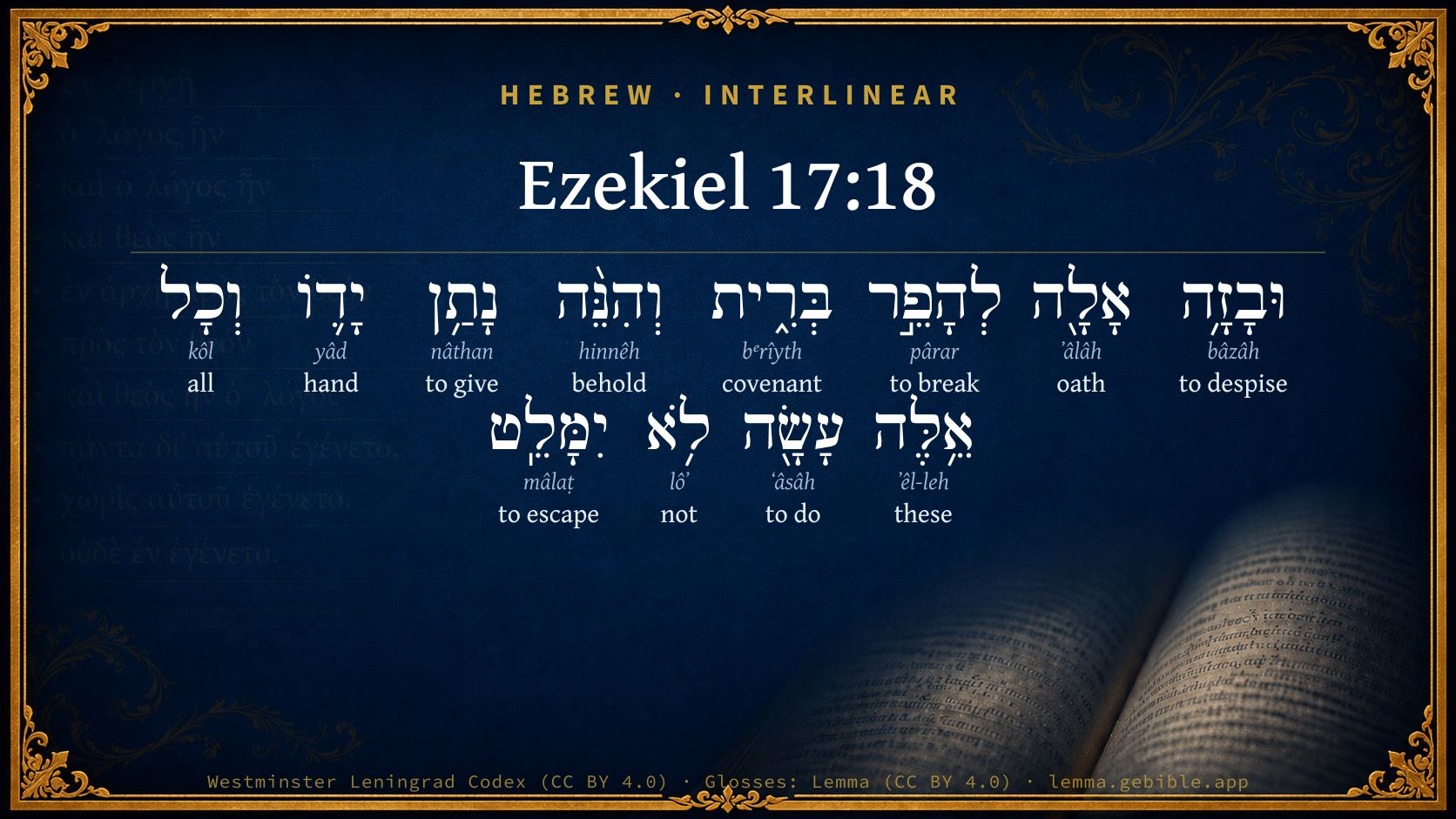
Hebrew (Westminster Leningrad Codex) Ezekiel 17:18 appears in the Hebrew Old Testament. The text above is from the Westminster Leningrad Codex. Each word links to its Strong’s number, a concise gloss, and parsing drawn from the Open Scriptures Hebrew Bible morphology. Click any word for its full Brown-Driver-Briggs (BDB) entry.
Download image
Cite this verse

Ezekiel 17:18 (World English Bible). Public Domain. Lemma interlinear Bible study tool, https://lemma.gebible.app/v/ezekiel/17/18.

Show BibTeX & RIS
BibTeX
RIS
English Translation
For he has despised the oath by breaking the covenant; and behold, he had given his hand, and yet has done all these things; he shall not escape.
World English Bible · Public Domain
Download a study sheet

One document with this verse’s original text, its word-by-word gloss line, the meaning frame, cross-references with their text, attributed commentary, and full source and license credits — printable, and it pastes into notes with its structure intact.

This verse Autodidact and up

Study sheet (.html) Plain text (.txt)

A passage Seminary Student

Up to 50 verses in one chapter. A passage sheet keeps up to 6 commentary sources and 12 cross-references per verse, in the order this page ranks them, and says so on the sheet whenever that leaves anything out. Ask for a single verse and you get the Autodidact verse sheet above.

Everything on this page stays free to read, with no account — the sheet is a download of what is already on screen, not access to it.

Want to remove ads? Support Godless Engineer
Compare translations 3

The same verse in 3 English versions, stacked beneath the original-language interlinear above. Click any original word for its lexicon entry.

Each is an independent rendering of the whole verse — the interlinear is not word-aligned to these translations.

Highlighted words mark where these versions differ — a whole-verse word diff, not a word-by-word alignment.

  • World English Bible Public Domain
    For he has despised the oath by breaking the covenant; and behold, he had given his hand, and yet has done all these things; he shall not escape.
  • King James Version Public Domain
    Seeing he despised the oath by breaking the covenant, when, lo, he had given his hand, and hath done all these things, he shall not escape.
  • unfoldingWord Literal Text CC BY-SA 4.0
    For the king despised his oath by breaking the covenant. Behold, he reached out with his hand to make a promise and yet he did all these things. He will not escape.

unfoldingWord Literal Text — © unfoldingWord, licensed CC BY-SA 4.0. Word-aligned USFM3 via Door43 (git.door43.org/unfoldingWord/en_ult).

Versions to compare (up to 4)

3 of 4 selected

Show all 18 translations

Every available English version of this verse, each an independent rendering of the whole verse.

  • World English Bible Public Domain
    For he has despised the oath by breaking the covenant; and behold, he had given his hand, and yet has done all these things; he shall not escape.
  • Berean Standard Bible Public Domain
    He despised the oath by breaking the covenant. Seeing that he gave his hand in pledge yet did all these things, he will not escape!’
  • Majority Standard Bible Public Domain
    He despised the oath by breaking the covenant. Seeing that he gave his hand in pledge yet did all these things, he will not escape!’
  • King James Version Public Domain
    Seeing he despised the oath by breaking the covenant, when, lo, he had given his hand, and hath done all these things, he shall not escape.
  • American Standard Version (1901) Public Domain
    For he hath despised the oath by breaking the covenant; and behold, he had given his hand, and yet hath done all these things; he shall not escape.
  • Revised Version (1885) Public Domain
    For he hath despised the oath by breaking the covenant; and behold, he had given his hand, and yet hath done all these things; he shall not escape.
  • Geneva Bible (1599) Public Domain
    For he hath despised the othe, and broken ye couenant (yet lo, he had giuen his hand) because he hath done all these things, he shall not escape.
  • Douay-Rheims (1899) Public Domain
    For he had despised the oath, breaking his covenant, and behold he hath given his hand: and having done all these things, he shall not escape.
  • Young's Literal Translation Public Domain
    And he despised the oath -- to break covenant, And lo, he hath given his hand, And all these he hath done, he escapeth not.
  • Literal Standard Version CC BY-SA 4.0
    And he despised the oath—to break covenant, || And behold, he has given his hand, || And all these he has done—he does not escape.
  • Unlocked Literal Bible CC BY-SA 4.0
    For the king despised his oath by breaking the covenant. Behold, he reached out with his hand to make a promise and yet he did all these things. He will not escape.
  • unfoldingWord Literal Text CC BY-SA 4.0
    For the king despised his oath by breaking the covenant. Behold, he reached out with his hand to make a promise and yet he did all these things. He will not escape.
  • Darby Bible Public Domain
    He despised the oath, and broke the covenant; and behold, he had given his hand, yet hath he done all these things: he shall not escape.
  • World Messianic Bible Public Domain
    For he has despised the oath by breaking the covenant; and behold, he had given his hand, and yet has done all these things. He won’t escape.
  • Webster's Bible Public Domain
    Seeing he despised the oath by breaking the covenant, when lo, he had given his hand, and hath done all these things, he shall not escape.
  • Free Bible Version CC BY-SA 4.0
    He disregarded his oath by breaking the agreement. Because he shook hands as a sign of the promise he made, yet rebelled in this way, he won't go unpunished!’
  • Bible in Basic English Public Domain
    For he put his oath on one side in letting the agreement be broken; and though he had given his hand to it, he did all these things; he will not get away safe.
  • JPS Tanakh (1917) Public Domain
    seeing he hath despised the oath by breaking the covenant, when, lo, he had given his hand, and hath done all these things, he shall not escape.

Literal Standard Version (2020), Covenant Press — licensed CC BY-SA 4.0. Text via the HelloAO Bible API (eBible.org). Unlocked Literal Bible (unfoldingWord) — licensed CC BY-SA 4.0. Text via the HelloAO Bible API (eBible.org). unfoldingWord Literal Text — © unfoldingWord, licensed CC BY-SA 4.0. Word-aligned USFM3 via Door43 (git.door43.org/unfoldingWord/en_ult). Free Bible Version, Dr. Jonathan Gallagher — licensed CC BY-SA 4.0. Text via the HelloAO Bible API (eBible.org).

Word by word

More ways to search: Search by grammar → Find every occurrence → Compare this word →

Practice this passage: Drill this verse → Learn its vocabulary →

אָלָ֖ה
ʼâlâh
H423
“oath”
Noun, Common, Feminine, Singular, Absolute
Part of Speech
Noun
Type
Common
Gender
Feminine
Number
Singular
State
Absolute
Full BDB Definition

Origin: from H422

TWOT: 91a

oath - oath of covenant - curse - from God - from men - execration
  1. וּבָזָ֥ה bâzâh H959 “and · to despise” Conjunction + Verb, Qal, Perfect, 3rd Person, Masculine, Singular
  2. לְהָפֵ֣ר pârar H6565 “to break” Preposition + Verb, Hiphil, Infinitive Construct
  3. בְּרִ֑ית bᵉrîyth H1285 “covenant” Noun, Common, Feminine, Singular, Absolute
  4. וְהִנֵּ֨ה hinnêh H2009 “and · behold” Conjunction + Particle, Demonstrative
  5. נָתַ֥ן nâthan H5414 “to give” Verb, Qal, Perfect, 3rd Person, Masculine, Singular
  6. יָד֛וֹ yâd H3027 “hand · his” Noun, Common, Both, Singular, Construct + Suffix, Personal, 3rd Person, Masculine, Singular
  7. וְכָל kôl H3605 “and · all of” Conjunction + Noun, Common, Masculine, Singular, Construct
  8. אֵ֥לֶּה ʼêl-leh H428 “these” Pronoun, Demonstrative, Common, Plural
  9. עָשָׂ֖ה ʻâsâh H6213 “to do” Verb, Qal, Perfect, 3rd Person, Masculine, Singular
  10. לֹ֥א lôʼ H3808 “not” Particle, Negative
  11. יִמָּלֵֽט mâlaṭ H4422 “to escape” Verb, Niphal, Imperfect, 3rd Person, Masculine, Singular

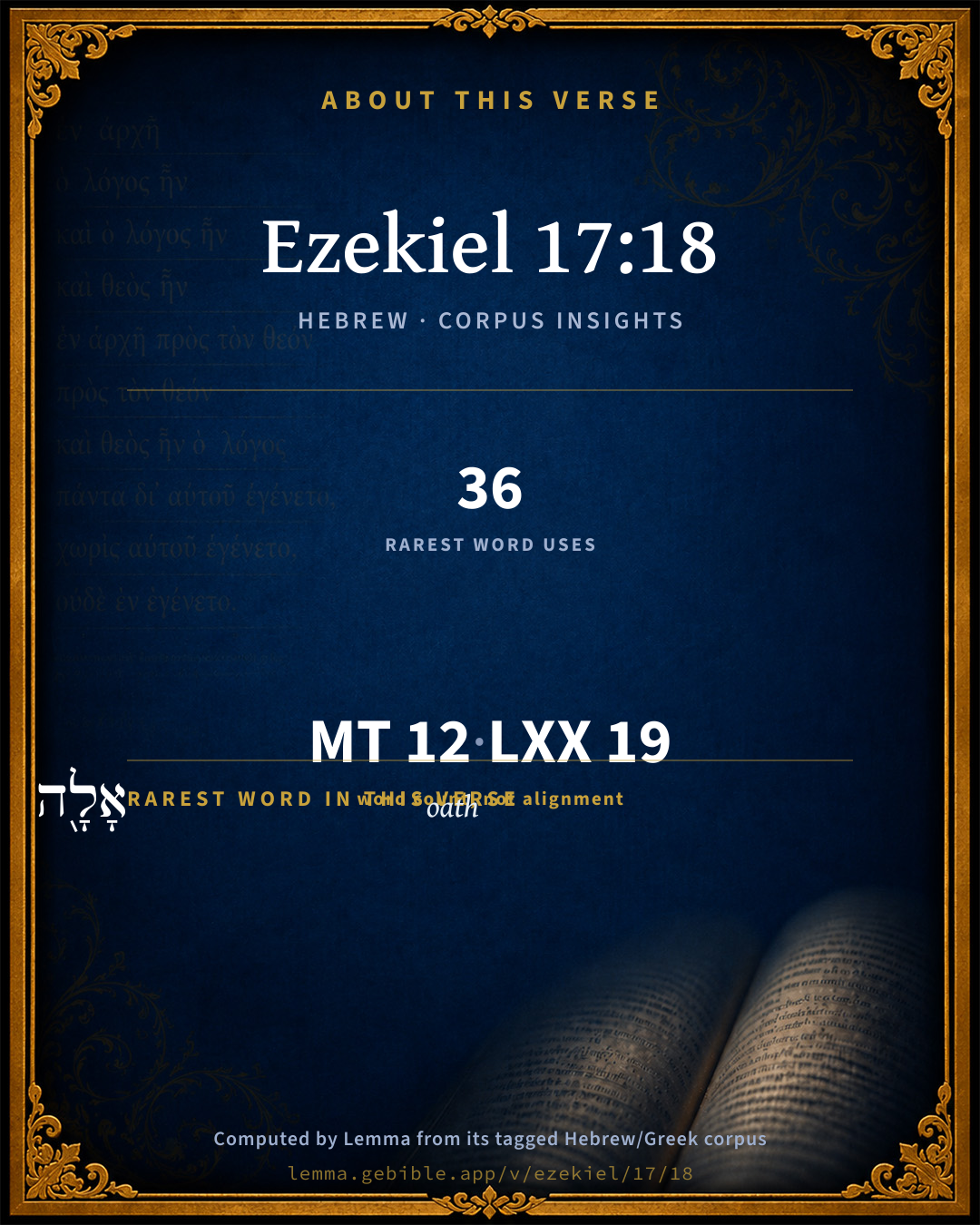
About this verse

These counts appear in no published source. They are computed here, from the morphology-tagged text and Lemma’s own curated glosses. What Lemma adds →

12
words
12
distinct lemmas
Prophets
section

Shared distinctive vocabulary

אָלָ֖ה oath H423 occurs in 32 verses of the Hebrew Bible. Also found in:

Grammatical profile

  • 5 verbs
  • 4 nouns
  • 1 pronoun
  • 2 particles

Verb forms

  • וּבָזָ֥ה Qal · Perfect
  • לְהָפֵ֣ר Hiphil · Infinitive Construct
  • נָתַ֥ן Qal · Perfect
  • עָשָׂ֖ה Qal · Perfect
  • יִמָּלֵֽט Niphal · Imperfect

Hebrew & Septuagint length

In English translation the verse runs 28 words from the Hebrew and 31 from the Septuagint (LXX English) — closely comparable.

A rough comparison of the two English renderings, which tokenize alike — not a word-level alignment.

Word counts can differ between the Hebrew and the Greek without any difference in meaning — e.g. the Hebrew direct-object marker אֵת has no separate Greek word, and Greek often adds the article ὁ.

In the original languages it is 12 Hebrew tokens and 19 Greek tokens — but the two are counted differently (Hebrew bundles its prefixes and suffixes into one token; the Greek is in lemma form), so that isn’t a like-for-like length.

Cross-references

3

Topical passages linked to Ezekiel 17:18 in the Treasury of Scripture Knowledge — connected by theme and wording, ordered by reader-vote popularity; previews shown in the World English Bible.

  • 1 Chronicles 29:24 All the princes, the mighty men, and also all of the sons of king David submitted themselves to Solomon the king.
  • 2 Chronicles 30:8 Now don't you be stiff-necked, as your fathers were; but yield yourselves to Yahweh, and enter into his sanctuary, which he has sanctified forever, and serve Yahweh your God, that his fierce anger may turn away from you.
  • Lamentations 5:6 We have given the hand to the Egyptians, To the Assyrians, to be satisfied with bread.

Cross-references courtesy of OpenBible.info (CC BY 4.0).

Hebrew and Greek witnesses Masoretic Hebrew ↔ Greek Septuagint

The same verse in the two great witnesses to the Old Testament, shown verse-for-verse.

These are two independent witnesses, not word-aligned to each other, and the Septuagint is shown in lemma (dictionary) form.

Hebrew Ezekiel 17:18 Masoretic · Westminster Leningrad Codex

וּבָזָ֥ה אָלָ֖ה לְהָפֵ֣ר בְּרִ֑ית וְהִנֵּ֨ה נָתַ֥ן יָד֛וֹ וְכָל אֵ֥לֶּה עָשָׂ֖ה לֹ֥א יִמָּלֵֽט

For he has despised the oath by breaking the covenant; and behold, he had given his hand, and yet has done all these things; he shall not escape.

World English Bible · Public Domain

Greek LXX Ezekiel 17:18 Septuagint · lemma form

καί ἀτιμόω ὁρκωμοσία ὁ παραβαίνω διαθήκη καί ἰδού δίδωμι ὁ χείρ αὐτός καί πᾶς οὗτος ποιέω αὐτός μή σώζω

Whereas he has profaned the oath so as to break the covenant, when, behold, I engage his hand, and he has done all these things to him, he shall not escape.

LXX2012 (modern English Septuagint) · Public Domain

Hebrew: Westminster Leningrad Codex (CC BY 4.0). Greek: Septuagint (public domain); English from LXX2012 (modern English Septuagint) (Public Domain). How the Septuagint differs from the Hebrew →

Targum (Aramaic paraphrase)

1

The Targum is the ancient Jewish Aramaic paraphrase of the Hebrew Scriptures — an interpretive translation, not the Hebrew text itself. Onkelos (literal) and Pseudo-Jonathan (expansive) render the Torah, and Jonathan the Prophets. Coverage is partial: where no permissively-licensed English translation exists for a verse, only the Aramaic is shown. This is verse-level text, not a word-by-word alignment to the Hebrew.

  1. Targum Jonathan Prophets (Joshua–Malachi)
    וּבְסַר עַל מוֹמֵי לְאַשְׁנָאָה קְיַם וְהָא אַמְטֵי יְדֵיהּ לְפַרְעֹה וְכָל אִלֵין עֲבַד לָא יִשְׁתֵּיזֵיב:

    (no public-domain English translation for this verse)

    Targum Jonathan — Aramaic: “Mikraot Gedolot” (public domain). English: “Sefaria Community Translation” (CC0 1.0 (public-domain dedication)); “London "Chaldee Paraphrase," 1871” (public domain). Text via Sefaria.

Commentary

Notes on Ezekiel 17:18 from classic Christian and Jewish commentators (each source and its license shown beneath its notes). The classic Christian expositions comment on the surrounding passage and are grouped to its opening verse, so a note may address several verses; the Jewish commentaries on the Tanakh (Rashi and others) are per-verse, so they appear only where the commentator wrote on this verse.

Lemma curates 59 commentaries, every one of them public domain or Creative Commons licensed, each selected and text-cleaned for this edition rather than reprinted as found. About our sources →

Trapp's Complete Commentary

John Trapp

Eze 17:18 Seeing he despised the oath by breaking the covenant, when, lo, he had given his hand, and hath done all these [things], he shall not escape.

Ver. 18. Seeing he despised the oath.] Despised it ex fastu quodam, out of pride and disdain, as the word signifieth, as Pascenius the Papist jeereth at King James for inventing the oath of allegiance. There is in our chronicles a memorable story of one Sir Ralph Percy, slain upon Hegely Moor, in Northumberland, by the Lord Mountacute, general for Edward IV He would in no way depart the field, though defeated; but, in dying, said, I have saved the bird in my breast, meaning his oath to King Henry VI {a} Had false Zedekiah done so, he had, for this once at least, escaped; but ambition - whose motto is said to be Sic mea fata sequor So I follow my destiny - was his ruin.

{a} Speed.

John Trapp, A Commentary or Exposition upon All the Books of the Old and New Testament (1647–1656) — public domain. Text from a community e-Sword module.

Geneva Bible (1599)

Geneva Bible translators

Because he took the Name of God in vain, and brake his oath which he had confirmed by giving his hand: therefore the Prophet declareth that God would not suffer such perjury and infidelity to escape punishment.

Geneva Bible (1599) marginal notes — public domain. Text via Bolls.life.

Jamieson, Fausset & Brown

Robert Jamieson, A. R. Fausset & David Brown

given his hand--in ratification of the oath (Kg2 10:15; Ezr 10:19), and also in token of subjection to Nebuchadnezzar (Ch1 29:24, Margin; Ch2 30:8, Margin; Lam 5:6).

Jamieson, Fausset & Brown — Commentary Critical and Explanatory on the Whole Bible (1871) — public domain (CC PDM 1.0). Text via the HelloAO Bible API.

Adam Clarke's Commentary

Verse 18. Seeing he despised the oath] This God particularly resents. He had bound himself by oath, in the presence of Jehovah, to be faithful to the covenant that he made with Nebuchadnezzar, and he took the first opportunity to break it; therefore he shall not escape.

Adam Clarke's Commentary on the Bible (1810–1826) — public domain. Text from a community e-Sword/MySword module.

John Calvin's Commentaries

Ezekiel repeals again, that, even speaking, Zedekiah could not succeed, since he violated the treaty for we yesterday said that this persuasion is always fixed in men’s minds, that treaties are sacred, and cannot be broken with impunity. Since, therefore, the sacredness of treaties was always prevalent among men, Ezekiel here pronounces that the issue would be disastrous, because Zedekiah despised his oath when he broke the treaty after stretching out his hand. He describes a gesture, as I think, customary among men — that of stretching forth the hand when they wish to witness a covenant. The alliance, then, between the Egyptians and the Jews is here described by an outward gesture, because Zedekiah stretched forth his hand, and yet had violated it in this way: but since he perfidiously revolted from King Nebuchadnezzar, to whom he had pledged his faith, he has done all this, says he, therefore he shall not be liberated. It follows —

John Calvin's Commentaries (1540-1563) — public domain. Text from the Calvin Translation Society English edition (1840s-50s) via the Christian Classics Ethereal Library (ccel.org). Calvin's coverage is partial (roughly two-thirds of the Bible); uncommented books and verses are honest gaps, never fabricated. The 19th-century editor's footnotes and remarks are omitted so the notes are faithfully Calvin's own voice.

John Gill's Exposition

And I will spread my net upon him, and he shall be taken in my snare,.... See Gill on Eze 12:13; where the same words are used, and of the same person:

and I will bring him to Babylon; though, as it is said in the place referred to, he should not see it, his eyes being put out before he was brought thither:

and I will plead with him there for his trespass that he hath trespassed against me; for though it was breaking covenant and oath with a Heathen prince, yet it was a trespass against God, in whose name they were made; and his being laid in prison at Babylon, and kept there to the time of his death, was the Lord's pleading with him, and judging of him; it was a reproof for his sins, and a condemnation of him and them.

John Gill's Exposition of the Whole Bible (1746–1763) — public domain (CC PDM 1.0). Text via the HelloAO Bible API.

Haydock's Catholic Bible Commentary

Hand. Swearing perhaps to both (Haydock) the Egyptian and to the Chaldean monarch.

George Leo Haydock (1774–1849), Haydock's Catholic Family Bible and Commentary, 1859 edition — public domain. Excludes Psalms (Douay-Rheims chapter numbering differs from Protestant) and Deuterocanonical books (Catholic canon only).

Matthew Poole's English Annotations

This verse gives us the reason of this unhappy enterprise, which is summed up in wilful, presumptuous, and most unparalleled perjury. Zedekiah

had given his hand; a solemn confirming of the oath, or covenant, and it implies the voluntary act of Zedekiah in swearing, which makes the perjury so much the fouler.

All these things; too bad to be named, and most unbecoming any one that was a beneficiary, and had so much from the bounty of one that was not obliged to do any thing for him.

Matthew Poole's English Annotations on the Holy Bible (1683–1685) — public domain. Text from a community e-Sword/MySword module.

The Pulpit Commentary

Vers. 18, 19. The broken covenant.

In turning to Egypt for protection Zedekiah had broken faith with Nebuchadnezzar; but he had done worse, for he had broken the covenant between God and the house of David.

I UNFAITHFULNESS TO MAN IS UNFAITHFULNESS TO GOD. All sin against man is also sin against God. The second table of commandments lies upon the first, and a breach of the one involves a breach of the other. David confesses that he had sinned against God, and God only, (Psa_51:4) though his crime was directly committed against Uriah the Hittite. The penitent prodigal charges himself with having sinned against heaven as well as before his father. (Luk_15:18) God enters into all earthly arrangements. The oath is a direct call upon God to do this; but without any such solemn appeal God cannot but take note of all we say and do, and as the Guardian of truth and justice he will consider any earthly unfaithfulness as wrong against himself.

II THOSE WHO ARE PLEDGED TO THE SERVICE OF GOD ARE ESPECIALLY UNFAITHFUL TO HIM WHEN THEY ARE UNFAITHFUL TO THEIR FELLOW MEN. Zedekiah was the king of a covenant nation, and his throne was bound by God"s solemn covenant with David. He was, therefore, in an especial sense a servant of God. If the servant behaves ill in the world his Master must take note of the fact. It is a wrong against the Master, who is dishonoured by his shameful conduct. When a professedly Christian man shows a lack of integrity before the world, his sin is intensified by contrast with his high profession. It is bad for the common person to be faithless, but when a knight of honoured title shows the same failure of character, he brings disgrace upon his order. If one who stands before men as a Christian proves himself to be dishonourable in business, he injures the holy Name of his Master, and he breaks faith with the God whom he has promised to serve.

III UNFAITHFULNESS TO A COVENANT WITH GOD IS A HEINOUS SIN. The Jews were peculiarly privileged; therefore their sin was especially guilty. They were bound to fidelity by exceptional pledges; their disloyalty was, therefore, the more culpable. Christians now stand in the ancient position of the Jews.

1. Christians are peculiarly privileged. They not only receive the general mercies of God which all men may share. They are partakers of his choicest covenant blessings. Jesus Christ, who has pledged the new covenant in his blood, has brought with it the highest blessings. For Christians to fall into sin is doubly guilty.

2. Christians are especially pledged. If we take the Christian name we incur the Christian obligations. The vows of God are then upon us. We are pledged to loyalty to Christ. It is no common sin to break vows of Christian service. The prophet called this sin in Israel adultery. It carries the shame and guilt of that outrage on honour.

The Pulpit Commentary (1880–1919), ed. H.D.M. Spence-Jones & Joseph S. Exell — public domain. Text from a community e-Sword module.

John Wesley's Explanatory Notes

Given his hand - Solemnly confirming the oath.

John Wesley, Explanatory Notes Upon the Whole Bible (1754–1765) — public domain. Text via the GEBible commentary corpus.

Rashi

Rabbi Shlomo Yitzchaki (Rashi)

he gave his hand He promised in good faith and raised his hand in a covenant.

Rashi on the Tanakh — English translations: “The Judaica Press complete Tanach with Rashi, translated by A. J. Rosenberg” (CC BY 4.0); “Pentateuch with Rashi's commentary by M. Rosenbaum and A.M. Silbermann, 1929-1934” (public domain); “The Metsudah Tanach series, Lakewood, N.J” (CC BY 4.0); and “The Book of Joshua, Metsudah Publications, 1997” (CC BY 4.0). Text via Sefaria.

Lesson kit

Teaching starters — assembled from the data on this page, not authored interpretation. Every prompt links to the verse data it draws on. Edit before teaching.

Ezekiel, in the Prophets, opens this verse with 12 words (12 distinct Hebrew lemmas). Its most distinctive word is ʼâlâh (“oath”). A historical commentator’s framing appears above. Read the whole chapter for the surrounding context.

Discussion questions

  1. How does “oath” (ʼâlâh) shape what this verse is saying?
  2. Genesis 24:41 shares the word «oath» with this verse. How do the two illuminate each other?
  3. These translations render this verse differently. What is at stake in choosing one wording over another?
  4. The verb «וּבָזָ֥ה» is Qal Perfect. How does its form color the action?
  5. Reading how Trapp's Complete Commentary and Geneva Bible (1599) read this verse, where do the two commentators agree and where do they part?

Things to notice

Reading settings

Reading text

Shown beneath each verse's original-language words.

Old Testament
Old Testament edition

Read the OT as the Masoretic Hebrew (MT) or the Greek Septuagint (LXX).

English shown for the Greek Septuagint (in the Hebrew ↔ Greek comparison).

Comparing translations? Open the Compare panel on any verse page to stack up to four side by side.