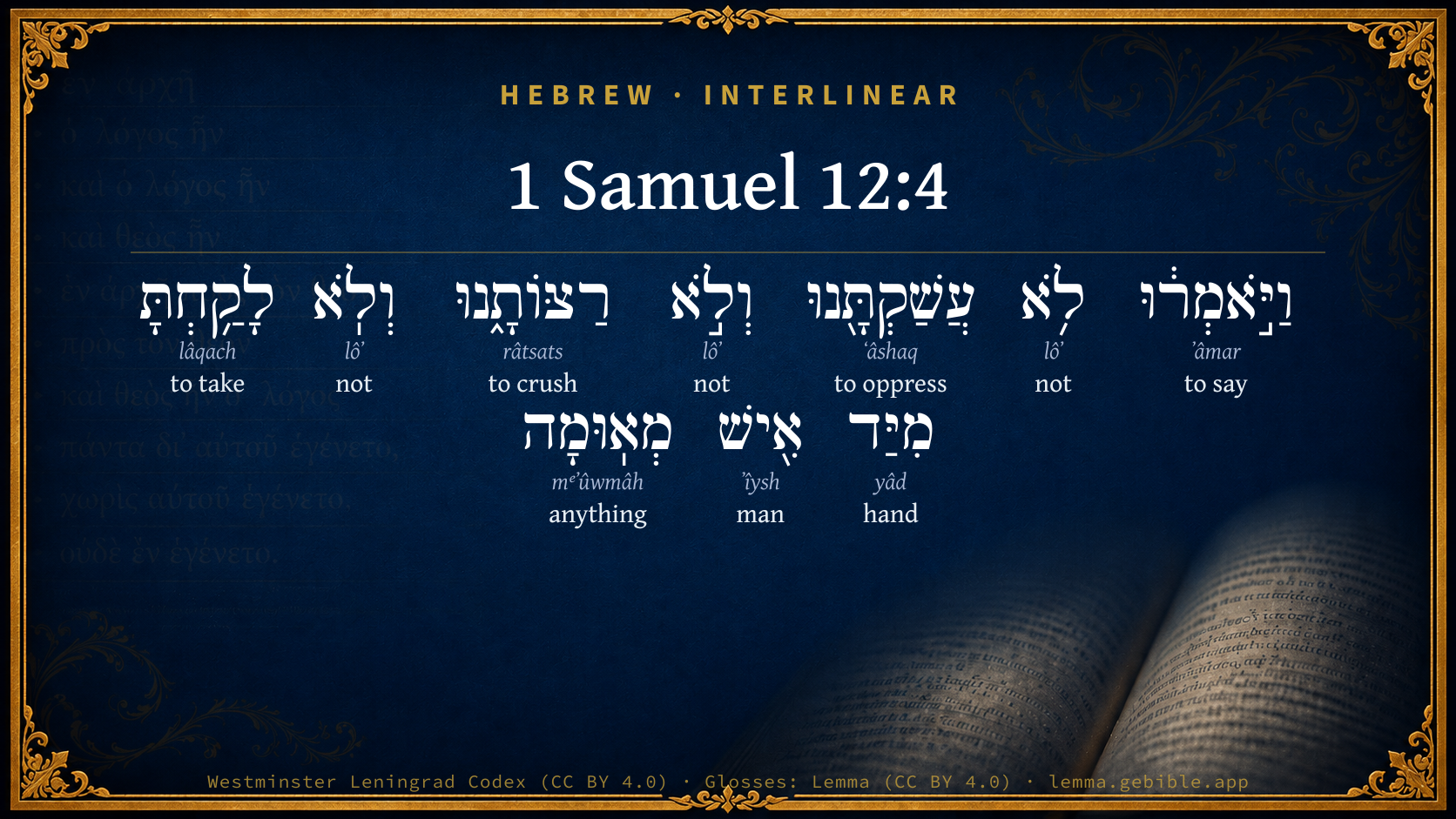
1 Samuel 12:4

Hebrew (Westminster Leningrad Codex) 1 Samuel 12:4 appears in the Hebrew Old Testament. The text above is from the Westminster Leningrad Codex. Each word links to its Strong’s number, a concise gloss, and parsing drawn from the Open Scriptures Hebrew Bible morphology. Click any word for its full Brown-Driver-Briggs (BDB) entry.
Download image
Cite this verse

1 Samuel 12:4 (World English Bible). Public Domain. Lemma interlinear Bible study tool, https://lemma.gebible.app/v/1-samuel/12/4.

Show BibTeX & RIS
BibTeX
RIS
English Translation
They said, You have not defrauded us, nor oppressed us, neither have you taken anything of any man's hand.
World English Bible · Public Domain
Download a study sheet

One document with this verse’s original text, its word-by-word gloss line, the meaning frame, cross-references with their text, attributed commentary, and full source and license credits — printable, and it pastes into notes with its structure intact.

This verse Autodidact and up

Study sheet (.html) Plain text (.txt)

A passage Seminary Student

Up to 50 verses in one chapter. A passage sheet keeps up to 6 commentary sources and 12 cross-references per verse, in the order this page ranks them, and says so on the sheet whenever that leaves anything out. Ask for a single verse and you get the Autodidact verse sheet above.

Everything on this page stays free to read, with no account — the sheet is a download of what is already on screen, not access to it.

Want to remove ads? Support Godless Engineer
Compare translations 3

The same verse in 3 English versions, stacked beneath the original-language interlinear above. Click any original word for its lexicon entry.

Each is an independent rendering of the whole verse — the interlinear is not word-aligned to these translations.

Highlighted words mark where these versions differ — a whole-verse word diff, not a word-by-word alignment.

  • World English Bible Public Domain
    They said, You have not defrauded us, nor oppressed us, neither have you taken anything of any man's hand.
  • King James Version Public Domain
    And they said, Thou hast not defrauded us, nor oppressed us, neither hast thou taken ought of any man's hand.
  • unfoldingWord Literal Text CC BY-SA 4.0
    And they said, “You have not defrauded us, and you have not oppressed us, and you have not taken anything from the hand of a man.”

unfoldingWord Literal Text — © unfoldingWord, licensed CC BY-SA 4.0. Word-aligned USFM3 via Door43 (git.door43.org/unfoldingWord/en_ult).

Versions to compare (up to 4)

3 of 4 selected

Show all 18 translations

Every available English version of this verse, each an independent rendering of the whole verse.

  • World English Bible Public Domain
    They said, You have not defrauded us, nor oppressed us, neither have you taken anything of any man's hand.
  • Berean Standard Bible Public Domain
    “You have not wronged us or oppressed us,” they replied, “nor have you taken anything from the hand of man.”
  • Majority Standard Bible Public Domain
    “You have not cheated us or oppressed us,” they replied, “nor have you taken anything from the hand of man.”
  • King James Version Public Domain
    And they said, Thou hast not defrauded us, nor oppressed us, neither hast thou taken ought of any man's hand.
  • American Standard Version (1901) Public Domain
    And they said, Thou hast not defrauded us, nor oppressed us, neither hast thou taken aught of any man's hand.
  • Revised Version (1885) Public Domain
    And they said, Thou hast not defrauded us, nor oppressed us, neither hast thou taken aught of any man’s hand.
  • Geneva Bible (1599) Public Domain
    Then they sayde, Thou hast done vs no wrong, nor hast hurt vs, neither hast thou taken ought of any mans hand.
  • Douay-Rheims (1899) Public Domain
    And they said: Thou hast not wronged us, nor oppressed us, nor taken ought at any man's hand.
  • Young's Literal Translation Public Domain
    And they say, `Thou hast not oppressed us, nor hast thou crushed us, nor hast thou taken from the hand of any one anything.'
  • Literal Standard Version CC BY-SA 4.0
    And they say, “You have not oppressed us, nor have you crushed us, nor have you taken anything from the hand of anyone.”
  • Unlocked Literal Bible CC BY-SA 4.0
    They said, “You have not cheated us, oppressed us, or have stolen anything from any man's hand.”
  • unfoldingWord Literal Text CC BY-SA 4.0
    And they said, “You have not defrauded us, and you have not oppressed us, and you have not taken anything from the hand of a man.”
  • Darby Bible Public Domain
    And they said, Thou hast not defrauded us, and thou hast not injured us, neither hast thou taken aught of any man's hand.
  • World Messianic Bible Public Domain
    They said, “You have not defrauded us, nor oppressed us, neither have you taken anything from anyone’s hand.”
  • Webster's Bible Public Domain
    And they said thou hast not defrauded us, nor oppressed us, neither hast thou taken aught from any man's hand.
  • Free Bible Version CC BY-SA 4.0
    “No, you have never cheated or oppressed us,” they replied, “and you have never taken anything from anyone.”
  • Bible in Basic English Public Domain
    And they said, You have never been untrue to us or cruel to us; you have taken nothing from any man.
  • JPS Tanakh (1917) Public Domain
    And they said: 'Thou hast not defrauded us, nor oppressed us, neither hast thou taken aught of any man's hand.'

Literal Standard Version (2020), Covenant Press — licensed CC BY-SA 4.0. Text via the HelloAO Bible API (eBible.org). Unlocked Literal Bible (unfoldingWord) — licensed CC BY-SA 4.0. Text via the HelloAO Bible API (eBible.org). unfoldingWord Literal Text — © unfoldingWord, licensed CC BY-SA 4.0. Word-aligned USFM3 via Door43 (git.door43.org/unfoldingWord/en_ult). Free Bible Version, Dr. Jonathan Gallagher — licensed CC BY-SA 4.0. Text via the HelloAO Bible API (eBible.org).

Word by word

More ways to search: Search by grammar → Find every occurrence → Compare this word →

Practice this passage: Drill this verse → Learn its vocabulary →

רַצּוֹתָ֑נוּ
râtsats
H7533
“to crush · us”
Verb, Qal, Perfect, 2nd Person, Masculine, Singular + Suffix, Personal, 1st Person, Common, Plural
Part of Speech
Verb
Stem
Qal
Form
Perfect
Person
2nd Person
Gender
Masculine
Number
Singular
Full BDB Definition

Origin: a primitive root

TWOT: 2212

to crush, oppress - (Qal) - to crush, get crushed, be crushed - to crush, oppress (figuratively) - crushed (participle passive) - (Niphal) to be crushed, be broken - (Piel) - to crush in pieces - to grievously oppress (figuratively) - (Poel) to oppress (figuratively) - (Hiphil) to crush - (Hithpoel) to crush each other
  1. וַיֹּ֣אמְר֔וּ ʼâmar H559 “and · to say” Conjunction + Verb, Qal, Sequential Imperfect, 3rd Person, Masculine, Plural
  2. לֹ֥א lôʼ H3808 “not” Particle, Negative
  3. עֲשַׁקְתָּ֖נוּ ʻâshaq H6231 “to oppress · us” Verb, Qal, Perfect, 2nd Person, Masculine, Singular + Suffix, Personal, 1st Person, Common, Plural
  4. וְלֹ֣א lôʼ H3808 “and · not” Conjunction + Particle, Negative
  5. וְלֹֽא lôʼ H3808 “and · not” Conjunction + Particle, Negative
  6. לָקַ֥חְתָּ lâqach H3947 “to take” Verb, Qal, Perfect, 2nd Person, Masculine, Singular
  7. מִיַּד yâd H3027 “from · hand of” Preposition + Noun, Common, Both, Singular, Construct
  8. אִ֖ישׁ ʼîysh H376 “man” Noun, Common, Masculine, Singular, Absolute
  9. מְאֽוּמָה mᵉʼûwmâh H3972 “anything” Noun, Common, Feminine, Singular, Absolute

About this verse

These counts appear in no published source. They are computed here, from the morphology-tagged text and Lemma’s own curated glosses. What Lemma adds →

10
words
8
distinct lemmas
Historical
section

Notable vocabulary

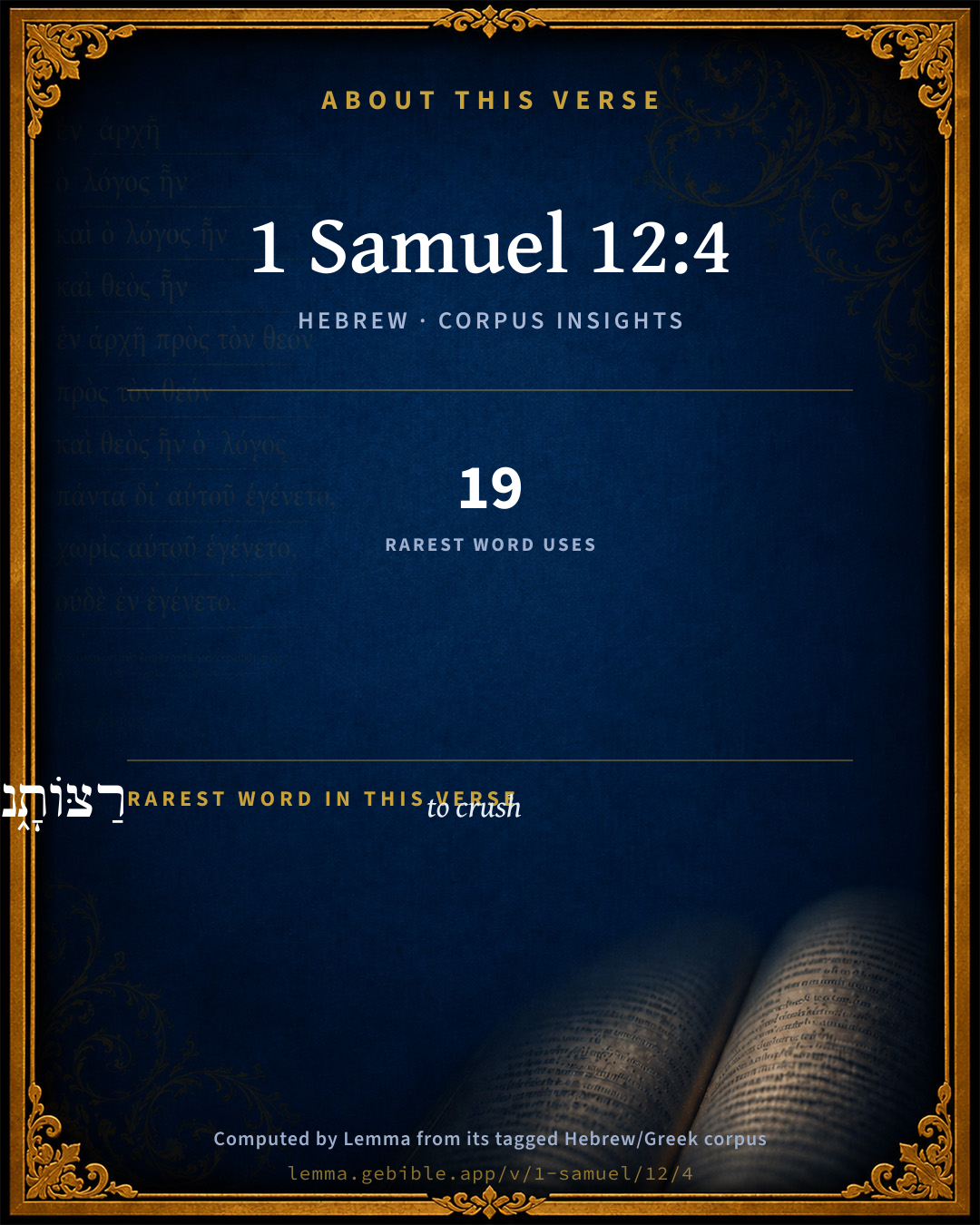
The rarest word here is רַצּוֹתָ֑נוּ to crush H7533 — appearing just 19 times in the whole Hebrew Bible.

Shared distinctive vocabulary

רַצּוֹתָ֑נוּ to crush H7533 occurs in 18 verses of the Hebrew Bible. Also found in:

Grammatical profile

  • 4 verbs
  • 3 nouns
  • 3 particles

Verb forms

  • וַיֹּ֣אמְר֔וּ Qal · Sequential Imperfect
  • עֲשַׁקְתָּ֖נוּ Qal · Perfect
  • רַצּוֹתָ֑נוּ Qal · Perfect
  • לָקַ֥חְתָּ Qal · Perfect

Repetition

A word recurs within this verse — often emphatic in Hebrew:

Hebrew & Septuagint length

In English translation the verse runs 19 words from the Hebrew and 32 from the Septuagint (LXX English) — the Septuagint runs noticeably longer here. See the side-by-side →

A rough comparison of the two English renderings, which tokenize alike — not a word-level alignment.

Word counts can differ between the Hebrew and the Greek without any difference in meaning — e.g. the Hebrew direct-object marker אֵת has no separate Greek word, and Greek often adds the article ὁ.

Cross-references

3

Topical passages linked to 1 Samuel 12:4 in the Treasury of Scripture Knowledge — connected by theme and wording, ordered by reader-vote popularity; previews shown in the World English Bible.

  • Psalms 37:5–6 Commit your way to Yahweh. Trust also in him, and he will do this:
  • Daniel 6:4 Then the presidents and the satraps sought to find occasion against Daniel as touching the kingdom; but they could find no occasion nor fault, because he was faithful, neither was there any error or fault found in him.
  • 3 John 1:12 Demetrius has the testimony of all, and of the truth itself; yes, we also testify, and you know that our testimony is true.

Cross-references courtesy of OpenBible.info (CC BY 4.0).

Hebrew and Greek witnesses Masoretic Hebrew ↔ Greek Septuagint

The same verse in the two great witnesses to the Old Testament, shown verse-for-verse.

Here the Septuagint runs noticeably longer than the Hebrew — LXX2012 (modern English Septuagint) 32 words vs World English Bible 19. A rough length comparison of the two English translations, not a word-level alignment — read both below.

These are two independent witnesses, not word-aligned to each other, and the Septuagint is shown in lemma (dictionary) form.

Hebrew 1 Samuel 12:4 Masoretic · Westminster Leningrad Codex

וַיֹּ֣אמְר֔וּ לֹ֥א עֲשַׁקְתָּ֖נוּ וְלֹ֣א רַצּוֹתָ֑נוּ וְלֹֽא לָקַ֥חְתָּ מִיַּד אִ֖ישׁ מְאֽוּמָה

They said, You have not defrauded us, nor oppressed us, neither have you taken anything of any man's hand.

World English Bible · Public Domain

Greek LXX 1 Samuel 12:4 Septuagint · lemma form

καί εἶπον πρός σαμουηλ οὐ ἀδικέω ἐγώ καί οὐ καταδυναστεύω καί οὐ θλάω ἐγώ καί οὐ λαμβάνω ἐκ χείρ οὐδείς οὐδείς

And they said to Samuel, You have not injured us, and you have not oppressed us; and you have not afflicted us, and you have not taken anything from any one's hand.

LXX2012 (modern English Septuagint) · Public Domain

Hebrew: Westminster Leningrad Codex (CC BY 4.0). Greek: Septuagint (public domain); English from LXX2012 (modern English Septuagint) (Public Domain). How the Septuagint differs from the Hebrew →

Targum (Aramaic paraphrase)

1

The Targum is the ancient Jewish Aramaic paraphrase of the Hebrew Scriptures — an interpretive translation, not the Hebrew text itself. Onkelos (literal) and Pseudo-Jonathan (expansive) render the Torah, and Jonathan the Prophets. Coverage is partial: where no permissively-licensed English translation exists for a verse, only the Aramaic is shown. This is verse-level text, not a word-by-word alignment to the Hebrew.

  1. Targum Jonathan Prophets (Joshua–Malachi)
    וַאֲמַרוּ לָא עֲשַׁקְתָּנָא וְלָא אֲנַסְתָּנָא וְלָא קַבֵּילְתָּא מִיַד אֱנָשׁ מִדָעַם:

    (no public-domain English translation for this verse)

    Targum Jonathan — Aramaic: “Mikraot Gedolot” (public domain). English: “Sefaria Community Translation” (CC0 1.0 (public-domain dedication)); “London "Chaldee Paraphrase," 1871” (public domain). Text via Sefaria.

Commentary

Notes on 1 Samuel 12:4 from classic Christian and Jewish commentators (each source and its license shown beneath its notes). The classic Christian expositions comment on the surrounding passage and are grouped to its opening verse, so a note may address several verses; the Jewish commentaries on the Tanakh (Rashi and others) are per-verse, so they appear only where the commentator wrote on this verse.

Lemma curates 59 commentaries, every one of them public domain or Creative Commons licensed, each selected and text-cleaned for this edition rather than reprinted as found. About our sources →

Trapp's Complete Commentary

John Trapp

1Sa 12:4 And they said, Thou hast not defrauded us, nor oppressed us, neither hast thou taken ought of any man’s hand.

Ver. 4. Thou hast not defrauded us.] Happy is Samuel thus to be acquitted by himself in private, by others in public, in both by God. Quoad vixit, virtutum laude crevit, saith Cornelius Nepos concerning Cato. In maximis laboribus usque ad summam senectutem summa cum gloria vivit, saith Cicero of the same Cato. Invictus praeterea cupiditatibus animi et rigidae innocentiae, saith Pliny of him. How much better may all this be said of Samuel, and a great deal more?

John Trapp, A Commentary or Exposition upon All the Books of the Old and New Testament (1647–1656) — public domain. Text from a community e-Sword module.

Adam Clarke's Commentary

Verse 4. They said, Thou hast not defrauded] Of what minister or governor can any nation under heaven say such things?

Adam Clarke's Commentary on the Bible (1810–1826) — public domain. Text from a community e-Sword/MySword module.

John Gill's Exposition

And they said,.... One in the name of the rest, or they all cried out as one man:

thou hast not defrauded us, nor oppressed us; had done them no wrong, neither privately nor publicly, by fraud or by force:

neither hast thou taken ought of any man's hand; as a gift, present, or bribe, to fit your his cause. Some would infer hence that be took nothing of them for his support and maintenance, and that he lived upon his own substance; but that is not likely or reasonable; it was but just that they should support him and his family suitably to his character as a judge, whose whole life was spent in their service.

John Gill's Exposition of the Whole Bible (1746–1763) — public domain (CC PDM 1.0). Text via the HelloAO Bible API.

unfoldingWord translationNotes

Door43 World Missions Community

from any man's hand ... in my hand

These phrases mean what a person possesses or what they have done to obtain favor from others. This is a polite way of saying he has not stolen, nor has he given or taken bribes. (See: Euphemism)

translationWords

hand

Yahweh

testimony

anoint

unfoldingWord translationNotes — © Distant Shores Media and the Door43 World Missions Community, licensed CC BY-SA 4.0. Source: git.door43.org/Door43/en_tn.

Lesson kit

Teaching starters — assembled from the data on this page, not authored interpretation. Every prompt links to the verse data it draws on. Edit before teaching.

1 Samuel, in the Historical, opens this verse with 10 words (8 distinct Hebrew lemmas). Its most distinctive word is râtsats (“to crush”). The Greek Septuagint runs longer here. A historical commentator’s framing appears above. Read the whole chapter for the surrounding context.

Discussion questions

  1. How does “to crush” (râtsats) shape what this verse is saying?
  2. How does Genesis 25:22, which shares the word «to crush», read alongside this verse?
  3. What does the repetition of “not” (3× in this one verse) do in this verse?
  4. The Septuagint runs longer here than the Hebrew. What might account for the difference?
  5. The translations on this page render this verse differently — a whole-verse word diff, not a word-by-word alignment. What might account for the different wordings?
  6. «וַיֹּ֣אמְר֔וּ» is a Qal Sequential Imperfect verb. How does that grammatical form shape the action described?
  7. Compare how Trapp's Complete Commentary and Adam Clarke's Commentary read this verse. Where do they agree or differ?

Things to notice

Reading settings

Reading text

Shown beneath each verse's original-language words.

Old Testament
Old Testament edition

Read the OT as the Masoretic Hebrew (MT) or the Greek Septuagint (LXX).

English shown for the Greek Septuagint (in the Hebrew ↔ Greek comparison).

Comparing translations? Open the Compare panel on any verse page to stack up to four side by side.