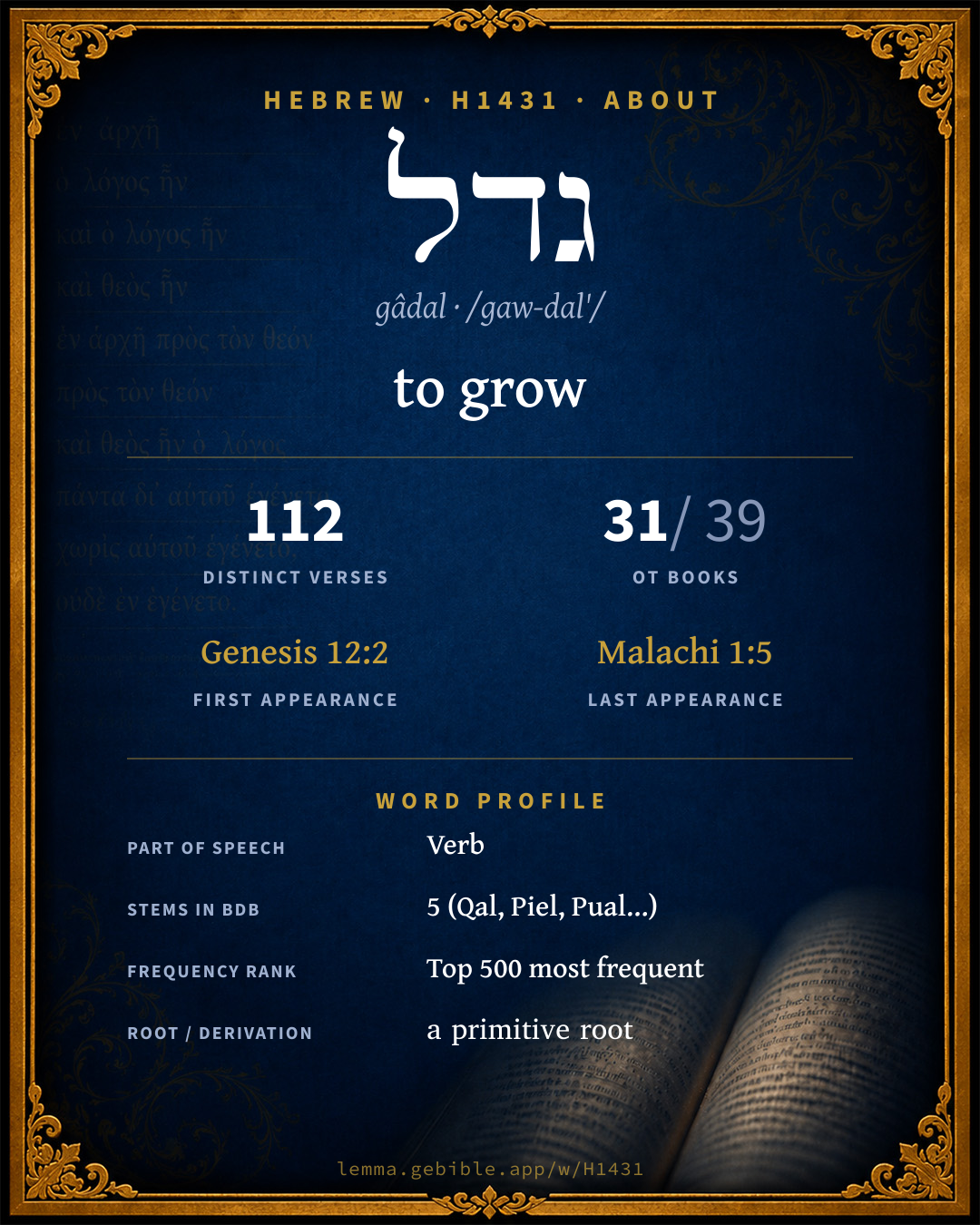
גָּדַל
to grow
also: promote, make powerful, praise, magnify fuller range ↓
Full lexicon entry — Brown-Driver-Briggs (BDB)
From Brown-Driver-Briggs (BDB)
Where this word appears
See every Qal verb in the Hebrew Bible →
Grammar key — what these labels mean
Part of speech
- Verb
- An action or state-of-being word.
Stem
- Hiphil
- The causative active stem (“he caused / brought about”). Here: ‘make great’
- Qal
- The basic, simple active stem — the plain form of the verb (“he wrote”). Here: ‘grow up’
- Piel
- An intensive or resultative active stem. Here: ‘cause to grow’
- Hithpael
- The reflexive or reciprocal stem (the subject acts on itself).
- Pual
- The passive counterpart of the Piel. Here: ‘pl.’
Form
- Perfect
- A completed action or state — Hebrew marks aspect (completeness) more than strict tense (“he wrote”).
- Sequential Imperfect
- An imperfect with prefixed waw — the standard past-narrative form (waw-consecutive imperfect).
- Imperfect
- An incomplete, ongoing, or future action (“he will / would write”).
- Jussive
- A third- or second-person volitional form expressing wish or command (“let him write”).
- Infinitive Construct
- A bound verbal noun, frequently with prepositions (“to write / in writing”).
- Sequential Perfect
- A perfect with prefixed waw continuing a preceding imperfect or command (waw-consecutive perfect).
- Cohortative
- A first-person volitional form expressing wish or resolve (“let me / let us write”).
- Participle Active
- A verbal adjective expressing ongoing or characteristic action (“writing / one who writes”).
- Participle Passive
- A verbal adjective expressing action received (“written”).
- Imperative
- A direct command (“write!”).
State
- Absolute
- The independent form of a noun, not bound to a following word.
- Construct
- A noun bound to a following noun in a possessive / “of” relationship (the construct chain).
Person
- 3rd Person
- The one spoken about (“he / she / it / they”).
- 1st Person
- The speaker (“I / we”).
- 2nd Person
- The one addressed (“you”).
Gender
- Masculine
- Grammatically masculine.
- Common
- Either gender — not distinguished for this form.
- Feminine
- Grammatically feminine.
Number
- Singular
- One.
- Plural
- More than one (in Hebrew, generally three or more).
Grammatical forms 48 distinct
- Verb, Hiphil, Perfect, 3rd Person, Masculine, Singular 14 times (12%)
- Verb, Qal, Sequential Imperfect, 3rd Person, Masculine, Singular 13 times (11%)
- Verb, Qal, Imperfect, 3rd Person, Masculine, Singular 10 times (9%)
- Verb, Qal, Perfect, 3rd Person, Common, Plural 6 times (5%)
- Verb, Piel, Perfect, 3rd Person, Masculine, Singular 5 times (4%)
- Verb, Qal, Perfect, 3rd Person, Masculine, Singular 4 times (3%)
- Verb, Piel, Infinitive Construct 4 times (3%)
- Verb, Qal, Sequential Imperfect, 3rd Person, Feminine, Singular 3 times (3%)
+40 more forms (57 occurrences)
Parsed forms decoded from the imported morphology (morphhb / Westminster Leningrad Codex — WLC text public domain, morphhb tagging CC BY 4.0), counted across 116 parsed occurrences — not distinct verses.
Every verse where H1431 appears — 112 distinct verses across 31 books. Click any verse to open its interlinear word-by-word view. Verse text shown in the World English Bible for context — . Each verse’s Hebrew form is shown with its reference; the English is not keyword-highlighted, since the data carries no word-level English alignment. Use “Compare translations” on any verse to read it across multiple English versions. This concordance covers the Hebrew Bible; Septuagint (Greek Old Testament) occurrences are not indexed here.
Genesis 12 verses
- Genesis 12:2 וַ/אֲגַדְּלָ֖ה conj + Piel impf 1cs I will make of you a great nation. I will bless you, and make your name great. You will be a blessing.
- Genesis 19:13 גָֽדְלָ֤ה Qal pf 3fs for we will destroy this place, because the cry of them is grown great before Yahweh. Yahweh has sent us to destroy it."
- Genesis 19:19 וַ/תַּגְדֵּ֣ל conj + Hiphil wimpf 2ms See now, your servant has found favor in your sight, and you have magnified your loving kindness, which you have shown to me in saving my life. I can't escape to the mountain, lest evil overtake me, and I die.
- Genesis 21:8 וַ/יִּגְדַּ֥ל conj + Qal wimpf 3ms The child grew, and was weaned. Abraham made a great feast on the day that Isaac was weaned.
- Genesis 21:20 וַ/יִּגְדָּ֑ל conj + Qal wimpf 3ms God was with the boy, and he grew. He lived in the wilderness, and became, as he grew up, an archer.
- Genesis 24:35 וַ/יִּגְדָּ֑ל conj + Qal wimpf 3ms Yahweh has blessed my master greatly. He has become great. He has given him flocks and herds, silver and gold, men-servants and maid-servants, and camels and donkeys.
- Genesis 25:27 וַֽ/יִּגְדְּלוּ֙ conj + Qal wimpf 3mp The boys grew. Esau was a skillful hunter, a man of the field. Jacob was a quiet man, living in tents.
- Genesis 26:13 וַ/יִּגְדַּ֖ל גָדַ֖ל conj + Qal wimpf 3ms Qal pf 3ms The man grew great, and grew more and more until he became very great.
- Genesis 38:11 יִגְדַּל֙ Qal impf 3ms Then Judah said to Tamar, his daughter-in-law, "Remain a widow in your father's house, until Shelah, my son, is grown up;" for he said, "Lest he also die, like his brothers." Tamar went and lived in her father's house.
- Genesis 38:14 גָדַ֣ל Qal pf 3ms She took off of her the garments of her widowhood, and covered herself with her veil, and wrapped herself, and sat in the gate of Enaim, which is by the way to Timnah; for she saw that Shelah was grown up, and she wasn't given to him as a wife.
- Genesis 41:40 אֶגְדַּ֥ל Qal impf 1cs You shall be over my house, and according to your word will all my people be ruled. Only in the throne I will be greater than you."
- Genesis 48:19 יִגְדָּ֑ל יִגְדַּ֣ל Qal impf 3ms Qal impf 3ms His father refused, and said, "I know, my son, I know. He also will become a people, and he also will be great. However, his younger brother will be greater than he, and his seed will become a multitude of nations."
Exodus 2 verses
- Exodus 2:10 וַ/יִגְדַּ֣ל conj + Qal wimpf 3ms The child grew, and she brought him to Pharaoh's daughter, and he became her son. She named him Moses, and said, "Because I drew him out of the water."
- Exodus 2:11 וַ/יִּגְדַּ֤ל conj + Qal wimpf 3ms It happened in those days, when Moses had grown up, that he went out to his brothers, and looked at their burdens. He saw an Egyptian striking a Hebrew, one of his brothers.
Numbers 2 verses
- Numbers 6:5 גַּדֵּ֥ל Piel inf.cs "All the days of his vow of separation there shall no razor come on his head, until the days are fulfilled, in which he separates himself to Yahweh. He shall be holy. He shall let the locks of the hair of his head grow long.
- Numbers 14:17 יִגְדַּל Qal juss 3ms Now please let the power of the Lord be great, according as you have spoken, saying,
Joshua 2 verses
- Joshua 3:7 גַּדֶּלְ/ךָ֔ Piel inf.cs + sfx pers 2ms Yahweh said to Joshua, This day will I begin to magnify you in the sight of all Israel, that they may know that, as I was with Moses, so I will be with you.
- Joshua 4:14 גִּדַּ֤ל Piel pf 3ms On that day Yahweh magnified Joshua in the sight of all Israel; and they feared him, as they feared Moses, all the days of his life.
Judges 2 verses
- Judges 11:2 וַ/יִּגְדְּל֨וּ conj + Qal wimpf 3mp Gilead's wife bore him sons; and when his wife's sons grew up, they drove out Jephthah, and said to him, You shall not inherit in our father's house; for you are the son of another woman.
- Judges 13:24 וַ/יִּגְדַּ֣ל conj + Qal wimpf 3ms The woman bore a son, and named him Samson: and the child grew, and Yahweh blessed him.
Ruth 1 verse
1 Samuel 5 verses
- 1 Samuel 2:21 וַ/יִּגְדַּ֛ל conj + Qal wimpf 3ms Yahweh visited Hannah, and she conceived, and bore three sons and two daughters. The child Samuel grew before Yahweh.
- 1 Samuel 3:19 וַ/יִּגְדַּ֖ל conj + Qal wimpf 3ms Samuel grew, and Yahweh was with him, and did let none of his words fall to the ground.
- 1 Samuel 12:24 הִגְדִּ֖ל Hiphil pf 3ms Only fear Yahweh, and serve him in truth with all your heart; for consider how great things he has done for you.
- 1 Samuel 20:41 הִגְדִּֽיל Hiphil pf 3ms As soon as the boy was gone, David arose out of [a place] toward the South, and fell on his face to the ground, and bowed himself three times: and they kissed one another, and wept one with another, until David exceeded.
- 1 Samuel 26:24 גָּדְלָ֧ה תִּגְדַּ֤ל Qal pf 3fs Qal impf 3fs Behold, as your life was much set by this day in my eyes, so let my life be much set by in the eyes of Yahweh, and let him deliver me out of all oppression.
2 Samuel 4 verses
- 2 Samuel 7:22 גָּדַ֖לְתָּ Qal pf 2ms Therefore you are great, Yahweh God: for there is none like you, neither is there any God besides you, according to all that we have heard with our ears.
- 2 Samuel 7:26 וְ/יִגְדַּ֨ל conj + Qal impf 3ms Let your name be magnified forever, saying, Yahweh of hosts is God over Israel; and the house of your servant David shall be established before you.
- 2 Samuel 12:3 וַ/תִּגְדַּ֥ל conj + Qal wimpf 3fs but the poor man had nothing, except one little ewe lamb, which he had bought and raised. It grew up together with him, and with his children. It ate of his own food, drank of his own cup, and lay in his bosom, and was to him like a daughter.
- 2 Samuel 22:51 מגדיל Hiphil ptcp.act ms cs Great deliverance gives he to his king, Shows loving kindness to his anointed, To David and to his seed, forevermore.
1 Kings 5 verses
- 1 Kings 1:37 וִֽ/יגַדֵּל֙ conj + Piel impf 3ms As Yahweh has been with my lord the king, even so be he with Solomon, and make his throne greater than the throne of my lord king David.
- 1 Kings 1:47 וִֽ/יגַדֵּ֥ל conj + Piel impf 3ms Moreover the king's servants came to bless our lord king David, saying, Your God make the name of Solomon better than your name, and make his throne greater than your throne: and the king bowed himself on the bed.
- 1 Kings 10:23 וַ/יִּגְדַּל֙ conj + Qal wimpf 3ms So king Solomon exceeded all the kings of the earth in riches and in wisdom.
- 1 Kings 12:8 גָּדְל֣וּ Qal pf 3cp But he forsook the counsel of the old men which they had given him, and took counsel with the young men who had grown up with him, who stood before him.
- 1 Kings 12:10 גָּדְל֣וּ Qal pf 3cp The young men who had grown up with him spoke to him, saying, Thus shall you tell this people who spoke to you, saying, Your father made our yoke heavy, but make you it lighter to us; thus shall you speak to them, My little finger is thicker than my father's loins.
2 Kings 2 verses
- 2 Kings 4:18 וַ/יִּגְדַּ֖ל conj + Qal wimpf 3ms When the child was grown, it fell on a day, that he went out to his father to the reapers.
- 2 Kings 10:6 מְגַדְּלִ֥ים Piel ptcp.act mp Then he wrote a letter the second time to them, saying, If you be on my side, and if you will listen to my voice, take the heads of the men your master's sons, and come to me to Jezreel by tomorrow this time. Now the king's sons, being seventy persons, were with the great men of the city, who brought them up.
1 Chronicles 4 verses
- 1 Chronicles 17:24 וְ/יִגְדַּ֨ל conj + Qal impf 3ms Let your name be established and magnified forever, saying, Yahweh of Hosts is the God of Israel, even a God to Israel: and the house of David your servant is established before you.
- 1 Chronicles 22:5 לְ/הַגְדִּ֨יל prep + Hiphil inf.cs David said, Solomon my son is young and tender, and the house that is to be built for Yahweh must be exceedingly magnificent, of fame and of glory throughout all countries: I will therefore make preparation for it. So David prepared abundantly before his death.
- 1 Chronicles 29:12 לְ/גַדֵּ֥ל prep + Piel inf.cs Both riches and honor come of you, and you rule over all; and in your hand is power and might; and it is in your hand to make great, and to give strength to all.
- 1 Chronicles 29:25 וַ/יְגַדֵּ֨ל conj + Piel wimpf 3ms Yahweh magnified Solomon exceedingly in the sight of all Israel, and bestowed on him such royal majesty as had not been on any king before him in Israel.
2 Chronicles 4 verses
- 2 Chronicles 1:1 וַֽ/יְגַדְּלֵ֖/הוּ conj + Piel wimpf 3ms + sfx pers 3ms Solomon the son of David was strengthened in his kingdom, and Yahweh his God was with him, and magnified him exceedingly.
- 2 Chronicles 9:22 וַ/יִּגְדַּל֙ conj + Qal wimpf 3ms So king Solomon exceeded all the kings of the earth in riches and wisdom.
- 2 Chronicles 10:8 גָּדְל֣וּ Qal pf 3cp But he forsook the counsel of the old men which they had given him, and took counsel with the young men who had grown up with him, who stood before him.
- 2 Chronicles 10:10 גָּדְל֣וּ Qal pf 3cp The young men who had grown up with him spoke to him, saying, Thus shall you tell the people who spoke to you, saying, Your father made our yoke heavy, but make you it lighter to us; thus shall you say to them, My little finger is thicker than my father's loins.
Ezra 1 verse
Esther 3 verses
- Esther 3:1 גִּדַּל֩ Piel pf 3ms After these things did king Ahasuerus promote Haman the son of Hammedatha the Agagite, and advanced him, and set his seat above all the princes who were with him.
- Esther 5:11 גִּדְּל֤/וֹ Piel pf 3ms + sfx pers 3ms Haman recounted to them the glory of his riches, and the multitude of his children, and all the things in which the king had promoted him, and how he had advanced him above the princes and servants of the king.
- Esther 10:2 גִּדְּל֖/וֹ Piel pf 3ms + sfx pers 3ms All the acts of his power and of his might, and the full account of the greatness of Mordecai, whereunto the king advanced him, aren't they written in the book of the chronicles of the kings of Media and Persia?
Job 4 verses
- Job 2:13 גָדַ֥ל Qal pf 3ms So they sat down with him on the ground seven days and seven nights, and none spoke a word to him, for they saw that his grief was very great.
- Job 7:17 תְגַדְּלֶ֑/נּוּ Piel impf 2ms + sfx pers 3ms What is man, that you should magnify him, That you should set your mind on him,
- Job 19:5 תַּגְדִּ֑ילוּ Hiphil impf 2mp If indeed you will magnify yourselves against me, And plead against me my reproach;
- Job 31:18 גְּדֵלַ֣/נִי Qal pf 3ms + sfx pers 1cs (No, from my youth he grew up with me as with a father, Her have I guided from my mother's womb);
Psalms 16 verses
- Psalms 18:50 מגדל מַגְדִּיל֮ Piel ptcp.act ms Hiphil ptcp.act ms He gives great deliverance to his king, And shows loving kindness to his anointed, To David and to his seed, forevermore.
- Psalms 34:3 גַּדְּל֣וּ Piel impv 2mp Oh magnify Yahweh with me. Let us exalt his name together.
- Psalms 35:26 הַֽ/מַּגְדִּילִ֥ים ptcl def.art + Hiphil ptcp.act mp Let them be disappointed and confounded together who rejoice at my calamity. Let them be clothed with shame and dishonor who magnify themselves against me.
- Psalms 35:27 יִגְדַּ֣ל Qal impf 3ms Let them shout for joy and be glad, who favor my righteous cause. Yes, let them say continually, "Yahweh be magnified, Who has pleasure in the prosperity of his servant!"
- Psalms 38:16 הִגְדִּֽילוּ Hiphil pf 3cp For I said, "Don't let them gloat over me, Or exalt themselves over me when my foot slips."
- Psalms 40:16 יִגְדַּ֣ל Qal impf 3ms Let all those who seek you rejoice and be glad in you. Let such as love your salvation say continually, "Let Yahweh be exalted!"
- Psalms 41:9 הִגְדִּ֖יל Hiphil pf 3ms Yes, my own familiar friend, in whom I trusted, Who ate bread with me, Has lifted up his heel against me.
- Psalms 55:12 הִגְדִּ֑יל Hiphil pf 3ms For it was not an enemy who insulted me, Then I could have endured it. Neither was it he who hated me who raised himself up against me, Then I would have hid myself from him.
- Psalms 69:30 וַ/אֲגַדְּלֶ֥/נּוּ conj + Piel coh 1cs + sfx pers 3ms I will praise the name of God with a song, And will magnify him with thanksgiving.
- Psalms 70:4 יִגְדַּ֣ל Qal impf 3ms Let all those who seek you rejoice and be glad in you. Let those who love your salvation continually say, "Let God be exalted!"
- Psalms 92:5 גָּדְל֣וּ Qal pf 3cp How great are your works, Yahweh! Your thoughts are very deep.
- Psalms 104:1 גָּדַ֣לְתָּ Qal pf 2ms Bless Yahweh, my soul. Yahweh, my God, you are very great. You are clothed with honor and majesty.
- Psalms 126:2 הִגְדִּ֥יל Hiphil pf 3ms Then our mouth was filled with laughter, And our tongue with singing. Then they said among the nations, "Yahweh has done great things for them."
- Psalms 126:3 הִגְדִּ֣יל Hiphil pf 3ms Yahweh has done great things for us, And we are glad.
- Psalms 138:2 הִגְדַּ֥לְתָּ Hiphil pf 2ms I will bow down toward your holy temple, And give thanks to your Name for your loving kindness and for your truth; For you have exalted your Name and your Word above all.
- Psalms 144:12 מְגֻדָּלִ֪ים Pual ptcp.pass mp Then our sons will be like well-nurtured plants, Our daughters like pillars carved to adorn a palace.
Ecclesiastes 3 verses
- Ecclesiastes 1:16 הִגְדַּ֤לְתִּי Hiphil pf 1cs I said to myself, "Behold, I have obtained for myself great wisdom above all who were before me in Jerusalem. Yes, my heart has had great experience of wisdom and knowledge."
- Ecclesiastes 2:4 הִגְדַּ֖לְתִּי Hiphil pf 1cs I made myself great works. I built myself houses. I planted myself vineyards.
- Ecclesiastes 2:9 וְ/גָדַ֣לְתִּי conj + Qal pf 1cs So I was great, and increased more than all who were before me in Jerusalem. My wisdom also remained with me.
Isaiah 9 verses
- Isaiah 1:2 גִּדַּ֣לְתִּי Piel pf 1cs Hear, heavens, And listen, earth; for Yahweh has spoken: I have nourished and brought up children, And they have rebelled against me.
- Isaiah 9:3 הִגְדַּ֣לְתָּ Hiphil pf 2ms You have multiplied the nation, you have increased their joy: they joy before you according to the joy in harvest, as men rejoice when they divide the spoil.
- Isaiah 10:15 יִתְגַּדֵּ֤ל Hithpael impf 3ms Shall the axe boast itself against him who hews therewith? Shall the saw magnify itself against him who wields it? as if a rod should wield those who lift it up, [or] as if a staff should lift up [him who is] not wood.
- Isaiah 23:4 גִדַּ֛לְתִּי Piel pf 1cs Be ashamed, Sidon; for the sea has spoken, the stronghold of the sea, saying, I have not travailed, nor brought forth, neither have I nourished young men, nor brought up virgins.
- Isaiah 28:29 הִגְדִּ֖יל Hiphil pf 3ms This also comes forth from Yahweh of Hosts, who is wonderful in counsel, and excellent in wisdom.
- Isaiah 42:21 יַגְדִּ֥יל Hiphil impf 3ms It pleased Yahweh, for his righteousness' sake, to magnify the law, and make it honorable.
- Isaiah 44:14 יְגַדֵּֽל Piel impf 3ms He cuts down cedars for himself, and takes the cypress and the oak, and strengthens for himself one among the trees of the forest: he plants a fir tree, and the rain nourishes it.
- Isaiah 49:21 גִדֵּ֔ל Piel pf 3ms Then shall you say in your heart, Who has conceived these for me, seeing I have been bereaved of my children, and am solitary, an exile, and wandering back and forth? and who has brought up these? Behold, I was left alone; these, where were they?
- Isaiah 51:18 גִּדֵּֽלָה Piel pf 3fs There is none to guide her among all the sons whom she has brought forth; neither is there any who takes her by the hand among all the sons who she has brought up.
Jeremiah 3 verses
- Jeremiah 5:27 גָּדְל֖וּ Qal pf 3cp As a cage is full of birds, so are their houses full of deceit: therefore they are become great, and grew rich.
- Jeremiah 48:26 הִגְדִּ֑יל Hiphil pf 3ms Make you him drunken; for he magnified himself against Yahweh: and Moab shall wallow in his vomit, and he also shall be in derision.
- Jeremiah 48:42 הִגְדִּֽיל Hiphil pf 3ms Moab shall be destroyed from being a people, because he has magnified himself against Yahweh.
Lamentations 2 verses
- Lamentations 1:9 הִגְדִּ֖יל Hiphil pf 3ms Her filthiness was in her skirts; she didn't remember her latter end; Therefore is she come down wonderfully; she has no comforter: See, Yahweh, my affliction; for the enemy has magnified himself.
- Lamentations 4:6 וַ/יִּגְדַּל֙ conj + Qal wimpf 3ms For the iniquity of the daughter of my people is greater than the sin of Sodom, That was overthrown as in a moment, and no hands were laid on her.
Ezekiel 5 verses
- Ezekiel 16:7 וַֽ/תִּגְדְּלִ֔י conj + Qal wimpf 2fs I caused you to multiply as that which grows in the field, and you increased and grew great, and you attained to excellent ornament; your breasts were fashioned, and your hair was grown; yet you were naked and bare.
- Ezekiel 24:9 אַגְדִּ֥יל Hiphil impf 1cs Therefore thus says the Lord Yahweh: Woe to the bloody city! I also will make the pile great.
- Ezekiel 31:4 גִּדְּל֔וּ/הוּ Piel pf 3cp + sfx pers 3ms The waters nourished it, the deep made it to grow: the rivers of it ran round about its plantation; and it sent out its channels to all the trees of the field.
- Ezekiel 35:13 וַ/תַּגְדִּ֤ילוּ conj + Hiphil wimpf 2mp You have magnified yourselves against me with your mouth, and have multiplied your words against me: I have heard it.
- Ezekiel 38:23 וְ/הִתְגַּדִּלְתִּי֙ conj + Hithpael wpf 1cs I will magnify myself, and sanctify myself, and I will make myself known in the eyes of many nations; and they shall know that I am Yahweh.
Daniel 9 verses
- Daniel 1:5 וּֽ/לְ/גַדְּלָ֖/ם conj + prep + Piel inf.cs + sfx pers 3mp The king appointed for them a daily portion of the king's dainties, and of the wine which he drank, and that they should be nourished three years; that at the end of it they should stand before the king.
- Daniel 8:4 וְ/הִגְדִּֽיל conj + Hiphil wpf 3ms I saw the ram pushing westward, and northward, and southward; and no animals could stand before him, neither was there any who could deliver out of his hand; but he did according to his will, and magnified himself.
- Daniel 8:8 הִגְדִּ֣יל Hiphil pf 3ms The male goat magnified himself exceedingly: and when he was strong, the great horn was broken; and instead of it there came up four notable [horns] toward the four winds of the sky.
- Daniel 8:9 וַ/תִּגְדַּל conj + Qal wimpf 3fs Out of one of them came forth a little horn, which grew exceeding great, toward the south, and toward the east, and toward the glorious [land].
- Daniel 8:10 וַ/תִּגְדַּ֖ל conj + Qal wimpf 3fs It grew great, even to the host of the sky; and some of the host and of the stars it cast down to the ground, and trampled on them.
- Daniel 8:11 הִגְדִּ֑יל Hiphil pf 3ms Yes, it magnified itself, even to the prince of the host; and it took away from him the continual [burnt offering], and the place of his sanctuary was cast down.
- Daniel 8:25 יַגְדִּ֔יל Hiphil impf 3ms Through his policy he shall cause craft to prosper in his hand; and he shall magnify himself in his heart, and in [their] security shall he destroy many: he shall also stand up against the prince of princes; but he shall be broken without hand.
- Daniel 11:36 וְ/יִתְגַּדֵּל֙ conj + Hithpael impf 3ms The king shall do according to his will; and he shall exalt himself, and magnify himself above every god, and shall speak marvelous things against the God of gods; and he shall prosper until the indignation be accomplished; for that which is determined shall be done.
- Daniel 11:37 יִתְגַּדָּֽל Hithpael impf 3ms Neither shall he regard the gods of his fathers, nor the desire of women, nor regard any god; for he shall magnify himself above all.
Hosea 1 verse
Joel 2 verses
- Joel 2:20 הִגְדִּ֖יל Hiphil pf 3ms But I will remove the northern army far away from you, And will drive it into a barren and desolate land, Its front into the eastern sea, And its back into the western sea; And its stench will come up, And its bad smell will rise." Surely he has done great things.
- Joel 2:21 הִגְדִּ֥יל Hiphil pf 3ms Land, don't be afraid. Be glad and rejoice, for Yahweh has done great things.
Amos 1 verse
Obadiah 1 verse
Jonah 1 verse
Micah 1 verse
Zephaniah 2 verses
- Zephaniah 2:8 וַ/יַּגְדִּ֖ילוּ conj + Hiphil wimpf 3mp I have heard the reproach of Moab, and the insults of the children of Ammon, with which they have reproached my people, and magnified themselves against their border.
- Zephaniah 2:10 וַ/יַּגְדִּ֔לוּ conj + Hiphil wimpf 3mp This they will have for their pride, because they have reproached and magnified themselves against the people of Yahweh of Hosts.
Zechariah 2 verses
- Zechariah 12:7 תִגְדַּ֜ל Qal impf 3fs Yahweh also will save the tents of Judah first, that the glory of the house of David and the glory of the inhabitants of Jerusalem not be magnified above Judah.
- Zechariah 12:11 יִגְדַּ֤ל Qal impf 3ms In that day there will be a great mourning in Jerusalem, like the mourning of Hadadrimmon in the valley of Megiddon.
Malachi 1 verse
About this entry
At a glance — auto-summarized from this page’s data, not written by a person. Every figure links to its source below. This summary describes the numbers; it doesn’t interpret them.
“to grow” is the headline sense of the Hebrew verb גדל (gâdal). As a verb its force shifts by stem, across 5 stems (Qal, Piel, and more). It turns up in 112 verses across 31 books, a common footprint. First canonically at Genesis 12:2, it enters the text early. From the same root come גדול, גדל and גדל. Each statement above links to its evidence; the full detail follows below.
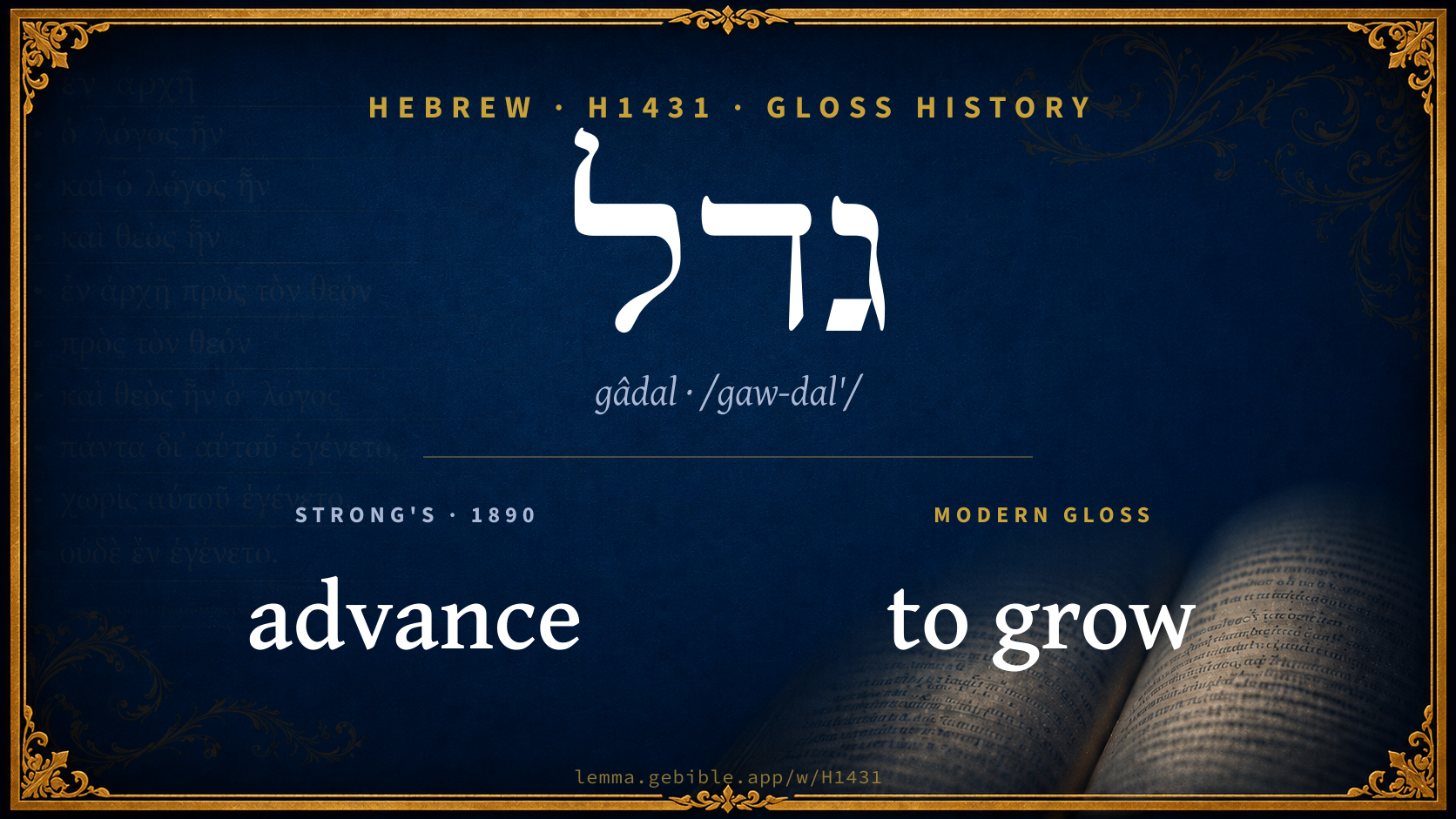
Gloss history
Strong's 1890 vs modern scholarship
About this word
Strong's H1431 catalogs a Hebrew word from the Hebrew Old Testament.
These counts are not copied from any lexicon or concordance. They are computed here, from the morphology-tagged Hebrew Old Testament. What Lemma adds →
- 112
- distinct verses
- The word appears in 112 distinct verses.
- 31 / 39
- OT books
- The word appears in 31 of 39 Old Testament books.
- #377
- by frequency
- Top 500 most frequent Hebrew words (rank 377 of 8,640 Hebrew words by occurrence).
View all 112 occurrences in the concordance →
By section of the Old Testament
By traditional corpus
Conventional, traditional groupings — biblical authorship is debated, so this is a traditional corpus grouping, not an authorship claim. Each share is this word’s portion of its verses in that division of the Hebrew canon. Each figure is a share of the word’s 112 distinct verses.
- Prophets (Nevi'im) 49 verses · 44%
- Writings (Ketuvim) 47 verses · 42%
- Torah (Pentateuch) 16 verses · 14%
How translations render this word
Counts come from each version’s own published word-to-Strong’s tagging or interlinear alignment — an approximate guide to how each version renders this word, not a word-level alignment the data otherwise carries. Because each total is that version’s own tagged count, the per-version totals vary from one another and need not match the appearance or distinct-verse counts above. These counts may also differ from a printed concordance because Lemma counts each distinctly tagged rendering and does not collapse phrase taggings into a single head-word total. This is a fixed set of word-tagged versions (KJV, ASV, BSB, ULT) and does not change with the reading translation you choose elsewhere. Each version’s license is shown beside its name below (and on Sources).
- King James Version: Great 8×, Grew 6×, Be magnified 4×
- American Standard Version: Great 8×, Grew 6×, Magnified 6×
- Berean Standard Bible: Great 9×, Had grown up 6×, Grew 5×
- unfoldingWord Literal Text: Great 13×, And 11×, Be great 7×
King James Version Public Domain
Renders H1431 across 118 tagged occurrences — most commonly:
Plus other, less common renderings. Plus 67 renderings that appear only once — usually multi-word phrases or single function words the recovered tagging swept in, not distinct renderings. Not rendered by a distinct English word in 1 further occurrence.
American Standard Version Public Domain
Renders H1431 across 119 tagged occurrences — most commonly:
Plus other, less common renderings. Plus 71 renderings that appear only once — usually multi-word phrases or single function words the recovered tagging swept in, not distinct renderings.
Berean Standard Bible Public Domain
Renders H1431 across 115 tagged occurrences — most commonly:
Plus 76 renderings that appear only once — usually multi-word phrases or single function words the recovered tagging swept in, not distinct renderings. Not rendered by a distinct English word in 3 further occurrences.
unfoldingWord Literal Text CC BY-SA 4.0
Renders H1431 across 156 tagged occurrences — most commonly:
Plus other, less common renderings. Plus 67 renderings that appear only once — usually multi-word phrases or single function words the recovered tagging swept in, not distinct renderings.
29 senses and sub-senses in the full BDB
Hebrew verbs can shift meaning by stem (binyan): Qal is the basic action, Niphal is often passive or reflexive, Piel often intensifies or makes it factitive, and Hiphil is typically causative. The senses below are grouped under the stem BDB assigns to each. This entry also uses Pual (the passive of Piel) and Hithpael (reflexive or reciprocal).
What do BDB’s symbols mean?
BDB uses these scholarly abbreviations:
| Symbol | Meaning |
|---|---|
| 𝔊 | the Septuagint (the ancient Greek translation, LXX) |
| 𝔙 | the Vulgate (the Latin translation) |
| 𝔖 | the Syriac version (the Peshitta) |
| 𝔗 | the Targum (the Aramaic translation) |
| ψ | the Psalms |
| √ | root (the underlying root or stem) |
| ‖ | parallel passage (a synonymous or contrasted parallel) |
| † | the dagger: every passage where the word occurs is cited |
The 29 senses and sub-senses the full Brown-Driver-Briggs lexicon distinguishes for this word, in lexicon order (not ranked by frequency), with BDB’s own verbatim wording and sub-sense lettering. Shown in Hebrew script with BDB’s own scholarly abbreviations. The condensed entry is in the Lexicon Entry tab. See also the Forms in the corpus table below.
Qal
- Pf. ג׳ etc. Gn 38:14 + 14 times; sf. גְּדֵלַנִי Jb 31:18; Impf. יִגְדַּל etc. ψ 35:27 + 34 times;— e.g. Genesis 38:14
- 1. grow up,
- a. child Gn 21:8, 20; 25:27; 38:11, 14 Ex 2:10, 11 (JE) Ju 11:2; 13:24 Ru 1:13 1 S 2:21; 3:19 1 K 12:8, 10 (= 2 Ch 10:8, 10) 2 K 4:18; גְּדֵלַנִי כְאָב he grew up to me as to a father Jb 31:18; e.g. Genesis 21:8
- b. lamb 2 S 12:3. e.g. 2 Samuel 12:3
- 2. become great,
- a. in extent, wealthy Gn 26:13(×2); 41:40 (JE) Je 5:27; e.g. Genesis 26:13
- b. in value, בְּעֵינֵי י׳, גָּֽדְלָה נֶפֶשׁ בְּעֵיָנ֑י prized by 1 S 26:24(×2); e.g. 1 Samuel 26:24
- c. in intensity, grief Jb 2:13, mourning Zc 12:11, punishment La 4:6, trespass Ezr 9:6; e.g. Job 2:13
- d. in sound, loud cry Gn 19:13 (J); e.g. Genesis 19:13
- e. in importance, of a king Ec 2:9 1 K 10:23 (= 2 Ch 9:22) Dn 8:9, 10 (under fig. of horn), chief Gn 24:35; 48:19 (J), Messiah Mi 5:3, Jerusalem Ez 16:7; e.g. Ecclesiastes 2:9
- f. of God 2 S 7:22 ψ 104:1, his works ψ 92:6, his power Nu 14:17 (J). e.g. 2 Samuel 7:22
- 3. to be magnified,
- a. house of David Zc 12:7; e.g. Zechariah 12:7
- b. Yahweh ψ 35:27; 40:17; 70:5 Mal 1:5, his name 2 S 7:26 (= 1 Ch 17:24). e.g. Psalms 35:27
Piel
- Pf. גִּדַּל Jos 4:14 Est 3:1; גִּדֵּ֔ל Is 49:21; גִּדֵּ֑לָה Is 51:18, etc.; Impf. יְגַדֵּל Is 44:14 + 8 times; Imv. גַּדְּלוּ ψ 34:4; Inf. גַּדֵּל Nu 6:5 + 3 times; Pt. מְגַדְּלִים 2 K 10:6 (מְגַדְּלוֹת) Ct 5:13 𝔊 𝔙 Hi Bö De);— e.g. Joshua 4:14
- 1. cause to grow, e.g. hair Nu 6:5 (P), plants Jon 4:10 Is 44:14 Ez 31:4 Ct 5:13; bring up children 2 K 10:6 Is 1:2; 23:4; 49:21; 51:18 Dn 1:5 Ho 9:12. e.g. Numbers 6:5
- 2. make great, powerful Gn 12:2 (J) Jos 3:7; 4:14 (D) 1 K 1:37, 47 1 Ch 29:12, 25 2 Ch 1:1 Est 3:1; 5:11; 10:2. e.g. Genesis 12:2
- 3. magnify,
- a. man Jb 7:17; e.g. Job 7:17
- b. God ψ 34:4 w. ל, 69:31. e.g. Psalms 34:4
Pual
- Pt. pl. מְגֻדָּלִים brought up ψ 144:12. e.g. Psalms 144:12
Hiphil
- Pf. הִגְדִּיל ψ 41:10 +, etc.; Impf. יַגְדִּיל Is 42:21 Dn 8:25, etc.; Inf. הַגְדִּיל 1 Ch 22:8 Am 8:5; Pt. מַגְדִּיל ψ 18:51 (= מִגְדֹּיל in ‖ 2 S 22:51); pl. מַגְדִּילִים ψ 35:26;— e.g. Psalms 41:10
- 1. make great, e.g. shekel Am 8:5, pile for fire Ez 24:9, joy Is 9:2, counsel Is 28:29, wisdom Ec 1:16, works Ec 2:4, house of Yahweh 1 Ch 22:5; the heel ψ 41:10 either lifted high (Ges), or (cf. De Now) gave me insidiously a great fall; cf. ג׳ פִּיךָ Ob 12 i.e. utter proud words (v. רחב Hiph.). e.g. Amos 8:5
- 2. magnify, salvation ψ 18:51, so ‖ 2 S 22:51 (Kt מַגְדִּיל; > Qr מִגְדֹּל). mercy Gn 19:19 (J), teaching Is 42:21, the word of Yahweh ψ 138:2. e.g. Psalms 18:51
- 3. do great things הִגְדִּיל לַעֲשׂוֹת,
- a. in a good sense, of God ψ 126:2, Jo 2:21, also pregn. without Inf. 1 S 12:24. e.g. Psalms 126:2
- b. in bad sense, of ‘the northern one’ Jo 2:20, also pregn. without Inf. La 1:9 Zp 2:8, 10 Dn 8:4, 8, 11, 25; with עַל, of enemies ψ 35:26; 38:17; 55:13 Jb 19:5 Je 48:26, 42; Ez 35:13 of speaking ג׳ עָלַי בְּפִיכֶם. e.g. Joel 2:20
- c. also, with Inf. implied, wept greatly 1 S 20:41. e.g. 1 Samuel 20:41
Hithpael
- Pf. וְהִתְגַּדִּלְתִּ֫י Ez 38:23 I will magnify myself, shew myself great and powerful (of God); Impf. יִתְגַּדֵּל, with עַל in a bad sense, magnify oneself against Is 10:15 Dn 11:36; יִתְגַּדָּ֑ל Dn 11:37. e.g. Ezekiel 38:23
Senses from the full Brown-Driver-Briggs lexicon (Brown, Driver, Briggs; Oxford 1906 — public domain), digitized via Sefaria, supplemented by the OpenScriptures HebrewLexicon (CC BY 4.0). Full attribution on Sources.
Word origin
vb. grow up, become great (Aramaic גְּדַל (Ithpe.), ܓܕܰܠ twist, twine, Arabic جَدَلَ twist a cord, make firm, strong, become strong, so NH)—
— Brown-Driver-Briggs (Oxford 1906, public domain), digitized via Sefaria, supplemented by the OpenScriptures HebrewLexicon (CC BY 4.0). See Sources.
Origin: a primitive root
Jastrow Dictionary
A second Hebrew/Aramaic lexicon for comparison, covering Aramaic and post-biblical (Talmudic, Targumic, Midrashic) usage that the biblical-Hebrew BDB does not. Matched by lemma rather than by Strong’s number, so a lemma may carry more than one Jastrow headword (shown separately below), and the entries cover usage well beyond the Bible.
גָּדַל I
- v. גדל II) to be high, to grow, be large, tall. Ex. R. s. 1 שהיה גָדֵל שלא וכ׳ he was extraordinarily tall for his age. Ib. וכי אין הכל גְּדֵילִים do not all children grow?—Y. Maasr. I, 49ᵃ, v. טְפוּס; a. fr. Fem. גְּדֵילָה, pl. גְּדֵילוֹת. Succ. 34ᵃ; a. fr.
- 1. to raise (of live stock and of plants); to rear, train. Kil. VIII, 1 מותרים לגַדֵּל you are permitted to raise. Snh. 19ᵇ מיכל גִּידְּלָה Michal reared (Mirab’s children). Ib.; Meg. 13ᵃ המְגַדֵּל יתום וכ׳ he who educates an orphan in his house. Gen. R. s. 98 היו … מְגַדְּלִים שער they let their hair grow (in mourning). Erub. 100ᵇ מְגַדָּלֶת שער she lets her hair grow (does not cut it); a. fr.
- 2. to raise to dignity, make famous; to praise. Hor. 9ᵃ (ref. to Lev. XXI, 10) whence do we know אם אין לו שחייבין לגַדְּלוֹ when he (the Highpriest) is poor, that they (the brethren) are bound to raise him (make him independent)? Ib. גַּדְּלֵהוּ משל אחיו raise him by a collection from his brethren (v. Rabb. D. S. a. l.). Esth. R. to III, 1 למה גִדְּלוֹ for what purpose did (the Lord) raise him? Yalk. Esth. 1053 עד היכן גִּידְּלוֹ וכ׳ how high did he raise him? Fifty cubits (to the gallows); a. fr.—Y. Meg. III, end, 74ᶜ (ref. to הגדול, Neh. VIII, 6) במה גִידְּלוֹ wherewith did he magnify the Lord (describe His greatness)?; Yoma 69ᵇ ג׳ בשם וכ׳ he praised the Lord by pronouncing the tetragrammaton; Y. Ber. VII, 11ᶜ גודלו (corr. acc.)—Part. pass. מְגוּדָּל well grown. Ber. 11ᵃ; a. fr.—Kidd. 49ᵃ; 49ᵇ, v. גַּדֶּלֶת. e.g. Leviticus 21:10
- to grow up, to become of age. Yeb. X, 9 וּמִשֶּׁהִ׳ and after he is of age. Ib. XIII, 1 עד שתַּגְדִּיל until she becomes of age; a. fr.
- , Nithpa. נִתְגַּדֵּל
- 1. to be raised to dignity. Esth. R. to III, 1 יִתְגַּדֵּל ואח"כ יתלה let him first become great and then be hanged. Gen. R. s. 99, end (play on פֹּרָת, Gen. XLIX, 22) ע"י פָּרוֹת נ׳ by means of cows (Pharaoh’s dream) was he raised to power; a. fr.— to be magnified. Y. Ber. IX, 14ᵃ top; Y. Taan. I, 64ᵇ top יִתְגַּדֵּל וכ׳ may Thy Name be glorified, sanctified &c.; a. e. e.g. Genesis 49:22
- 3. to glorify one’s self, to boast, parade. Ned. 62ᵃ; Ab. IV, 5 אל תעשם עטרה להִתְגַּדֵּל בהם make them (the words of the Law) not a crown to parade therewith.
- 4. to grow, prosper, be nursed. Tanḥ. V’zoth 1; Pesik. ib. p. 199ᵃ הרי … מִתְגַּדֵּל עמו the poison-bearing tree will be nursed along with it (the health-giving tree). Tanḥ. B’resh. 7 נִתְגַּדַּלְתָּ וחטאת thou didst grow older and didst sin, opp. תינוק היית; a. fr.
גְּדַל I
- Kidd. 71ᵇ ג׳ ולא נסיב was grown up and not yet married.
- to raise, rear. Ḥag. 4ᵇ מרים מְגַדְּלָא דרדקי Miryam, the childrens’ nurse.
- to be exalted. Targ. Ps. CIV, 1.
גָּדַל II
- (v. preced.; cmp. גדש) [to heap up, round;] to plait, dress the hair. Kel. XVI, 7 גּוֹדְלֵי מצנפות capweavers (on a model head, v. אִמּוּם). Ib. XV, 3 וגוֹדְלוֹת and dress their hair. Sabb. X, 6 הגּוֹדֶלֶת she who plaits her hair (on the Sabbath). Ib. 94ᵇ bot. גודלת משום אורגת plaiting the hair (is forbidden on the Sabbath) as an act of weaving; ib. 95ᵃ (another opin.) ג׳ … משום בונה as an act of building. Y. ib. VII, 10ᵈ הגודל כלי צורה he who forms raised figures on a vessel. M. Kat. 11ᵃ ג׳ תנור to build a stove.
גְּדַל II
- Gitt. 69ᵃ ניגדול תרתי וכ׳ let him twine two threads. M. Kat. 11ᵃ למִיגְדַּל אהורי to weave nets; למי׳ תנורא to build a stove, v. preced.
- same. Ḥag. 4ᵇ מרים מְגַדְּלָא נשייא Ms. M. (ed. מג׳ שיער נ׳) Miriam the women’s hair-dresser (v. Rabb. D. S. a. l. note); Snh. 67ᵃ; Sabb. 104ᵇ (missing in later editions). Succ. 37ᵃ הנהו מְגַדְּלֵי הושענא those twining the willow twigs (v. הוֹשַׁעְנָא).
גִּדָּל
- , v. גִּידּוֹל
גִּידּוֹל
- Giddol, name of several Amoraim. Y. Meg. III, end 74ᶜ ר׳ גי׳; Yoma 69ᵇ ר׳ גדל. Y. Bets. I, 60ᵃ (without title). Kidd. 59ᵃ ר׳ גידל; a. fr.—G. b. Binyamin, b. Minyamin (Minyomi). Y. Pes. VIII, end, 36ᵇ.—Y. B. Bath. III, 14ᵃ; Bab. B. Bath. 39ᵇ; a. fr.—G. b. R’ulai. Gitt. 34ᵃ
A Dictionary of the Targumim, the Talmud Babli and Yerushalmi, and the Midrashic Literature (Marcus Jastrow; London, Luzac, 1903) — Public Domain. Digitized via Sefaria. Digitized via Sefaria. Full attribution on Sources.
Forms in the corpus
The 94 distinct written forms H1431 takes in the Hebrew Bible, most frequent first — each parse links to that stem’s occurrences in the concordance. Hebrew forms include their vowel points and cantillation, so a single lemma takes many written forms.
The 60 most common forms are shown; 34 rarer forms follow in the full concordance.
Same root — word family
Other BDB entries built from the same root as H1431, grouped by Strong’s listed origin. These share a root / origin per the lexicon — not necessarily a shared meaning. Each links to that word’s own entry.
Derived from this word
- גדול gâdôwl H1419 great
- גדל gâdêl H1432 growing up
- גדל gôdel H1433 greatness
- גדל gᵉdil H1434 tassels
- מגדל migdâl H4026 tower
Proper names from this root
People and places named from this root — a name, not an additional meaning of the word.
- גדל Giddêl H1435 Giddel
- גדליה Gᵉdalyâh H1436 Gedaliah
- גדלתי Giddaltîy H1437 Giddalti
- יגדליהו Yigdalyâhûw H3012 Igdaliah
Compare all same-root words → Showing 4 of 10 — not the complete family. 4 of the same-root words are proper names (people or places). They share a root, not necessarily a meaning.
Septuagint verse parallels
This word appears in 104 verses that also exist in the Greek Old Testament (Septuagint), out of the 112 Hebrew verses it occurs in. You can read those verses in Greek by switching the Old Testament edition to the Septuagint.
Read these verses in the Septuagint
- Genesis 12:2
- Exodus 2:10
- Numbers 6:5
- Joshua 3:7
- Judges 11:2
- Ruth 1:13
- 1 Samuel 2:21
- 2 Samuel 7:22
- 1 Kings 1:37
- 2 Kings 4:18
- 1 Chronicles 17:24
- 2 Chronicles 1:1
This is a verse-level parallel only — the same verses exist in both the Hebrew and Greek Old Testaments. No word-level Hebrew↔Greek correspondence is claimed: the data carries no such alignment, so no Greek word is shown as this Hebrew word’s translation. Coverage is not total — the Septuagint omits the deuterocanon and renumbers the Psalms, so some Hebrew verses have no direct Greek parallel.