
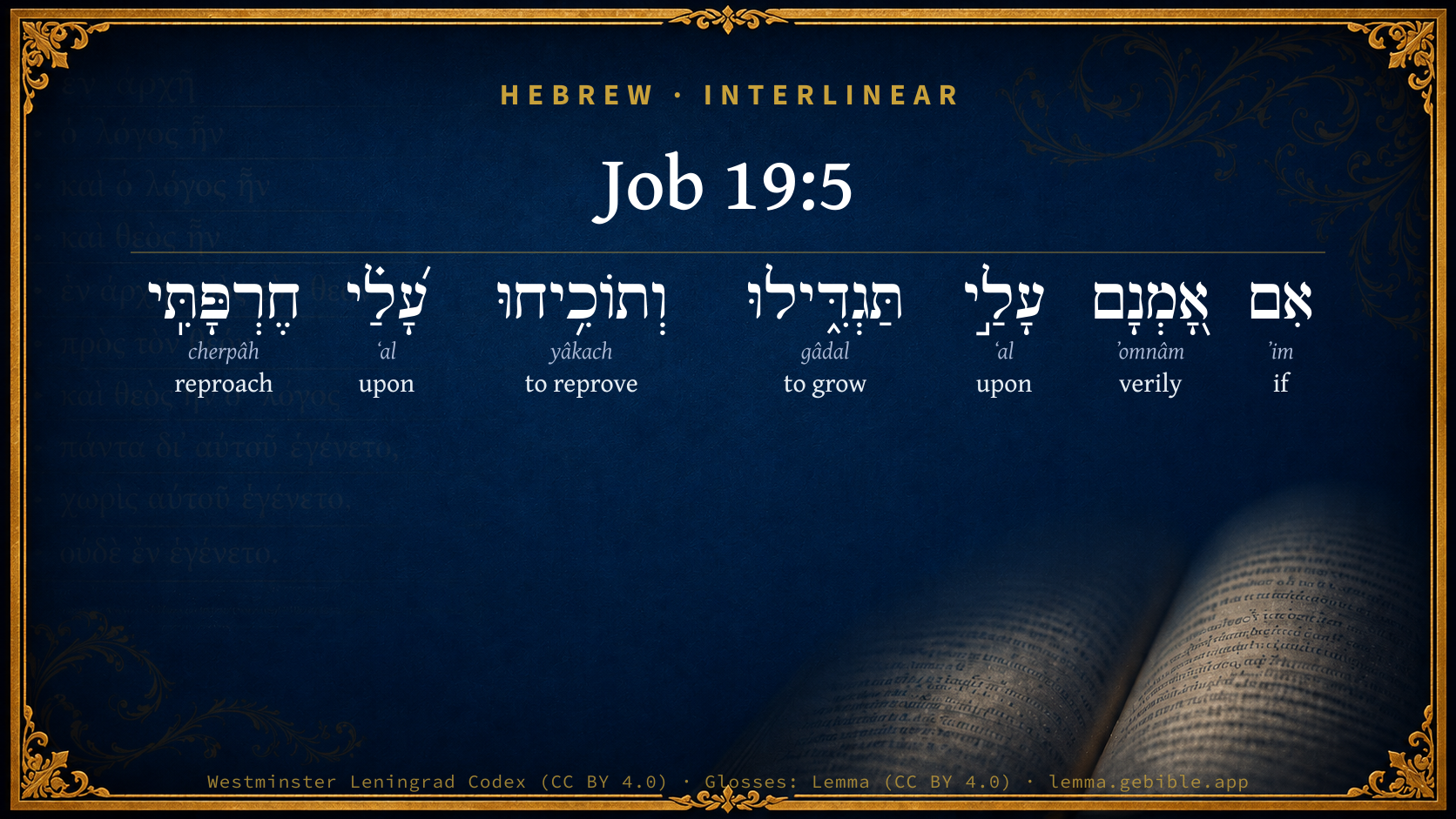
Job 19:5

Hebrew (Westminster Leningrad Codex) Job 19:5 appears in the Hebrew Old Testament. The text above is from the Westminster Leningrad Codex. Each word links to its Strong’s number, a concise gloss, and parsing drawn from the Open Scriptures Hebrew Bible morphology. Click any word for its full Brown-Driver-Briggs (BDB) entry.
Download image
Cite this verse

Job 19:5 (World English Bible). Public Domain. Lemma interlinear Bible study tool, https://lemma.gebible.app/v/job/19/5.

Show BibTeX & RIS
BibTeX
RIS
English Translation
If indeed you will magnify yourselves against me, And plead against me my reproach;
World English Bible · Public Domain
Download a study sheet

One document with this verse’s original text, its word-by-word gloss line, the meaning frame, cross-references with their text, attributed commentary, and full source and license credits — printable, and it pastes into notes with its structure intact.

This verse Autodidact and up

Study sheet (.html) Plain text (.txt)

A passage Seminary Student

Up to 50 verses in one chapter. A passage sheet keeps up to 6 commentary sources and 12 cross-references per verse, in the order this page ranks them, and says so on the sheet whenever that leaves anything out. Ask for a single verse and you get the Autodidact verse sheet above.

Everything on this page stays free to read, with no account — the sheet is a download of what is already on screen, not access to it.

Want to remove ads? Support Godless Engineer
Compare translations 3

The same verse in 3 English versions, stacked beneath the original-language interlinear above. Click any original word for its lexicon entry.

Each is an independent rendering of the whole verse — the interlinear is not word-aligned to these translations.

Highlighted words mark where these versions differ — a whole-verse word diff, not a word-by-word alignment.

  • World English Bible Public Domain
    If indeed you will magnify yourselves against me, And plead against me my reproach;
  • King James Version Public Domain
    If indeed ye will magnify yourselves against me, and plead against me my reproach:
  • unfoldingWord Literal Text CC BY-SA 4.0
    If truly you will exalt yourselves above me and plead my disgrace against me,

unfoldingWord Literal Text — © unfoldingWord, licensed CC BY-SA 4.0. Word-aligned USFM3 via Door43 (git.door43.org/unfoldingWord/en_ult).

Versions to compare (up to 4)

3 of 4 selected

Show all 18 translations

Every available English version of this verse, each an independent rendering of the whole verse.

  • World English Bible Public Domain
    If indeed you will magnify yourselves against me, And plead against me my reproach;
  • Berean Standard Bible Public Domain
    If indeed you would exalt yourselves above me and use my disgrace against me,
  • Majority Standard Bible Public Domain
    If indeed you would exalt yourselves above me and use my disgrace against me,
  • King James Version Public Domain
    If indeed ye will magnify yourselves against me, and plead against me my reproach:
  • American Standard Version (1901) Public Domain
    If indeed ye will magnify yourselves against me, And plead against me my reproach;
  • Revised Version (1885) Public Domain
    If indeed ye will magnify yourselves against me, and plead against me my reproach:
  • Geneva Bible (1599) Public Domain
    But in deede if ye will aduance your selues against me, and rebuke me for my reproche,
  • Douay-Rheims (1899) Public Domain
    But you have set yourselves up against me, and reprove me with my reproaches.
  • Young's Literal Translation Public Domain
    If, truly, over me ye magnify yourselves, And decide against me my reproach;
  • Literal Standard Version CC BY-SA 4.0
    If, truly, you magnify yourselves over me, || And decide my reproach against me;
  • Unlocked Literal Bible CC BY-SA 4.0
    If indeed you will exalt yourselves above me and use my humiliation against me,
  • unfoldingWord Literal Text CC BY-SA 4.0
    If truly you will exalt yourselves above me and plead my disgrace against me,
  • Darby Bible Public Domain
    If indeed ye will magnify yourselves against me, and prove against me my reproach,
  • World Messianic Bible Public Domain
    If indeed you will magnify yourselves against me, and plead against me my reproach,
  • Webster's Bible Public Domain
    If indeed ye will magnify yourselves against me, and plead against me my reproach:
  • Free Bible Version CC BY-SA 4.0
    You think you're so much better than me, and you use my degradation against me.
  • Bible in Basic English Public Domain
    If you make yourselves great against me, using my punishment as an argument against me,
  • JPS Tanakh (1917) Public Domain
    If indeed ye will magnify yourselves against me, and plead against me my reproach;

Literal Standard Version (2020), Covenant Press — licensed CC BY-SA 4.0. Text via the HelloAO Bible API (eBible.org). Unlocked Literal Bible (unfoldingWord) — licensed CC BY-SA 4.0. Text via the HelloAO Bible API (eBible.org). unfoldingWord Literal Text — © unfoldingWord, licensed CC BY-SA 4.0. Word-aligned USFM3 via Door43 (git.door43.org/unfoldingWord/en_ult). Free Bible Version, Dr. Jonathan Gallagher — licensed CC BY-SA 4.0. Text via the HelloAO Bible API (eBible.org).

Word by word

More ways to search: Search by grammar → Find every occurrence → Compare this word →

Practice this passage: Drill this verse → Learn its vocabulary →

About this verse

These counts appear in no published source. They are computed here, from the morphology-tagged text and Lemma’s own curated glosses. What Lemma adds →

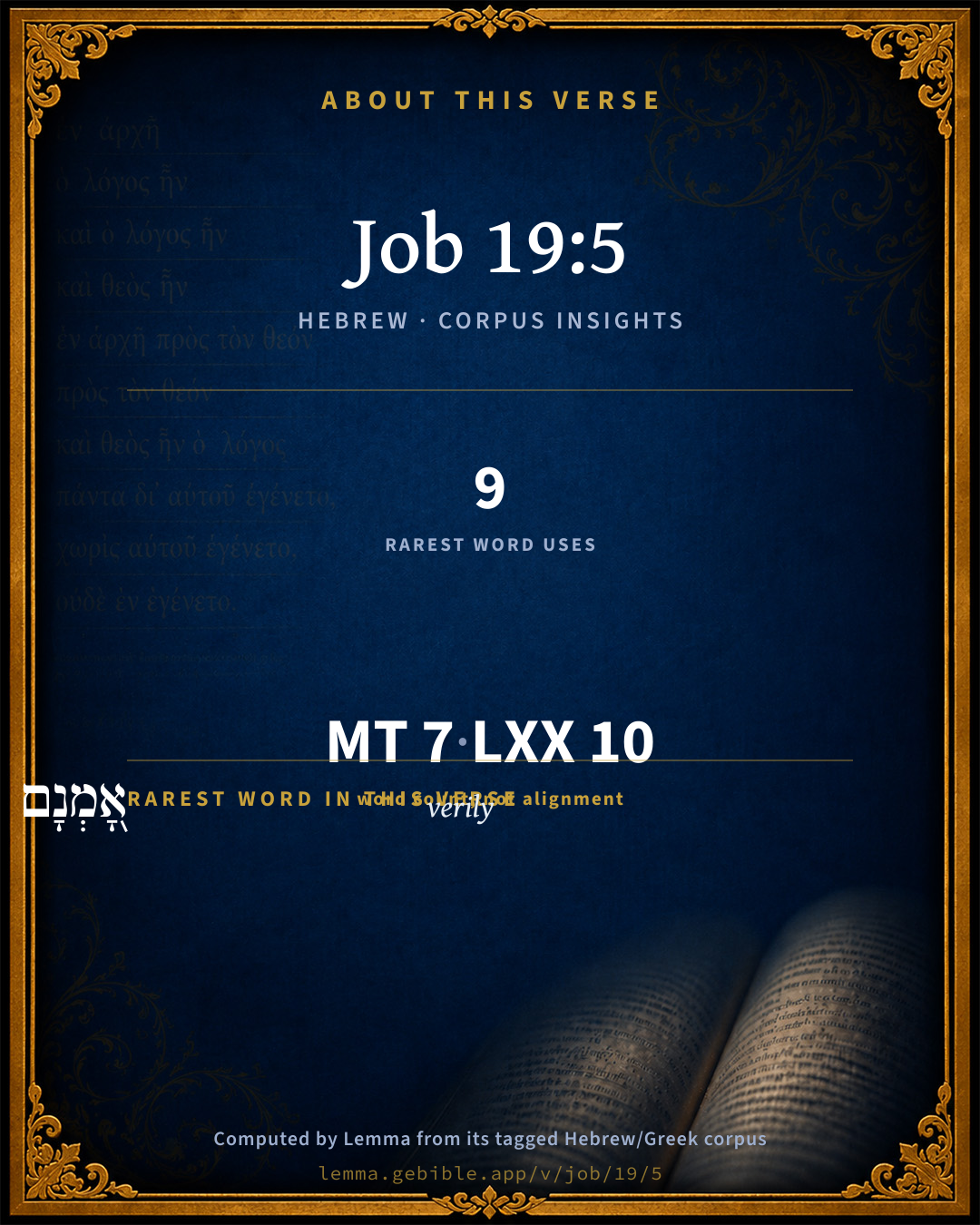
7
words
6
distinct lemmas
Wisdom
section

Notable vocabulary

The rarest word here is אָ֭מְנָם verily H551 — appearing just 9 times in the whole Hebrew Bible.

Shared distinctive vocabulary

אָ֭מְנָם verily H551 occurs in 9 verses of the Hebrew Bible. Also found in:

Grammatical profile

  • 2 verbs
  • 1 noun
  • 2 prepositions
  • 1 conjunction
  • 1 adverb

Verb forms

  • תַּגְדִּ֑ילוּ Hiphil · Imperfect
  • וְתוֹכִ֥יחוּ Hiphil · Imperfect

Repetition

A word recurs within this verse — often emphatic in Hebrew:

  • עָלַ֣י upon H5921 ×2

Hebrew & Septuagint length

In English translation the verse runs 14 words from the Hebrew and 13 from the Septuagint (LXX English) — closely comparable.

A rough comparison of the two English renderings, which tokenize alike — not a word-level alignment.

Word counts can differ between the Hebrew and the Greek without any difference in meaning — e.g. the Hebrew direct-object marker אֵת has no separate Greek word, and Greek often adds the article ὁ.

In the original languages it is 7 Hebrew tokens and 10 Greek tokens — but the two are counted differently (Hebrew bundles its prefixes and suffixes into one token; the Greek is in lemma form), so that isn’t a like-for-like length.

Cross-references

14

Topical passages linked to Job 19:5 in the Treasury of Scripture Knowledge — connected by theme and wording, ordered by reader-vote popularity; previews shown in the World English Bible.

  • Psalms 35:26 Let them be disappointed and confounded together who rejoice at my calamity. Let them be clothed with shame and dishonor who magnify themselves against me.
  • Psalms 38:16 For I said, "Don't let them gloat over me, Or exalt themselves over me when my foot slips."
  • Psalms 55:12 For it was not an enemy who insulted me, Then I could have endured it. Neither was it he who hated me who raised himself up against me, Then I would have hid myself from him.
  • 1 Samuel 1:6 Her rival provoked her sore, to make her fret, because Yahweh had shut up her womb.
  • Nehemiah 1:3 They said to me, The remnant who are left of the captivity there in the province are in great affliction and reproach: the wall of Jerusalem also is broken down, and the gates of it are burned with fire.
  • Psalms 41:11 By this I know that you delight in me, Because my enemy doesn't triumph over me.
  • Isaiah 4:1 Seven women shall take hold of one man in that day, saying, "We will eat our own bread, and wear our own clothing: only let us be called by your name. Take away our reproach."
  • Micah 7:8 Don't rejoice against me, my enemy. When I fall, I will arise. When I sit in darkness, Yahweh will be a light to me.
  • Zephaniah 2:10 This they will have for their pride, because they have reproached and magnified themselves against the people of Yahweh of Hosts.
  • Zechariah 12:7 Yahweh also will save the tents of Judah first, that the glory of the house of David and the glory of the inhabitants of Jerusalem not be magnified above Judah.
  • Luke 1:25 "Thus has the Lord done to me in the days in which he looked at me, to take away my reproach among men."
  • Luke 13:2–4 Jesus answered them, "Do you think that these Galileans were worse sinners than all the other Galileans, because they suffered such things?
  • John 9:2 His disciples asked him, "Rabbi, who sinned, this man or his parents, that he was born blind?"
  • John 9:34 They answered him, "You were altogether born in sins, and do you teach us?" They threw him out.

Cross-references courtesy of OpenBible.info (CC BY 4.0).

Hebrew and Greek witnesses Masoretic Hebrew ↔ Greek Septuagint

The same verse in the two great witnesses to the Old Testament, shown verse-for-verse.

These are two independent witnesses, not word-aligned to each other, and the Septuagint is shown in lemma (dictionary) form.

Hebrew Job 19:5 Masoretic · Westminster Leningrad Codex

אִם אָ֭מְנָם עָלַ֣י תַּגְדִּ֑ילוּ וְתוֹכִ֥יחוּ עָ֝לַ֗י חֶרְפָּתִּֽי

If indeed you will magnify yourselves against me, And plead against me my reproach;

World English Bible · Public Domain

Greek LXX Job 19:5 Septuagint · lemma form

ἔα δέ ὅτι ἐπί ἐγώ μεγαλύνω ἐνἅλλομαι δέ ἐγώ ὄνειδος

But alas! for you⌃ magnify yourselves against me, and insult me with reproach.

LXX2012 (modern English Septuagint) · Public Domain

Hebrew: Westminster Leningrad Codex (CC BY 4.0). Greek: Septuagint (public domain); English from LXX2012 (modern English Septuagint) (Public Domain). How the Septuagint differs from the Hebrew →

Commentary

Notes on Job 19:5 from classic Christian and Jewish commentators (each source and its license shown beneath its notes). The classic Christian expositions comment on the surrounding passage and are grouped to its opening verse, so a note may address several verses; the Jewish commentaries on the Tanakh (Rashi and others) are per-verse, so they appear only where the commentator wrote on this verse.

Lemma curates 59 commentaries, every one of them public domain or Creative Commons licensed, each selected and text-cleaned for this edition rather than reprinted as found. About our sources →

Trapp's Complete Commentary

John Trapp

Job 19:5 If indeed ye will magnify [yourselves] against me, and plead against me my reproach:

Ver. 5. If indeed ye will magnify yourselves against me] Or, Will you indeed magnify yourselves against me? sc. because of mine error, as Job 19:4, which yet ye have not convinced me of? Will ye insult me, therefore, and throw dirt upon me? Of Bonassus, a certain beast as big as an ox, Aristotle reporteth, that having horns bending inward and unfit for fight, after that he is wounded by the hunters, he fleeth for his life, and often letteth fly his dung for four yards or more, upon the dogs or men that pursue him, to their great annoyance (Hist Animal., lib. ix. cap. 4, 5). In like sort deal many disputers of this world; when they cannot make good their matter by strength of argument, they cast upon their adversaries the dung of calumnies, so seeking to magnify themselves against him, and pleading against him his reproach.

And plead against me my reproach] Affliction exposeth a man to reproach. Where the hedge is low the beast will be breaking over. See Zep 3:12. {See Trapp on "Zep 3:12"}

John Trapp, A Commentary or Exposition upon All the Books of the Old and New Testament (1647–1656) — public domain. Text from a community e-Sword module.

Jamieson, Fausset & Brown

Robert Jamieson, A. R. Fausset & David Brown

magnify, &c.--Speak proudly (Oba 1:12; Eze 35:13).

against me--emphatically repeated (Psa 38:16).

plead . . . reproach--English Version makes this part of the protasis, "if" being understood, and the apodosis beginning at Job 19:6. Better with UMBREIT, If ye would become great heroes against me in truth, ye must prove (evince) against me my guilt, or shame, which you assert. In the English Version "reproach" will mean Job's calamities, which they "pleaded" against him as a "reproach," or proof of guilt.

Jamieson, Fausset & Brown — Commentary Critical and Explanatory on the Whole Bible (1871) — public domain (CC PDM 1.0). Text via the HelloAO Bible API.

The Cambridge Bible for Schools and Colleges

gen. ed. J. J. S. Perowne

5. If his friends mean in earnest to found inferences on his calamities then he will tell them that it is God who hath brought these on him unjustly (Job_19:6).

The Cambridge Bible for Schools and Colleges (gen. ed. J. J. S. Perowne; Cambridge University Press, 1878–1918) — public domain. Text from a community e-Sword module.

John Gill's Exposition

Know now that God hath overthrown me,.... He would have them take notice that all his afflictions were from the hand of God; and therefore should take care to what they imputed any acts of his, whose ways are unsearchable, and the reasons of them not to be found out; and therefore, if a wrong construction should be put upon them, which may be easily done by weak sighted men, it must be displeasing to him. Job had all along from the first ascribed his afflictions to God, and he still continued to do so; he saw his hand in them all; whoever were the instruments, it was God that had overthrown him, or cast him down from an high to a very low estate; that had taken away his substance, his children, and his wealth: or "hath perverted me" (l); not that God had made him perverse, or was the cause or occasion of any perverseness in him, either in his words or in his actions, or had perverted his cause, and the judgment of it; Job could readily answer to those questions of Bildad, "doth God pervert judgment? or doth the Almighty pervert justice?" and say, no, he doth not; but he is to be understood in the same sense as the church is, when she says, see Lam 3:9; "he hath made my path crooked"; where the same word is used as here; and both she and Job mean that God had brought them into cross, crooked, and afflictive dispensations:

and hath compassed me with his net; and which also designs affliction, which is God's net, which he has made, ordained, and makes use of; which he lays for his people, and takes them in, and draws them to himself, and prevents them committing sin, and causes to issue in their good; see Lam 1:13.

(l) "pervertit me", Montanus, Mercerus; so Vatablus, Drusius, Schultens.

John Gill's Exposition of the Whole Bible (1746–1763) — public domain (CC PDM 1.0). Text via the HelloAO Bible API.

Albert Barnes' Notes on the Bible

If, indeed, ye will magnify yourselves against me - This is connected with the next verse. The sense is, “all these calamities came from God. He has brought them upon me in a sudden and mysterious manner. In these circumstances you ought to have pity upon me; Job 19:21. Instead of magnifying yourselves against me, setting yourselves up as censors and judges, overwhelming me with reproaches and filling my mind with pain and anguish, you ought to show to me the sympathy of a friend.” The phrase, “magnify yourselves,” refers to the fact that they had assumed a tone of superiority and an authoritative manner, instead of showing the compassion due to a friend in affliction.

And plead against me my reproach - My calamities as a cause of reproach. You urge them as a proof of the displeasure of God, and you join in reproaching me as a hypocrite. Instead of this, you should have shown compassion to me as a man whom God had greatly afflicted.

Albert Barnes' Notes on the Bible (1834–1885) — public domain. Text from a community e-Sword/MySword module.

Haydock's Catholic Bible Commentary

Reproaches, which I endure, as if they were a sure proof of your assertion. (Haydock) -- I must therefore refute you. (Calmet)

George Leo Haydock (1774–1849), Haydock's Catholic Family Bible and Commentary, 1859 edition — public domain. Excludes Psalms (Douay-Rheims chapter numbering differs from Protestant) and Deuterocanonical books (Catholic canon only).

Matthew Poole's English Annotations

Magnify yourselves against me, i.e. use lofty, and imperious, and contemptuous speeches against me; or seek praise and honour from others, by your conquering or outreasoning of me.

My reproach; either,

1. Your reproaches of me; if your reproachful and censorious speeches must pass for solid arguments. Or,

2. My wickedness, which, if true, were just matter of reproach, and the cause of all my miseries. Or,

3. My contemptible and calamitous condition, for which you reproach and condemn me as a hypocrite and wicked man.

Matthew Poole's English Annotations on the Holy Bible (1683–1685) — public domain. Text from a community e-Sword/MySword module.

Whedon's Commentary on the Bible

Daniel D. Whedon

5. And plead — Then prove. If ye will look down upon me in pride, it is incumbent upon you by good arguments to prove against me shamelessness of deed or of life. Reproach, in the original, is the sense of shame which sin brings in its train. The Hebrew has no stronger word for shame than — חרפה. Some make this verse a question.

Daniel D. Whedon (gen. ed.), Commentary on the Old and New Testaments (1874–1909) — public domain. Text from a community e-Sword module.

The Pulpit Commentary

If indeed ye will magnify yourselves against me. If you have no sense of justice, and are disinclined to pay any heed to my expostulations; if you intend still to insist on magnifying yourselves against me, and bringing up against me my "reproach;" then let me make appeal to your pity. Consider my whole condition how I stand with God, who persecutes me and "destroys" me (ver. 10); how I stand with my relatives and such other friends as I have beside yourselves, who disclaim and forsake me (vers. 13-19); and how I am conditioned with respect to my body, emaciated and on the verge of death (ver. 20); and then, if neither your friendship nor your sense of justice will induce you to abstain from persecuting me, abstain at any rate for pity"s sake (ver. 21). And plead against me my reproach. Job"s special "reproach" was that God had laid his hand upon him. This was a manifest fact, and could not be denied. His "comforters" concluded from it that he was a monster of wickedness.

The Pulpit Commentary (1880–1919), ed. H.D.M. Spence-Jones & Joseph S. Exell — public domain. Text from a community e-Sword module.

unfoldingWord translationNotes

Door43 World Missions Community

General Information:

Job continues to speak to his three friends.

If indeed you will exalt yourselves above me

"If you think you are better than I am" or "Since you act as though you are better than I am"

use my humiliation against me

How his friends would do this can be stated clearly. AT: "claim that my humiliation is proof against me" or "use my humiliation as evidence that I am guilty" (See: Assumed Knowledge and Implicit Information)

use my humiliation against me

The abstract noun "humiliation" can be expressed with the verb "humiliate." AT: "claim that what has happened to humiliate me proves that I am guilty" (See: Abstract Nouns)

has caught me in his net

Job speaks as if God were a hunter that has trapped Job in his net. This metaphor represents God taking control of Job and Job's feeling of helplessness. AT: "has trapped me" or "has taken control of me" or "has control of what happens to me, so that I am helpless" (See: Metaphor)

translationWords

humiliate

know

God

unfoldingWord translationNotes — © Distant Shores Media and the Door43 World Missions Community, licensed CC BY-SA 4.0. Source: git.door43.org/Door43/en_tn.

Rashi

Rabbi Shlomo Yitzchaki (Rashi)

If indeed you are added upon me to my trouble. and prove against me my reproach You show and prove my reproach to my face.

Rashi on the Tanakh — English translations: “The Judaica Press complete Tanach with Rashi, translated by A. J. Rosenberg” (CC BY 4.0); “Pentateuch with Rashi's commentary by M. Rosenbaum and A.M. Silbermann, 1929-1934” (public domain); “The Metsudah Tanach series, Lakewood, N.J” (CC BY 4.0); and “The Book of Joshua, Metsudah Publications, 1997” (CC BY 4.0). Text via Sefaria.

Lesson kit

Teaching starters — assembled from the data on this page, not authored interpretation. Every prompt links to the verse data it draws on. Edit before teaching.

Job, in the Wisdom, opens this verse with 7 words (6 distinct Hebrew lemmas). Its most distinctive word is ʼomnâm (“verily”). A historical commentator’s framing appears above. Read the whole chapter for the surrounding context.

Discussion questions

  1. The word ʼomnâm carries the sense “verily.” How does it shape the verse?
  2. Ruth 3:12 shares the word «verily» with this verse. How do the two illuminate each other?
  3. “upon” occurs 2× in this one verse. What is the effect of the repetition?
  4. These translations render this verse differently. What is at stake in choosing one wording over another?
  5. The verb «תַּגְדִּ֑ילוּ» is Hiphil Imperfect. How does its form color the action?
  6. Reading how Trapp's Complete Commentary and Jamieson, Fausset & Brown read this verse, where do the two commentators agree and where do they part?

Things to notice

Reading settings

Reading text

Shown beneath each verse's original-language words.

Old Testament
Old Testament edition

Read the OT as the Masoretic Hebrew (MT) or the Greek Septuagint (LXX).

English shown for the Greek Septuagint (in the Hebrew ↔ Greek comparison).

Comparing translations? Open the Compare panel on any verse page to stack up to four side by side.