
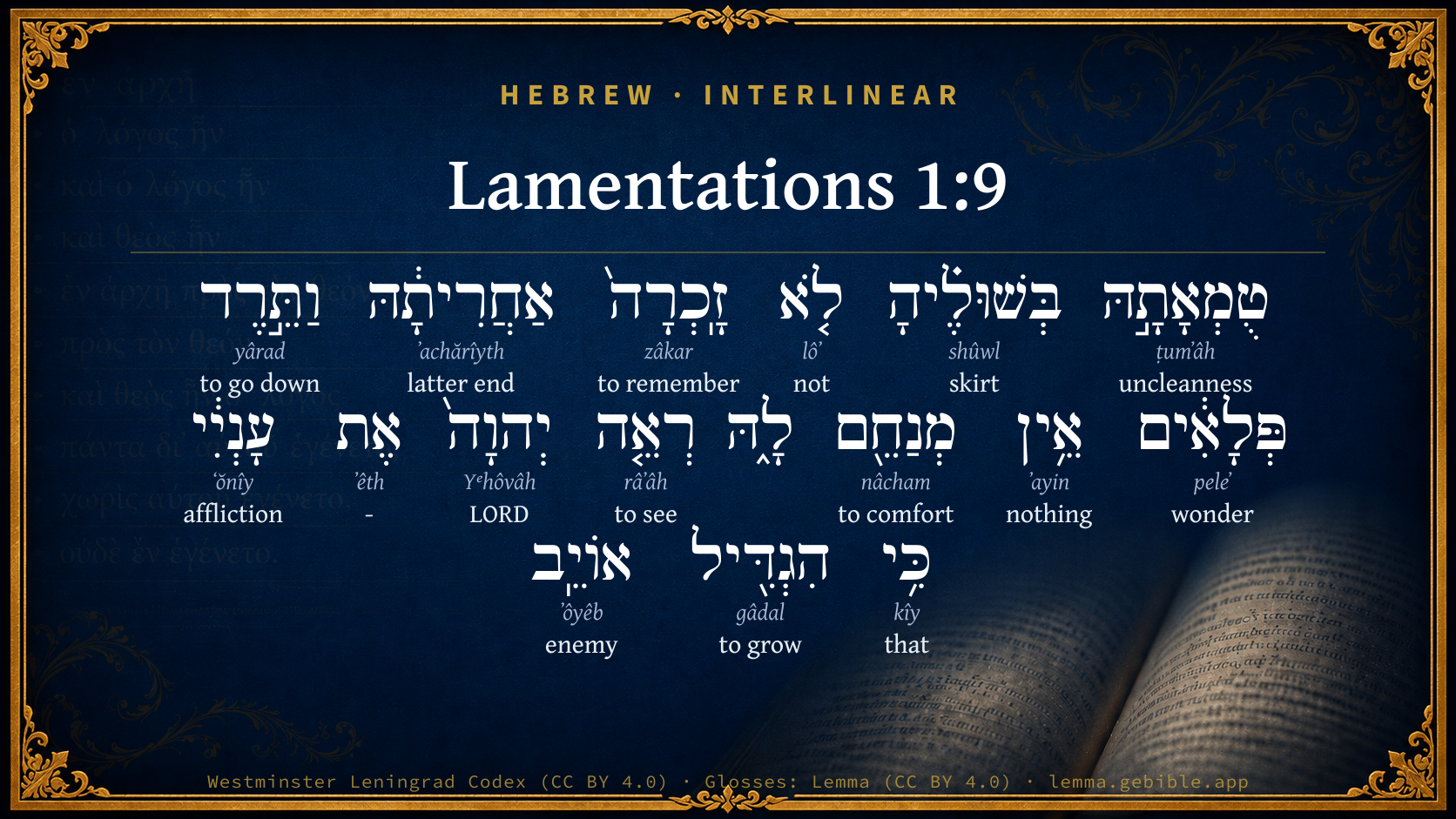
Lamentations 1:9

Hebrew (Westminster Leningrad Codex) Lamentations 1:9 appears in the Hebrew Old Testament. The text above is from the Westminster Leningrad Codex. Each word links to its Strong’s number, a concise gloss, and parsing drawn from the Open Scriptures Hebrew Bible morphology. Click any word for its full Brown-Driver-Briggs (BDB) entry.
Download image
Cite this verse

Lamentations 1:9 (World English Bible). Public Domain. Lemma interlinear Bible study tool, https://lemma.gebible.app/v/lamentations/1/9.

Show BibTeX & RIS
BibTeX
RIS
English Translation
Her filthiness was in her skirts; she didn't remember her latter end; Therefore is she come down wonderfully; she has no comforter: See, Yahweh, my affliction; for the enemy has magnified himself.
World English Bible · Public Domain
Download a study sheet

One document with this verse’s original text, its word-by-word gloss line, the meaning frame, cross-references with their text, attributed commentary, and full source and license credits — printable, and it pastes into notes with its structure intact.

This verse Autodidact and up

Study sheet (.html) Plain text (.txt)

A passage Seminary Student

Up to 50 verses in one chapter. A passage sheet keeps up to 6 commentary sources and 12 cross-references per verse, in the order this page ranks them, and says so on the sheet whenever that leaves anything out. Ask for a single verse and you get the Autodidact verse sheet above.

Everything on this page stays free to read, with no account — the sheet is a download of what is already on screen, not access to it.

Want to remove ads? Support Godless Engineer
Compare translations 3

The same verse in 3 English versions, stacked beneath the original-language interlinear above. Click any original word for its lexicon entry.

Each is an independent rendering of the whole verse — the interlinear is not word-aligned to these translations.

Highlighted words mark where these versions differ — a whole-verse word diff, not a word-by-word alignment.

  • World English Bible Public Domain
    Her filthiness was in her skirts; she didn't remember her latter end; Therefore is she come down wonderfully; she has no comforter: See, Yahweh, my affliction; for the enemy has magnified himself.
  • King James Version Public Domain
    Her filthiness is in her skirts; she remembereth not her last end; therefore she came down wonderfully: she had no comforter. O LORD, behold my affliction: for the enemy hath magnified himself.
  • unfoldingWord Literal Text CC BY-SA 4.0
    Her uncleanness is in her skirts; she did not remember her end. And she went down astonishingly; there is no comforter for her. “See, Yahweh, my affliction, for the enemy has magnified himself.” YODH

unfoldingWord Literal Text — © unfoldingWord, licensed CC BY-SA 4.0. Word-aligned USFM3 via Door43 (git.door43.org/unfoldingWord/en_ult).

Versions to compare (up to 4)

3 of 4 selected

Show all 18 translations

Every available English version of this verse, each an independent rendering of the whole verse.

  • World English Bible Public Domain
    Her filthiness was in her skirts; she didn't remember her latter end; Therefore is she come down wonderfully; she has no comforter: See, Yahweh, my affliction; for the enemy has magnified himself.
  • Berean Standard Bible Public Domain
    Her uncleanness stains her skirts; she did not consider her end. Her downfall was astounding; there was no one to comfort her. Look, O LORD, on my affliction, for the enemy has triumphed!
  • Majority Standard Bible Public Domain
    Her uncleanness stains her skirts; she did not consider her end. Her downfall was astounding; there was no one to comfort her. Look, O LORD, on my affliction, for the enemy has triumphed!
  • King James Version Public Domain
    Her filthiness is in her skirts; she remembereth not her last end; therefore she came down wonderfully: she had no comforter. O LORD, behold my affliction: for the enemy hath magnified himself.
  • American Standard Version (1901) Public Domain
    Her filthiness was in her skirts; she remembered not her latter end; Therefore is she come down wonderfully; she hath no comforter: Behold, O Jehovah, my affliction; for the enemy hath magnified himself.
  • Revised Version (1885) Public Domain
    Her filthiness was in her skirts; she remembered not her latter end; therefore is she come down wonderfully; she hath no comforter: behold, O LORD, my affliction; for the enemy hath magnified himself.
  • Geneva Bible (1599) Public Domain
    Her filthinesse is in her skirts: she remembred not her last ende, therefore she came downe wonderfully: she had no comforter: O Lord, behold mine affliction: for the enemie is proud.
  • Douay-Rheims (1899) Public Domain
    Teth. Her filthiness is on her feet, and she hath not remembered her end: she is wonderfully cast down, not having a comforter: behold, O Lord, my affliction, because the enemy is lifted up.
  • Young's Literal Translation Public Domain
    Her uncleanness `is' in her skirts, She hath not remembered her latter end, And she cometh down wonderfully, There is no comforter for her. See, O Jehovah, mine affliction, For exerted himself hath an enemy.
  • Literal Standard Version CC BY-SA 4.0
    Her uncleanness [is] in her skirts, || She has not remembered her latter end, || And she comes down wonderfully, || There is no comforter for her. See, O YHWH, my affliction, || For an enemy has exerted himself.
  • Unlocked Literal Bible CC BY-SA 4.0
    She has become unclean beneath her skirts. She did not think about her future. Her fall was terrible. There was no one to comfort her. She cried out, “Look at my affliction, Yahweh, for the enemy has become too great!”
  • unfoldingWord Literal Text CC BY-SA 4.0
    Her uncleanness is in her skirts; she did not remember her end. And she went down astonishingly; there is no comforter for her. “See, Yahweh, my affliction, for the enemy has magnified himself.” YODH
  • Darby Bible Public Domain
    Her impurity was in her skirts, she remembered not her latter end; and she came down wonderfully: she hath no comforter. Jehovah, behold my affliction; for the enemy hath magnified himself.
  • World Messianic Bible Public Domain
    Her filthiness was in her skirts. She didn’t remember her latter end. Therefore she has come down astoundingly. She has no comforter. “See, LORD, my affliction; for the enemy has magnified himself.”
  • Webster's Bible Public Domain
    Her filthiness is in her skirts; she remembereth not her last end; therefore she hath been wonderfully abased: she had no comforter. O LORD, behold my affliction: for the enemy hath magnified himself.
  • Free Bible Version CC BY-SA 4.0
    Her uncleanness contaminates her skirts. She didn't think about what would happen. Her fall was a shock, and no one was there to comfort her. “Please, Lord, see how much I'm suffering, because the enemy has won!” she says.
  • Bible in Basic English Public Domain
    In her skirts were her unclean ways; she gave no thought to her end; and her fall has been a wonder; she has no comforter: see her sorrow, O Lord; for the attacker is lifted up.
  • JPS Tanakh (1917) Public Domain
    Her filthiness was in her skirts, she was not mindful of her end; therefore is she come down wonderfully, she hath no comforter. 'Behold, O LORD, my affliction, for the enemy hath magnified himself.'

Literal Standard Version (2020), Covenant Press — licensed CC BY-SA 4.0. Text via the HelloAO Bible API (eBible.org). Unlocked Literal Bible (unfoldingWord) — licensed CC BY-SA 4.0. Text via the HelloAO Bible API (eBible.org). unfoldingWord Literal Text — © unfoldingWord, licensed CC BY-SA 4.0. Word-aligned USFM3 via Door43 (git.door43.org/unfoldingWord/en_ult). Free Bible Version, Dr. Jonathan Gallagher — licensed CC BY-SA 4.0. Text via the HelloAO Bible API (eBible.org).

Word by word

More ways to search: Search by grammar → Find every occurrence → Compare this word →

Practice this passage: Drill this verse → Learn its vocabulary →

בְּשׁוּלֶ֗יהָ
shûwl
H7757
“in/at · skirts · her”
Preposition + Noun, Common, Masculine, Plural, Construct + Suffix, Personal, 3rd Person, Feminine, Singular
Part of Speech
Preposition + Noun
Type
Common
Gender
Masculine
Number
Plural
State
Construct
Full BDB Definition

Origin: from an unused root meaning to hang down

TWOT: 2346a

skirt (of robe) - of high priest's robe - of God's train, city as woman, ignominy, defilement (figuratively)
  1. טֻמְאָתָ֣הּ ṭumʼâh H2932 “uncleanness · her” Noun, Common, Feminine, Singular, Construct + Suffix, Personal, 3rd Person, Feminine, Singular
  2. לֹ֤א lôʼ H3808 “not” Particle, Negative
  3. זָֽכְרָה֙ zâkar H2142 “to remember” Verb, Qal, Perfect, 3rd Person, Feminine, Singular
  4. אַחֲרִיתָ֔הּ ʼachărîyth H319 “latter end · her” Noun, Common, Feminine, Singular, Construct + Suffix, Personal, 3rd Person, Feminine, Singular
  5. וַתֵּ֣רֶד yârad H3381 “and · to go down” Conjunction + Verb, Qal, Sequential Imperfect, 3rd Person, Feminine, Singular
  6. פְּלָאִ֔ים peleʼ H6382 “wonders” Noun, Common, Masculine, Plural, Absolute
  7. אֵ֥ין ʼayin H369 “nothing” Particle, Negative
  8. מְנַחֵ֖ם nâcham H5162 “comforting” Verb, Piel, Participle Active, Masculine, Singular, Absolute
  9. רְאֵ֤ה râʼâh H7200 “see” Verb, Qal, Imperative, 2nd Person, Masculine, Singular
  10. יְהוָה֙ Yᵉhôvâh H3068 “LORD” Noun, Proper
  11. אֶת ʼêth H853 “-” Particle, Direct Object
  12. עָנְיִ֔י ʻŏnîy H6040 “affliction · my” Noun, Common, Masculine, Singular, Construct + Suffix, Personal, 1st Person, Common, Singular
  13. כִּ֥י kîy H3588 “that” Conjunction
  14. הִגְדִּ֖יל gâdal H1431 “to grow” Verb, Hiphil, Perfect, 3rd Person, Masculine, Singular
  15. אוֹיֵֽב ʼôyêb H341 “enemy” Verb, Qal, Participle Active, Masculine, Singular, Absolute

About this verse

These counts appear in no published source. They are computed here, from the morphology-tagged text and Lemma’s own curated glosses. What Lemma adds →

17
words
16
distinct lemmas
Prophets
section

Notable vocabulary

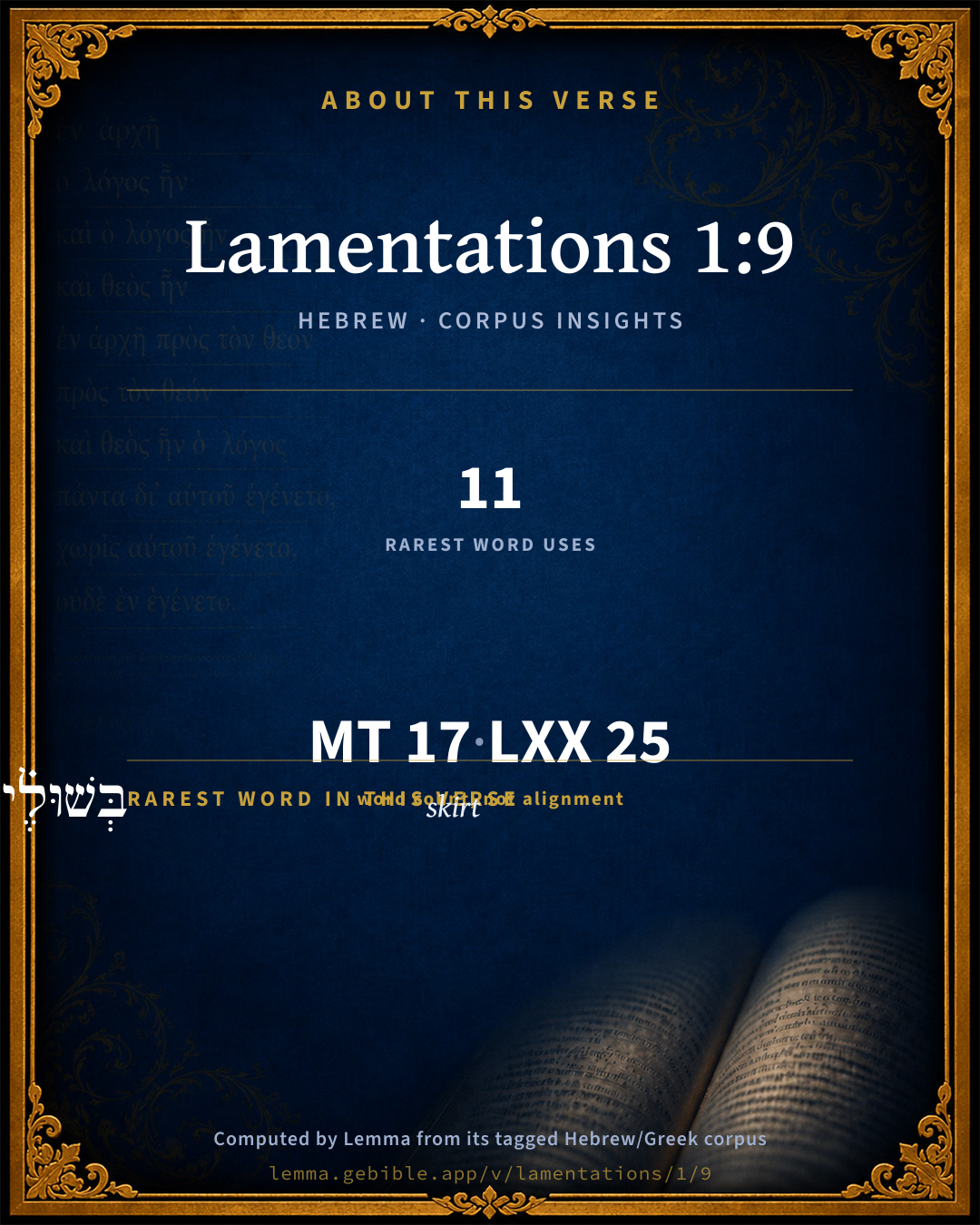
The rarest word here is בְּשׁוּלֶ֗יהָ skirt H7757 — appearing just 11 times in the whole Hebrew Bible.

Shared distinctive vocabulary

בְּשׁוּלֶ֗יהָ skirt H7757 occurs in 10 verses of the Hebrew Bible. Also found in:

Grammatical profile

  • 6 verbs
  • 6 nouns
  • 1 preposition
  • 1 conjunction
  • 3 particles

Verb forms

  • זָֽכְרָה֙ Qal · Perfect
  • וַתֵּ֣רֶד Qal · Sequential Imperfect
  • מְנַחֵ֖ם Piel · Participle Active
  • רְאֵ֤ה Qal · Imperative
  • הִגְדִּ֖יל Hiphil · Perfect
  • אוֹיֵֽב Qal · Participle Active

Hebrew & Septuagint length

In English translation the verse runs 32 words from the Hebrew and 36 from the Septuagint (LXX English) — closely comparable.

A rough comparison of the two English renderings, which tokenize alike — not a word-level alignment.

Word counts can differ between the Hebrew and the Greek without any difference in meaning — e.g. the Hebrew direct-object marker אֵת has no separate Greek word, and Greek often adds the article ὁ.

In the original languages it is 17 Hebrew tokens and 25 Greek tokens — but the two are counted differently (Hebrew bundles its prefixes and suffixes into one token; the Greek is in lemma form), so that isn’t a like-for-like length.

Cross-references

43

Topical passages linked to Lamentations 1:9 in the Treasury of Scripture Knowledge — connected by theme and wording, ordered by reader-vote popularity; previews shown in the World English Bible.

  • Deuteronomy 32:29 Oh that they were wise, that they understood this, That they would consider their latter end!
  • Psalms 25:18 Consider my affliction and my travail. Forgive all my sins.
  • Isaiah 47:7 You said, I shall be mistress forever; so that you did not lay these things to your heart, neither did remember the latter end of it.
  • Ecclesiastes 4:1 Then I returned and saw all the oppressions that are done under the sun: and, behold, the tears of those who were oppressed, and they had no comforter; and on the side of their oppressors there was power; but they had no comforter.
  • Lamentations 1:17 Zion spreads forth her hands; there is none to comfort her; Yahweh has commanded concerning Jacob, that those who are round about him should be his adversaries: Jerusalem is among them as an unclean thing.
  • Psalms 119:153 Consider my affliction, and deliver me, For I don't forget your law.
  • Isaiah 3:8 For Jerusalem is ruined, and Judah is fallen; Because their tongue and their doings are against Yahweh, To provoke the eyes of his glory.
  • Jeremiah 2:34 Also in your skirts is found the blood of the souls of the innocent poor: you did not find them breaking in; but it is because of all these things.
  • Jeremiah 13:17–18 But if you will not hear it, my soul shall weep in secret for [your] pride; and my eye shall weep sore, and run down with tears, because Yahweh's flock is taken captive.
  • Jeremiah 48:26 Make you him drunken; for he magnified himself against Yahweh: and Moab shall wallow in his vomit, and he also shall be in derision.
  • Zephaniah 2:10 This they will have for their pride, because they have reproached and magnified themselves against the people of Yahweh of Hosts.
  • 2 Thessalonians 2:4–8 he who opposes and exalts himself against all that is called God or that is worshiped; so that he sits as God in the temple of God, setting himself up as God.
  • Exodus 3:7 Yahweh said, "I have surely seen the affliction of my people who are in Egypt, and have heard their cry because of their taskmasters, for I know their sorrows.
  • Exodus 3:17 and I have said, I will bring you up out of the affliction of Egypt to the land of the Canaanite, the Hittite, the Amorite, the Perizzite, the Hivite, and the Jebusite, to a land flowing with milk and honey."'
  • Exodus 4:31 The people believed, and when they heard that Yahweh had visited the children of Israel, and that he had seen their affliction, then they bowed their heads and worshiped.
  • Deuteronomy 26:7 and we cried to Yahweh, the God of our fathers, and Yahweh heard our voice, and saw our affliction, and our toil, and our oppression;
  • Deuteronomy 32:27 Were it not that I feared the provocation of the enemy, Lest their adversaries should judge wrongly, Lest they should say, Our hand is exalted, Yahweh has not done all this.
  • 1 Samuel 1:11 She vowed a vow, and said, Yahweh of hosts, if you will indeed look on the affliction of your handmaid, and remember me, and not forget your handmaid, but will give to your handmaid a man-child, then I will give him to Yahweh all the days of his life, and there shall no razor come on his head.
  • 2 Samuel 16:12 It may be that Yahweh will look on the wrong done to me, and that Yahweh will requite me good for [his] cursing of me this day.
  • 2 Kings 14:26 For Yahweh saw the affliction of Israel, that it was very bitter; for there was none shut up nor left at large, neither was there any helper for Israel.
  • Nehemiah 9:32 Now therefore, our God, the great, the mighty, and the awesome God, who keep covenant and loving kindness, don't let all the travail seem little before you, that has come on us, on our kings, on our princes, and on our priests, and on our prophets, and on our fathers, and on all your people, since the time of the kings of Assyria to this day.
  • Psalms 74:8–9 They said in their heart, "We will crush them completely." They have burned up all the places in the land where God was worshiped.
  • Psalms 74:22–23 Arise, God! Plead your own cause. Remember how the foolish man mocks you all day.
  • Psalms 140:8 Yahweh, don't grant the desires of the wicked. Don't let their evil plans succeed, or they will become proud. Selah.
  • Isaiah 37:4 It may be Yahweh your God will hear the words of Rabshakeh, whom the king of Assyria his master has sent to defy the living God, and will rebuke the words which Yahweh your God has heard. Therefore lift up your prayer for the remnant that is left.
  • Isaiah 37:17 Turn your ear, Yahweh, and hear; open your eyes, Yahweh, and behold; and hear all the words of Sennacherib, who has sent to defy the living God.
  • Isaiah 37:23 Whom have you defied and blasphemed? and against whom have you exalted your voice and lifted up your eyes on high? [even] against the Holy One of Israel.
  • Isaiah 37:29 Because of your raging against me, and because your arrogance is come up into my ears, therefore will I put my hook in your nose, and my bridle in your lips, and I will turn you back by the way by which you came.
  • Isaiah 40:2 Speak comfortably to Jerusalem; and cry to her, that her warfare is accomplished, that her iniquity is pardoned, that she has received of Yahweh's hand double for all her sins.
  • Isaiah 54:11 you afflicted, tossed with tempest, and not comforted, behold, I will set your stones in beautiful colors, and lay your foundations with sapphires.
  • Jeremiah 5:31 the prophets prophesy falsely, and the priests bear rule by their means; and my people love to have it so: and what will you do in the end of it?
  • Jeremiah 13:27 I have seen your abominations, even your adulteries, and your neighing, the lewdness of your prostitution, on the hills in the field. Woe to you, Jerusalem! you will not be made clean; how long shall it yet be?
  • Jeremiah 16:7 neither shall men break [bread] for them in mourning, to comfort them for the dead; neither shall men give them the cup of consolation to drink for their father or for their mother.
  • Jeremiah 50:29 Call together the archers against Babylon, all those who bend the bow; encamp against her round about; let none of it escape: recompense her according to her work; according to all that she has done, do to her; for she has been proud against Yahweh, against the Holy One of Israel.
  • Lamentations 1:1–2 How does the city sit solitary, that was full of people! She has become as a widow, who was great among the nations! She who was a princess among the provinces is become tributary!
  • Lamentations 1:21 They have heard that I sigh; there is none to comfort me; All my enemies have heard of my trouble; they are glad that you have done it: You will bring the day that you have proclaimed, and they shall be like me.
  • Lamentations 2:13 What shall I testify to you? what shall I liken to you, daughter of Jerusalem? What shall I compare to you, that I may comfort you, virgin daughter of Zion? For your breach is great like the sea: who can heal you?
  • Lamentations 4:1 How is the gold become dim! [how] is the most pure gold changed! The stones of the sanctuary are poured out at the head of every street.
  • Ezekiel 24:12–13 She has wearied [herself] with toil; yet her great rust doesn't go forth out of her; her rust doesn't [go forth] by fire.
  • Daniel 9:17–19 Now therefore, our God, listen to the prayer of your servant, and to his petitions, and cause your face to shine on your sanctuary that is desolate, for the Lord's sake.
  • Hosea 2:14 "Therefore, behold, I will allure her, And bring her into the wilderness, And speak tenderly to her.
  • John 11:19 Many of the Jews had joined the women around Martha and Mary, to console them concerning their brother.
  • 1 Peter 4:17 For the time has come for judgment to begin at the house of God. If it begins first with us, what will happen to those who don't obey the Gospel of God?

Cross-references courtesy of OpenBible.info (CC BY 4.0).

Hebrew and Greek witnesses Masoretic Hebrew ↔ Greek Septuagint

The same verse in the two great witnesses to the Old Testament, shown verse-for-verse.

These are two independent witnesses, not word-aligned to each other, and the Septuagint is shown in lemma (dictionary) form.

Hebrew Lamentations 1:9 Masoretic · Westminster Leningrad Codex

טֻמְאָתָ֣הּ בְּשׁוּלֶ֗יהָ לֹ֤א זָֽכְרָה֙ אַחֲרִיתָ֔הּ וַתֵּ֣רֶד פְּלָאִ֔ים אֵ֥ין מְנַחֵ֖ם לָ֑הּ רְאֵ֤ה יְהוָה֙ אֶת עָנְיִ֔י כִּ֥י הִגְדִּ֖יל אוֹיֵֽב

Her filthiness was in her skirts; she didn't remember her latter end; Therefore is she come down wonderfully; she has no comforter: See, Yahweh, my affliction; for the enemy has magnified himself.

World English Bible · Public Domain

Greek LXX Lamentations 1:9 Septuagint · lemma form

ἀκαθαρσία αὐτός πρός πούς αὐτός οὐ μιμνήσκω ἔσχατος αὐτός καί καταβιβάζω ὑπέρογκος οὐ εἰμί ὁ παρακαλέω αὐτός ὁράω κύριος ὁ ταπείνωσις ἐγώ ὅτι μεγαλύνω ἐχθρός

TETH. Her uncleanness is before her feet; she remembered not her last end; she has lowered her boasting tone, there is none to comfort her. Behold, O Lord, my affliction: for the enemy has magnified himself.

LXX2012 (modern English Septuagint) · Public Domain

Hebrew: Westminster Leningrad Codex (CC BY 4.0). Greek: Septuagint (public domain); English from LXX2012 (modern English Septuagint) (Public Domain). How the Septuagint differs from the Hebrew →

Commentary

Notes on Lamentations 1:9 from classic Christian and Jewish commentators (each source and its license shown beneath its notes). The classic Christian expositions comment on the surrounding passage and are grouped to its opening verse, so a note may address several verses; the Jewish commentaries on the Tanakh (Rashi and others) are per-verse, so they appear only where the commentator wrote on this verse.

Lemma curates 59 commentaries, every one of them public domain or Creative Commons licensed, each selected and text-cleaned for this edition rather than reprinted as found. About our sources →

Trapp's Complete Commentary

John Trapp

Lam 1:9 Her filthiness [is] in her skirts; she remembereth not her last end; therefore she came down wonderfully: she had no comforter. O LORD, behold my affliction: for the enemy hath magnified [himself].

Ver. 9. Her filthiness is in her skirts.] Taxat impudentiam insignem. {a} She rather glorieth in her wickedness, than is any whit abashed of it - a metaphor from a menstruous woman that is immodest. Oh quam Vulgatee hoc hodie malum. Oh how comon this present time of evil. See Isa 3:9. But whence this gracelessness

She remembereth not her last end,] i.e., What a black tail of plagues sin draweth after it, and that for all these things she must come to judgment. Memorare novissima is a good preservative from sin; but most men are of Otho the emperor’s mind, who thought it a piece of dastardy to speak or think much of death; {b} whereas Moses assureth us that by keeping out the thoughts of death, we keep our spirits void of true magnanimity, and that one of those that will consider their latter end would chase a thousand. {Deu 32:30}

Therefore she came down wonderfully.] Heb., With wonderments. Her incogitancy and inconsiderateness, together with the licentious wickedness following thereupon, being more heavy than a talent of lead, {Zec 5:7} brought her down with a powder, as we say, ita ut ad miraculum corruerit.

O Lord, behold mine affliction.] If not me, as utterly unworthy, yet mine affliction, as thou once didst Hagar’s; {Gen 16:13} and if I may obtain no favour, yet why should the enemy insult to thy dishonour {Deu 32:27 Psa 35:26; Psa 38:16 Jer 48:26; Jer 48:42 Zep 2:10}

{a} Paschasius.

{b} Plura de extremis loqui pars ignaviae est. - Tacit., lib. ii, Hist.

John Trapp, A Commentary or Exposition upon All the Books of the Old and New Testament (1647–1656) — public domain. Text from a community e-Sword module.

The Biblical Illustrator

Joseph S. Exell

Lam_1:9

She remembereth not her last end: therefore she came down wonderfully.

The wicked surprised by their own destruction

There are certain great principles in the Divine administration, the operation of which gives a degree of uniformity to the Divine proceedings. For instance, it is the manner of our God to visit with signal destruction those who have proudly set at naught His authority in a course of prosperous wickedness. Such was His treatment of Jerusalem. So it has been with individuals. Nebuchadnezzar, Herod, etc. Destruction came upon them, not only in a terrible form, but at an hour when they did not expect it. The same thing will hold true, in a greater or less degree, of all sinners, as it respects their final doom; while it will be especially true of those who have sinned against great light, and with a high hand. The destruction which will overtake sinners at last will be to them a matter of awful surprise. It will be at once unexpectedly dreadful, and dreadfully unexpected.

I. Gods wrath against the wicked is constantly accumulating. If the first sin you ever committed provoked God, do you think that the second provoked Him less; and that as He saw you become accustomed to sin, He came to think as little of it as yourself, and has not even charged your sin against you? Do you not remember that the Bible speaks of the sinner treasuring up wrath against the day of wrath?

II. The destruction which will come upon sinners will be to them a matter of fearful surprise, inasmuch as in the present life Gods wrath, for the most part, seems to slumber; at least they perceive no direct expression of it. It is true, indeed, that God is giving them warnings enough, both in His Word and providence; and if they did not close their ears against them, they could not fail to be alarmed; and they will never be able, in the day of their calamity, to charge God with having concealed from them their danger. Nevertheless, He treats them here as probationers for eternity; He sets life and death before them, but He does not unsheath His sword, and point it at the sinners heart. He does not find that the elements are armed for his destruction. The thundercloud rises, and rolls, and looks terrific, as if it were borne along by an avenging hand, but the lightning that blazes from it passes him by unhurt. In short, not one of the vials of Gods wrath can be said to be open upon him. There is nothing which he interprets as an indication of anything dreadful in the future. Now, must not all this be a preparation for a fearful surprise at last?

III. Not only have the wicked, during the present life, received no signal expressions of Divine vengeance, but they have been constantly receiving expressions of the Divine goodness; and this is another circumstance which will serve to increase the surprise that will be occasioned by their destruction. What a fearful transition will it be from this world, in which there are so many blessings, to a world in which existence itself becomes a curse! Oh, will not the sinner feel that he has come down wonderfully?

IV. God sometimes not only gives to the wicked a common share of temporal blessings, but distinguishes them by worldly prosperity; hence another reason of the surprise which they will experience at last. Think of the rich, and the great, and the noble of this world, who have been accustomed to receive a homage which has sometimes fallen little short of idolatry, finding themselves in the prison of despair, with no sound but the sound of their own wailing--with no society but the society of the reprobate! Have not these persons come down wonderfully?

V. The destruction which will finally overtake the wicked will be to them a matter of great surprise, inasmuch as they will, in some way or other, have made confident calculation foe escaping it. It will be found, no doubt, that many of them had flattered themselves with the hope that the doctrine of future punishment might turn out to be false; and some will have been left through their own perverseness to believe the lie, that the good and the bad will at last be equally happy. There will be others who will have wrought themselves into a conviction that destruction might be averted by some easier means than those which the Gospel prescribes, and may have chosen to trust to the orthodoxy of their creed, or the kindness of their temper, or the morality of their life. There will be others who will have intended ultimately to escape destruction by becoming true Christians, but who were looking out for some more convenient season. One thing will be certain in respect to all,--they will have intended to come out well at last. Not an individual among all the sufferers in hell but will have expected finally to be saved. Lessons.

1. How blinding is the influence of depravity.

2. It is a most awful calamity to relapse into a habit of carelessness after being awakened.

3. There is no class of men so much to be pitied as those who are perhaps most frequently the objects of envy, and none whose condition is so much to be envied as those whose circumstances are often looked upon as the most undesirable.

4. Who of you will turn a deaf ear to the warning which this subject suggests, to flee from the wrath to come? (W. B. Sprague, D. D.)

Sin unremembered

1. They that be hardened in sin by despising destruction, do grow to forget those things which continual experience and the light of reason daily call to remembrance.

(1) The daily custom of things, without grace to esteem them aright, breedeth contempt of them in our corrupt nature.

(2) Satan blindeth the children of disobedience, lest they should rightly regard good things and profit by them.

2. The forgetfulness of the reward of sin throweth men headlong into iniquity; but the remembrance of it stayeth us from many evils (Amo_6:3; Psa_16:8). (J. Udall.)

Forgetfulness of the end

I. Why is man so forgetful of his end?

(1) Not because he can have any doubt as to the importance of it.

(2) Not because he lacks reminders of the sad event.

(3) Not because he has the slightest hope of avoiding it. Why then?

1. His instinctive repugnance to it.

2. The difficulty of realising it.

3. The commonness of the occurrence of the event.

4. The prevalent expectation of long life.

5. The secular engrossments of life.

6. The systematic efforts to render man oblivious of the subject.

II. Why should man remember his end?

1. That we may duly estimate our sinful condition.

2. To moderate our attachments to this passing life.

3. To stimulate us to a right preparation for the event.

4. To enable us to welcome the event when it comes. (Homilist.)

The end in view should control conduct

If the lazy student would only bring clearly before his mind the examination room, and the unanswerable paper, and the bitter mortification when the pass list comes out and his name is not there, he would not trifle and dawdle and seek all manner of diversions as he does, but he would bind himself to his desk and his task. If the young man that begins to tamper with purity, and in the midst of the temptations of a great city to gratify the lust of the eye and the lust of the flesh, because he is away from the shelter of his fathers house, and the rebuke of his mothers purity, could see, as the older of us have seen, men with their bones full of the iniquity of their youth, or drifted away from their home to die down in the country like a rat in a hole, do you think the temptations of the streets and low places of amusement would not be stripped of their fascination? If the man beginning to drink was to say to himself, What am I to do in the end when the craving becomes physical, and volition is suspended, and anything is sacrificed in order to still the domineering devil within, do you think he would begin? I do not believe that all sin comes from ignorance, but sure I am that if the sinful man saw what the end is, he would, in nine cases out of ten, be held back. What will you do in the end? Use that question, dear friends, as the Ithuriel spear which will touch the squatting tempter at your ear, and there will start up, in its own shape, the fiend. (A. Maclaren.)

O Lord, behold my affliction.--

Refuge in distress

1. The only refuge in distress is to fly to the Lord by faithful and fervent prayer.

(1) He it is that smiteth, and none else can heal.

(2) He hath promised to hear and deliver us, calling upon Him in the day of our troubles (Psa_50:15).

2. This prayer being made by the prophet in the name of the people, teacheth us: it is a great blessing of God to that people that hath a minister who is both able and willing not only to teach them the truth, but also to be their mouth to direct them.

3. God so pitieth His people that the view of their miseries moveth Him to help them, even when all men are against them.

(1) He loveth them with an everlasting love.

(2) He will not suffer them to be trodden down of their enemies for ever. (J. Udall.)

The Biblical Illustrator, edited by Joseph S. Exell (c. 1880s–1900s) — public domain. Text from a community e-Sword module.

Keil & Delitzsch

C. F. Keil & F. Delitzsch

In Lam 1:9 the figure if uncleanness is further developed. Her uncleanness sticks to the hems or skirts of her garment. טמאה is the defilement caused by touching a person or thing Levitically unclean, Lev 5:3; Lev 7:21; here, therefore, it means defilement by sins and crimes. This has now been revealed by the judgment, because she did not think of her end. These words point to the warning given in the song of Moses, Deu 32:29 : "If they were wise, they would understand this (that apostasy from the Lord brings heavy punishment after it), they would think of their end," i.e., the evil issue of continued resistance to God's commands. But the words are especially a quotation from Isa 47:7, where they are used of Babylon, that thought she would always remain mistress, and did not think of the end of her pride; therefore on her also came the sentence, "Come down from thy glory, sit in the dust," Isa 47:1, cf. Jer 48:18.

Jerusalem has now experienced this also; she has come down wonderfully, or fallen from the height of her glory into the depths of misery and disgrace, where she has none to comfort her, and is constrained to sigh, "O Lord, behold my misery!" These words are to be taken as a sign from the daughter of Zion, deeply humbled through shame and repentance for her sins. This is required by the whole tenor of the words, and confirmed by a comparison with Lam 1:11 and Lam 1:20. פּלאים is used adverbially; cf. Ewald, 204, b [Gesenius, 100, 2, b.] There is no need for supplying anything after הגדּיל, cf. Jer 48:26, Jer 48:42; Dan 8:4, Dan 8:8,Dan 8:11, Dan 8:25, although לעשׂות originally stood with it, e.g., Joe 2:20; cf. Ewald, 122, c [and Gesenius' Lexicon, s.v. גּדל]. The clause כּי הגדּיל, which assigns the reason, refers not merely to the sighing of Jerusalem, but also to the words, "and she came down wonderfully." The boasting of the enemy shows itself in the regardless, arrogant treatment not merely of the people and their property, but also of their holy things.

Keil & Delitzsch — Biblical Commentary on the Old Testament (1861–1891) — public domain (CC PDM 1.0). Text via the HelloAO Bible API. (Old Testament only.)

Geneva Bible (1599)

Geneva Bible translators

She is not ashamed of her sin, although it be manifest.

Hebrew, hath magnified himself.

Geneva Bible (1599) marginal notes — public domain. Text via Bolls.life.

Jamieson, Fausset & Brown

Robert Jamieson, A. R. Fausset & David Brown

Continuation of the image in Lam 1:8. Her ignominy and misery cannot be concealed but are apparent to all, as if a woman were suffering under such a flow as to reach the end of her skirts.

remembereth not . . . last end-- (Deu 32:29; Isa 47:7). She forgot how fatal must be the end of her iniquity. Or, as the words following imply: She, in despair, cannot lift herself up to lay hold of God's promises as to her "latter end" [CALVIN].

wonderfully--Hebrew, "wonders," that is, with amazing dejection.

O Lord, behold--Judah here breaks in, speaking for herself.

for the enemy hath magnified himself--What might seem ground for despair, the elated insulting of the enemy, is rather ground for good hope.

Jamieson, Fausset & Brown — Commentary Critical and Explanatory on the Whole Bible (1871) — public domain (CC PDM 1.0). Text via the HelloAO Bible API.

Adam Clarke's Commentary

Verse 9. She remembereth not her last end] Although evident marks of her pollution appeared about her, and the land was defiled by her sinfulness even to its utmost borders, she had no thought or consideration of what must be the consequence of all this at the last. - Blayney.

Adam Clarke's Commentary on the Bible (1810–1826) — public domain. Text from a community e-Sword/MySword module.

John Calvin's Commentaries

He continues here, as I think, the same subject; he had said at the end of the last verse that turpitude or baseness had been seen at Jerusalem; and now he says that it was on the very fringes or skirts. The Prophet seems to allude to menstruous women who hide their uncleanness as much as they can; but. such a thing is of no avail, as nature must have its course. In short, the Prophet intimates that the Jews had become filthy in no common degree, being so afflicted that their uncleanness appeared on their skirts. This seems to be the Prophet’s meaning. Interpreters think that Jeremiah speaks of the sins of the people, but they are mistaken; for I doubt not but that the reference is to their punishment. They say that filthiness was on the skirts, because the people had shamelessly prostituted themselves to all kinds of wickedness, and that they remembered not their end, because they had become altogether foolish, according to what is said in the song of Moses,

“O that they were wise, and would foresee their end? (Deuteronomy 32 29.)

But let any one duly consider the design of the Prophet, and he will readily agree with me that he speaks not of guilt, but on the contrary of punishment.

The Prophet then says that the reproach of the Jews was on their skirts, because they could not hide their disgrace, For shame often makes men to hide their evils and silently to bear them, because they are unwilling to expose themselves to the mockery of their enemies. But the Prophet says that the miseries of the people could not be kept hidden, but that they appeared to all, as the case is with women subject to an overflow — it issues forth to the extremities of their garments.

And when he says that she remembered not her end, I understand this to mean, that the Jews were so overwhelmed with despair, that they did not raise up their thoughts to God’s promises; for it is no ordinary source of comfort, and what even common sense dictates to us, to take breath in extreme evils, and to extend our thoughts farther, for misery will not always oppress us — some change for the better will happen. As then men are wont thus to sustain themselves in adversities, he says that the Jews remembered not their end; that is, they were so demented by their sorrow, that they became stupified, and entertained no hope as to the future. In short, by these words, he denotes extreme despair; for the Jews were so stupified that they could not raise up their minds to any hope.

And the reason is expressed, because they had come down wonderfully, that is, because they had been cast down in an extraordinary manner. A noun is here put instead of an adverb, and in the masculine gender, צפלאים pelaim; sometimes we have פלאות, pelaut, but in the same sense. He then says that the Jews had sunk as it were miraculously; but by a miracle he means a prodigy, the word being taken in a bad sense; then miraculously has Jerusalem come down. It hence followed that it succumbed under its miseries, so that it could not turn its thoughts to any hope, nor think of another end; but. became stupid in its miseries, as men usually become desperate, when they think that there is no deliverance for them. He repeats what he had said before, that there was no comforter

These things ought to be carefully observed, for Satan at this day uses various means to lead us to despair. In order to avert us from all confidence in the grace of God, he sets before us extreme calamities. And when sorrow lays such hold on our minds, that the hope of grace does not shine forth, from that immoderate sorrow arises impatience, which may drive us to madness. Hence it comes that we murmur, and then clamor against God. As, then, at this day Satan supplies materials to harass our minds, that we may succumb under our griefs, let us bear in mind what the Prophet says, that Jerusalem, which was then the only true Church of God in the world, was overwhelmed with so many and so great evils, that she remembered not her end. This, indeed, ought to be understood of external circumstances, for God no doubt sustained the minds of the godly, and always so mitigated their grief that they had regard to their end. But the reference is to the people in general, and also to the outward appearance of things, when the Prophet says that the Jews remembered not their end.

He now encourages them to pray, and suggests words to them, for he speaks as in the person of all: See, Jehovah, my affliction, for the enemy hath highly exalted himself. Though the Prophet here represents the Church, yet he exhorts them no doubt, according to the obligations of his office, to entertain good hope, and encourages them to pray, for true and earnest prayer cannot be offered without faith; for when the taste of God’s grace is lost, it cannot be that we can pray from the heart; and through the promises alone it is that we can have a taste of God’s paternal goodness. There is, then, no doubt but that the Prophet here promises a sure deliverance to the Jews, provided they turned to God, and believed and were fully persuaded that he would be their deliverer.

We now, then, see what is the right way of teaching, even that men are to be humbled, and that their just condemnation is to be set before them, and that they are also to be encouraged to entertain hope, and a hand is to be stretched out to them, that they may pray to God, and not hesitate in extreme evils not only to hope for but even to request aid from him. This is the order observed by the Prophet; we must learn in adversities ever to come down to ourselves, and to acknowledge our guilt; and then when we are sunk deep, we must learn to elevate our minds by faith that thence prayer may arise by which our salvation is to be attained.

One thing has escaped me; the Prophet, in order to obtain favor, says, that enemies had greatly exalted themselves. And this deserves a special notice; for what seems to occasion despair to us, ought, on the contrary, to encourage us to entertain good hope, that is, when enemies are insolent and carry themselves with great arrogance and insult us. The greater, then, is their pride and the less tolerable, with more confidence may we call on God, for the Holy Spirit has not in vain taught us this truth, that God will be propitious to us when enemies thus greatly exalt themselves, that is, when they become beyond measure proud, and immoderately indulge themselves in every kind of contempt. It follows —

John Calvin's Commentaries (1540-1563) — public domain. Text from the Calvin Translation Society English edition (1840s-50s) via the Christian Classics Ethereal Library (ccel.org). Calvin's coverage is partial (roughly two-thirds of the Bible); uncommented books and verses are honest gaps, never fabricated. The 19th-century editor's footnotes and remarks are omitted so the notes are faithfully Calvin's own voice.

Ellicott's Commentary for English Readers

(9) Her filthiness.—The picture of pollution is pushed to its most loathsome extreme. The very skirts of the garment are defiled.

She remembereth not . . .—Better, she remembered not. It was her recklessness as to the future (comp. Deu_32:29, for the phrase) which brought her down to this “wonderful” and extreme prostration.

O Lord, behold my affliction.—The words are not those of the prophet, but of Zion, anticipating the dramatic personation which begins systematically at Lam_1:12.

A Bible Commentary for English Readers, edited by Charles John Ellicott (1878–1897) — public domain. Text from a community e-Sword module.

The Cambridge Bible for Schools and Colleges

gen. ed. J. J. S. Perowne

9. is she come down wonderfully] Cp. Isa_47:1.

The Cambridge Bible for Schools and Colleges (gen. ed. J. J. S. Perowne; Cambridge University Press, 1878–1918) — public domain. Text from a community e-Sword module.

John Gill's Exposition

Her filthiness is in her skirts,.... Her sin is manifest to all, being to be seen in her punishment. The allusion is to a menstruous woman, to whom she is compared, both before and after; whose blood flows down to the skirts of her garments, and there seen; by which it is known that she is in her separation. So the Targum,

"the filthiness of the blood of her separation is in her skirts; she is not cleansed from it, nor does she repent of her sins:''

she remembereth not her last end; she did not consider in the time of her prosperity what her sins would bring her to; what would be the issue of them; nay, though she was warned by the prophet, and was told what things would come to at last, yet she laid it not to heart; nor did she lay it up in her mind, or reflect upon it; but went on in her sinful courses:

therefore she came down wonderfully; or, "with wonders" (u); from a very exalted estate to a very low one; from the height of honour and prosperity to the depth of distress and misery; to the astonishment and wonder of all about her, that so flourishing a city and kingdom should be brought to ruin at once, in so strange a manner; see Dan 8:24;

she had no comforter; as none to help her against her enemies, Lam 1:7; and to prevent her ruin; so none to pity her, and have compassion upon her, and speak a comfortable word to her now she was in it:

O Lord, behold my affliction: not with his eye of omniscience only, which he did, and, of which she had no doubt; but with an eye of pity and compassion: thus Zion is at once and suddenly introduced, breaking out in this pathetic manner, being in great affliction and distress, having none else to apply to; and the enemy bearing hard upon her, and behaving in a very insolent and audacious manner, transgressing all bounds of humanity and decency; and therefore hoped the Lord would have compassion on her, though she had sinned against him:

for the enemy hath magnified himself; behaved haughtily both against God and his people; attributing great things to himself; magnifying his own power and wisdom.

(u) "mirabiliter", Montanus, Vatablus.

John Gill's Exposition of the Whole Bible (1746–1763) — public domain (CC PDM 1.0). Text via the HelloAO Bible API.

Albert Barnes' Notes on the Bible

Her filthiness is in her skirts - Her personal defilement is no longer concealed beneath the raiment Jer 13:22.

She came down wonderfully - Jerusalem once enthroned as a princess must sit on the ground as a slave.

Albert Barnes' Notes on the Bible (1834–1885) — public domain. Text from a community e-Sword/MySword module.

Haydock's Catholic Bible Commentary

End in her prosperity, to avert this misfortune. (Haydock) --- Idolatry is a spiritual adultery, (Worthington) and one of the worst species of filth. (Haydock)

George Leo Haydock (1774–1849), Haydock's Catholic Family Bible and Commentary, 1859 edition — public domain. Excludes Psalms (Douay-Rheims chapter numbering differs from Protestant) and Deuterocanonical books (Catholic canon only).

Matthew Poole's English Annotations

He persisteth in his comparison of the Jewish people, either to a sluttish, nasty woman, or to an impudent woman that is not ashamed to expose her nastiness or wickedness to the view of all.

She remembereth not her last end, therefore she came down wonderfully; that is, the Jews never considered, or would not believe, what those degrees of sin would at last bring them to, and that hath been the cause of that prodigious calamity into which God had brought them.

O Lord, behold my affliction: for the enemy hath magnified himself: the prophet turns himself to God, whom he desires to behold the affliction of this people, that is, with a pitiful, compassionate eye. It is a very usual thing in Holy Scripture to signify the acts. of the heart by the acts of the inward and outward senses, those especially of the memory, eye, and ear, because objects must be first brought in by the senses before they can affect the soul. Hence (the Scripture speaking of God after the manner of men) the servants of God desiring God to have compassion on them, show them favour, &c., desire him to behold and look upon their affliction.

Matthew Poole's English Annotations on the Holy Bible (1683–1685) — public domain. Text from a community e-Sword/MySword module.

Whedon's Commentary on the Bible

Daniel D. Whedon

9. Skirts — More exactly, the train of the long flowing robe. And so the meaning is, that the personal defilement is no longer concealed, but revoltingly conspicuous.

Came down wonderfully — Sometimes the sad contrasts of human life are so startling that we instinctively accept them as judgments from God.

Daniel D. Whedon (gen. ed.), Commentary on the Old and New Testaments (1874–1909) — public domain. Text from a community e-Sword module.

The Pulpit Commentary

She remembereth not, etc.; rather, she thought not upon, etc. An allusion to Isa_47:7. O Lord, behold, etc. This is the language in which the "sigh" (ver. 8) finds expression.

The Pulpit Commentary (1880–1919), ed. H.D.M. Spence-Jones & Joseph S. Exell — public domain. Text from a community e-Sword module.

Rashi

Rabbi Shlomo Yitzchaki (Rashi)

Her uncleanliness is in her skirts This is an expression of disgrace. Her menstrual blood is visible in the skirts of her garments, i.e., her sins are conspicuous; she committed them flagrantly.

she was not mindful of her end When they would sin, they were not mindful of what their end would be. Therefore, “she fell astonishingly.” Her descent was astonishing, bringing about much bewilderment, for everyone was bewildered that this happened to her, something that did not happen to any other city.

Rashi on the Tanakh — English translations: “The Judaica Press complete Tanach with Rashi, translated by A. J. Rosenberg” (CC BY 4.0); “Pentateuch with Rashi's commentary by M. Rosenbaum and A.M. Silbermann, 1929-1934” (public domain); “The Metsudah Tanach series, Lakewood, N.J” (CC BY 4.0); and “The Book of Joshua, Metsudah Publications, 1997” (CC BY 4.0). Text via Sefaria.

Lesson kit

Teaching starters — assembled from the data on this page, not authored interpretation. Every prompt links to the verse data it draws on. Edit before teaching.

Lamentations, in the Prophets, opens this verse with 17 words (16 distinct Hebrew lemmas). Its most distinctive word is shûwl (“skirt”). A historical commentator’s framing appears above. Read the whole chapter for the surrounding context.

Discussion questions

  1. How does “skirt” (shûwl) shape what this verse is saying?
  2. How does Exodus 28:33, which shares the word «skirt», read alongside this verse?
  3. These translations render this verse differently. What is at stake in choosing one wording over another?
  4. «זָֽכְרָה֙» is a Qal Perfect verb. How does that grammatical form shape the action described?
  5. Compare how Trapp's Complete Commentary and The Biblical Illustrator read this verse. Where do they agree or differ?

Things to notice

Reading settings

Reading text

Shown beneath each verse's original-language words.

Old Testament
Old Testament edition

Read the OT as the Masoretic Hebrew (MT) or the Greek Septuagint (LXX).

English shown for the Greek Septuagint (in the Hebrew ↔ Greek comparison).

Comparing translations? Open the Compare panel on any verse page to stack up to four side by side.