Psalms 144:12

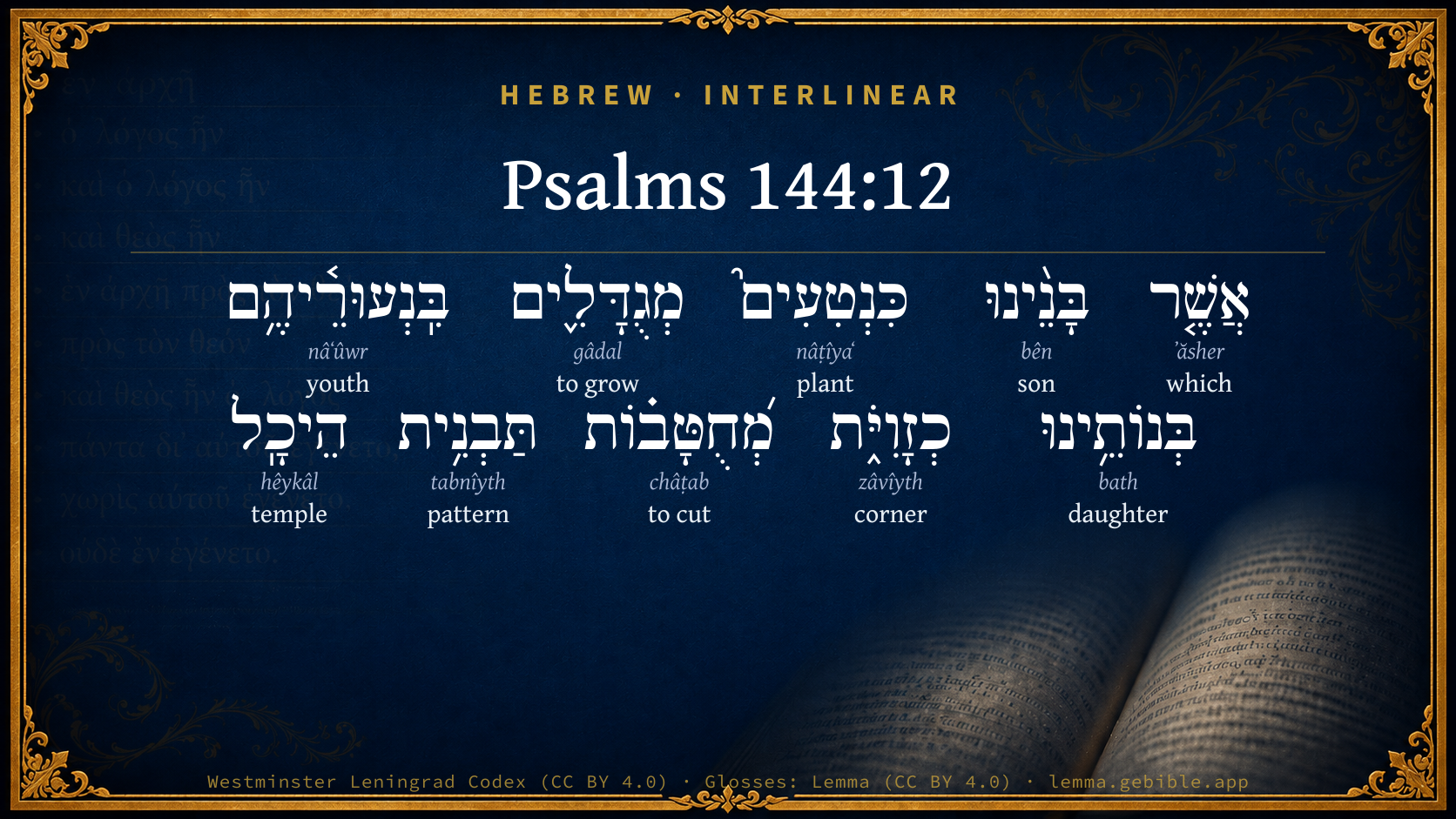
Hebrew (Westminster Leningrad Codex) Psalms 144:12 appears in the Hebrew Old Testament. The text above is from the Westminster Leningrad Codex. Each word links to its Strong’s number, a concise gloss, and parsing drawn from the Open Scriptures Hebrew Bible morphology. Click any word for its full Brown-Driver-Briggs (BDB) entry.
Download image
Cite this verse

Psalms 144:12 (World English Bible). Public Domain. Lemma interlinear Bible study tool, https://lemma.gebible.app/v/psalms/144/12.

Show BibTeX & RIS
BibTeX
RIS
English Translation
Then our sons will be like well-nurtured plants, Our daughters like pillars carved to adorn a palace.
World English Bible · Public Domain
Highlights
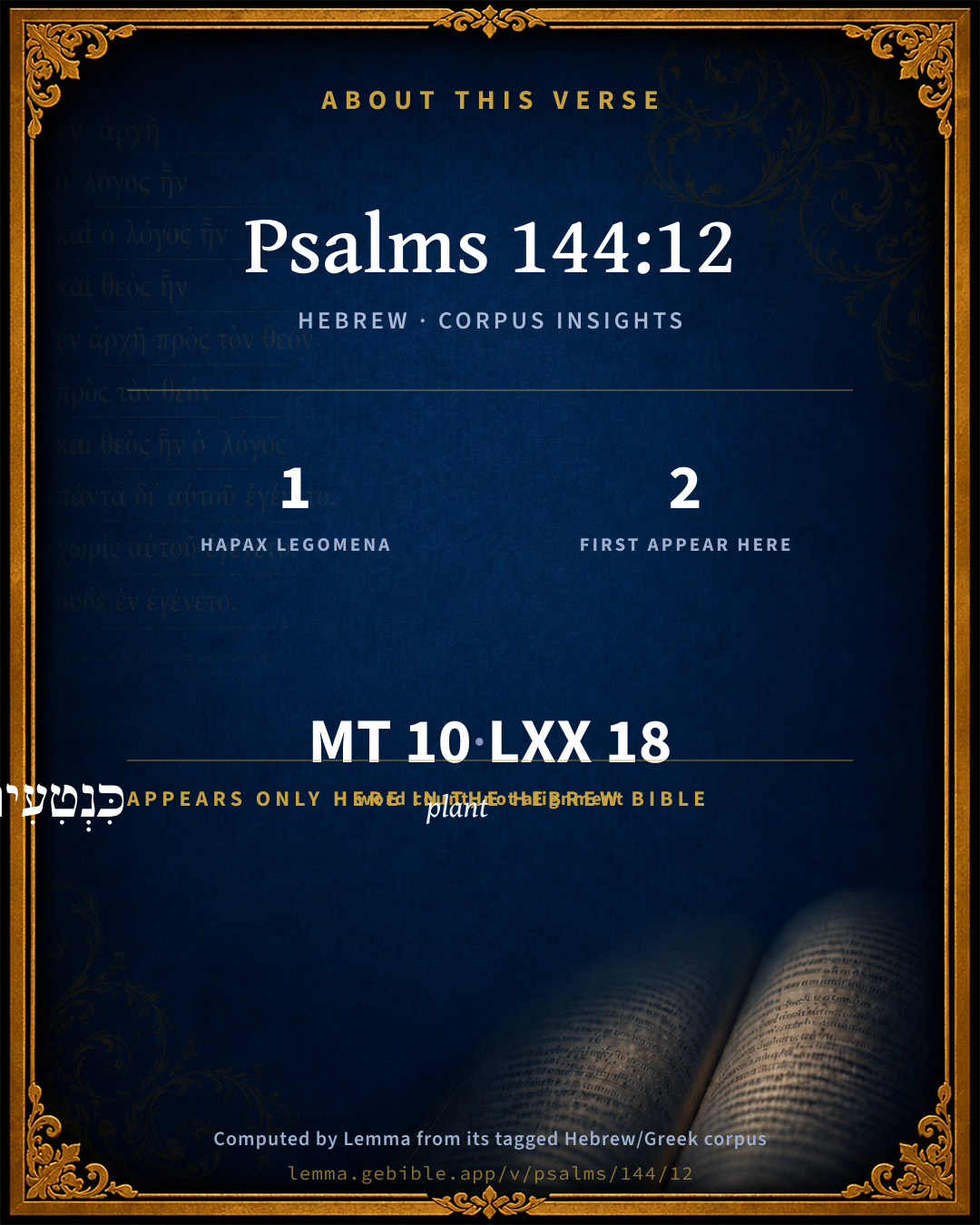
  • 1 hapax legomenon — only here in the Hebrew Bible
  • 2 first appearances in the Hebrew Bible
Full analysis ↓
Download a study sheet

One document with this verse’s original text, its word-by-word gloss line, the meaning frame, cross-references with their text, attributed commentary, and full source and license credits — printable, and it pastes into notes with its structure intact.

This verse Autodidact and up

Study sheet (.html) Plain text (.txt)

A passage Seminary Student

Up to 50 verses in one chapter. A passage sheet keeps up to 6 commentary sources and 12 cross-references per verse, in the order this page ranks them, and says so on the sheet whenever that leaves anything out. Ask for a single verse and you get the Autodidact verse sheet above.

Everything on this page stays free to read, with no account — the sheet is a download of what is already on screen, not access to it.

Want to remove ads? Support Godless Engineer
Compare translations 3

The same verse in 3 English versions, stacked beneath the original-language interlinear above. Click any original word for its lexicon entry.

Each is an independent rendering of the whole verse — the interlinear is not word-aligned to these translations.

Highlighted words mark where these versions differ — a whole-verse word diff, not a word-by-word alignment.

  • World English Bible Public Domain
    Then our sons will be like well-nurtured plants, Our daughters like pillars carved to adorn a palace.
  • King James Version Public Domain
    That our sons may be as plants grown up in their youth; that our daughters may be as corner stones, polished after the similitude of a palace:
  • unfoldingWord Literal Text CC BY-SA 4.0
    that our sons like plants having been enlarged in their youth, our daughters, like corner pillars carved the pattern of a palace.

unfoldingWord Literal Text — © unfoldingWord, licensed CC BY-SA 4.0. Word-aligned USFM3 via Door43 (git.door43.org/unfoldingWord/en_ult).

Versions to compare (up to 4)

3 of 4 selected

Show all 18 translations

Every available English version of this verse, each an independent rendering of the whole verse.

  • World English Bible Public Domain
    Then our sons will be like well-nurtured plants, Our daughters like pillars carved to adorn a palace.
  • Berean Standard Bible Public Domain
    Then our sons will be like plants nurtured in their youth, our daughters like corner pillars carved to adorn a palace.
  • Majority Standard Bible Public Domain
    Then our sons will be like plants nurtured in their youth, our daughters like corner pillars carved to adorn a palace.
  • King James Version Public Domain
    That our sons may be as plants grown up in their youth; that our daughters may be as corner stones, polished after the similitude of a palace:
  • American Standard Version (1901) Public Domain
    When our sons shall be as plants grown up in their youth, And our daughters as corner-stones hewn after the fashion of a palace;
  • Revised Version (1885) Public Domain
    When our sons shall be as plants grown up in their youth; and our daughters as corner stones hewn after the fashion of a palace;
  • Geneva Bible (1599) Public Domain
    That our sonnes may be as the plantes growing vp in their youth, and our daughters as the corner stones, grauen after the similitude of a palace:
  • Douay-Rheims (1899) Public Domain
    and in thy mercy thou wilt destroy my enemies. And thou wilt cut off all them that afflict my soul: for I am thy servant.
  • Young's Literal Translation Public Domain
    Because our sons `are' as plants, Becoming great in their youth, Our daughters as hewn stones, Polished -- the likeness of a palace,
  • Literal Standard Version CC BY-SA 4.0
    Because our sons [are] as plants, || Becoming great in their youth, || Our daughters as hewn stones, || Polished—the likeness of a palace,
  • Unlocked Literal Bible CC BY-SA 4.0
    May our sons be like plants who grow to full size in their youth and our daughters like carved corner pillars, shapely like those of a palace.
  • unfoldingWord Literal Text CC BY-SA 4.0
    that our sons like plants having been enlarged in their youth, our daughters, like corner pillars carved the pattern of a palace.
  • Darby Bible Public Domain
    That our sons may be as plants grown up in their youth; our daughters as corner-columns, sculptured after the fashion of a palace:
  • World Messianic Bible Public Domain
    Then our sons will be like well-nurtured plants, our daughters like pillars carved to adorn a palace.
  • Webster's Bible Public Domain
    That our sons may be as plants grown up in their youth; that our daughters may be as corner stones, polished after the similitude of a palace:
  • Free Bible Version CC BY-SA 4.0
    Then our sons will grow up like plants in their youth and become mature, and our daughters will be like beautiful pillars carved to support a palace.
  • Bible in Basic English Public Domain
    Our sons are like tall young plants; and our daughters like the shining stones of a king's house;
  • JPS Tanakh (1917) Public Domain
    We whose sons are as plants grown up in their youth; whose daughters are as corner-pillars carved after the fashion of a palace;

Literal Standard Version (2020), Covenant Press — licensed CC BY-SA 4.0. Text via the HelloAO Bible API (eBible.org). Unlocked Literal Bible (unfoldingWord) — licensed CC BY-SA 4.0. Text via the HelloAO Bible API (eBible.org). unfoldingWord Literal Text — © unfoldingWord, licensed CC BY-SA 4.0. Word-aligned USFM3 via Door43 (git.door43.org/unfoldingWord/en_ult). Free Bible Version, Dr. Jonathan Gallagher — licensed CC BY-SA 4.0. Text via the HelloAO Bible API (eBible.org).

Word by word

More ways to search: Search by grammar → Find every occurrence → Compare this word →

Practice this passage: Drill this verse → Learn its vocabulary →

כִּנְטִעִים֮
nâṭîyaʻ
H5195
“like/as · plants”
Preposition + Noun, Common, Masculine, Plural, Absolute
Part of Speech
Preposition + Noun
Type
Common
Gender
Masculine
Number
Plural
State
Absolute
Full BDB Definition

Origin: from H5193

TWOT: 1354b

plant (figuratively of vigorous sons)
  1. אֲשֶׁ֤ר ʼăsher H834 “which” Particle, Relative
  2. בָּנֵ֨ינוּ bên H1121 “sons · our” Noun, Common, Masculine, Plural, Construct + Suffix, Personal, 1st Person, Common, Plural
  3. מְגֻדָּלִ֪ים gâdal H1431 “grown” Verb, Pual, Participle Passive, Masculine, Plural, Absolute
  4. בִּֽנְעוּרֵ֫יהֶ֥ם nâʻûwr H5271 “in/at · youth · their” Preposition + Noun, Common, Both, Plural, Construct + Suffix, Personal, 3rd Person, Masculine, Plural
  5. בְּנוֹתֵ֥ינוּ bath H1323 “daughters · our” Noun, Common, Feminine, Plural, Construct + Suffix, Personal, 1st Person, Common, Plural
  6. כְזָוִיֹּ֑ת zâvîyth H2106 “like/as · corners” Preposition + Noun, Common, Feminine, Plural, Absolute
  7. מְ֝חֻטָּב֗וֹת châṭab H2404 “cut” Verb, Pual, Participle Passive, Feminine, Plural, Absolute
  8. תַּבְנִ֥ית tabnîyth H8403 “pattern of” Noun, Common, Feminine, Singular, Construct
  9. הֵיכָֽל hêykâl H1964 “temple” Noun, Common, Masculine, Singular, Absolute

About this verse

These counts appear in no published source. They are computed here, from the morphology-tagged text and Lemma’s own curated glosses. What Lemma adds →

10
words
10
distinct lemmas
Wisdom
section

Notable vocabulary

1 hapax legomenon — a word that appears only here in the entire Hebrew Bible:

  • כִּנְטִעִים֮ plant H5195

First appearance in Scripture

These words make their first canonical appearance in the Hebrew Bible here:

  • כִּנְטִעִים֮ plant H5195
  • כְזָוִיֹּ֑ת corner H2106

Shared distinctive vocabulary

כְזָוִיֹּ֑ת corner H2106 occurs in 2 verses of the Hebrew Bible. Also found in:

Grammatical profile

  • 2 verbs
  • 7 nouns
  • 1 particle

Verb forms

  • מְגֻדָּלִ֪ים Pual · Participle Passive
  • מְ֝חֻטָּב֗וֹת Pual · Participle Passive

Hebrew & Septuagint length

In English translation the verse runs 17 words from the Hebrew and 21 from the Septuagint (LXX English) — closely comparable.

A rough comparison of the two English renderings, which tokenize alike — not a word-level alignment.

Word counts can differ between the Hebrew and the Greek without any difference in meaning — e.g. the Hebrew direct-object marker אֵת has no separate Greek word, and Greek often adds the article ὁ.

In the original languages it is 10 Hebrew tokens and 18 Greek tokens — but the two are counted differently (Hebrew bundles its prefixes and suffixes into one token; the Greek is in lemma form), so that isn’t a like-for-like length.

Cross-references

10

Topical passages linked to Psalms 144:12 in the Treasury of Scripture Knowledge — connected by theme and wording, ordered by reader-vote popularity; previews shown in the World English Bible.

  • Psalms 128:3 Your wife will be as a fruitful vine, In the innermost parts of your house; Your children like olive plants, Around your table.
  • 1 Peter 3:3–6 Let your beauty be not just the outward adorning of braiding the hair, and of wearing jewels of gold, or of putting on fine clothing;
  • Isaiah 44:3–5 For I will pour water on him who is thirsty, and streams on the dry ground; I will pour my Spirit on your seed, and my blessing on your offspring:
  • Psalms 115:14–15 May Yahweh increase you more and more, You and your children.
  • Job 42:15 In all the land were no women found so beautiful as the daughters of Job. Their father gave them an inheritance among their brothers.
  • Song of Solomon 8:8–9 We have a little sister. She has no breasts. What shall we do for our sister In the day when she is to be spoken for?
  • Lamentations 4:2 The precious sons of Zion, comparable to fine gold, How are they esteemed as earthen pitchers, the work of the hands of the potter!
  • Psalms 127:4–5 As arrows in the hand of a mighty man, So are the children of youth.
  • Proverbs 31:10–27 Who can find a worthy woman? For her price is far above rubies.
  • Isaiah 3:16–24 Moreover Yahweh said, "Because the daughters of Zion are haughty, And walk with outstretched necks and flirting eyes, Walking to trip as they go, Jingling ornaments on their feet;

Cross-references courtesy of OpenBible.info (CC BY 4.0).

Hebrew and Greek witnesses Masoretic Hebrew ↔ Greek Septuagint

The same verse in the two great witnesses to the Old Testament, shown verse-for-verse.

You’re reading Greek Psalm 143 (Hebrew Psalm 144). The Septuagint counts the superscription, so verse numbers can differ from the Hebrew — chapter-level alignment, not verse-by-verse. Numbering follows Rahlfs.

These are two independent witnesses, not word-aligned to each other, and the Septuagint is shown in lemma (dictionary) form.

Hebrew Psalms 144:12 Masoretic · Westminster Leningrad Codex

אֲשֶׁ֤ר בָּנֵ֨ינוּ כִּנְטִעִים֮ מְגֻדָּלִ֪ים בִּֽנְעוּרֵ֫יהֶ֥ם בְּנוֹתֵ֥ינוּ כְזָוִיֹּ֑ת מְ֝חֻטָּב֗וֹת תַּבְנִ֥ית הֵיכָֽל

Then our sons will be like well-nurtured plants, Our daughters like pillars carved to adorn a palace.

World English Bible · Public Domain

Greek LXX Greek Psalm 143:12 Septuagint · lemma form

ὅς ὁ υἱός ὡς νεόφυτος ἁδρύνω ἐν ὁ νεότης αὐτός ὁ θυγάτηρ αὐτός καλλωπίζω περικοσμέω ὡς ὁμοίωμα ναός

whose children are as plants, strengthened in their youth: their daughters are beautiful, sumptuously adorned after the similitude of a temple.

LXX2012 (modern English Septuagint) · Public Domain

On this verse, The Cambridge Bible for Schools and Colleges discusses the Septuagint’s reading. Read the note in Commentary ↓

Hebrew: Westminster Leningrad Codex (CC BY 4.0). Greek: Septuagint (public domain); English from LXX2012 (modern English Septuagint) (Public Domain). How the Septuagint differs from the Hebrew →

Commentary

Notes on Psalms 144:12 from classic Christian and Jewish commentators (each source and its license shown beneath its notes). The classic Christian expositions comment on the surrounding passage and are grouped to its opening verse, so a note may address several verses; the Jewish commentaries on the Tanakh (Rashi and others) are per-verse, so they appear only where the commentator wrote on this verse.

Lemma curates 59 commentaries, every one of them public domain or Creative Commons licensed, each selected and text-cleaned for this edition rather than reprinted as found. About our sources →

The Cambridge Bible for Schools and Colleges

gen. ed. J. J. S. Perowne

12. That our sons may be like plants well grown in their youth] Cp. Psa_128:3. Plant denotes a freshly planted sapling sending up its young shoots, LXX νεόφυτα, cp. Job_14:9. Vergil uses a similar comparison (Aen. ix. 674), “Abietibus iuvenes patriis et montibus aequos.”

The word for well-grown, which may be used either of children (Isa_1:2, nourished) or of trees (Isa_44:14), is to be connected with plants; in their youth belongs to sons.

our daughters … like corner pillars sculptured in the fashion of a palace] The exact meaning is uncertain. If this rendering is right, it is natural to think of the Caryatides, the graceful female figures so commonly employed as columns in Greek architecture. ‘Tall and stately’ would be the ideas suggested by the comparison. But, as Delitzsch points out, the architecture of Syria and Palestine has never employed Caryatides either in ancient or modern times. On the other hand the corners of the large rooms in the houses of wealthy Orientals are commonly ornamented with carved work richly coloured and gilded. He would render like richly coloured corners, and supposes that the comparison refers to the bright dresses and rich ornaments worn by the women. Cp. 2Sa_1:24. This explanation is however less natural.

12–15. A description of the prosperity of Israel under the protection and blessing of Jehovah. Cp. generally Deu_28:2 ff; Deu_30:9.

The absolute dependence of the earlier verses upon existing Psalms makes it probable that these verses also are borrowed, though the poem from which they were taken is not preserved; and the absence of a clear grammatical connexion with the preceding verses makes this probability almost a certainty.

What the compiler intended the connexion to be (for considering the general character of the Psalm we need not doubt that he appended them himself) is much disputed.

(1) The LXX (followed of course by the Vulg.) changes the pronouns to the third person, and makes Psa_144:12-14 describe the temporal prosperity of the enemies of Israel referred to in Psa_144:11. “Whose mouth hath spoken vanity … whose sons are as young plants &c.” Psa_144:15 then describes the contrast between this temporal happiness and the true spiritual happiness which Israel possesses. ‘Men call the people happy who have these things; (but truly) happy is the people whose God is the Lord.’ This however can only be regarded as a conjectural alteration, and not as the true reading.

(2) It is possible to render, We whose sons, or (R.V.) When our sons &c., and to take Psa_144:15 as the apodosis, but such a lengthy protasis as the whole of Psa_144:12-14 is awkward.

(3) The A.V., which follows Aq., Symm. and Jer., may give the right meaning. The goal to which the Psalmist looks forward as the end of deliverance from enemies is the happiness and prosperity of the nation. No doubt the construction is harsh, but it may be explained by the supposition that the Psalmist borrowed the description in Psa_144:12-14, and tacked it loosely on to the rest of his poem by the particle of relation or conjunction asher, without altering the construction of the passage to suit it.

The Cambridge Bible for Schools and Colleges (gen. ed. J. J. S. Perowne; Cambridge University Press, 1878–1918) — public domain. Text from a community e-Sword module.

Trapp's Complete Commentary

John Trapp

Psa 144:12 That our sons [may be] as plants grown up in their youth; [that] our daughters [may be] as corner stones, polished [after] the similitude of a palace:

Ver. 12. That our sons may be as plants, &c.] As young plants, fair and flourishing.

That our daughters may be as corner stones, &c.] Tall and trim, comely of person and costly arrayed, resembling the polished pillars at palace gates. Tremellius rendereth the last words of this verse, sint structura templi, may be the building of the temple, that is, may be such living stones as may be used to the building and polishing of God’s Church, that we may altogether grow up to a holy temple in the Lord, Eph 2:21; Eph 4:12-13. For, indeed, what can better preserve Jacob from confusion, or his face from waxing pale, than to see his children, the work of God’s hands, framed and fitted for God’s building. This maketh religious parents to sanctify God’s name (as here), even to sanctify the Holy One, and with singular encouragement, from the God of Israel, Isa 29:22-23.

John Trapp, A Commentary or Exposition upon All the Books of the Old and New Testament (1647–1656) — public domain. Text from a community e-Sword module.

Keil & Delitzsch

C. F. Keil & F. Delitzsch

With reference to the relation of this passage to the preceding, vid., the introduction. אשׁר (it is uncertain whether this is a word belonging originally to this piece or one added by the person who appended it as a sort of clasp or rivet) signifies here quoniam, as in Jdg 9:17; Jer 16:13, and frequently. lxx ὢν οἱ υίοὶ (אשׁר בניהם); so that the temporal prosperity of the enemies is pictured here, and in Psa 144:15 the spiritual possession of Israel is contrasted with it. The union becomes satisfactorily close in connection with this reading, but the reference of the description, so designedly set forth, to the enemies is improbable. In Psa 144:12-14 we hear a language that is altogether peculiar, without any assignable earlier model. Instead of נטעים we read נטעים elsewhere; "in their youth" belongs to "our sons." מזוינוּ, our garners or treasuries, from a singular מזו or מזוּ (apparently from a verb מזה, but contracted out of מזוה), is a hapaxlegomenon; the older language has the words אסם, אוצר, ממּגוּרה instead of it. In like manner זן, genus (vid., Ewald, Lehrbuch, S. 380), is a later word (found besides only in Ch2 16:14, where וּזנים signifies et varia quidem, Syriac zenonoje, or directly spices from species); the older language has miyn for this word. Instead of אלּוּפים, kine, which signifies "princes" in the older language, the older language says אלפים in Psa 8:8. The plena scriptio צאוננוּ, in which the Waw is even inaccurate, corresponds to the later period; and to this corresponds שׁ = אשׁר in Psa 144:15, cf. on the other hand Psa 33:12. Also מסבּלים, laden = bearing, like the Latin forda from ferre (cf. מעבּר in Job 21:10), is not found elsewhere. צאן is (contrary to Gen 30:39) treated as a feminine collective, and אלּוּף (cf. שׁור in Job 21:10) as a nomen epicaenum. Contrary to the usage of the word, Maurer, Kצster, Von Lengerke, and F׬rst render it: our princes are set up (after Ezr 6:3); also, after the mention of animals of the fold upon the meadows out-of-doors, one does not expect the mention of princes, but of horned cattle that are to be found in the stalls.

זוית elsewhere signifies a corner, and here, according to the prevailing view, the corner-pillars; so that the elegant slender daughters are likened to tastefully sculptured Caryatides - not to sculptured projections (Luther). For (1) זוית does not signify a projection, but a corner, an angle, Arabic Arab. zâwyt, zâwia (in the terminology of the stone-mason the square-stone = אבן פּנּהּ, in the terminology of the carpenter the square), from Arab. zwâ, abdere (cf. e.g., the proverb: fı̂'l zawâjâ chabâjâ, in the corners are treasures). (2) The upstanding pillar is better adapted to the comparison than the overhanging projection. But that other prevailing interpretation is also doubtful. The architecture of Syria and Palestine - the ancient, so far as it can be known to us from its remains, and the new - exhibits nothing in connection with which one would be led to think of "corner-pillars." Nor is there any trace of that signification to be found in the Semitic זוית. On the other hand, the corners of large rooms in the houses of persons of position are ornamented with carved work even in the present day, and since this ornamentation is variegated, it may be asked whether מחתּבות does here signify "sculptured," and not rather "striped in colours, variegated," which we prefer, since חטב (cogn. חצב) signifies nothing more than to hew firewood;

(Note: In every instance where חטב (cogn. חצב) occurs, frequently side by side with שׁאב מים (to draw water), it signifies to hew wood for kindling; wherefore in Arabic, in which the verb has been lost, Arab. ḥaṭab signifies firewood (in distinction from Arab. chšb, wood for building, timber), and not merely this, but fuel in the widest sense, e.g., in villages where wood is scarce, cow-dung (vid., Job, at Job 20:6-11, note), and the hemp-stalk, or stalk of the maize, in the desert the Arab. b‛rt, i.e., camel-dung (which blazes up with a blue flame), and the perennial steppe-plant or its root. In relation to Arab. ḥaṭab, aḥṭb signifies lopped, pruned, robbed of its branches (of a tree), and Arab. ḥrb ḥâtb a pruning war, which devastates a country, just as the wood-gathering women of a settlement (styled Arab. 'l-ḥâťbât or 'l-ȟwâṭt) with their small hatchet (Arab. miḥṭab) lay a district covered with tall plants bare in a few days. In the villages of the Merg' the little girls who collect the dry cow-dung upon the pastures are called Arab. bnât ḥâṭbât, בּנות הטבות. - Wetzstein.)

and on the other side, the signification of the Arabic chaṭiba, to be striped, many-coloured (IV to become green-striped, of the coloquintida), is also secured to the verb חטב side by side with that signification by Pro 7:16. It is therefore to be rendered: our daughters are as corners adorned in varied colours after the architecture of palaces.

(Note: Corners with variegated carved work are found even in the present day in Damascus in every reception-room (the so-called Arab. qâ‛t) or respectable houses cf. Lane, Manners and Customs of the Modern Egyptians, Introduction). An architectural ornament composed with much good taste and laborious art out of wood carvings, and glittering with gold and brilliant colours, covers the upper part of the corners, of which a ḳâ‛a may have as many as sixteen, since three wings frequently abut upon the bêt el-baḥǎra, i.e., the square with its marble basin. This decoration, which has a most pleasing effect to the eye, is a great advantage to saloons from two to three storeys high, and is evidently designed to get rid of the darker corners above on the ceiling, comes down from the ceiling in the corners of the room for the length of six to nine feet, gradually becoming narrower as it descends. It is the broadest above, so that it there also covers the ends of the horizontal corners formed by the walls and the ceiling. If this crowning of the corners, the technical designation of which, if I remember rightly, is Arab. 'l-qrnyt, ḳornı̂a, might be said to go back into Biblical antiquity, the Psalmist would have used it as a simile to mark the beauty, gorgeous dress, and rich adornment of women. Perhaps, too, because they are not only modest and chaste (cf. Arabic mesturât, a veiled woman, in opposition to memshushât, one shone on by the sun), but also, like the children of respectable families, hidden from the eyes of strangers; for the Arabic proverb quoted above says, "treasures are hidden in the corners," and the superscription of a letter addressed to a lady of position runs: "May it kiss the hand of the protected lady and of the hidden jewel." - Wetzstein.)

The words האליף, to bring forth by thousands, and מרבּב (denominative from רבבה), which surpasses it, multiplied by tens of thousands, are freely formed. Concerning חוּצות, meadows, vid., on Job 18:17. פּרץ, in a martial sense a defeat, clades, e.g., in Jdg 21:15, is here any violent misfortune whatever, as murrain, which causes a breach, and יוצאת any head of cattle which goes off by a single misfortune. The lamentation in the streets is intended as in Jer 14:2. שׁכּכה is also found in Sol 5:9; nor does the poet, however, hesitate to blend this שׁ with the tetragrammaton into one word. The Jod is not dageshed (cf. Psa 123:2), because it is to be read שׁאדני, cf. מיהוה = מאדני in Gen 18:14. Luther takes Psa 144:15 and Psa 144:15 as contrasts: Blessed is the people that is in such a case, But blessed is the people whose God is the Lord. There is, however, no antithesis intended, but only an exceeding of the first declaration by the second. For to be allowed to call the God from whom every blessing comes his God, is still infinitely more than the richest abundance of material blessing. The pinnacle of Israel's good fortune consists in being, by the election of grace, the people of the Lord (Psa 33:12).

Keil & Delitzsch — Biblical Commentary on the Old Testament (1861–1891) — public domain (CC PDM 1.0). Text via the HelloAO Bible API. (Old Testament only.)

J. A. Alexander on Psalms

Joseph Addison Alexander

12. (Psa 144:12) So that our sons (may be) as plants grown large in their youth, our daughters as corner-stones hewn (for) the building of the temple. The reminiscences or imitations of Psalms 18 suddenly cease here, and are followed by a series of original, peculiar, and for the most part no doubt antique expressions. On the supposition that the title is correct in making David the author, this is natural enough. On any other supposition it is unaccountable, unless by the gratuitous assumption, that this is a fragment of an older composition, a mode of reasoning by which any thing may be either proved or disproved. The first word in Hebrew is the relative pronoun, and the literal meaning of the clause is, (by) which (or in consequence of which) our sons, etc. The which refers to the deliverance prayed for in the preceding verse. Grown large, literally magnified or made great. The common version (grown up in their youth) has a paradoxical appearance, arising from the ambiguity of our phrase grown up, which is applied (like the Greek) both to age and stature. The word translated cornerstones has the same sense in Zec 9:15. The corner-stones are mentioned as those which were hewn and polished with peculiar care. Likeness or model would agree better with the usage of the Hebrew word, but its primary sense, as a derivative of the verb to build, is here still more appropriate. Most interpreters give the last word the vague sense of a palace, considered as a splendid building. There is something, however, far more striking in the translation temple, found in the Prayer-Book and the ancient versions. The omission of the article is a poetic licence of perpetual occurrence. The temple was the great architectural model and standard of comparison, and particularly remarkable for the great size and skilful elaboration of its foundation-stones, some of which, there is reason to believe, have remained undisturbed since the time of Solomon. See Robinson's Palestine, vol. i. pp. 422-426.

Joseph Addison Alexander, The Psalms Translated and Explained (1850) — public domain. Text from a community e-Sword module.

Tyndale Open Study Notes

Tyndale Open Resources

144:12-15 This prayer for the Lord’s blessing brings the laments of Pss 140–144 to a close. It offers a vision of God’s provision and protection (see Ps 127), not only for the psalmist, but for his descendants and those of all the godly.

144:12 The psalmist compares sons and daughters to plants and pillars, which are images of strength and beauty.

Tyndale Open Study Notes — © Tyndale Open Resources, licensed CC BY-SA 4.0. Text via the HelloAO Bible API.

Geneva Bible (1599)

Geneva Bible translators

He desireth God to continue his benefits toward his people, counting the procreation of children and their good education among the chiefest of God’s benefits.

Geneva Bible (1599) marginal notes — public domain. Text via Bolls.life.

Adam Clarke's Commentary

Verse 12. That our sons may be as plants] God had promised to his people, being faithful, THREE descriptions of BLESSINGS, De 28:4.

1. The fruit of the body - sons and daughters.

2. The fruits of the ground - grass and corn in sufficient plenty.

3. Fruit of the cattle - "the increase of kine, and flocks of sheep."

These are the blessings to which the psalmist refers here, as those in which he might at present exult and triumph: blessings actually enjoyed by his people at large; proofs of his mild and paternal government, and of the especial blessing of the Almighty. The people who were in such a state, and revolted, had no excuse: they were doubly guilty, as ungrateful both to God and man.

Adam Clarke's Commentary on the Bible (1810–1826) — public domain. Text from a community e-Sword/MySword module.

John Calvin's Commentaries

12. Because our sons, etc. These three concluding verses some consider as being a wish or a prayer. “Grant that our sons may be as plants,” etc. Such is the view taken by the Translators of the English Bible.

John Calvin's Commentaries (1540-1563) — public domain. Text from the Calvin Translation Society English edition (1840s-50s) via the Christian Classics Ethereal Library (ccel.org). Calvin's coverage is partial (roughly two-thirds of the Bible); uncommented books and verses are honest gaps, never fabricated. The 19th-century editor's footnotes and remarks are omitted so the notes are faithfully Calvin's own voice.

Ellicott's Commentary for English Readers

(12) That our sons.—This rendering of the relative, which so strangely begins this fragment, would be possible after Gen_11:7; Gen_13:16, &c, if a finite verb instead of participles followed; or it might mean “because,” as in Gen_30:18, &c, but for the same anomalous construction; or it might, as by the LXX., be rendered whose, if any antecedent for it could be discovered. But all these devices are plainly impossible, and there is nothing for it but to treat the passage which it introduces as a fragment of another poem quite unconnected with the previous part of the psalm. Render, we whose.

As plants.—The Hebrew word seems always to denote a young, vigorous tree lately planted. (See especially Job_14:9, aptly translated by the LXX. νεόϕυτον. (For the comparison, comp. Isa_5:7; Psa_1:3, Note, Psa_128:3.)

Grown up in their youth.—The form here used is peculiar, but in another conjugation the verb is frequently used of bringing up children (see 2Ki_10:6; Isa_1:2; Isa_23:4, &c.). as it is of the rain nourishing young plants (Isa_44:14). Here the poet must mean grown tall beyond their age, or the figure is somewhat tame. A suggestion to read, “reproductive in their youth,” i.e., though young themselves, bringing up families, improves the poetry, and suits well the intention of this fragment of song and the general feeling of the Hebrew race. Comp. especially Psa_127:4, “sons of youth” (Burgess).

Corner stones.—The word only occurs once besides, in Zec_9:15, where it is used of the corners of the altar. The derivation is from a root meaning to conceal, as is also the word rendered garners, in the next verse. Aquila and Symmachus, “angles.”

Polished.—The Hebrew word means to hew, used, with one exception, of wood for fuel, but is cognate with a word used of stones, and in Isa_51:1 in the passive participle of a cave hewn in a rock. The exception is Pro_7:16, where the word is applied to tapestry.

After the similitude of a palace—i.e., like a large and stately building. There seems no reason to confine the reference to the Temple, as the LXX. and Vulg. do, though the absence of the article is not insuperably against this (Isa_44:28).

The explanations usually given of this passage make the resemblance to be either to caryatides carved at the angles of a palace, or to carved or variegated wood pillars in the corners of a spacious room. For the former there seems to be no authority in Scripture or known Hebrew usage. The latter has the support of Dr. J. G. Wetzstein, but seems far-fetched. It is far more according to Hebrew feeling to render the words simply, like hewn angles, the building of a palace; an image suggestive, like that of “the wall” in Son_8:9 (see Note), of unassailable chastity and virtue. Perhaps the phrase “women of strength or of a strong fortification,” in Rth_3:11, may imply the same figure. Grätz alters to “daughters of a palace.”

A Bible Commentary for English Readers, edited by Charles John Ellicott (1878–1897) — public domain. Text from a community e-Sword module.

John Gill's Exposition

That our sons may be as plants grown up in their youth,.... The Septuagint, Vulgate Latin, Ethiopic, Syriac, and Arabic versions, read, "whose sons are as plants", &c. as if this and what follows were a description of the families, estates, substance, and outward happiness of wicked men, the enemies of David, the strange children he desired to be delivered from, agreeably to Job 21:7; and if the word "saying", or "who say", be supplied, as by some (o), and connected with "that our sons are", &c. they may express the vain boastings of these men, and explain what is meant by the vanity their mouth spake; as well as furnish out another reason for the repetition of the above requests, namely, for the sake of introducing those vain boasts to which the happiness of good men is opposed, who have an interest in God as their God, Psa 144:15; but we with other versions take them to be a petition of the psalmist; that as he would deliver him personally out of the hands of his enemies, so he would bless his subjects with all prosperity and happiness in their families and estates; like a good prince concerned for the real welfare of his people, and wishes that their sons might be as plants, young, tender, well nursed, and taken care of, that were healthful, thriving, flourishing, and promising much fruit; so they might he of healthful constitutions, well educated in all useful knowledge, natural and religious, and grow both in wisdom and stature, and appear to be of promising parts for usefulness in the church and state; and especially that they might be the plants of the Lord, pleasant ones to him, and profitable to others; be planted in Christ, and in his house, and grow in grace and in the knowledge of him, and grow up to him their bead in all things. The Targum is,

"that our sons may be as plants of the dactyles (or palm trees, Psa 92:12), nourished up in the doctrine of the law from their youth;''

see Psa 128:3;

that our daughters may be as corner stones, polished after the similitude of a palace; or "temple"; tall, beautiful, and in good proportion; children have their name in Hebrew from a word which signifies to "build" (p), because by them families are built up, Rut 4:11; and by marriage divers families are connected together, so that they are as corner stones to them; thus Plautus (q) speaks of children as a building, and parents as the fabricators of them; laying the foundation of them, raising them up and polishing them, and sparing no cost to make them useful to the commonwealth: or "as corner pillars" (r), which support the house and continue in it; so they guide the house, take care of the affairs of it, and be keepers at home, Ti1 5:14; and like such as are in temples or in kings' palaces, finely graved and beautifully polished, be adorned with grace and good works, particularly with modesty, meekness, and humility, Th1 2:9; and grow up into an holy temple in the Lord, being parts of the spiritual building, and being laid on the foundation, of which Jesus Christ is the corner stone. The Targum is,

"our daughters splendid and fit for the priests that minister in the midst of the temple.''

The Syriac version,

"their daughters as spouses adorned like temples.''

(o) So Schmidt. (p) "aedificavit, unde" & "filii et filiae". (q) Mostellaria, Act. 1. Sc. 2. (r) "sicut angulares lapides, aut columnae", Michaelis.

John Gill's Exposition of the Whole Bible (1746–1763) — public domain (CC PDM 1.0). Text via the HelloAO Bible API.

Albert Barnes' Notes on the Bible

That our sons may be as plants grown up in their youth - That our sons - not called forth to the hardships of the tent and the field, the perils and the exposures of war - may grow up under the culture of home, of the family, in quiet scenes, as plants carefully cultivated and flourishing. Compare Psa 128:3. The Hebrew here is, “grown large in their youth;” not “grown up,” which has a paradoxical appearance. The meaning is, that they may be stout, strong, vigorous, well-formed, even in early life; that they may not be stunted in their growth, but be of full and manly proportions.

That our daughters may be as cornerstones - The word used here - זויות zâvı̂yôth - occurs only in the plural form, and means properly “corners” - from a verb meaning to hide away, to conceal. The word is used respecting the corners of an altar, Zec 9:15; and seems here to refer to the corner columns of a palace or temple: perhaps, as Gesenius (Lexicon) supposes, in allusion to the columns representing female figures so common in Egyptian architecture.

Polished - Margin, “cut.” The idea is not that of “polishing” or “smoothing,” but of cutting or sculpturing. It is the stone carefully cut as an ornament.

After the similitude of a palace - A more literal translation would be, “The likeness or model of a temple;” or, for the building of a temple. That is, that they may be such as may be properly compared with the ornamental columns of a temple or palace. The comparison is a very beautiful one, having the idea of grace, symmetry, fair proportions: that on which the skill of the sculptor is most abundantly lavished.

Albert Barnes' Notes on the Bible (1834–1885) — public domain. Text from a community e-Sword/MySword module.

Matthew Poole's English Annotations

This mercy I beg, not only for my own sake, but for the sake of thy people, that thine and our enemies being subdued, and peace established in the land, thy people may enjoy those blessings which thou hast promised to them; and particularly,

that our sons, which are the strength, and safety, and hopes of a nation, may be like plants, flourishing and thriving, and growing in height and strength, as plants do in their youth, and they only; for when they grow old, they wither and decay.

Our daughters; upon whom the hope of posterity depends.

As corner-stones, polished after the similitude of palace; strong and beautiful, and adorned with all the ornaments belonging to their sex.

Matthew Poole's English Annotations on the Holy Bible (1683–1685) — public domain. Text from a community e-Sword/MySword module.

The Treasury of David

Charles H. Spurgeon

Ver. 12. God's blessing works wonders for a people.

That our sons may be as plants grown up in their youth. Our sons are of first importance to the state, since men take a leading part in its affairs; and that the young men are the older men will be. He desires that they may be like strong, well rooted, young trees, which promise great things. If they do not grow in their youth, when will they grow? If in their opening manhood they are dwarfed, they will never get over it. O the joys which we may have through our sons! And, on the other hand, what misery they may cause us! Plants may grow crooked, or in some other way disappoint the planter, and so may our sons. But when we see them developed in holiness, what joy we have of them!

That our daughters may be as corner stones, polished after the similitude of a palace. We desire a blessing for our whole family, daughters as well as sons. For the girls to be left out of the circle of blessing would be unhappy indeed. Daughters unite families as corner stones join walls together, and at the same time they adorn them as polished stones garnish the structure into which they are builded. Home becomes a palace when the daughters are maids of honour, and the sons are nobles in spirit; then the father is a king, and the mother a queen, and royal residences are more than outdone. A city built up of such dwellings is a city of palaces, and a state composed of such cities is a republic of princes.

Ver. 12. The reminiscences or imitations of Ps 18:1-50, suddenly cease here, and are followed by a series of original, peculiar, and for the most part or no doubt antique expressions. Oil the supposition that the title is correct in making David the author, this is natural enough. On any other supposition it is unaccountable, unless by the gratuitous assumption, that this is a fragment of an older composition, a mode of reasoning by which anything may be either proved or disproved. Joseph Addison Alexander.

Ver. 12. That our sons may be as plants, etc. They who have ever been employed in the cultivation of plants of any kind, are continually tempted to wish that the human objects of their care and culture would grow up as rapidly, as straight, as flourishing, would as uniformly fulfil their specific idea and purpose, as abundantly reward the labour bestowed on them...If our sons are indeed to grow up as young plants, like our English oaks, which according to the analogies of Nature, furnish no inappropriate type of our national character, they must not be stunted or dwarfed or pollarded, for the sake of being kept under the shade of a stranger. They should grow up straight toward heaven, as God had ordained them to grow...There is something so palpable and striking in this type, that twenty-five years ago, in speaking of the gentlemanly character, I was led to say, "If a gentleman is to grow up he must grow like a tree: there must be nothing between him and heaven." Julius Charles Hare, in a Sermon entitled "Education the Necessity of Mankind", 1851.

Ver. 12. That our sons may be as plants grown up in their youth, etc. Thus David prays for the rising generation. Metaphors seem generally unsuitable to prayer, but they do not wear this aspect in the prayers recorded in the Scriptures. The language of the text is tropical, but the metaphors are suitable and seasonable. Roots of vegetables are necessarily invisible. Tender plants are insignificant. A plant grown up, having height in its stem, width in its branches, abundance in its foliage, and fulness in its bloom, is conspicuous. David prays that the sons of that generation might be in their youth "as plants grown up", that is, that their piety might not only live, but that their godliness might be fully expressed. The stones of a foundation are concealed. The stones in the mid wall of a building are also necessarily hid. The stones on the surface of a wall are visible, but they are not distinguished. The cornerstone of buildings in that day was prominent and eminent. Placed at the angle of the structure, where two walls met, on the top of the walls, and being richly ornamented and polished, it attracted attention. David prays that the daughters of that day might make an open and lovely profession of religionthat both sons and daughters might not only have piety but show it. Samuel Martin, in "Cares of Youth."

Ver. 12. "Plants grown up" "Corner stones polished." These processes of growth and polish can be carried on in one place only, the church of Christ. Neale and Littledale.

Ver. 12. That our daughters may be as corner stones, etc. "The polished corners of the temple", rather "the sculptured angles, the ornament, of a palace." Great care and much ornament were bestowed by the ancients upon the angles of their splendid palaces. It is remarkable that the Greeks made use of pilasters, called Caryatides (carved after the figure of a woman dressed in long robes), to support the entablatures of their buildings. Daniel Cresswell.

Ver. 12. That our daughters may be as corner stones, polished after the similitude of a palace or temple. By daughters families are united and connected to their mutual strength, as the parts of a building are by the cornerstones; and when they are graceful and beautiful both in body and mind, they are then polished after the similitude of a nice and curious structure. When we see our daughters well established, and stayed with wisdom and discretion, as cornerstones are fastened in the building; when we see them by faith united to Christ, as the chief cornerstone, adorned with the graces of God's Spirit, which are the polishing of that which is naturally rough, and "become women professing godliness"; when we see them purified and consecrated to God as living temples, we think ourselves happy in them. Matthew Henry.

Ver. 12. That our daughters may be as corner stones, etc. One might perhaps at the first glance have expected that the daughters of a household would be as the graceful ornament of the clustering foliage or the fruit bearing tree, and the sons as the cornerstones upholding the weight and burden of the building, and yet it is the reverse here. And I think one may read the love and tenderness of the Lord in this apparently casual but intended expression, and that he meant the nations of the earth to know and understand how much of their happiness, their strength, and their security was dependent on the female children of a family. It has not been so considered in many a nation that knew not God: in polished Greece in times of old, and in some heathen nations even to this day, the female children of a family have been cruelly destroyed, as adding to the burdens and diminishing the resources of a household; and alas! too, even in Christian countries, if not destroyed, they are with equal pitiless and remorseless cruelty cut off from all the solace and ties and endearments of life, and immured in that living mockery of a grave, the cloister, that they may not prove incumbrances and hindrances to others! How contrary all this to the loving purpose of our loving God! whose Holy Spirit has written for our learning that sons and daughters are alike intended to be the ornament and grace, the happiness and blessing of every household. Barton Bouchier.

Ver. 12. After the similitude of a palace. Most interpreters give the last word the vague sense of "a palace." There is something, however, far more striking in the translation temple, found in the Prayer Book and the ancient versions. The omission of the article is a poetic license of perpetual occurrence. The temple was the great architectural model and standard of comparison, and particularly remarkable for the great size and skilful elaboration of its foundation stones, some of which, there is reason to believe, have remained undisturbed since the time of Solomon. Joseph Addison Alexander.

Ver. 12-15. In the former part of the psalm he speaks of such things as concern his own happiness: "Blessed be the Lord my strength" (Ps 144:1); "Send thine hand from above; and deliver me out of great waters" (Ps 144:7); "Rid me, and deliver me from the hand of strange children" (Ps 144:11). And he might as easily have continued the same strain in the clauses following: "That my sons may grow up as plants, my daughters may be as the polished corners of the temple, my sheep fruitful, my oxen strong, my garners full and plenteous"; and accordingly he might have concluded it also"Happy shall I be, if I be in such a case." This, I say, he might have done; nay, this he would have done, if his desires had reflected only upon himself. But being of a diffusive heart, and knowing what belonged to the neighbourhoods of piety, as loath to enjoy this happiness alone, he alters his style, and (being in the height of well wishes to himself) he turns the singular into a pluralour sheep, our oxen, our garners, our sons and daughters, that he might compendiate all in this, Happy are the people. Here is a true testimony both of a religious and generous mind, who knew in his most retired thoughts to look out of himself, and to be mindful of the public welfare in his most private meditations. S. Ambrose observes it as a clear character of a noble spirit, to do what tends to the public good, though to his own disadvantage. Richard Holdsworth (1590-1649), in "The Valley of Vision."

Ver. 12-15. These words contain a striking picture of a prosperous and happy nation. We are presented with a view of the masculine youth of the nation by the oaks of the forest, become great in the early period of the vigour and excellency of the soil. They are represented in the distinguishing character of their sex, standing abroad the strength of the nation, whence its resources for action must be derived. On the other hand, the young females of a nation are exhibited under an equally just and proper representation of their position and distinguishing character. They are not exhibited by a metaphor derived from the hardier tenants of the forest, but they are shown to us by a representation taken from the perpetual accompaniments of the dwelling; they are the supports and the ornaments of domestic life. Plenty of every kind is represented to us in possession and in reasonable expectation. No breaking in, no invasion by a furious foe, oppresses the inhabitants of this happy country with terror; neither is there any going out. The barbarous practice employed by Sennacherib, and other ancient conquerors, of transporting the inhabitants of a vanquished country to some distant, unfriendly, and hated land, the practice at this moment employed, to the scandal of the name and the sorrow of Europethey dread not: they fear no "going out." Under circumstances of such a nature causes of distress or complaint exist not; or, if they do, they are capable of being so modified, and alleviated, and remedied, that there is no complaining in the streets. "Happy, then, is that people, that is in such a case." John Pye Smith, 1775-1851.

Ver. 12. Youth attended with development, stability, usefulness, and spiritual health.

Ver. 12. (first clause). To Young Men. Consider,

1. What is desired on your behalf: "Sons may be as plants", etc.

a) That you may be respected and valued.

b) That you may have settled principles and virtues. Plants are not blown hither and thither.

c) That you may be vigorous and strong in moral power.

2. What is requisite on your part to the accomplishment of this desire.

a) A good rooting in Christ.

b) Constant nourishment from the word of God.

c) The dews of divine grace obtained by prayer.

d) A resolute tendency within to answer the God appointed purpose of your existence. J.F.

Ver. 12. (second clause). To Young Women. Consider,

1. The important position you may occupy in the social fabric: "As cornerstones."

a) The moral and religious tone of society is determined more by your character and influence than by those of men.

b) The complexion of home life will be a reflex of your conduct and character, either as daughters, sisters, or wives.

c) The moulding of the character of the next generation, remember, begins with the mother's influence.

d) Let these facts weigh with you as a motive in seeking the grace of God, without which you can never fulfil your mission worthily.

2. The beauty which ought to belong to you in your position. "Polished after", etc. The beauty of,

a) Heart purity: "The King's daughter is all glorious within."

b) A noble and modest conduct: "wrought gold", no imitation; real gold.

c) Gracious and gentle demeanour.

3. How both the right position and right beauty are obtained.

a) By yielding yourselves to God.

b) By Christ dwelling in your heart.

b) By becoming living stones and polished stones under the workmanship of the Holy Spirit. J.F.

Psalms 144:13*

Charles H. Spurgeon's The Treasury of David (1869–1885) — public domain. Psalms only. Text from a community e-Sword/MySword module.

Whedon's Commentary on the Bible

Daniel D. Whedon

12. Grown up—That is, becoming strong, refers to our sons in an early and vigorous development. So polished refers to daughters. It is better rendered carved. To this day the corners of houses in Damascus may be seen carved in beautiful style, showing the figures here used to mean gracefulness of form and richness of attire.

Daniel D. Whedon (gen. ed.), Commentary on the Old and New Testaments (1874–1909) — public domain. Text from a community e-Sword module.

The Pulpit Commentary

That our sons may be as plants. The stanza which these words introduce is a very remarkable one, having nothing at all corresponding to it in the rest of the Psalter. It has been thought by some to be an antique document, quoted by the writer of the psalm, as suited for a festal occasion. Our translation makes it a picture of the condition to which the writer hopes that Israel may one day come; but the best recent critics see in it a description of Israel"s actual condition in the writer"s day. Professor Cheyne translates, "Because our sons are as plants;" and Dr. Kay, "What time our sons are as plants." Grown up in their youth; literally, grown large. The sons are compared to ornamental trees or shrubs, growing outside a building. That our daughters may be as cornerstones, polished (or, "carved") after the similitude of a palace. The daughters are like carved pillars, lighting up the angular recesses of the structure.

Vers. 12-15. True national prosperity.

"It is only a narrow and one-sided religion that can see anything out of place in this beatitude of plenty and peace." "As plants: this figure marks the native strength and vigor and freedom of the youth of the land. As corner-pillars: marks the polished gracefulness, the quiet beauty, of the maidens; who are like exquisitely sculptured forms (Caryatides) which adorned the corner of some magnificent hall or chamber of a palace." (It does not, however, seem probable that at any time sculptured figures were allowed in Hebrew houses or palaces.) Ornamentation and various coloring of pillars may be referred to. Three things make up temporal prosperity. Family joys; business success; social security. The sense of God"s gracious relations sanctifies all three.

I FAMILY JOYS. From Eastern points of view, large families were desirable; but usually in the East daughters are despised. Two things are noticeable in these verses.

1. Daughters are spoken of as honorably as sons.

2. It is the growing up, developing character of children, that is the chief source of family joy.

II BUSINESS SUCCESS. Dealt with in the psalm from the strictly agricultural point of view. The figures employed all belong to farm-life. This may give indication of the date of the psalm; but we may take it as illustrative of all the ways in which men work for their living. Harvest is the key to the prosperity of the year, and that is in God"s hand. Times of confidence and enterprise bring national prosperity.

III SOCIAL SECURITY. This is suggested by the sentence, "That there be no breaking in nor going out." Security is the condition of business enterprise. Men will not work for what they have no hope of keeping when it is gained. Social security is imperiled by fear of attack from national foes, and also by the restlessness of sections within the nation (nihilists, and extravagant socialists, etc.). But family joys, business success, and social security are, in a way, merely material things. Back of them all there must be this secret of happiness the "nation"s God is the Lord. R.T.

HOMILIES BY C. SHORT Vers. 12-15. A golden age.

"The psalmist recounts glorious victories in the past; complains that the nation is now beset by barbarous enemies, so false and treacherous that no covenant can be kept with them; prays for deliverance from them by an interposition great and glorious as had been vouchsafed of old; and anticipates the return of a golden age of peace and plenty." The people who have Jehovah for their God, who obey his will and are governed by his laws, will be distinguished in the following ways.

I BY THE CHARACTER OF ITS YOUNG MEN AND WOMEN. (Ver. 12)

1. They will be beautiful. In body and mind. Like plants, the young men, with vigor and freedom and beauty. Like polished corners, the maidens or corner-pillars, with exquisitely sculptured figures.

2. They will be vigorous. As a consequence of their purity and health.

3. They will be free. The plant has the freedom of all the air of heaven; nothing between it and heaven.

II BY THE WEALTH OF ITS POSSESSIONS.

1. Rich in merchandise. (Ver. 13) Full garners. A free, healthy, pure people are bound to prosper.

2. Rich in agricultural and pastoral possessions. (Ver. 13) Sheep and oxen multiplied.

III BLESSED WITH THE PROSPERITIES OF PEACE. (Ver. 14) "No sallying forth from our walls, and no cry of battle in our streets." A state of war destructive of all kinds of prosperity. S.

The Pulpit Commentary (1880–1919), ed. H.D.M. Spence-Jones & Joseph S. Exell — public domain. Text from a community e-Sword module.

John Wesley's Explanatory Notes

That - This mercy I beg not only for my own sake, but for the sake of thy people, that they may enjoy those blessings which thou hast promised them; and particularly, that our sons, who are the strength and hopes of a nation, may be like plants, flourishing and growing in height and strength, as plants do in their youth; for when they grow old, they wither and decay. Cornerstone - Strong and beautiful.

John Wesley, Explanatory Notes Upon the Whole Bible (1754–1765) — public domain. Text via the GEBible commentary corpus.

unfoldingWord translationNotes

Door43 World Missions Community

like plants who grow to full size

healthy and strong

in their youth

the time when people develop

our daughters like carved corner pillars

"may our daughters be like carved corner pillars"

carved corner pillars

"beautiful posts that hold up the corners of a large house"

pillars, shapely like those of a palace

"pillars that are carved to make a palace beautiful"

thousands and ten thousands in our fields

"thousands—even tens of thousands!—and fill up our fields" (See: Numbers)

translationWords

son

column

palace

storehouse

kind

ewe

unfoldingWord translationNotes — © Distant Shores Media and the Door43 World Missions Community, licensed CC BY-SA 4.0. Source: git.door43.org/Door43/en_tn.

Rashi

Rabbi Shlomo Yitzchaki (Rashi)

For our sons are, etc. That is to say that now too this generation is righteous.

our sons are like saplings which have no blemish, so pure are they from sin. (I found.)

grown up in their youth with this good name, that they are like saplings in their youth, growing all their lives; and this praise cannot be substantiated except in the generation of Hezekiah.

our daughters are of tall, beautiful stature like the cornerstones of a stone house, in which the cornerstones are placed exactly one opposite the other, and it ascends upward until the corners are even.

praised as the form of the Temple Praised by those who see them and compare them to the form of the height of the Temple. Our Rabbis, however, explained: Our daughters are like corners Full of desire as the corners of the altar are full of blood, but they are intimate only with their husbands.

Rashi on the Tanakh — English translations: “The Judaica Press complete Tanach with Rashi, translated by A. J. Rosenberg” (CC BY 4.0); “Pentateuch with Rashi's commentary by M. Rosenbaum and A.M. Silbermann, 1929-1934” (public domain); “The Metsudah Tanach series, Lakewood, N.J” (CC BY 4.0); and “The Book of Joshua, Metsudah Publications, 1997” (CC BY 4.0). Text via Sefaria.

Lesson kit

Teaching starters — assembled from the data on this page, not authored interpretation. Every prompt links to the verse data it draws on. Edit before teaching.

Psalms, in the Wisdom, opens this verse with 10 words (10 distinct Hebrew lemmas). Its most distinctive word is nâṭîyaʻ (“plant”). A historical commentator’s framing appears above. Read the whole chapter for the surrounding context.

Discussion questions

  1. The word nâṭîyaʻ carries the sense “plant.” How does it shape the verse?
  2. This verse holds 1 word here found nowhere else in the Hebrew Bible. What might the rare word draw attention to?
  3. 2 words here appear for the first time in Scripture. What is being introduced at this debut?
  4. Zechariah 9:15 shares the word «corner» with this verse. How do the two illuminate each other?
  5. These translations render this verse differently; the difference is in the English rendering, not the original. What questions does that raise?
  6. The verb «מְגֻדָּלִ֪ים» is Pual Participle Passive. How does its form color the action?
  7. Reading how The Cambridge Bible for Schools and Colleges and Trapp's Complete Commentary read this verse, where do the two commentators agree and where do they part?

Things to notice

Reading settings

Reading text

Shown beneath each verse's original-language words.

Old Testament
Old Testament edition

Read the OT as the Masoretic Hebrew (MT) or the Greek Septuagint (LXX).

English shown for the Greek Septuagint (in the Hebrew ↔ Greek comparison).

Comparing translations? Open the Compare panel on any verse page to stack up to four side by side.