Zephaniah 2:10

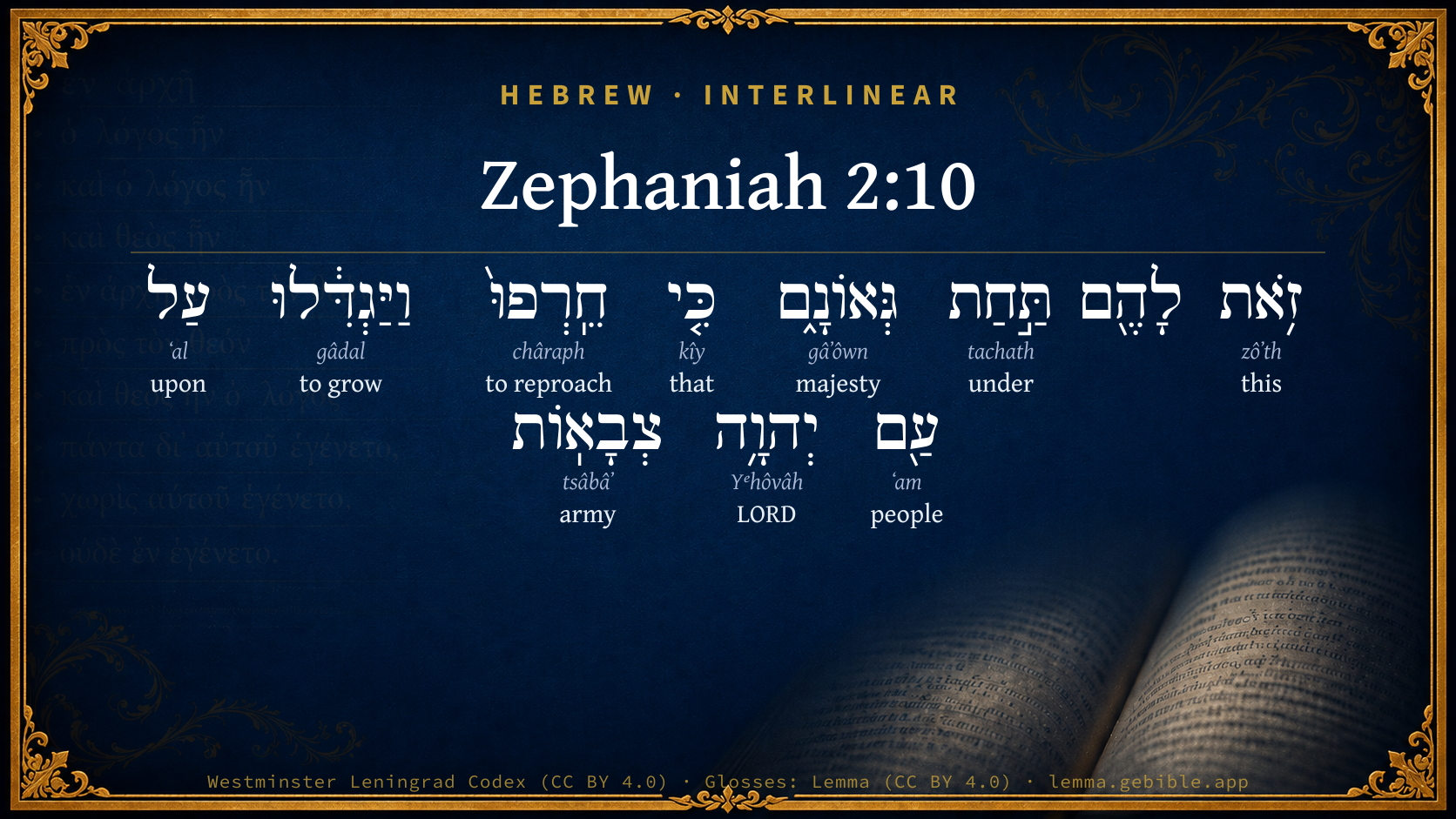
Hebrew (Westminster Leningrad Codex) Zephaniah 2:10 appears in the Hebrew Old Testament. The text above is from the Westminster Leningrad Codex. Each word links to its Strong’s number, a concise gloss, and parsing drawn from the Open Scriptures Hebrew Bible morphology. Click any word for its full Brown-Driver-Briggs (BDB) entry.
Download image
Cite this verse

Zephaniah 2:10 (World English Bible). Public Domain. Lemma interlinear Bible study tool, https://lemma.gebible.app/v/zephaniah/2/10.

Show BibTeX & RIS
BibTeX
RIS
English Translation
This they will have for their pride, because they have reproached and magnified themselves against the people of Yahweh of Hosts.
World English Bible · Public Domain
Download a study sheet

One document with this verse’s original text, its word-by-word gloss line, the meaning frame, cross-references with their text, attributed commentary, and full source and license credits — printable, and it pastes into notes with its structure intact.

This verse Autodidact and up

Study sheet (.html) Plain text (.txt)

A passage Seminary Student

Up to 50 verses in one chapter. A passage sheet keeps up to 6 commentary sources and 12 cross-references per verse, in the order this page ranks them, and says so on the sheet whenever that leaves anything out. Ask for a single verse and you get the Autodidact verse sheet above.

Everything on this page stays free to read, with no account — the sheet is a download of what is already on screen, not access to it.

Want to remove ads? Support Godless Engineer
Compare translations 3

The same verse in 3 English versions, stacked beneath the original-language interlinear above. Click any original word for its lexicon entry.

Each is an independent rendering of the whole verse — the interlinear is not word-aligned to these translations.

Highlighted words mark where these versions differ — a whole-verse word diff, not a word-by-word alignment.

  • World English Bible Public Domain
    This they will have for their pride, because they have reproached and magnified themselves against the people of Yahweh of Hosts.
  • King James Version Public Domain
    This shall they have for their pride, because they have reproached and magnified themselves against the people of the LORD of hosts.
  • unfoldingWord Literal Text CC BY-SA 4.0
    This will be to them instead of their pride, for they reproached and made themselves great against the people of Yahweh of Armies.

unfoldingWord Literal Text — © unfoldingWord, licensed CC BY-SA 4.0. Word-aligned USFM3 via Door43 (git.door43.org/unfoldingWord/en_ult).

Versions to compare (up to 4)

3 of 4 selected

Show all 18 translations

Every available English version of this verse, each an independent rendering of the whole verse.

  • World English Bible Public Domain
    This they will have for their pride, because they have reproached and magnified themselves against the people of Yahweh of Hosts.
  • Berean Standard Bible Public Domain
    This they shall have in return for their pride, for taunting and mocking the people of the LORD of Hosts.
  • Majority Standard Bible Public Domain
    This they shall have in return for their pride, for taunting and mocking the people of the LORD of Hosts.
  • King James Version Public Domain
    This shall they have for their pride, because they have reproached and magnified themselves against the people of the LORD of hosts.
  • American Standard Version (1901) Public Domain
    This shall they have for their pride, because they have reproached and magnified themselves against the people of Jehovah of hosts.
  • Revised Version (1885) Public Domain
    This shall they have for their pride, because they have reproached and magnified themselves against the people of the LORD of hosts.
  • Geneva Bible (1599) Public Domain
    This shall they haue for their pride, because they haue reproched and magnified themselues against the Lord of hostes people.
  • Douay-Rheims (1899) Public Domain
    This shall befall them for their pride: because they have blasphemed, and have been magnified against the people of the Lord of hosts.
  • Young's Literal Translation Public Domain
    This `is' to them for their arrogancy, Because they have reproached, And they magnify `themselves' against the people of Jehovah of Hosts.
  • Literal Standard Version CC BY-SA 4.0
    This [is] to them for their arrogancy, || Because they have reproached, || And they magnify [themselves] against the people of YHWH of Hosts.
  • Unlocked Literal Bible CC BY-SA 4.0
    This will happen to Moab and Ammon because of their pride, since they taunted and mocked the people of Yahweh of hosts.
  • unfoldingWord Literal Text CC BY-SA 4.0
    This will be to them instead of their pride, for they reproached and made themselves great against the people of Yahweh of Armies.
  • Darby Bible Public Domain
    This shall they have for their pride, because they have reproached and magnified themselves against the people of Jehovah of hosts.
  • World Messianic Bible Public Domain
    This they will have for their pride, because they have reproached and magnified themselves against the people of the LORD of Hosts.
  • Webster's Bible Public Domain
    This shall they have for their pride, because they have reproached and magnified themselves against the people of the LORD of hosts.
  • Free Bible Version CC BY-SA 4.0
    This is what they will receive for their pride because they mocked and threatened the people of the Lord Almighty.
  • Bible in Basic English Public Domain
    This will be their fate because of their pride, because they have said evil, lifting themselves up against the people of the Lord of armies.
  • JPS Tanakh (1917) Public Domain
    This shall they have for their pride, because they have taunted and spoken boastfully against the people of the LORD of hosts.

Literal Standard Version (2020), Covenant Press — licensed CC BY-SA 4.0. Text via the HelloAO Bible API (eBible.org). Unlocked Literal Bible (unfoldingWord) — licensed CC BY-SA 4.0. Text via the HelloAO Bible API (eBible.org). unfoldingWord Literal Text — © unfoldingWord, licensed CC BY-SA 4.0. Word-aligned USFM3 via Door43 (git.door43.org/unfoldingWord/en_ult). Free Bible Version, Dr. Jonathan Gallagher — licensed CC BY-SA 4.0. Text via the HelloAO Bible API (eBible.org).

Word by word

More ways to search: Search by grammar → Find every occurrence → Compare this word →

Practice this passage: Drill this verse → Learn its vocabulary →

חֵֽרְפוּ֙
châraph
H2778
“to reproach”
Verb, Piel, Perfect, 3rd Person, Common, Plural
Part of Speech
Verb
Stem
Piel
Form
Perfect
Person
3rd Person
Gender
Common
Number
Plural
Full BDB Definition

Origin: a primitive root

TWOT: 749 , 750 , 751

to reproach, taunt, blaspheme, defy, jeopardise, rail, upbraid - (Qal) to reproach - (Piel) to reproach, defy, taunt - (Qal) to winter, spend harvest time, remain in harvest time - (Niphal) to acquire, be betrothed
  1. זֹ֥את zôʼth H2063 “this” Pronoun, Demonstrative, Feminine, Singular
  2. תַּ֣חַת tachath H8478 “under” Preposition
  3. גְּאוֹנָ֑ם gâʼôwn H1347 “majesty · their” Noun, Common, Masculine, Singular, Construct + Suffix, Personal, 3rd Person, Masculine, Plural
  4. כִּ֤י kîy H3588 “that” Conjunction
  5. וַיַּגְדִּ֔לוּ gâdal H1431 “and · to grow” Conjunction + Verb, Hiphil, Sequential Imperfect, 3rd Person, Masculine, Plural
  6. עַל ʻal H5921 “upon” Preposition
  7. עַ֖ם ʻam H5971 “people of” Noun, Common, Masculine, Singular, Construct
  8. יְהוָ֥ה Yᵉhôvâh H3068 “LORD” Noun, Proper
  9. צְבָאֽוֹת tsâbâʼ H6635 “armies” Noun, Common, Both, Plural, Absolute

About this verse

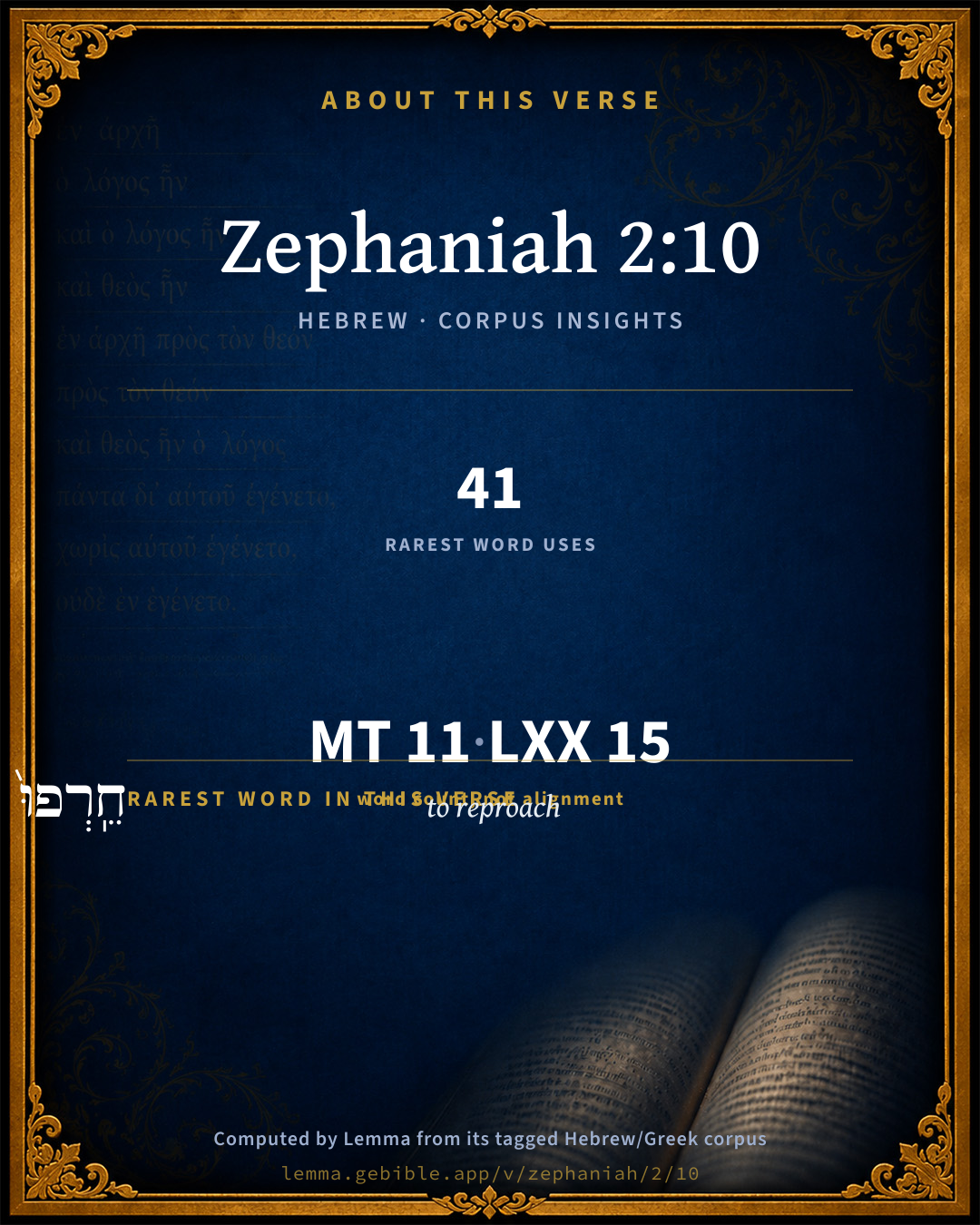
These counts appear in no published source. They are computed here, from the morphology-tagged text and Lemma’s own curated glosses. What Lemma adds →

11
words
10
distinct lemmas
Prophets
section

Shared distinctive vocabulary

חֵֽרְפוּ֙ to reproach H2778 occurs in 40 verses of the Hebrew Bible. Also found in:

Grammatical profile

  • 2 verbs
  • 4 nouns
  • 1 pronoun
  • 3 prepositions
  • 1 conjunction

Verb forms

  • חֵֽרְפוּ֙ Piel · Perfect
  • וַיַּגְדִּ֔לוּ Hiphil · Sequential Imperfect

Hebrew & Septuagint length

In English translation the verse runs 21 words from the Hebrew and 20 from the Septuagint (LXX English) — closely comparable.

A rough comparison of the two English renderings, which tokenize alike — not a word-level alignment.

Word counts can differ between the Hebrew and the Greek without any difference in meaning — e.g. the Hebrew direct-object marker אֵת has no separate Greek word, and Greek often adds the article ὁ.

In the original languages it is 11 Hebrew tokens and 15 Greek tokens — but the two are counted differently (Hebrew bundles its prefixes and suffixes into one token; the Greek is in lemma form), so that isn’t a like-for-like length.

Cross-references

12

Topical passages linked to Zephaniah 2:10 in the Treasury of Scripture Knowledge — connected by theme and wording, ordered by reader-vote popularity; previews shown in the World English Bible.

  • Isaiah 16:6 We have heard of the pride of Moab, [that] he is very proud; even of his arrogance, and his pride, and his wrath; his boastings are nothing.
  • Jeremiah 48:29 We have heard of the pride of Moab, [that] he is very proud; his loftiness, and his pride, and his arrogance, and the haughtiness of his heart.
  • Zephaniah 2:8 I have heard the reproach of Moab, and the insults of the children of Ammon, with which they have reproached my people, and magnified themselves against their border.
  • Exodus 9:17 as you still exalt yourself against my people, that you won't let them go.
  • Exodus 10:3 Moses and Aaron went in to Pharaoh, and said to him, "This is what Yahweh, the God of the Hebrews, says: 'How long will you refuse to humble yourself before me? Let my people go, that they may serve me.
  • Isaiah 10:12–15 Therefore it shall happen that, when the Lord has performed his whole work on Mount Zion and on Jerusalem, I will punish the fruit of the stout heart of the king of Assyria, and the glory of his high looks.
  • Isaiah 37:22–29 this is the word which Yahweh has spoken concerning him: The virgin daughter of Zion has despised you and ridiculed you; the daughter of Jerusalem has shaken her head at you.
  • Ezekiel 38:14–18 Therefore, son of man, prophesy, and tell Gog, Thus says the Lord Yahweh: In that day when my people Israel dwells securely, shall you not know it?
  • Daniel 4:37 Now I, Nebuchadnezzar, praise and extol and honor the King of heaven; for all his works are truth, and his ways justice; and those who walk in pride he is able to abase.
  • Daniel 5:20–23 But when his heart was lifted up, and his spirit was hardened so that he dealt proudly, he was deposed from his kingly throne, and they took his glory from him:
  • Obadiah 1:3 The pride of your heart has deceived you, you who dwell in the clefts of the rock, whose habitation is high, who says in his heart, 'Who will bring me down to the ground?'
  • 1 Peter 5:5 Likewise, you younger ones, be subject to the elder. Yes, all of you gird yourselves with humility, to subject yourselves to one another; for "God resists the proud, but gives grace to the humble."

Cross-references courtesy of OpenBible.info (CC BY 4.0).

Hebrew and Greek witnesses Masoretic Hebrew ↔ Greek Septuagint

The same verse in the two great witnesses to the Old Testament, shown verse-for-verse.

These are two independent witnesses, not word-aligned to each other, and the Septuagint is shown in lemma (dictionary) form.

Hebrew Zephaniah 2:10 Masoretic · Westminster Leningrad Codex

זֹ֥את לָהֶ֖ם תַּ֣חַת גְּאוֹנָ֑ם כִּ֤י חֵֽרְפוּ֙ וַיַּגְדִּ֔לוּ עַל עַ֖ם יְהוָ֥ה צְבָאֽוֹת

This they will have for their pride, because they have reproached and magnified themselves against the people of Yahweh of Hosts.

World English Bible · Public Domain

Greek LXX Zephaniah 2:10 Septuagint · lemma form

οὗτος αὐτός ἀντί ὁ ὕβρις αὐτός διότι ὀνειδίζω καί μεγαλύνω ἐπί ὁ κύριος ὁ παντοκράτωρ

This is their punishment in return for their haughtiness, because they have reproached and magnified themselves against the Lord Almighty.

LXX2012 (modern English Septuagint) · Public Domain

Hebrew: Westminster Leningrad Codex (CC BY 4.0). Greek: Septuagint (public domain); English from LXX2012 (modern English Septuagint) (Public Domain). How the Septuagint differs from the Hebrew →

Targum (Aramaic paraphrase)

1

The Targum is the ancient Jewish Aramaic paraphrase of the Hebrew Scriptures — an interpretive translation, not the Hebrew text itself. Onkelos (literal) and Pseudo-Jonathan (expansive) render the Torah, and Jonathan the Prophets. Coverage is partial: where no permissively-licensed English translation exists for a verse, only the Aramaic is shown. This is verse-level text, not a word-by-word alignment to the Hebrew.

  1. Targum Jonathan Prophets (Joshua–Malachi)
    דָא לְהוֹן חֲלַף אִתְרַבְרְבוּתְהוֹן אֲרֵי חֲסִידוּ וְאִתְרַבְרְבוּ עַל עַמֵיהּ דַייָ צְבָאוֹת:

    (no public-domain English translation for this verse)

    Targum Jonathan — Aramaic: “Mikraot Gedolot” (public domain). English: “Sefaria Community Translation” (CC0 1.0 (public-domain dedication)); “London "Chaldee Paraphrase," 1871” (public domain). Text via Sefaria.

Commentary

Notes on Zephaniah 2:10 from classic Christian and Jewish commentators (each source and its license shown beneath its notes). The classic Christian expositions comment on the surrounding passage and are grouped to its opening verse, so a note may address several verses; the Jewish commentaries on the Tanakh (Rashi and others) are per-verse, so they appear only where the commentator wrote on this verse.

Lemma curates 59 commentaries, every one of them public domain or Creative Commons licensed, each selected and text-cleaned for this edition rather than reprinted as found. About our sources →

Trapp's Complete Commentary

John Trapp

Zep 2:10 This shall they have for their pride, because they have reproached and magnified [themselves] against the people of the LORD of hosts.

Ver. 10. This shall they have for their pride] Moabites were as much noted for their pride as now the Spaniards are; and are therefore here devoted to destruction. Pride goeth before a fall, &c. A bulging wall stands not long; a joint luxated and swelled, till that be down cannot be set. God resisteth the proud, 1Pe 5:5, he bringeth those ungodly down to the ground, Psa 147:6.

Because they have reproached, &c.] And all this out of the pride of their hearts, which breaketh out, as a master pox, in their body; so that the pride of Moab testifieth to his face, and it shall be to him an abomination of desolation.

John Trapp, A Commentary or Exposition upon All the Books of the Old and New Testament (1647–1656) — public domain. Text from a community e-Sword module.

Jamieson, Fausset & Brown

Robert Jamieson, A. R. Fausset & David Brown

(Compare Zep 2:8).

their pride--in antithesis to the meek (Zep 2:3).

Jamieson, Fausset & Brown — Commentary Critical and Explanatory on the Whole Bible (1871) — public domain (CC PDM 1.0). Text via the HelloAO Bible API.

Adam Clarke's Commentary

Verse 10. Because they have reproached] See on Zep 2:8.

Adam Clarke's Commentary on the Bible (1810–1826) — public domain. Text from a community e-Sword/MySword module.

The Cambridge Bible for Schools and Colleges

gen. ed. J. J. S. Perowne

10. Comp. Zep_2:8, Isa_16:6, Jer_48:29. In the last clause Sept. reads: magnified themselves against the Lord of hosts, omitting people. Jer_48:26; Jer_48:42.

The Cambridge Bible for Schools and Colleges (gen. ed. J. J. S. Perowne; Cambridge University Press, 1878–1918) — public domain. Text from a community e-Sword module.

John Gill's Exposition

This shall they have for their pride This calamity shall come upon their land, the land of the Moabites and Ammonites, for their pride, which often goes before a fall; and has frequently been the cause of the ruin of kingdoms and states, and of particular persons; and indeed seems to have been the first sin of the apostate angels, and of fallen man. Of the pride of Moab see ( Isaiah 16:6 ) : because they have reproached and magnified [themselves] against the people of the Lord of hosts; they looked with disdain upon them, as greatly below them; and spoke contemptibly of them, of their nation, and religion; and "made" themselves "great", and set up themselves "above" them, opened their mouths wide, and gave their tongues great liberties in blaspheming and reviling them: what was done to them is taken by the Lord as done to himself; see ( Jeremiah 48:42 ) .

John Gill's Exposition of the Whole Bible (1746–1763) — public domain (CC PDM 1.0). Text via the HelloAO Bible API.

Albert Barnes' Notes on the Bible

This shall they have for their pride - Literally, “This to them instead of their pride.” Contempt and shame shall be the residue of the proud man; the exaltation shall be gone, and all which they shall gain to themselves shall be shame. Moab and Ammon are the types of heretics . As they were akin to the people of God, but hating it; akin to Abraham through a lawless birth, but ever molesting the children of Abraham, so heretics profess to believe in Christ, to be children of Christ, and yet ever seek to overthrow the faith of Christians. As the Church says, “My mothers children are” “angry with me” Son 1:5. They seem to have escaped the overthrow of Sodom and Gomorrah (pagan sins), and to have found a place of refuge (Zoar); and yet they are in darkness and cannot see the light of faith; and in an unlawful manner they mingle, against all right, the falsehood of Satan with the truth of God; so that their doctrines become, in part, “doctrines of devils,” in part have some stamp of the original truth.

To them, as to the Jews, our Lord says, “Ye are of your father the devil.” While they profess to be children of God, they claim by their names to have God for their Father (Moab) and to be of His people (Ammon), while in hatred to His true children they forfeit both. As Moab seduced Israel, so they the children of the Church. They too enlarge themselves against the borders of the Church, rending off its children and making themselves the Church. They too utter reproaches and revilings against it. “Take away their revilings,” says an early father , “against the law of Moses, and the prophets, and God the Creator, and they have not a word to utter.” They too “remove the old landmarks which the fathers” (the prophets and Apostles) “have set.” And so, barrenness is their portion; as, after a time, heretics ever divide, and do not multiply; they are a desert, being out of the Church of God: and at last the remnant of Judah, the Church, possesses them, and absorbs them into herself.

Albert Barnes' Notes on the Bible (1834–1885) — public domain. Text from a community e-Sword/MySword module.

Matthew Poole's English Annotations

This shall they have; this grievous ruin like Sodom’s, this just retaliation; they insulted over Israel, Israel shall tread on them.

For their pride; haughty mind and carriage: see Zep 2:8.

Reproached; defamed, spoken lies and scandals against the Jews, lessening them.

Magnified themselves; their persons and exploits.

Against the people of the Lord of hosts; against the only people of the Lord of hosts, who suffered reproach with his people and in them, for Moabites and Ammonites, as others, boasted of their gods above the true God:

Matthew Poole's English Annotations on the Holy Bible (1683–1685) — public domain. Text from a community e-Sword/MySword module.

The Pulpit Commentary

This shall they have. All these calamities mentioned above shall fall on the Ammonites and Moabites in punishment of their pride and spite and insolence (see note on ver. 8).

The Pulpit Commentary (1880–1919), ed. H.D.M. Spence-Jones & Joseph S. Exell — public domain. Text from a community e-Sword module.

unfoldingWord translationNotes

Door43 World Missions Community

General Information:

In Zep 2:4-15, Yahweh announces his judgment on the nations that surround Judah.

they taunted and mocked the people of Yahweh of hosts ... he will taunt all the gods of the earth

Yahweh is speaking with irony. He will taunt the worthless gods in the same way that the people who served those gods had taunted Yahweh's people.

translationWords

proud

mock

fear

false god

earth

worship

unfoldingWord translationNotes — © Distant Shores Media and the Door43 World Missions Community, licensed CC BY-SA 4.0. Source: git.door43.org/Door43/en_tn.

Lesson kit

Teaching starters — assembled from the data on this page, not authored interpretation. Every prompt links to the verse data it draws on. Edit before teaching.

Zephaniah, in the Prophets, opens this verse with 11 words (10 distinct Hebrew lemmas). Its most distinctive word is châraph (“to reproach”). A historical commentator’s framing appears above. Read the whole chapter for the surrounding context.

Discussion questions

  1. The word châraph carries the sense “to reproach.” How does it shape the verse?
  2. How does Leviticus 19:20, which shares the word «to reproach», read alongside this verse?
  3. These translations render this verse differently; the difference is in the English rendering, not the original. What questions does that raise?
  4. «חֵֽרְפוּ֙» is a Piel Perfect verb. How does that grammatical form shape the action described?
  5. Compare how Trapp's Complete Commentary and Jamieson, Fausset & Brown read this verse. Where do they agree or differ?

Things to notice

Reading settings

Reading text

Shown beneath each verse's original-language words.

Old Testament
Old Testament edition

Read the OT as the Masoretic Hebrew (MT) or the Greek Septuagint (LXX).

English shown for the Greek Septuagint (in the Hebrew ↔ Greek comparison).

Comparing translations? Open the Compare panel on any verse page to stack up to four side by side.