
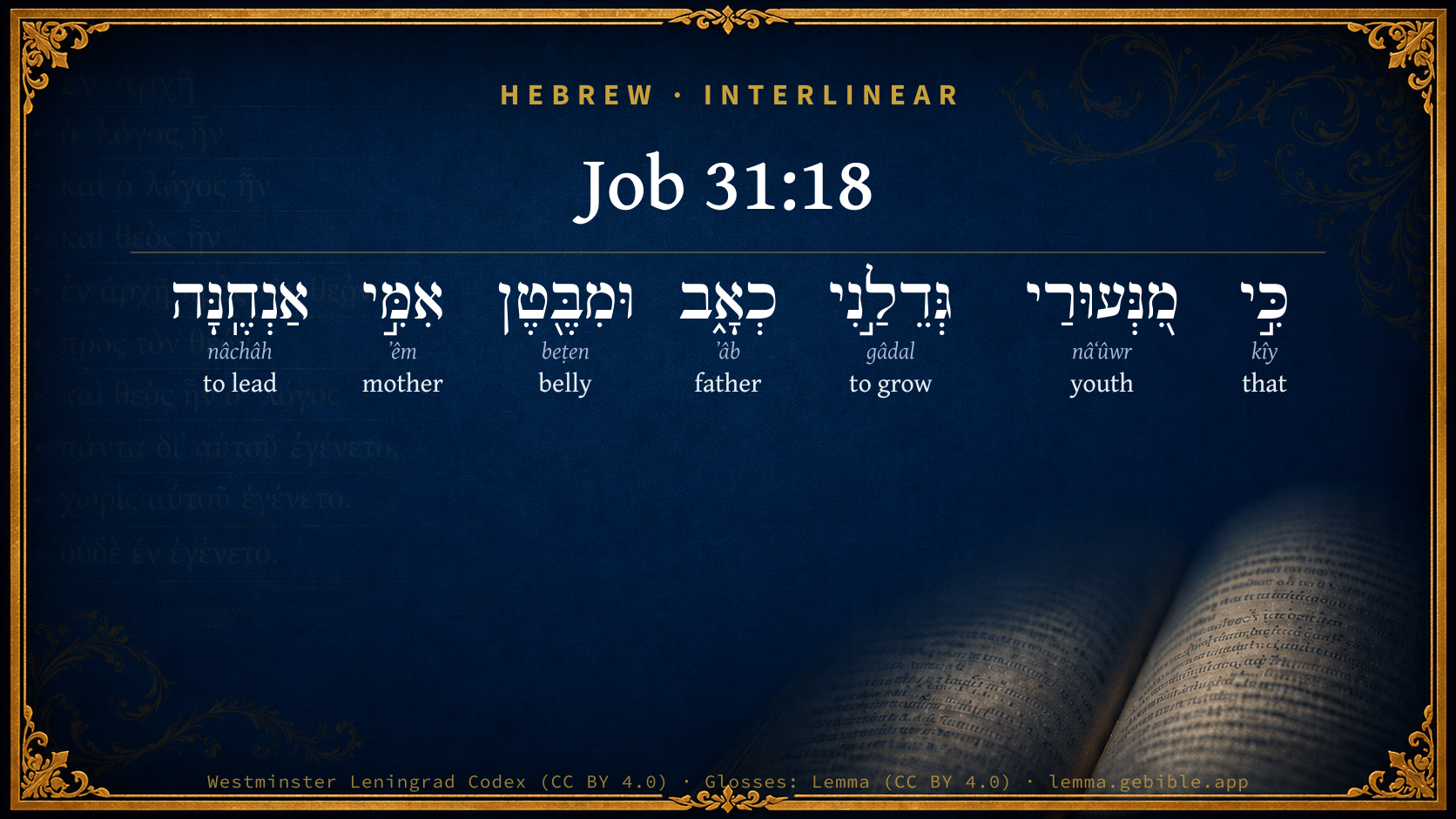
Job 31:18

Hebrew (Westminster Leningrad Codex) Job 31:18 appears in the Hebrew Old Testament. The text above is from the Westminster Leningrad Codex. Each word links to its Strong’s number, a concise gloss, and parsing drawn from the Open Scriptures Hebrew Bible morphology. Click any word for its full Brown-Driver-Briggs (BDB) entry.
Download image
Cite this verse

Job 31:18 (World English Bible). Public Domain. Lemma interlinear Bible study tool, https://lemma.gebible.app/v/job/31/18.

Show BibTeX & RIS
BibTeX
RIS
English Translation
(No, from my youth he grew up with me as with a father, Her have I guided from my mother's womb);
World English Bible · Public Domain
Download a study sheet

One document with this verse’s original text, its word-by-word gloss line, the meaning frame, cross-references with their text, attributed commentary, and full source and license credits — printable, and it pastes into notes with its structure intact.

This verse Autodidact and up

Study sheet (.html) Plain text (.txt)

A passage Seminary Student

Up to 50 verses in one chapter. A passage sheet keeps up to 6 commentary sources and 12 cross-references per verse, in the order this page ranks them, and says so on the sheet whenever that leaves anything out. Ask for a single verse and you get the Autodidact verse sheet above.

Everything on this page stays free to read, with no account — the sheet is a download of what is already on screen, not access to it.

Want to remove ads? Support Godless Engineer
Compare translations 3

The same verse in 3 English versions, stacked beneath the original-language interlinear above. Click any original word for its lexicon entry.

Each is an independent rendering of the whole verse — the interlinear is not word-aligned to these translations.

Highlighted words mark where these versions differ — a whole-verse word diff, not a word-by-word alignment.

  • World English Bible Public Domain
    (No, from my youth he grew up with me as with a father, Her have I guided from my mother's womb);
  • King James Version Public Domain
    (For from my youth he was brought up with me, as with a father, and I have guided her from my mother's womb;)
  • unfoldingWord Literal Text CC BY-SA 4.0
    for from my youth he has grown up with me as a father, and from the belly of my mother I have guided her.

unfoldingWord Literal Text — © unfoldingWord, licensed CC BY-SA 4.0. Word-aligned USFM3 via Door43 (git.door43.org/unfoldingWord/en_ult).

Versions to compare (up to 4)

3 of 4 selected

Show all 18 translations

Every available English version of this verse, each an independent rendering of the whole verse.

  • World English Bible Public Domain
    (No, from my youth he grew up with me as with a father, Her have I guided from my mother's womb);
  • Berean Standard Bible Public Domain
    though from my youth I reared him as would a father, and from my mother’s womb I guided the widow—
  • Majority Standard Bible Public Domain
    though from my youth I reared him as would a father, and from my mother’s womb I guided the widow—
  • King James Version Public Domain
    (For from my youth he was brought up with me, as with a father, and I have guided her from my mother's womb;)
  • American Standard Version (1901) Public Domain
    (Nay, from my youth he grew up with me as with a father, And her have I guided from my mother's womb);
  • Revised Version (1885) Public Domain
    (Nay, from my youth he grew up with me as with a father, and I have been her guide from my mother’s womb;)
  • Geneva Bible (1599) Public Domain
    (For from my youth hee hath growen vp with me as with a father, and from my mothers wombe I haue bene a guide vnto her)
  • Douay-Rheims (1899) Public Domain
    (For from my infancy mercy grew up with me: and it came out with me from my mother's womb:)
  • Young's Literal Translation Public Domain
    (But from my youth He grew up with me as `with' a father, And from the belly of my mother I am led.)
  • Literal Standard Version CC BY-SA 4.0
    (But from my youth || He grew up with me as [with] a father, || And from the belly of my mother I am led),
  • Unlocked Literal Bible CC BY-SA 4.0
    because from my youth the orphan grew up with me as with a father, and I have guided his mother, a widow, from my own mother's womb.
  • unfoldingWord Literal Text CC BY-SA 4.0
    for from my youth he has grown up with me as a father, and from the belly of my mother I have guided her.
  • Darby Bible Public Domain
    (For from my youth he grew up with me as with a father, and I have guided the [widow] from my mother's womb;)
  • World Messianic Bible Public Domain
    (no, from my youth he grew up with me as with a father, I have guided her from my mother’s womb);
  • Webster's Bible Public Domain
    (For from my youth he was brought up with me, as with a father, and I have guided her from my mother's womb;)
  • Free Bible Version CC BY-SA 4.0
    From when I was young I was a father to orphans and took care of widows.
  • Bible in Basic English Public Domain
    (For I was cared for by God as by a father from my earliest days; he was my guide from the body of my mother;)
  • JPS Tanakh (1917) Public Domain
    Nay, from my youth he grew up with me as with a father, and I have been her guide from my mother's womb.

Literal Standard Version (2020), Covenant Press — licensed CC BY-SA 4.0. Text via the HelloAO Bible API (eBible.org). Unlocked Literal Bible (unfoldingWord) — licensed CC BY-SA 4.0. Text via the HelloAO Bible API (eBible.org). unfoldingWord Literal Text — © unfoldingWord, licensed CC BY-SA 4.0. Word-aligned USFM3 via Door43 (git.door43.org/unfoldingWord/en_ult). Free Bible Version, Dr. Jonathan Gallagher — licensed CC BY-SA 4.0. Text via the HelloAO Bible API (eBible.org).

Word by word

More ways to search: Search by grammar → Find every occurrence → Compare this word →

Practice this passage: Drill this verse → Learn its vocabulary →

אַנְחֶֽנָּה
nâchâh
H5148
“to lead · her”
Verb, Hiphil, Imperfect, 1st Person, Common, Singular + Suffix, Personal, 3rd Person, Feminine, Singular
Part of Speech
Verb
Stem
Hiphil
Form
Imperfect
Person
1st Person
Gender
Common
Number
Singular
Full BDB Definition

Origin: a primitive root

TWOT: 1341

to lead, guide - (Qal) to lead, bring - (Hiphil) to lead, guide
  1. כִּ֣י kîy H3588 “that” Conjunction
  2. מִ֭נְּעוּרַי nâʻûwr H5271 “from · youth · my” Preposition + Noun, Common, Both, Plural, Construct + Suffix, Personal, 1st Person, Common, Singular
  3. גְּדֵלַ֣נִי gâdal H1431 “to grow · me” Verb, Qal, Perfect, 3rd Person, Masculine, Singular + Suffix, Personal, 1st Person, Common, Singular
  4. כְאָ֑ב ʼâb H1 “like/as · father” Preposition + Noun, Common, Masculine, Singular, Absolute
  5. וּמִבֶּ֖טֶן beṭen H990 “and · from · belly of” Conjunction + Preposition + Noun, Common, Feminine, Singular, Construct
  6. אִמִּ֣י ʼêm H517 “mother · my” Noun, Common, Feminine, Singular, Construct + Suffix, Personal, 1st Person, Common, Singular

About this verse

These counts appear in no published source. They are computed here, from the morphology-tagged text and Lemma’s own curated glosses. What Lemma adds →

7
words
7
distinct lemmas
Wisdom
section

Shared distinctive vocabulary

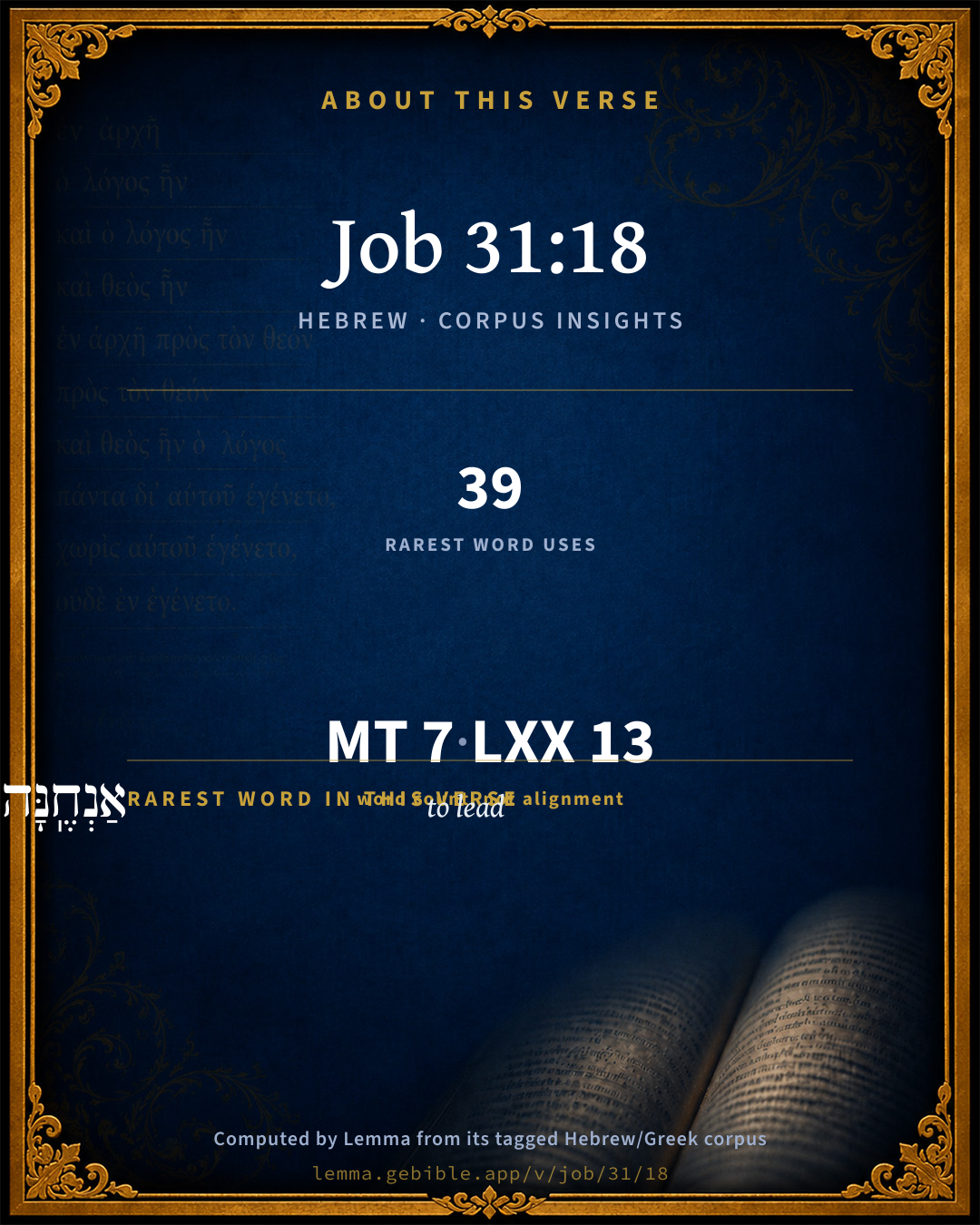
אַנְחֶֽנָּה to lead H5148 occurs in 39 verses of the Hebrew Bible. Also found in:

Grammatical profile

  • 2 verbs
  • 4 nouns
  • 1 conjunction

Verb forms

  • גְּדֵלַ֣נִי Qal · Perfect
  • אַנְחֶֽנָּה Hiphil · Imperfect

Hebrew & Septuagint length

In English translation the verse runs 21 words from the Hebrew and 17 from the Septuagint (LXX English) — closely comparable.

A rough comparison of the two English renderings, which tokenize alike — not a word-level alignment.

Word counts can differ between the Hebrew and the Greek without any difference in meaning — e.g. the Hebrew direct-object marker אֵת has no separate Greek word, and Greek often adds the article ὁ.

In the original languages it is 7 Hebrew tokens and 13 Greek tokens — but the two are counted differently (Hebrew bundles its prefixes and suffixes into one token; the Greek is in lemma form), so that isn’t a like-for-like length.

Hebrew and Greek witnesses Masoretic Hebrew ↔ Greek Septuagint

The same verse in the two great witnesses to the Old Testament, shown verse-for-verse.

These are two independent witnesses, not word-aligned to each other, and the Septuagint is shown in lemma (dictionary) form.

Hebrew Job 31:18 Masoretic · Westminster Leningrad Codex

כִּ֣י מִ֭נְּעוּרַי גְּדֵלַ֣נִי כְאָ֑ב וּמִבֶּ֖טֶן אִמִּ֣י אַנְחֶֽנָּה

(No, from my youth he grew up with me as with a father, Her have I guided from my mother's womb);

World English Bible · Public Domain

Greek LXX Job 31:18 Septuagint · lemma form

ὅτι ἐκ νεότης ἐγώ ἐκτρέφω ὡς πατήρ καί ἐκ γαστήρ μήτηρ ἐγώ ὁδηγέω

(for I nourished them as a father from my youth and guided them from my mother's womb.)

LXX2012 (modern English Septuagint) · Public Domain

On this verse, Adam Clarke's Commentary discusses the Septuagint’s reading. Read the note in Commentary ↓

Hebrew: Westminster Leningrad Codex (CC BY 4.0). Greek: Septuagint (public domain); English from LXX2012 (modern English Septuagint) (Public Domain). How the Septuagint differs from the Hebrew →

Commentary

Notes on Job 31:18 from classic Christian and Jewish commentators (each source and its license shown beneath its notes). The classic Christian expositions comment on the surrounding passage and are grouped to its opening verse, so a note may address several verses; the Jewish commentaries on the Tanakh (Rashi and others) are per-verse, so they appear only where the commentator wrote on this verse.

Lemma curates 59 commentaries, every one of them public domain or Creative Commons licensed, each selected and text-cleaned for this edition rather than reprinted as found. About our sources →

Trapp's Complete Commentary

John Trapp

Job 31:18 (For from my youth he was brought up with me, as [with] a father, and I have guided her from my mother’s womb;)

Ver. 18. For from my youth he was brought up with me, &c.] i.e. Ever since I could do anything it hath been my delight to be doing good to the poor orphans, whom I have tenderly bred, as a father useth to breed his children. Non est vulgare Dei donum, saith Mercer, This is no ordinary mercy for men to be of a merciful disposition and melting hearted toward the poor and necessitous, as some are naturally, and from the womb. Such are said to have been Artaxerxes Longimanus, Titus the emperor, Otho III, Stephen king of Hungary, Oswald king of England, &c.

And I have guided her from my mother’s womb] Ductavi illam, meaning the widow, or the orphan, to whom I have been a manly guide, and that of a child little. See the previous note. Sutton’s hospitals and many more monuments of charity in this kind are worthily alleged by some of our divines, to prove that, for their time and ability, Protestants have equalled and exceeded Papists in this way of good works. Job’s desire of doing good appeared early, as if it had been born with him; like as Plutarch writeth of Coriolanus, that he was so natural and expert a soldier, that he might seem to have been born with his arms upon his back and his weapons in his hands, εγγενη και εμφυτα..

John Trapp, A Commentary or Exposition upon All the Books of the Old and New Testament (1647–1656) — public domain. Text from a community e-Sword module.

Joseph Benson's Commentary

Job 31:18. For from my youth — As soon as I was capable of managing my own affairs, and doing good to others; he was brought up with me as with a father — Under my care and protection, with all the diligence and tenderness of a father. And I have guided her — The widow, mentioned Job 31:16; from my mother’s womb — From my tender years; ever since I was capable of discerning good from evil, I have made conscience of this duty.

Joseph Benson's Commentary on the Old and New Testaments (1811–1818) — public domain. Text from a community e-Sword module.

Geneva Bible (1599)

Geneva Bible translators

He nourished the fatherless, and maintained the widow’s cause.

Geneva Bible (1599) marginal notes — public domain. Text via Bolls.life.

Jamieson, Fausset & Brown

Robert Jamieson, A. R. Fausset & David Brown

Parenthetical: asserting that he did the contrary to the things in Job 31:16-17.

he--the orphan.

guided her--namely, the widow, by advice and protection. On this and "a father," see Job 29:16.

Jamieson, Fausset & Brown — Commentary Critical and Explanatory on the Whole Bible (1871) — public domain (CC PDM 1.0). Text via the HelloAO Bible API.

Adam Clarke's Commentary

Verse 18. This is a very difficult verse, and is variously translated. Take the following instances: - For from his youth he (the male orphan) was brought up with me as a father. Yea, I have guided her (the female orphan) from her mother's womb. - Heath.

Nam a pueris educavit me commiseratio; jam inde ab utero matris meae illa me deduxit. - Houbigant.

"For commiseration educated me from my childhood;

And she brought me up even from my mother's womb."

This is agreeable to the Vulgate.

"Behold, from my youth calamity hath quickened me;

Even from my mother's womb have I distributed it."

This is Mr. Goods version, and is widely different from the above.

For mercy grewe up with me fro my youth,

And compassion fro my mother's wombe.

Coverdale.

Ὁτι εκ νεοτητος μου εξετρεφον ὡς πατηρ, και εκ γαστρος μητρος μου ὡδηγησα. - Septuagint.

"For from my youth I nourished them as a father; and I was their guide from my mother's womb."

The Syriac. "For from my childhood he educated me in distresses, and from the womb of my mother in groans." The Arabic is nearly the same.

The general meaning may be gathered from the above; but who can reconcile such discordant translations?

Adam Clarke's Commentary on the Bible (1810–1826) — public domain. Text from a community e-Sword/MySword module.

Ellicott's Commentary for English Readers

(18) For from my youth he.—The pronouns refer to the fatherless of Job_31:17 and to the widow of Job_31:16.

A Bible Commentary for English Readers, edited by Charles John Ellicott (1878–1897) — public domain. Text from a community e-Sword module.

The Cambridge Bible for Schools and Colleges

gen. ed. J. J. S. Perowne

18. he was brought up with me] Rather, he (the fatherless) grew up with me. Job probably did not achieve his greatness, he was born to it. And possibly he inherited the traditions of a great and benevolent house. And thus even from his youth he took the place toward the poor of a patron and father.

The Cambridge Bible for Schools and Colleges (gen. ed. J. J. S. Perowne; Cambridge University Press, 1878–1918) — public domain. Text from a community e-Sword module.

John Gill's Exposition

If I have seen any perish for want of clothing,.... A man may be in such poor circumstances as to want proper clothing to cover his naked body with, and preserve it from the inclemencies of the weather, and for want of it be ready to perish or die with cold. Job denies he had seen any such; not that he had never seen persons in such perishing circumstances; but he had not seen them as to "despise" them, as the Vulgate Latin version, as to have them in contempt, or look at them with disdain because of their poverty and rags, or sordid apparel; or so as to "overlook" them, as the Septuagint version, to neglect them, and to take no notice of them, and make no provision for their clothing, a warm and comfortable garment, as in Job 31:20,

or any poor without covering; without clothing sufficient to cover himself with, and keep him warm; Job had seen such objects, but he did not leave them in such a condition; he saw them, and had compassion on them, and clothed them.

John Gill's Exposition of the Whole Bible (1746–1763) — public domain (CC PDM 1.0). Text via the HelloAO Bible API.

Albert Barnes' Notes on the Bible

For from my youth he was brought up with me - This verse is usually regarded as a parenthesis, though very various expositions have been given of it. Some have understood it as denying that he had in any way neglected the widow and the fatherless, and affirming that the orphan had always, even from his youth, found a father in him, and the widow a guide. Others, as our translators, suppose that it is a parenthesis thrown in to indicate his general course of life, although the imprecation which he makes on himself, if he had neglected the widow and the orphan, is found in Job 31:22. Luther reads the two previous verses as questions, and this as an answer to them, and so also do Rosenmuller and Noyes. Umbreit regards this verse as a parenthesis. This is probably to be considered as the correct interpretation, for this better agrees with the Hebrew than the other proposed. It implies a denial of having neglected the widow and the orphan, but the full expression of his abhorrence of a charge of having done so, is to be found in the strong language in Job 31:22. The unusual Hebrew word גדלני gâdalniy probably stands for עמי גדל gâdal ‛imy - “he was brought up with me.” This form of the word does not occur elsewhere.

As with a father - That is, he always found in me one who treated him as a father. The meaning is, that he had always had under his care those who were orphans; that from his very youth they had been accustomed to look up to him as a father; and that they had never been disappointed in him. It is the language of one who seems to have been born to rank, and who had the means of benefiting others, and who had done it all his life. This accords also with the Oriental notions of kindness - requiring that it should be shown especially to the widow and the fatherless.

I have guided her - Margin, “That is, the widow.” The meaning is, that he had been her counsellor and friend.

From my mother’s womb - This cannot be literally true, but it means that he had done it from early life; or as we would say, he had always done it.

Albert Barnes' Notes on the Bible (1834–1885) — public domain. Text from a community e-Sword/MySword module.

Haydock's Catholic Bible Commentary

Womb. I was of a compassionate disposition, with which I always corresponded. (St. Gregory) --- Hebrew, "from my youth, pity (ceab, which Protestants translate "as with a father." Haydock) grew up with me; and from my birth I have preserved it!" (Calmet) --- Protestants, "From my youth he was brought up with me, as with a father, and I have guided her (the widow, margin) from my mother’s womb." Septuagint, "I fed him as a father, Theodotion adds, and was his leader from," &c. It was my earliest delight to assist the afflicted orphan and widow. (Haydock)

George Leo Haydock (1774–1849), Haydock's Catholic Family Bible and Commentary, 1859 edition — public domain. Excludes Psalms (Douay-Rheims chapter numbering differs from Protestant) and Deuterocanonical books (Catholic canon only).

Matthew Poole's English Annotations

From my youth; as soon as I was capable of managing my own affairs, and of doing good to others.

He was brought up with me, in my family, or at least under my care and protection.

As with a father, i.e. with all the diligence and tenderness of a father.

I have guided her, i.e. the widow, mentioned Job 31:16, and commonly joined with the fatherless.

From my mother’s womb, i.e. from my tender years; ever since I was capable of discerning good and evil, I have made conscience of this duty; and this my continuance in well-doing is a good evidence of my sincerity therein.

Matthew Poole's English Annotations on the Holy Bible (1683–1685) — public domain. Text from a community e-Sword/MySword module.

Whedon's Commentary on the Bible

Daniel D. Whedon

Third strophe — In CIVIL life, also, Job declares he had practised righteousness towards the dependent, and shown mercy to the suffering and defenceless. — The entire strophe contemplates the false charges Eliphaz had made upon this very point, (Job_22:6-9,) and is enforced by a threefold appeal to God, and an imprecation that if he speak not the truth great bodily harm may come upon him, Job_31:16-23.

18. He — The fatherless.

Her — The widow.

Daniel D. Whedon (gen. ed.), Commentary on the Old and New Testaments (1874–1909) — public domain. Text from a community e-Sword module.

The Pulpit Commentary

For from my youth he was brought up with me, as with a father, and I have guided her from my mother"s womb; i.e. I have always, so long as I can remember, protected the orphan and done my best to help the widow. It has been my habit from my earliest years so to act. The language is exaggerated; but it had, no doubt, a basis of fact to rest upon. Job was brought up in these principles.

The Pulpit Commentary (1880–1919), ed. H.D.M. Spence-Jones & Joseph S. Exell — public domain. Text from a community e-Sword module.

John Wesley's Explanatory Notes

Youth - As soon as I was capable of managing mine own affairs. With me - Under my care. A father - With all the diligence and tenderness of a father. Her - The widow mentioned ver. 16. From - From my tender years; ever since I was capable of discerning good and evil.

John Wesley, Explanatory Notes Upon the Whole Bible (1754–1765) — public domain. Text via the GEBible commentary corpus.

Rashi

Rabbi Shlomo Yitzchaki (Rashi)

For, from my youth it raised me This virtue [raised me] as a father who raises me and teaches me. So did the uprightness of my heart teach me from my youth.

and from my mother’s womb I led it This trait.

Rashi on the Tanakh — English translations: “The Judaica Press complete Tanach with Rashi, translated by A. J. Rosenberg” (CC BY 4.0); “Pentateuch with Rashi's commentary by M. Rosenbaum and A.M. Silbermann, 1929-1934” (public domain); “The Metsudah Tanach series, Lakewood, N.J” (CC BY 4.0); and “The Book of Joshua, Metsudah Publications, 1997” (CC BY 4.0). Text via Sefaria.

Lesson kit

Teaching starters — assembled from the data on this page, not authored interpretation. Every prompt links to the verse data it draws on. Edit before teaching.

Job, in the Wisdom, opens this verse with 7 words (7 distinct Hebrew lemmas). Its most distinctive word is nâchâh (“to lead”). A historical commentator’s framing appears above. Read the whole chapter for the surrounding context.

Discussion questions

  1. What does “to lead” (nâchâh) contribute to the verse as a whole?
  2. Genesis 24:27 shares the word «to lead» with this verse. How do the two illuminate each other?
  3. These translations render this verse differently; the difference is in the English rendering, not the original. What questions does that raise?
  4. The verb «גְּדֵלַ֣נִי» is Qal Perfect. How does its form color the action?
  5. Reading how Trapp's Complete Commentary and Joseph Benson's Commentary read this verse, where do the two commentators agree and where do they part?

Things to notice

Reading settings

Reading text

Shown beneath each verse's original-language words.

Old Testament
Old Testament edition

Read the OT as the Masoretic Hebrew (MT) or the Greek Septuagint (LXX).

English shown for the Greek Septuagint (in the Hebrew ↔ Greek comparison).

Comparing translations? Open the Compare panel on any verse page to stack up to four side by side.