Hosea 9:12

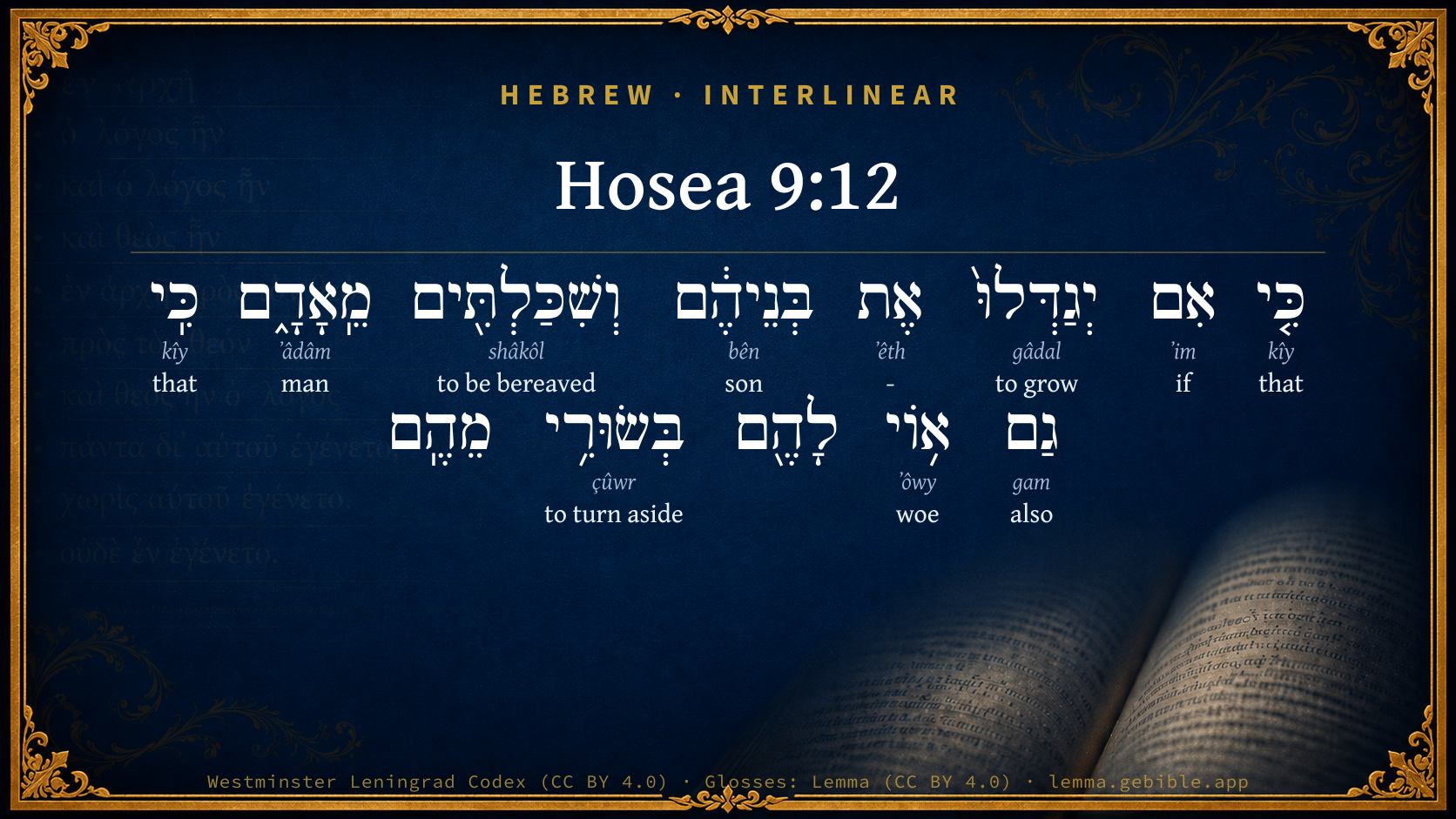
Hebrew (Westminster Leningrad Codex) Hosea 9:12 appears in the Hebrew Old Testament. The text above is from the Westminster Leningrad Codex. Each word links to its Strong’s number, a concise gloss, and parsing drawn from the Open Scriptures Hebrew Bible morphology. Click any word for its full Brown-Driver-Briggs (BDB) entry.
Download image
Cite this verse

Hosea 9:12 (World English Bible). Public Domain. Lemma interlinear Bible study tool, https://lemma.gebible.app/v/hosea/9/12.

Show BibTeX & RIS
BibTeX
RIS
English Translation
Though they bring up their children, Yet I will bereave them, so that not a man shall be left. Indeed, woe also to them when I depart from them!
World English Bible · Public Domain
Download a study sheet

One document with this verse’s original text, its word-by-word gloss line, the meaning frame, cross-references with their text, attributed commentary, and full source and license credits — printable, and it pastes into notes with its structure intact.

This verse Autodidact and up

Study sheet (.html) Plain text (.txt)

A passage Seminary Student

Up to 50 verses in one chapter. A passage sheet keeps up to 6 commentary sources and 12 cross-references per verse, in the order this page ranks them, and says so on the sheet whenever that leaves anything out. Ask for a single verse and you get the Autodidact verse sheet above.

Everything on this page stays free to read, with no account — the sheet is a download of what is already on screen, not access to it.

Want to remove ads? Support Godless Engineer
Compare translations 3

The same verse in 3 English versions, stacked beneath the original-language interlinear above. Click any original word for its lexicon entry.

Each is an independent rendering of the whole verse — the interlinear is not word-aligned to these translations.

Highlighted words mark where these versions differ — a whole-verse word diff, not a word-by-word alignment.

  • World English Bible Public Domain
    Though they bring up their children, Yet I will bereave them, so that not a man shall be left. Indeed, woe also to them when I depart from them!
  • King James Version Public Domain
    Though they bring up their children, yet will I bereave them, that there shall not be a man left: yea, woe also to them when I depart from them!
  • unfoldingWord Literal Text CC BY-SA 4.0
    Even if they raise their children, I will bereave them from a man. For indeed, woe to them when I turn away from them!

unfoldingWord Literal Text — © unfoldingWord, licensed CC BY-SA 4.0. Word-aligned USFM3 via Door43 (git.door43.org/unfoldingWord/en_ult).

Versions to compare (up to 4)

3 of 4 selected

Show all 18 translations

Every available English version of this verse, each an independent rendering of the whole verse.

  • World English Bible Public Domain
    Though they bring up their children, Yet I will bereave them, so that not a man shall be left. Indeed, woe also to them when I depart from them!
  • Berean Standard Bible Public Domain
    Even if they raise their children, I will bereave them of each one. Yes, woe be to them when I turn away from them!
  • Majority Standard Bible Public Domain
    Even if they raise their children, I will bereave them of each one. Yes, woe be to them when I turn away from them!
  • King James Version Public Domain
    Though they bring up their children, yet will I bereave them, that there shall not be a man left: yea, woe also to them when I depart from them!
  • American Standard Version (1901) Public Domain
    Though they bring up their children, yet will I bereave them, so that not a man shall be left: yea, woe also to them when I depart from them!
  • Revised Version (1885) Public Domain
    Though they bring up their children, yet will I bereave them, that there be not a man left: yea, woe also to them when I depart from them!
  • Geneva Bible (1599) Public Domain
    Though they bring vp their children, yet I will depriue them from being men: yea, woe to them, when I depart from them.
  • Douay-Rheims (1899) Public Domain
    And though they should bring up their children, I will make them without children among men: yea, and woe to them, when I shall depart from them.
  • Young's Literal Translation Public Domain
    For though they nourish their sons, I have made them childless -- without man, Surely also, wo to them, when I turn aside from them.
  • Literal Standard Version CC BY-SA 4.0
    For though they nourish their sons, I have made them childless—without man, || Surely also, woe to them when I turn aside from them.
  • Unlocked Literal Bible CC BY-SA 4.0
    Though they have brought up children, I will take them away so that none of them is left. Woe to them when I turn away from them!
  • unfoldingWord Literal Text CC BY-SA 4.0
    Even if they raise their children, I will bereave them from a man. For indeed, woe to them when I turn away from them!
  • Darby Bible Public Domain
    For even should they bring up their children, yet will I bereave them, [that] not a man [remain]: for woe also to them when I shall have departed from them!
  • World Messianic Bible Public Domain
    Though they bring up their children, yet I will bereave them, so that not a man shall be left. Indeed, woe also to them when I depart from them!
  • Webster's Bible Public Domain
    Though they bring up their children, yet will I bereave them, that there shall not be a man left: yes, woe also to them when I depart from them!
  • Free Bible Version CC BY-SA 4.0
    Even if they bring up children, I will make sure they do not survive. What a disaster for you when I turn away from you!
  • Bible in Basic English Public Domain
    Even though their children have come to growth I will take them away, so that not a man will be there; for their evil-doing will be complete and they will be put to shame because of it.
  • JPS Tanakh (1917) Public Domain
    Yea, though they bring up their children, yet will I bereave them, that there be not a man left; yea, woe also to them when I depart from them!

Literal Standard Version (2020), Covenant Press — licensed CC BY-SA 4.0. Text via the HelloAO Bible API (eBible.org). Unlocked Literal Bible (unfoldingWord) — licensed CC BY-SA 4.0. Text via the HelloAO Bible API (eBible.org). unfoldingWord Literal Text — © unfoldingWord, licensed CC BY-SA 4.0. Word-aligned USFM3 via Door43 (git.door43.org/unfoldingWord/en_ult). Free Bible Version, Dr. Jonathan Gallagher — licensed CC BY-SA 4.0. Text via the HelloAO Bible API (eBible.org).

Word by word

More ways to search: Search by grammar → Find every occurrence → Compare this word →

Practice this passage: Drill this verse → Learn its vocabulary →

וְשִׁכַּלְתִּ֖ים
shâkôl
H7921
“and · to be bereaved · them”
Conjunction + Verb, Piel, Sequential Perfect, 1st Person, Common, Singular + Suffix, Personal, 3rd Person, Masculine, Plural
Part of Speech
Conjunction + Verb
Stem
Piel
Form
Sequential Perfect
Person
1st Person
Gender
Common
Number
Singular
Full BDB Definition

Origin: a primitive root

TWOT: 2385

to be bereaved, make childless, miscarry - (Qal) to be bereaved - (Piel) - to make childless - to cause barrenness, show barrenness or abortion - to miscarry - (Hiphil) miscarrying (participle)
  1. כִּ֤י kîy H3588 “that” Conjunction
  2. אִם ʼim H518 “if” Conjunction
  3. יְגַדְּלוּ֙ gâdal H1431 “to grow” Verb, Piel, Imperfect, 3rd Person, Masculine, Plural
  4. אֶת ʼêth H853 “-” Particle, Direct Object
  5. בְּנֵיהֶ֔ם bên H1121 “sons · their” Noun, Common, Masculine, Plural, Construct + Suffix, Personal, 3rd Person, Masculine, Plural
  6. מֵֽאָדָ֑ם ʼâdâm H120 “from · man” Preposition + Noun, Common, Masculine, Singular, Absolute
  7. כִּֽי kîy H3588 “that” Conjunction
  8. גַם gam H1571 “also” Adverb
  9. א֥וֹי ʼôwy H188 “woe” Particle, Interjection
  10. בְּשׂוּרִ֥י çûwr H5493 “in/at · to turn aside · me” Preposition + Verb, Qal, Infinitive Construct + Suffix, Personal, 1st Person, Common, Singular

About this verse

These counts appear in no published source. They are computed here, from the morphology-tagged text and Lemma’s own curated glosses. What Lemma adds →

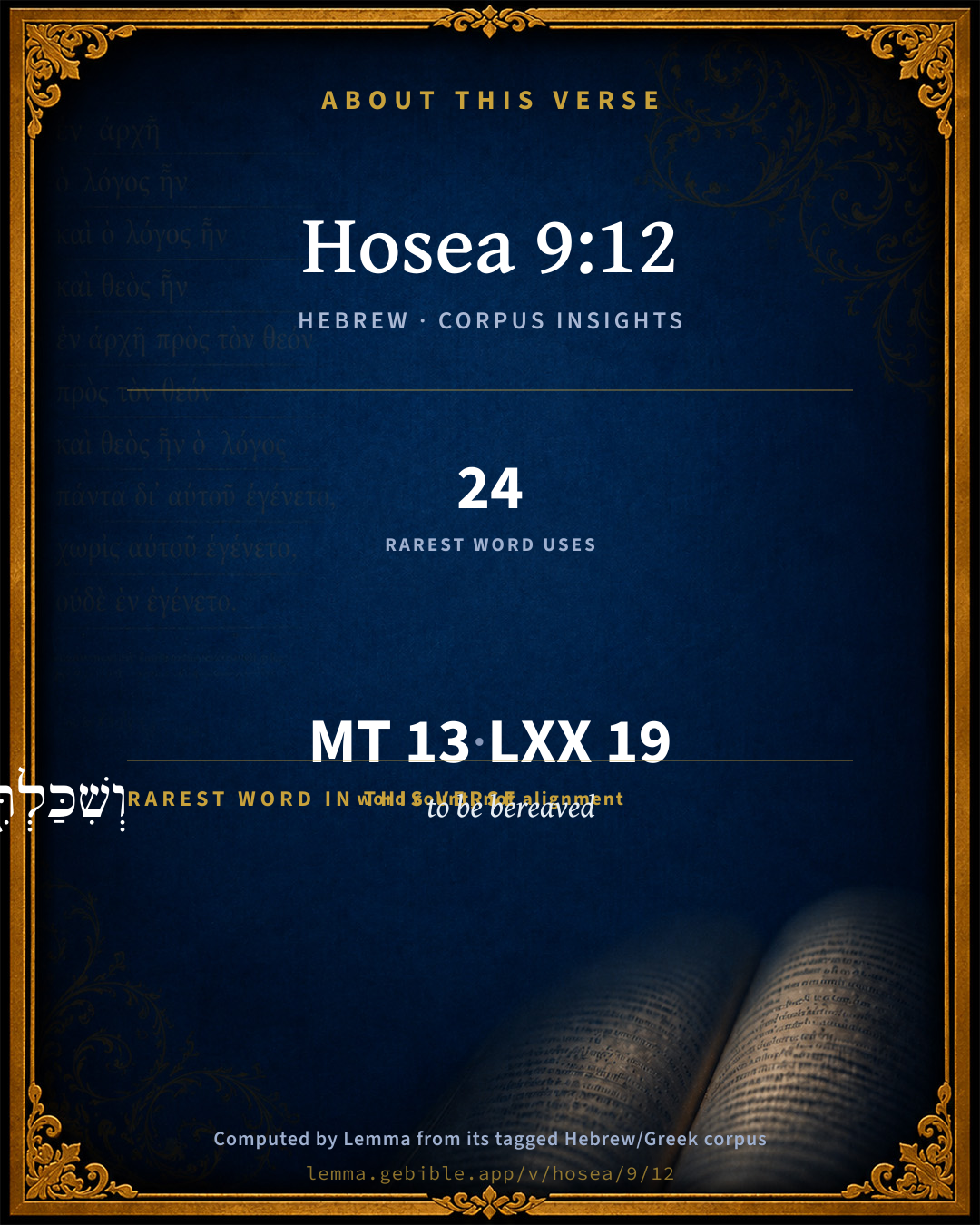
13
words
10
distinct lemmas
Prophets
section

Notable vocabulary

The rarest word here is וְשִׁכַּלְתִּ֖ים to be bereaved H7921 — appearing just 24 times in the whole Hebrew Bible.

Shared distinctive vocabulary

וְשִׁכַּלְתִּ֖ים to be bereaved H7921 occurs in 22 verses of the Hebrew Bible. Also found in:

Grammatical profile

  • 3 verbs
  • 2 nouns
  • 2 prepositions
  • 3 conjunctions
  • 1 adverb
  • 2 particles

Verb forms

  • יְגַדְּלוּ֙ Piel · Imperfect
  • וְשִׁכַּלְתִּ֖ים Piel · Sequential Perfect
  • בְּשׂוּרִ֥י Qal · Infinitive Construct

Repetition

A word recurs within this verse — often emphatic in Hebrew:

  • כִּ֤י that H3588 ×2

Hebrew & Septuagint length

In English translation the verse runs 29 words from the Hebrew and 27 from the Septuagint (LXX English) — closely comparable.

A rough comparison of the two English renderings, which tokenize alike — not a word-level alignment.

Word counts can differ between the Hebrew and the Greek without any difference in meaning — e.g. the Hebrew direct-object marker אֵת has no separate Greek word, and Greek often adds the article ὁ.

In the original languages it is 13 Hebrew tokens and 19 Greek tokens — but the two are counted differently (Hebrew bundles its prefixes and suffixes into one token; the Greek is in lemma form), so that isn’t a like-for-like length.

Cross-references

18

Topical passages linked to Hosea 9:12 in the Treasury of Scripture Knowledge — connected by theme and wording, ordered by reader-vote popularity; previews shown in the World English Bible.

  • Hosea 7:13 Woe to them! For they have wandered from me. Destruction to them! For they have trespassed against me. Though I would redeem them, Yet they have spoken lies against me.
  • Deuteronomy 31:17 Then my anger shall be kindled against them in that day, and I will forsake them, and I will hide my face from them, and they shall be devoured, and many evils and troubles shall come on them; so that they will say in that day, Haven't these evils come on us because our God is not among us?
  • Deuteronomy 32:25 Outside shall the sword bereave, In the chambers terror; [It shall destroy] both young man and virgin, The suckling with the man of gray hairs.
  • Hosea 9:16 Ephraim is struck. Their root has dried up. They will bear no fruit. Even though they bring forth, yet I will kill the beloved ones of their womb."
  • Numbers 26:65 For Yahweh had said of them, They shall surely die in the wilderness. There was not left a man of them, save Caleb the son of Jephunneh, and Joshua the son of Nun.
  • Deuteronomy 28:32 Your sons and your daughters shall be given to another people; and your eyes shall look, and fail with longing for them all the day: and there shall be nothing in the power of your hand.
  • Deuteronomy 28:41–42 You shall father sons and daughters, but they shall not be yours; for they shall go into captivity.
  • Judges 4:16 But Barak pursued after the chariots, and after the host, to Harosheth of the Gentiles: and all the host of Sisera fell by the edge of the sword; there was not a man left.
  • 1 Samuel 16:14 Now the Spirit of Yahweh departed from Saul, and an evil spirit from Yahweh troubled him.
  • 1 Samuel 28:15–16 Samuel said to Saul, Why have you disquieted me, to bring me up? Saul answered, I am sore distressed; for the Philistines make war against me, and God is departed from me, and answers me no more, neither by prophets, nor by dreams: therefore I have called you, that you may make known to me what I shall do.
  • 2 Kings 17:18 Therefore Yahweh was very angry with Israel, and removed them out of his sight: there was none left but the tribe of Judah only.
  • 2 Kings 17:23 until Yahweh removed Israel out of his sight, as he spoke by all his servants the prophets. So Israel was carried away out of their own land to Assyria to this day.
  • Job 27:14 If his children are multiplied, it is for the sword. His offspring shall not be satisfied with bread.
  • Jeremiah 15:7 I have winnowed them with a fan in the gates of the land; I have bereaved [them] of children, I have destroyed my people; they didn't return from their ways.
  • Jeremiah 16:3–4 For thus says Yahweh concerning the sons and concerning the daughters who are born in this place, and concerning their mothers who bore them, and concerning their fathers who became the father of them in this land:
  • Lamentations 2:20 Look, Yahweh, and see to whom you have done thus! Shall the women eat their fruit, the children that are dandled in the hands? Shall the priest and the prophet be killed in the sanctuary of the Lord?
  • Hosea 9:5–6 What will you do in the day of solemn assembly, And in the day of the feast of Yahweh?
  • Hosea 9:13 Ephraim, like I have seen Tyre, is planted in a pleasant place; But Ephraim will bring out his children to the killer.

Cross-references courtesy of OpenBible.info (CC BY 4.0).

Hebrew and Greek witnesses Masoretic Hebrew ↔ Greek Septuagint

The same verse in the two great witnesses to the Old Testament, shown verse-for-verse.

These are two independent witnesses, not word-aligned to each other, and the Septuagint is shown in lemma (dictionary) form.

Hebrew Hosea 9:12 Masoretic · Westminster Leningrad Codex

כִּ֤י אִם יְגַדְּלוּ֙ אֶת בְּנֵיהֶ֔ם וְשִׁכַּלְתִּ֖ים מֵֽאָדָ֑ם כִּֽי גַם א֥וֹי לָהֶ֖ם בְּשׂוּרִ֥י מֵהֶֽם

Though they bring up their children, Yet I will bereave them, so that not a man shall be left. Indeed, woe also to them when I depart from them!

World English Bible · Public Domain

Greek LXX Hosea 9:12 Septuagint · lemma form

διότι καί ἐάν ἐκτρέφω ὁ τέκνον αὐτός ἀτεκνόω ἐκ ἄνθρωπος διότι καί οὐαί αὐτός εἰμί σάρξ ἐγώ ἐκ αὐτός

For even if they should rear their children, yet shall they be utterly bereaved: therefore also there is woe to them, though my flesh is of them.

LXX2012 (modern English Septuagint) · Public Domain

On this verse, Haydock's Catholic Bible Commentary discusses the Septuagint’s reading. Read the note in Commentary ↓

Hebrew: Westminster Leningrad Codex (CC BY 4.0). Greek: Septuagint (public domain); English from LXX2012 (modern English Septuagint) (Public Domain). How the Septuagint differs from the Hebrew →

Targum (Aramaic paraphrase)

1

The Targum is the ancient Jewish Aramaic paraphrase of the Hebrew Scriptures — an interpretive translation, not the Hebrew text itself. Onkelos (literal) and Pseudo-Jonathan (expansive) render the Torah, and Jonathan the Prophets. Coverage is partial: where no permissively-licensed English translation exists for a verse, only the Aramaic is shown. This is verse-level text, not a word-by-word alignment to the Hebrew.

  1. Targum Jonathan Prophets (Joshua–Malachi)
    אֲרֵי אִם יִרְבּוּן יַת בְּנֵיהוֹן וְאַתְכְּלִינוּן מִלְמֶהֱוֵי גַבְרִין אֲרֵי וַי לְהוֹן בְּסַלָקוּתִי שְׁכִנְתִּי מִנְהוֹן:

    (no public-domain English translation for this verse)

    Targum Jonathan — Aramaic: “Mikraot Gedolot” (public domain). English: “Sefaria Community Translation” (CC0 1.0 (public-domain dedication)); “London "Chaldee Paraphrase," 1871” (public domain). Text via Sefaria.

Commentary

Notes on Hosea 9:12 from classic Christian and Jewish commentators (each source and its license shown beneath its notes). The classic Christian expositions comment on the surrounding passage and are grouped to its opening verse, so a note may address several verses; the Jewish commentaries on the Tanakh (Rashi and others) are per-verse, so they appear only where the commentator wrote on this verse.

Lemma curates 59 commentaries, every one of them public domain or Creative Commons licensed, each selected and text-cleaned for this edition rather than reprinted as found. About our sources →

Trapp's Complete Commentary

John Trapp

Hos 9:12 Though they bring up their children, yet will I bereave them, [that there shall] not [be] a man [left]: yea, woe also to them when I depart from them!

Ver. 12. Though they bring up children, yet will I bereave them] "If his children be multiplied, it is for the sword; and his offspring shall not be satisfied with bread," Job 27:14. This was fulfilled in Ahab’s seventy sons, beheaded together, 2Ki 10:6-7, in whom be had vainly promised himself the establishment of his house, which God had threatened to root out: in Jehu and his posterity after the fourth generation: those Romans that went out against the enemy at the Porta scelerata wicked gate, (as it was thereupon called) and never returned again; and that Eckius Raschachius, a German captain, at the siege of Buda, A.D. 1541, whose son, a valiant young gentleman, being got out of the army without his father’s knowledge, bare himself so gallantly in fight against the enemy, in the sight of his father and the army, that he was highly commended of all men, and especially of his father, that knew him not at all. Yet before he could clear himself he was compassed in by the enemy, and valiantly fighting, slain. Raschachius, exceedingly moved with the death of so brave a man, ignorant how near he touched himself, turning about to the other captains said, This worthy gentleman, whatsoever he be, is worthy of eternal commendation, and to be most honourably buried by the whole army. As the rest of the captains were with like compassion approving his speech, the dead body of the unfortunate son rescued, was presented to the most miserable father; which caused all them that were there present to shed tears. But such a sudden and inward grief surprised the aged father, and struck so to his heart, that after he had stood a while speechless, with his eyes set in his head, he suddenly fell down dead.

Yea, woe also to them when I depart from them] This is indeed worse than all the rest; this is that only evil spoken of by Ezekiel: hell itself is nothing else but a separation from God’s presence, with the ill consequents thereof; and the tears of hell are not sufficient to bewail the loss of that beautiful vision. How miserable was Cain when cast off by God! Saul, when forsaken of him! David, when deserted, though but for a few months! Job, for a few years, Suidas saith seven! While God was graciously with him, and prospered him, he was Jobab (that same mentioned Gen 36:34, as some think), but when under sense of God’s absence, contracted into Job. See the like, Gen 17:5 Rth 1:20. His desertion was far more comfortable than David’s; it was probational only, but David’s penal, for chastisement of some way of wickedness. O lay we hold upon God (as the spouse doth upon her Beloved), and cry, as the prophet did, "Lord, leave us not," Jer 14:9. If he seem to be about, and his back be turned, cry aloud after him, as the blind man in the Gospel did, till Jesus stood: set up thy note, as Micah did after his lost idols, Jdg 18:24. Ye have taken away my gods, saith he, and what have I more? as if he should have said, I esteem all that you have left me as nothing, now that my gods are gone. Jerusalem, the joy of the whole earth, pleased not Absalom, unless he might see David’s face. God was no sooner gone from Miriam but the leprosy appeared in her face. But of this before.

John Trapp, A Commentary or Exposition upon All the Books of the Old and New Testament (1647–1656) — public domain. Text from a community e-Sword module.

Jamieson, Fausset & Brown

Robert Jamieson, A. R. Fausset & David Brown

Even though they should rear their children, yet will I bereave them (the Ephraimites) of them (Job 27:14).

woe . . . to them when I depart--Yet the ungodly in their madness desire God to depart from them (Job 21:14; Job 22:17; Mat 8:34). At last they know to their cost how awful it is when God has departed (Deu 31:17; Sa1 28:15-16; compare Hos 9:11; Sa1 4:21).

Jamieson, Fausset & Brown — Commentary Critical and Explanatory on the Whole Bible (1871) — public domain (CC PDM 1.0). Text via the HelloAO Bible API.

Adam Clarke's Commentary

Verse 12. Though they bring up their children] And were they even to have children, I would bereave them of them; for, when I depart from them, they shall have all manner of wretchedness and wo.

Adam Clarke's Commentary on the Bible (1810–1826) — public domain. Text from a community e-Sword/MySword module.

John Calvin's Commentaries

He then adds, Though they shall bring up children, I will yet exterminate them, so that they shall not be men, or, before they grow up, as some expound the words. The meaning is, that though Ephraim then flattered himself, yet a dreadful ruin was at hand, which would extinguish the whole seed, so that there would be nothing remaining. But lest they should think that all was over, when the Lord had inflicted on them one punishment, he lays down three gradations; that God would slay them first in the birth, then extinguish them in the womb, and, lastly, before conception; but if he spared them, so that they would raise up children, it would yet be without advantage, inasmuch as God would take away the youths in the flower of their age. Thus, then he threatens entire destruction to the kingdom of Israel.

And, lastly, he closes the verse in these words, And surely woe will be to them when I shall depart from them The Prophet means by these words, that men become miserable and accursed, when they alienate themselves from God, and when God takes away from them his favour. After having mentioned especially the vengeance of Godwhich was at hand, he says here that the cause and occasion of all evils would be, that God would depart from them, inasmuch as they had previously renounced their faith in him. But we must bear in mind the reason why the Prophet added this clause, and that is, because wicked men dream, that though God be displeased, things will yet go on prosperously with them: for they neither ascribe adversities to the wrath of God, nor acknowledge the fountain of all blessings to be God’s free and paternal favour. As then profane men do not understand this truth, however much God may proclaim that he is an enemy to them, that he is armed to destroy them, they care nothing, but promise to themselves a prosperous fortune: until they feel the hand of God and the signs of destruction appear, they continue still secure. This is the reason why the Prophet says, that there is woe to men when God departs from them. Forasmuch, then, as Scripture teaches everywhere that every desirable thing comes and flows to us from the mere grace of God and his paternal favour, so the Prophet declares in this place, that men are miserable and accursed when God is angry with them. But it follows —

John Calvin's Commentaries (1540-1563) — public domain. Text from the Calvin Translation Society English edition (1840s-50s) via the Christian Classics Ethereal Library (ccel.org). Calvin's coverage is partial (roughly two-thirds of the Bible); uncommented books and verses are honest gaps, never fabricated. The 19th-century editor's footnotes and remarks are omitted so the notes are faithfully Calvin's own voice.

The Cambridge Bible for Schools and Colleges

gen. ed. J. J. S. Perowne

12. But what shall be the fate of the children already born? A lurid light is next thrown upon this.

Though] Rather, Yea, though.

bereave them] Or, ‘make them childless’; comp. 1Sa_15:33.

when I depart from them] Better, (reading with a Shin instead of a Sin), when I look away from them. The sense of the passage is, even to turn away my face would sink them in an abyss of ruin. The ordinary reading does not allow us easily to account for the ‘also’, or rather, ‘even’, which precedes.

The Cambridge Bible for Schools and Colleges (gen. ed. J. J. S. Perowne; Cambridge University Press, 1878–1918) — public domain. Text from a community e-Sword module.

John Gill's Exposition

Ephraim, as I saw Tyrus, is planted in a pleasant place,.... That is, either as the city of Tyre, a very famous city in Phoenicia, was situated in a very pleasant place by the sea, and abounded in wealth and riches, and was well fortified, and seemed secure from all danger, and from all enemies; so Ephraim or the ten tribes, the kingdom of Israel, were in like circumstances, equal to Tyre, as the Targum paraphrases it, in prosperity and plenty; yet as the prophet in the vision of prophecy saw that Tyre, notwithstanding all its advantages by power and wealth, by art and nature, would be destroyed, first by Nebuchadnezzar, and then by Alexander; so by the same prophetic spirit he saw that Ephraim or the ten tribes, notwithstanding their present prosperity, and the safety and security they thought themselves in, yet should be given up to ruin and destruction by the hand of the Assyrians; or it may be rendered thus, "Ephraim as", or "when I saw it, unto Tyre" (k); reaching unto that place, and bordering upon it, as part of the ten tribes did; I saw it, I observed it, took a survey of it, and I perceived it was "planted in a pleasant place"; like a tree planted in a fruitful soil, well rooted, and in a flourishing condition; so were they, abounding with all good things, and having a numerous offspring; from all which they promised themselves much happiness for ages to come:

but Ephraim shall bring forth his children to the murderer; to sacrifice them to Mo, as some; so the Targum,

"they of the house of Ephraim have sinned in slaying their children to the service of idols;''

with which Jarchi agrees; but rather the sense is, with Kimchi, and others, when their enemies shall come against them, as the Assyrian army, they shall go out with their sons to fight with them, and these shall be destroyed and murdered by them; it will be like leading lambs to the slaughter to be butchered and devoured by them.

(k) "quando vidi usque ad Tyrum", Schmidt.

John Gill's Exposition of the Whole Bible (1746–1763) — public domain (CC PDM 1.0). Text via the HelloAO Bible API.

Albert Barnes' Notes on the Bible

Though they bring up children - God had threatened to deprive them of children, in every stage before or at their birth. Now, beyond this, he tells them, as to those who should escape this sentence, he would bereave them of them, or make them childless.

That there shall not be a man left - Literally, “from man.” The brief word may be filled up, as the English Version has done (by not infrequent an idiom):

(1) “from there being a man;” or

(2) “from” among “men;” as Samuel said to Agag (1Sa 15:33; add Pro 30:14), “as thy sword has made women childless, so shall thy mother be childless among women;” or

(3) “from” becoming “men,” i. e., from reaching man’s estate.

The prophet, in any case, does not mcan absolute excision, for he says, “they shall be wanderers among the nations,” and had foretold, that they should abide, as they now are, and be converted in the end. But since their pride was in their numbers, he says, that these should be reduced in every stage from conception to ripened manhood. So God had forewarned Israel in the law, “If thou wilt not observe to do all the words of this law - ye shall be left few in number, whereas ye were as the stars of heaven for multitude” Deu 28:58, Deu 28:62. A sentence, felt the more by Ephraim, as being the head of the most powerful division of the people, and himself the largest portion of it.

Yea - (literally, “for”) woe also unto them, when I depart from them This is, at once, the ground and the completion of their misery, its beginning and its end. God’s departure was the source of all evil to them; as He foretold them, “I will forsake them, and I will hide My face from them, and they shall be devoured, and many evils and troubles shall befall them, so that they shall say in that day, Are not these evils come upon us, because our God is not among us?” Deu 31:17. But His departure was itself above all. For the prophet says also; “for woe also unto them.” This was the last step in the scale of misery. Beyond the loss of the children, whom they hoped or longed for, beyond the loss of their present might, and all their hope to come, there is a further undefined, unlimited, evil, “woe to them also,” when God should “withdraw,” not His care and providence only, but Himself also from them; “when I depart from them.” They had “departed” and turned away, from or “against” God (see the note at Hos 7:13). It had been their characteristic Hos 4:16. Now God Himself would requite them, as they had requited Him. He would depart from them. This is the last state of privation, which forms the “punishment of loss” in Hell. When the soul has lost God, what has it?

Albert Barnes' Notes on the Bible (1834–1885) — public domain. Text from a community e-Sword/MySword module.

Haydock's Catholic Bible Commentary

When. Septuagint Theodotion, "my flesh is taken from them," which Theodoret, Lyranus, &c., explain of the incarnation; but Aquila, &c., agree with the Vulgate which is more natural. (Calmet)

George Leo Haydock (1774–1849), Haydock's Catholic Family Bible and Commentary, 1859 edition — public domain. Excludes Psalms (Douay-Rheims chapter numbering differs from Protestant) and Deuterocanonical books (Catholic canon only).

Matthew Poole's English Annotations

Or suppose neither of these, but that their children live, grow up and come to some maturity, yet God, provoked by their sins, will deprive them of their children by famine; or by civil wars, which were long and bloody on each other; or by pestilence; or by captivity, and dispersing them among enemies, to whom they shall be slaves, and, as slaves, beget children not to themselves, but to their masters.

There shall not be a man left; there shall be a total extirpation of them and their memory; or else, I will cut them off from among men, as the phrase will bear.

Woe also to them when I depart from them! to complete their misery, I will leave them, I will depart from them. It is sad to lose children, it is sadder to lose their God.

Matthew Poole's English Annotations on the Holy Bible (1683–1685) — public domain. Text from a community e-Sword/MySword module.

Whedon's Commentary on the Bible

Daniel D. Whedon

12. The children already born will not escape.

Though — More accurately, Yea, though.

Bereave — Or, make childless (1Sa_15:33).

Not be a man left [“not a man shall be left”] — Children will not reach the age of manhood.

To them — Is interpreted most naturally as referring to the parents; they also will suffer.

When I depart from them — There is no need for changing the text so as to read, “I look away” (compare Hos_5:6; Hos_5:15).

Hos_9:13 presents grave linguistic difficulties. The thought which the English translators seek to express seems to be: At present Israel is flourishing like Tyre, but soon it will become desolate, for it must bring out its children to the slayer. Would the prophet express this thought in as awkward Hebrew as the verse now contains? LXX. reads a different, and in some respects a better text, and by its aid we may reconstruct the Hebrew so as to read, “Ephraim, according as I see, for prey has appointed his children; Ephraim — he must lead out his children to slaughter.” The reading becomes still smoother if according as I see is omitted. With these alterations Hos_9:13 becomes an expansion of Hos_9:11-12, setting forth the destruction of Ephraim’s youth in war.

Daniel D. Whedon (gen. ed.), Commentary on the Old and New Testaments (1874–1909) — public domain. Text from a community e-Sword module.

The Pulpit Commentary

Vers. 12-17. "The wicked shall not go unpunished.

If they escape one calamity, they are sure to be overtaken and overwhelmed by another.

I CALAMITY OF TWOFOLD KIND THREATENED. There is:

1. Bereavement, and that of a most painful nature. To be childless altogether, or to lose children in infancy, is sorrowful enough; but to be bereft of children when they have grown up to manhood or womanhood is an unspeakably greater sorrow. After labor, and trouble, and care, and thought have been expended in their upbringing; after all difficulties have been surmounted; and when sons have become like plants grown up in their youth, and daughters like corner-stones polished after the similitude of a palace; when the conduct of both is characterized by dutifulness, love, and obedience; and when parents naturally expect much help and comfort from them, and have their affections twined round them at such a time, to be deprived of them either by a sudden stroke, or by slow disease, is a condition more than ordinarily sorrowful. It is only the grace of God in large measure that can sustain and support parents so afflicted; while the exercise of grace on their part has no doubt compensatory blessings. The bereavement of Israel was to be complete-without a man left. If left, they might be left without the intellect of a man, or the physical strength of a man; they might be imbeciles or invalids, and thus in a worse condition than if not left at all.

2. But a still worse woe impends, namely, that of Divine desertion. This is God"s withdrawal from a people or a person. When he thus withdraws, he withdraws his goodness and mercy, common graces, gifts, and comforts. When this withdrawal takes place we are utterly helpless; as the king of Israel said to the poor woman who cried for help, "If the Lord do not help thee, whence shall I help thee?" or as the apparition of Samuel to Saul, "Wherefore then dost thou ask of me, seeing the Lord is departed from thee?" We may pass through fiery trials, or be plunged in the deep waters of affliction; but if we enjoy the Divine presence we need not be afraid. As long as the Lord of hosts is with us, and the God of Jacob is our Refuge, we need not fear the raging of the great sea-billows, or the upheaval of the mountains, or even the shock of the earthquake. The sorest of all troubles is to be forsaken by God. Oh, how sad the lot of a man who, forsaken by God, is left in the power of his enemies! "I am sore distressed," said the unhappy monarch; "for the Philistines make war against me, and God is departed from me.

II A COMPARISON INSTITUTED. Ephraim is compared to Tyro in prosperity, in position, in population, and in military prowess; and yet God was preparing to take his departure from them.

1. His presence maintains health, strength, and various other comforts; or if, in his wise providence, he sees fit to withdraw any of these, he sanctifies that withdrawal. But when God himself withdraws, then his mercies prepare for flight too; nor is any blessing left behind. Not only so; even when men are at the height of prosperity, as they think, God may be on the point of departing from them, as from Israel in the days of Jeroboam II, if we are right in referring this comparison of the prophet to that period.

2. How we should prize God"s presence and pray for its continuance, saying, "Leave us not," and avoid whatever would force or hasten his departure! But how may we be sure that he has not already forsaken us? The answer may be learned from the words of the psalmist: "I will keep thy statutes: oh, forsake me not utterly." As long as we are resolved to keep his statutes, we may have little fellowship with, but cannot be forsaken by, God.

3. How dreadful the doom of those from whom God has actually and already departed! It is like the withdrawal of the sun from the firmament. "Take a delightful summer"s day, and how beautiful it is! Now compare that with a winter"s dark, dismal night. What makes the difference between these two? The presence of the sun in the one, and its absence from the other. This is but the presence or the departing of one of God"s creatures. Oh! if that makes such a difference in the world, what must the presence or departing of the infinite God do to the soul?" In the case of Ephraim, their children are brought forth to the murderers not only murdered, but that murder perpetrated before the eyes of their parents. This seems the severest stroke of all. Even a heathen poet has most pathetically portrayed the extreme sadness of this condition in the death of Polites, a son of Priam, who addresses his murderer Pyrrhus in the well-known words: "May the gods, if there be any kind power in heaven to watch such deeds, yield you your due reward, who have defiled the father"s eyes by the sight of his son"s murder.

III COMMISERATION EXPRESSED. The prophet prays for his people, but seems straitened in his petitions, or rather he is at a loss to know what was most expedient for them and conducive to the Divine glory. He does not pray for peace, nor for deliverance, nor for prosperity. He dared not venture. He knew too well the sins of his countrymen, their abuse of the Divine mercies, their contempt of warning, their hardness of heart, their searedness of conscience, and their gross misuse of all means used for their recovery. No wonder he pauses and hesitates. He cannot pray for a numerous progeny to be vouchsafed to his people, or for children at all Better they should never come into the world at all than to be made the prey of the spoiler; better not to be born than to become victims of the murderer; better perish before birth or from the birth than live a life of sin and misery, and die a death of violence and hopelessness! At length, in view of the sinfulness of the people, the misery of times not far distant, and the fast-approaching calamities, he prays either that children might not be born at all, or that they might not be sustained so as long to survive their birth.

IV CRIMINALITY EXPOSED. We are here reminded of the plan of Israel"s criminal conduct, of the punishment of it, and of the princes who were ringleaders in it.

1. The place of their chief and greatest crimes was Gilgal. What a contrast: The place that testified to God"s greatest mercies also witnessed Israel"s greatest wickedness. In Gilgal the memorial stones were set up after the passage of the Jordan; in Gilgal the first Passover was celebrated after the Exodus; in Gilgal the rite of circumcision was renewed and the reproach of Egypt rolled away; in Gilgal Israel first ate the fruits of the promised land. Yet all their wickedness, their chief wickedness, was wrought there. There they threw off the government of God by judges, and would have Saul to be their king; there, in their superstition, they worshipped God instead of at Jerusalem, and thus trampled underfoot the Divine appointment. The more God signalizes a person or place by his mercies, the more severe his judgments on the wickedness of such. Every time God"s eye rested on Gilgal, a feeling of hatred was roused against the works and workers of iniquity there.

2. The punishment of their wickedness was expulsion. "Some sins," as has been said, "provoke God to anger, and some to grief, but some to hatred." "There I hated them." It is dreadful when our sins provoke hatred. This is the great difference between the sins of the saints and others. The sins of the saints may anger God, may grieve God, but the sins of others provoke God to hatred." That hatred manifests itself in their expulsion. They are driven out of God"s house, and so nationally unchurched as a disobedient and unruly child is driven out of his father"s house, or as a rebellious and unruly servant is turned out of the house of his master; while son and servant receive no more tokens of favor or good will.

3. Their princes, one and all, set the bad example of rebellion and revolt. As "like priest, like people," so like prince, like people. Persons in high places have it in their power to do much good or work much evil by their influence and example; for such they are responsible, and shall one day be called to account. Of every talent given us, whether health, or wealth, or influence, or opportunities of doing or getting good, we must all one day give an exact account.

V CONSUMPTION COMPLETED. A tree may lose its leaves, but a following spring will restore them; it may lose some of its branches in the process of pruning, but this will not prevent it growing again. Yea, "there is hope of a tree, if it be cut down, that it will sprout again, and that the tender branch thereof will not cease. Though the root thereof wax old in the earth, and the stock thereof die in the ground; yet through the scent of water it will bud, and bring forth boughs like a plant." So long as the root retains life, there is hope of the tree; but once the root is dried up and dead, ruin is inevitable. Thus Ephraim was smitten; thus many are smitten in just judgment from the Almighty. When the root is thus dried up, there can be no hope of fruit. If men will bear fruit to the world, or sin, or self, and not unto God, it is only just they should be left fruitless. If men will not bring up their children for God, training them in the nurture and admonition of the Lord, is it strange they should be left childless?

VI CASTAWAYS AMONG THE NATIONS. This is the condition in which Israel remains till the present day. They cast away the truth of God, and now they are cast away. They rejected the Son; for he came to his own realms, and his subjects received him not; now they are outcast. Note the cause: "Because they did not hearken unto him." This was regarded by Luther as a notable statement, and worthy to be written on all our walls. Bow often we find men hearkening to the counsels of the wicked, or to the suggestions of worldly policy, or to the temptations of the evil one, or to their own lusts and passions, but not to God! Let men beware of refusing to give audience to God. Let them beware of acting as if they did not hear with the ear, nor understand with the heart. Every Jew one meets is a warning of the danger of not hearkening to God. While every Jew is a living monument to the truth of Scripture, he is at the same time a proof of the calamity incurred by not hearkening to God. It is here predicted that they should be wanderers among the nations. The fulfillment of the prediction may be expressed in the sadly truthful words of the Hebrew melodyTribes of the wandering foot and weary breast, How shall ye flee away and be at rest! The wild dove hath her nest, the fox his cave, Mankind their country; Israel but the grave!

The Pulpit Commentary (1880–1919), ed. H.D.M. Spence-Jones & Joseph S. Exell — public domain. Text from a community e-Sword module.

John Wesley's Explanatory Notes

Not a man left - There shall be a total extirpation of them. When I depart - To compleat their misery, I will depart from them. It is sad to lose our children, but sadder to lose our God.

John Wesley, Explanatory Notes Upon the Whole Bible (1754–1765) — public domain. Text via the GEBible commentary corpus.

Rashi

Rabbi Shlomo Yitzchaki (Rashi)

for woe... also Woe to the fathers.

when I turn away from them Heb. בְּשוּרִי, like בְּסוּרִי, when I turn away from them. This is one of the words listed in the Masorah, which are spelled with a “sin” but read with a “sammech.” Another explanation: their honor shall fly away like a bird etc. Like this bird which flies away and is no more, so will their honor fly away and flee, all that they toiled with their children in birth, [in the womb,] and in conception. From birth This refers to the birth pangs. and from the womb This refers to the days of pregnancy. and from conception At the time of coitus. All this toil of theirs will end. How so? For, when they raise their children, I will bereave them.

Rashi on the Tanakh — English translations: “The Judaica Press complete Tanach with Rashi, translated by A. J. Rosenberg” (CC BY 4.0); “Pentateuch with Rashi's commentary by M. Rosenbaum and A.M. Silbermann, 1929-1934” (public domain); “The Metsudah Tanach series, Lakewood, N.J” (CC BY 4.0); and “The Book of Joshua, Metsudah Publications, 1997” (CC BY 4.0). Text via Sefaria.

Lesson kit

Teaching starters — assembled from the data on this page, not authored interpretation. Every prompt links to the verse data it draws on. Edit before teaching.

Hosea, in the Prophets, opens this verse with 13 words (10 distinct Hebrew lemmas). Its most distinctive word is shâkôl (“to be bereaved”). A historical commentator’s framing appears above. Read the whole chapter for the surrounding context.

Discussion questions

  1. How does “to be bereaved” (shâkôl) shape what this verse is saying?
  2. Genesis 27:45 shares the word «to be bereaved» with this verse. How do the two illuminate each other?
  3. “that” occurs 2× in this one verse. What is the effect of the repetition?
  4. These translations render this verse differently. What is at stake in choosing one wording over another?
  5. The verb «יְגַדְּלוּ֙» is Piel Imperfect. How does its form color the action?
  6. Reading how Trapp's Complete Commentary and Jamieson, Fausset & Brown read this verse, where do the two commentators agree and where do they part?

Things to notice

Reading settings

Reading text

Shown beneath each verse's original-language words.

Old Testament
Old Testament edition

Read the OT as the Masoretic Hebrew (MT) or the Greek Septuagint (LXX).

English shown for the Greek Septuagint (in the Hebrew ↔ Greek comparison).

Comparing translations? Open the Compare panel on any verse page to stack up to four side by side.