

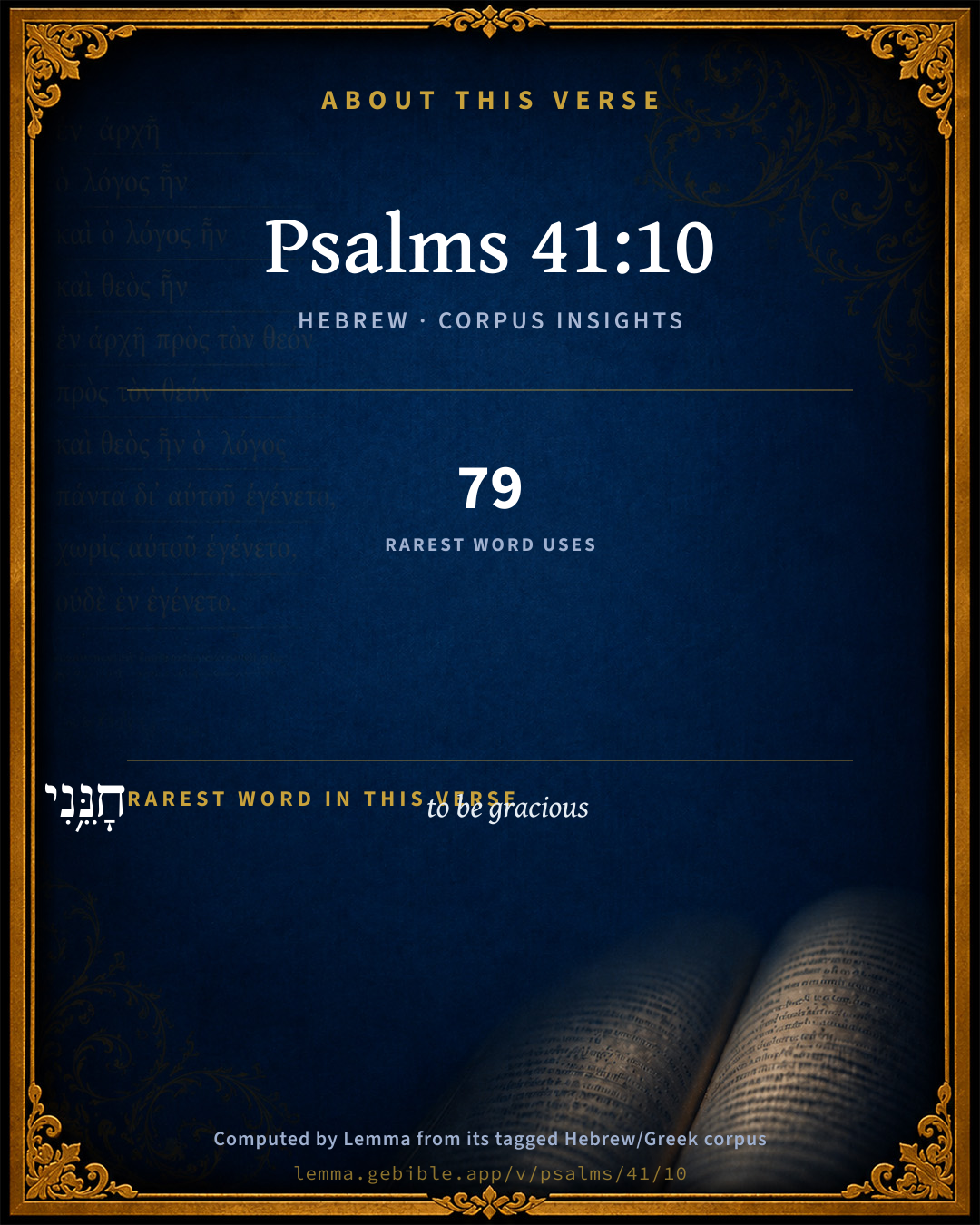
Psalms 41:10

Hebrew (Westminster Leningrad Codex) Psalms 41:10 appears in the Hebrew Old Testament. The text above is from the Westminster Leningrad Codex. Each word links to its Strong’s number, a concise gloss, and parsing drawn from the Open Scriptures Hebrew Bible morphology. Click any word for its full Brown-Driver-Briggs (BDB) entry.
Download image
Cite this verse

Psalms 41:10 (World English Bible). Public Domain. Lemma interlinear Bible study tool, https://lemma.gebible.app/v/psalms/41/10.

Show BibTeX & RIS
BibTeX
RIS
English Translation
But you, Yahweh, have mercy on me, and raise me up, That I may repay them.
World English Bible · Public Domain
Download a study sheet

One document with this verse’s original text, its word-by-word gloss line, the meaning frame, cross-references with their text, attributed commentary, and full source and license credits — printable, and it pastes into notes with its structure intact.

This verse Autodidact and up

Study sheet (.html) Plain text (.txt)

A passage Seminary Student

Up to 50 verses in one chapter. A passage sheet keeps up to 6 commentary sources and 12 cross-references per verse, in the order this page ranks them, and says so on the sheet whenever that leaves anything out. Ask for a single verse and you get the Autodidact verse sheet above.

Everything on this page stays free to read, with no account — the sheet is a download of what is already on screen, not access to it.

Want to remove ads? Support Godless Engineer
Compare translations 3

The same verse in 3 English versions, stacked beneath the original-language interlinear above. Click any original word for its lexicon entry.

Each is an independent rendering of the whole verse — the interlinear is not word-aligned to these translations.

Highlighted words mark where these versions differ — a whole-verse word diff, not a word-by-word alignment.

  • World English Bible Public Domain
    But you, Yahweh, have mercy on me, and raise me up, That I may repay them.
  • King James Version Public Domain
    But thou, O LORD, be merciful unto me, and raise me up, that I may requite them.
  • unfoldingWord Literal Text CC BY-SA 4.0
    But you, Yahweh, be gracious to me and raise me up, so that I may repay them.

unfoldingWord Literal Text — © unfoldingWord, licensed CC BY-SA 4.0. Word-aligned USFM3 via Door43 (git.door43.org/unfoldingWord/en_ult).

Versions to compare (up to 4)

3 of 4 selected

Show all 18 translations

Every available English version of this verse, each an independent rendering of the whole verse.

  • World English Bible Public Domain
    But you, Yahweh, have mercy on me, and raise me up, That I may repay them.
  • Berean Standard Bible Public Domain
    But You, O LORD, be gracious to me and raise me up, that I may repay them.
  • Majority Standard Bible Public Domain
    But You, O LORD, be gracious to me and raise me up, that I may repay them.
  • King James Version Public Domain
    But thou, O LORD, be merciful unto me, and raise me up, that I may requite them.
  • American Standard Version (1901) Public Domain
    But thou, O Jehovah, have mercy upon me, and raise me up, That I may requite them.
  • Revised Version (1885) Public Domain
    But thou, O LORD, have mercy upon me, and raise me up, that I may requite them.
  • Geneva Bible (1599) Public Domain
    Therefore, O Lord, haue mercy vpon mee, and raise me vp: so I shall reward them.
  • Douay-Rheims (1899) Public Domain
    For even the man of peace, in whom I trusted, who ate my bread, hath greatly supplanted me.
  • Young's Literal Translation Public Domain
    And Thou, Jehovah, favour me, And cause me to rise, And I give recompence to them.
  • Literal Standard Version CC BY-SA 4.0
    And You, YHWH, favor me, || And cause me to rise, || And I give repayment to them.
  • Unlocked Literal Bible CC BY-SA 4.0
    But you, Yahweh, have mercy on me and raise me up so that I may pay them back.
  • unfoldingWord Literal Text CC BY-SA 4.0
    But you, Yahweh, be gracious to me and raise me up, so that I may repay them.
  • Darby Bible Public Domain
    But thou, Jehovah, be gracious unto me, and raise me up, that I may requite them.
  • World Messianic Bible Public Domain
    But you, LORD, have mercy on me, and raise me up, that I may repay them.
  • Webster's Bible Public Domain
    \\41:9\\Yes, my own familiar friend, in whom I trusted, who ate of my bread, hath lifted up his heel against me.
  • Free Bible Version CC BY-SA 4.0
    But you Lord, please be gracious to me, make me well so I can repay them!
  • Bible in Basic English Public Domain
    But you, O Lord, have mercy on me, lifting me up, so that I may give them their punishment.
  • JPS Tanakh (1917) Public Domain
    (41-11) But Thou, O LORD, be gracious unto me, and raise me up, that I may requite them.

Literal Standard Version (2020), Covenant Press — licensed CC BY-SA 4.0. Text via the HelloAO Bible API (eBible.org). Unlocked Literal Bible (unfoldingWord) — licensed CC BY-SA 4.0. Text via the HelloAO Bible API (eBible.org). unfoldingWord Literal Text — © unfoldingWord, licensed CC BY-SA 4.0. Word-aligned USFM3 via Door43 (git.door43.org/unfoldingWord/en_ult). Free Bible Version, Dr. Jonathan Gallagher — licensed CC BY-SA 4.0. Text via the HelloAO Bible API (eBible.org).

Word by word

More ways to search: Search by grammar → Find every occurrence → Compare this word →

Practice this passage: Drill this verse → Learn its vocabulary →

חָנֵּ֥נִי
chânan
H2603
“be gracious · me”
Verb, Qal, Imperative, 2nd Person, Masculine, Singular + Suffix, Personal, 1st Person, Common, Singular
Part of Speech
Verb
Stem
Qal
Form
Imperative
Person
2nd Person
Gender
Masculine
Number
Singular
Full BDB Definition

Origin: a primitive root [compare H2583 ]

TWOT: 694 , 695

to be gracious, show favour, pity - (Qal) to show favour, be gracious - (Niphal) to be pitied - (Piel) to make gracious, make favourable, be gracious - (Poel) to direct favour to, have mercy on - (Hophal) to be shown favour, be shown consideration - (Hithpael) to seek favour, implore favour - to be loathsome
  1. וְאַתָּ֤ה ʼattâh H859 “and · you” Conjunction + Pronoun, Personal, 2nd Person, Masculine, Singular
  2. יְהוָ֗ה Yᵉhôvâh H3068 “LORD” Noun, Proper
  3. וַהֲקִימֵ֑נִי qûwm H6965 “and · rise · me” Conjunction + Verb, Hiphil, Imperative, 2nd Person, Masculine, Singular + Suffix, Personal, 1st Person, Common, Singular
  4. וַֽאֲשַׁלְּמָ֥ה shâlam H7999 “and · to be at peace” Conjunction + Verb, Piel, Cohortative, 1st Person, Common, Singular

About this verse

These counts appear in no published source. They are computed here, from the morphology-tagged text and Lemma’s own curated glosses. What Lemma adds →

6
words
5
distinct lemmas
Wisdom
section

Grammatical profile

  • 3 verbs
  • 1 noun
  • 1 pronoun
  • 1 preposition

Verb forms

  • חָנֵּ֥נִי Qal · Imperative
  • וַהֲקִימֵ֑נִי Hiphil · Imperative
  • וַֽאֲשַׁלְּמָ֥ה Piel · Cohortative

Hebrew & Septuagint length

In English translation the verse runs 16 words from the Hebrew and 17 from the Septuagint (LXX English) — closely comparable.

A rough comparison of the two English renderings, which tokenize alike — not a word-level alignment.

Word counts can differ between the Hebrew and the Greek without any difference in meaning — e.g. the Hebrew direct-object marker אֵת has no separate Greek word, and Greek often adds the article ὁ.

Cross-references

1

Topical passages linked to Psalms 41:10 in the Treasury of Scripture Knowledge — connected by theme and wording, ordered by reader-vote popularity; previews shown in the World English Bible.

  • Luke 19:27 But bring those enemies of mine who didn't want me to reign over them here, and kill them before me.'"

Cross-references courtesy of OpenBible.info (CC BY 4.0).

Hebrew and Greek witnesses Masoretic Hebrew ↔ Greek Septuagint

The same verse in the two great witnesses to the Old Testament, shown verse-for-verse.

You’re reading Greek Psalm 40 (Hebrew Psalm 41). The Septuagint counts the superscription, so verse numbers can differ from the Hebrew — chapter-level alignment, not verse-by-verse. Numbering follows Rahlfs.

These are two independent witnesses, not word-aligned to each other, and the Septuagint is shown in lemma (dictionary) form.

Hebrew Psalms 41:10 Masoretic · Westminster Leningrad Codex

וְאַתָּ֤ה יְהוָ֗ה חָנֵּ֥נִי וַהֲקִימֵ֑נִי וַֽאֲשַׁלְּמָ֥ה לָהֶֽם

But you, Yahweh, have mercy on me, and raise me up, That I may repay them.

World English Bible · Public Domain

Greek LXX Greek Psalm 40:10 Septuagint · lemma form

καί γάρ ὁ ἄνθρωπος ὁ εἰρήνη ἐγώ ἐπί ὅς ἐλπίζω ὁ ἐσθίω ἄρτος ἐγώ μεγαλύνω ἐπί ἐγώ πτερνισμός

But you, O Lord, have compassion upon me, and raise me up, and I shall requite them.

LXX2012 (modern English Septuagint) · Public Domain

Hebrew: Westminster Leningrad Codex (CC BY 4.0). Greek: Septuagint (public domain); English from LXX2012 (modern English Septuagint) (Public Domain). How the Septuagint differs from the Hebrew →

Commentary

Notes on Psalms 41:10 from classic Christian and Jewish commentators (each source and its license shown beneath its notes). The classic Christian expositions comment on the surrounding passage and are grouped to its opening verse, so a note may address several verses; the Jewish commentaries on the Tanakh (Rashi and others) are per-verse, so they appear only where the commentator wrote on this verse.

Lemma curates 59 commentaries, every one of them public domain or Creative Commons licensed, each selected and text-cleaned for this edition rather than reprinted as found. About our sources →

Trapp's Complete Commentary

John Trapp

Psa 41:10 But thou, O LORD, be merciful unto me, and raise me up, that I may requite them.

Ver. 10. But thou, O Lord, be merciful unto me] As storms beat a ship into the harbour, so did men’s misusages drive David to God; and as children, meeting with hard measure abroad, hie home to their parents, so here.

And raise me up] From off this bed of weakness, and from under their feet of insolence and cruelty.

That I may requite them] Not in a way of private revenge (for that was utterly unlawful, and would not bear a prayer), but of justice, as I am a king, and a lawful magistrate. The fear of this might haply make Ahithophel (foreseeing that all would be naught on Absalom’s side) to save the hangman a labour.

John Trapp, A Commentary or Exposition upon All the Books of the Old and New Testament (1647–1656) — public domain. Text from a community e-Sword module.

Joseph Benson's Commentary

Psa 41:10. But thou, O Lord, be merciful unto me — They censure me grievously, and conclude my case to be desperate; but, Lord, do thou vindicate me, and confute them. Raise me up, that I may requite them — Hebrew, ואשׁלמה, veashallemah, and I will requite them, that is, punish them for their malicious, perfidious, and wicked practices, which, being now a magistrate, it was his duty to do, for the public good. For he was not to bear the sword in vain, but, being a minister of God, invested with his authority, was to be a revenger, to execute wrath upon those that did evil, Rom 13:4; although, when a private person, he was so far from revenging himself that he rendered good for evil, Psa 35:12-13. In this prayer of David, that God would raise him up, is included a prophecy of the exaltation of Christ, whom God raised from the dead, that he might be a just avenger of all the wrongs done to him and to his people, particularly by the Jews, whose utter destruction followed not long after. Thus, “the hour is coming when the church shall arise to glory, and all her enemies shall be confounded.” — Horne.

Joseph Benson's Commentary on the Old and New Testaments (1811–1818) — public domain. Text from a community e-Sword module.

J. A. Alexander on Psalms

Joseph Addison Alexander

11. (Psa 41:10). And thou, Jehovah, have mercy upon me, and cause me to arise, and I will repay them. The connection between this verse and the one before it can be fully expressed in English only by a but at the beginning of the sentence. The pronoun is emphatic, thou, on thy part, as distinguished from these spiteful enemies. He here resumes the prayer begun in Psa 41:5 (4), and interrupted by the description of the malice of his enemies. Make me to rise, help me up from this bed of weakness and suffering, with obvious allusion to their having said that he would never rise again, Psa 41:9 (8). "O Lord, do what they pronounce impossible." The last words of this verse seem at first sight inconsistent with the Christian doctrine of forgiveness, as laid down in Mat 5:39-40, Rom 12:19. (Compare 1Pe 2:23.) But as this is also an Old Testament doctrine (see Pro 20:22), as David himself recognised the principle, Psa 7:5 (4), and acted on it, as appears from 2Sa 19:24 (23), the disagreement can be only an apparent one. It may be partially removed by observing that the speaker here is neither Christ nor David in his proper person, but an ideal character, representing the whole class of righteous sufferers, so that what is here said really amounts to little more than a prediction that the malignant persecutors of this class shall be requited. In the next place, let it be observed that it is not said how he will repay them, whether by punishment or by heaping coals of fire upon their heads, according to Solomon's and Paul's directions. (Pro 25:21-22, Rom 12:20-21.) Lastly, the rule laid down by Christ himself admits of righteous retribution, not only on the part of magistrates and rulers, but of private persons, where the means employed are lawful in themselves, and where their use is prompted, not by selfish pride or a revengeful malice, but by a desire to prevent a greater evil, to assert God's honour, and even to benefit the offender himself.

Joseph Addison Alexander, The Psalms Translated and Explained (1850) — public domain. Text from a community e-Sword module.

Jamieson, Fausset & Brown

Robert Jamieson, A. R. Fausset & David Brown

A lawful punishment of criminals is not revenge, nor inconsistent with their final good (compare Psa 40:14-15).

Jamieson, Fausset & Brown — Commentary Critical and Explanatory on the Whole Bible (1871) — public domain (CC PDM 1.0). Text via the HelloAO Bible API.

Adam Clarke's Commentary

Verse 10. Raise me up] Restore me from this sickness, that I may requite them. This has also been applied to our Lord; who, knowing that he must die, prays that he may rise again, and thus disappoint the malice of his enemies.

Adam Clarke's Commentary on the Bible (1810–1826) — public domain. Text from a community e-Sword/MySword module.

John Calvin's Commentaries

10 Do thou, O Jehovah I have mercy upon me. From a consideration of the wrongful cruelty of his enemies, he again takes encouragement to pray. And there is included in what he says a tacit contrast between God and men; as if he had said, Since there is to be found no aid or help in the world, but as, on the contrary, a strange degree of cruelty, or secret malice, every where prevails, be thou, at least, O Lord! pleased to succor me by thy mercy. This is the course which ought to be pursued by all the afflicted, whom the world unjustly persecutes; that is to say, they ought not only to occupy themselves in bewailing the wrongs which are done them, but they ought also to commend their cause to God: and the more Satan endeavors to overthrow their faith, and to distract their thoughts, the more should they fix their minds attentively on God alone. In using such language, the Psalmist again ascribes his restoration to the mercy of God as its cause. What he says in the concluding clause of the verse of taking vengeance seems harsh and unaccountable. If he confessed truly and from the heart, in the preceding part of the psalm, that God was just in thus afflicting him, why does he not extend forgiveness to others, as he desires that forgiveness should be granted to himself? Surely it were a shameful abuse of the grace of God, if, after having been restored and pardoned by him, we should refuse to follow his example in showing mercy. Besides, it would have been a feeling far removed from that of humility or kindness, for David, even while he was yet in the midst of death, to have desired revenge. But here two things are to be taken into account: First, David was not as one of the common people, but a king appointed by God, and invested with authority; and, secondly, It is not from an impulse of the flesh, but in virtue of the nature of his office, that he is led to denounce against his enemies the punishment which they had merited. If, then, each individual indiscriminately, in taking vengeance upon his enemies, should allege the example of David in his own defense, it is necessary, first, to take into account the difference which subsists between us and David, by reason of the circumstances and position in which he was placed by God; and, secondly, it is necessary to ascertain whether the same zeal which was in him reigns also in us, or rather, whether we are directed and governed by the same divine Spirit. David, being king, was entitled, in virtue of his royal authority, to execute the vengeance of God against the wicked; but as to us our hands are tied. In the second place, As he represented the person of Christ, so he cherished in his heart pure and holy affections: and hence it is, that, in speaking as he does in this verse, he indulged not his own angry spirit, but fulfilled faithfully the duties of the station to which he had been called of God. In short, in acting thus, he executed the righteous judgment of God, just in the same way as it is lawful for us to pray that the Lord himself would take vengeance upon the ungodly; for, as we are not armed with the power of the sword, it is our duty to have recourse to the heavenly Judge. At the same time, in beseeching him to show himself our guardian and defender, by taking vengeance on our enemies, we must do so in a calm and composed state of mind, and exercise a watchful care lest we should give too loose reins to our desires, by casting off the rule prescribed by the Spirit. As to David, the duties of his station required that he should employ means for subduing the rebellious, and that he should be truly the minister of God in inflicting punishment upon all the wicked.

John Calvin's Commentaries (1540-1563) — public domain. Text from the Calvin Translation Society English edition (1840s-50s) via the Christian Classics Ethereal Library (ccel.org). Calvin's coverage is partial (roughly two-thirds of the Bible); uncommented books and verses are honest gaps, never fabricated. The 19th-century editor's footnotes and remarks are omitted so the notes are faithfully Calvin's own voice.

The Cambridge Bible for Schools and Colleges

gen. ed. J. J. S. Perowne

10. But thou, O Jehovah, in contrast to their malignity, be thou gracious unto me: though they say ‘he shall rise up no more,’ raise me up.

that I may requite them] The words have a vindictive ring, which is startling, and seems inconsistent with Psa_7:4; Pro_20:22. Yet if the speaker was David, conscious of his divine appointment to be king, he might well pray that he might be restored to punish traitors as they deserved. For the most part he would leave vengeance to Jehovah (1Sa_25:33; 2Sa_3:39), yet in this instance he might feel that he would be acting as Jehovah’s instrument, in punishing those who were conspiring to resist His purposes. See Introd. p. xc f.

10–12. After describing his urgent need, the Psalmist resumes his prayer from Psa_41:4, and affirms his confident assurance of God’s favour.

The Cambridge Bible for Schools and Colleges (gen. ed. J. J. S. Perowne; Cambridge University Press, 1878–1918) — public domain. Text from a community e-Sword module.

John Gill's Exposition

But thou, O Lord, be merciful unto me, and raise me up,.... Not from a bed of illness, nor from a state of poverty and want; but from the dead: it was by the will of his divine Father that he suffered death, and it was to him he made satisfaction and reconciliation for the sins of his people, by his sufferings and death; and therefore it was but a reasonable request, that, having done this, he should be raised from the dead: besides, his Father had promised it, and he had believed it; so that this prayer was a prayer of faith, founded upon a divine promise; and the resurrection of Christ is for the most part ascribed to God the Father as his act; though not to the exclusion of the Son, who had power, as to lay down his life, so to take it up again; and though the resurrection of Christ from the dead is not only an act of power, but also of justice, he having paid his people's debts, atoned for their sins, and satisfied law and justice, it was but right and equitable that he should be discharged from the prison of the grave, and set free; yet here it is requested as an act of mercy, grace, and kindness; for, by doing it, it would appear that his Father's wrath was taken away from him, and that he had turned himself from the fierceness of his anger to him, and that he was well pleased with his righteousness and sacrifice; besides, it was giving him glory, as well as rolling away the reproach he lay under; and, however, it was in mercy to his body the church, whom he represented, since it was for their justification; nay, their regeneration is influenced by it; and so is the resurrection of their bodies, of which Christ's resurrection is the pledge and pattern. The end Christ had in view in making the request follows;

that I may requite them: not "him", Judas, last mentioned; for justice pursued and overtook him; he destroyed himself, and was gone to his own place, before Christ's resurrection from the dead; but them, the Jews, as a body; his enemies that spoke ill of him, wished ill to him, conspired against him, to take away his life, and did bring him to the dust of death: and this his requital of them, after his resurrection, was either of good for evil, by ordering his disciples to preach his Gospel, first at Jerusalem, to those very persons who were concerned in his death, many of whom were converted, baptized, and added to the church; or of evil, for their evil to him, which had its accomplishment in part, at the destruction of Jerusalem, and will more fully at the day of judgment, when they that have pierced him shall see him come in the clouds of heaven.

John Gill's Exposition of the Whole Bible (1746–1763) — public domain (CC PDM 1.0). Text via the HelloAO Bible API.

Albert Barnes' Notes on the Bible

But thou, O Lord, be merciful unto me - That is, give me strength; restore me from my sickness and weakness.

And raise me up - From my bed of languishing.

That I may requite them - That I may repay them; or may recompense them. The word used here - שׁלם shālam - means properly, to be whole, sound, safe; then, in Piel, to make secure, or preserve in safety; and then, to complete, to make whole, to make good, to restore; and then, to make whole or to complete in the sense of recompensing or requiting: to make the matter equal. It would be well expressed here by the familiar language, “giving them what they deserve.” But it is not necessary to understand this as indicating an unforgiving spirit. The writer may have meant to say that the persons who demeaned themselves in this manner ought to be punished; that the public good required it; and being a magistrate, he spoke as one appointed to administer the laws, and prayed for a restoration to strength, that he might administer justice in this and in all similar cases. It is possible also that he meant to say he would repay them by “heaping coals of fire on their heads” - by acts of kindness in place of the wrongs that they had done him (see Pro 25:21-22; compare Rom 12:20-21); though I admit, that this is not the obvious interpretation. But in order to show that this was uttered with a bad spirit, and under the promptings of revenge, it would be necessary to show that neither of these supposable interpretations could be the true one. It may be added here that we may not be required to vindicate all the expressions of personal feeling found in the Psalms in order to any just view of inspiration. See General Introduction, 6 (6).

Albert Barnes' Notes on the Bible (1834–1885) — public domain. Text from a community e-Sword/MySword module.

Matthew Poole's English Annotations

Be merciful unto me: they censure me grievously, and conclude my case to be desperate; but, Lord, do thou vindicate me, and confute them.

That I may requite them; or, and I will requite them, i.e. punish them for their malicious, and perfidious, and wicked practices; which, being now a magistrate, he was obliged to revenge, Rom 13:4; although when he was a private person, he was so far from revenging evil, that he rendered good for it, as we see, Psa 35:12,13, and elsewhere.

Matthew Poole's English Annotations on the Holy Bible (1683–1685) — public domain. Text from a community e-Sword/MySword module.

The Treasury of David

Charles H. Spurgeon

Ver. 10. But thou, O Lord, be merciful unto me. How the hunted and affrighted soul turns to her God! How she seems to take breath with a "but, thou!" How she clings to the hope of mercy from God when every chance of pity from man is gone! And raise me up. Recover me from my sickness, give me to regain my position. Jesus was raised up from the grave; his descent was ended by an ascent. That I may requite them. This as it reads is a truly Old Testament sentence, and quite aside from the spirit of Christianity, yet we must remember that David was a person in magisterial office, and might without any personal revenge, desire to punish those who had insulted his authority and libelled his public character. Our great Apostle and High Priest had no personal animosities, but even he by his resurrection has requited the powers of evil, and avenged on death and hell all their base attacks upon his cause and person. Still the strained application of every sentence of this Psalm to Christ is not to our liking, and we prefer to call attention to the better spirit of the gospel beyond that of the old dispensation.

Ver. 10. That I may requite them. Either (1), kindness for injuries (as in Ps 35:13): it is the mark of a good and brave man to do good to all in his power, to hurt no one, even though provoked by wrong: or, (2), punishment for wrong doingthat I may punish them; for am I not their magistrate, and the executioner of God's justice! Martin Geier.

Ver. 10. That I may requite them. David was not as one of the common people, but a king appointed by God and invested with authority, and it is not from an impulse of the flesh, but in virtue of the nature of his office, that he is led to denounce against his enemies the punishment which they had merited. John Calvin.

Charles H. Spurgeon's The Treasury of David (1869–1885) — public domain. Psalms only. Text from a community e-Sword/MySword module.

Whedon's Commentary on the Bible

Daniel D. Whedon

10. That I may requite them—Their sin was high treason, which by the laws of all nations is punishable with death. But as they had conspired against the throne of David no less than against his person, the issue lay primarily between them and God, who had anointed David as king, and promised perpetuity to his dynasty. The stability of government, involving the public welfare, demanded that proper notice should be taken of their proceedings.

Daniel D. Whedon (gen. ed.), Commentary on the Old and New Testaments (1874–1909) — public domain. Text from a community e-Sword module.

The Pulpit Commentary

But thou, O Lord, be merciful unto me (comp. ver. 4). The writer passes from complaint to prayer, and once more calls on God to deliver him. And raise me up. Falsify the prediction of my enemies (ver. 8); raise me up from my sick-bed, and re-establish me in a position of authority. That I may requite them. This was not private revenge, but David"s duty as a king. (Rom_13:4)

Vers. 10-12. He prays against his enemies.

(Cf. homily on Ps 35) C.

Vers. 10-12. Influence.

This passage may suggest to us some thoughts as to influence. We have all the power of influencing others for good or for evil. This is the necessary result of our being and relationships. Our chief influence will be upon those with whom we are most closely associated; but we also influence others, often unconsciously. You cannot pay a visit, or reside for a short time in a district, without making some impression upon those you meet, and leaving them the better or the worse for having known you. There are differences as to the way people judge. Some over-estimate themselves. They have a high opinion of their own importance. You might think, from the way they talk, that the world could not get on without them. Others under-estimate themselves. They are poor, and think they can do nothing. They are modest and humble-minded, and set little value on what they can effect. Or it may be they have met with disappointments and reverses, and have lost hope. They have laboured in vain, and have not the heart to try again. It is well to remember that we have this awful power of influencing others, and while we confess our responsibility, we should be careful so to live and act as that our influence shall be for good, and not for evil; a blessing, and not a curse. How is this to be secured?

I BY LIVING NEAR TO GOD. It is as God is merciful to us, and raises us up, bringing us nearer to himself, that we are able to "requite" others, not after the desire of our own evil hearts, but after the loving way of God (ver. 10; Mat_5:45-48). Pray God, that he may set you "before his face" (ver. 13), and then as you receive his grace, you will reflect his goodness; as you rejoice in the light of his presence, you will bring sunshine into many a shady place, and hope to many a troubled heart.

II BY HAVING A HIGH STANDARD OF DUTY. We must not make custom, or convenience, or the etiquette of the world, our rule, but we must learn the "perfect will of God" from Christ. The more loyal we are to our highest ideals, the more shall we gain of moral force, and the greater will be our power of doing good to others. Character settles influence. It is the salt that is good, and not the salt that has lost its savour, that is fit for use. It is the man who has the Spirit of Christ, and not the man who minds earthly things, who is the greatest force in the world. How weak was Lot as compared with Abraham!

III BY DOING OUR WORK FAITHFULLY IN OUR SEVERAL PLACES. People are influenced more by what others do than by what they say. Example is better than precept. If there be a man of undoubted "integrity," he is not only respected, but his daily life has a salutary effect upon those with whom he is associated. It is the man we trust that we are disposed to follow. How many are there who do their duty quietly and unobtrusively, and who are never heard or" far from home, who yet prove a blessing in the society with which they are connected! Their lives are prayers towards God, and powers for good towards men. Virtue goes out of them, even when they know it not. God"s favour is upon them, and they grow in favour with men.

IV BY CULTIVATION OF THE SPIRIT OF BROTHERLY KINDNESS AND LOVE. Much depends upon the spirit that is in us, because our spirit determines our actions, and our actions are seen of men, and have their effect upon their minds. If we are proud and selfish, we cannot win the hearts of others. But if we are self-forgetful and kind, our influence will be beneficial. There are some who try to do good, but hold themselves aloof, and their efforts are of little avail. Let us strive, therefore, to follow Christ (Joh_13:12-15) humbly, lovingly, patiently, doing good as we have opportunity, and, above all, living ourselves according to the law of godliness, and let us leave results with God. W.F.

The Pulpit Commentary (1880–1919), ed. H.D.M. Spence-Jones & Joseph S. Exell — public domain. Text from a community e-Sword module.

John Wesley's Explanatory Notes

Requite - Punish them for their wicked practices; which being now a magistrate, he was obliged to do.

John Wesley, Explanatory Notes Upon the Whole Bible (1754–1765) — public domain. Text via the GEBible commentary corpus.

Keil & Delitzsch

C. F. Keil & F. Delitzsch

(Heb.: 41:11-13) Having now described their behaviour towards him, sick in soul and body as he is, so devoid of affection, yea, so malignantly hostile and so totally contrary to the will and promise of God, David prays that God would raise him up, for he is now lying low, sick in soul and in body. The prayer is followed, as in Ps 39:14 and many other passages, by the future with ah: that I may be able to requite them, or: then will I requite them. What is meant is the requiting which it was David's duty as a duly constituted king to exercise, and which he did really execute by the power of God, when he subdued the rebellion of Absalom and maintained his ground in opposition to faithlessness and meanness. Instead of בּזאת אדע (Gen 42:33, cf. Gen 15:8, Exo 7:17; Num 16:28; Jos 3:10) the expression is בּזאת ידעתּי in the sense of (ex hoc) cognoverim. On חפצתּ בּי cf. Psa 18:20; Psa 22:9; Psa 35:27. By the second כּי, the בּזאת, which points forwards, is explained. The adversatively accented subject ואני stands first in Psa 41:13 as a nom. absol., just as in Psa 35:13. Psa 41:13 states, retrospectively from the standpoint of fulfilment, what will then be made manifest and assure him of the divine good pleasure, viz., Jahve upholds him (תּמך as in Psa 63:9), and firmly sets him as His chosen one before Him (cf. Psa 39:6) in accordance with the Messianic promise in Sa2 7:16, which speaks of an unlimited future.

Keil & Delitzsch — Biblical Commentary on the Old Testament (1861–1891) — public domain (CC PDM 1.0). Text via the HelloAO Bible API. (Old Testament only.)

unfoldingWord translationNotes

Door43 World Missions Community

But you, Yahweh, have mercy on me and raise me up

This is a request. AT: "Please, Yahweh, have mercy on me and raise me up" (See: Statements - Other Uses)

raise me up

This means to raise him up from his bed, or to make him recover from his disease. AT: "make me well" (See: Idiom)

so that I may pay them back

The writer speaks of revenge on his enemies as if it were paying to them what he owes. AT: "so that I may take revenge on them" (See: Metaphor)

By this I know that you delight in me, for my enemy does not triumph over me

The word "this" refers to what the writer will say next. For clarity, the clauses may be reversed. AT: "Because my enemy does not triumph over me, I know that you delight in me" (See: Order of Events)

By this I know that you delight in me, for my enemy does not triumph over me

This can also be translated in future tense, since Yahweh has not yet healed him. AT: "If you enable me to do that, with the result that my enemies do not defeat me, I will know that you are pleased with me" (See: Assumed Knowledge and Implicit Information)

you support me in my integrity

"you support me because of my integrity"

will keep me before your face

The writer speaks of being in Yahweh's presence as being in a place where Yahweh can see him and he can see Yahweh's face. AT: "will keep me with you" (See: Metaphor)

translationWords

Yahweh

mercy

raise

delight

adversary

integrity

face

eternity

unfoldingWord translationNotes — © Distant Shores Media and the Door43 World Missions Community, licensed CC BY-SA 4.0. Source: git.door43.org/Door43/en_tn.

Rashi

Rabbi Shlomo Yitzchaki (Rashi)

developed an ambush for me Heb. עקב, an ambush, as (in Josh. 8:13): “and their ambush party (עקבו) on the west of the city.”

Rashi on the Tanakh — English translations: “The Judaica Press complete Tanach with Rashi, translated by A. J. Rosenberg” (CC BY 4.0); “Pentateuch with Rashi's commentary by M. Rosenbaum and A.M. Silbermann, 1929-1934” (public domain); “The Metsudah Tanach series, Lakewood, N.J” (CC BY 4.0); and “The Book of Joshua, Metsudah Publications, 1997” (CC BY 4.0). Text via Sefaria.

Lesson kit

Teaching starters — assembled from the data on this page, not authored interpretation. Every prompt links to the verse data it draws on. Edit before teaching.

Psalms, in the Wisdom, opens this verse with 6 words (5 distinct Hebrew lemmas). Its most distinctive word is chânan (“to be gracious”). A historical commentator’s framing appears above. Read the whole chapter for the surrounding context.

Discussion questions

  1. The word chânan carries the sense “to be gracious.” How does it shape the verse?
  2. Luke 19:27 shares this passage’s theme. How do the two illuminate each other?
  3. These translations render this verse differently. What is at stake in choosing one wording over another?
  4. The verb «חָנֵּ֥נִי» is Qal Imperative. How does its form color the action?
  5. Reading how Trapp's Complete Commentary and Joseph Benson's Commentary read this verse, where do the two commentators agree and where do they part?

Things to notice

Reading settings

Reading text

Shown beneath each verse's original-language words.

Old Testament
Old Testament edition

Read the OT as the Masoretic Hebrew (MT) or the Greek Septuagint (LXX).

English shown for the Greek Septuagint (in the Hebrew ↔ Greek comparison).

Comparing translations? Open the Compare panel on any verse page to stack up to four side by side.