Isaiah 51:18

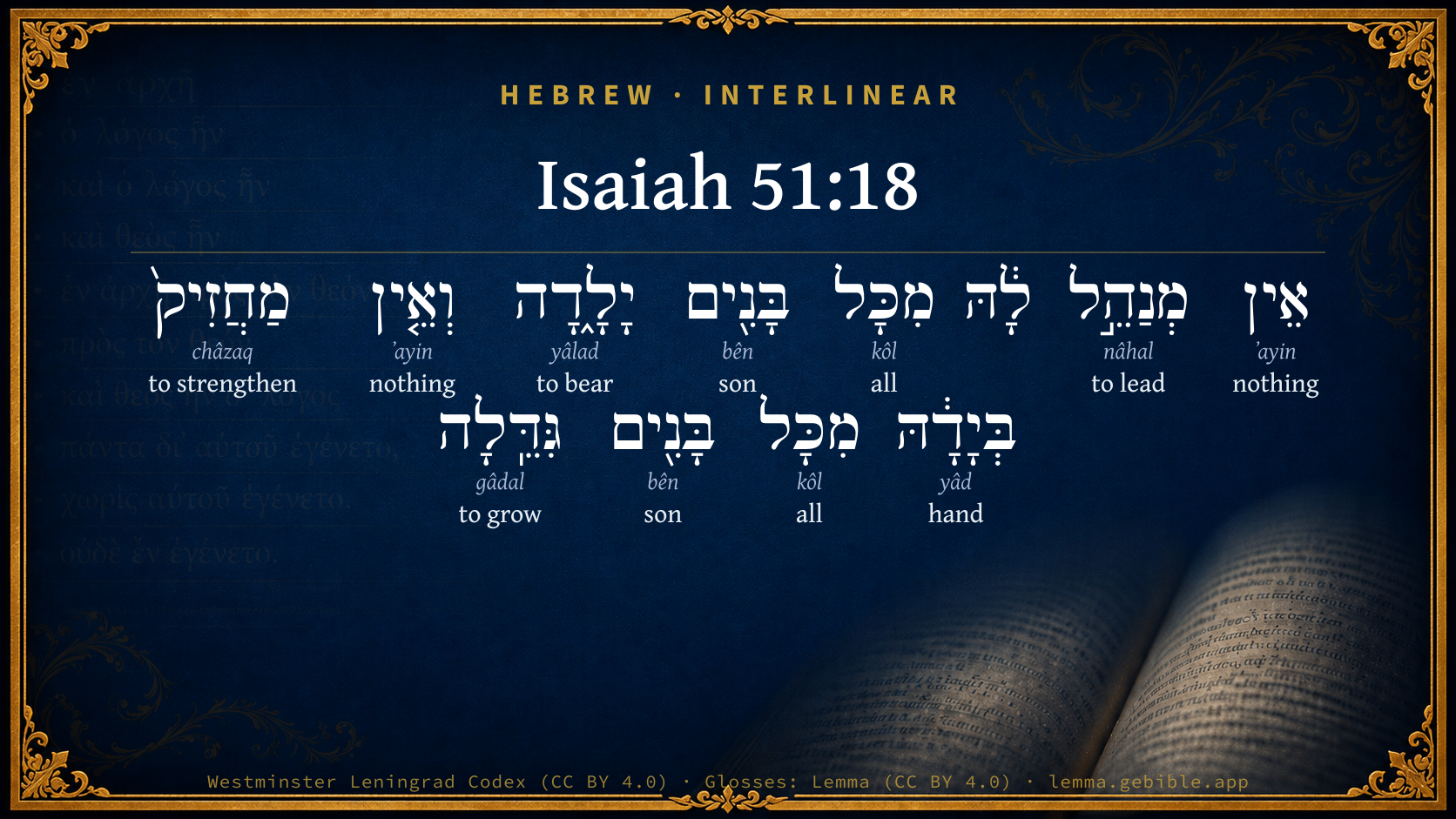
Hebrew (Westminster Leningrad Codex) Isaiah 51:18 appears in the Hebrew Old Testament. The text above is from the Westminster Leningrad Codex. Each word links to its Strong’s number, a concise gloss, and parsing drawn from the Open Scriptures Hebrew Bible morphology. Click any word for its full Brown-Driver-Briggs (BDB) entry.
Download image
Cite this verse

Isaiah 51:18 (World English Bible). Public Domain. Lemma interlinear Bible study tool, https://lemma.gebible.app/v/isaiah/51/18.

Show BibTeX & RIS
BibTeX
RIS
English Translation
There is none to guide her among all the sons whom she has brought forth; neither is there any who takes her by the hand among all the sons who she has brought up.
World English Bible · Public Domain
Download a study sheet

One document with this verse’s original text, its word-by-word gloss line, the meaning frame, cross-references with their text, attributed commentary, and full source and license credits — printable, and it pastes into notes with its structure intact.

This verse Autodidact and up

Study sheet (.html) Plain text (.txt)

A passage Seminary Student

Up to 50 verses in one chapter. A passage sheet keeps up to 6 commentary sources and 12 cross-references per verse, in the order this page ranks them, and says so on the sheet whenever that leaves anything out. Ask for a single verse and you get the Autodidact verse sheet above.

Everything on this page stays free to read, with no account — the sheet is a download of what is already on screen, not access to it.

Want to remove ads? Support Godless Engineer
Compare translations 3

The same verse in 3 English versions, stacked beneath the original-language interlinear above. Click any original word for its lexicon entry.

Each is an independent rendering of the whole verse — the interlinear is not word-aligned to these translations.

Highlighted words mark where these versions differ — a whole-verse word diff, not a word-by-word alignment.

  • World English Bible Public Domain
    There is none to guide her among all the sons whom she has brought forth; neither is there any who takes her by the hand among all the sons who she has brought up.
  • King James Version Public Domain
    There is none to guide her among all the sons whom she hath brought forth; neither is there any that taketh her by the hand of all the sons that she hath brought up.
  • unfoldingWord Literal Text CC BY-SA 4.0
    There is no one guiding her from all of the sons she bore, and there is no one holding her hand from all of the sons she raised.

unfoldingWord Literal Text — © unfoldingWord, licensed CC BY-SA 4.0. Word-aligned USFM3 via Door43 (git.door43.org/unfoldingWord/en_ult).

Versions to compare (up to 4)

3 of 4 selected

Show all 18 translations

Every available English version of this verse, each an independent rendering of the whole verse.

  • World English Bible Public Domain
    There is none to guide her among all the sons whom she has brought forth; neither is there any who takes her by the hand among all the sons who she has brought up.
  • Berean Standard Bible Public Domain
    Among all the sons she bore, there is no one to guide her; among all the sons she brought up, there is no one to take her hand.
  • Majority Standard Bible Public Domain
    Among all the sons she bore, there is no one to guide her; among all the sons she brought up, there is no one to take her hand.
  • King James Version Public Domain
    There is none to guide her among all the sons whom she hath brought forth; neither is there any that taketh her by the hand of all the sons that she hath brought up.
  • American Standard Version (1901) Public Domain
    There is none to guide her among all the sons whom she hath brought forth; neither is there any that taketh her by the hand among all the sons that she hath brought up.
  • Revised Version (1885) Public Domain
    There is none to guide her among all the sons whom she hath brought forth; neither is there any that taketh her by the hand of all the sons that she hath brought up.
  • Geneva Bible (1599) Public Domain
    There is none to guide her among all the sonnes, whome she hath brought foorth: there is none that taketh her by the hand of all the sonnes that she hath brought vp.
  • Douay-Rheims (1899) Public Domain
    There is none that can uphold her among all the children that she hath brought forth: and there is none that taketh her by the hand among all the children that she hath brought up.
  • Young's Literal Translation Public Domain
    There is not a leader to her Out of all the sons she hath borne, And there is none laying hold on her hand Out of all the sons she hath nourished.
  • Literal Standard Version CC BY-SA 4.0
    There is not a leader to her || Out of all the sons she has borne, || And there is none laying hold on her hand || Out of all the sons she has nourished.
  • Unlocked Literal Bible CC BY-SA 4.0
    There is no one among all the sons she has born to guide her; there is no one among all the sons that she has raised to take her by the hand.
  • unfoldingWord Literal Text CC BY-SA 4.0
    There is no one guiding her from all of the sons she bore, and there is no one holding her hand from all of the sons she raised.
  • Darby Bible Public Domain
    -- there is none to guide her among all the children that she hath brought forth; neither is there any to take her by the hand of all the children that she hath brought up.
  • World Messianic Bible Public Domain
    There is no one to guide her among all the sons to whom she has given birth; and there is no one who takes her by the hand among all the sons whom she has brought up.
  • Webster's Bible Public Domain
    There is none to guide her among all the sons whom she hath brought forth; neither is there any that taketh her by the hand of all the sons that she hath brought up.
  • Free Bible Version CC BY-SA 4.0
    Of all your children you had, there's not one left to guide you. Of all the children you raised, there's not one to take you by the hand.
  • Bible in Basic English Public Domain
    She has no one among all her children to be her guide; not one of the sons she has taken care of takes her by the hand.
  • JPS Tanakh (1917) Public Domain
    There is none to guide her among all the sons whom she hath brought forth; neither is there any that taketh her by the hand of all the sons that she hath brought up.

Literal Standard Version (2020), Covenant Press — licensed CC BY-SA 4.0. Text via the HelloAO Bible API (eBible.org). Unlocked Literal Bible (unfoldingWord) — licensed CC BY-SA 4.0. Text via the HelloAO Bible API (eBible.org). unfoldingWord Literal Text — © unfoldingWord, licensed CC BY-SA 4.0. Word-aligned USFM3 via Door43 (git.door43.org/unfoldingWord/en_ult). Free Bible Version, Dr. Jonathan Gallagher — licensed CC BY-SA 4.0. Text via the HelloAO Bible API (eBible.org).

Word by word

More ways to search: Search by grammar → Find every occurrence → Compare this word →

Practice this passage: Drill this verse → Learn its vocabulary →

מְנַהֵ֣ל
nâhal
H5095
“leading”
Verb, Piel, Participle Active, Masculine, Singular, Absolute
Part of Speech
Verb
Stem
Piel
Form
Participle Active
Gender
Masculine
Number
Singular
State
Absolute
Full BDB Definition

Origin: a primitive root

TWOT: 1312

to lead, give rest, lead with care, guide to a watering place or station, cause to rest, bring to a station or place of rest, guide, refresh - (Piel) - to lead to a watering-place or station and cause to rest there - to lead or bring to a station or goal - to lead, guide - to give rest to - to refresh (with food) - (Hithpael) - to lead on - to journey by stations or stages
  1. אֵין ʼayin H369 “nothing” Particle, Negative
  2. מִכָּל kôl H3605 “from · all of” Preposition + Noun, Common, Masculine, Singular, Construct
  3. בָּנִ֖ים bên H1121 “sons” Noun, Common, Masculine, Plural, Absolute
  4. יָלָ֑דָה yâlad H3205 “to bear” Verb, Qal, Perfect, 3rd Person, Feminine, Singular
  5. וְאֵ֤ין ʼayin H369 “and · nothing” Conjunction + Particle, Negative
  6. מַחֲזִיק֙ châzaq H2388 “strengthening” Verb, Hiphil, Participle Active, Masculine, Singular, Absolute
  7. בְּיָדָ֔הּ yâd H3027 “in/at · hand · her” Preposition + Noun, Common, Both, Singular, Construct + Suffix, Personal, 3rd Person, Feminine, Singular
  8. מִכָּל kôl H3605 “from · all of” Preposition + Noun, Common, Masculine, Singular, Construct
  9. בָּנִ֖ים bên H1121 “sons” Noun, Common, Masculine, Plural, Absolute
  10. גִּדֵּֽלָה gâdal H1431 “to grow” Verb, Piel, Perfect, 3rd Person, Feminine, Singular

About this verse

These counts appear in no published source. They are computed here, from the morphology-tagged text and Lemma’s own curated glosses. What Lemma adds →

12
words
8
distinct lemmas
Prophets
section

Notable vocabulary

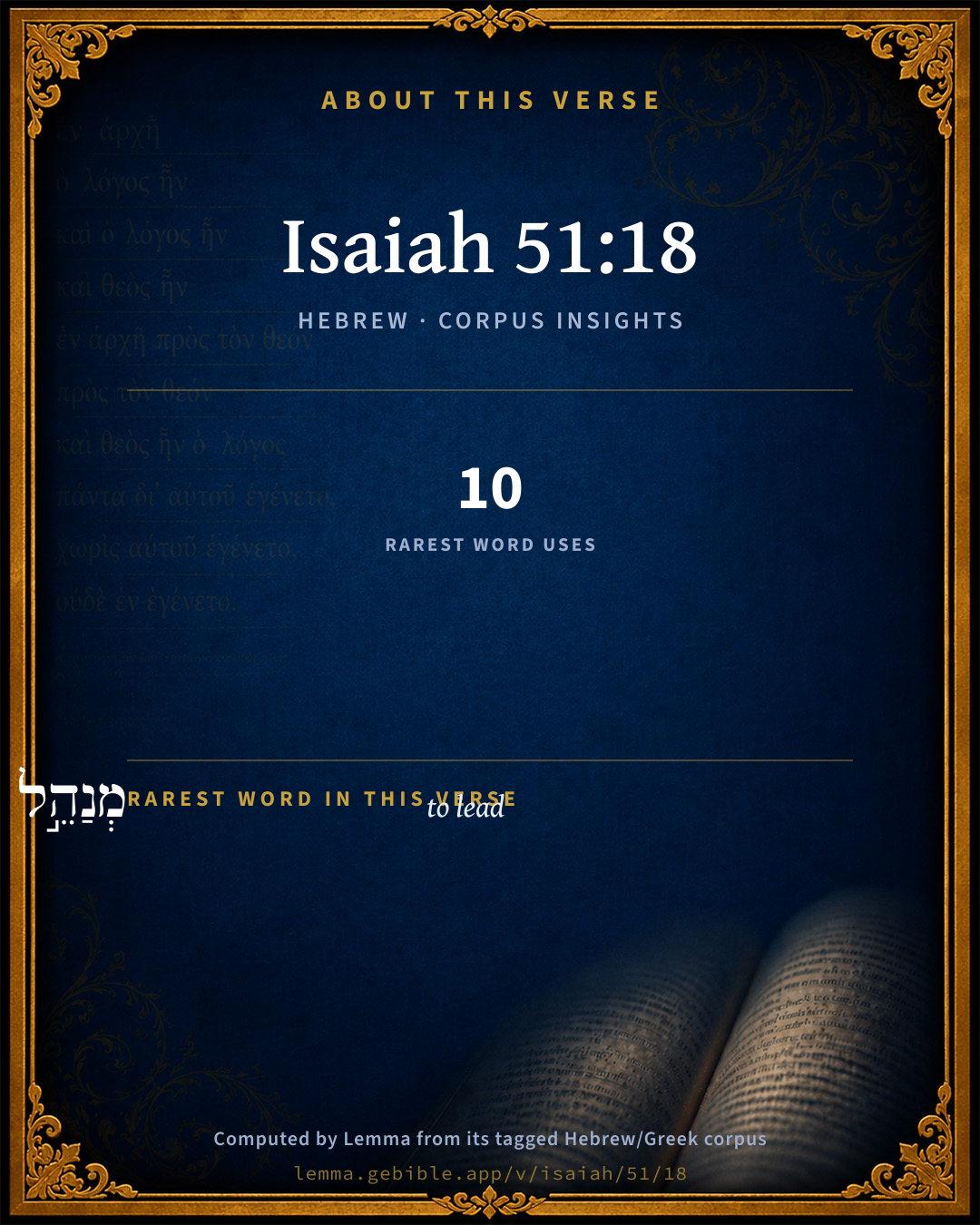
The rarest word here is מְנַהֵ֣ל to lead H5095 — appearing just 10 times in the whole Hebrew Bible.

Shared distinctive vocabulary

מְנַהֵ֣ל to lead H5095 occurs in 10 verses of the Hebrew Bible. Also found in:

Grammatical profile

  • 4 verbs
  • 5 nouns
  • 1 preposition
  • 2 particles

Verb forms

  • מְנַהֵ֣ל Piel · Participle Active
  • יָלָ֑דָה Qal · Perfect
  • מַחֲזִיק֙ Hiphil · Participle Active
  • גִּדֵּֽלָה Piel · Perfect

Repetition

Words recur within this verse — often emphatic in Hebrew:

  • אֵין nothing H369 ×2
  • מִכָּל all H3605 ×2
  • בָּנִ֖ים son H1121 ×2

Hebrew & Septuagint length

In English translation the verse runs 34 words from the Hebrew and 34 from the Septuagint (LXX English) — the same length.

A rough comparison of the two English renderings, which tokenize alike — not a word-level alignment.

Word counts can differ between the Hebrew and the Greek without any difference in meaning — e.g. the Hebrew direct-object marker אֵת has no separate Greek word, and Greek often adds the article ὁ.

Cross-references

14

Topical passages linked to Isaiah 51:18 in the Treasury of Scripture Knowledge — connected by theme and wording, ordered by reader-vote popularity; previews shown in the World English Bible.

  • Psalms 88:18 You have put lover and friend far from me, And my friends into darkness.
  • Isaiah 49:21 Then shall you say in your heart, Who has conceived these for me, seeing I have been bereaved of my children, and am solitary, an exile, and wandering back and forth? and who has brought up these? Behold, I was left alone; these, where were they?
  • Psalms 142:4 Look on my right, and see; For there is no one who is concerned for me. Refuge has fled from me. No one cares for my soul.
  • Isaiah 41:13 For I, Yahweh your God, will hold your right hand, saying to you, Don't be afraid; I will help you.
  • Isaiah 45:1 Thus says Yahweh to his anointed, to Cyrus, whose right hand I have held, to subdue nations before him, and I will loose the loins of kings; to open the doors before him, and the gates shall not be shut:
  • Matthew 9:36 But when he saw the multitudes, he was moved with compassion for them, because they were harassed and scattered, like sheep without a shepherd.
  • Matthew 15:14 Leave them alone. They are blind guides of the blind. If the blind guide the blind, both will fall into a pit."
  • Mark 8:23 He took hold of the blind man by the hand, and brought him out of the village. When he had spit on his eyes, and laid his hands on him, he asked him if he saw anything.
  • Job 8:20 "Behold, God will not cast away a blameless man, Neither will he uphold the evil-doers.
  • Isaiah 3:4–8 I will give boys to be their princes, And children shall rule over them.
  • Jeremiah 31:32 not according to the covenant that I made with their fathers in the day that I took them by the hand to bring them out of the land of Egypt; which my covenant they broke, although I was a husband to them, says Yahweh.
  • Acts 9:8 Saul arose from the ground, and when his eyes were opened, he saw no one. They led him by the hand, and brought him into Damascus.
  • Acts 13:11 Now, behold, the hand of the Lord is on you, and you will be blind, not seeing the sun for a season!" Immediately there fell on him a mist and darkness. He went around seeking someone to lead him by the hand.
  • Hebrews 8:9 Not according to the covenant that I made with their fathers, In the day that I took them by the hand to lead them out of the land of Egypt; For they didn't continue in my covenant, And I disregarded them," says the Lord.

Cross-references courtesy of OpenBible.info (CC BY 4.0).

Hebrew and Greek witnesses Masoretic Hebrew ↔ Greek Septuagint

The same verse in the two great witnesses to the Old Testament, shown verse-for-verse.

These are two independent witnesses, not word-aligned to each other, and the Septuagint is shown in lemma (dictionary) form.

Hebrew Isaiah 51:18 Masoretic · Westminster Leningrad Codex

אֵין מְנַהֵ֣ל לָ֔הּ מִכָּל בָּנִ֖ים יָלָ֑דָה וְאֵ֤ין מַחֲזִיק֙ בְּיָדָ֔הּ מִכָּל בָּנִ֖ים גִּדֵּֽלָה

There is none to guide her among all the sons whom she has brought forth; neither is there any who takes her by the hand among all the sons who she has brought up.

World English Bible · Public Domain

Greek LXX Isaiah 51:18 Septuagint · lemma form

καί οὐ εἰμί ὁ παρακαλέω σύ ἀπό πᾶς ὁ τέκνον σύ ὅς τίκτω καί οὐ εἰμί ὁ ἀντιλαμβάνω ὁ χείρ σύ οὐδέ ἀπό πᾶς ὁ υἱός σύ ὅς ὑψόω

and there was none to comfort you of all the children whom you bore; and there was none to take hold of your hand, not even of all the children whom you have reared.

LXX2012 (modern English Septuagint) · Public Domain

Hebrew: Westminster Leningrad Codex (CC BY 4.0). Greek: Septuagint (public domain); English from LXX2012 (modern English Septuagint) (Public Domain). How the Septuagint differs from the Hebrew →

Targum (Aramaic paraphrase)

1

The Targum is the ancient Jewish Aramaic paraphrase of the Hebrew Scriptures — an interpretive translation, not the Hebrew text itself. Onkelos (literal) and Pseudo-Jonathan (expansive) render the Torah, and Jonathan the Prophets. Coverage is partial: where no permissively-licensed English translation exists for a verse, only the Aramaic is shown. This is verse-level text, not a word-by-word alignment to the Hebrew.

  1. Targum Jonathan Prophets (Joshua–Malachi)
    לֵית דִמְנַחֵם לָהּ מִכָּל בְּנִין דִילֵידַת וְלֵית דְמַתְקִיף בִּידָהּ מִכָּל בְּנִין דְרַבִּיאַת:

    There is none to comfort thee, of all the sons which she hath brought forth; neither is there one to lay hold on her hand, of all the sons she hath nourished.

    Targum Jonathan — Aramaic: “Mikraot Gedolot” (public domain). English: “Sefaria Community Translation” (CC0 1.0 (public-domain dedication)); “London "Chaldee Paraphrase," 1871” (public domain). Text via Sefaria.

Commentary

Notes on Isaiah 51:18 from classic Christian and Jewish commentators (each source and its license shown beneath its notes). The classic Christian expositions comment on the surrounding passage and are grouped to its opening verse, so a note may address several verses; the Jewish commentaries on the Tanakh (Rashi and others) are per-verse, so they appear only where the commentator wrote on this verse.

Lemma curates 59 commentaries, every one of them public domain or Creative Commons licensed, each selected and text-cleaned for this edition rather than reprinted as found. About our sources →

Trapp's Complete Commentary

John Trapp

Isa 51:18 [There is] none to guide her among all the sons [whom] she hath brought forth; neither [is there any] that taketh her by the hand of all the sons [that] she hath brought up.

Ver. 18. There is none to guide her.] This was a point next the worst, as we say. She was without prudent and pious magistrates and ministers, or other friends to advise her; and so she was δισκακοδαιμων - twice miserable. Christ hath promised all his, "I will not leave you destitute," or orphans.

Among all her sons.] Who should see to their aged parents and sublevate them, as pious Aeneas did, and as Scipio, who therehence had his name; but Zion’s sons were themselves in a dreadful plight, {Isa 51:20} and in an ill case to relieve their mother.

John Trapp, A Commentary or Exposition upon All the Books of the Old and New Testament (1647–1656) — public domain. Text from a community e-Sword module.

Joseph Benson's Commentary

Isa 51:18-20. There is none to guide her, &c. — When thou wast drunk with this cup, and couldest not direct or support thy steps, neither thy princes, nor prophets, nor priests, were able or willing to lead or uphold thee. These two things are come upon thee — Those here following, which, although they be expressed in four words, yet may be fitly reduced to two things, namely, desolation by famine, and destruction by the sword. Who shall be sorry for thee — Who is there left to take pity on thee, since thy children are all in as miserable a condition as thyself? See Isa 51:18; Isa 51:20. By whom shall I comfort thee — What human means of comfort is there left for thee?

Thy sons have fainted — They are so far from being able to comfort thee, as was said Isa 51:18, that they themselves faint away for want of comfort, and through famine. They lie at the head of all the streets — Dead by famine, or the sword of the enemy; as a wild bull in a net — Those of them who are not slain are struggling for life. They are full of the fury of the Lord — “The bold image of the cup of God’s wrath,” says Bishop Lowth, “often employed by the sacred writers, is nowhere handled with greater force and sublimity than in this passage. Jerusalem is represented in person, as staggering under the effects of it, destitute of that assistance which she might expect from her children, not one of them being able to support or lead her. They, abject and amazed, lie at the head of every street, overwhelmed with the greatness of their distress; like the oryx entangled in a net, in vain struggling to rend it and extricate himself. This is poetry of the first order, sublimity of the highest proof.”

Joseph Benson's Commentary on the Old and New Testaments (1811–1818) — public domain. Text from a community e-Sword module.

Jamieson, Fausset & Brown

Robert Jamieson, A. R. Fausset & David Brown

Following up the image in Isa 51:17, intoxicated and confused by the cup of God's anger, she has none to guide her in her helpless state; she has not yet awakened out of the sleep caused by that draught. This cannot apply to the Babylonish captivity; for in it they had Ezekiel and Daniel, Ezra and Nehemiah, as "guides," and soon awoke out of that sleep; but it applies to the Jews now, and will be still more applicable in their coming oppression by Antichrist.

Jamieson, Fausset & Brown — Commentary Critical and Explanatory on the Whole Bible (1871) — public domain (CC PDM 1.0). Text via the HelloAO Bible API.

John Gill's Exposition

There is none to guide her among all the sons whom she hath brought forth,.... Still alluding to drunken persons staggering in the streets, that can scarcely stand on their feet, and do not know their way, and yet have none to hold them up and guide them, not even of their friends and relations:

neither is there any that taketh her by the hand of all the sons that she hath brought up; to hold her up from falling, of which there is danger by reeling to and fro, through the intoxicating liquor; and this, either for want of sons, these being dead, or through want of filial affection in them. This was true of Jerusalem, literally understood, at the time of her last destruction by the Romans, when she had no king, priest, nor prophet, to counsel and direct, defend and protect her; and will be the case of the church of God at the slaying of the witnesses, when their own friends will be shy of them, and refuse or neglect to do any kind offices, or show any respect unto them, signified by not suffering their dead bodies to be put into graves, Rev 11:9.

John Gill's Exposition of the Whole Bible (1746–1763) — public domain (CC PDM 1.0). Text via the HelloAO Bible API.

Albert Barnes' Notes on the Bible

There is none to guide her - The image here is taken from the condition of one who is under the influence of an intoxicating draught, and who needs some one to sustain and guide him. The idea is, than among all the inhabitants of Jerusalem in the time of the calamity, there was none who could restore to order the agitated and distracted affairs of the nation. All its wisdom was destroyed; its counsels perplexed; its power overcome.

All the sons whom she hath brought forth - All the inhabitants of Jerusalem.

Albert Barnes' Notes on the Bible (1834–1885) — public domain. Text from a community e-Sword/MySword module.

Matthew Poole's English Annotations

When thou wast drunk with this cup, and not able to go, neither thy princes, nor prophets, nor priests were able or willing to lead and support thee.

Matthew Poole's English Annotations on the Holy Bible (1683–1685) — public domain. Text from a community e-Sword/MySword module.

Whedon's Commentary on the Bible

Daniel D. Whedon

18-20. There is none to guide her — There is none like Messiah to guide and lead. The sons of Jerusalem — namely, the priests and prophets — have lost character, hence ability spiritually to guide. Two things, or two classes of evils, have happened to her: destruction (waste) and desolation — famine and the sword. The state suffers the first, the people the second. Where are the pitying ones to give thee aid? Or, by whom shall I, Messiah, render thee aid? See Lam_2:13. The twentieth verse is a little difficult of interpretation. This whole passage is in the tone of sore lamentation. The twentieth verse, especially, dramatically exhibits people after nightfall flung out of the city (Babylon, we will suppose) for safety. But the gates become shut, and they are caught just as the hunter captures wild antelopes (such is the meaning) in a net which he fixes in the field, and into which he drives his prey. All this is the judgment of God upon Jerusalem.

Daniel D. Whedon (gen. ed.), Commentary on the Old and New Testaments (1874–1909) — public domain. Text from a community e-Sword module.

The Pulpit Commentary

None to guide her. From the time that Johanan, the son of Kareah, and the other "captains of the forces," quitted Judaea and fled into Egypt, taking with them Jeremiah and Baruch, (Jer_43:5-7) there was no one left in the country with any authority or any ability to direct affairs. The city, no doubt, suffered by this state of things, becoming more ruined and more desolate than it would have been otherwise. Had Johanan and the Jews under him remained in the land, God had promised to "build them, and not pull them down;" to "plant them, and not pluck them up". (Jer_42:10) Thus Jerusalem"s extreme desolation was not wholly the result of the Babylonian conquest, but was partly due to the after-misconduct of the Jews left in the country.

The Pulpit Commentary (1880–1919), ed. H.D.M. Spence-Jones & Joseph S. Exell — public domain. Text from a community e-Sword module.

John Wesley's Explanatory Notes

None to guide - When thou wast drunk with this cup, and not able to go.

John Wesley, Explanatory Notes Upon the Whole Bible (1754–1765) — public domain. Text via the GEBible commentary corpus.

J. A. Alexander on Isaiah

Joseph Addison Alexander

“There is no guide to her (or no one leading her) of all the sons she has brought forth, and no one grasping her hand of all the sons she has brought up.” From addressing Zion in the second person, he now proceeds to speak of her in the third. This verse is not so much descriptive of unnatural abandonment as it is of weakness. The sense is not that no one will, but that no one can protect or guide her. Some interpreters suppose the figure of a drunken person to be still continued. The mother and the sons, (i.e., the people collectively and individually, are distinguished only by a figure of speech).

Joseph Addison Alexander, The Prophecies of Isaiah (1846–1847; New York: Scribner, 1870–1878) — public domain. Text from a community e-Sword module.

Ibn Ezra

Rabbi Abraham ibn Ezra

There is none to guide her. Israel is like a woman, that has none to guide her; Israel has no king nor judge, to be saved by him.

Ibn Ezra on the Tanakh — English translations: “Sefaria Community Translation” (CC0 1.0 (public-domain dedication)); “Yalkut, Sifsei Chachomim Chumash, Metsudah Publications, 2009” (CC BY 4.0); and “Commentary of Ibn Ezra on Isaiah - trans. by M. Friedlander, 1873” (public domain). Text via Sefaria.

Lesson kit

Teaching starters — assembled from the data on this page, not authored interpretation. Every prompt links to the verse data it draws on. Edit before teaching.

Isaiah, in the Prophets, opens this verse with 12 words (8 distinct Hebrew lemmas). Its most distinctive word is nâhal (“to lead”). A historical commentator’s framing appears above. Read the whole chapter for the surrounding context.

Discussion questions

  1. The word nâhal carries the sense “to lead.” How does it shape the verse?
  2. Genesis 33:14 shares the word «to lead» with this verse. How do the two illuminate each other?
  3. “nothing” occurs 2× in this one verse. What is the effect of the repetition?
  4. These translations render this verse differently. What is at stake in choosing one wording over another?
  5. The verb «מְנַהֵ֣ל» is Piel Participle Active. How does its form color the action?
  6. Reading how Trapp's Complete Commentary and Joseph Benson's Commentary read this verse, where do the two commentators agree and where do they part?

Things to notice

Reading settings

Reading text

Shown beneath each verse's original-language words.

Old Testament
Old Testament edition

Read the OT as the Masoretic Hebrew (MT) or the Greek Septuagint (LXX).

English shown for the Greek Septuagint (in the Hebrew ↔ Greek comparison).

Comparing translations? Open the Compare panel on any verse page to stack up to four side by side.