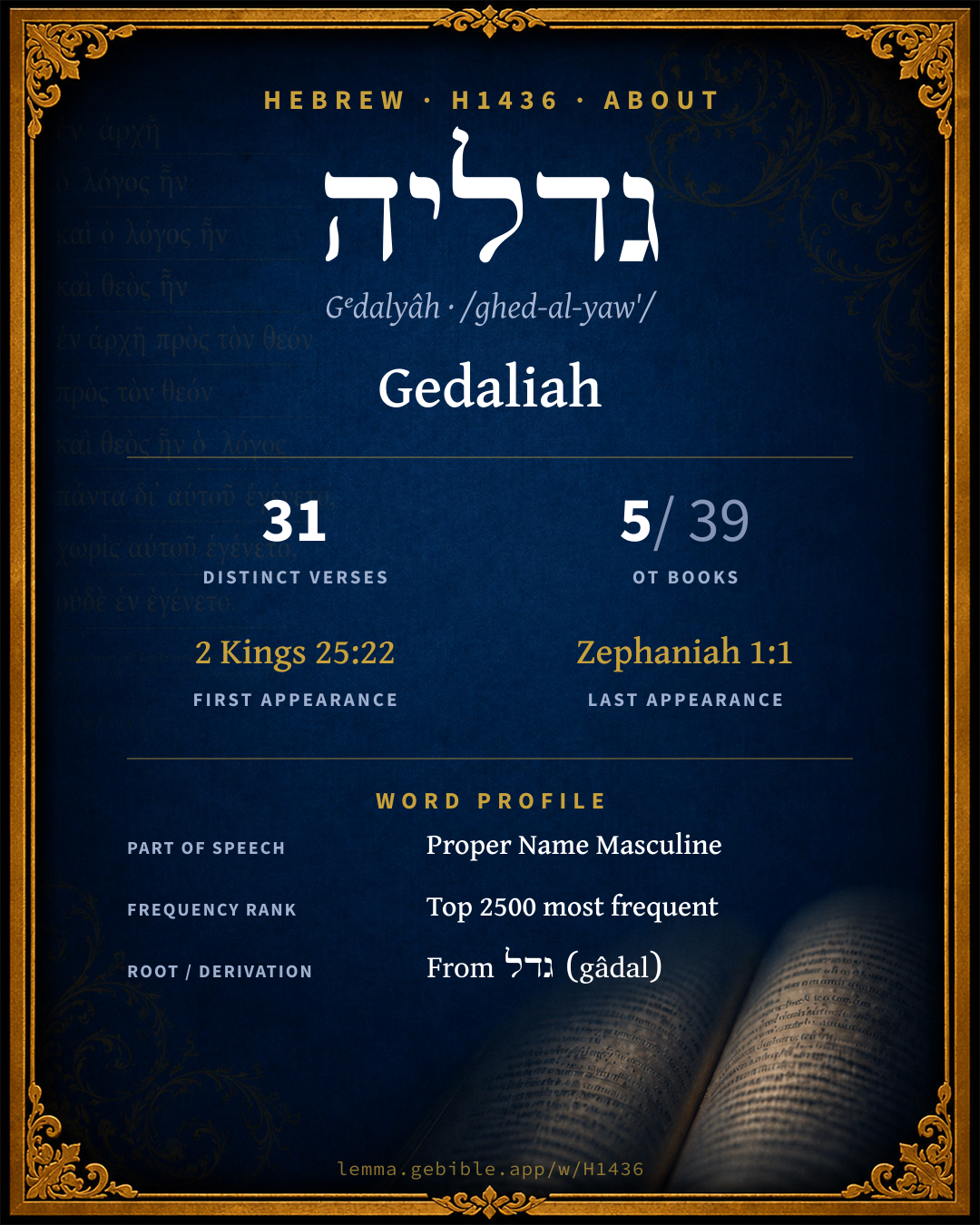
גְּדַלְיָה
Gedaliah
BDB lists 6 entries for ‘Gedaliah’ fuller range ↓
Full lexicon entry — Brown-Driver-Briggs (BDB)
From Brown-Driver-Briggs (BDB)
Where this word appears
Grammar key — what these labels mean
Part of speech
- Noun
- A naming word — a person, place, thing, or idea.
Noun type
- Proper
- A name of a specific person, place, or people (e.g. Abraham, Zion, Israel).
Every verse where H1436 appears — 31 distinct verses across 5 books. Click any verse to open its interlinear word-by-word view. Verse text shown in the World English Bible for context — . Each verse’s Hebrew form is shown with its reference; the English is not keyword-highlighted, since the data carries no word-level English alignment. Use “Compare translations” on any verse to read it across multiple English versions. This concordance covers the Hebrew Bible; Septuagint (Greek Old Testament) occurrences are not indexed here.
2 Kings 4 verses
- 2 Kings 25:22 גְּדַלְיָ֖הוּ n Proper As for the people who were left in the land of Judah, whom Nebuchadnezzar king of Babylon had left, even over them he made Gedaliah the son of Ahikam, the son of Shaphan, governor.
- 2 Kings 25:23 גְּדַלְיָ֔הוּ גְּדַלְיָ֖הוּ n Proper n Proper Now when all the captains of the forces, they and their men, heard that the king of Babylon had made Gedaliah governor, they came to Gedaliah to Mizpah, even Ishmael the son of Nethaniah, and Johanan the son of Kareah, and Seraiah the son of Tanhumeth the Netophathite, and Jaazaniah the son of the Maacathite, they and their men.
- 2 Kings 25:24 גְּדַלְיָ֨הוּ֙ n Proper Gedaliah swore to them and to their men, and said to them, Don't be afraid because of the servants of the Chaldeans: dwell in the land, and serve the king of Babylon, and it shall be well with you.
- 2 Kings 25:25 גְּדַלְיָ֖הוּ n Proper But it happened in the seventh month, that Ishmael the son of Nethaniah, the son of Elishama, of the royal seed came, and ten men with him, and struck Gedaliah, so that he died, and the Jews and the Chaldeans that were with him at Mizpah.
1 Chronicles 2 verses
- 1 Chronicles 25:3 גְּדַלְיָ֡הוּ n Proper Of Jeduthun; the sons of Jeduthun: Gedaliah, and Zeri, and Jeshaiah, Hashabiah, and Mattithiah, six, under the hands of their father Jeduthun with the harp, who prophesied in giving thanks and praising Yahweh.
- 1 Chronicles 25:9 גְּדַלְיָ֨הוּ֙ n Proper Now the first lot came forth for Asaph to Joseph: the second to Gedaliah; he and his brothers and sons were twelve:
Ezra 1 verse
Jeremiah 23 verses
- Jeremiah 38:1 וּ/גְדַלְיָ֨הוּ֙ conj + n Proper Shephatiah the son of Mattan, and Gedaliah the son of Pashhur, and Jucal the son of Shelemiah, and Pashhur the son of Malchijah, heard the words that Jeremiah spoke to all the people, saying,
- Jeremiah 39:14 גְּדַלְיָ֨הוּ֙ n Proper they sent, and took Jeremiah out of the court of the guard, and committed him to Gedaliah the son of Ahikam, the son of Shaphan, that he should carry him home: so he lived among the people.
- Jeremiah 40:5 גְּדַלְיָ֣ה n Proper Now while he was not yet gone back, Go back then, [said he], to Gedaliah the son of Ahikam, the son of Shaphan, whom the king of Babylon has made governor over the cities of Judah, and dwell with him among the people; or go wherever it seems right to you to go. So the captain of the guard gave him food and a present, and let him go.
- Jeremiah 40:6 גְּדַלְיָ֥ה n Proper Then went Jeremiah to Gedaliah the son of Ahikam to Mizpah, and lived with him among the people who were left in the land.
- Jeremiah 40:7 גְּדַלְיָ֥הוּ n Proper Now when all the captains of the forces who were in the fields, even they and their men, heard that the king of Babylon had made Gedaliah the son of Ahikam governor in the land, and had committed to him men, and women, and children, and of the poorest of the land, of those who were not carried away captive to Babylon;
- Jeremiah 40:8 גְּדַלְיָ֖ה n Proper then they came to Gedaliah to Mizpah, [to wit], Ishmael the son of Nethaniah, and Johanan and Jonathan the sons of Kareah, and Seraiah the son of Tanhumeth, and the sons of Ephai the Netophathite, and Jezaniah the son of the Maacathite, they and their men.
- Jeremiah 40:9 גְּדַלְיָ֨הוּ n Proper Gedaliah the son of Ahikam the son of Shaphan swore to them and to their men, saying, Don't be afraid to serve the Chaldeans: dwell in the land, and serve the king of Babylon, and it shall be well with you.
- Jeremiah 40:11 גְּדַלְיָ֖הוּ n Proper Likewise when all the Jews who were in Moab, and among the children of Ammon, and in Edom, and who were in all the countries, heard that the king of Babylon had left a remnant of Judah, and that he had set over them Gedaliah the son of Ahikam, the son of Shaphan;
- Jeremiah 40:12 גְּדַלְיָ֖הוּ n Proper then all the Jews returned out of all places where they were driven, and came to the land of Judah, to Gedaliah, to Mizpah, and gathered wine and summer fruits very much.
- Jeremiah 40:13 גְּדַלְיָ֖הוּ n Proper Moreover Johanan the son of Kareah, and all the captains of the forces who were in the fields, came to Gedaliah to Mizpah,
- Jeremiah 40:14 גְּדַלְיָ֖הוּ n Proper and said to him, Do you know that Baalis the king of the children of Ammon has sent Ishmael the son of Nethaniah to take your life? But Gedaliah the son of Ahikam didn't believe them.
- Jeremiah 40:15 גְּדַלְיָהוּ֩ n Proper Then Johanan the son of Kareah spoke to Gedaliah in Mizpah secretly, saying, Please let me go, and I will kill Ishmael the son of Nethaniah, and no man shall know it: why should he take your life, that all the Jews who are gathered to you should be scattered, and the remnant of Judah perish?
- Jeremiah 40:16 גְּדַלְיָ֤הוּ n Proper But Gedaliah the son of Ahikam said to Johanan the son of Kareah, You shall not do this thing; for you speak falsely of Ishmael.
- Jeremiah 41:1 גְּדַלְיָ֥הוּ n Proper Now it happened in the seventh month, that Ishmael the son of Nethaniah, the son of Elishama, of the seed royal and [one of] the chief officers of the king, and ten men with him, came to Gedaliah the son of Ahikam to Mizpah; and there they ate bread together in Mizpah.
- Jeremiah 41:2 גְּדַלְיָ֨הוּ n Proper Then arose Ishmael the son of Nethaniah, and the ten men who were with him, and struck Gedaliah the son of Ahikam the son of Shaphan with the sword, and killed him, whom the king of Babylon had made governor over the land.
- Jeremiah 41:3 גְּדַלְיָ֨הוּ֙ n Proper Ishmael also killed all the Jews who were with him, [to wit], with Gedaliah, at Mizpah, and the Chaldeans who were found there, the men of war.
- Jeremiah 41:4 גְּדַלְיָ֑הוּ n Proper It happened the second day after he had killed Gedaliah, and no man knew it,
- Jeremiah 41:6 גְּדַלְיָ֥הוּ n Proper Ishmael the son of Nethaniah went forth from Mizpah to meet them, weeping all along as he went: and it happened, as he met them, he said to them, Come to Gedaliah the son of Ahikam.
- Jeremiah 41:9 גְּדַלְיָ֔הוּ n Proper Now the pit in which Ishmael cast all the dead bodies of the men whom he had killed, by the side of Gedaliah (the same was who which Asa the king had made for fear of Baasha king of Israel), Ishmael the son of Nethaniah filled it with those who were killed.
- Jeremiah 41:10 גְּדַלְיָ֖הוּ n Proper Then Ishmael carried away captive all the residue of the people who were in Mizpah, even the king's daughters, and all the people who remained in Mizpah, whom Nebuzaradan the captain of the guard had committed to Gedaliah the son of Ahikam; Ishmael the son of Nethaniah carried them away captive, and departed to go over to the children of Ammon.
- Jeremiah 41:16 גְּדַלְיָ֖ה n Proper Then took Johanan the son of Kareah, and all the captains of the forces who were with him, all the remnant of the people whom he had recovered from Ishmael the son of Nethaniah, from Mizpah, after that he had killed Gedaliah the son of Ahikam, [to wit], the men of war, and the women, and the children, and the eunuchs, whom he had brought back from Gibeon:
- Jeremiah 41:18 גְּדַלְיָ֨הוּ֙ n Proper because of the Chaldeans; for they were afraid of them, because Ishmael the son of Nethaniah had killed Gedaliah the son of Ahikam, whom the king of Babylon made governor over the land.
- Jeremiah 43:6 גְּדַלְיָ֖הוּ n Proper the men, and the women, and the children, and the king's daughters, and every person who Nebuzaradan the captain of the guard had left with Gedaliah the son of Ahikam, the son of Shaphan; and Jeremiah the prophet, and Baruch the son of Neriah;
Zephaniah 1 verse
About this entry
At a glance — auto-summarized from this page’s data, not written by a person. Every figure links to its source below. This summary describes the numbers; it doesn’t interpret them.
גדליה (Gᵉdalyâh) is a Hebrew name most often rendered “Gedaliah.” It clusters heavily in Jeremiah, which alone accounts for 74% of its uses. With 31 verses in 5 books, it is a moderately common word in the Hebrew Bible. Debuting at 2 Kings 25:22, it then recurs through the corpus. For the data behind this summary, explore 31-verse concordance and the renderings breakdown below.
Gloss history
Strong's 1890 vs modern scholarship
About this word
Strong's H1436 catalogs a Hebrew word from the Hebrew Old Testament.
These counts are not copied from any lexicon or concordance. They are computed here, from the morphology-tagged Hebrew Old Testament. What Lemma adds →
- 31
- distinct verses
- The word appears in 31 distinct verses.
- 5 / 39
- OT books
- The word appears in 5 of 39 Old Testament books.
- #1,086
- by frequency
- Top 2500 most frequent Hebrew words (rank 1,086 of 8,640 Hebrew words by occurrence).
View all 31 occurrences in the concordance →
Most concentrated in
- Jeremiah 23 verses 74%
- 2 Kings 4 verses 13%
- 1 Chronicles 2 verses 6%
By section of the Old Testament
By traditional corpus
Conventional, traditional groupings — biblical authorship is debated, so this is a traditional corpus grouping, not an authorship claim. Each share is this word’s portion of its verses in that division of the Hebrew canon. Each figure is a share of the word’s 31 distinct verses.
- Prophets (Nevi'im) 28 verses · 90%
- Writings (Ketuvim) 3 verses · 10%
How translations render this word
Counts come from each version’s own published word-to-Strong’s tagging or interlinear alignment — an approximate guide to how each version renders this word, not a word-level alignment the data otherwise carries. Because each total is that version’s own tagged count, the per-version totals vary from one another and need not match the appearance or distinct-verse counts above. These counts may also differ from a printed concordance because Lemma counts each distinctly tagged rendering and does not collapse phrase taggings into a single head-word total. This is a fixed set of word-tagged versions (KJV, ASV, BSB, ULT) and does not change with the reading translation you choose elsewhere. Each version’s license is shown beside its name below (and on Sources).
BDB lists this Strong’s number as 2 distinct words (homographs). Each count above pools all of them and is not split by sense — see the Senses section below. A low-frequency rendering may belong to a different one of those words, not the primary meaning.
- King James Version†: Gedaliah 26×, Had made gedaliah 2×
- American Standard Version†: Gedaliah 21×, Had made gedaliah 2×, Smote gedaliah 2×
- Berean Standard Bible†: Gedaliah 30×
- unfoldingWord Literal Text†: Gedaliah 9×
King James Version Public Domain
Renders H1436 across 32† tagged occurrences — most commonly:
Plus 4 renderings that appear only once — usually multi-word phrases or single function words the recovered tagging swept in, not distinct renderings.
American Standard Version Public Domain
Renders H1436 across 32† tagged occurrences — most commonly:
Plus 7 renderings that appear only once — usually multi-word phrases or single function words the recovered tagging swept in, not distinct renderings.
Berean Standard Bible Public Domain
Renders H1436 across 32† tagged occurrences — most commonly:
Plus 2 renderings that appear only once — usually multi-word phrases or single function words the recovered tagging swept in, not distinct renderings.
unfoldingWord Literal Text CC BY-SA 4.0
Renders H1436 across 9† tagged occurrences — most commonly:
Senses in the full BDB
What do BDB’s symbols mean?
BDB uses these scholarly abbreviations:
| Symbol | Meaning |
|---|---|
| 𝔊 | the Septuagint (the ancient Greek translation, LXX) |
| 𝔙 | the Vulgate (the Latin translation) |
| 𝔖 | the Syriac version (the Peshitta) |
| 𝔗 | the Targum (the Aramaic translation) |
| ψ | the Psalms |
| √ | root (the underlying root or stem) |
| ‖ | parallel passage (a synonymous or contrasted parallel) |
| † | the dagger: every passage where the word occurs is cited |
The 6 senses and sub-senses the full Brown-Driver-Briggs lexicon distinguishes for this word, in lexicon order (not ranked by frequency), with BDB’s own verbatim wording and sub-sense lettering. Shown in Hebrew script with BDB’s own scholarly abbreviations. The condensed entry is in the Lexicon Entry tab. See also the Forms in the corpus table below.
גדליה I m. (Yah is great)
- 1. governor of Judea appointed by Nebuchadnezzar Je 40:5, 8; 41:16. e.g. Jeremiah 40:5
- 2. son of Amariah, a son of Hezekiah Zp 1:1. e.g. Zephaniah 1:1
- 3. priest of the sons of Jeshua Ezr 10:18. e.g. Ezra 10:18
גדליה II m. (Yah(u) is great)
- 1. governor of Judea = גדליה 2 K 25:22–25 Je 39:14; 40:6–16; 41:1–18; 43:6 (24 times) e.g. 2 Kings 25:22
- 2. son of Pashur, one of the chiefs of Jerusalem in the time of Jeremiah Je 38:1. e.g. Jeremiah 38:1
- 3. one of the sons of Jeduthun, in the time of David 1 Ch 25:3, 9. e.g. 1 Chronicles 25:3
Senses from the full Brown-Driver-Briggs lexicon (Brown, Driver, Briggs; Oxford 1906 — public domain), digitized via Sefaria, supplemented by the OpenScriptures HebrewLexicon (CC BY 4.0). Full attribution on Sources.
Word origin
I. n.pr.m. (Yah is great)—
I. n.pr.m. (Yah(u) is great)—
— Brown-Driver-Briggs (Oxford 1906, public domain), digitized via Sefaria, supplemented by the OpenScriptures HebrewLexicon (CC BY 4.0). See Sources.
Derived from גדל (gâdal) (H1431) — to grow.
Forms in the corpus
The 15 distinct written forms H1436 takes in the Hebrew Bible, most frequent first — each parse links to that state’s occurrences in the concordance. Hebrew forms include their vowel points and cantillation, so a single lemma takes many written forms.
| Form | Parsing | Example | Uses |
|---|---|---|---|
| גְּדַלְיָ֖הוּ | Noun, Proper | 2 Kings 25:22 | 9 |
| גְּדַלְיָ֨הוּ֙ | Noun, Proper | 1 Chronicles 25:9 | 5 |
| גְּדַלְיָ֥הוּ | Noun, Proper | Jeremiah 40:7 | 3 |
| גְּדַלְיָ֔הוּ | Noun, Proper | 2 Kings 25:23 | 2 |
| גְּדַלְיָ֖ה | Noun, Proper | Jeremiah 40:8 | 2 |
| גְּדַלְיָ֨הוּ | Noun, Proper | Jeremiah 40:9 | 2 |
| גְּדַלְיָ֑הוּ | Noun, Proper | Jeremiah 41:4 | 1 |
| גְּדַלְיָ֔ה | Noun, Proper | Zephaniah 1:1 | 1 |
| גְּדַלְיָ֡הוּ | Noun, Proper | 1 Chronicles 25:3 | 1 |
| גְּדַלְיָ֣ה | Noun, Proper | Jeremiah 40:5 | 1 |
| גְּדַלְיָ֤הוּ | Noun, Proper | Jeremiah 40:16 | 1 |
| גְּדַלְיָ֥ה | Noun, Proper | Jeremiah 40:6 | 1 |
| גְּדַלְיָהוּ֩ | Noun, Proper | Jeremiah 40:15 | 1 |
| וּ/גְדַלְיָ֨הוּ֙ | Noun, Proper | Jeremiah 38:1 | 1 |
| וּ/גְדַלְיָֽה | Noun, Proper | Ezra 10:18 | 1 |
Same root — word family
Other BDB entries built from the same root as H1436, grouped by Strong’s listed origin. These share a root / origin per the lexicon — not necessarily a shared meaning. Each links to that word’s own entry.
Derives from
Shares the same root
- גדול gâdôwl H1419 great
- גדל gâdêl H1432 growing up
- גדל gôdel H1433 greatness
- גדל gᵉdil H1434 tassels
- מגדל migdâl H4026 tower
Proper names from this root
People and places named from this root — a name, not an additional meaning of the word.
Compare all same-root words → Showing 4 of 10 — not the complete family. 3 of the same-root words are proper names (people or places). They share a root, not necessarily a meaning.
Bible dictionary
Public-domain dictionary articles matched to this entry by name (Gedaliah). A biblical name can be shared by more than one person or place, so an article may treat several.
Easton's Bible Dictionary · M. G. Easton, 1897
Made great by Jehovah. (1.) the son of Jeduthum (1 Chr. 25:3, 9). (2.) The grandfather of the prophet Zephaniah, and the father of Cushi (Zeph. 1:1). (3.) One of the Jewish nobles who conspired against Jeremiah (Jer. 38:1). (4.) The son of Ahikam, and grandson of Shaphan, secretary of king Josiah (Jer. 26:24). After the destruction of Jerusalem (see ZEDEKIAH), Nebuchadnezzar left him to govern the country as tributary to him (2 Kings 25:22; Jer. 40:5; 52:16). Ishmael, however, at the head of a party of the royal family, "Jewish irreconcilables", rose against him, and slew him and "all the Jews that were with him" (Jer. 41:2, 3) at Mizpah about three months after the destruction of Jerusalem. He and his band also plundered the town of Mizpah, and carried off many captives. He was, however, overtaken by Johanan and routed. He fled with such of his followers as escaped to the Ammonites (41:15). The little remnant of the Jews now fled to Egypt.
Smith's Bible Dictionary · William Smith, 1863
(God is my greatness), son of Ahikam (Jeremiah's protector, (Jeremiah 26:24) and grandson of Shaphan the secretary of King Josiah. After the destruction of the temple, B.C. 588, Nebuchadnezzar departed from Judea, leaving Gedaliah with a Chaldean guard, (Jeremiah 40:5) at Mizpah to govern the vinedressers and husbandmen, (Jeremiah 52:16) who were exempted from captivity. Jeremiah jointed Gedaliah; and Mizpah became the resort of Jews from various quarters. (Jeremiah 40:6,11) He was murdered by Ishmael two months after his appointment.
Hitchcock's Bible Names Dictionary · Roswell D. Hitchcock, 1869
God is my greatness
Classic public-domain reference works; full attribution on Sources.
Septuagint verse parallels
This word appears in 28 verses that also exist in the Greek Old Testament (Septuagint), out of the 31 Hebrew verses it occurs in. You can read those verses in Greek by switching the Old Testament edition to the Septuagint.
Read these verses in the Septuagint
This is a verse-level parallel only — the same verses exist in both the Hebrew and Greek Old Testaments. No word-level Hebrew↔Greek correspondence is claimed: the data carries no such alignment, so no Greek word is shown as this Hebrew word’s translation. Coverage is not total — the Septuagint omits the deuterocanon and renumbers the Psalms, so some Hebrew verses have no direct Greek parallel.