
1 Kings 12:10

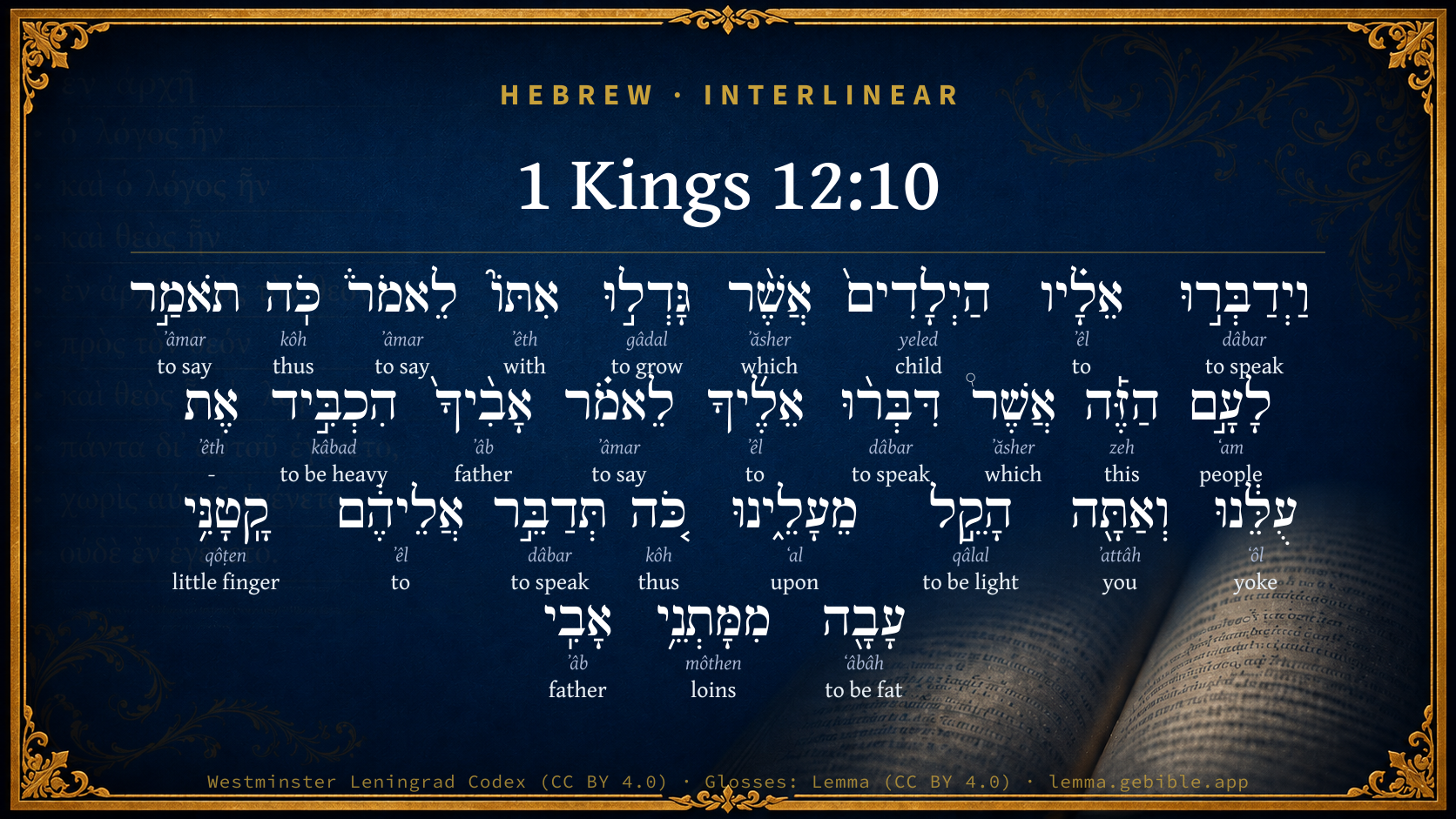
Hebrew (Westminster Leningrad Codex) 1 Kings 12:10 appears in the Hebrew Old Testament. The text above is from the Westminster Leningrad Codex. Each word links to its Strong’s number, a concise gloss, and parsing drawn from the Open Scriptures Hebrew Bible morphology. Click any word for its full Brown-Driver-Briggs (BDB) entry.
Download image
Cite this verse

1 Kings 12:10 (World English Bible). Public Domain. Lemma interlinear Bible study tool, https://lemma.gebible.app/v/1-kings/12/10.

Show BibTeX & RIS
BibTeX
RIS
English Translation
The young men who had grown up with him spoke to him, saying, Thus shall you tell this people who spoke to you, saying, Your father made our yoke heavy, but make you it lighter to us; thus shall you speak to them, My little finger is thicker than my father's loins.
World English Bible · Public Domain
Highlights
  • 1 first appearance in the Hebrew Bible
Full analysis ↓
Download a study sheet

One document with this verse’s original text, its word-by-word gloss line, the meaning frame, cross-references with their text, attributed commentary, and full source and license credits — printable, and it pastes into notes with its structure intact.

This verse Autodidact and up

Study sheet (.html) Plain text (.txt)

A passage Seminary Student

Up to 50 verses in one chapter. A passage sheet keeps up to 6 commentary sources and 12 cross-references per verse, in the order this page ranks them, and says so on the sheet whenever that leaves anything out. Ask for a single verse and you get the Autodidact verse sheet above.

Everything on this page stays free to read, with no account — the sheet is a download of what is already on screen, not access to it.

Want to remove ads? Support Godless Engineer
Compare translations 3

The same verse in 3 English versions, stacked beneath the original-language interlinear above. Click any original word for its lexicon entry.

Each is an independent rendering of the whole verse — the interlinear is not word-aligned to these translations.

Highlighted words mark where these versions differ — a whole-verse word diff, not a word-by-word alignment.

  • World English Bible Public Domain
    The young men who had grown up with him spoke to him, saying, Thus shall you tell this people who spoke to you, saying, Your father made our yoke heavy, but make you it lighter to us; thus shall you speak to them, My little finger is thicker than my father's loins.
  • King James Version Public Domain
    And the young men that were grown up with him spake unto him, saying, Thus shalt thou speak unto this people that spake unto thee, saying, Thy father made our yoke heavy, but make thou it lighter unto us; thus shalt thou say unto them, My little finger shall be thicker than my father's loins.
  • unfoldingWord Literal Text CC BY-SA 4.0
    And the young men who had grown up with him spoke to him, saying, “Thus you shall say to this people who spoke to you, saying, ‘Your father made our yoke heavy, but you, make light from upon us.’ Thus you shall speak to them, ‘My little finger thicker than the loins of my father.

unfoldingWord Literal Text — © unfoldingWord, licensed CC BY-SA 4.0. Word-aligned USFM3 via Door43 (git.door43.org/unfoldingWord/en_ult).

Versions to compare (up to 4)

3 of 4 selected

Show all 18 translations

Every available English version of this verse, each an independent rendering of the whole verse.

  • World English Bible Public Domain
    The young men who had grown up with him spoke to him, saying, Thus shall you tell this people who spoke to you, saying, Your father made our yoke heavy, but make you it lighter to us; thus shall you speak to them, My little finger is thicker than my father's loins.
  • Berean Standard Bible Public Domain
    The young men who had grown up with him replied, “This is how you should answer these people who said to you, ‘Your father made our yoke heavy, but you should make it lighter.’ This is what you should tell them: ‘My little finger is thicker than my father’s waist!
  • Majority Standard Bible Public Domain
    The young men who had grown up with him replied, “This is how you should answer these people who said to you, ‘Your father made our yoke heavy, but you must make it lighter.’ This is what you should tell them: ‘My little finger is thicker than my father’s waist!
  • King James Version Public Domain
    And the young men that were grown up with him spake unto him, saying, Thus shalt thou speak unto this people that spake unto thee, saying, Thy father made our yoke heavy, but make thou it lighter unto us; thus shalt thou say unto them, My little finger shall be thicker than my father's loins.
  • American Standard Version (1901) Public Domain
    And the young men that were grown up with him spake unto him, saying, Thus shalt thou say unto this people that spake unto thee, saying, Thy father made our yoke heavy, but make thou it lighter unto us; thus shalt thou speak unto them, My little finger is thicker than my father's loins.
  • Revised Version (1885) Public Domain
    And the young men that were grown up with him spake unto him, saying, Thus shalt thou say unto this people that spake unto thee, saying, Thy father made our yoke heavy, but make thou it lighter unto us; thus shalt thou speak unto them, My little finger is thicker than my father’s loins.
  • Geneva Bible (1599) Public Domain
    Then the yong men that were brought vp with him, spake vnto him, saying, Thus shalt thou say vnto this people, that haue spoken vnto thee, and said, Thy father hath made our yoke heauie, but make thou it lighter vnto vs: euen thus shalt thou say vnto them, My least part shalbe bigger then my fathers loynes.
  • Douay-Rheims (1899) Public Domain
    And the young men that had been brought up with him, said: Thus shalt thou speak to this people, who have spoken to thee, saying: Thy father made our yoke heavy, do thou ease us. Thou shalt say to them: My little finger is thicker than the back of my father.
  • Young's Literal Translation Public Domain
    And they speak unto him -- the lads who had grown up with him -- saying, `Thus dost thou say to this people who have spoken unto thee, saying, Thy father made our yoke heavy, and thou, make `it' light upon us; thus dost thou speak unto them, My little `finger' is thicker than the loins of my father;
  • Literal Standard Version CC BY-SA 4.0
    And they speak to him—the boys who had grown up with him—saying, “Thus you say to this people who have spoken to you, saying, Your father made our yoke heavy, and you, make [it] light on us; thus you speak to them, My little [finger] is thicker than the loins of my father;
  • Unlocked Literal Bible CC BY-SA 4.0
    The young men who had grown up with Rehoboam spoke to him, saying, “Speak to these people who told you that your father Solomon made their yoke heavy but that you must make it lighter. You should say to them, 'My little finger is thicker than my father's waist.
  • unfoldingWord Literal Text CC BY-SA 4.0
    And the young men who had grown up with him spoke to him, saying, “Thus you shall say to this people who spoke to you, saying, ‘Your father made our yoke heavy, but you, make light from upon us.’ Thus you shall speak to them, ‘My little finger thicker than the loins of my father.
  • Darby Bible Public Domain
    And the young men that had grown up with him spoke to him saying, Thus shalt thou say to this people that have spoken to thee saying, Thy father made our yoke heavy, and lighten thou it for us, -- thus shalt thou say to them: My little [finger] is thicker than my father's loins;
  • World Messianic Bible Public Domain
    The young men who had grown up with him said to him, “Tell these people who spoke to you, saying, ‘Your father made our yoke heavy, but make it lighter to us’—tell them, ‘My little finger is thicker than my father’s waist.
  • Webster's Bible Public Domain
    And the young men that had grown up with him spoke to him, saying, Thus shalt thou speak to this people who spoke to thee, saying, Thy father made our yoke heavy, but make thou it lighter to us; thus shalt thou say to them, My little finger shall be thicker than my father's loins.
  • Free Bible Version CC BY-SA 4.0
    The young men he had grown up with told him, “This is what you have to tell these people who said to you, ‘Your father made our burden heavy, but you should make it lighter.’ This is what you should answer them: ‘My little finger is thicker than my father's waist!
  • Bible in Basic English Public Domain
    And the young men of his generation said to him, This is the answer to give to the people who came to you saying, Your father put a hard yoke on us; will you make it less? say to them, My little finger is thicker than my father's body;
  • JPS Tanakh (1917) Public Domain
    And the young men that were grown up with him spoke unto him, saying: 'Thus shalt thou say unto this people that spoke unto thee, saying: Thy father made our yoke heavy, but make thou it lighter unto us; thus shalt thou speak unto them: My little finger is thicker than my father's loins.

Literal Standard Version (2020), Covenant Press — licensed CC BY-SA 4.0. Text via the HelloAO Bible API (eBible.org). Unlocked Literal Bible (unfoldingWord) — licensed CC BY-SA 4.0. Text via the HelloAO Bible API (eBible.org). unfoldingWord Literal Text — © unfoldingWord, licensed CC BY-SA 4.0. Word-aligned USFM3 via Door43 (git.door43.org/unfoldingWord/en_ult). Free Bible Version, Dr. Jonathan Gallagher — licensed CC BY-SA 4.0. Text via the HelloAO Bible API (eBible.org).

Word by word

More ways to search: Search by grammar → Find every occurrence → Compare this word →

Practice this passage: Drill this verse → Learn its vocabulary →

קָֽטָנִּ֥י
qôṭen
H6995
“little finger · my”
Noun, Common, Masculine, Singular, Construct + Suffix, Personal, 1st Person, Common, Singular
Part of Speech
Noun
Type
Common
Gender
Masculine
Number
Singular
State
Construct
Full BDB Definition

Origin: from H6994

TWOT: 2009c

little finger
  1. וַיְדַבְּר֣וּ dâbar H1696 “and · to speak” Conjunction + Verb, Piel, Sequential Imperfect, 3rd Person, Masculine, Plural
  2. אֵלָ֗יו ʼêl H413 “to · him” Preposition + Suffix, Personal, 3rd Person, Masculine, Singular
  3. הַיְלָדִים֙ yeled H3206 “the · children” Particle, Definite Article + Noun, Common, Masculine, Plural, Absolute
  4. אֲשֶׁ֨ר ʼăsher H834 “which” Particle, Relative
  5. גָּדְל֣וּ gâdal H1431 “to grow” Verb, Qal, Perfect, 3rd Person, Common, Plural
  6. אִתּוֹ֮ ʼêth H854 “with · him” Preposition + Suffix, Personal, 3rd Person, Masculine, Singular
  7. לֵאמֹר֒ ʼâmar H559 “to say” Preposition + Verb, Qal, Infinitive Construct
  8. כֹּֽה kôh H3541 “thus” Adverb
  9. תֹאמַ֣ר ʼâmar H559 “to say” Verb, Qal, Imperfect, 2nd Person, Masculine, Singular
  10. לָעָ֣ם ʻam H5971 “to/for the · people” Preposition, Determined + Noun, Common, Masculine, Singular, Absolute
  11. הַזֶּ֡ה zeh H2088 “the · this” Particle, Definite Article + Pronoun, Demonstrative, Masculine, Singular
  12. אֲשֶׁר֩ ʼăsher H834 “which” Particle, Relative
  13. דִּבְּר֨וּ dâbar H1696 “to speak” Verb, Piel, Perfect, 3rd Person, Common, Plural
  14. אֵלֶ֜יךָ ʼêl H413 “to · you” Preposition + Suffix, Personal, 2nd Person, Masculine, Singular
  15. לֵאמֹ֗ר ʼâmar H559 “to say” Preposition + Verb, Qal, Infinitive Construct
  16. אָבִ֨יךָ֙ ʼâb H1 “father · your” Noun, Common, Masculine, Singular, Construct + Suffix, Personal, 2nd Person, Masculine, Singular
  17. הִכְבִּ֣יד kâbad H3513 “to be heavy” Verb, Hiphil, Perfect, 3rd Person, Masculine, Singular
  18. אֶת ʼêth H853 “-” Particle, Direct Object
  19. עֻלֵּ֔נוּ ʻôl H5923 “yoke · our” Noun, Common, Masculine, Singular, Construct + Suffix, Personal, 1st Person, Common, Plural
  20. וְאַתָּ֖ה ʼattâh H859 “and · you” Conjunction + Pronoun, Personal, 2nd Person, Masculine, Singular
  21. הָקֵ֣ל qâlal H7043 “be light” Verb, Hiphil, Imperative, 2nd Person, Masculine, Singular
  22. מֵעָלֵ֑ינוּ ʻal H5921 “from · upon · us” Preposition + Preposition + Suffix, Personal, 1st Person, Common, Plural
  23. כֹּ֚ה kôh H3541 “thus” Adverb
  24. תְּדַבֵּ֣ר dâbar H1696 “to speak” Verb, Piel, Imperfect, 2nd Person, Masculine, Singular
  25. אֲלֵיהֶ֔ם ʼêl H413 “to · them” Preposition + Suffix, Personal, 3rd Person, Masculine, Plural
  26. עָבָ֖ה ʻâbâh H5666 “to be fat” Verb, Qal, Perfect, 3rd Person, Masculine, Singular
  27. מִמָּתְנֵ֥י môthen H4975 “from · loins of” Preposition + Noun, Common, Masculine, Dual, Construct
  28. אָבִֽי ʼâb H1 “father · my” Noun, Common, Masculine, Singular, Construct + Suffix, Personal, 1st Person, Common, Singular

About this verse

These counts appear in no published source. They are computed here, from the morphology-tagged text and Lemma’s own curated glosses. What Lemma adds →

29
words
20
distinct lemmas
Historical
section

Notable vocabulary

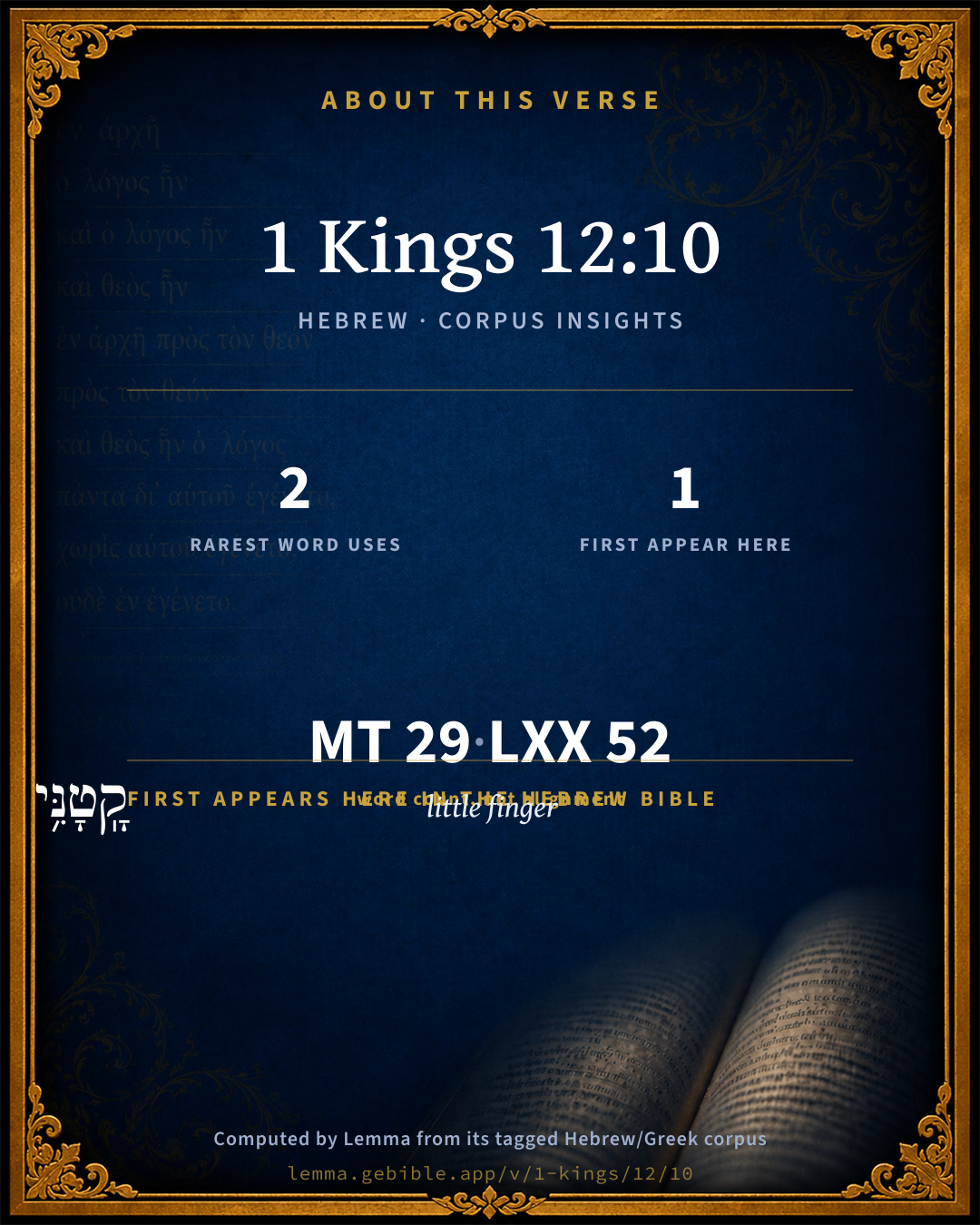
The rarest word here is קָֽטָנִּ֥י little finger H6995 — appearing just 2 times in the whole Hebrew Bible.

First appearance in Scripture

This word makes its first canonical appearance in the Hebrew Bible here:

  • קָֽטָנִּ֥י little finger H6995

Shared distinctive vocabulary

קָֽטָנִּ֥י little finger H6995 occurs in 2 verses of the Hebrew Bible. Also found in:

Grammatical profile

  • 10 verbs
  • 7 nouns
  • 2 pronouns
  • 5 prepositions
  • 2 adverbs
  • 3 particles

Verb forms

  • וַיְדַבְּר֣וּ Piel · Sequential Imperfect
  • גָּדְל֣וּ Qal · Perfect
  • לֵאמֹר֒ Qal · Infinitive Construct
  • תֹאמַ֣ר Qal · Imperfect
  • דִּבְּר֨וּ Piel · Perfect
  • לֵאמֹ֗ר Qal · Infinitive Construct
  • הִכְבִּ֣יד Hiphil · Perfect
  • הָקֵ֣ל Hiphil · Imperative
  • תְּדַבֵּ֣ר Piel · Imperfect
  • עָבָ֖ה Qal · Perfect

Repetition

Words recur within this verse — often emphatic in Hebrew:

  • וַיְדַבְּר֣וּ to speak H1696 ×3
  • לֵאמֹר֒ to say H559 ×3
  • כֹּֽה thus H3541 ×2
  • אָבִ֨יךָ֙ father H1 ×2
  • אֵלָ֗יו to H413 ×3
  • אֲשֶׁ֨ר which H834 ×2

Hebrew & Septuagint length

In English translation the verse runs 52 words from the Hebrew and 63 from the Septuagint (LXX English) — closely comparable.

A rough comparison of the two English renderings, which tokenize alike — not a word-level alignment.

Word counts can differ between the Hebrew and the Greek without any difference in meaning — e.g. the Hebrew direct-object marker אֵת has no separate Greek word, and Greek often adds the article ὁ.

In the original languages it is 29 Hebrew tokens and 52 Greek tokens — but the two are counted differently (Hebrew bundles its prefixes and suffixes into one token; the Greek is in lemma form), so that isn’t a like-for-like length.

Cross-references

7

Topical passages linked to 1 Kings 12:10 in the Treasury of Scripture Knowledge — connected by theme and wording, ordered by reader-vote popularity; previews shown in the World English Bible.

  • 2 Chronicles 10:10–11 The young men who had grown up with him spoke to him, saying, Thus shall you tell the people who spoke to you, saying, Your father made our yoke heavy, but make you it lighter to us; thus shall you say to them, My little finger is thicker than my father's loins.
  • 2 Samuel 17:7–13 Hushai said to Absalom, The counsel that Ahithophel has given this time is not good.
  • Proverbs 10:14 Wise men lay up knowledge, But the mouth of the foolish is near ruin.
  • Proverbs 18:6–7 A fool's lips come into strife, And his mouth invites beatings.
  • Proverbs 28:25 One who is greedy stirs up strife; But one who trusts in Yahweh will prosper.
  • Proverbs 29:23 A man's pride brings him low, But one of lowly spirit gains honor.
  • Isaiah 47:6 I was angry with my people, I profaned my inheritance, and gave them into your hand: you did show them no mercy; on the aged have you very heavily laid your yoke.

Cross-references courtesy of OpenBible.info (CC BY 4.0).

Hebrew and Greek witnesses Masoretic Hebrew ↔ Greek Septuagint

The same verse in the two great witnesses to the Old Testament, shown verse-for-verse.

These are two independent witnesses, not word-aligned to each other, and the Septuagint is shown in lemma (dictionary) form.

Hebrew 1 Kings 12:10 Masoretic · Westminster Leningrad Codex

וַיְדַבְּר֣וּ אֵלָ֗יו הַיְלָדִים֙ אֲשֶׁ֨ר גָּדְל֣וּ אִתּוֹ֮ לֵאמֹר֒ כֹּֽה תֹאמַ֣ר לָעָ֣ם הַזֶּ֡ה אֲשֶׁר֩ דִּבְּר֨וּ אֵלֶ֜יךָ לֵאמֹ֗ר אָבִ֨יךָ֙ הִכְבִּ֣יד אֶת עֻלֵּ֔נוּ וְאַתָּ֖ה הָקֵ֣ל מֵעָלֵ֑ינוּ כֹּ֚ה תְּדַבֵּ֣ר אֲלֵיהֶ֔ם קָֽטָנִּ֥י עָבָ֖ה מִמָּתְנֵ֥י אָבִֽי

The young men who had grown up with him spoke to him, saying, Thus shall you tell this people who spoke to you, saying, Your father made our yoke heavy, but make you it lighter to us; thus shall you speak to them, My little finger is thicker than my father's loins.

World English Bible · Public Domain

Greek LXX 1 Kings 12:10 Septuagint · lemma form

καί λαλέω πρός αὐτός ὁ παιδάριον ὁ ἐκτρέφω μετά αὐτός ὁ παραἵστημι πρό πρόσωπον αὐτός λέγω ὅδε λαλέω ὁ λαός οὗτος ὁ λαλέω πρός σύ λέγω ὁ πατήρ σύ βαρύνω ὁ κλοιός ἐγώ καί σύ νῦν κουφίζω ἀπό ἐγώ ὅδε λαλέω πρός αὐτός ὁ μικρότης ἐγώ παχύς ὁ ὀσφύς ὁ πατήρ ἐγώ

And the young men who had been brought up with him, who stood before his face, spoke to him, saying, Thus shall you say to this people who have spoken to you, saying, Your father made our yoke heavy, and do you now lighten it from off us: thus shall say to them, My little finger shall be thicker than my father's loins.

LXX2012 (modern English Septuagint) · Public Domain

On this verse, The Cambridge Bible for Schools and Colleges discusses the Septuagint’s reading. Read the note in Commentary ↓

Hebrew: Westminster Leningrad Codex (CC BY 4.0). Greek: Septuagint (public domain); English from LXX2012 (modern English Septuagint) (Public Domain). How the Septuagint differs from the Hebrew →

Targum (Aramaic paraphrase)

1

The Targum is the ancient Jewish Aramaic paraphrase of the Hebrew Scriptures — an interpretive translation, not the Hebrew text itself. Onkelos (literal) and Pseudo-Jonathan (expansive) render the Torah, and Jonathan the Prophets. Coverage is partial: where no permissively-licensed English translation exists for a verse, only the Aramaic is shown. This is verse-level text, not a word-by-word alignment to the Hebrew.

  1. Targum Jonathan Prophets (Joshua–Malachi)
    וּמַלִילוּ עִמֵיהּ יַנְקַיָא דִרְבִיאוּ עִמֵיהּ לְמֵימָר כְּדֵין תֵּימַר לְעַמָא הָדֵין דְמַלִילוּ עִמָךְ לְמֵימַר אֲבוּךְ אַתְקֵיף יַת נִירָנָא וְאַתְּ אֲקֵיל מִנָנָא כְּדֵין תֵּימַר לְהוֹן חֲלָשׁוּתִי תַקִיפָא מֵעוּלֵימוּתֵיהּ דְאַבָּא:

    (no public-domain English translation for this verse)

    Targum Jonathan — Aramaic: “Mikraot Gedolot” (public domain). English: “Sefaria Community Translation” (CC0 1.0 (public-domain dedication)); “London "Chaldee Paraphrase," 1871” (public domain). Text via Sefaria.

Commentary

Notes on 1 Kings 12:10 from classic Christian and Jewish commentators (each source and its license shown beneath its notes). The classic Christian expositions comment on the surrounding passage and are grouped to its opening verse, so a note may address several verses; the Jewish commentaries on the Tanakh (Rashi and others) are per-verse, so they appear only where the commentator wrote on this verse.

Lemma curates 59 commentaries, every one of them public domain or Creative Commons licensed, each selected and text-cleaned for this edition rather than reprinted as found. About our sources →

Trapp's Complete Commentary

John Trapp

1Ki 12:10 And the young men that were grown up with him spake unto him, saying, Thus shalt thou speak unto this people that spake unto thee, saying, Thy father made our yoke heavy, but make thou [it] lighter unto us; thus shalt thou say unto them, My little [finger] shall be thicker than my father’s loins.

Ver. 10. And the going men that were grown up with him.] And so knew how to humour him; as,

“ Agmen adulantum media procedit in aula. ”

My little finger shall be thicker than my father’s loins,] i.e., Multo fortior sum patre meo. {a} I have as much and more absolute power over your persons and goods than ever my father had; and can force you according to my will. He was a youth when he was crowned, and consented to anything: but I am forty years of age, and will not be made such a child of. The rashness, therefore, of your present demands, I will chastise with rigour, &c. Now, what was it but pride, boldness, and folly, that made this silly man thus to vaunt himself, and say, My little finger, &c.? How truly he spoke it, that one thing sufficiently showeth, that the golden shields used to be borne before his father, were taken away from Rehoboam, and brazen shields put in their places! Hic nimirum fuit vanae illius gloriationis exitus, saith one. This was the issue of these vain vauntings.

{a} Vatab.

John Trapp, A Commentary or Exposition upon All the Books of the Old and New Testament (1647–1656) — public domain. Text from a community e-Sword module.

The Biblical Illustrator

Joseph S. Exell

1Ki_12:10-14

My little finger shall be thicker than my fathers loins.

Rehoboams foolish answer

These were the words of an infatuated fool--a fool led on to his own destruction by the irony of destiny.

I. Wisdom is not hereditary. The question is often asked, as this kind of phenomenon comes under notice, how does it happen that great men seldom have great children? Does genius wear itself out? We incline to think that the gross neglect which geniuses manifest towards their children has much to do with it. Still, it cannot be denied that the descendants of many of our greatest men have been little better than drivelling idiots.

II. Curse of evil company. We could not find a more painful instance than the one under consideration, either in profane or sacred history. It was fraught with terrible consequences.

1. It is a curse to the man himself. Do evil, unholy, foolish companions make a person happy? Does it not rather bring trouble, sorrow, regrets, and present inconvenience? It is expensive, humiliating, degrading.

2. It is a curse to the mans influence. Character is assimilated with those with whom we associate. And even if the evil influence does not produce evil results, the name of the evil clings to him who mixes with it.

3. It is a curse to his future. It will ultimately bring him ruin. No person was ever yet strong enough in his integrity to resist the united influence of boon cornpardons. Their influence sows a seed which will ultimately produce an abundant harvest.

III. Stupidity of despotism. A despot uses his power for the mere sake of using it, and not to effect any good purpose, or to bring about any desirable end. There are many minor despots in the world--persons put into little offices, who love to manifest and to parade their brief authority.

IV. The overruling power of God. He maketh even the wrath and the folly of man to praise Him. Had Rehoboam acted wisely, we do not know whether the Judgment might not have been still further postponed; but as it was, this act precipitated Gods wrath and effected His purposes. (Homilist.)

The character of Rehoboam

I. The circumstances in which Rehoboam commenced his reign were unusually hazardous.

II. The manner in which this demand on the part of the people was met by the king.

III. The final reply of Rehoboam to the demand of his people. It was nothing else, we cannot but say, than downright infatuation.

IV. The cause was from the Lord. And this is one among many proofs of Gods absolute predestination, and of the perfect freedom of human actions. The division of the kingdom from Rehoboam was absolutely certain; it was determined by God; it was positively predicted by a prophet of God.

V. Those points in the character and history of rehoboam, which may be calculated to convey suitable instruction. And let me remark:

1. Talent and piety are not inherited by birth. No part of Solomons far-famed wisdom descended to his son. He was even more than usually deficient in common prudence, and in the capacity for government. A father may convey to his heirs the riches he has accumulated; but there is a nobler wealth, which cannot be bequeathed, and which cannot be transferred. Knowledge, mental opulence, talent--these are the result of individual application, of laborious industry, and of perseverance. Without these, no fancied gifts of nature can avail; and with these there is scarcely any extent of acquisition, which it is not possible to secure. But it is yet far more important to notice, that true piety does not descend by birth: Religion is a personal and individual thing; it is not transferred like property, it does not descend like any civil privilege. Religion is an individual matter; it is a change wrought upon the individuals mind; it is a living principle and energy within the individual heart and the individual nature. Talent and piety are not inherited by birth.

2. The kings rejection of wise counsel. The aged are not always wise, and they are often too cold and too calculating to be safe guides; and sometimes also their manner is unfortunate and repulsing; they are unamiable, they are irmpatient of the habits and feelings of youth, and they pronounce too magisterially to be very easily borne. But these are exceptions, and beyond all doubt, a multitude of years should teach wisdom. It was one of the laws of ancient Sparta (a heathen State), that whenever an old man appeared, the young in the assembly should rise up in token of their reverence. Reverence for age lies at the foundation of a sound moral character; it is not only becoming, it is not only beautiful, but it is essential; and where it is wanting in measure, it shows there is something utterly wrong, utterly unsound, in the moral constitution.

3. His arbitrary disposition. Instead of soothing, and gradually quenching the spirit of revolt, Rehoboam sought to cut down the clamours of his subjects, by arbitrary measures. The saying of the wise man cannot be too often repeated, A soft answer turneth away wrath.

4. Rehoboams imprudent choice of his associates. We cannot question that the ruin of this prince is to be ascribed to those whom he selected as his companions. Had it not been for the young men who grew up along with him, the kingdoms of Israel and Judah bad been undivided, and he had retained the crown. And, in connection with this, Evil communications corrupt good manners. There is nothing, so far as personal piety is concerned, so far as the salvation of the soul is concerned, of so much importance as the choice of your associates. (J. Young, M. A.)

Dangerous counsellors of James II.

But there was at the court a small knot of Roman Catholics whose hearts had been ulcerated by old injuries, whose heads had been turned by recent elevation, who were impatient to climb to the highest honours of the State, and who, having little to lose, were not troubled by thoughts of the day of reckoning. These men called with one voice for war on the constitution of the Church and the State. They told their master that he owed it to his religion and to the dignity of his crown to stand firm against the outcry of heretical demagogues, and to let the Parliament see from the first that he would be master in spite of opposition, and that the only effect of opposition would be to make him a hard master. (Macaulays England.)

The Biblical Illustrator, edited by Joseph S. Exell (c. 1880s–1900s) — public domain. Text from a community e-Sword module.

Joseph Benson's Commentary

1Ki 12:10-11. My little finger shall be thicker, &c. — Or, rather, is thicker, and therefore stronger, and more able to crush you, if you proceed in these mutinous demands, than his loins — In which is the principal seat of strength. My father was young and weak, and had many enemies, when he first took the kingdom, but I am the undoubted heir, and I find the kingdom by his wise care, far better settled and fortified against all enemies, foreign or domestic, than he did. Or, they advise him, in these words, to threaten to lay burdens upon them as much heavier than his father’s, as the loins of a man are thicker than his little finger. I will add to your yoke — That is, I will make it heavier and stronger, both to punish your petulance, and to curb and restrain you from seditions attempts. My father chastised you with whips — Punished and made you smart when you transgressed his laws or resisted his authority; but I will chastise you with scorpions — With such whips as will sting you like scorpions. If you proceed in these courses, I will most severely punish you. What sort of instrument is here meant by scorpions, cannot now be perfectly determined; though some authors think that whips with rowels in them, or sharp thorns tied to them, are intended by the expression. Undoubtedly it was a scourge, called so from its cruelty.

Joseph Benson's Commentary on the Old and New Testaments (1811–1818) — public domain. Text from a community e-Sword module.

Geneva Bible (1599)

Geneva Bible translators

Or, little finger.

I am much more able to keep you in subjection than my father was.

Geneva Bible (1599) marginal notes — public domain. Text via Bolls.life.

Adam Clarke's Commentary

Verse 10. And the young men that were grown up with him] It was a custom in different countries to educate with the heir to the throne young noblemen of nearly the same age. This, as Calmet observes, answered two great and important ends: -

1. It excited the prince to emulation; that he might, as far as possible, surpass in all manly exercises, and in all acts of prudence and virtue, those whom one day he was to surpass in the elevation and dignity of his station.

2. That he might acquire a correct knowledge of the disposition and views of those who were likely to be, under him, the highest officers of the state; and consequently, know the better how to trust and employ them. The old counsellors Rehoboam did not know; with the young nobility he had been familiar.

My little finger shall be thicker] A proverbial mode of expression: "My little finger is thicker than my father's thigh." As much as the thigh surpasses the little finger in thickness, so much does my power exceed that of my father; and the use that I shall make of it, to employ and tax you, shall be in proportion.

Adam Clarke's Commentary on the Bible (1810–1826) — public domain. Text from a community e-Sword/MySword module.

Ellicott's Commentary for English Readers

(10) Thus shalt thou speak.—The advice of the young men—the spoilt children of a magnificent and luxurious despotism, of which alone they had experience—is the language of the arrogant self-confidence, which mistakes obstinacy for vigour, and, blind to all signs of the times, supposes that what once was possible, and perhaps good for the national progress, must last for ever. It is couched in needlessly and absurdly offensive language; but it is, as all history shows—perhaps not least the history of our own Stuart dynasty—a not unfrequent policy in revolutionary times; holding that to yield in one point is to endanger the whole fabric of sovereign power; relying on the prestige of an authority proudly confident in itself; and trusting to cow by threats the classes long subject to despotic oppression, and despised accordingly by those who wield it. It can succeed only when the popular disaffection is superficial, or when a nation is wearied out with revolutionary fanaticism and failure.

A Bible Commentary for English Readers, edited by Charles John Ellicott (1878–1897) — public domain. Text from a community e-Sword module.

The Cambridge Bible for Schools and Colleges

gen. ed. J. J. S. Perowne

10. my little finger shall be (R.V. is) thicker than my father’s loins] The italics of A.V. shew that the word ‘finger’ is explanatory, and not represented in the text. The LXX. gives ἡ μικρότης μου. There can however be no doubt that ‘my littleness’ is here correctly expounded by ‘my little finger,’ as the Vulgate, Josephus, the Syriac version and ancient Jewish commentators explain it.

The Cambridge Bible for Schools and Colleges (gen. ed. J. J. S. Perowne; Cambridge University Press, 1878–1918) — public domain. Text from a community e-Sword module.

John Gill's Exposition

And now, whereas my father did lade you with a heavy yoke,.... Which was putting words into his mouth, owning the charge and accusation brought against his father, as he did, Kg1 12:14, which was very unbecoming, if true; unless this is said according to the sense of the people:

I will add to your yoke; make it heavier, lay more taxes on them:

my father hath chastised you with whips; which was putting a lie into his mouth, and which he uttered, Kg1 12:14 for no instance of severity exercised on the people in general can be given during the whole reign of Solomon:

but I will chastise you with scorpions; treat them more roughly, and with greater rigour: whips may mean smaller ones, these horse whips, as in the Targum; which gave an acute pain, like the sting of scorpions, or made a wound like one. Ben Gersom says, these were rods with thorns on them, which pierced and gave much pain. Weemse (h) thinks these are alluded to by thorns in the sides, Num 33:55, for whipping with them was about the sides, and not along the back. Abarbinel calls them iron thorns, rods that had iron prongs or rowels to them, which tore the flesh extremely. Isidore (i) says, a rod that is smooth is called a rod, but, if knotty and prickled, it is rightly called a scorpion, because it makes a wound in the body arched or crooked. Pliny (k) ascribes the invention of this sort of scorpions to the Cretians.

(h) Christian Synagogue, paragraph 6. diatrib. 2. p. 190. (i) Origin. l. 5. c. 27. p. 39. (k) Nat. Hist. l. 7. c. 56.

John Gill's Exposition of the Whole Bible (1746–1763) — public domain (CC PDM 1.0). Text via the HelloAO Bible API.

Albert Barnes' Notes on the Bible

My little finger ... - i. e., “You shall find my hand heavier on you than my father’s - as much heavier as if my little finger were thicker than his loins.”

Albert Barnes' Notes on the Bible (1834–1885) — public domain. Text from a community e-Sword/MySword module.

Haydock's Catholic Bible Commentary

Finger is not expressed in Hebrew or Septuagint, but the Syriac and Josephus agree with the Vulgate. In Paralipomenon, we read loins, instead of back. Hebrew and Septuagint, my little (Protestants supply finger). Septuagint, "my littleness," Greek: mikrotes; but in Paralipomenon finger is added. (Haydock) --- Chaldean, "my weakness is stronger than my father’s strength." The loins denote strength. Roboam did not use these boastings and insolent expressions: but he adopted their spirit. (Calmet) --- He insinuates that he was twice as old as his father when he began to reign, (Pineda vii. 24,) or he uses a proverbial exaggeration. (Delrio. adag. 202.) (Menochius)

George Leo Haydock (1774–1849), Haydock's Catholic Family Bible and Commentary, 1859 edition — public domain. Excludes Psalms (Douay-Rheims chapter numbering differs from Protestant) and Deuterocanonical books (Catholic canon only).

Matthew Poole's English Annotations

Or rather, is thicker, and therefore stronger, and mere able to crush you, if you proceed in these mutinous demands,

than his loins, in which is the principal seat of strength. My father was young and weak, and had many enemies, when he first took the kingdom; but I am the undoubted heir; and I find the kingdom by his wise care far better settled and fortified against all enemies, foreign or domestic, than he did.

Matthew Poole's English Annotations on the Holy Bible (1683–1685) — public domain. Text from a community e-Sword/MySword module.

Whedon's Commentary on the Bible

Daniel D. Whedon

10. My little finger… thicker than my father’s loins — A proverbial expression equivalent to, My power is greater than my father’s, and my exactions shall come upon you accordingly.

Daniel D. Whedon (gen. ed.), Commentary on the Old and New Testaments (1874–1909) — public domain. Text from a community e-Sword module.

The Pulpit Commentary

And the young men that were grown up with him spake unto him, saying, Thus shalt thou speak unto this people There is a certain amount of contemptuousness in the expression (cf. St. Joh_7:49) that spake unto thee The repetition, "speak, spake," is probably not undesigned. It suggests the idea of retaliation, or that it was a piece of presumption on their part to have spoken at all, saying, Thy father made our yoke heavy, but make thou it lighter unto us lit., from upon us; thus shalt thou say unto them This iteration is expressive of determination and resentment. We may read between the lines, "I would make short work with them, and teach them a lesson they will not forget", My little finger "Finger" is not in the original, but the meaning is indisputable shall be or is, hb; ; strictly, was thicker. The LXX has simply pacutera thicker than my father"s loins. A figurative and perhaps proverbial expression. The sense is clear. "My hand shall be heavier than my father"s, my force greater than his, my weakness even stronger than his strength." The counsel of the young men is full of flattery, which would be acceptable to a young king.

The Pulpit Commentary (1880–1919), ed. H.D.M. Spence-Jones & Joseph S. Exell — public domain. Text from a community e-Sword module.

John Wesley's Explanatory Notes

Shall be thicker - Or rather, is thicker, and therefore stronger, and more able to crush you, if you proceed in these mutinous demands, than his loins, in which is the principal seat of strength.

John Wesley, Explanatory Notes Upon the Whole Bible (1754–1765) — public domain. Text via the GEBible commentary corpus.

unfoldingWord translationNotes

Door43 World Missions Community

My little finger is thicker than my father's waist

This metaphor means that Rehoboam is more cruel and intimidating than his father. AT: "What I will do to make your burden heavier is much more than what my father put on you" (See: Metaphor)

My father punished you with whips, but I will punish you with scorpions

This metaphor means that the punishment Rehoboam plans to give will be worse than what his father gave. AT: "My father used whips to force you to work but I will use even crueler punishment" (See: Metaphor)

punish you with scorpions

The word "scorpions" may refer to 1) a whip with sharp metal barbs on the end or 2) a spider-like creature that has a poisonous sting.

translationWords

Solomon

yoke

burden

punish

unfoldingWord translationNotes — © Distant Shores Media and the Door43 World Missions Community, licensed CC BY-SA 4.0. Source: git.door43.org/Door43/en_tn.

Rashi

Rabbi Shlomo Yitzchaki (Rashi)

My little finger is thicker. My little finger.

Rashi on the Tanakh — English translations: “The Judaica Press complete Tanach with Rashi, translated by A. J. Rosenberg” (CC BY 4.0); “Pentateuch with Rashi's commentary by M. Rosenbaum and A.M. Silbermann, 1929-1934” (public domain); “The Metsudah Tanach series, Lakewood, N.J” (CC BY 4.0); and “The Book of Joshua, Metsudah Publications, 1997” (CC BY 4.0). Text via Sefaria.

Lesson kit

Teaching starters — assembled from the data on this page, not authored interpretation. Every prompt links to the verse data it draws on. Edit before teaching.

1 Kings, in the Historical, opens this verse with 29 words (20 distinct Hebrew lemmas). Its most distinctive word is qôṭen (“little finger”). A historical commentator’s framing appears above. Read the whole chapter for the surrounding context.

Discussion questions

  1. The word qôṭen carries the sense “little finger.” How does it shape the verse?
  2. This is the first place “little finger” appears in Scripture (first appears here). What does its debut here establish?
  3. How does 2 Chronicles 10:10, which shares the word «little finger», read alongside this verse?
  4. What does the repetition of “to speak” (3× in this one verse) do in this verse?
  5. The translations on this page render this verse differently — a whole-verse word diff, not a word-by-word alignment. What might account for the different wordings?
  6. «וַיְדַבְּר֣וּ» is a Piel Sequential Imperfect verb. How does that grammatical form shape the action described?
  7. Compare how Trapp's Complete Commentary and The Biblical Illustrator read this verse. Where do they agree or differ?

Things to notice

Reading settings

Reading text

Shown beneath each verse's original-language words.

Old Testament
Old Testament edition

Read the OT as the Masoretic Hebrew (MT) or the Greek Septuagint (LXX).

English shown for the Greek Septuagint (in the Hebrew ↔ Greek comparison).

Comparing translations? Open the Compare panel on any verse page to stack up to four side by side.