Ezekiel 38:23

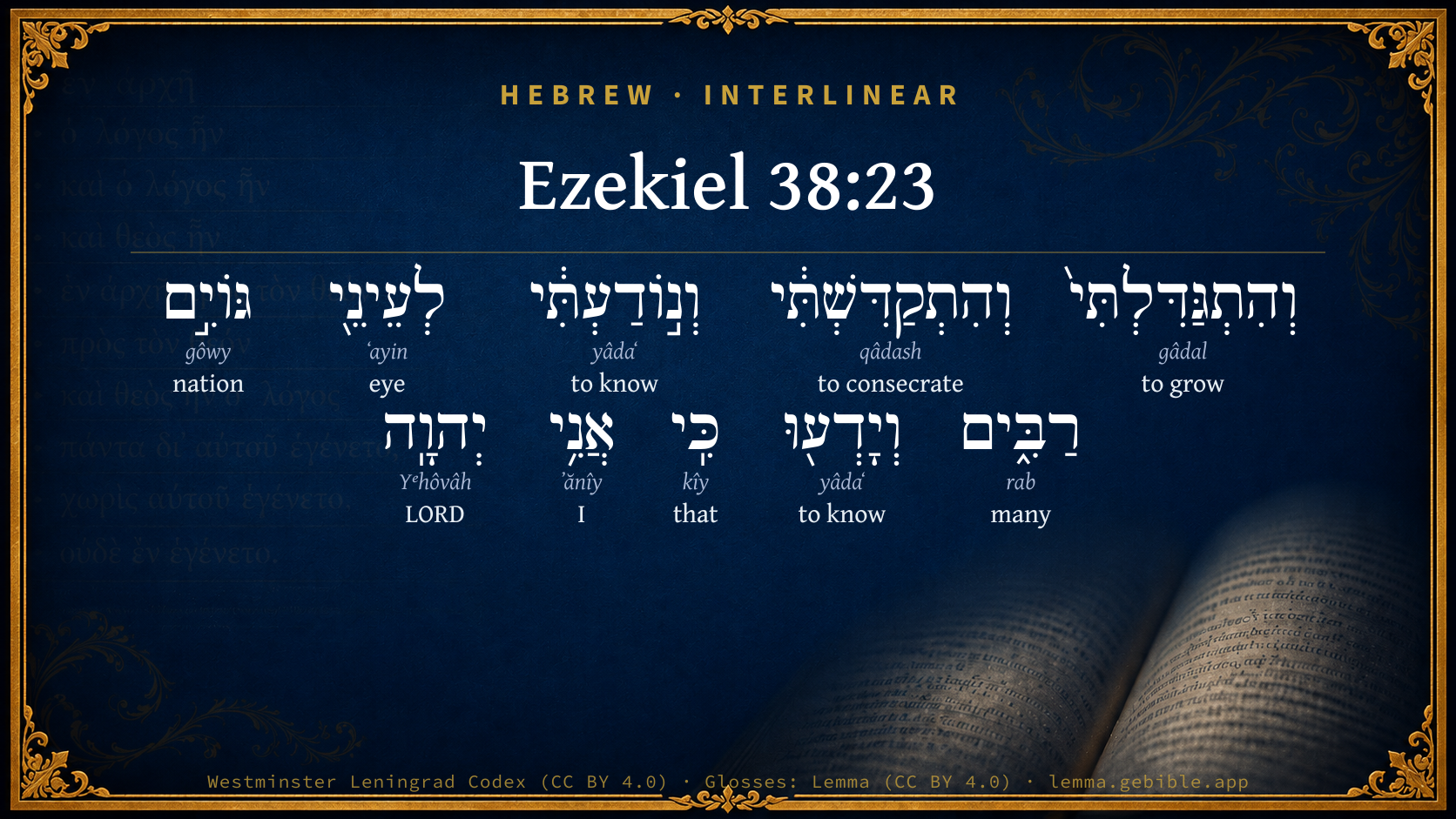
Hebrew (Westminster Leningrad Codex) Ezekiel 38:23 appears in the Hebrew Old Testament. The text above is from the Westminster Leningrad Codex. Each word links to its Strong’s number, a concise gloss, and parsing drawn from the Open Scriptures Hebrew Bible morphology. Click any word for its full Brown-Driver-Briggs (BDB) entry.
Download image
Cite this verse

Ezekiel 38:23 (World English Bible). Public Domain. Lemma interlinear Bible study tool, https://lemma.gebible.app/v/ezekiel/38/23.

Show BibTeX & RIS
BibTeX
RIS
English Translation
I will magnify myself, and sanctify myself, and I will make myself known in the eyes of many nations; and they shall know that I am Yahweh.
World English Bible · Public Domain
Download a study sheet

One document with this verse’s original text, its word-by-word gloss line, the meaning frame, cross-references with their text, attributed commentary, and full source and license credits — printable, and it pastes into notes with its structure intact.

This verse Autodidact and up

Study sheet (.html) Plain text (.txt)

A passage Seminary Student

Up to 50 verses in one chapter. A passage sheet keeps up to 6 commentary sources and 12 cross-references per verse, in the order this page ranks them, and says so on the sheet whenever that leaves anything out. Ask for a single verse and you get the Autodidact verse sheet above.

Everything on this page stays free to read, with no account — the sheet is a download of what is already on screen, not access to it.

Want to remove ads? Support Godless Engineer
Compare translations 3

The same verse in 3 English versions, stacked beneath the original-language interlinear above. Click any original word for its lexicon entry.

Each is an independent rendering of the whole verse — the interlinear is not word-aligned to these translations.

Highlighted words mark where these versions differ — a whole-verse word diff, not a word-by-word alignment.

  • World English Bible Public Domain
    I will magnify myself, and sanctify myself, and I will make myself known in the eyes of many nations; and they shall know that I am Yahweh.
  • King James Version Public Domain
    Thus will I magnify myself, and sanctify myself; and I will be known in the eyes of many nations, and they shall know that I am the LORD.
  • unfoldingWord Literal Text CC BY-SA 4.0
    For I will show my greatness and my holiness and I will make myself known in the eyes of the many nations, and they will know that I am Yahweh.’”

unfoldingWord Literal Text — © unfoldingWord, licensed CC BY-SA 4.0. Word-aligned USFM3 via Door43 (git.door43.org/unfoldingWord/en_ult).

Versions to compare (up to 4)

3 of 4 selected

Show all 18 translations

Every available English version of this verse, each an independent rendering of the whole verse.

  • World English Bible Public Domain
    I will magnify myself, and sanctify myself, and I will make myself known in the eyes of many nations; and they shall know that I am Yahweh.
  • Berean Standard Bible Public Domain
    I will magnify and sanctify Myself, and will reveal Myself in the sight of many nations. Then they will know that I am the LORD.
  • Majority Standard Bible Public Domain
    I will magnify and sanctify Myself, and I will reveal Myself in the sight of many nations. Then they will know that I am the LORD.
  • King James Version Public Domain
    Thus will I magnify myself, and sanctify myself; and I will be known in the eyes of many nations, and they shall know that I am the LORD.
  • American Standard Version (1901) Public Domain
    And I will magnify myself, and sanctify myself, and I will make myself known in the eyes of many nations; and they shall know that I am Jehovah.
  • Revised Version (1885) Public Domain
    And I will magnify myself, and sanctify myself, and I will make myself known in the eyes of many nations; and they shall know that I am the LORD.
  • Geneva Bible (1599) Public Domain
    Thus will I be magnified, and sanctified, and knowen in the eyes of many nations, and they shall knowe, that I am the Lord.
  • Douay-Rheims (1899) Public Domain
    And I will be magnified, and I will be sanctified: and I will be known in the eyes of many nations: and they shall know that I am the Lord.
  • Young's Literal Translation Public Domain
    And I have magnified Myself, and sanctified Myself, And I have been known before the eyes of many nations, And they have known that I `am' Jehovah!
  • Literal Standard Version CC BY-SA 4.0
    And I have magnified Myself, and sanctified Myself, || And I have been known before the eyes of many nations, || And they have known that I [am] YHWH!”
  • Unlocked Literal Bible CC BY-SA 4.0
    For I will show my greatness and my holiness and I will make myself known in the eyes of the many nations, and they will know that I am Yahweh.'”
  • unfoldingWord Literal Text CC BY-SA 4.0
    For I will show my greatness and my holiness and I will make myself known in the eyes of the many nations, and they will know that I am Yahweh.’”
  • Darby Bible Public Domain
    And I will magnify myself, and sanctify myself, and I will be known in the eyes of many nations, and they shall know that I [am] Jehovah.
  • World Messianic Bible Public Domain
    I will magnify myself and sanctify myself, and I will make myself known in the eyes of many nations. Then they will know that I am the LORD.”’
  • Webster's Bible Public Domain
    Thus will I magnify myself, and sanctify myself; and I will be known in the eyes of many nations, and they shall know that I am the LORD.
  • Free Bible Version CC BY-SA 4.0
    I will demonstrate my true power and holiness, revealing myself to many nations. Then they will acknowledge that I am the Lord.”
  • Bible in Basic English Public Domain
    And I will make my name great and make myself holy, and I will make myself clear to a number of nations; and they will be certain that I am the Lord.
  • JPS Tanakh (1917) Public Domain
    Thus will I magnify Myself, and sanctify Myself, and I will make Myself known in the eyes of many nations; and they shall know that I am the LORD.

Literal Standard Version (2020), Covenant Press — licensed CC BY-SA 4.0. Text via the HelloAO Bible API (eBible.org). Unlocked Literal Bible (unfoldingWord) — licensed CC BY-SA 4.0. Text via the HelloAO Bible API (eBible.org). unfoldingWord Literal Text — © unfoldingWord, licensed CC BY-SA 4.0. Word-aligned USFM3 via Door43 (git.door43.org/unfoldingWord/en_ult). Free Bible Version, Dr. Jonathan Gallagher — licensed CC BY-SA 4.0. Text via the HelloAO Bible API (eBible.org).

Word by word

More ways to search: Search by grammar → Find every occurrence → Compare this word →

Practice this passage: Drill this verse → Learn its vocabulary →

וְהִתְגַּדִּלְתִּי֙
gâdal
H1431
“and · to grow”
Conjunction + Verb, Hithpael, Sequential Perfect, 1st Person, Common, Singular
Part of Speech
Conjunction + Verb
Stem
Hithpael
Form
Sequential Perfect
Person
1st Person
Gender
Common
Number
Singular
Full BDB Definition

Origin: a primitive root

TWOT: 315

to grow, become great or important, promote, make powerful, praise, magnify, do great things - (Qal) - to grow up - to become great - to be magnified - (Piel) - to cause to grow - to make great, powerful - to magnify - (Pual) to be brought up - (Hiphil) - to make great - to magnify - to do great things - (Hithpael) to magnify oneself
  1. וְהִתְקַדִּשְׁתִּ֔י qâdash H6942 “and · to consecrate” Conjunction + Verb, Hithpael, Sequential Perfect, 1st Person, Common, Singular
  2. וְנ֣וֹדַעְתִּ֔י yâdaʻ H3045 “and · to know” Conjunction + Verb, Niphal, Sequential Perfect, 1st Person, Common, Singular
  3. לְעֵינֵ֖י ʻayin H5869 “to/for · eyes of” Preposition + Noun, Common, Both, Dual, Construct
  4. גּוֹיִ֣ם gôwy H1471 “nations” Noun, Common, Masculine, Plural, Absolute
  5. רַבִּ֑ים rab H7227 “many” Adjective, Adjective, Masculine, Plural, Absolute
  6. וְיָדְע֖וּ yâdaʻ H3045 “and · to know” Conjunction + Verb, Qal, Sequential Perfect, 3rd Person, Common, Plural
  7. כִּֽי kîy H3588 “that” Conjunction
  8. אֲנִ֥י ʼănîy H589 “I” Pronoun, Personal, 1st Person, Common, Singular
  9. יְהוָֽה Yᵉhôvâh H3068 “LORD” Noun, Proper

About this verse

These counts appear in no published source. They are computed here, from the morphology-tagged text and Lemma’s own curated glosses. What Lemma adds →

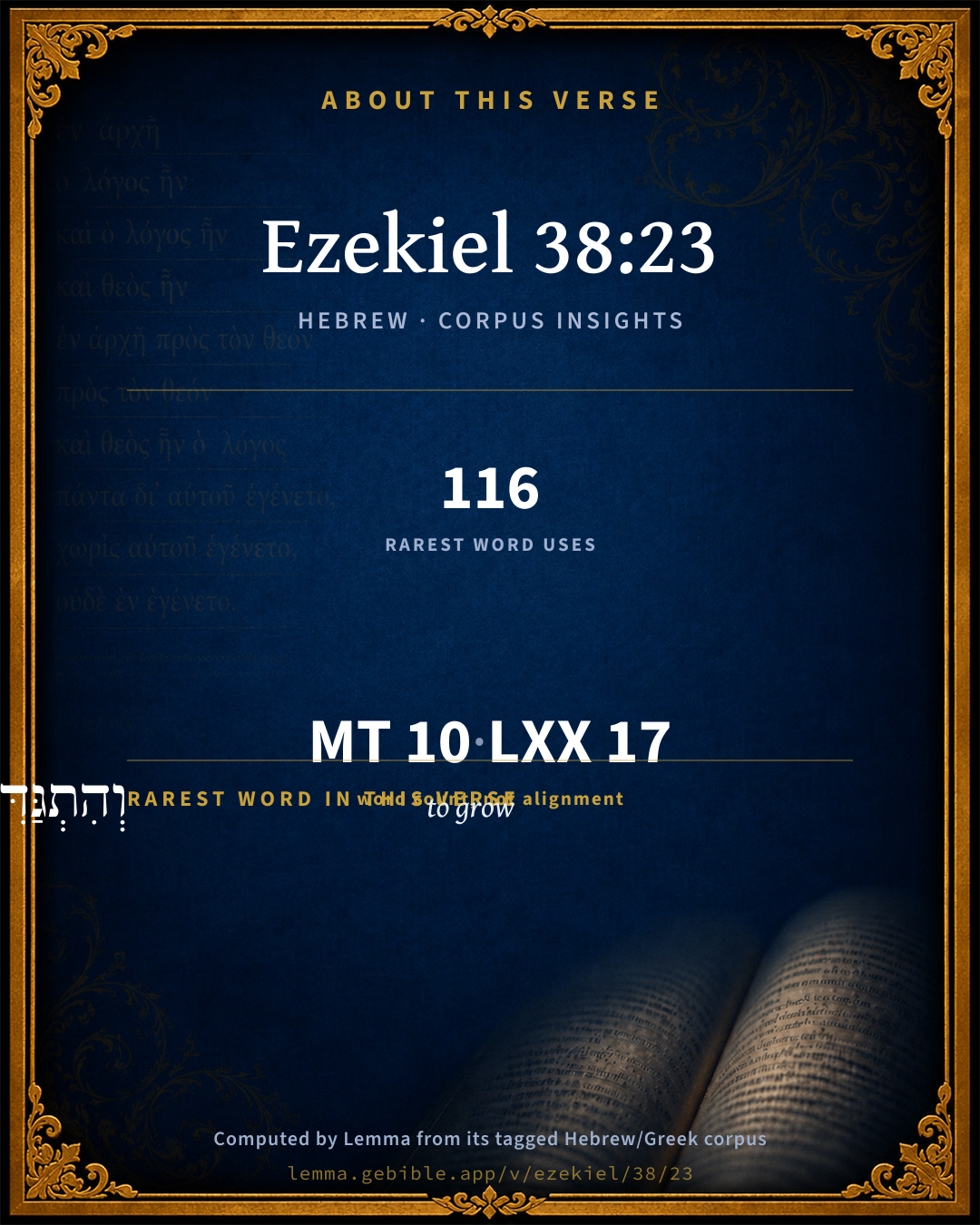
10
words
9
distinct lemmas
Prophets
section

Grammatical profile

  • 4 verbs
  • 3 nouns
  • 1 adjective
  • 1 pronoun
  • 1 conjunction

Verb forms

  • וְהִתְגַּדִּלְתִּי֙ Hithpael · Sequential Perfect
  • וְהִתְקַדִּשְׁתִּ֔י Hithpael · Sequential Perfect
  • וְנ֣וֹדַעְתִּ֔י Niphal · Sequential Perfect
  • וְיָדְע֖וּ Qal · Sequential Perfect

Repetition

A word recurs within this verse — often emphatic in Hebrew:

  • וְנ֣וֹדַעְתִּ֔י to know H3045 ×2

Hebrew & Septuagint length

In English translation the verse runs 27 words from the Hebrew and 29 from the Septuagint (LXX English) — closely comparable.

A rough comparison of the two English renderings, which tokenize alike — not a word-level alignment.

Word counts can differ between the Hebrew and the Greek without any difference in meaning — e.g. the Hebrew direct-object marker אֵת has no separate Greek word, and Greek often adds the article ὁ.

In the original languages it is 10 Hebrew tokens and 17 Greek tokens — but the two are counted differently (Hebrew bundles its prefixes and suffixes into one token; the Greek is in lemma form), so that isn’t a like-for-like length.

Cross-references

9

Topical passages linked to Ezekiel 38:23 in the Treasury of Scripture Knowledge — connected by theme and wording, ordered by reader-vote popularity; previews shown in the World English Bible.

  • Psalms 9:16 Yahweh has made himself known. He has executed judgment. The wicked is snared by the work of his own hands. Meditation. Selah.
  • Ezekiel 38:16 and you shall come up against my people Israel, as a cloud to cover the land: it shall happen in the latter days, that I will bring you against my land, that the nations may know me, when I shall be sanctified in you, Gog, before their eyes.
  • Revelation 19:1–6 After these things I heard something like a loud voice of a great multitude in heaven, saying, "Hallelujah! Salvation, power, and glory belong to our God:
  • Ezekiel 36:23 I will sanctify my great name, which has been profaned among the nations, which you have profaned in the midst of them; and the nations shall know that I am Yahweh, says the Lord Yahweh, when I shall be sanctified in you before their eyes.
  • Ezekiel 37:28 The nations shall know that I am Yahweh who sanctifies Israel, when my sanctuary shall be in the midst of them forevermore.
  • Revelation 15:3–4 They sang the song of Moses, the servant of God, and the song of the Lamb, saying, "Great and marvelous are your works, Lord God, the Almighty; Righteous and true are your ways, you King of the nations.
  • Ezekiel 39:7 My holy name will I make known in the midst of my people Israel; neither will I allow my holy name to be profaned any more: and the nations shall know that I am Yahweh, the Holy One in Israel.
  • Ezekiel 39:13 Yes, all the people of the land shall bury them; and it shall be to them a renown in the day that I shall be glorified, says the Lord Yahweh.
  • Ezekiel 39:27 when I have brought them back from the peoples, and gathered them out of their enemies' lands, and am sanctified in them in the sight of many nations.

Cross-references courtesy of OpenBible.info (CC BY 4.0).

Hebrew and Greek witnesses Masoretic Hebrew ↔ Greek Septuagint

The same verse in the two great witnesses to the Old Testament, shown verse-for-verse.

These are two independent witnesses, not word-aligned to each other, and the Septuagint is shown in lemma (dictionary) form.

Hebrew Ezekiel 38:23 Masoretic · Westminster Leningrad Codex

וְהִתְגַּדִּלְתִּי֙ וְהִתְקַדִּשְׁתִּ֔י וְנ֣וֹדַעְתִּ֔י לְעֵינֵ֖י גּוֹיִ֣ם רַבִּ֑ים וְיָדְע֖וּ כִּֽי אֲנִ֥י יְהוָֽה

I will magnify myself, and sanctify myself, and I will make myself known in the eyes of many nations; and they shall know that I am Yahweh.

World English Bible · Public Domain

Greek LXX Ezekiel 38:23 Septuagint · lemma form

καί μεγαλύνω καί ἁγιάζω καί ἐνδοξάζομαι καί γιγνώσκω ἐναντίον ἔθνος πολύς καί γιγνώσκω ὅτι ἐγώ εἰμί κύριος

And I will be magnified, and sanctified, and glorified; and I will be known in the presence of many nations, and they shall know that I am the Lord.

LXX2012 (modern English Septuagint) · Public Domain

Hebrew: Westminster Leningrad Codex (CC BY 4.0). Greek: Septuagint (public domain); English from LXX2012 (modern English Septuagint) (Public Domain). How the Septuagint differs from the Hebrew →

Targum (Aramaic paraphrase)

1

The Targum is the ancient Jewish Aramaic paraphrase of the Hebrew Scriptures — an interpretive translation, not the Hebrew text itself. Onkelos (literal) and Pseudo-Jonathan (expansive) render the Torah, and Jonathan the Prophets. Coverage is partial: where no permissively-licensed English translation exists for a verse, only the Aramaic is shown. This is verse-level text, not a word-by-word alignment to the Hebrew.

  1. Targum Jonathan Prophets (Joshua–Malachi)
    וְאִתְרַבֵּי וְאִתְקַדֵשׁ וַאֲגַלֵי גְבוּרְתִּי לְעֵינֵי עַמְמִין סַגִיאִין וְיֵדְעוּן אֲרֵי אֲנָא יְיָ:

    (no public-domain English translation for this verse)

    Targum Jonathan — Aramaic: “Mikraot Gedolot” (public domain). English: “Sefaria Community Translation” (CC0 1.0 (public-domain dedication)); “London "Chaldee Paraphrase," 1871” (public domain). Text via Sefaria.

Commentary

Notes on Ezekiel 38:23 from classic Christian and Jewish commentators (each source and its license shown beneath its notes). The classic Christian expositions comment on the surrounding passage and are grouped to its opening verse, so a note may address several verses; the Jewish commentaries on the Tanakh (Rashi and others) are per-verse, so they appear only where the commentator wrote on this verse.

Lemma curates 59 commentaries, every one of them public domain or Creative Commons licensed, each selected and text-cleaned for this edition rather than reprinted as found. About our sources →

Trapp's Complete Commentary

John Trapp

Eze 38:23 Thus will I magnify myself, and sanctify myself; and I will be known in the eyes of many nations, and they shall know that I [am] the LORD.

Ver. 23. Thus will I magnify myself.] This end God proposeth to himself in all his works; and well he may, since he hath none higher than himself to whom to have respect. And let all this that hath been said comfort us against the rage and good success, if any such yet be, of the antichristian rout, since these are but - as he said once of decaying Carthage - the last sprunts and bites of dying wild beasts.

John Trapp, A Commentary or Exposition upon All the Books of the Old and New Testament (1647–1656) — public domain. Text from a community e-Sword module.

The Cambridge Bible for Schools and Colleges

gen. ed. J. J. S. Perowne

23. Thus will Jehovah magnify himself—manifest his greatness and power; and sanctify himself—shew himself to be “holy,” i.e. one who is God, Eze_36:23. Then shall he be known as that which he is by all the nations of the earth.

The Cambridge Bible for Schools and Colleges (gen. ed. J. J. S. Perowne; Cambridge University Press, 1878–1918) — public domain. Text from a community e-Sword module.

Matthew Poole's English Annotations

Thus, in this most dreadful manner, will I magnify myself; undeniably prove that I am the mighty, just, faithful, wise, holy, and merciful God toward my people, and that I am the great, just, and terrible One against mine and my church’s enemies.

Sanctify myself; declare I am holy and true to my word.

Many nations; many heathen nations shall see this in the execution of my judgments, and own it to my praise, that I am, and none else is, the Lord.

Matthew Poole's English Annotations on the Holy Bible (1683–1685) — public domain. Text from a community e-Sword/MySword module.

The Pulpit Commentary

God sanctifying himself.

I AN EXPLANATION OF THE FACT. What is it for God to sanctify himself? Man is sanctified when he is set apart for God; and this sanctification is needed in the case of man because he has been alienated from God and devoted to the world. Further, in the case of man, sanctification involves purification, and perhaps the first thought that occurs to us when the word is mentioned is that sin is to be purged out of the heart, and holiness infused by the influence of the Holy Spirit. But now all these notions are inapplicable to God. He is the Lord, not the servant, and he is not, therefore, to be thought of as set apart for any purpose. He never failed in his position, and he does not need the recovery and rededication which we understand by sanctification. Lastly, he never sinned, and therefore he requires no purification. What, then, is meant by God sanctifying himself? The idea seems to be partly interpreted by the earlier phrase, "Thus will I magnify myself." God has not been rightly appreciated by men. His supreme majesty and his ineffable holiness have been slighted. The awful separateness of character which distinguishes between God and man has not been enough regarded. Thus, though God himself has remained unchanged as he is unchangeable, his Name has been profaned. When the Name of God is rescued and restored to its true place of honor, God is said to be sanctified.

II A DESCRIPTION OF THE PROCESS. If this is the sanctification of God, how is it brought about? We are here told that God accomplishes it himself. He is the great Sanctifier. He sanctifies his people by his Spirit. He says, "Thus will I magnify myself, and sanctify myself.

1. This is done by revelation. God manifests himself. His Name was dishonored while his greatness was hidden. He unveils his glory, and then men are amazed to read his great Name. Thus it is rescued from degradation.

2. This is done in judgments. God comes down among defiant men and scatters his foes. The heathen once regarded him as on a level with their own gods. But now his supremacy and therefore his separateness are seen. Thus God is known among the nations and sanctified among men.

3. This is done in spiritual experience. The sanctification by judgments is an external process. It may arouse wonder and even create conviction, but it does not stimulate the veneration which includes love and true worship. But when God manifests himself to his people as he does not unto the world, his holiness and his goodness are brought home to them with a fresh force.

4. This is done in the sanctification of Gods people. They are called upon to sanctify the Lord God in their hearts. (1Pe_3:15) When the heart is consecrated to God, God"s holiness is confessed as it never was before. To be devoted to God is the way to recognize God"s supreme glory.

Making God great and holy.

"I magnify myself, and sanctify myself.

I GOD MAKING HIMSELF GREAT AND HOLY IN THE SIGHT OF MEN. We may ask:

1. Why God magnifies himself; and the answer will be Not for the mere purpose of self-glorification. We cannot think that of him "whose nature and whose name is Love". (see homily on Eze_36:16-21) We conclude that he desires and determines to make His Name to be had in reverence, and to cause himself to be honored as the Great and Holy One, because

(1) it is inherently right that it should be so; and because

(2) it is altogether and immeasurably advantageous and elevating to his children that it should be so; it is indeed the only way by which they can attain a true and worthy manhood; for it is reverence toward God which is the very root of human excellence and nobility.

2. How he magnifies himself. This is by

(1) all that he has said of himself in his Word;

(2) all that he makes known of his disposition and his character by his Divine providence;

(3) by the revelation of himself in the Person of his Son. In these three ways especially God makes us know how great he is, how great his majesty, his power, his goodness, his righteousness; and how holy he is, how utterly he hates sin, how determined he is to rebuke it, and not only to rebuke it, but to conquer and to expel it. Most especially does he "magnify and sanctify himself" in Jesus Christ; for in his Person and in his work we see the greatness of his love, and the intensity of his hatred of sin and the fixedness of his purpose to subdue and to extirpate it.

II OUR DUTY TO MAGNIFY HIM.

1. Why we should do so. Because:

(1) It is the one right thing for us to do. The Great One should be exalted; the Holy One should be honored, because he is great and holy, especially because his greatness is the greatness of goodness as well as of power, and because his holiness is crowned with patience and mercy.

(2) To revere God and magnify him in our heart is the one way to our own moral and spiritual elevation, to nobility of character, to excellency of life.

(3) It is distinctly the way to promote the happiness and well-being of the world.

2. How we can do so.

(1) In our spirit; by cherishing in our hearts the reverence that is "due to his Name;" i.e. due to himself for all that he is and has done for us.

(2) In our life. (see Php_1:20) By bringing all our actions into harmony with the known will of God; by living in such a way that we show ourselves to be loyal subjects of Jesus Christ, consulting his mind and obedient to his Word in everything; by making it clear that we are willing to put forth any effort or submit to any sacrifice in order that Christ may be great in the esteem and in the affections of men; thus we "magnify and sanctify" him.

(3) By our speech. We need not always be introducing the distinctive language of religion into our conversation; yet we may take opportunity in the home, as well as at the desk or in the pulpit, to commend Jesus Christ to the hearts of young and old, as that Divine Savior in whom to trust, as that Divine Lord in whose service they will find freedom, rest, and eternal life. C.

The Pulpit Commentary (1880–1919), ed. H.D.M. Spence-Jones & Joseph S. Exell — public domain. Text from a community e-Sword module.

John Wesley's Explanatory Notes

Magnify - Undeniably prove that I am the mighty, just, faithful, wise, holy, and merciful God. Sanctify - Declare I am holy, and true to my word.

John Wesley, Explanatory Notes Upon the Whole Bible (1754–1765) — public domain. Text via the GEBible commentary corpus.

Lesson kit

Teaching starters — assembled from the data on this page, not authored interpretation. Every prompt links to the verse data it draws on. Edit before teaching.

Ezekiel, in the Prophets, opens this verse with 10 words (9 distinct Hebrew lemmas). Its most distinctive word is gâdal (“to grow”). A historical commentator’s framing appears above. Read the whole chapter for the surrounding context.

Discussion questions

  1. The word gâdal carries the sense “to grow.” How does it shape the verse?
  2. How does Psalms 9:16, which shares this passage’s theme, read alongside this verse?
  3. What does the repetition of “to know” (2× in this one verse) do in this verse?
  4. These translations render this verse differently; the difference is in the English rendering, not the original. What questions does that raise?
  5. «וְהִתְגַּדִּלְתִּי֙» is a Hithpael Sequential Perfect verb. How does that grammatical form shape the action described?
  6. Compare how Trapp's Complete Commentary and The Cambridge Bible for Schools and Colleges read this verse. Where do they agree or differ?

Things to notice

Reading settings

Reading text

Shown beneath each verse's original-language words.

Old Testament
Old Testament edition

Read the OT as the Masoretic Hebrew (MT) or the Greek Septuagint (LXX).

English shown for the Greek Septuagint (in the Hebrew ↔ Greek comparison).

Comparing translations? Open the Compare panel on any verse page to stack up to four side by side.