
Ecclesiastes 2:4

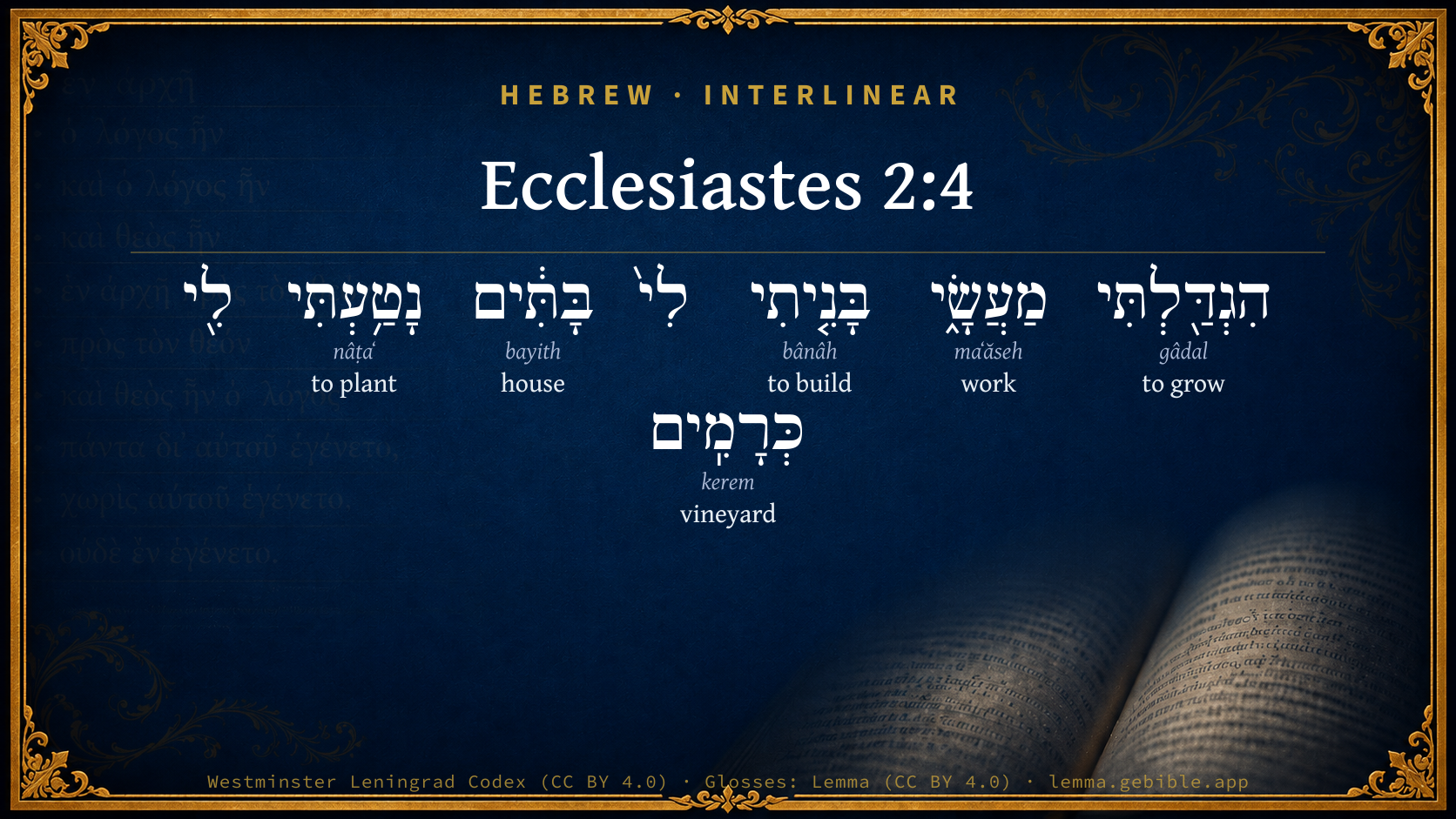
Hebrew (Westminster Leningrad Codex) Ecclesiastes 2:4 appears in the Hebrew Old Testament. The text above is from the Westminster Leningrad Codex. Each word links to its Strong’s number, a concise gloss, and parsing drawn from the Open Scriptures Hebrew Bible morphology. Click any word for its full Brown-Driver-Briggs (BDB) entry.
Download image
Cite this verse

Ecclesiastes 2:4 (World English Bible). Public Domain. Lemma interlinear Bible study tool, https://lemma.gebible.app/v/ecclesiastes/2/4.

Show BibTeX & RIS
BibTeX
RIS
English Translation
I made myself great works. I built myself houses. I planted myself vineyards.
World English Bible · Public Domain
Download a study sheet

One document with this verse’s original text, its word-by-word gloss line, the meaning frame, cross-references with their text, attributed commentary, and full source and license credits — printable, and it pastes into notes with its structure intact.

This verse Autodidact and up

Study sheet (.html) Plain text (.txt)

A passage Seminary Student

Up to 50 verses in one chapter. A passage sheet keeps up to 6 commentary sources and 12 cross-references per verse, in the order this page ranks them, and says so on the sheet whenever that leaves anything out. Ask for a single verse and you get the Autodidact verse sheet above.

Everything on this page stays free to read, with no account — the sheet is a download of what is already on screen, not access to it.

Want to remove ads? Support Godless Engineer
Compare translations 3

The same verse in 3 English versions, stacked beneath the original-language interlinear above. Click any original word for its lexicon entry.

Each is an independent rendering of the whole verse — the interlinear is not word-aligned to these translations.

Highlighted words mark where these versions differ — a whole-verse word diff, not a word-by-word alignment.

  • World English Bible Public Domain
    I made myself great works. I built myself houses. I planted myself vineyards.
  • King James Version Public Domain
    I made me great works; I builded me houses; I planted me vineyards:
  • unfoldingWord Literal Text CC BY-SA 4.0
    I enlarged my deeds. I built for myself houses. I planted for myself vineyards.

unfoldingWord Literal Text — © unfoldingWord, licensed CC BY-SA 4.0. Word-aligned USFM3 via Door43 (git.door43.org/unfoldingWord/en_ult).

Versions to compare (up to 4)

3 of 4 selected

Show all 18 translations

Every available English version of this verse, each an independent rendering of the whole verse.

  • World English Bible Public Domain
    I made myself great works. I built myself houses. I planted myself vineyards.
  • Berean Standard Bible Public Domain
    I expanded my pursuits. I built houses and planted vineyards for myself.
  • Majority Standard Bible Public Domain
    I expanded my pursuits. I built houses and planted vineyards for myself.
  • King James Version Public Domain
    I made me great works; I builded me houses; I planted me vineyards:
  • American Standard Version (1901) Public Domain
    I made me great works; I builded me houses; I planted me vineyards;
  • Revised Version (1885) Public Domain
    I made me great works; I builded me houses; I planted me vineyards;
  • Geneva Bible (1599) Public Domain
    I haue made my great workes: I haue built me houses: I haue planted me vineyards.
  • Douay-Rheims (1899) Public Domain
    I made me great works, I built me houses, and planted vineyards,
  • Young's Literal Translation Public Domain
    I made great my works, I builded for me houses, I planted for me vineyards.
  • Literal Standard Version CC BY-SA 4.0
    I made great my works, I built for myself houses, I planted for myself vineyards.
  • Unlocked Literal Bible CC BY-SA 4.0
    I accomplished great things. I built houses for myself and planted vineyards.
  • unfoldingWord Literal Text CC BY-SA 4.0
    I enlarged my deeds. I built for myself houses. I planted for myself vineyards.
  • Darby Bible Public Domain
    I made me great works; I builded me houses; I planted me vineyards;
  • World Messianic Bible Public Domain
    I made myself great works. I built myself houses. I planted myself vineyards.
  • Webster's Bible Public Domain
    I made me great works; I built me houses; I planted me vineyards:
  • Free Bible Version CC BY-SA 4.0
    Then I tried great construction projects. I built houses for myself; I planted vineyards for myself.
  • Bible in Basic English Public Domain
    I undertook great works, building myself houses and planting vine-gardens.
  • JPS Tanakh (1917) Public Domain
    I made me great works; I builded me houses; I planted me vineyards;

Literal Standard Version (2020), Covenant Press — licensed CC BY-SA 4.0. Text via the HelloAO Bible API (eBible.org). Unlocked Literal Bible (unfoldingWord) — licensed CC BY-SA 4.0. Text via the HelloAO Bible API (eBible.org). unfoldingWord Literal Text — © unfoldingWord, licensed CC BY-SA 4.0. Word-aligned USFM3 via Door43 (git.door43.org/unfoldingWord/en_ult). Free Bible Version, Dr. Jonathan Gallagher — licensed CC BY-SA 4.0. Text via the HelloAO Bible API (eBible.org).

Word by word

More ways to search: Search by grammar → Find every occurrence → Compare this word →

Practice this passage: Drill this verse → Learn its vocabulary →

נָטַ֥עְתִּי
nâṭaʻ
H5193
“to plant”
Verb, Qal, Perfect, 1st Person, Common, Singular
Part of Speech
Verb
Stem
Qal
Form
Perfect
Person
1st Person
Gender
Common
Number
Singular
Full BDB Definition

Origin: a primitive root

TWOT: 1354

to plant, fasten, fix, establish - (Qal) - to plant - to plant, establish (figuratively) - (Niphal) - to be planted - to be established (figuratively)
  1. הִגְדַּ֖לְתִּי gâdal H1431 “to grow” Verb, Hiphil, Perfect, 1st Person, Common, Singular
  2. מַעֲשָׂ֑י maʻăseh H4639 “works · my” Noun, Common, Masculine, Plural, Construct + Suffix, Personal, 1st Person, Common, Singular
  3. בָּנִ֤יתִי bânâh H1129 “to build” Verb, Qal, Perfect, 1st Person, Common, Singular
  4. בָּתִּ֔ים bayith H1004 “houses” Noun, Common, Masculine, Plural, Absolute
  5. כְּרָמִֽים kerem H3754 “vineyards” Noun, Common, Both, Plural, Absolute

About this verse

These counts appear in no published source. They are computed here, from the morphology-tagged text and Lemma’s own curated glosses. What Lemma adds →

8
words
6
distinct lemmas
Wisdom
section

Shared distinctive vocabulary

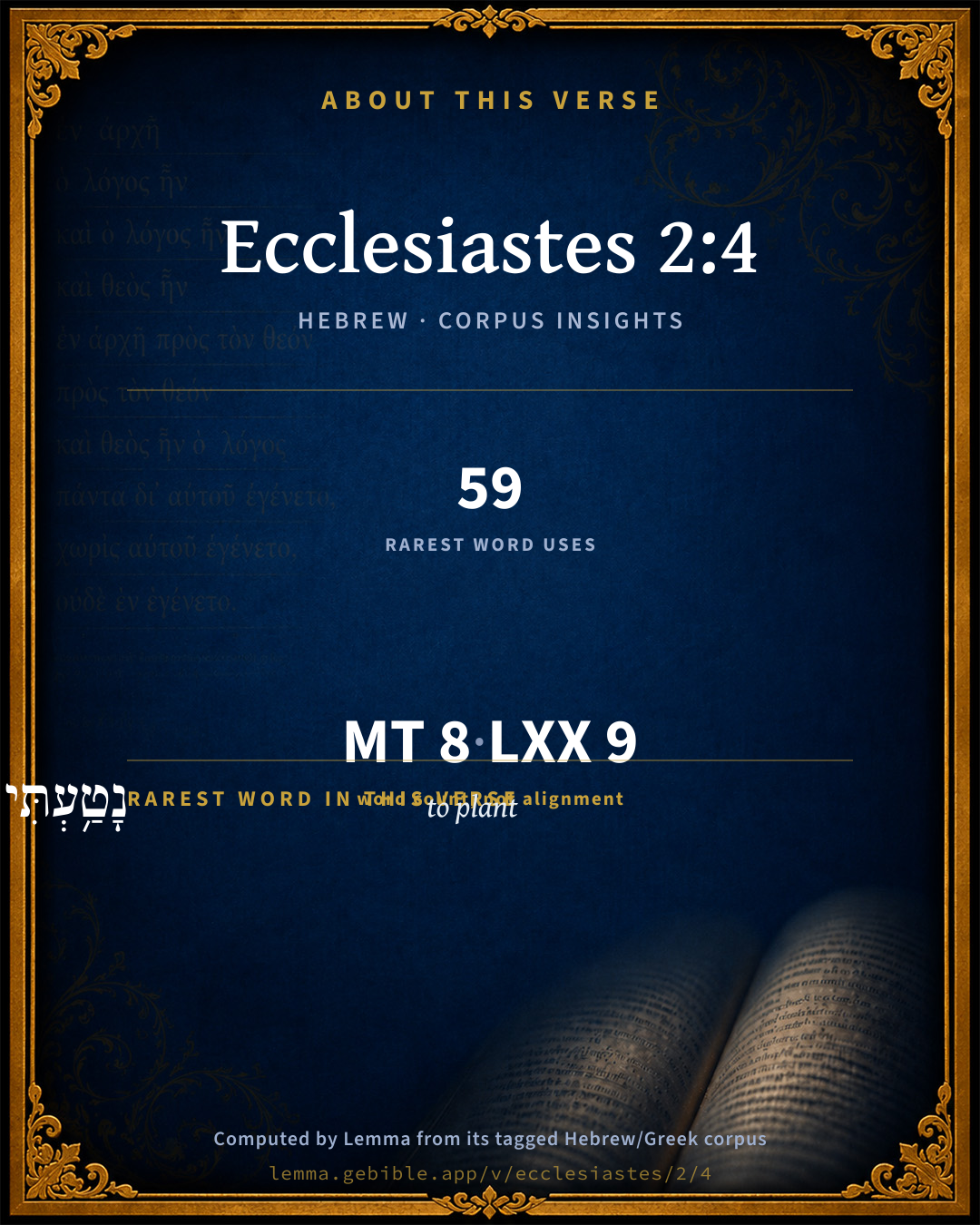
נָטַ֥עְתִּי to plant H5193 occurs in 55 verses of the Hebrew Bible. Also found in:

Grammatical profile

  • 3 verbs
  • 3 nouns
  • 2 prepositions

Verb forms

  • הִגְדַּ֖לְתִּי Hiphil · Perfect
  • בָּנִ֤יתִי Qal · Perfect
  • נָטַ֥עְתִּי Qal · Perfect

Hebrew & Septuagint length

In English translation the verse runs 13 words from the Hebrew and 12 from the Septuagint (LXX English) — closely comparable.

A rough comparison of the two English renderings, which tokenize alike — not a word-level alignment.

Word counts can differ between the Hebrew and the Greek without any difference in meaning — e.g. the Hebrew direct-object marker אֵת has no separate Greek word, and Greek often adds the article ὁ.

In the original languages it is 8 Hebrew tokens and 9 Greek tokens — but the two are counted differently (Hebrew bundles its prefixes and suffixes into one token; the Greek is in lemma form), so that isn’t a like-for-like length.

Cross-references

17

Topical passages linked to Ecclesiastes 2:4 in the Treasury of Scripture Knowledge — connected by theme and wording, ordered by reader-vote popularity; previews shown in the World English Bible.

  • 1 Kings 7:1–12 Solomon was building his own house thirteen years, and he finished all his house.
  • Genesis 11:4 They said, "Come, let's build us a city, and a tower, whose top reaches to the sky, and let's make us a name; lest we be scattered abroad on the surface of the whole earth."
  • Deuteronomy 8:12–14 lest, when you have eaten and are full, and have built goodly houses, and lived therein;
  • 2 Samuel 18:18 Now Absalom in his lifetime had taken and reared up for himself the pillar, which is in the king's dale; for he said, I have no son to keep my name in memory: and he called the pillar after his own name; and it is called Absalom's monument, to this day.
  • 1 Kings 9:1 It happened, when Solomon had finished the building of the house of Yahweh, and the king's house, and all Solomon's desire which he was pleased to do,
  • 1 Kings 10:19–20 There were six steps to the throne, and the top of the throne was round behind; and there were stays on either side by the place of the seat, and two lions standing beside the stays.
  • 1 Kings 15:19 [There is] a league between me and you, between my father and your father: behold, I have sent to you a present of silver and gold; go, break your league with Baasha king of Israel, that he may depart from me.
  • 1 Chronicles 27:27 and over the vineyards was Shimei the Ramathite: and over the increase of the vineyards for the wine-cellars was Zabdi the Shiphmite:
  • 2 Chronicles 8:1–6 It happened at the end of twenty years, in which Solomon had built the house of Yahweh, and his own house,
  • 2 Chronicles 8:11 Solomon brought up the daughter of Pharaoh out of the city of David to the house that he had built for her; for he said, My wife shall not dwell in the house of David king of Israel, because the places are holy, whereunto the ark of Yahweh has come.
  • 2 Chronicles 26:10 He built towers in the wilderness, and hewed out many cisterns, for he had much cattle; in the lowland also, and in the plain: [and he had] farmers and vineyard keepers in the mountains and in the fruitful fields; for he loved farming.
  • Psalms 49:11 Their inward thought is that their houses will endure forever, And their dwelling places to all generations. They name their lands after themselves.
  • Song of Solomon 7:12 Let's go early up to the vineyards. Let's see whether the vine has budded, Its blossom is open, And the pomegranates are in flower. There I will give you my love.
  • Song of Solomon 8:11–12 Solomon had a vineyard at Baal Hamon. He leased out the vineyard to keepers. Each was to bring a thousand shekels of silver for its fruit.
  • Isaiah 5:1 Let me sing for my well beloved a song of my beloved about his vineyard. My beloved had a vineyard on a very fruitful hill.
  • Daniel 4:30 The king spoke and said, Is not this great Babylon, which I have built for the royal dwelling-place, by the might of my power and for the glory of my majesty?
  • Song of Solomon 1:14 My beloved is to me a cluster of henna blossoms From the vineyards of En Gedi. Lover

Cross-references courtesy of OpenBible.info (CC BY 4.0).

Hebrew and Greek witnesses Masoretic Hebrew ↔ Greek Septuagint

The same verse in the two great witnesses to the Old Testament, shown verse-for-verse.

These are two independent witnesses, not word-aligned to each other, and the Septuagint is shown in lemma (dictionary) form.

Hebrew Ecclesiastes 2:4 Masoretic · Westminster Leningrad Codex

הִגְדַּ֖לְתִּי מַעֲשָׂ֑י בָּנִ֤יתִי לִי֙ בָּתִּ֔ים נָטַ֥עְתִּי לִ֖י כְּרָמִֽים

I made myself great works. I built myself houses. I planted myself vineyards.

World English Bible · Public Domain

Greek LXX Ecclesiastes 2:4 Septuagint · lemma form

μεγαλύνω ποίημα ἐγώ οἰκοδομέω ἐγώ οἶκος φυτεύω ἐγώ ἀμπελών

I enlarged my work; I built me houses; I planted me vineyards.

LXX2012 (modern English Septuagint) · Public Domain

On this verse, The Pulpit Commentary discusses the Septuagint’s reading. Read the note in Commentary ↓

Hebrew: Westminster Leningrad Codex (CC BY 4.0). Greek: Septuagint (public domain); English from LXX2012 (modern English Septuagint) (Public Domain). How the Septuagint differs from the Hebrew →

Commentary

Notes on Ecclesiastes 2:4 from classic Christian and Jewish commentators (each source and its license shown beneath its notes). The classic Christian expositions comment on the surrounding passage and are grouped to its opening verse, so a note may address several verses; the Jewish commentaries on the Tanakh (Rashi and others) are per-verse, so they appear only where the commentator wrote on this verse.

Lemma curates 59 commentaries, every one of them public domain or Creative Commons licensed, each selected and text-cleaned for this edition rather than reprinted as found. About our sources →

Trapp's Complete Commentary

John Trapp

Ecc 2:4 I made me great works; I builded me houses; I planted me vineyards:

Ver. 4. I made me great works.] I took not pleasure in trifles, as Domitian did, in catching and killing flies with his penknife; or as Artaxerxes did, in making hafts for knives; or as Solyman the great Turk did, in making notches of horn for bows; but I built stately houses, planted pleasant vineyards, &c. A godly man may be busied in mean, low things; but he is not satisfied in them as adequate objects: he trades for better commodities, and cannot rest without them.

I builded me houses.] Curious and spacious, such as is the Turk’s seraglio or palace, said to be more than two miles in compass. William Rufus built Westminster hall, and when it was done, found much fault with it for being built too little, saying, It was fitter for a chamber than for a hall for a king of England, and took a plot of land for one far more spacious to be added unto it. {a}

I planted me vineyards.] That no pleasant thing might be wanting to me. To plant a vineyard is a matter of much cost and care; but it soon quits cost by bearing (1.) Plenty of fruit in clusters and bunches, many grapes together; (2.) By bearing pleasant fruit, no fruit being more delectable to the taste than is the grape, nor more comfortable to the heart than is the wine made of the grape. {Jdg 9:13} Solomon had one gallant vineyard at Baalhamon that yielded him great profit. {Son 8:1}

{a} Daniel’s History.

John Trapp, A Commentary or Exposition upon All the Books of the Old and New Testament (1647–1656) — public domain. Text from a community e-Sword module.

Joseph Benson's Commentary

Ecc 2:4-7. I made me great works — Magnificent works, for my honour and delight. I builded me houses — Of which see 1Ki 7:1, &c.; 9:15, &c.; Son 8:11. I made me gardens — Hebrew, paradises, or gardens of pleasure; I planted trees, &c. — Mixing pleasure and profit together. I made me pools of water — Because the rain there fell but seldom; to water therewith the wood — The nurseries of young trees, which, for the multitude of them, were like a wood or forest. I had servants born in my house — Of my bond-servants, which therefore were a part of my possessions.

Joseph Benson's Commentary on the Old and New Testaments (1811–1818) — public domain. Text from a community e-Sword module.

Tyndale Open Study Notes

Tyndale Open Resources

2:4-8 Solomon’s building achievements were as small as porches and gates and as large as entire cities (see 1 Kgs 9:15-19). These projects, meant primarily for his own pleasure, included the palace and its accompanying buildings (see 1 Kgs 7:1-12).

2:4 Solomon’s vineyards are mentioned in Song 8:11-12.

Tyndale Open Study Notes — © Tyndale Open Resources, licensed CC BY-SA 4.0. Text via the HelloAO Bible API.

Jamieson, Fausset & Brown

Robert Jamieson, A. R. Fausset & David Brown

(Kg1 7:1-8; Kg1 9:1, Kg1 9:19; Kg1 10:18, &c.).

vineyards-- (Sol 8:11).

Jamieson, Fausset & Brown — Commentary Critical and Explanatory on the Whole Bible (1871) — public domain (CC PDM 1.0). Text via the HelloAO Bible API.

Adam Clarke's Commentary

Verse 4. I builded me houses] Palace after palace; the house of the forest of Lebanon, 1Kg 7:1, c. a house for the queen; the temple, c., 2Ch 8:1, c. 1Kg 9:10, &c., besides many other buildings of various kinds.

Adam Clarke's Commentary on the Bible (1810–1826) — public domain. Text from a community e-Sword/MySword module.

Ellicott's Commentary for English Readers

(4) Houses.—1Ki_5:11; 2Ch_8:4.

Vineyards.—1Ch_27:27; Son_8:11.

A Bible Commentary for English Readers, edited by Charles John Ellicott (1878–1897) — public domain. Text from a community e-Sword module.

The Cambridge Bible for Schools and Colleges

gen. ed. J. J. S. Perowne

4. I made me great works] The verse may be either a retrospect of the details of the life of the pleasure-seeker as sketched in the previous verse, or, as seems more probable, the account of a new experiment in which the man passed from purely sensual pleasures to the life of what we know as ‘culture,’ the pursuit of beauty and magnificence in Art. Here the writer throws himself into the surroundings of the historical Solomon. We may venture to refer to Tennyson’s Palace of Art as tracing the working out of a like experiment to its inevitable issue. See Appendix II.

I builded me houses] We think of David’s house of cedar (2Ch_2:3) and the storehouses, oliveyards and vineyards (1Ch_27:25-31) which Solomon had inherited, of his own palace, and the house of the forest of Lebanon and the house for Pharaoh’s daughter, which he built (1Ki_7:1-9), of Tadmor and Hamath and Beth-horon and Baalath, the cities in far off lands which owned him as their founder (2Ch_8:3-6). It is significant, on any theory of authorship, that we find no reference to Solomon’s work in building “the house of the Lord.” That was naturally outside the range of the experiments in search of happiness and too sacred to be mentioned in connexion with them here, either by the king himself or by the writer who personates him. On the assumption of personation the writer may have drawn his pictures of kingly state from the palaces and parks of the Ptolemies, including the botanical and zoological gardens connected with the Museum at Alexandria, or from those of the Persian kings at Susa or Persepolis.

I planted me vineyards] Of these one, that of Baal-hamon, has been immortalised by its mention in the Song of Solomon (Ecc_8:11). It was planted with the choicest vine, and the value of its produce estimated at a thousand pieces of silver. Engedi seems also to have been famous for its vineyards (Song Son_1:14).

The Cambridge Bible for Schools and Colleges (gen. ed. J. J. S. Perowne; Cambridge University Press, 1878–1918) — public domain. Text from a community e-Sword module.

John Gill's Exposition

I made me great works,.... He did not spend his time in trifling things, as Domitian (a), in catching and killing flies; but in devising, designing, directing, and superintending great works of art and skill, becoming the grandeur of his state, and the greatness of his mind: the Midrash restrains it to his great throne of ivory, overlaid with gold, Kg1 10:18, but it is a general expression, including all the great things he did, of which the following is a particular enumeration;

I builded me houses; among which must not be reckoned the house of God, though that was built by him, and in the first place; yet this was built, not for his own pleasure and grandeur, but for the worship and glory of God: but his own house and palace is chiefly meant, which was thirteen years in building; and the house of the forest in Lebanon, which perhaps was his country seat; with all other houses and offices, for his stores, for his servants, his horsemen, and chariots; see Kg1 7:1; and in fine spacious buildings men take a great deal of pleasure, and promise themselves much happiness in dwelling in them, and in perpetuating their names to posterity by them; see Psa 49:11. The Targum is,

"I multiplied good works in Jerusalem; I builded me houses; the house of the sanctuary, to make atonement for Israel; the king's house of refreshment, and the conclave and porch; and the house of judgment, of hewn stones, where the wise men sit and do judgment; I made a throne of ivory for the royal seat;''

I planted me vineyards; perhaps those at Engedi were of his planting; however, he had one at Baalhamon, and no doubt in other places, Sol 1:14; the Targum makes mention of one at Jabne, planted by him; these also add to the pleasure of human life; it is delightful to walk in them, to gather the fruit and drink of the wine of them; see Sol 7:12.

(a) Sueton. Vit. Domitian. c. 3. Aurel. Victor. De. Caesar. & Epitome.

John Gill's Exposition of the Whole Bible (1746–1763) — public domain (CC PDM 1.0). Text via the HelloAO Bible API.

Albert Barnes' Notes on the Bible

Compare 1Ki 7:1-12; 1Ki 9:15-19; 1Ki 10:14-27; and 2Ch 8:4.

Albert Barnes' Notes on the Bible (1834–1885) — public domain. Text from a community e-Sword/MySword module.

Haydock's Catholic Bible Commentary

Works; palaces, towns, and particularly the temple. Many, like Solomon, will refrain from wine, and still yield to other excesses.

George Leo Haydock (1774–1849), Haydock's Catholic Family Bible and Commentary, 1859 edition — public domain. Excludes Psalms (Douay-Rheims chapter numbering differs from Protestant) and Deuterocanonical books (Catholic canon only).

Matthew Poole's English Annotations

I made me great works; magnificent works for my honour and delight.

I built me houses; of which see 1Ki 7:1, &c.; 1Ki 9:15, &c. I planted me vineyards: see Son 8:11.

Matthew Poole's English Annotations on the Holy Bible (1683–1685) — public domain. Text from a community e-Sword/MySword module.

Whedon's Commentary on the Bible

Daniel D. Whedon

4. I made me great works — Hebrew, I enlarged my works. Solomon used the resources of the kingdom in magnificent enterprises. His own palace stood on a neighbouring hilltop to the temple. He built, also, for his Egyptian wife, a palace, called 1Ki_7:2, “The house of the forest of Lebanon.” His vineyard at Baal-hamon is mentioned in Son_8:11. He probably had others, also, as for instance at Engedi: Sol. Son_1:14.

Daniel D. Whedon (gen. ed.), Commentary on the Old and New Testaments (1874–1909) — public domain. Text from a community e-Sword module.

The Pulpit Commentary

This commences a new experience in the pursuit of his object. Leaving this life of self-indulgence, he takes to art and culture, the details being drawn from the accounts of the historical Solomon. I made me great works; literally, I made great my works; Septuagint, jEmegaluna poihma per; Vulgate, Magnificavi opera mea. Among these works the temple, with all its wonderful structural preparations, is not specially mentioned, perhaps because no one could think of Solomon without connecting his name with this magnificent building, and it was superfluous to call attention to it; or else because the religious aspect of his operations is not here in question, but only his taste and pursuit of beauty. But the omission tells strongly against the Solomonic authorship of the book. I builded me houses. Solomon had a passion for erecting magnificent buildings. We have various accounts of his works of this nature in 1Ki 7 and 1Ki 9 2Ch 8. There was the huge palace for himself, whichoccupied thirteen years in building; there was the "house of the forest of Lebanon," a splendid hall constructed with pillars of cedar; the porch of pillars; the hall of judgment; the harem for the daughter of Pharaoh. Then there were fortresses, store-cities, chariot-towns, national works of great importance; cities in distant lands which he founded, such as Tadmor in the wilderness. I planted me vineyards. David had vineyards and olive yards, (1Ch_27:27, 1Ch_27:28) which passed into the possession of his son; and we read in Son_8:11 of a vineyard that Solomon had in Baal-hamon, which some identify with Belamon, (RAPC Jdt 8:3) a place near Shunem, in the Plain of Esdraelon.

Vers. 4-11.

Another experiment: refined voluptuousness.

Riotous mirth having failed miserably to give him the settled happiness after which he sought, our author records another and more promising experiment which he made, the search for happiness in a life of culture pursuit of beauty and magnificence in art." More promising it was, because it brought into play higher and purer emotions than those to which ordinary sensuality appeals; it cultivated the side of the nature which adjoins, and almost merges into, the spiritual. The Law of Moses, forbidding as it did the making of images or representations of natural objects or of living creatures for purposes of worship, had prevented much advance being made in sculpture and painting; but there were still extensive fields of artistic development left for cultivation. Architecture and gardening afforded abundant scope for the exhibition and gratification of a refined taste. And so Solomon built splendid palaces, and planted vineyards, and laid out parks and gardens, and filled them with the choicest fruit trees, and dug pools for the irrigation of his plantations in the time of summer drought. Nothing was omitted that could minister to his sense of the beautiful, or that could enhance his splendor and dignity. A large household, great flocks of cattle, heaps of silver and gold, precious treasures from distant lands, the pleasures of music and of the harem are all enumerated as being procured by his wealth and power, and employed for his gratification. All that the eye could rest on with delight, all that the heart could desire, was brought within his reach. And all the time wisdom was with him, guiding him in the pursuit of pleasure, and not abandoning him in the enjoyment of it. Nothing occurred to prevent the experiment being carried through to the very end. The delights he enumerates were in themselves lawful, and therefore were indulged in without any uneasy sensation of transgressing against the Law of God or the dictates of conscience. Nay, the very fact that he had a moral end in view when he began the experiment seemed to give a high sanction to it. He was not interrupted by the intrusion of other thoughts and cares. No foreign enemy disturbed his peace; sickness did not incapacitate him; his wealth was not exhausted by the large demands made upon it for the support of his magnificence and luxury. And so he went to the utmost bounds of refined enjoyment, and found much that for a time amply rewarded him for the efforts he put forth. "My heart," he says, "rejoiced in all my labor" (ver. 10). His busy mind was kept occupied; his senses were charmed by the beauty and richness of the treasures he had gathered together, and of the great works which gave such abundant evidence of his taste and wealth. His experiment was not quite fruitless, therefore. Present gratification he found in the course of his labors; but when they were completed, the pleasure they had yielded passed away. The charm of novelty was gone. Possession did not yield the joy and delight which acquisition had done. When the palaces were finished, the gardens planted, the gems and rarities accumulated, the luxurious household established, and nothing left to do but to rest in the happiness that these things had been expected to secure, the sense of defeat and disappointment again fell upon the king. Then I looked on all the works that my hands had wrought, and on the labor that I had labored to do: and, behold, all was vanity and vexation of spirit, and there was no profit under the sun." He does not try to explain the cause of his failure, but simply records the fact that he did fail. "He does not moralize, still less preach; he just paints the picture of his soul"s sad wanderings, of the baffled effort of a human heart, and passes on." But we may find it highly profitable to inquire what were the causes why the life of culture which, without harshness, may be called a refined voluptuousness fails to give satisfaction to the human soul.

I In the first place, IT IS A LIFE OF ISOLATION FROM GOD. As Solomon represents the course he followed, we see that the thought of God was excluded from his mind. The Divine gifts were enjoyed, the love of the beautiful which is implanted in the soul of man was gratified, every exquisite sensation of which we are capable was indulged, but the one thing needed to sanctify the happiness obtained and render it perfect was omitted. "God," says St. Augustine, "has made us for himself, and we cannot rest until we rest in him." Emotions of gratitude, adoration, humility, and self-consecration to His service cannot be suppressed without great loss the loss even of that security and tranquility of spirit which are essential to true happiness. All the resources upon which Solomon drew may furnish helps to happiness, but none of them, nor all of them together, could, apart from God, secure it. Compare with the failure of Solomon the success of those who have often, in circumstances of extreme discomfort and suffering, enjoyed the peace of God that passeth all understanding. The sixty-third psalm, written by David in the time of exile and hardship, illustrates the truth that in communion with God the soul enjoys a happiness which cannot be found elsewhere. "A man"s life does not consist in the abundance of the things which he possesseth." Apart from the favor of God and the service of God, the richest possessions and the most skilful employment of them can secure no lasting satisfaction. For we are so constituted as creatures that our life is not complete if we are dissevered from our Creator.

II In the second place, IT IS A SELFISH LIFE. All that Solomon describes are his efforts to secure certain durable results for himself; to indulge his love for the beautiful in nature and art, and to surround himself with luxury and splendor. He would have been more successful in his search for happiness if he had endeavored to relieve the wants of others to clothe the naked, to feed the hungry, to comfort the afflicted, and to instruct the ignorant. Self-denial and self-sacrifice for the sake of others would have brought him nearer the gem of his desire. The penalty of his selfish pursuit fell heavily upon him. He could not live at a height above mankind, in the enjoyment of his own felicity, for long; "the riddle of the painful earth" filled him with thoughts of self-loathing and despair, which shattered all his happiness. Do what he might, old age, disease, and death were foes he could not conquer, and all about him in human society he could discern moral evils and inequalities which he could not set right nor" even explain. Such selfish isolation as that into which for a time he had withdrawn himself failed to secure the object he had in view, for he could not really dissever his lot from that of his fellows, or escape the evils which afflicted them. The idea of a life of luxurious ease, undisturbed by the sight or thought of the miseries and hardships of life, was a vain dream, from which he soon awoke. In his poem, "The Palace of Art," Tennyson has given a most luminous and suggestive commentary upon this portion of the Book of Ecclesiastes. In it he represents the soul as seeking forgiveness for the sin of selfish isolation by penitence, prayer, and self-renunciation, and as anticipating a resumption of all the joys of culture and art in companionship with others. In communion with God, in fellowship with others, all things that are noble and pure and lovely are taken into holy keeping, and form a lasting source of joy and happiness. J.W.

The Pulpit Commentary (1880–1919), ed. H.D.M. Spence-Jones & Joseph S. Exell — public domain. Text from a community e-Sword module.

Keil & Delitzsch

C. F. Keil & F. Delitzsch

"I undertook great works, built me houses, planted me vineyards. I made me gardens and parks, and planted therein all kinds of fruit-trees. I made me water-pools to water therewith a forest bringing forth trees." The expression, "I made great my works," is like Ecc 1:16; the verb contains the adj. as its obj. The love of wisdom, a sense of the beautiful in nature and art, a striving after splendour and dignity, are fundamental traits in Solomon's character. His reign was a period of undisturbed and assured peace. The nations far and near stood in manifold friendly relations with him. Solomon was "the man of rest," Ch1 22:9; his whole appearance was as it were the embodied glory itself that had blossomed from out of the evils and wars of the reign of David. The Israelitish commonwealth hovered on a pinnacle of worldly glory till then unattained, but with the danger of falling and being lost in the world. The whole tendency of the time followed, as it were, a secular course, and it was Solomon first of all whom the danger of the love of the world, and of worldly conformity to which he was exposed, brought to ruin, and who, like so many of the O.T. worthies, began in the spirit and ended in the flesh. Regarding his buildings, - the house of the forest of Lebanon, the pillared hall (porch), the hall of judgment, the palace intended for himself and the daughter of Pharaoh, - vid. the description in Kg1 7:1-12, gathered from the annals of the kingdom; Kg1 9:15-22 = Ch2 8:3-6, gives an account of Solomon's separate buildings (to which also the city of Millo belongs), and of the cities which he built; the temple, store-cities, treasure-cities, etc., are naturally not in view in the passage before us, where it is not so much useful buildings, as rather buildings for pleasure (Kg1 9:19), that are referred to. Vineyards, according to Ch1 27:27, belonged to David's royal domain; a vineyard in Baal-hamon which Solomon possessed, but appears at a later period to have given up, is mentioned at the close of the Song. That he was fond of gardening, appears from manifold expressions in the Song; delight in the life and movements of the natural world, and particularly in plants, is a prominent feature in Solomon's character, in which he agrees with Shulamith. The Song; Sol 6:2, represents him in the garden at the palace. We have spoken under the Song; Sol 6:11., of the gardens and parks at Etam, on the south-west of Bethlehem. Regarding the originally Persian word pardēs (plur. pardesim, Mishnic pardesoth), vid., under Sol 4:13; regarding the primary meaning of berēchah (plur. const. berēchoth, in contradistinction to birchoth, blessings), the necessary information is found under Sol 7:5. These Solomonic pools are at the present day to be seen near old Etam, and the clause here denoting a purpose, "to water from them a forest which sprouted trees, i.e., brought forth sprouting trees," is suitable to these; for verbs of flowing and swarming, also verbs of growing, thought of transitively, may be connected with obj. - accus., Ewald, 281b; cf. under Isa 5:6. Thus, as he gave himself to the building of houses, the care of gardens, and the erection of pools, so also to the cultivation of forests, with the raising of new trees.

Another means, wisely considered as productive of happiness, was a large household and great flocks of cattle, which he procured for himself.

Keil & Delitzsch — Biblical Commentary on the Old Testament (1861–1891) — public domain (CC PDM 1.0). Text via the HelloAO Bible API. (Old Testament only.)

unfoldingWord translationNotes

Door43 World Missions Community

I built houses for myself and planted vineyards. I built for myself gardens and parks. I planted ... I created

The writer probably told people to do the work. AT: "I had people build houses and plant vineyards for me. I had them build gardens and parks for me ... I had them plant ... I had them create" (See: Metonymy)

gardens and parks

These two words share similar meanings and refer to beautiful orchards of fruit trees. (See: Doublet)

to water a forest

"to provide water for a forest"

forest where trees were grown

This can be stated in active form. AT: "forest where trees grew" (See: Active or Passive)

translationWords

vineyard

create

unfoldingWord translationNotes — © Distant Shores Media and the Door43 World Missions Community, licensed CC BY-SA 4.0. Source: git.door43.org/Door43/en_tn.

Rashi

Rabbi Shlomo Yitzchaki (Rashi)

I made myself great works in the days of my greatness.

Rashi on the Tanakh — English translations: “The Judaica Press complete Tanach with Rashi, translated by A. J. Rosenberg” (CC BY 4.0); “Pentateuch with Rashi's commentary by M. Rosenbaum and A.M. Silbermann, 1929-1934” (public domain); “The Metsudah Tanach series, Lakewood, N.J” (CC BY 4.0); and “The Book of Joshua, Metsudah Publications, 1997” (CC BY 4.0). Text via Sefaria.

Lesson kit

Teaching starters — assembled from the data on this page, not authored interpretation. Every prompt links to the verse data it draws on. Edit before teaching.

Ecclesiastes, in the Wisdom, opens this verse with 8 words (6 distinct Hebrew lemmas). Its most distinctive word is nâṭaʻ (“to plant”). A historical commentator’s framing appears above. Read the whole chapter for the surrounding context.

Discussion questions

  1. What does “to plant” (nâṭaʻ) contribute to the verse as a whole?
  2. Genesis 2:8 shares the word «to plant» with this verse. How do the two illuminate each other?
  3. These translations render this verse differently. What is at stake in choosing one wording over another?
  4. The verb «הִגְדַּ֖לְתִּי» is Hiphil Perfect. How does its form color the action?
  5. Reading how Trapp's Complete Commentary and Joseph Benson's Commentary read this verse, where do the two commentators agree and where do they part?

Things to notice

Reading settings

Reading text

Shown beneath each verse's original-language words.

Old Testament
Old Testament edition

Read the OT as the Masoretic Hebrew (MT) or the Greek Septuagint (LXX).

English shown for the Greek Septuagint (in the Hebrew ↔ Greek comparison).

Comparing translations? Open the Compare panel on any verse page to stack up to four side by side.