Zechariah 12:11

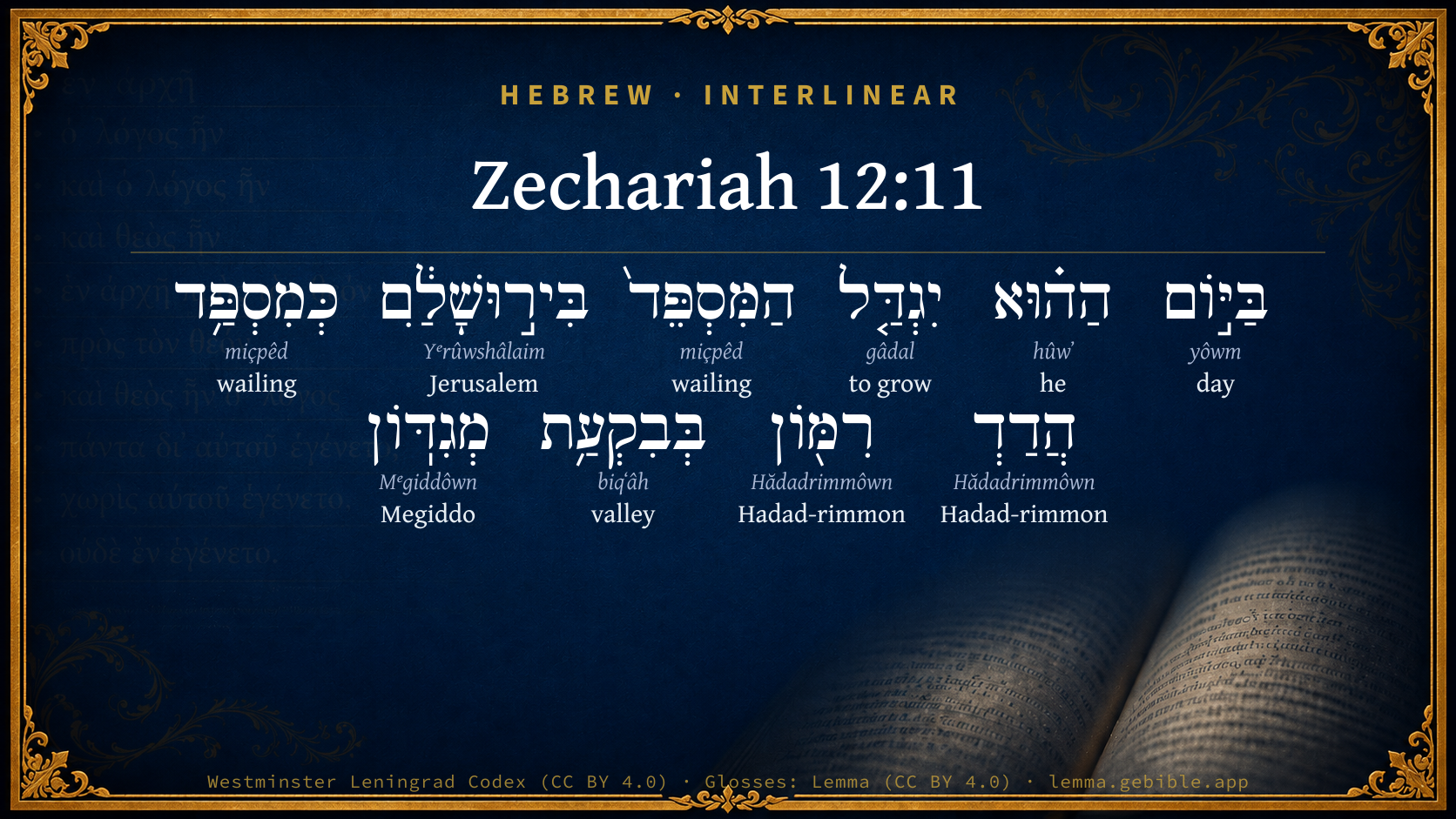
Hebrew (Westminster Leningrad Codex) Zechariah 12:11 appears in the Hebrew Old Testament. The text above is from the Westminster Leningrad Codex. Each word links to its Strong’s number, a concise gloss, and parsing drawn from the Open Scriptures Hebrew Bible morphology. Click any word for its full Brown-Driver-Briggs (BDB) entry.
Download image
Cite this verse

Zechariah 12:11 (World English Bible). Public Domain. Lemma interlinear Bible study tool, https://lemma.gebible.app/v/zechariah/12/11.

Show BibTeX & RIS
BibTeX
RIS
English Translation
In that day there will be a great mourning in Jerusalem, like the mourning of Hadadrimmon in the valley of Megiddon.
World English Bible · Public Domain
Highlights
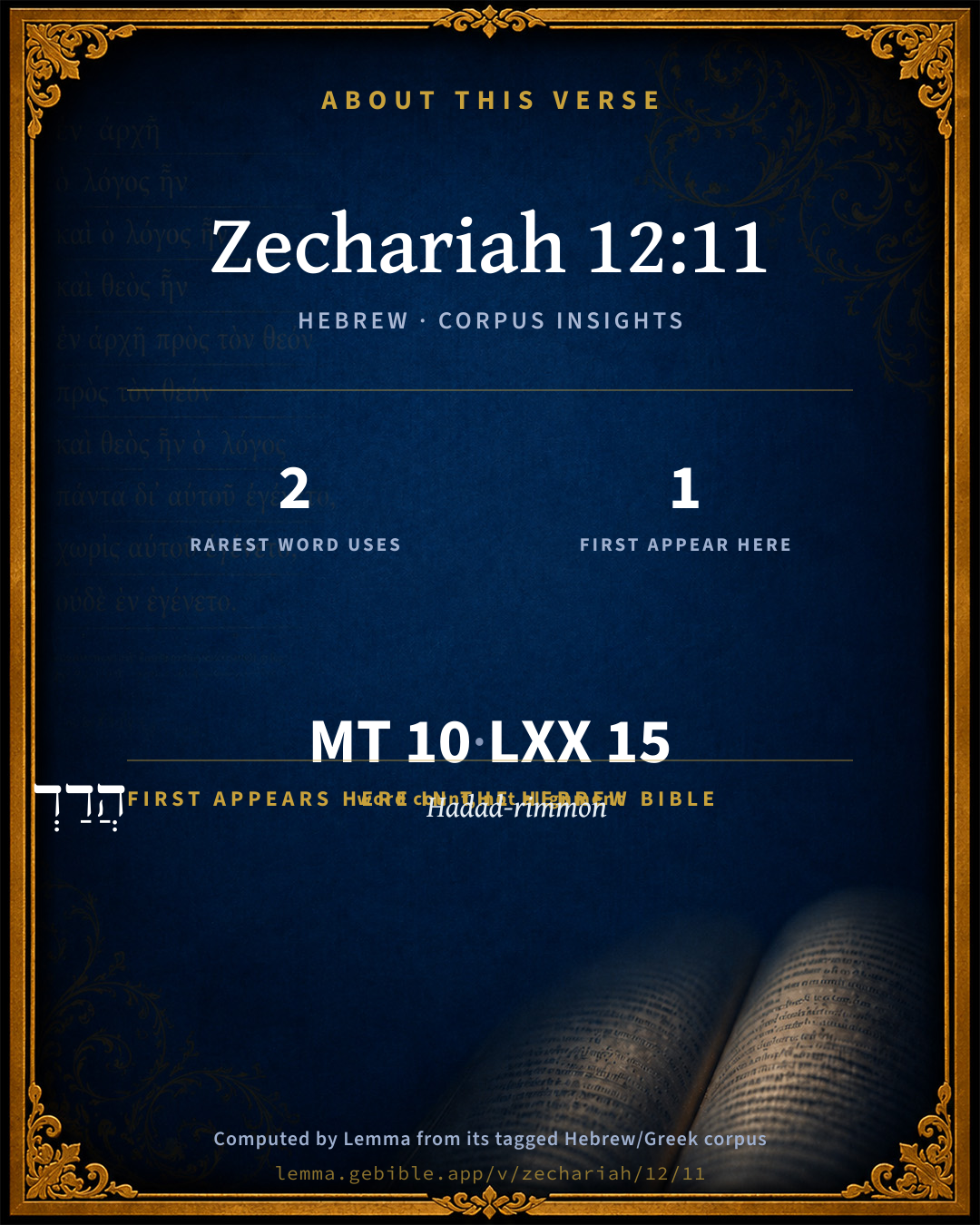
  • 1 first appearance in the Hebrew Bible
Full analysis ↓
Download a study sheet

One document with this verse’s original text, its word-by-word gloss line, the meaning frame, cross-references with their text, attributed commentary, and full source and license credits — printable, and it pastes into notes with its structure intact.

This verse Autodidact and up

Study sheet (.html) Plain text (.txt)

A passage Seminary Student

Up to 50 verses in one chapter. A passage sheet keeps up to 6 commentary sources and 12 cross-references per verse, in the order this page ranks them, and says so on the sheet whenever that leaves anything out. Ask for a single verse and you get the Autodidact verse sheet above.

Everything on this page stays free to read, with no account — the sheet is a download of what is already on screen, not access to it.

Want to remove ads? Support Godless Engineer
Compare translations 3

The same verse in 3 English versions, stacked beneath the original-language interlinear above. Click any original word for its lexicon entry.

Each is an independent rendering of the whole verse — the interlinear is not word-aligned to these translations.

Highlighted words mark where these versions differ — a whole-verse word diff, not a word-by-word alignment.

  • World English Bible Public Domain
    In that day there will be a great mourning in Jerusalem, like the mourning of Hadadrimmon in the valley of Megiddon.
  • King James Version Public Domain
    In that day shall there be a great mourning in Jerusalem, as the mourning of Hadadrimmon in the valley of Megiddon.
  • unfoldingWord Literal Text CC BY-SA 4.0
    On that day the laments in Jerusalem will be like the laments at Hadad Rimmon in the plain of Megiddo.

unfoldingWord Literal Text — © unfoldingWord, licensed CC BY-SA 4.0. Word-aligned USFM3 via Door43 (git.door43.org/unfoldingWord/en_ult).

Versions to compare (up to 4)

3 of 4 selected

Show all 18 translations

Every available English version of this verse, each an independent rendering of the whole verse.

  • World English Bible Public Domain
    In that day there will be a great mourning in Jerusalem, like the mourning of Hadadrimmon in the valley of Megiddon.
  • Berean Standard Bible Public Domain
    On that day the wailing in Jerusalem will be as great as the wailing of Hadad-rimmon in the plain of Megiddo.
  • Majority Standard Bible Public Domain
    On that day the wailing in Jerusalem will be as great as the wailing of Hadad-rimmon in the plain of Megiddo.
  • King James Version Public Domain
    In that day shall there be a great mourning in Jerusalem, as the mourning of Hadadrimmon in the valley of Megiddon.
  • American Standard Version (1901) Public Domain
    In that day shall there be a great mourning in Jerusalem, as the mourning of Hadadrimmon in the valley of Megiddon.
  • Revised Version (1885) Public Domain
    In that day shall there be a great mourning in Jerusalem, as the mourning of Hadadrimmon in the valley of Megiddon.
  • Geneva Bible (1599) Public Domain
    In that day shall there be a great mourning in Ierusalem, as the mourning of Hadadrimmon in the valley of Megiddon.
  • Douay-Rheims (1899) Public Domain
    In that day there shall be a great lamentation in Jerusalem like the lamentation of Adadremmon in the plain of Mageddon.
  • Young's Literal Translation Public Domain
    In that day, great is the mourning of Jerusalem, As the mourning of Hadadrimmon in the valley of Megiddon,
  • Literal Standard Version CC BY-SA 4.0
    In that day, great is the mourning of Jerusalem, || As the mourning of Hadadrimmon in the Valley of Megiddon,
  • Unlocked Literal Bible CC BY-SA 4.0
    On that day the laments in Jerusalem will be like the laments at Hadad Rimmon in the plain of Megiddo.
  • unfoldingWord Literal Text CC BY-SA 4.0
    On that day the laments in Jerusalem will be like the laments at Hadad Rimmon in the plain of Megiddo.
  • Darby Bible Public Domain
    In that day shall there be a great mourning in Jerusalem, as the mourning of Hadad-rimmon in the valley of Megiddon.
  • World Messianic Bible Public Domain
    In that day there will be a great mourning in Jerusalem, like the mourning of Hadadrimmon in the valley of Megiddo.
  • Webster's Bible Public Domain
    In that day shall there be a great mourning in Jerusalem, as the mourning of Hadadrimmon in the valley of Megiddon.
  • Free Bible Version CC BY-SA 4.0
    On that day the mourning in Jerusalem will be as great as the mourning in Hadad-Rimmon in the valley of Megiddo.
  • Bible in Basic English Public Domain
    In that day there will be a great weeping in Jerusalem, like the weeping of Hadad-rimmon in the valley of Megiddon.
  • JPS Tanakh (1917) Public Domain
    In that day shall there be a great mourning in Jerusalem, as the mourning of Hadadrimmon in the valley of Megiddon.

Literal Standard Version (2020), Covenant Press — licensed CC BY-SA 4.0. Text via the HelloAO Bible API (eBible.org). Unlocked Literal Bible (unfoldingWord) — licensed CC BY-SA 4.0. Text via the HelloAO Bible API (eBible.org). unfoldingWord Literal Text — © unfoldingWord, licensed CC BY-SA 4.0. Word-aligned USFM3 via Door43 (git.door43.org/unfoldingWord/en_ult). Free Bible Version, Dr. Jonathan Gallagher — licensed CC BY-SA 4.0. Text via the HelloAO Bible API (eBible.org).

Word by word

More ways to search: Search by grammar → Find every occurrence → Compare this word →

Practice this passage: Drill this verse → Learn its vocabulary →

הֲדַדְ
Hădadrimmôwn
H1910
“Hadad-rimmon”
Noun, Proper
Part of Speech
Noun
Type
Proper
Full BDB Definition

Origin: from H1908 and H7417

TWOT: None

Hadad-rimmon = "Hadad of the pomegranates" - a place in the valley of Megiddo where a national lamentation was held for the death of King Josiah; named after two Syrian gods
  1. בַּיּ֣וֹם yôwm H3117 “in/at the · day” Preposition, Determined + Noun, Common, Masculine, Singular, Absolute
  2. הַה֗וּא hûwʼ H1931 “the · he” Particle, Definite Article + Pronoun, Personal, 3rd Person, Masculine, Singular
  3. יִגְדַּ֤ל gâdal H1431 “to grow” Verb, Qal, Imperfect, 3rd Person, Masculine, Singular
  4. הַמִּסְפֵּד֙ miçpêd H4553 “the · wailing” Particle, Definite Article + Noun, Common, Masculine, Singular, Absolute
  5. בִּיר֣וּשָׁלִַ֔ם Yᵉrûwshâlaim H3389 “in/at · Jerusalem” Preposition + Noun, Proper
  6. כְּמִסְפַּ֥ד miçpêd H4553 “like/as · wailing of” Preposition + Noun, Common, Masculine, Singular, Construct
  7. רִמּ֖וֹן Hădadrimmôwn H1910 “Hadad-rimmon” Noun, Proper
  8. בְּבִקְעַ֥ת biqʻâh H1237 “in/at · valley of” Preposition + Noun, Common, Feminine, Singular, Construct
  9. מְגִדּֽוֹן Mᵉgiddôwn H4023 “Megiddo” Noun, Proper

About this verse

These counts appear in no published source. They are computed here, from the morphology-tagged text and Lemma’s own curated glosses. What Lemma adds →

10
words
8
distinct lemmas
Prophets
section

Notable vocabulary

The rarest word here is הֲדַדְ Hadad-rimmon H1910 — appearing just 2 times in the whole Hebrew Bible.

First appearance in Scripture

This word makes its first canonical appearance in the Hebrew Bible here:

  • הֲדַדְ Hadad-rimmon H1910

Grammatical profile

  • 1 verb
  • 8 nouns
  • 1 pronoun

Verb forms

  • יִגְדַּ֤ל Qal · Imperfect

Repetition

Words recur within this verse — often emphatic in Hebrew:

  • הַמִּסְפֵּד֙ wailing H4553 ×2
  • הֲדַדְ Hadad-rimmon H1910 ×2

Hebrew & Septuagint length

In English translation the verse runs 21 words from the Hebrew and 23 from the Septuagint (LXX English) — closely comparable.

A rough comparison of the two English renderings, which tokenize alike — not a word-level alignment.

Word counts can differ between the Hebrew and the Greek without any difference in meaning — e.g. the Hebrew direct-object marker אֵת has no separate Greek word, and Greek often adds the article ὁ.

In the original languages it is 10 Hebrew tokens and 15 Greek tokens — but the two are counted differently (Hebrew bundles its prefixes and suffixes into one token; the Greek is in lemma form), so that isn’t a like-for-like length.

Cross-references

2

Topical passages linked to Zechariah 12:11 in the Treasury of Scripture Knowledge — connected by theme and wording, ordered by reader-vote popularity; previews shown in the World English Bible.

  • 2 Kings 23:29 In his days Pharaoh Necoh king of Egypt went up against the king of Assyria to the river Euphrates: and king Josiah went against him; and [Pharaoh Necoh] killed him at Megiddo, when he had seen him.
  • 2 Chronicles 35:24 So his servants took him out of the chariot, and put him in the second chariot that he had, and brought him to Jerusalem; and he died, and was buried in the tombs of his fathers. All Judah and Jerusalem mourned for Josiah.

Cross-references courtesy of OpenBible.info (CC BY 4.0).

Hebrew and Greek witnesses Masoretic Hebrew ↔ Greek Septuagint

The same verse in the two great witnesses to the Old Testament, shown verse-for-verse.

These are two independent witnesses, not word-aligned to each other, and the Septuagint is shown in lemma (dictionary) form.

Hebrew Zechariah 12:11 Masoretic · Westminster Leningrad Codex

בַּיּ֣וֹם הַה֗וּא יִגְדַּ֤ל הַמִּסְפֵּד֙ בִּיר֣וּשָׁלִַ֔ם כְּמִסְפַּ֥ד הֲדַדְ רִמּ֖וֹן בְּבִקְעַ֥ת מְגִדּֽוֹן

In that day there will be a great mourning in Jerusalem, like the mourning of Hadadrimmon in the valley of Megiddon.

World English Bible · Public Domain

Greek LXX Zechariah 12:11 Septuagint · lemma form

ἐν ὁ ἡμέρα ἐκεῖνος μεγαλύνω ὁ κοπετός ἐν ἰερουσαλήμ ὡς κοπετός ῥοών ἐν πεδίον ἐκκόπτω

In that day the lamentation in Jerusalem shall be very great, as the mourning for the pomegranate grove cut down in the plain.

LXX2012 (modern English Septuagint) · Public Domain

On this verse, Joseph Benson's Commentary discusses the Septuagint’s reading. Read the note in Commentary ↓

Hebrew: Westminster Leningrad Codex (CC BY 4.0). Greek: Septuagint (public domain); English from LXX2012 (modern English Septuagint) (Public Domain). How the Septuagint differs from the Hebrew →

Targum (Aramaic paraphrase)

1

The Targum is the ancient Jewish Aramaic paraphrase of the Hebrew Scriptures — an interpretive translation, not the Hebrew text itself. Onkelos (literal) and Pseudo-Jonathan (expansive) render the Torah, and Jonathan the Prophets. Coverage is partial: where no permissively-licensed English translation exists for a verse, only the Aramaic is shown. This is verse-level text, not a word-by-word alignment to the Hebrew.

  1. Targum Jonathan Prophets (Joshua–Malachi)
    בְּעִדָנָא הַהִיא יִסְגֵי מִסְפְּדָא בִּירוּשְׁלֵם כְּמִסְפְּדָא דְאַחְאָב בַּר עָמְרִי דִי קְטַל יָתֵיהּ הֲדַדְרִמוֹן בַּר טַבְרִימוֹן וּכְמִסְפַּר יֹאשִׁיָה בַר אָמוֹן דִי קְטַל יָתֵיהּ פַּרְעֹה חֲגִירָא בְּבִקְעַת מְגִדוֹן:

    (no public-domain English translation for this verse)

    Targum Jonathan — Aramaic: “Mikraot Gedolot” (public domain). English: “Sefaria Community Translation” (CC0 1.0 (public-domain dedication)); “London "Chaldee Paraphrase," 1871” (public domain). Text via Sefaria.

Commentary

Notes on Zechariah 12:11 from classic Christian and Jewish commentators (each source and its license shown beneath its notes). The classic Christian expositions comment on the surrounding passage and are grouped to its opening verse, so a note may address several verses; the Jewish commentaries on the Tanakh (Rashi and others) are per-verse, so they appear only where the commentator wrote on this verse.

Lemma curates 59 commentaries, every one of them public domain or Creative Commons licensed, each selected and text-cleaned for this edition rather than reprinted as found. About our sources →

Trapp's Complete Commentary

John Trapp

Zec 12:11 In that day shall there be a great mourning in Jerusalem, as the mourning of Hadadrimmon in the valley of Megiddon.

Ver. 11. In that day shall there be a great mourning in Jerusalem] Magnificabitur luctus (so the Hebrew hath it), their mourning shall be greatened, their heaviness heightened, they shall rise in their repentance above all that is ordinary. The casuists and schoolmen affirm sorrow for sin to be the greatest of all sorrows. 1. In conatu: in the effort, the whole soul seems to send springs into it, out of every faculty. 2. In extensione: in the strain, it is a spring which in this life more or less is continually dropping; neither would God have the wounds of godly sorrow to be so dosed up at all, as not to bleed afresh upon every good occasion. 3. In appreciatione: In understanding, the true penitentiary doth ever judge that a good God offended, a Saviour crucified, should be the primo cause of greatest grief. 4. In intensione: in aim, for intention of displicence in the will; there being no other things with which, or for which, the will is more displeased with itself than for sinning against God. There is more cause of grief, say they, for sinning than for the death of Christ; because therein was aliquid placens, pleasing anyone but sin is simpliciter displicens, simply displeasing. But is it not godly mourning, may some say, unless it be so great? I answer, that other mourning may make more noise, like a dashing shower of rain, or a land flood that by a small shallow channel comes down from a hill. When a man mourns for his only son, or the like, this comes from God as a judgment; it comes downhill, as it were, hath nature to work with it, and nothing to hinder it; but this mourning and melting over Christ is as a stream that goeth uphill, and through many reeds and flags, as Mr Cotton expresseth it.

As the mourning of Hadadrimmon in the valley of Megiddo] Where good Josiah was slain, and where the people saw, to their unspeakable grief and heart break, family, Church, and commonwealth plucked up by the roots in the loss of that one man, who was the very breath of all their nostrils, as Jeremiah sadly acknowledgeth in his Lamentations, composed on that very occasion, and when he died, all their prosperity here died with him; and themselves were no better than living ghosts, walking sepulchres of themselves; a being they had, but not a life; those that before seemed to touch heaven with their finger, fell down to the earth as if they had been planet-struck, as Budaeus speaketh of the French courtiers at the death of Louis XII - nunc humi derepente serpere sideratos esse diceres. When Augustus died, orbis ruinam timueramus, saith Paterculus, we thought all had been lost, and that the world would have fallen about our ears. When our Edward VI (that second Josiah) was taken away, Cardan sung this sorrowful Epicedion;

“ Flete nefas magnum, sed tote flebitis orbe

Mortales; vestrum corruit omnis honos. ”

John Trapp, A Commentary or Exposition upon All the Books of the Old and New Testament (1647–1656) — public domain. Text from a community e-Sword module.

Joseph Benson's Commentary

Zec 12:11-14. In that day — When the Jews shall mourn for their sins, and for that great sin, the crucifying the Lord of glory; there shall be a great mourning in Jerusalem — A mourning expressed by the greatest the Jews ever experienced, the mourning for Josiah slain in Hadadrimmon, a town in the valley of Megiddon. There the lamentations for that good prince began, and were continued for many days from thence to Jerusalem, whither his body was carried to be interred in the sepulchre of his fathers; and there all Judah and Jerusalem mourned for him, and appointed the day to be annually observed with lamentations: so that from thenceforward the mourning for Josiah became a proverb for an extraordinary lamentation. And the land shall mourn, every family apart — The whole land shall mourn in a most solemn manner: and every family shall sequester themselves from business and conversation for that purpose. The house of David apart, and their wives apart — Those of the royal family, who have rejected Christ, shall lead the way. Even husbands and wives shall abstain from each others company, as was usual in times of solemn humiliation. Or, as some learned men suggest, in solemn processions, it was usual for the several orders of men to go distinctly, and likewise for the women to go in ranks by themselves, each tribe, or order of men and women, using a distinct form of lamentation, and expressing their sorrow in different words. This was probably done in the mourning for Josiah, and observed in the times after the return from captivity: see 2Ch 35:25, to which ceremonies the expressions of text may allude. The family of Nathan apart — David had a son named Nathan, 2Sa 5:14. This branch of the royal family seems to be here meant, as that by Solomon is implied in the preceding clause. “It is possible,” says Newcome, “that at the final restoration of the Jews, the genealogies of some tribes may be found to have been preserved; and that the family of David may be traced up to more than one of its collateral branches; each of which, on account of its distinguished eminence, is to mourn apart.” The house of Levi apart — If the tribe of Levi be intended, it may be observed, the sacerdotal tribe were the most bitter persecutors of Christ; they hired the traitor, they sought witnesses; the high-priest, the head of that family, condemned him to die: for all which sins they shall one day be called upon to reckon with God, and therefore, above other tribes, are particularly named as chief mourners, for their injustice and cruelty to their Messiah. But probably a Levi, mentioned Luk 3:29, is meant. The family of Shimei apart — For Shimei, the LXX., Arabic, and Syriac have Simeon. “As Nathan, Simeon, and Levi, are all reckoned among the progenitors of Christ, Luk 3:29-31, may not their families be mentioned by name as more particularly concerned in the guilt to be lamented? For neither did his brethren believe in him, Joh 7:5.” — Blayney. All the families that remain, every family apart, and their wives apart — Thus, after the mention of four particulars, he completes the induction by a general clause. As if he had said, It would be tedious to mention every family and their wives, though but once, therefore a general comprehensive account may suffice: some of every family, of the whole remnant of Israel, shall mourn, look to, believe in, and obey Christ. Thus the mourning of the Jews for their Messiah shall bear some proportion to their violence and cruelty against him; and they, through faith, shall live by the death of him whom they slew, and rise to glory by him whom they loaded with reproaches! What will not grace do, when it converts, accepts, comforts, and glorifies such offenders!

Joseph Benson's Commentary on the Old and New Testaments (1811–1818) — public domain. Text from a community e-Sword module.

Whedon's Commentary on the Bible

Daniel D. Whedon

Zec_12:11-14 continue the description of the intensity and universality of the lamentation.

11. Hadadrimmon in the valley of Megiddon — This expression has received many different interpretations; even the ancient versions differ from one another. At present two views stand out most prominently: (1) The Plain of Megiddo was the scene of one of the most disastrous events in Hebrew history, the fatal wounding of King Josiah (2Ki_23:29-30; 2Ch_35:20 ff.). For many years a public lamentation was held in commemoration of the death of this king (2Ch_35:25; compare Jer_22:10); and it is with this mourning over the death of Josiah that the mourning mentioned here is connected by many. Hadadrimmon is then understood as the place where Josiah fell. To this interpretation it has been objected that the mourning for Josiah took place in Jerusalem, not at the place of his death. The force of this objection is recognized by many, hence they understand the reference not of the public mourning but of the lamentation which arose as soon as the news of Josiah’s fatal injury spread. Another difficulty is presented by the name Hadadrimmon, for no place bearing that name has yet been found, though it has been identified with the small village Rummaneh, near Megiddo. (2) Some commentators connect the phrase with the weeping for Tammuz (Eze_8:14), who is identical with the Phoenician deity Adonis. The name Hadadrimmon consists of two elements, both names of the storm god, who is thought to be the same as Tammuz-Adonis. That it was customary to hold mournings for the latter is proven by the passage in Ezekiel, but the identification of Hadadrimmon with Adonis is by no means certain; besides, it is exceedingly doubtful that a prophet or any other devout Israelite would illustrate the depth of repentance and sorrow by a reference to an abominable heathen practice. Targum identifies Hadadrimmon with the slayer of King Ahab (1Ki_22:34 ff.), but this identification also is improbable; therefore the most probable view is still that which connects the passage with the lamentation for Josiah upon the battlefield, immediately after his fatal wounding.

Zec_12:12-14 describe the universality of the lamentation. All parts of the community will participate, and all will weep as over the loss of a loved one.

Their wives apart — The men were the moving spirits in the rejection of the representative of Jehovah, but the women will feel themselves involved in the guilt. For the separation of the sexes compare Exo_15:20.

Family — Is used here not in the narrow sense in which we are accustomed to use the term, but in the wider sense of clan or tribe. The community is made up of a great number of such; of these four representative families are named; the others are included in “all the families that remain” (Zec_12:14).

David… Nathan… Levi… Shimei — The last is literally “the Shimeites.” Jerome reproduces the rabbinical interpretation of these names thus: “In David the regal tribe is included, that is, Judah; in Nathan the prophetic order is described. Levi refers to the priests, for from him sprang the priesthood. In Simeon the teachers are included, as the companies of masters sprang from that tribe. He says nothing about the other tribes, as they had no special privilege or dignity.” So far as Simeon is concerned, the explanation breaks down, for Shimeites has no connection with Simeon; it is rather the patronymic of Shimei. Only two of the groups named can be determined with certainty. House of David means the successors of David, that is, the civil rulers (see on Zec_12:7); house of Levi represents the priesthood, the ecclesiastical rulers. The two are mentioned to indicate that even the most prominent in the community will join in the mourning. Nathan might be the well-known prophet bearing that name (2Sa_7:2); if so, house of Nathan would denote the prophetic order. In view of Zec_13:2 ff., this interpretation is improbable; besides, the use of house implied in the interpretation would not be in accord with its use in the other expressions.

Perhaps it is better to see here a reference to Nathan, the son of David (2Sa_5:14; Luk_3:31); if so, house of Nathan denotes the descendants of this son of David. If this is the correct interpretation, then it becomes quite probable that the other name denotes a branch of the family of Levi, namely, Shimei, the grandson of Levi (Num_3:17 ff.); the Shimeites are the descendants of this Shimei. Why these two unimportant families should be singled out and placed alongside of the chief representatives we do not know; it may be simply to indicate that the families of prominence as well as those living in obscurity will participate in the mourning.

Daniel D. Whedon (gen. ed.), Commentary on the Old and New Testaments (1874–1909) — public domain. Text from a community e-Sword module.

Keil & Delitzsch

C. F. Keil & F. Delitzsch

In Zac 12:11-14 the magnitude and universality of the mourning are still further depicted. Zac 12:11. "In that day the mourning in Jerusalem will be great, like the mourning of Hadad-rimmon in the valley of Megiddo. Zac 12:12. And the land will mourn, every family apart; the family of the house of David apart, and their wives apart; the family of the house of Nathan apart, and their wives apart. Zac 12:13. The family of the house of Levi apart, and their wives apart; the family of the Shimeite apart, and their wives apart. Zac 12:14. All the rest of the families, every family apart, and their wives apart." In Zac 12:11, the depth and bitterness of the pain on account of the slain Messiah are depicted by comparing it to the mourning of Hadad-rimmon. Jerome says with regard to this: "Adad-remmon is a city near Jerusalem, which was formerly called by this name, but is now called Maximianopolis, in the field of Mageddon, where the good king Josiah was wounded by Pharaoh Necho." This statement of Jerome is confirmed by the fact that the ancient Canaanitish or Hebrew name of the city has been preserved in Rmuni, a small village three-quarters of an hour to the south of Lejun (Legio = Megiddo: see at Jos 12:21; and V. de Velde, Reise, i. p. 267). The mourning of Hadad-rimmon is therefore the mourning for the calamity which befel Israel at Hadad-rimmon in the death of the good king Josiah, who was mortally wounded in the valley Megiddo, according to Ch2 35:22., so that he very soon gave up the ghost. The death of this most pious of all the kings of Judah was bewailed by the people, especially the righteous members of the nation, so bitterly, that not only did the prophet Jeremiah compose an elegy on his death, but other singers, both male and female, bewailed him in dirges, which were placed in a collection of elegiac songs, and preserved in Israel till long after the captivity (Ch2 35:25). Zechariah compares the lamentation for the putting of the Messiah to death to this great national mourning. All the other explanations that have been given of these words are so arbitrary, as hardly to be worthy of notice. This applies, for example, to the idea mentioned by the Chald., that the reference is to the death of the wicked Ahab, and also to Hitzig's hypothesis, that Hadad-rimmon was the one name of the god Adonis. For, apart from the fact that it is only from this passage that Movers has inferred that there ever was an idol of that name, a prophet of Jehovah could not possibly have compared the great lamentation of the Israelites over the death of the Messiah to the lamentation over the death of Ahab the ungodly king of Israel, or to the mourning for a Syrian idol. But the mourning will not be confined to Jerusalem; the land (hâ'ârets), i.e., the whole nation, will also mourn. This universality of the lamentation is individualized in Zac 12:12-14, and so depicted as to show that all the families and households of the nation mourn, and not the men only, but also the women. To this end the prophet mentions four distinct leading and secondary families, and then adds in conclusion, "all the rest of the families, with their wives." Of the several families named, two can be determined with certainty, - namely, the family of the house of David, i.e., the posterity of king David, and the family of the house of Levi, i.e., the posterity of the patriarch Levi. But about the other two families there is a difference of opinion. The rabbinical writers suppose that Nathan is the well known prophet of that name, and the family of Shimei the tribe of Simeon, which is said, according to the rabbinical fiction, to have furnished teachers to the nation.

(Note: Jerome gives the Jewish view thus: "In David the regal tribe is included, i.e., Judah. In Nathan the prophetic order is described. Levi refers to the priests, from whom the priesthood sprang. In Simeon the teachers are included, as the companies of masters sprang from that tribe. He says nothing about the other tribes, as they had no special privilege of dignity.")

But the latter opinion is overthrown, apart from any other reason, by the fact that the patronymic of Simeon is not written שׁמעי, but שׁמעני, in Jos 21:4; Ch1 27:16. Still less can the Benjamite Shimei, who cursed David (Sa2 16:5.), be intended. משׁפּחת השּׁמעי is the name given in Num 3:21 to the family of the son of Gershon and the grandson of Levi (Num 3:17.). This is the family intended here, and in harmony with this Nathan is not the prophet of that name, but the son of David, from whom Zerubbabel was descended (Luk 3:27, Luk 3:31). Luther adopted this explanation: "Four families," he says, "are enumerated, two from the royal line, under the names of David and Nathan, and two from the priestly line, as Levi and Shimei; after which he embraces all together." Of two tribes he mentions one leading family and one subordinate branch, to show that not only are all the families of Israel in general seized with the same grief, but all the separate branches of those families. Thus the word mishpâchâh is used here, as in many other cases, in the wider and more restricted meaning of the leading and the subordinate families.

Keil & Delitzsch — Biblical Commentary on the Old Testament (1861–1891) — public domain (CC PDM 1.0). Text via the HelloAO Bible API. (Old Testament only.)

Tyndale Open Study Notes

Tyndale Open Resources

12:11 The name Hadad-rimmon combines the names of two Syrian deities, the storm-god Hadad and the thunder-god Rimmon. The great mourning for these gods may be similar to the weeping for Tammuz, one of the rituals practiced in the Mesopotamian fertility cults. • Joshua captured Megiddo (Josh 12:21), a major city on the southwest edge of the Jezreel Valley; it was allotted to the tribe of Manasseh (Josh 17:11). Megiddo controlled a key pass on the great highway from Egypt to Mesopotamia, and so was of great strategic importance. It was a district capital during Solomon’s reign (1 Kgs 4:12). King Josiah was mortally wounded in a battle against Pharaoh Neco and the Egyptians on the plain of Megiddo (2 Chr 35:22-23), and the mountain of Megiddo is the site of the great battle depicted in Rev 16:16.

Tyndale Open Study Notes — © Tyndale Open Resources, licensed CC BY-SA 4.0. Text via the HelloAO Bible API.

Geneva Bible (1599)

Geneva Bible translators

Which was the name of a town and place near to Megiddo where Josiah was slain, 2 Chron. 35:22.

They shall lament and repent exceedingly for their offences against God.

Geneva Bible (1599) marginal notes — public domain. Text via Bolls.life.

Jamieson, Fausset & Brown

Robert Jamieson, A. R. Fausset & David Brown

As in Zac 12:10 the bitterness of their mourning is illustrated by a private case of mourning, so in this verse by a public one, the greatest recorded in Jewish history, that for the violent death in battle with Pharaoh-necho of the good King Josiah, whose reign had been the only gleam of brightness for the period from Hezekiah to the downfall of the state; lamentations were written by Jeremiah for the occasion (Kg2 23:29-30; Ch2 35:22-27).

Hadad-rimmon--a place or city in the great plain of Esdraelon, the battlefield of many a conflict, near Megiddo; called so from the Syrian idol Rimmon. Hadad also was the name of the sun, a chief god of the Syrians [MACROBIUS, Saturnalia, 1.23]. A universal and an individual mourning at once.

Jamieson, Fausset & Brown — Commentary Critical and Explanatory on the Whole Bible (1871) — public domain (CC PDM 1.0). Text via the HelloAO Bible API.

Adam Clarke's Commentary

Verse 11. A great mourning] A universal repentance.

As the mourning of Hadadrimmon] They shall mourn as deeply for the crucified Christ as their forefathers did for the death of Josiah, who was slain at Hadadrimmon in the valley of Megiddon. See 2Ch 35:24-25.

Adam Clarke's Commentary on the Bible (1810–1826) — public domain. Text from a community e-Sword/MySword module.

John Calvin's Commentaries

The Prophet says nearly the same thing to the end of the chapter; but as the event was worthy of being commemorated, he embellishes it with many figurative terms. He then says, that the lamentation for the death of Christ would be like that after the death of Josiah; for they who would have Hadadrimmon to be a man’s name, have no reason for what they hold, and indulge themselves in mere conjecture. It is indeed agreed almost by all that Hadadrimmon was either a town connected with the plain of Megiddon, or a country near Jezreel. But as to what it was, it is a matter of no great consequence. I indeed believe that Hadadrimmon was a neighboring town, or a part of that country in which was situated the plain of Megiddon.

We may now observe, that this comparison which the Prophet institutes is very apposite; for when Josiah was slain by the King of Egypt, it is said in 2 Chronicles 35:25, that an yearly lamentation was appointed. The Jews then were wont every year to lament the death of Josiah; for from that time it was evident that God was so displeased with the people, that they had no longer any hope of deliverance; nay, Jeremiah in his mournful song had special reference to Josiah, as it appears from sacred history. And, among other things, he says, that Christ our Lord, in whose life lived our life, was slain for our sins. Jeremiah then acknowledges that it was a special proof of God’s vengeance, that that pious king was taken away, and that the Jews were thus as it were forsaken, and became afterwards like a dead body, inasmuch as they only breathed in the life of Josiah: and at the same time he reminds us, that the kingdom, which God had intended to be the type and image of the kingdom of Christ, had as it were ceased to exist; for the successor of Josiah was deprived of all royal honor, and at length not only the whole dignity, but also the safety of the people, were trampled under foot. Hence, most fitly does the Prophet apply this lamentation to the death of Christ; as though he had said, — That the Jews lamented yearly the death of Josiah, because it was an evidence of the dreadful vengeance of God that they were deprived of that pious ruler; and that now there would be a similar lamentation, when they perceived that their light of salvation was extinguished, because they had crucified the Son of God, unless they humbly acknowledged their great wickedness, and obtained pardon.

We now then see the true meaning of the Prophet, when he says, that the lamentation in Jerusalem would be like that in Megiddon.

Were any to object and say, that the death of Christ was not accompanied with tears and mourning; I answer, — that the penitence of believers only is here described; for we know that a few only of the whole people were converted to God: but it is not to be wondered that the Prophet speaks generally of the whole nation, though he referred only to the elect of God and a small remnant; for God regarded those few who repented as the whole race of Abraham. Some mention the women of whom Luke speaks; but this seems too confined and strained: and we find also that that lamentation was forbidden by Christ,

“Weep,” he says, “for yourselves and for your children, not for me.” (Luke 23:28.)

Since then Christ shows that that weeping was vain and useless, we may surely say that what is here said by Zechariah was not then fulfilled. And we must bear in mind what I have said before, — that by lamentation and sorrow is described that repentance with which the Jews were favored, not indeed all, but such as had been ordained to salvation by the gratuitous adoption of God. It follows —

John Calvin's Commentaries (1540-1563) — public domain. Text from the Calvin Translation Society English edition (1840s-50s) via the Christian Classics Ethereal Library (ccel.org). Calvin's coverage is partial (roughly two-thirds of the Bible); uncommented books and verses are honest gaps, never fabricated. The 19th-century editor's footnotes and remarks are omitted so the notes are faithfully Calvin's own voice.

Ellicott's Commentary for English Readers

(11) Hadadrimmon, says Jerome, “is a city near Jezreel, now called Maximianopolis, in the field of Mageddon, where the good king Josiah was (mortally) wounded in battle with Pharaoh-necho.” (Comp. 2Ch_35:22-25). Assyriologists seem to be of opinion that the name should be pronounced Hadar-Ramman.

It has been urged as an objection to the post-exilic origin of this prophecy that the expression “as the mourning of Hadad-rimmon in the valley of Megiddon” is a note of time, which should fix the date of this prophecy to a time shortly after the death of Josiah. We reply that this mourning over Josiah was a typical instance, and became “an ordinance for Israel” (2Ch_35:25’), and so was naturally cited with reference to a similar occasion. Moreover, the fact that a place in the tribe of Issachar was, in the prophet’s time, known by an Assyrian name seems to us a proof, in itself almost conclusive, that the date of this prophecy is post-exilian.

A Bible Commentary for English Readers, edited by Charles John Ellicott (1878–1897) — public domain. Text from a community e-Sword module.

The Cambridge Bible for Schools and Colleges

gen. ed. J. J. S. Perowne

11. Hadadrimmon] This is generally supposed, on the authority of Jerome, to have been a city near Jezreel, called in his day Maximinianopolis, in the valley of Megiddo, and the place where Josiah was fatally wounded by Pharaoh-Necho, king of Egypt. Both accounts of Josiah’s death state that it was “at,” or “in the valley of” Megiddo, that his wound was received (2Ki_23:29; 2Ch_35:22), while the fuller account in the Book of Chronicles not only affirms the national character of the mourning for him at the time, “all Judah and Jerusalem mourned for Josiah,” but informs us that the prophet Jeremiah, probably in some dirge composed for the occasion, “lamented for him,” and that the anniversary of his death long continued to be observed as a day of national calamity. “All the singing men and the singing women spake of Josiah in their lamentations to this day, and (they) made them an ordinance in Israel; and behold they are written in the lamentations.” “The grief of the people at the fall of their brave and pious king at the age of thirty-nine years was extraordinarily deep. It seemed as though a gloomy foreboding would take possession of their minds that his fall really involved that of the realm itself, of which he had been the last great prop. Long years after, the elegies composed on him by Jeremiah, and sung among the people, were still preserved, and were repeated with a sad pleasure on the days set apart for the commemoration of the royal hero.” Ewald.

The Cambridge Bible for Schools and Colleges (gen. ed. J. J. S. Perowne; Cambridge University Press, 1878–1918) — public domain. Text from a community e-Sword module.

John Gill's Exposition

In that day shall there be a great mourning in Jerusalem,.... Great numbers being awakened, convinced, and converted, and brought to true repentance:

as the mourning of Hadadrimmon in the valley of Megiddon. Lightfoot (i) thinks the prophet alludes to the two great and general lamentations of Israel; the one about the rock Rimmon, where a whole tribe was come to four hundred (it should be six hundred) men, Jdg 20:47 and may be rendered, "the sad shout of Rimmon"; and the other in the valley of Megiddo, for the death of Josiah. Some take Hadadrimmon to be the name of a man, as Aben Ezra; and the Targum and Jarchi say who he was, and also make two mournings to be alluded to (k); paraphrasing the words thus,

"at that time mourning shall be multiplied in Jerusalem, as the mourning of Ahab the son of Omri, whom Hadadrimmon the son of Tabrimmon slew in Ramothgilead; and as the mourning of Josiah, the son of Amon, whom Pharaohnecho, or the lame, slew in the valley of Megiddo:''

and so the Syriac version renders it,

"as the mourning of the son of Amon in the valley of Megiddo.''

Of the first of these, see Kg1 22:31 and of the latter, Kg2 23:29 according to Jerom, it was the name of a place in the valley of Megiddo, near to Jezreel; and which, in his time, went by the name of Maximianopolis, called so in honour of the Emperor Maximian; it was seventeen miles from Caesarea in Palestine, and ten miles from Jezreel (l); and mention is made by Jewish (m) writers of the valley of Rimmon, in which place the elders intercalated the year; though Jerom elsewhere (n) says, that Adadrimon was a king, the son of Tabrimmon, who reigned at Carchemish, whom Pharaohnecho slew at the same time he slew Josiah. Both words, Hadad, or Adad, and Rimmon, are names of idols with the Syrians.

(i) Works, vol. 1. p. 46. (k) Vid. T. Bab. Megillah, fol. 3. 1. & Gloss. in ib. & Moed Katon, fol. 28. 2. (l) Vid. Reland. Palestina Illustrata, tom. 2. p. 892. (m) T. Hieros. Chagigah, fol. 78. 4. (n) Trad. Heb. fol. 86. I.

John Gill's Exposition of the Whole Bible (1746–1763) — public domain (CC PDM 1.0). Text via the HelloAO Bible API.

Albert Barnes' Notes on the Bible

As the mourning of Hadadrimmon in the valley of Megiddon - This was the greatest sorrow, which had fallen on Judah. Josiah was the last hope of its declining kingdom. His sons probably showed already their unlikeness to their father, whereby they precipitated their country’s fall. in Josiah’s death the last gleam of the sunset of Judah faded into night. Of him it is recorded, that “his pious acts, according to what was written in the law of the Lord,” were written in his country’s history 2Ch 35:26, 2Ch 35:7; for him the prophet “Jeremiah wrote a dirge” 2Ch 35:25; “all” the minstrels of his country “spake of him in their dirges” 2Ch 35:25. The dirges were “made an ordinance” which survived the captivity; “to this day” 2Ch 35:25, it is said at the close of the Chronicles. Among the gathering sorrows of Israel, this lament over Josiah was written in the national collection of “dirges” 2Ch 35:25. “Hadadrimmon,” as being compounded of the name of two Syrian idols, is, in its name, a witness how Syrian idolatry penetrated into the kingdom, when it was detached from the worship of God. It was (Jerome) “a city near Jezreel, now called Maximinianopolis in the plain of Megiddon, in which the righteous king Josiah was wounded by Pharaoh Necho.” This “was 17 miles from Caesarea, 10 from Esdraelon.” Its name still survives in a small village, south of Megiddon , and so, on the way back to Jerusalem.

Albert Barnes' Notes on the Bible (1834–1885) — public domain. Text from a community e-Sword/MySword module.

Haydock's Catholic Bible Commentary

Adadremmon. A place near Mageddon, where the good king Josias was slain, and much lamented by his people. (Challoner) --- It was not far from Jezrahel, 2 Paralipomenon xxxv. The lamentation for Josias represents that of impenitent sinners at the day of judgment. (St. Jerome) (Worthington) --- Septuagint translate the proper names, "of the pomegranate which is cut down in the field." (Haydock) --- All from ver. 8 may be explained of Judas.

George Leo Haydock (1774–1849), Haydock's Catholic Family Bible and Commentary, 1859 edition — public domain. Excludes Psalms (Douay-Rheims chapter numbering differs from Protestant) and Deuterocanonical books (Catholic canon only).

Matthew Poole's English Annotations

In that day, when the Jews shall know, own, and mourn for their sins and for that great sin in crucifying the Lord of glory, shall there be a great mourning; a very great mourning, which is expressed by the greatest the Jews ever were acquainted with. and which for its greatness grew up into a proverb:

The mourning of Hadadrimmon, or the mourning for Josiah slain at Hadadrimmon, a town in the valley of Megiddon. Of this mourning see 2Ch 35:24,25.

Matthew Poole's English Annotations on the Holy Bible (1683–1685) — public domain. Text from a community e-Sword/MySword module.

The Pulpit Commentary

As if the above comparisons were not strong enough, the prophet presents a new one, referring to a historical event, which occasioned a universal mourning in Jerusalem. As the mourning of (at) Hadadrimmon in the valley of Megiddon. This is generally supposed to refer to the death of King Josiah of a wound received at Megiddo, in the battle with Pharaoh-Necho (B.C. 60), and to the national lamentation made for him and long observed on the anniversary of the calamity. (see 2Ki_23:29 2Ch_35:20-25) This universal and perennial mourning is a figure of the continual remembrance of the death of Christ in the Church. There is a difficulty about the identification of Hadadrimmon. St. Jerome says it was a place in the Plain of Megiddo, near Jezreel, and known in his day by the name of Maximianopolis. This is supposed to be Rummaneh, seven miles northwest of Jezreel, on the southern edge of the Plain of Esdraelon. But the identification is far from certain. The Assyrian name given to the place may, as Lowe suggests, be a confirmation of the post-exilian origin of the prophecy. The site of Megiddo also is undetermined, though Condor suggests Mujedda, a ruined city about three miles south of Bethshean. The opinion that the name Hadadrimmon is that of a Syrian or Phoenician god, whose rites were celebrated as those of Adonis ("the weeping for Tammuz" of Eze_8:14), is preposterous; and the idea that the prophet would thus refer to the worship of an abominable idol is one that could have occurred only to disbelievers in revelation. The LXX, mistaking the text, gives, wv kopetow ekkoptomenou , "as mourning for a pomegranate cut off in the plain.

Vers. 11-14. The great mourning.

The scene depicted has reference first of all to the Jews. Already partially fulfilled. But the principles involved are of universal application. Take it to illustrate true repentance.

I GOD FOR ITS CAUSE. Not man, but God. The Father of our spirits acting on our spirit. "The spirit of grace.

II SINNERS OF MANKIND FOR ITS SUBJECTS. Not angels. We read of their fail, but never of their rising again. For them there seems no place for repentance. Not the righteous. If man were innocent, there would be no need for penitence. But sinners. As all have sinned, repentance is required of all.

III THE CROSS OF CHRIST FOR ITS INSTRUMENT. On the one hand, how can the sense of sin be brought home to man"s conscience? On the other, how can God, consistently with his righteousness, show mercy to the sinner? The answer is found in the cross. Here we see, and here alone:

1. The exceeding sinfulness of sin.

2. The exceeding greatness of God"s love to sinners. "God commendeth his own love towards us, in that, while we were yet sinners, Christ died for us.

IV INTENSITY AND THOROUGHNESS FOR ITS GREAT CHARACTERISTICS.

1. Intensity. Thought and feeling. Sorrow deep and bitter.

2. Thoroughness. Goes to the very root of the matter; real and abiding.

V REGENERATION OF SOCIETY AS ITS BLESSED RESULT. Society made up of individuals. Change them, and you change all. The whole lump will be leavened. When there is peace with God, purity of life, brotherly kindness and charity, the old glory of the land will be restored. F.

The Pulpit Commentary (1880–1919), ed. H.D.M. Spence-Jones & Joseph S. Exell — public domain. Text from a community e-Sword module.

John Wesley's Explanatory Notes

In that day - When the Jews shall mourn for their sins, and for that great sin, crucifying the Lord of glory. A great mourning - A mourning exprest by the greatest the Jews ever were acquainted with, and which for its greatness grew into a proverb. The mourning for Josiah slain at Hadadrimmon, a town in the valley of Megiddo.

John Wesley, Explanatory Notes Upon the Whole Bible (1754–1765) — public domain. Text via the GEBible commentary corpus.

Rashi

Rabbi Shlomo Yitzchaki (Rashi)

like the mourning of Hadadrimmon in the Valley of Megiddon Hadadrimmon has no connection to the Valley of Megiddon. These are, rather, two cases of mourning. [The first is] like the mourning of Ahab the son of Omri, who was slain by Hadadrimmon the son of Tabrimmon in Ramoth Gilead, as it is stated (I Kings 22:36): “A cry passed through the camp.” That is the mourning [of Ahab. The second case is] like the mourning of Josiah the son of Amon, who was slain by Pharoah the lame in the Valley of Megiddon, as it is stated (II Chron. 35:25): “And Jeremiah lamented for Josiah, and all the singing men and singing women spoke in their laments, etc.”

Rashi on the Tanakh — English translations: “The Judaica Press complete Tanach with Rashi, translated by A. J. Rosenberg” (CC BY 4.0); “Pentateuch with Rashi's commentary by M. Rosenbaum and A.M. Silbermann, 1929-1934” (public domain); “The Metsudah Tanach series, Lakewood, N.J” (CC BY 4.0); and “The Book of Joshua, Metsudah Publications, 1997” (CC BY 4.0). Text via Sefaria.

Lesson kit

Teaching starters — assembled from the data on this page, not authored interpretation. Every prompt links to the verse data it draws on. Edit before teaching.

Zechariah, in the Prophets, opens this verse with 10 words (8 distinct Hebrew lemmas). Its most distinctive word is Hădadrimmôwn (“Hadad-rimmon”). A historical commentator’s framing appears above. Read the whole chapter for the surrounding context.

Discussion questions

  1. What does “Hadad-rimmon” (Hădadrimmôwn) contribute to the verse as a whole?
  2. The word “Hadad-rimmon” first appears here in Scripture. What is being introduced at this debut?
  3. 2 Kings 23:29 shares this passage’s theme. How do the two illuminate each other?
  4. “wailing” occurs 2× in this one verse. What is the effect of the repetition?
  5. The translations on this page render this verse differently — a whole-verse word diff, not a word-by-word alignment. What might account for the different wordings?
  6. The verb «יִגְדַּ֤ל» is Qal Imperfect. How does its form color the action?
  7. Reading how Trapp's Complete Commentary and Joseph Benson's Commentary read this verse, where do the two commentators agree and where do they part?

Things to notice

Reading settings

Reading text

Shown beneath each verse's original-language words.

Old Testament
Old Testament edition

Read the OT as the Masoretic Hebrew (MT) or the Greek Septuagint (LXX).

English shown for the Greek Septuagint (in the Hebrew ↔ Greek comparison).

Comparing translations? Open the Compare panel on any verse page to stack up to four side by side.