Daniel 8:9

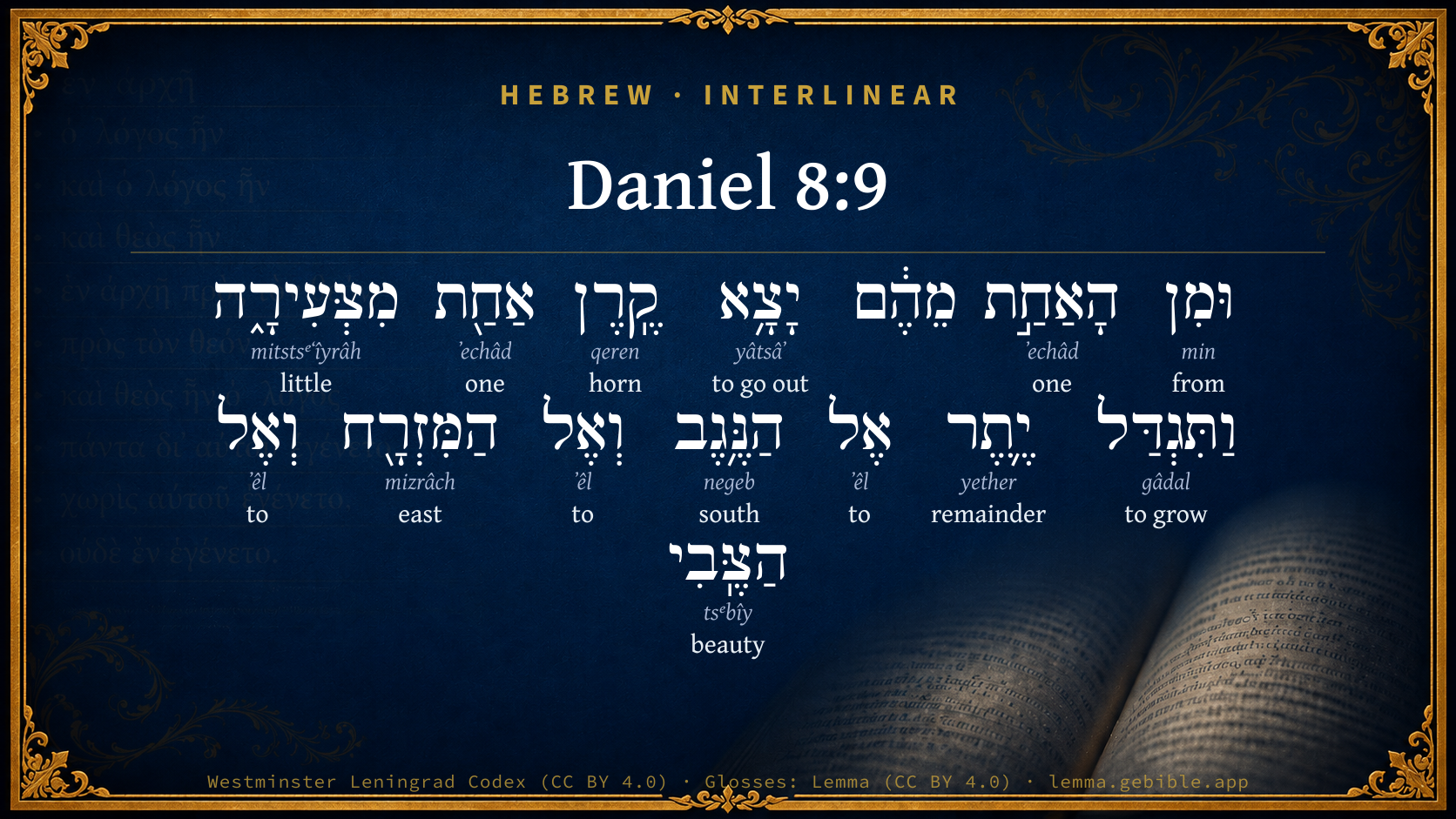
Hebrew (Westminster Leningrad Codex) Daniel 8:9 appears in the Hebrew Old Testament. The text above is from the Westminster Leningrad Codex. Each word links to its Strong’s number, a concise gloss, and parsing drawn from the Open Scriptures Hebrew Bible morphology. Click any word for its full Brown-Driver-Briggs (BDB) entry.
Download image
Cite this verse

Daniel 8:9 (World English Bible). Public Domain. Lemma interlinear Bible study tool, https://lemma.gebible.app/v/daniel/8/9.

Show BibTeX & RIS
BibTeX
RIS
English Translation
Out of one of them came forth a little horn, which grew exceeding great, toward the south, and toward the east, and toward the glorious [land].
World English Bible · Public Domain
Highlights
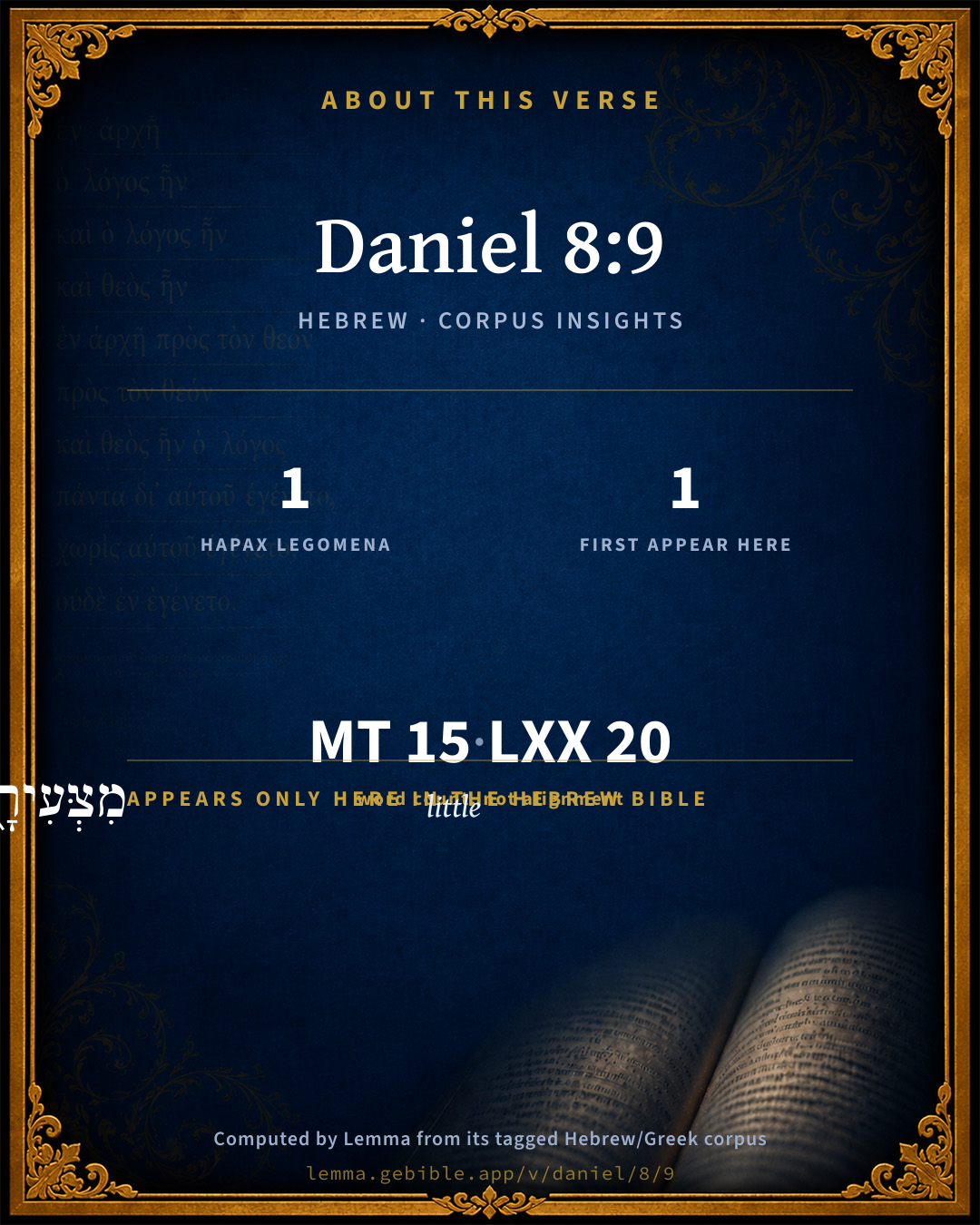
  • 1 hapax legomenon — only here in the Hebrew Bible
  • 1 first appearance in the Hebrew Bible
Full analysis ↓
Download a study sheet

One document with this verse’s original text, its word-by-word gloss line, the meaning frame, cross-references with their text, attributed commentary, and full source and license credits — printable, and it pastes into notes with its structure intact.

This verse Autodidact and up

Study sheet (.html) Plain text (.txt)

A passage Seminary Student

Up to 50 verses in one chapter. A passage sheet keeps up to 6 commentary sources and 12 cross-references per verse, in the order this page ranks them, and says so on the sheet whenever that leaves anything out. Ask for a single verse and you get the Autodidact verse sheet above.

Everything on this page stays free to read, with no account — the sheet is a download of what is already on screen, not access to it.

Want to remove ads? Support Godless Engineer
Compare translations 3

The same verse in 3 English versions, stacked beneath the original-language interlinear above. Click any original word for its lexicon entry.

Each is an independent rendering of the whole verse — the interlinear is not word-aligned to these translations.

Highlighted words mark where these versions differ — a whole-verse word diff, not a word-by-word alignment.

  • World English Bible Public Domain
    Out of one of them came forth a little horn, which grew exceeding great, toward the south, and toward the east, and toward the glorious [land].
  • King James Version Public Domain
    And out of one of them came forth a little horn, which waxed exceeding great, toward the south, and toward the east, and toward the pleasant land.
  • unfoldingWord Literal Text CC BY-SA 4.0
    Out of one of them came forth a little horn, which grew exceedingly great toward the south, toward the east, and toward the Beautiful Land.

unfoldingWord Literal Text — © unfoldingWord, licensed CC BY-SA 4.0. Word-aligned USFM3 via Door43 (git.door43.org/unfoldingWord/en_ult).

Versions to compare (up to 4)

3 of 4 selected

Show all 18 translations

Every available English version of this verse, each an independent rendering of the whole verse.

  • World English Bible Public Domain
    Out of one of them came forth a little horn, which grew exceeding great, toward the south, and toward the east, and toward the glorious [land].
  • Berean Standard Bible Public Domain
    From one of these horns a little horn emerged and grew extensively toward the south and the east and toward the Beautiful Land.
  • Majority Standard Bible Public Domain
    From one of these horns a little horn emerged and grew extensively toward the south and the east and toward the Beautiful Land.
  • King James Version Public Domain
    And out of one of them came forth a little horn, which waxed exceeding great, toward the south, and toward the east, and toward the pleasant land.
  • American Standard Version (1901) Public Domain
    And out of one of them came forth a little horn, which waxed exceeding great, toward the south, and toward the east, and toward the glorious `land'.
  • Revised Version (1885) Public Domain
    And out of one of them came forth a little horn, which waxed exceeding great, toward the south, and toward the east, and toward the glorious land.
  • Geneva Bible (1599) Public Domain
    And out of one of them came foorth a litle horne, which waxed very great toward the South, and toward the East, and towarde the pleasant land.
  • Douay-Rheims (1899) Public Domain
    And out of one of them came forth a little horn: and it became great against the south, and against the east, and against the strength.
  • Young's Literal Translation Public Domain
    And from the one of them come forth hath a little horn, and it exerteth itself greatly toward the south, and toward the east, and toward the beauteous `land';
  • Literal Standard Version CC BY-SA 4.0
    And from one of them has come forth a little horn, and it exerts itself greatly toward the south, and toward the east, and toward the beautiful [land];
  • Unlocked Literal Bible CC BY-SA 4.0
    Out of one of them grew another horn, little at first, but which became very large in the south, in the east, and in the land of beauty.
  • unfoldingWord Literal Text CC BY-SA 4.0
    Out of one of them came forth a little horn, which grew exceedingly great toward the south, toward the east, and toward the Beautiful Land.
  • Darby Bible Public Domain
    And out of one of them came forth a little horn, which became exceeding great, toward the south, and toward the east, and toward the beauty [of the earth].
  • World Messianic Bible Public Domain
    Out of one of them came out a little horn which grew exceedingly great—toward the south, and toward the east, and toward the glorious land.
  • Webster's Bible Public Domain
    And out of one of them came forth a little horn, which became exceeding great, towards the south, and towards the east, and towards the pleasant land.
  • Free Bible Version CC BY-SA 4.0
    A little horn came up from one of them, and grew extremely powerful to the south and to the east and to the Beautiful Land.
  • Bible in Basic English Public Domain
    And out of one of them came another horn, a little one, which became very great, stretching to the south and to the east and to the beautiful land.
  • JPS Tanakh (1917) Public Domain
    And out of one of them came forth a little horn, which waxed exceeding great, toward the south, and toward the east, and toward the beauteous land.

Literal Standard Version (2020), Covenant Press — licensed CC BY-SA 4.0. Text via the HelloAO Bible API (eBible.org). Unlocked Literal Bible (unfoldingWord) — licensed CC BY-SA 4.0. Text via the HelloAO Bible API (eBible.org). unfoldingWord Literal Text — © unfoldingWord, licensed CC BY-SA 4.0. Word-aligned USFM3 via Door43 (git.door43.org/unfoldingWord/en_ult). Free Bible Version, Dr. Jonathan Gallagher — licensed CC BY-SA 4.0. Text via the HelloAO Bible API (eBible.org).

Word by word

More ways to search: Search by grammar → Find every occurrence → Compare this word →

Practice this passage: Drill this verse → Learn its vocabulary →

מִצְּעִירָ֑ה
mitstsᵉʻîyrâh
H4704
“from · little”
Preposition + Adjective, Adjective, Feminine, Singular, Absolute
Part of Speech
Preposition + Adjective
Type
Adjective
Gender
Feminine
Number
Singular
State
Absolute
Full BDB Definition

Origin: from H4705

TWOT: 1948c

little, insignificant, a small thing
  1. וּמִן min H4480 “and · from” Conjunction + Preposition
  2. הָאַחַ֣ת ʼechâd H259 “the · one” Particle, Definite Article + Adjective, Cardinal number, Feminine, Singular, Absolute
  3. יָצָ֥א yâtsâʼ H3318 “to go out” Verb, Qal, Perfect, 3rd Person, Masculine, Singular
  4. קֶֽרֶן qeren H7161 “horn” Noun, Common, Both, Singular, Absolute
  5. אַחַ֖ת ʼechâd H259 “one” Adjective, Cardinal number, Feminine, Singular, Absolute
  6. וַתִּגְדַּל gâdal H1431 “and · to grow” Conjunction + Verb, Qal, Sequential Imperfect, 3rd Person, Feminine, Singular
  7. יֶ֛תֶר yether H3499 “remainder” Noun, Common, Masculine, Singular, Absolute
  8. אֶל ʼêl H413 “to” Preposition
  9. הַנֶּ֥גֶב negeb H5045 “the · south” Particle, Definite Article + Noun, Common, Masculine, Singular, Absolute
  10. וְאֶל ʼêl H413 “and · to” Conjunction + Preposition
  11. הַמִּזְרָ֖ח mizrâch H4217 “the · east” Particle, Definite Article + Noun, Common, Masculine, Singular, Absolute
  12. וְאֶל ʼêl H413 “and · to” Conjunction + Preposition
  13. הַצֶּֽבִי tsᵉbîy H6643 “the · beauty” Particle, Definite Article + Noun, Common, Masculine, Singular, Absolute

About this verse

These counts appear in no published source. They are computed here, from the morphology-tagged text and Lemma’s own curated glosses. What Lemma adds →

15
words
11
distinct lemmas
Prophets
section

Notable vocabulary

1 hapax legomenon — a word that appears only here in the entire Hebrew Bible:

  • מִצְּעִירָ֑ה little H4704

First appearance in Scripture

This word makes its first canonical appearance in the Hebrew Bible here:

  • מִצְּעִירָ֑ה little H4704

Shared distinctive vocabulary

הַצֶּֽבִי beauty H6643 occurs in 32 verses of the Hebrew Bible. Also found in:

Grammatical profile

  • 2 verbs
  • 5 nouns
  • 3 adjectives
  • 5 prepositions

Verb forms

  • יָצָ֥א Qal · Perfect
  • וַתִּגְדַּל Qal · Sequential Imperfect

Repetition

Words recur within this verse — often emphatic in Hebrew:

  • הָאַחַ֣ת one H259 ×2
  • אֶל to H413 ×3

Hebrew & Septuagint length

In English translation the verse runs 26 words from the Hebrew and 23 from the Septuagint (LXX English) — closely comparable.

A rough comparison of the two English renderings, which tokenize alike — not a word-level alignment.

Word counts can differ between the Hebrew and the Greek without any difference in meaning — e.g. the Hebrew direct-object marker אֵת has no separate Greek word, and Greek often adds the article ὁ.

In the original languages it is 15 Hebrew tokens and 20 Greek tokens — but the two are counted differently (Hebrew bundles its prefixes and suffixes into one token; the Greek is in lemma form), so that isn’t a like-for-like length.

Cross-references

12

Topical passages linked to Daniel 8:9 in the Treasury of Scripture Knowledge — connected by theme and wording, ordered by reader-vote popularity; previews shown in the World English Bible.

  • Daniel 11:16 But he who comes against him shall do according to his own will, and none shall stand before him; and he shall stand in the glorious land, and in his hand shall be destruction.
  • Psalms 48:2 Beautiful in elevation, the joy of the whole earth, Is Mount Zion, on the north sides, The city of the great King.
  • Ezekiel 20:6 in that day I swore to them, to bring them forth out of the land of Egypt into a land that I had searched out for them, flowing with milk and honey, which is the glory of all lands.
  • Ezekiel 20:15 Moreover also I swore to them in the wilderness, that I would not bring them into the land which I had given them, flowing with milk and honey, which is the glory of all lands;
  • Daniel 7:8 I considered the horns, and, behold, there came up among them another horn, a little one, before which three of the first horns were plucked up by the roots: and, behold, in this horn were eyes like the eyes of a man, and a mouth speaking great things.
  • Psalms 105:24 He increased his people greatly, And made them stronger than their adversaries.
  • Jeremiah 3:19 But I said, How I will put you among the children, and give you a pleasant land, a goodly heritage of the hosts of the nations! and I said, You shall call me My Father, and shall not turn away from following me.
  • Daniel 7:20–26 and concerning the ten horns that were on its head, and the other [horn] which came up, and before which three fell, even that horn that had eyes, and a mouth that spoke great things, whose look was more stout than its fellows.
  • Daniel 8:23–24 In the latter time of their kingdom, when the transgressors are come to the full, a king of fierce face, and understanding dark sentences, shall stand up.
  • Daniel 11:21 In his place shall stand up a contemptible person, to whom they had not given the honor of the kingdom: but he shall come in time of security, and shall obtain the kingdom by flatteries.
  • Daniel 11:25–45 He shall stir up his power and his courage against the king of the south with a great army; and the king of the south shall war in battle with an exceeding great and mighty army; but he shall not stand; for they shall devise devices against him.
  • Zechariah 7:14 "but I will scatter them with a whirlwind among all the nations which they have not known. Thus the land was desolate after them, so that no man passed through nor returned: for they made the pleasant land desolate."

Cross-references courtesy of OpenBible.info (CC BY 4.0).

Hebrew and Greek witnesses Masoretic Hebrew ↔ Greek Septuagint

The same verse in the two great witnesses to the Old Testament, shown verse-for-verse.

These are two independent witnesses, not word-aligned to each other, and the Septuagint is shown in lemma (dictionary) form.

Hebrew Daniel 8:9 Masoretic · Westminster Leningrad Codex

וּמִן הָאַחַ֣ת מֵהֶ֔ם יָצָ֥א קֶֽרֶן אַחַ֖ת מִצְּעִירָ֑ה וַתִּגְדַּל יֶ֛תֶר אֶל הַנֶּ֥גֶב וְאֶל הַמִּזְרָ֖ח וְאֶל הַצֶּֽבִי

Out of one of them came forth a little horn, which grew exceeding great, toward the south, and toward the east, and toward the glorious [land].

World English Bible · Public Domain

Greek LXX Daniel 8:9 Septuagint · lemma form

καί ἐκ εἷς αὐτός ἀναφύω κέρας ἰσχυρός εἷς καί καταἰσχύω καί πατάσσω ἐπί μεσημβρία καί ἐπί ἀνατολή καί ἐπί βορέας

And out of one of them came forth one strong horn, and it grew very great toward the south, and toward the host:

LXX2012 (modern English Septuagint) · Public Domain

On this verse, The Cambridge Bible for Schools and Colleges discusses the Septuagint’s reading. Read the note in Commentary ↓

Hebrew: Westminster Leningrad Codex (CC BY 4.0). Greek: Septuagint (public domain); English from LXX2012 (modern English Septuagint) (Public Domain). How the Septuagint differs from the Hebrew →

Commentary

Notes on Daniel 8:9 from classic Christian and Jewish commentators (each source and its license shown beneath its notes). The classic Christian expositions comment on the surrounding passage and are grouped to its opening verse, so a note may address several verses; the Jewish commentaries on the Tanakh (Rashi and others) are per-verse, so they appear only where the commentator wrote on this verse.

Lemma curates 59 commentaries, every one of them public domain or Creative Commons licensed, each selected and text-cleaned for this edition rather than reprinted as found. About our sources →

Jamieson, Fausset & Brown

Robert Jamieson, A. R. Fausset & David Brown

little horn--not to be confounded with the little horn of the fourth kingdom in Dan 7:8. The little horn in Dan 7:8 comes as an eleventh horn after ten preceding horns. In Dan 8:9 it is not an independent fifth horn, after the four previous ones, but it arises out of one of the four existing horns. This horn is explained (Dan 8:23) to be "a king of fierce countenance," &c. Antiochus Epiphanes is meant. Greece with all its refinement produces the first, that is, the Old Testament Antichrist. Antiochus had an extraordinarly love of art, which expressed itself in grand temples. He wished to substitute Zeus Olympius for Jehovah at Jerusalem. Thus first heathen civilization from below, and revealed religion from above, came into collision. Identifying himself with Jupiter, his aim was to make his own worship universal (compare Dan 8:25 with Dan 11:36); so mad was he in this that he was called Epimanes (maniac) instead of Epiphanes. None of the previous world rulers, Nebuchadnezzar (Dan 4:31-34), Darius (Dan 6:27-28), Cyrus (Ezr 1:2-4), Artaxerxes Longimanus (Ezr 7:12), had systematically opposed the Jews' religious worship. Hence the need of prophecy to prepare them for Antiochus. The struggle of the Maccabees was a fruit of Daniel's prophecy (1 Maccabees 2:59). He is the forerunner of the final Antichrist, standing in the same relation to the first advent of Christ that Antichrist does to His second coming. The sins in Israel which gave rise to the Greek Antichrist were that some Jews adopted Hellenic customs (compare Dan 11:30, Dan 11:32), erecting theaters, and regarding all religions alike, sacrificing to Jehovah, but at the same time sending money for sacrifices to Hercules. Such shall be the state of the world when ripe for Antichrist. At Dan 8:9 and Dan 8:23 the description passes from the literal Antiochus to features which, though partially attributed to him, hold good in their fullest sense only of his antitype, the New Testament Antichrist. The Mohammedan Antichrist may also be included; answering to the Euphratean (Turk) horsemen (Rev 9:14-21), loosed "an hour, a day, a month, a year" (391 years, in the year-day theory), to scourge corrupted, idolatrous Christianity. In A.D. 637 the Saracen Moslem mosque of Omar was founded on the site of the temple, "treading under foot the sanctuary" (Dan 8:11-13); and there it still remains.The first conquest of the Turks over Christians was in A.D. 1281; and 391 years after they reached their zenith of power and began to decline, Sobieski defeating them at Vienna. Mohammed II, called "the conqueror," reigned A.D. 1451-1481, in which period Constantinople fell 391 years after brings us to our own day, in which Turkey's fall is imminent.

waxed . . . great, toward . . . south-- (Dan 11:25). Antiochus fought against PTOLEMY Philometer and Egypt, that is, the south.

toward the east--He fought against those who attempted a change of government in Persia.

toward the pleasant land--Judea, "the glorious land" (Dan 11:16, Dan 11:41, Dan 11:45; compare Psa 48:2; Eze 20:6, Eze 20:15). Its chief pleasantness consists in its being God's chosen land (Psa 132:13; Jer 3:19). Into it Antiochus made his inroad after his return from Egypt.

Jamieson, Fausset & Brown — Commentary Critical and Explanatory on the Whole Bible (1871) — public domain (CC PDM 1.0). Text via the HelloAO Bible API.

Trapp's Complete Commentary

John Trapp

Dan 8:9 And out of one of them came forth a little horn, which waxed exceeding great, toward the south, and toward the east, and toward the pleasant [land].

Ver. 9. And out of one of them.] Out of the posterity of Seleucus, king of Syria.

Came forth a little horn.] This was Antiochus, surnamed Epiphanes, illustrious; Polybius called him Epimanes, the madman. He is here called a "little horn," because he was vile and base from the very first to the last of him; indeed, he was born a prince, but without a kingdom, a mere nullatenensis, till he became a usurper. He was sent for a hostage to Rome by his father, Antiochus the Great, whom the Romans had cudgelled into a treaty, taking away from him the best part of his kingdom. After his father’s death, he stole away from Rome and seized upon the kingdom of Syria, casting out of it his nephew Demetrius, who was the rightful heir. Afterwards he got into his hands also the kingdom of Egypt, under colour of protector to his young nephew, Ptolemy Philometor; and being therehence discharged by the Romans, and made to answer Parebo, I will be gone, he went thence in a rage, and like a madman wreaked his teem, as we say, upon the poor Jews, playing the devil among them.

Toward the south,] i.e., Egypt,

And toward the east.] Persia, which he also conquered.

And toward the pleasant land,] i.e., Judea, called here Decus Capreolus, the delectable and desirable country, by reason of its great prerogatives. So Eze 20:6 Psa 48:2.

John Trapp, A Commentary or Exposition upon All the Books of the Old and New Testament (1647–1656) — public domain. Text from a community e-Sword module.

The Biblical Illustrator

Joseph S. Exell

Dan_8:9

And out of one of them came forth a little horn.

A Little Horn

If we would know who he is that is signified by this horn, it is necessary that we have his characteristic features and qualities exhibited before us, that we may survey them at one view.

1. He arose out of one of the four horns which were on the he-goat, i.e., one of the kingdoms into which the Grecian empire was divided.

2. He arose in the latter time of their kingdom.

3. He was little at first.

4. But he afterwards waxed exceeding great, toward the south, and toward the east, and toward the pleasant land.

5. He fights immediately against God.

6. And the host of the saints.

7. This takes place at a time when the dally sacrifice is in use, while the sanctuary is yet standing, and when transgressions in Israel have come to the full. He takes away the sacrifice, and stamps upon and profanes the sanctuary.

8. This king prospers in his enterprises against God and the saints.

9. He is impudent and cruel.

10. Crafty and deceitful.

11. His power is great, yet there is another power concealed under it.

12. He is broken without hand, i.e., destroyed without the intervention of man. It is impossible for any who duly attends to these features and qualities to apply this prophecy to Mahomet, or to the kingdom of the Turks and Saracens. There does not appear to be any reason why we should depart from the ancient and commonly received interpretation, which applies this prophecy to Antiochus Epiphanes, especially as it speaks of a king, not of a kingdom, and specifies the personal qualities of this king, such as impudence, cruelty, cunning, and deceit, which are altogether inapplicable to a whole kingdom. He is a king raging with unexampled malignity against God and His people, and prefiguring an Antichrist who should not have his equal among all who had preceded him. (Magnus F. Roos, A.M.)

The Biblical Illustrator, edited by Joseph S. Exell (c. 1880s–1900s) — public domain. Text from a community e-Sword module.

Joseph Benson's Commentary

Dan 8:9. And out of one of them — Namely, out of one of the four notable horns, mentioned in the preceding verse, came forth a little horn — The reader will be pleased particularly to observe this, as being a key to the right interpretation of the subsequent prophecy. The little horn proceeded from one of the four kingdoms just mentioned, into which Alexander’s empire was divided after his death: therefore to look for it elsewhere, or to interpret it of any power, king, or kingdom, which had not its origin in one of them, must be a misinterpretation of the prophecy. From one of the four successors of Alexander, namely, from Antiochus the Great, came forth Antiochus, afterward called Epiphanes, or Illustrious, by his flatterers; but by Polybius termed more properly Epimanes, or the madman. He was indeed a vile person, as the angel characterizes him, Dan 11:21, to whom the honour of the kingdom did not belong, Demetrius, his eldest brother’s son, being the rightful heir. He is here called a little horn: as he was originally of no great fortune or dignity, a younger brother, a contemptible person, and a sort of captive at Rome. Some have objected, that the word horn, in these visions, never signifies a single king, but always a kingdom or empire; but this is evidently a mistake, as the notable horn, mentioned Dan 8:5, which the goat had between his eyes, manifestly means Alexander the Great. This little horn belonging to the third, or Macedonian monarchy, must not be confounded with the little horn belonging to the fourth, mentioned Dan 7:8-20, although this here spoken of may be allowed to be a type or figure of the latter. Which waxed exceeding great toward the south — He extended his dominion toward the south, when, taking advantage of the youth of Ptolemy Philometer, (see 1Ma 1:16-19,) he made himself master of Egypt, called the south, in several places of chap. 11. of this prophecy. And toward the east — Where he conquered Armenia, and penetrated into Persia. And toward the pleasant land — Or, the land of Judea, called the pleasant land, by the holy writers, as being chosen by God for the place of his people’s habitation, and of his house or temple; where also the Messiah was to appear, called elsewhere the glory of all lands, Eze 20:6; Eze 20:15. The cruelties which Antiochus Epiphanes exercised in Judea seem to be the primary subject of the following verses. In which, however, he may be considered as a type of antichrist, exercising still greater cruelties on the Christian Church.

Joseph Benson's Commentary on the Old and New Testaments (1811–1818) — public domain. Text from a community e-Sword module.

Keil & Delitzsch

C. F. Keil & F. Delitzsch

The interpretation of the vision.

Dan 8:9

Without following the development of the four horns further, the prophecy passes over to the little horn, which grew up out of one of the four horns, and gained great significance in relation to the history of the people of God. The masculine forms מהם and יצא (out of them came) are to be explained as a constructio ad sensum. אחת (one) after קרן (horn) is as little superfluous as is the מן in מצּעירה. אחת is a numeral, one horn, not several; מן is either comparative, less than little, i.e., very little (Ewald), or, as less than insignificance, wretchedness, i.e., in an altogether miserable way (Hv.). The one explanation is more forced than the other, and the idea of wretchedness is altogether untenable. Yet the מן serves as a circumlocution for the superlative = perpaucus (Gesen., Win., Aub.), while verbal analogies for it are wanting. מן signifies from, out of; but it is not to be united with קרן: one horn of smallness (v. Leng.), in which case מן would be superfluous, but with the verb יצא: it came up out of littleness, a parvo, i.e., a parvis initiis (Maur., Hofm., Kran., Klief.). Thus it corresponds with סלקת זעירה, Dan 7:8. In the words "it arose out of littleness" there lies the idea that it grew to great power from a small beginning; for it became very great, i.e., powerful, toward the south, toward the east, and toward the הצּבי (the splendour, glory), i.e., toward the glorious land. הצּבי = הצּבי ארץ, Dan 11:16, Dan 11:41. This designation of the land of Israel is framed after Jer 3:19 and Eze 20:6, Eze 20:15, where this land is called "a heritage of the greatest glory of nations" (a goodly heritage of the host of nations, E. V.), "a glory of all lands," i.e., the most glorious land which a people can possess. The expression is synonymous with חמדּה ארץ ("pleasant land"), Jer 3:19; Zac 7:14; Psa 106:24. Canaan was so designate don account of its great fruitfulness as a land flowing with milk and honey; cf. Eze 20:6.

The one of the four horns from which the little horn grew up is the Syrian monarchy, and the horn growing up out of it is the king Antiochus Epiphanes, as Josephus (Ant. x. 11. 7) and all interpreters acknowledge, on the ground of 1 Macc. 1:10. The south, against which he became great, is Egypt (cf. Dan 11:5 and 1 Macc. 1:16ff.). The east is not Asia (Kranichfeld), but Babylon, and particularly Elymas and Armenia, 1 Macc. 1:31, 37; 3:31, 37; 6:1-4, according to which he subdued Elymas and overcame Artaxias, king of Armenia (App. Syr. c. 45, 46; Polyb. xxxi. 11). Besides the south and the east, Canaan, the holy land, as lying between, is named as the third land, as in Isa 19:23. it is named as third, between Egypt and Assyria; but הצּבי ואל ("and toward the glorious land") is not, with Kranichfeld, to be regarded as an exegetical addition to המּזרח ואל ("and toward the east"). Palestine lay neither to the east of Daniel, nor geographically to the east of the kingdom denoted by the little horn, because the text gives no support to the identifying of this kingdom with the Javanic, the horn operating from the west.

Dan 8:10

As this horn became great in extent toward the south and toward the east, so also it grew up in height even unto the host of heaven, and some of them it cast down, i.e., some of the stars, to the earth. The host of heaven is here, as in Jer 33:22, the whole body of the stars of heaven, the constellations, and of the stars is epexegetical of of the host. Daniel in the vision sees the horn grow so great in height, that it reaches even to the heavens, can reach the heavenly bodies with the hand, and throws some of the stars (מן is partitive) down to the earth and tramples upon them, destroys them with scorn. The words of the angel, Jer 33:24, show that by the stars we are to understand the people of the saints, the people of God. The stars cast down to the earth are, according to this, neither the Levites (Grotius), nor the viri illustres in Israel (Glass.), nor the chief rulers of the Jews in church and state (Dathe). If the people of the saints generally are compared to the host of heaven, the stars, then the separate stars cannot be the ecclesiastical or civil chiefs, but the members of this nation in common. But by "the people of the saints" is to be understood (since the little horn denotes Antiochus Epiphanes) the people of God in the Old Covenant, the people of Israel. They are named the people of the saints by virtue of their being called to be an holy nation (Exo 19:6), because "they had the revelation of God and God Himself dwelling among them, altogether irrespective of the subjective degrees of sanctification in individuals" (Kliefoth). But the comparing of them with the host of the stars does not arise from Jewish national pride, nor does it mean that Daniel thought only of the truly faithful in Israel (Theod., Hv.), or that the pseudo-Daniel thought that with the death of Antiochus the Messiah would appear, and that then Israel, after the extermination of the godless, would become a people of pure holiness. The comparison rather has its roots in this, that God, the King of Israel, is called the God of hosts, and by the צבאות (hosts) are generally to be understood the stars or the angels; but the tribes of Israel also, who were led by God out of Egypt, are called "the hosts of Jehovah" (Exo 7:4; Exo 12:41). As in heaven the angels and stars, so on earth the sons of Israel form the host of God; and as the angels on account of the glory of their nature are called קדושׁים (holy ones), so the Israelites by virtue of their being chosen to be the holy nation of God, forming the kingdom of heaven in this world. As God, the King of this people, has His throne in heaven, so there also Israel have their true home, and are in the eyes of God regarded as like unto the stars. This comparison serves, then, to characterize the insolence of Antiochus as a wickedness against Heaven and the heavenly order of things. Cf. 2 Macc. 9:10.

(Note: The deep practical explanation of Calvin deserves attention: - "Although the church often lies prostrate in the world and is trodden under foot, yet is it always precious before God. Hence the prophet adorns the church with this remarkable praise, not to obtain for it great dignity in the sight of men, but because God has separated it from the world and provided for it a sure inheritance in heaven. Although the sons of God are pilgrims on the earth, and have scarcely any place in it, because they are as castaways, yet they are nevertheless citizens of heaven. Hence we derive this useful lesson, that we should bear it patiently when we are thrown prostrate on the ground, and are despised by tyrants and contemners of God. In the meantime our seat is laid up in heaven, and God numbers us among the stars, although, as Paul says, we are as dung and as the offscourings of all things." - Calv. in loc.)

Dan 8:11

This horn raised its might even to the Prince of the host. הצבא שׂר, the Prince of the host of heaven, is obviously not the high priest Onias (Grotius), but the God of heaven and the King of Israel, the Prince of princes, as He is called in Dan 8:25. עד הגדּיל (he magnified himself to) is repeated in Dan 8:25 by על יעמוד (he shall stand up against). Wherein this rising up against God consisted, the second half of the verse indicates in the statement that the תּמיד (daily sacrifice) was taken away, and the building of His sanctuary was destroyed. This verse does not record a part of the vision, but is a further development of that which was seen in prophetic words. Hence we may not, with Ebrard, refer its contents to heavenly events, to a putting away of the sacrifice from before the throne of God and a destruction of the heavenly sanctuary. On the contrary, Kliefoth has well remarked that it is "without example in Scripture that men penetrate into heaven to insult God; what men do against God is done on the earth." התּמיד is everything in the worship of God which is not used merely temporarily, but is permanent, as the daily sacrifice, the setting forth of the shew-bread, and the like. The limitation of it to the daily morning and evening service in the writings of the Rabbis is unknown in the O.T. The word much rather comprehends all that is of permanent use in the holy services of divine worship (Hgst., Hv., Hofm., Kran., Klief.). Thus interpreted, the prophetic announcement corresponds with history; for, according to 1 Macc. 1:45, Antiochus gave orders that they should "forbid burnt-offerings, and sacrifice, and drink-offerings in the temple; and that they should profane the Sabbath and festival days."

The horn also overthrew the place of the sanctuary of Jehovah. השׁליך, to cast away, to cast forth, - used of buildings, to lay waste; cf. Jer 9:18. מכון, properly, that which is set up, erected; here, as frequently, of the dwelling-place of God, the temple: so also שׁבתּך מכון (a settled place for thee to dwell in), Exo 15:17; Kg1 8:13. It is used also of the heavenly dwelling-place of God, Kg1 8:39, Kg1 8:43; here, of the temple of Jerusalem. With regard to the historical fulfilment, cf. The expressions, "her (Jerusalem's) sanctuary was laid waste like a wilderness," and "pollute the sanctuary," 1 Macc. 1:39, 46; and "the sanctuary was trodden down," 1 Macc. 3:45.

Dan 8:12

The actions of the little horn are definitively comprehended in this verse, as may be seen from this, that in the first hemistich צבא and תּמיד are mentioned together. But this hemistich has been very variously interpreted. We must altogether reject the interpretation of the Vulgate, "Robur autem datum est contra juge sacrificium propter peccata," which is reproduced in Luther's translation, "There was given to him such strength against the daily sacrifice on account of sin;" or Calvin's, "Et tempus datum est super jugi sacrificio in scelere," whereby, after Raschi's example, צבא is interpreted of the statio militaris, and thence the interpretation tempus or intervallum is derived. For צבא means neither robur, nor tempus, nor statio militaris, but only military service, and perhaps military forces. Add to this that צבא both in Dan 8:10, Dan 8:13 means host. If we maintain this, with the majority of interpreters, only two explanations are admissible, according as we understand צבא of the host of heaven, i.e., of Israel, or of some other host. The latter interpretation is apparently supported partly by the absence of the article in צבא, and partly by the construction of the word as fem. (תּנּתן). Accordingly, Hitzig says that a Hebrew reader could not understand the words otherwise than as meaning, "and a warlike expedition was made or conducted against the daily sacrifice with wickedness" (i.e., the impure service of idols); while others translate, "and a host placed against he daily sacrifice on account of sin" (Syr., Grot., Harenb., J. D. Michaelis); or, "a host is given against the daily sacrifice in wickedness" (Wieseler); or, "given against that which was continual with the service of idols," i.e., so that, in the place of the "continual," wickedness, the worship of idols, is appointed (Hofmann); or, "the power of an army is given to it (the horn) against the daily sacrifice through wickedness," i.e., by the evil higher demons (Ebrard). But the latter interpretation is to be rejected on account of the arbitrary insertion of לו (to it); and against all the others it is to be remarked, that there is no proof either from Dan 8:13, or from Eze 32:23 or Eze 26:8, that נתן means to lead out, to bring forward, to give contrary to or against.

Keil & Delitzsch — Biblical Commentary on the Old Testament (1861–1891) — public domain (CC PDM 1.0). Text via the HelloAO Bible API. (Old Testament only.)

Scofield Reference Notes

C. I. Scofield

little horn

The "little horn" here is a prophecy fulfilled in Antiochus Epiphanes, B.C. 175, who profaned the temple and terribly persecuted the Jews. He is not to be confounded with the "little horn" of Daniel 7. who is yet to come, and who will dominate the earth during the great tribulation. (See Scofield "Dan 7:8") concerning "The Beast". See Scofield "Rev 19:20" and "The great tribulation," Psa 2:5. See Scofield "Rev 7:14". But Antiochus is a remarkable type of the Beast, the terrible "little horn" of the last days. Dan 8:24-25 go beyond Antiochus and evidently refer to the "little horn" of Daniel 7. Both Antiochus and the Beast, but the Beast pre-eminently, are in view in Dan 8:24-25. That the "little horn" of Daniel 7. cannot be the little horn of Dan 8:9-13; Dan 8:23 is evident. The former comes up among the ten horns into which the fourth empire (Roman) is to be divided; the little horn of Daniel 8. comes out of one of the four kingdoms into which the third (Grecian) empire was divided (Dan 8:23), and in "the latter time" of the four kingdoms Dan 8:22; Dan 8:23). This was historically true of Antiochus Epiphanes. They are alike in hatred of the Jews and of God, and in profaning the temple. Cf. Dan 7:25 (the Beast) with Dan 8:10-12 (Antiochus):

one of them Anticohus Epiphanes came out of Syria, one of the "four notable" kingdoms into which Alexander’s empire was divided.

The Scofield Reference Bible (1917 edition), notes by C. I. Scofield — public domain. Text from a community e-Sword module.

Geneva Bible (1599)

Geneva Bible translators

Whereby he meaneth Ptolemeus.

Which was Antiochus Epiphanes, who was of a servile and flattering nature, and also there were others between him and the kingdom, and therefore is here called the little horn, because neither princely conditions, nor any other thing was in him, why he should obtain this kingdom.

That is, toward Egypt.

That is, Judea.

Geneva Bible (1599) marginal notes — public domain. Text via Bolls.life.

Adam Clarke's Commentary

Verse 9. Out of one of them came forth a little horn] Some think that Antiochus Epiphanes is meant; but Bp. Newton contends that it is the Roman government that is intended; and although very great at its zenith, yet very little in its rising.

Waxed-great toward the south] The Romans made Egypt a province of their empire, and it continued such for some centuries.

Toward the east] They conquered Syria, and made it a province.

Toward the pleasant land.] Judea, so called Ps 106:24; Jer 3:19; Da 11:16; Da 11:41. It is well known that they took Judea, and made it a province; and afterwards burnt the city and the temple, and scattered the Jews over the face of the earth.

Adam Clarke's Commentary on the Bible (1810–1826) — public domain. Text from a community e-Sword/MySword module.

John Calvin's Commentaries

Now God shews his Prophet what peculiarly concerned the welfare of his Church. For it was of very great importance to warn the Jews of the calamities which were about to oppress them. There is nothing which more torments the minds of men than their becoming bewildered in false imaginations, and thinking the world the sport of chance, while they never ponder over the providence of God nor reflect upon his judgments. Hence, with this design, God wished to teach the Prophet and all the pious the nature of their future afflictions, since they would thus understand how events never happened by chance, but all these scourges proceeded from God; for the same God both determines and executes his decrees, as he also predicts future events. For if nothing had been predicted, the pious would have glided gently downwards to despair in consequence of their heavy afflictions. We know also how magnificently the prophets extol the grace of God when they promise return and deliverance. Isaiah, too, has elsewhere spoken to this effect: Not in haste nor in tumult shall ye go forth, but with a standard displayed. Again, The wealth of all the nations shall flow towards you; kings shall come, and submit, and bow the knee to thee. (Isaiah 52:10; Isaiah 55:12; Isaiah 55:6.) The Jews were permitted to return to their own land; but we know how cruelly they were harassed by all their neighbors, so that they did not dwell in that corner of the world without the greatest difficulties. The building of both the city and the Temple was hindered by many enemies, till at length they became tributary to the kings of Syria. Antiochus, indeed, who is here alluded to, advanced with cruel tyranny against the people of God. If this had not been predicted, they would have thought themselves deceived by the splendid promises concerning their return. But when they perceived everything occurring according as they had been opportunely forewarned, this became no slight solace in the midst of their woes; they could then determine at once how completely it was in the power of God to relieve them from so many and such oppressive evils. With what intention, then, had God predicted all these things to his Prophet Daniel? clearly that the Jews might look forward to a happy result, and not give way to despair under events so full of anxiety and confusion. This, then, was the utility of the prophecy, with reference to that particular period.

When the Prophet says, Out of one of those four horns a little horn arose, Antiochus Epiphanes is most distinctly pointed out. The title Epiphanes entails “illustrious,” as, after the capture of his father, he was detained as a hostage at Rome, and then escaped from custody. Historians inform us of his possessing a servile disposition, and being much addicted to gross flattery. As he had nothing royal or heroic in his feelings, but was simply remarkable for cunning, the Prophet is justified in calling him the little horn He was far more powerful than his neighbors; but the horn is called little, not in comparison with the kingdoms of either Egypt, or Asia, or Macedon, but because no one supposed he would ever be king and succeed his father. He was the eldest of many brothers, and singularly servile and cunning, without a single trait worthy of future royalty. Thus he was the little horn who escaped secretly and fraudulently from custody, as, we have already mentioned, and returned to his native country, which he afterwards governed.

He now adds, This horn was very mighty towards the south, and the east, and “the desire”’ for unless he had been checked by the Romans, he would have obtained possession of Egypt. There is a remarkable and celebrated story of Pompilius, who, was sent to him to command him to abstain from Egypt at the, bidding of the senate. After he had delivered his message, Antiochus demanded time for deliberation, but Pompilius drew a circle with the staff which he held in his hand, and forbade him to move his foot until he gave him an answer. Though he claimed Egypt as his own by right of conquest, yet he dared not openly to deny the Romans their request; at first he pretended to be merely the guardian of his nephew, but he certainly seized upon the kingdom in his own name. However, he dared not oppose the Romans, but by changing his ground wished to dismiss Pompilius. They had been mutual acquaintances, and a great familiarity had arisen between them while he was a hostage at Rome; hence he offered to salute Pompilius at the interview, but he rejected him disdainfully, and, as I have said, drew a line around him, saying, “Before you go out of this circle answer me; do not delude me by asking time to consult with your councilors; answer at once, otherwise I know how to treat thee.” He was compelled to relinquish Egypt, although he had formerly refused to do so. The language of the Prophet, then, was not in vain, The small horn became mighty towards the south, that is, towards Egypt, and the east; for he extended his kingdom as far as Ptolemais. In the third place, he uses the word glory; that is, Judea, the sanctuary of God, which he had chosen as his dwelling, and desired his name to be invoked. Thus this small horn extended itself to the glory, or the land of glory or desire. There is nothing doubtful in the sense, though the interpretation scarcely agrees with the words. It afterwards follows: —

John Calvin's Commentaries (1540-1563) — public domain. Text from the Calvin Translation Society English edition (1840s-50s) via the Christian Classics Ethereal Library (ccel.org). Calvin's coverage is partial (roughly two-thirds of the Bible); uncommented books and verses are honest gaps, never fabricated. The 19th-century editor's footnotes and remarks are omitted so the notes are faithfully Calvin's own voice.

Ellicott's Commentary for English Readers

(9) Little.—Literally, out of littleness. (Comp. Dan_7:8.) This is explained more fully in Dan_8:23. The southern campaigns of Antiochus Epiphanes are related 1Ma_1:16; for his eastern wars see 1Ma_3:31-37; 1Ma_6:1-4.

The pleasant land—i.e., Palestine, which here, as in Isa_19:23-24, is spoken of as a third land, between south and east. The phrase, “pleasant land,” or “glorious land,” which recurs Dan_11:16-41, was suggested to Daniel by the language of Jer_3:19; Eze_20:6; Eze_20:15.

A Bible Commentary for English Readers, edited by Charles John Ellicott (1878–1897) — public domain. Text from a community e-Sword module.

The Cambridge Bible for Schools and Colleges

gen. ed. J. J. S. Perowne

9. out of one of them] The history of Seleucus himself and his immediate successors is passed over: and the prophecy proceeds at once to Antiochus Epiphanes (b.c. 175–164), whose reign was fraught with such momentous consequences for the Jews.

a little horn] cf. Dan_7:8. The general sense is, no doubt, given correctly; but the exact meaning of the Heb. (which is very peculiar) is far from clear. The explanation which is least forced is ‘a horn (arising) out of (being) a small one.’ It is quite possible, however, that the text is slightly in error: by omitting one letter, we should obtain the ordinary Hebrew for ‘a little horn’; and by altering two letters, we should get ‘another horn, a little one’ (cf. Dan_7:8). Probably one of these is the true reading: LXX. Theod. support the former.

toward the south] i.e. Egypt, as in ch. 11 (Dan_8:5, &c.). On the wars of Antiochus against Egypt, see more fully on ch. Dan_11:21 ff.

toward the east] Antiochus led an expedition into Elymais (on the E. of Babylonia) in the last year of his life (see on Dan_11:40).

and toward the beauteous (land)] lit. the beauty; but the full expression ‘land of beauty,’ or ‘beauteous land,’ occurs in Dan_11:16; Dan_11:41. It is a title of honour for the land of Israel, based upon Jer_3:19, where Canaan is called ‘the heritage of beauty (i.e. the most beauteous heritage) of the hosts of the nations,’ and Eze_20:6; Eze_20:9, ‘the land flowing with milk and honey, which is the beauty of all lands’ (or, as we might say, the crown of all lands).

9–14. Antiochus Epiphanes (b.c. 175–164), and his assaults upon the religion of the Jews (cf. Dan_8:23-25).

The Cambridge Bible for Schools and Colleges (gen. ed. J. J. S. Perowne; Cambridge University Press, 1878–1918) — public domain. Text from a community e-Sword module.

John Gill's Exposition

And out of one of them came forth a little horn,.... Meaning not the kingdom of Titus Vespasian, as Jarchi; nor the kingdom of the Turks, as Saadiah; but the kingdom of Antiochia, as Aben Ezra and Jacchiades; or rather Antiochus Epiphanes, who sprung from the kingdom of the Seleucidae in Syria, or from Seleucus king of Syria, one of the four horns before mentioned: this is that sinful root said to come out from thence, in the Apocrypha:

"And there came out of them a wicked root Antiochus surnamed Epiphanes, son of Antiochus the king, who had been an hostage at Rome, and he reigned in the hundred and thirty and seventh year of the kingdom of the Greeks.'' (1 Maccabees 1:10)

called "a horn", because he had some power and authority, and which he usurped and increased in; though but a "little" one in comparison of Alexander the great horn; or at his beginning, being an hostage at Rome; from whence he got away by stealth, and seized the kingdom of Syria, which belonged to his elder brother's son, whom he dispossessed of it; and by mean, artful, and deceitful methods, got it into his hands, who had no right unto it, nor any princely qualities for it:

which waxed exceeding great toward the south; towards Egypt, which lay south of Syria; into which Antiochus entered, and fought against Ptolemy Philometer, king of it, took many cities, and besieged Alexandria; and in all probability would have subdued the whole country, had not the Romans (c) restrained him, by sending their ambassador Popilius to him, who obliged him to desist and depart;

"17 Wherefore he entered into Egypt with a great multitude, with chariots, and elephants, and horsemen, and a great navy, 18 And made war against Ptolemee king of Egypt: but Ptolemee was afraid of him, and fled; and many were wounded to death. 19 Thus they got the strong cities in the land of Egypt and he took the spoils thereof. 20 And after that Antiochus had smitten Egypt, he returned again in the hundred forty and third year, and went up against Israel and Jerusalem with a great multitude,'' (1 Maccabees 1)

and toward the east; towards Armenia and Persia, the Atropatii in Media, and the countries beyond the Euphrates, whom he made tributary to him; in the Apocrypha:

"Wherefore, being greatly perplexed in his mind, he determined to go into Persia, there to take the tributes of the countries, and to gather much money.'' (1 Maccabees 3:31)

"1 About that time king Antiochus travelling through the high countries heard say, that Elymais in the country of Persia was a city greatly renowned for riches, silver, and gold; 2 And that there was in it a very rich temple, wherein were coverings of gold, and breastplates, and shields, which Alexander, son of Philip, the Macedonian king, who reigned first among the Grecians, had left there.'' (1 Maccabees 6)

and toward the pleasant land; the land of Judea, so called because of its delightful situation, and great fruitfulness; and because God chose it above all others for his habitation; where his word, and worship, and ordinances, were observed and enjoyed; and where the Messiah should be born and dwell; into this Antiochus led his army, and greatly afflicted and distressed it; he made himself master of most places in Galilee and Judea. The Arabic version reads "toward the west"; no mention is made of the north, because there he himself reigned; Syria being north to Egypt, as that was south to Syria; hence afterwards the king of Egypt is called the king of the south, and the king of Syria the king of the north.

(c) See Joseph. Antiqu. l. 12. c. 5. sect. 2.

John Gill's Exposition of the Whole Bible (1746–1763) — public domain (CC PDM 1.0). Text via the HelloAO Bible API.

Albert Barnes' Notes on the Bible

And out of one of them, came forth a little horn - Emblematic of new power that should spring up. Compare the notes at Dan 7:8. This little horn sprang, up out of one of the others; it did not spring up in the midst of the others as the little horn, in Dan 7:8, did among the ten others. This seemed to grow out of one of the four, and the meaning cannot be misunderstood. From one of the four powers or kingdoms into which the empire of Alexander would be divided, there would spring up this ambitions and persecuting power.

Which waxed exceeding great - Which became exceedingly powerful. It was comparatively small at first, but ultimately became mighty. There can be no doubt that Antiochus Epiphanes is denoted here. All the circumstances of the prediction find a fulfillment in him; and if it were supposed that this was written after he had lived, and that it was the design of the writer to describe him by this symbol, he could not have found a symbol that would have been more striking or appropriate than this. The Syriac version has inserted here, in the Syriae text, the words “Antiochus Epiphanes,” and almost without exception expositors have been agreed in the opinion that he is referred to. For a general account of him, see the notes at Dan 7:24, following The author of the book of Maccabees, after noticing, in the passage above quoted, the death of Alexander, and the distractions that followed his death, says, “And there came out of them a wicked root, Antiochus, surnamed Epiphanes, son of Antiochus the king, who had been a hostage at Rome, and he reigned in the hundred and thirty and seventh year of the kingdom of the Greeks,” 1 Macc. 1:10. A few expositors have supposed that this passage refers to Antichrist - what will not expositors of the Bible suppose? But the great body of interpreters have understood it to refer to Antiochus. This prince was a successor of Seleucus Nicator, who, in the division of the empire of Alexander, obtained Syria, Babylonia, Media, etc. (see above the note at Dan 8:8), and whose capital was Antioch. The succession of princes who reigned in Antioch, from Seleucus to Antiochus Epiphanes, were as follows:

(1) Seleucus Nicator, 312-280 b.c.

(2) Antiochus Soter, his son, 280-261.

(3) Antiochus Theos, his son, 261-247.

(4) Seleucus Callinicus, his son, 247-226.

(5) (Alexander), or Seleucus Ceraunus, his son, 226-223.

(6) Antiochus the Great, his brother, 223-187.

(7) Seleucus Philopater, his son, 187-176.

(8) Antiochus Epiphanes, his brother, 176-164.

- Clinton’s Fasti Hellenici, vol. iii. Appendix, ch. iii.

The succession of the Syrian kings reigning in Antioch was continued until Syria was reduced to the form of a Roman province by Pompey, 63 b.c. Seleucus Philopater, the immediate predecessor of Antiochus, having been assassinated by one of his courtiers, his brother Antiochus hastened to occupy the vacant throne, although the natural heir, Demetrius, son of Seleucus, was yet alive, but a hostage at Rome. Antiochus assumed the name of Epiphanes, or Illustrious. In Dan 11:21, it is intimated that he gained the kingdom by flatteries; and there can be no doubt that bribery, and the promise of reward to others, was made use of to secure his power. See Kitto’s Cyclo., i. 168-170. Of the acts of this prince there will be occasion for a fuller detail in the notes on the remainder of this chapter, and Dan. 11.

Toward the south - Toward the country of Egypt, etc. In the year 171 b.c., he declared war against Ptolemy Philometer, and in the year 170 he conquered Egypt, and plundered Jerusalem. 1 Macc. 1:16-19: “Now when the kingdom was established before Antiochus, he thought to reign over Egypt, that he might have the dominion of two realms. Wherefore he entered Egypt with a great multitude, with chariots, and elephants, and horsemen, and a great navy. And made war against Ptolemee king of Egypt: but Ptolemee was afraid of him, and fled; and many were wounded to death. Thus they got the strong cities in the land of Egypt, and he took the spoils thereof.”

And toward the east - Toward Persia and the countries of the East. He went there - these countries being nominally subject to him - according to the author of the book of Maccabees (1 Macc. 3:21-37), in order to replenish his exhausted treasury, that he might carry on his wars with the Jews, and that he might keep up the splendor and liberality of his court: “He saw that the money of his treasures failed, and that the tributes in the country were small, because of the dissension and plague which he had brought upon the land, and he feared that he should not be able to bear the charges any longer, nor to have such gifts to give so liberally as he did before; wherefore, being greatly perplexed in his mind, he determined to go into Persia, there to take the tributes of the countries, and to gather much money. So the king departed from Antioch, his royal city, the hundred forty and seventh year; and having passed the river Euphrates, he went through the high countries.”

And toward the pleasant land - The word used here (צבי tsebı̂y) means, properly, splendor, beauty, Isa 4:2; Isa 24:16; Isa 28:1, Isa 28:4-5. It is applied, in Isa 13:19, to Babylon - “the glory of kingdoms.” Here it evidently denotes the land of the Israelites, or Palestine - so often described as a land of beauty, as flowing with milk and honey, etc. This is such language as a pious Hebrew would naturally use of his own country, and especially if he was an exile from it, as Daniel was. Nothing more would be necessary to designate the land so as to be understood than such an appellation - as nothing more would be necessary to designate his country to an exile from China than to speak of “the flowery land.” Antiochus, on his return from Egypt, turned aside and invaded Judea, and ultimately robbed the temple, destroyed Jerusalem, and spread desolation through the land. See 1 Macc. 1.

Albert Barnes' Notes on the Bible (1834–1885) — public domain. Text from a community e-Sword/MySword module.

Haydock's Catholic Bible Commentary

A little horn. Antiochus Epiphanes, a descendant of Seleucus. He grew against the south and the east, by his victories over the kings of Egypt and Armenia; and against the strength, that is, against Jerusalem and the people of God. (Challoner) --- He persecuted God’s people, and set up the idol of Jupiter Olympius in the very temple. (Worthington)

George Leo Haydock (1774–1849), Haydock's Catholic Family Bible and Commentary, 1859 edition — public domain. Excludes Psalms (Douay-Rheims chapter numbering differs from Protestant) and Deuterocanonical books (Catholic canon only).

Matthew Poole's English Annotations

A little horn; the little horn was Antiochus Epiphanes, he arose out of the Seleucidae of Syria; called a little horn,

1. Because he was much less than Alexander, called a notable horn; Dan 8:5.

2. Little, because he was the youngest of his brethren.

3. He was held a prisoner and pledge at Rome, whence he escaped.

4. Little, because he had nothing at first of greatness and heroic nobleness in him, also of low fortune.

Toward the south, i.e. Egypt, where he besieged and took many places from Philometer, till the Romans stopped him.

Toward the east, i.e. in Syria, Babylon, Armenia.

Toward the pleasant land; Judea, so called because of the temple and people of God in it, and the fruitfulness of it, Eze 20:6,

the glory of all lands. So Dan 9:15; Psa 48:2,3, Jer 3:19; Dan 11:16,41,45.

Matthew Poole's English Annotations on the Holy Bible (1683–1685) — public domain. Text from a community e-Sword/MySword module.

Whedon's Commentary on the Bible

Daniel D. Whedon

9. Out of one of these grand divisions of the empire (Syria) the little horn arose. This horn has previously been identified as Antiochus IV Epiphanes, the “eleventh” horn or king of the fourth empire (Dan_7:8; Dan_7:20; Dan_7:24). That he was the “eleventh” would indicate in symbolical language that he was “one too many,” since “ten” is the symbolic number of completeness. Antiochus, who was the second son of Antiochus the Great, after expelling Heliodorus, who was a claimant to the throne, grasped the Syrian kingdom from his brother, Seleucus Philopator, B.C. 175. He immediately planned and executed several successful campaigns into Egypt on the south (compare Dan_11:5; Dan_11:25; 1Ma_1:18), and toward Persia on the east (1Ma_3:31); but was especially brutal in his conquests of the pleasant, or, rather, glorious country of Palestine. (Compare Jer_3:13; Zec_7:14; Eze_20:6.) Again and again he visited Jerusalem with terrible punishments, despoiling the city, defiling the temple, and massacring many thousands of its inhabitants, being seemingly determined, if possible, to exterminate the Jewish nation (1 Macc. i-iii; 2 Macc. v, vi; Antiquities of the Jews, XII, Dan_5:3; XII, Dan_7:2; Apion, Dan_2:7).

Daniel D. Whedon (gen. ed.), Commentary on the Old and New Testaments (1874–1909) — public domain. Text from a community e-Sword module.

The Pulpit Commentary

And out of one of them came forth a little horn, which waxed exceeding great, toward the south, and toward the east. and toward the pleasant land. The Greek versions here differ considerably from the Massoretic text. The LXX is as follows: "And out of one there sprang a strong horn, and it prevailed and smote toward the south, toward the south-west (ejpiton), and toward the east, and toward the north." In this case, ejpiton is clearly a doublet an alternative rendering that has got into the text from the margin. jEpi borjrJan results from reading tzephonah (hnwOpx) instead of tzebee (ybix,). Theodotion renders, "From one of them went forth a strong horn, and was magnified exceedingly to the south and to the power reading ab; x; (tzaba), "host," for tzebee. It is to be observed that both translate mitztze"eeroth as "strong" (ijscurov) instead of "little." The reason of this is that they have taken m as equivalent to ex, therefore equivalent to a negative. The Peshitta agrees with the Authorized in reading mitztzeeroth as "little," but leaves out the difficult final word rendered "the pleasant land" in our Authorized Version. Jerome translates mitztzeeeroth by modicum, and tzebee by fortitudinem a combination of Theodotion and the Massoretic; he must have had tzaba in his text instead of tzebee, this may have been due to the fact that tzaba occurs in the next verse. The reference is sufficiently obvious to Antiochus. The description is accurate; he sprang from one of the four horns or dynasties that succeeded the great conqueror. He carried his arms to the east, but mainly to the south against Egypt. The great difficulties are in the two Hebrew words mitztz"eeroth and tzebee. As to the first word, the fact that the two Greek versions have read it are conclusive against the suggestion of Gratz and Hitzig, supported by Bevan, that we should omit mi. (min). Jephet-ibn-Ali takes min as denoting the origin of the horn, "from a little one." The further suggestion of Gratz, that we should adopt the reading of the LXX, is rightly combatted by Professor Bevan. The readings alike of the LXX and Theodotion could have sprung from the Massoretic reading, whereas neither of these could so readily be the original reading. It was necessary that Israel should be prominent in this part of the prophecy; it all leads up to the persecution the Jews endured at the hands of Epiphanes. It is necessary, then, to hold that this word, whatever reading we adopt, and whatever immediate meaning we assign to it, must refer to Palestine. Ewald renders it "ornament;" Bevan, "glory.

Vers. 9-12, 23-25.

The scourge of Israel.

shall stand up against the Prince of princes; but he shall be broken without hand" (ver. 25). As in the previous homily, we give a mere directive outline, for the help of those who may care to make the antichrist of the later Hebrew time the subject of treatment. The sketch given by the prophet undoubtedly applies to Antiochus Epiphanes. The only question has been raised by those who wish to throw discredit on the supernatural in prophecy, and who, struck by the marvellous minuteness of Daniel"s description, have tried to show that it must have been written after the event, and therefore not by Daniel at all. Observe:

1. The general description. Out of one of the four kingdoms into which Alexander"s empire was divided, came forth a new kingdom at least a new king, with special characteristics, and with special antagonistic relations to the kingdom of God.

2. The notes of time very remarkable. The date of the rise of Antiochus is given. "In the latter time" of the dominion of the four kingdoms "a king of fierce countenance, and understanding dark sentences, shall stand up." These kingdoms were gradually absorbed into the Roman empire, but may be considered to have commenced with the defeat of Perseus at the battle of Pydna, B.C. 168. Another note: "When the transgressions are come to the full." We understand that to be said of the state of thing,s in Judaea. There affairs were in a frightful state. We can imagine the condition when men fought for the high priesthood, and obtained it often by bribery or murder. "The sacred writers often speak of iniquity as being full of the cup of iniquity as being full as if there was a certain limit or capacity beyond which it could not be allowed to go. When that arrives, God interferes, and cuts off the guilty by some heavy judgment." Such a state of things existed at Jerusalem, when Antiochus ascended the throne of Syria.

I HIS CHARACTER was marked by:

1. Shameless audacity. "Of fierce countenance;" i.e. "hardy of countenance" (ver. 23). Destitute of shame. Most conquerors respected the religion of the conquered; this man forced on the Jews his own.

2. Deceitful subtlety. Master of deceitful wiles. Understanding dark sentences" (ver. 23).

3. Power. But such advantage as he gained against Israel was "not by his own power." By whose.9 By God"s. In what sense? The eternal law of righteousness made him its instrument, as against the iniquity of Israel.

4. Practical genius. "He shall practise" (ver. 24); i.e. "he shall do;" i.e. the man was to be no mere dreamer. What he professed he would perform.

5. Destructiveness. (Ver. 24.) The activity should be malicious.

II HIS ACTION.

1. He practised deceit. (Ver. 25.) "And though by peace shall destroy many." He would destroy a people resting in an unreal security.

2. He disliked the ecclesiastical rulers in Israel. (Ver. 10.) Read, The horn "waxed great against the host," etc.

3. He acted so that the whole Hebrew commonwealth was at his mercy. (Ver. 12.) Read, "A host was given him with the daily sacrifice, by reason of transgression.

4. He abolished the daily sacrifice. (Ver. 11.) Read, "And by him was taken away the perpetual, and was cast down the place of his sanctuary." No doubt the daily sacrifice is principally intended, but there is given to it grandeur by designating it "the perpetual," i.e. the everlasting changeless element in the Hebrew ritual. The undying testimony to the atonement of the Lord (Exo_29:35-44; Lev_6:13) Against the Redeemer"s own memorial did Antiochus lift up his hand. That struck down, the sanctuary was desolate. (See terrible description, RAPC 1Ma 1. Note the heroic fidelity of some, vers. 63, 64.)

5. He struck at the truth. (Ver. 12.)

6. He sets himself against God. "He magnified himself against the Prince of the hosts;" He stood up against the Prince of princes" (vers. 11, 25).

7. He attained to a certain sort and measure of prosperity. (Ver. 9.) The reference is to Egypt, to what remained of Persia, and to Judaea.

III THE DOOM. How sublime the prophecy! "He shall be broken without hand." How terrible the fulfilment! He fell by an invisible blow from the King of kings. He died of grief and remorse at Babylon. R. (RAPC 1Ma 1:16 2Ma 9)

The Pulpit Commentary (1880–1919), ed. H.D.M. Spence-Jones & Joseph S. Exell — public domain. Text from a community e-Sword module.

John Wesley's Explanatory Notes

A little horn - This little horn was Antiochus Epiphanes. The south - Egypt where he besieged and took many places. The east - In Syria, Babylon, Armenia. The pleasant land - Judea, so called because of the temple and people of God in it, and the fruitfulness of it.

John Wesley, Explanatory Notes Upon the Whole Bible (1754–1765) — public domain. Text via the GEBible commentary corpus.

unfoldingWord translationNotes

Door43 World Missions Community

but which became very large

"but it became very large"

in the south, in the east, and in the land of beauty

This probably means it pointed in those directions. This can be stated. AT: "and pointed toward the south and then toward the east and then toward the beautiful land of Israel"

the land of beauty

This is a reference to the land of Israel. (See: Idiom)

It became so large as to engage in war

Here the horn is given qualities of a person and is engaging in war. (See: Personification)

Some of that army ... thrown down to the earth

This can be stated in active form. AT: The horn threw some of that army and some of the stars down to the earth" (See: Active or Passive)

it trampled on them

Here the horn is given qualities of a person that tramples on the stars and on the army. (See: Personification)

translationWords

Israel

heaven

unfoldingWord translationNotes — © Distant Shores Media and the Door43 World Missions Community, licensed CC BY-SA 4.0. Source: git.door43.org/Door43/en_tn.

Rashi

Rabbi Shlomo Yitzchaki (Rashi)

And from one of them and from one of these kingdoms.

emerged a...horn The kingdom of Titus emerged from it.

small A small and despised kingdom, as he calls it above one small horn, and that is in the manner of (Obad. 1:2): “...you are very despised.”

and it became very great Heb. וַתִּגְדַּל מְאֹד.

to the south That is Egypt, which is to the south of the land of Israel.

and to the coveted land Heb. הַצְבִי The land of Israel, called אֶרֶץ הַצְבִי, the coveted land [or the land of beauty] after the manner of (Jer. 3:19): “an inheritance of the beauty of hosts of nations.”

Rashi on the Tanakh — English translations: “The Judaica Press complete Tanach with Rashi, translated by A. J. Rosenberg” (CC BY 4.0); “Pentateuch with Rashi's commentary by M. Rosenbaum and A.M. Silbermann, 1929-1934” (public domain); “The Metsudah Tanach series, Lakewood, N.J” (CC BY 4.0); and “The Book of Joshua, Metsudah Publications, 1997” (CC BY 4.0). Text via Sefaria.

Lesson kit

Teaching starters — assembled from the data on this page, not authored interpretation. Every prompt links to the verse data it draws on. Edit before teaching.

Daniel, in the Prophets, opens this verse with 15 words (11 distinct Hebrew lemmas). Its most distinctive word is mitstsᵉʻîyrâh (“little”). A historical commentator’s framing appears above. Read the whole chapter for the surrounding context.

Discussion questions

  1. How does “little” (mitstsᵉʻîyrâh) shape what this verse is saying?
  2. This verse holds 1 word here found nowhere else in the Hebrew Bible. What might the rare word draw attention to?
  3. The word “little” first appears here in Scripture. What is being introduced at this debut?
  4. Deuteronomy 12:15 shares the word «beauty» with this verse. How do the two illuminate each other?
  5. “one” occurs 2× in this one verse. What is the effect of the repetition?
  6. These translations render this verse differently; the difference is in the English rendering, not the original. What questions does that raise?
  7. The verb «יָצָ֥א» is Qal Perfect. How does its form color the action?
  8. Reading how Jamieson, Fausset & Brown and Trapp's Complete Commentary read this verse, where do the two commentators agree and where do they part?

Things to notice

  • 1 word in this verse appears nowhere else in the Hebrew Bible.
  • 1 word makes its first canonical appearance in Scripture here.
  • This verse counts 15 Hebrew ↔ 20 Greek words.
  • These translations choose different wording for 7 words in this verse.
  • “one” occurs 2× in this single verse.

Reading settings

Reading text

Shown beneath each verse's original-language words.

Old Testament
Old Testament edition

Read the OT as the Masoretic Hebrew (MT) or the Greek Septuagint (LXX).

English shown for the Greek Septuagint (in the Hebrew ↔ Greek comparison).

Comparing translations? Open the Compare panel on any verse page to stack up to four side by side.