
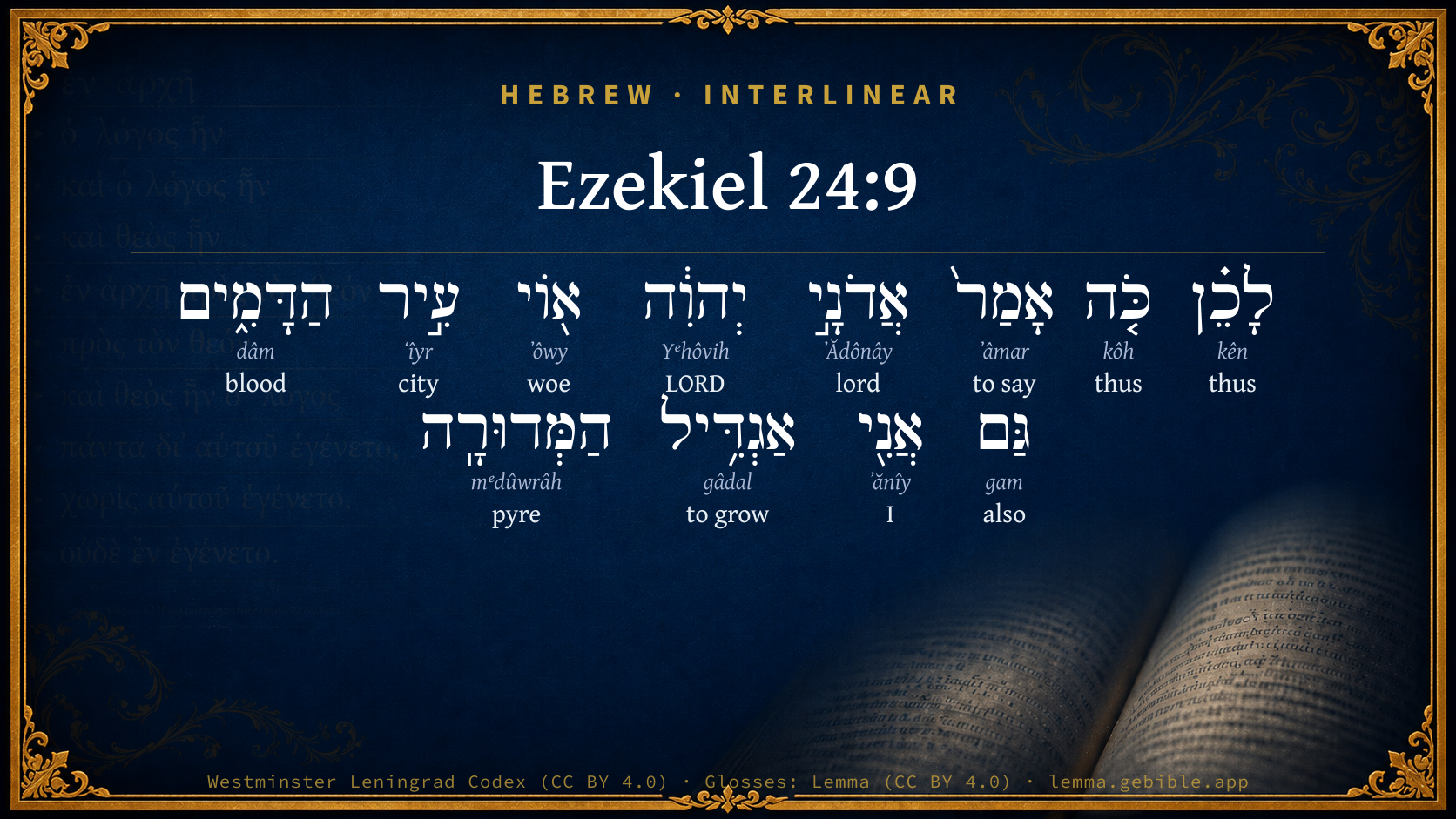
Ezekiel 24:9

Hebrew (Westminster Leningrad Codex) Ezekiel 24:9 appears in the Hebrew Old Testament. The text above is from the Westminster Leningrad Codex. Each word links to its Strong’s number, a concise gloss, and parsing drawn from the Open Scriptures Hebrew Bible morphology. Click any word for its full Brown-Driver-Briggs (BDB) entry.
Download image
Cite this verse

Ezekiel 24:9 (World English Bible). Public Domain. Lemma interlinear Bible study tool, https://lemma.gebible.app/v/ezekiel/24/9.

Show BibTeX & RIS
BibTeX
RIS
English Translation
Therefore thus says the Lord Yahweh: Woe to the bloody city! I also will make the pile great.
World English Bible · Public Domain
Download a study sheet

One document with this verse’s original text, its word-by-word gloss line, the meaning frame, cross-references with their text, attributed commentary, and full source and license credits — printable, and it pastes into notes with its structure intact.

This verse Autodidact and up

Study sheet (.html) Plain text (.txt)

A passage Seminary Student

Up to 50 verses in one chapter. A passage sheet keeps up to 6 commentary sources and 12 cross-references per verse, in the order this page ranks them, and says so on the sheet whenever that leaves anything out. Ask for a single verse and you get the Autodidact verse sheet above.

Everything on this page stays free to read, with no account — the sheet is a download of what is already on screen, not access to it.

Want to remove ads? Support Godless Engineer
Compare translations 3

The same verse in 3 English versions, stacked beneath the original-language interlinear above. Click any original word for its lexicon entry.

Each is an independent rendering of the whole verse — the interlinear is not word-aligned to these translations.

Highlighted words mark where these versions differ — a whole-verse word diff, not a word-by-word alignment.

  • World English Bible Public Domain
    Therefore thus says the Lord Yahweh: Woe to the bloody city! I also will make the pile great.
  • King James Version Public Domain
    Therefore thus saith the Lord GOD; Woe to the bloody city! I will even make the pile for fire great.
  • unfoldingWord Literal Text CC BY-SA 4.0
    Therefore, the Lord Yahweh says this: Woe to the city of blood. I will also enlarge the pile of wood.

unfoldingWord Literal Text — © unfoldingWord, licensed CC BY-SA 4.0. Word-aligned USFM3 via Door43 (git.door43.org/unfoldingWord/en_ult).

Versions to compare (up to 4)

3 of 4 selected

Show all 18 translations

Every available English version of this verse, each an independent rendering of the whole verse.

  • World English Bible Public Domain
    Therefore thus says the Lord Yahweh: Woe to the bloody city! I also will make the pile great.
  • Berean Standard Bible Public Domain
    Yes, this is what the Lord GOD says: ‘Woe to the city of bloodshed! I, too, will pile the kindling high.
  • Majority Standard Bible Public Domain
    Yes, this is what the Lord GOD says: ‘Woe to the city of bloodshed! I, too, will pile the kindling high.
  • King James Version Public Domain
    Therefore thus saith the Lord GOD; Woe to the bloody city! I will even make the pile for fire great.
  • American Standard Version (1901) Public Domain
    Therefore thus saith the Lord Jehovah: Woe to the bloody city! I also will make the pile great.
  • Revised Version (1885) Public Domain
    Therefore thus saith the Lord GOD: Woe to the bloody city! I also will make the pile great.
  • Geneva Bible (1599) Public Domain
    Therefore thus saith ye Lord God, Woe to the bloody citie, for I will make ye burning great.
  • Douay-Rheims (1899) Public Domain
    Therefore thus saith the Lord God: Woe to the bloody city, of which I will make a great bonfire.
  • Young's Literal Translation Public Domain
    Therefore, thus said the Lord Jehovah: Wo `to' the city of blood, yea, I -- I make great the pile.
  • Literal Standard Version CC BY-SA 4.0
    Therefore, thus said Lord YHWH: Woe [to] the city of blood, indeed, I make the pile great.
  • Unlocked Literal Bible CC BY-SA 4.0
    Therefore, the Lord Yahweh says this: Woe to the city of blood. I will also enlarge the pile of wood.
  • unfoldingWord Literal Text CC BY-SA 4.0
    Therefore, the Lord Yahweh says this: Woe to the city of blood. I will also enlarge the pile of wood.
  • Darby Bible Public Domain
    Therefore thus saith the Lord Jehovah: Woe to the bloody city! I also will make the pile great.
  • World Messianic Bible Public Domain
    “‘Therefore the Lord GOD says: “Woe to the bloody city! I also will make the pile great.
  • Webster's Bible Public Domain
    Therefore thus saith the Lord GOD; Woe to the bloody city! I will even make the pile for fire great.
  • Free Bible Version CC BY-SA 4.0
    So this is what the Lord God says: Disaster is coming to the city that has shed so much blood! I will also pile up a large heap of firewood.
  • Bible in Basic English Public Domain
    For this cause the Lord has said: A curse is on the town of blood! and I will make great the burning mass.
  • JPS Tanakh (1917) Public Domain
    Therefore thus saith the Lord GOD: Woe to the bloody city! I also will make the pile great,

Literal Standard Version (2020), Covenant Press — licensed CC BY-SA 4.0. Text via the HelloAO Bible API (eBible.org). Unlocked Literal Bible (unfoldingWord) — licensed CC BY-SA 4.0. Text via the HelloAO Bible API (eBible.org). unfoldingWord Literal Text — © unfoldingWord, licensed CC BY-SA 4.0. Word-aligned USFM3 via Door43 (git.door43.org/unfoldingWord/en_ult). Free Bible Version, Dr. Jonathan Gallagher — licensed CC BY-SA 4.0. Text via the HelloAO Bible API (eBible.org).

Word by word

More ways to search: Search by grammar → Find every occurrence → Compare this word →

Practice this passage: Drill this verse → Learn its vocabulary →

הַמְּדוּרָֽה
mᵉdûwrâh
H4071
“the · pyre”
Particle, Definite Article + Noun, Common, Feminine, Singular, Absolute
Part of Speech
Particle + Noun
Type
Common
Gender
Feminine
Number
Singular
State
Absolute
Full BDB Definition

Origin: from H1752 in the sense of accumulation

TWOT: 418c

pile (of fuel), pyre, pile (of wood)
  1. לָכֵ֗ן kên H3651 “to/for · thus” Preposition + Adverb
  2. כֹּ֤ה kôh H3541 “thus” Adverb
  3. אָמַר֙ ʼâmar H559 “to say” Verb, Qal, Perfect, 3rd Person, Masculine, Singular
  4. אֲדֹנָ֣י ʼĂdônây H136 “Lord · my” Noun, Common, Masculine, Plural, Construct + Suffix, Personal, 1st Person, Common, Singular
  5. יְהוִ֔ה Yᵉhôvih H3069 “LORD” Noun, Proper
  6. א֖וֹי ʼôwy H188 “woe” Particle, Interjection
  7. עִ֣יר ʻîyr H5892 “city of” Noun, Common, Feminine, Singular, Construct
  8. הַדָּמִ֑ים dâm H1818 “the · blood” Particle, Definite Article + Noun, Common, Masculine, Plural, Absolute
  9. גַּם gam H1571 “also” Particle, Accusative
  10. אֲנִ֖י ʼănîy H589 “I” Pronoun, Personal, 1st Person, Common, Singular
  11. אַגְדִּ֥יל gâdal H1431 “to grow” Verb, Hiphil, Imperfect, 1st Person, Common, Singular

About this verse

These counts appear in no published source. They are computed here, from the morphology-tagged text and Lemma’s own curated glosses. What Lemma adds →

12
words
12
distinct lemmas
Prophets
section

Notable vocabulary

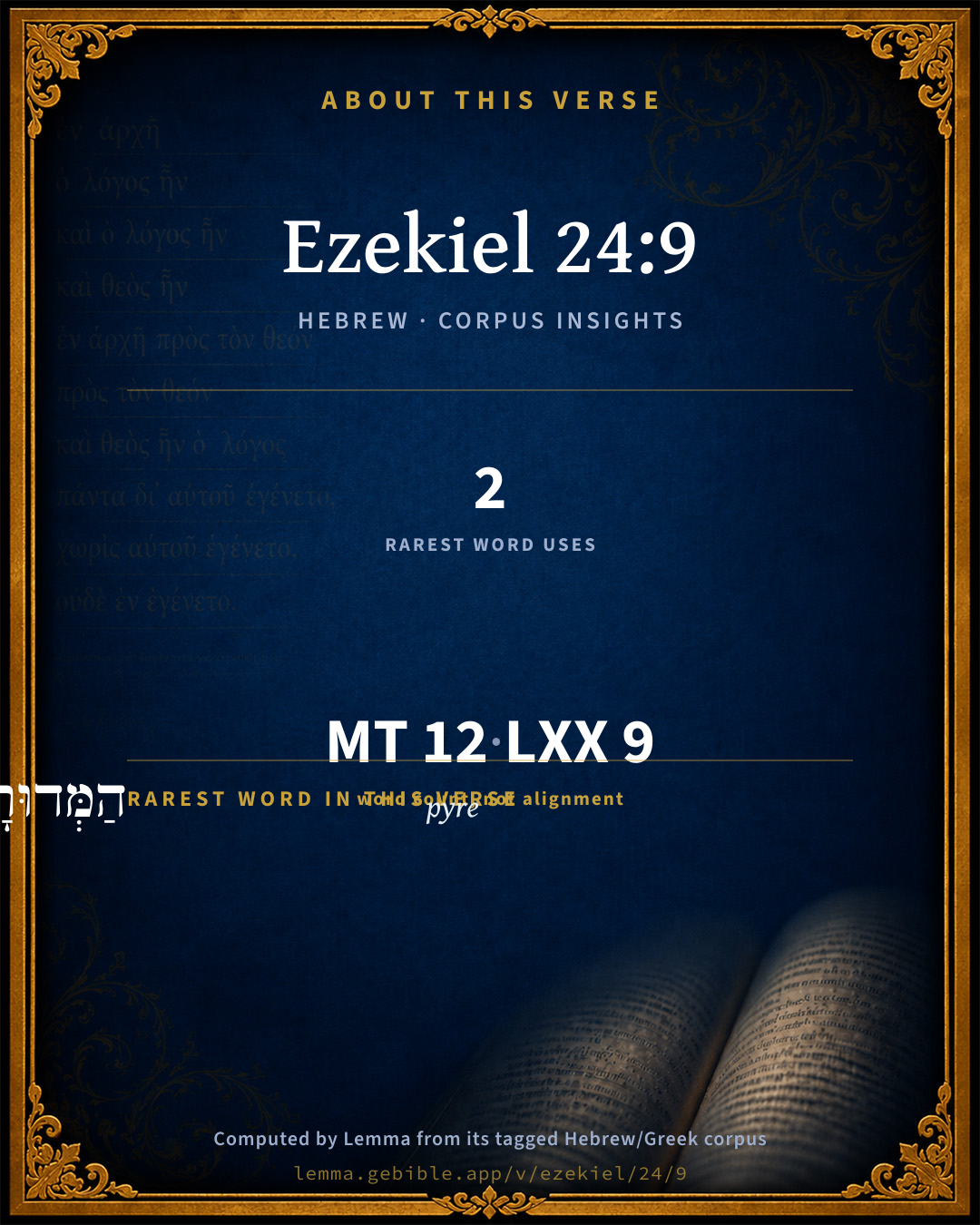
The rarest word here is הַמְּדוּרָֽה pyre H4071 — appearing just 2 times in the whole Hebrew Bible.

Shared distinctive vocabulary

הַמְּדוּרָֽה pyre H4071 occurs in 2 verses of the Hebrew Bible. Also found in:

Grammatical profile

  • 2 verbs
  • 5 nouns
  • 1 pronoun
  • 2 adverbs
  • 2 particles

Verb forms

  • אָמַר֙ Qal · Perfect
  • אַגְדִּ֥יל Hiphil · Imperfect

Hebrew & Septuagint length

In English translation the verse runs 18 words from the Hebrew and 12 from the Septuagint (LXX English) — the Septuagint runs noticeably shorter here. See the side-by-side →

A rough comparison of the two English renderings, which tokenize alike — not a word-level alignment.

Word counts can differ between the Hebrew and the Greek without any difference in meaning — e.g. the Hebrew direct-object marker אֵת has no separate Greek word, and Greek often adds the article ὁ.

In the original languages it is 12 Hebrew tokens and 9 Greek tokens — but the two are counted differently (Hebrew bundles its prefixes and suffixes into one token; the Greek is in lemma form), so that isn’t a like-for-like length.

Cross-references

15

Topical passages linked to Ezekiel 24:9 in the Treasury of Scripture Knowledge — connected by theme and wording, ordered by reader-vote popularity; previews shown in the World English Bible.

  • Ezekiel 24:6 Therefore thus says the Lord Yahweh: Woe to the bloody city, to the caldron whose rust is therein, and whose rust is not gone out of it! take out of it piece after piece; No lot is fallen on it.
  • Habakkuk 2:12 Woe to him who builds a town with blood, and establishes a city by iniquity!
  • Isaiah 30:33 For a Topheth is prepared of old; yes, for the king it is made ready; he has made it deep and large; the pile of it is fire and much wood; the breath of Yahweh, like a stream of sulfur, does kindle it.
  • Isaiah 31:9 His rock shall pass away by reason of terror, and his princes shall be dismayed at the ensign, says Yahweh, whose fire is in Zion, and his furnace in Jerusalem.
  • Ezekiel 22:19–22 Therefore thus says the Lord Yahweh: Because you are all become dross, therefore, behold, I will gather you into the midst of Jerusalem.
  • Ezekiel 22:31 Therefore have I poured out my indignation on them; I have consumed them with the fire of my wrath: their own way have I brought on their heads, says the Lord Yahweh.
  • Nahum 3:1 Woe to the bloody city! It is all full of lies and robbery. The prey doesn't depart.
  • Luke 13:34–35 "Jerusalem, Jerusalem, that kills the prophets, and stones those who are sent to her! How often I wanted to gather your children together, like a hen gathers her own brood under her wings, and you refused!
  • 2 Thessalonians 1:8 giving vengeance to those who don't know God, and to those who don't obey the Gospel of our Lord Jesus,
  • 2 Peter 3:7–12 But the heavens that now are, and the earth, by the same word have been stored up for fire, being reserved against the day of judgment and destruction of ungodly men.
  • Jude 1:7 Even as Sodom and Gomorrah, and the cities around them, having, in the same way as these, given themselves over to sexual immorality and gone after strange flesh, are set forth as an example, suffering the punishment of eternal fire.
  • Revelation 14:20 The winepress was trodden outside of the city, and blood came out from the winepress, even to the bridles of the horses, as far as one thousand six hundred stadia.
  • Revelation 16:6 For they poured out the blood of the saints and the prophets, and you have given them blood to drink. They deserve this."
  • Revelation 16:19 The great city was divided into three parts, and the cities of the nations fell. Babylon the great was remembered in the sight of God, to give to her the cup of the wine of the fierceness of his wrath.
  • Revelation 21:8 But for the cowardly, unbelieving, sinners, abominable, murderers, sexually immoral, sorcerers, idolaters, and all liars, their part is in the lake that burns with fire and sulfur, which is the second death."

Cross-references courtesy of OpenBible.info (CC BY 4.0).

Hebrew and Greek witnesses Masoretic Hebrew ↔ Greek Septuagint

The same verse in the two great witnesses to the Old Testament, shown verse-for-verse.

Here the Septuagint runs noticeably shorter than the Hebrew — LXX2012 (modern English Septuagint) 12 words vs World English Bible 18. A rough length comparison of the two English translations, not a word-level alignment — read both below.

These are two independent witnesses, not word-aligned to each other, and the Septuagint is shown in lemma (dictionary) form.

Hebrew Ezekiel 24:9 Masoretic · Westminster Leningrad Codex

לָכֵ֗ן כֹּ֤ה אָמַר֙ אֲדֹנָ֣י יְהוִ֔ה א֖וֹי עִ֣יר הַדָּמִ֑ים גַּם אֲנִ֖י אַגְדִּ֥יל הַמְּדוּרָֽה

Therefore thus says the Lord Yahweh: Woe to the bloody city! I also will make the pile great.

World English Bible · Public Domain

Greek LXX Ezekiel 24:9 Septuagint · lemma form

διά οὗτος ὅδε λέγω κύριος καΐἐγώ μεγαλύνω ὁ δαλός

Therefore thus says the Lord, I will also make the firebrand great,

LXX2012 (modern English Septuagint) · Public Domain

On this verse, The Cambridge Bible for Schools and Colleges discusses the Septuagint’s reading. Read the note in Commentary ↓

Hebrew: Westminster Leningrad Codex (CC BY 4.0). Greek: Septuagint (public domain); English from LXX2012 (modern English Septuagint) (Public Domain). How the Septuagint differs from the Hebrew →

Targum (Aramaic paraphrase)

1

The Targum is the ancient Jewish Aramaic paraphrase of the Hebrew Scriptures — an interpretive translation, not the Hebrew text itself. Onkelos (literal) and Pseudo-Jonathan (expansive) render the Torah, and Jonathan the Prophets. Coverage is partial: where no permissively-licensed English translation exists for a verse, only the Aramaic is shown. This is verse-level text, not a word-by-word alignment to the Hebrew.

  1. Targum Jonathan Prophets (Joshua–Malachi)
    בְּכֵן כִדְנַן אֲמַר יְיָ אֱלֹהִים וַי עַל קַרְתָּא דְאֶשְׁדֵי דַם זַכַּאי בְּגַוָהּ אַף אֲנָא אַסְגֵי תְּבִירָהּ:

    (no public-domain English translation for this verse)

    Targum Jonathan — Aramaic: “Mikraot Gedolot” (public domain). English: “Sefaria Community Translation” (CC0 1.0 (public-domain dedication)); “London "Chaldee Paraphrase," 1871” (public domain). Text via Sefaria.

Commentary

Notes on Ezekiel 24:9 from classic Christian and Jewish commentators (each source and its license shown beneath its notes). The classic Christian expositions comment on the surrounding passage and are grouped to its opening verse, so a note may address several verses; the Jewish commentaries on the Tanakh (Rashi and others) are per-verse, so they appear only where the commentator wrote on this verse.

Lemma curates 59 commentaries, every one of them public domain or Creative Commons licensed, each selected and text-cleaned for this edition rather than reprinted as found. About our sources →

Trapp's Complete Commentary

John Trapp

Eze 24:9 Therefore thus saith the Lord GOD; Woe to the bloody city! I will even make the pile for fire great.

Ver. 9. Woe to the bloody city.] See Nah 3:1 Hab 2:12.

I will even make the pile for fire great.] They shall undergo a long and sore siege.

John Trapp, A Commentary or Exposition upon All the Books of the Old and New Testament (1647–1656) — public domain. Text from a community e-Sword module.

Joseph Benson's Commentary

Eze 24:9-11. Thus saith the Lord, &c. — In this and the two following verses is still more fully explained the meaning of the symbol of the boiling pot, and what the fire is that made it boil. By making the pile for the fire great, is signified the destruction being very great and general. And spice it well — Or, season it well, so as to make it desirable. The expression imports, that the Babylonians should be as much set on destroying the city and inhabitants, as hungry people are greedy of devouring meat well spiced and dressed. This was a very proper expression, considering that Jerusalem, in the foregoing part of this chapter, is represented as a boiling pot, and the inhabitants of it as pieces of flesh boiled in it. All the other expressions of this verse signify an entire destruction. Then set it empty upon the coals thereof, &c. — This expresses, that after a riddance was made of the inhabitants, either by slaughtering them with the sword, or carrying them away into captivity, the city itself, represented by the pot, should be burned with fire, that its impurity might be consumed, or purged away by the flames; that is to say, that their wickedness might be taken away with their persons and city; or that the remains of the inhabitants, who were made captives, should be reformed by this terrible destruction of Jerusalem. If we understand it as spoken of the place of the city, the expression may allude to what was commanded in the ceremonial law, namely, that metal vessels, which water could not cleanse, should be purified by fire. Thus nothing short of burning Jerusalem down to the ground could purge it from its abominations: afterward it should be rebuilt, and become a holy city, free from the idolatries which had formerly defiled it.

Joseph Benson's Commentary on the Old and New Testaments (1811–1818) — public domain. Text from a community e-Sword module.

Tyndale Open Study Notes

Tyndale Open Resources

24:9-12 God declared that he would now make the cooking pot , Jerusalem, as red hot as if it were in a refiner’s furnace. Even this fire would not purge its corruption, however, for Jerusalem’s impurity was indelible.

Tyndale Open Study Notes — © Tyndale Open Resources, licensed CC BY-SA 4.0. Text via the HelloAO Bible API.

Geneva Bible (1599)

Geneva Bible translators

Or, an heap of wood.

Geneva Bible (1599) marginal notes — public domain. Text via Bolls.life.

Jamieson, Fausset & Brown

Robert Jamieson, A. R. Fausset & David Brown

the pile for fire--the hostile materials for the city's destruction.

Jamieson, Fausset & Brown — Commentary Critical and Explanatory on the Whole Bible (1871) — public domain (CC PDM 1.0). Text via the HelloAO Bible API.

The Cambridge Bible for Schools and Colleges

gen. ed. J. J. S. Perowne

9. I will even] I too will make. LXX. wants the clause “woe … city,” cf. Eze_24:6.

9–14. Rising anew into tones of threatening the divine voice commands fuel to be heaped under the caldron, and to set it empty upon the coals, that its brass may glow in the fire and its rust be consumed.

The Cambridge Bible for Schools and Colleges (gen. ed. J. J. S. Perowne; Cambridge University Press, 1878–1918) — public domain. Text from a community e-Sword module.

John Gill's Exposition

Therefore thus saith the Lord God, woe to the bloody city,.... See Gill on Eze 24:6,

I will even make the pile for fire great; a large pile of wood, a great quantity of fuel to maintain the fire, and keep the pot boiling; meaning the vast army of the Chaldeans, which the Lord would bring against Jerusalem, which should closely besiege it, and vigorously attack it, until it had executed the fury of the wrath of God, comparable to fire, and of his judgments upon it. The Targum is,

"even I will multiply her destruction.''

John Gill's Exposition of the Whole Bible (1746–1763) — public domain (CC PDM 1.0). Text via the HelloAO Bible API.

Matthew Poole's English Annotations

Woe to the bloody city! see Eze 24:6.

I will even make the pile for fire great; God’s hand shall be seen inflicting all those sore afflictions on them. Judgments are a fire, the fuel whereof is to be great; for it is a fire to consume the wicked, and God will make it sufficiently great to do this. I will bring the mighty army of the Chaldeans, which, as a pile of wood set on fire, shall burn them up.

Matthew Poole's English Annotations on the Holy Bible (1683–1685) — public domain. Text from a community e-Sword/MySword module.

Whedon's Commentary on the Bible

Daniel D. Whedon

9. Woe to the bloody city — See also Eze_24:6; Eze_22:3; Eze_23:3. Jerusalem “the holy” now deserves the same name as Nineveh! (Nab. Eze_3:1.)

Daniel D. Whedon (gen. ed.), Commentary on the Old and New Testaments (1874–1909) — public domain. Text from a community e-Sword module.

The Pulpit Commentary

We return to the image of the cauldron, and once again, as in Ver. 6 and Eze_22:3 and Eze_23:37, we have the words which Nahum (Nah_3:1) had used of Nineveh applied to Jerusalem.

The Pulpit Commentary (1880–1919), ed. H.D.M. Spence-Jones & Joseph S. Exell — public domain. Text from a community e-Sword module.

unfoldingWord translationNotes

Door43 World Missions Community

General Information:

Yahweh continues telling a parable to Ezekiel about a cooking pot that represents Jerusalem. This parable continues through Ezekiel 24:14. (See: Parables)

the city of blood

Here "blood" is a reference to "murder." AT: "the city of murderers" (See: Metonymy)

I will also enlarge the pile of wood

It is implied that the pile of wood is under the cooking pot that represents Jerusalem. "I will make the pile of wood on the fire under you even bigger" (See: Assumed Knowledge and Implicit Information)

kindle the fire

"light the fire"

let the bones be charred

This can be stated in active form. AT: "burn the bones" (See: Active or Passive)

translationWords

Lord Yahweh

unfoldingWord translationNotes — © Distant Shores Media and the Door43 World Missions Community, licensed CC BY-SA 4.0. Source: git.door43.org/Door43/en_tn.

Rashi

Rabbi Shlomo Yitzchaki (Rashi)

the fire [Heb. הַמְדוּרָה,] a great kindling, foaie in Old French, a pyre.

Rashi on the Tanakh — English translations: “The Judaica Press complete Tanach with Rashi, translated by A. J. Rosenberg” (CC BY 4.0); “Pentateuch with Rashi's commentary by M. Rosenbaum and A.M. Silbermann, 1929-1934” (public domain); “The Metsudah Tanach series, Lakewood, N.J” (CC BY 4.0); and “The Book of Joshua, Metsudah Publications, 1997” (CC BY 4.0). Text via Sefaria.

Lesson kit

Teaching starters — assembled from the data on this page, not authored interpretation. Every prompt links to the verse data it draws on. Edit before teaching.

Ezekiel, in the Prophets, opens this verse with 12 words (12 distinct Hebrew lemmas). Its most distinctive word is mᵉdûwrâh (“pyre”). The Greek Septuagint runs shorter here. A historical commentator’s framing appears above. Read the whole chapter for the surrounding context.

Discussion questions

  1. The word mᵉdûwrâh carries the sense “pyre.” How does it shape the verse?
  2. Isaiah 30:33 shares the word «pyre» with this verse. How do the two illuminate each other?
  3. Compared with the Hebrew, the Septuagint runs shorter here. What questions does that raise?
  4. These translations render this verse differently; the difference is in the English rendering, not the original. What questions does that raise?
  5. The verb «אָמַר֙» is Qal Perfect. How does its form color the action?
  6. Reading how Trapp's Complete Commentary and Joseph Benson's Commentary read this verse, where do the two commentators agree and where do they part?

Things to notice

Reading settings

Reading text

Shown beneath each verse's original-language words.

Old Testament
Old Testament edition

Read the OT as the Masoretic Hebrew (MT) or the Greek Septuagint (LXX).

English shown for the Greek Septuagint (in the Hebrew ↔ Greek comparison).

Comparing translations? Open the Compare panel on any verse page to stack up to four side by side.