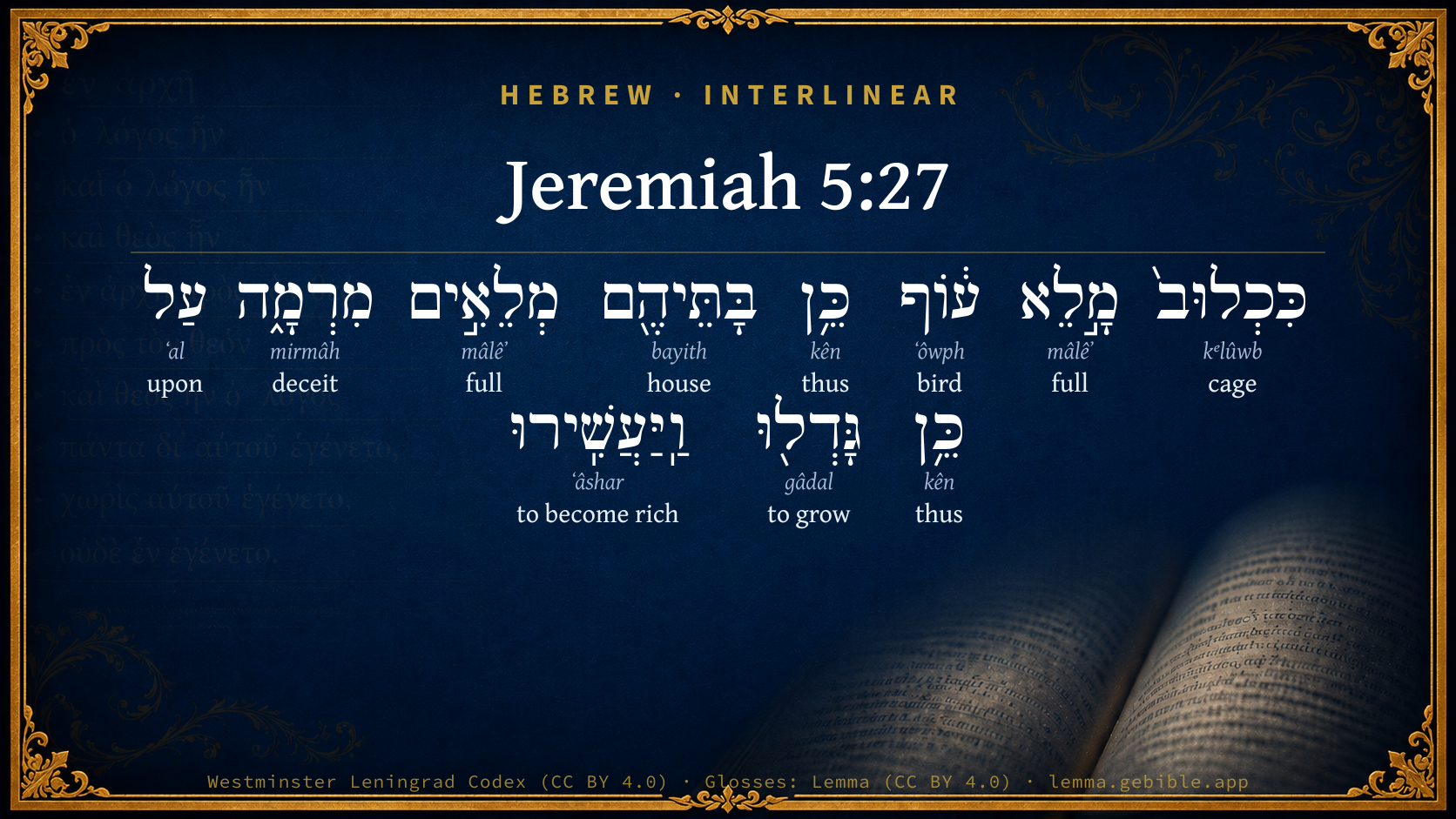
Jeremiah 5:27

Hebrew (Westminster Leningrad Codex) Jeremiah 5:27 appears in the Hebrew Old Testament. The text above is from the Westminster Leningrad Codex. Each word links to its Strong’s number, a concise gloss, and parsing drawn from the Open Scriptures Hebrew Bible morphology. Click any word for its full Brown-Driver-Briggs (BDB) entry.
Download image
Cite this verse

Jeremiah 5:27 (World English Bible). Public Domain. Lemma interlinear Bible study tool, https://lemma.gebible.app/v/jeremiah/5/27.

Show BibTeX & RIS
BibTeX
RIS
English Translation
As a cage is full of birds, so are their houses full of deceit: therefore they are become great, and grew rich.
World English Bible · Public Domain
Highlights
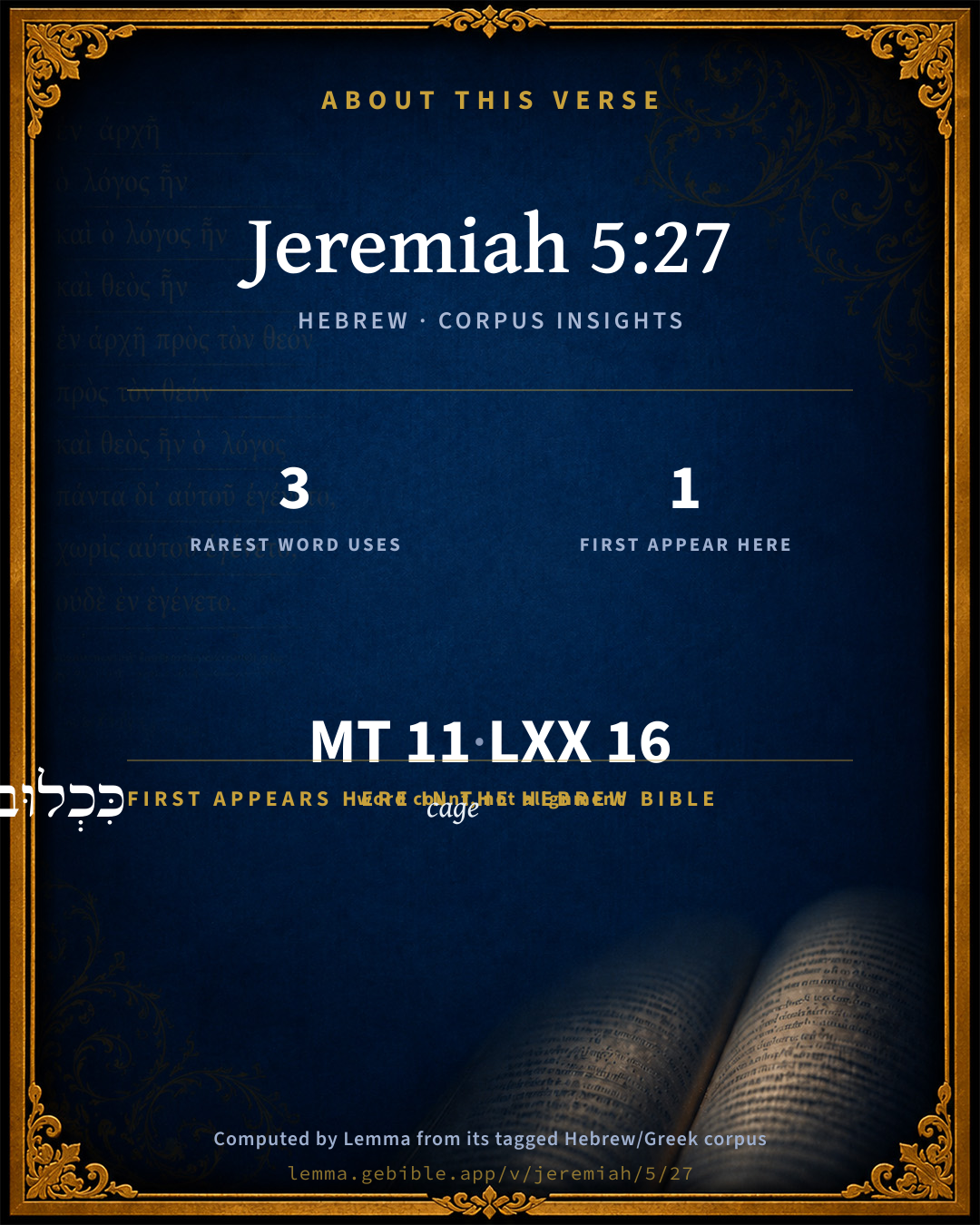
  • 1 first appearance in the Hebrew Bible
Full analysis ↓
Download a study sheet

One document with this verse’s original text, its word-by-word gloss line, the meaning frame, cross-references with their text, attributed commentary, and full source and license credits — printable, and it pastes into notes with its structure intact.

This verse Autodidact and up

Study sheet (.html) Plain text (.txt)

A passage Seminary Student

Up to 50 verses in one chapter. A passage sheet keeps up to 6 commentary sources and 12 cross-references per verse, in the order this page ranks them, and says so on the sheet whenever that leaves anything out. Ask for a single verse and you get the Autodidact verse sheet above.

Everything on this page stays free to read, with no account — the sheet is a download of what is already on screen, not access to it.

Want to remove ads? Support Godless Engineer
Compare translations 3

The same verse in 3 English versions, stacked beneath the original-language interlinear above. Click any original word for its lexicon entry.

Each is an independent rendering of the whole verse — the interlinear is not word-aligned to these translations.

Highlighted words mark where these versions differ — a whole-verse word diff, not a word-by-word alignment.

  • World English Bible Public Domain
    As a cage is full of birds, so are their houses full of deceit: therefore they are become great, and grew rich.
  • King James Version Public Domain
    As a cage is full of birds, so are their houses full of deceit: therefore they are become great, and waxen rich.
  • unfoldingWord Literal Text CC BY-SA 4.0
    Like a cage full of birds, thus their houses full of deceit, thus they grow large and become rich.

unfoldingWord Literal Text — © unfoldingWord, licensed CC BY-SA 4.0. Word-aligned USFM3 via Door43 (git.door43.org/unfoldingWord/en_ult).

Versions to compare (up to 4)

3 of 4 selected

Show all 18 translations

Every available English version of this verse, each an independent rendering of the whole verse.

  • World English Bible Public Domain
    As a cage is full of birds, so are their houses full of deceit: therefore they are become great, and grew rich.
  • Berean Standard Bible Public Domain
    Like cages full of birds, so their houses are full of deceit. Therefore they have become powerful and rich.
  • Majority Standard Bible Public Domain
    Like cages full of birds, so their houses are full of deceit. Therefore they have become powerful and rich.
  • King James Version Public Domain
    As a cage is full of birds, so are their houses full of deceit: therefore they are become great, and waxen rich.
  • American Standard Version (1901) Public Domain
    As a cage is full of birds, so are their houses full of deceit: therefore they are become great, and waxed rich.
  • Revised Version (1885) Public Domain
    As a cage is full of birds, so are their houses full of deceit: therefore they are become great, and waxen rich.
  • Geneva Bible (1599) Public Domain
    As a cage is full of birdes, so are their houses full of deceite: thereby they are become great and waxen riche.
  • Douay-Rheims (1899) Public Domain
    As a net is full of birds, so their houses are full of deceit: therefore are they become great and enriched.
  • Young's Literal Translation Public Domain
    As a cage full of fowls, So their houses are full of deceit, Therefore they have been great, and are rich.
  • Literal Standard Version CC BY-SA 4.0
    As a cage full of birds, || So their houses are full of deceit, || Therefore they have been great, and are rich.
  • Unlocked Literal Bible CC BY-SA 4.0
    Like a cage full of birds, their houses are full of deceit. So they grow large and become rich.
  • unfoldingWord Literal Text CC BY-SA 4.0
    Like a cage full of birds, thus their houses full of deceit, thus they grow large and become rich.
  • Darby Bible Public Domain
    As a cage full of birds, so are their houses full of deceit: therefore they are become great, and have enriched themselves.
  • World Messianic Bible Public Domain
    As a cage is full of birds, so are their houses full of deceit. Therefore they have become great, and grew rich.
  • Webster's Bible Public Domain
    As a cage is full of birds, so are their houses full of deceit: therefore they have become great, and have grown rich.
  • Free Bible Version CC BY-SA 4.0
    Their homes are full of their ill-gotten gains, like cages full of birds. That's why they've become powerful and rich.
  • Bible in Basic English Public Domain
    As the fowl-house is full of birds, so are their houses full of deceit: for this reason they have become great and have got wealth.
  • JPS Tanakh (1917) Public Domain
    As a cage is full of birds, so are their houses full of deceit; therefore they are become great, and waxen rich;

Literal Standard Version (2020), Covenant Press — licensed CC BY-SA 4.0. Text via the HelloAO Bible API (eBible.org). Unlocked Literal Bible (unfoldingWord) — licensed CC BY-SA 4.0. Text via the HelloAO Bible API (eBible.org). unfoldingWord Literal Text — © unfoldingWord, licensed CC BY-SA 4.0. Word-aligned USFM3 via Door43 (git.door43.org/unfoldingWord/en_ult). Free Bible Version, Dr. Jonathan Gallagher — licensed CC BY-SA 4.0. Text via the HelloAO Bible API (eBible.org).

Word by word

More ways to search: Search by grammar → Find every occurrence → Compare this word →

Practice this passage: Drill this verse → Learn its vocabulary →

כִּכְלוּב֙
kᵉlûwb
H3619
“like/as · cage”
Preposition + Noun, Common, Masculine, Singular, Absolute
Part of Speech
Preposition + Noun
Type
Common
Gender
Masculine
Number
Singular
State
Absolute
Full BDB Definition

Origin: from the same as H3611

TWOT: 981b

cage, basket, dog cage
  1. מָ֣לֵא mâlêʼ H4392 “full” Adjective, Adjective, Masculine, Singular, Absolute
  2. ע֔וֹף ʻôwph H5775 “bird” Noun, Common, Masculine, Singular, Absolute
  3. כֵּ֥ן kên H3651 “thus” Particle, Demonstrative
  4. בָּתֵּיהֶ֖ם bayith H1004 “houses · their” Noun, Common, Masculine, Plural, Construct + Suffix, Personal, 3rd Person, Masculine, Plural
  5. מְלֵאִ֣ים mâlêʼ H4392 “full” Adjective, Adjective, Masculine, Plural, Absolute
  6. מִרְמָ֑ה mirmâh H4820 “deceit” Noun, Common, Feminine, Singular, Absolute
  7. עַל ʻal H5921 “upon” Preposition
  8. כֵּ֥ן kên H3651 “thus” Particle, Demonstrative
  9. גָּדְל֖וּ gâdal H1431 “to grow” Verb, Qal, Perfect, 3rd Person, Common, Plural
  10. וַֽיַּעֲשִֽׁירוּ ʻâshar H6238 “and · to become rich” Conjunction + Verb, Hiphil, Sequential Imperfect, 3rd Person, Masculine, Plural

About this verse

These counts appear in no published source. They are computed here, from the morphology-tagged text and Lemma’s own curated glosses. What Lemma adds →

11
words
9
distinct lemmas
Prophets
section

Notable vocabulary

The rarest word here is כִּכְלוּב֙ cage H3619 — appearing just 3 times in the whole Hebrew Bible.

First appearance in Scripture

This word makes its first canonical appearance in the Hebrew Bible here:

  • כִּכְלוּב֙ cage H3619

Shared distinctive vocabulary

כִּכְלוּב֙ cage H3619 occurs in 3 verses of the Hebrew Bible. Also found in:

Grammatical profile

  • 2 verbs
  • 4 nouns
  • 2 adjectives
  • 1 preposition
  • 2 particles

Verb forms

  • גָּדְל֖וּ Qal · Perfect
  • וַֽיַּעֲשִֽׁירוּ Hiphil · Sequential Imperfect

Repetition

Words recur within this verse — often emphatic in Hebrew:

  • מָ֣לֵא full H4392 ×2
  • כֵּ֥ן thus H3651 ×2

Hebrew & Septuagint length

In the original languages it is 11 Hebrew tokens and 16 Greek tokens — but the two are counted differently (Hebrew bundles its prefixes and suffixes into one token; the Greek is in lemma form), so that isn’t a like-for-like length.

Cross-references

8

Topical passages linked to Jeremiah 5:27 in the Treasury of Scripture Knowledge — connected by theme and wording, ordered by reader-vote popularity; previews shown in the World English Bible.

  • Proverbs 1:11–13 If they say, "Come with us, Let's lay in wait for blood; Let's lurk secretly for the innocent without cause;
  • Jeremiah 9:6 Your habitation is in the midst of deceit; through deceit they refuse to know me, says Yahweh.
  • Hosea 12:7–8 A merchant has dishonest scales in his hand. He loves to defraud.
  • Amos 8:4–6 Hear this, you who desire to swallow up the needy, And cause the poor of the land to fail,
  • Micah 1:12 For the inhabitant of Maroth waits anxiously for good, Because evil has come down from Yahweh to the gate of Jerusalem.
  • Habakkuk 2:9–11 Woe to him who gets an evil gain for his house, that he may set his nest on high, that he may be delivered from the hand of evil!
  • Revelation 18:2 He cried with a mighty voice, saying, "Fallen, fallen is Babylon the great, and she has become a habitation of demons, a prison of every unclean spirit, and a prison of every unclean and hateful bird!
  • Micah 6:10–11 Are there yet treasures of wickedness in the house of the wicked, And a short ephah that is accursed?

Cross-references courtesy of OpenBible.info (CC BY 4.0).

Hebrew and Greek witnesses Masoretic Hebrew ↔ Greek Septuagint

The same verse in the two great witnesses to the Old Testament, shown verse-for-verse.

These are two independent witnesses, not word-aligned to each other, and the Septuagint is shown in lemma (dictionary) form.

Hebrew Jeremiah 5:27 Masoretic · Westminster Leningrad Codex

כִּכְלוּב֙ מָ֣לֵא ע֔וֹף כֵּ֥ן בָּתֵּיהֶ֖ם מְלֵאִ֣ים מִרְמָ֑ה עַל כֵּ֥ן גָּדְל֖וּ וַֽיַּעֲשִֽׁירוּ

As a cage is full of birds, so are their houses full of deceit: therefore they are become great, and grew rich.

World English Bible · Public Domain

Greek LXX Structure differs

In the Septuagint, Jeremiah is about an eighth shorter than the Hebrew and arranges its material differently — the Oracles Against the Nations (Hebrew chapters 46–51) appear in the middle of the Greek book, after 25:13. Because the chapter and verse boundaries do not line up, a verse-for-verse comparison with the Hebrew is not shown.

A verse-for-verse comparison isn’t shown here because the chapters and verses don’t line up. Switch to the LXX edition with the MT / LXX toggle above to read the Greek directly.

On this verse, The Cambridge Bible for Schools and Colleges discusses the Septuagint’s reading. Read the note in Commentary ↓

Hebrew: Westminster Leningrad Codex (CC BY 4.0). Greek: Septuagint (public domain); English from a public-domain English Septuagint. How the Septuagint differs from the Hebrew →

Targum (Aramaic paraphrase)

1

The Targum is the ancient Jewish Aramaic paraphrase of the Hebrew Scriptures — an interpretive translation, not the Hebrew text itself. Onkelos (literal) and Pseudo-Jonathan (expansive) render the Torah, and Jonathan the Prophets. Coverage is partial: where no permissively-licensed English translation exists for a verse, only the Aramaic is shown. This is verse-level text, not a word-by-word alignment to the Hebrew.

  1. Targum Jonathan Prophets (Joshua–Malachi)
    כְּבֵית פִּטְמָא דִמְלֵי עוֹפָא כֵּן בָּתֵּיהוֹן מְלַן נִכְלִין עַל כֵּן סַגִיאוּ וַעֲתִירוּ:

    (no public-domain English translation for this verse)

    Targum Jonathan — Aramaic: “Mikraot Gedolot” (public domain). English: “Sefaria Community Translation” (CC0 1.0 (public-domain dedication)); “London "Chaldee Paraphrase," 1871” (public domain). Text via Sefaria.

Commentary

Notes on Jeremiah 5:27 from classic Christian and Jewish commentators (each source and its license shown beneath its notes). The classic Christian expositions comment on the surrounding passage and are grouped to its opening verse, so a note may address several verses; the Jewish commentaries on the Tanakh (Rashi and others) are per-verse, so they appear only where the commentator wrote on this verse.

Lemma curates 59 commentaries, every one of them public domain or Creative Commons licensed, each selected and text-cleaned for this edition rather than reprinted as found. About our sources →

Trapp's Complete Commentary

John Trapp

Jer 5:27 As a cage is full of birds, so [are] their houses full of deceit: therefore they are become great, and waxen rich.

Ver. 27. As a cage is full of birds, so are their houses full of deceit,] i.e., Of ill-gotten goods, which will prove no such catch in the close, as they count upon.

John Trapp, A Commentary or Exposition upon All the Books of the Old and New Testament (1647–1656) — public domain. Text from a community e-Sword module.

Jamieson, Fausset & Brown

Robert Jamieson, A. R. Fausset & David Brown

full of deceit--full of treasures got by deceit.

rich-- (Psa 73:12, Psa 73:18-20).

Jamieson, Fausset & Brown — Commentary Critical and Explanatory on the Whole Bible (1871) — public domain (CC PDM 1.0). Text via the HelloAO Bible API.

Adam Clarke's Commentary

Verse 27. As a cage is full of birds] There is no doubt that the reference here is to a decoy or trap-cage, as Dr. Blayney has rendered it; in these the fowlers put several tame birds, which when the wild ones see, they come and light on the cage, and fall into the snare.

Adam Clarke's Commentary on the Bible (1810–1826) — public domain. Text from a community e-Sword/MySword module.

John Calvin's Commentaries

Jeremiah goes on with the same subject. He made use, as we have said, of a similitude taken from fowling: he now applies this similitude to the Jews, — that their houses were full of fraud, as the cage (some render it basket ) is full of birds: for fowlers, when they go for game, carry with them either bags or cages or baskets. So then Jeremiah says, that they collected plunder on every side, so that their houses were full of frauds: but by fraud he means spoils, which they acquired by unjust means. It may at the first view seem an obscure language; but if we take the word מרמה, mereme, in a passive sense, there will be nothing ambiguous. The Prophet then does not use a language strictly correct when he says, that their houses were full of deceit or fraud; but they were full of spoils which they had acquired by deceit and fraud. Hence, what he means by fraud were the plunders by which they had become rich, as he afterwards explains.

We now perceive, that the meaning of the Prophet is, — that there was no longer a proof required, that the Jews circumvented the helpless and the poor, for their houses were filled with such spoils as made evident their wickedness: they had scraped together their riches by depriving the helpless and the poor of their substance. And hence he adds, By this have they increased and become rich It is probable that they gloried in their wealth, like thieves, whose trade is to plunder: for when they increased, they thought themselves raised above all danger. They were like courtiers, who by rapines and frauds and tyrannical violence, draw to themselves from all quarters the possessions of others, so that one got annually sixty thousands and another a hundred thousands; and then they became the more ferocious, because they thought that they could not be called to an account, being blinded by the splendor of their riches. But the Prophet here derides this besotted glorying, and says, “Behold, they are become great in the world, and they would have themselves to be on this account exalted;” increased have they, he says, and become rich; that is, “If any one will now search their houses, he will indeed find many things by which they make a display before the eyes of the simple; but they are nothing but rapines, plunders, frauds, spoils, thefts, and, in a word, robberies.” This is what he simply means. He afterwards adds —

John Calvin's Commentaries (1540-1563) — public domain. Text from the Calvin Translation Society English edition (1840s-50s) via the Christian Classics Ethereal Library (ccel.org). Calvin's coverage is partial (roughly two-thirds of the Bible); uncommented books and verses are honest gaps, never fabricated. The 19th-century editor's footnotes and remarks are omitted so the notes are faithfully Calvin's own voice.

Ellicott's Commentary for English Readers

(27) A cage.—The large wicker basket (Amo_8:1-2) in which the fowler kept the birds he had caught, or, possibly, used for decoy-birds.

A Bible Commentary for English Readers, edited by Charles John Ellicott (1878–1897) — public domain. Text from a community e-Sword module.

The Cambridge Bible for Schools and Colleges

gen. ed. J. J. S. Perowne

27. cage] The Hebrew word occurs elsewhere only in Amos (Jer_8:1), “a basket of summer fruit.” Here, however, Cheyne (Pulpit Comm., ad loc.), quoting Hitzig, thinks that “the cage was at the same time a trap.” He quotes Sir_11:30 (see note in C.B.), “As a decoy partridge in a cage,” where the Greek word used is that with which LXX render “baskets” in Jer_6:9.

deceit] riches won by craft, as birds by the fowler.

The Cambridge Bible for Schools and Colleges (gen. ed. J. J. S. Perowne; Cambridge University Press, 1878–1918) — public domain. Text from a community e-Sword module.

John Gill's Exposition

As a cage is full of birds,.... Jarchi and Kimchi understand it of a place in which fowls, are brought up and fattened, what we call a "pen"; and, so the Targum renders it, a house or place of fattening. The word is rendered a "basket" in Amo 8:1 and may here design one in which birds taken in snares, or by hawking, were put. The Septuagint version, and those that follow it, render it, "a snare": which agrees with what goes before. It seems to intend a decoy, in which many birds are put to allure others; and, what with them, and those that are drawn in by them, it becomes very full; and this sense of the comparison is favoured by the rendition or application, which follows:

so are their houses full of deceit; of mammon, gathered by deceit, as Kimchi interprets it; ungodly mammon; riches got in a fraudulent way, by cozening and cheating, tricking and overreaching:

therefore they are become great; in worldly things, and in the esteem of men, and in their own opinion, though of no account with God:

and waxen rich; not with the true riches, the riches of grace, the unsearchable riches of Christ, his durable riches and righteousness; nor indeed with the riches of the world, honestly and lawfully gotten; but with unrighteous mammon.

John Gill's Exposition of the Whole Bible (1746–1763) — public domain (CC PDM 1.0). Text via the HelloAO Bible API.

Matthew Poole's English Annotations

As a cage is full of birds, so are their houses full of deceit, i.e. they fill up their houses with the goods and wealth of those that they deceive and overreach; ill-gotten goods; a metonymy of the efficient; as the fowler carries his cage along with him, wherein he puts the birds which he catcheth, to keep safe that they get not away, when once they are caught, as also by their appearance and singing to entice others.

Therefore they are become great, and waxen rich; showing how and in what manner they got their riches, therefore, or by this means; such as are gotten by a lying tongue, Pro 21:6, called the treasures of wickedness, Mic 6:10.

Matthew Poole's English Annotations on the Holy Bible (1683–1685) — public domain. Text from a community e-Sword/MySword module.

The Pulpit Commentary

A cage. The Hebrew word klub is used in Amo_8:1 for a basket such as was used for fruit; it seems to be the parent of the Greek word klwbov , used in the "Anthology" for a bird-cage. The root means to plait or braid; hence some sort of basket-work seems to be meant. Connecting this with the preceding verse, Hitzig seems right in inferring that the "cage" was at the same time a trap (comp. Ecc 11:30, "Like as a partridge taken in a cage en kartallw , a peculiar kind of basket, so is the heart of the proud"). Canon Tristram suggests that there is an allusion to decoy-birds, which are still much employed in Syria, and are carefully trained for their office ("Natural History of the Bible," p. 163), But this seems to go beyond the text. Deceit; i.e. the goods obtained by deceit.

Vers. 27, 28. The devil"s lure.

"Their houses are full of deceit, therefore they are become great," etc.

I SEVERAL OF THESE LURES ARE NAMED HERE.

1. Wealth: "They are waxen rich.

2. Luxury: "They are waxen fat, they shine.

3. Impunity: "They overpass... they judge not... yet they prosper.

4. Success: "They prosper.

II AND THE LIKE LURES ARE HELD OUT STILL. Satan is ever seeking, and with sad success, in seduce men by such and similar snares.

III IT IS WHAT WE MIGHT EXPECT. For that Satan should in this manner tempt men is in keeping with his constant method of parodying and travestying all the good works of God. What virtue, what Christian grace, is there that he does not caricature-modesty by servility, prudence by meanness, generosity by careless waste, etc.? And so here, "The blessing of the Lord, it maketh rich," and hence Satan sets to work to devise a blessing of his which also shall make rich and this is his great lure.

IV AND THIS LURE IS MADE THE MORE ATTRACTIVE BY THE FACT THAT GOD OFTEN SUFFERS HIS SERVANTS TO FALL INTO GREAT DISTRESS. "Many are the afflictions of the righteous;" "In the world ye shall have tribulation." For God desires that we shall love him for himself, yea, when our earthly interests even plead against him. Such trial of on; faith is exceeding precious in his sight.

V OUR DUTY AND DEFENSE, THEREFORE, IS:

1. To look right on beyond the present reward, even to "the end.

2. To expose to others the treachery of these apparent rewards.

3. To pray for and cherish the spirit of Nehemiah, who said, "So did not I, because of the fear of God.

4. To yield our heart and soul up to the better attraction of Christ and his cross, until we come to say of him, "Thou art mine exceeding joy. C.

The Pulpit Commentary (1880–1919), ed. H.D.M. Spence-Jones & Joseph S. Exell — public domain. Text from a community e-Sword module.

John Wesley's Explanatory Notes

Their houses - They fill their houses with the goods of those they deceive, and over-reach.

John Wesley, Explanatory Notes Upon the Whole Bible (1754–1765) — public domain. Text via the GEBible commentary corpus.

Rashi

Rabbi Shlomo Yitzchaki (Rashi)

As a cage That is a place where they fatten fowl, and so does Jonathan render it, like a fattening place, and in O.F. (frank).

Rashi on the Tanakh — English translations: “The Judaica Press complete Tanach with Rashi, translated by A. J. Rosenberg” (CC BY 4.0); “Pentateuch with Rashi's commentary by M. Rosenbaum and A.M. Silbermann, 1929-1934” (public domain); “The Metsudah Tanach series, Lakewood, N.J” (CC BY 4.0); and “The Book of Joshua, Metsudah Publications, 1997” (CC BY 4.0). Text via Sefaria.

Lesson kit

Teaching starters — assembled from the data on this page, not authored interpretation. Every prompt links to the verse data it draws on. Edit before teaching.

Jeremiah, in the Prophets, opens this verse with 11 words (9 distinct Hebrew lemmas). Its most distinctive word is kᵉlûwb (“cage”). A historical commentator’s framing appears above. Read the whole chapter for the surrounding context.

Discussion questions

  1. How does “cage” (kᵉlûwb) shape what this verse is saying?
  2. This is the first place “cage” appears in Scripture (first appears here). What does its debut here establish?
  3. How does Amos 8:1, which shares the word «cage», read alongside this verse?
  4. What does the repetition of “full” (2× in this one verse) do in this verse?
  5. These translations render this verse differently. What is at stake in choosing one wording over another?
  6. «גָּדְל֖וּ» is a Qal Perfect verb. How does that grammatical form shape the action described?
  7. Compare how Trapp's Complete Commentary and Jamieson, Fausset & Brown read this verse. Where do they agree or differ?

Things to notice

Reading settings

Reading text

Shown beneath each verse's original-language words.

Old Testament
Old Testament edition

Read the OT as the Masoretic Hebrew (MT) or the Greek Septuagint (LXX).

English shown for the Greek Septuagint (in the Hebrew ↔ Greek comparison).

Comparing translations? Open the Compare panel on any verse page to stack up to four side by side.