
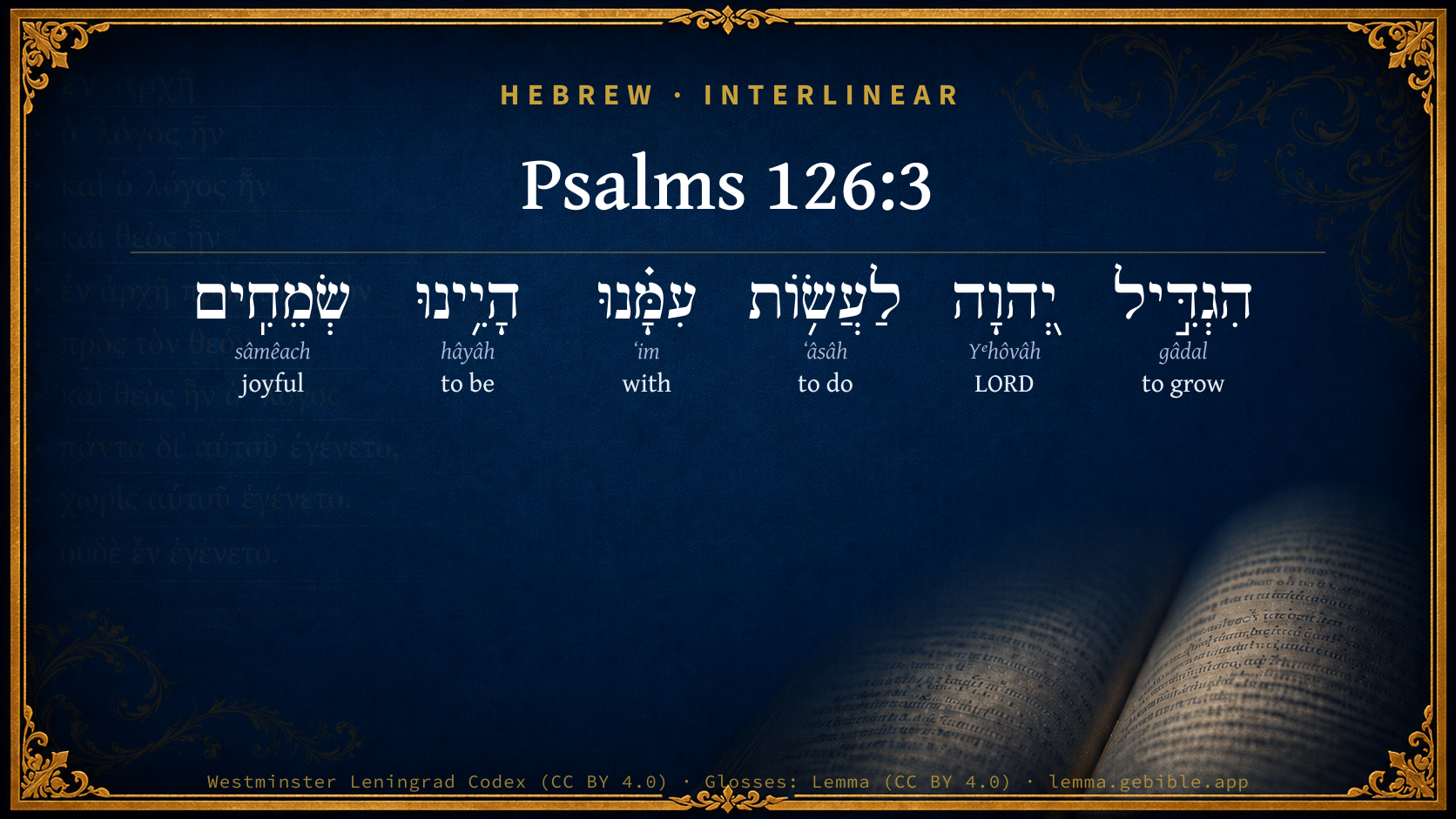
Psalms 126:3

Hebrew (Westminster Leningrad Codex) Psalms 126:3 appears in the Hebrew Old Testament. The text above is from the Westminster Leningrad Codex. Each word links to its Strong’s number, a concise gloss, and parsing drawn from the Open Scriptures Hebrew Bible morphology. Click any word for its full Brown-Driver-Briggs (BDB) entry.
Download image
Cite this verse

Psalms 126:3 (World English Bible). Public Domain. Lemma interlinear Bible study tool, https://lemma.gebible.app/v/psalms/126/3.

Show BibTeX & RIS
BibTeX
RIS
English Translation
Yahweh has done great things for us, And we are glad.
World English Bible · Public Domain
Download a study sheet

One document with this verse’s original text, its word-by-word gloss line, the meaning frame, cross-references with their text, attributed commentary, and full source and license credits — printable, and it pastes into notes with its structure intact.

This verse Autodidact and up

Study sheet (.html) Plain text (.txt)

A passage Seminary Student

Up to 50 verses in one chapter. A passage sheet keeps up to 6 commentary sources and 12 cross-references per verse, in the order this page ranks them, and says so on the sheet whenever that leaves anything out. Ask for a single verse and you get the Autodidact verse sheet above.

Everything on this page stays free to read, with no account — the sheet is a download of what is already on screen, not access to it.

Want to remove ads? Support Godless Engineer
Compare translations 3

The same verse in 3 English versions, stacked beneath the original-language interlinear above. Click any original word for its lexicon entry.

Each is an independent rendering of the whole verse — the interlinear is not word-aligned to these translations.

Highlighted words mark where these versions differ — a whole-verse word diff, not a word-by-word alignment.

  • World English Bible Public Domain
    Yahweh has done great things for us, And we are glad.
  • King James Version Public Domain
    The LORD hath done great things for us; whereof we are glad.
  • unfoldingWord Literal Text CC BY-SA 4.0
    Yahweh has made great to do with us; we are joyful.

unfoldingWord Literal Text — © unfoldingWord, licensed CC BY-SA 4.0. Word-aligned USFM3 via Door43 (git.door43.org/unfoldingWord/en_ult).

Versions to compare (up to 4)

3 of 4 selected

Show all 18 translations

Every available English version of this verse, each an independent rendering of the whole verse.

  • World English Bible Public Domain
    Yahweh has done great things for us, And we are glad.
  • Berean Standard Bible Public Domain
    The LORD has done great things for us; we are filled with joy.
  • Majority Standard Bible Public Domain
    The LORD has done great things for us; we are filled with joy.
  • King James Version Public Domain
    The LORD hath done great things for us; whereof we are glad.
  • American Standard Version (1901) Public Domain
    Jehovah hath done great things for us, `Whereof' we are glad.
  • Revised Version (1885) Public Domain
    The LORD hath done great things for us; whereof we are glad.
  • Geneva Bible (1599) Public Domain
    The Lord hath done great things for vs, whereof we reioyce.
  • Douay-Rheims (1899) Public Domain
    For the Lord will not leave the rod of sinners upon the lot of the just: that the just may not stretch forth their hands to iniquity.
  • Young's Literal Translation Public Domain
    Jehovah did great things with us, We have been joyful.
  • Literal Standard Version CC BY-SA 4.0
    YHWH did great things with us, || We have been joyful.
  • Unlocked Literal Bible CC BY-SA 4.0
    Yahweh did great things for us; how glad we were!
  • unfoldingWord Literal Text CC BY-SA 4.0
    Yahweh has made great to do with us; we are joyful.
  • Darby Bible Public Domain
    Jehovah hath done great things for us; [and] we are joyful.
  • World Messianic Bible Public Domain
    The LORD has done great things for us, and we are glad.
  • Webster's Bible Public Domain
    The LORD hath done great things for us; of which we are glad.
  • Free Bible Version CC BY-SA 4.0
    The Lord certainly has done wonderful things for us. How happy we were!
  • Bible in Basic English Public Domain
    The Lord has done great things for us; because of which we are glad.
  • JPS Tanakh (1917) Public Domain
    The LORD hath done great things with us; we are rejoiced.

Literal Standard Version (2020), Covenant Press — licensed CC BY-SA 4.0. Text via the HelloAO Bible API (eBible.org). Unlocked Literal Bible (unfoldingWord) — licensed CC BY-SA 4.0. Text via the HelloAO Bible API (eBible.org). unfoldingWord Literal Text — © unfoldingWord, licensed CC BY-SA 4.0. Word-aligned USFM3 via Door43 (git.door43.org/unfoldingWord/en_ult). Free Bible Version, Dr. Jonathan Gallagher — licensed CC BY-SA 4.0. Text via the HelloAO Bible API (eBible.org).

Word by word

More ways to search: Search by grammar → Find every occurrence → Compare this word →

Practice this passage: Drill this verse → Learn its vocabulary →

About this verse

These counts appear in no published source. They are computed here, from the morphology-tagged text and Lemma’s own curated glosses. What Lemma adds →

6
words
6
distinct lemmas
Wisdom
section

Notable vocabulary

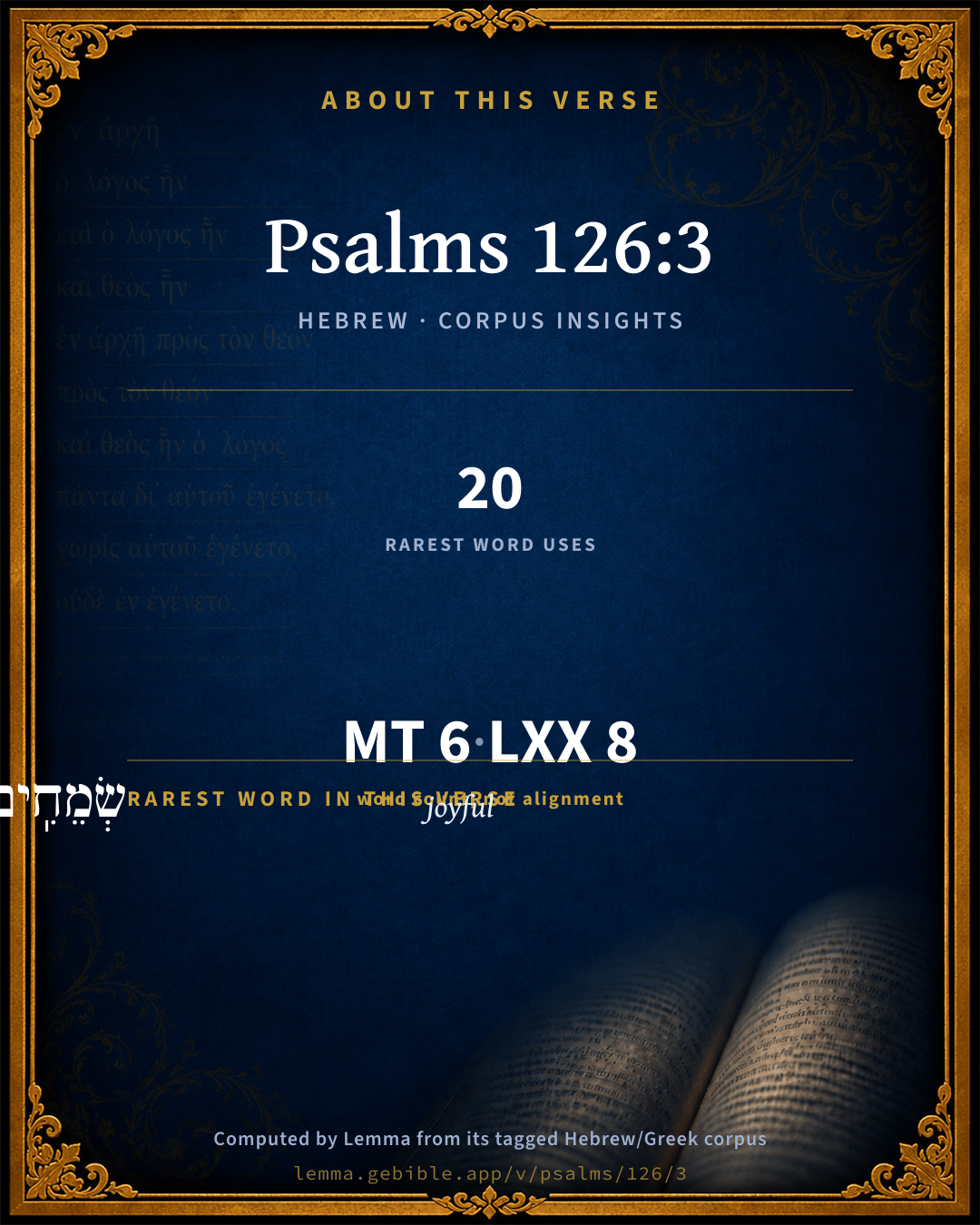
The rarest word here is שְׂמֵחִֽים joyful H8056 — appearing just 20 times in the whole Hebrew Bible.

Shared distinctive vocabulary

שְׂמֵחִֽים joyful H8056 occurs in 20 verses of the Hebrew Bible. Also found in:

Grammatical profile

  • 3 verbs
  • 1 noun
  • 1 adjective
  • 1 preposition

Verb forms

  • הִגְדִּ֣יל Hiphil · Perfect
  • לַעֲשׂ֥וֹת Qal · Infinitive Construct
  • הָיִ֥ינוּ Qal · Perfect

Hebrew & Septuagint length

In English translation the verse runs 11 words from the Hebrew and 19 from the Septuagint (LXX English) — closely comparable.

A rough comparison of the two English renderings, which tokenize alike — not a word-level alignment.

Word counts can differ between the Hebrew and the Greek without any difference in meaning — e.g. the Hebrew direct-object marker אֵת has no separate Greek word, and Greek often adds the article ὁ.

In the original languages it is 6 Hebrew tokens and 8 Greek tokens — but the two are counted differently (Hebrew bundles its prefixes and suffixes into one token; the Greek is in lemma form), so that isn’t a like-for-like length.

Cross-references

17

Topical passages linked to Psalms 126:3 in the Treasury of Scripture Knowledge — connected by theme and wording, ordered by reader-vote popularity; previews shown in the World English Bible.

  • Luke 1:49 For he who is mighty has done great things for me. Holy is his name.
  • Isaiah 51:9–11 Awake, awake, put on strength, arm of Yahweh; awake, as in the days of old, the generations of ancient times. Isn't it you who did cut Rahab in pieces, who pierced the monster?
  • Isaiah 66:14 You shall see [it], and your heart shall rejoice, and your bones shall flourish like the tender grass: and the hand of Yahweh shall be known toward his servants; and he will have indignation against his enemies.
  • Isaiah 12:4–6 In that day you will say, "Give thanks to Yahweh! Call on his name. Declare his doings among the peoples. Proclaim that his name is exalted!
  • Psalms 66:5–6 Come, and see God's deeds-- Awesome work on behalf of the children of men.
  • Psalms 68:7–8 God, when you went forth before your people, When you marched through the wilderness... Selah.
  • Revelation 12:10 I heard a loud voice in heaven, saying, "Now is come the salvation, the power, and the Kingdom of our God, and the authority of his Christ; for the accuser of our brothers has been thrown down, who accuses them before our God day and night.
  • Revelation 19:1–7 After these things I heard something like a loud voice of a great multitude in heaven, saying, "Hallelujah! Salvation, power, and glory belong to our God:
  • Psalms 31:19 Oh how great is your goodness, Which you have laid up for those who fear you, Which you have worked for those who take refuge in you, Before the sons of men!
  • Isaiah 11:11–16 It shall happen in that day, that the Lord will set his hand again the second time to recover the remnant of his people, who shall remain, from Assyria, and from Egypt, and from Pathros, and from Cush, and from Elam, and from Shinar, and from Hamath, and from the islands of the sea.
  • Ephesians 1:18–22 having the eyes of your hearts enlightened, that you may know what is the hope of his calling, and what are the riches of the glory of his inheritance in the saints,
  • Psalms 18:50 He gives great deliverance to his king, And shows loving kindness to his anointed, To David and to his seed, forevermore.
  • Ezra 7:27–28 Blessed be Yahweh, the God of our fathers, who has put such a thing as this in the king's heart, to beautify the house of Yahweh which is in Jerusalem;
  • Psalms 68:22 The Lord said, "I will bring you again from Bashan, I will bring you again from the depths of the sea;
  • Isaiah 25:9 It shall be said in that day, Behold, this is our God; we have waited for him, and he will save us: this is Yahweh; we have waited for him, we will be glad and rejoice in his salvation.
  • Isaiah 52:9–10 Break forth into joy, sing together, you waste places of Jerusalem; for Yahweh has comforted his people, he has redeemed Jerusalem.
  • Luke 1:46 Mary said, "My soul magnifies the Lord.

Cross-references courtesy of OpenBible.info (CC BY 4.0).

Hebrew and Greek witnesses Masoretic Hebrew ↔ Greek Septuagint

The same verse in the two great witnesses to the Old Testament, shown verse-for-verse.

You’re reading Greek Psalm 125 (Hebrew Psalm 126). The Septuagint counts the superscription, so verse numbers can differ from the Hebrew — chapter-level alignment, not verse-by-verse. Numbering follows Rahlfs.

These are two independent witnesses, not word-aligned to each other, and the Septuagint is shown in lemma (dictionary) form.

Hebrew Psalms 126:3 Masoretic · Westminster Leningrad Codex

הִגְדִּ֣יל יְ֭הוָה לַעֲשׂ֥וֹת עִמָּ֗נוּ הָיִ֥ינוּ שְׂמֵחִֽים

Yahweh has done great things for us, And we are glad.

World English Bible · Public Domain

Greek LXX Greek Psalm 125:3 Septuagint · lemma form

μεγαλύνω κύριος ὁ ποιέω μετά ἐγώ γίγνομαι εὐφραίνω

The Lord has done great things among them. The Lord has done great things for us, we became joyful.

LXX2012 (modern English Septuagint) · Public Domain

Hebrew: Westminster Leningrad Codex (CC BY 4.0). Greek: Septuagint (public domain); English from LXX2012 (modern English Septuagint) (Public Domain). How the Septuagint differs from the Hebrew →

Commentary

Notes on Psalms 126:3 from classic Christian and Jewish commentators (each source and its license shown beneath its notes). The classic Christian expositions comment on the surrounding passage and are grouped to its opening verse, so a note may address several verses; the Jewish commentaries on the Tanakh (Rashi and others) are per-verse, so they appear only where the commentator wrote on this verse.

Lemma curates 59 commentaries, every one of them public domain or Creative Commons licensed, each selected and text-cleaned for this edition rather than reprinted as found. About our sources →

Trapp's Complete Commentary

John Trapp

Psa 126:3 The LORD hath done great things for us; [whereof] we are glad.

Ver. 3. The Lord hath done great things] q.d. It is a shame, then, for us not to say so, much more; and, by a holy avarice, to take the praises out of their mouths, who are no sharers in it, but spectators only. Let the redeemed of the Lord say so, speaking good of his name.

John Trapp, A Commentary or Exposition upon All the Books of the Old and New Testament (1647–1656) — public domain. Text from a community e-Sword module.

The Biblical Illustrator

Joseph S. Exell

Psa_126:3

The Lord hath done great things for us.

Great things for us

I. The fact propounded. Note the personality of the statement. For us.

1. As regards our country. Where is there country so fair or land so fertile as ours? Where is such freedom and peace enjoyed?

2. As regards our religious privileges. We have a pure faith, an open Bible, and freedom to worship God as we think best.

3. As regards our individual wants. Homes, friends, food, sustenance, health, etc.

4. As regards our spiritual welfare. We were vile--we are made pure. We were far away--but are now brought nigh. God has done His part in all this, and if our eternal happiness is not assured the fault is ours, not His.

II. The feeling. Whereof we are glad. These Jews had been deprived of their privileges for some considerable period, and then, in the desolation of their spirits and in the misery of their servitude, they began to realize the mercies they had so thanklessly enjoyed. Do we not often tempt God to take away our privileges and to deprive us of our mercies? (J. J. S. Bird, B. A.)

Grateful acknowledgment of Divine goodness

I. A pleasing statement. What great things God hath done for His people--

1. In redemption.

2. In conversion.

3. In the bestowal of Divine freedom.

4. The enjoyment of Church fellowship.

5. By providential interpositions and deliverances.

6. By spiritual advancement.

II. A joyful statement. This gladness implies--

1. Sensibility.

2. Real enjoyment.

3. Heartfelt gladness.

4. Social gladness. For us.

III. Application.

1. Mourn your ingratitude and forgetfulness.

2. Pray for quickening grace.

3. Anticipate the time when you shall be made eternally glad. (Helps for the Pulpit.)

Great things

I. The Lords work acknowledged. God is at the head of all our affairs. Many will not give God the glory. Nebuchadnezzar (Dan_4:30); Herod (Act_12:21; Act_12:23).

II. Its greatness recognized.

1. Greater things than we deserved.

2. Greater things than we knew. Greater things than we expected.

III. An interest therein claimed. What advantage is there if we cannot say for us? The Jews knew what God had done by the edict of Cyrus. They must take advantage of it. God only opened the way, and constrained them to walk in it.

IV. Joyful gladness expressed.

1. Why are we glad?

(1) The work is so great.

(2) The work is done.

(3) The work is done well.

2. How should we show our gladness?

(1) By a cheerful countenance.

(2) By willing labour.

(3) By generous gifts.

V. Application.

1. Has the Lord done aught for you?

2. Have you acknowledged His hand?

3. Has it made you glad?

4. What are you expecting in the future? (The Study.)

Christian gratitude for the goodness of God: -

I. What things have been done for us?

1. National.

2. Domestic.

3. Personal.

II. Who hath done them?

III. How can we, for whom the Lord has done great things, most properly express our joy, and most profitably evince our gratitude? Those, certainly, may rejoice in benefits received whose consciences only testify to them of judgments deserved. Every one whom God has spared may warrantably believe that he has been spared for purposes of mercy. (T. Dale, M. A.)

Personal experience forceful

In most of the reviews of Mr. Morleys Life of Gladstone attention has been called to the fact that whilst the whole work is a literary masterpiece, the third volume is far above the two previous ones in picturesque and stirring power. The events it records took place under the writers own eye, and in them he took a prominent part, and this has given an ease, a freedom, and a force of description that no secondhand reports or most reliable documents can give. That which we have for ourselves seen, tasted, and handled is the part of our testimony that tells and brings conviction to others. (H. O. Mackey.)

The Biblical Illustrator, edited by Joseph S. Exell (c. 1880s–1900s) — public domain. Text from a community e-Sword module.

Joseph Benson's Commentary

Psa 126:3. The Lord hath done great things for us — And we should be very ungrateful if we did not thankfully acknowledge it, and praise him for the singular benefits, which excite even the wonder of strangers; for the Lord hath not only restored our liberty, but manifested the greatness of his power in affecting this our deliverance; whereof we are glad — Which justly fills us with joy and triumph.

Joseph Benson's Commentary on the Old and New Testaments (1811–1818) — public domain. Text from a community e-Sword module.

J. A. Alexander on Psalms

Joseph Addison Alexander

3. (Psa 126:3) Jehovah has done great things to us. We are joyful. This last is not a mere appendage to the first clause, we are glad that he has done great things for us, but an independent proposition, containing the proof of that by which it is preceded. He has indeed done much for us, for whereas we were lately wretched, we are now rejoicing, or more closely rendered, have become joyful.

Joseph Addison Alexander, The Psalms Translated and Explained (1850) — public domain. Text from a community e-Sword module.

Adam Clarke's Commentary

Verse 3. The Lord hath done great things for us] We acknowledge the hand of our God. Deus nobis haec otia fecit, "God alone has given us this enlargement."

We are glad.] This is a mere burst of ecstatic joy. O how happy are we!

Adam Clarke's Commentary on the Bible (1810–1826) — public domain. Text from a community e-Sword/MySword module.

The Cambridge Bible for Schools and Colleges

gen. ed. J. J. S. Perowne

3. The community appropriates the words of the nations, and recalls the joy of that wonderful time: Jehovah did great things for us: we were glad.

The Cambridge Bible for Schools and Colleges (gen. ed. J. J. S. Perowne; Cambridge University Press, 1878–1918) — public domain. Text from a community e-Sword module.

John Gill's Exposition

The Lord hath done great things for us,.... These words are generally supposed to be the words of the Jews, taking up those of the Gentiles, and confirming them; acknowledging that the Lord had done great things for them indeed; which, had they not owned, they would have been exceeding ungrateful; had they been silent concerning them, the stones would have cried out, and the very Heathens condemned them. But I see not why they may not be thought to be the words of those among the Heathens continued; declaring that the great things done were not for the Jews only, but for them also; as the great redemption by Christ is of persons out of every tongue, people, and nation; for he is the propitiation, not for the Jews only, but for the sins of the whole world; and having this in view, thus they express themselves. The work of redemption is a great thing of itself; the produce of great wisdom; the effect of great love; procured at a great price, for great sinners, by a great Saviour; and is not only a deliverance from sin, Satan, and the law; but contains many great and glorious blessings in it, as justification, remission of sins, adoption, and eternal life;

whereof we are glad; that those great things are done without us, finished by the Redeemer himself; that they are so great and glorious, so rich and plenteous, so full and free, and suitable to us; and done for us sinners of the Gentiles, so unworthy of them, who are by nature children of wrath as others.

John Gill's Exposition of the Whole Bible (1746–1763) — public domain (CC PDM 1.0). Text via the HelloAO Bible API.

Albert Barnes' Notes on the Bible

The Lord hath done great things for us - All that the people around us say is true. We see it; we feel it; we acknowledge it. Those to whom this pertained would see it more clearly than those who had merely observed it. A surrounding world may see in the conversion of a man, in his being turned from sin, in the influence of religion upon him, in his comfort, calmness, and peace, that “the Lord has done great things” for him; but he himself, while he responds most fully to what they say, will see this more clearly than they do. There is more in his redemption, his conversion, his peace and joy, than they do or can perceive, and with emphasis he himself will say, “The Lord has done great things for me.”

Whereof we are glad - It fills our souls with joy. If this is understood of the returning Hebrews - coming back from the captivity in Babylon - all must see how appropriate is the language; if it be applied to a sinner returning to God, it is no less suitable, for there is nothing that so fills the mind with joy as a true conversion to God.

Albert Barnes' Notes on the Bible (1834–1885) — public domain. Text from a community e-Sword/MySword module.

The Treasury of David

Charles H. Spurgeon

Ver. 3. The LORD hath done great things for us; whereof we are glad. They did not deny the statement which reflected so much glory upon Jehovah: with exultation they admitted and repeated the statement of Jehovah's notable dealings with them. To themselves they appropriated the joyful assertion; they said "The Lord hath done great things for us", and they declared their gladness at the fact. It is a poor modesty which is ashamed to own its joys in the Lord. Call it rather a robbery of God. There is so little of happiness abroad that if we possess a full share of it we ought not to hide our light under a bushel, but let it shine on all that are in the house. Let us avow our joy, and the reason of it, stating the "whereof" as well as the fact. None are so happy as those who arc newly turned and returned from captivity; none can more promptly and satisfactorily give a reason for the gladness that is in them, the Lord himself has blessed us, blessed us greatly, blessed us individually, blessed assuredly; and because of this we sing unto his name. I heard one say the other day in prayer "whereof we desire to be glad." Strange dilution and defilement of Scriptural language! Surely if God has done great things for us we are glad, and cannot be otherwise. No doubt such language is meant to be lowly, but in truth it is loathsome.

Ver. 3. The Lord hath done great things for us, etc. This verse is the marrow of the whole psalm, occasioned by the return of God's people out of Babel's captivity into their own country. Their deliverance was so great and incredible that when God brought it to pass they were as men in a dream, thinking it rather a dream, and a vain imagination, than a real truth. 1. Because it was so great a deliverance from so great and lasting a bondage, it seemed too good to be true. 2. It was sudden and unexpected, when they little thought or hoped for it...3. All things seemed desperate, nothing more unlikely, or impossible rather. 4. The manner was so admirable (without the counsel, help, or strength of man: nay, it was beyond and against all human means); that they doubt whether these things be not the dreams of men that are awake. Thomas Taylor (1576-1632), in "A Mappe of Pwme."

Ver. 3. For us. What were we, might Sion say (who were glad to lick the dust of the feet of our enemies), that the Lord of heaven and earth should look so graciously upon us? The meanness of the receiver argues the magnificence of the giver. "Who am I, that the mother of my Lord should visit me?" this was a true and religious compliment of devout Elizabeth. The best of men are but the children of dust, and grandchildren of nothing. And yet for the Lord to do great things for us! this yet greatens those "great things". Was it because we were his church? It was his super abounding grace to select us out of others, as it was our greater gracelessness, above all others, so to provoke him, as to force him to throw us into captivity. Or was it because our humiliation, in that disconsolate condition, did move him to so great compassion? Alas! there was a choice of nations whom he might have taken in our room, that might have proved far more faithful than we have been for the one half of those favours we have enjoyed.

Or was it for his covenant's sake with our forefathers? Alas! we had forfeited that long since, again and again, we know not how often. Wherefore, when we remember ourselves, we cannot but make this an aggravation of God's "great things", that he should do them for us, FOR US, so very, very unworthy. Malachiah or Matthew Harris, in a Sermon entitled "Brittaines Hallelujah", 1639.

Ver. 3. The LORD hath done great things for us. In this acknowledgment and confession there are three noteworthy points of thankfulness.

1. That they were "great things" which were done.

2. Who it was who did them: "the Lord."

3. That they are done: not against us, but "for us."

Alexander Henderson, 1583-1646.

Psalms 126:4*

Charles H. Spurgeon's The Treasury of David (1869–1885) — public domain. Psalms only. Text from a community e-Sword/MySword module.

The Pulpit Commentary

The Lord hath done great things for us. "What the heathen said was true the Lord hath indeed done great things for us." Whereof we are glad. For these great things we rejoice and give thanks. The first part of the psalm the absolutely pure joy-song here ends; and the second part the mixed joy and sorrow begins.

The Pulpit Commentary (1880–1919), ed. H.D.M. Spence-Jones & Joseph S. Exell — public domain. Text from a community e-Sword module.

Lesson kit

Teaching starters — assembled from the data on this page, not authored interpretation. Every prompt links to the verse data it draws on. Edit before teaching.

Psalms, in the Wisdom, opens this verse with 6 words (6 distinct Hebrew lemmas). Its most distinctive word is sâmêach (“joyful”). A historical commentator’s framing appears above. Read the whole chapter for the surrounding context.

Discussion questions

  1. What does “joyful” (sâmêach) contribute to the verse as a whole?
  2. Deuteronomy 16:15 shares the word «joyful» with this verse. How do the two illuminate each other?
  3. The translations on this page render this verse differently — a whole-verse word diff, not a word-by-word alignment. What might account for the different wordings?
  4. The verb «הִגְדִּ֣יל» is Hiphil Perfect. How does its form color the action?
  5. Reading how Trapp's Complete Commentary and The Biblical Illustrator read this verse, where do the two commentators agree and where do they part?

Things to notice

Reading settings

Reading text

Shown beneath each verse's original-language words.

Old Testament
Old Testament edition

Read the OT as the Masoretic Hebrew (MT) or the Greek Septuagint (LXX).

English shown for the Greek Septuagint (in the Hebrew ↔ Greek comparison).

Comparing translations? Open the Compare panel on any verse page to stack up to four side by side.