Psalms 35:26

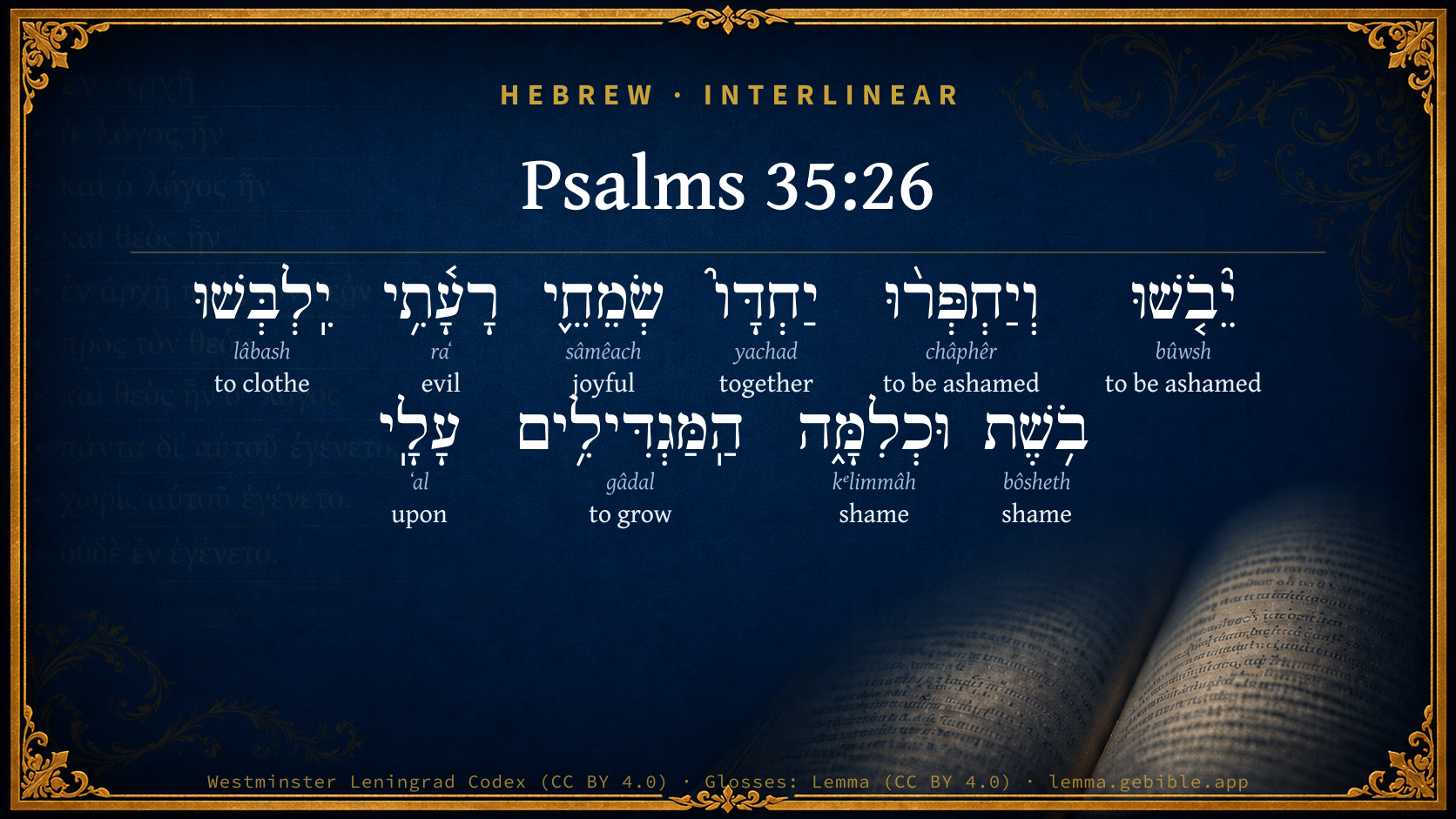
Hebrew (Westminster Leningrad Codex) Psalms 35:26 appears in the Hebrew Old Testament. The text above is from the Westminster Leningrad Codex. Each word links to its Strong’s number, a concise gloss, and parsing drawn from the Open Scriptures Hebrew Bible morphology. Click any word for its full Brown-Driver-Briggs (BDB) entry.
Download image
Cite this verse

Psalms 35:26 (World English Bible). Public Domain. Lemma interlinear Bible study tool, https://lemma.gebible.app/v/psalms/35/26.

Show BibTeX & RIS
BibTeX
RIS
English Translation
Let them be disappointed and confounded together who rejoice at my calamity. Let them be clothed with shame and dishonor who magnify themselves against me.
World English Bible · Public Domain
Download a study sheet

One document with this verse’s original text, its word-by-word gloss line, the meaning frame, cross-references with their text, attributed commentary, and full source and license credits — printable, and it pastes into notes with its structure intact.

This verse Autodidact and up

Study sheet (.html) Plain text (.txt)

A passage Seminary Student

Up to 50 verses in one chapter. A passage sheet keeps up to 6 commentary sources and 12 cross-references per verse, in the order this page ranks them, and says so on the sheet whenever that leaves anything out. Ask for a single verse and you get the Autodidact verse sheet above.

Everything on this page stays free to read, with no account — the sheet is a download of what is already on screen, not access to it.

Want to remove ads? Support Godless Engineer
Compare translations 3

The same verse in 3 English versions, stacked beneath the original-language interlinear above. Click any original word for its lexicon entry.

Each is an independent rendering of the whole verse — the interlinear is not word-aligned to these translations.

Highlighted words mark where these versions differ — a whole-verse word diff, not a word-by-word alignment.

  • World English Bible Public Domain
    Let them be disappointed and confounded together who rejoice at my calamity. Let them be clothed with shame and dishonor who magnify themselves against me.
  • King James Version Public Domain
    Let them be ashamed and brought to confusion together that rejoice at mine hurt: let them be clothed with shame and dishonour that magnify themselves against me.
  • unfoldingWord Literal Text CC BY-SA 4.0
    Let them be ashamed and confounded together, those rejoicing at my evil. Let them be clothed with shame and humiliation, the ones magnifying against me.

unfoldingWord Literal Text — © unfoldingWord, licensed CC BY-SA 4.0. Word-aligned USFM3 via Door43 (git.door43.org/unfoldingWord/en_ult).

Versions to compare (up to 4)

3 of 4 selected

Show all 18 translations

Every available English version of this verse, each an independent rendering of the whole verse.

  • World English Bible Public Domain
    Let them be disappointed and confounded together who rejoice at my calamity. Let them be clothed with shame and dishonor who magnify themselves against me.
  • Berean Standard Bible Public Domain
    May those who gloat in my distress be ashamed and confounded; may those who exalt themselves over me be clothed in shame and reproach.
  • Majority Standard Bible Public Domain
    May those who gloat in my distress be ashamed and confounded; may those who exalt themselves over me be clothed in shame and reproach.
  • King James Version Public Domain
    Let them be ashamed and brought to confusion together that rejoice at mine hurt: let them be clothed with shame and dishonour that magnify themselves against me.
  • American Standard Version (1901) Public Domain
    Let them be put to shame and confounded together that rejoice at my hurt: Let them be clothed with shame and dishonor that magnify themselves against me.
  • Revised Version (1885) Public Domain
    Let them be ashamed and confounded together that rejoice at mine hurt: let them be clothed with shame and dishonour that magnify themselves against me.
  • Geneva Bible (1599) Public Domain
    Let them bee confounded, and put to shame together, that reioyce at mine hurt: let them bee clothed with confusion and shame, that lift vp themselues against me.
  • Douay-Rheims (1899) Public Domain
    Let them blush: and be ashamed together, who rejoice at my evils. Let them be clothed with confusion and shame, who speak great things against me.
  • Young's Literal Translation Public Domain
    They are ashamed and confounded together, Who are rejoicing at my evil. They put on shame and confusion, Who are magnifying themselves against me.
  • Literal Standard Version CC BY-SA 4.0
    They are ashamed and confounded together, || Who are rejoicing at my evil. They put on shame and confusion, || Who are magnifying themselves against me.
  • Unlocked Literal Bible CC BY-SA 4.0
    May they be put to shame and may they be confounded who rejoice at my distress. May those who exalt themselves over me be clothed with shame and dishonor.
  • unfoldingWord Literal Text CC BY-SA 4.0
    Let them be ashamed and confounded together, those rejoicing at my evil. Let them be clothed with shame and humiliation, the ones magnifying against me.
  • Darby Bible Public Domain
    Let them be ashamed and brought to confusion together that rejoice at mine adversity; let them be clothed with shame and dishonour that magnify themselves against me.
  • World Messianic Bible Public Domain
    Let them be disappointed and confounded together who rejoice at my calamity. Let them be clothed with shame and dishonor who magnify themselves against me.
  • Webster's Bible Public Domain
    Let them be ashamed and brought to confusion together that rejoice at my hurt: let them be clothed with shame and dishonor that magnify themselves against me.
  • Free Bible Version CC BY-SA 4.0
    Make them totally ashamed, all those who are happy for the trouble I'm in. Let those who are celebrating over me be covered with shame and dishonor.
  • Bible in Basic English Public Domain
    Let all those who take pleasure in my troubles be shamed and come to nothing: let those who are lifted up against me be covered with shame and have no honour.
  • JPS Tanakh (1917) Public Domain
    Let them be ashamed and abashed together that rejoice at my hurt; let them be clothed with shame and confusion that magnify themselves against me.

Literal Standard Version (2020), Covenant Press — licensed CC BY-SA 4.0. Text via the HelloAO Bible API (eBible.org). Unlocked Literal Bible (unfoldingWord) — licensed CC BY-SA 4.0. Text via the HelloAO Bible API (eBible.org). unfoldingWord Literal Text — © unfoldingWord, licensed CC BY-SA 4.0. Word-aligned USFM3 via Door43 (git.door43.org/unfoldingWord/en_ult). Free Bible Version, Dr. Jonathan Gallagher — licensed CC BY-SA 4.0. Text via the HelloAO Bible API (eBible.org).

Word by word

More ways to search: Search by grammar → Find every occurrence → Compare this word →

Practice this passage: Drill this verse → Learn its vocabulary →

וְיַחְפְּר֨וּ
châphêr
H2659
“and · to be ashamed”
Conjunction + Verb, Qal, Imperfect, 3rd Person, Masculine, Plural
Part of Speech
Conjunction + Verb
Stem
Qal
Form
Imperfect
Person
3rd Person
Gender
Masculine
Number
Plural
Full BDB Definition

Origin: a primitive root [perhaps rath, the same as H2658 through the idea of detection]

TWOT: 715

to be ashamed, be confounded, be abashed, feel abashed - (Qal) to be ashamed, be abashed - (Hiphil) to display shame, demonstrate shame, cause embarrassment
  1. יֵ֘בֹ֤שׁוּ bûwsh H954 “to be ashamed” Verb, Qal, Imperfect, 3rd Person, Masculine, Plural
  2. יַחְדָּו֮ yachad H3162 “together” Adverb
  3. שְׂמֵחֵ֪י sâmêach H8056 “joyful of” Adjective, Adjective, Masculine, Plural, Construct
  4. רָעָ֫תִ֥י raʻ H7451 “evil · my” Noun, Common, Feminine, Singular, Construct + Suffix, Personal, 1st Person, Common, Singular
  5. יִֽלְבְּשׁוּ lâbash H3847 “to clothe” Verb, Qal, Imperfect, 3rd Person, Masculine, Plural
  6. בֹ֥שֶׁת bôsheth H1322 “shame” Noun, Common, Feminine, Singular, Absolute
  7. וּכְלִמָּ֑ה kᵉlimmâh H3639 “and · shame” Conjunction + Noun, Common, Feminine, Singular, Absolute
  8. הַֽמַּגְדִּילִ֥ים gâdal H1431 “the · growing” Particle, Definite Article + Verb, Hiphil, Participle Active, Masculine, Plural, Absolute
  9. עָלָֽי ʻal H5921 “upon · me” Preposition + Suffix, Personal, 1st Person, Common, Singular

About this verse

These counts appear in no published source. They are computed here, from the morphology-tagged text and Lemma’s own curated glosses. What Lemma adds →

10
words
10
distinct lemmas
Wisdom
section

Notable vocabulary

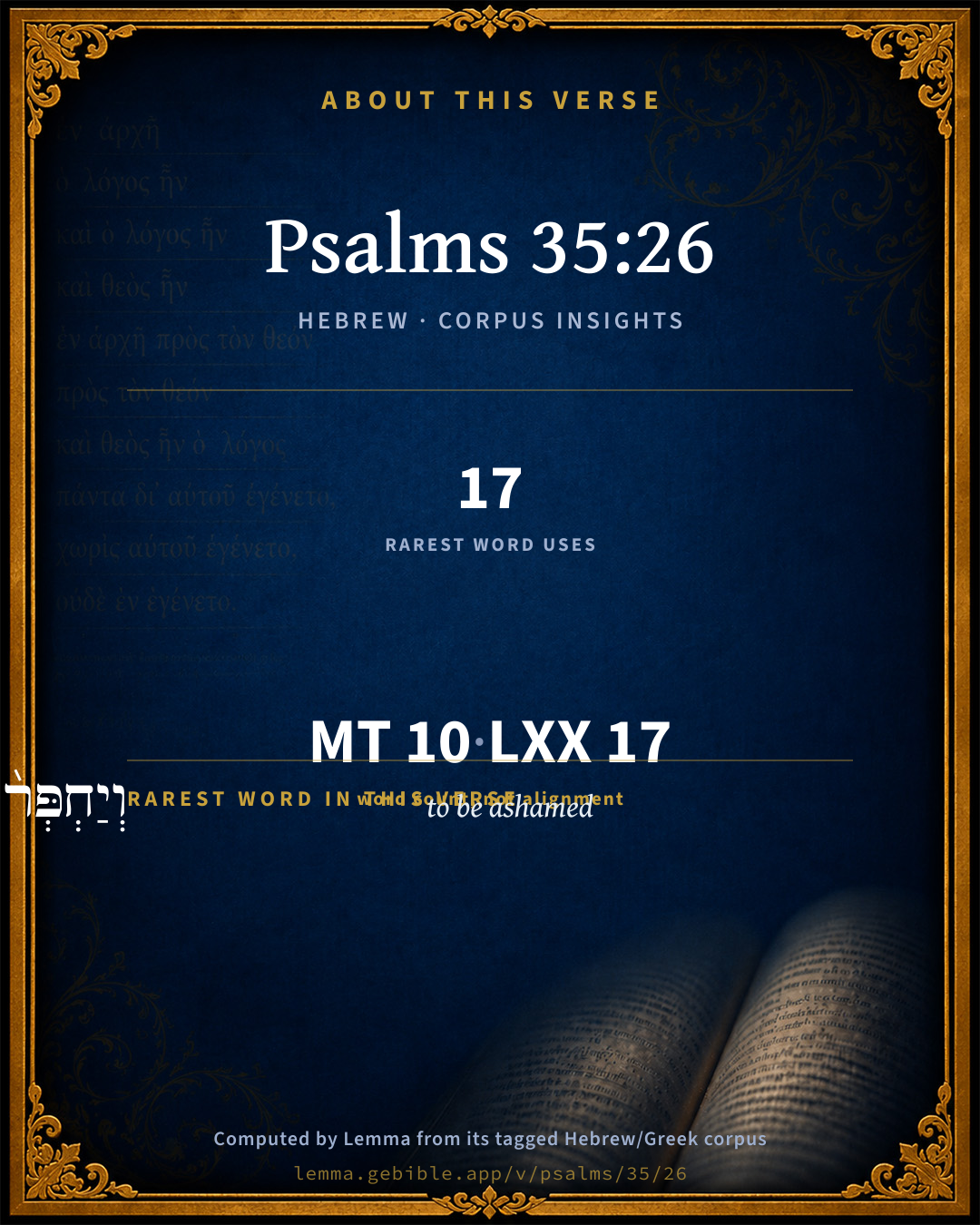
The rarest word here is וְיַחְפְּר֨וּ to be ashamed H2659 — appearing just 17 times in the whole Hebrew Bible.

Shared distinctive vocabulary

וְיַחְפְּר֨וּ to be ashamed H2659 occurs in 17 verses of the Hebrew Bible. Also found in:

Grammatical profile

  • 4 verbs
  • 3 nouns
  • 1 adjective
  • 1 preposition
  • 1 adverb

Verb forms

  • יֵ֘בֹ֤שׁוּ Qal · Imperfect
  • וְיַחְפְּר֨וּ Qal · Imperfect
  • יִֽלְבְּשׁוּ Qal · Imperfect
  • הַֽמַּגְדִּילִ֥ים Hiphil · Participle Active

Hebrew & Septuagint length

In English translation the verse runs 25 words from the Hebrew and 27 from the Septuagint (LXX English) — closely comparable.

A rough comparison of the two English renderings, which tokenize alike — not a word-level alignment.

Word counts can differ between the Hebrew and the Greek without any difference in meaning — e.g. the Hebrew direct-object marker אֵת has no separate Greek word, and Greek often adds the article ὁ.

In the original languages it is 10 Hebrew tokens and 17 Greek tokens — but the two are counted differently (Hebrew bundles its prefixes and suffixes into one token; the Greek is in lemma form), so that isn’t a like-for-like length.

Cross-references

15

Topical passages linked to Psalms 35:26 in the Treasury of Scripture Knowledge — connected by theme and wording, ordered by reader-vote popularity; previews shown in the World English Bible.

  • Job 8:22 Those who hate you shall be clothed with shame. The tent of the wicked shall be no more."
  • Psalms 38:16 For I said, "Don't let them gloat over me, Or exalt themselves over me when my foot slips."
  • Job 19:5 If indeed you will magnify yourselves against me, And plead against me my reproach;
  • Psalms 132:18 I will clothe his enemies with shame, But on himself, his crown will be resplendant."
  • Isaiah 41:11 Behold, all those who are incensed against you shall be disappointed and confounded: those who strive with you shall be as nothing, and shall perish.
  • Psalms 35:4 Let those who seek after my soul be disappointed and brought to dishonor. Let those who plot my ruin be turned back and confounded.
  • Psalms 40:14–15 Let them be disappointed and confounded together who seek after my soul to destroy it. Let them be turned backward and brought to dishonor who delight in my hurt.
  • Psalms 55:12 For it was not an enemy who insulted me, Then I could have endured it. Neither was it he who hated me who raised himself up against me, Then I would have hid myself from him.
  • Psalms 71:13 Let my accusers be disappointed and consumed. Let them be covered with disgrace and scorn who want to harm me.
  • Psalms 109:28–29 They may curse, but you bless. When they arise, they will be shamed, But your servant shall rejoice.
  • Psalms 129:5 Let them be disappointed and turned backward, All those who hate Zion.
  • Isaiah 65:13–15 Therefore thus says the Lord Yahweh, Behold, my servants shall eat, but you shall be hungry; behold, my servants shall drink, but you shall be thirsty; behold, my servants shall rejoice, but you shall be disappointed;
  • Jeremiah 48:26 Make you him drunken; for he magnified himself against Yahweh: and Moab shall wallow in his vomit, and he also shall be in derision.
  • Daniel 11:36 The king shall do according to his will; and he shall exalt himself, and magnify himself above every god, and shall speak marvelous things against the God of gods; and he shall prosper until the indignation be accomplished; for that which is determined shall be done.
  • 1 Peter 5:5 Likewise, you younger ones, be subject to the elder. Yes, all of you gird yourselves with humility, to subject yourselves to one another; for "God resists the proud, but gives grace to the humble."

Cross-references courtesy of OpenBible.info (CC BY 4.0).

Hebrew and Greek witnesses Masoretic Hebrew ↔ Greek Septuagint

The same verse in the two great witnesses to the Old Testament, shown verse-for-verse.

You’re reading Greek Psalm 34 (Hebrew Psalm 35). The Septuagint counts the superscription, so verse numbers can differ from the Hebrew — chapter-level alignment, not verse-by-verse. Numbering follows Rahlfs.

These are two independent witnesses, not word-aligned to each other, and the Septuagint is shown in lemma (dictionary) form.

Hebrew Psalms 35:26 Masoretic · Westminster Leningrad Codex

יֵ֘בֹ֤שׁוּ וְיַחְפְּר֨וּ יַחְדָּו֮ שְׂמֵחֵ֪י רָעָ֫תִ֥י יִֽלְבְּשׁוּ בֹ֥שֶׁת וּכְלִמָּ֑ה הַֽמַּגְדִּילִ֥ים עָלָֽי

Let them be disappointed and confounded together who rejoice at my calamity. Let them be clothed with shame and dishonor who magnify themselves against me.

World English Bible · Public Domain

Greek LXX Greek Psalm 34:26 Septuagint · lemma form

αἰσχύνω καί ἐντρέπω ἅμα ὁ ἐπιχαίρω ὁ κακός ἐγώ ἐνδύω αἰσχύνη καί ἐντροπή ὁ μεγαλορρημονέω ἐπί ἐγώ

Let them be confounded and ashamed together that rejoice at my afflictions: let them be clothed with shame and confusion that speak great swelling words against me.

LXX2012 (modern English Septuagint) · Public Domain

Hebrew: Westminster Leningrad Codex (CC BY 4.0). Greek: Septuagint (public domain); English from LXX2012 (modern English Septuagint) (Public Domain). How the Septuagint differs from the Hebrew →

Commentary

Notes on Psalms 35:26 from classic Christian and Jewish commentators (each source and its license shown beneath its notes). The classic Christian expositions comment on the surrounding passage and are grouped to its opening verse, so a note may address several verses; the Jewish commentaries on the Tanakh (Rashi and others) are per-verse, so they appear only where the commentator wrote on this verse.

Lemma curates 59 commentaries, every one of them public domain or Creative Commons licensed, each selected and text-cleaned for this edition rather than reprinted as found. About our sources →

Trapp's Complete Commentary

John Trapp

Psa 35:26 Let them be ashamed and brought to confusion together that rejoice at mine hurt: let them be clothed with shame and dishonour that magnify [themselves] against me.

Ver. 26. Let them be ashamed, &c.] They shall so; and this prayer against the Church’s enemies shall still speak effectually.

John Trapp, A Commentary or Exposition upon All the Books of the Old and New Testament (1647–1656) — public domain. Text from a community e-Sword module.

J. A. Alexander on Psalms

Joseph Addison Alexander

26. (Psa 35:26) Let them be ashamed and blush together—the rejoicers in my evil; let them put on shame and contempt the (men) magnifying against me (their words, or their deeds, or themselves)! The relative construction, who rejoice in my hurt, who magnify against me, gives the sense, but in an English rather than a Hebrew form.—Ashamed, disappointed and defeated. See above, on Psa 35:4.—Blush, be confused or confounded.—My evil, i.e. evil fortune, injury, including the idea of injustice, as the antithetical term in Psa 35:27 is righteousness or justification.—Put on, as a dress, and wear it, or be covered with it. See below, on Psa 109:18 (17), and compare Job 8:24.—Contempt, disgrace, ignominy.—Making great, etc., their mouth or words, i.e. speaking proudly, Oba 1:12, Eze 35:13; or still more probably and agreeably to usage, acting proudly, as in Psa 55:13 (12), and elsewhere. The complete expression may be that used in Joe 2:20.

Joseph Addison Alexander, The Psalms Translated and Explained (1850) — public domain. Text from a community e-Sword module.

Tyndale Open Study Notes

Tyndale Open Resources

35:26-28 The psalmist calls on the Lord to judge the wicked and to rescue the godly and bring them joy.

Tyndale Open Study Notes — © Tyndale Open Resources, licensed CC BY-SA 4.0. Text via the HelloAO Bible API.

Geneva Bible (1599)

Geneva Bible translators

That is, at once, were they never so many or mighty.

This prayer shall always be verified against them that persecute the faithful.

Geneva Bible (1599) marginal notes — public domain. Text via Bolls.life.

Jamieson, Fausset & Brown

Robert Jamieson, A. R. Fausset & David Brown

clothed--covered wholly (Job 8:22).

Jamieson, Fausset & Brown — Commentary Critical and Explanatory on the Whole Bible (1871) — public domain (CC PDM 1.0). Text via the HelloAO Bible API.

Adam Clarke's Commentary

Verse 26. Let them be ashamed] This may be a prophetic declaration against Saul and his courtiers. They were ashamed, confounded, clothed with shame, and dishonoured. All these took place in Saul's last battle with the Philistines, where he lost his crown and his life, and came to a most dishonourable end.

Adam Clarke's Commentary on the Bible (1810–1826) — public domain. Text from a community e-Sword/MySword module.

John Calvin's Commentaries

26. Let those who rejoice at thy hurt be ashamed and confounded together. This imprecation has already been expounded; and it is only necessary to remark, that there is peculiar force in the expression, together, or at once. It shows that it was not only one or two, but a great multitude, who waged war against him, and that he yielded not to the influence of fear, but believed that as soon as God should lift up his hand, he could at one stroke easily overthrow them all. When it is said that they seek after and rejoice in David’s hurt, this shows that they were filled with cruel hatred against him. And when it is said, that they magnify themselves against him, this is a token of pride. David, therefore, in order to render them more hateful in the sight of God, represents them as filled with pride and cruelty. And as this form of prayer was dictated by the Holy Spirit to David, there can be no doubt that the end of all the proud shall be such as is here predicted, that they shall turn back overwhelmed with shame and disgrace.

John Calvin's Commentaries (1540-1563) — public domain. Text from the Calvin Translation Society English edition (1840s-50s) via the Christian Classics Ethereal Library (ccel.org). Calvin's coverage is partial (roughly two-thirds of the Bible); uncommented books and verses are honest gaps, never fabricated. The 19th-century editor's footnotes and remarks are omitted so the notes are faithfully Calvin's own voice.

The Cambridge Bible for Schools and Colleges

gen. ed. J. J. S. Perowne

26. A repetition of Psa_35:4, with some variations, occurring again in Psa_40:14.

The Cambridge Bible for Schools and Colleges (gen. ed. J. J. S. Perowne; Cambridge University Press, 1878–1918) — public domain. Text from a community e-Sword module.

John Gill's Exposition

Let them be ashamed and brought to confusion together,.... In a body, as one man; as they gathered together against him, Psa 35:15; so he entreats they might together be brought to shame and confusion, they not being able to execute their designs; their schemes being broken, their counsels defeated, and they exposed to contempt;

that rejoice at mine hurt; the same with his adversity, or halting, Psa 35:15;

let them be clothed with shame and dishonour that magnify themselves against me; let them be covered with it, as a man is with a garment; who magnified themselves, opened their mouths in great swelling words of vanity against him, vaunted and bragged over him, as in their power, and at their will.

John Gill's Exposition of the Whole Bible (1746–1763) — public domain (CC PDM 1.0). Text via the HelloAO Bible API.

Albert Barnes' Notes on the Bible

Let them be ashamed ... - See the notes at Psa 35:4.

That magnify themselves against me - Who seek to exalt themselves over me; to make themselves great by humbling and destroying me. They hope to rise on my ruin.

Albert Barnes' Notes on the Bible (1834–1885) — public domain. Text from a community e-Sword/MySword module.

Matthew Poole's English Annotations

As they gathered themselves together to deride and oppose me, so do thou gather them together to destroy them. Or, in like manner, one as well as another; let the proud and great ones of them be disappointed and ashamed as well as the meanest among them.

Themselves; the same ellipsis we have Psa 38:16; 55:12; Jer 48:26. Or, their mouth, as it is expressed, Oba 1:12. So Eze 35:13. That extol themselves and their power, and look upon me with scorn and contempt.

Matthew Poole's English Annotations on the Holy Bible (1683–1685) — public domain. Text from a community e-Sword/MySword module.

The Treasury of David

Charles H. Spurgeon

Verse 26. Here is the eternal result of all the laborious and crafty devices of the Lord's enemies. God will make little of them, though they ["magnified themselves;"] he will shame them for shaming his people, bring them to confusion for making confusion, pull off their fine apparel and give them a beggardly suit of dishonour, and turn all their rejoicing into weeping and wailing, and gnashing of teeth. Truly, the saints can afford to wait.

[Verses] 4 - 8, 26. How are we to account for such prayers for vengeance? We find them chiefly in four Psalms, the seventh, thirty-fifth, sixty-ninth, and one-hundred and ninth, and the imprecations in these form a terrible climax. In the last no less than thirty anathemas have been counted. Are these the mere outbursts of passionate and unsanctified feeling, or are they the legitimate expression of a righteous indignation? Are they to be excused as being animated by the "spirit of Elias"? a spirit not unholy indeed, but far removed from the meekness and gentleness of Christ; or are they the stereotyped forms in which the spirit of devotion may utter itself? Are they Jewish only, or may they be Christian also? An uninstructed fastidiousness, as it is well known, has made many persons recoil from reading these Psalms at all. Many have found their lips falter when they have been called to join in using them in the congregation, and have either uttered them with bated breath and doubting heart, or have interpreted them in a sense widely at variance with the letter. Some have tried to reconcile them with a more enlightened conscience, by regarding such words not as the expression of a wish, but as the utterance of a prediction; but the Hebrew optative which is distinct enough from the simple future, absolutely forbids this expedient. Others again would see in them expressions which may lawfully be used in the soul's wrestling against spiritual enemies. And finally, some would defend them as utterances of righteous zeal for God's honour, and remind us that if we do not sympathise with such zeal, it may be not because our religion is more pure, but because our hearts are colder.

Now the real source of the difficulty lies in our not observing and bearing in mind the essential difference between the Old Testament and the New. The older dispensation was in every sense a sterner one than the new. The spirit of Elias, though not an evil spirit, was not the spirit of Christ. "The Son of Man came not to destroy men's lives, but to save them." Luke 9:56. And through him his disciples are made partakers of the same spirit. But this was not the spirit of the older economy. The Jewish nation had been trained in a sterner school. It had been steeled and hardened by the discipline which had pledged it to a war of extermination with idolaters; and however necessary such a discipline might be, it would not tend to foster the gentler virtues; it is conceivable how even a righteous man, under it, feeling it to be his bounden duty to root out evil wherever he saw it, and identifying, as he did, his own enemies with the enemies of Jehovah, might use language which to us appears unnecessarily vindictive. To men so trained and taught, what we call "religious toleration," was a thing not only wrong, but absolutely inconceivable.

It may be quite true that we find revenge forbidden as directly in the Old Testament as in the New, as, for instance, in Leviticus 19:18, "Thou shalt not avenge," etc., though even there is a limitation, "against the children of thy people." And it may be no less true that we find instances of imprecation in the New; as when St. Paul says (2 Timothy 4:14), "Alexander the coppersmith did me much evil: the Lord reward him according to his works," or when he exclaims (Acts 23:3), "God will smite thee, thou whited wall;" or, "If any man love not the Lord Jesus Christ, let him be anathema." But even these expressions are very different from the varied, deliberate, carefully constructed, detailed anathemas of the Psalms. And our Lord's denunciations, to which Hengstenberg refers, are in no way parallel. They are not curses upon individuals, but in fact solemn utterances of the great truth, "Except ye repent, ye shall all likewise perish." But after all, whatever may be said of particular passages, the general tone which runs through the two covenants, is unquestionably different. To deny this is not to honour Moses, but to dishonour Christ. Matthew 5:43; 19:8. On the other hand, we must not forget that these imprecations are not the passionate longings for personal revenge. The singer undoubtedly sees in his enemies the enemies of God and his church. They that are not with him are against God. And because the zeal of God's house even consumes him, he prays that all the doers of iniquity may be rooted out. The indignation therefore is righteous, though it may appear to us wrongly directed, or excessive in its utterance.

Once more, the very fact that a dark cloud hid God's judgment in the world to come from the view of the Old Testament saints, may be alleged in excuse of this their desire to see him take vengeance on his enemies here. How deeply this problem of God's righteousness exercised their minds is abundantly evident from numerous places in the Psalms. They longed to see that righteousness manifested. It could be manifested, they thought, only in the evident exaltation of the righteous, and the evident destruction of the wicked here. Hence, with their eye always fixed on temporal recompense, they could even wish and pray for the destruction of the ungodly. The awful things of the world to come were to a great extent hid from their eyes. Could they have seen these, then surely their prayer would have been not, "Let the angel of the Lord persecute them," "Blot them out of thy book;" but rather with him who hung upon the cross; "Father, forgive them, for they know not what they do." [J. J. Stewart Perowne.]

[Verses] 4, 8, 26. David was about as devoid of vindictiveness as any public character who can well be named. His conduct in relation to Saul, from first to last displayed a singularly noble spirit, far removed from anything like the lust of vengeance; and the meekness with which he endured the bitter reproaches of Shimei, bore witness to the same spirit after his accession to the throne. . . . .

When David's whole career is intelligently and fairly reviewed, it leaves on the mind the impression of a man possessed of as meek and placable a temper as was ever associated with so great strength of will, and such strong passions. Even in the heats of sudden resentment, he was not apt to be hurried into deeds of revenge. Such being the case, it would certainly have been a strange and unaccountable thing if he had shown himself less the master of his own spirit in poems composed in seasons of retirement and communion with God, especially since these very poems express a keen sense of the heinousness of the sin that has been laid to his charge. He can affirm regarding his implacable enemies, "As for me, when they were sick, my clothing was sackcloth: I humbled my soul with fasting; and my prayer returned into mine own bosom. I behaved myself as though he had been my friend or brother: I bowed down heavily, as one that mourneth for his mother." Psalm 35:13, 14. "O Lord, my God, if I have done this; if there be iniquity in my hands; if I have rewarded evil unto him that was at peace with me (yea, I have delivered him that without cause is mine enemy): let the enemy persecute my soul, and take it; yea, let him tread down my life upon the earth." Psalm 7:3 - 5. Surely one ought to think twice before putting on the imprecations an interpretation which would make them utterly incongruous with these appeals, uttered almost in the same breath. [William Binnie, D.D.]

[Verse] 26. The convict dress of the wicked - ["clothed with shame,"] etc.

Charles H. Spurgeon's The Treasury of David (1869–1885) — public domain. Psalms only. Text from a community e-Sword/MySword module.

Whedon's Commentary on the Bible

Daniel D. Whedon

26. Let them be ashamed—In this and the connecting verses of the strophe is given the moral sense of all the imprecations in Psa_35:4-8

Daniel D. Whedon (gen. ed.), Commentary on the Old and New Testaments (1874–1909) — public domain. Text from a community e-Sword module.

The Pulpit Commentary

Let them be ashamed and brought to confusion together that rejoice at mine hurt: let them be clothed with shame and dishonour that magnify themselves against me (comp. ver. 4, of which this is an enlargement, with variations, the sentiment being exactly the same). Very similar maledictions will be found in Psa_40:14 Psa_70:2 Psa_71:13 Psa_109:29.

The Pulpit Commentary (1880–1919), ed. H.D.M. Spence-Jones & Joseph S. Exell — public domain. Text from a community e-Sword module.

Lesson kit

Teaching starters — assembled from the data on this page, not authored interpretation. Every prompt links to the verse data it draws on. Edit before teaching.

Psalms, in the Wisdom, opens this verse with 10 words (10 distinct Hebrew lemmas). Its most distinctive word is châphêr (“to be ashamed”). A historical commentator’s framing appears above. Read the whole chapter for the surrounding context.

Discussion questions

  1. How does “to be ashamed” (châphêr) shape what this verse is saying?
  2. Job 6:20 shares the word «to be ashamed» with this verse. How do the two illuminate each other?
  3. These translations render this verse differently. What is at stake in choosing one wording over another?
  4. The verb «יֵ֘בֹ֤שׁוּ» is Qal Imperfect. How does its form color the action?
  5. Reading how Trapp's Complete Commentary and J. A. Alexander on Psalms read this verse, where do the two commentators agree and where do they part?

Things to notice

Reading settings

Reading text

Shown beneath each verse's original-language words.

Old Testament
Old Testament edition

Read the OT as the Masoretic Hebrew (MT) or the Greek Septuagint (LXX).

English shown for the Greek Septuagint (in the Hebrew ↔ Greek comparison).

Comparing translations? Open the Compare panel on any verse page to stack up to four side by side.