
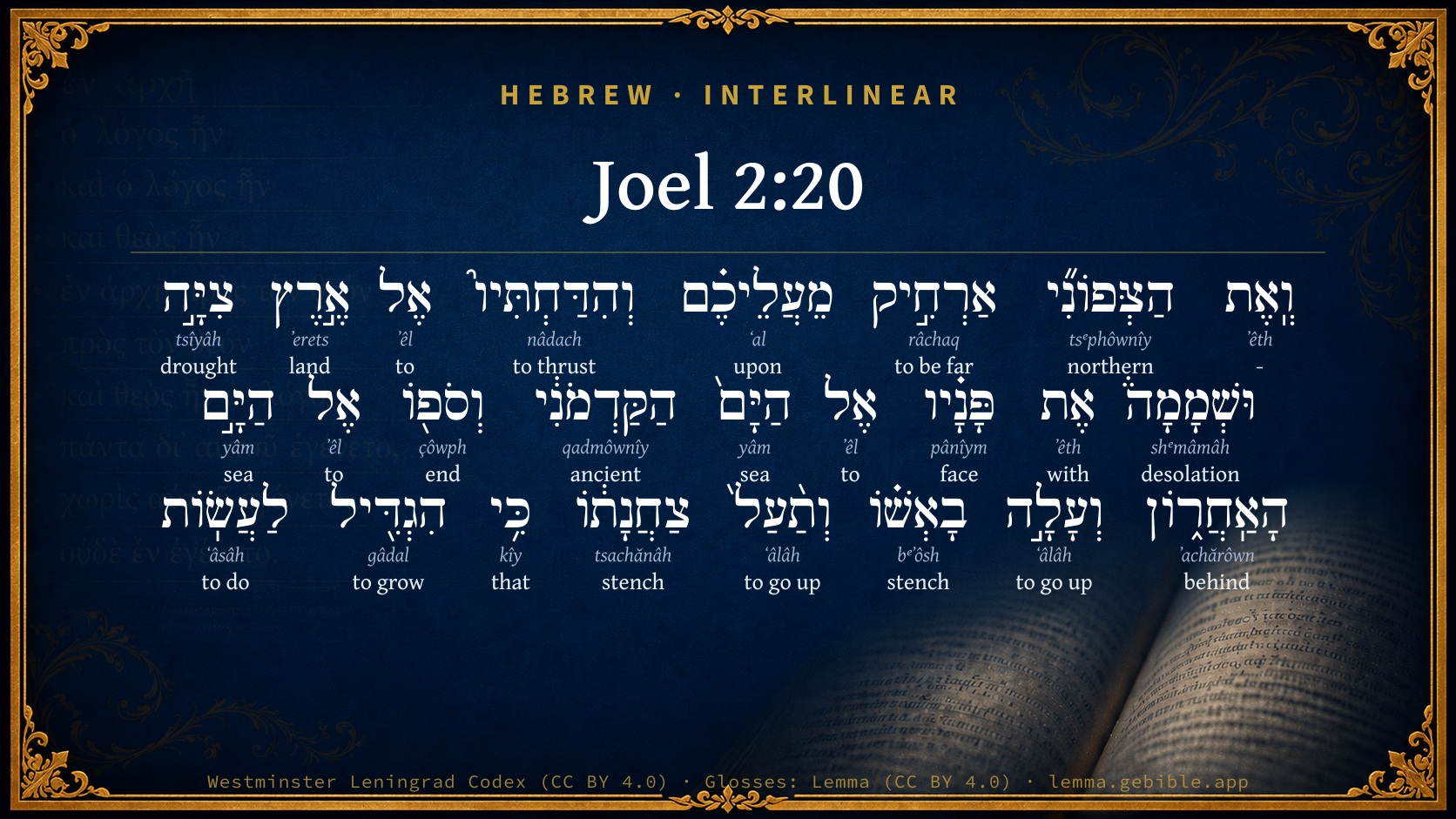
Joel 2:20

Hebrew (Westminster Leningrad Codex) Joel 2:20 appears in the Hebrew Old Testament. The text above is from the Westminster Leningrad Codex. Each word links to its Strong’s number, a concise gloss, and parsing drawn from the Open Scriptures Hebrew Bible morphology. Click any word for its full Brown-Driver-Briggs (BDB) entry.
Download image
Cite this verse

Joel 2:20 (World English Bible). Public Domain. Lemma interlinear Bible study tool, https://lemma.gebible.app/v/joel/2/20.

Show BibTeX & RIS
BibTeX
RIS
English Translation
But I will remove the northern army far away from you, And will drive it into a barren and desolate land, Its front into the eastern sea, And its back into the western sea; And its stench will come up, And its bad smell will rise." Surely he has done great things.
World English Bible · Public Domain
Highlights
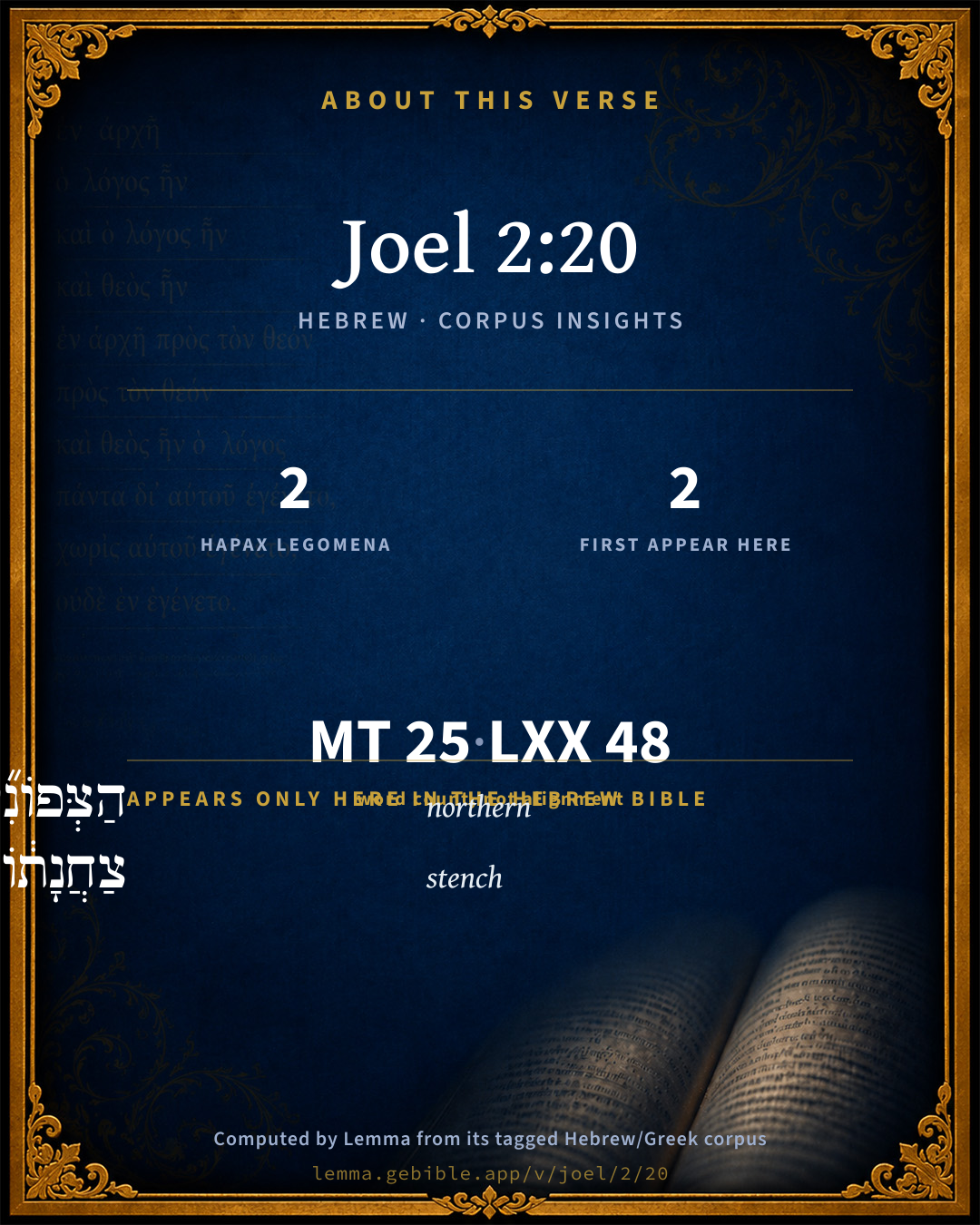
  • 2 hapax legomena — only here in the Hebrew Bible
  • 2 first appearances in the Hebrew Bible
Full analysis ↓
Download a study sheet

One document with this verse’s original text, its word-by-word gloss line, the meaning frame, cross-references with their text, attributed commentary, and full source and license credits — printable, and it pastes into notes with its structure intact.

This verse Autodidact and up

Study sheet (.html) Plain text (.txt)

A passage Seminary Student

Up to 50 verses in one chapter. A passage sheet keeps up to 6 commentary sources and 12 cross-references per verse, in the order this page ranks them, and says so on the sheet whenever that leaves anything out. Ask for a single verse and you get the Autodidact verse sheet above.

Everything on this page stays free to read, with no account — the sheet is a download of what is already on screen, not access to it.

Want to remove ads? Support Godless Engineer
Compare translations 3

The same verse in 3 English versions, stacked beneath the original-language interlinear above. Click any original word for its lexicon entry.

Each is an independent rendering of the whole verse — the interlinear is not word-aligned to these translations.

Highlighted words mark where these versions differ — a whole-verse word diff, not a word-by-word alignment.

  • World English Bible Public Domain
    But I will remove the northern army far away from you, And will drive it into a barren and desolate land, Its front into the eastern sea, And its back into the western sea; And its stench will come up, And its bad smell will rise." Surely he has done great things.
  • King James Version Public Domain
    But I will remove far off from you the northern army, and will drive him into a land barren and desolate, with his face toward the east sea, and his hinder part toward the utmost sea, and his stink shall come up, and his ill savour shall come up, because he hath done great things.
  • unfoldingWord Literal Text CC BY-SA 4.0
    And I will distance the northerner from upon you, and I will banish him into a land of dryness and desolation, his face into the eastern sea and his back into the western sea. And his stench will rise, and his odor will rise, for he has been great in doing.”

unfoldingWord Literal Text — © unfoldingWord, licensed CC BY-SA 4.0. Word-aligned USFM3 via Door43 (git.door43.org/unfoldingWord/en_ult).

Versions to compare (up to 4)

3 of 4 selected

Show all 18 translations

Every available English version of this verse, each an independent rendering of the whole verse.

  • World English Bible Public Domain
    But I will remove the northern army far away from you, And will drive it into a barren and desolate land, Its front into the eastern sea, And its back into the western sea; And its stench will come up, And its bad smell will rise." Surely he has done great things.
  • Berean Standard Bible Public Domain
    The northern army I will drive away from you, banishing it to a barren and desolate land, its front ranks into the Eastern Sea, and its rear guard into the Western Sea. And its stench will rise; its foul odor will ascend. For He has done great things.
  • Majority Standard Bible Public Domain
    The northern army I will drive away from you, banishing it to a barren and desolate land, its front ranks into the Eastern Sea, and its rear guard into the Western Sea. And its stench will rise; its foul odor will ascend. For He has done great things.
  • King James Version Public Domain
    But I will remove far off from you the northern army, and will drive him into a land barren and desolate, with his face toward the east sea, and his hinder part toward the utmost sea, and his stink shall come up, and his ill savour shall come up, because he hath done great things.
  • American Standard Version (1901) Public Domain
    but I will remove far off from you the northern `army', and will drive it into a land barren and desolate, its forepart into the eastern sea, and its hinder part into the western sea; and its stench shall come up, and its ill savor shall come up, because it hath done great things.
  • Revised Version (1885) Public Domain
    but I will remove far off from you the northern army, and will drive him into a land barren and desolate, his forepart into the eastern sea, and his hinder part into the western sea; and his stink shall come up, and his ill savour shall come up, because he hath done great things.
  • Geneva Bible (1599) Public Domain
    But I will remooue farre off from you the Northren armie, and I will driue him into a land, barren and desolate with his face toward the East sea, and his end to the vtmost sea, and his stinke shall come vp, and his corruption shall ascend, because he hath exalted himselfe to do this.
  • Douay-Rheims (1899) Public Domain
    And I will remove far off from you the northern enemy: and I will drive him into a land unpassable, and desert, with his face towards the east sea, and his hinder part towards the utmost sea: and his stench shall ascend, and his rottenness shall go up, because he hath done proudly.
  • Young's Literal Translation Public Domain
    And the northern I put far off from you, And have driven him unto a land dry and desolate, With his face unto the eastern sea, And his rear unto the western sea, And come up hath his stink, And come up doth his stench, For he hath exerted himself to work.
  • Literal Standard Version CC BY-SA 4.0
    And the northern I put far off from you, || And have driven him to a land dry and desolate, || With his face toward the Eastern Sea, || And his rear to the Western Sea, || And his stink has come up, || And his stench comes up, || For he has exerted himself to work.”
  • Unlocked Literal Bible CC BY-SA 4.0
    I will remove the northern attackers far from you, and will drive them into a dry and abandoned land. The front of their army will go into the eastern sea, and the rear into the western sea. Its stench will rise, and its bad smell will rise.” Indeed, he has done great things.
  • unfoldingWord Literal Text CC BY-SA 4.0
    And I will distance the northerner from upon you, and I will banish him into a land of dryness and desolation, his face into the eastern sea and his back into the western sea. And his stench will rise, and his odor will rise, for he has been great in doing.”
  • Darby Bible Public Domain
    And I will remove far off from you him [that cometh] from the north, and will drive him into a land barren and desolate, his face toward the eastern sea, and his rear toward the hinder sea; and his stench shall come up, and his ill odour shall come up, for he hath exalted himself to do great things.
  • World Messianic Bible Public Domain
    But I will remove the northern army far away from you, and will drive it into a barren and desolate land, its front into the eastern sea, and its back into the western sea; and its stench will come up, and its bad smell will rise.” Surely he has done great things.
  • Webster's Bible Public Domain
    But I will remove far from you the northern army, and will drive him into a land barren and desolate, with his face towards the east sea, and his hinder part towards the utmost sea, and his odious scent shall come up, and his ill savor shall come up, because he hath done great things.
  • Free Bible Version CC BY-SA 4.0
    I will remove from you the army from the north; I will drive them into the desolate wilderness—the front into the eastern sea, and the rear into the western sea. The stench of the dead army will rise up—a real stink—for it has done terrible things.”
  • Bible in Basic English Public Domain
    I will send the one from the north far away from you, driving him into a dry and waste land, with his front to the sea of the east and his back to the sea of the west, and the smell of him will go up, even his evil smell will go up.
  • JPS Tanakh (1917) Public Domain
    But I will remove far off from you the northern one, and will drive him into a land barren and desolate, with his face toward the eastern sea, and his hinder part toward the western sea; that his foulness may come up, and his ill savour may come up, because he hath done great things.'

Literal Standard Version (2020), Covenant Press — licensed CC BY-SA 4.0. Text via the HelloAO Bible API (eBible.org). Unlocked Literal Bible (unfoldingWord) — licensed CC BY-SA 4.0. Text via the HelloAO Bible API (eBible.org). unfoldingWord Literal Text — © unfoldingWord, licensed CC BY-SA 4.0. Word-aligned USFM3 via Door43 (git.door43.org/unfoldingWord/en_ult). Free Bible Version, Dr. Jonathan Gallagher — licensed CC BY-SA 4.0. Text via the HelloAO Bible API (eBible.org).

Word by word

More ways to search: Search by grammar → Find every occurrence → Compare this word →

Practice this passage: Drill this verse → Learn its vocabulary →

הַצְּפוֹנִ֞י
tsᵉphôwnîy
H6830
“the · northern”
Particle, Definite Article + Adjective, Adjective, Masculine, Singular, Absolute
Part of Speech
Particle + Adjective
Type
Adjective
Gender
Masculine
Number
Singular
State
Absolute
Full BDB Definition

Origin: from H6828

TWOT: 1953c

northern (adjective) - northern one, northerner (substantive) (noun masculine)
  1. וְֽאֶת ʼêth H853 “and · -” Conjunction + Particle, Direct Object
  2. אַרְחִ֣יק râchaq H7368 “to be far” Verb, Hiphil, Imperfect, 1st Person, Common, Singular
  3. מֵעֲלֵיכֶ֗ם ʻal H5921 “from · upon · you” Preposition + Preposition + Suffix, Personal, 2nd Person, Masculine, Plural
  4. וְהִדַּחְתִּיו֮ nâdach H5080 “and · to thrust · him” Conjunction + Verb, Hiphil, Sequential Perfect, 1st Person, Common, Singular + Suffix, Personal, 3rd Person, Masculine, Singular
  5. אֶל ʼêl H413 “to” Preposition
  6. אֶ֣רֶץ ʼerets H776 “land” Noun, Common, Both, Singular, Absolute
  7. צִיָּ֣ה tsîyâh H6723 “drought” Adjective, Adjective, Feminine, Singular, Absolute
  8. וּשְׁמָמָה֒ shᵉmâmâh H8077 “and · desolation” Conjunction + Noun, Common, Feminine, Singular, Absolute
  9. אֶת ʼêth H854 “with” Preposition
  10. פָּנָ֗יו pânîym H6440 “face(s) · his” Noun, Common, Both, Plural, Construct + Suffix, Personal, 3rd Person, Masculine, Singular
  11. אֶל ʼêl H413 “to” Preposition
  12. הַיָּם֙ yâm H3220 “the · sea” Particle, Definite Article + Noun, Common, Masculine, Singular, Absolute
  13. הַקַּדְמֹנִ֔י qadmôwnîy H6931 “the · ancient” Particle, Definite Article + Adjective, Adjective, Masculine, Singular, Absolute
  14. וְסֹפ֖וֹ çôwph H5490 “and · end · his” Conjunction + Noun, Common, Masculine, Singular, Construct + Suffix, Personal, 3rd Person, Masculine, Singular
  15. אֶל ʼêl H413 “to” Preposition
  16. הַיָּ֣ם yâm H3220 “the · sea” Particle, Definite Article + Noun, Common, Masculine, Singular, Absolute
  17. הָאַֽחֲר֑וֹן ʼachărôwn H314 “the · behind” Particle, Definite Article + Adjective, Adjective, Masculine, Singular, Absolute
  18. וְעָלָ֣ה ʻâlâh H5927 “and · to go up” Conjunction + Verb, Qal, Sequential Perfect, 3rd Person, Masculine, Singular
  19. בָאְשׁ֗וֹ bᵉʼôsh H889 “stench · his” Noun, Common, Masculine, Singular, Construct + Suffix, Personal, 3rd Person, Masculine, Singular
  20. וְתַ֨עַל֙ ʻâlâh H5927 “and · to go up” Conjunction + Verb, Qal, Imperfect, 3rd Person, Feminine, Singular
  21. צַחֲנָת֔וֹ tsachănâh H6709 “stench · his” Noun, Common, Feminine, Singular, Construct + Suffix, Personal, 3rd Person, Masculine, Singular
  22. כִּ֥י kîy H3588 “that” Conjunction
  23. הִגְדִּ֖יל gâdal H1431 “to grow” Verb, Hiphil, Perfect, 3rd Person, Masculine, Singular
  24. לַעֲשֽׂוֹת ʻâsâh H6213 “to do” Preposition + Verb, Qal, Infinitive Construct

About this verse

These counts appear in no published source. They are computed here, from the morphology-tagged text and Lemma’s own curated glosses. What Lemma adds →

25
words
21
distinct lemmas
Prophets
section

Notable vocabulary

2 hapax legomena — words that appear only here in the entire Hebrew Bible:

  • הַצְּפוֹנִ֞י northern H6830
  • צַחֲנָת֔וֹ stench H6709

First appearance in Scripture

These words make their first canonical appearance in the Hebrew Bible here:

  • הַצְּפוֹנִ֞י northern H6830
  • צַחֲנָת֔וֹ stench H6709

Shared distinctive vocabulary

בָאְשׁ֗וֹ stench H889 occurs in 3 verses of the Hebrew Bible. Also found in:

Grammatical profile

  • 6 verbs
  • 8 nouns
  • 4 adjectives
  • 5 prepositions
  • 1 conjunction
  • 1 particle

Verb forms

  • אַרְחִ֣יק Hiphil · Imperfect
  • וְהִדַּחְתִּיו֮ Hiphil · Sequential Perfect
  • וְעָלָ֣ה Qal · Sequential Perfect
  • וְתַ֨עַל֙ Qal · Imperfect
  • הִגְדִּ֖יל Hiphil · Perfect
  • לַעֲשֽׂוֹת Qal · Infinitive Construct

Repetition

Words recur within this verse — often emphatic in Hebrew:

  • הַיָּם֙ sea H3220 ×2
  • וְעָלָ֣ה to go up H5927 ×2
  • אֶל to H413 ×3

Hebrew & Septuagint length

In English translation the verse runs 52 words from the Hebrew and 55 from the Septuagint (LXX English) — closely comparable.

A rough comparison of the two English renderings, which tokenize alike — not a word-level alignment.

Word counts can differ between the Hebrew and the Greek without any difference in meaning — e.g. the Hebrew direct-object marker אֵת has no separate Greek word, and Greek often adds the article ὁ.

In the original languages it is 25 Hebrew tokens and 48 Greek tokens — but the two are counted differently (Hebrew bundles its prefixes and suffixes into one token; the Greek is in lemma form), so that isn’t a like-for-like length.

Cross-references

12

Topical passages linked to Joel 2:20 in the Treasury of Scripture Knowledge — connected by theme and wording, ordered by reader-vote popularity; previews shown in the World English Bible.

  • Zechariah 14:8 It will happen in that day, that living waters will go out from Jerusalem; half of them toward the eastern sea, and half of them toward the western sea; in summer and in winter will it be.
  • Deuteronomy 11:24 Every place whereon the sole of your foot shall tread shall be yours: from the wilderness, and Lebanon, from the river, the river Euphrates, even to the hinder sea shall be your border.
  • Isaiah 34:3 Their slain also shall be cast out, and the stench of their dead bodies shall come up; and the mountains shall be melted with their blood.
  • Amos 4:10 I sent plagues among you like I did Egypt. I have slain your young men with the sword, And have carried away your horses; And I filled your nostrils with the stench of your camp Yet you haven't returned to me," says Yahweh.
  • Exodus 10:19 Yahweh turned an exceeding strong west wind, which took up the locusts, and drove them into the Red Sea. There remained not one locust in all the borders of Egypt.
  • Ezekiel 39:12–16 Seven months shall the house of Israel be burying them, that they may cleanse the land.
  • Ezekiel 47:18 The east side, between Hauran and Damascus and Gilead, and the land of Israel, shall be the Jordan; from the [north] border to the east sea shall you measure. This is the east side.
  • Jeremiah 1:14–15 Then Yahweh said to me, Out of the north evil shall break forth on all the inhabitants of the land.
  • Joel 1:4–6 What the swarming locust has left, the great locust has eaten. What the great locust has left, the grasshopper has eaten. What the grasshopper has left, the caterpillar has eaten.
  • Joel 2:2–11 A day of darkness and gloominess, A day of clouds and thick darkness. As the dawn spreading on the mountains, A great and strong people; There has never been the like, Neither will there be any more after them, Even to the years of many generations.
  • 2 Kings 8:13 Hazael said, But what is your servant, who is but a dog, that he should do this great thing? Elisha answered, Yahweh has shown me that you shall be king over Syria.
  • Ezekiel 47:7–8 Now when I had returned, behold, on the bank of the river were very many trees on the one side and on the other.

Cross-references courtesy of OpenBible.info (CC BY 4.0).

Hebrew and Greek witnesses Masoretic Hebrew ↔ Greek Septuagint

The same verse in the two great witnesses to the Old Testament, shown verse-for-verse.

These are two independent witnesses, not word-aligned to each other, and the Septuagint is shown in lemma (dictionary) form.

Hebrew Joel 2:20 Masoretic · Westminster Leningrad Codex

וְֽאֶת הַצְּפוֹנִ֞י אַרְחִ֣יק מֵעֲלֵיכֶ֗ם וְהִדַּחְתִּיו֮ אֶל אֶ֣רֶץ צִיָּ֣ה וּשְׁמָמָה֒ אֶת פָּנָ֗יו אֶל הַיָּם֙ הַקַּדְמֹנִ֔י וְסֹפ֖וֹ אֶל הַיָּ֣ם הָאַֽחֲר֑וֹן וְעָלָ֣ה בָאְשׁ֗וֹ וְתַ֨עַל֙ צַחֲנָת֔וֹ כִּ֥י הִגְדִּ֖יל לַעֲשֽׂוֹת

But I will remove the northern army far away from you, And will drive it into a barren and desolate land, Its front into the eastern sea, And its back into the western sea; And its stench will come up, And its bad smell will rise." Surely he has done great things.

World English Bible · Public Domain

Greek LXX Joel 2:20 Septuagint · lemma form

καί ὁ ἀπό βορέας ἐκδιώκω ἀπό σύ καί ἐκὠθέω αὐτός εἰς γῆ ἄνυδρος καί ἀπο ἀναἵζω ὁ πρόσωπον αὐτός εἰς ὁ θάλασσα ὁ πρῶτος καί ὁ ὀπίσω αὐτός εἰς ὁ θάλασσα ὁ ἔσχατος καί ἀναβαίνω ὁ σαπρία αὐτός καί ἀναβαίνω ὁ βρόμος αὐτός ὅτι μεγαλύνω ὁ ἔργον αὐτός

And I will chase away from you the northern adversary, and will drive him away into a dry land, and I will sink his face in the former sea, and his back parts in the latter sea, and his ill savor shall come up, and his stink come up, because he has wrought great things.

LXX2012 (modern English Septuagint) · Public Domain

Hebrew: Westminster Leningrad Codex (CC BY 4.0). Greek: Septuagint (public domain); English from LXX2012 (modern English Septuagint) (Public Domain). How the Septuagint differs from the Hebrew →

Targum (Aramaic paraphrase)

1

The Targum is the ancient Jewish Aramaic paraphrase of the Hebrew Scriptures — an interpretive translation, not the Hebrew text itself. Onkelos (literal) and Pseudo-Jonathan (expansive) render the Torah, and Jonathan the Prophets. Coverage is partial: where no permissively-licensed English translation exists for a verse, only the Aramaic is shown. This is verse-level text, not a word-by-word alignment to the Hebrew.

  1. Targum Jonathan Prophets (Joshua–Malachi)
    וְיַת עַמָא דְאָתֵי מִצִפּוּנָא אַרְחֵיק מִנְכוֹן וְאַגְלִינֵיהּ לְאַרְעָא צַדְיָא וַחֲרֵיבָא רֵישֵׁיהּ לְיַמָא מַדִינְחָא וְסוֹפֵיהּ לְיַמָא מַעַרָבָאָה וְתִסַק סְרוּחֵיהּ וִיהַךְ רֵיחֵיהּ אֲרֵי אַסְנֵי לְמֶעְבַּד בִּישִׁין:

    (no public-domain English translation for this verse)

    Targum Jonathan — Aramaic: “Mikraot Gedolot” (public domain). English: “Sefaria Community Translation” (CC0 1.0 (public-domain dedication)); “London "Chaldee Paraphrase," 1871” (public domain). Text via Sefaria.

Commentary

Notes on Joel 2:20 from classic Christian and Jewish commentators (each source and its license shown beneath its notes). The classic Christian expositions comment on the surrounding passage and are grouped to its opening verse, so a note may address several verses; the Jewish commentaries on the Tanakh (Rashi and others) are per-verse, so they appear only where the commentator wrote on this verse.

Lemma curates 59 commentaries, every one of them public domain or Creative Commons licensed, each selected and text-cleaned for this edition rather than reprinted as found. About our sources →

Trapp's Complete Commentary

John Trapp

Joe 2:20 But I will remove far off from you the northern [army], and will drive him into a land barren and desolate, with his face toward the east sea, and his hinder part toward the utmost sea, and his stink shall come up, and his ill savour shall come up, because he hath done great things.

Ver. 20. But I will remove far off from you the northern army] sc. of vermin, of those destroying creatures that came from the north. Ab Aquilone nihil boni was a proverb among this people. God promiseth here to free them of that mischief, and to disimpest the country of those noisome insects. Gratiae privativae plures sunt quam positivae, saith Gerson, God’s privative favours to us are more than his positive; hence man’s happiness is usually called salvation, which properly betokeneth the privative part thereof. Little do we consider or understand from how many deaths and dangers we are daily and hourly delivered. It is good to keep a catalogue of God’s providences, and to transmit them to posterity, such as was that of the gunpowder plot; and before that, of the Reformation begun by Henry VIII, and carried on by his son, to the ridding of the land of those popish locusts; which Reformation, how imperfect soever, to be done by so weak and simple means, yea, by casual and cross means, against the force of so puissant and political an adversary, is that miracle, which we are in these times to look for. An outlander speaketh thus of it, Ecclesiae Anglicanae reformationem desperasset aetas praeterita, admiratur praesens, obstupescet futura (Scultet.). This was the Lord’s own work, and it is marvellous in our eyes. Oh that the same Lord would be both author and finisher! and as he hath in good part cut off the names of the idols out of the land, so that they shall be no more remembered; so he would cause the prophets and the unclean spirit to pass out of the land, that he would send all false doctrine and heresy packing to hell from whence they came. Fiat, Fiat. Do it, do it!

And will drive him into a land barren and desolate] Or, dry and forlorn, where he shall perish for want of food. The body of this army shall be driven into the wilderness, the vanguard into the lake of Sodom toward the east; and the rearward into the Mediterranean Sea, toward the west; for the Western Ocean was hardly known to the Hebrews; as neither was it to the Romans, till the days of Julius Caesar.

And his stink shall come up, and his ill savour, &c.] se. by reason of their dead carcases covering the earth, and infecting the air. The old Hebrews understood this text concerning the destruction of the devil in the days of the Messiah. Oh that God would once destroy that firstborn of the devil, that king of locusts, Abaddon, the pope, and dung his vineyard with the dead carcases of his incurable complices, that their stink might ascend, and their ill savour come up into all men’s nostrils. Matthew Paris (an ingenuous Papist), speaking of the court of Rome long since, said, Huius foetor usque ad nubes fumum teterrimum exhalabat, Her filthiness hath sent up a most noisome stench to the very clouds of heaven, as Sodom’s did. And Theodorus Vrias (another of her good sons in Germany) complained, A.D. 1414, that the Church of Rome was become ex aurea argenteam, ex argentea ferream, ex ferrea terream, superesse ut in stercus abiret, of gold silver, of silver iron, of iron earth, and that she would next become of earth dung, &c. She is so already, and stinks alive worse than any carrion, rotting in its slime. Oh that God would once put into the hearts of the kings of the earth to loathe her, and burn her, for an old stinking bawd, as is prophesied they shall, Rev 17:16.

Because he hath done great things] Heb. he hath magnified to do, he hath made great spoil and havoc, he hath revelled in the ruins of God’s poor people, and so hath hastened his own destruction, and their deliverance. The saints are many times more beholden to their enemies’ outrages than to their own deserts or duties for deliverance. Some interpreters, at Castalio, Leveley, &c., understand the text of God; and render it Quia magnifice aget, for the Lord shall do great things, as it is also in the following verse; there being here the same anomaly, or change of person, as is Isa 22:19, "And I will drive thee from thy station and from thy state shall he pull thee down."

John Trapp, A Commentary or Exposition upon All the Books of the Old and New Testament (1647–1656) — public domain. Text from a community e-Sword module.

Geneva Bible (1599)

Geneva Bible translators

That is, the Assyrians your enemies.

Called the salt sea, or Persian sea: meaning, that though his army were so great that it filled all from this sea to the sea called Mediterranean, yet he would scatter them.

Geneva Bible (1599) marginal notes — public domain. Text via Bolls.life.

Jamieson, Fausset & Brown

Robert Jamieson, A. R. Fausset & David Brown

the northern army--The Hebrew expresses that the north in relation to Palestine is not merely the quarter whence the invader comes, but is his native land, "the Northlander"; namely, the Assyrian or Babylonian (compare Jer 1:14-15; Zep 2:13). The locust's native country is not the north, but the south, the deserts of Arabia, Egypt, and Libya. Assyria and Babylon are the type and forerunner of all Israel's foes (Rome, and the final Antichrist), from whom God will at last deliver His people, as He did from Sennacherib (Kg2 19:35).

face . . . hinder part--more applicable to a human army's van and rear, than to locusts. The northern invaders are to be dispersed in every other direction but that from which they had come: "a land barren and desolate," that is, Arabia-Deserta: "the eastern (or front) sea," that is, the Dead Sea: "the utmost (or hinder) sea," that is, the Mediterranean. In front and behind mean east and west; as, in marking the quarters of the world, they faced the east, which was therefore "in front"; the west was behind them; the south was on their right, and the north on their left.

stink--metaphor from locusts, which perish when blown by a storm into the sea or the desert, and emit from their putrefying bodies such a stench as often breeds a pestilence.

because he hath done great things--that is, because the invader hath haughtily magnified himself in his doings. Compare as to Sennacherib, Kg2 19:11-13, Kg2 19:22, Kg2 19:28. This is quite inapplicable to the locusts, who merely seek food, not self-glorification, in invading a country.

Jamieson, Fausset & Brown — Commentary Critical and Explanatory on the Whole Bible (1871) — public domain (CC PDM 1.0). Text via the HelloAO Bible API.

Adam Clarke's Commentary

Verse 20. I will remove far off from you the northern army] "That is, the locusts; which might enter Judea by the north, as Circassia and Mingrelia abound with them. Or the locusts may be thus called, because they spread terror like the Assyrian armies, which entered Judea by the north. See Zep 2:13." - Newcome. Syria, which was northward of Judea, was infested with them; and it must have been a northern wind that brought them into Judea, in the time of Joel; as God promises to change this wind, and carry them into a barren and desolate land, Arabia Deserta. "And his face toward the east sea," i.e., the Dead Sea, which lay eastward of Jerusalem. "His hinder part toward the utmost sea," the western sea, i.e., the Mediterranean.

And his stink shall come up] After having been drowned by millions in the Mediterranean, the reflux of the tide has often brought them back, and thrown there in heaps upon the shore, where they putrefied in such a manner as to infect the air and produce pestilence, by which both men and cattle have died in great multitudes. See Bochart, Hieroz., vol. ii., p. 481.

Livy, and St. Augustine after him, relate that there was such an immense crowd of locusts in Africa that, having eaten up every green thing, a wind arose that carried them into the sea, where they perished; but being cast upon the shore, they putrefied, and bred such a pestilence, that eighty thousand men died of it in the kingdom of Massinissa, and thirty thousand in the garrison of Utica, in which only ten remained alive. See Calmet and Livy, lib. xc., and August. De Civitate Dei, lib. iv., c. 31. We have many testimonies of a similar kind.

Because he hath done great things] Or, כי ki, although he have done great things, or, after he has done them, i.e., in almost destroying the whole country.

Adam Clarke's Commentary on the Bible (1810–1826) — public domain. Text from a community e-Sword/MySword module.

John Calvin's Commentaries

In this verse he more fully confirms the Jews, that they might not be afraid of reproach from the Gentiles. It may have been that the Assyrians were now in readiness, prepared for war; it was then difficult to free the Jews from every fear. The Prophet had said generally that they would be no more subject to the mockeries of the Gentiles; but yet fear could not but be felt by them. “We see the Assyrians already armed; and what can we expect but to be devoured by them? for we are not able to resist them.” Anxiety then must have constantly tormented the Jews, had he not distinctly and in express words declared, “It is in God’s power to drive away the Assyrians, and to confound all their attempts.” The Prophet, therefore, is now on this subject. The Northlander, he says, will I remove far from you. The Chaldeans and the Assyrians, we know, were northward of Judea. He then means here by the North those enemies, whose preparations terrified the Jews. Hence he says, I will drive them from you, and drive them far into a land of desert and of drought . By these words he intimates, that though furnished with the greatest forces, and gaping for the land of Judea, and ready in their cupidity to devour it, the Syrians would yet return home without effecting anything; I will cast them into a desert land. In vain, he says, they covet your abundance, and desire to satisfy themselves with the fertility of your land; for I will drive them and their dread away.

He then adds, His face to the east sea, and his rear to the hindmost sea; that is, I will scatter them here and there, so that his front shall be to one sea, (supposed to be the Salt Sea,) and his extremity to the hindermost sea, which was doubtless the Mediterranean: for the Salt Sea was east to the Jews, that is, it lies, as it is well known, towards the east. We now perceive in part what the Prophet means. But it must, at the same time, be added, that the Prophet removes fear from the Jews, which occupied their minds by observing the power of the Assyrians so great and extensive. “What is to be done? though God is present with us, and protects us by his help, yet how will he resist the Assyrians, for that army will fill the land”. “God will yet find means,” says the Prophet; “though the Assyrians should occupy the whole land, from the Salt or the East Sea to the Meridian or Mediterranean Sea, yet will God drive away this vast multitude: there is no reason then that ye should fear.” Hence the Prophet has designedly set forth how terrible the Assyrian forces would be, that he might show that they could not be resisted, unless the Lord should disperse them and disappoint all their efforts. At last he adds, And his ill savor shall ascend: but I am not able to finish to-day.

John Calvin's Commentaries (1540-1563) — public domain. Text from the Calvin Translation Society English edition (1840s-50s) via the Christian Classics Ethereal Library (ccel.org). Calvin's coverage is partial (roughly two-thirds of the Bible); uncommented books and verses are honest gaps, never fabricated. The 19th-century editor's footnotes and remarks are omitted so the notes are faithfully Calvin's own voice.

Ellicott's Commentary for English Readers

(20) The northern army.—Literally, him of the north. “This is an exception to the usual direction of the flight of locusts” (Stanley, Jewish Church), but it may be literally applied to the Assyrian hordes, whom the Jews generally spoke of as dwelling in the north. In Jer_1:13 the symbolical caldron is represented as pouring its contents (the Chaldæan army) southwards from the face of the north. And even though the wind might be conceived as capriciously blowing the locusts from the north, yet the addition of the patronymic syllable to the Hebrew word indicates a native of the north, which excludes a reference to locusts. Under the image of the destruction of the locusts, the prophet points to the deliverance from the northern invaders.

The east sea is the Dead Sea; the utmost or hinder sea is the Mediterranean; the desolate land is the southern desert. The northern invader shall be expelled all along the coasts of Palestine. His stink shall come up. In the eighth plague of Egypt, when on the repentance of Pharaoh the locusts were removed, they were cast into the Red Sea, and there remained not one locust in all the coasts of Egypt (Exo_10:19). In the present instance there is the result stated in the case of the decomposition of the bodies of the locusts left on the land: the air was infected with a horrible pestilence. There are various allusions to this terrible result of their putrefaction in the writers who describe the horrors of a plague of locusts. St. Jerome tells of the awful sufferings inflicted on man and beast through this cause; and St. Augustine (De Civitate Dei, iii. 31) relates that eight hundred thousand men perished from this reason in the kingdom of Masinissa alone, besides many more near the coast. Thus Joel declares the complete destruction of the enemies of Israel, who having completed the purpose of vengeance for which they were summoned, and, like the Assyrians under the walls of Jerusalem, having exalted themselves against the Lord, perish miserably under the stroke of His power.

A Bible Commentary for English Readers, edited by Charles John Ellicott (1878–1897) — public domain. Text from a community e-Sword module.

The Cambridge Bible for Schools and Colleges

gen. ed. J. J. S. Perowne

20. from you] lit. from upon you, from being a burden on you; a delicate Hebrew idiom which cannot generally be represented without stiffness in English: comp. on Amo_5:23; and see Exo_10:17 (‘remove from upon me,’—also of locusts).

the northern army] lit. the northern one. The reference, as seems evident both from the context and also from the words following (which exactly describe the fate of a swarm of locusts), can be only to the locusts: although it is true that locusts generally invade Palestine from the S. or S. E., there is not sufficient ground for supposing this rule to be a universal one: they are not indigenous in Palestine, but are brought thither by the wind from their breeding-ground; and instances are on record of their being seen in the Syrian desert—Niebuhr, for instance (Credner, p. 271), saw a large tract of country between Mosul and Nisibis covered with young locusts—whence a N.E. wind would readily bear them towards Judah, in which case the epithet Northern would very naturally be applied to them (the Chaldaeans, though Babylon is in reality almost due East of Palestine, are often spoken of as coming from the North, on account of that being the usual direction of their approach; Jer_13:20; Jer_47:2, &c.).

into a dry land, and a waste] i.e. into the desert, on the S.E. or S. of Judah.

his forepart (or van: lit. face) into the east sea] lit. the front sea, i.e. the Dead Sea (Eze_47:18; Zec_14:8).

and his rear (lit. end) into the west sea] lit. the hinder sea, i.e. the Mediterranean Sea (Deu_11:24; Deu_34:2; Zec_14:8). The Hebrews, like other ancient nations, in fixing the points of the compass, faced Eastwards; hence in front or before is often used for the East, behind for the West, the right hand for the South (cf. the Arab. Yemen, i.e. the South part of Arabia). The description of the removal of the locusts is naturally not to be understood with prosaic literalness: it is intended rather as an imaginative representation of their rapid and complete destruction, though a wind rising first in the N.W., and afterwards gradually veering round to the N.E., would produce approximately the effects indicated.

Rear (סוף) is properly an Aramaic word (Dan_4:8, &c.), occurring otherwise only in late Hebrew, 2Ch_20:16; Ecc_3:11; Ecc_7:2; Ecc_12:13.

[and his stink shall come up,] that his foulness may come up] The tautology, and especially the tense and construction (וְתַעַל) of the second clause make it probable that the first clause (here bracketed) is a gloss, based upon Isa_34:3 (cf. Amo_4:10), designed for the purpose of explaining the rare word (found only here) rendered foulness[43]. The reference is to the decaying carcases of the locusts, which often (see below) have been known to produce putrid exhalations.

[43] The meaning is fixed by the Aramaic (see Payne Smith, Thes. Syr. col. 3393–4).

because he hath done great things] lit. hath shewn greatness in doing. Applied to God (see the next verse), the phrase is used in a good sense; applied to His creatures, it implies that they have in some way done more than they should have done, or have acted overweeningly (cf. Lam_1:9, of the Chaldaeans: lit. “the enemy hath shewn greatness”; Psa_35:26 al.). There is of course a logical inexactness in the application of the expression to insects unconscious of moral distinctions; but the prophet invests them poetically with rational powers, just as other prophets for instance imagine trees or mountains as capable of rejoicing because Jehovah has redeemed His people (Isa_44:23, &c.).

It is a common fate of locust swarms to be driven away by the wind, and to perish in the sea (Exo_10:19). Jerome says that in his own time when Judaea had been visited by locusts, he had known them to be driven by the wind into the same two seas which are mentioned by Joel, the shores of both being strewn afterwards by their carcases, cast up by the waters, producing pestilential odours. Augustine (de Civ. Dei, 3:31) quotes heathen writers as stating how in Africa immense swarms of locusts, cast by the wind into the sea, were afterwards thrown up by the waves, infecting the air, and giving rise to a serious pestilence. Locusts “not only produce a famine, but in districts near the sea where they had been drowned, they have occasioned a pestilence from the putrid effluvia of the immense numbers blown upon the coast or thrown up by the tides” (Forbes, Memoirs, 2:373). “The South and East winds drive the clouds of locusts with violence into the Mediterranean, and drown them in such quantities, that when their dead are cast on the shore they infect the air to a great distance” (Volney, 1:278).

The Cambridge Bible for Schools and Colleges (gen. ed. J. J. S. Perowne; Cambridge University Press, 1878–1918) — public domain. Text from a community e-Sword module.

John Gill's Exposition

But I will remove far off from you the northern army,.... The army of the locusts, which came from the northern corner, as Aben Ezra and Kimchi; and is the first sense Jarchi makes mention of; though he says their Rabbins (b) interpret it of the evil imagination hid in the heart of men; and the two seas, later mentioned, of the two temples, first and second, destroyed by it; so, Kimchi says, they explain this verse of the days of the Messiah, and observes, the same sense they give; but Jarchi mentions another, according to which a people coming from the north are designed, even the kings of Assyria; and with this agrees the Targum, which paraphrases it,

"and the people which come from the north I will remove far off from you;''

and indeed locusts do not usually come from the north, but from the south, or from the east; it was an east wind that brought the locusts into Egypt, Exo 10:13; though the word "northern" may be used of the locusts in the emblem, because the Assyrians or Chaldeans came from the north to Judea:

and will drive him into a land barren and desolate: where there are no green grass, herbs, plants, and trees, to live upon, and so must starve and die:

with his face towards the east sea; the front of this northern army was towards the east sea, into which it was drove and fell; that is, the sea of Chinnereth, or Gennesareth, the same with the lake of Tiberias, often mentioned in the New Testament; or the Salt sea, the same with the lake Asphaltites, or Dead sea, which was where Sodom and Gomorrah formerly stood, as is usually said; and both these were to the east of the land of Israel, as Kimchi and Ben Melech observe; and so either of them might be called the "eastern sea":

and his hinder part towards the utmost sea; the rear of this army was towards the utmost sea, or hinder sea, as it is called in Zac 14:8; the western sea, as Kimchi and Ben Melech interpret it, the same with the Mediterranean sea, which lay to the west of the land of Israel; so the Egyptian locusts were cast into the Red sea, Exo 10:19; and Pliny (c) observes, that they are sometimes taken away with a wind, and fall into seas and lakes, and adds, perhaps this comes by chance; but what is here related came not by chance, but by the will and providence of God:

and his stink shall come up, and his ill savour shall come up: that is, the stink and ill savour of the locusts shall come, up out of the seas and lakes into which they fell, and where they died and putrefied; or, being cast up from thence upon the shares, gave a most noisome stench; so Jerom on the place says,

"in our times we have seen swarms of locusts cover the land of Judea, which upon the wind rising have been driven into the first and last seas; that is, into the Dead and Mediterranean seas; and when the shores of both seas have been filled with heaps of dead locusts, which the waters have thrown up, their rottenness and stench have been so very noxious as to corrupt the air, and produce a pestilence among men and beasts;''

or this may be understood of the fall and ruin of the enemies of the Jews, signified by these locusts; and some apply it to Sennacherib's army smote by the angel, when there fell in one night a hundred and fourscore and five thousand of them in the land of Israel, and lay unburied, Kg2 19:35; Theodoret interprets the seas of armies; the first sea of the army of the Babylonians, by which Nineveh the royal seat of the Assyrians was destroyed; and the other sea of the army of the Persians, who, under Cyrus, took Babylon, the metropolis of the Chaldean empire:

because he hath done great things; evil things, as the Targum; either the locust, which had done much mischief to the fruits of the earth; or the enemy, signified by it, who had behaved proudly, and done much hurt to the inhabitants of Judea: or, "though he hath done great things" (d), as some render it, yet all this shall come to him. Some interpret it of God, "for he (God) hath done", or "will do, great things" (e); in the removing of the locusts, or in the destruction of those enemies they represented, as is expressly said of him in Joe 2:21.

(b) Vid. T. Bab. Succah, fol. 52. 1. (c) Nat. Hist. l. 11. c. 29. (d) "quamvis magna gesserit", Gataker. (e) "Quia magnifica Jehovah agit", Junius & Tremellius; "aget", Piscator, Liveleus, Castalio.

John Gill's Exposition of the Whole Bible (1746–1763) — public domain (CC PDM 1.0). Text via the HelloAO Bible API.

Albert Barnes' Notes on the Bible

And I will remove far off from you the northern army - God speaks of the human agent under the figure of the locusts, which perish in the sea; yet so as to show at once, that He did not intend the locust itself, nor to describe the mode in which He should overthrow the human oppressor. He is not speaking of the locust itself, for the Northern is no name for the locust which infested Palestine, since it came from the south; nor would the destruction of the locust be in two opposite seas, since they are uniformly driven by the wind into the sea, upon whose waves they alight and perish, but the wind would not carry them into two opposite seas; nor would the locust perish in a “barren and desolate” land, but would fly further; nor would it be said of the locust that he was destroyed, Because he had done great things . But He represents to us, how this enemy should be driven quite out of the bounds of His people, so that he should not vex them more, but perish.

The imagery is from the holy land. The “East sea” is the Dead Sea, once the fertile “vale of Siddim” Gen 14:3, , “in which sea were formerly Sodom and Gomorrah, Admah and Zeboim, until God overthrew them.” This, in the Pentateuch, is called “the salt sea” Gen 14:3; Num 34:3, Num 34:12, or “the sea of the plain,” or “desert” (Deu 3:17; Deu 4:49; Jos 3:16; Jos 12:3; Jos 15:25; Jos 18:19; also in 2Ki 14:25), explained in Deuteronomy and Joshua to be “the salt sea” Deut. 3; Josh. 3; 12; Ezekiel calls it “the East sea” Eze 47:18, and in Numbers it is said of it, “your south border shall be the salt sea eastward” Num 34:3. The utmost, or rather, the “hinder sea” Deu 11:24; Deu 34:2 (i. e., that which is behind one who is looking toward the east whose Hebrew name is from “fronting” you) is the Mediterranean, “on whose shores are Gaza and Ascalon, Azotus and Joppa and Caesarea.” The “land barren and desolate,” lying between, is the desert of Arabia, the southern boundary of the holy land.

The picture then seems to be, that the “Northern” foes filled the whole of Judaea, in numbers like the locust, and that God drove them violently forth, all along the bounds of the holy land, into the desert, the Dead Sea, the Mediterranean. Jerome relates a mercy of God in his own time which illustrates the image; but he writes so much in the language of Holy Scripture, that perhaps he only means that the locusts were driven into the sea, not into both seas. “In our times too we have seen hosts of locusts cover Judaea, which afterward, by the mercy of the Lord, when the priests and people, ‘between the porch and the altar,’ i. e., between the place of the Cross and the Resurrection prayed the Lord and said, ‘spare Thy people,’ a wind arising, were carried headlong ‘into the Eastern sea, and the utmost sea.’” Alvarez relates how, priests and people joining in litanies to God, He delivered them from an exceeding plague of locusts, which covered 24 English miles, as He delivered Egypt of old at the prayer of Moses . “When we knew of this plague being so near, most of the clerks of the place came to me, that I should tell them some remedy against it. I answered them, that I knew of no remedy except to commend themselves to God and to pray Him to drive the plague out of the land. I went to the Embassador and told him that to me it seemed good that we should make a procession with the people of the land and that it might please our Lord God to hear us; it seemed good to the Embassador; and, in the morning of the next day, we collected the people of the place and all the Clergy; and we took our altar-stone, and those of the place theirs, and our Cross and theirs, singing our litany, we went forth from the Church, all the Portuguese and the greater part of the people of the place. I said to them that they should not keep silence, but should, as we, cry aloud saying in their tongue Zio marinos, i. e., in our’s, Lord Jesus Christ, have mercy on us.

And with this cry and litany, we went through an open wheat-country for the space of one third of a league. It pleased our Lord to hear the sinners, and while we were turning to the place, because their (the locusts’) road was toward the sea whence they had come, there were so many after us, that it seemed no otherwise than that they sought to break our ribs and heads with blows of stones, such were the blows they dealt us. At this time a great thunderstorm arose from toward the sea, which came in their face with rain and hail, which lasted three good hours; the river and brooks filled greatly; and when they had ceased to drive, it was matter of amazement, that the dead locusts on the bank of the great river measured two cubits high; and so for the rivulets, there was a great multitude of dead on their banks. On the next day in the morning there was not in the whole land even one live locust.”

And his stink shall come up - The image is still from the locust. It, being such a fearful scourge of God, every individual full of activity and life repeated countlessly in the innumerable host, is, at God’s will and in His time, cast by His word into the sea, and when thrown up by the waves on the shore, becomes in a few hours one undistinguishable, putrefying, heaving mass. Such does human malice and ambition and pride become, as soon as God casts aside the sinful instrument of His chastisement. Just now, a world to conquer could not satisfy it; superior to man, independent, it deems, of God. He takes away its breath, it is a putrid carcass. Such was Sennacherib’s army; in the evening inspiring terror; “before the morning, he is not” Isa 17:14. “They were all dead corpses.” Isa 37:36.

The likeness stops here. For the punishment is at an end. The wicked and the persecutors of God’s people are cut off; the severance has taken place. On the one side, there is the putrefying mass; on the other, the jubilee of thanksgiving. The gulf is fixed between them. The offensive smell of the corruption ascends; as Isaiah closes his prophecy, “the carcases” of the wicked, the perpetual prey of the “worm and the fire, shall be an abhorring to all flesh.” The righteous behold it, but it reaches them not, to hurt them. In actual life, the putrid exhalations at times have, among those on the sea-shore, produced a pestilence, a second visitation of God, more destructive than the first. This, however, has been but seldom. Yet what must have been the mass of decay of creatures so slight, which could produce a wide-wasting pestilence! What an image of the numbers of those who perish, and of the fetidness of sin! Augustine, in answer to the pagan who imputed all the calamities of the later Roman Empire to the displeasure of the gods, because the world had become Christian, says , “They themselves have recorded that the multitude of locusts was, even in Africa, a sort of prodigy, while it was a Roman province. They say that, after the locusts had consumed the fruits and leaves of trees, they were cast into the sea, in a vast incalculable cloud, which having died and being cast back on the shores, and the air being infected thereby, such a pestilence arose, that in the realm of Masinissa alone 800,000 men perished, and manymore in the lands on the coasts. Then at Utica, out of 30,000 men in the prime of life who were there, they assert that 10 only remained.”

Jerome says of the locusts of Palestine ; “when the shores of both seas were filled with heaps of dead locusts which the waters had cast up, their stench and putrefaction was so noxious as to corrupt the air, so that a pestilence was produced among both beasts and men.” Modern writers say , “The locusts not only produce a famine, but in districts near the sea where they had been drowned, they have occasioned a pestilence from the putrid effluvia of the immense numbers blown upon the coast or thrown up by the tides.” : “We observed, in May and June, a number of these insects coming from the south directing their course to the northern shore; they darken the sky like a thick cloud, but scarcely have they quitted the shore before they who, a moment before, ravaged and ruined the country, cover the surface of the sea with their dead bodies, to the great distress of the Franks near the harbor, on account of the stench from such a number of dead insects, driven by the winds close to the very houses.” : “All the full-grown insects were driven into the sea by a tempestuous northwest wind, and were afterward cast upon the beach, where, it is said, they formed a bank of 3 or 4 feet high, extending - a distance of near 50 English miles. It is asserted that when this mass became putrid and the wind was southeast the stench was sensibly felt in several parts of Sneuwberg. The column passed the houses of two of our party, who asserted that it continued without any interruption for more than a month.” : “The south and east winds drive the clouds of locusts with violence into the Mediterranean, and drown them in such quantities that when their dead are cast on the shore, they infect the air to a great distance.” Wonderful image of the instantaneous, ease, completeness, of the destruction of God’s enemies; a mass of active life exchanged, in a moment, into a mass of death.

Because he hath done great things - Literally, (as in the English margin) ““because he hath magnified to do,” i. e., as used of man, “hath done proudly.” To do greatly Joe 2:21; Psa 126:2-3; 1Sa 12:24, or to magnify Himself, Eze 38:23, when used of God, is to display His essential greatness, in goodness to His people, or in vengeance on their enemies. Man’s great deeds are mostly deeds of great ambition, great violence, great pride, great iniquity; and so of him, the words “he magnified himself, Isa 10:15; Dan 11:36-37, he did greatly” Lam 1:9; Zep 2:8; Dan 8:4, Dan 8:8, Dan 8:11, Dan 8:25, mean, he did ambitiously, proudly, and so offended God. In like way “great doings,” when used of God, are His great works of good ; of man, his great works of evil . : “Man has great deserts, but evil.” “To speak great things” Psa 12:3; Dan 7:8, Dan 7:11, Dan 7:20, is to speak proud things: “greatness of heart” Isa 9:9; Isa 10:12 is pride of heart. He is speaking then of man who was God’s instrument in chastening His people; since of irrational, irresponsible creatures, a term which involves moral fault, would not have been used, nor would a moral fault have been set down as the ground why God destroyed them. The destruction of Sennacherib or Holofernes have been assigned as the fulfillment of this prophecy. They were part of its fulfillment, and of the great law of God which it declares, that instruments, which He employs, and who exceed or accomplish for their own ends, the office which He assigns them, He casts away and destroys.

Albert Barnes' Notes on the Bible (1834–1885) — public domain. Text from a community e-Sword/MySword module.

Haydock's Catholic Bible Commentary

CHAPTER II.

The northern enemy. Some understand this of Holofernes and his army, others of the locusts. (Challoner) --- Protestants, "the northern army." Hebrew may denote (Haydock) wind. This often drives away locusts. Those here spoken of were drowned in the Mediterranean and Dead Seas. (Calmet) --- This occasioned a pestilence, (St. Jerome; St. Augustine, City of God iv. 31.) to prevent which the locusts were to be speedily buried, Isaias xxxiii. 4. --- Proudly. Hebrew, "great things." God, or the locusts are meant.

George Leo Haydock (1774–1849), Haydock's Catholic Family Bible and Commentary, 1859 edition — public domain. Excludes Psalms (Douay-Rheims chapter numbering differs from Protestant) and Deuterocanonical books (Catholic canon only).

Matthew Poole's English Annotations

But, Heb. And,

I will remove far off from you the northern army; that part of these numerous locusts which are towards the north shall be removed far from you, no more to annoy you on that quarter: some say this refers to the dissipation of Sennacherib’s army, which came up from the parts which lay somewhat northerly from Jerusalem and Judea.

And will drive him; some other part of this locust army shall be driven away into the southern deserts, here described by a

barren and desolate land.

His face; the van of this army, here called the face, shall be driven into the

east sea; the sea of Tiberias, or the Salt Sea, or the Dead Sea, east of Jerusalem.

His hinder part, the rear of this army of insects, shall be driven into the great, the west sea, here called the utmost sea, in the letter and history. The total destruction of this army of insects is here foretold, which no doubt came to pass. If Sennacherib’s army and its dissipation were here shadowed out, it is fairly accommodable to this place, when upon his death and the rout of his army from heaven, his forces retired out of Judea on all quarters with loss of men, as is ever the fate of an invading army beaten in the heart of the invaded country.

His ill savour shall come up; the stench of these locusts destroyed and lying putrefied on the face of the earth, or the corpses of the Assyrians slain and unburied.

Because he hath done great things: some refer this to the locusts, and those whom they signified; he, i.e. this army of locusts or Assyrians: others refer it to God, thus,

for he will do great things; as indeed the utter destroying of this devouring army, and removal of this dreadful famine, was a great work and marvellous, and it was an answer to their fasting and praying; though it was not all done which is contained in this conditional promise, for that this people never performed the condition.

Matthew Poole's English Annotations on the Holy Bible (1683–1685) — public domain. Text from a community e-Sword/MySword module.

The Pulpit Commentary

But I will remove far off from you the northern army, and will drive him into a land barren and desolate, with his face toward the east sea, and his hinder part toward the utmost sea. This verse promises the destruction of the devastator. The prophet here specifies the means by which the Eternal was going to restore the blessings of harvest. The order of sequence is inverted the effect preceding the cause; thus, re. storation of prosperity and plenty goes before, and the cause thereof, being relief from invasion and loss, follows after. Nor is there anything singular in this, as men are more alive to recovery from a distressful state of any kind than to the remedy which effects it. The "army" of this verse we still hold to be the tribes of locusts, which, like an invading army, with its numerous regimental divisions, had overrun the land, scattering dismay and distress wherever it advanced; yet from this very verse, and the expression "northern" in particular, it has been argued that it cannot refer to locusts, but to human invaders symbolized by locusts and the havoc wrought by them.

(1) The north is not the native land of locusts; it is rather the south the Arabian, Lybian, or Egyptian desert. But

(2) "northern" may denote the quarter from which the locusts appeared to the prophet in vision to enter the land; or, driven upward by a south wind which regularly blows, as we are informed, in those regions during spring, and then to the north of Palestine by an east wind which blows with similar regularity in summer, and again into and ultimately out of Palestine by the north wind blowing in the autumn. "In this case," says a writer in the "Speaker"s Commentary," "the northern plague would have been a natural expression for an inhabitant of Jerusalem to use in speaking of the locusts; as natural as it would be for a Londoner to speak of a pestilence that had commenced its ravages in Great Britain at Edinburgh, as coming to him from the north, though it were originally imported from France or Spain." The word

(3) may symbolically denote "calamitous," according to the explanation of some, since calamity is so frequently represented as coming from the north, so that the north is more or less identified with disaster; thus we read in Jer_4:6, "I will bring evil from the north, and a great destruction." It may, however, be safely admitted that, by the locust, the northern or Assyrian enemies of Judah, who advanced from the north as the most accessible quarter for attack, are in a subsidiary sense represented. The expulsion of these enemies brings relief; they are driven into a parched, and so desert and desolate, land; "and there," as Kimchi observes, "they shall die because they shall find nothing to eat." That land may be either the Idumaean desert south of Judah or Arabia Deserta. Thus the main body of the great locust-army perishes in the southern desert; while the van of the army is driven into the Dead Sea, and the rear of it into the Mediterranean Sea. Or, more literally, the face of this locust-host was towards the east, or front sea, that is, as already intimated, the Dead Sea eastward; his hinder part toward the west, or hinder sea, that is, the Mediterranean westward. Thus they were driven in every other direction than that by which they came, namely, south, east, and west. In marking the quarters of the world, the Jews faced the east, so that the west was behind them, the south on their right hand, and the north on their left. We have thus a most vivid picture of the speedy and total destruction of the locusts. After expulsion, no danger was to be apprehended from them, for, blown into the sea or desert, they perished at once and for ever. The terms employed are very graphic; thus, mealekem is much more than mikkem would be, and imply that a heavy burden was lifted from upon, or up off the face of a desolated land, and the heart of a distressed people. And his stink shall come up, and his ill savour shall come up, because he hath done great things; margin, magnified to do. The stench emitted from the putrefying bodies of those locusts would be sickening and stifling sufficient to occasion a pestilence. Many testimonies from travellers and others prove the reality of both circumstances the ill savour and its pestiferous nature. Several expressions in this verse are applicable enough to an army, as in the last clause, where he is said to do great things, or literally, "magnified to do," that is, magnified himself in his doings; it may, however, apply equally well to the great destruction by the locust-army. There is no doubt the superadded notion of haughtiness along with that of great doings. It really means that, as an instrument of God, they had effected a fearfully violent desolation, and this is assigned as a reason for the total destruction of those locusts.

The Pulpit Commentary (1880–1919), ed. H.D.M. Spence-Jones & Joseph S. Exell — public domain. Text from a community e-Sword module.

John Wesley's Explanatory Notes

The northern army - That part of the locusts which are toward the north. With his face - The van of this army shall be driven into the dead sea, east of Jerusalem. The hinder part - The rear of this army shall be driven into the west sea. His stink - The stench of these locusts destroying and lying putrified on the face of the earth, or the corpses of the Assyrians slain and unburied.

John Wesley, Explanatory Notes Upon the Whole Bible (1754–1765) — public domain. Text via the GEBible commentary corpus.

unfoldingWord translationNotes

Door43 World Missions Community

General Information:

God continues his promise to Israel.

northern ... eastern ... western

These directions are from the perspective of people living in the land of Israel.

the eastern sea

the Dead Sea

the western sea

the Mediterranean Sea

he has done great things

That is, Yahweh has done great things. Another possible meaning is that the writer speaks of the invading army, "it has done very bad things."

translationWords

cast out

unfoldingWord translationNotes — © Distant Shores Media and the Door43 World Missions Community, licensed CC BY-SA 4.0. Source: git.door43.org/Door43/en_tn.

Rashi

Rabbi Shlomo Yitzchaki (Rashi)

And the northerner Heb. הַצְּפוֹנִי. This can be interpreted as referring to the host of locusts, upon which the expression, “and I will drive him to a land barren and desolate,” fits aptly. Another explanation: The people that come from the north, viz., the kings of Assyria. And our Sages (Sukkah 52a) state: This is the temptation, which is hidden (צָפוּן) in a person’s heart.

the western sea the eastern sea. And our Sages, who interpreted it [i.e., הַצְּפוֹנִי] as a reference to temptation, interpreted these two seas as the First Temple and the Second Temple. I.e, they explain הַקַּדְמוֹנִי as first and הָאַחֲרוֹן as last. And so they explained it: Because he directed his face toward the First Temple and the Second Temple and destroyed them. [God says: I will drive him out to a land barren and desolate, where he will find no one to incite. That will be because he set his sights for the First Temple and for the Second Temple and, because he incited the people to sin, they were destroyed. The two Temples, where everyone would gather during the three Pilgrimage Festivals, are symbolized by the sea, where water of the streams gather.] And, according to the Targum, who explains it as a reference to the king of Assyria, we must explain “his face to the eastern sea, and his end to the western sea” to mean that part of his army I will send to the east and part of it to the west.

its ill savor Heb. צַחֲנָתוֹ. The word בָאְשוֹ, its stench, indicates concerning that it is an expression of filth.

for it did great things—I.e, it did a great evil, for it stretched forth its hands upon the great.

Rashi on the Tanakh — English translations: “The Judaica Press complete Tanach with Rashi, translated by A. J. Rosenberg” (CC BY 4.0); “Pentateuch with Rashi's commentary by M. Rosenbaum and A.M. Silbermann, 1929-1934” (public domain); “The Metsudah Tanach series, Lakewood, N.J” (CC BY 4.0); and “The Book of Joshua, Metsudah Publications, 1997” (CC BY 4.0). Text via Sefaria.

Lesson kit

Teaching starters — assembled from the data on this page, not authored interpretation. Every prompt links to the verse data it draws on. Edit before teaching.

Joel, in the Prophets, opens this verse with 25 words (21 distinct Hebrew lemmas). Its most distinctive word is tsᵉphôwnîy (“northern”). A historical commentator’s framing appears above. Read the whole chapter for the surrounding context.

Discussion questions

  1. What does “northern” (tsᵉphôwnîy) contribute to the verse as a whole?
  2. This verse holds 2 words here found nowhere else in the Hebrew Bible. What might the rare words draw attention to?
  3. 2 words here appear for the first time in Scripture. What is being introduced at this debut?
  4. Isaiah 34:3 shares the word «stench» with this verse. How do the two illuminate each other?
  5. “sea” occurs 2× in this one verse. What is the effect of the repetition?
  6. These translations render this verse differently; the difference is in the English rendering, not the original. What questions does that raise?
  7. The verb «אַרְחִ֣יק» is Hiphil Imperfect. How does its form color the action?
  8. Reading how Trapp's Complete Commentary and Geneva Bible (1599) read this verse, where do the two commentators agree and where do they part?

Things to notice

  • 2 words in this verse appear nowhere else in the Hebrew Bible.
  • 2 words make their first canonical appearance in Scripture here.
  • This verse counts 25 Hebrew ↔ 48 Greek words.
  • These translations choose different wording for 44 words in this verse.
  • “sea” occurs 2× in this single verse.

Reading settings

Reading text

Shown beneath each verse's original-language words.

Old Testament
Old Testament edition

Read the OT as the Masoretic Hebrew (MT) or the Greek Septuagint (LXX).

English shown for the Greek Septuagint (in the Hebrew ↔ Greek comparison).

Comparing translations? Open the Compare panel on any verse page to stack up to four side by side.