
Jonah 4:10

Hebrew (Westminster Leningrad Codex) Jonah 4:10 appears in the Hebrew Old Testament. The text above is from the Westminster Leningrad Codex. Each word links to its Strong’s number, a concise gloss, and parsing drawn from the Open Scriptures Hebrew Bible morphology. Click any word for its full Brown-Driver-Briggs (BDB) entry.
Download image
Cite this verse

Jonah 4:10 (World English Bible). Public Domain. Lemma interlinear Bible study tool, https://lemma.gebible.app/v/jonah/4/10.

Show BibTeX & RIS
BibTeX
RIS
English Translation
Yahweh said, "You have been concerned for the vine, for which you have not labored, neither made it grow; which came up in a night, and perished in a night.
World English Bible · Public Domain
Download a study sheet

One document with this verse’s original text, its word-by-word gloss line, the meaning frame, cross-references with their text, attributed commentary, and full source and license credits — printable, and it pastes into notes with its structure intact.

This verse Autodidact and up

Study sheet (.html) Plain text (.txt)

A passage Seminary Student

Up to 50 verses in one chapter. A passage sheet keeps up to 6 commentary sources and 12 cross-references per verse, in the order this page ranks them, and says so on the sheet whenever that leaves anything out. Ask for a single verse and you get the Autodidact verse sheet above.

Everything on this page stays free to read, with no account — the sheet is a download of what is already on screen, not access to it.

Want to remove ads? Support Godless Engineer
Compare translations 3

The same verse in 3 English versions, stacked beneath the original-language interlinear above. Click any original word for its lexicon entry.

Each is an independent rendering of the whole verse — the interlinear is not word-aligned to these translations.

Highlighted words mark where these versions differ — a whole-verse word diff, not a word-by-word alignment.

  • World English Bible Public Domain
    Yahweh said, "You have been concerned for the vine, for which you have not labored, neither made it grow; which came up in a night, and perished in a night.
  • King James Version Public Domain
    Then said the LORD, Thou hast had pity on the gourd, for the which thou hast not laboured, neither madest it grow; which came up in a night, and perished in a night:
  • unfoldingWord Literal Text CC BY-SA 4.0
    Then Yahweh said, “You, you feel troubled about the plant, for which you did no work, nor did you make it grow; it came as a son of a night, and it perished as a son of a night.

unfoldingWord Literal Text — © unfoldingWord, licensed CC BY-SA 4.0. Word-aligned USFM3 via Door43 (git.door43.org/unfoldingWord/en_ult).

Versions to compare (up to 4)

3 of 4 selected

Show all 18 translations

Every available English version of this verse, each an independent rendering of the whole verse.

  • World English Bible Public Domain
    Yahweh said, "You have been concerned for the vine, for which you have not labored, neither made it grow; which came up in a night, and perished in a night.
  • Berean Standard Bible Public Domain
    But the LORD said, “You cared about the plant, which you neither tended nor made grow. It sprang up in a night and perished in a night.
  • Majority Standard Bible Public Domain
    But the LORD said, “You cared about the plant, which you neither tended nor made grow. It sprang up in a night and perished in a night.
  • King James Version Public Domain
    Then said the LORD, Thou hast had pity on the gourd, for the which thou hast not laboured, neither madest it grow; which came up in a night, and perished in a night:
  • American Standard Version (1901) Public Domain
    And Jehovah said, Thou hast had regard for the gourd, for which thou hast not labored, neither madest it grow; which came up in a night, and perished in a night:
  • Revised Version (1885) Public Domain
    And the LORD said, Thou hast had pity on the gourd; for the which thou hast not laboured, neither madest it grow; which came up in a night, and perished in a night:
  • Geneva Bible (1599) Public Domain
    Then said the Lord, Thou hast had pitie on the gourde for the which thou hast not laboured, neither madest it growe, which came vp in a night, and perished in a night,
  • Douay-Rheims (1899) Public Domain
    And the Lord said: Thou art grieved for the ivy, for which thou hast not laboured, nor made it to grow, which in one night came up, and in one night perished.
  • Young's Literal Translation Public Domain
    And Jehovah saith, `Thou hast had pity on the gourd, for which thou didst not labour, neither didst thou nourish it, which a son of a night was, and a son of a night perished,
  • Literal Standard Version CC BY-SA 4.0
    And YHWH says, “You have had pity on the gourd, for which you did not labor, neither did you nourish it, which came up [as] a son of night, and perished [as] a son of night,
  • Unlocked Literal Bible CC BY-SA 4.0
    Yahweh said, “You have had compassion for the plant, for which you have not labored, nor did you make it grow. It grew up in a night and died in a night.
  • unfoldingWord Literal Text CC BY-SA 4.0
    Then Yahweh said, “You, you feel troubled about the plant, for which you did no work, nor did you make it grow; it came as a son of a night, and it perished as a son of a night.
  • Darby Bible Public Domain
    And Jehovah said, Thou hast pity on the gourd, for which thou hast not laboured, neither madest it grow; which came up in a night, and perished in a night:
  • World Messianic Bible Public Domain
    The LORD said, “You have been concerned for the vine, for which you have not labored, neither made it grow; which came up in a night and perished in a night.
  • Webster's Bible Public Domain
    Then said the LORD, Thou hast had pity on the gourd, for which thou hast not labored, neither made it grow; which came up in a night, and perished in a night:
  • Free Bible Version CC BY-SA 4.0
    Then the Lord told Jonah, “You're concerned about a plant which you did nothing about, and you didn't make it grow. It came up overnight and died overnight.
  • Bible in Basic English Public Domain
    And the Lord said, You had pity on the vine, for which you did no work and for the growth of which you were not responsible; which came up in a night and came to an end in a night;
  • JPS Tanakh (1917) Public Domain
    And the LORD said: 'Thou hast had pity on the gourd, for which thou hast not laboured, neither madest it grow, which came up in a night, and perished in a night;

Literal Standard Version (2020), Covenant Press — licensed CC BY-SA 4.0. Text via the HelloAO Bible API (eBible.org). Unlocked Literal Bible (unfoldingWord) — licensed CC BY-SA 4.0. Text via the HelloAO Bible API (eBible.org). unfoldingWord Literal Text — © unfoldingWord, licensed CC BY-SA 4.0. Word-aligned USFM3 via Door43 (git.door43.org/unfoldingWord/en_ult). Free Bible Version, Dr. Jonathan Gallagher — licensed CC BY-SA 4.0. Text via the HelloAO Bible API (eBible.org).

Word by word

More ways to search: Search by grammar → Find every occurrence → Compare this word →

Practice this passage: Drill this verse → Learn its vocabulary →

הַקִּ֣יקָי֔וֹן
qîyqâyôwn
H7021
“the · gourd”
Particle, Definite Article + Noun, Common, Masculine, Singular, Absolute
Part of Speech
Particle + Noun
Type
Common
Gender
Masculine
Number
Singular
State
Absolute
Full BDB Definition

Origin: perhaps from H7006

TWOT: 2021

a plant - perhaps a gourd, castor-oil plant, bottle-gourd
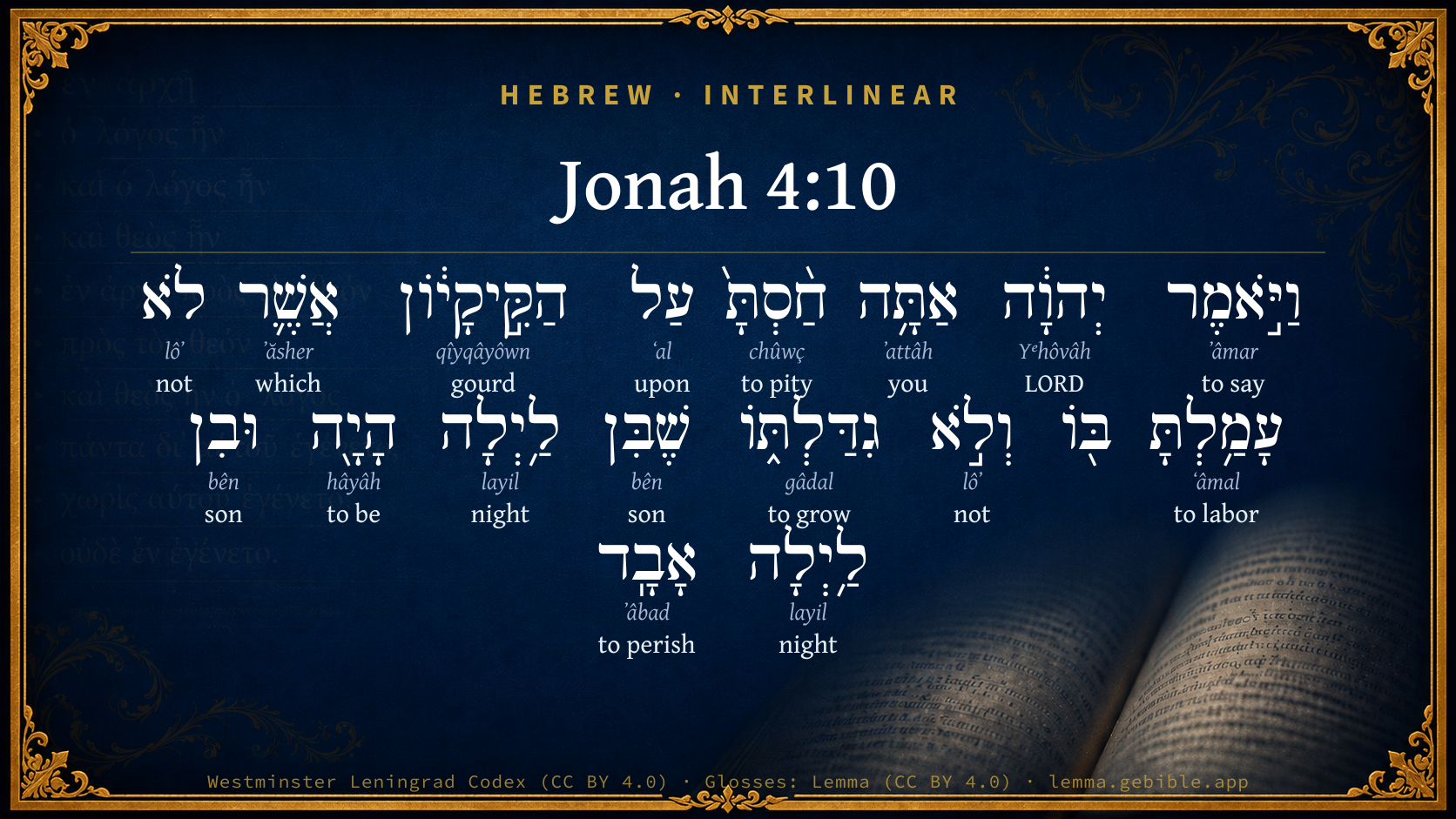
  1. וַיֹּ֣אמֶר ʼâmar H559 “and · to say” Conjunction + Verb, Qal, Sequential Imperfect, 3rd Person, Masculine, Singular
  2. יְהוָ֔ה Yᵉhôvâh H3068 “LORD” Noun, Proper
  3. אַתָּ֥ה ʼattâh H859 “you” Pronoun, Personal, 2nd Person, Masculine, Singular
  4. חַ֨סְתָּ֙ chûwç H2347 “to pity” Verb, Qal, Perfect, 2nd Person, Masculine, Singular
  5. עַל ʻal H5921 “upon” Preposition
  6. אֲשֶׁ֛ר ʼăsher H834 “which” Particle, Relative
  7. לֹא lôʼ H3808 “not” Particle, Negative
  8. עָמַ֥לְתָּ ʻâmal H5998 “to labor” Verb, Qal, Perfect, 2nd Person, Masculine, Singular
  9. וְלֹ֣א lôʼ H3808 “and · not” Conjunction + Particle, Negative
  10. גִדַּלְתּ֑וֹ gâdal H1431 “to grow · him” Verb, Piel, Perfect, 2nd Person, Masculine, Singular + Suffix, Personal, 3rd Person, Masculine, Singular
  11. שֶׁבִּן bên H1121 “who/which · son of” Particle, Relative + Noun, Common, Masculine, Singular, Construct
  12. לַ֥יְלָה layil H3915 “night” Noun, Common, Masculine, Singular, Absolute
  13. הָיָ֖ה hâyâh H1961 “to be” Verb, Qal, Perfect, 3rd Person, Masculine, Singular
  14. וּבִן bên H1121 “and · son of” Conjunction + Noun, Common, Masculine, Singular, Construct
  15. לַ֥יְלָה layil H3915 “night” Noun, Common, Masculine, Singular, Absolute
  16. אָבָֽד ʼâbad H6 “to perish” Verb, Qal, Perfect, 3rd Person, Masculine, Singular

About this verse

These counts appear in no published source. They are computed here, from the morphology-tagged text and Lemma’s own curated glosses. What Lemma adds →

18
words
14
distinct lemmas
Prophets
section

Notable vocabulary

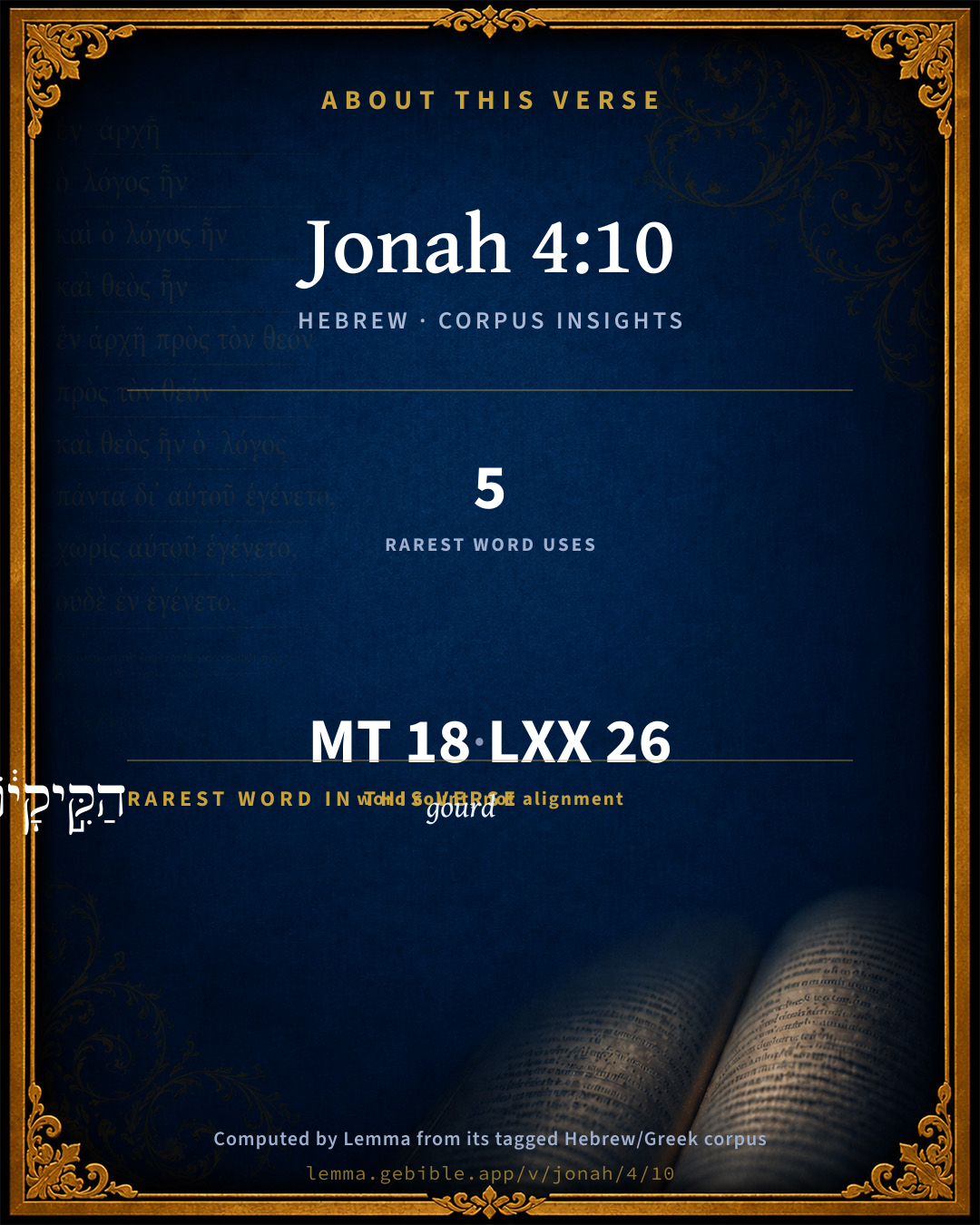
The rarest word here is הַקִּ֣יקָי֔וֹן gourd H7021 — appearing just 5 times in the whole Hebrew Bible.

Shared distinctive vocabulary

הַקִּ֣יקָי֔וֹן gourd H7021 occurs in 4 verses of the Hebrew Bible. Also found in:

Grammatical profile

  • 6 verbs
  • 6 nouns
  • 1 pronoun
  • 2 prepositions
  • 3 particles

Verb forms

  • וַיֹּ֣אמֶר Qal · Sequential Imperfect
  • חַ֨סְתָּ֙ Qal · Perfect
  • עָמַ֥לְתָּ Qal · Perfect
  • גִדַּלְתּ֑וֹ Piel · Perfect
  • הָיָ֖ה Qal · Perfect
  • אָבָֽד Qal · Perfect

Repetition

Words recur within this verse — often emphatic in Hebrew:

  • שֶׁבִּן son H1121 ×2
  • לַ֥יְלָה night H3915 ×2
  • לֹא not H3808 ×2

Hebrew & Septuagint length

In English translation the verse runs 30 words from the Hebrew and 31 from the Septuagint (LXX English) — closely comparable.

A rough comparison of the two English renderings, which tokenize alike — not a word-level alignment.

Word counts can differ between the Hebrew and the Greek without any difference in meaning — e.g. the Hebrew direct-object marker אֵת has no separate Greek word, and Greek often adds the article ὁ.

In the original languages it is 18 Hebrew tokens and 26 Greek tokens — but the two are counted differently (Hebrew bundles its prefixes and suffixes into one token; the Greek is in lemma form), so that isn’t a like-for-like length.

Hebrew and Greek witnesses Masoretic Hebrew ↔ Greek Septuagint

The same verse in the two great witnesses to the Old Testament, shown verse-for-verse.

These are two independent witnesses, not word-aligned to each other, and the Septuagint is shown in lemma (dictionary) form.

Hebrew Jonah 4:10 Masoretic · Westminster Leningrad Codex

וַיֹּ֣אמֶר יְהוָ֔ה אַתָּ֥ה חַ֨סְתָּ֙ עַל הַקִּ֣יקָי֔וֹן אֲשֶׁ֛ר לֹא עָמַ֥לְתָּ בּ֖וֹ וְלֹ֣א גִדַּלְתּ֑וֹ שֶׁבִּן לַ֥יְלָה הָיָ֖ה וּבִן לַ֥יְלָה אָבָֽד

Yahweh said, "You have been concerned for the vine, for which you have not labored, neither made it grow; which came up in a night, and perished in a night.

World English Bible · Public Domain

Greek LXX Jonah 4:10 Septuagint · lemma form

καί εἶπον κύριος σύ φείδομαι ὑπέρ ὁ κολόκυνθα ὑπέρ ὅς οὐ κακοπαθέω ἐπί αὐτός καί οὐ ἐκτρέφω αὐτός ὅς γίγνομαι ὑπό νύξ καί ὑπό νύξ ἀποὀλλύω

And the Lord said, You had pity on the gourd, for which you have not suffered, neither did you rear it; which came up before night, and perished before another night:

LXX2012 (modern English Septuagint) · Public Domain

On this verse, The Pulpit Commentary discusses the Septuagint’s reading. Read the note in Commentary ↓

Hebrew: Westminster Leningrad Codex (CC BY 4.0). Greek: Septuagint (public domain); English from LXX2012 (modern English Septuagint) (Public Domain). How the Septuagint differs from the Hebrew →

Targum (Aramaic paraphrase)

1

The Targum is the ancient Jewish Aramaic paraphrase of the Hebrew Scriptures — an interpretive translation, not the Hebrew text itself. Onkelos (literal) and Pseudo-Jonathan (expansive) render the Torah, and Jonathan the Prophets. Coverage is partial: where no permissively-licensed English translation exists for a verse, only the Aramaic is shown. This is verse-level text, not a word-by-word alignment to the Hebrew.

  1. Targum Jonathan Prophets (Joshua–Malachi)
    וַאֲמַר יְיָ אַתְּ חַסְתָּא עַל קִיקָיוֹן דְלָא עָמַלְתָּ בֵּיהּ וְלָא רַבִּיתֵיהּ דִי בְלֵילְיָא הָדֵין הֲוָה וּבְלֵילְיָא אוֹחֲרָנָא אֲבַד:

    And the LORD said, “You! You had mercy on the gourd which you didn’t work for and you didn’t grow, one night it was there and the next it was gone.

    Targum Jonathan — Aramaic: “Mikraot Gedolot” (public domain). English: “Sefaria Community Translation” (CC0 1.0 (public-domain dedication)); “London "Chaldee Paraphrase," 1871” (public domain). Text via Sefaria.

Commentary

Notes on Jonah 4:10 from classic Christian and Jewish commentators (each source and its license shown beneath its notes). The classic Christian expositions comment on the surrounding passage and are grouped to its opening verse, so a note may address several verses; the Jewish commentaries on the Tanakh (Rashi and others) are per-verse, so they appear only where the commentator wrote on this verse.

Lemma curates 59 commentaries, every one of them public domain or Creative Commons licensed, each selected and text-cleaned for this edition rather than reprinted as found. About our sources →

Trapp's Complete Commentary

John Trapp

Jon 4:10 Then said the LORD, Thou hast had pity on the gourd, for the which thou hast not laboured, neither madest it grow; which came up in a night, and perished in a night:

Ver. 10. Then said the Lord] He did not roar upon Jonah, nor run upon him with a drawn sword, even on his neck, upon the thick bosses of his bucklers, Job 15:26; but gently said unto him, that he might the more admire his own impotence and God’s lenity; both which he studiously describeth all along this prophecy; a good sign of his sound repentance.

Thou hast had pity on the gourd] Here is the end, scope, and application of the parable; whereby it appeareth that God prepared not the gourd so much for the ease and use of Jonah’s body as for a medicine to his soul, convincing him of the iniquity both of his ways and wishes, by an argument drawn from the less to the greater; and confuting him by a comparison. Thou, a sinful and wretched man, hast had pity, or spared, and art sorry it perished. The gourd a sorry shrub, a mean mushroom, and none of thine either, but as lent thee; Alas, master, said they, it was but borrowed.

For the which thou hast not laboured] And so canst not be so fast affected to it. For all men love their own works rather than other men’s, as parents and poets, saith Aristotle (παντες αγαπωσι μαλλον τα εργα αυτων. Ethic. 1, 4); proving thereby, that those which have received their riches from their parents are more liberal than they which have gotten them by their own labour.

Neither madest it grow] Thou hast neither planted nor watered it, or any way added to it, by thine industry; for that also was no part of thy pains, but mine. Not that God laboureth about his creatures, for he doth all his work without tool or toil, Isa 40:28; but this, as many other things in Scripture, are spoken after the manner of men, and so must be taken.

Which came up in a night] Heb. was the son of a night, not without a miracle; though Pliny speaks of the quick and wonderful growth of this shrub.

And perished in a night] Cito oriens, cito itidem moriens, quickly come, and as quickly gone; a fit emblem of earth’s happiness. Surely man walketh in a vain show; foenea quadam faelicitate temporaliter florens: they shall soon be cut down like the grass, and wither as the green herb. They are but ημεροβιοι; their life is but a day (and such a day too, as no man is sure to have twelve hours to it), as this gourd was but of one day’s continuance, as it came up in a night, so it perished the next; cito crevit, cito decrevit, repente prolatus, repente sublatus, quickly created, quickly destroyed, suddenly coming, suddenly cut down, of very small continuance (Tarnov.).

John Trapp, A Commentary or Exposition upon All the Books of the Old and New Testament (1647–1656) — public domain. Text from a community e-Sword module.

The Biblical Illustrator

Joseph S. Exell

Jon_4:10-11

Thou hast had pity on the gourd.

Jonahs gourd

There is no mention of Israel in this Book of Jonah. It is concerned solely about the welfare of a foreign nation. There can be no doubt that the spirit of the book is entirely opposed to Jewish feeling. While its form is historical, in substance it is prophetical. It contains great and important truths which Israel was in danger of overlooking, and foreshadows a time when Gods mercy towards mankind should no longer be restrained within the limits of the seed of Jacob. All the concern of the writer is to point a moral lesson. The exclusive spirit which regarded all nations as made to subserve the welfare of Israel was always hateful to God. But Jonah is scarcely to be blamed for not seeing what many excellent Christians have failed to see. We must not throw stones at Jonah, for our own houses are sufficiently brittle. Look at the lesson of the gourd. It had cost him nothing, his wisdom had not provided it, nor his care cherished its growth, yet he resented the loss of it as a personal injury. It was a parable designed to convey a needful lesson to abate Jonahs peevish grief at the sparing of Nineveh. God answered Jonah by dealing with the plant as Jonah would have had Him deal with Nineveh. What was there, then, in Nineveh, which answered to the consolation Jonah derived from the plant? Its sentient life and evident happiness, the work of Gods hands, unspoiled as yet by human wickedness, was Gods gourd, the consolation of His heart when the hot wind of Ninevehs wickedness blew upon Him. He could not bear the thought of sending the pestilence to crush in pain and death all this innocent life and enjoyment, or of giving up these tender little ones to the cruel carnage of savage foes. Judgment is His strange work, and only when absolutely necessary will He sacrifice the innocent and helpless for the sake of punishing the world and purifying its moral atmosphere. This is a very beautiful lesson. It sheds a shaft of tender light into Gods dealings with mankind. God will not let the happiness of creation be sacrificed for the sake of punishing human Corruption. The final lesson of this Book of Jonah is full of encouragement, and gives us a conception of God which is scarcely surpassed even in the New Testament. He is represented as more merciful than His servant, and as possessed of far wider sympathies. If God were not more merciful than man there would be little hope for us. Repentance instantly calls forth Divine mercy. The prayer of the contrite no sooner reaches His ear than the justifying word goes forth. (E. W. Shalders, B. A.)

The Biblical Illustrator, edited by Joseph S. Exell (c. 1880s–1900s) — public domain. Text from a community e-Sword module.

Joseph Benson's Commentary

Jon 4:10. Then said the Lord — Jonah having thus showed his love and pity for the gourd, God proceeds to judge him out of his own mouth; Thou hast had pity on the gourd, &c. — Thou deplorest the loss of the gourd, and thinkest it a severe misfortune to thee, and hard that thou shouldest be deprived of it, though it was not made by thee, came up without any labour of thine, and was by its nature of a short duration: — if this is the case with thee in regard to a mean, short-lived plant, think how unjustly thou judgest, when thou condemnest my mercy toward the Ninevites! How much more severe would it have been to have destroyed a whole city, in the ruin of which many innocent creatures, as children and brute animals, must necessarily have been involved; and, what is still more awful, many immortal beings have been plunged into everlasting misery! If thou supposest I ought to have spared or preserved the gourd, because it shaded thee from the heat; think how much more my essential goodness and kindness toward my creatures, the work of my hands, must incline me to spare them whenever it can be done any way consistently with my justice or the laws of my government.

Joseph Benson's Commentary on the Old and New Testaments (1811–1818) — public domain. Text from a community e-Sword module.

Jamieson, Fausset & Brown

Robert Jamieson, A. R. Fausset & David Brown

The main lesson of the book. If Jonah so pities a plant which cost him no toil to rear, and which is so short lived and valueless, much more must Jehovah pity those hundreds of thousands of immortal men and women in great Nineveh whom He has made with such a display of creative power, especially when many of them repent, and seeing that, if all in it were destroyed, "more than six score thousand" of unoffending children, besides "much cattle," would be involved in the common destruction: Compare the same argument drawn from God's justice and mercy in . A similar illustration from the insignificance of a plant, which "to-day is and to-morrow is cast into the oven," and which, nevertheless, is clothed by God with surpassing beauty, is given by Christ to prove that God will care for the infinitely more precious bodies and souls of men who are to live for ever (). One soul is of more value than the whole world; surely, then, one soul is of more value than many gourds. The point of comparison spiritually is the need which Jonah, for the time being, had of the foliage of the gourd. However he might dispense with it at other times, now it was necessary for his comfort, and almost for his life. So now that Nineveh, as a city, fears God and turns to Him, God's cause needs it, and would suffer by its overthrow, just as Jonah's material well-being suffered by the withering of the gourd. If there were any hope of Israel's being awakened by Nineveh's destruction to fulfil her high destination of being a light to surrounding heathenism, then there would not have been the same need to God's cause of Nineveh's preservation, (though there would have always been need of saving the penitent). But as Israel, after judgments, now with returning prosperity turns back to apostasy, the means needed to vindicate God's cause, and provoke Israel, if possible, to jealousy, is the example of the great capital of heathendom suddenly repenting at the first warning, and consequently being spared. Thus Israel would see the kingdom of heaven transplanted from its ancient seat to another which would willingly yield its spiritual fruits. The tidings which Jonah brought back to his countrymen of Nineveh's repentance and rescue, would, if believingly understood, be far more fitted than the news of its overthrow to recall Israel to the service of God. Israel failed to learn the lesson, and so was cast out of her land. But even this was not an unmitigated evil. Jonah was a type, as of Christ, so also of Israel. Jonah, though an outcast, was highly honored of God in Nineveh; so Israel's outcast condition would prove no impediment to her serving God's cause still, if only she was faithful to God. Ezekiel and Daniel were so at Babylon; and the Jews, scattered in all lands as witnesses for the one true God, pioneered the way for Christianity, so that it spread with a rapidity which otherwise was not likely to have attended it [FAIRBAIRN].

Jamieson, Fausset & Brown — Commentary Critical and Explanatory on the Whole Bible (1871) — public domain (CC PDM 1.0). Text via the HelloAO Bible API.

Adam Clarke's Commentary

Verse 10. Which came up in a night] St. Jerome, speaking of this plant, the kikayon, assigns to it an extraordinary rapidity of growth. It delights in a sandy soil, and in a few days what was a plant grows into a large shrub. But he does not appear to have meant the ricinus; this however is the most likely. The expressions coming up in a night and perishing in a night are only metaphorical to express speedy growth and speedy decay; and so, as we have seen, the Chaldee interprets it, די בליליא הדי הוה ובליליא אוחרנא אבד "which existed this night but in the next night perished;" and this I am satisfied is the true import of the Hebrew phrase.

Adam Clarke's Commentary on the Bible (1810–1826) — public domain. Text from a community e-Sword/MySword module.

John Calvin's Commentaries

Here God explains the design he had in suddenly raising up the gourd, and then in causing it to perish or wither through the gnawing of a worm; it was to teach Jonah that misconduct towards the Ninevites was very inhuman. Though we find that the holy Prophet had become a prey to dreadful feelings, yet God, by this exhibition, does in a manner remind him of his folly; for, under the representation of a gourd, he shows how unkindly he desired the destruction of so populous a city as Nineveh.

Yet this comparison may appear ill suited for the purpose. Jonah felt sorry for the gourd, but he only regarded himself: hence he was displeased, because the relief with which he was pleased was taken away from him. As then this inconvenience had driven Jonah to anger, the similitude may not seem appropriate when God thus reasons, Thou wouldest spare the gourd, should I not spare this great city? Nay, but he was not concerned for the gourd itself: if all the gourds of the world withered, he would not have been touched with any grief; but as he felt the greatest danger being scorched by the extreme heat of the sun, it was on this account that he was angry. To this I answer, — that though Jonah consulted his own advantage, yet this similitude is most suitable: for God preserves men for the purpose for which he has designed them. Jonah grieved for the withering of the gourd, because he was deprived of its shade: and God does not create men in vain; it is then no wonder that he wishes them to be saved. We hence see that Jonah was not unsuitably taught by this representation, how inhumanely he conducted himself towards the Ninevites. He was certainly but one individual; since then he made such an account of himself and the gourd only, how was it that he cast aside all care for so great and so populous a city? Ought not this to have come to his mind, that it was no wonder that God, the Creator and Father, had a care for so many thousands of men? Though indeed the Ninevites were alienated from God, yet as they were men, God, as he is the Father of the whole human race, acknowledged them as his own, at least to such an extent as to give them the common light of day, and other blessings of earthly life. We now then understand the import of this comparison: “Thou wouldest spare,” he says, “the gourd, and should I not spare this great city?”

It hence appears how frivolous is the gloss of Jerome, — that Jonah was not angry on account of the deliverance of the city, but because he saw that his own nation would, through its means, be destroyed: for God repeats again that Jonah’s feeling was quite different, — that he bore with indignity the deliverance of the city from ruin. And less to be endured it is still, that Jerome excuses Jonah by saying that he nobly and courageously answered God, that he had not sinned in being angry even to death. That man dared, without any shame or discernment, to invent a pretense that he might excuse so disgraceful an obstinacy. But it is enough for us to understand the real meaning of the Prophet. Here then he shows, according to God’s representation, that his cruelty was justly condemned for having anxiously desired the destruction of a populous city.

But we ought to notice all the parts of the similitudes when he says, Thou wouldest have spared, etc. There is an emphasis in the pronoun אתה, ate, for God compares himself with Jonah; “Who art thou? Doubtless a mortal man is not so inclined to mercy as I am. But thou takest to thyself this right — to desire to spare the gourd, even thou who art made of clay. Now this gourd is not thy work, thou hast not labored for it, it has not proceeded from thy culture or toil; and further, thou hast not raised it up, and further still, it was the daughter of a night, and in one night it perished; it was an evanescent shrub or herb. If then thou regardest the nature of the gourd, if thou regardest thyself, and joinest together all the other circumstances, thou wilt find no reason for thy hot displeasure. But should not I, who am God, in whose hand are all things, whose prerogative and whose constant practice it is mercifully to bear with men — should not I spare them, though they were worthy of destruction? and should not I spare a great city? The matter here is not concerning a little plant, but a large number of people. And, in the last place, it is a city, in which there are a hundred and twenty thousand men who know not how to distinguish between their right hand and the left.”

We now then see how emphatical are all the parts of this comparison. And though God’s design was to reprove the foolish and sinful grief of Jonah, we may yet further collect a general instruction by reasoning in this manner, “We feel for one another, and so nature inclines us, and yet we are wicked and cruel. If then men are inclined to mercy through some hidden impulse of nature, what may not be hoped from the inconceivable goodness of God, who is the Creator of the whole world, and the Father of us all? and will not he, who is the fountain of all goodness and mercy spare us?”

John Calvin's Commentaries (1540-1563) — public domain. Text from the Calvin Translation Society English edition (1840s-50s) via the Christian Classics Ethereal Library (ccel.org). Calvin's coverage is partial (roughly two-thirds of the Bible); uncommented books and verses are honest gaps, never fabricated. The 19th-century editor's footnotes and remarks are omitted so the notes are faithfully Calvin's own voice.

Ellicott's Commentary for English Readers

(10) Which came up.—The original is one of those forcible idioms impossible to reproduce, which son of a night was, and son of a night perished.

A Bible Commentary for English Readers, edited by Charles John Ellicott (1878–1897) — public domain. Text from a community e-Sword module.

The Cambridge Bible for Schools and Colleges

gen. ed. J. J. S. Perowne

10. for the which thou hast not laboured, neither madest it grow] The principle on which the contrast implied by these words rests is that the effort which we have bestowed upon any object, the degree in which our powers of mind or heart or body have been expended upon it, in a word what it has cost us, is a measure of our regard for it. No claim of this kind had the plant on Jonah. No single effort had he made for it. He had not planted, or trained, or watered it, yet he pitied it, and mourned for its decay with a yearning tenderness. But on Almighty God, though the contrast is rather implied than expressed, all creation has such a claim in fullest measure. He “labours” not indeed; He speaks, and it is done; He wills, and it is accomplished. Yet in all things that exist He has the deepest interest. He planned them, He made them, He sustains them, He rules them, He cares for them. His tender mercies are over all His works. “This entire train of thought,” as Kalisch well remarks, “is implied in the following fine lines of the Wisdom of Solomon: ‘The whole world is before Thee as a drop of the morning dew; but Thou hast mercy upon all … and overlookest the sins of men, in order that they may amend; for Thou lovest all the things that are, and disdainest nothing that Thou hast made.… Indeed Thou sparest all, for they are Thine, O Lord, Thou lover of souls.’ Wis_11:22-26.”

came up in a night &c.] lit. was the son of a night, and perished the son of a night, i. e. it came into existence and reached maturity (comp. for this sense of was, And God said Let light be, and light was, Gen_1:3) in a single night, and no less rapidly (not literally in a single night, for it was when the morning arose) withered away.

10, 11.] The final appeal is forcible and conclusive, a grand and worthy climax to this remarkable book. The contrasts are striking and designed: Thou and I (the pronouns are emphatic, and each of them introduces a member of the comparison), man and God; the short-lived palmchrist and Nineveh that great city; the plant that cost thee nothing, the vast population, the sixscore thousand children, the very much cattle, which I made and uphold continually. Jonah is met upon his own ground, the merely human sentiment of compassion, regard for what is useful and good after its kind, sorrow for its loss, unwillingness to see it perish. The higher moral ground is for the time abandoned. The repentance of the Ninevites is not brought into consideration. But the lower ground is a step to the higher. “The natural God-implanted feeling is the germ of the spiritual.”

The Cambridge Bible for Schools and Colleges (gen. ed. J. J. S. Perowne; Cambridge University Press, 1878–1918) — public domain. Text from a community e-Sword module.

John Gill's Exposition

Then said the Lord, thou hast had pity on the gourd,.... Or, "hast spared it" (c); that is, would have spared it, had it lain in his power, though but a weeds and worthless thing:

for the which thou hast not laboured; in digging the ground, and by sowing or planting it; it being raised up at once by the Lord himself, and not by any, human art and industry; nor by any of his:

neither madest it grow; by dunging the earth about it, or by watering and pruning it:

which came up in a night, and perished in a night; not in the same night; for it sprung up one night, continued a whole any, and then perished the next night. The Targum is more explicit,

"which was in this (or one) night, and perished in another night;''

by all which the Lord suggests to Jonah the vast difference between the gourd he would have spared, and for the loss of which he was so angry, and the city of Nineveh the Lord spared, which so highly displeased him; the one was but an herb, a plant, the other a great city; that a single plant, but the city consisted of thousands of persons; the plant was not the effect of his toil and labour, but the inhabitants of this city were the works of God's hands. In the building of this city, according to historians (d) a million and a half of men were employed eight years together; the plant was liken mushroom, it sprung up in a night, and perished in one; whereas this was a very ancient city, that had stood ever since the days of Nimrod.

(c) "pepercisiti", Pagninus, Montanus, Mercerus, Burkius; "pepercisses", Piscator. (d) Eustathius in Dionys. Perieg. p. 125.

John Gill's Exposition of the Whole Bible (1746–1763) — public domain (CC PDM 1.0). Text via the HelloAO Bible API.

Albert Barnes' Notes on the Bible

Thou hadst pity on the palm-christ - In the feeling of our common mortality, the soul cannot but yearn over decay. Even a drooping flower is sad to look on, so beautiful, so frail. It belongs to this passing world, where nothing lovely abides, all things beautiful hasten to cease to be. The natural God-implanted feeling is the germ of the spiritual.

Albert Barnes' Notes on the Bible (1834–1885) — public domain. Text from a community e-Sword/MySword module.

Haydock's Catholic Bible Commentary

CHAPTER IV.

George Leo Haydock (1774–1849), Haydock's Catholic Family Bible and Commentary, 1859 edition — public domain. Excludes Psalms (Douay-Rheims chapter numbering differs from Protestant) and Deuterocanonical books (Catholic canon only).

Matthew Poole's English Annotations

Then, when Jonah had showed his affection of love and pity to the gourd,

said the Lord; showed Jonah the little reason he had to concern himself for the gourd, and the great reason God had on his side in pitying and sparing Nineveh.

Thou, a man, of narrow and uneven compassions,

hast both

had and showed pity on the gourd, a common and worthless weed.

For the which thou hast not laboured; it was not the work of thy hand to set it.

Neither madest it grow; nor didst thou water, and give growth to it; it was not thine.

Which came up, as a mushroom, was the birth of one night,

and perished, died, and was only fit for the fire when withered, in a night; with equal suddenness withered.

Matthew Poole's English Annotations on the Holy Bible (1683–1685) — public domain. Text from a community e-Sword/MySword module.

Whedon's Commentary on the Bible

Daniel D. Whedon

10, 11. By his answer Jonah unwittingly offers Jehovah the opportunity to put him to shame. The prophet’s attitude is absurd. He grieves over the destruction of an insignificant plant, in which he could have no vital interest; he had expended no labor upon it, nor had he caused its growth. How absurd to find fault with Jehovah for sparing Nineveh with its thousands of inhabitants! The two verses are full of marked contrasts.

Thou… I — The pronouns are emphatic in Hebrew.

Gourd… Nineveh — The former small and insignificant, the latter great and magnificent. The superiority of the latter’s claim upon the divine mercy is further indicated:

That cannot discern between their right hand and their left hand — Children of the tenderest age. They have as yet done no wrong; surely for their sake alone God would be justified in saving the city. The age limit to which this expression may be applied is variously estimated. Some think of three years, others of seven. The latter is favored by the fact that among Orientals seven years seems to be a favorite period by which to reckon childhood. Since, as commonly estimated, children under seven years of age constitute about one fifth of the entire population, the number given here would make the population of Nineveh about six hundred thousand. If the other estimate is accepted the number would be considerably increased. Nineveh proper cannot have contained such a large population; the city in its widest extent must be in the mind of the author (see on Jon_3:3).

Much cattle — The animals also were guiltless. Besides, as Calvin remarks, “Oxen were certainly superior to shrubs. If Jonah was right in grieving over one withered shrub, it would surely be a harder and more cruel thing for so many innocent animals to perish.” An additional reason for the divine mercy is at least implied. Jonah had expended no labor upon the plant, but how much effort and care had Jehovah bestowed upon the population of Nineveh! The fact that he sent a prophet to preach there (Jon_1:2; Jon_3:2) was evidence of his interest in the city. Could he cast off the inhabitants when they turned to him?

What an insight these words give into the divine love and mercy, into the very heart of God! Jonah had condemned himself; “he was obliged to keep silent, defeated, as it were, by his own sentence.”

Daniel D. Whedon (gen. ed.), Commentary on the Old and New Testaments (1874–1909) — public domain. Text from a community e-Sword module.

The Pulpit Commentary

The Lord. Jehovah. closing the story, and driving home the lesson with unanswerable force, the prophet himself being the judge. Thou hast had pity; thou on thy part hast spared; Septuagint, su efeisw . For the which thou hast not laboured; Septuagint, upeyhsav ep authn , "for which thou sufferedst no evil." The more trouble a thing costs us, the more we regard it, as a mother loves her sickly child best. Neither madest it grow. As God had made Nineveh into a "great city." Which came up in a night, and perished in a night; literally, which was the son of a night, and perished the son of a night. The allusion, of course, is to the extraordinary rapidity of the growth and destruction of the gourd.

Vers. 10, 11. The breadth of the Divine piety.

The close of this very remarkable book is deserving of attention and admiration, as evidently gathering up and exhibiting the purpose for which this composition was designed. Of all things apprehensible by us nothing is equal in interest to the character of the Supreme Ruler and Lord. This is depicted in this closing passage of the narrative and prophecy in the most attractive, encouraging, and glorious colours.

I GOD"S PITY CONTRASTS WITH MAN"S HARDNESS AND SEVERITY. Jonah, though a prophet of the Lord, would have witnessed the destruction of Nineveh with equanimity and even satisfaction. It might have been supposed that a sinful and fallible being would have been more compassionate. But for the supreme illustration of pity we must look to the Father of all.

II GOD"S PITY IS EXCITED BY THE SPECTACLE OF A GREAT AND POPULOUS COMMUNITY IN DANGER OF DESTRUCTION. Nineveh was at the other end of the scale, so to speak, from the palmcrist which grew up and perished in a few hours. It was an ancient, vast, populous, powerful, famous city. "Should I not spare," asked God of Jonah, "Nineveh, that great city?" There is in this language something which appeals to our heart. God is represented in the most amiable and attractive light. Such sentiments as these will be cherished by God-like men, by those Christ-like hearts that sympathize with him who beheld Jerusalem, and wept over it,

III GOD"S PITY IS INTENSIFIED BY THE SPECTACLE OF LITTLE CHILDREN EXPOSED TO DESTRUCTION. By those who are described as unable to discern between their right hand and their left we may well understand babes and young children who had not sinned. Yet these were in danger of being overtaken by the one common calamity and ruin. The tender heart of the All-Father was touched by the possibility of such a catastrophe. And when it was possible to avert it in harmony with the principles of the Divine government, and so as not to endanger the spiritual interests of humanity it was a joy to the heart of God to spare the city and the babes of the city"s household.

APPLICATION.

1. Let the hearers of the gospel take advantage of the sparing mercy of theLord.

2. Let the preachers of the gospel proclaim the sparing mercy of the Lord.

3. Let all Christians sympathize with, delight in, and imitate, the sparingmercy of the Lord.

The Pulpit Commentary (1880–1919), ed. H.D.M. Spence-Jones & Joseph S. Exell — public domain. Text from a community e-Sword module.

John Wesley's Explanatory Notes

laboured - Thou didst not set it. Grow - Nor didst thou water or give growth to it.

John Wesley, Explanatory Notes Upon the Whole Bible (1754–1765) — public domain. Text via the GEBible commentary corpus.

unfoldingWord translationNotes

Door43 World Missions Community

Yahweh said

It may be helpful to say that Yahweh was speaking to Jonah. AT: "Yahweh said to Jonah" (See: Assumed Knowledge and Implicit Information)

should I not have compassion for Nineveh, that great city ... cattle?

God used this question to emphasize his claim that he should have compassion on Nineveh. AT: "I certainly should have compassion for Nineveh, that important city ... cattle." (See: Rhetorical Question)

in which there are more

This can also be the beginning of a new sentence. AT: "There are more" or "It has more"

one hundred and twenty thousand people

120,000 people (See: Numbers)

who do not know the difference between their right hand and their left hand

This may be a way of saying "they cannot tell the difference between right and wrong."

also many cattle

The author is pointing out the depth of Nineveh's repentance to the extent that Yahweh takes note of the beasts' participation in the act of repentance. (See: Background Information)

translationWords

Yahweh

compassion

labor

Nineveh

unfoldingWord translationNotes — © Distant Shores Media and the Door43 World Missions Community, licensed CC BY-SA 4.0. Source: git.door43.org/Door43/en_tn.

Rashi

Rabbi Shlomo Yitzchaki (Rashi)

for which you did not toil—with plowing, sowing, or watering.

one night Heb. בִּן-לַיְלָה, lit., one night old, like בֶּן לַיְלָה. It grew only one night.

Rashi on the Tanakh — English translations: “The Judaica Press complete Tanach with Rashi, translated by A. J. Rosenberg” (CC BY 4.0); “Pentateuch with Rashi's commentary by M. Rosenbaum and A.M. Silbermann, 1929-1934” (public domain); “The Metsudah Tanach series, Lakewood, N.J” (CC BY 4.0); and “The Book of Joshua, Metsudah Publications, 1997” (CC BY 4.0). Text via Sefaria.

Lesson kit

Teaching starters — assembled from the data on this page, not authored interpretation. Every prompt links to the verse data it draws on. Edit before teaching.

Jonah, in the Prophets, opens this verse with 18 words (14 distinct Hebrew lemmas). Its most distinctive word is qîyqâyôwn (“gourd”). A historical commentator’s framing appears above. Read the whole chapter for the surrounding context.

Discussion questions

  1. What does “gourd” (qîyqâyôwn) contribute to the verse as a whole?
  2. How does Jonah 4:6, which shares the word «gourd», read alongside this verse?
  3. What does the repetition of “son” (2× in this one verse) do in this verse?
  4. The translations on this page render this verse differently — a whole-verse word diff, not a word-by-word alignment. What might account for the different wordings?
  5. «וַיֹּ֣אמֶר» is a Qal Sequential Imperfect verb. How does that grammatical form shape the action described?
  6. Compare how Trapp's Complete Commentary and The Biblical Illustrator read this verse. Where do they agree or differ?

Things to notice

Reading settings

Reading text

Shown beneath each verse's original-language words.

Old Testament
Old Testament edition

Read the OT as the Masoretic Hebrew (MT) or the Greek Septuagint (LXX).

English shown for the Greek Septuagint (in the Hebrew ↔ Greek comparison).

Comparing translations? Open the Compare panel on any verse page to stack up to four side by side.