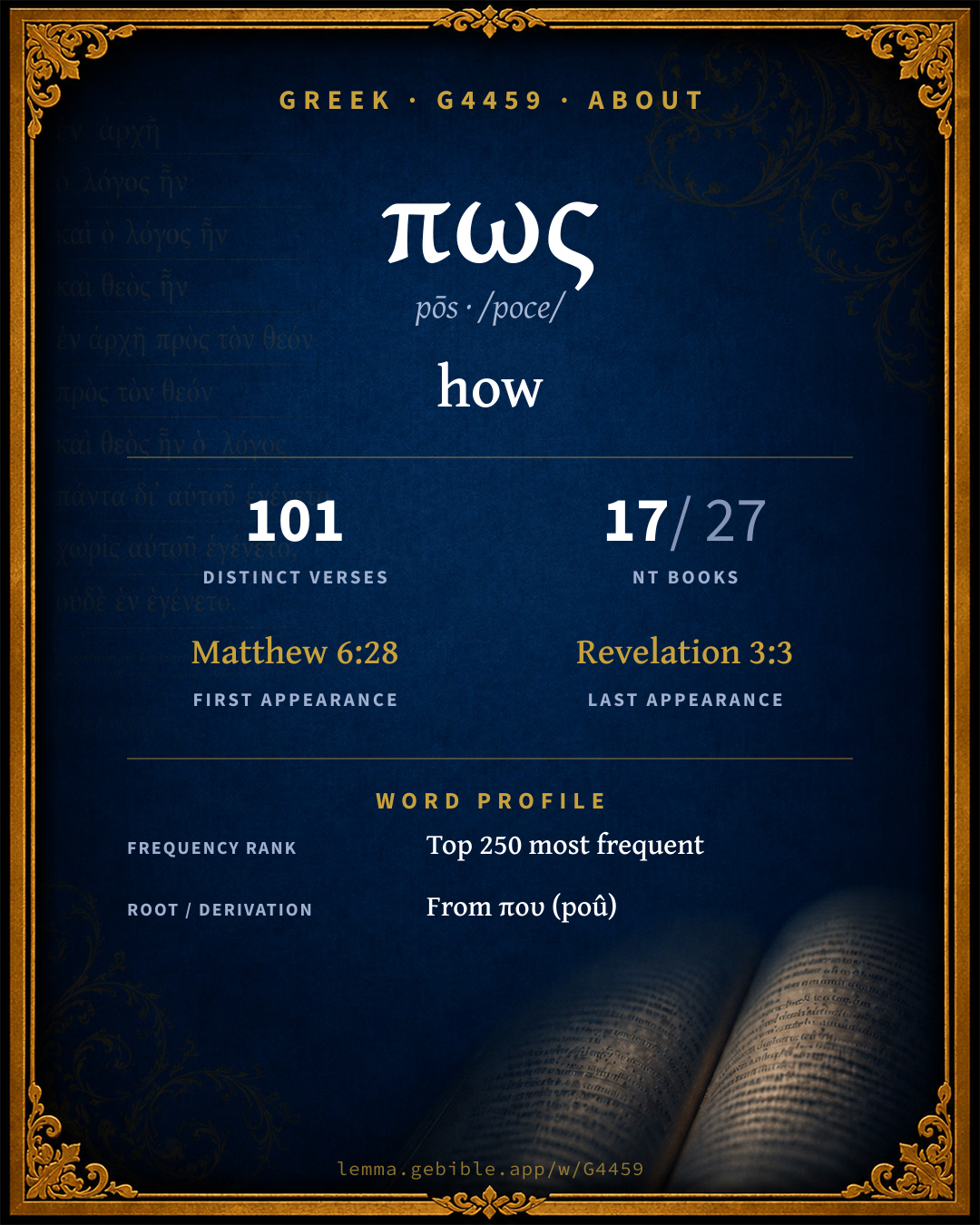
πῶς
how
Full lexicon entry — Thayer's Greek Lexicon
From Thayer's Greek Lexicon
Where this word appears
Grammar key — what these labels mean
Part of speech
- Adverb
- A word that modifies a verb, adjective, or other adverb.
Degree
- Interrogative
- Marks an interrogative form.
Grammatical forms
- Adverb, Interrogative 77 times (74%)
- Adverb 27 times (26%)
Parsed forms decoded from the imported morphology (Robinson–Tischendorf, public domain), counted across 104 parsed occurrences — not distinct verses.
Every verse where G4459 appears — 101 distinct verses across 17 books. Click any verse to open its interlinear word-by-word view. Verse text shown in the World English Bible for context — . Each verse’s Greek form is shown with its reference; the English is not keyword-highlighted, since the data carries no word-level English alignment. Use “Compare translations” on any verse to read it across multiple English versions. This concordance covers the Greek New Testament; Septuagint (Greek Old Testament) occurrences of this word are not indexed here.
Matthew 14 verses
- Matthew 6:28 πῶς adv Why are you anxious about clothing? Consider the lilies of the field, how they grow. They don't toil, neither do they spin,
- Matthew 7:4 πῶς adv interrog Or how will you tell your brother, 'Let me remove the speck from your eye;' and behold, the beam is in your own eye?
- Matthew 10:19 πῶς adv interrog But when they deliver you up, don't be anxious how or what you will say, for it will be given you in that hour what you will say.
- Matthew 12:4 πῶς adv how he entered into the house of God, and ate the show bread, which was not lawful for him to eat, neither for those who were with him, but only for the priests?
- Matthew 12:26 πῶς adv interrog If Satan casts out Satan, he is divided against himself. How then will his kingdom stand?
- Matthew 12:29 πῶς adv interrog Or how can one enter into the house of the strong man, and plunder his goods, unless he first bind the strong man? Then he will plunder his house.
- Matthew 12:34 πῶς adv interrog You offspring of vipers, how can you, being evil, speak good things? For out of the abundance of the heart, the mouth speaks.
- Matthew 16:11 πῶς adv interrog How is it that you don't perceive that I didn't speak to you concerning bread? But beware of the yeast of the Pharisees and Sadducees."
- Matthew 21:20 πως adv interrog When the disciples saw it, they marveled, saying, "How did the fig tree immediately wither away?"
- Matthew 22:12 πως adv interrog and he said to him, 'Friend, how did you come in here not wearing wedding clothing?' He was speechless.
- Matthew 22:43 πῶς adv interrog He said to them, "How then does David in the Spirit call him Lord, saying,
- Matthew 22:45 πῶς adv interrog "If then David calls him Lord, how is he his son?"
- Matthew 23:33 πῶς adv interrog You serpents, you offspring of vipers, how will you escape the judgment of Gehenna?
- Matthew 26:54 πῶς adv interrog How then would the Scriptures be fulfilled that it must be so?"
Mark 15 verses
- Mark 2:26 πῶς adv How he entered into the house of God when Abiathar was high priest, and ate the show bread, which it is not lawful to eat except for the priests, and gave also to those who were with him?"
- Mark 3:23 πῶς adv interrog He summoned them, and said to them in parables, "How can Satan cast out Satan?
- Mark 4:13 πῶς adv interrog He said to them, "Don't you understand this parable? How will you understand all of the parables?
- Mark 4:30 πῶς adv interrog He said, "How will we liken the Kingdom of God? Or with what parable will we illustrate it?
- Mark 4:40 πῶς adv interrog He said to them, "Why are you so afraid? How is it that you have no faith?"
- Mark 5:16 πῶς adv Those who saw it declared to them how it happened to him who was possessed by demons, and about the pigs.
- Mark 9:12 πῶς adv interrog He said to them, "Elijah indeed comes first, and restores all things. How is it written about the Son of Man, that he should suffer many things and be despised?
- Mark 10:23 πῶς adv Jesus looked around, and said to his disciples, "How difficult it is for those who have riches to enter into the Kingdom of God!"
- Mark 10:24 πῶς adv The disciples were amazed at his words. But Jesus answered again, "Children, how hard is it for those who trust in riches to enter into the Kingdom of God!
- Mark 11:18 πῶς adv interrog The chief priests and the scribes heard it, and sought how they might destroy him. For they feared him, because all the multitude was astonished at his teaching.
- Mark 12:26 πῶς adv interrog But about the dead, that they are raised; haven't you read in the book of Moses, about the Bush, how God spoke to him, saying, 'I am the God of Abraham, the God of Isaac, and the God of Jacob?'
- Mark 12:35 πῶς adv interrog Jesus responded, as he taught in the temple, "How is it that the scribes say that the Christ is the son of David?
- Mark 12:41 πῶς adv Jesus sat down opposite the treasury, and saw how the multitude cast money into the treasury. Many who were rich cast in much.
- Mark 14:1 πῶς adv interrog It was now two days before the feast of the Passover and the unleavened bread, and the chief priests and the scribes sought how they might sieze him by deception, and kill him.
- Mark 14:11 πῶς adv interrog They, when they heard it, were glad, and promised to give him money. He sought how he might conveniently deliver him.
Luke 16 verses
- Luke 1:34 πῶς adv interrog Mary said to the angel, "How can this be, seeing I am a virgin?"
- Luke 6:42 πῶς adv interrog Or how can you tell your brother, 'Brother, let me remove the speck of chaff that is in your eye,' when you yourself don't see the beam that is in your own eye? You hypocrite! First remove the beam from your own eye, and then you can see clearly to remove the speck of chaff that is in your brother's eye.
- Luke 8:18 πῶς adv Be careful therefore how you hear. For whoever has, to him will be given; and whoever doesn't have, from him will be taken away even that which he thinks he has."
- Luke 8:36 πῶς adv Those who saw it told them how he who had been possessed by demons was healed.
- Luke 10:26 πῶς adv interrog He said to him, "What is written in the law? How do you read it?"
- Luke 11:18 πῶς adv interrog If Satan also is divided against himself, how will his kingdom stand? For you say that I cast out demons by Beelzebul.
- Luke 12:11 πῶς adv interrog When they bring you before the synagogues, the rulers, and the authorities, don't be anxious how or what you will answer, or what you will say;
- Luke 12:27 πῶς adv Consider the lilies, how they grow. They don't toil, neither do they spin; yet I tell you, even Solomon in all his glory was not arrayed like one of these.
- Luke 12:50 πῶς adv But I have a baptism to be baptized with, and how distressed I am until it is accomplished!
- Luke 12:56 πῶς adv interrog You hypocrites! You know how to interpret the appearance of the earth and the sky, but how is it that you don't interpret this time?
- Luke 14:7 πῶς adv He spoke a parable to those who were invited, when he noticed how they chose the best seats, and said to them,
- Luke 18:24 πῶς adv Jesus, seeing that he became very sad, said, "How hard it is for those who have riches to enter into the Kingdom of God!
- Luke 20:41 πῶς adv interrog He said to them, "Why do they say that the Christ is David's son?
- Luke 20:44 πῶς adv interrog "David therefore calls him Lord, so how is he his son?"
- Luke 22:2 πῶς adv interrog The chief priests and the scribes sought how they might put him to death, for they feared the people.
- Luke 22:4 πῶς adv interrog He went away, and talked with the chief priests and captains about how he might deliver him to them.
John 20 verses
- John 3:4 πῶς adv interrog Nicodemus said to him, "How can a man be born when he is old? Can he enter a second time into his mother's womb, and be born?"
- John 3:9 πῶς adv interrog Nicodemus answered him, "How can these things be?"
- John 3:12 πῶς adv interrog If I told you earthly things and you don't believe, how will you believe if I tell you heavenly things?
- John 4:9 πῶς adv interrog The Samaritan woman therefore said to him, "How is it that you, being a Jew, ask for a drink from me, a Samaritan woman?" (For Jews have no dealings with Samaritans.)
- John 5:44 πῶς adv interrog How can you believe, who receive glory from one another, and you don't seek the glory that comes from the only God?
- John 5:47 πῶς adv interrog But if you don't believe his writings, how will you believe my words?"
- John 6:42 πῶς adv interrog They said, "Isn't this Jesus, the son of Joseph, whose father and mother we know? How then does he say, 'I have come down out of heaven?'"
- John 6:52 πῶς adv interrog The Jews therefore contended with one another, saying, "How can this man give us his flesh to eat?"
- John 7:15 πῶς adv interrog The Jews therefore marveled, saying, "How does this man know letters, having never been educated?"
- John 8:33 πῶς adv interrog They answered him, "We are Abraham's seed, and have never been in bondage to anyone. How do you say, 'You will be made free?'"
- John 9:10 πῶς adv interrog They therefore were asking him, "How were your eyes opened?"
- John 9:15 πῶς adv interrog Again therefore the Pharisees also asked him how he received his sight. He said to them, "He put mud on my eyes, I washed, and I see."
- John 9:16 πῶς adv interrog Some therefore of the Pharisees said, "This man is not from God, because he doesn't keep the Sabbath." Others said, "How can a man who is a sinner do such signs?" There was division among them.
- John 9:19 πῶς adv interrog and asked them, "Is this your son, who you say was born blind? How then does he now see?"
- John 9:21 πῶς adv interrog but how he now sees, we don't know; or who opened his eyes, we don't know. He is of age. Ask him. He will speak for himself."
- John 9:26 πῶς adv interrog They said to him again, "What did he do to you? How did he open your eyes?"
- John 11:36 πῶς adv The Jews therefore said, "See how much affection he had for him!"
- John 12:34 πῶς adv interrog The multitude answered him, "We have heard out of the law that the Christ remains forever. How do you say, 'The Son of Man must be lifted up?' Who is this Son of Man?"
- John 14:5 πῶς adv interrog Thomas says to him, "Lord, we don't know where you are going. How can we know the way?"
- John 14:9 πῶς adv interrog Jesus said to him, "Have I been with you such a long time, and do you not know me, Philip? He who has seen me has seen the Father. How do you say, 'Show us the Father?'
Acts 8 verses
- Acts 2:8 πῶς adv interrog How do we hear, everyone in our own native language?
- Acts 4:21 πῶς adv interrog When they had further threatened them, they let them go, finding no way to punish them, because of the people; for everyone glorified God for that which was done.
- Acts 8:31 πῶς adv interrog He said, "How can I, unless someone explains it to me?" He begged Philip to come up and sit with him.
- Acts 9:27 πῶς πῶς adv adv But Barnabas took him, and brought him to the apostles, and declared to them how he had seen the Lord in the way, and that he had spoken to him, and how at Damascus he had preached boldly in the name of Jesus.
- Acts 11:13 πῶς adv He told us how he had seen the angel standing in his house, and saying to him, 'Send to Joppa, and get Simon, whose surname is Peter,
- Acts 12:17 πῶς adv But he, beckoning to them with his hand to be silent, declared to them how the Lord had brought him out of the prison. He said, "Tell these things to James, and to the brothers." Then he departed, and went to another place.
- Acts 15:36 πῶς adv interrog After some days Paul said to Barnabas, "Let's return now and visit our brothers in every city in which we proclaimed the word of the Lord, to see how they are doing."
- Acts 20:18 πῶς adv When they had come to him, he said to them, "You yourselves know, from the first day that I set foot in Asia, how I was with you all the time,
Romans 6 verses
- Romans 3:6 πῶς adv interrog May it never be! For then how will God judge the world?
- Romans 4:10 πῶς adv interrog How then was it counted? When he was in circumcision, or in uncircumcision? Not in circumcision, but in uncircumcision.
- Romans 6:2 πῶς adv interrog May it never be! We who died to sin, how could we live in it any longer?
- Romans 8:32 πῶς adv interrog He who didn't spare his own Son, but delivered him up for us all, how would he not also with him freely give us all things?
- Romans 10:14 πῶς πῶς πῶς adv interrog adv interrog adv interrog How then will they call on him in whom they have not believed? How will they believe in him whom they have not heard? How will they hear without a preacher?
- Romans 10:15 πῶς adv interrog And how will they preach unless they are sent? As it is written: "How beautiful are the feet of those who preach the Gospel of peace, Who bring glad tidings of good things!"
1 Corinthians 9 verses
- 1 Corinthians 3:10 πῶς adv According to the grace of God which was given to me, as a wise master builder I laid a foundation, and another builds on it. But let each man be careful how he builds on it.
- 1 Corinthians 7:32 πῶς adv interrog But I desire to have you to be free from cares. He who is unmarried is concerned for the things of the Lord, how he may please the Lord;
- 1 Corinthians 7:33 πῶς adv interrog but he who is married is concerned about the things of the world, how he may please his wife.
- 1 Corinthians 7:34 πῶς adv interrog There is also a difference between a wife and a virgin. The unmarried woman cares about the things of the Lord, that she may be holy both in body and in spirit. But she who is married cares about the things of the world--how she may please her husband.
- 1 Corinthians 14:7 πῶς adv interrog Even things without life, giving a voice, whether pipe or harp, if they didn't give a distinction in the sounds, how would it be known what is piped or harped?
- 1 Corinthians 14:9 πῶς adv interrog So also you, unless you uttered by the tongue words easy to understand, how would it be known what is spoken? For you would be speaking into the air.
- 1 Corinthians 14:16 πῶς adv interrog Otherwise if you bless with the spirit, how will he who fills the place of the unlearned say the "Amen" at your giving of thanks, seeing he doesn't know what you say?
- 1 Corinthians 15:12 πῶς adv interrog Now if Christ is preached, that he has been raised from the dead, how do some among you say that there is no resurrection of the dead?
- 1 Corinthians 15:35 πῶς adv interrog But someone will say, "How are the dead raised?" and, "With what kind of body do they come?"
2 Corinthians 1 verse
Galatians 2 verses
- Galatians 2:14 πῶς adv interrog But when I saw that they didn't walk uprightly according to the truth of the Gospel, I said to Peter before them all, "If you, being a Jew, live as the Gentiles do, and not as the Jews do, why do you compel the Gentiles to live as the Jews do?
- Galatians 4:9 πῶς adv interrog But now that you have come to know God, or rather to be known by God, why do you turn back again to the weak and miserable elements, to which you desire to be in bondage all over again?
Ephesians 1 verse
Colossians 1 verse
1 Thessalonians 2 verses
- 1 Thessalonians 1:9 πῶς adv For they themselves report concerning us what kind of a reception we had from you; and how you turned to God from idols, to serve a living and true God,
- 1 Thessalonians 4:1 πῶς adv Finally then, brothers, we beg and exhort you in the Lord Jesus, that as you received from us how you ought to walk and to please God, that you abound more and more.
2 Thessalonians 1 verse
1 Timothy 2 verses
- 1 Timothy 3:5 πῶς adv interrog (but if a man doesn't know how to rule his own house, how will he take care of the assembly of God?)
- 1 Timothy 3:15 πῶς adv but if I wait long, that you may know how men ought to behave themselves in the house of God, which is the assembly of the living God, the pillar and ground of the truth.
Hebrews 1 verse
1 John 1 verse
Revelation 1 verse
About this entry
At a glance — auto-summarized from this page’s data, not written by a person. Every figure links to its source below. This summary describes the numbers; it doesn’t interpret them.
πως (pōs) is a Greek word most often rendered “how.” It first appears in Matthew 6:28. It turns up in 101 verses across 17 books, a common footprint. From the same root come που, ποιος and ποτε. For the data behind this summary, explore the sense tree and the renderings breakdown below.
Gloss history
Strong's 1890 vs modern scholarship

About this word
Strong's G4459 catalogs a Greek word from the Greek New Testament.
These counts are not copied from any lexicon or concordance. They are computed here, from the morphology-tagged Greek New Testament. What Lemma adds →
- 101
- distinct verses
- The word appears in 101 distinct verses.
- 17 / 27
- NT books
- The word appears in 17 of 27 New Testament books.
- #158
- by frequency
- Top 250 most frequent Greek words (rank 158 of 5,347 Greek words by occurrence).
View all 101 occurrences in the concordance →
By section of the New Testament
By traditional corpus
Conventional, traditional groupings — biblical authorship is debated, so this is a traditional corpus grouping, not an authorship claim. Some books belong to more than one corpus (Luke is in both the Gospels and the Lukan corpus, and so on), so these shares overlap and need not total 100%. Each figure is a share of the word’s 101 distinct verses.
- Gospels 65 verses · 64%
- Pauline corpus 25 verses · 25%
- Lukan (Luke–Acts) 24 verses · 24%
- Johannine 22 verses · 22%
- Hebrews 1 verse · 1%
- General (Catholic) Epistles 1 verse · 1%
- Revelation 1 verse · 1%
How translations render this word
Counts come from each version’s own published word-to-Strong’s tagging or interlinear alignment — an approximate guide to how each version renders this word, not a word-level alignment the data otherwise carries. Because each total is that version’s own tagged count, the per-version totals vary from one another and need not match the appearance or distinct-verse counts above. These counts may also differ from a printed concordance because Lemma counts each distinctly tagged rendering and does not collapse phrase taggings into a single head-word total. This is a fixed set of word-tagged versions (KJV, ASV, BSB, ULT) and does not change with the reading translation you choose elsewhere. Each version’s license is shown beside its name below (and on Sources).
- King James Version: How 91×, How is it 3×, Means 2×
- American Standard Version: How 89×, How is it that 3×, Any means 2×
- Berean Standard Bible: How 84×, Way 4×, What 3×
- unfoldingWord Literal Text: How 100×
King James Version Public Domain
Renders G4459 across 102 tagged occurrences — most commonly:
Plus 6 renderings that appear only once — usually multi-word phrases or single function words the recovered tagging swept in, not distinct renderings. Not rendered by a distinct English word in 1 further occurrence.
American Standard Version Public Domain
Renders G4459 across 101 tagged occurrences — most commonly:
Plus 5 renderings that appear only once — usually multi-word phrases or single function words the recovered tagging swept in, not distinct renderings. Not rendered by a distinct English word in 1 further occurrence.
Berean Standard Bible Public Domain
Renders G4459 across 104 tagged occurrences — most commonly:
Plus 9 renderings that appear only once — usually multi-word phrases or single function words the recovered tagging swept in, not distinct renderings. Not rendered by a distinct English word in 10 further occurrences.
unfoldingWord Literal Text CC BY-SA 4.0
Renders G4459 across 104 tagged occurrences — most commonly:
Plus 4 renderings that appear only once — usually multi-word phrases or single function words the recovered tagging swept in, not distinct renderings.
Senses in Thayer's
The 1 sense Thayer's distinguishes for this word, in lexicon order (not ranked by frequency or importance). The full entry — with sub-senses — is in the Lexicon Entry tab.
- how, in what way
Word origin
Derived from που (poû) (G4226) — somewhere.
Adverb from the base of G4226 ; an interrogitive particle of manner; in what way? (sometimes the question is indirect how? ); also as exclamation how much! : - how after (by) what manner (means) that. [ Occasionally unexpressed in English .]
— Strong’s Exhaustive Concordance (1890), public domain.
Forms in the corpus
The 2 distinct written forms G4459 takes in the Greek New Testament, most frequent first — each parse links to that case’s occurrences in the concordance.
| Form | Parsing | Example | Uses |
|---|---|---|---|
| πῶς pō̂s | Adverb, Interrogative | Matthew 7:4 | 102 |
| πως pōs | Adverb, Interrogative | Matthew 21:20 | 2 |
Same root — word family
Other Thayer's entries built from the same root as G4459, grouped by Strong’s listed origin. These share a root / origin per the lexicon — not necessarily a shared meaning. Each links to that word’s own entry.
Derives from
Shares the same root
Compare all same-root words → Showing 4 of 5 — not the complete family. They share a root, not necessarily a meaning.
Septuagint usage
The same Greek word πως appears 102 times in the Greek Old Testament (Septuagint), across 95 verses in 27 books.
- 102
- LXX occurrences
- Tagged occurrences of this Greek word in the Septuagint.
- 95
- verses
- Distinct Septuagint verses containing this word.
- 27 / 39
- OT books
- The word appears in 27 of the 39 Old Testament books.
Sample Septuagint occurrences
- Genesis 39:9 πῶς
- Exodus 6:12 πῶς
- Deuteronomy 1:12 πῶς
- Joshua 9:7 πῶς
- Judges 16:15 πῶς
- Ruth 2:11 πῶς
- 1 Samuel 16:2 πῶς
- 2 Samuel 1:5 πῶς
- 1 Kings 12:6 πῶς
- 2 Kings 6:15 πῶς
- 1 Chronicles 13:12 πῶς
- 2 Chronicles 10:6 πῶς
Septuagint occurrences (same lexeme)
Every verse where the same Strong’s number (G4459) appears in the Greek Septuagint — showing the first 50 of 95. Verse text shown in the World English Bible for context; the Greek form is the matched word — the English is not keyword-highlighted.
- Genesis 39:9 πῶς He isn't greater in this house than I, neither has he kept back anything from me but you, because you are his wife. How then can I do this great wickedness, and sin against God?"
- Genesis 43:27 πῶς He asked them of their welfare, and said, "Is your father well, the old man of whom you spoke? Is he yet alive?"
- Genesis 44:8 πῶς Behold, the money, which we found in our sacks' mouths, we brought again to you out of the land of Canaan. How then should we steal silver or gold out of your lord's house?
- Genesis 44:34 πῶς For how will I go up to my father, if the boy isn't with me? Lest I see the evil that will come on my father."
- Exodus 6:12 πῶς Moses spoke before Yahweh, saying, "Behold, the children of Israel haven't listened to me. How then shall Pharaoh listen to me, who am of uncircumcised lips?"
- Exodus 6:30 πῶς Moses said before Yahweh, "Behold, I am of uncircumcised lips, and how shall Pharaoh listen to me?"
- Exodus 33:16 πῶς For how would people know that I have found favor in your sight, I and your people? Isn't it in that you go with us, so that we are separated, I and your people, from all the people who are on the surface of the earth?"
- Deuteronomy 1:12 πῶς How can I myself alone bear your encumbrance, and your burden, and your strife?
- Deuteronomy 2:7 πῶς For Yahweh your God has blessed you in all the work of your hand; he has known your walking through this great wilderness: these forty years Yahweh your God has been with you; you have lacked nothing.
- Deuteronomy 7:17 πῶς If you shall say in your heart, These nations are more than I; how can I dispossess them?
- Deuteronomy 12:30 πῶς take heed to yourself that you not be ensnared to follow them, after that they are destroyed from before you; and that you not inquire after their gods, saying, How do these nations serve their gods? even so will I do likewise.
- Deuteronomy 18:21 πῶς If you say in your heart, How shall we know the word which Yahweh has not spoken?
- Deuteronomy 25:18 πῶς how he met you by the way, and struck the hindmost of you, all who were feeble behind you, when you were faint and weary; and he didn't fear God.
- Deuteronomy 28:67 πῶς In the morning you shall say, Would it were even! and at even you shall say, Would it were morning! for the fear of your heart which you shall fear, and for the sight of your eyes which you shall see.
- Deuteronomy 31:27 πῶς For I know your rebellion, and your stiff neck: behold, while I am yet alive with you this day, you have been rebellious against Yahweh; and how much more after my death?
- Deuteronomy 32:30 πῶς How should one chase a thousand, Two put ten thousand to flight, Except their Rock had sold them, Yahweh had delivered them up?
- Joshua 9:7 πῶς The men of Israel said to the Hivites, What if you dwell among us; and how shall we make a covenant with you?
- Judges 16:15 πῶς She said to him, How can you say, I love you, when your heart is not with me? you have mocked me these three times, and have not told me in which your great strength lies.
- Ruth 2:11 πῶς Boaz answered her, It has fully been shown me, all that you have done to your mother-in-law since the death of your husband; and how you have left your father and your mother, and the land of your birth, and have come to a people that you didn't know before.
- Ruth 3:18 πῶς Then said she, "Sit still, my daughter, until you know how the matter will fall; for the man will not rest, until he has finished the thing this day."
- 1 Samuel 16:2 πῶς Samuel said, How can I go? if Saul hear it, he will kill me. Yahweh said, Take a heifer with you, and say, I am come to sacrifice to Yahweh.
- 1 Samuel 23:3 πῶς David's men said to him, Behold, we are afraid here in Judah: how much more then if we go to Keilah against the armies of the Philistines?
- 2 Samuel 1:5 πῶς David said to the young man who told him, How know you that Saul and Jonathan his son are dead?
- 2 Samuel 1:14 πῶς David said to him, How were you not afraid to put forth your hand to destroy Yahweh's anointed?
- 2 Samuel 1:19 πῶς Your glory, Israel, is slain on your high places! How are the mighty fallen!
- 2 Samuel 1:25 πῶς How are the mighty fallen in the midst of the battle! Jonathan is slain on your high places.
- 2 Samuel 1:27 πῶς How are the mighty fallen, The weapons of war perished!
- 2 Samuel 2:22 πῶς Abner said again to Asahel, Turn you aside from following me: why should I strike you to the ground? how then should I hold up my face to Joab your brother?
- 2 Samuel 6:9 πῶς David was afraid of Yahweh that day; and he said, How shall the ark of Yahweh come to me?
- 2 Samuel 11:11 πῶς Uriah said to David, The ark, and Israel, and Judah, abide in booths; and my lord Joab, and the servants of my lord, are encamped in the open field; shall I then go into my house, to eat and to drink, and to lie with my wife? as you live, and as your soul lives, I will not do this thing.
- 2 Samuel 12:18 πῶς It happened on the seventh day, that the child died. The servants of David feared to tell him that the child was dead; for they said, Behold, while the child was yet alive, we spoke to him, and he didn't listen to our voice: how will he then vex himself, if we tell him that the child is dead!
- 2 Samuel 14:15 πως Now therefore seeing that I have come to speak this word to my lord the king, it is because the people have made me afraid: and your handmaid said, I will now speak to the king; it may be that the king will perform the request of his servant.
- 2 Samuel 16:12 πως It may be that Yahweh will look on the wrong done to me, and that Yahweh will requite me good for [his] cursing of me this day.
- 2 Samuel 23:3 πῶς The God of Israel said, The Rock of Israel spoke to me: One who rules over men righteously, Who rules in the fear of God,
- 1 Kings 12:6 πῶς King Rehoboam took counsel with the old men, who had stood before Solomon his father while he yet lived, saying, What counsel give you me to return answer to this people?
- 1 Kings 18:5 πῶς Ahab said to Obadiah, Go through the land, to all the springs of water, and to all the brooks: peradventure we may find grass and save the horses and mules alive, that we not lose all the animals.
- 1 Kings 21:31 πῶς
- 2 Kings 6:15 πῶς When the servant of the man of God was risen early, and gone forth, behold, a host with horses and chariots was round about the city. His servant said to him, Alas, my master! how shall we do?
- 2 Kings 10:4 πῶς But they were exceedingly afraid, and said, Behold, the two kings didn't stand before him: how then shall we stand?
- 2 Kings 17:28 πῶς So one of the priests whom they had carried away from Samaria came and lived in Bethel, and taught them how they should fear Yahweh.
- 2 Kings 18:24 πῶς How then can you turn away the face of one captain of the least of my master's servants, and put your trust on Egypt for chariots and for horsemen?
- 2 Kings 19:4 πῶς It may be Yahweh your God will hear all the words of Rabshakeh, whom the king of Assyria his master has sent to defy the living God, and will rebuke the words which Yahweh your God has heard. Therefore lift up your prayer for the remnant that is left.
- 1 Chronicles 13:12 πῶς David was afraid of God that day, saying, How shall I bring the ark of God home to me?
- 2 Chronicles 10:6 πῶς King Rehoboam took counsel with the old men, who had stood before Solomon his father while he yet lived, saying, What counsel give you me to return answer to this people?
- Ezra 12:17 πῶς
- Esther 8:6 πῶς for how can I endure to see the evil that shall come to my people? or how can I endure to see the destruction of my relatives?
- Esther 9:12 πῶς The king said to Esther the queen, The Jews have slain and destroyed five hundred men in Shushan the palace, and the ten sons of Haman; what then have they done in the rest of the king's provinces! Now what is your petition? and it shall be granted you: or what is your request further? and it shall be done.
- Esther 9:24 πῶς because Haman the son of Hammedatha, the Agagite, the enemy of all the Jews, had plotted against the Jews to destroy them, and had cast Pur, that is the lot, to consume them, and to destroy them;
- Job 9:2 πῶς "Truly I know that it is so, But how can man be just with God?
- Job 11:5 πῶς But oh that God would speak, And open his lips against you,
These are occurrences of the same Greek lexeme (G4459) in the Septuagint — not a translation of any one Hebrew word. The store carries no word-level Hebrew↔Greek alignment, so no Hebrew original is asserted here. Counts come from the recovered LXX Strong's tagging — high-frequency vocabulary is well covered, while rare or late forms may be untagged — so they reflect tagged occurrences and may slightly undercount.