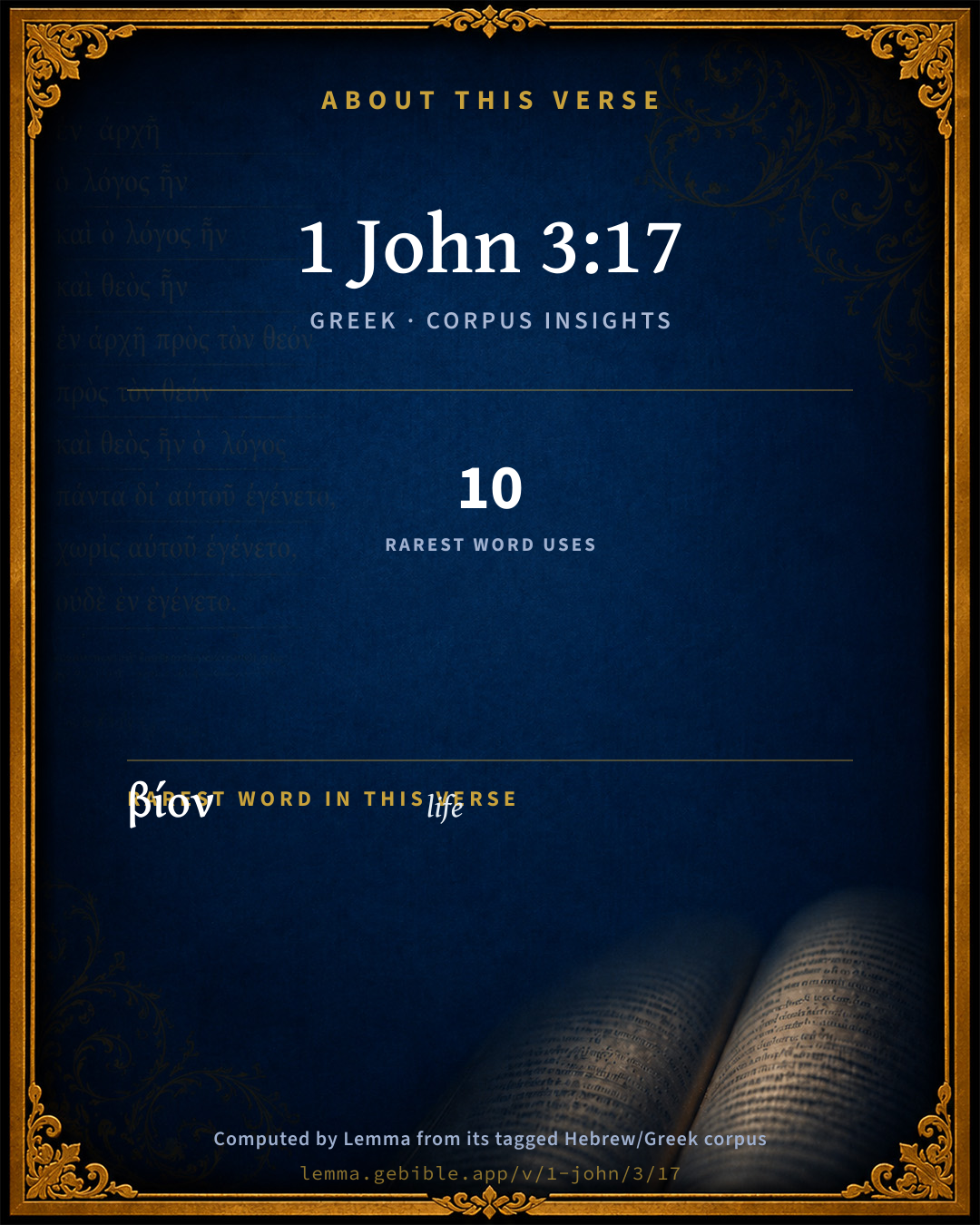
1 John 3:17

Greek (Tischendorf 8th ed.) 1 John 3:17 appears in the Greek New Testament. The text above is from the Tischendorf 8th edition. Each word links to its Strong’s number and a concise gloss. Click any word for its full Thayer’s Greek Lexicon entry.

Download image
Cite this verse

1 John 3:17 (World English Bible). Public Domain. Lemma interlinear Bible study tool, https://lemma.gebible.app/v/1-john/3/17.

Show BibTeX & RIS
BibTeX
RIS
English Translation
But whoever has the world's goods, and sees his brother in need, and closes his heart of compassion against him, how does the love of God remain in him?
World English Bible · Public Domain
Download a study sheet

One document with this verse’s original text, its word-by-word gloss line, the meaning frame, cross-references with their text, attributed commentary, and full source and license credits — printable, and it pastes into notes with its structure intact.

This verse Autodidact and up

Study sheet (.html) Plain text (.txt)

A passage Seminary Student

Up to 50 verses in one chapter. A passage sheet keeps up to 6 commentary sources and 12 cross-references per verse, in the order this page ranks them, and says so on the sheet whenever that leaves anything out. Ask for a single verse and you get the Autodidact verse sheet above.

Everything on this page stays free to read, with no account — the sheet is a download of what is already on screen, not access to it.

Want to remove ads? Support Godless Engineer
Compare translations 3

The same verse in 3 English versions, stacked beneath the original-language interlinear above. Click any original word for its lexicon entry.

Each is an independent rendering of the whole verse — the interlinear is not word-aligned to these translations.

Highlighted words mark where these versions differ — a whole-verse word diff, not a word-by-word alignment.

  • World English Bible Public Domain
    But whoever has the world's goods, and sees his brother in need, and closes his heart of compassion against him, how does the love of God remain in him?
  • King James Version Public Domain
    But whoso hath this world's good, and seeth his brother have need, and shutteth up his bowels of compassion from him, how dwelleth the love of God in him?
  • unfoldingWord Literal Text CC BY-SA 4.0
    But whoever has the possessions of the world and sees his brother having need and closes his entrails from him, how does the love of God remain in him?

unfoldingWord Literal Text — © unfoldingWord, licensed CC BY-SA 4.0. Word-aligned USFM3 via Door43 (git.door43.org/unfoldingWord/en_ult).

Versions to compare (up to 4)

3 of 4 selected

Show all 19 translations

Every available English version of this verse, each an independent rendering of the whole verse.

  • World English Bible Public Domain
    But whoever has the world's goods, and sees his brother in need, and closes his heart of compassion against him, how does the love of God remain in him?
  • Berean Standard Bible Public Domain
    If anyone with earthly possessions sees his brother in need, but withholds his compassion from him, how can the love of God abide in him?
  • Majority Standard Bible Public Domain
    If anyone with earthly possessions sees his brother in need, but withholds his compassion from him, how can the love of God abide in him?
  • King James Version Public Domain
    But whoso hath this world's good, and seeth his brother have need, and shutteth up his bowels of compassion from him, how dwelleth the love of God in him?
  • American Standard Version (1901) Public Domain
    But whoso hath the world's goods, and beholdeth his brother in need, and shutteth up his compassion from him, how doth the love of God abide in him?
  • Revised Version (1885) Public Domain
    But whoso hath the world’s goods, and beholdeth his brother in need, and shutteth up his compassion from him, how doth the love of God abide in him?
  • Geneva Bible (1599) Public Domain
    And whosoeuer hath this worlds good, and seeth his brother haue neede, and shutteth vp his compassion from him, howe dwelleth the loue of God in him?
  • Douay-Rheims (1899) Public Domain
    He that hath the substance of this world, and shall see his brother in need, and shall shut up his bowels from him: how doth the charity of God abide in him?
  • Young's Literal Translation Public Domain
    and whoever may have the goods of the world, and may view his brother having need, and may shut up his bowels from him -- how doth the love of God remain in him?
  • Literal Standard Version CC BY-SA 4.0
    and whoever may have the goods of the world, and may view his brother having need, and may shut up his yearnings from him—how does the love of God remain in him?
  • Unlocked Literal Bible CC BY-SA 4.0
    But whoever has the world's goods, sees his brother in need, and shuts up his heart of compassion from him, how does the love of God remain in him?
  • unfoldingWord Literal Text CC BY-SA 4.0
    But whoever has the possessions of the world and sees his brother having need and closes his entrails from him, how does the love of God remain in him?
  • Darby Bible Public Domain
    But whoso may have the world's substance, and see his brother having need, and shut up his bowels from him, how abides the love of God in him?
  • World Messianic Bible Public Domain
    But whoever has the world’s goods and sees his brother in need, then closes his heart of compassion against him, how does God’s love remain in him?
  • Webster's Bible Public Domain
    But he who hath this world's good, and seeth his brother have need, and shutteth up his bowels of compassion from him, how dwelleth the love of God in him?
  • Free Bible Version CC BY-SA 4.0
    If one of you is living well in this world and you see your Christian brother or sister in need, but you don't show compassion—how can God's love be living in you?
  • Bible in Basic English Public Domain
    But if a man has this world's goods, and sees that his brother is in need, and keeps his heart shut against his brother, how is it possible for the love of God to be in him?
  • Text-Critical English NT CC BY 4.0
    If anyone has the world's goods and sees his brother in need but closes his heart against him, how does the love of God abide in him?
  • Tyndale New Testament (1534) Public Domain
    Whosoever hath this worldes good and seith his brother have neade: and shutteth vp his compassion from him: how dwelleth the love of God in him?

Literal Standard Version (2020), Covenant Press — licensed CC BY-SA 4.0. Text via the HelloAO Bible API (eBible.org). Unlocked Literal Bible (unfoldingWord) — licensed CC BY-SA 4.0. Text via the HelloAO Bible API (eBible.org). unfoldingWord Literal Text — © unfoldingWord, licensed CC BY-SA 4.0. Word-aligned USFM3 via Door43 (git.door43.org/unfoldingWord/en_ult). Free Bible Version, Dr. Jonathan Gallagher — licensed CC BY-SA 4.0. Text via the HelloAO Bible API (eBible.org).

Word by word

More ways to search: Search by grammar → Find every occurrence → Compare this word →

Practice this passage: Drill this verse → Learn its vocabulary →

βίον
bíos
G979
“life”
Noun, Accusative, Singular, Masculine
Part of Speech
Noun
Case
Accusative
Number
Singular
Gender
Masculine
Full Thayer's Definition

Origin: a primary word

TDNT: 15:52,3

1. life a. life extensively 1. the period or course of life b. that by which life is sustained, resources, wealth, goods
  1. ὃς hós G3739 “who” Relative pronoun, Nominative, Singular, Masculine
  2. δ’ dé G1161 “but” Conjunction
  3. ἂν án G302 “if” Particle
  4. ἔχῃ échō G2192 “to have” Verb, Present, Active, Subjunctive, 3rd person, Singular
  5. τὸν ho G3588 “the” Article, Accusative, Singular, Masculine
  6. τοῦ ho G3588 “the” Article, Genitive, Singular, Masculine
  7. κόσμου kósmos G2889 “world” Noun, Genitive, Singular, Masculine
  8. καὶ kaí G2532 “and” Conjunction
  9. θεωρῇ theōréō G2334 “to behold” Verb, Present, Active, Subjunctive, 3rd person, Singular
  10. τὸν ho G3588 “the” Article, Accusative, Singular, Masculine
  11. ἀδελφὸν adelphós G80 “brother” Noun, Accusative, Singular, Masculine
  12. αὐτοῦ autós G846 “he” Personal pronoun, Genitive, Singular, Masculine
  13. χρείαν chreía G5532 “necessity” Noun, Accusative, Singular, Feminine
  14. ἔχοντα échō G2192 “to have” Verb, Present, Active, Participle, Accusative, Singular, Masculine
  15. καὶ kaí G2532 “and” Conjunction
  16. κλείσῃ kleíō G2808 “to shut” Verb, Aorist, Active, Subjunctive, 3rd person, Singular
  17. τὰ ho G3588 “the” Article, Accusative, Plural, Neuter
  18. σπλάγχνα splánchnon G4698 “bowels” Noun, Accusative, Plural, Neuter
  19. αὐτοῦ autós G846 “he” Personal pronoun, Genitive, Singular, Masculine
  20. ἀπ’ apó G575 “from” Preposition
  21. αὐτοῦ autós G846 “he” Personal pronoun, Genitive, Singular, Masculine
  22. πῶς pōs G4459 “how” Adverb, Interrogative
  23. ἡ ho G3588 “the” Article, Nominative, Singular, Feminine
  24. ἀγάπη agápē G26 “brotherly love” Noun, Nominative, Singular, Feminine
  25. τοῦ ho G3588 “the” Article, Genitive, Singular, Masculine
  26. θεοῦ theós G2316 “God” Noun, Genitive, Singular, Masculine
  27. μένει ménō G3306 “to remain” Verb, Present, Active, Indicative, 3rd person, Singular
  28. ἐν en G1722 “in” Preposition
  29. αὐτῷ autós G846 “he” Personal pronoun, Dative, Singular, Masculine

About this verse

These counts appear in no published source. They are computed here, from the morphology-tagged text and Lemma’s own curated glosses. What Lemma adds →

30
words
20
distinct lemmas
General Epistles
section

Notable vocabulary

The rarest word here is βίον life G979 — appearing just 10 times in the whole Greek New Testament.

Shared distinctive vocabulary

βίον life G979 occurs in 10 verses of the Greek New Testament. Also found in:

Repetition

Words recur within this verse:

  • ἔχῃ to have G2192 ×2
  • τὸν the G3588 ×6
  • αὐτοῦ he G846 ×4
  • καὶ and G2532 ×2

Cross-references

14

Topical passages linked to 1 John 3:17 in the Treasury of Scripture Knowledge — connected by theme and wording, ordered by reader-vote popularity; previews shown in the World English Bible.

  • Hebrews 13:16 But don't forget to be doing good and sharing, for with such sacrifices God is well pleased.
  • Isaiah 58:7–10 Isn't it to deal your bread to the hungry, and that you bring the poor who are cast out to your house? when you see the naked, that you cover him; and that you not hide yourself from your own flesh?
  • Deuteronomy 15:7–11 If there be with you a poor man, one of your brothers, within any of your gates in your land which Yahweh your God gives you, you shall not harden your heart, nor shut your hand from your poor brother;
  • 1 John 4:20 If a man says, "I love God," and hates his brother, he is a liar; for he who doesn't love his brother whom he has seen, how can he love God whom he has not seen?
  • Proverbs 19:17 He who has pity on the poor lends to Yahweh; He will reward him.
  • Luke 3:11 He answered them, "He who has two coats, let him give to him who has none. He who has food, let him do likewise."
  • 2 Corinthians 9:5–9 I thought it necessary therefore to entreat the brothers that they would go before to you, and arrange ahead of time the generous gift that you promised before, that the same might be ready as a matter of generosity, and not of greediness.
  • James 2:15 And if a brother or sister is naked and in lack of daily food,
  • 2 Corinthians 8:14–15 but for equality. Your abundance at this present time supplies their lack, that their abundance also may become a supply for your lack; that there may be equality.
  • 1 Timothy 6:17–18 Charge those who are rich in this present world that they not be haughty, nor have their hope set on the uncertainty of riches, but on the living God, who richly provides us with everything to enjoy;
  • 2 Corinthians 8:9 For you know the grace of our Lord Jesus Christ, that, though he was rich, yet for your sakes he became poor, that you through his poverty might become rich.
  • Proverbs 28:9 He who turns away his ear from hearing the law, Even his prayer is an abomination.
  • 1 John 5:1 Whoever believes that Jesus is the Christ is born of God. Whoever loves the father also loves the child who is born of him.
  • Proverbs 12:10 A righteous man regards the life of his animal, But the tender mercies of the wicked are cruel.

Cross-references courtesy of OpenBible.info (CC BY 4.0).

Commentary

Notes on 1 John 3:17 from classic Christian and Jewish commentators (each source and its license shown beneath its notes). The classic Christian expositions comment on the surrounding passage and are grouped to its opening verse, so a note may address several verses; the Jewish commentaries on the Tanakh (Rashi and others) are per-verse, so they appear only where the commentator wrote on this verse.

Lemma curates 59 commentaries, every one of them public domain or Creative Commons licensed, each selected and text-cleaned for this edition rather than reprinted as found. About our sources →

The Biblical Illustrator

Joseph S. Exell

1Jn_3:17-21

But whoso hath this worlds good, and seeth his brother have need, and shutteth up his bowels of compassion from him, how dwelleth the love of God in him?

Righteousness essential to the answer of a good conscience in ourselves and before God

The lesson here is sincerity. Beware of self-deception. It is easy to imagine what you would do to win or help a brother; and you may please yourselves by carrying the imagination to any length you choose. You will lay down your life for one who is, or who may be, a brother! And yet you cannot lay down for him your love of this worlds good; your love of ease and selfish comfort; your fastidious taste; your proud or shy reserve. John brings out into prominence a general principle connecting conscience and faith, with immediate reference to his particular topic of brotherly love. The principle may be briefly stated. There can be no faith where there is not conscience; no more of faith than there is of conscience. In plain terms, I cannot look my God in the face if I cannot look myself in the face. If my heart condemns me, much more must He condemn me who is greater than my heart, and knoweth all things. Reserving the special application of this principle to the grace of brotherly kindness, I ask you for the present to consider it more generally with reference to the Divine love; first, as you have to receive it by faith; and, secondly, as you have to retain it and act it out in your loving walk with God and man.

I. I am a receiver of this love. And it concerns me much that my faith, by which I receive it, should be strong and steadfast, which, however, it cannot be unless my conscience, in receiving it, is guileless. The plain question then is, Are you dealing truly with God as He deals truly with you? Are you meeting Him, as He meets you, in good faith? Is all real and downright earnest with you? Or are you toying and playing with spiritual frames as if it were all a mere affair of sentimentalism? Is there a sort of half-consciousness in you that you would really apprehend and welcome the mediation of Christ better than you do if it were meant merely to establish a relation between God and you, so far amicable as to secure your being let alone now and let off at last; and that in consideration of certain specified and ascertainable acts of homage, without its being insisted on that God and you should become so completely one? If your heart misgive you and condemn you on such points as these, it is no wonder that you have not peace with Him who is greater than your heart, and knoweth all things.

II. Not only as receiving Gods love does it concern me to see to it that my heart condemns me not, but as retaining it and acting it out in my walk and conduct. Otherwise, how dwelleth the love of God in me? It is a great matter if the eye be single, if your heart do not condemn you. The consciousness of integrity is, of itself, a well spring of peace and power in the guileless soul. The clear look, the erect gait, the firm step, the ringing voice, of an upright man, are as impressive upon others as they are expressive of himself. But that is not all. The assurance or confidence of which John speaks is not self-assurance or self-confidence. No. It is assurance before God; it is confidence toward God. Why does the apostle make our heart condemning us so fatal to our assuring our heart before God? It is because God is greater than our hearty and knoweth all things. He assumes that it is with God we have to do, and that we feel this. Our own verdict upon ourselves is comparatively a small affair; we ask the verdict of God. (R. S. Candlish, D. D.)

Shutting up compassion

Pure and undefiled religion is the imitation of God. Whatever else may characterise the men who have passed from death unto life, this is characteristic of them all. Now, assuming this, look at the immense interrogation which he proposed in our present text. A man is presented to us who professes to be a son of the Lord Almighty, but his profession was unsubstantiated.

I. The man whose religion is vain has this worlds goods; of the things which are necessary for the vigorous maintenance of life he has enough and to spare. Before his wants ever recur there is the supply. God daily loadeth him with His benefits.

II. He seeth his brother have need. It is not with others as it is with him. By treacherous and sore calamity they are afflicted in mind, or body, or estate; perhaps from ascertainable causes, perhaps from causes not ascertainable, they are destitute of daily food. He sees it plainly.

III. He shuts up the bowels of his compassion. There may be the clamorous appeal, he is deaf to that; there may be the eloquent appeal of the silent heart. It is just the same, and lest his bowels, peradventure, should yearn, he locks them up and bids them remain unmoved. Why should he interfere? People should be more careful; there should be a great deal more frugality; the institutions of the country should prevent such calamities. Such applications are nothing to him, and now, at all events, he means to be excused.

IV. How dwelleth the love of God in him? Does he resemble God? I know your answer. That man an imitator of God, who causeth the sun to shine upon the just and the unjust! That man an imitator of Him who giveth us rain from heaven and fruitful seasons, filling our hearts with food and gladness! That man an imitator of Him who dealeth not with us after our sins, who rewardeth us not according to our iniquities! Impossible! How can he be? God is merciful, he is unmerciful; God is communicative, he is parsimonious; God is compassionate, he is unrelenting; God bindeth up the broken in heart and healeth their wounds, he irritates the broken in heart. There is no similarity whatever. You might call light and darkness one. (W. Brock.)

Charity to the poor

I. Who are they that are obliged to works of charity? All are obliged to do something towards supplying the wants of others whom God hath blessed with greater abundance than is sufficient for the supply of their own. It is not the value of the gift which God regards, but the honest purpose of the giver.

II. Who are they towards whom works of charity ought to be exercised? By the needy you are not to understand absolutely every needy man, but everyone who being in need is not able by honest means to provide for himself. Those are before all others the objects of charity, who want food and raiment sufficient for the sustenance of their bodies. The reason of this is that life is the foundation of all other blessings in this world. We are bound, according to our abilities, not only to preserve the life of others, but to secure their happiness too. And in this work sickness and pain are principally to be regarded. When life, health, and liberty are secure, the law of charity grows to be more undermined, yet I think we should not say that it entirely ceases. For the having what is barely necessary for the purposes of life is but the first and lowest degree of happiness.

III. Whence the value of charity arises, or what it is that makes the outward act of giving to become acceptable to God. That which the apostle condemns here is the shutting up our bowels against the cries of the needy. God can feed the hungry, clothe the naked, heal the sick, and deliver the prisoner from captivity without drawing anything from our stores. But as He has otherwise ordered things, He hath given us affections suitable to the conditions in which He hath placed us, and made us by nature humane and merciful. When the heart is open, it is impossible that the hands can be shut. There is a pleasure in giving, which a truly compassionate mind is no more able to resist than it can forbear to commiserate.

IV. The want of a charitable and benevolent disposition is inconsistent with the love of God. (H. Stebbing, D. D.)

The duty of charitable distribution

I. The principle on which this great duty is unalterably founded. All the goods of nature, the fruits of the earth, the beasts of the field, the fowls of the air, and the fishes of the sea, were given to man for his sustenance and use. But as the necessities of man impel him, no less than his passions lead him, to a state of civilisation and society, so the necessary effect hath been a limitation of this common right of the enjoyment of the goods of nature by the establishment of particular properties. It must be granted that in most of the kingdoms of the earth the inequalities of property are too great, either for the public peace of the whole, or the private happiness of the individuals, whether rich or poor. To prevent therefore, or to remedy these dreadful evils, the great principle of Christian charity comes in. And on this principle it appears that our care of the necessitous is by no means to be considered as a voluntary act of virtue, which we may perform or remit at pleasure.

II. The various motives which may urge the rich to the consistent and continued practice of it.

1. And first, on account of their present satisfaction of mind, and with a view to a rational and true enjoyment of wealth, they ought to attend to the continued practice of this duty. Love, hope, peace, and joy are the constant companions of the compassionate soul.

2. Again, as the rich ought religiously to attend to the great work of charitable distribution as the necessary means of regulating their own desires, so the welfare of their families and children ought to be a farther motive to their exemplary practice of this duty. The noblest and most valuable inheritance that a father can leave his child is that of an honest and generous mind.

3. The last motive I shall urge for the performance of this great duty is the security of your future and eternal welfare in a better world than this. A selfish attention to wealth tends strongly to withdraw our affections from God and virtue.

III. The proper methods and objects of it.

1. And here it will be necessary, first, to show the invalidity of a plausible pretence, which would destroy the very essence of this duty. It is pretended that the principle of a charitable distribution is superfluous, because, if the rich do but spend or squander the incomes of their estates, the money will distribute itself, and like blood circulating from the heart will fall into all the various channels of the body politic, in that just proportion which their respective situations may demand. The objection is plausible, yet void of truth. For, first, supposing the effects to be such as are here represented with respect to the necessitous, yet they would be bad with regard to the rich themselves. But farther. This kind of distribution by mere expense can never effectually relieve the necessitous. Insolence and oppression are its certain consequences. Again, there fore, this method of distribution can never be effectual, because they who stand most in need can never be succoured by it. For the mere act of expending wealth can never affect any of the lower ranks, but those who labour. But the helpless young, the sick, and aged must languish and die in misery. Nay, what is yet worse, while the helpless innocent are thus left destitute of relief, the associates of wickedness are often fed to the full.

2. A second excuse for an exemption from this duty must likewise here be obviated, which is the pretended sufficiency of poor laws for the maintenance of the necessitous. But that they can never stand in the place of a true spirit of charity will appear from considering them either in their formation or execution. If they are formed merely on the principles of prudence and policy, void of a charitable zeal, they will always be of a rigid, and often of a cruel complexion. Again, laws for the maintenance of the poor must ever be defective in their execution unless inspirited by true charity, because, on the same principle as already laid down, they must generally be executed in a despotic manner. Also they never can effectually separate the good from the bad, the worthy from the worthless, so as to relieve and reward the one in preference to the other. It now remains that we point out the proper objects of this great Christian duty. First, all they who, through natural infirmity, age, sickness, or accidental disaster, are rendered incapable of self-support by labour. Among this number, more particularly, we are bound to relieve our neighbouring poor. Our neighbours real wants are better known to us than theirs who are farther removed from our observation. Again, among this number a selection ought to be made of the most worthy, not to the total exclusion of even the worthless, but as an encouragement to virtue. Beyond these common objects of our charity there is still a higher sphere for beneficence to shine in--on those who, by inevitable misfortunes, have been reduced from wealth to a state of necessity. Beyond these objects of our charitable assistance here enumerated, there yet remains one, which deserves a particular consideration. I mean the children of the necessitous. (John Brown, D. D.)

On Christian beneficence

I. The source of Christian beneficence. Many possess a constitutional benevolence of disposition. But nothing short of the love of God can ensure obedience to His will in any department of duty, and no inferior motive can be regarded by Him with acceptance.

II. The indispensable necessity of beneficence as a branch of Christian character. Beneficence is a positive law of the Divine government, and cannot be dispensed with, save by incurring the guilt of disobedience against the supreme authority of God. Christian beneficence is most comprehensive, extending to the entire nature of man.

III. The principles by which beneficence ought to be regulated deserve serious consideration. To consider the case of the poor is an obligation as imperative as that of relieving it. Indiscriminate alms giving is a serious evil to both giver and receiver. Let the understanding be Divinely enlightened, and the bowels of compassion not be shut against the brother who hath need, and we may safely commit to your own judgment and feelings the extent of your benefactions.

IV. Its dependence upon the gracious influences of the Spirit of God. The fruit of the Spirit is love. (John Smyth, D. D.)

My little children, let us not love in word, neither in tongue; but in deed and in truth--

Deceptive friendliness

I. Expressions of courtesy which have no root in the heart.

II. Blandishments to gain an end.

III. Manifestations of superficial good nature and friendliness which cannot stand the test of times of adversity.

IV. Expressions of sympathy without help. (R. Abercrombie, M. A.)

Charity in deed better than in thought

When you see a plan in an architects office that is very new and very pretty to look at, you say, Ah! nothing has been done with it, but when you see a plan that is smudgy, and torn, and almost broken through where it has been folded, you know that the man has done something with it. Now, do not fall in love with the plan, and think it very pretty, but never carry it out. When Dr. Guthrie wanted his ragged schools founded, he called on a certain minister, who said, Well you know, Mr. Guthrie, there is nothing very new in your scheme; I and Mr. So-and-so have been thinking over a similar plan to yours for the last twenty years. Oh! yes, said Dr. Guthrie, I dare say; but you have never carried it out. So some people are always thinking over some very fine plan of their own; but while the grass grows the steed starves. (C. H. Spurgeon.)

The Biblical Illustrator, edited by Joseph S. Exell (c. 1880s–1900s) — public domain. Text from a community e-Sword module.

Bengel's Gnomon

Johann Albrecht Bengel

1Jn 3:17. Τὸν βίον τοῦ κόσμου, the substance of the world) An instance of the figure Litotes: in antithesis to lives, 1Jn 3:16.—κλείσῃ, shall shut) whether asked for aid, or not asked. The sight of the wretched at once knocks at the hearts of the spectators, or even opens them: then a man freely either closes his bowels of compassion, or opens them more fully. Comp. Deu 15:7.—τὰ σπλάγχνα, his bowels) Together with his bowels a man’s substance is also closed or opened.—ἡ ἀγάπη τοῦ Θεοῦ) that is, love towards God: ch. 1Jn 4:20.—μένει, abides) He said that he loved God: but he does not now love: 1Jn 3:18.

Bengel's Gnomon of the New Testament — English translation (T&T Clark, Edinburgh, 1860) — public domain. Text from a community e-Sword module.

Meyer's Critical & Exegetical Commentary

Heinrich August Wilhelm Meyer

1Jn_3:17. As the apostle wants to bring out that love must show itself by action, he turns his attention to the most direct evidence of it, namely, compassion towards the needy brother. By the adversative connection (δέ) with 1Jn_3:16, John marks the progress from the greater, which is justly demanded, to the less, the non-performance of which seems, therefore, a grosser transgression of the rule just stated (Düsterdieck). According to Ebrard, the δέ is meant to express the opposition to the delusion that love can only show itself in great actions and sacrifices; but there is no suggestion in the context of anything like this.

τὸν βίον τοῦ κόσμου: the life of the world, i.e. that which serves to support the earthly, worldly life; comp. Luk_8:43; Luk_15:12; Luk_21:4.[229] The expression forms here a significant contrast to ζωὴ αἰώνιος (1Jn_3:15).

θεωρεῖν, stronger than ὁρᾶν, strictly to be a spectator, hence = to look at; it expresses the active beholding (Ebrard, similarly Myrberg: oculis immotis).

With χρεῖαν ἔχειν, comp. Mar_2:25; Eph_4:28.

The expression: κλείειν τὰ σπλάγχνα, is only found here; τὰ σπγάγχνα as a translation of רַחֲמַיִם appears both in the LXX. as well as often in the N. T. = καρδία; to close the heart, is as much as: to forbid to compassion towards the needy brother entrance into ones heart; the additional ἀπʼ αὐτοῦ is used in pregnant sense = turning away from him (Lücke, de Wette, Düsterdieck). The first two clauses might have had (not, as Baumgarten-Crusius says, must have had) the form of subordinate clauses; but by the fact that the form of principal clauses is given to them, the statement gains in vividness. The conclusion, which according to the sense is negative, appears as a question with πῶς (comp. chap. 1Jn_4:20), whereby the negation is emphatically brought out. ἡ ἀγάπη τοῦ Θεοῦ is love to God, not the love of God to us (Calov).[230] Here also ΜΈΝΕΙΝ has the meaning noticed on 1Jn_3:15 (Myrberg); incorrectly Lücke: as John is speaking of the probable absence of the previously-existing Christian life, it is put ΜΈΝΕΙ and not ἘΣΤΊ. The apostle does not want to say that the pitiless person loses again his love to God, but that it never is really in him at all. Pitilessness cannot be combined with love to God; the reason of this John states in chap. 1Jn_4:20.

[229] Comp. the Greek proverb: βίος βίου δεόμενος οὐκ ἔστι βίος.

[230] Ebrard explains ἡ ἀγάπη τ. Θεοῦ: the love which in its essential being took substantial form after Christ and in Christs loving deed (!).

Meyer — Critical and Exegetical Commentary on the New Testament — English translation by Peter Christie, edited by Frederick Crombie (T&T Clark, 1880) — public domain. Text from a community e-Sword module.

Expositor's Greek Testament

ed. W. Robertson Nicoll

1Jn 3:17 . Love must be practical. It is easy to “lay down one’s life”: martyrdom is heroic and exhilarating; the difficulty lies in doing the little things, facing day by day the petty sacrifices and self-denials which no one notices and no one applauds. τόν βίον τοῦ κόσμου , “the livelihood of the world”; see note on 1Jn 2:16 . θεωρῇ , of a moving spectacle; cf. Mat 27:55 . κλείσῃ , schliesst : the metaphor is locking the chamber of the heart instead of flinging it wide open and lavishing its treasures. σπλάγχνα , רַתְֽמִים , viscera , “the inward parts,” viewed by the ancients as the seat of the affections. Cf. Col 3:12 : σπλάγχνα οἰκτιρμοῦ . ἡ ἀγ . τ . Θ ., “love for God” (objective genitive), inspired by and answering to the love which God feels (subjective genitive). Cf. note on 1Jn 2:5 .

The Expositor's Greek Testament, edited by W. Robertson Nicoll (1897–1910) — public domain. Text from a community e-Sword module.

Geneva Bible (1599)

Geneva Bible translators

He reasoneth by comparison: For if we are bound even to give our life for our neighbors, how much more are we bound to help our brothers’ necessity with our goods and substance?

Wherewith this life is sustained.

Openeth not his heart to him, nor helpeth him willingly and cheerfully.

Geneva Bible (1599) marginal notes — public domain. Text via Bolls.life.

Jamieson, Fausset & Brown

Robert Jamieson, A. R. Fausset & David Brown

this world's good--literally, "livelihood" or substance. If we ought to lay down our lives for the brethren (Jo1 3:16), how much more ought we not to withhold our substance?

seeth--not merely casually, but deliberately contemplates as a spectator; Greek, "beholds."

shutteth up his bowels of compassion--which had been momentarily opened by the spectacle of his brother's need. The "bowels" mean the heart, the seat of compassion.

how--How is it possible that "the love of (that is, 'to') God dwelleth (Greek, 'abideth') in him?" Our superfluities should yield to the necessities; our comforts, and even our necessaries in some measure, should yield to the extreme wants of our brethren. "Faith gives Christ to me; love flowing from faith gives me to my neighbor."

Jamieson, Fausset & Brown — Commentary Critical and Explanatory on the Whole Bible (1871) — public domain (CC PDM 1.0). Text via the HelloAO Bible API.

Adam Clarke's Commentary

Verse 17. But whoso hath this worlds good] Here is a test of this love; if we do not divide our bread with the hungry, we certainly would not lay down our life for him. Whatever love we may pretend to mankind, if we are not charitable and benevolent, we give the lie to our profession. If we have not bowels of compassion, we have not the love of God in us; if we shut up our bowels against the poor, we shut Christ out of our hearts, and ourselves out of heaven.

This worlds good.-τουβιοντουκοσμου. The life of this world, i.e. the means of life; for so βιος is often used. See Mr 12:44; Lu 8:43; Lu 15:12; Lu 15:30; Lu 21:4, and other places.

How dwelleth the love of God in him?] That is, it cannot possibly dwell in such a person. Hardheartedness and God's love never meet together, much less can they be associated.

Adam Clarke's Commentary on the Bible (1810–1826) — public domain. Text from a community e-Sword/MySword module.

John Calvin's Commentaries

17 But whose hath this world’s good, or, If any one has the world’s sustenance. He now speaks of the common duties of love, which flow from that chief foundation, that is, when we are prepared to serve our neighbors even to death. He, at the same time, seems to reason from the greater to the less; for he who refuses to alleviate by his goods the want of his brother, while his life is safe and secure, much less would he expose for him his life to danger. Then he denies that there is love in us, if we withhold help from our neighbors. But he so recommends this external kindness, that at the same time he very fitly expresses the right way of doing good, and what sort of feeling ought to be in us.

Let this, then, be the first proposition, that no one truly loves his brethren, except he really shews this whenever an occasion occurs; the second, that as far as any one has the means, he is bound so far to assist his brethren, for the Lord thus supplies us with the opportunity to exercise love; the third, that the necessity of every one ought to be seen to, for as any one needs food and drink or other things of which we have abundance, so he requires our aid; the fourth, that no act of kindness, except accompanied with sympathy, is pleasing to God. There are many apparently liberal, who yet do not feel for the miseries of their brethren. But the Apostle requires that our bowels should be opened; which is done, when we are endued with such a feeling as to sympathize with others in their evils, no otherwise than as though they were our own.

The love of God Here he speaks of loving the brethren; why then does he mention the love of God? even because this principle is to be held, that it cannot be but that the love of God will generate in us the love of the brethren. And thus God tries our love to him, when he bids us to love men from a regard to himself, according to what is said in Psalm 16:2,

“My goodness reaches not to thee, but towards the saints who are on the earth is my will and my care.”

John Calvin's Commentaries (1540-1563) — public domain. Text from the Calvin Translation Society English edition (1840s-50s) via the Christian Classics Ethereal Library (ccel.org). Calvin's coverage is partial (roughly two-thirds of the Bible); uncommented books and verses are honest gaps, never fabricated. The 19th-century editor's footnotes and remarks are omitted so the notes are faithfully Calvin's own voice.

The Cambridge Bible for Schools and Colleges

gen. ed. J. J. S. Perowne

17. But whoso hath this world’s good] Better, as R. V., But whoso hath the world’s goods. The ‘But’ is full of meaning. ‘But not many of us are ever called upon to die for another: smaller sacrifices, however, may be demanded of us; and what if we fail to make them?’ The word for ‘good’ or ‘goods’ (βίος) is the same as that rendered ‘life’ in 1Jn_2:16, where see note. It signifies there and here ‘means of life, subsistence’. ‘The world’s life’, therefore, means that which supports the life of mankind, or life in this world (see on 1Jn_2:15) in marked contrast to eternal life (1Jn_3:15).

and seeth his brother have need] Better, and beholdeth his brother having need. The verb implies that he not only sees him (ἰδεῖν), but looks at him and considers him (θεωρεῖν). It is a word of which the contemplative Apostle is very fond; and outside the Synoptic Gospels and the Acts it occurs nowhere but in S. John’s writings and Heb_7:4. It is a pity to spoil the irony of the original by weakening ‘having need’ into ‘in need’ (R. V.). The one has as his possession the world’s wealth, the other has as his possession need.

shutteth up his bowels of compassion from him] There is no ‘of compassion’ in the Greek and we hardly need both substantives. The ancients believed the bowels to be the seat of the affections (Gen_43:30; 1Ki_3:26; Jer_31:20; Php_1:8; Php_2:1; Phm_1:7; Phm_1:12; Phm_1:20) as well as the heart, whereas we take the latter only. Coverdale (here, as often, following Luther) alters Tyndale’s ‘shutteth up his compassion’ into ‘shutteth up his heart.’ And in fact, ‘shutteth up his bowels from him’ is the same as ‘closeth his heart against him.’ The phrase occurs nowhere else in N. T., but comp. 2Co_6:12. The ‘from him’ is picturesque, as in 1Jn_2:28 : it expresses the moving away and turning his back on his brother. In LXX. ‘Thou shalt not harden thine heart’ (Deu_15:7) is ‘Thou shalt not turn away thine heart’.

how dwelleth the love of God in him?] Better, as R. V., how doth the love of God abide in him? this preserves the order of the Greek better and marks the recurrence of S. John’s favourite verb ‘abide’ (see on 1Jn_2:24). ‘The love of God’, as usual in this Epistle (see on 1Jn_2:5), means man’s love to God. The question here is equivalent to the statement in 1Jn_4:20, that to love God and hate one’s brother is impossible.

The Cambridge Bible for Schools and Colleges (gen. ed. J. J. S. Perowne; Cambridge University Press, 1878–1918) — public domain. Text from a community e-Sword module.

John Gill's Exposition

My little children, let us not love in word, neither in tongue,.... Which though it holds good of love to God, and to Jesus Christ, yet here is to be understood of love to the brethren, as the context shows; and so the Syriac version reads, "let us not love one another in word", &c. that is, without the heart, or with a double heart; speaking one thing with the lip, and designing another thing in the heart; speaking peaceably with the mouth, and with the heart laying wait; or we should not love in this manner "only"; and so the Arabic version of De Dieu adds. It is very lawful, and right to express our love to one another, and to all men in words, to give good words, and use courteous language, and speak in a kind, tender, and affectionate manner, and especially to persons in distress; but this should not be all, it will be of no avail to say to such, be warmed and filled, and give them nothing but these good words, nothing to warm and fill them with; see Jam 2:15;

but in deed and in truth; for true love is a laborious and operative grace, hence we read of the work and labour of love; it shows itself by the saints serving one another, in spirituals; as by bearing one another's burdens, forbearing with, and forgiving one another, praying for each other, and building up one another on their most holy faith; exhorting each other to the duties of religion, and not suffering sins upon one another, but admonish in love, and restore with meekness; and in temporals, distributing to the necessities of the saints, ministering: to them of their worldly substance, and supplying their daily wants: and this is loving "in deed", or "in work"; this is actual love, love in fact, and what is apparent and evident: and it is "in truth", when it is in reality, and not in show only; and when it is cordially and heartily done, with cheerfulness, and without grudging.

John Gill's Exposition of the Whole Bible (1746–1763) — public domain (CC PDM 1.0). Text via the HelloAO Bible API.

Trapp's Complete Commentary

John Trapp

17 But whoso hath this world’s good, and seeth his brother have need, and shutteth up his bowels of compassion from him, how dwelleth the love of God in him?

Ver. 17. This world’s goods] Gr. τον βιον, livelihood, which is all that the world looks after.

And shutteth up his bowels, &c.] Not drawing out unto him both his sheaf and his soul, Isa 58:9. But locking up as with a key (so the Greek κλειση here signifies) both his barn and his bowels; not considering his brother’s necessity and his own ability.

John Trapp, A Commentary or Exposition upon All the Books of the Old and New Testament (1647–1656) — public domain. Text from a community e-Sword module.

Albert Barnes' Notes on the Bible

But whoso hath this world’s good - Has property - called “this world’s good,” or a good pertaining to this world, because it is of value to us only as it meets our wants this side of the grave; and perhaps also because it is sought supremely by the people of the world. The general meaning of this verse, in connection with the previous verse, is, that if we ought to be willing to lay down our lives for others, we ought to be willing to make those comparatively smaller sacrifices which are necessary to relieve them in their distresses; and that if we are unwilling to do this, we can have no evidence that the love of God dwells in us.

And seeth his brother have need - Need of food, of raiment, of shelter; or sick, and poor, and unable to provide for his own wants and those of his family.

And shutteth up his bowels of compassion from him - The bowels, or “upper viscera,” embracing the heart, and the region of the chest generally, are in the Scriptures represented as the seat of mercy, piety, and compassion, because when the mind feels compassion it is that part which is affected. Compare the notes at Isa 16:11.

How dwelleth the love of God in him? - How can a man love God who does not love those who bear his image? See the notes at 1Jo 4:20. On the general sentiment here, see the notes at Jam 2:14-16. The meaning is plain, that we cannot have evidence of piety unless we are ready to do good to others, especially to our Christian brethren. See the Mat 25:45 note; Gal 6:10 note.

Albert Barnes' Notes on the Bible (1834–1885) — public domain. Text from a community e-Sword/MySword module.

Matthew Poole's English Annotations

i.e. If the love of God in us should make us lay down our lives for the brethren, and we be not willing, in their necessity and our own ability, to relieve them, how plain is the case, that it is not in us!

Matthew Poole's English Annotations on the Holy Bible (1683–1685) — public domain. Text from a community e-Sword/MySword module.

Whedon's Commentary on the Bible

Daniel D. Whedon

17. But—Introducing a contrast between this consummate love which would give life, and that want of love which would refuse even the alms that would supply a needed livelihood.

Bowels—The conceptual bodily seat of the compassionate affections.

How—Strong interrogative expression of the negative. For since our love of our brother and our love of God are one element and essence, the exclusion of one excludes the other.

Daniel D. Whedon (gen. ed.), Commentary on the Old and New Testaments (1874–1909) — public domain. Text from a community e-Sword module.

The Pulpit Commentary

"But de if a man not only fails to do this, but even steadily contemplates qewrh another"s distress, and forthwith (aorist, kleish closes his heart against him, although he has the means of relieving him, how can he have any love for God?" The meaning is not, "How can God love him?" as is plain from 1Jn_4:20. But possibly "love such as God has shown towards us" may be meant. (1Jn_4:10) "The world"s goods" toon tou kosmou is literally "the world"s means of life" (seeov 1Jn_2:16, and Trench on "New Testament Synonyms," for the difference between bi and zwh. (For tagcna as the seat of the affections, comp. Luk_1:78; 2Co_6:12 2Co_7:15; Php_1:8 2:1; Phm_1:7, Phm_1:12) The ajp aujtou is graphic; closes his heart and turns away from him. (1Jn_2:28)

The Pulpit Commentary (1880–1919), ed. H.D.M. Spence-Jones & Joseph S. Exell — public domain. Text from a community e-Sword module.

John Wesley's Explanatory Notes

But whoso hath this world's good - Worldly substance, far less valuable than life. And seeth his brother have need - The very sight of want knocks at the door of the spectator's heart. And shutteth up - Whether asked or not. His bowels of compassion from him, how dwelleth the love of God in him - Certainly not at all, however he may talk, 1 John iii, 18, of loving God.

John Wesley, Explanatory Notes Upon the Whole Bible (1754–1765) — public domain. Text via the GEBible commentary corpus.

Burkitt's Expository Notes on the New Testament

William Burkitt

Our apostle here draws an argument from the greater to the less, after this manner: "If, says he, we ought to be ready in some cases to part with our lives for the brethren, surely we much more ought to impart and communicate our worldly goods to them in the time of their necessity, and he that refuses so to do, can never think there is any thing of that love in him, which God requires of him towards his children."

Learn hence, that there certainly dwells no love of God in that man’s heart, who having this world’s goods, stretchest not out his hands to help the necessities of his brother.

Here note, 1. The fountain from which all charitable distributions are to proceed and flow, namely, from the compassion of the heart.

2. That the compassion of the heart must draw forth the help of the hand: He that is a Christian indeed will open both heart and hand to the distressed, and they shall partake of his purse as well as of his pity.

3. It is not said, He that has abundance of this world’s goods, let him of his great superfluity give; but he that hath this world’s goods: that is, in any measure, yea, though he has no more than he works for, yet is he required, Eph 4:28 that worketh with his hands, to give to him that needeth. The world is greatly deceived who thinks charity and almsgiving a duty that only concerns the rich; indeed it concerns them eminently, but not exclusively. And oh! the dreadful account that some rich men have to give, who expend more upon a lust in one day, than they give to the poor in a whole year. But yet, after all, every one that hath this world’s goods, though he has but what he labours and sweats for, yet must he in in proportion to what he has, give to him that needeth.

Note, 4. The object of this our compassion and charity; a brother, a brother in need, and every brother in need; not only such as are cast down, but such as are falling, are the proper objects of our pity and help.

Note, 5. The circumstance of time when we must give, namely, when we see our brother in need. What a vanity is it to leave our alms till after our death, to be beholden to the justice of others for their distribution! Let us see our charity bestowed with our own eyes, and given out with our own hands, when the loins of the poor will bless us, but their prayers will do us no good when we are dead. Whoso seeth his brother have need, and shutteth up his bowels of compassion from him, how dwelleth the love of God in him?

From the whole learn, That when we are in a capacity, and enjoy an opportunity of expressing our charitable benevolence towards our poor and indigent brethren, the omission of it is a certain evidence that there is nothing of the love of God residing in us.

William Burkitt's Expository Notes on the New Testament (1700–1703) — public domain. Text from a community e-Sword module.

The People's New Testament

B. W. Johnson

17. But whoso, etc. If this be true, what shall be said of one who refuses to succor his suffering brother with all his goods?

B. W. Johnson's The People's New Testament with Notes (1889–1891) — public domain. Electronic text from the Christian Classics Ethereal Library (CCEL) ThML edition.

Cambridge Greek Testament for Schools and Colleges

17. ὃς δ ̓ ἂν ἔχη. The phrase is as wide in its sweep as πᾶς ὁ ἔχων: comp. 1Jn 2:5. The δέ is full of meaning. ‘Not many of us are ever called upon to die for others: but smaller sacrifices are often demanded of us; and what if we fail to respond?’ Si nondum es idoneus mori pro fratre, jam idoneus esto dare de tuis facultatibus fratri (Bede). τὸν βίον τ. κόσμου is to be rendered, as in R.V., the world’s goods: βίος, as in 1Jn 2:16 (see note), signifies ‘means of life, subsistence,’ including all resources of wealth and ability. Τὸν βίον τ. κ., therefore, means all that supports and enriches the life of this world (1Jn 2:15) in contrast to ζωὴ αἰώνιος (1Jn 3:15).

θεωρῇ τ. ἀδ. αὐτ. χρείαν ἔχοντα. Beholdeth his brother having need. He not only sees him (ἰδεῖν), but looks at him and considers him (θεωρεῖν). It is a word of which the contemplative Apostle is very fond (Joh 2:23; Joh 7:3; Joh 12:45; Joh 14:19; Joh 16:16; &c.), and outside the Gospels and Acts it is found only in S. John’s writings and Heb 7:4. It is a pity to spoil the simple irony of the original by weakening χρείαν ἔχοντα into ‘in need’ (R.V.). So also Luther; siehet seinen Bruder darben. This misses the contrast between ἔχῃ τ. βίον and χρείαν ἔχοντα. The one has as his possession wealth, the other has as his possession-need. The New Vulgate has necessitatem habere, which is far better than necesse habere, as in 1Jn 2:27: the Old Vulgate has necesse habere in both places. Cyprian has desiderantem here twice.

κλείσῃ τ. σπλάγχνα αὐτ. ἀπ ̓ αὐτ. The ancients believed the bowels to be the seat of the affections (Gen 43:30; 1Ki 3:26; Jer 31:20; Php 1:8; Php 2:1; Phm 1:7; Phm 1:12; Phm 1:20) as well as the heart, whereas we take the latter only. Coverdale (here, as often, following Luther) alters Tyndale’s ‘shutteth up his compassion’ into ‘shutteth up his heart.’ And in fact, ‘shutteth up his bowels from him’ is the same as ‘closeth his heart against him.’ The phrase occurs nowhere else in N.T., but comp. 2Co 6:12. The ‘from him’ is picturesque, as in 1Jn 2:28 it expresses the moving away and turning his back on his brother. Comp. οὐκ ἀποστρέψεις τὴν καρδίαν σου οὐδὲ μὴ συσφίγξεις τὴν χεῖρά σου ἀπὸ τοῦ ἀδελφοῦ σου (Deu 15:7).

πῶς. For the abrupt argumentative interrogation comp. πῶς τοῖς ἐμοῖς. ῥήμασιν πιστεύσετε; (Joh 5:47). See also 1Co 14:7; 1Co 14:9; 1Co 14:16; 1Co 15:12. The order of the Greek is worth keeping, as in R.V., how doth the love of God abide in him? For μένειν ἐν, ‘to have a home in,’ see on 1Jn 2:24. For ἡ ἀγάπη τ. Θ., which again means man’s love to God, see on 1Jn 2:5. The idea that God is the source of that love which man feels towards Him may be included here. The question here (πῶς) is equivalent to the statement in 1Jn 4:20 (οὐ), that to love God and hate one’s brother is morally impossible.

Cambridge Greek Testament for Schools and Colleges (Cambridge University Press, 1896; 21 vols, various authors incl. Carr, Maclear, Plummer, Farrar, Lumby, Moule, M. R. James, Simcox) — public domain. Text from a community e-Sword module.

Alford’s Greek Testament

Henry Alford

17.] But (“by the adversative connexion of ver. 17 with ver. 16 the Apostle marks the passage from the greater, which is justly demanded of us, to the lesser, the violation of which is all the more a transgression of the law just prescribed.” Düsterd.) whosoever hath the world’s sustenance (βίος, as in ch. 2:16, and in reff., for that whereon life is sustained. Grotius quotes the classical proverb, βίος βίου δεόμενος οὐκ ἔστι βίος. Œc. and some others have misunderstood τὸν βίον τοῦ κόσμου as if it meant excessive wealth: Œc. even making τοῦ κόσμου a gen. of apposition: οὐ τοὺς βίου σπανίζοντας λέγω, ἀλλὰ καὶ τοὺς ὅλον τὸν κόσμον σχεδὸν ὕπαρξιν ἔχοντας πλούτου. And Piscator makes it mean “victus, cui acquirendo mundus est deditus.” But there can be little doubt that most Commentators are right in explaining the expression to mean, with Beza, “mundanæ facultates,” “les biens de ce monde;” as E. V., “this world’s good”), and beholdeth (θεωρῇ gives more than the casual sight: it is the standing and looking on as a spectator: so that it ever involves not the eye only, but the mind also, in the sight: it is contemplari, not simply videre. So Chrys. in Joh. Hom. lxxv. 1, vol. viii. p. 405, οἶδεν ἡ γραφὴ ἐπὶ ἀκριβοῦς γνώσεως θεωρίαν λέγειν· ἐπειδὰν γὰρ τῶν αἰσθήσεων τρανοτέρα ἡ ὄψις, διὰ ταύτης ἀεὶ τὸν ἀκριβῆ παρίστησι γνῶσιν. St. John is very fond of the word (reff.), and wherever it occurs, this its meaning may be more or less traced. There is then in this unmerciful man not merely the being aware of, but the deliberate contemplation of the distress of his brother) his brother having need, and shutteth up (by the slight addition of “up,” we faintly represent the force of the Greek aor. κλείσῃ, as implying that the shutting is then and there done, as the result of the contemplation: not a mere constitutional hardness of heart, but an act of exclusion from sympathy following deliberately on the beholding of his brother’s distress) his bowels (= his heart, the seat of compassion: as so often in the N. T. See reff., and Luk 1:78, 2Co 7:15, Php 1:8, Php 2:1, Phm 1:7, Phm 1:12) from him (ἀπʼ αὐτοῦ is pregnant, as in ch. 2:28, “aversandi notionem habens.” There is no Hebraism: nor is any supply such as ἀποστρεφόμενος wanted. κλείειν ἀπό is just as good Greek as κρύπτειν ἀπό, Joh 12:36 al. As Düsterd. remarks, the fact that a man shuts up his heart against his brother, includes in it the fact that that brother is excluded from the heart thus shut up), how (can it be that; as in ch. 4:20, πῶς δύναται ἀγαπᾷν;) doth the love of God (i. e. from the very express filling out of the thought in ch. 4:20, “love to God;” not God’s love to us. See also ch. 2:5, where we have the same expression and reference to the love of God being in a man. The context indeed here might seem, as the mention of Christ’s love to us has so immediately preceded, to require the other meaning; or at least, that of “the love whereof God hath set us a pattern:” and accordingly both these have been held: the former by Luther, in his second exposition, and Calov., the latter by Socinus and Grotius. But I see not how we can escape the force of the passages above cited) abide in him (Lücke and Düsterd. are disposed to lay a stress on the μένει here, thereby opening a door for the view that the love of God may indeed be in him in some sense, but not as a firm abiding principle; that at all events at the moment when he thus shuts up his bowels of compassion, it is not abiding in him. But this would seem to violate the ideal strictness of the Apostle’s teaching, and the true sense rather to be, “How can we think of such an one as at all possessing the love of God in any proper sense?” giving thus much emphasis to μένει, but not putting it in opposition to ἐστίν, as Lücke does; for it is, in the root, equivalent to it.

Here again, many questions of casuistry have been raised as to the nature and extent of the duty of almsgiving, on which it is impossible to enter here, and for which I must refer my readers as before. The safest answers to them all will be found in the Christian conscience enlightened by the Holy Spirit, guiding the Christian heart warmed by the living presence of Christ)?

Henry Alford, The Greek Testament (1849–1861) — public domain. Text from a community e-Sword module.

International Critical Commentary

17. The practical test. Wider obligations may be acknowledged with all readiness in theory, where a more homely test reveals the extent of a man’s failure. The writer is always enforcing the truth that philanthropy begins at home. Cf. Philo, De Post. Cain, 86 (Cohn, ii. 18), τί γὰρ ὄφελος λέγειν μὲν τὰ βέλ τιστα, διανοεῖσθαι δὲ καὶ πράττειν τὰ αἴσχιστα; σοφιστῶν οὗτος ὸτρόπος.

τὸν βίον τοῦ κόσμου] Well paraphrased in Augustine’s version, facultates mundi. Βίος always denotes life in its external aspects. Cf. 2:16, ἡ ἀλαζονία τοῦ βίου: Mar 12:44 ( = Luk 21:4); 1Ti 2:2; 2Ti 2:4; and for the verb, 1 P. 4:2, τὸν ἐπίλοιπον ἐν σαρκὶ βιῶσαι χρόνον. Cf. also Act 26:4, τὴν… βίωσίν μου ἐκ νεότητος. Consequently, βίος is rare in the N.T., while ζωή occurs more than a hundred times.

θεωρῇ] Behold: not merely cast a passing glance, but see, long enough to appreciate and understand the circumstances of the case. Cf. Joh 20:6; Act 4:13; Rev 11:11 f.

χρείαν ἔχοντα] Cf. 2:27; and for the use of the phrase absolutely, Mar 2:25; Act 2:45, Act 2:4:35; Eph 4:28.

κλείσῃ] Cf. Psa_76. (77.) 10, ἢ συνέξει τοὺς οἰκτειρμοὺς αὐτοῦ ἐν τῇ ὀργῇ αὐτοῦ; cf. also Deu 15:7, ἐὰν γένηται ἐν σοὶ ἐνδεής … οὐκ ἀποστέρξεις τὴν καρδίαν σου. The word perhaps suggests that a barrier has to be raised against the natural human feelings which the contemplation of such a case calls out.

τὰ σπλάγχνα] Cf. Pro 12:10, τὰ δὲ σπλάγχνα τῶν ἀσεβῶν ἀνελεήμονα. The word is not found in the earlier parts of the Septuagint, and only in this passage is it used to translate רַחֲמִים, which in the Psalms is paraphrased by οἰκτιρμοί (Psa_24. (25.) 6, and in Isaiah (47:6) by ἔλεος. See Lightfoot’s note on Php 1:8. The classical distinction between σπλάγχνα and ἔντερα (not in N.T.) is not to be found in Hebrew forms of expression.

τοῦ θεοῦ] The context determines that the genitive must be objective. Cf. 5:3.

εχη] εχει τιςIc 258 (56).

θεωρη] θεωρει K L 29. 40 alplus 20.

αυτου (? 1o)] om. Isa_7.

κλειση] κλεισει L 13 al.

απ αυτου] om. Ib δ180 (1319).

εν] επIa 70 (505) Ib 253f (2) K 453 δ401 (62).

International Critical Commentary — older volumes (1896–1929), various authors — public domain. Text from a community e-Sword module.

Vincent's Word Studies in the New Testament

Marvin R. Vincent

This world 's good [τον βιον του κοσμου] . Rev., the worlds goods. Biov means that by which life is sustained, resources, wealth.

Seeth [θεωρη] . Deliberately contemplates. See on Joh 1:18. Rev., beholdeth. The only occurrence of the verb in John's Epistles.

Have need [χρειαν εχοντα] . Lit., having need. Rev., in need.

Bowels of compassion [τα σπλαγχνα] . See on pitiful, 1Pe 3:8. Rev., much better, his compassion. The word only here in John.

Marvin R. Vincent, Word Studies in the New Testament (1887–1900) — public domain. Text from a community e-Sword/MySword module.

Lesson kit

Teaching starters — assembled from the data on this page, not authored interpretation. Every prompt links to the verse data it draws on. Edit before teaching.

1 John, in the General Epistles, opens this verse with 30 words (20 distinct Greek lemmas). Its most distinctive word is bíos (“life”). A historical commentator’s framing appears above. Read the whole chapter for the surrounding context.

Discussion questions

  1. The word bíos carries the sense “life.” How does it shape the verse?
  2. How does Mark 12:44, which shares the word «life», read alongside this verse?
  3. What does the repetition of “to have” (2× in this one verse) do in this verse?
  4. These translations render this verse differently. What is at stake in choosing one wording over another?
  5. Compare how The Biblical Illustrator and Bengel's Gnomon read this verse. Where do they agree or differ?

Things to notice

Reading settings

Reading text

Shown beneath each verse's original-language words.

Old Testament
Old Testament edition

Read the OT as the Masoretic Hebrew (MT) or the Greek Septuagint (LXX).

English shown for the Greek Septuagint (in the Hebrew ↔ Greek comparison).

Comparing translations? Open the Compare panel on any verse page to stack up to four side by side.