Luke 18:24

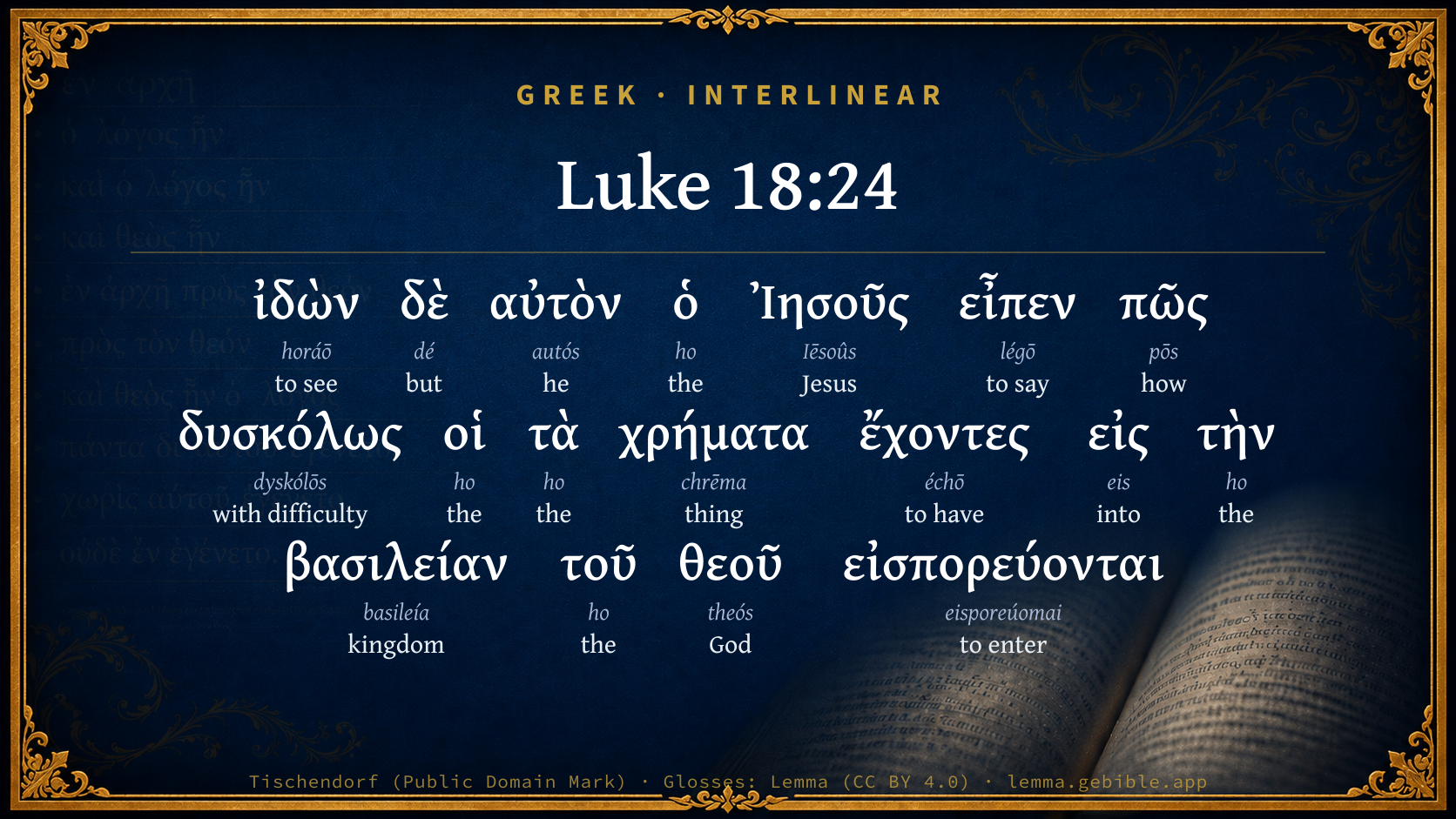
Greek (Tischendorf 8th ed.) Luke 18:24 appears in the Greek New Testament. The text above is from the Tischendorf 8th edition. Each word links to its Strong’s number and a concise gloss. Click any word for its full Thayer’s Greek Lexicon entry.
Download image
Cite this verse

Luke 18:24 (World English Bible). Public Domain. Lemma interlinear Bible study tool, https://lemma.gebible.app/v/luke/18/24.

Show BibTeX & RIS
BibTeX
RIS
English Translation
Jesus, seeing that he became very sad, said, "How hard it is for those who have riches to enter into the Kingdom of God!
World English Bible · Public Domain
Download a study sheet

One document with this verse’s original text, its word-by-word gloss line, the meaning frame, cross-references with their text, attributed commentary, and full source and license credits — printable, and it pastes into notes with its structure intact.

This verse Autodidact and up

Study sheet (.html) Plain text (.txt)

A passage Seminary Student

Up to 50 verses in one chapter. A passage sheet keeps up to 6 commentary sources and 12 cross-references per verse, in the order this page ranks them, and says so on the sheet whenever that leaves anything out. Ask for a single verse and you get the Autodidact verse sheet above.

Everything on this page stays free to read, with no account — the sheet is a download of what is already on screen, not access to it.

Want to remove ads? Support Godless Engineer
Compare translations 3

The same verse in 3 English versions, stacked beneath the original-language interlinear above. Click any original word for its lexicon entry.

Each is an independent rendering of the whole verse — the interlinear is not word-aligned to these translations.

Highlighted words mark where these versions differ — a whole-verse word diff, not a word-by-word alignment.

  • World English Bible Public Domain
    Jesus, seeing that he became very sad, said, "How hard it is for those who have riches to enter into the Kingdom of God!
  • King James Version Public Domain
    And when Jesus saw that he was very sorrowful, he said, How hardly shall they that have riches enter into the kingdom of God!
  • unfoldingWord Literal Text CC BY-SA 4.0
    Then Jesus, having looked at him, said, “How difficultly do the ones having riches enter into the kingdom of God!

unfoldingWord Literal Text — © unfoldingWord, licensed CC BY-SA 4.0. Word-aligned USFM3 via Door43 (git.door43.org/unfoldingWord/en_ult).

Versions to compare (up to 4)

3 of 4 selected

Show all 19 translations

Every available English version of this verse, each an independent rendering of the whole verse.

  • World English Bible Public Domain
    Jesus, seeing that he became very sad, said, "How hard it is for those who have riches to enter into the Kingdom of God!
  • Berean Standard Bible Public Domain
    Seeing the man’s sadness, Jesus said, “How hard it is for the rich to enter the kingdom of God!
  • Majority Standard Bible Public Domain
    Seeing the man’s sadness, Jesus said, “How hard it is for the rich to enter the kingdom of God!
  • King James Version Public Domain
    And when Jesus saw that he was very sorrowful, he said, How hardly shall they that have riches enter into the kingdom of God!
  • American Standard Version (1901) Public Domain
    And Jesus seeing him said, How hardly shall they that have riches enter into the kingdom of God!
  • Revised Version (1885) Public Domain
    And Jesus seeing him said, How hardly shall they that have riches enter into the kingdom of God!
  • Geneva Bible (1599) Public Domain
    And when Iesus sawe him very sorowfull, he said, With what difficultie shall they that haue riches, enter into the kingdome of God!
  • Douay-Rheims (1899) Public Domain
    And Jesus seeing him become sorrowful, said: How hardly shall they that have riches enter into the kingdom of God.
  • Young's Literal Translation Public Domain
    And Jesus having seen him become very sorrowful, said, `How hardly shall those having riches enter into the reign of God!
  • Literal Standard Version CC BY-SA 4.0
    And Jesus having seen him become very sorrowful, said, “How hardly will those having riches enter into the Kingdom of God!
  • Unlocked Literal Bible CC BY-SA 4.0
    Then Jesus, seeing him, became very sad and said, “How difficult it is for those who are rich to enter the kingdom of God!
  • unfoldingWord Literal Text CC BY-SA 4.0
    Then Jesus, having looked at him, said, “How difficultly do the ones having riches enter into the kingdom of God!
  • Darby Bible Public Domain
    But when Jesus saw that he became very sorrowful, he said, How difficultly shall those who have riches enter into the kingdom of God;
  • World Messianic Bible Public Domain
    Yeshua, seeing that he became very sad, said, “How hard it is for those who have riches to enter into God’s Kingdom!
  • Webster's Bible Public Domain
    And when Jesus saw that he was very sorrowful, he said, How hardly will they that have riches enter into the kingdom of God!
  • Free Bible Version CC BY-SA 4.0
    When he saw his reaction, Jesus said, “How difficult it is for the rich to enter the kingdom of God!
  • Bible in Basic English Public Domain
    And Jesus, looking at him, said, How hard it is for those who have wealth to get into the kingdom of God!
  • Text-Critical English NT CC BY 4.0
    When Jesus saw that the man had become very sorrowful, he said, “How difficult it will be for those who have riches to enter the kingdom of God!
  • Tyndale New Testament (1534) Public Domain
    When Iesus sawe him morne he sayde: with what difficulte shall they that have ryches enter into the kyngdome of God:

Literal Standard Version (2020), Covenant Press — licensed CC BY-SA 4.0. Text via the HelloAO Bible API (eBible.org). Unlocked Literal Bible (unfoldingWord) — licensed CC BY-SA 4.0. Text via the HelloAO Bible API (eBible.org). unfoldingWord Literal Text — © unfoldingWord, licensed CC BY-SA 4.0. Word-aligned USFM3 via Door43 (git.door43.org/unfoldingWord/en_ult). Free Bible Version, Dr. Jonathan Gallagher — licensed CC BY-SA 4.0. Text via the HelloAO Bible API (eBible.org).

Word by word

More ways to search: Search by grammar → Find every occurrence → Compare this word →

Practice this passage: Drill this verse → Learn its vocabulary →

δυσκόλως
dyskólōs
G1423
“with difficulty”
Adverb
Part of Speech
Adverb
Full Thayer's Definition

Origin: from G1422

TDNT: None

1. with difficulty
  1. ἰδὼν horáō G3708 “to see” Verb, Aorist, Active, Participle, Nominative, Singular, Masculine
  2. δὲ dé G1161 “but” Conjunction
  3. αὐτὸν autós G846 “he” Personal pronoun, Accusative, Singular, Masculine
  4. ὁ ho G3588 “the” Article, Nominative, Singular, Masculine
  5. Ἰησοῦς Iēsoûs G2424 “Jesus” Noun, Nominative, Singular, Masculine
  6. εἶπεν légō G3004 “to say” Verb, Aorist, Active, Indicative, 3rd person, Singular
  7. πῶς pōs G4459 “how” Adverb
  8. οἱ ho G3588 “the” Article, Nominative, Plural, Masculine
  9. τὰ ho G3588 “the” Article, Accusative, Plural, Neuter
  10. χρήματα chrēma G5536 “thing” Noun, Accusative, Plural, Neuter
  11. ἔχοντες échō G2192 “to have” Verb, Present, Active, Participle, Nominative, Plural, Masculine
  12. εἰς eis G1519 “into” Preposition
  13. τὴν ho G3588 “the” Article, Accusative, Singular, Feminine
  14. βασιλείαν basileía G932 “kingdom” Noun, Accusative, Singular, Feminine
  15. τοῦ ho G3588 “the” Article, Genitive, Singular, Masculine
  16. θεοῦ theós G2316 “God” Noun, Genitive, Singular, Masculine
  17. εἰσπορεύονται eisporeúomai G1531 “to enter” Verb, Present, Middle or Passive deponent, Indicative, 3rd person, Plural

About this verse

These counts appear in no published source. They are computed here, from the morphology-tagged text and Lemma’s own curated glosses. What Lemma adds →

18
words
14
distinct lemmas
Gospels
section

Notable vocabulary

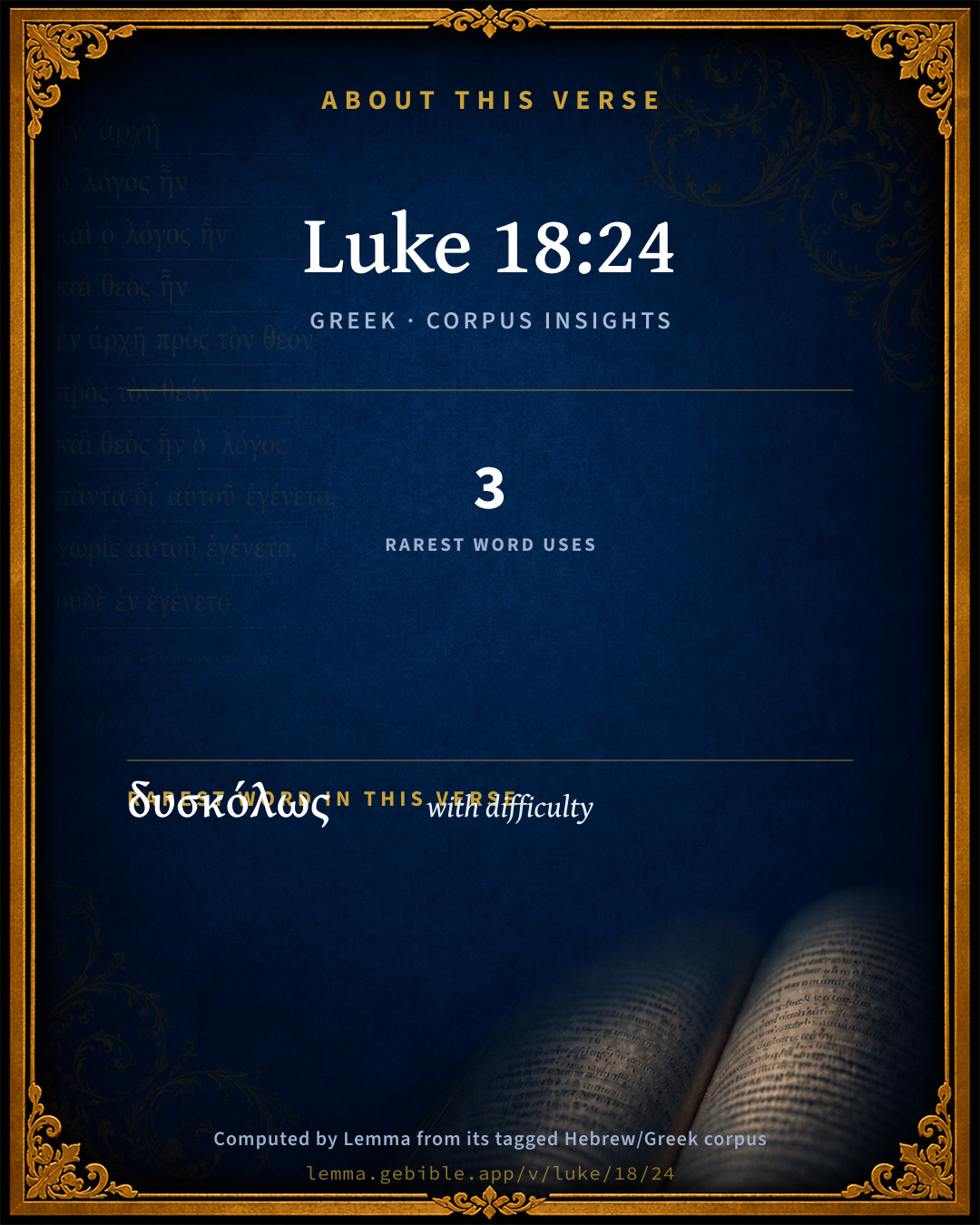
The rarest word here is δυσκόλως with difficulty G1423 — appearing just 3 times in the whole Greek New Testament.

Shared distinctive vocabulary

δυσκόλως with difficulty G1423 occurs in 3 verses of the Greek New Testament. Also found in:

Repetition

A word recurs within this verse:

Cross-references

17

Topical passages linked to Luke 18:24 in the Treasury of Scripture Knowledge — connected by theme and wording, ordered by reader-vote popularity; previews shown in the World English Bible.

  • Proverbs 11:28 He who trusts in his riches will fall, But the righteous shall flourish as the green leaf.
  • Proverbs 30:9 Lest I be full, deny you, and say, 'Who is Yahweh?' Or lest I be poor, and steal, And so dishonor the name of my God.
  • Mark 10:23–27 Jesus looked around, and said to his disciples, "How difficult it is for those who have riches to enter into the Kingdom of God!"
  • James 2:5–7 Listen, my beloved brothers. Didn't God choose those who are poor in this world to be rich in faith, and heirs of the Kingdom which he promised to those who love him?
  • Psalms 10:3 For the wicked boasts of his heart's cravings, He blesses the greedy, and condemns Yahweh.
  • Matthew 19:23–25 Jesus said to his disciples, "Most assuredly I say to you, a rich man will enter into the Kingdom of Heaven with difficulty.
  • Deuteronomy 6:10–12 It shall be, when Yahweh your God shall bring you into the land which he swore to your fathers, to Abraham, to Isaac, and to Jacob, to give you, great and goodly cities, which you didn't build,
  • Deuteronomy 8:11–17 Beware lest you forget Yahweh your God, in not keeping his commandments, and his ordinances, and his statutes, which I command you this day:
  • Psalms 73:5–12 They are free from burdens of men, Neither are they plagued like other men.
  • Proverbs 18:11 The rich man's wealth is his strong city, Like an unscalable wall in his own imagination.
  • Jeremiah 2:31 Generation, see the word of Yahweh. Have I been a wilderness to Israel? or a land of thick darkness? why say my people, We are broken loose; we will come no more to you?
  • Jeremiah 5:5 I will get me to the great men, and will speak to them; for they know the way of Yahweh, and the law of their God. But these with one accord have broken the yoke, and burst the bonds.
  • Mark 6:26 The king was exceedingly sorry, but for the sake of his oaths, and of his dinner guests, he didn't wish to refuse her.
  • 1 Corinthians 1:26–27 For you see your calling, brothers, that not many are wise according to the flesh, not many mighty, and not many noble;
  • 2 Corinthians 7:9–10 I now rejoice, not that you were made sorry, but that you were made sorry to repentance. For you were made sorry in a godly way, that you might suffer loss by us in nothing.
  • 1 Timothy 6:9–10 But those who are determined to be rich fall into a temptation and a snare and many foolish and harmful lusts, such as drown men in ruin and destruction.
  • James 5:1–6 Come now, you rich, weep and howl for your miseries that are coming on you.

Cross-references courtesy of OpenBible.info (CC BY 4.0).

Commentary

Notes on Luke 18:24 from classic Christian and Jewish commentators (each source and its license shown beneath its notes). The classic Christian expositions comment on the surrounding passage and are grouped to its opening verse, so a note may address several verses; the Jewish commentaries on the Tanakh (Rashi and others) are per-verse, so they appear only where the commentator wrote on this verse.

Lemma curates 59 commentaries, every one of them public domain or Creative Commons licensed, each selected and text-cleaned for this edition rather than reprinted as found. About our sources →

Tyndale Open Study Notes

Tyndale Open Resources

18:24-25 How hard it is for the rich to enter the Kingdom of God! Though Scripture sometimes speaks of riches as a blessing from God (2 Chr 1:11-12; Pss 112:3; 128:2; Prov 8:18; Isa 61:6), many passages warn against the danger of trusting riches instead of God (Ps 62:10; Prov 11:28; Jer 9:23-24; 49:4-5). • the eye of a needle: See study note on Mark 10:25. This is not merely difficult, but impossible. No one can be saved while trusting in riches. Salvation comes only by dependence on God (Luke 18:27).

Tyndale Open Study Notes — © Tyndale Open Resources, licensed CC BY-SA 4.0. Text via the HelloAO Bible API.

Expositor's Greek Testament

ed. W. Robertson Nicoll

Luk 18:24-30 . Ensuing conversation (Mat 19:23-30 , Mar 10:23-31 ).

Luk 18:24 . εἰσπορεύονται : present, not future, as in parallels, indicating not what will happen but what is apt to happen from the nature of riches.

The Expositor's Greek Testament, edited by W. Robertson Nicoll (1897–1910) — public domain. Text from a community e-Sword module.

Godet's Commentaries

Frédéric Louis Godet

2 d. Luk 18:24-27. The Conversation regarding the Rich Man.

It is not the fact of proprietorship which hinders the soul from taking its flight to spiritual blessings; it is the feeling of security which it inspires. So, in Mark, Jesus says, in explanation of His first declaration: “How hard is it for them that trust in riches to enter...!” The Shemites denote the impossibility of a thing by the image of a heavily-laden camel arriving at a city gate which is low and narrow, and through which it cannot pass. Then, to give this image the piquant form which the Oriental proverb loves, this gate is transformed into the eye of a needle. Some commentators and copyists, not understanding this figure, have changed κάμηλος, camel, into κάμιλος (the η was pronounced ι), a very unusual word, which does not occur even in the ancient lexicographers, and which, it is alleged, sometimes denotes a ship’s cable. In the received text (τρυμαλιᾶς ῥαφίδος), ῥαφίδος is a correction borrowed from Mark and Matthew; the true reading in Luke is βελόνης, which also signifies needle. Instead of the word τρυμαλία, the Alex. read τρύπημα (or τρήμα). The first form might come from Mark; but it is more probable that it is the second which is taken from Matthew, the Gospel most generally used. We must therefore read in Luke, τρυμαλιᾶς βελόνης.

To exclude the rich from salvation was, it seemed, to exclude all; for if the most blessed among men can only be saved with difficulty, what will become of the rest? Such appears to be the connection between Luk 18:25-26. De Wette joins them in a somewhat different way: “As every one more or less seeks riches, none therefore can be saved.” This connection is less natural.

Jesus, according to Matthew and Mark, at this point turns on His disciples a look full of earnestness (ἐμβλέψας αὐτοῖς, looking upon them): “It is but too true; but there is a sphere in which the impossible is possible, that of the divine operation (παρὰ τῷ Θεῷ, with God).” Thus Jesus in the twinkling of an eye lifts the mind of His hearers from human works, of which alone the young man was thinking, to that divine work of radical regeneration which proceeds from the One only good, and of which Jesus is alone the instrument. Comp. a similar and equally rapid gradation of ideas, Joh 3:2; Joh 3:5.

Which would have been better for this young man—to leave his goods to become the companion in labour of the St. Peters and St. Johns, or to keep those possessions so soon to be laid waste by the Roman legions?

Frédéric Louis Godet — Commentaries on Luke, John, Romans, and 1 Corinthians — English translation (T&T Clark, Edinburgh, 1870s–1890s) — public domain. Text from a community e-Sword module.

Geneva Bible (1599)

Geneva Bible translators

To be both rich and godly, is a singular gift of God.

Geneva Bible (1599) marginal notes — public domain. Text via Bolls.life.

Jamieson, Fausset & Brown

Robert Jamieson, A. R. Fausset & David Brown

when Jesus saw--Mark says (Mar 3:34), He "looked round about"--as if first following the departing youth with His eye--"and saith unto His disciples."

How hardly, &c.--with what difficulty. In Mark (Mar 10:24) an explanation is added, "How hard is it for them that trust in riches," &c.--that is, with what difficulty is this idolatrous trust conquered, without which they cannot enter; and this is introduced by the word "children"--sweet diminutive of affection and pity (Joh 21:5).

Jamieson, Fausset & Brown — Commentary Critical and Explanatory on the Whole Bible (1871) — public domain (CC PDM 1.0). Text via the HelloAO Bible API.

Adam Clarke's Commentary

Verse 24. How hardly shall they that have riches, &c.] See the notes on this discourse of our Lord, on Mt 19:21-30, and Mr 10:30.

Adam Clarke's Commentary on the Bible (1810–1826) — public domain. Text from a community e-Sword/MySword module.

Ellicott's Commentary for English Readers

(24-27) When Jesus saw that he was very sorrowful.—See Notes on Mat_19:23-26; Mar_10:23-27. The better MSS. give simply, “When Jesus saw him, He said . . .”

How hardly shall they that have riches . . .—Another verbal agreement with St. Mark.

A Bible Commentary for English Readers, edited by Charles John Ellicott (1878–1897) — public domain. Text from a community e-Sword module.

The Cambridge Bible for Schools and Colleges

gen. ed. J. J. S. Perowne

24. saw that he was very sorrowful] Several good uncials read merely ‘when Jesus saw him.’

shall they that have riches] Rather, do they. The striking reading of some MSS. (א, B, &c.) in Mar_10:24, is that Christ, seeing the pained astonishment of the disciples, said, “Children! how hard it is to enter into the kingdom of God”—hard for all; above all, hard for the rich. Other MSS. have “for those that trust in riches’’(comp. Pro_11:28)—but that would be a truism; and, indeed, while they trust in riches, it would be not only hard, but impossible. The point that Jesus wished to teach was that riches are always a temptation and a snare. 1Ti_6:9-10. Let us not forget that Judas heard these words only a few days or weeks before he sold his Lord. It was almost a proverb among the ancients that “the very rich are not good.” Stobaeus, xciii. 27.

The Cambridge Bible for Schools and Colleges (gen. ed. J. J. S. Perowne; Cambridge University Press, 1878–1918) — public domain. Text from a community e-Sword module.

John Gill's Exposition

And when Jesus saw that he was very sorrowful,.... As he might, by his looks and gestures; and perceived that he was determined not to part with his possessions, and follow him:

he said to his disciples, how hardly shall they that have riches enter into the kingdom of God! embrace the Gospel, and submit to the ordinances of it; deny themselves, part with their worldly substance for the cause of Christ, and interest of religion. Riches, which should be a reason for, are often a bar unto a profession of Christ, and his Gospel. This is delivered as an affirmation, or by way of assertion; see Gill on Mat 19:23.

John Gill's Exposition of the Whole Bible (1746–1763) — public domain (CC PDM 1.0). Text via the HelloAO Bible API.

Trapp's Complete Commentary

John Trapp

24 And when Jesus saw that he was very sorrowful, he said, How hardly shall they that have riches enter into the kingdom of God!

Ver. 24. See Mat 19:23.

John Trapp, A Commentary or Exposition upon All the Books of the Old and New Testament (1647–1656) — public domain. Text from a community e-Sword module.

The Pulpit Commentary

And when Jesus saw that he was very sorrowful, he said, How hardly shall they that have riches enter into the kingdom of God! The temptations which beset a rich man are so many and so various. The poor, indeed, with all their trials, stand fairer for the kingdom than do their envied richer brothers and sisters.

Wealth and piety.

Wherein lies the difficulty of a rich man entering the kingdom? This young ruler shrank from parting with his property, but Jesus Christ does not ordinarily ask men of wealth to "sell all that they have and give to the poor." His difficulty, therefore, is not the common one.

1. It is not that the rich man is not as welcome to the friendship of Christ as the poor man. He does not make distinctions in his invitation, or in his desire that men should come to him. In him in whom is neither male nor female, bond nor free, there is neither rich nor poor. The poor as much as the rich, and also the rich as much as the poor, are the objects of his love and of his seeking. The Lord of our nature regards us, and concerns himself for us, not on account of our circumstances, but because he knows the value of our souls.

2. Not because the rich man cannot illustrate the distinctive graces of Christianity. The sale and distribution of property in apostolic times was an expedient which was adopted for the occasion; but it was not insisted upon as necessary even then, (Act_5:4) and it was very soon abandoned. Paul, writing to Timothy, wrote on the supposition that the Christian Church included many wealthy men. (1Ti 6) Every age and every country has witnessed the lives of wealthy Christian men, who have illustrated every grace that the great Teacher has commended. It is clear that a rich man map be as humble, as generous, as temperate, as pure, as devout, as any poor man can be; and he sometimes is so. The explanation of our Lord"s language is found in the fact that riches are apt to put a serious obstacle in the way of entrance into the kingdom. If we would find our way into that holy and blessed kingdom, it is necessary that we should have a sense of our personal emptiness and need. We come to Christ to be filled with his fulness, to be enriched by his grace and love. He is a Physician, and it is they who feel that they are sick that are likely to apply for his healing power. He is the Divine Source of all wealth and enrichment, (Rev_3:18) and they must know themselves to be poor who come to buy of him gold that they may become rich. Hence the difficulty. It is for this reason that

I A MAN WHOSE MIND IS FULL OF KNOWLEDGE finds it hard to receive distinctive Christian truth. He is rich, as compared with his fellows, in the acquisition of knowledge. He is proud of this possession of his, and is bent on making the most of it. Jesus Christ comes to him, and says that he must lay aside his own views and notions, and sit at his feet and receive the truth he brings to him from God. Then the "rich" man has to sacrifice his favourite theories, has to make nothing of his learning, that he may admit to his mind the wisdom that is from above; and he finds it very "hard" to do this.

II A MAN WHO IS CLOTHED WITH HONOUR finds it hard to take a very humble view of himself. For honour is an order of wealth, and one that is highly prized. But the natural and common effect of it is to lead those who are the objects of it to form a flattering view of themselves; it is hard to get them to believe that in God"s sight they may be as sinful as those held in very much less regard by their fellow-men. But the ground on which human souls must come to Christ is that of humility. "Blessed are the poor in spirit: for theirs is the kingdom of heaven.

III A MAN WHOSE CHAMBERS ARE FULL OF TREASURE is tempted to seek his satisfaction in the lower good. We have to make our choice, as Divine truth is presented to us, whether we will live for the service of Christ or for our own personal enjoyment and aggrandizement. To the poor, to the afflicted, to the suffering, to those who know they have not long to live, the temptation to live for this present world is not so strong; on their ear the overtures of the gospel of grace fall as that very thing they need for theft comfort and their peace; they have little to surrender, they have much to gain. But to those to whom every avenue of enjoyment is open; to those who may look hopefully, perhaps confidently, for place, for power, for society, for pleasure, for honour, the inducement is very strong and urgent to cast in their lot with those "whose portion is in this life." Many voices very close to their ear, very clear and convincing, call for their strength to be given to the material rather than the spiritual, to the temporal rather than the eternal, to the human rather than the Divine; and it is "hard" for them to resist and to overcome.

1. Let poverty find its ample consolation in the accessibility of the riches that always satisfy and never flee.

2. Let those who know neither poverty nor riches thank God for the happy mean in which his providence has placed them not subjecting them to the temptations of either.

3. Let wealth beware lest it make a sad, a supreme, mistake; lest, in the great spiritual strife, it"Clutch the tinsel gilding, and let go the crown of life. C.

The Pulpit Commentary (1880–1919), ed. H.D.M. Spence-Jones & Joseph S. Exell — public domain. Text from a community e-Sword module.

Kretzmann's Popular Commentary

Paul E. Kretzmann

The lesson of the incident:

v. 24. And when Jesus saw that he was very sorrowful, He said, How hardly shall they that have riches enter into the kingdom of God!

v. 25. For it is easier for a camel to go through a needle’s eye than for a rich man to enter into the kingdom of God.

v. 26. And they that heard it said, Who then can be saved?

v. 27. And He said, The things which are impossible with men are possible with God.

The young ruler had gotten more than he bargained for; he went away from Jesus, and it is very doubtful whether he ever returned. Jesus determined to teach His disciples and others that were near a lesson drawn from the incident. He told them in the form of an exclamation: How difficult, how next to impossible, it is for those that have goods, that are rich, to enter into the kingdom of God! See Mat 19:23-30; Mar 10:23-31. A person that is rich, actually calls the goods that are entrusted to him his own, and thus puts his trust in them, instead of in God alone, who has laid this responsibility upon him, is a servant of mammon, and cannot get to heaven. The difficulty is well illustrated by a proverb after the Oriental fashion, according to which it is easier for a camel to go through the eye of a needle than for a rich man of that kind to enter into the kingdom of heaven. "For the rich people commonly become so entangled in the love and in the lust of riches that they cannot seek Jesus; yea, they do not desire to see Him: All their consolation is centered in money and goods; the more they get, the greater their desire, grows to possess still more. " But the saying of Jesus was too much for the spiritual understanding of the disciples and other hearers. In astonishment and perplexity they ask: And who can be saved? But Jesus gave them the solution by saying: The impossible with men is possible with God. It is true in general that God’s almighty power is not limited. And it is true, with special reference to conversion, that it is by the merciful power of God that sinful people are converted and renewed, that their hearts are torn loose from the love of this world and its riches and turned to His service all alone.

Paul E. Kretzmann, Popular Commentary of the Bible (1921–1924) — public domain. Text from a community e-Sword module.

Burkitt's Expository Notes on the New Testament

William Burkitt

Our holy Lord takes occasion from the rich man’s departure from him, to discourse concerning the danger of riches, and the difficulties that attend rich men in their way to heaven.

From whence we may collect and gather,

1. That rich men do certainly meet with more difficulties in their way to heaven than other men; it is difficult to withdraw their affections from riches, to place their supreme love upon God in the midst of their riches, and to depend entirely upon God in a rich condition; for the rich man’s wealth is his strong tower.

2. That yet the fault lies not in riches, but in rich men, who by placing their trust and reposing their confidence in riches, do render their salvation difficult, if not impossible.

3. Our Saviour’s proverbial speech of a camels going through the eye of a needle implies thus much, that it is not only a great difficulty, but an utter impossibility, for such as abound in worldly wealth, and place their confidence therein, to be saved, without an extraordinary grace and assistance from God. It is hard for God to make a rich man happy, because he thinks himself happy without God.

4. That as difficult and impossible as this may seem to men, yet nothing is impossible with God; he can change the heart of the rich, by the rich and powerful influences of his Holy Spirit: That which is impossible with men is possible with God.

William Burkitt's Expository Notes on the New Testament (1700–1703) — public domain. Text from a community e-Sword module.

unfoldingWord translationNotes

Door43 World Missions Community

How difficult it is ... kingdom of God!

This is an exclamation, and not a question. AT: "It is so very hard ... kingdom of God!" (See: Exclamations)

a camel to go through a needle's eye

It is impossible for a camel to fit through the eye of a needle. Jesus was probably using hyperbole to mean it is extremely difficult for a rich man to enter God's kingdom. (See: Hyperbole and Generalization)

needle's eye

The needle's eye is the hole in a sewing needle through which the thread is passed.

translationWords

kingdom of God

camel

unfoldingWord translationNotes — © Distant Shores Media and the Door43 World Missions Community, licensed CC BY-SA 4.0. Source: git.door43.org/Door43/en_tn.

Cambridge Greek Testament for Schools and Colleges

24. ἰδὼν δὲ αὐτόν. Several good uncials read merely ‘when Jesus saw him.’ The Gospel to the Hebrews as quoted by Origen on Mat 19:19 has here a weak and prosaic addition, which shews its complete inferiority.

οἱ τὰ χρήματα ἔχοντες. The striking reading of some MSS. (אB, &c.) in Mar 10:24, is that Christ, seeing the pained astonishment of the disciples, said, “Children! how hard it is to enter into the kingdom of God”—hard for all; above all, hard for the rich. Other MSS. have “for those that trust in riches” (comp. Pro 11:28)—but that would be a truism; and indeed, while they trust in riches, it would be not only hard, but impossible. The point that Jesus wished to teach was that riches are always a temptation and a snare. 1Ti 6:9-10. Let us not forget that Judas heard these words only a few days or weeks before he sold his Lord. It was almost a proverb among the ancients that “the very rich are not good.” Stobaeus, XCIII. 27.

Cambridge Greek Testament for Schools and Colleges (Cambridge University Press, 1896; 21 vols, various authors incl. Carr, Maclear, Plummer, Farrar, Lumby, Moule, M. R. James, Simcox) — public domain. Text from a community e-Sword module.

International Critical Commentary

24. Πῶς δυσκόλως. All three have this adv., which occurs nowhere else in bibl. Grk. Clam. Alex. seems to allude to the saying when he writes ὁ λόγος τουὺς τελώμας λέγει δυσκόλως σωθήσεται (Strom. v. 5. p. 662, ed. Potter). Lk. omits the departure of the ruler, which took place before these words were uttered. Mk. alone records (10:24) the consternation which they excited in the disciples, and Christ’s repetition of them. It was perhaps largely for the sake of Judas that these stern words about the perils of wealth were uttered to them.

International Critical Commentary — older volumes (1896–1929), various authors — public domain. Text from a community e-Sword module.

Lesson kit

Teaching starters — assembled from the data on this page, not authored interpretation. Every prompt links to the verse data it draws on. Edit before teaching.

Luke, in the Gospels, opens this verse with 18 words (14 distinct Greek lemmas). Its most distinctive word is dyskólōs (“with difficulty”). A historical commentator’s framing appears above. Read the whole chapter for the surrounding context.

Discussion questions

  1. What does “with difficulty” (dyskólōs) contribute to the verse as a whole?
  2. Matthew 19:23 shares the word «with difficulty» with this verse. How do the two illuminate each other?
  3. “the” occurs 5× in this one verse. What is the effect of the repetition?
  4. These translations render this verse differently. What is at stake in choosing one wording over another?
  5. Reading how Tyndale Open Study Notes and Expositor's Greek Testament read this verse, where do the two commentators agree and where do they part?

Things to notice

Reading settings

Reading text

Shown beneath each verse's original-language words.

Old Testament
Old Testament edition

Read the OT as the Masoretic Hebrew (MT) or the Greek Septuagint (LXX).

English shown for the Greek Septuagint (in the Hebrew ↔ Greek comparison).

Comparing translations? Open the Compare panel on any verse page to stack up to four side by side.