
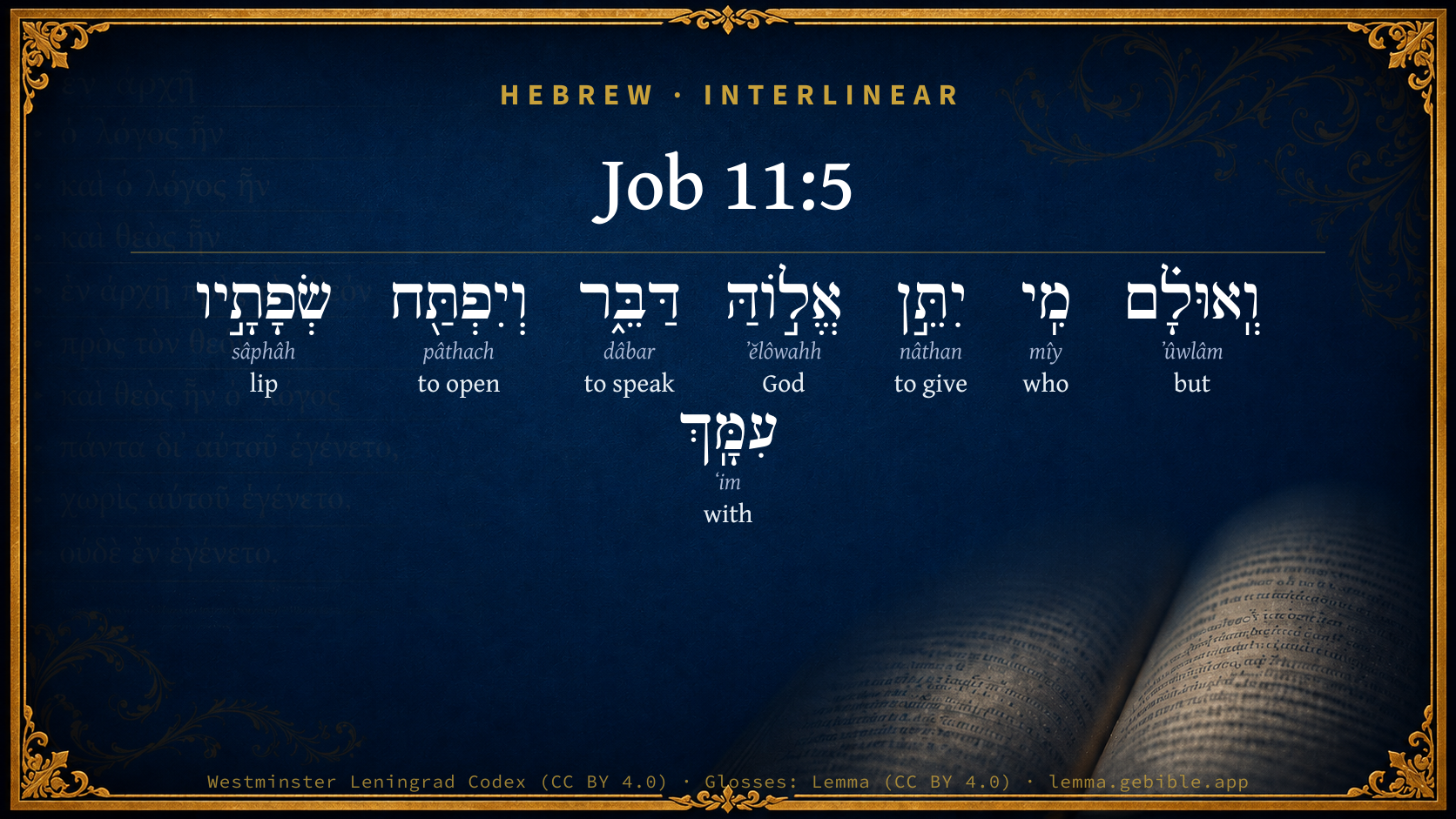
Job 11:5

Hebrew (Westminster Leningrad Codex) Job 11:5 appears in the Hebrew Old Testament. The text above is from the Westminster Leningrad Codex. Each word links to its Strong’s number, a concise gloss, and parsing drawn from the Open Scriptures Hebrew Bible morphology. Click any word for its full Brown-Driver-Briggs (BDB) entry.
Download image
Cite this verse

Job 11:5 (World English Bible). Public Domain. Lemma interlinear Bible study tool, https://lemma.gebible.app/v/job/11/5.

Show BibTeX & RIS
BibTeX
RIS
English Translation
But oh that God would speak, And open his lips against you,
World English Bible · Public Domain
Download a study sheet

One document with this verse’s original text, its word-by-word gloss line, the meaning frame, cross-references with their text, attributed commentary, and full source and license credits — printable, and it pastes into notes with its structure intact.

This verse Autodidact and up

Study sheet (.html) Plain text (.txt)

A passage Seminary Student

Up to 50 verses in one chapter. A passage sheet keeps up to 6 commentary sources and 12 cross-references per verse, in the order this page ranks them, and says so on the sheet whenever that leaves anything out. Ask for a single verse and you get the Autodidact verse sheet above.

Everything on this page stays free to read, with no account — the sheet is a download of what is already on screen, not access to it.

Want to remove ads? Support Godless Engineer
Compare translations 3

The same verse in 3 English versions, stacked beneath the original-language interlinear above. Click any original word for its lexicon entry.

Each is an independent rendering of the whole verse — the interlinear is not word-aligned to these translations.

Highlighted words mark where these versions differ — a whole-verse word diff, not a word-by-word alignment.

  • World English Bible Public Domain
    But oh that God would speak, And open his lips against you,
  • King James Version Public Domain
    But oh that God would speak, and open his lips against thee;
  • unfoldingWord Literal Text CC BY-SA 4.0
    But who will give God to speak and open his lips against you

unfoldingWord Literal Text — © unfoldingWord, licensed CC BY-SA 4.0. Word-aligned USFM3 via Door43 (git.door43.org/unfoldingWord/en_ult).

Versions to compare (up to 4)

3 of 4 selected

Show all 18 translations

Every available English version of this verse, each an independent rendering of the whole verse.

  • World English Bible Public Domain
    But oh that God would speak, And open his lips against you,
  • Berean Standard Bible Public Domain
    But if only God would speak and open His lips against you,
  • Majority Standard Bible Public Domain
    But if only God would speak and open His lips against you,
  • King James Version Public Domain
    But oh that God would speak, and open his lips against thee;
  • American Standard Version (1901) Public Domain
    But oh that God would speak, And open his lips against thee,
  • Revised Version (1885) Public Domain
    But Oh that God would speak, and open his lips against thee;
  • Geneva Bible (1599) Public Domain
    But, oh that God would speake and open his lippes against thee!
  • Douay-Rheims (1899) Public Domain
    And I wish that God would speak with thee, and would open his lips to thee,
  • Young's Literal Translation Public Domain
    And yet, O that God had spoken! And doth open His lips with thee.
  • Literal Standard Version CC BY-SA 4.0
    And yet, O that God had spoken! And opens His lips with you.
  • Unlocked Literal Bible CC BY-SA 4.0
    But, oh, that God would speak and open his lips against you;
  • unfoldingWord Literal Text CC BY-SA 4.0
    But who will give God to speak and open his lips against you
  • Darby Bible Public Domain
    But oh that +God would speak, and open his lips against thee;
  • World Messianic Bible Public Domain
    But oh that God would speak, and open his lips against you,
  • Webster's Bible Public Domain
    But Oh that God would speak, and open his lips against thee;
  • Free Bible Version CC BY-SA 4.0
    If only God would speak up and tell you directly,
  • Bible in Basic English Public Domain
    But if only God would take up the word, opening his lips in argument with you;
  • JPS Tanakh (1917) Public Domain
    But oh that God would speak, and open His lips against thee;

Literal Standard Version (2020), Covenant Press — licensed CC BY-SA 4.0. Text via the HelloAO Bible API (eBible.org). Unlocked Literal Bible (unfoldingWord) — licensed CC BY-SA 4.0. Text via the HelloAO Bible API (eBible.org). unfoldingWord Literal Text — © unfoldingWord, licensed CC BY-SA 4.0. Word-aligned USFM3 via Door43 (git.door43.org/unfoldingWord/en_ult). Free Bible Version, Dr. Jonathan Gallagher — licensed CC BY-SA 4.0. Text via the HelloAO Bible API (eBible.org).

Word by word

More ways to search: Search by grammar → Find every occurrence → Compare this word →

Practice this passage: Drill this verse → Learn its vocabulary →

About this verse

These counts appear in no published source. They are computed here, from the morphology-tagged text and Lemma’s own curated glosses. What Lemma adds →

8
words
8
distinct lemmas
Wisdom
section

Notable vocabulary

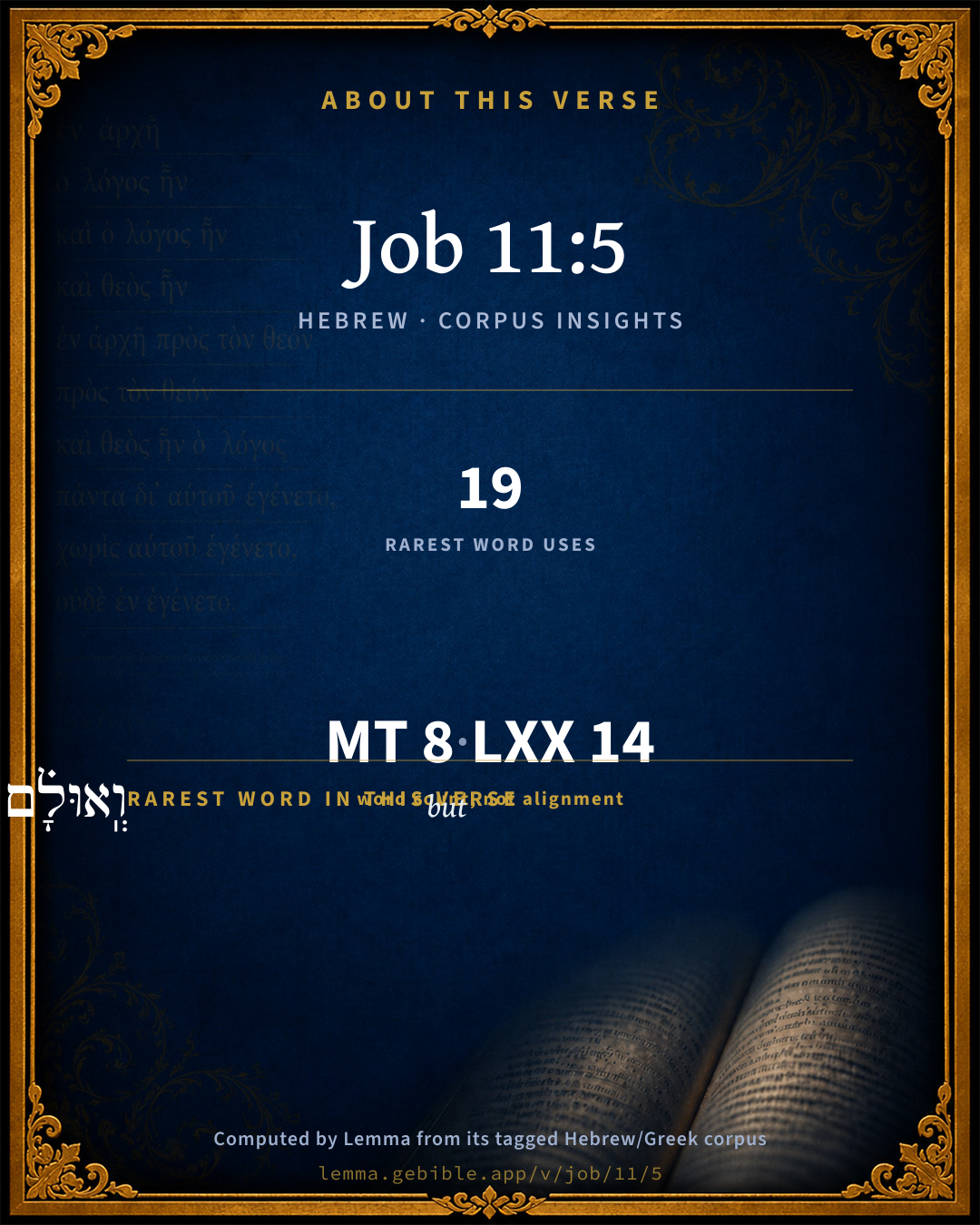
The rarest word here is וְֽאוּלָ֗ם but H199 — appearing just 19 times in the whole Hebrew Bible.

Shared distinctive vocabulary

וְֽאוּלָ֗ם but H199 occurs in 19 verses of the Hebrew Bible. Also found in:

Grammatical profile

  • 3 verbs
  • 2 nouns
  • 1 preposition
  • 1 adverb
  • 1 particle

Verb forms

  • יִתֵּ֣ן Qal · Imperfect
  • דַּבֵּ֑ר Piel · Imperative
  • וְיִפְתַּ֖ח Qal · Imperfect

Hebrew & Septuagint length

In English translation the verse runs 12 words from the Hebrew and 15 from the Septuagint (LXX English) — closely comparable.

A rough comparison of the two English renderings, which tokenize alike — not a word-level alignment.

Word counts can differ between the Hebrew and the Greek without any difference in meaning — e.g. the Hebrew direct-object marker אֵת has no separate Greek word, and Greek often adds the article ὁ.

In the original languages it is 8 Hebrew tokens and 14 Greek tokens — but the two are counted differently (Hebrew bundles its prefixes and suffixes into one token; the Greek is in lemma form), so that isn’t a like-for-like length.

Cross-references

7

Topical passages linked to Job 11:5 in the Treasury of Scripture Knowledge — connected by theme and wording, ordered by reader-vote popularity; previews shown in the World English Bible.

  • Job 38:1–2 Then Yahweh answered Job out of the whirlwind,
  • Job 23:3–7 Oh that I knew where I might find him! That I might come even to his seat!
  • Job 31:35 Oh that I had one to hear me! (Behold, here is my signature, let the Almighty answer me); Let the accuser write my indictment!
  • Job 33:6–18 Behold, I am toward God even as you are: I am also formed out of the clay.
  • Job 40:1–5 Moreover Yahweh answered Job,
  • Job 40:8 Will you even annul my judgment? Will you condemn me, that you may be justified?
  • Job 42:7 It was so, that after Yahweh had spoken these words to Job, Yahweh said to Eliphaz the Temanite, "My wrath is kindled against you, and against your two friends; for you have not spoken of me the thing that is right, as my servant Job has.

Cross-references courtesy of OpenBible.info (CC BY 4.0).

Hebrew and Greek witnesses Masoretic Hebrew ↔ Greek Septuagint

The same verse in the two great witnesses to the Old Testament, shown verse-for-verse.

These are two independent witnesses, not word-aligned to each other, and the Septuagint is shown in lemma (dictionary) form.

Hebrew Job 11:5 Masoretic · Westminster Leningrad Codex

וְֽאוּלָ֗ם מִֽי יִתֵּ֣ן אֱל֣וֹהַּ דַּבֵּ֑ר וְיִפְתַּ֖ח שְׂפָתָ֣יו עִמָּֽךְ

But oh that God would speak, And open his lips against you,

World English Bible · Public Domain

Greek LXX Job 11:5 Septuagint · lemma form

ἀλλά πῶς ἄν ὁ κύριος λαλέω πρός σύ καί ἀναοἴγω χεῖλος αὐτός μετά σύ

But oh that the Lord would speak to you, and open his lips to you!

LXX2012 (modern English Septuagint) · Public Domain

Hebrew: Westminster Leningrad Codex (CC BY 4.0). Greek: Septuagint (public domain); English from LXX2012 (modern English Septuagint) (Public Domain). How the Septuagint differs from the Hebrew →

Commentary

Notes on Job 11:5 from classic Christian and Jewish commentators (each source and its license shown beneath its notes). The classic Christian expositions comment on the surrounding passage and are grouped to its opening verse, so a note may address several verses; the Jewish commentaries on the Tanakh (Rashi and others) are per-verse, so they appear only where the commentator wrote on this verse.

Lemma curates 59 commentaries, every one of them public domain or Creative Commons licensed, each selected and text-cleaned for this edition rather than reprinted as found. About our sources →

Trapp's Complete Commentary

John Trapp

Job 11:5 But oh that God would speak, and open his lips against thee;

Ver. 5. But oh that God would speak, &c.] For we do but lose our sweet words upon thee, since thou art set, and so wedded and wedged to thine own will and way, that thou canst not be removed and rectified, but by an extraordinary touch from the hand of heaven: oh therefore that God would speak and open his lips against thee, and for us; for so Zophar doubts not but he would do; but if it proved otherwise, Job 42:7-10, Job was justified, and these three condemned, because they had not spoken of God (or to God, as in this text), the thing that was right, Job 11:7, but had been Satan’s instruments to discourage Job, and to drive that good man to many passionate speeches. Some men (and women too, as Sarah, Gen 16:5) are overly hasty to send for God, as it were, by a post, to decide their controversies; who, if he should come at their call, would certainly pronounce against them. Fret not thyself therefore to do evil, Psa 37:1; be not rash with thy mouth, and let not thine heart be hasty to utter anything in this way before God, Ecc 5:2, or to interest him in thy quarrels and controversies, for he will surely pass an impartial sentence; neither is there any iniquity with the Lord our God, nor respecting of persons, nor receiving of gifts, 1Ch 19:7. One interpreter from this wish of Zophar noteth, that it is an ordinary practice of heretics (Satan’s factors) to mention God, as approving of their errors, if by speaking he would from heaven declare himseff plainly, and that therefore we should take heed of those that labour to work upon us this way, when by right reason they are able to evince nothing that they say.

John Trapp, A Commentary or Exposition upon All the Books of the Old and New Testament (1647–1656) — public domain. Text from a community e-Sword module.

Joseph Benson's Commentary

Job 11:5. O that God would speak — Plead with thee according to thy desire: he would soon put thee to silence. We are commonly ready, with great assurance, to interest God in our quarrels. But they are not always in the right who are most forward to appeal to his judgment, and prejudge it against their antagonists.

Joseph Benson's Commentary on the Old and New Testaments (1811–1818) — public domain. Text from a community e-Sword module.

Tyndale Open Study Notes

Tyndale Open Resources

11:5-6 punishing you . . . less than you deserve: Zophar believed that calamity indicated divine retribution for sins (cp. 34:36).

Tyndale Open Study Notes — © Tyndale Open Resources, licensed CC BY-SA 4.0. Text via the HelloAO Bible API.

Adam Clarke's Commentary

Verse 5. But O that God would speak] How little feeling, humanity, and charity is there in this prayer!

Adam Clarke's Commentary on the Bible (1810–1826) — public domain. Text from a community e-Sword/MySword module.

The Cambridge Bible for Schools and Colleges

gen. ed. J. J. S. Perowne

5. Job had expressed his readiness to meet God and plead his cause before Him, ch. Job_9:25; Zophar, with reference to this, exclaims, Would that God would speak! The result would be different from what Job anticipated, his guilt would be laid before him.

The Cambridge Bible for Schools and Colleges (gen. ed. J. J. S. Perowne; Cambridge University Press, 1878–1918) — public domain. Text from a community e-Sword module.

John Gill's Exposition

But O that God would speak,.... To Job, and stop his mouth, so full of words; convict him of his lies, reprove him for his mocks and scoffs, and make him ashamed of them; refute his false doctrine and oppose it, and show him his folly and vanity in imagining it to be pure, and in conceit thinking himself to be free from sin, and even in the sight of God himself: Zophar seems by this wish to suggest, that what his friends had as yet spoke had had no effect upon Job, and signified nothing; and that he despaired of bringing him to any true sense of himself and his case, but that God only could do it; and therefore he entreats he would take him in hand, and speak unto him; as he had by his providences in afflicting him, so by his spirit in teaching and instructing him; and he adds:

and open his lips against thee; or rather, "with thee", or "to thee" (a); converse with thee; speak out his mind freely; disclose the secrets of his wisdom, as in Job 11:6, and that for thy good; fully convince thee of thy sins, mistakes, and follies: for, notwithstanding all the heat and warmth of Zophar's spirit, yet, being a good man, as it cannot be thought he should wilfully and knowingly slander Job, and put a false gloss on his words, so neither could he desire any hurt or injury to be done him, or that God would deal with him as an enemy; only convince and reprove him for his sin, and justify himself and his own conduct, which he imagined Job had arraigned.

(a) , Sept. "tecum", Pagninus, Montanus, Beza, Vatablus, Mercerus, Cocceius, Schmidt, Michaelis; "tibi", V. L. "ad te", Piscator.

John Gill's Exposition of the Whole Bible (1746–1763) — public domain (CC PDM 1.0). Text via the HelloAO Bible API.

Albert Barnes' Notes on the Bible

But oh that God would speak - Hebrew, “and truly, who will give that God should speak.” It is the expression of an earnest wish that God would address him, and bring him to a proper sense of his ill desert. The meaning is, that if God should speak to him he would by no means find himself so holy as he now claimed to be.

Albert Barnes' Notes on the Bible (1834–1885) — public domain. Text from a community e-Sword/MySword module.

Matthew Poole's English Annotations

i.e. Plead with thee, according to thy desire, Job 9:32, &c. He would soon put thee to silence and shame.

Matthew Poole's English Annotations on the Holy Bible (1683–1685) — public domain. Text from a community e-Sword/MySword module.

The Pulpit Commentary

But oh that God would speak, and open his lips against thee! "Oh that God would do," i.e. "what thou hast challenged him to do show thee wherein he contends with thee! (comp. Job_10:2) Then how would thy reasonings be confuted, and thy boastings be brought low!

"Oh that God would speak!

Zophar"s wish is most ungenerous. Feeling his own inability to give a complete reply to the complaints of Job, he expresses a desire that God may interpose and give the requisite answer. He really wants God to come as his advocate and speak on the side of conventional orthodoxy. But though he is now moved by an uncharitable thought, the desire that he is led to express is significant of a common need of mankind. Both Job and his accusers look for a Divine interposition, and long for a clear utterance of God"s mind.

I IT IS NATURAL TO DESIRE A DIVINE VOICE. This desire springs out of our spiritual instincts. We cannot shake it off. It is almost universally felt among all races of men, and it becomes only deeper and more urgent with the progress of spiritual culture. The animals betray no signs of any such wish. We alone feel as orphans, as exiles from home; we alone crave a voice from heaven. This is but natural. The child longs to hear from his father. The perplexed looks for a guide, the sorrowful for a comforter, the wronged for an advocate. Will God come and solve the great riddle of existence?

II IT IS UNREASONABLE TO EXPECT TO HEAR GOD"S VOICE WITH THE OUTWARD EAR. By our materialism we pervert the natural instinct that cries out for God. We Live so much in the body that we come to overvalue the experience of our senses. It seems to us that we should be better satisfied if we could hear God"s voice sounding like the voice of our human friend. We forget that the senses may be subject to illusion. If we heard a voice as from heaven we could not be sure that it came from God. Moreover, it is not well that God should cut the knot and explain every mystery at once. We are not yet ready to receive all truth. It is good for our discipline that our patience should be tried, and that we should walk by faith.

III GOD HAS SPOKEN. We listen for the thunder and ignore the still, small voice. But God is ever speaking to us in his Spirit through our consciences. He has given more explicit revelations of his truth through the inspiration of prophets and apostles. The circulation of the Bible is the going forth of God"s voice. Christ is the incarnate Word of God. What Zophar wished for has in a measure appeared in Christ. The old craving for a Divine oracle is met in the best way by the advent of our Lord as "the truth". (Joh_14:6)

IV GOD WILL SPEAK MORE FULLY AT THE END OF THE DAYS. God appeared at the end of Job"s trials. A grand theophany in final judgment is promised us. (Zec_14:4) Even in the light of the gospel many problems are still obscure. Christ did not bring the answer to every question when he appeared on earth. He brought sufficient light for saving knowledge, but he left us to walk by faith. Thus we may still crave the complete revelation, when God shall speak once more, vindicating the right and clearing the mystery of providence. Meanwhile. the nearer we walk to Christ the more of his voice can we hear, and the less perplexed shall we be; for he who follows Christ will not walk in darkness. W.F.A. (Joh_12:35)

The Pulpit Commentary (1880–1919), ed. H.D.M. Spence-Jones & Joseph S. Exell — public domain. Text from a community e-Sword module.

John Wesley's Explanatory Notes

Speak - Plead with thee according to thy desire: he would soon put thee to silence. We are commonly ready with great assurance to interest God in our quarrels. But they are not always in the right, who are most forward, to appeal to his judgment, and prejudge it against their antagonists.

John Wesley, Explanatory Notes Upon the Whole Bible (1754–1765) — public domain. Text via the GEBible commentary corpus.

Lesson kit

Teaching starters — assembled from the data on this page, not authored interpretation. Every prompt links to the verse data it draws on. Edit before teaching.

Job, in the Wisdom, opens this verse with 8 words (8 distinct Hebrew lemmas). Its most distinctive word is ʼûwlâm (“but”). A historical commentator’s framing appears above. Read the whole chapter for the surrounding context.

Discussion questions

  1. The word ʼûwlâm carries the sense “but.” How does it shape the verse?
  2. Genesis 28:19 shares the word «but» with this verse. How do the two illuminate each other?
  3. These translations render this verse differently. What is at stake in choosing one wording over another?
  4. The verb «יִתֵּ֣ן» is Qal Imperfect. How does its form color the action?
  5. Reading how Trapp's Complete Commentary and Joseph Benson's Commentary read this verse, where do the two commentators agree and where do they part?

Things to notice

Reading settings

Reading text

Shown beneath each verse's original-language words.

Old Testament
Old Testament edition

Read the OT as the Masoretic Hebrew (MT) or the Greek Septuagint (LXX).

English shown for the Greek Septuagint (in the Hebrew ↔ Greek comparison).

Comparing translations? Open the Compare panel on any verse page to stack up to four side by side.