Romans 4:10

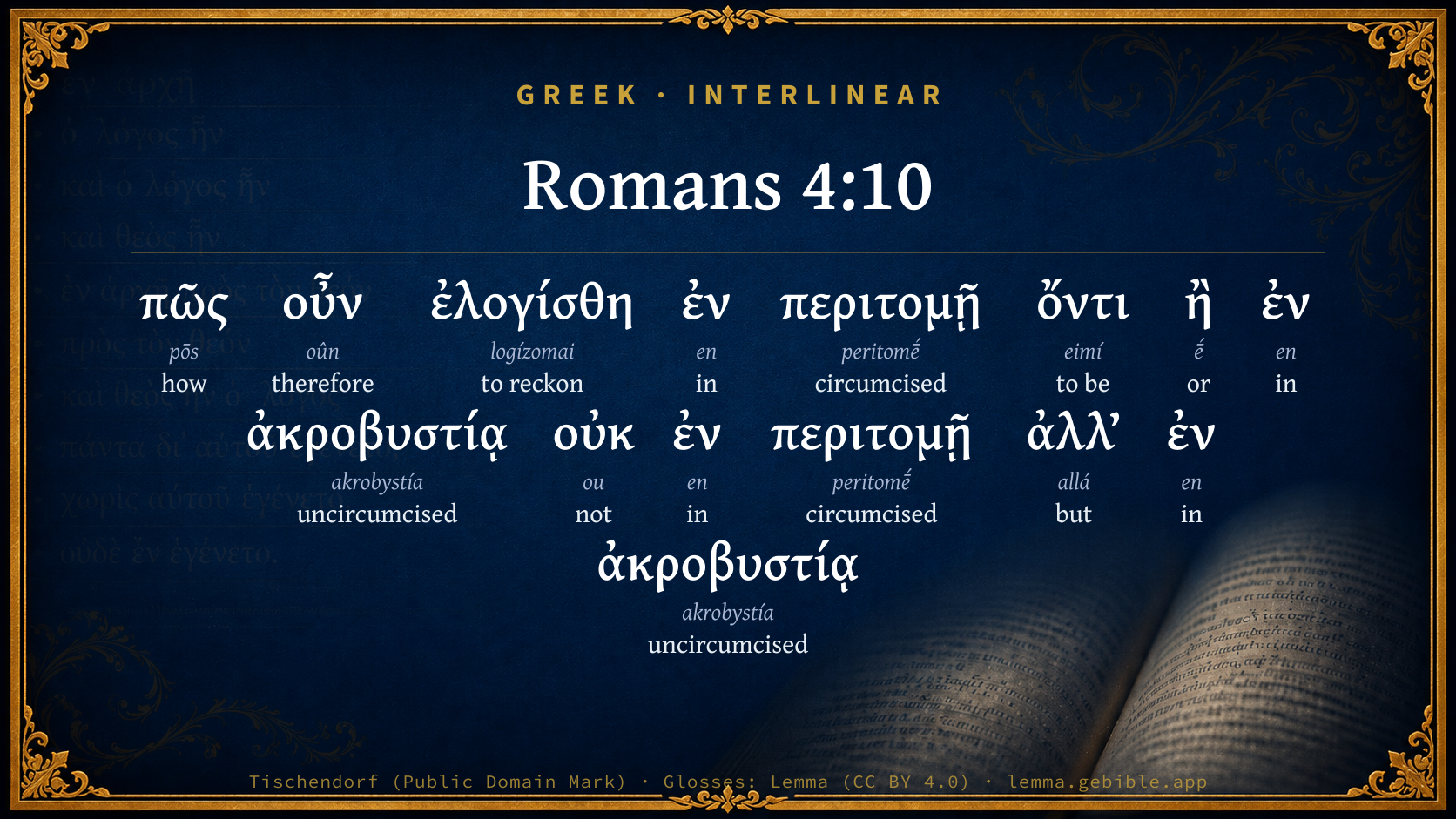
Greek (Tischendorf 8th ed.) Romans 4:10 appears in the Greek New Testament. The text above is from the Tischendorf 8th edition. Each word links to its Strong’s number and a concise gloss. Click any word for its full Thayer’s Greek Lexicon entry.
Download image
Cite this verse

Romans 4:10 (World English Bible). Public Domain. Lemma interlinear Bible study tool, https://lemma.gebible.app/v/romans/4/10.

Show BibTeX & RIS
BibTeX
RIS
English Translation
How then was it counted? When he was in circumcision, or in uncircumcision? Not in circumcision, but in uncircumcision.
World English Bible · Public Domain
Download a study sheet

One document with this verse’s original text, its word-by-word gloss line, the meaning frame, cross-references with their text, attributed commentary, and full source and license credits — printable, and it pastes into notes with its structure intact.

This verse Autodidact and up

Study sheet (.html) Plain text (.txt)

A passage Seminary Student

Up to 50 verses in one chapter. A passage sheet keeps up to 6 commentary sources and 12 cross-references per verse, in the order this page ranks them, and says so on the sheet whenever that leaves anything out. Ask for a single verse and you get the Autodidact verse sheet above.

Everything on this page stays free to read, with no account — the sheet is a download of what is already on screen, not access to it.

Want to remove ads? Support Godless Engineer
Compare translations 3

The same verse in 3 English versions, stacked beneath the original-language interlinear above. Click any original word for its lexicon entry.

Each is an independent rendering of the whole verse — the interlinear is not word-aligned to these translations.

Highlighted words mark where these versions differ — a whole-verse word diff, not a word-by-word alignment.

  • World English Bible Public Domain
    How then was it counted? When he was in circumcision, or in uncircumcision? Not in circumcision, but in uncircumcision.
  • King James Version Public Domain
    How was it then reckoned? when he was in circumcision, or in uncircumcision? Not in circumcision, but in uncircumcision.
  • unfoldingWord Literal Text CC BY-SA 4.0
    How then was it credited? Being in circumcision, or in uncircumcision? not in circumcision, but in uncircumcision.

unfoldingWord Literal Text — © unfoldingWord, licensed CC BY-SA 4.0. Word-aligned USFM3 via Door43 (git.door43.org/unfoldingWord/en_ult).

Versions to compare (up to 4)

3 of 4 selected

Show all 19 translations

Every available English version of this verse, each an independent rendering of the whole verse.

  • World English Bible Public Domain
    How then was it counted? When he was in circumcision, or in uncircumcision? Not in circumcision, but in uncircumcision.
  • Berean Standard Bible Public Domain
    In what context was it credited? Was it after his circumcision, or before? It was not after, but before.
  • Majority Standard Bible Public Domain
    In what context was it credited? Was it after his circumcision, or before? It was not after, but before.
  • King James Version Public Domain
    How was it then reckoned? when he was in circumcision, or in uncircumcision? Not in circumcision, but in uncircumcision.
  • American Standard Version (1901) Public Domain
    How then was it reckoned? when he was in circumcision, or in uncircumcision? Not in circumcision, but in uncircumcision:
  • Revised Version (1885) Public Domain
    How then was it reckoned? when he was in circumcision, or in uncircumcision? Not in circumcision, but in uncircumcision:
  • Geneva Bible (1599) Public Domain
    Howe was it then imputed? when he was circumcised, or vncircumcised? not when he was cricumcised, but when he was vncircumcised.
  • Douay-Rheims (1899) Public Domain
    How then was it reputed? When he was in circumcision, or in uncircumcision? Not in circumcision, but in uncircumcision.
  • Young's Literal Translation Public Domain
    how then was it reckoned? he being in circumcision, or in uncircumcision? not in circumcision, but in uncircumcision;
  • Literal Standard Version CC BY-SA 4.0
    How then was it reckoned? He being in circumcision, or in uncircumcision? Not in circumcision, but in uncircumcision;
  • Unlocked Literal Bible CC BY-SA 4.0
    So how was it counted? When Abraham was in circumcision, or in uncircumcision? It was not in circumcision, but in uncircumcision.
  • unfoldingWord Literal Text CC BY-SA 4.0
    How then was it credited? Being in circumcision, or in uncircumcision? not in circumcision, but in uncircumcision.
  • Darby Bible Public Domain
    How then has it been reckoned? when he was in circumcision, or in uncircumcision? Not in circumcision, but in uncircumcision.
  • World Messianic Bible Public Domain
    How then was it counted? When he was in circumcision, or in uncircumcision? Not in circumcision, but in uncircumcision.
  • Webster's Bible Public Domain
    How then was it reckoned? when he was in circumcision, or in uncircumcision? Not in circumcision, but in uncircumcision.
  • Free Bible Version CC BY-SA 4.0
    But when did this happen? When Abraham was a Jew or before?
  • Bible in Basic English Public Domain
    How, then, was it judged? when he had circumcision, or when he had it not? Not when he had it, but when he did not have it:
  • Text-Critical English NT CC BY 4.0
    How then was it counted? When he was circumcised, or uncircumcised? Not when he was circumcised, but when he was uncircumcised.
  • Tyndale New Testament (1534) Public Domain
    How was it rekened? in the tyme of circumcision? or in the tyme before he was circumcised? Not in tyme of circucision: but when he was yet vncircumcised.

Literal Standard Version (2020), Covenant Press — licensed CC BY-SA 4.0. Text via the HelloAO Bible API (eBible.org). Unlocked Literal Bible (unfoldingWord) — licensed CC BY-SA 4.0. Text via the HelloAO Bible API (eBible.org). unfoldingWord Literal Text — © unfoldingWord, licensed CC BY-SA 4.0. Word-aligned USFM3 via Door43 (git.door43.org/unfoldingWord/en_ult). Free Bible Version, Dr. Jonathan Gallagher — licensed CC BY-SA 4.0. Text via the HelloAO Bible API (eBible.org).

Word by word

More ways to search: Search by grammar → Find every occurrence → Compare this word →

Practice this passage: Drill this verse → Learn its vocabulary →

ἀκροβυστίᾳ
akrobystía
G203
“uncircumcised”
Noun, Dative, Singular, Feminine
Part of Speech
Noun
Case
Dative
Number
Singular
Gender
Feminine
Full Thayer's Definition

Origin: from G206 and probably a modified form of posthe (the penis or male sexual organ)

TDNT: 04:45,4

1. having the foreskin, uncircumcised 2. a Gentile 3. a condition in which the corrupt desires rooted in the flesh were not yet extinct
  1. πῶς pōs G4459 “how” Adverb, Interrogative
  2. οὖν oûn G3767 “therefore” Conjunction
  3. ἐλογίσθη logízomai G3049 “to reckon” Verb, Aorist, Passive, Indicative, 3rd person, Singular
  4. ἐν en G1722 “in” Preposition
  5. περιτομῇ peritomḗ G4061 “circumcised” Noun, Dative, Singular, Feminine
  6. ὄντι eimí G1510 “to be” Verb, Present, Active, Participle, Dative, Singular, Masculine
  7. ἢ ḗ G2228 “or” Particle
  8. ἐν en G1722 “in” Preposition
  9. οὐκ ou G3756 “not” Particle, Negative
  10. ἐν en G1722 “in” Preposition
  11. περιτομῇ peritomḗ G4061 “circumcised” Noun, Dative, Singular, Feminine
  12. ἀλλ’ allá G235 “but” Conjunction
  13. ἐν en G1722 “in” Preposition
  14. ἀκροβυστίᾳ akrobystía G203 “uncircumcised” Noun, Dative, Singular, Feminine

About this verse

These counts appear in no published source. They are computed here, from the morphology-tagged text and Lemma’s own curated glosses. What Lemma adds →

15
words
10
distinct lemmas
Pauline Epistles
section

Notable vocabulary

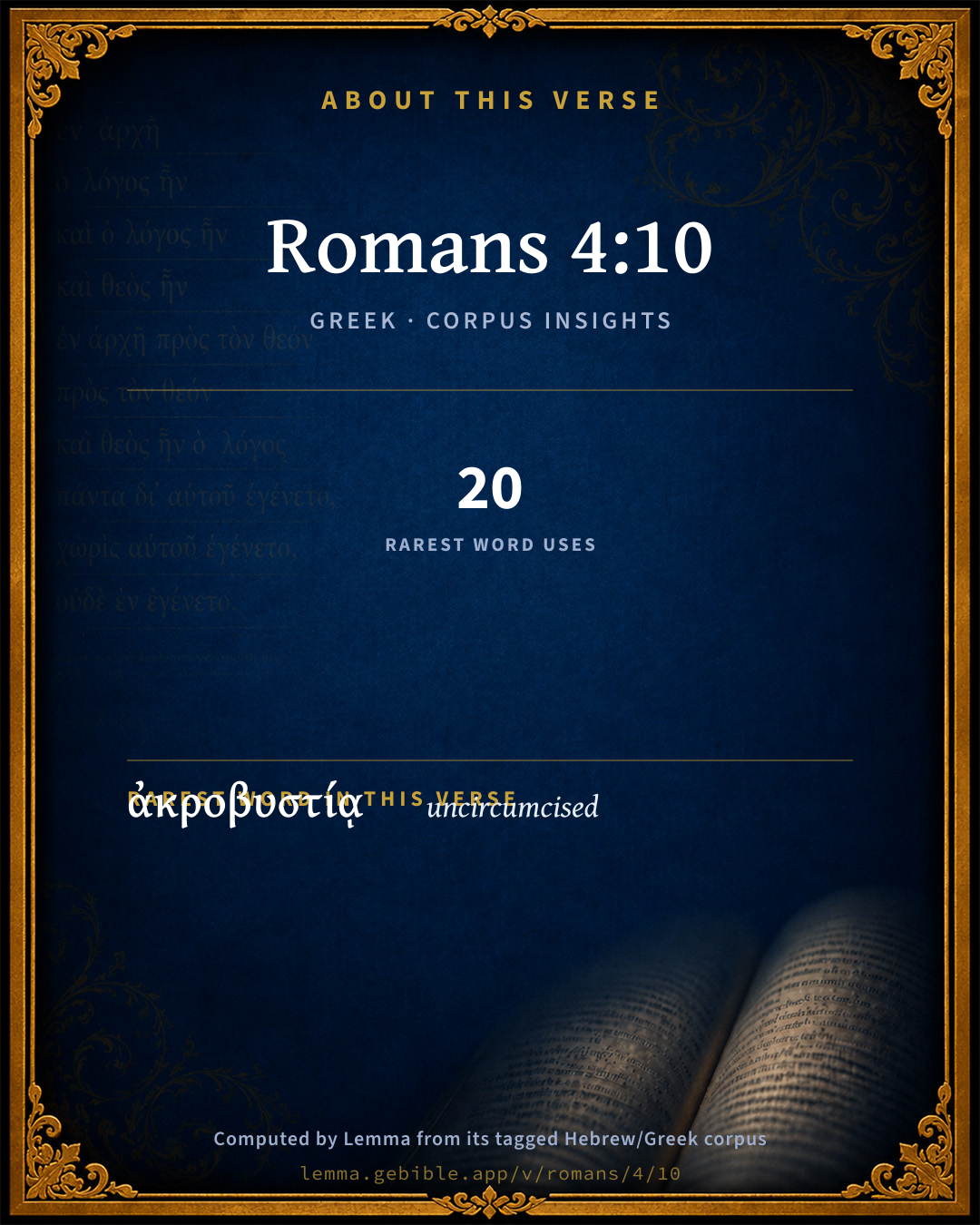
The rarest word here is ἀκροβυστίᾳ uncircumcised G203 — appearing just 20 times in the whole Greek New Testament.

Shared distinctive vocabulary

ἀκροβυστίᾳ uncircumcised G203 occurs in 17 verses of the Greek New Testament. Also found in:

Repetition

Words recur within this verse:

  • περιτομῇ circumcised G4061 ×2
  • ἀκροβυστίᾳ uncircumcised G203 ×2
  • ἐν in G1722 ×4

Cross-references

9

Topical passages linked to Romans 4:10 in the Treasury of Scripture Knowledge — connected by theme and wording, ordered by reader-vote popularity; previews shown in the World English Bible.

  • Galatians 6:15 For in Christ Jesus neither is circumcision anything, nor uncircumcision, but a new creation.
  • Galatians 5:6 For in Christ Jesus neither circumcision amounts to anything, nor uncircumcision, but faith working through love.
  • Genesis 15:5–6 Yahweh brought him outside, and said, "Look now toward the sky, and count the stars, if you are able to count them." He said to Abram, "So shall your seed be."
  • Genesis 15:16 In the fourth generation they will come here again, for the iniquity of the Amorite is not yet full."
  • Genesis 16:1–3 Now Sarai, Abram's wife, bore him no children. She had a handmaid, an Egyptian, whose name was Hagar.
  • Genesis 17:1 When Abram was ninety-nine years old, Yahweh appeared to Abram, and said to him, "I am God Almighty. Walk before me, and be blameless.
  • Genesis 17:10 This is my covenant, which you shall keep, between me and you and your seed after you. Every male among you shall be circumcised.
  • Genesis 17:23–27 Abraham took Ishmael his son, all who were born in his house, and all who were bought with his money; every male among the men of Abraham's house, and circumcised the flesh of their foreskin in the same day, as God had said to him.
  • 1 Corinthians 7:18–19 Was anyone called having been circumcised? Let him not become uncircumcised. Has anyone been called in uncircumcision? Let him not be circumcised.

Cross-references courtesy of OpenBible.info (CC BY 4.0).

Commentary

Notes on Romans 4:10 from classic Christian and Jewish commentators (each source and its license shown beneath its notes). The classic Christian expositions comment on the surrounding passage and are grouped to its opening verse, so a note may address several verses; the Jewish commentaries on the Tanakh (Rashi and others) are per-verse, so they appear only where the commentator wrote on this verse.

Lemma curates 59 commentaries, every one of them public domain or Creative Commons licensed, each selected and text-cleaned for this edition rather than reprinted as found. About our sources →

Tyndale Open Study Notes

Tyndale Open Resources

4:10 God accepted Abraham before he was circumcised! Paul’s point is simple: God’s declaration of Abraham’s righteousness in Gen 15:6 could not have been based on his circumcision, which happened later (Gen 17). This point further demonstrates that God’s acceptance and blessing is a free gift and not earned by works.

Tyndale Open Study Notes — © Tyndale Open Resources, licensed CC BY-SA 4.0. Text via the HelloAO Bible API.

Bengel's Gnomon

Johann Albrecht Bengel

Rom 4:10. Πῶς, how) This word implies more than when.—ὀυκ ἐν περιτομῇ, not in circumcision) For justification is described, Genesis 15; circumcision, Genesis 17.

Bengel's Gnomon of the New Testament — English translation (T&T Clark, Edinburgh, 1860) — public domain. Text from a community e-Sword module.

Expositor's Greek Testament

ed. W. Robertson Nicoll

Rom 4:10 . πῶς οὖν ἐλογίσθη ; To say that his faith was reckoned as righteousness, without mentioning circumcision, suggests that the latter was at least not indispensable; still it is not decisive, and so the further question must be asked, How i.e. , under what conditions was his faith thus reckoned to him? Was it when he was circumcised or when he was uncircumcised? History enables Paul to answer, Not when he was circumcised, but when he was uncircumcised. Abraham’s justification is narrated in Gen 15 , his circumcision not till Gen 17 , some fourteen years later: hence it was not his circumcision on which he depended for acceptance with God.

The Expositor's Greek Testament, edited by W. Robertson Nicoll (1897–1910) — public domain. Text from a community e-Sword module.

Hodge's Commentary on Romans, Ephesians & First Corinthians

Charles Hodge

Rom_4:10

How was it then reckoned? When he was in circumcision or uncircumcision? Not in circumcision, but in uncircumcision. Of course, his circumcision, which was long subsequent to his justification, could not be either the ground or necessary condition of his acceptance with God.

Charles Hodge — Commentary on Romans (1835), First Corinthians (1857), and Ephesians (1856) — public domain. Text from a community e-Sword module.

Geneva Bible (1599)

Geneva Bible translators

He proveth that it belongeth to the uncircumcised (for there was no doubt of the circumcised) in this sort: Abraham was justified in uncircumcision, therefore this justification belongeth also to the uncircumcised. Nay, it does not appertain to the circumcised in respect of the circumcision, much less are the uncircumcised shut out for their uncircumcision.

Geneva Bible (1599) marginal notes — public domain. Text via Bolls.life.

Adam Clarke's Commentary

Verse 10. How was it then reckoned?] In what circumstances was Abraham when this blessing was bestowed upon him? When he was circumcised, or before?

Not in circumcision, but in uncircumcision.] Faith was reckoned to Abraham for justification, as we read Ge 15:6, (where see the note;) but circumcision was not instituted till about fourteen or fifteen years after, Ge 17:1, c. for faith was reckoned to Abraham for righteousness or justification at least one year before Ishmael was born; compare Gen. 15, and 16. At Ishmael's birth he was eighty-six years of age, Ge 16:16; and, at the institution of circumcision, Ishmael was thirteen, and Abraham ninety-nine years old. See Ge 17:24, Ge 17:25; and see Dr. Taylor.

Adam Clarke's Commentary on the Bible (1810–1826) — public domain. Text from a community e-Sword/MySword module.

The Cambridge Bible for Schools and Colleges

gen. ed. J. J. S. Perowne

10. Not in circumcision] Genesis 15 precedes Genesis 17 by at least fourteen years.

The Cambridge Bible for Schools and Colleges (gen. ed. J. J. S. Perowne; Cambridge University Press, 1878–1918) — public domain. Text from a community e-Sword module.

John Gill's Exposition

And he received the sign of circumcision,.... Or "the sign circumcision", as the Syriac version reads it, and so the Alexandrian copy, and two of Stephens's; that is, Abraham received at the hands of God, the commandment of circumcision, which was a "sign" or token of the covenant; not of grace, but of that peculiar covenant God made with Abraham and his natural seed, concerning their enjoyment of the land of Canaan; and which was a distinctive sign or badge, which distinguished the posterity of Abraham from other people, and was also a typical one; not of baptism, for circumcision was peculiar to Abraham's natural seed, whereas baptism is not, but was administered to Gentiles as well as Jews; circumcision was confined to males only, not so baptism; circumcision bears no likeness to, nor any resemblance with baptism, whereas there is always some likeness and agreement between the type and the antitype; besides, if this had been the case, circumcision would have ceased when baptism took place, whereas it is certain it did not, but continued in full force with the rest of the ceremonies until the death of Christ; and it is as certain, that "baptism" was administered and continued to be administered three or four years before that time; which fully demonstrates the falsehood of that assertion, that baptism succeeds or comes in the room of circumcision; whereas baptism was in full force before circumcision was out of date: but circumcision was a typical sign of Christ, as all the ceremonies of the law were, and of the shedding of his blood, to cleanse from all sin, original and actual, and also of the circumcision of the heart. And was, moreover,

a seal of the righteousness of faith; or which "sign" was "a seal"; and so it signifies the same as before; "signs, so they call seals", says Harpocratian (f), and "to be signed", he says, is used, "instead of being sealed": or it may be expressive of something else, as that circumcision was a seal, not for secrecy, but for certainty; it being a confirmation, not merely of the sincerity of Abraham's faith, but of his justifying righteousness, which was not his faith, but that which his faith looked to; and

which he had, both faith and righteousness,

yet being uncircumcised: whence it follows, that he was not justified by his circumcision, but by a righteousness which he had before he was circumcised, or otherwise his circumcision could not have been a seal of it: though this clause, "which he had, yet being uncircumcised", may be rendered, "which should be in the uncircumcision", that is, in the uncircumcised Gentiles; and the sense be, that circumcision was a seal to Abraham, and gave assurance to him that he should be the father of many nations in a spiritual sense; and that the righteousness of faith which he had, should also come upon, and be imputed to the uncircumcised Gentiles; and accordingly it may be observed, that this seal was continued in full force on his natural seed, until this promise began to take place, and then it was abolished: this seal was broken off when the middle wall of partition was broken down, and the word of righteousness and faith, or the Gospel preaching justification by the righteousness of Christ, was ordered to be published to the Gentile world. It may be inquired whether circumcision being called a seal, will prove that baptism is a seal of the covenant? I answer, that circumcision was only a seal to Abraham of a peculiar covenant made with him, and of a particular promise made to him, and was it to be admitted a seal of the covenant of grace, it will not prove baptism to be such; since, as has been observed, baptism does not succeed it in place, in time, and use; and could this be allowed that it succeeds it, and is a seal of the righteousness of faith, as that was, it can only be a seal to them that have both faith and righteousness, and not to them that have neither; it would only at most be a seal to believers. But, alas! not ordinances, but other things more valuable than they, are the seals of the covenant, and of believers; the blood of Christ is the seal, and the only seal of the covenant of grace, by which its promises and blessings are ratified and confirmed; and the Holy Spirit is the only earnest, pledge, seal, and sealer of the saints, until the day of redemption. The apostle uses the word "seal" concerning circumcision, it being a word his countrymen made use of when they spoke of it, thus paraphrasing on Sol 3:8; they say (g),

"everyone of them was sealed, , "with the seal of circumcision" upon their flesh, as Abraham was sealed in his flesh:''

that he might be the father of all them that believe, though they be not circumcised; that is, his circumcision was a seal unto him that he should be so, which explains and confirms the sense of the former clause; not a father of the uncircumcised Gentiles by natural generation, for so he was only the father of the Jews, but of them as they were believers; and not so called because he was the author of their faith, but because they have the same sort of faith he had:

that righteousness might be imputed to them also; not Abraham's faith and righteousness, nor their own, but the righteousness of Christ received by faith, which is unto all, and upon all them that believe, without any difference of Jew or Gentile. Now when the apostle styles Abraham the father of "all" believers, even of uncircumcised ones, he says no other than what the Jews frequently own. Says one (h) of them, speaking of the Ishmaelites;

"they are the seed of Abraham, who was , "the head of them that believe?"''

and says (i) another,

"Hagar might bring the firstfruits, and read, as it is said to Abraham, "a father of, many nations have I made thee", Gen 17:5; for he is , "the father of the whole world", who enter under the wings of the Shekinah;''

and says the same writer elsewhere (k), having mentioned the above passage,

"they said in times past, thou wast the father of the Syrians, but now thou art "the father of the whole world"; wherefore every stranger may say this, "as thou hast sworn to our fathers", Mic 7:20; for Abraham was "the father of the whole world"; seeing, , "he has taught the true faith".''

The apostle reasons on what they themselves allow, to prove that the blessedness of justification comes not only upon the Jews, but upon the Gentiles also.

(f) Lexicon in Decem Rhetores, p. 266. Ed. Manssac. (g) Targum in Cant. 3. 8. (h) In Caphtor, fol. 121. 1. (i) Maimon. Hilchot Biccurim, c. 4. sect. 3. (k) Comment in Misn. Biccurim, c. 1. sect. 4. Vid. T. Hieros Biccurim, fol. 64. 1. & T. Bab. Beracot, fol. 13. 1. & Zohar in Gen. fol. 69. 3.

John Gill's Exposition of the Whole Bible (1746–1763) — public domain (CC PDM 1.0). Text via the HelloAO Bible API.

Trapp's Complete Commentary

John Trapp

10 How was it then reckoned? when he was in circumcision, or in uncircumcision? Not in circumcision, but in uncircumcision.

Ver. 10. In, circumcision] As the Jew would have it. No such matter.

John Trapp, A Commentary or Exposition upon All the Books of the Old and New Testament (1647–1656) — public domain. Text from a community e-Sword module.

Albert Barnes' Notes on the Bible

How - In what circumstances, or time.

When he was in circumcision ... - Before or after he was circumcised? This was the very point of the inquiry. For if he was justified by faith after he was circumcised, the Jew might pretend that it was in virtue of his circumcision; that even his faith was acceptable, because he was circumcised. But if it was before he was circumcised, this plea could not be set up; and the argument of the apostle was confirmed by the case of Abraham, the great father and model of the Jewish people, that circumcision and the deeds of the Law did not conduce to justification; and that as Abraham was justified without those works, so might others be, and the pagan, therefore, might be admitted to similar privileges.

Not in circumcision - Not being circumcised, or after he was circumcised, but before. This was the record in the case; Gen 15:6; Compare Gen 17:10.

Albert Barnes' Notes on the Bible (1834–1885) — public domain. Text from a community e-Sword/MySword module.

Haydock's Catholic Bible Commentary

In effect, Abraham received circumcision a year only before the birth of Isaac; whereas he had received the promises and justification more than 25 years before, when the Almighty caused him to depart from Mesopotamia. (Calmet) --- Therefore he was justified by faith and grace, which is common both to the circumcised and uncircumcised. (Menochius)

George Leo Haydock (1774–1849), Haydock's Catholic Family Bible and Commentary, 1859 edition — public domain. Excludes Psalms (Douay-Rheims chapter numbering differs from Protestant) and Deuterocanonical books (Catholic canon only).

Matthew Poole's English Annotations

And if this be the question, the way to resolve it, is, to consider in what circumstances Abraham was when his faith was thus reckoned to him for righteousness; it was a long time before he was circumcised. The promise to which Abraham’s faith had respect, was made to him fourteen years, at least, before his circumcision: compare Gen 15:2, and Gen 17:24,25; also see Gen 16:16. If the blessedness, therefore, of justification was not annexed to circumcision, the Gentiles are no less capable of it than the Jews.

Matthew Poole's English Annotations on the Holy Bible (1683–1685) — public domain. Text from a community e-Sword/MySword module.

Whedon's Commentary on the Bible

Daniel D. Whedon

10. How… reckoned—The apostle puts this point in full dialogue (a dialogue which had, doubtless, often occurred between him and the Jews) in order to give it the emphasis due to its importance. All the blessedness over which David exults may come by faith to the uncircumcised.

Daniel D. Whedon (gen. ed.), Commentary on the Old and New Testaments (1874–1909) — public domain. Text from a community e-Sword module.

John Wesley's Explanatory Notes

Not in circumcision - Not after he was circumcised; for he was justified before Ishmael was born, Gen. xv, 1-21; but he was not circumcised till Ishmael was thirteen years old, Gen. xvii, 25.

John Wesley, Explanatory Notes Upon the Whole Bible (1754–1765) — public domain. Text via the GEBible commentary corpus.

Godbey's Commentary on the New Testament

William B. Godbey

10. “How then was it imputed? to him being in circumcision or in uncircumcision? Not in circumcision, but in uncircumcision.” This is a continued evolution of this wonderful and unanswerable Pauline argument, actually the most prolix in all the Bible, confirmatory of justification full and free for all the world by the free grace of God in Christ, received and appropriated by faith alone, without work of law. The very fact that this took place in the case of Abraham twenty four years before the organization of the visible church in his house, teaches us a grand and impressive lesson; i. e., that God in His infallible administration, by putting twenty-four years between the two transactions, forever annihilates the possibility of their identification by sensible, honest people. What an awful job the devil has on his hands to prove the essentiality of water baptism or any other church ordinance to justification, when Abraham, God’s paragon saint and the representative of every other, was justified by the free grace of God in Christ twenty-four years before he received a church ordinance! I know there is a disposition on the part of many superficial, bogus theologians flippantly to pass over the Abrahamic covenant. This is wholesale murder, because Abraham had no covenant, but was simply the recipient of the renovation of the Messianic covenant by which the world is redeemed. Hence the Scriptures positively identify the Abrahamic with the Mediatorial covenant. Then, if you are not justified like Abraham, becoming one of his legitimate spiritual posterity, you have no interest in Christ (Gal 3:25). Mark this long quotation from the Psalms of David, descriptive of God’s “blessed man,” whose sins are covered, and to whom he does not impute iniquity. If it turns out that you are not that “blessed man,” the devil gets you to an absolute certainty, whether in the pulpit, the pew or the world. Now you see clearly how Paul identifies this “blessed man” with the Abrahamic covenant, because he is justified by faith alone, without works, like father Abraham, who actually got converted twenty-four years before he was baptized. Do not forget the inspired epithet, “blessed,” which God applies to the man who, like Abraham, is justified by faith without legal obedience. “Blessed” literally means “happy.” You take the poor legalists, all round, and you find anything but a happy people. They are blue as indigo. It is a regular long-faced Christianity — Satan’s counterfeit. Take the people who have nothing but Jesus and depend on nothing but God, and you will find “happy” pilgrims every time. That is the reason why Satan’s legalistic church members can not keep away from theaters, dances, card tables, circuses, horse races and saloons. It is because they have no happiness in their religion. Hence they have to go to the devil for joy to keep them from dying of the blues. There is nothing in the Abrahamic covenant but Jesus. Hence the children of father Abraham are a jolly set.

William B. Godbey, Commentary on the New Testament (1896–1900) — public domain. Text from a community e-Sword module.

McGarvey & Pendleton's Commentaries

J. W. McGarvey

How then was it reckoned? when he was in circumcision, or in uncircumcision? Not in circumcision, but in uncircumcision [Do the words of David apply only to the Jews, the circumcised, or do they likewise apply also to the Gentiles, the uncircumcised? Surely they apply to the uncircumcised, for they describe the blessing which Abraham enjoyed before his circumcision. Of what use, then, was circumcision, and why did Abraham receive it?]:

J. W. McGarvey (with Philip Y. Pendleton), Commentaries on the New Testament (The Fourfold Gospel, 1914; Acts; and the epistles) — public domain. Text from a community e-Sword/MySword module.

The People's New Testament

B. W. Johnson

10. How was it then reckoned? To settle the question, whether this blessedness applies to Gentiles as well as Jews, the inquiry is made whether Abraham was a Jew or Gentile when it was said of him, “His faith was counted for righteousness.” He was not circumcised for at least fourteen years after this statement was made of him. Compare Gen. 15:6 with Gen. 17:25. He was then justified, without circumcision, while yet a Gentile.

B. W. Johnson's The People's New Testament with Notes (1889–1891) — public domain. Electronic text from the Christian Classics Ethereal Library (CCEL) ThML edition.

Cambridge Greek Testament for Schools and Colleges

10. ἐν περιτομῇ. The true place of περιτομή in the history of GOD’s dealings with man: it was a sign (Rom 4:4) of a state already existing and due to GOD’s free gift.

Cambridge Greek Testament for Schools and Colleges (Cambridge University Press, 1896; 21 vols, various authors incl. Carr, Maclear, Plummer, Farrar, Lumby, Moule, M. R. James, Simcox) — public domain. Text from a community e-Sword module.

Alford’s Greek Testament

Henry Alford

10.] πῶς, under what circumstances? The interval between the recognition of his faith (Gen 15:6) and his circumcision, was perhaps as much as twenty-five, certainly not less (Gen 17:25) than fourteen years.

Henry Alford, The Greek Testament (1849–1861) — public domain. Text from a community e-Sword module.

International Critical Commentary

10. St. Paul appeals to the historic fact that the Divine recognition of Abraham’s faith came in order of time before his circumcision: the one recorded in Gen 15:6, the other in Gen 17:10ff. Therefore although it might be (and was) confirmed by circumcision, it could not be due to it or conditioned by it.

International Critical Commentary — older volumes (1896–1929), various authors — public domain. Text from a community e-Sword module.

Lesson kit

Teaching starters — assembled from the data on this page, not authored interpretation. Every prompt links to the verse data it draws on. Edit before teaching.

Romans, in the Pauline Epistles, opens this verse with 15 words (10 distinct Greek lemmas). Its most distinctive word is akrobystía (“uncircumcised”). A historical commentator’s framing appears above. Read the whole chapter for the surrounding context.

Discussion questions

  1. How does “uncircumcised” (akrobystía) shape what this verse is saying?
  2. How does Acts 11:3, which shares the word «uncircumcised», read alongside this verse?
  3. What does the repetition of “circumcised” (2× in this one verse) do in this verse?
  4. These translations render this verse differently. What is at stake in choosing one wording over another?
  5. Compare how Tyndale Open Study Notes and Bengel's Gnomon read this verse. Where do they agree or differ?

Things to notice

  • These translations choose different wording for 5 words in this verse.
  • “circumcised” occurs 2× in this single verse.
  • 10 distinct Greek lemmas span 15 words in this verse.

Reading settings

Reading text

Shown beneath each verse's original-language words.

Old Testament
Old Testament edition

Read the OT as the Masoretic Hebrew (MT) or the Greek Septuagint (LXX).

English shown for the Greek Septuagint (in the Hebrew ↔ Greek comparison).

Comparing translations? Open the Compare panel on any verse page to stack up to four side by side.